Information sharing within the procurement process is considered crucial since most procurement activities and task performance are largely contingent on achieving organizational goals. With the advent of technology and the inadequacy of it, information sharing has become a struggle in most developing nations. Hence, this study aims to investigate the impact of information sharing and management commitment on procurement performance within public procurement organizations.
Predicated on a comprehensive review of pertinent and extant literature, a pilot survey, questionnaire was administered to 150 procurement officers in various organizations directly involved in Ghana’s procurement supply chain. Using the resource-based theory, an examination of the roles of information sharing and management commitment on procurement performance in procurement companies; three (3) constructs were tested using a partial least square structural equation modeling approach.
The results revealed that information sharing and management commitment are key to improving procurement performance. This result suggests that management and policymakers should ensure that information shared in line with procurement dealings is well protected since major decisions are relied on to improve procurement performance.
The insight given in understanding the extent and nature of the influence of information sharing and management commitment on procurement performance in public organizations should inform actions and efforts to improve the procurement supply chain, particularly in the Ghanaian landscape.
The findings of the study indicate that the procurement performance of a firm is shaped by the extent of information sharing within the firm’s procurement chain. Hence, firms need to focus on timely, accurate and quality information sharing pertaining to the procurement processes, decisions and management to engender the required performance of procurement tasks and functions.
Introduction
Information sharing among procurement officers and management commitment have been regarded as critical factors influencing public procurement’s success and performance in modern business organizations (Cooper et al., 2017). As a result, public organizations are finding ways to adapt to the changing and competitive environment and improve procurement performance through adequate information sharing among all stakeholders in the procurement process (Basingstoke and Deane, 2018). Procurement performance cannot be archived in a vacuum. Kankam et al. (2023) explicitly argued that the management of organizations continues to explore and offer assurance of adequate financial support and dedication required to oversee the entire procurement process and develop channels for proper communication and information exchange.
Cooper et al. (2017) described information sharing as the regular and frequent communication and updating of information among the procurement supply chain participants and processes to improve procurement performance outcomes. The current business world has become extremely dynamic and unpredictable. As such, public organizations in procurement task functions and activities must access and deliver the appropriate information to stakeholders in the procurement process on time to engender success. In addition, information sharing is essential for effective procurement performance. Hence, public procurement organizations must adapt the channels to deliver and receive information accurately. The dogma remains that ineffective information-sharing channels can result in inaccurate information that can result in misunderstanding among procurement process participants, thus, negatively impacting procurement performance (Kankam et al., 2023). Oyuke and Shale (2014) also identified management’s commitment to play a crucial function in enhancing the procurement performance of businesses. It is presumed that the procurement performance of public organizations relies on the firms’ capacity to support procurement operations (Oyuke and Shale, 2014). Kemunto and Ngugi (2014) identified policies governing the procurement process and budgetary allocations supporting the procurement process as the forms of management’s commitment to procurement processes (Kemunto and Ngugi, 2014). This demonstrates that procurement as a function within public organizations requires management commitment to managing the organization’s application of the procurement laws, regulations and policies. This has become a guiding principle by which most management direct the stakeholders in the procurement process to enhance procurement performance. The organizational management’s commitment to providing financial support for various procurement processes and activities also contributes to effective procurement performance (Chari et al., 2016). This demonstrates that management must provide adequate financial and human resources within the organization to aid the smooth operation of the procurement processes. From the preceding explanation, it can be inferred that senior management plays a crucial role in firms’ procurement activities. According to Amayi and Ngugi (2017), there is a direct correlation between management commitment support and procurement performance. As evidence, the ability of top management to guarantee effective delivery and operationalization of procurement activities tends to directly influence procurement performance (Oyuke and Shale, 2014).
However, prior research has indicated that management commitment to procurement performance has a negative aspect. This suggests that the attitude and conduct of top management pursuing their self-interest at the expense of the procurement’s overall objective can negatively affect performance. Albeit from extant literature, there is evidence of inconsistencies with various results. Predicated on the results of previous studies, there appears to be an apparent knowledge gap regarding the nature and extent of the impact of information sharing and management commitment on procurement performance. Against this background, this study has been conducted to assess the nature and extent of the influence of information sharing and management commitment on procurement performance. This knowledge can be useful in improving information sharing strategies and shaping management commitment in procurement processes and performance in public organizations.
Theoretical background
From several studies on the subject area, Nasiri et al. (2020) and Ardito et al. (2020) demonstrated that information sharing can improve procurement performance. Somjai and Jermsittiparsert (2019) studied information sharing and procurement performance in Thailand and discovered that information sharing directly affects procurement performance. Similarly, Alicia et al. (2019) explored how information sharing affects procurement performance and foresaw that information sharing can impact a company’s purchases. The works of Benitez et al. (2018), Truong et al. (2017) and Ozduran and Tanova (2017) corroborated the influences of information sharing on the procurement functioning of organizations. However, from these numerous studies, there is an apparent paucity of understanding of the nature and extent of the effects of information sharing on procurement performance in their related organizations, processes and task functions. This position is shared by Ohana and Meyer (2016).
Subsequently, Cai et al. (2016) found managerial commitment to significantly affect procurement performance. Ivandianto and Tarigan (2020) indicated that senior management support strongly affects procurement performance in Indonesia. In Chari et al. (2016), it was found that management commitment can sustain growth and procurement performance in homogenous organizations. Kemunto and Ngugi (2014) and Amemba et al. (2013) observed that management commitment can significantly impact procurement performance in project organizations.
Consequently, Kembro et al. (2017) empirically linked information sharing and management commitment. The findings showed a strong link between management commitment and information sharing. This was also shared by Suárez (2016), which affirmed that information sharing, and management commitment have a positive relationship when managed effectively. This indicates that information sharing affects management commitment.
Despite the enormous contributions to the subject from the above literature synthesis, there is yet to be any significant study that explores the linkages among all three dimensions (information sharing, management commitment and procurement performance). The summary of the indicative measures of the three constructs of information sharing, management commitment and procurement performance are found in Table 1. This study examines the nature and extent of the effect of information sharing and managerial commitment on the procurement performance of public organizations. It is expected that this knowledge is crucial in improving procurement activities.
Development of the hypothesis
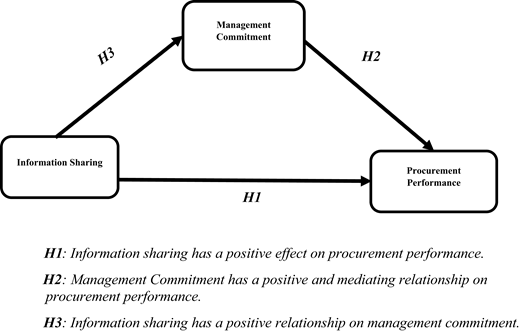
The success and long-term viability of government operations rely heavily on the performance of public procurement. Several factors have been found to contribute to procurement performance, with information sharing and management dedication considered critical among them. Wan Abdullah et al. (2022) postulated that the level of information sharing and management commitment within public procurement companies directly impacts procurement performance. Public procurement companies can achieve greater activity coordination, enhanced decision-making processes and cost savings through effective and efficient information sharing. Moreover, when management is committed to the procurement process and actively oversees and guides its implementation, companies can benefit from increased accountability, enhanced performance and greater success in achieving procurement objectives (Preda, 2019). Therefore, it can definitively be asserted that a relationship exists between information sharing and management’s commitment to procurement task functions. These elements play pivotal roles in ensuring the success of operations in public procurement companies, as demonstrated in Figure 1 (Sanda et al., 2020).
It is quite evident from the literature review that there is a need for empirical investigation of information sharing and procurement performance. There is considerable work on procurement performance but expect a theoretical argument that information sharing directly impacts procurement performance (Somjai and Jermsittiparsert, 2019). Scholars have highlighted the need for empirical investigation in the context of information sharing and procurement performance (Ozduran and Tanova, 2017; Ohana and Meyer, 2016; Chari et al., 2016).
On the other hand, management commitment affects an organization’s procurement performance (Chari et al., 2016). Therefore, an organization’s procurement performance is affected by the activities of top management concerning procurement operations (Kemunto and Ngugi, 2014). Based on this, top management support directly affects procurement performance (Ivandianto and Tarigan, 2020). Truong et al. (2017) also concurred that top management commitment is directly linked with procurement performance; hence, the hypothesis formulated.
Jin Lin et al. (2015) noted that procurement is a critical aspect for businesses for acquiring goods and services from external sources. Effective information sharing is essential in procurement organizations to enhance transparency, accountability and overall performance (Zhao et al., 2014). Recent studies have shown that information sharing has a positive relationship with both organizational commitment and performance commitment in procurement companies (Vluggen et al., 2019). Thus, drawing from the above and Figure 1, the following hypotheses were formulated:
Information sharing has a positive effect on procurement performance.
Management commitment has a positive and mediating relationship on procurement performance.
Information sharing has a positive relationship on management commitment.
Research methodology
A deductive research approach using a quantitative questionnaire survey was adopted for this study. This first comprised a literature review and a self-administered survey. Based on the formulated hypothesis, a questionnaire was developed based on variables identified in Table 1 for a survey to assess the role of information sharing and management commitment on procurement performance in public procurement organizations and companies in Ghana. The questionnaire developed was piloted among (5) procurement professionals to validate the variable derived from the literature review. These professionals were chosen for their expertise in procurement activities, with selection criteria including professional qualifications, a minimum of 15 years of experience in the industry and a background in public sectors, particularly in procurement. In addition, these professionals were granted the authority to modify or supplement variables as needed. A configured closed-ended questionnaire was developed leveraging on a five-point Likert scale from (1) Strongly disagree to (5) Strongly Agree. These questionnaires were administered online and self-administered to Public Procurement professionals within public procurement units and built environment professionals in procurement supply chains in Ghana.
The research population comprised public companies and organizations registered with the Public Procurement Authority, Ghana and Ghana Enterprise Agencies (Ghana Enterprise Agency, 2021). Using a simple random sampling technique through the rule of thumb in determining the partial least square structural equation modeling (PLS-SEM) appropriate sample size, Hair et al. (2014) proposed a guideline stating that the sample size for a structural model in SEM should ideally be ten times the largest number of formative indicators used to measure a construct or ten times the number of structural paths directed to a specific construct. Despite this, Hair et al. (2016) suggested that the sample size should ideally range from five to ten times the number of indicators or variable items. Consequently, the chosen sample size for the study was set at 150. The data collection phase spanned one month to ensure that participants had completed enough to be used for data analysis. Through persistent follow-ups and reminders, 99 completed questionnaires were obtained out of the 150 distributed, resulting in a response rate of 66%. Subsequent examinations confirmed the validity and consistency of the responses. There was no missing data from these professionals, ensuring that the data set used for the study was complete and comprehensive.
According to Biddle (2006) and Aghimien et al. (2021), SEM is a well-established statistical method for testing models. SEM offers notable advantages, allowing researchers to simultaneously assess multiple hypothesized relationships, gauge model fit with actual data and explore alternative models (Bolino et al., 2006; Adekunle et al., 2024; Ebekozien et al., 2022). In addition, SEM facilitates the integration of two model-testing techniques: multiple regression analysis and factor analysis. While regression analysis delves into the relationship between a criterion variable and its predictor variables, factor analysis identifies latent variables (i.e. factors) that explain the shared variance among a set of observed variables. Factor analysis is frequently used to reveal the inherent factor structure in the scores obtained from questionnaire items (Hair et al., 2014; Ikuabe et al., 2024; Ibrahim et al., 2024). In the realm of SEM, two prominent methods are used: variance-based partial least squares and covariance-based techniques (Al-Emran et al., 2019; Hair et al., 2011). Consequently, SEM-PLS emerges as a fitting methodology for this investigation. The current study meticulously examined both the measurement model (assessing validity and reliability) and the structural model (scrutinizing the relationship between variables). To achieve this, Smart PLS Version 4.0.9.2 was used.
Findings
Demographics of the study
The demographic characteristics of respondents significantly impact enhancing problem-solving and addressing specific industrial challenges (Wahab and Othman, 2021; Wahab and Tajuddin, 2019). The respondents’ demographic information is derived from procurement officers and other professionals within the procurement supply chain. From the background of respondents, their experience and educational profiles were considered. Kotur and Anbazhagan (2014) stated that work experience and education affect performance. Hegarty et al. (2011) agreed that academic qualifications can increase professional and organizational development of knowledge. These factors shape a person’s skills, knowledge and talents, which impact their professional performance. Workers with above 10 years of working experience might have much knowledge and understanding of procurement processes and performance. These participants were well-versed in procurement strategies and processes, such as e-auctions, negotiations and procure-to-pay, indicating a deep understanding of procurement gained through extensive experience (Manyathi et al., 2021). Table 2 shows the descriptive analysis of the respondents’ background characteristics. In terms of work experience, 17.2% had up to 1–5 years of experience in the procurement supply chain, 40.4% had 6–10 years of working experience and 42.5% had more than 10 years of work experience. In the case of the respondents’ educational backgrounds, 1.0% had obtained a diploma certificate, 51.5% had a bachelor’s degree and 47.5% had a master’s degree.
Model assessment
The survey data underwent statistical analysis using the PLS-SEM methodology. The PLS-SEM analysis adhered to the recommended guidelines by Hair et al. (2014), comprising the assessment of the reflective measurement model and the structural model. The reflective measurement model evaluation encompassed internal reliability, validity and average variance extracted (AVE). The structural model assessment involved examining the coefficient of determination (R2), cross-validated redundancy (Q2) and path coefficients (Hair et al., 2014). The subsequent section presents the evaluation of the relationship.
Reflective measurement model assessment
To validate the measurement model of the hypothetical model, the study examined the reliability, convergent validity and discriminant validity based on guidelines from Hair et al. (2016). Cronbach’s alpha, composite reliability and AVE were used to assess the internal consistency and reliability of the constructs. Factor loadings over 0.70 are recommended (Hair et al., 2014) (Table 3). After performing the outer loading test criterion and removing one indicator with a loading under 0.442, reliability was measured. Cronbach’s alpha provides an estimate of construct reliability through inter-item correlations, with suitable values ranging from 0.700–0.980 (Hair et al., 2011; Straub et al., 2004). The results, which fell between 0.948 and 0.954, verified reliability. Composite reliability and AVE were also computed to further support internal consistency assessment. Composite reliability values closer to one indicate higher reliability, with Hair et al. (2014) recommending scores above 0.700.
Regarding AVE, Hair et al. (2016) advised thresholds above 0.500 demonstrate adequate internal consistency. The AVE results varied from 0.618–0.708, while composite reliability was between 0.960 and 0.967, confirming satisfactory internal consistency and reliability levels based on these metrics.
Mediation analysis
The purpose of this analysis was to examine the cause-and-effect connection between an independent variable and a dependent variable, incorporating a third explanatory mediator variable into the investigation (Carrión et al., 2017). To achieve this, the analysis used the PLS-SEM bootstrapping approach. Bootstrapping was preferred due to its ability to handle small sample sizes and its lack of assumptions about the sampling distribution of the statistics (Hair et al., 2014). Mediation analysis was performed to assess the mediating role of management commitment (MC) in the relationship between information sharing and procurement performance. The results in Table 4 revealed a significant indirect effect of information sharing on procurement performance (beta value= −0.167; t-values = 2.219; p-value < 0.027). The total effect of information sharing on procurement performance was significant (beta value = 0.821; t-values = 12.024; p-value < 0.00), with the inclusion of a mediator, the effect of information sharing on procurement performance was still significant (beta value = 0.988; t-values = 10.744; p-value < 0.00). This shows management commitment’s contemporary partial mediating role in the relationship between information sharing and procurement performance.
Discriminant validity in the PLS-SEM model was evaluated using the Heterotrait–Monotrait (HTMT) ratio, as suggested by Henseler et al. (2015). Traditional approaches for assessing discriminant validity are known to have low sensitivity. Thus, an alternative criterion derived from the Multitrait–Multimethod (MTMM) matrix was used. The HTMT ratio analysis systematically assessed discriminant validity and helped establish construct validity in variance-based SEM models (Henseler et al., 2015). According to Henseler et al. (2015), acceptable levels of discriminant validity are below 0.90. From the results presented in Table 5, all HTMT ratios were less than 0.900, indicating sufficient discriminant validity for the study model.
Structural model assessment
The assessment of the structural model’s estimation plays a crucial role in gauging the level of support the empirical data provides for the hypothesis. As Hair et al. (2014) suggested, using the coefficient of determination (R2) and evaluating path coefficients are reliable methods for scrutinizing the Structural Conceptual relationship within a structural model. According to Hair et al. (2014), R2 values of 0.75, 0.50 and 0.25 indicate substantial, moderate or weak predictive accuracy, respectively. Table 6 shows an R-square value of 0.506 for management commitment and 0.714 for procurement performance, indicating that the regression model’s independent variables explained 50.6% of the variance in management commitment and 71.4% in procurement performance. The adjusted R-square for the dependent variables are 0.612 and 0.833, meaning the relationship may moderately explain the dependent variable of management commitment and procurement performance.
To conclude the hypothesis, evaluations were conducted on the path coefficients and significance levels. These figures were computed using the Smart-PLS software, using the bootstrapping technique. The bootstrapping procedure involved a sample size of 5,000, with a confidence level of 5% (α = 0.05; two-tailed test). Consequently, a t-values exceeding 1.96 indicates statistical significance or support for the hypothesis. Table 7 shows the overview of path coefficients and their corresponding significance levels.
Discussion
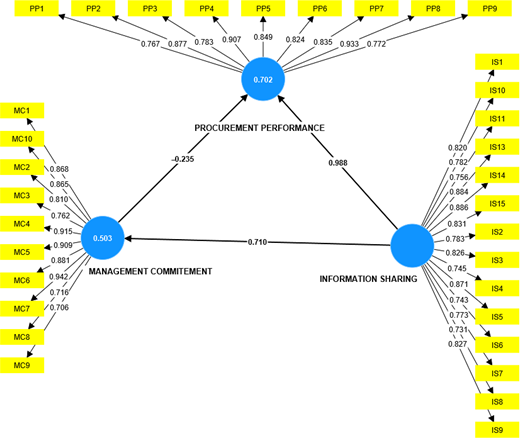
The result showed a significant direct correlation between information sharing and procurement performance (beta value = 0.988; t-values = 10.740; p-value < 0.00). The implication of this is that the impact of information sharing tends to be significant, especially in this recent technological era. This shows that the firm’s information sharing among the actors and parties in line with the procurement operations helped improve decision-making. The result conforms to the work by Somjai and Jermsittiparsert (2019), indicating that there is a direct linkage between firms’ information-sharing procurement performance. The result, buttressed with the work by Ozduran and Tanova (2017), indicates that procurement firms recognize the importance of information sharing in procurement activities and directly affects firms’ procurement performance. The resultant implication is that the firm’s timely, accurate, reliable and quality information sharing was executed in relation to sharing vital information among the actors in the procurement chain. Hence, the firm’s effective information sharing regarding sourcing, purchasing of materials, procurement financial transactions and negotiating for items helped transparency among the actors in the procurement chain. The implication is that firms were able to make effective decision-making based on the quality and credibility of the information that was shared, which improved procurement efficiency and competitiveness. The study result conforms to the work by Truong et al. (2017) and Suárez (2016), indicating that information sharing directly impacts procurement performance.
The findings showed that management commitment had significant direct relationship with firms’ procurement performance (beta value = −0.235; t-values = 2.290; p value = 0.036). The result confirmed the findings of Cai et al. (2016), Ivandianto and Tarigan (2020) and Chari et al. (2016), which indicated that there is a direct link between top management commitment and procurement performance. This implies that the top management ensured adequate budgetary allocations to support the firms’ procurement activities and operations. The implication is that the firms’ management commitment in terms of budgetary allocation helped them to procure all the needed materials, which helped improve procurement efficiency and competitiveness in the procurement industry. The result conforms to the work by Kemunto and Ngugi (2014), which established that firms’ top management support in the form of providing financial resources to ensure procurement implementation helped improve procurement efficiency and performance.
The study’s outcome (Figure 2) revealed that information sharing had a significant direct relationship with management commitment (Beta value = 0.710; t-values= 10.101; p-value = 0.00). The result of the study conforms to the work by Chen et al. (2008), which established that management commitment support was a major determinant of information sharing among procurement firms. Hence, the significant linkage between top management commitment and information sharing within the procurement function is explained by the fact that the management of the firms was committed. This ensured that the information sharing was timely, accurate, reliable and credible, which created a competitive advantage over other firms that possessed the actual information without knowing the wealth and benefits of sharing information accurately. In support of the result, Bhattacharjee et al. (2018) argued that commitment and support from management are essential in the management of any organization and are one of the key factors that interact with information sharing and a firm’s procurement performance. A study by Van Den Hooff and De Ridder (2004) revealed that management commitment is one of the most important variables in explaining employee information-sharing behavior.
Implication of the study
The study’s findings imply that firms reap significant gains in their procurement performance through effective information sharing and management commitment. Hence, the study found that information sharing directly affects procurement performance. This shows that a firm’s procurement performance is influenced by information sharing within the firm’s procurement chain. Therefore, firms need to focus on timely, accurate and quality information sharing pertaining to the procurement of materials, financial transactions, negotiation of items, sourcing and supplier selection, which could help procurement performance. Also, due to the significance of other factors, such as the top management commitment support that has been significant in other prior studies conducted in developed countries. This implies that procurement firms in developing countries must invest more in management commitment support. This will help enhance their effective and efficient monitoring of procurement operations, provide regular training programs to players within the procurement chain and provide resources that tend to result in more information sharing, improving procurement performance. The study result revealed that information sharing, and management commitment are considered to play a significant role in improving procurement performance. This result suggests that management and policymakers should ensure that information shared in line with procurement dealings is well protected since major decision-making is relied on to improve procurement performance. From a practical perspective, the implication of the study’s findings is that compliance with regulatory requirements of procurement mandates will be enhanced by information sharing. Furthermore, this would propel better decision-making and aid the mitigation of unwholesome occurrences such as supply chain disruptions.
Conclusion
The study revealed that there is a direct link between information sharing and firms’ procurement performance. Based on this, the study recommends that the management of the firms should develop an information-sharing framework that will be used to guide the sharing of information within and outside of the firms. This will help improve the credibility and quality of information sharing, leading to improved procurement performance. The study also revealed a direct linkage between management commitment and procurement performance. This shows that top management commitment is a significant key to improving procurement performance. Based on this, the study recommends that firms adopt the top management commitment concept and ideologies because it has a broad perspective that allows the top management to identify opportunities within the procurement chain that can be exploited and emulated by leaders and members. This is because the top management tends to provide appropriate strategies, policies and implementation plans concerning procurement activities, which tend to improve procurement performance. Finally, the study revealed that information sharing and management commitment significantly affected firms’ procurement performance. Based on this, the study recommends that since management commitment serves as a key influencer in information sharing, firms’ boards of directors should focus more on resourcing top management. This will help them ensure effective implementation and monitoring of procurement information sharing, leading to improved procurement performance.
The study’s sample size can be deemed to be small, which may impact the accuracy of generalizations and conclusions of the findings. Therefore, future research should increase the sample size and include other similar firms to increase the accuracy of the conclusions inherent in the findings. The study used a quantitative technique to collect data. Therefore, it is believed that future research should ensure the use of mixed methods that will allow the use of interviews as another medium to solicit different views on the subject matter, which will help shed more light on the topic. Finally, future research should consider comparative studies that could involve firms within the neighboring countries across the boundaries of Ghana. In this regard, the study will have a broader perspective and enlarge the scope of the study concerning the topic under discussion.