There is a rising concern about climate change and its impacts on the physical products of the construction industry. Studies concerning mitigating the impact of climate change on construction-related Sustainable Development Goals (SDGs) projects using a soft systems methodology (SSM) framework are scarce. This study aimed to investigate the root causes of climate change and developed an SSM-based framework to mitigate the negative impacts on construction-related SDG projects in Nigeria.
This research used a SSM to understand the impact of climate change on Nigeria’s construction-related SDG projects, using a developed framework. The researchers conducted 40 face-to-face interviews with experts aligned with the SSM stages. The researchers manually analysed the collected data and presented the results.
This study shows that, besides the signs of climate change’s negative impacts and the absence of an institutional framework, particularly during the rainy season, it threatens value-driven construction-SDGs projects. The research findings developed a framework to improve the carbon neutrality of construction-related SDG projects, enhance risk management associated with climate change, enhance infrastructure system resilience and sustainability, and improve general operations, thereby improving construction-related SDG projects.
As part of the research’s implications, this study proposed measures to mitigate the impacts of climate change on construction-related SDG projects. Findings will also encourage stakeholders to consider relevant mechanisms to meet construction-related SDG project requirements and ensure satisfaction, thereby enhancing productivity and excellence.
1. Introduction
The built environment is key to achieving most SDGs. In the past two centuries, greenhouse gas (GHG) emissions have contributed significantly to global climate change (Qiao, 2024). Ahmed et al. (2021) and Qiao (2024) affirmed that GHG emissions from energy use are the major contributors to climate change in the built environment. Yokoo et al. (2015) stated that the industry contributes 5–40% of GHG emissions in other countries and 16% within the European Union (Yokoo et al., 2015). Morecroft et al. (2019) and Khazeal et al. (2024) described climate change as a long-term shift in wind patterns, precipitation levels, temperature patterns and other attributes of the climate system. IPCC (2013) reported that unregulated human activities had caused an increase of 0.8–1.2°C above pre-industrial levels. Climate change encompasses. It includes melting ice cover, rising sea levels, extreme weather and changes in rainfall patterns. Ebekozien et al. (2024a) affirmed that unregulated construction activities could expose the environment to unfavourable consequences and could compound climate change challenges. The consequences include unduly upsetting vulnerable inhabitants, social inequalities and aggravating the current economic situation (Agboola et al., 2023). Ebekozien et al. (2024a) identified ecosystem loss, compromised biodiversity and the planet’s ecological balance, food security risks impacting humanity, water shortage, public health challenges and economic instability. These issues may threaten the achievement of Sustainable Development Goals (SDGs) in construction projects.
The 17 SDGs, as articulated in the 2030 Agenda, comprise 169 targets and 230 indicators (United Nations, 2022). Ebekozien et al. (2024a) identified SDGs (15, 11, 9, 7 and 6) as the main construction-related SDGs. This includes encouraging sustainable use of the ecosystem and mitigating desertification (SDG 15), developing sustainable cities and communities (SDG 11), building resilient and sustainable infrastructure (SDG 9), affordable and clean energy (SDG 7) and Pipe-borne water and sanitation (SDG 6) (UN, 2022). These Goals may influence others, such as SDGs 1, 2, 3 and 8. However, climate action (Goal 13) is critical to sustainable development. The UNDP (2015) emphasised the need to mitigate the impacts of climate change, including in construction-related SDGs projects. This is critical in built environment projects, as infrastructure resilience is essential to withstand the impacts of climate change. Acceptable planning to check unregulated activities from fossil fuel burning that emits GHG emissions, rising water levels, forest clearing, industrial procedures and agricultural methods via a framework may diminish climate change on construction-related SDG projects. This assertion may contribute to the reason for the Paris Agreement and the UN Framework Convention on Climate Change globally (Ebekozien et al., 2024a). Therefore, a framework beyond global-level agitation is necessary, especially for countries with rapid urbanisation, to mitigate environmental consequences now and in the future. This is the research motivation to arrest the alarming climate change in Nigeria’s built environment space, which is becoming a threat to achieving construction-related SDGs. Extant literature shows this is missing. The lack of a framework to mitigate climate change may have contributed to recurring severe flooding, posing a threat to construction-related SDGs in Nigeria. Nnodim et al. (2024) reported that water had receded as of Wednesday, 11 September 2024, leading to the submerging of about 70% of Maiduguri, Borno State, and part of Bayelsa State, Nigeria. This includes the correctional facility, Sanda Kyarimi Park Zoo, University of Maiduguri Teaching Hospital, cemetery, post office, schools, business centres, damaged residential houses, the state secretariat, Shehu of Borno’s Palace, Government House and rendered not less than one million people rendered homeless in an already devasted inter-religious conflict zone (Boko Haran) and the death toll had hit 30 (Nnodim et al., 2024).
It shows that, if left unmitigated, the impact of climate change on construction-related SDG projects may threaten humanity and the environment. Studies (Checkland and Poulter, 2020; Ebekozien et al., 2024b) revealed that developing a framework using soft system methodology (SSM) is suitable for tackling persistent, complex issues in Nigeria. Besides the developing framework mitigating the negative impact of climate change, it intends to guide stakeholders, especially construction contracting firms, consultants, academicians and policymakers, on climate-related decisions and policies via a systematic method. There is a need to explore the root causes of climate change in construction-related SDG projects using the SMM framework to identify and propose mitigation measures. This study’s motivation has become relevant and timely with global climate change and its threats to the built environment, including construction-related SDGs projects. An anti-climate change mechanism using a framework may have negative impacts and, by extension, improve the achievement of construction-related SDGs in Nigeria. Studies (Runhaar et al., 2018; Tabara et al., 2019; Filho et al., 2022) have examined climate change, but none have examined construction-related SDG projects. Besides Ebekozien et al. (2024a), who investigated the impact of climate change on construction sites but did not address root causes, there is a paucity of studies that use a framework to mitigate its impact on construction-related SDG projects in Nigeria. Therefore, this research explores the causes of climate change and develops an SSM-based framework to mitigate its negative impacts on construction-related SDG projects in Nigeria. The application of SSM to create a framework is timely and a dynamic inspiration. This research’s objectives are:
To investigate the root causes of climate change in construction-related SDG projects.
To develop a framework using SSM for construction-related SDGs projects to mitigate climate change.
2. Literature review
2.1 Climate change in the built environment
The term “climate change” refers to natural variations in climate. Filho et al. (2022) and Qiao (2024) opined that it describes the post-industrial warming phenomenon and its penalties. The major cause is traced to unregulated human activities. The need to combat climate change was emphasised in SDG 13 (Climate Action) (UNDP, 2015; UN, 2022), especially in the built environment. Qiao (2024) suggested that physical infrastructure is resilient to climate change impacts. The reduction of carbon emissions in infrastructure provision must be integrated into decision-making to improve the achievement of infrastructure climate resilience and sustainability. Hence, the need to quantify GHG emissions cannot be overemphasised. IPCC (2014) reported that the UN Intergovernmental Panel on Climate Change (IPCC) established several Representative Concentration Pathways (RCPs) to measure global GHG emissions and serve as records for future reference, including very high, intermediate and stringent (low) RCPs. The impacts of climate change on the built environment, including construction-related SDGs projects, have become pertinent research areas for scholars. Qiao (2024) stated that climate change can adversely affect the built environment and physical infrastructure if left unmitigated.
Qiao (2024) asserted that the direct impacts of climate change on the physical infrastructure are energy consumption, durability and performance. The indirect impacts are the other aspects. This includes infrastructure performance, durability and demographic changes that can lead to energy consumption. In China, Chen et al. (2018) corroborated Mauree et al. (2018), who modelled the energy consumption of a higher education institution in Switzerland, and the simulation findings revealed a declining heating request and an increase in cooling request in the future as it will become cooler in summer and warmer in the winter season. Qiao (2024) opined that climate change impacts building energy consumption, including the durability, bearing capacity and other aspects of building materials. Civil infrastructure, such as roadway asphalt/concrete pavements, is exposed to the environment and influenced by climate change. This is due to changes in groundwater levels, rainfall and temperature. The consequences include life-cycle costs and pavement performance (Qiao, 2024). Qiao et al. (2022) found that temperature has a greater influence on pavement than other climate factors. The bridges in cities and communities (Goals 9 and 11) are not exempt from the impacts of climate change, given the increased risk of flooding. Excess flooding can lead to bridge failure or bridge deck uplift (Nasr et al., 2019). Stakeholders need to embrace mechanisms to reduce GHG emissions from the built environment.
Carbon neutrality has to be embraced by all parties to improve the achievement of construction-related SDG projects. Qiao (2024) described carbon neutrality as the offsetting of GHG produced by an evaluated scheme over a duration as a “carbon sink”. A carbon sink implies emission mitigation, energy conservation and reforestation to achieve a zero-carbon state. This is critical for the built environment because of its role in achieving the SDGs and in generating 10–40% of global carbon emissions (United States Environmental Protection Agency (USEPA), 2022). This is worrisome. Qiao (2024) suggested that climate adaptation encourages sustainable passive design in buildings, leveraging the natural environment to vent, cool and heat buildings. Energy building experts recommend retrofitting traditional buildings to make them energy-efficient due to numerous benefits (Urge-Vorsetz et al., 2020). This includes mitigating the impacts of climate change, setting carbon-neutrality goals and achieving synergies across social and economic aspects. Energy-efficient buildings also reduce indoor temperature. Chen et al. (2022) found that major construction materials such as cement, blocks/bricks, lime, steel, gravel and sand are more carbon-intensive. Thus, there are fewer sustainable construction materials to mitigate climate change. Chen et al. (2022) suggested that sustainable construction materials should be promoted to reduce carbon emissions in construction projects. Xu et al. (2022) corroborated Chen et al. (2022) and confirmed the role of wood species, such as bamboo, as a sustainable construction material to reduce urban carbon emissions. Also, it is a sustainable building material with good compressive strength and high tensile (Stocchero et al., 2017). It implies that bamboo can store large amounts of atmospheric carbon in buildings. Regarding the recycling practice, Manu et al. (2022) emphasised the 4Rs (reduce, reuse, recycle and recover) to achieve environmental and economic benefits for all.
2.2 Conceptual framework
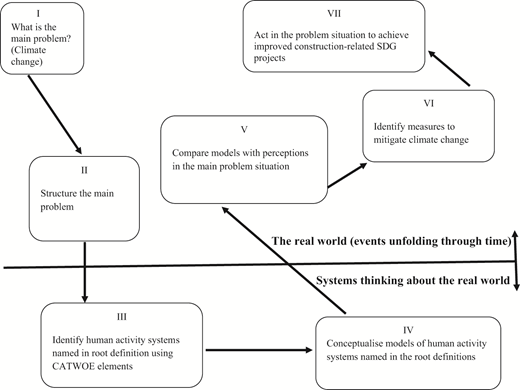
Studies (IPCC, 2014; Qiao, 2024; Ebekozien et al., 2024a) showed that GHG emissions from the built environment contribute significantly to climate change. Slawinski et al. (2015) affirmed that climate-related physical impacts will be observed on a large scale due to increasing emissions. This has become a concern for stakeholders (construction contracting firms and consultants) because of the possible disruptions it can cause to operations, including construction-related SDG projects. Stakeholders’ upskilling and reskilling in climate change matters are pertinent because uncertainties increase. This study adopted the Theory of Contingency to support the framework. Lo and Shiah (2016) asserted that the impacts of climate change and environmental concerns shape the strategy for green construction. This study used the term “technique for climate change” (Lee, 2012), as stakeholders (construction contracting firms and consultants) manage risk-related contingencies arising from climate change that influence construction-related SDG projects. Thus, this study adopts variables aligned with those of Volberda et al. (2012) and Alves et al. (2017); including construction-related SDGs, as presented in Figure 1. Figure 1 summarises the framework explored in this sub-section. The firm’s mission statement for low-carbon management concerns an organisation’s capabilities to promote actions to adapt to emergent contingencies (Alves et al., 2017). Regarding adopting low-carbon operational practices, Alves et al. (2017) argued that these practices should be actions firms take in response to present or future contingencies. Finally, the last variable is to ensure improvements in risk management associated with climate change impacts on construction-related SDG projects, climate regulations to mitigate those impacts, climate change awareness and management, firms’ reputations regarding climate change compliance and general operational improvements leading to improved construction-related SDG projects.
3. Research method
3.1 Soft system methodology
SSM is robust for addressing complex problems (Checkland and Poulter, 2020; Ebekozien et al., 2024b). Checkland (1981) reported that, in the late 1970s, Peter Checkland invented the SSM method as an action-oriented inquiry into challenging situations. The mechanism uses frameworks of human action to explore the main stakeholders (construction contracting firms and consultants) in the real-world problem (climate change facing construction-related SDG projects) and interviewees’ perceptions to proffer measures to mitigate the issues through a systematic method. Ebekozien et al. (2024b) affirmed that the SSM is a qualitative approach that can relate systems thinking to non-systematic problems. This method permits the researcher and the interviewees to appraise issues through the action-oriented analysis, as modified in Figure 1. Figure 1 aligns with Checkland’s (1981) identified seven steps in the SSM framework and is supported by face-to-face interviews with experts in climate change and construction-related SDGs. This agrees with Alves et al. (2017), who adopted a qualitative research design to explore experts’ perceptions of adopting low-carbon operations practices in Brazil. The SSM framework has limitations, as Jackson (1990) identified. This includes the study’s framework, grounded in interpretive assumptions and the shift from modelling systems to capturing perceptions of real-life situations. Notwithstanding, this technique (SSM) provides a means to integrate a framework that could improve practice and, in this context, enhance the impact of climate change mitigation on construction-related SDG projects.
This research adopted purposive and snowball sampling to identify participants and ensure adequate representation, thereby achieving saturation (Creswell and Creswell, 2018; Aun and Bustami, 2025; Ebekozien et al., 2025, 2026). The interviewees (public clients, government senior staff and above employees in relevant ministries/departments/agencies, construction contracting firm management staff and consultants) were experts in Nigerian construction-related SDGs and climate change matters, as presented in Table 1. Regarding the participant’s selection criteria, in addition to experience with construction-related SDGs and climate change in Nigeria, a 10-year minimum experience benchmark was adopted. For the construction contracting firms, to ensure good coverage, this study adopted the National Bureau of Statistics (2019) classification of contracting firms, where construction sites with less than ten workers were grouped as small, between ten and less than 50 workers were grouped as medium, and above 50 workers were grouped as large construction firms. The interviews took place from June 2024 to August 2024 and lasted an average of 40 min. This study’s design, data collection and post-data analysis were guided by the framework presented in Table 2 and aligned with Yin’s (2014) framework. Appendix presents a sample of the semi-structured questions.
This research used a thematic approach to analyse the data and achieved saturation at the 34th interviewee. This study’s saturation was achieved when no new variables emerged from the collected data. This research manually analysed 40 documents to generate the codes, categories and themes. The researchers obtained the objectives from the categories, and common patterns played a significant part. It agrees with Jaafar et al. (2021). One hundred and two codes were developed and re-clustered based on occurrence, frequency and references, in line with Aigbavboa et al. (2023, 2024). This study created ten sub-themes from the 102 codes and followed the face-to-face collection technique revealed in Figure 1 – Customer, Action, Transformation, Worldview, Owner and Environment (CATWOE) analysis (Checkland and Poulter, 2020). The researchers conducted this research in accordance with global best practices and guidelines for the Protection of Research Participants.
4. Findings
4.1 Steps 1 and 2: the condition of the main issue and structure
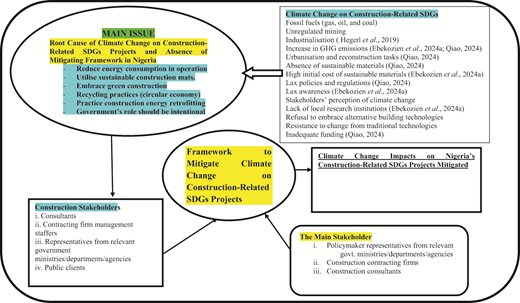
Steps 1 and 2 identify the main problem and structure, as illustrated in Figure 1. As stated in the Introduction Section, this research explores the causes of climate change. It develops an SSM-based framework to mitigate the negative impacts on construction-related SDG projects in Nigeria. The relevance of the framework for managing long-term issues such as this has been emphasised by Checkland and Poulter (2020) and Ebekozien et al. (2024b). Therefore, this study generated a robust viewpoint from the reviewed literature, as illustrated in Figure 2. Figure 2 presents real-world problems and their mitigation in the context of climate change and its impacts on construction-related SDG projects. Identifying and acknowledging the main factors of the issue (root causes of climate change), including the analysis restriction, such as natural disasters, as they affect the stakeholders, cannot be overstated.
Figure 2 shows that the main stakeholders in climate change and construction-related SDG projects include consultants, management staff from contracting firms, representatives from relevant government ministries/departments/agencies, and public clients. In this context, the public client, as the end-user of construction-related SDG projects, engages consultants and contracting firms to ensure the concept is actualised from pre-contract to post-contract administration. Participant P14 says, […]. Nigeria’s government at all levels must be intentional to mitigate climate change impacts on construction-related SDGs projects. The recent collapse of the Alau dam on the Ngadda River in Borno State, Nigeria, on Tuesday (10th of September 2024) could have been avoidable if the needful had been done […]. Results show that climate change impacts on construction-related SDG projects threaten Agenda 2030 Goals (majority). Findings show the impacts of climate change, especially flooding, on construction-related SDGs projects, including hospital buildings (SDGs 3), residential houses (SDG 11), commercial buildings (SDGs 3 and 11), school buildings (SDGs 4 and 9) and physical infrastructure such as pipe borne water and boreholes (SDG 6), drainage and road networks (SDGs 9 and 11), bridges (SDG 11), zoos (SDG 15), telecommunication systems (SDG 9), sub-power stations (SDGs 7 and 9), dams (SDG 9), etc. washed away (majority).
Findings also reveal that threats to SDGs 1 (no poverty) and 2 (zero hunger) are secondary consequences of climate change’s impact on construction-related SDG projects. This warrants urgent concern because the globe is warming faster than at any time in recorded history. Warmer temperatures alter weather patterns and disrupt nature’s balance (P3, P6, P14, P19, P26, P36 and P40). This poses risks to construction-related SDG projects and the end users. Findings identify fossil fuels, such as gas, oil and coal, as the largest contributors to global climate change and GHG emissions. This is the outcome of industrialisation. Participant P1 says, […] GHG emissions threaten humanity and its environment. If not mitigated, it can blanket the earth and trap the sun’s heat, leading to extreme global warming and climate change […]. Other causes include stakeholders’ perceptions of climate change, lax policies and regulations, limited awareness of the consequences of climate change for infrastructure, refusal to embrace alternative building technologies and unregulated mining, all of which contribute to strong cooling. Northern Nigeria may soon experience this scenario, with possible earthquakes resulting from unregulated mining. Findings show that major construction materials are anti-climate-friendly, emitting high GHG emissions, and should be reviewed. This includes cement, reinforcement, granite and sharp sand (majority). The unavailability of a framework to mitigate GHG emissions due to climate change and global warming in developing countries, such as Nigeria, from main construction materials complicates the process for construction-related SDG projects (majority). A framework to mitigate the impact of climate change on construction-related SDG projects is pertinent to improving the productivity and quality of these projects and, by extension, to achieving secondary SDGs such as Goals 1 and 2.
4.2 Step 3: identify activities and define the main issue via CATWOE elements
The researchers identified the activities associated with the main issue through a CATWOE analysis. The CATWOE comprises major parties related to construction SDGs projects and climate change, as presented in Table 3. This comprises the actors (consultants, contracting firm management staff, representatives from relevant government ministries/departments/agencies and public clients), transformation, a worldwide perspective, ownership and environmental constraints in mitigating climate change issues in construction-related SDG projects in Nigeria.
4.3 Step 4: the study’s framework
In step four, this study proposed a framework through the CATWOE analysis, as presented in Figure 2 and Table 1. This study developed the conceptual framework based on the “Transformation” elements in the analysis. It shows that the policy to integrate climate change adaptation and mitigation for construction-related SDG projects is pertinent, as proposed in Figure 2. This research’s findings suggest that all stakeholders should be intentional in mitigating climate change, and that this should be supported by government policies and programme measures at all levels. Participant P1 says, […]. Besides designing and constructing construction-related SDGs projects to adapt, they should be constructed to mitigate the impact of climate change in all ramifications […]. The concept of carbon neutrality should be integrated into construction-related SDG projects. The concept’s target is to offset GHG generated by an appraised system (P1, P2, P11, P24, P29, P35 and P39). This includes services, products, individuals and firms (majority). Findings show that GHG emissions reduction, energy saving, reforestation and sustainable construction materials are possible ways to “carbon sink” or achieve “a zero-carbon emission state” (majority). Figure 2 reveals the causes of climate change on construction-related SDG projects. Examples of construction-related SDG projects impacted negatively by climate change from the recent Borno State extreme flooding include hospital buildings (SDGs 3), residential houses (SDG 11), commercial buildings (SDGs 3 and 11), school buildings (SDGs 4 and 9) and physical infrastructure such as pipe borne water and boreholes (SDG 6), drainage and road networks (SDGs 9 and 11), bridges (SDG 11), zoos (SDG 15), telecommunication systems (SDG 9), sub-power stations (SDGs 7 and 9) and dams (SDG 9) (majority). Findings identify fossil fuels (gas, oil and coal), unregulated mining, industrialisation, an increase in GHG emissions, urbanisation and reconstruction activities, an absence of sustainable materials, high cost of the initial cost of sustainable materials, lax policies and regulations and lax awareness as the causes of climate change on construction-related SDGs projects. Others include stakeholders’ perceptions of climate change, the lack of local research institutions, refusal to embrace alternative building technologies, resistance to change from traditional technologies, and inadequate funding.
4.4 Step 5: compare a framework with perceptions of the issue
4.5 Step 6: measures that can mitigate climate change
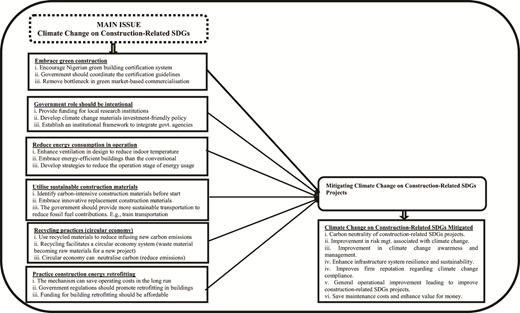
Results show that the impact of climate change on construction-related SDG projects is more pronounced, especially during the recent 2024 flooding across Nigeria, with the worst-hit area being the Alau Dam in Borno State, Nigeria. The persistent climate change, especially during the rainy season, has harmfully impacted the quality of construction-related SDG projects (majority). This is worrisome. Developing a framework to reduce the impact of climate change on construction-related SDG projects is overdue and one of the motivations of this study, as presented in Figure 3. Figure 3 presents the six developed categories and their variables used to create the framework. This includes reducing energy consumption in operation (three items), using sustainable construction materials (three items), embracing green construction (three items), recycling practices (circular economy) (three items), practising construction energy retrofitting (three items) and the government role (three items). Figure three reveals that the outcomes of these six categories would reduce the impact of climate change on construction-related SDG projects. This is a novelty and forms part of the study’s motivations. In summary, Figure 3 highlights detailed measures to mitigate the impact of climate change, clustered into six sub-themes, while Figure 2 identifies the root causes and the sub-theme measures. Figure 3 is more detailed, with items relevant to each sub-theme measure, and it also addresses the study’s Objective 2.
4.6 Step 7: act on the issue
This phase shows the six categories identified in the previous step, generated from the analysed 40 documents. For example, to encourage the Nigerian green building certification system (P2, P24 and P29), the government should coordinate the certification guidelines (P2, P23, P29 and P35) and remove the bottlenecks in green market-based commercialisation (majority), which are integrated to create “embrace green construction”. The government’s role is critical and cuts across the six sub-theme measures. Participant P13 says, […] […] the recent Alau Dam incident is evidence of the government’s failure to mitigate climate change intentionally. Our government is mostly interested in the aftermath, while serious governments embrace proactive measures. Were relevant government authorities unaware of the rising water levels and possible dam overflowing? Participant P13’s allegation was rebuffed by Participant P37, who affirms that the relevant authorities did the needful and placed the communities on red alert, but were not prepared for this volume, and the failure of Alau Dam compounded the flooding issues. Findings suggest that the government needs to be more proactive in managing extreme flooding, especially when the danger alert is released. Participant P18 says, […]. what is wrong is providing alternative and safe locations for the red alert communities with provision for their feeding for the duration as practised globally? This was missing and may have contributed to why many refused to relocate. Government policies and actions towards climate change mitigation should be intentional and supported with a friendly environment to attract investors into green and sustainable construction materials that will be affordable and accessible (majority).
Concerning reduced consumption in operation and sustainable construction materials usage measures, findings reveal these variables (enhance ventilation in design to reduce indoor temperature, embrace energy-efficient buildings than the conventional, develop strategies to reduce the operation stage of energy usage, identify carbon-intensive construction materials before start, embrace innovative replacement construction materials and government should provide more sustainable transportation to reduce fossil fuels contribution. e.g. train transportation) will positively diminish the impact of climate change on construction-related SDGs projects. Participant P4 says, […] […] governments at all levels can review the transportation systems in the country and embrace carbon-zero transport systems, such as trains for the masses […]. Providing alternative transportation will mitigate the carbon emissions from fossil fuels and, by extension, reduce the overall GHG emissions into the atmosphere. Also, results reveal that the impact of climate change can be diminished from the design stage of the construction projects. Hence, the firm’s carbon-free mission statement is critical regarding this goal and explores innovative replacement construction materials (P3, P11, P13, P20, P23, P26, P28, P30, P34 and P37).
Findings show that integrating recycling practices (circular economy) and construction energy retrofitting are pertinent to diminishing the impact of climate change on construction-related SDG projects. Findings suggest the use of recycled materials to reduce carbon emissions (majority), the government should regulate and promote retrofitting in buildings (P2, P4-P17, P25, P28 and P38), and the government should support building retrofitting funding (P1, P3-P13, P23, P27, P29, P31 and P35). Recycling facilitates a circular economy (waste materials become raw materials for a new project) and can neutralise carbon, reduce emissions and help achieve construction-related SDG targets. Participant P27 says, […] […] funding is a major challenge when building energy retrofitting, especially for small contractors like us. It’s a long, capital-intensive project. It will be hard for small contracting firms to venture into such projects without government support and an enabling environment. This current government is not helping the matter with double taxes here and there […] The developed framework will enhance the resilience and sustainability of the physical infrastructure system for construction-related SDG projects, especially during the rainy season (majority). The developed model (Figure 3) underscores the need for stakeholders, especially governments, construction contracting firms, and consultants, to intentionally embrace and mitigate the impacts of climate change on construction-related SDG projects for the benefit of the present and the future. Feasible measures to mitigate climate change threatening SDGs projects have been underscored in Figures 2 and 3, respectively.
5. Discussion of findings
The impact of climate change on industries has received global attention, particularly in construction. However, there is no research on the root causes from the construction stakeholders’ perspective, the impact on construction-related SDG projects, and how the framework could be used to mitigate the perceived impacts in Nigeria. This is part of the study’s implications. Findings identified fossil fuels (gas, oil and coal), unregulated mining, industrialisation, increase in GHG emissions, urbanisation and reconstruction tasks, absence of sustainable materials, the high initial cost of sustainable materials, lax policies and regulations, lax awareness, stakeholders’ perception to climate change, lack of local research institutions, refusal to embrace alternative building technologies, resistance to change from the traditional technologies and inadequate funding as the major causes of climate change on construction-related SDGs projects. This study shows that the construction industry is the major contributor to GHG emissions in electricity consumption and materials production. Results align with those of Hurlimann et al. (2019) and Ebekozien et al. (2024a), who found that the key construction materials emit high levels of carbon. This includes steel, cement and aggregates. Regarding the issue of unregulated mining, the findings agree with Umar (2024), who reported a panic scene in Mpape Community, an Abuja suburb in the Bwari Area Council in the Federal Capital Territory, over an earthquake tremor in early September 2024. The Mpape Community hosts several unregulated mining activities. If mining activities are not monitored, construction-related SDG projects in this location may be threatened, as the continuous movement of the continental plate can trigger earthquakes. Regarding urbanisation and reconstruction activities, the findings align with those of Tunji-Olayeni et al. (2020), Agboola et al. (2023) and Ebekozien et al. (2024a). Beyioku (2016) identified rising sea temperatures, GHG emissions, damage to physical infrastructure, global warming and air pollution as the fallout from climate change. Tunji-Olayeni et al. (2020) opined that developing countries’ dependence on fossil fuels is a key cause of pollution in urban areas. Agboola et al. (2023) found that urbanisation, deforestation/desertification, air pollution, biodiversity loss, population growth and land degradation are major factors driving climate change. This is worrisome and could impact negatively on construction-related SDG projects.
Thus, it is important to adopt a proactive approach to mitigate the impact of climate change on construction-related SDG projects through an unexplored framework such as SSM. Reducing energy consumption in operation, using sustainable construction materials, embracing green construction, recycling practices (circular economy), practising construction energy retrofitting, and the government’s role emerged as six constructs and were integrated into the framework to achieve a better-developed framework to reduce the impact of climate change on construction-related SDGs projects, as illustrated in Figure 3. Findings agree with Qiao (2024), who identified five constructs as possible measures to effectively reduce carbon emissions to neutrality in the construction industry, but not for construction-related SDG projects. The results align with Urge-Vorsetz et al. (2020) and Chen et al. (2022) regarding reducing energy consumption and using sustainable building materials. Urge-Vorsetz et al. (2020) recommended transforming traditional buildings into energy-efficient buildings through retrofitting, citing numerous benefits. This includes mitigating the impacts of climate change, setting carbon-neutrality goals and achieving synergies across social and economic aspects. Chen et al. (2022) found that major construction materials such as cement, blocks/bricks, lime, steel, gravel and sand are more carbon-intensive. Thus, there are a few sustainable construction materials to mitigate climate change.
Regarding green construction, the findings agree with Stocchero et al. (2017), Xu et al. (2022), Ebekozien et al. (2024a) and Qiao (2024) on the importance of recycling and building energy retrofitting measures. Stocchero et al. (2017) affirmed that bamboo is a sustainable building material with good compressive strength and high tensile. This implies that bamboo can store large amounts of atmospheric carbon in buildings. Xu et al. (2022) corroborated Chen et al. (2022) and confirmed the role of wood species, such as bamboo, as a sustainable construction material to reduce urban carbon emissions. However, more scientific research is needed to determine the material’s lifespan compared to steel. Thus, this study developed a framework using SSM to reduce the impact of climate change on construction-related SDG projects. This developed framework is a sustainable tool for reducing the impact of climate change, as shown in Figure 3. Besides enhancing the physical infrastructure system’s resilience and sustainability, the framework may prompt stakeholders, especially policymakers, contracting firms and consultants, to intentionally implement policies and programmes tailored to carbon neutrality in the built environment.
6. The study’s implications
The extant literature reveals a paucity of frameworks developed to mitigate the impact of climate change on construction-related SDG projects. This theoretical gap will be filled through the SSM method, which will develop a framework to address the issues. This approach became appropriate because of its unique ability to address long-term issues and to allow participants to propose measures grounded in in-depth perceptions. Besides adopting the Contingency Theory to support the proposed framework, this research developed a proposed framework that was translated into the developed framework. It aligned with Checkland (1981) and Ebekozien et al. (2024b), as illustrated in Figures 1, 2 and 3. Hence, the adopted theory is significant and enables operators to consider the limitations of climate change to develop approaches capable of creating low-carbon operations management and improving the system, specifically in the context of construction-related SDG projects. This implies that the Theory of Contingency and frameworks (proposed and developed) are part of this study’s theoretical contributions.
This research provides practical evidence of the negative impact of climate change on construction-related SDG projects, including the recent damage caused by the collapse of the Alau Dam in Borno State, Nigeria. This study developed measures within an all-inclusive framework informed by emerging data. The research findings have practical implications for policymakers, construction contracting firms and consultants because the key constructs emerged from the collated data. These measures include reducing energy consumption in operation, using sustainable construction materials, embracing green construction, recycling practices (circular economy), practising construction energy retrofitting and the government’s role in mitigating climate change on construction-related SDGs Projects. This framework will assist policymakers and other stakeholders, especially in implementing measures to mitigate the impact of climate change and GHG emissions in the built environment. In addition to enhancing the physical infrastructure system’s resilience and sustainability, these measures are critical for built environment projects, ensuring infrastructure resilience against the impacts of climate change.
7. The study’s limitations and areas for future research
This study has limitations. The researchers used a qualitative method via SSM. The in-depth literature review and the interviewees’ extensive knowledge helped mitigate the negative impact on this research’s results. Thus, this research’s results could be adapted and applied in other locations with similar climate change challenges on construction-related SDG projects. Also, future studies may consider broader coverage and use the findings from their study to validate the framework using a different methodological approach.
8. Conclusion
This research investigated the root causes and developed a framework for implementing SSM-based measures to diminish the impact of climate change on construction-related SDGs. This study’s findings show that the negative impact of climate change on construction-related SDG projects is pronounced, especially during the rainy season in Nigeria. Results reveal that the non-availability of a framework may threaten construction-related SDG projects. Thus, this study developed a framework, based on measures derived from the results, to mitigate climate change impacts on construction-related SDG projects, as illustrated in Figure 3. The outcome of the developed framework will promote carbon neutrality of construction-related SDG projects, improve risk management associated with climate change, improve climate change awareness and management, improve firm reputation regarding climate change compliance, enhance infrastructure system resilience and sustainability, a general operational improvement, leading to improved construction-related SDG projects, save maintenance costs and enhance value for money.
Special thanks to the participants for their scholarly contributions, which enhanced the findings of this study. Thanks also to Dr S. S. Umar (Rector, Auchi Polytechnic) and his team for creating an enabling environment for this research. The authors appreciate the comments, suggestions, and recommendations provided by the anonymous reviewers, which improved the quality of this manuscript during the blind peer-review process.
References
Further reading
Appendix. Semi-structured interview questions
Basic questions for the participants
For record purposes, what is your organisation’s name?
What is your position within the organisation?
Please tell us your years of work experience.
Are you knowledgeable about climate change and construction-related SDG projects?
If yes to question 4, can you identify construction projects and their related SDGs?
In your view, what is the root cause of climate change in Nigeria’s construction-related SDG projects?
Can the impacts of climate change on construction-related SDGs be mitigated?
If yes to question 7, what measures are there?
Is it possible to have a framework to mitigate climate change in construction-related SDG projects in Nigeria?
If yes to question 9, what roles should stakeholders play to ensure an effective framework to mitigate climate change in construction-related SDG projects?
If no to question 9, how can we mitigate climate change in construction-related SDG projects?