

The sphere of performance measurement in strategic facilities management
Article Type: Editorial From: Journal of Facilities Management, Volume 10, Issue 3
Strategic facilities management (FM) is the way forward for every organisation to add their service value. All service elements are viewed strategically to ensure the operation can fully support their core objectives. The strategic approach introduces the concept of efficient management to support both corporate and public endeavours, which is gaining more interest and recognition. Organisations need to recognise the need to make a big shift in implementing FM strategically, from both the short- and long-term perspective.
One of the key approaches of a strategic FM model for an organisation is in the implementation of a performance measurement system (PMS). PMS was first developed for monitoring and maintaining both the service and organisational processes in order to achieve the goals and objectives of the organisation(Nanni et al., 1992). The PMS concept has progressed over time with the models and approaches being designed to be adaptable to the different needs and scope of services. Various set of metrics were introduced which are believed to help quantify the effectiveness of the process with the intention and aim of learning to improve the standard of work.
British Institute of Facilities Management (BIFM) (2007) also suggested that there are three different stages where PMS is being applied in an organisation. These are the operational, tactical and strategic levels as shown in Table I. The aim of each stage or level is different and at a strategic level the drive for PMS demands accuracy and objectivity where the organisation initiates and monitors the performance of service providers by using a set of key performance indicators (KPIs). In this case, performance in the form of monitoring KPIs is seen as explicit knowledge that is used as a knowledge transfer (Fong and Dettwiler, 2009).
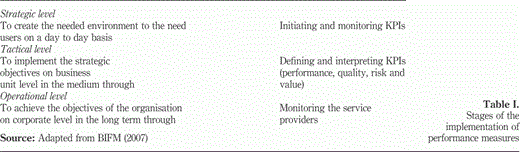
Table I Stages of the implementation of performance measures
Performance measurement of FM plays an important role as it is seen as a significant determinant of corporate goal achievement. The main focus of FM has always been on cost reduction, but there is a growing interest and changing trend in creating added value. With this new perspective, the need to reduce cost is balanced against the increased efficiency which leads to the added value. Performance of FM service delivery needs to be measured to ensure appropriate added value is being achieved (Tucker and Pitt, 2009). The approach of an innovative PMS was also introduced by Anderson and McAdam (2004). Table II shows how the revolution of the concept and innovative approaches of PMS for a strategic FM offering are compared with the traditional PMS in an operational FM scenario.
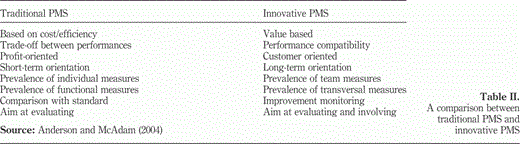
Table II A comparison between traditional PMS and innovative PMS
PM is not easy to undertake effectively but appropriate KPIs must be developed. The indicators will help in assessing the performance in functionality, quality, added value and cost. A complete set of PM indicators and measures measure whether the functions, service providers and departments are doing the right thing in the right way (Myeda et al., 2011). Client and FM managers must understand the need to measure FM performance strategically for instance by looking at the strong correlation between the performance and satisfaction by the end-users. More often, they forget that the supplier’s performance must be measured, as it is a key in achieving the desired result.
PMS when being implemented strategically in FM brings a new manageable concept of internal and external responsibilities for services and it is a most effective indicator of synergies amongst different services and providers to reduce costs and performance of an organisation. Amaratunga (2000) also believes that based on the concept of a strategic PMS, there is a need to determine,verify and integrate the axioms of modern PMS in the context of FM. The final output of a strategic PMS should serve as a means to manage and improve performance as it needs to prove the significant contribution of FM to the organisation’s core business by delivering high quality, cost-effective and highly satisfactory services.
Nik Elyna Myeda

