In this briefing, the authors highlight some recent developments and research in slope and deep foundation engineering and in the university education system in Hong Kong.
1. INTRODUCTION
Hong Kong is located off the south-east coast of China. This prosperous city has a land area of only 1100 km2, but amazingly it accommodates a population of about 7 million. The territory has hilly relief, with about 15% of the area being developed land while the majority comprises sparely developed areas and country parks. Despite its small area, Hong Kong has been one of the world's most important financial and business centres for years. Intensive development is found along the magnificent Victoria Harbour and extends to hillsides near the coast.
The present landscape of Hong Kong has been controlled mainly by the underlying rocks. There are three main types of rock in Hong Kong: volcanic, granitic and sedimentary. The predominant rocks in Hong Kong are deeply weathered, typically to depths of up to 60 m in the granites and up to 20 m in volcanic rocks.1,2
To promote and sustain Hong Kong's economic development and growth since the 1950s, extensive civil engineering and building works have been carried out by both the public and private sectors. Higher education and research have been expanded significantly since the 1990s. Limited space and high demand have made land in Hong Kong relatively expensive. Tall buildings, supported by deep foundations, are often built to optimise the ratios of floor area to land area. The combination of extremely hilly terrain, deeply weathered rocks and high seasonal rainfall has imposed major challenges on the government, engineers, contractors, researchers and educators who deal with slope instability problems and deep foundations in Hong Kong.
2. SLOPE ENGINEERING
Hong Kong has for many years faced challenges from slope instability problems as a result of its hilly terrain, high seasonal rainfall and dense hillside development. There are as many as 54 000 sizeable man-made slopes and retaining walls registered in the Catalogue of Slopes in Hong Kong. On average, some 200–300 slope failures are reported to the Geotechnical Engineering Office (GEO) every year.3 Most of the failures are triggered by heavy rainfall. Various efforts have been made to minimise landslide risks and reduce losses to the general public in Hong Kong.
2.1. Application of quantitative risk assessment in slope engineering
The conventional deterministic approach using limit equilibrium with a factor of safety is generally adequate for routine designs, but it has limitations. The factor of safety is essentially an empirical index, intended to aid judgement and decision-making.4 The design factor of safety will vary with the situation, for example the political climate, and it considers risk implicitly. Although it is intended to cover the uncertainties involved, it does not consider damage or consequences directly or explicitly. There may be a standard design safety factor for particular types of problem that would be taken as the minimum acceptable one. Cost considerations often make it difficult to justify to the client a higher design safety factor than the commonly adopted value. Conversely, over-designing costs money and often militates against the achievement of an elegant solution. There needs to be a balance between the over-conservatism and the uncertainties that have to be covered. However, conventional factors of safety will not ensure performance. Excessively mechanical use of codes of practice is liable to result in unsatisfactory performance, particularly for people who lack the experience to appreciate and allow for the peculiarities involved in practice.4
Based on fairly intense development work in the past few years, the knowledge and experience gained in applying quantitative risk assessment (QRA) in geotechnical engineering have advanced significantly worldwide. QRA has been applied to quantify the risk of slope failures in Hong Kong.5 For instance, the application of global QRA in assessing the overall risk that arises from the 37 000 old man-made slopes in Hong Kong is described in Reference 4. The development of a risk-based design approach to supplement the conventional approach for certain classes of problem is often attributed to the following considerations.4
There is a growing realisation that considerable uncertainties are associated with ground and groundwater conditions, especially given the inherent variability of weathered profiles and tropical rainstorm characteristics; even slopes or other geotechnical structures that have previously been assessed as being up to the required standards can have a fairly high failure rate.6,7
A risk-based approach assists in prioritising the retrofitting of larger slopes with more serious failure consequences, and in the development of a rational strategy to deal with such a category of slopes.
A risk-based approach facilitates the communication of the realities of landslide risk to the general public.
2.2. Landscaping and bioengineering of slopes
Unregulated and indiscriminate shotcreting and the use of chunam, which is a cement–lime stabilised soil used as a plaster to protect the surfaces of excavations from erosion and infiltration, on many man-made slopes and associated retaining walls have aroused growing community concern over their appearance in recent years. Led by the Geotechnical Engineering Office,8 a systematic and integrated approach to bioengineering and landscape treatment in slopes and retaining walls has been promoted and gradually developed in Hong Kong.9–11 Geotechnical engineers make use of bioengineering techniques to improve the appearance of slopes and retaining walls and to conserve the environment. The integrated use of geotechnical engineering, bioengineering and landscape architecture has advanced the design, construction, maintenance and aesthetics of man-made slopes and retaining structures.
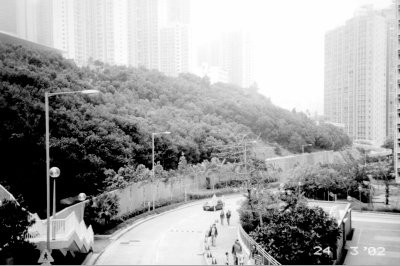
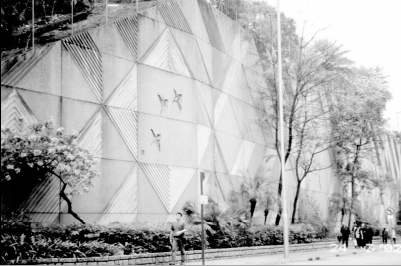
According to local experience, weather, topography, hydrogeological environment and soil conditions are the key factors affecting vegetation growth. Among many bioengineering techniques, hydroseeding is the most common and perhaps the cheapest means of greening slopes in Hong Kong. It is local practice to use hydroseeding or turfing on soil cut slopes up to 35°; hydroseeding with geosynthetic erosion protection mats is applied on steeper cut slopes up to 55°. Shrubs, trees and creepers are planted, as shown in Fig. 1. However, on soil cut slopes with angles greater than 55° hydroseeding is no longer efficient, and hence other bioengineering techniques are adopted, such as pit-planting of trees and shrubs, toe planting, crest and berm planters and creepers, as shown in Fig. 2.
In current local practice, reliance is routinely placed on vegetation to help control surface erosion, but rarely to strengthen the ground,9 owing to the lack of knowledge of net hydrological effects and uncertainty in the adequacy of root-enhanced soil strength with depth. In spite of this, research on more planting methods is currently being carried out in Hong Kong for their suitability to be applied on slopes steeper than 55°. These include spray mats, geo-fibres, soil-filled panels, planter-grillage systems and composite erosion control mat systems.12 A number of trial slopes have been selected to investigate the effectiveness of new bioengineering techniques.
2.3. Digital information and technology
Other notable advances in slope engineering include the use of advanced digital technology. The engineering profession in Hong Kong has been developing the use of the global positioning system and pocket computers with a geographic information system (GIS) platform in geotechnical applications, such as field mapping.13 GIS data are accessible on site through a pocket computer, and field data are recalled from and sent to offices by means of a mobile phone. The technology enables real-time processing of data, and simplifies the recording of data obtained from field works.
2.4. Educating and warning the public
In addition to its technical developments and advances in slope engineering, the Geotechnical Engineering Office has been educating the public about the importance of slope safety in reducing landslide risk. When there is a high chance of landslides as a result of persistent heavy rainfall, a landslide warning will be issued by the Hong Kong Observatory to alert the public to possible landslide risk. Relevant government departments and engineers will take immediate action to prevent losses from landslides. In addition, the public can freely access the Slope Information System at the Hong Kong Slope Safety Website 〈http://hkss.ced.gov.hk〉 to obtain slope information. With concerted efforts, the public has built up a better understanding of the potential hazards presented by slopes and the precautions that should be taken.
3. DEEP FOUNDATION ENGINEERING
3.1. Challenges encountered in designing deep foundations
As Hong Kong has limited land in comparison with its large population and intensive urban development, it is not surprising that typical residential blocks nowadays have over 40 storeys, and commercial towers are even taller. Many of the tall buildings located along the Victoria Harbour on the Hong Kong Island and the Kowloon peninsula are founded on reclaimed land. Deep foundations are commonly adopted in the foundation designs for these buildings. They are required to resist both vertical and horizontal loads due to the weight of the building and wind respectively. The prevailing deep foundation types for tall buildings on these reclaimed lands are large-diameter bored piles and excavated rectangular barrettes, which are very long, normally in excess of 50 m.14 These piles and barrettes often extend through the fill layer, underlying soft marine clay, sandy clay, and alluvial sand deposit down into the deep weathered granitic soil (saprolite), which is typically less weathered with increasing depth. The weathered granite can have a thickness up to 80 m in some places and extend to a depth of over 100 m below ground. As a result of the above factors, it is not uncommon nowadays to design bored piles with a diameter up to 3·8 m and under-reams to 4·5 m.15 Equivalent sizes of barrette are often designed and built as well.
3.2. Tests on effectiveness of shaft grouting
In order to increase the shaft resistance of large-diameter bored piles and barrettes, the shaft grouting technique was first attempted in weathered igneous rocks in Hong Kong in 1998. A $12 million trial programme aimed at testing the large-scale deep foundations embedded in weathered igneous rocks for the West Rail project owned by the Kowloon-Canton Railway Corporation was carried out in 199816 The system adopted for shaft grouting consisted of 50 mm diameter mild steel tube-à-manchette pipes, with manchettes spaced at 1 m intervals along the pipes. The pipes were fixed to the outside of the reinforcement cage and within the zone of the concrete cover, and they extended to the full depth of the shaft grout zone. The pipes were evenly spaced around the perimeter of the piles and the barrettes. Water and grout were injected using a small-diameter flexible double packer system. It was reported that the shaft resistance of the grouted piles and barrettes increased two- to threefold compared with those of non-grouted ones.15,17,18 Since then, shaft-grouted piles and barrettes have gained popularity in Hong Kong.
3.3. Combined use of rock socket and end bearing capacity
Another recent advance in deep foundation design and construction is the combined use of rock socket and end bearing capacity.16,18 Large-scale pile test loads were applied using a combination of 30 MN of kentledge and a single 30 MN Osterberg load cell to demonstrate the adequacy of the combination. Test results revealed that a two- to threefold increase in design pile capacity including side resistance of rock socket and bearing capacity could be achieved, compared with the existing extremely conservative allowable design values.16,18
3.4. Application of geophysics
Practitioners have been exploring the integrated use of geophysics and borehole drilling when handling challenging foundation works in areas with complex ground conditions.19,20 The proper application of geophysical methods to augment boreholes in foundation designs is cost-effective in establishing a reliable ground model.
4. UNIVERSITY TEACHING AND RESEARCH
Following the education pattern and systems in the UK, and to meet the local demands of higher education, the number of universities in Hong Kong has increased from two to eight since the 1990s. Among the eight universities, three of them—the Hong Kong Polytechnic University (HKPU), the Hong Kong University of Science and Technology (HKUST) and the University of Hong Kong (HKU)—offer civil engineering programmes including geotechnical engineering as one of their major disciplines. Currently each university employs five or six full-time academic staff engaged in teaching and research in geotechnical engineering. Details of the departments, research interests and activities at these three universities are given in their websites: 〈http://www.cse.polyu.edu.hk〉 for HKPU, 〈http://www.ce.ust.hk/home.asp〉 for HKUST, and 〈http://www.hku.hk/civil/〉 for HKU.
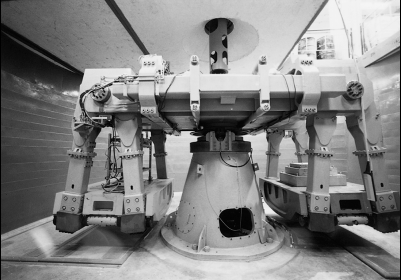
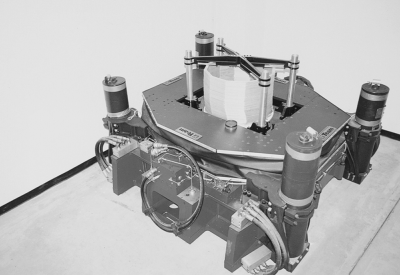
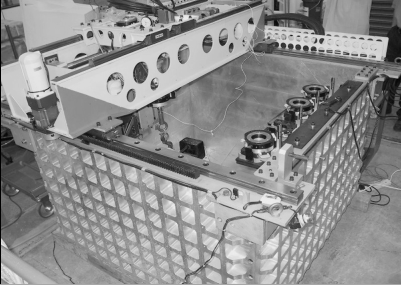
The research culture in Hong Kong has changed substantially since the 1990s, and research equipment and facilities have been improved significantly. Notable advances include the establishment of the unique state-of-the-art 8·5 m beam geotechnical centrifuge at HKUST (Fig. 3),21,22 the Jockey Club Research and Information Centre for Landslip Prevention and Land Development led by Professor C. F. Lee at HKU 〈http://www.jcric.hku.hk/〉, and the true triaxial system for soil testing under both static and cyclic loading up to 20 Hz in the soil mechanics laboratory at HKPU 〈www.cse.polyu.edu.hk/lab/soil.html〉. The Hong Kong geotechnical centrifuge 〈http://www.gcf.ust.hk/〉 possesses three distinctive features: the world's first biaxial shaking table (Fig. 4), which can simulate earthquake effects on soils and soil structures; a state-of-the-art four-axis robotic manipulator23 (Fig. 5), which enables detailed simulations of construction activities in-flight; and the developing high-speed data acquisition and transmission systems that will permit users from all over the world to view any test via the internet in almost real time.