F. Baynes, Baynes Geologic Pty Ltd, Australia
P. G. Fookes, Consulting Engineering Geologist, UK
J. Hutchinson, John Hutchinson & Associates, UK
We commend the Editor for instigating the series of briefings looking critically at education and training, and his opening choice of Professor Atkinson to provoke a debate. We presume that if a leading journal thinks that it is necessary to have such a debate then it is likely that there really is ‘something the matter with geotechnical engineering’.
1. AN EXAMINATION OF THE PATIENT
Professor Atkinson identifies two symptoms. He thinks that too much geotechnical engineering is done by non-geotechnical engineers, and that there is too much litigation. He attributes the cause of this to poor education and basic training, an emphasis on practical aspects of engineering and reliance on codes. He sees the remedy as teaching basic engineering principles, geology, and ways of dealing with uncertainty.
We strongly agree with much of this, but see things overall in a somewhat different light. We think geotechnical engineering is suffering from a debilitating malaise. Our views are those of practitioners of engineering geology involved in a wide variety of ground engineering projects requiring the application of soil mechanics, rock mechanics, hydrogeology and project management around the world.
2. THE UNDERLYING MALAISE
One of the fundamental problems with geotechnical engineers is the often huge gulf between the ground models that they use for analysis and decision-making, and those that can be regarded as realistic models. We believe that all too frequently this gulf leads to inappropriate, unreasonable and ultimately costly decisions. This gulf is the malaise.
3. THE FUNDAMENTAL DIAGNOSIS
We see the symptoms of poor geotechnical engineering frequently in the form of over-design or failure and/or litigation, all of which amounts to avoidable expense to the owners. We think that the cause of this is the poor quality of some geotechnical engineering decision-making. We see this as the fundamental diagnosis, and this possibly runs counter, at least in some respects, to another of Professor Atkinson's contentions, that in the UK there is a pool of ‘world-beating skills in ground engineering.’
4. ONE OBVIOUS REASON
Poor-quality decision-making in geotechnical engineering can clearly result from inadequate education and training, but we think it also arises from the essential nature of engineering. Engineering is the practical application of scientific knowledge, but it is often said that the engineer does for 50p what otherwise would cost £1. Herein lies the rub. Nobody is willing to pay for thinking time. The very nature of engineering is to produce things for as little cost as possible, and in so doing it is inherent that standards will be reduced and quality trimmed, until there are failures.
5. SO IS THE PATIENT SICK OR JUST MALINGERING?
The real question is whether the number of failures in the overall sense of the word is greater than the level that we could reasonably expect given the intrinsic nature of engineering. From our perspective the nature and number of failures in geotechnical engineering are indicative of a deeper malaise, which we have diagnosed as predominantly the poor quality of decision-making.
We believe that geotechnical engineering should have, at its root, scientific geo-thinking, and feel that the poor decision-making we see within geotechnical engineering is largely a result of inadequacies in such thinking. In other words, we think that the pendulum has swung too far towards narrow engineering thinking, epitomised by a reliance on codes and the common failure to allow sufficient time and money for investigation, and away from more holistic and scientific geo-thinking.
6. SOME CLASSICAL SYMPTOMS OF THE MALAISE
Although there are undoubtedly many other examples of poor-quality decision-making in geotechnical engineering, we choose to focus on the area where geotechnical engineering interfaces with engineering geology and particularly on the use of models that need to reflect a sound understanding of geological reality. We constantly observe geotechnical engineers using inadequate models of reality that lead to failures. Some examples of these are
an inability to anticipate what geological conditions might reasonably be foreseen when all the field evidence is indicating a specific geological model
an inability to deal with uncertainty in natural processes within engineering design
design and construct contracts that go badly wrong because costs are estimated and risks allocated before there is an adequate understanding of the geology and therefore no ability to engineer the geo-problems where most of the risks lie
inadequate site investigations that, in failing to recognise faults, major relict landslides and other features, lead to massive environmental and financial impacts on projects
stability analyses using circular failure mechanisms in circumstances where structural geology control is plainly evident
design of structures that will drain the ground without an awareness that this could lead to settlement hazards in superficial deposits
rock mass strength criteria and rock mass classification systems that specifically do not relate to structurally controlled failures when the vast majority of rock mass failures that engineers have to deal with are controlled by structural geology
design of offshore foundation systems assuming uniform soil conditions in circumstances where geological knowledge indicates that periods of exposure above sea level and localised cementation should be reasonably anticipated
frequent lack of appreciation of the importance of near-surface weathering and the associated changes to the engineering character of geo-materials
over-simple treatment of groundwater flow through fissured rock masses where discrete oriented fracture systems are modelled as uniform porous media.
7. SOME REMEDIES?
Professor Atkinson appropriately asks ‘what about geology?’, and we generally like what he says, but we think that one of his questions is phrased somewhat unrealistically. For example, taking someone to, say, Alaska would be educative, and probably great fun, but expensive and might not provide the key to a relict periglacial situation. An engineer may well not be aware of what knowledge is crucial until he or she discusses the problem with an engineering geologist. We regard the importance of engineering geology as being somewhat underplayed in Professor Atkinson's overview of the situation. Underground works and the all-important engineering geology of the Quaternary, for example, are not mentioned.
We also like his healthy scepticism about codes, especially where these leave little room for judgement. How can engineers who are taught to use codes and think in terms of codes, and yet are not equipped to travel intellectually outside codes, hope to come to terms with scientific investigations in an environment characterised by uncertainty? It would be highly inappropriate to teach and practise geology by codes, but we would not remove them entirely, as they can provide helpful guidelines provided they are based on geo-scientific thinking and sound experience, and are not merely narrow conduits that simply constrain and direct the user to standard solutions.
8. IS RADICAL SURGERY OR QUARANTINE NECESSARY?
We feel that the educational components that deal with geology, model-making and uncertainty need improving, and especially those aspects of training that encourage the engineer to interact with other members of the engineering team. We believe that it is beyond the training and expertise of many geotechnical engineers to form their own geological conclusions in anything but the most simple and familiar of geological settings, and that this should be recognised. We think this is what John Atkinson was saying, but perhaps not quite so pointedly. It follows that, on most projects, geotechnical engineers need to interact closely with an engineering geologist in order to achieve success.
This does raise some big questions as to the degree of specialisation in ground engineering appropriate for general civil engineers, geotechnical engineers and engineering geologists: we believe there is probably a consensus that this should increase from the former to the latter. As Professor Atkinson notes, it is important for the general civil engineer to appreciate the value of good ground engineering, particularly in reducing construction risks and in recognising when to call in a specialist.
9. LONG-TERM PROGNOSIS
In the long term we suspect that it will be difficult to change radically the very nature of engineering practice. To achieve any change, the engineering profession must first recognise that something is wrong and then take positive steps to educate a generation of engineers to, among other things, a better understanding of geology. The pendulum may have swung too far, but we should not draw back from trying to readjust this.
Author's reply
I am grateful to Baynes, Fookes and Hutchinson for their written discussion on my Briefing Note. There are also contributions by David Beadman1 and Nick Langdon2 in the January 2003 issue of Geotechnical Engineering, and I would like to add comments on these.
It seems to me that all these contributions are in general agreement that something is the matter with geotechnical engineering. There are some different views about what the matter really is. Few solutions are offered.
Baynes, Fookes and Hutchinson focus on the importance of geology and the role of engineering geologists within the ground engineering business. They contend that the contribution of engineering geologists is not seen by geotechnical engineers to be as important as they believe it should be. They argue that ground engineering often goes wrong because engineering geologists were not on hand to develop a good ground model. This is all true. My point, which is slightly different, is that the contribution of ground engineering professionals (that is, engineering geologists and geotechnical engineers) is not seen to be as important as it should be by construction industry professionals.
David Beadman argues the need to provide geotechnical engineers with broad training in the workplace (my italics). We all agree on the need for broad training, but the issue I raised is whether universities have the resources to offer training as well as education. I think that David is agreeing with me that training must be in the workplace.
In these days, when industry is recruiting from a diminishing pool of graduate civil engineers, companies will have to offer imaginative training schemes to recruit the best graduates. I advise my tutees going for job interviews to ask about the training schemes their prospective employers are offering, and I suspect that many university tutors give the same advice.
Nick Langdon's main concern is with the technical ability of graduates and the way in which basic principles are taught. I considered this in section 5 of my Briefing Note, where I set out what I consider to be the fundamental soil mechanics theories that students should be taught and which engineers should understand.
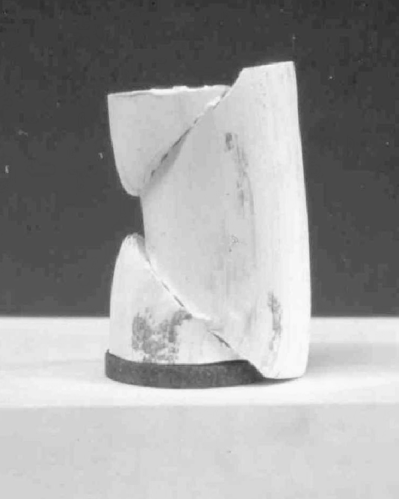
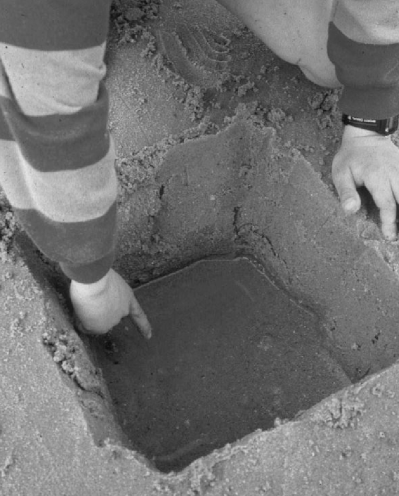
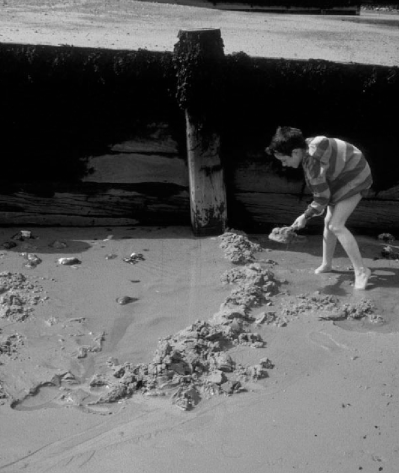
At City University we teach students that there is no fundamental difference between sands and clays. The main difference, related to grain size, is in drainage and ability to develop suctions. They do an unconfined compression test on a sample of clay (Fig. 1) and on a sample of sand (Fig. 2). They are taught that in both samples pore water suctions increase effective stress, which, together with a friction angle, gives the sample an unconfined compression strength. They are taught how to calculate the suction from the unconfined compression strength and the friction angle. They are also invited to make a ground excavation (Fig. 3) and build a dam (Fig. 4).
I believe that my most recent textbook3 treated these and other fundamental topics reasonably clearly. Other well-used soil mechanics textbooks talk about cohesive soils; they do not distinguish between compression and consolidation, and they do not unify shearing and volumetric behaviour. My book is now out of print because it did not have enough sales, whereas these other textbooks continue to sell well. Given that students buy the textbooks recommended by their lecturers, does this prove Nick Langdon's point?
At City University we are still able to give undergraduates one-week field residential courses in geology and ground engineering and in surveying. Many university civil engineering departments have largely abandoned residential field work on the grounds of cost.
The main issues that I raised were as follows.
What is education, which universities do well; and what is training, which industry used to do well?
Why is it that the construction industry has such a low regard for ground engineering?
Why is it that ground engineering design is governed more by codes of practice and the legal profession and less by sound engineering principles?
My original article dealt mostly with ground engineering, because that is my specialist field. But my comments on education, training and practice are relevant to the construction industry more generally.
We are in a period of change in higher education in general, in the education and training of civil engineers in particular, and in the ways in which works are procured. Debates in higher education revolve around access and funding. Debates in education and training of civil engineers revolve around entry qualifications (to include mathematics or not?) and matching sections; what should be expected of graduates in the short term and in the long term? Debates in procurement revolve around apportionment of risk and self-certification. It seems to me that many of the issues that I raised about education and training of ground engineers and the practice of ground engineering are relevant to these wider debates.