Contribution by B. Jones
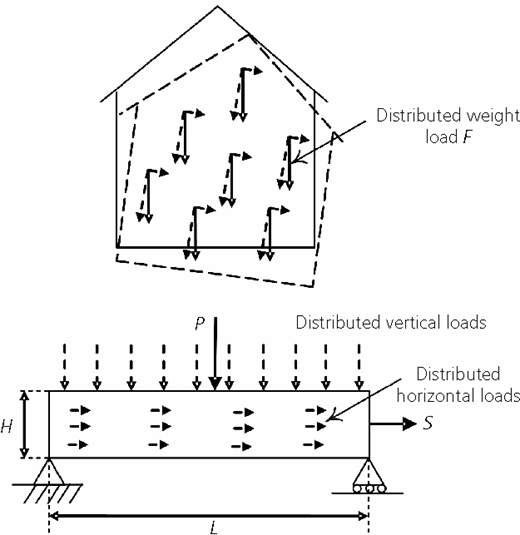
The authors (Namazi and Mohamad, 2010) have provided an elegantly derived solution to the problem of accounting for tilt in damage assessments. However, the solution depends on the assumption that the side of the building at the top of the settlement-induced slope is fixed, while the side of the building at the bottom of the slope is completely free to move (see Figure 2 of the original paper). This intuitively seems unrealistic if the foundation details are similar, and although the assumption allows strains to be caused by tilt, no horizontal strains would be transferred to the building from the ground if it were true. It would be more appropriate to assume that both sides are fixed in relation to the ground, as current methods do. If both sides are fixed, no additional strains are caused by tilt, but horizontal strains in the ground induce horizontal strains in the building. Could the authors provide evidence to show that the assumption illustrated by Figure 2 is valid?
Authors' reply
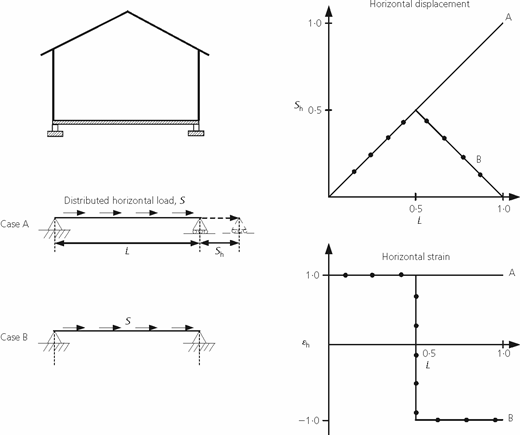
In the tilted building, the model considers the horizontal component of the self-weight as the activating force (uniformly distributed) to induce horizontal strain within the structure and assumes the immediate soils below the foundation to be displaced elastically by the same amount. Such a notion may be acceptable, considering the resistance force (e.g. shear stiffness) provided by the soils is very small in comparison to the stiffness of the structure (e.g. Liu and Ma, 2013). Conversely, the foundation may act as the resistance to the ‘active' excavation-induced ground displacements below. In this case, the measured horizontal strain (assuming linearly distributed ground displacement) is usually smaller owing to the inherent stiffness of the structure. The horizontal strains from these two components may be superimposed on the overall tensile strains calculation as expressed previously in Equations 14 and 15. It must be noted that the onset of visible cracking associated with the maximum horizontal tensile strain is not sensitive to the mode of beam supports. As shown in Figure 7, under a uniformly distributed axial load, both beams with fixed–fixed and fixed–free end conditions yield similar maximum tensile strains, albeit the fixed–fixed ends having an elongation of only half the length of the building, which is rather unrealistic.