

It is well known that the construction of a wider impervious core for earthfill dams provides greater piping resistance and a greater resistance to earthquakes, which can cause internal cracks within the core. Also, designing a wide core can minimise construction defects. However, the core width and its location in earth or rockfill dams are actually determined by consideration of factors such as the type of material, piping resistance, geological features, cracking, earthquake considerations and stability requirements. In this study the influence of thickness of the impervious core and the magnitude of the earthquake coefficient on the stability of both upstream and downstream slopes of the Kızılca dam are presented. Because the clay core will be a compacted fill and the characteristics of the clay core material are very good, with high dry unit weights and permeabilities less than 10−10 m/s, hopefully there will be no problems of piping. There will be no seepage or stability problems with the geology of the Kızılca dam site; therefore the problem is only to determine the ultimate choice of the impervious core slopes from the point of view of maintaining the optimum stability of the Kızılca dam's outer slopes, to construct an economical impervious fill, and to determine whether or not the alluvium under the dam has to be removed. That is why, using conventional sliding surface methods, the stability analysis for sudden drawdown and full impounded water-level cases was performed for different core slopes with IV : IH and IV : 0·5H.
1. INTRODUCTION
This paper describes the positive influence of the reduced size of the clay core, from 1V : 1H slope to 1V : 0·5H slope (H = 9: horizontal, V = 9: vertical), on the dam stability and foundation excavation depth. Slope stability analysis was performed using the program STABLE.1
Kızılca dam, with a crest length of 150 m and a height of 48 m, will be situated on Kestel stream, 6·5 km south of Kızılca town in Sandikli-Afyon. It will store 5 850 000 m3 of water to be used for irrigation. The geological formation is weathered metamorphic schists. Because of weathering, the rock quality designation (RQD) could not be obtained. The valley floor has been infilled with 6·0 m thick alluvium composed of clayey and silty sand, gravel and boulders and considered sufficiently stiff with an allowable bearing pressure of 350 kN/m2. The site is located in one of the most seismically active regions of Turkey. For the economical lifetime of the dam, the surface wave magnitudes (Ms) were estimated as 6·10 and 6·99. The bedrock acceleration at the site was calculated as 0·08g. Also, the estimated horizontal seismic coefficients for the pseudo-static slope stability calculations were 0·131g and 0·18g.2
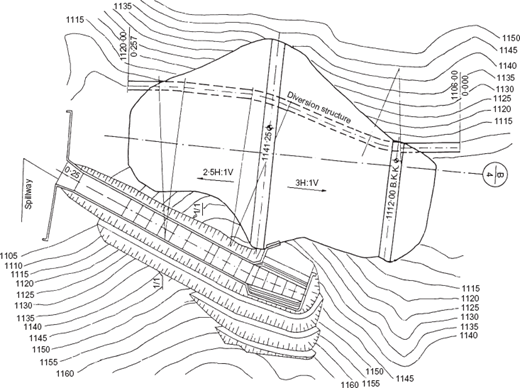
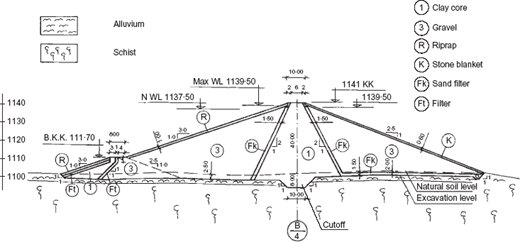
The discharge capacity of the side channel spillway designed on the left bank side is 285 m3/s. Also, the flow capacity of the diversion conduit, located on the right bank side (see Fig. 1), with a diameter of 2·3 m and a length of 257 m, is 25 m3/s.3 The upstream slope of the dam is 1V : 3H and the downstream slope is 1V : 2·5H (Fig. 2). Two different clay core slopes with 1V : 1H and 1V : 0·5H were considered at the design stage.
2. EMBANKMENT DESIGN FOR KIZILCA DAM
After evaluating the site and the available material characteristics, it was decided that a zoned earthfill-type dam would be the best choice. But a further decision had to be made regarding selection of the slopes of both the embankment and its central clay core. Therefore the question was whether reducing the clay core size by changing its slopes and the magnitudes of seismic coefficient would have any influence on the overall stability of the Kızılca dam. Another question was whether alluvium excavation under the dam would be needed. Therefore detailed pseudo-static slope stability calculations were performed. As laboratory shear test results were not available, reasonable shear strength properties for the embankment material and the alluvium were selected from established correlations relating soil classification, plasticity index and standard penetration resistance (SPT N) values to cohesion and angle of friction.4
3. STABILITY ANALYSIS
Pseudo-static stability analyses were performed on the maximum cross-section of the dam (Fig. 2) using the material properties summarised in Table 1. Conventional slip circles were investigated for accelerations of 0·131g and 0·18g.
Material properties
| Type of material | Cohesion, c: kN/m2 | Angle of internal friction, Φ: deg. | Wet unit weight, γwet: kN/m3 | Saturated unit weight, γsat: kN/m3 |
|---|---|---|---|---|
| Clay | 15 | 20 | 18·3 | 21·0 |
| Gravel | – | 38 | 18·8 | 20·0 |
| Filter | – | 37·5 | 18·4 | 19·5 |
| Alluvium | – | 38 | 21·0 | 21·2 |
| Schist | 100 | 55 | 21·5 | 22·0 |
The most critical case for stability of the upstream slope of the embankment is rapid drawdown analysed for a horizontal seismic coefficient of 0·131g and for clay core slopes with 1V : 1H (Fig. 3) and 1V : 0·5H (Fig. 4). Because a drawdown and an earthquake are unlikely to occur at the same time, the authors also investigated drawdown for the no-earthquake condition (Figs 5 and 6).
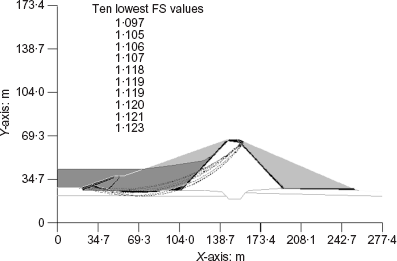
Upstream slope stability of Kızılca dam: sudden drawdown (central clay core slopes IV : IH; earthquake acceleration 0·131g). Almost all slip surfaces pass through foundation layer
Upstream slope stability of Kızılca dam: sudden drawdown (central clay core slopes IV : IH; earthquake acceleration 0·131g). Almost all slip surfaces pass through foundation layer
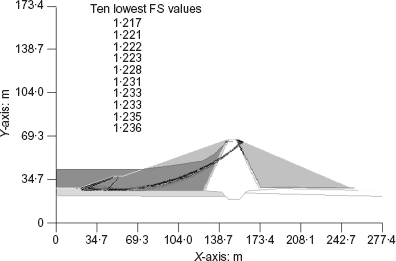
Upstream slope stability of Kızılca dam: sudden drawdown (central clay core slopes IV : 0·5H; earthquake acceleration 0·131g). All slip surfaces are above foundation layer
Upstream slope stability of Kızılca dam: sudden drawdown (central clay core slopes IV : 0·5H; earthquake acceleration 0·131g). All slip surfaces are above foundation layer
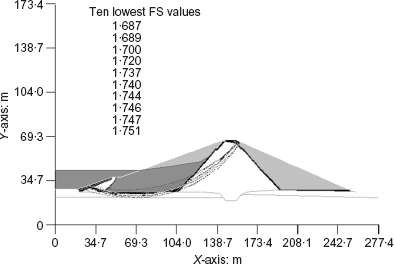
Upstream slope stability of Kızılca dam: sudden drawdown (central clay core slopes IV : IH; earthquake acceleration 0g). Almost all slip surfaces penetrate into foundation alluvium
Upstream slope stability of Kızılca dam: sudden drawdown (central clay core slopes IV : IH; earthquake acceleration 0g). Almost all slip surfaces penetrate into foundation alluvium
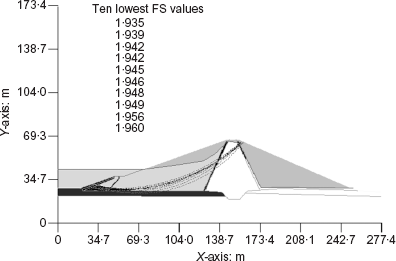
Upstream slope stability of Kızılca dam: sudden drawdown (central clay core slopes IV : 0·5H; earthquake acceleration 0g). Most slip surfaces do not penetrate into foundation layer
Upstream slope stability of Kızılca dam: sudden drawdown (central clay core slopes IV : 0·5H; earthquake acceleration 0g). Most slip surfaces do not penetrate into foundation layer
The most critical condition for the downstream slope of the embankment is full impounded water level at the time of an earthquake. The stability of this slope was also evaluated for clay core slopes with 1V : 1H and 1V : 0·5H using accelerations of 0·131g and 0·18g (Figs 7–10).
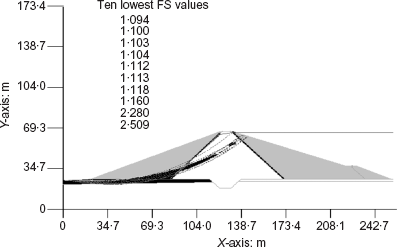
Downstream slope stability of Kızılca dam: full storage pool (central clay core slopes IV : IH; earthquake acceleration 0·131g). All slip surfaces pass through foundation layer
Downstream slope stability of Kızılca dam: full storage pool (central clay core slopes IV : IH; earthquake acceleration 0·131g). All slip surfaces pass through foundation layer
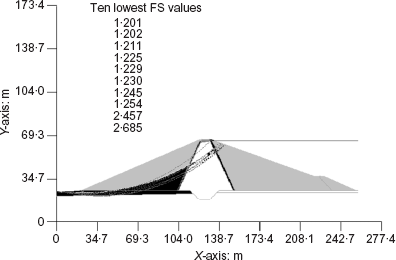
Downstream slope stability of Kızılca dam: full storage pool (central clay core slopes IV : 0·5H; earthquake acceleration 0·131g). All slip surfaces pass through foundation layer
Downstream slope stability of Kızılca dam: full storage pool (central clay core slopes IV : 0·5H; earthquake acceleration 0·131g). All slip surfaces pass through foundation layer
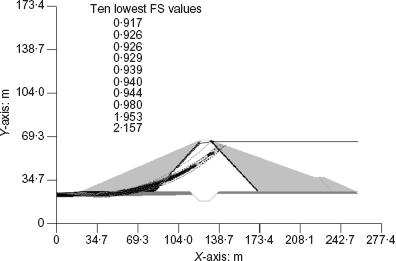
Downstream slope stability of Kızılca dam: full storage pool (central clay core slopes IV : IH; earthquake acceleration 0·18g). All slip surfaces pass through foundation layer
Downstream slope stability of Kızılca dam: full storage pool (central clay core slopes IV : IH; earthquake acceleration 0·18g). All slip surfaces pass through foundation layer
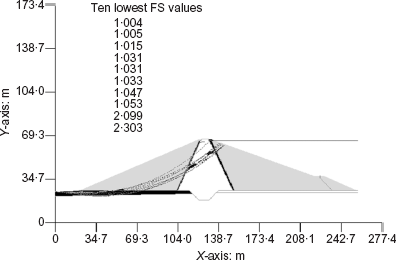
Downstream slope stability of Kızılca dam: full storage pool (central clay core slopes IV : 0·5H; earthquake acceleration 0·18g). All slip surfaces pass through foundation layer
Downstream slope stability of Kızılca dam: full storage pool (central clay core slopes IV : 0·5H; earthquake acceleration 0·18g). All slip surfaces pass through foundation layer
In this study, slope stability analyses were performed using the program STABLE developed at Purdue University, USA (ISHRC and Purdue University, 1986). STABLE is a conventional stability analysis program in which it is possible to configure and draw the geometry of the dam and its material and water boundaries, and it is easy to handle the material properties such as cohesion, friction angle and unit weights. It is also possible to study circular and non-circular sliding surfaces and wedge-type sliding. STABLE has been used for analysing the stability of natural slopes, earthfill and rockfill dams in the State Hydraulic Works, Turkey, and in many parts of the USA.
For the Kızılca dam the authors analysed 100 circular sliding surfaces using the Bishop method because it was observed in previous cases that slope failure surfaces in homogeneous or zoned-type earthfill embankments and dams are either circular or nearly circular. But if an earthfill dam has zones of quite different material properties, then non-circular sliding might occur. However, this is not the case for the Kızılca dam. Also, if a foundation layer is weaker than earthfill material, a wedge (block)-type sliding, passing through this weak foundation layer, might occur. But this is also not the case for the Kızılca dam because the alluvium foundation and the upstream and downstream core support materials are similar (both are gravelly sand) and the foundation material is sufficiently strong. Therefore block-type sliding is not expected.
Analysing many slip surfaces will provide more information on the stability of the slopes than a single analysis.5 Therefore 100 circular sliding surfaces were analysed for the Kızılca dam.
4. DISCUSSION
If piping is not expected, reduction of the impervious core thickness will be better for the safety of the outer slopes of the dam, because the slip surfaces passing through the clay core will be shorter, which reduces the pore water pressure, increasing the normal pressure and frictional strength on the sliding surfaces.
It is clearly seen that the upstream slope of the dam with 1V : 1H clay core slopes will not be safer than that of the embankment with 1V : 0·5H core slope (Figs 3–6), as critical sliding surfaces for the clay core slopes with 1V : 1H are deeper and longer, and penetrate further into the river alluvium. Thus the safety factors become lower. So designing clay core slopes with 1V : 1H will not be a good choice for the safety of the Kızılca dam's upstream slope; also, it will affect the excavation depth of alluvium of the upstream side of the cut-off.
In the case of full impounding, the downstream slope of the dam with 1V : 0·5H clay core slopes is 10% safer than that of the dam with 1V : 1H clay core slopes, for a seismic coefficient of 0·131g (Figs 7 and 8). But all critical surfaces penetrate into alluvium for the core slopes with 1V : 1H and 1V : 0·5H. For clay core slopes with 1V : 0·5H, safety factors are around 1·0 for the 0·18g acceleration (Fig. 10), but for core slopes with 1V : 1H they are below 1·0 (Fig. 9). Thus the selection of clay core slopes as 1V : 0·5H will be more economical and safer for the embankment's downstream slope.
5. CONCLUSION
The influence of the central clay core slopes and the earthquake accelerations on the stability of the outer slopes of Kızılca dam has been examined. It is seen that the selection of a wider impervious core reduces the safety factors of the outer slopes of the dam. It is also seen that the construction of a wide core will not be economical because of the need for more clay core fill material and foundation excavation. Therefore it was finally decided to design a thinner impervious core by choosing a steep slope of 1 : 0·5 and, for safety, not to excavate and remove the alluvium beneath the dam on the upstream side of the clay core but to remove it on the downstream side.

