The authors of these three papers treat consolidation, due to the flow of water to the vertical drains, assuming the soil has both constant compressibility mv and constant permeability k, which generate a constant value for the coefficient of radial or horizontal consolidation, ch. Would not the authors agree that, because the soils involved were soft and very compressible, they could have had significant changes in stiffness and permeability, due to the effective stress changes imposed during consolidation? If this were the case, analyses that took into account these stress-dependent parameters should yield additional insight into the observed responses of the soils involved.
The discusser does not have sufficient detail of the soils encountered by the authors to reanalyse the results of the field studies that were presented. However, as an illustration, analyses for one very soft soil are given, showing the different soil responses generated by the different assumptions.
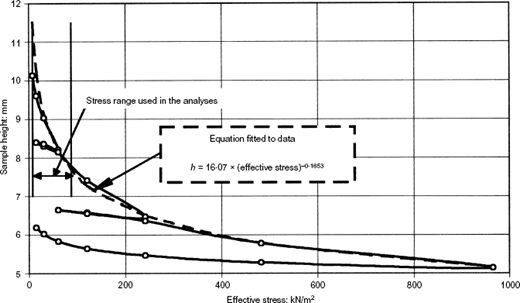
The compression and swelling data, shown in Table 1 and Fig. 1, are from each stage of a one-dimensional consolidation test on a sample of soft ‘intertidal’ marine sediment.
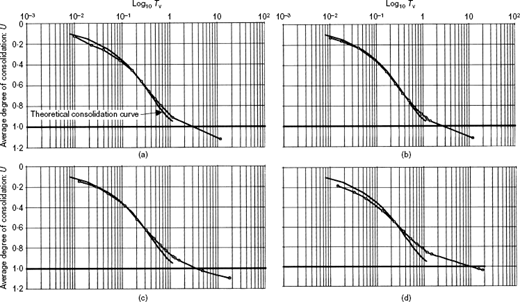
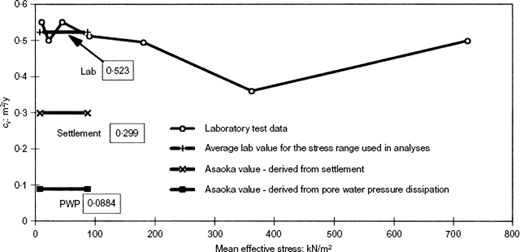
If it is assumed that, because the stress increments in this test are small, mv and k are reasonably constant during each stage, then the time–settlement responses can be compared with theoretical predictions. Fig. 2 shows the comparisons, fitted at 50% consolidation, and the values for cv that this fit generates. The loading stage cv values are plotted in Fig. 3. For the stress range considered in the subsequent analyses an average ‘lab’ value of cv = 0·523 m2/yr is obtained.
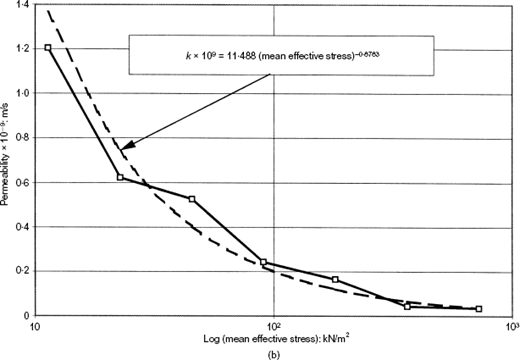
The measured mv and derived cv values for each stage were then used to derive stress-dependent permeability k values. It is possible, with some consolidation apparatus, to obtain the stress-dependent k values directly.
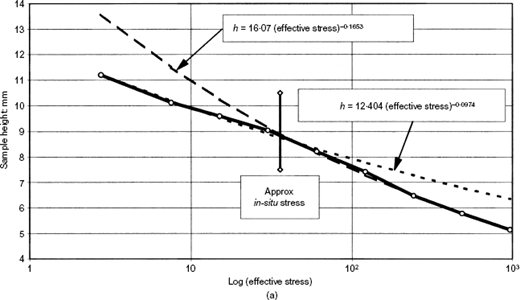
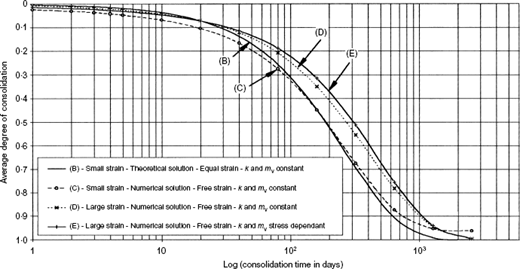
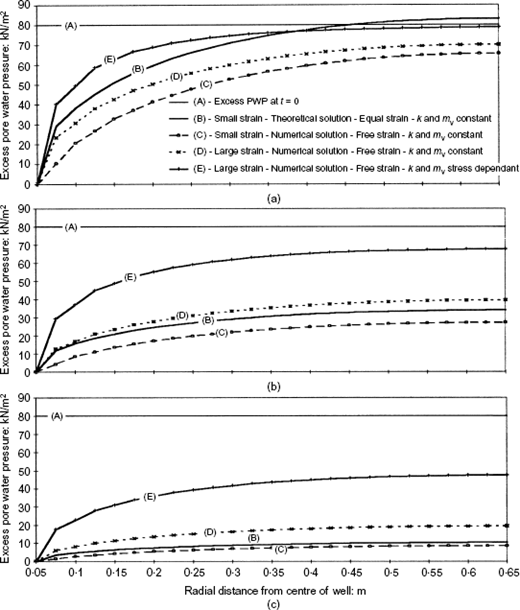
The data for sample height and permeability against effective stress were fitted with trend lines in the form of power functions, as shown in Fig. 4. The equations for the trend lines for the sample height of the normally consolidated branch, and for the permeability, were used to generate settlement and pore pressure values from numerical iterative calculations. The calculations were performed in a spreadsheet, with various constraining assumptions, and the results are shown in Figs 5 and 6. The influence of the stress-dependent compressibility and permeability, depicted by curves E in these figures, is very clear. The early reduction in permeability, close to the well, has the effect of slowing the dissipation of the excess pore water pressure and settlement, as compared with the analyses for which compressibility, mv, and permeability, k, were taken as constant.
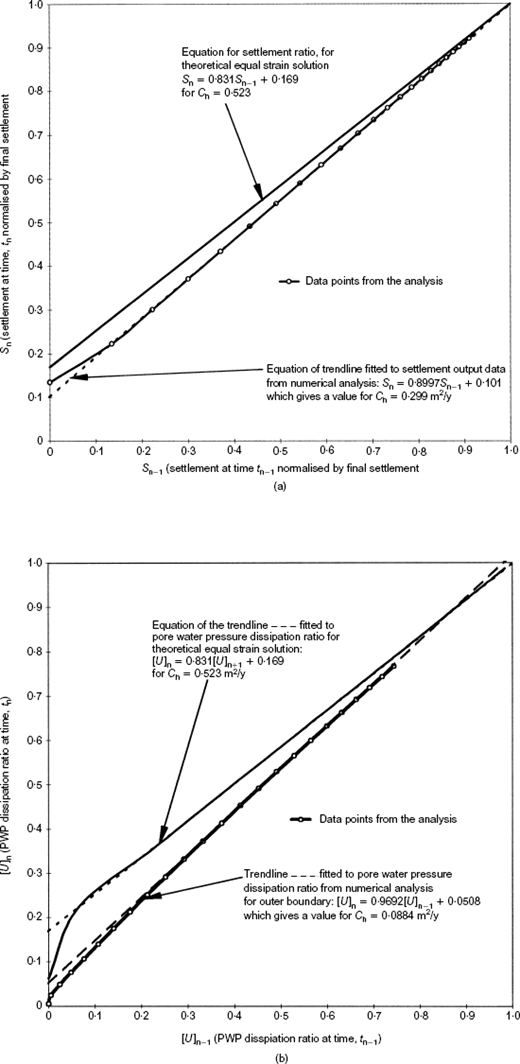
In the paper ‘Consolidation of a very soft clay with vertical drains’ the authors have used the Asaoka method to back-calculate values of the coefficient of horizontal consolidation, ch. The Asaoka (1978) method is a graphical inversion of Barron's (1948) equal strain solution, for which the compressibility, mv, and permeability, k, are taken as constant. The authors also took into consideration the modifications to Asaoka's method suggested by Magnan & Deroy (1980). It is worthy of note that Magnan et al. (1983) suggest that the inverted Barron formula can be used to evaluate ch from pore pressure dissipation data as well as from the settlement data. In Figs 7(a) and Fig. 7(b) Asaoka's construction is shown, using the results from the numerical analyses. It is clear that the plots for the output data, when stress-dependent compressibility and permeability are allowed for, are very different from the results generated using the constant ‘lab' cv value.
The back-calculated ch values from the Asaoka construction are given in Table 2. Widely different values are obtained from consideration of settlement as compared with pore water pressure dissipation, and both are different from the appreciably constant value seen in the laboratory tests.
In light of these numerical evaluations, the variations in the value of the fitted consolidation coefficient, ch, is a function of the stress-dependent soil behaviour. Would not the authors of the three papers agree, as most soft compressible soils exhibit quite strong stress-dependent compressibility and permeability, that forecasts made by the soils engineer should take these soil responses into account? The numerical analyses presented here indicate that, if the soils engineer does not take stress-dependent compressibility and permeability into account, ‘forecasts’ for drain well performance are unlikely to coincide with the response of the soil to the drainage processes in the field.
Authors' reply
The authors agree with the discusser that neither the compressibility, mv, nor the permeability, k, is constant. In our paper, none of these parameters was assumed constant. In fact, we also recognise that the consolidation parameters of soft clay vary with the consolidation process (Chu & Choa, 1997). Two of our PhD students had just completed their projects trying to model this problem. One (Xiao, 2000) carried out large-scale model tests to study the way in which the consolidation properties of soil around a vertical drain vary with the consolidation process. Another (Nie, 1999) has developed a computer program to model how the variation of consolidation parameters affects the consolidation of soft clay around vertical drains.
Authors’ reply
We should like to express our thanks to the discusser for his comments concerning the stress dependence of the compressibility and permeability of soft soils. Although he is right, strictly speaking, the compressibility and the permeability vary in the same direction, so that the ratio k/mv remains reasonably constant and so does cv, as shown in Table 1, where it can be observed that cv varies within a narrow interval of 0·52± 5% m2/yr for an effective stress range from 7·5 to 240 kN/m2. Besides, the assumption of taking cv as a constant does not imply that k and mv are both constant, but is equivalent to assuming that, as the soil particles are moved closer together, the decrease in permeability is proportional to the decrease in compressibility.
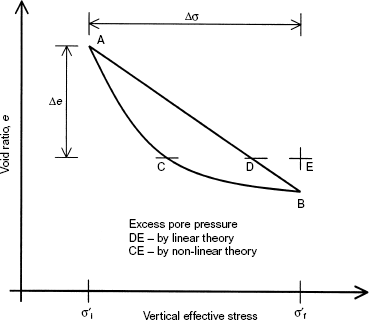
In fact the main sources of mismatch in predictions of consolidation analysis are non-linearity in stress–strain behaviour, large strains and secondary compression. Martins & Lima (1996) performed a comparative study of linear and non-linear consolidation theories, and showed that although the average degree of consolidation, U, may be accurately predicted from linear theory, the pore pressure is always underestimated in this case. The errors are related to the ratio between final and initial effective stresses σ′f/σ′i and, for Tv = 2, vary from about 17% for σ′f/σ′i = 1·5 to about 39% for σ′f/σ′i = 3·0 For large σ′f/σ′i ratios, pore pressure predictions could be seriously in error if the chord AB in Fig. 8 is taken as an approximation for the arc AB, the true relationship between void ratio and vertical effective stress. The case study presented by Almeida et al. (1994) of a 20 m thick embankment placed over a soft clay layer with a σ′f/σ′i ratio of the order of 30 illustrates such a case. The non-linear relationship between void ratio and vertical effective stress had to be taken into account in order to estimate the average degree of consolidation concerning settlements and excess pore pressures, which were quite different. Notwithstanding the strong non-linear relationship between void ratio and effective stress, a constant-valued cv was used to predict the settlements and pore pressures that were still to occur. Last, but not least, the question raised by the discusser about the validity of using a constant cv value with both k and mv stress dependent, which he argues against, can be answered by remembering the non-linear theory of consolidation developed by Davis & Raymond (1965), where one of the basic hypotheses is exactly that which is discussed herein.
The inadequate use of small strain analysis when large strains take place also accounts for the departure of field measurements from theoretical predictions, as illustrated in Fig. 5 provided by the discusser. This figure also points out the minor influence of considering k and mv to be stress dependent compared with the influence of taking into account large strains in the computation of the average degree of consolidation.
Finally, the authors believe that secondary compression (used herein in the sense of strain-rate-dependent settlements) is always present in the consolidation of soft soils, and occurs together with primary consolidation. Settlements due to secondary compression are frequently a source of error leading to failure in accurate predictions. Although the authors recognise the importance of secondary compression, its effect was disregarded in the presented analysis of field data for, in the authors' opinion, soil mechanics has not yet provided a satisfactory approach to handling such types of settlement. As the discussion of secondary compression is beyond the scope of this discussion reply, some authors' ideas about the phenomenon can be found in Martins & Lacerda (1985) and Martins et al. (1997).
Author's reply
We agree with Dr Skinner's comments and have no further comment to make.