

The paper presents a novel approach for the analysis of lateral pile–soil interaction, which complements previous work on the axial load problem. In referring to alternative methods of analysing large pile groups, however, the authors state that ‘these methods are not very efficient’. This statement is not entirely correct, because efficient methods of analysis are currently available. For example, the solution by Randolph (1981), implemented in the program Piglet (Randolph, 1987), provides a simplified solution to large pile group problems in little computational time. A more rigorous approach is represented by the pile group program PGroupN (Basile, 1999, 2003), which provides a complete non-linear boundary element solution of the soil continuum while retaining a computationally efficient code. With reference to the case study on the 102-pile group presented in the paper, the PGroupN analysis takes only a few seconds on a standard personal computer, taking into consideration the symmetry of the pile layout.
Another aspect that merits special consideration is the linear elastic assumption for the soil model made within the paper. Non-linear pile–soil response is a most important aspect of behaviour for piles under lateral loading, even at relatively low applied load levels. Despite the authors’ suggestion of approximately considering soil non-linearity by adopting lower values of soil stiffness near the ground surface, the discusser believes that there are many attractions in adopting a non-linear soil model within the analysis, particularly if the computational costs are negligible. This would also avoid the need for further assumptions in the choice of lateral soil stiffness for the upper layers, which is in itself difficult owing to the effects of pile installation and pile–soil separation behind the pile.
As pointed out by Poulos et al. (2001), it is not necessary to adopt complex non-linear soil models to obtain realistic predictions of lateral pile response. In most cases, a simple hyperbolic model, such as that adopted by PGroupN, is capable of capturing the main non-linear features of behaviour. This is shown in Figs 10–12, which illustrate how the PGroupN analysis leads to more realistic predictions of pile response and a better fit with the measured values of Matlock et al. (1980). However, it should be observed that the above case study is not very suitable for assessing the accuracy of a pile group analysis, as the experimental method of controlling moments at the pile head is fraught with difficulty. The single-pile measurements are probably the most reliable results provided by Matlock and colleagues. In the PGroupN analyses, the assumed profile of undrained shear strength (Cu) is that reported by Bogard & Matlock (1983), whereas an empirical correlation Es/Cu = 150 is adopted for the Young's modulus of the soft clay.
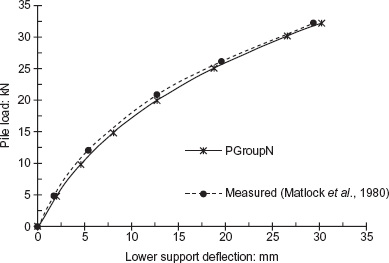
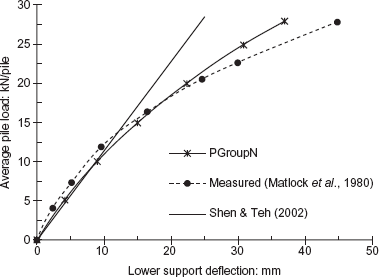
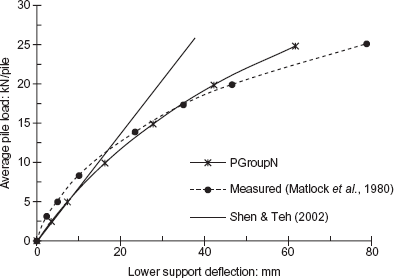
Another fundamental limitation of the linear elastic methods is that they result in a considerable overestimation of the load concentration at the outer piles of the group, and this may lead to an over-conservative design. Indeed, it has long been recognised that consideration of soil non-linearity leads to a reduction of the load taken by the piles at a greater load level—that is, the corner piles. An example of this feature of behaviour is shown in Fig. 13, in which the PGroupN solution compares favourably with that of the authors in the linear range. However, if the effects of soil non-linearity are considered, these result in a relative reduction of the load concentration at the corner pile and a more uniform load distribution. The amount of this reduction will clearly depend on the applied load level.
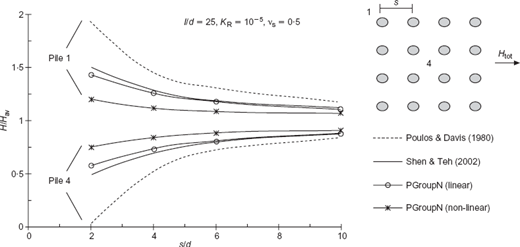
Consideration of soil non-linearity is therefore of basic importance in pile group design (which is strongly influenced by the high corner loads and moments predicted by linear models) and may lead to more effective design techniques and savings in construction costs.
Authors’ response
The writers thank the discusser for his interest in our paper. The following is our response.
As described in our paper, a number of numerical methods are available for the analysis of laterally loaded pile groups. However, most of them require the discretisation of the pile shaft with a large number of elements for flexible piles in order to obtain solutions with good accuracy: for example, 80 pile elements were used in the finite element analysis by Verruijt & Kooijman (1989) for very flexible piles. Thus the size of the overall matrix that needs to be solved becomes large for large pile groups, especially when compared with the variational approach that uses finite series with a limited number of terms to describe the pile response and requires no discretisation. It is from this point of view that the writers stated that ‘these methods are not very efficient for large pile groups’.
The writers obviously are aware of the limitations of elastic analysis for laterally loaded piles, and regard elastic analysis only as an approximate estimate of group movement at normal working load levels. Soil non-linearity can to some extent be taken into account in the elastic analysis by adopting a linearly increasing modulus, as values of the secant modulus near the ground surface are likely to be very small owing to the high stress level, but will increase with depth. This way of treatment has been suggested in a number of papers (e.g. Reese & Matlock, 1956; Randolph, 1981). As demonstrated in the case studies of our paper, elastic analysis could give a reasonable prediction for the lateral pile response.
The writers agree with the discusser that there are many attractions in adopting a non-linear analysis for laterally loaded piles, especially with regard to the prediction of load distribution among piles as shown in Fig. 13, as it is a more rational way to analyse this kind of non-linear pile–soil system. However, the writers believe that elastic analysis taking some account of soil non-linearity in the way described in the paper still has a role to play for practical purposes.

