


The inherent variability of tailings is the main challenge in compacted filtered tailings stacks (CFTS) operation. Despite the advances in dewatering technologies, the filtration efficiency depends on the tailings’ gradation and mineralogy. A usual process is to filter materials separately, which can later be mixed and compacted. In this paper, two iron ore tailings (flotation and slime) from a unique mine and three mixtures (80/20, 70/30 and 60/40) produced from them are studied, to investigate the influence of grading on tailings’ compressibility, strength, stiffness and state measures. The materials were thoroughly characterised and submitted to triaxial tests under low (50 kPa) and high (1000 kPa) confinement levels and different moulding conditions (loose and dense). The results showed that the behaviour of the range of gradings investigated was similar in terms of compressibility, strength mobilisation (peak and M value), dilatancy and stiffness for similar compaction efforts. The packings produced seem to be affected mainly by the mineral composition and grading, while the mechanical procedures only change the magnitude of the state achieved, maintaining the proportion between them. Understanding how grading and mineralogy affect different geomechanical aspects of tailings is the first step towards resilient projects, which are essential to the future of the mining industry.
NOTATION
- Ag
area between the particle size distributions (PSDs) of the mixture and flotation tailings
- At
area between the PSDs of the flotation and slime tailings
- C
convexity
- D50
mean particle diameter
- Dmin
minimum dilatancy
- E
elongation
- ec
after-consolidation void ratio
- ecs
critical state void ratio
- emax
maximum void ratio
- emin
minimum void ratio
- G
shear modulus
- Gs
specific gravity
- M
critical state shear strength
- p′0
mean effective pressure after consolidation
- q
deviatoric stress
- q/p′
stress ratio
- S
sphericity
- wot
optimum moisture content
- ν0
initial specific volume
- νc
specific volume after consolidation
- γd,max
maximum dry unit weight
- εa
axial strain
- εs
shear strain
- εv
volumetric strain
- ηmax
peak strength
- ψ0
initial state parameter
INTRODUCTION
The rising demand for metal ores associated with the depletion of mineral resources implies the need to mine low-grade ore deposits, increasing the volume of tailings that must be handled appropriately. Elevated amounts of water facilitate iron ore beneficiation but result in tailings with the consistency of slurry that have been disposed of in dams over the years (Spitz & Trudinger, 2019). However, uncertainties and recent disasters associated with these structures (particularly upstream dams) motivated the dewatering of tailings for disposal in dry stacking facilities (Gomes et al., 2016; Consoli et al., 2022, 2023).
In this context, a great challenge in the mining industry is to obtain a filtered material that satisfies the geomechanical requirements while remaining cost-efficient, despite the high variability in tailings due to variation in ores and operational issues. These fluctuations are inherent to mining, but the filtration and compaction processes are more sensitive to tailings variations than conventional storage methods (Crystal et al., 2018). The construction of compacted filtered tailings stacks (CFTS) requires the tailings to be dewatered until they are close to their optimum moisture content and then compacted to their maximum density (Lupo & Hall, 2011). However, the presence of fines and clay-sized particles hinders the technical and economic issues of the filtration process. The filtration technology adopted depends on tailings particle size distribution (PSD) and mineralogy (Lara Montani et al., 2013; Spitz & Trudinger, 2019).
For this reason, the design of filtration plants and CFTS must consider the expected range of variability in the ore body and operations during the mine’s lifetime. The production processes must adapt to deal with materials having significantly different gradations (Davies, 2011; Lupo & Hall, 2011; Lara Montani et al., 2013). An alternative that considers this variability is to filter the materials from different process streams separately and use special filter systems only for challenging materials. Then, combining the tailings after filtering would be more cost-effective than combining them before filtering (Crystal et al., 2018).
Moreover, adopting a resilience approach in CFTS projects and operations is essential to deal safely and effectively with materials that present variable characteristics from the start (at the mine) until the end (filtered tailings) of the beneficiation plant. For a system to be resilient, it must be inherently capable of returning to its original state after a perturbation, preserving its functionality over time (Holling, 1973). Resilience can be achieved by adaptive management: recognition of gradual changes in the system and adoption of measures to manage them effectively. An engineered system can be adaptive when appropriately designed to respond to variations in its properties, such as the material’s strength (Basu et al., 2015; Lee & Basu, 2018). Although current engineering practice seldom considers infrastructure resilience, it is essential for important geotechnical projects such as tailings stacks. For example, if the tailings’ grading variation is known and monitored, the filtration plant and CFTS operations can be designed to lead with this over time. Also, the geotechnical response can be investigated for the expected grading range, making the system less susceptible to problems.
The geotechnical behaviour of mixed soils is still far from presenting a unified framework. Prior research has focused on bimodal and gap-graded materials with unique mineralogy (Lade et al., 1998; Salgado et al., 2000; Thevanayagam et al., 2002; Yang et al., 2006; Carraro et al., 2009; Xiao et al., 2017; Yilmaz et al., 2023). These previous investigations often resulted in empirical relations between the fines content and the mechanical response or the physical properties (Shire et al., 2016; Liu et al., 2021). For these bimodal (or gap-graded) soils, the behaviour can usually be separated into two zones by a threshold fines content (TFC): dominated by finer grains and dominated by coarser grains (Thevanayagam et al., 2002; Carraro et al., 2009). Many researchers have shown that TFC is not an intrinsic soil property (Zuo & Baudet, 2015; Yilmaz et al., 2023); some consider it as a third zone of behaviour dependent on the density of the material (Shire et al., 2016). The influence of fines is complex and presents controversial results in the literature, even for simple soil mixtures. As the natural deposits of purely bimodal soils are rare, it is fundamental to understand the stress distribution of soils with a broader range of PSDs (Liu et al., 2021). Also, the characteristics of fine and coarse particles (such as mineralogy and morphology) can affect their packing and interactions, influencing their mechanical behaviour (Yang & Wei, 2012).
Understanding the grading influence is even more significant for tailings mixtures because grinding during the ore beneficiation results in well-graded materials with continuous PSD. These mechanical processes also affect the tailings’ morphology, producing very angular and rough particles (Yang et al., 2019). Besides, the tailings’ mineralogy is highly dependent on the ore body and the efficiency of the ore recovery processes. In other words, the tailings’ clastic and anthropic nature differentiate them from the geotechnical behaviour of natural soils. Then, the mixture of tailings can result in a more complex response than natural soils and needs to be investigated appropriately.
Moreover, the previous literature on the influence of grading on tailings’ behaviour has mainly focused on the undrained condition, investigating the liquefaction susceptibility of loose samples in conventional dams (e.g. Carrera et al., 2011; Torres-Cruz & Santamarina, 2020). In these cases, the changes in the PSD considered are generally due to the natural variations occurring along the dam in relation to the disposal point (Li et al., 2018; Li & Coop, 2019). In contrast, this paper studies artificial mixtures of two tailings obtained at the end of the beneficiation plant after the filtering process. The main objective is to understand how the grading variability can influence these materials’ strength, stiffness and state variables. Knowledge of tailings behaviour for the whole range of possible conditions in the field provides important information for proper tailings management, with the aim of achieving resilient design of CFTS.
DESCRIPTIONS OF MATERIALS
Tailings
The iron ore tailings used were collected from a plant located in the Quadrilátero Ferrífero in the central region of Minas Gerais, Brazil. The characteristics of the tailings are intrinsically linked to the processes adopted during the iron ore beneficiation. Iron recovery is mainly based on physical processes with the aim of separating the commercial products from the gangue minerals. The usual streams used in Quadrilátero Ferrífero beneficiation plants are schematically represented in Fig. 1.
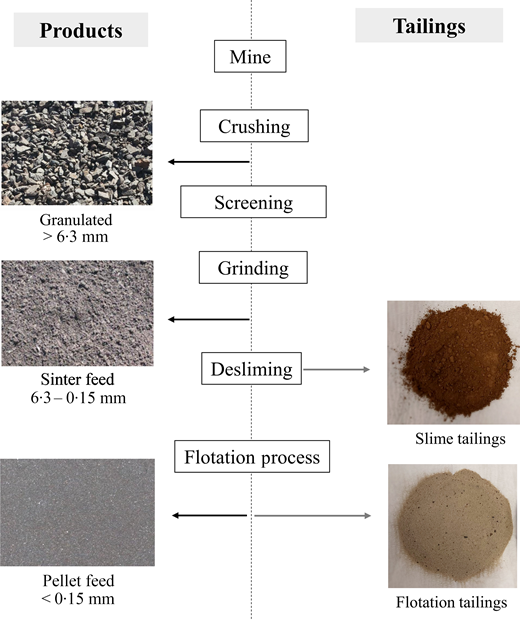
The products obtained from iron ore beneficiation have different gradations and economic values. The average particle size of these materials is inversely proportional to the degree of processing. Specifically, ore processing varies from crushing, grinding and screening methods (to obtain the coarser iron products) to more sophisticated processes (to upgrade the ore quality and recover iron from smaller particles). Granulated products with a particle size between 6·3 mm and 31·5 mm are obtained at the beginning of processing. Further grinding and concentration methods generate finer products called sinter feed (0·15 mm to 6·3 mm dia.). The remaining fine material with a grain size below the sinter feed product is submitted to the desliming stage through a sequence of hydrocyclone batteries. At this step, the slime tailings (overflow material) are removed, as excessive fines reduce the efficiency of the flotation process. Then, the underflow material is designated to the reverse cationic flotation process, isolating the finer-grained ore termed pellet feed (particles smaller than 0·15 mm) and producing coarser tailings (or flotation tailings).
Flotation and slime tailings are obtained by different production streams; both materials are in a slurry condition at the end of the processes because of the large amount of water used. Then, specific dewatering technologies are applied according to the tailings’ characteristics, aiming for their disposal in CFTS. The two tailings used in this study were collected at these different exit points after the dewatering and filtering processes.
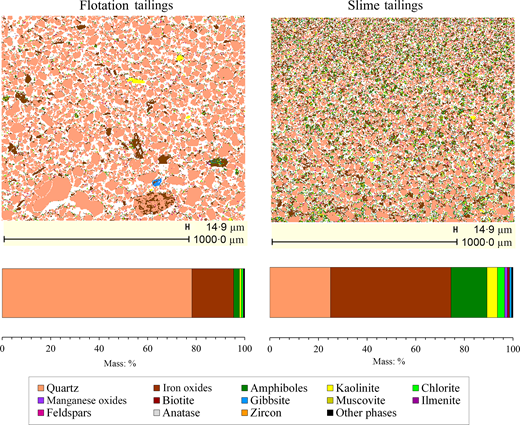
Figure 1 also indicates the physical characteristics of the tailings, as distinct colours indicate that the tailings particles present different mineralogy. The main minerals in both tailings are quartz and iron oxides, as observed in Fig. 2 obtained by quantitative evaluation of minerals by scanning electron microscopy (QEMSCAN). This indicates that the beneficiation processes are not totally efficient, and the tailings present some residual iron content. The slime tailings are the finer particles removed before the last iron-recovery process (flotation). Then, these particles have higher iron content, resulting in 49·5% iron oxides and 25% quartz. Conversely, the flotation tailings are obtained after the flotation processes and resemble natural sands, comprising 78·2% quartz and 17·2% iron oxides. Different mineral compositions result in distinct specific gravity (Gs) values, determined by water pycnometer. The Gs varies from 2·76 for flotation tailings to 3·26 for slime tailings.
Mixtures
The flotation and slime tailings obtained can be disposed of separately or mixed. Blending these materials in different proportions is common for CFTS. Consequently, the storage facility may receive materials within this spectrum: the project needs to account for these variations aiming for the system’s resilience. As the tailings’ PSDs are well graded and continuous, comparing them only based on a fines content value, as in bimodal mixtures, may not be appropriate. Therefore, a grading index (Gr), described in Fig. 3, was suggested to represent the material’s variability range during the CFTS operation. The mixture’s PSD can vary between an upper bound (represented by the slime tailings – Gr = 1) and a lower bound (represented by the flotation tailings – Gr = 0).
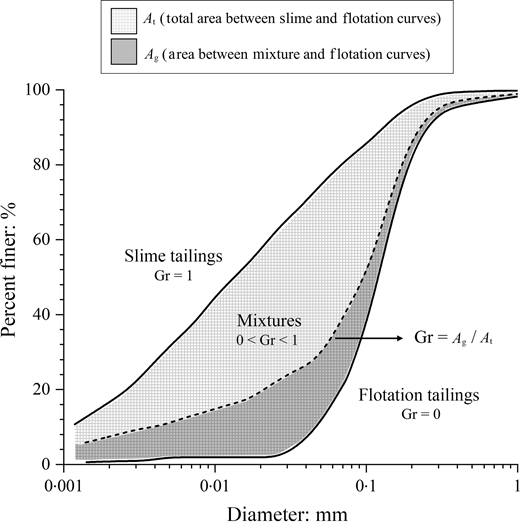
The Gr is defined as the ratio of the mixture boundary (Ag) over the total mixture potential (At), where Ag is defined as the area between the PSD of the mixture and the PSD of the lower bound (flotation tailings) and At is defined as the area between the PSDs of the upper and lower bounds (slime and flotation tailings).
Figure 4 presents the PSD of the tailings and the mixtures. The mixtures were selected primarily based on economic issues from practical operational observations. Owing to their characteristics, flotation tailings are less challenging to dispose of and can be used in the construction industry as natural sand replacement (e.g. Saldanha et al., 2024). In contrast, managing slime tailings is more problematic owing to their higher fine content. Because filtration techniques are expensive, these materials have been disposed of in dams over the years, in a loose and saturated condition. However, to comply with the new restrictions and achieve safer conditions, storing the slime tailings at the CFTS is also necessary. The plant from which the materials were collected currently operates with mixtures containing up to 20% slime tailings. Nevertheless, as the trend is to increase the amount of slime tailings, mixtures of up to 40% were selected to cover the possible fine contents to be used in the next few years.
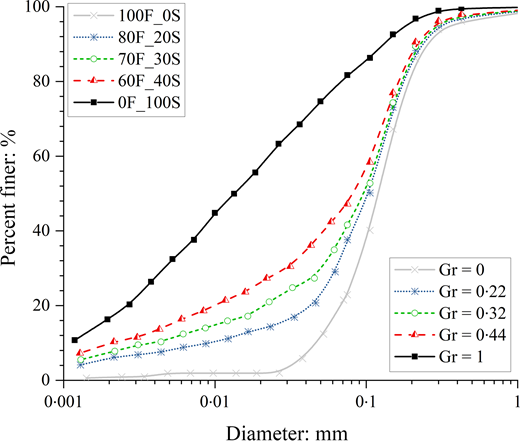
The PSD curves obtained by sieving and sedimentation following the ASTM D7928 standard (ASTM, 2021) are presented in Fig. 4. The flotation tailings and the mixtures are classified as silty sand (SM) according to the Unified Soil Classification System (USCS) and are non-plastic. The slime tailings are classified as low-plasticity silt (ML) with a plasticity index (PI) of 7. The mixtures are also classified by the Gr defined in Fig. 3, varying from 0·22 to 0·44. The Gs values obtained for the mixtures (2·86, 2·91 and 2·96) increase for higher fines content (greater Gr values), suggesting that the finer particles have more iron content due to the beneficiation processes. Thus, the Gs values directly correlate with the iron content (Table 1).
Physical characterisation of tailings and mixtures
| Identification | 100F_0S | 80F_20S | 70F_30S | 60F_40S | 0F_100S |
|---|---|---|---|---|---|
| Flotation tailings, F | 100% | 80% | 70% | 60% | 0% |
| Slime tailings, S | 0% | 20% | 30% | 40% | 100% |
| Grading index, Gr | 0 | 0·22 | 0·32 | 0·44 | 1 |
| Iron oxides content: % | 17·2 | 23·7 | 26·9 | 30·1 | 49·5 |
| Specific gravity, Gs | 2·76 | 2·86 | 2·91 | 2·96 | 3·26 |
| Liquid limit (LL): % | NP | NP | NP | NP | 31 |
| Plasticity index (PI): % | NP | NP | NP | NP | 7 |
| Coarse sand: % | 0·00 | 0·00 | 0·00 | 0·00 | 0·00 |
| Medium sand: % | 3·83 | 2·78 | 2·35 | 2·03 | 0·39 |
| Fine sand: % | 73·28 | 59·58 | 56·05 | 50·82 | 17·92 |
| Silt: % | 22·10 | 31·78 | 34·27 | 37·35 | 65·15 |
| Clay: % | 0·79 | 5·86 | 7·33 | 9·80 | 16·54 |
| Fines content (diameter < 0·075 mm): % | 22·89 | 37·64 | 41·60 | 47·15 | 81·69 |
| Classification (USCS) | SM | SM | SM | SM | ML |
| D50 : mm | 0·12 | 0·11 | 0·10 | 0·08 | 0·01 |
NP, non-plastic
Figure 5 shows the micrographs obtained for all materials using scanning electron microscopy (SEM). Aspects of particle morphology were determined through image analysis of SEM images by ImageJ software. The use of image-based methods for particle morphology has been used in soil mechanics to obtain information about the microscopic characteristics of particles (e.g. Zheng & Hryciw, 2015; Sun et al., 2019; Yang et al., 2019). The particle shape parameters were determined according to Yang et al. (2019). In flotation tailings, bulky and angular particles (mainly quartz) with rough surfaces can be identified. The particles (sphericity (S) = 0·86) are slightly less spherical than the sea sand (S = 0·88) tested by Yang et al. (2019) and the Langjökull glacial sediment (S = 0·89) tested by Altuhafi & Coop (2011). Also, the flotation tailings are more angular (convexity (C) = 0·92) than Yang et al. (2019) found for sea sand (C = 0·98), considering the same particle size range. For slime tailings, smaller and agglomerated flake-form particles can be noticed, with an elongated shape (elongation (E) = 0·37), lower sphericity (S = 0·76) and higher angularity (C = 0·87). Generally, the tailings are more angular than natural sands due to the crushing and grinding processes to which they are submitted, and the angularity tends to increase for smaller particles because the larger ones are subject to greater grinding of the sharp edges (Yang et al., 2019). This pattern was observed for the tailings studied here. Despite having similar particle shape descriptors, it is possible to notice that the particles of the slime tailings are slightly more angular than those of the flotation tailings. The mixtures formed by these angular tailings will result in arrangements with more contacts than the spherical particles. Then, angular–angular contacts will control particle interactions during loading (Yang & Wei, 2012).
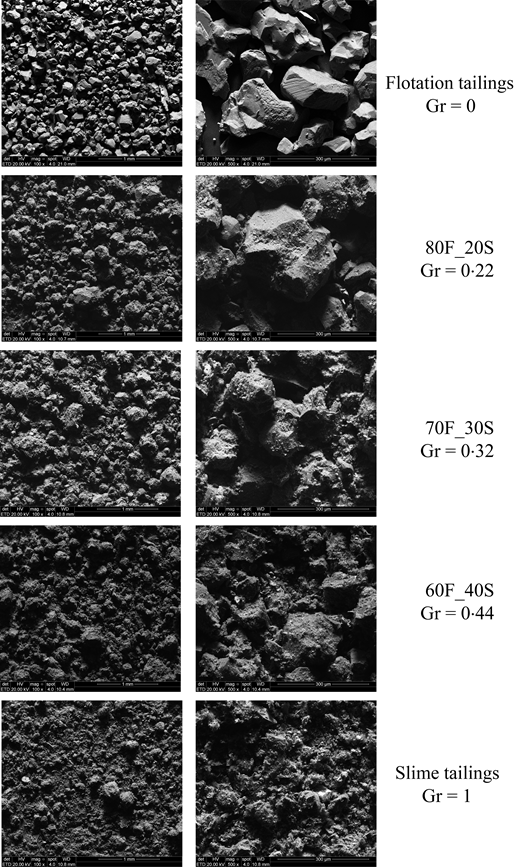
For the mixtures, the aggregates of small particles (mainly iron minerals) surround the larger particles, resulting in different arrangements, as shown in Fig. 5. Increasing the slime tailings content (↑ Gr) augments the number of smaller particles, which tend to distribute themselves over the irregularities on the surfaces of the larger grains. Therefore, finer and angular particles placed between the larger ones may affect the states achieved and the friction between the grains, influencing the material’s behaviour.
The data show that the tailings and mixtures vary widely in the aspects of grading, mineralogy and morphology. Table 1 summarises their physical characterisation.
EXPERIMENTS
Compaction characteristics
The construction of the stacks is sensitive to the material’s conditions; it is essential to understand their compaction behaviour to guide field operations. The compaction characteristics were assessed for the tailings and mixtures using the standard and modified Proctor tests. The results determined the influence of grading on the optimum moisture content (wot) and maximum dry unit weight (γd,max) for two different compaction energies that can be used in the field.
Maximum and minimum void ratios
The maximum and minimum void ratios (emax and emin, respectively) are defined as the range in which a particular material can exist. The ASTM standards D4253-16 (ASTM, 2016a) and D4254-16 (ASTM, 2016b) for determining the emax and emin were developed for sandy soils with less than 15% fines content (particles smaller than 0·075 mm). As the tailings and mixtures studied present higher fines content, some adjustments were made to determine these indexes. The emax and emin can be recognised as states where the material can be placed with a minimum and maximum effort. Therefore, it is logical to associate these limit states with the achievable states in the field, considering the practical application of these materials.
The emin was considered as the maximum degree of compaction feasible in a stack construction. Method A refers to the emin corresponding to the γd,max obtained by the standard effort in the Proctor test, while method B refers to the emin corresponding to the γd,max obtained by the modified effort in the Proctor test. Two different methods were used to determine the emax: one targeting the loosest achievable dry prepared sample and another targeting the loosest achievable slurry-deposited sample. Method A followed ASTM D4253-16 (ASTM, 2016a): a funnel was used to pour the dry material into a mould; the average void ratio obtained after three tests were selected as the emax. Method B is an adaptation of the slurry deposition method suggested by Carraro & Prezzi (2008). Instead of using the authors’ proposed method for determining index densities, a choice was made to follow the procedures described for moulding a specimen by slurry deposition. Thus, a 50 mm inner diameter plexiglass tube was used, and the dry mass considered was the same as that obtained with method A. After performing the procedures and leaving the tailings to rest, the deposited height was periodically measured until a sample with visual uniformity was obtained. Then, the final height was measured, and the sample’s void ratio was calculated considering full saturation. It is then possible to evaluate the emax achieved with the tailings and mixtures at two extreme conditions: totally dry and fully saturated, considering only the self-weight as the effort.
Triaxial tests
The specimens were moulded through moist tamping, following the undercompaction method (Ladd, 1978) under two moulding conditions: dense and loose. The dense specimens represent the optimum compaction (100% compaction degree) expected to occur in the field, considering the standard effort in the Proctor test. This effort was selected because it is the most feasible in the field due to the currently available equipment for compaction. The loose specimens were selected to investigate the material’s behaviour in the critical state condition (around 85% compaction degree considering the standard effort).
The dry tailings were mixed (considering the weight of solids) to achieve the defined gradings. That is, 0, 20, 30, 40 and 100% slime tailings were mixed with 100, 80, 70, 60 and 0% flotation tailings, producing, respectively, PSDs with Gr = 0, 0·22, 0·32, 0·44 and 1. The water content used was the optimum moisture content of each material. The specimens were moulded to be 50 mm in diameter and 100 mm high. The moist tailings layers were deposited inside a split mould and compacted to the assigned degree of compaction, scarifying the subsequent layers to guarantee adherence.
Twenty conventional isotropically consolidated drained triaxial tests were performed to assess the mechanical response of the five tailings and mixtures. Two initial effective confining pressures (p′0 = 50 kPa and p′0 = 1000 kPa) were selected to evaluate the grading influence under low and high pressures. The following notation was used to identify each test: W_X_Y_Z, where W is the flotation tailings percentage, X is slime tailings percentage, Y is the confining pressure (kPa) and Z is the initial moulding condition (D for dense and L for loose specimens). The tests were performed in the three usual steps: saturation, consolidation and shearing. First, the specimens were submitted to a saturation process composed of carbon dioxide percolation, water percolation and application of back-pressure increments to achieve 400 kPa (keeping the mean effective stress equal to 20 kPa). The Skempton B values were measured after the saturation and were all greater than 0·98. Then, the consolidation phase was conducted by incrementing the chamber pressure at a constant rate of 5 kPa/min up to the desired p′0 value. The specimens were maintained under the desired confining pressure until the volumetric strains ceased. Finally, the shearing phase was carried out using a strain-controlled method with a rate of 2·0 mm/h. The final void ratio was determined by the moisture content of the specimen at the end of each test. Also, two Hall effect sensors were used to evaluate the axial displacements, and one was employed to measure the radial displacements (Clayton & Khatrush, 1986). The internal displacement measurements were possible throughout all of the triaxial testing phases. The use of internal measurements has allowed the stiffness to be determined from very small load increments.
RESULTS AND DISCUSSION
Compaction characteristics
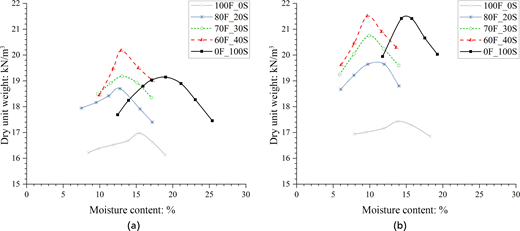
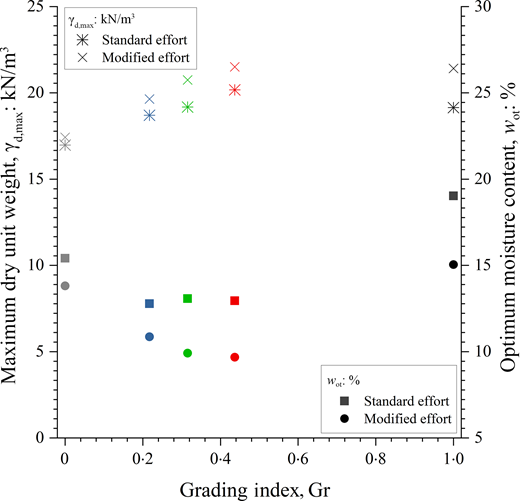
Figure 6 shows the compaction curves obtained for all materials, and Fig. 7 displays the obtained wot and γd,max, considering each grading and compaction effort. The flotation tailings (Gr = 0) present the flattest curve, which is the typical shape for coarser materials, as it indicates the lower influence of water content on the attainable densities. The mixtures (Gr = 0·22, 0·32 and 0·44) and slime tailings (Gr = 1) are more sensitive to moisture variations, as indicated by the more pronounced peaks. The water alters the contacts between the grains and facilitates the packing of fine and coarse particles. Similar trends of curve shape were observed for both energies applied, with an increase in γd,max and reduction in the wot for the modified effort.
Influence of grading index (Gr) and compaction effort on maximum dry unit weight and optimum moisture content
Influence of grading index (Gr) and compaction effort on maximum dry unit weight and optimum moisture content
The γd,max varied between 17 and 22 kN/m³ for the evaluated conditions. The progressive increase in the slime tailings content made achieving higher maximum densities for the mixtures possible because of the packing changes, provided by the inclusion of fines with heavier particles (higher Gs values). In parallel, wot varied between 10 and 19%. The mixtures resulted in lower wot than the tailings. This indicates the need for lower water contents (less lubrication between particles) to achieve the maximum compaction for a given effort due to the fines between the larger particles, which facilitates the achievement of denser packings. The three mixtures also present very close wot values, so the same target moisture could be fixed during the usual operation. Therefore, regarding moisture content, the focus would be on the filtering system.
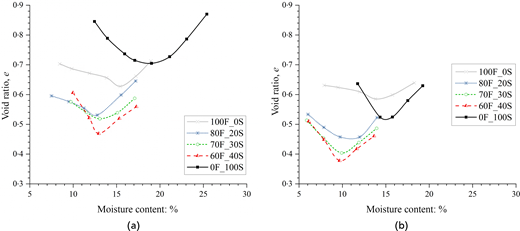
Figure 8 plots the compaction results in terms of void ratio. These graphs offer some insights about the arrangements and fabric produced when compacting different grading materials. Adding slime tailings (up to 40%) to flotation tailings was beneficial to the packing of grains: it made the achievement of lower void ratios possible, considering the same applied energy. However, there is a limit at which the trend reverses, since a higher void ratio was obtained for pure slime tailings compared against the mixtures.
Compaction curves in terms of void ratio for (a) standard effort and (b) modified effort
Compaction curves in terms of void ratio for (a) standard effort and (b) modified effort
The curves for the mixtures are closer in terms of void ratio than for density. Thus, the compaction potential of the mixtures is maintained by changing the grading, and the same equipment for compaction could be used during the operations. Regarding the CFTS design, the closeness of void ratio values for different mixtures can indicate that small fluctuations in the tailings’ characteristics during the construction would not cause severe changes in the compaction process.
Possible limit states
Figure 9 depicts the maximum and minimum void ratios obtained for tailings and mixtures as a function of the Gr, and Fig. 10 presents a schematic representation of the contacts and particles in these different states. Different trends were observed depending on the index considered.
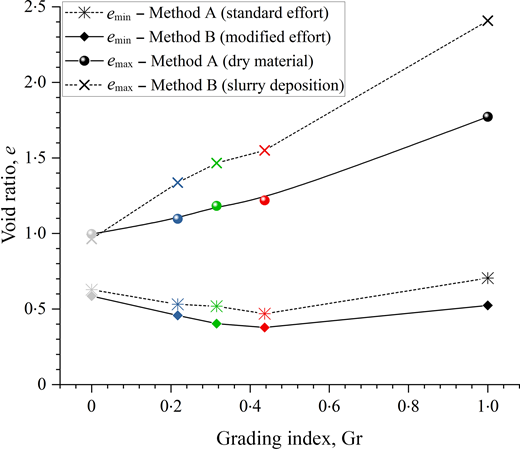
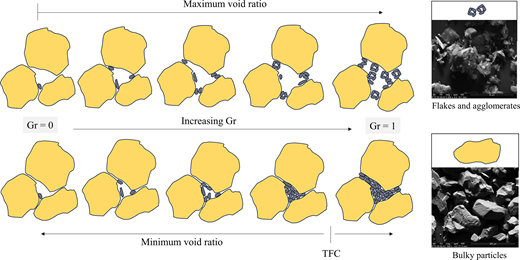
The emin follows the same ‘V’ shape with increasing fine particles observed in gap-graded and bimodal soils, while the emax deviates from this behaviour. Thus, emin initially decreases with increasing finer particles (increasing the Gr value), then increases with increasing finer particle content. The TFC for the emin occurred between 40% and 100% of slime tailings (0·44 > Gr >1). Including fines was beneficial for packings up to 40% of slime tailings since the finer particles fill the spaces between the larger ones when the compaction effort is applied.
In contrast, Fig. 9 shows that the higher the Gr (finer particles), the higher is the emax determined, regardless of the method considered. Thus, the fines added to the mixtures tend to separate the larger particles. This suggests that not all the fines roll into the void spaces, but some are located between the coarse grains and enlarge the soil skeleton (Yang et al., 2015). The angularity of tailings particles influences the packing condition of the mixtures: angular grains roll less efficiently into the void spaces (Yang & Wei, 2012). Also, it is common to observe the emax increasing linearly for sand–clay size mixtures because the emax of clean clay size is much larger, and a small amount of clay fines can introduce a sharp rise in the mixtures (Xiao et al., 2023). Also, some studies have shown that small particles of haematite bond to each other by way of Van der Waals forces and form haematite aggregates with a porous structure, causing the void ratio to increase with increasing haematite content (Yeo et al., 2023).
The linear trend observed by maximum void ratios can therefore be related to the angularity and iron content of the finer particles. In this case, the low effort applied is insufficient to move the angular particles into the voids or break the attraction forces between the agglomerates of small iron particles. However, by increasing the compaction effort (as in determining the minimum void ratio), particles can roll, and aggregates break, causing the material to rearrange into a more stable condition. These results indicate the importance of compaction in mining tailings as the applied energy controls the resultant fabric, which also depends on the material’s grading.
Compression behaviour
The compression behaviour is evaluated by the result of the isotropic consolidation phase of triaxial tests performed with the confining pressure of 1000 kPa. The specimens moulded at the initially dense condition were selected because they represent the target conditions in the field, considering the stacks’ compaction on the standard effort of the Proctor test. Fig. 11 shows the isotropic compression paths for tailings and mixtures. Although the materials started with different void ratios, the compressibility is similar for flotation tailings and the three mixtures, which indicates similar packing formed during the compaction. In contrast, the slime tailings are more compressible due to the arrangement created by the finer particles.
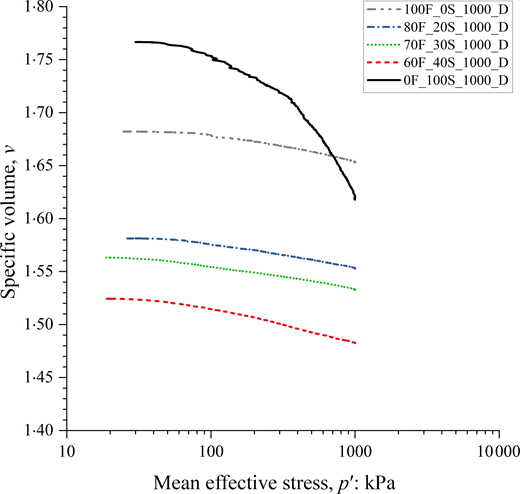
The intergranular contacts in mixtures explain the compression behaviour: the stronger contacts in granular media occur between coarse grains, and the contact forces become weaker as more fine particles are located between them (coarser–fine–coarser) (Yang et al., 2015). For flotation tailings compacted in a dense state, the contact between coarser particles prevails, resulting in a more stable structure. For the mixtures, the number of fines in the intergranular contacts increased, reducing the stability of the arrangement; however, adding up to 40% of slime tailings was insufficient to alter the contacts to promote considerable changes in the compressibility of the mixtures. This suggests that the global skeleton was not significantly altered, and the mixtures are in a similar state when the same compaction effort is applied. Also, the 60 F_40S mixture shows a slight increase in compressibility, which denotes changes in the grain interactions. Despite having the lowest void ratio among the mixtures, indicating that the elevated fines content favoured the grain arrangement, it was not the least compressible sample: the elevated amount of fine particles tends to surround the coarser particles, increasing the fine–fine contacts and reducing the rigidity of the granular matrix.
Significant higher volumetric deformations are observed in Fig. 11 for slime tailings moulded with the same effort. This can be related to more fine–fine contacts between the coarser grains for this material because of its substantially higher fines content (Fan et al., 2022). The higher deformations for slime tailings can also be associated with the higher iron content of small particles, as smaller haematite particles form aggregates in the specimen, affecting its compressibility. Then, the amount of porous aggregate increases as the haematite content increases. These aggregates break into smaller particles when loaded, and dramatic plastic deformation occurs (Yeo et al., 2023).
Also, Fig. 11 shows that the compression behaviour under low pressures (<100 kPa) is similar regardless of the material’s grading. The haematite aggregates maintain their structure for low stress levels and behave similarly to coarse particles before breaking (Yeo et al., 2023). This results in almost constant stiffness up to the structure’s degradation at higher stresses, which reinforces the importance of accounting for the stress level in the design of CFTS, since they might achieve greater heights. During their increase, the materials will be exposed to different compression paths, which can result in distinct behaviour according to their initial state and grading.
Shear behaviour
This section presents the triaxial results, with the aim of investigating the effects of the grading on the stress–strain–volumetric response considering different initial states (loose and dense) and stress levels (50 and 1000 kPa). Tables 2 and 3 show the characteristics of the tests performed.
Summary of tests performed on dense specimens
| Identification | Moulding | Consolidation | Peak | |||
|---|---|---|---|---|---|---|
| ν0 | p′0: kPa | νc | ψ0 | ηmax = q/p′ | Dmin | |
| 100F_0S_50_D | 1·70 | 50 | 1·70 | −0·08 | 1·59 | −0·41 |
| 80F_20S_50_D | 1·59 | 50 | 1·59 | −0·14 | 1·72 | −0·53 |
| 70F_30S_50_D | 1·58 | 50 | 1·58 | −0·14 | 1·69 | −0·65 |
| 60F_40S_50_D | 1·53 | 50 | 1·52 | −0·16 | 1·80 | −0·68 |
| 0F_100S_50_D | 1·77 | 50 | 1·76 | −0·15 | 1·63 | −0·34 |
| 100F_0S_1000_D | 1·69 | 1000 | 1·65 | −0·04 | 1·37 | −0·11 |
| 80F_20S_1000_D | 1·58 | 1000 | 1·55 | −0·07 | 1·47 | −0·16 |
| 70F_30S_1000_D | 1·57 | 1000 | 1·53 | −0·05 | 1·44 | −0·07 |
| 60F_40S_1000_D | 1·53 | 1000 | 1·48 | −0·06 | 1·45 | −0·08 |
| 0F_100S_1000_D | 1·76 | 1000 | 1·62 | −0·05 | 1·38 | −0·06 |
Summary of tests performed on loose specimens
| Identification | Moulding | Consolidation | End of test | ||
|---|---|---|---|---|---|
| ν0 | p′0: kPa | νc | ψ0 | ecs | |
| 100F_0S_50_F | 1·81 | 50 | 1·80 | 0·02 | 0·78 |
| 80F_20S_50_F | 1·80 | 50 | 1·81 | 0·08 | 0·73 |
| 70F_30S_50_F | 1·79 | 50 | 1·78 | 0·06 | 0·72 |
| 60F_40S_50_F | 1·80 | 50 | 1·79 | 0·11 | 0·68 |
| 0F_100S_50_F | 2·08 | 50 | 2·04 | 0·13 | 0·91 |
| 100F_0S_1000_F | 1·80 | 1000 | 1·75 | 0·06 | 0·69 |
| 80F_20S_1000_F | 1·77 | 1000 | 1·70 | 0·08 | 0·62 |
| 70F_30S_1000_F | 1·77 | 1000 | 1·69 | 0·11 | 0·58 |
| 60F_40S_1000_F | 1·77 | 1000 | 1·65 | 0·11 | 0·54 |
| 0F_100S_1000_F | 2·07 | 1000 | 1·79 | 0·12 | 0·67 |
Figure 12(a) shows the stress–axial strain–volumetric strain response for the specimens sheared under 50 kPa confining pressure, while Fig. 12(b) refers to tests sheared under 1000 kPa. The dense specimens showed a stiffer stress–strain curve with a pronounced peak deviatoric stress, followed by strain-softening. As expected, the peak is more pronounced for low confining pressures (50 kPa) because of the higher contribution of the interlocking.
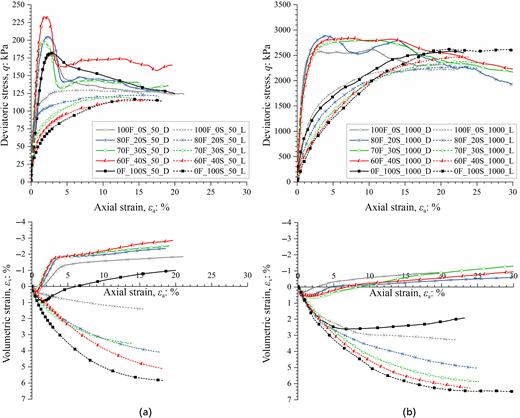
Stress–strain behaviour of tailings and mixtures sheared in a confining pressure of (a) 50 kPa and (b) 1000 kPa
Stress–strain behaviour of tailings and mixtures sheared in a confining pressure of (a) 50 kPa and (b) 1000 kPa
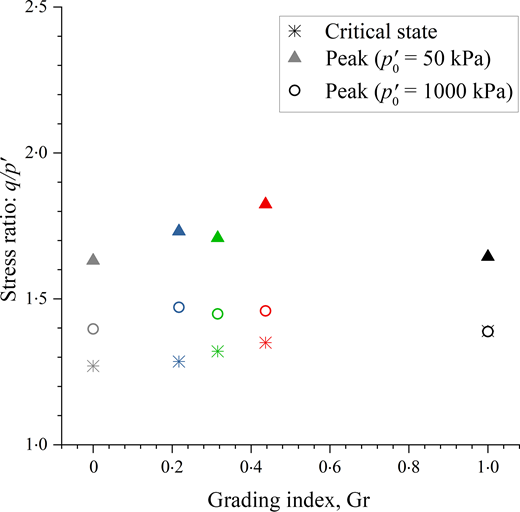
Despite the different initial void ratios, the peak values were similar and are plotted in Fig. 13 as a function of Gr. For the lowest confinement level, the mixtures presented slightly higher peak strength than the original tailings. This behaviour can be related to the particle arrangement during the compaction that resulted in a higher interlocking contribution, which was reduced at p′0 = 1000 kPa because of the restriction to the relative movement between particles during shearing.
Regarding volumetric changes, all the dense specimens presented an initial contractive response followed by a dilative trend at both stress levels. However, the slime tailings were slightly more contractive due to a less stable fabric formed in the optimum condition for this material. It is important to note that here, the compaction effort was kept constant, rather than the void ratio. One can argue that the differences in void ratio could explain the distinct volumetric response. However, it is known that the void ratio alone cannot fully represent the behaviour of non-plastic silts and sands (Been & Jefferies, 1985). The effects of the void ratio and other state variables will be further addressed below.
The loose specimens were moulded with a similar void ratio regardless of Gr, except for the slime tailings (Gr = 1). These specimens were moulded with a higher void ratio because the void ratio used for other materials corresponds to the dense condition of these tailings. Fig. 12 shows that the loose specimens presented a ductile response accompanied by a fully contractive behaviour. For the same initial void ratio, the material with the higher Gr showed more contractive behaviour, indicating that the initial tailings’ state is different, with distinct initial state parameter values (Table 3) despite being prepared at the same initial void ratio. Then, smaller particles in the granular matrix facilitate the rearrangement during the shearing, resulting in higher volumetric strains. Also, the influence of fines inclusion is observed in relation to initial stiffness.
The tests on loose specimens are moving towards stability in volumetric strains and deviatoric stress with increasing axial strain (Fig. 12). So, the end of test stress ratio was considered in the critical state analysis. Depending on the stress level, different patterns can be observed. As the investigated tailings/mixtures differ in fines and iron content, the interactions between the particles are completely different during the loadings. Each material can then experience distinct particle changes when sheared under different stress levels, affecting their mechanical response.
Figure 13 depicts the critical state stress ratio (M) values obtained by a linear fitting passing through the origin and the end shearing points of the two tests performed for each material. The results show slight changes in M with regard to the grading variation (around 2° in the critical state friction angle). Other studies carried out on sand–silt mixtures indicate that M tends to increase (or show slight variations) with increasing fines content (Salgado et al., 2000; Carraro et al., 2009; Zuo & Baudet, 2015; Xiao et al., 2017). The similarity between the M values for the wide range of gradings also contributes to resilience in project development because an average strength can be representative of all the mixtures.
The slightly higher M values observed when increasing the fine contents can be attributed to the higher quantity of small angular iron particles as greater energy is expended to move angular grains, which causes an increase in the mobilised resistance (Yang & Wei, 2012). Moreover, differences in the mineralogy of coarse (composed mainly of silica) and small particles (with high iron contents) can also contribute to the differences observed in the M values. Still, it is difficult to account for this influence (e.g. Torres-Cruz & Santamarina, 2020).
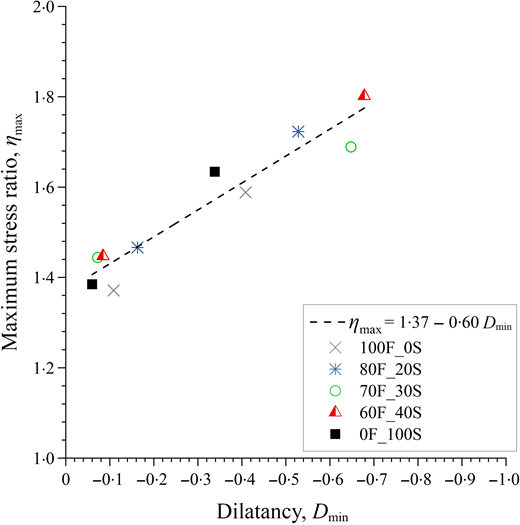
Despite the differences observed, a unique stress–dilatancy law can be adjusted for the wide range of materials studied, as shown in Fig. 14. It indicates that changes in grading (1 < Gr < 0) have a low influence on the shear strength. This outcome is significant in modelling since the dilatancy law is an important portion of constitutive behaviour. In a path towards resilient design of CFTS, this means that small fluctuations in the grading (and even mineralogy) of tailings could still be considered in the same modelling framework.
Stiffness degradation
Figure 15 depicts the stiffness degradation curves for specimens sheared at both confining pressures: 50 kPa (Fig. 15(a)) and 1000 kPa (Fig. 15(b)). The tangent shear modulus was calculated during the triaxial tests considering the load increments (measured by the load cell) and the specimen displacements (measured by Hall effect sensors for very low strains). These results can be discussed in parallel with the stress–strain curves in Fig. 12.
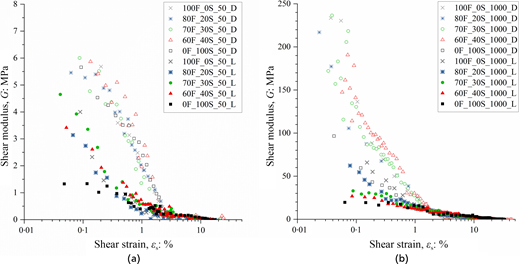
Except for the slime tailings, the dense specimens of each material showed similar stiffness within each stress level because of the higher stability of the arrangement created during compaction, which favoured the formation of stronger contacts between the particles (coarse–coarse type); meanwhile, agglomerates and fine particles tend to get trapped between the larger particles. These structures were less sensitive and have also been shown to be less compressible during the consolidation, as the coarse particles govern the overall stiffer response. However, the slime tailings sheared at the highest confining pressure presented a lower stiffness, which can be related to its higher compressibility. The haematite agglomerates cannot sustain such a stress level and break, resulting in larger macroscopic volumetric strains. Thus the fine particles rearrange to occupy the voids and spaces between the coarse particles, forming weaker contacts (coarse–fine–coarse). At 50 kPa confinement, the slime tailings were similar to other materials: the structure formed during compaction was maintained up to this stress level, and the haematite agglomerates still work as larger particles in the matrix.
For the loose samples moulded with the same void ratio, the shear modulus decreased with the increase in Gr. Hence, the structure formed (and thus the stress distribution) differs despite the samples having the same void ratio. The stiffness reduction with increasing grading may be explained by how the small particles interact with the coarse grains. In the loose specimens, the fines are positioned within the granular matrix, forming weaker contacts with the coarser particles and the stresses are not effectively transferred between the grains. Moreover, the stiffness reduction for loose specimens with increasing Gr is more pronounced for the confining pressure of 1000 kPa, indicating more drastic modifications in the loose sample’s structures at higher stress levels.
Then it is observed that, beyond the void ratio, the geotechnical behaviour depends on the stress level considered, and the grading influence can change according to the range of pressures evaluated. This is important in filtered tailings stacks because the structure’s height tends to increase over the years.
Measures of state
From Fig. 9, the different patterns for emin (V-shaped) and emax (linear) suggest that the relative density does not entirely govern the material’s behaviour. Besides being stress insensitive, the relative density for the tailings considered would be related to different forms of fabric that may not present a smooth transition between the two limiting states. To properly consider the state of the specimen, it is necessary to rely on reference states presenting well-defined behaviour modes, such as the critical state or the index void ratios (e.g. emin).
The loose specimens were used to evaluate the void ratio at the critical state (ecs), as they were close to showing stabilisation in volumetric strains at the end of the tests. Additional hyperbolic extrapolations were also applied to avoid the effects of incomplete testing (Ferreira & Bica, 2006; Shipton & Coop, 2015).
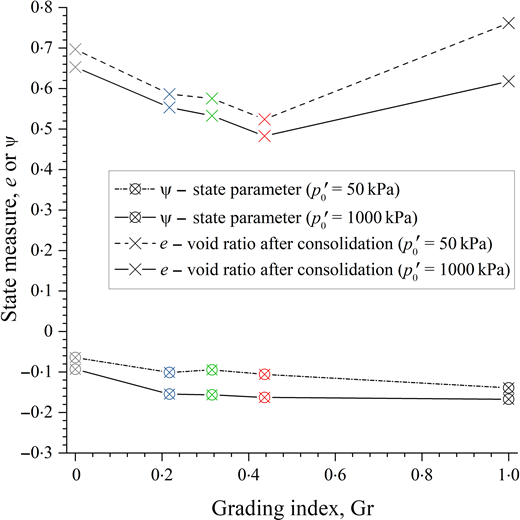
Figure 16 plots the emin and the void ratios after consolidation (ec) compared to ecs for different gradings and distinct confining pressures. It is observed that the ecs values, as the other state variables, depend on Gr and have the same V-shaped trend. This pattern of influence by the fines on the critical state has also been noted in many experimental investigations on different granular materials (e.g. Carrera et al., 2011; Torres-Cruz & Santamarina, 2020; Yilmaz et al., 2023).
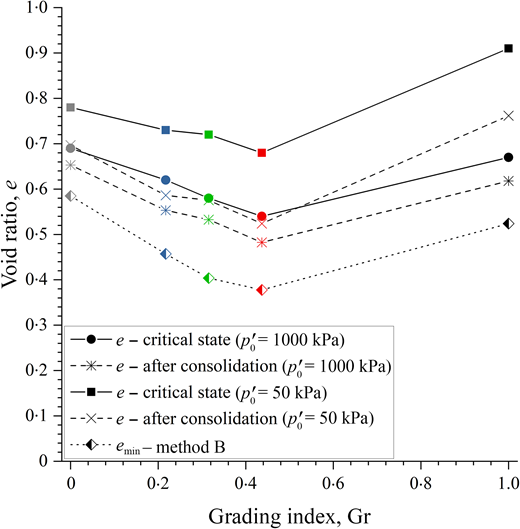
Even though the three states were achieved by different mechanical processes (compaction – emin, compression – ec and rearrangement – ecs), the grading influences were similar. As a result, the packings produced seem to be affected mainly by the composition and grading of the tailings and mixtures. The mechanical procedures used only change the magnitude of the state achieved (higher or lower void ratios), maintaining the proportion between them.
Nonetheless, the trends in Fig. 16 differ from the emax linear variation shown in Fig. 9, which indicates that the influence of grading on the states also depends on the effort (or energy) applied to obtain the specimen. The mechanical process used in the determination of emax has low energy, and the particle interactions govern the states achieved. As the structure formed by the materials in these conditions is not well defined and depends mainly on the weak bonds between particles, the emax is not an appropriate reference state.
Hence, the initial state of the mixtures (and their geotechnical performance) depends on the energy applied during the disposal and can present different patterns with regard to the grading variation. In tailings stacking, some level of compaction is expected to be applied, so the packings developed are more stable, and the grading influence is better understood. The results show that different initial void ratios are obtained when materials with different gradings are compacted at the same energy. However, even after applying different confining pressures (50 up to 1000 kPa), simulating the rising of the stack over time, the proportion between the initial and final states and the behaviour pattern (V-shaped) are maintained. Fig. 16 shows that the distance between the ecs values and the other indexes is approximately constant, suggesting a relationship between the moulding and critical state conditions of the materials studied. Then, the state parameter (ψ) was calculated as the vertical distance between the after-consolidation state (ec) and the void ratio at the critical state line (CSL) for the same mean effective stress (Fig. 17). The CSLs were adjusted for each material considering the void ratio at critical state (ecs) and the respective mean effective stresses obtained at the end of the tests, considering additional hyperbolic extrapolations to guarantee strength and stress stabilisation. A power law (ν = a − b (p′/100)c) was used to fit the CSLs based on findings for similar materials (Carrera et al., 2011; Bedin et al., 2012; Li et al., 2018; Consoli et al., 2023; Wagner et al., 2023). Table 4 presents the coefficient values used in the equation for each material.
Parameters used to fit the critical state lines (CSLs)
| Identification | a | b | c |
|---|---|---|---|
| 100F_0S | 1·82 | 0·04 | 0·41 |
| 80F_20S | 1·77 | 0·04 | 0·46 |
| 70F_30S | 1·76 | 0·04 | 0·52 |
| 60F_40S | 1·72 | 0·04 | 0·50 |
| 0F_100S | 1·97 | 0·06 | 0·55 |
Figure 17 shows that although the grading variation changes the initial void ratio of specimens moulded with the same mechanical process and energy, ψ is very similar. The state parameter is a well-known index for controlling soil behaviour, such as volumetric deformations and strength (Been & Jefferies, 1985). Thus, the similar stress–strain behaviour, strength–dilatancy and stiffness obtained for the dense specimens (especially between the mixtures) consisting of distinct gradations can be associated with similar ψ achieved. This highlights the importance of compaction control because maintaining the same energy can ensure the optimum arrangement of tailings in the field, supporting possible fluctuations in the gradings. For example, suppose the same dry unit weight is adopted as a reference during the compaction of different tailings mixtures. Their behaviour will differ in that case, as they will have different initial state parameters.
The similarities for the range of PSDs evaluated could indicate that adding fines does not influence tailings behaviour. However, despite the observed V-shaped pattern, the mixtures’ response (located before the TFC) is not purely coarse-dominated because many small particles added also tend to participate in the stress distribution. This can be associated with the well-graded and continuous PSDs. As Liu et al. (2021) demonstrated, many particles can contribute to stress mobilisation in continuous gradings, especially for dense arrangements. Instead, including small particles (more angular and with distinct mineralogy) alters the particle arrangements (fabric), and this influence is maintained for different states (only for non-compacted states, the influence of fines can be significantly different).
CONCLUDING REMARKS
This paper has provided an evaluation of how the grading can affect the compaction characteristics, particle arrangements and overall strength and stiffness of artificial mixtures of iron ore tailings. Understanding such aspects is the first step towards resilient projects, which are essential to the future of the mining industry. The outcomes help to improve understanding of tailings behaviour under possible conditions in conventional beneficiation plants and CFTS. In summary, increasing the slime tailings content in the mixtures tends to increase the fine particles, which are more angular and present higher iron content; the grading change is accompanied by morphological and mineralogical variations. The compression behaviour, strength mobilisation, dilatancy and stiffness were close among the mixtures (up to 40% of slime tailings) moulded at the optimum condition for both stress levels. Therefore, average parameters are representative, increasing the project’s resilience. In contrast, pure slime tailings behaviour deviates in some aspects, requiring care when increasing the fine content of mixtures. The critical state (through the state parameter) and the compacted state are efficient reference states where the behaviour is well defined. Furthermore, the following specific conclusions can be drawn.
Combining slime and flotation tailings provided more efficient packings (lower void ratio) than the original tailings. The compaction results indicate that small fluctuations in the characteristics of the tailings would not cause severe changes in the compaction process, allowing the use of the same equipment and procedures for on-field operations.
The different patterns for emin (V-shaped) and emax (linear) indicate the importance of compaction in mining tailings, where the energy applied controls the fabric formed. The different trend for these indexes suggests that the relative density cannot govern the behaviour of tailings. The grading influence on ecs, emin and ec was similar (same V-shape with a TFC in a Gr > 0·44), even though different mechanical processes were applied to achieve the three states. Then, these indexes could be used as references for state variables.
The grading’s influence on compression behaviour and stiffness can change depending on the range of pressures evaluated. This is important in filtered tailings stacks because the structure’s height increases over time. Under low pressures (50 kPa), the arrangement formed at the optimum compaction is maintained for all gradings, resulting in a similar response. The compressibility and stiffness of flotation tailings and mixtures continue to be similar by increasing the confining pressure to 1000 kPa, suggesting that the arrangement is still persistent. This is not the case for slime tailings because of the breakage of weaker fine–fine contacts and iron aggregates in the matrix that induce higher volumetric strains.
Despite different void ratios, the peak strength, stiffness and volumetric behaviour were similar for different gradings, especially between the mixtures. This was associated with similar state parameters obtained during the optimum compaction and highlights the importance of compaction control: maintaining the same energy can ensure a similar response of tailings in the field.
The critical state shear strength (M) values only showed slight changes in relation to the grading variation, and a unique stress–dilatancy law can be adjusted for the wide range of materials studied. This is significant in the modelling framework because a unique relation could account for small fluctuations in tailings’ grading (and even mineralogy).
DATA AVAILABILITY STATEMENT
Some or all data used are available from the corresponding author by request.
ACKNOWLEDGEMENTS
The authors wish to express their appreciation to MEC-CAPES (PROEX), CNPq and VALE S.A. for their support of the research group.
REFERENCES
Discussion on this paper closes 1 May 2026; for further details see p. ii.

