

Climate change presents a serious challenge to underground transport infrastructure. Rising temperatures and extreme weather events (EWEs) are causing an increase in geotechnical and structural difficulties. This review looks at important climate-related impacts, such as: (1) sea level rise, which heightens the risk of flooding, increases hydrostatic pressure, and leads to saltwater intrusion, affecting structural stability; (2) EWEs, including heavy rainfall and extreme temperatures, which weaken soils, cause cracks in tunnel linings, and put stress on drainage systems; (3) fluctuations in groundwater, which result in settlement, deformation, seepage, and corrosion; and (4) changes in soil composition due to droughts, floods, and freeze–thaw cycles, diminishing underground stability. These environmental changes have a greater effect on coastal and densely populated urban areas, where increased risks worsen infrastructure weaknesses. A comprehensive approach is necessary to adapt designs, improve geotechnical resilience, and reduce climate-induced risks. This study emphasises the need to incorporate adaptive strategies into infrastructure planning to guarantee long-term safety, functionality, and sustainability. By considering the interactions between climate change and underground systems, this review highlights the importance of proactive measures to safeguard essential transport networks in an environment that is rapidly changing.
Introduction
The impact of climate change on various facets of society is widely recognised as one of the greatest global challenges of this era. Primarily driven by anthropogenic greenhouse gas emissions, climate change has led to a cascade of interconnected effects, including rising global temperatures, intensified hydrological cycles, and the increased frequency and severity of extreme weather events (EWEs) such as heatwaves, heavy precipitation, droughts, and sea level rise (SLR) (Kandalai et al., 2023). Notably, the effect of climate change on transport infrastructure has become a major concern (Aroke et al., 2021). As the global average temperature rises and EWEs become more frequent and severe, transport systems spanning vast distances are increasingly susceptible to a range of issues including disruptions, damage, and degraded performance. According to a report by the American Society of Civil Engineers, the recent increase in the frequency and intensity of EWEs in the US has caused critical damage to transportation systems, leading to logistics disruptions and significant economic losses (Nogal et al., 2017).
Above-ground structures, such as highways, bridges, and airports, are directly exposed to atmospheric forces and have been extensively studied in terms of their vulnerability to flooding, erosion, and temperature fluctuations (Paul, 2020). However, comparatively less attention has been paid to underground transport infrastructure, which plays a vital role in urban mobility and economic systems. While underground systems are insulated from direct atmospheric exposure, they are deeply affected by changes in soil properties, groundwater levels (GWLs), and thermal fluctuations, all of which pose significant challenges for maintenance and repair (Toll et al., 2012; Freed and Zimmerman, 2022).
For instance, fluctuations in GWLs, exacerbated by SLR and extreme precipitation, can destabilise tunnels and reduce soil bearing capacity. Extreme temperatures contribute to thermal expansion and contraction, causing cracking, structural degradation, and ventilation issues in underground systems. Saltwater intrusion, a consequence of rising sea levels, compounds these risks by accelerating material corrosion. Tunnels are also at risk of flooding, as seen during Hurricane Sandy in 2012, which caused catastrophic damage to New York City’s transit system, resulting in billions of dollars in economic losses (Rosenzweig and Solecki, 2014). Similar flooding incidents in metro systems across cities such as London, Melbourne, and Taipei underscore the vulnerability of underground infrastructure to climate-induced hazards (Huang and Chien Li, 2013; Moloney and Fünfgeld, 2015).
Prior research on underground transport infrastructure has largely concentrated on functional damage, such as flooding caused by EWEs. However, comparatively little emphasis has been placed on the geotechnical and structural challenges that are unique to these systems, despite their critical importance to long-term resilience and functionality. The stability of these systems depends significantly on surrounding soil and rock conditions, which are subject to climate-induced changes (Abija, 2023). The railway lines traversing geographic regions prone to extreme temperature fluctuations are susceptible to various forms of deterioration, including cracks and water leakage. These issues can lead to disruptions in traffic and compromise passenger safety and comfort. However, detailed investigations into these specific challenges remain relatively scarce.
This paper conducts a comprehensive review of the main environmental drivers of climate change – precipitation, SLR, and temperature extremes – and their impacts on underground transport infrastructure. Groundwater fluctuations, a critical yet underexplored factor, are analysed for their influence on the stability and safety of these systems. By integrating geotechnical and structural perspectives, this study aims to address the knowledge gap and develop effective strategies for enhancing the resilience, adaptability, and sustainability of underground transport systems in a rapidly changing climate (Pettinaroli et al., 2023).
The impact of SLR on coastal infrastructure
Causes and projections of SLR
SLR is primarily driven by global warming, causing thermal expansion of oceans and the melting of ice sheets and glaciers (Griggs and Reguero, 2021). Approximately half of the observed rise in the past 25 years is attributed to thermal expansion due to rising ocean temperatures (Pan et al., 2021).
The Intergovernmental Panel on Climate Change AR6 report projects SLR of 0.28–0.55 m by 2100 under emission reductions, or 0.63–1.01 m if current trends continue (Lee et al., 2023). The National Oceanic and Atmospheric Administration (2022) estimates at least 0.6 m rise by century’s end, with the potential for 2.1 m if urgent action is not taken (Hu et al., 2022).
SLR exacerbates groundwater-related risks. Research in the San Francisco Bay Area shows rising groundwater could impact twice as much land as direct inundation, threatening infrastructure and mobilising contaminants (Befus et al., 2020). In Honolulu, SLR has driven multi-mechanism flooding, including marine inundation, groundwater rise, and storm drain backflow (Habel et al., 2020).
Satellite altimetry data indicate SLR is accelerating with an observed rate of 3.57 mm/year from 1993 to 2025, leading to a total rise of approximately 10 mm over this period (AVISO+, n.d.). Figure 1 illustrates this consistent upward trajectory of global mean sea level, as measured by satellite altimetry. The data highlight the accelerating trend, driven by thermal expansion of seawater and melting ice sheets, which poses significant challenges for coastal infrastructure and ecosystems.
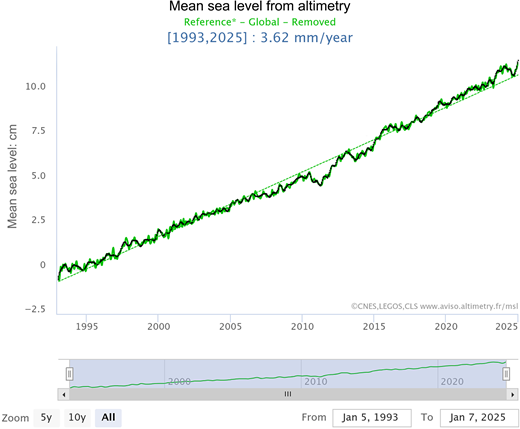
Sea level rise by altimetry from 1993 to 2025 (source: www.aviso.altimetry.fr)
Implications of SLR on coastal infrastructure
While SLR is a gradual process, its impacts are significantly intensified during EWEs such as storms and heavy rainfall. Together, these factors amplify flooding risks and structural stresses on underground transport systems, highlighting the urgent need to address EWEs in greater detail.
Urban and population vulnerabilities
Coastal regions are highly vulnerable to SLR due to the concentration of populations and economic activities in these zones. Approximately 20 of the world’s 33 megacities are located in coastal areas, facing risks such as flooding, erosion, and saltwater intrusion (Gargiulo et al., 2020). In regions such as South-east Asia, the Indo-Pacific islands, and the Caribbean, rapid urbanisation further increases exposure to climate-related hazards (Griggs and Reguero, 2021).
Adaptation planning requires understanding local sea level trends (Porro and Li, 2022). For example, over 50% of Ireland’s population lives in coastal areas, with major cities such as Dublin, Cork, and Limerick particularly vulnerable. Dublin alone saw a population increase of 46 500 people between 2016 and 2022, with a further 32% growth projected by 2036 (Paranunzio et al., 2022). However, expanding urban areas face growing risks from SLR and coastal flooding. Projections indicate that, with a 2°C temperature rise by 2050, many urbanised coastal areas will be below sea level. Lower elevation zones, such as Ireland’s east coast, are already experiencing significant impacts from coastal erosion linked to SLR.
Groundwater rise and structural impacts
SLR raises GWLs, creating significant geotechnical challenges for underground infrastructure. Elevated water tables increase hydrostatic pressure, reducing soil shear strength and bearing capacity, leading to settlement, deformation, and water ingress (Forero-Ortiz et al., 2020).
SLR also causes saltwater intrusion into groundwater systems, exacerbating risks to infrastructure. Saltwater accelerates corrosion of metallic pipes and degrades concrete due to aggressive chloride ions, reducing mechanical resistance and causing cracks (Bosserelle et al., 2022; Kamal-Chaoui and Robert, 2009; Tansel and Zhang, 2022). This issue is critical in cities such as Washington, DC, and Shanghai, where rising groundwater compromises transport and utility networks (Kamal-Chaoui and Robert, 2009).
Figure 2 illustrates the effects of SLR on groundwater systems, highlighting the process of saltwater intrusion. The upper section depicts current conditions, where freshwater and GWLs remain stable with minimal interaction with seawater. The lower section demonstrates potential changes driven by SLR, including a rising water table and increased intrusion of saltwater into underground systems. As saltwater infiltrates tunnels, wells, and sewage systems, it accelerates corrosion, weakens structural materials, and compromises the integrity of underground infrastructure. The rising water table further increases hydrostatic pressure, contributing to deformation and reduced soil stability around underground transport networks and utilities.
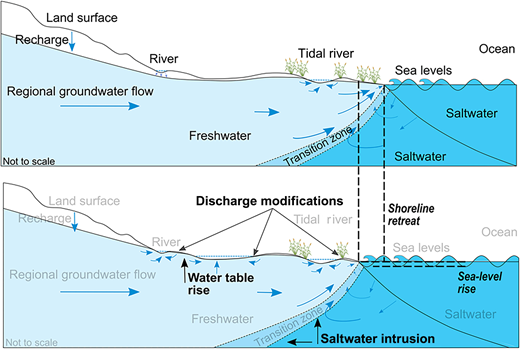
A comparison between current water levels (above) in the lower zone and potential changes (saltwater intrusion, rising water table/levels and discharge modifications) due to climate change-induced sea level rise (SLR) (Bosserelle et al., 2022)
A comparison between current water levels (above) in the lower zone and potential changes (saltwater intrusion, rising water table/levels and discharge modifications) due to climate change-induced sea level rise (SLR) (Bosserelle et al., 2022)
In a study carried out by Tansel and Zhang (2022), it was demonstrated that corrosion induced by saltwater intrusion reduced the thickness of metallic pipes, weakening their mechanical resistance. In addition, saltwater can contain chloride ions, which are very aggressive and initiate or accelerate the formation of pitting or cracking on the surface of pipes.
Contaminant mobilisation and environmental risks
SLR can mobilise contaminants due to groundwater rise, particularly in coastal areas with industrial legacies. Pollutants such as heavy metals and volatile organic compounds stored in landfills and industrial sites can leach into water supplies and ecosystems. Hill et al. (2023) estimate over 18 million hectares of US coastal land are at risk.
In the San Francisco Bay Area, rising groundwater threatens over 5000 contaminated sites, posing risks to infrastructure and public health. This highlights the need for real-time monitoring and remediation strategies to manage such environmental hazards (Befus et al., 2020).
Integrated impacts on underground transport infrastructure
Underground transport infrastructure is particularly vulnerable to SLR due to rising GWLs, increased hydrostatic pressure, and saltwater intrusion. Flooding events compounded by SLR have led to significant challenges for metro systems in cities such as London, Melbourne, and Taipei (Huang and Chien Li, 2013; Moloney and Fünfgeld, 2015). For example, the London Underground, one of the world’s oldest systems, has experienced recurrent flooding driven by SLR and extreme precipitation, particularly in low-lying sections near the Thames River. Older parts of the network, constructed before modern waterproofing technologies, have required retrofits such as improved drainage systems and advanced waterproof linings (Huang and Chien Li, 2013). Figure 3 highlights a flood risk map of London for 2030, showing vulnerable areas, including transport hubs and residential districts, emphasising the urgency of flood defences and urban adaptation (Climate Central, n.d.).
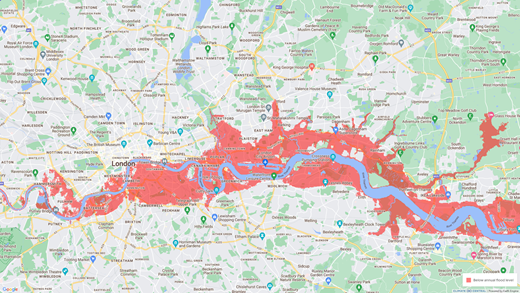
Figure 3 illustrates a flood risk map of London, highlighting areas projected to be underwater within the next decade due to the combined effects of SLR, storm surges, and EWEs. Low-lying regions, particularly along the Thames River, are shown as highly vulnerable, including parts of central London and the Docklands area. The map emphasises critical zones at risk, including transport hubs, residential neighbourhoods, and commercial districts, underscoring the urgency for flood defences, urban planning, and infrastructure adaptation to mitigate these impacts.
In Melbourne, heavy rainfall has overwhelmed drainage systems, causing water accumulation in key metro stations (Moloney and Fünfgeld, 2015). Similarly, in Taipei, sharp rises in GWLs during intense rainfall events create hydrostatic pressure, leading to leaks and structural stress in tunnels near riverbanks (Huang and Chien Li, 2013). Honolulu has experienced multi-mechanism flooding, where SLR-driven marine inundation, groundwater rise, and storm drain backflow collectively affect coastal transport infrastructure (Habel et al., 2020). Washington, DC’s metro system also faces rising hydrostatic pressures, leading to tunnel deformation and water seepage, with saltwater intrusion further accelerating corrosion of infrastructure (Kamal-Chaoui and Robert, 2009). In Shanghai, where much of the metro network lies below sea level, rising groundwater exacerbates material degradation and operational inefficiencies, increasing the need for advanced waterproofing and corrosion-resistant technologies (Kamal-Chaoui and Robert, 2009).
These examples demonstrate the compounding impacts of rising sea levels and EWEs on underground transport systems. The challenges underscore the need for proactive measures such as improved drainage networks, advanced waterproofing systems, and the integration of SLR projections into urban planning to enhance infrastructure resilience.
Impact of EWEs on underground transport infrastructure
Characteristics and frequency of EWEs
EWEs are becoming more frequent and severe due to global climate change, posing significant challenges to infrastructure, including underground transport systems. These events – such as heavy rainfall, storms, heatwaves, droughts, and flooding – are characterised by sudden onset, abnormal intensity, and prolonged duration compared with historical patterns (Seneviratne et al., 2021).
Regional variations influence the severity and type of EWEs. Coastal areas face higher risks of cyclones and storm surges, while inland regions are more prone to heatwaves and droughts. Compounding events, such as simultaneous flooding and landslides, further intensify their impacts (Lima et al., 2021).
The global rise in EWE frequency is driven by higher atmospheric moisture and greenhouse gas emissions. Regions such as South-eastern Asia and Europe are experiencing intensified rainfall (Dore, 2005), while temperate zones see more frequent heatwaves, exacerbating stress on natural and built environments. Human activities, including urbanisation and deforestation, amplify these trends, creating feedback loops that increase their magnitude (Dodman et al., 2021).
These evolving EWEs patterns have serious implications for underground transport infrastructure. Increased flooding from heavy rains and storm surges compromises the structural integrity of tunnels and stations, while heatwaves and droughts accelerate material degradation and foundation instability. Understanding these changing patterns is essential for designing resilient and adaptive transport systems capable of withstanding climate-induced challenges (Dharmarathne et al., 2024).
Heavy rainfall
Underground civil infrastructures, such as tunnels, drainage systems, and culverts, are vital for urban transport, water management, and resilience (Moteff et al., 2004). However, these systems are increasingly vulnerable to heavy rainfall events, which threaten structural stability and operational reliability. Heavy rainfall exacerbates secondary risks such as flooding, soil erosion, and ground instability, particularly where underground and overground systems interact. Water infiltration increases pore pressure, reduces soil strength, and can destabilise underground structures, especially when erosion from overground systems causes soil displacement and adds stress to underground foundations (Jiang and Tan, 2021; Bell, 2013).
Heavy rainfall also generates high hydrostatic pressure due to rising GWLs, particularly in soils with low drainage capacity, leading to additional lateral and vertical loads that compromise structural integrity. Differential ground settlement, triggered by uneven water infiltration, causes deformation and displacement, threatening underground systems’ alignment and stability.
In temperate regions such as the UK, heavy rainfall events similarly result in increased surface runoff rather than deep soil infiltration, particularly in clayey soils with low permeability. Clarke and Smethurst (2010) highlight that cycles of wetting and drying in engineered clay slopes exacerbate surface erosion and shallow instability. This dominance of runoff reduces the extent of pore water pressure changes in deeper soils but intensifies geotechnical challenges, including erosion-related damage and localised seepage issues. Such conditions create significant risks for surface water management and shallow infrastructure, particularly during wetter winters and more intense summer storms projected under UK climate scenarios.
A notable example occurred during 24–25 June 2017 at the Elingguan Tunnel in China’s Guizhou province. Unusual downpours punctured the lining of the construction joint at pier K1 + 125, leading to uncontrolled groundwater discharge (Figures 4 and 5). The storm caused longitudinal cracks in tunnel sidewalls, discharging sediments and crystals, as shown in Figure 5 (Tian et al., 2025).
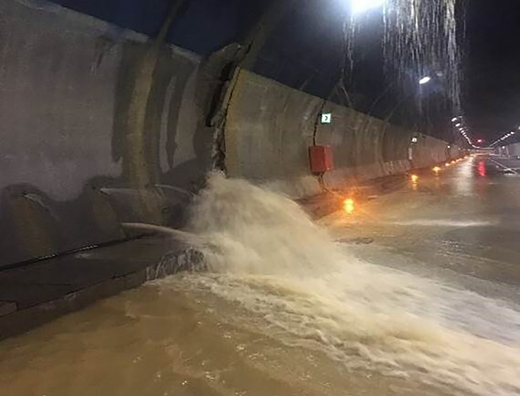
Heavy rainfall at the tunnel site. Elingguan Tunnel, Guizhou, China (source: Tian et al., 2025)
Heavy rainfall at the tunnel site. Elingguan Tunnel, Guizhou, China (source: Tian et al., 2025)
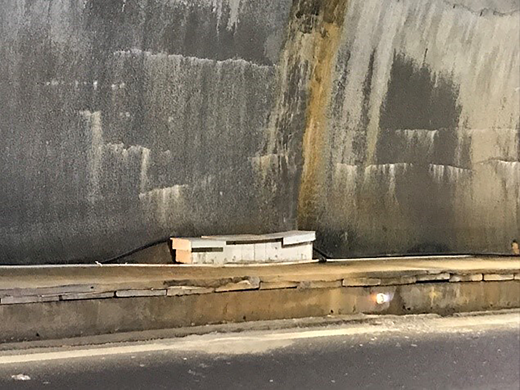
Longitudinal cracks in the side walls of the tunnel. Elingguan Tunnel, Guizhou, China (source: Tian et al., 2025)
Longitudinal cracks in the side walls of the tunnel. Elingguan Tunnel, Guizhou, China (source: Tian et al., 2025)
In Figure 4, it can be seen that during the rainstorm, a series of longitudinal cracks appeared on the sidewalls surrounding the piles, accompanied by the discharge of a considerable number of yellow sediments and white crystals, as shown in the photo in Figure 5 taken after the rainstorm.
Increased frequency and intensity of heavy rainfall, as predicted by Nissen et al. (2017), have amplified failures in urban environments. In China, such events have caused excavation sliding, retaining pile instability, and storm drain ruptures, highlighting the geotechnical challenges (Jiang and Tan, 2021). Figure 6 illustrates examples of heavy rainfall-related failures in existing and under-construction infrastructure.

Heavy rainfall–related failures of existing or under-construction infrastructure in China. (Jiang and Tan, 2021)
Heavy rainfall–related failures of existing or under-construction infrastructure in China. (Jiang and Tan, 2021)
Heavy rainfall remains a critical threat to the sustainability of urban infrastructures, necessitating urgent strategies to address these geotechnical risks as EWEs become increasingly frequent.
Flooding resulting from heavy precipitation
Flooding driven by heavy precipitation and urbanisation poses significant risks to underground transport infrastructure. Climate change has increased the frequency and severity of these events, with metro systems being particularly vulnerable to water ingress, structural damage, and operational disruption (Collins et al., 2013). Urbanisation exacerbates flooding risks by reducing permeable surfaces, which increases surface runoff and overwhelms drainage systems, creating compounded challenges for underground structures.
Figure 7 illustrates severe flooding impacts on metro systems in cities such as New York, Tokyo, Madrid, Prague, Washington, and Brussels (Forero-Ortiz et al., 2020). These images highlight the extent of water ingress, structural damage, and operational challenges during extreme rainfall events.
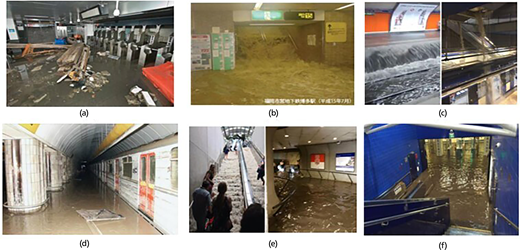
(a) New York; (b) Tokyo; (c) Madrid; (d) Prague; (e) Washington; (f) Brussels (source: Forero-Ortiz et al., 2020)
(a) New York; (b) Tokyo; (c) Madrid; (d) Prague; (e) Washington; (f) Brussels (source: Forero-Ortiz et al., 2020)
A notable example occurred in Shanghai, where heavy rainfall caused extensive water ingress into subway tunnels, weakening their structural integrity and operational capacity. Following this event, hydrodynamic models were used to assess drainage deficiencies and improve flood protection systems (Abdella and Mekuanent, 2021; Wang et al., 2024). Similarly, in Hong Kong, inadequate drainage during torrential rains led to severe flooding, damaging tunnel linings and electrical systems and causing operational delays (Yang et al., 2019).
The increasing urban population and expansion of impermeable surfaces further exacerbate these risks, resulting in electrical system failures, structural damage, and costly repairs. Table 1 summarises notable global case studies of flooding events, highlighting the geotechnical challenges encountered, such as groundwater infiltration, soil destabilisation, and structural deformation.
Summary of geotechnical impacts on underground transport systems due to flooding and seepage events
| Location | Year | Event description | Geotechnical impacts | Source |
|---|---|---|---|---|
| Kharkiv, Ukraine | 2018 | Continuous seepage near shallow metro stations | Risk of subsidence and localised soil collapse threatening shallow tunnel structures | Iegupov et al., 2018 |
| New Delhi, India | 2021 | Urban flash flooding during monsoon season | Tunnel collapse due to saturated soil layers and liquefaction effects | Vandanapu et al., 2016 |
| Holderness, UK | 2023 | Rapid erosion of coastal cliffs along the Holderness coast due to rising sea levels | Loss of coastal land, instability of slopes, and undermining of infrastructure foundations | Nowell, 2023 |
| Milan, Italy | 2023 | Groundwater infiltration during localised flooding | Electrical system failures and long-term groundwater infiltration risks increased maintenance challenges | Sartirana et al., 2022 |
| Tokyo, Japan | 2019 | Flooding in metro systems during heavy rainfall | Seepage pressure damaged retaining walls and caused excessive water logging in metro tunnels | Mishra, 2019 |
| Shanghai, China | 2024 | Heavy rainfall overwhelmed drainage systems | Water infiltration weakened tunnel linings and caused structural deformation due to increased hydrostatic pressure | Deng et al., 2016 |
| Izmir, Turkey | 2024 | Torrential rain and urban runoff | Surface erosion and water ingress compromised structural foundations of metro stations | Salata et al., 2022 |
| Turin, Italy | 2024 | Intense convective rainfall | Ground settlement destabilised underground tunnels, necessitating the deployment of early warning systems | Hardin, 2014 |
| Venice, Italy | 2024 | Storm surges and rising sea levels | Saltwater infiltration degraded concrete linings and caused subsidence in underground drainage systems | Allegri et al., 2024 |
Advanced simulation models are now widely used to predict potential tunnel flooding under extreme rainfall conditions. These models incorporate hydrological, topographical, and geotechnical data to simulate water flow and drainage capacity. Common tools include hydrodynamic models, which account for tunnel geometry and flow patterns; drainage network models, which evaluate existing drainage performance; and flood prediction models, which predict flooding magnitude based on meteorological data (Gao et al., 2023).
Extreme temperature changes
Recent analyses confirm that 2023 was the warmest year on record, with 2024 likely to surpass it. National Aeronautics and Space Administration (NASA) reported a 1.2°C increase in Earth’s average temperature above the 1951–1980 baseline, while the World Meteorological Organization (WMO) recorded a rise of 1.45°C above pre-industrial levels in 2023 (NASA, 2024; Polya, 2023). Preliminary data for January–September 2024 indicate further warming, with surface temperatures 1.54°C higher than pre-industrial levels (Dunstone et al., 2024). On 6 July 2024, the global average daily temperature reached 17.16°C, the highest ever recorded (Toreti et al., 2024).
The rise in global temperatures is driven by elevated greenhouse gases, including CO2, CH4, and N2O. Atmospheric CO2 concentrations hit 424 ppm in 2023, compared with 280 ppm in pre-industrial times (Friedlingstein et al., 2024). Methane emissions, largely from agriculture and energy sectors, further exacerbate warming (Filonchyk et al., 2024).
The impacts of extreme temperatures are evident globally. In July 2024, the western US experienced record-breaking temperatures, including 51.1°C in Palm Springs (New York Magazine, 2024). Similarly, in May 2024, a severe heatwave in Mexico exceeded 45°C in 19 states, causing health crises and at least 61 fatalities (Le Monde, 2024). Europe also recorded unprecedented heat; France’s hottest June saw temperatures exceeding 40°C, severely disrupting agriculture and energy production (Yiou et al., 2023).
Two datasets further illustrate rising global temperatures (Our World in Data, 2024). Figure 8 shows a steady increase in August temperatures from 1990 to 2024, highlighting the severity of seasonal warming (Twardosz et al., 2021).
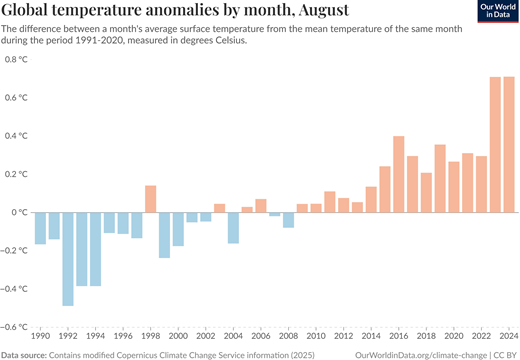
Global temperature anomalies in August, from 1990 to 2024 (www.ourworldindata.org)
The second dataset, Figure 9, focuses on November temperatures over the same period, underscoring that warming is not confined to summer but is a year-round phenomenon. Research by Dunstone et al. (2024) demonstrates how climate change is altering temperature patterns across all seasons, reducing variability and making extreme events more frequent.
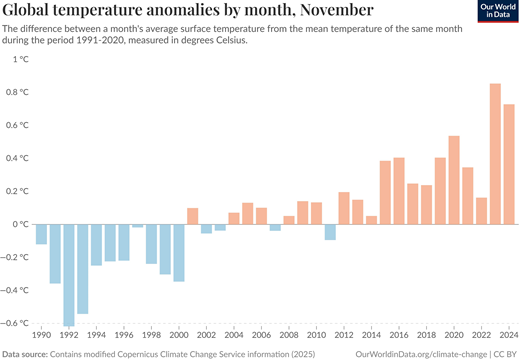
Global temperature anomalies in November, from 1990 to 2024 (www.ourworldindata.org)
Extreme temperatures also affect critical infrastructure, as outlined in Table 2. Various mechanisms demonstrate how climate change challenges structural integrity and operational efficiency.
Mechanisms and case studies of environmental impacts on underground infrastructure
| Mechanisms of impact | Description | Case studies |
|---|---|---|
| Material expansion and stress | Thermal expansion causes stress in tunnel structures, leading to cracking | London Underground: Heat-related cracking and retrofitting needs (Nicholson et al., 2014). |
| Performance under heat stress | Heat misalignments and stress cracks in rail tunnels reduce safety | London Underground: Misalignments during heatwaves require fixes (Steen et al., 2022). |
| Freeze–thaw cycles | Freeze–thaw cycles, cause frost heave, leading to settlement and damage | Norwegian tunnels: Frost heave damages linings and pavements (Aursand, 2013). |
| Soil dynamics during thawing | Thawing permafrost destabilises soil, causing tunnel distortion | Sub-arctic tunnels: Thawing causes uneven settlement and damage (Kurylyk et al., 2014). |
| Heat retention in enclosed spaces | Poor ventilation retains heat, compromising structure and comfort | Singapore metro: Heat stress from poor ventilation (Acero et al., 2022). |
| Energy demands for cooling | Extreme heat raises cooling needs, creating operational inefficiencies | High cooling costs in extreme heat (Goel et al., 2012). |
Consequences of severe climate variations on underground transport infrastructure
The increased frequency and intensity of various EWEs, such as floods, storms, droughts, and thaws, are causing structural damage, soil erosion, differential settlement, failure of drainage systems, and other impacts that compromise the integrity of infrastructure. In addition, permafrost retreat in Arctic and sub-Arctic regions, as a consequence of global warming, is causing settlement and deformation of infrastructure currently built on frozen ground (Fernández‐Fernández et al., 2024; Hinzman et al., 2005; Kurylyk et al., 2014).
Figure 10 visually illustrates how global temperature increases, a key driver of climate change, trigger various meteorological phenomena – such as heavy precipitation, storms, and SLR – that subsequently lead to geotechnical hazards such as floods, ground subsidence, and soil destabilisation. These hazards directly affect underground transport infrastructure, resulting in issues such as tunnel flooding, groundwater infiltration, and material corrosion.
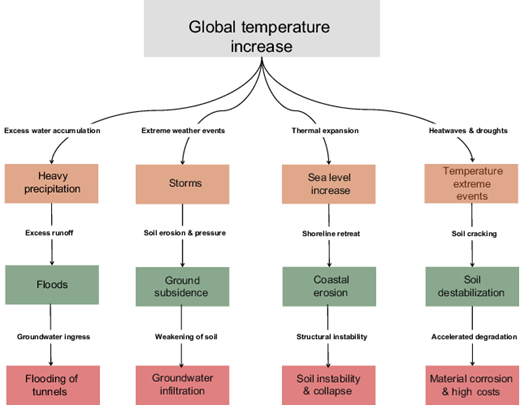
Potential natural hazards due to climate change (source: re-edited from Kandalai et al., 2023)
Potential natural hazards due to climate change (source: re-edited from Kandalai et al., 2023)
These risks stem from phenomena such as flooding, droughts, freeze–thaw cycles, and permafrost thaw, leading to geotechnical and structural failures. This section systematises these challenges by linking climatic drivers to their impacts. Table 3 presents a structured summary of climate processes, causes, and their impacts on underground infrastructure.
Global impacts of severe climate variations on underground infrastructure
| Country/region | Phenomenon | Causes | Impacts | Examples |
|---|---|---|---|---|
| Arctic/sub-arctic | Permafrost thaw | Rising global temperatures | Settlement, deformation of underground tunnels and pipelines | Deformation of underground pipelines in Siberia due to thawing permafrost (Ivanov et al., 2024) |
| Europe (Netherlands) | Groundwater level shifts | Intense precipitation, drought | Instability of underground metro systems and seepage | Amsterdam metro experiencing foundation issues and seepage from groundwater shifts (Jiang and Tan, 2022) |
| China | Heavy rainfall | Increased storm intensity | Flooding in underground tunnels and drainage system failures | Zhengzhou metro flooding (2021): 14 passengers killed in a tunnel during a heavy storm (Mishra, 2019) |
| Japan/Norway | Freeze–thaw cycles | Temperature fluctuations | Cracking and water ingress in underground tunnels | Hokkaido rail tunnels suffering frost heaving and cracking (Mishra, 2019; Aursand, 2013) |
| USA (New York) | Urban flooding | Inadequate drainage systems and sea level rise | Submersion of subway systems, electrical equipment damage | New York subway system flooded during Hurricane Sandy (2012), $5 billion in damage (Cariolet et al., 2019) |
A study of over 15 000 tunnels in China revealed that 52.4% were damaged by extreme rainfall events, primarily from storm surges and prolonged precipitation (Jiang and Tan, 2022). The Netherlands faces a similar challenge, with urban infrastructure threatened by rising GWLs.
Among the underground infrastructure failures caused by the heavy rainfall, the most affected were tunnels, underground containment structures, and stormwater drainage systems with varying underground depths, as shown in Figure 11. This visualisation provides a tangible representation of the vulnerabilities faced by underground infrastructures during heavy rainfall events, underlining the imperative need for specific adaptation strategies and improved design practices to ensure the long-lasting functionality of these critical systems. According to Cariolet et al. (2019) and Jiang and Tan (2022), the larger diameter and depth of underground infrastructures and utilities correspond to higher magnitudes of damage caused by heavy rainfall.

Schematic of urban underground infrastructures threatened by heavy rainfall (source: Jiang and Tan, 2022)
Schematic of urban underground infrastructures threatened by heavy rainfall (source: Jiang and Tan, 2022)
According to the Chinese national standard GB/T 28592-2012 (CNSA, 2012), which defines rainfall intensity levels according to the thresholds set out in Table 4, the rainfall intensity levels related to underground infrastructure failures were investigated and the relative frequency of each level was calculated using meteorological data from nearby stations or investigation reports of previous cases.
Intensity and frequency of failure-related rainfall events (source: Jiang and Tan, 2022)
| Grade | Rainfall intensity: mm/day | Relative frequency of occurrence: % |
|---|---|---|
| 1 Light rain | 0.1–9.9 | 0.0 |
| 2 Moderate rain | 10.0–24.9 | 0.8 |
| 3 Heavy rain | 25.0–49.9 | 49.2 |
| 4 Torrential rain | 50.0–99.9 | 31.2 |
| 5 Severe torrential rain | 100.0–249.9 | 14.6 |
| 6 Extreme torrential rain | ≥250 | 4.2 |
The results indicate that 99.2% of the failures were related to ‘heavy’ or higher rainfall levels and that, among the six rainfall intensity levels, the ‘heavy’ level was the most frequent, accounting for 49.2% of the failures. These results show that there is a significant relationship between heavy rainfall and underground infrastructure failures in urban areas.
Groundwater fluctuations and changes in soil parameters
Groundwater fluctuations, defined as variations in GWLs over time and space, significantly impact the geotechnical properties of soils and the stability of underground infrastructure. These fluctuations alter soil characteristics such as permeability, compressibility, shear strength, and bearing capacity, which are critical to infrastructure performance. While soils are highly responsive to groundwater changes, rocks generally offer greater short-term stability, except for karstic rocks, which are prone to dissolution over longer timescales (Baroková et al., 2023; Green, 2016).
Soils and rocks respond differently to groundwater fluctuations. Soils, being unconsolidated materials, exhibit rapid changes in permeability and mechanical properties under varying moisture levels. Rocks, although consolidated, may experience localised instability due to fractures and joints that facilitate water infiltration over time (Leap, 2016).
The porosity and permeability of geological materials dictate groundwater behaviour. Highly porous and permeable materials, such as sand and gravel, store significant groundwater and allow its movement with ease (Leap, 2016). Conversely, materials such as clay and granite exhibit low permeability, with water movement restricted to fine cracks and pores, resulting in slower water transmission (Nelson, 1994).
Effects of climate change on GWL fluctuations and their impact on groundwater infrastructure
Groundwater fluctuations, influenced by climate change, human activities, and land use changes, significantly affect underground infrastructure. Overpumping for agricultural, industrial, and domestic use has caused a sustained decline in GWLs, leading to saltwater intrusion, land subsidence, and reduced water availability (Mondal et al., 2024; Pramita et al., 2021). Climate change further amplifies GWLs variations through altered precipitation patterns, storm intensities, and prolonged droughts, introducing both hydraulic and hydrochemical challenges (Jiang and Tan, 2021).
In urban areas, where underground infrastructure is dense, groundwater pressure can erode foundations, cause seepage, and lead to costly repairs. For example, Shanghai’s multi-aquifer–aquitard system (MAAS), comprising alternating aquifers and clayey aquitards (Figure 12), amplifies groundwater-related risks. Rising GWLs during wet seasons increases hydrostatic pressure, leading to seepage, material degradation, and structural deformation. Groundwater rich in chloride and sulfate ions accelerates the corrosion of tunnel linings and metro systems (Ghobadi et al., 2016). In addition, Shanghai’s soft clay and silty soils, prone to settlement under fluctuating pore water pressures, further destabilise tunnels and underground stations (Shen et al., 2021; Xu et al., 2009).
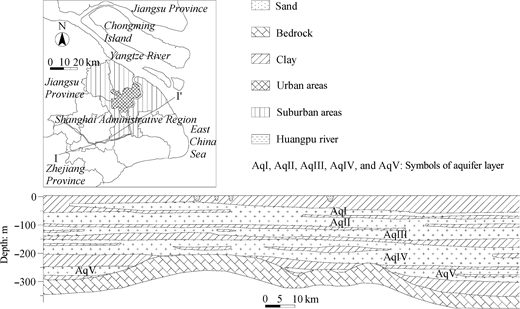
Shanghai’s MAAS, with alternating permeable aquifers and clayey aquitards, creates a complex hydrogeological environment (Xu et al., 2009). During wet seasons, rising GWLs increase hydrostatic pressure, causing seepage, deformation, and material degradation in underground infrastructure. Groundwater, rich in chloride and sulfate ions, accelerates the corrosion of construction materials, particularly in tunnels and metro systems, as ion-rich water infiltrates cracks and joints (Luo et al., 2015; Li et al., 2021). Over time, exposure to these aggressive hydrochemical conditions compromises the structural integrity of underground structures, increasing safety risks. In addition, soft clay and silty soil deposits in Shanghai become unstable under fluctuating pore water pressures, leading to settlement, cracking, and shrinkage (Shen et al., 2021).
Similar challenges are observed in Milan, where rising water tables now submerge metro systems initially designed for dry conditions. Extensive waterproofing and maintenance are required to ensure functionality. Figure 13 illustrates historical GWL fluctuations at Milan’s Comasina Station, showing water table recovery following reduced abstraction and industrial decline. While groundwater recovery is environmentally positive, it poses unforeseen risks for older infrastructure not designed for such conditions (De Caro et al., 2020; Colombo et al., 2017).

Groundwater level in Comasina Station (Milan) (Colombo et al., 2017). Re-edited
From a geotechnical perspective, alluvial and marine deposits in Shanghai’s subsurface complicate the interaction between groundwater and soil. Rising GWLs during heavy rainfall increases pore pressures, reducing soil shear strength and triggering settlement or deformation risks. Conversely, droughts or excessive pumping dries clayey soils, causing shrinkage and cracking, further destabilising foundations and tunnels (Shen et al., 2021).
Geotechnical challenges of groundwater in tunnelling
Tunnelling operations interact with groundwater systems, creating geotechnical challenges such as changes in soil strength, hydraulic conductivity, and seepage pressure management. Addressing these challenges is crucial to maintaining excavation stability and ensuring long-term structural integrity.
One key issue is the reduction in effective stress caused by groundwater saturation. Rising groundwater increases pore pressures, weakening soil shear strength and increasing compressibility, leading to deformation and instability. In sandy soils, high groundwater flow can cause piping and internal erosion, destabilising tunnel linings and surrounding soils. Figure 14 illustrates how seepage and pressure gradients interact with soil strength and structural stability (Pan and Dias, 2016).

Geotechnical challenges of groundwater in underground infrastructure. (source: re-edited from Attard et al., 2016)
Geotechnical challenges of groundwater in underground infrastructure. (source: re-edited from Attard et al., 2016)
Improper dewatering during tunnelling can exacerbate risks. Artificially lowering GWLs facilitates excavation in dry conditions, but excessive dewatering can cause differential settlement and soil subsidence, particularly in compressible soils. For example, during metro tunnel construction in Shanghai, inadequate groundwater control led to localised deformation and surface infrastructure damage. Modern strategies, such as real-time monitoring systems, now allow adaptive dewatering to mitigate such risks (Shen et al., 2021).
Site geological conditions further complicate tunnelling. In karst terrains, fluctuating groundwater dissolves soluble rocks such as limestone, creating voids that destabilise surrounding rock masses, requiring grouting or cavity filling (Green, 2016). In soft clayey soils, rising groundwater increases pore pressures, reducing shear strength and complicating tunnel lining stability.
Seasonal changes in groundwater temperature can also affect soil-freezing methods, requiring tailored stabilisation approaches for specific climatic conditions (Yang et al., 2015).
To manage these challenges, comprehensive mitigation strategies are essential. Figure 15 highlights techniques such as grouting, cutoff walls, and advanced drainage systems that stabilise soils and control groundwater flows. The integration of real-time monitoring systems with adaptive engineering designs has been instrumental in addressing fluctuating GWLs, ensuring safe and resilient tunnel construction (Pan and Dias, 2016).
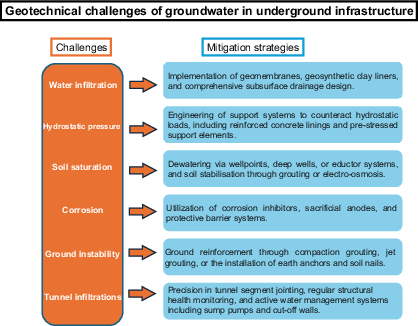
Geotechnical challenges of groundwater in underground infrastructure – mitigation strategies (source: re-edited from Attard et al., 2016)
Geotechnical challenges of groundwater in underground infrastructure – mitigation strategies (source: re-edited from Attard et al., 2016)
Conclusion
This literature review comprehensively examines the vulnerabilities and challenges that underground infrastructure faces in the context of climate change. It investigates critical factors, including changing rainfall patterns, rising sea levels, extreme temperatures, and global warming, which have a significant impact on critical underground infrastructures such as pipelines, utility networks, and tunnels. These climate-induced changes result in both direct and indirect effects, outlined as follows.
SLR, predominately driven by global warming and greenhouse gas emissions, poses one of the gravest threats to coastal underground transport infrastructure. It has been estimated that sea levels have increased at an average rate of 3.57 mm/year over the last 30 years, posing a significant risk to coastal cities and amplifying the hazards associated with EWEs. As sea levels rise, hydrostatic pressure on subsurface coastal infrastructure increases, causing water seepage that jeopardises structural integrity and, as a result, infrastructure serviceability.
The increased frequency and intensity of rainfall, caused by global warming, contribute significantly to soil erosion and undermine the stability of subsurface structures. Heavy rainfall alters soil composition, weakens foundational stability, and leads to structural instability in tunnels, drainage systems, and sewers. These effects compound to disrupt drainage systems, elevate flooding risks, and increase maintenance burdens.
Temperature fluctuations, while widely recognised for their atmospheric impacts, also pose significant challenges to underground transport infrastructure. The sharp increase in global temperatures contributes to thermal expansion and contraction within underground structures, which can lead to cracking and material degradation in tunnel linings and support systems. Freeze–thaw cycles, particularly in colder regions, cause frost heave and settlement, destabilising soil and damaging tunnel integrity. In addition, extreme heat within enclosed underground spaces, such as metro systems, exacerbates ventilation challenges, increases cooling demands, and impacts passenger comfort and safety. These mechanisms directly link temperature changes to operational and structural challenges for underground systems, underscoring the urgency of implementing climate adaptation strategies.
Fluctuations in the water table, caused by severe and erratic rainfall, may severely damage underground infrastructure. Rising GWLs increase hydrostatic pressure on subsurface structures, endangering their integrity and causing irregular settling, distortion, and displacement. Furthermore, water penetration exacerbates these issues, particularly in ageing infrastructure that is prone to seepage, which hinders infrastructure expansion and may result in soil wetness.
Given the circumstances described above, future studies should propose a multidisciplinary strategy to successfully address the problems posed by climate change to subsurface infrastructures. This entails incorporating climate resilience methods into the design and construction of new infrastructure, as well as modifying existing facilities to resist future climate scenarios. In future studies, the deployment of adaptation measures and the adoption of sustainable practices are critical in order to reduce hazards, protect public safety, and maintain the performance of underground infrastructures in the face of climate change.
Declaration of funding
The research presented in this article is funded by the Irish Research Council Postgraduate Employment-based Programme under the grant number EBPPG/2022/11, in collaboration with University College Cork (UCC) and Gavin & Doherty Geosolutions (GDG).

