

In order to study the effects of pre-existing fissures on the failure characteristics of granite after high-temperature treatment, granite samples containing three different sets of fissures were heated at different temperatures (100–800°C), and then a uniaxial compression test was carried out. The major findings are as follows. (a) Temperature and pre-existing fissures have a great influence on the strength of granite. When the temperature is low, the compressive strength exhibits an approximately linear upward relation with increasing α in the range from 30 to 60°. However, with increasing temperature, the effect of pre-existing fissures on the strength of granite decreases, and this trend of growth gradually diminishes. In addition, the thickness of granite samples (from 16 to 29 mm) has little effect on the strength of granite in this study. (b) The failure of granite is transformed from brittle to plastic deformation with elevated treatment temperature. In addition, according to failure patterns of granite, there are four crack failure modes under uniaxial pressure. Failure modes I and II occur below 600°C, and failure modes III and IV mainly occur above 600°C.
Notation
- 2a
length of the fissure (mm)
- A
bearing area (mm2)
- B1, B2
brittleness of granite after treatment by high temperature
- d
width of the fissure (mm)
- h
thickness of the granite samples (mm)
- P
peak stress (kN)
- T
treatment temperature (°C)
- α
angle between the fissure and minimum principal stress (°)
- ϵel
elastic (recoverable) strain
- ϵli
absolute irreversible longitudinal strain
- ϵtot
total strain at failure
- σc
peak strength (MPa)
Introduction
In recent years, the effect of temperature on rock fracture has been a concern. The properties of rock masses change after exposure to high temperature; this can be applied in many fields, such as stability and safety assessment of rock tunnels and bridges after fires (Ozguven and Ozcelik, 2013; Smith and Pells, 2008; Tang et al., 2017), geothermal energy exploitation (Ogino et al., 1999; Zhao et al., 2011), friction of deep-well drilling and high-temperature-assisted rock breaking (Shafiei and Dusseault, 2013) and storage sites of highly radioactive nuclear waste underground (Emirov et al., 2013; Hudson, 2001; Rutqvist et al., 2005; Wang et al., 2015), which all cause changes in rock properties. Based on the aforementioned applications, many studies have recently researched the influence of temperature and the corresponding changes on the thermal damages and failure mechanical behaviours of rock masses under different temperatures (Brotóns et al., 2013; Heuze, 1983; Lü et al., 2017; Shen et al., 2019; Sun et al., 2015, 2016; Yang et al., 2017; Yao et al., 2016; Yu et al., 2015; Wu et al., 2013). These researches have pointed out that the peak strength of rock gradually decreases with increasing temperature. In particular, the studies of granite by Chen et al. (2012), Liu and Xu (2014, 2015), Sun et al. (2015) and Yang et al. (2017) proposed that the compressive strength of granite slowly decreases below 400°C and then decreases rapidly, and indicated that the change in the strength of granite samples is related to the damage of the structure caused by thermal reactions.
In fact, different original cracks exist in the rock mass, which also influence the properties of rocks (Lu et al., 2014; Shao et al., 2015; Zhu et al., 2016). Clerici (1990) proposed that the use of a shape tracer combined with a computer provides quick and accurate determination of the fissure roughness. Finn et al. (2003) suggested that a segmented geometry may be used to establish the kinematics of fracture progression in fissure rocks at other scales and in different geologic settings. However, due to the complexity of cracks in rock mass, the influence of internal cracks on rock properties cannot be directly studied. Therefore, previous researchers have treated rocks under laboratory conditions and simulated primary cracks in rocks through the pre-existing fissure or hole method, and the effect of cracks on rock mechanical properties has been further studied (Huang et al., 2017; Wong and Chau, 1998; Wong and Einstein, 2009; Wong et al., 2001, 2002; Yang et al., 2008, 2011, 2012, 2014a, 2014b). Wong and Chau (1998) and Wong et al. (2001) studied crack coalescence in a rock-like material containing two and three cracks. Wong et al. (2002) and Wong and Einstein (2009) studied cracking and failure behaviour in rock samples containing single flaws under uniaxial compression. Yang et al. (2011, 2012, 2014a, 2014b) found that the uniaxial compressive strength of a sandstone sample containing a single fissure, two fissures and three fissures exhibits an obvious non-linear relationship with the fissure angle and the strength decreases with the number of fissures. Lu et al. (2014) studied the strength failure and crack coalescence behaviour of sandstone containing a single pre-existing fissure (45°). However, there have been few studies on the combined influences of temperature and ‘X’-type fissures on the mechanical properties of rocks. Therefore, in this study, the effects of temperature and X-type fissures on the compressive strength and failure characteristics of granite were further studied and analysed.
Methods and materials
Sample preparation and temperature treatment
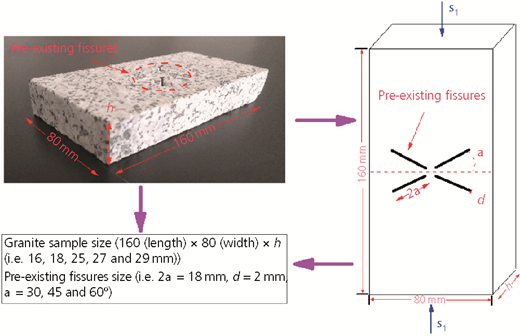
Granite samples with a bulk density of 2·68 g/cm3 and a water content of 0·03% were collected from Linyi, Shandong, China. The samples were cut into plate shapes (160 mm (length) × 80 mm (width)) with five different thickness levels (16, 18, 25, 27 and 29 mm). Moreover, the samples were cut with three fissure types (18 mm (length) × 2 mm (width)). The total number of granite samples required for the experiment was 210. The samples were heated at seven different temperature levels (100, 300, 400, 500, 600, 700 and 800°C) in a furnace (type KSL-1700X) at a rate of 10°C/min and isothermally maintained for 1 h. Then, the samples were cooled to room temperature by air.
Uniaxial compression test
In this study, according to the stress direction of the rock sample in Figure 1, all samples were tested by a computer-controlled hydraulic universal testing machine (WES-1000D) at a loading rate of 0·5 kN/s. The compressive strength of the samples with pre-existing fissures after different temperature treatments was calculated by using Equation 1, and the failure mode of the samples was analysed.
where σ c is the peak strength (MPa); P is the peak stress (kN); and A is the bearing area (mm2).
Results
Effects of high temperature on granite strength
The test results are shown in Table 1 and Figure 2, and they show that the compressive strength can be divided into two stages with elevated treatment temperature.
Stage 1 is from 100 to 400°C. In this stage, the compressive strengths of the granite samples do not change obviously with increasing temperature. As shown in Table 1, when α = 30°, the average compressive strengths of the granite samples with h = 16, 18, 25, 27 and 29 mm are 115·02, 116·87, 118·57, 123·26 and 148·88 MPa, respectively, after heating treatment at 100°C. The average compressive strengths of the granite samples with h = 16, 18, 25, 27 and 29 mm are 92·48, 90·39, 98·55, 132·80 and 132·32 MPa, respectively, after heating treatment at 400°C (as shown in Figure 2(a)). When α = 45°, the average compressive strengths of the granite samples with h = 16, 18, 25, 27 and 29 mm are 127·41, 124·36, 141·96, 161·38 and 157·62 MPa, respectively, after heating treatment at 100°C. The average compressive strengths of the granite samples with h = 16, 18, 25, 27 and 29 mm are 114·65, 130·37, 136·81, 142·56 and 137·68 MPa, respectively, after heating treatment at 400°C (as shown in Figure 2(b)). When α = 60°, the average compressive strengths of the granite samples with h = 16, 18, 25, 27 and 29 mm are 139·01, 151·29, 158·67, 159·57 and 173·88 MPa, respectively, after heating treatment at 100°C. The average compressive strengths of the granite samples with h = 16, 18, 25, 27 and 29 mm are 115·32, 140·01, 154·07, 160·80 and 150·41 MPa, respectively, after heating treatment at 400°C (as shown in Figure 2(c)).
Stage 2 is from 400 to 800°C. During this stage, the compressive strengths of the granite samples decrease rapidly. When α = 30°, the compressive strengths of the granite samples with h = 16, 18, 25, 27 and 29 mm decrease to only 27·79, 38·24, 43·97, 38·56 and 31·34 MPa, respectively, after heating treatment at 800°C. When α = 45°, the compressive strengths of the granite samples with h = 16, 18, 25, 27 and 29 mm decrease to only 48·69, 54·64, 48·20, 48·98 and 34·11 MPa, respectively, after heating treatment at 800°C. When α = 60°, the compressive strengths of the granite samples with h = 16, 18, 25, 27 and 29 mm decrease to only 49·72, 59·28, 54·00, 48·94 and 40·00 MPa, respectively, after heating treatment at 800°C.
Average compressive strength values of the granite samples (MPa)
| h: mm | α: ° | Average compressive strength: MPa | ||||||
|---|---|---|---|---|---|---|---|---|
| 100°C | 300°C | 400°C | 500°C | 600°C | 700°C | 800°C | ||
| 16 | 30 | 115·02 | 105·83 | 92·48 | 75·20 | 59·52 | 54·11 | 27·79 |
| 45 | 127·47 | 121·80 | 114·65 | 90·81 | 72·73 | 62·82 | 48·69 | |
| 60 | 139·01 | 125·17 | 115·32 | 90·64 | 73·77 | 66·22 | 49·72 | |
| 18 | 30 | 116·87 | 109·88 | 90·39 | 71·32 | 69·74 | 45·92 | 38·24 |
| 45 | 124·36 | 138·42 | 130·37 | 126·32 | 78·48 | 49·48 | 54·64 | |
| 60 | 151·29 | 142·61 | 140·01 | 135·37 | 87·44 | 54·15 | 59·28 | |
| 25 | 30 | 118·57 | 109·95 | 98·55 | 85·81 | 74·02 | 40·16 | 43·97 |
| 45 | 141·96 | 147·00 | 136·81 | 124·11 | 84·97 | 60·57 | 48·20 | |
| 60 | 158·67 | 157·97 | 154·07 | 154·49 | 108·78 | 79·60 | 54·00 | |
| 27 | 30 | 123·26 | 136·05 | 132·80 | 129·53 | 86·54 | 54·62 | 38·56 |
| 45 | 161·38 | 150·44 | 142·56 | 130·99 | 98·17 | 61·65 | 48·98 | |
| 60 | 159·57 | 162·06 | 160·80 | 153·03 | 107·50 | 68·88 | 48·94 | |
| 29 | 30 | 148·88 | 130·05 | 132·32 | 117·45 | 63·82 | 39·60 | 31·34 |
| 45 | 157·62 | 140·33 | 137·68 | 140·45 | 69·33 | 52·80 | 34·11 | |
| 60 | 173·88 | 148·81 | 150·41 | 147·98 | 85·55 | 66·24 | 40·00 | |
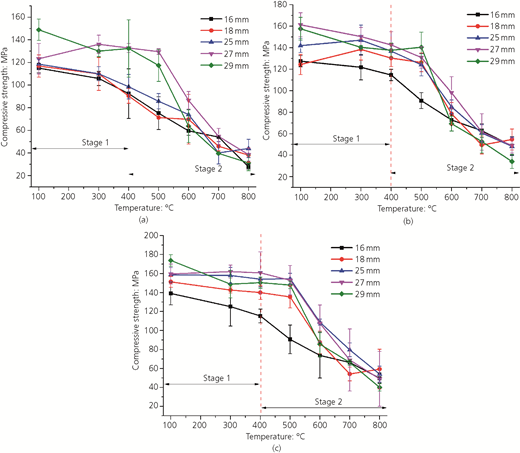
Compressive strengths of the granite samples with respect to temperature: (a) α = 30°; (b) α = 45°; (c) α = 60°
Compressive strengths of the granite samples with respect to temperature: (a) α = 30°; (b) α = 45°; (c) α = 60°
Effects of fissures on granite strength
Figure 3 shows the compressive strengths of the samples with different types of fissures. The results indicate that compressive strength exhibits an upward trend with increasing α. The compressive strengths of the granite samples (T = 100°C and h = 16 mm) first increase from 115·02 MPa (α = 30°) to 127·47 MPa (α = 45°) and then to 139·01 MPa (α = 60°).
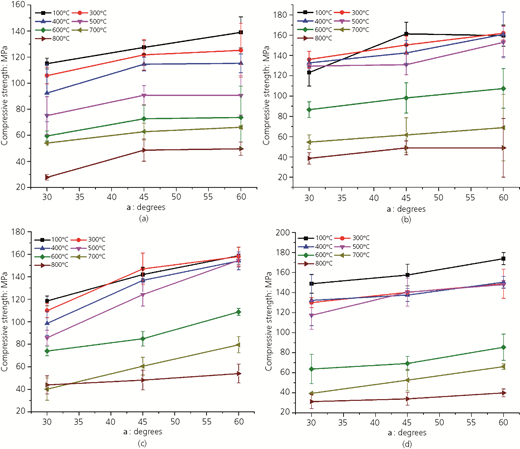
Compressive strengths of the granite samples with respect to pre-existing fissure angle: (a) h = 16 mm; (b) h = 25 mm; (c) h = 27 mm; (d) h = 29 mm
Compressive strengths of the granite samples with respect to pre-existing fissure angle: (a) h = 16 mm; (b) h = 25 mm; (c) h = 27 mm; (d) h = 29 mm
Effects of thickness on granite strength
It can be seen from Figure 4 that the curve is approximately parallel in the thickness range 16–27 mm. When the thickness exceeds 27 mm, the curve tends to decrease. The overall change trend is relatively small.
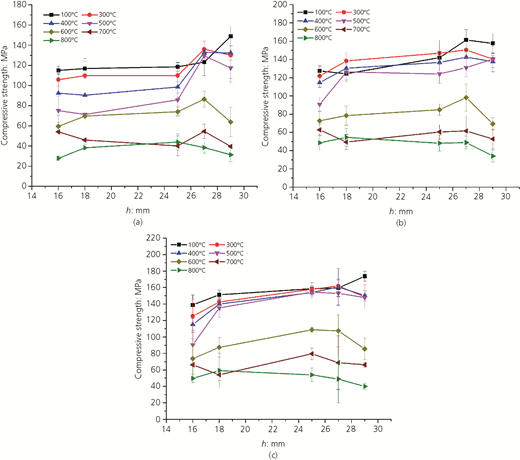
Relationship between thickness and compressive strength: (a) α = 30°; (b) α = 45°; (c) α = 60°
Relationship between thickness and compressive strength: (a) α = 30°; (b) α = 45°; (c) α = 60°
Uniaxial failure characteristics of granite
Shown in Figure 5 are the stress–deformation curves of the granite samples with different fissures. The results show that the peak stress of granite increases with increase in the fissure angle and that the axial deformation of granite experiences little change with different fissure types.
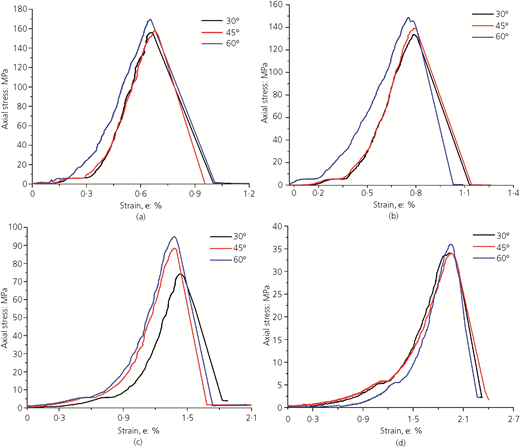
Stress–deformation curves of heated granite samples (e.g. h = 29 mm) with different pre-existing fissures: (a) 100°C; (b) 300°C; (c) 600°C; (d) 800°C
Stress–deformation curves of heated granite samples (e.g. h = 29 mm) with different pre-existing fissures: (a) 100°C; (b) 300°C; (c) 600°C; (d) 800°C
Figure 6 shows the main failure and crack characteristics of the granite samples (three types of pre-existing fissures) after heat treatments at 100, 300, 500, 600, 700 and 800°C. When the treatment temperature is between 100 and 600°C, the sample is broken into large pieces when damaged. The brittle fracture and axial distribution of the rock sample cracks are the main failure features. When the granite samples are heated at 800°C, at the moment of failure, the sample is broken into large pieces and flaky and granular powder. Moreover, according to failure patterns of granite (Yang et al., 2011, 2014a; Zhang et al., 2019), there are four crack failure modes under uniaxial pressure from Figure 6. In mode I, there are three new cracks, two cracks on both sides passing through pre-existing fissures and a parallel new crack in the middle along the stress direction. In mode II, there are three new cracks, two cracks on both sides not completely passing through pre-existing fissures and a new crack in the middle along the stress direction. In mode III, there are only two new cracks on both sides, which pass through pre-existing fissures. In mode IV, there are only two new cracks, which do not completely pass through pre-existing fissures.
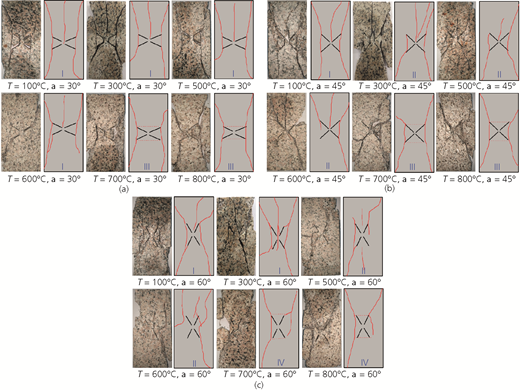
Uniaxial failure and crack characteristics of granite (e.g. h = 29 mm) after high-temperature treatment: (a) α = 30°; (b) α = 45°; (c) α = 60°
Uniaxial failure and crack characteristics of granite (e.g. h = 29 mm) after high-temperature treatment: (a) α = 30°; (b) α = 45°; (c) α = 60°
Discussion
It is known that the mechanical properties of rock are affected by rock shape, rock size, temperature, crack distribution, crack quantity and confining pressure (Heap et al., 2009; Nara and Kaneko, 2006). In this study, the mechanism of the effect of cracks and temperature on the mechanical properties of granite will be analysed as follows.
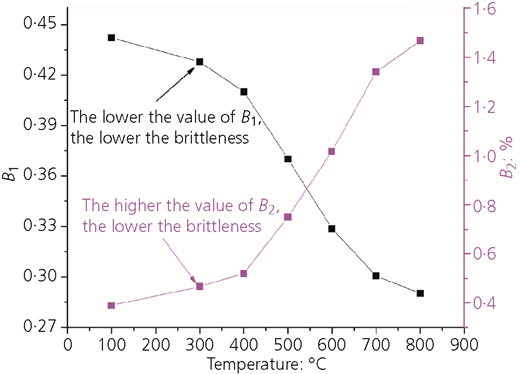
In this study, the compressive strengths of granite samples decrease with increasing temperature, which has a similar change trend with previous studies (see Figure 7) (Huang et al., 2017; Liu and Xu, 2015; Shao et al., 2015; Sun et al., 2015). In the process of heat treatment, the physical and chemical properties of granite mineral particles change, which leads to changes in the internal structure of granite (Sun et al., 2016; Zhang et al., 2016). In this study, the granite sample is mainly composed of quartz, feldspar and hornblende. These minerals have different thermal expansion coefficients, which form a heterogeneous structure in terms of thermal stresses (David et al., 1999; Liu and Xu, 2014; Yoshitaka et al., 2010). With increasing temperature, quartz, feldspar and hornblende exhibit inhomogeneous expansion. When the thermal stress reaches or exceeds the local strength, the maximum thermal stress occurs at the intersection point of the mineral particles, and the connections between the mineral particles are destroyed and microcracks appear and expand (as shown in Figure 8) (Freire-Lista et al., 2016; Griffiths et al., 2017, 2018; Liu and Xu, 2014; Xiao et al., 2018, 2019). In addition, the phase transition of the minerals could also lead to increasing structural defects in the mineral particles. At approximately 573°C and atmospheric conditions, quartz is transformed from alpha quartz to beta quartz (as shown in Figure 7) (Somerton and Boozer, 1961). The rapid expansion of mineral particles results in a decrease in compressive strength (Alm, 1985; Sun et al., 2016, 2015). Temperature also leads to change in the brittleness of granite (Chen et al., 2012; Liu and Xu, 2014; Shao et al., 2015; Sun et al., 2015; Tullis and Yund, 1977; Violay et al., 2017; Yang et al., 2017). The brittleness of granite after treatment by high temperature is calculated by using Equations 2 and 3 (Andreev, 1995; Hucka and Das, 1974).
where ϵel is the elastic (recoverable) strain and ϵtot is the total strain at failure.
where ϵli is the absolute irreversible longitudinal strain.
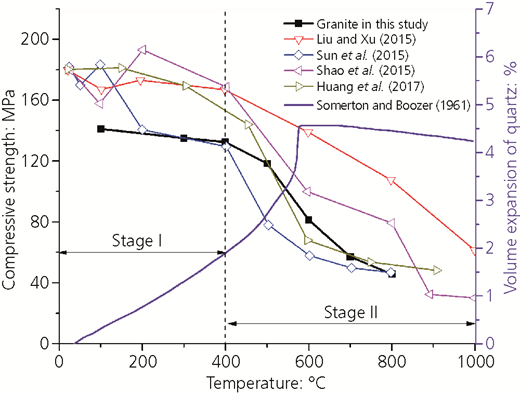
Strengths of the granite samples with increasing temperature: Liu and Xu (2015): ∅50 × 100 mm; Sun et al. (2015): ∅50 × 100 mm; Shao et al. (2015): ∅22·5 × 45 mm; Huang et al. (2017): 160 (length) × 80 (width) × 30 mm (thickness)
Strengths of the granite samples with increasing temperature: Liu and Xu (2015): ∅50 × 100 mm; Sun et al. (2015): ∅50 × 100 mm; Shao et al. (2015): ∅22·5 × 45 mm; Huang et al. (2017): 160 (length) × 80 (width) × 30 mm (thickness)
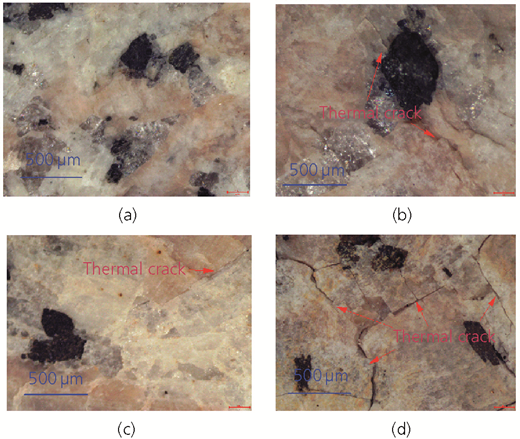
Thermal cracks on granite surface after different temperature treatments: (a) 100°C; (b) 400°C; (c) 600°C; (d) 800°C
Thermal cracks on granite surface after different temperature treatments: (a) 100°C; (b) 400°C; (c) 600°C; (d) 800°C
As shown in Figure 9, the brittleness of granite decreases with increasing temperature. Therefore, it is inferred that the failure of granite in a uniaxial compression experiment results in transformation from brittle to plastic deformation with increasing temperature.
Fissures have a great influence on the strength of granite in a uniaxial compression test. It is obvious that the compressive stress exhibits an approximately linear upward relation with increasing α in the range from 30 to 60° (as shown in Figure 3). However, previous studies (Yang et al., 2011, 2014a) investigated the effect of different angle fissures on sandstone strength by prefabricating two kinds of single fissures, which showed a variation between these parameters different from the variation shown in the current study. Without considering the effects of temperature, the authors of the previous studies showed that the compressive strength of sandstone containing a single fissure has a non-linear relationship with the fissure angle in the range from 15 to 75° (see Figure 10). The comparison between previous studies and this study shows that the strength variation and uniaxial failure characteristics of single-fissure rocks are different from those of X-type fissure rocks in this study.
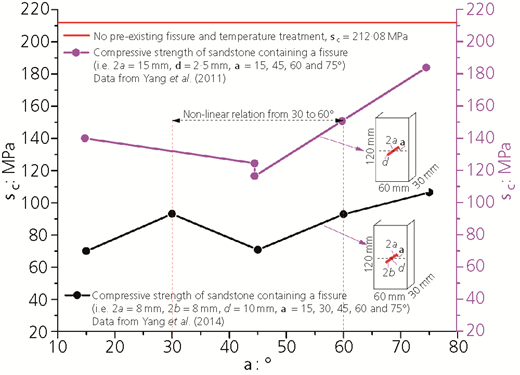
Compressive strength of rock samples containing a fissure: Yang et al. (2011): single fissure with 2a = 15 mm, d = 2·5 mm and α = 15, 45, 60 and 75°; Yang et al. (2014a): single fissure with 2a = 8 mm, 2b = 8 mm, d = 10 mm and α = 15, 30, 45, 60 and 75°
Compressive strength of rock samples containing a fissure: Yang et al. (2011): single fissure with 2a = 15 mm, d = 2·5 mm and α = 15, 45, 60 and 75°; Yang et al. (2014a): single fissure with 2a = 8 mm, 2b = 8 mm, d = 10 mm and α = 15, 30, 45, 60 and 75°
This study found temperature and fissures have a common effect on the failure pattern of granite (see Table 2). When the temperature is lower, the influence of the fissures on the failure mode of granite is particularly prominent, which mainly causes failure modes I and II. When the temperature increases, the temperature becomes the dominant factor affecting the properties of granite. The higher the temperature is, the more serious the damage to the rock mass around the pre-existing fissure. Under high-temperature treatment, pre-existing fissures are more likely to lead to the further development of internal fissures in granite (David et al., 2012; Freire-Lista et al., 2016; Sun et al., 2015; Wang et al., 2015). The rock mass around the fissure is more easily damaged in the process of uniaxial compression. There are mainly failure modes III and IV above 600°C. Therefore, the temperature of 600°C can be considered as the threshold for the change in failure characteristics. In summary, fissures and temperature have important effects on the failure pattern of granite samples.
Conclusions
In this study, in order to study the combined effects of temperature, pre-existing fissures and thickness on the compressive strengths of granite samples, high-temperature tests and uniaxial compression tests were carried out on granite samples of different thicknesses with pre-existing fissures. The major findings are as follows.
Temperature and pre-existing fissures have a great influence on the strength of granite. When the temperature is low, the compressive strength exhibits an approximately linear upward relation with increasing α in the range from 30 to 60°. However, with increasing temperature, the influence of pre-existing fissures on the strength of granite decreases and this trend of growth gradually diminishes. In addition, the thickness of granite samples (from 16 to 29 mm) has little effect on the strength of granite in this study.
The failure of granite is transformed from brittle to plastic deformation with elevated treatment temperature. In addition, according to failure patterns of granite, there are four crack failure modes under uniaxial pressure. Failure modes I and II occur below 600°C, and failure modes III and IV mainly occur above 600°C.
Acknowledgements
This research was supported by the National Natural Science Foundation of China (grants 41672279, 41874113 and 41807233) and the Natural Science Foundation of Jiangsu Province (grant BK20180662). The authors would also like to thank the technicians who helped them during the experiment.

