


This systematic literature review (SLR) structures and analyzes the research on female self-initiated expatriates (FSIEs), an under-explored subgroup within expatriation studies. The study identifies key themes and developments and outlines a future research agenda.
An SLR of 34 empirical studies was conducted, employing an inductive approach for an in-depth analysis of the articles, utilizing the Gioia methodology to code, review and organize the data systematically.
FSIEs choose expatriation to overcome career stagnation and to break glass ceilings in their home countries. They face specific challenges, including gender discrimination and exclusion. Yet, they exhibit powerful coping mechanisms and utilize social, often female, support networks. FSIEs tend to repatriate at higher rates than men, driven by economic and family-related reasons.
This SLR offers insights into FSIEs’ motivations, adjustment and careers, while calling for future research, inter alia, focusing on long-term career impacts and intersectional approaches to better capture the diverse motivations and experiences of FSIEs. Similarly, we encourage future research to conduct comparative studies between FSIEs, male SIEs and female assigned expatriates, while also utilizing other promising methodological designs, such as diary or multi-level studies.
Introduction
Expatriate research has long recognized gender as a factor that can influence individuals’ international mobility and selection for expatriate assignments. Historically, while expatriation studies have focused predominantly on male expatriates (Linehan and Walsh, 1999), with women often relegated to roles such as ‘trailing spouses’ (McNulty, 2012), seminal pioneering works, including those of Adler (1984), Taylor and Napier (1996), and Caligiuri and Tung (1999), began investigating female expatriates’ participation and success in international assignments. Further, these studies have significantly advanced our understanding of the gendered dimensions of expatriation, with Adler (1987) famously debunking myths about female expatriates, demonstrating that they are highly capable and suited to undertake international assignments. This work paved the way for research highlighting female expatriates’ potential as a largely untapped talent pool with distinctive management styles and adaptability skills that may be particularly valuable in diverse international contexts (Janssens et al., 2006; Tung, 2004).
An important characteristic of this literature, though, is that it focused primarily on assigned female expatriates, deployed by multinational organizations (Shortland, 2014). In the context of assigned expatriation, women continue to be disproportionately underrepresented (Salamin and Hanappi, 2014), often due to organizational biases, gendered stereotypes, and perceptions of host country cultural constraints (Shortland and Perkins, 2020), but also due to a lack of confidence and self-underestimation (Fischlmayr, 2002). Theoretical frameworks such as social role theory (Eagly, 1987) and gender stereotyping (e.g. Heilman, 2001) offer explanations for this. For instance, social role theory suggests that societal expectations shape gendered career choices and expatriation decisions, reinforcing the perception that women are less suited for international assignments (Markham, 1987). Similarly, the gender stereotype perspective highlights how implicit biases in organizations and host cultures contribute to discrimination, exclusion, and barriers to career advancement for female expatriates (Caligiuri and Cascio, 1998). Another valuable lens is provided by intersectionality (Crenshaw, 1989). This theoretical perspective acknowledges that gender does not operate in isolation but intersects with other identity factors, such as ethnicity, socio-economic background, and religion, resulting in differentiated experiences for individuals (Shortland and Perkins, 2022). In this regard, research shows that female expatriates from diverse backgrounds often encounter distinct challenges informed by their gender, nationality, and host-country perceptions (Hutchings et al., 2012; Varma et al., 2006).
In contrast to assigned expatriates (AEs), self-initiated expatriates (SIEs) relocate abroad on their own volition and decide to work in a foreign country for a defined or undefined period of time (cf. Andresen et al., 2014). Unlike AEs, who often benefit from structured organizational support, such as pre-departure training, relocation assistance, and guaranteed job roles upon return, SIEs must independently manage their expatriation journeys, from securing employment to adapting to new cultural and professional environments (Peltokorpi and Froese, 2009; Tharenou, 2013). There are manifold benefits of employing SIEs for organizations. For instance, Tharenou (2013) argued that SIEs are well-suited to work in technical roles as well as lower/middle management positions, can support the management of foreign operations, and tend to have extensive knowledge about host country markets.
With regard to the representation of males and females, interestingly, a striking difference between the AE- and SIE-population exists. Accordingly, while assigned expatriation is still predominantly male (Mäkelä et al., 2011), the SIE-population appears to be less gendered (e.g. Andresen et al., 2015; Stoermer et al., 2020; Tharenou, 2009), with females opting to relocate independently around as often as men. Women might use this mode of expatriation to overcome the systematic biases and organizational glass ceilings of assigned expatriation, or to start a new chapter after profound changes to their private lives occurred (e.g. Myers, 2011; Wechtler, 2018). At the same time, however, relocation might also pose new challenges as female self-initiated expatriates (FSIEs) are not embedded in parent country organizational support structures and might experience a double jeopardy (Beal, 1969, 2008) in relation to being female and a foreigner. For example, FSIEs could be confronted with demanding situations in host countries that differ from male SIEs or female AEs, such as the lack of organizational support for international school costs for their children (Muir et al., 2014).
In the present systematic literature review (SLR), we focus on the strand of literature on FSIEs. Thus, while literature reviews on self-initiated expatriation and female expatriates exist (e.g. Brewster et al., 2021; Salamin and Hanappi, 2014; Shortland, 2014), none have systematically examined the pertinent research on FSIEs, taking a differentiated view on the combined aspects of self-initiated expatriation and femaleness. This omission prevents us from fully understanding self-initiated expatriation from a highly relevant gendered perspective, the lived realities of FSIEs, and, in practice, their management in organizations. Through the application of an SLR (Tranfield et al., 2003), resulting in the analysis of 34 relevant empirical research articles, we intend to address this critical omission and, accordingly, aim to fulfill the following goals: First, we map the current state of research on FSIEs; second, we identify the key themes and trends in the literature; and third, we develop directions and an agenda for future research, as well as managerial implications.
This article is structured as follows: First, we provide a detailed description of the methodological and analytical procedures of the SLR. Next, we present the findings, organized around the key themes identified in the literature. We then outline the implications of our findings in terms of avenues for future research, theory, and practice. Lastly, we address the limitations of our SLR and end the article with a conclusion.
Methodology
To review the existing research on FSIEs, we selected an SLR as the most appropriate method. SLRs aim to identify, analyze, and interpret all relevant evidence, while reducing bias and enhancing the transparency and rigor of the review process. This approach is particularly suitable for fields with limited research (Fan et al., 2022) and, as such, its strengths can be harnessed in light of our subject of interest – FSIEs. Further, SLRs are well-established in the international human resource management literature (e.g. Aycan, 2005; Brewster et al., 2021; Hutchings, 2022). To ensure a rigorous, replicable, and transparent process, we adopted the three-step approach outlined by Tranfield et al. (2003). First, this entails planning the review and establishing a protocol; second, conducting the review; and third, analyzing and reporting the findings. The initial step involved recognizing the need for a review, formulating the research focus, and determining its expected contribution to research, theory, and practice. The second step, focusing on identifying and reviewing the relevant literature, is described in the following section.
Data collection
To identify relevant literature, this study utilizes two reputable databases as sources to locate suitable articles (Kraus et al., 2022). The search was conducted through the Web of Science and EBSCO databases, both recognized as leading sources for comprehensive literature reviews. In Web of Science, the Core Collection covers over 9,500 journals across 182 scientific categories (Clarivate, 2023). In EBSCO, the Global Search provides access to multiple databases, including Business Source Ultimate, Elsevier Science Direct, Emerald Insight, and Sage Journals Online. This review focuses on empirical, peer-reviewed journal articles and, thus, excludes working papers, editorials, book chapters, and literature reviews. While there is a trend to exclude journals based on academic rankings and journal metrics (e.g. ABS Academic Journal Guide, JCR Impact Factor, VHB Publication Media Rating) (Kraus et al., 2020), no such threshold was applied in this study. This approach ensured that all relevant studies in this specific domain were included, providing a comprehensive overview of the literature on FSIEs. Additionally, we did not specify a starting year, allowing for a broad perspective on the development of FSIE-research. The endpoint is set to August 2024 to include the most recent academic journal publications (incl. advance online publications).
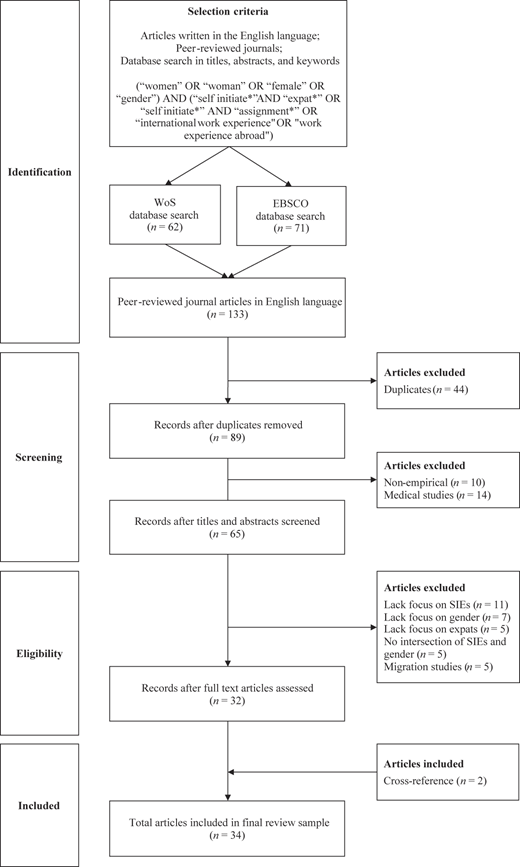
To identify the relevant literature, we designed a specific search string by exploring established keywords. The terms “women” OR “woman” OR “female” OR “gender” were paired with “self initiate*” AND “expat*” OR “self initiate*” AND “assignment*” OR “international work experience” OR “work experience abroad”. The search was conducted within the titles, abstracts, and keywords of the literature. Due to the prevalence of English in expatriate research, only articles written in English were included. This process identified a preliminary sample of 133 publications across both databases. A manual check of titles and authors removed 44 duplicates which yielded a total of 89 articles. Next, we conducted abstract screening to assess both topical relevance and methodological fit. At this stage, ten non-empirical studies were excluded, alongside fourteen articles from the medical field. These medical articles appeared in the search results due to an overlap between gender-related keywords and similar medical terminology (e.g. “self-testing” or “self-administered”), which show no relation to the expatriation or management domain. This resulted in a subset of 65 articles, which were then subjected to full-text review. In this final step, 33 articles were excluded due to thematic misalignment. More specifically, seven articles were removed for lacking any gender focus, eleven did not center on self-initiated expatriation, and five had no meaningful connection to expatriation at all, having used broader terms such as “international work experience” in non-expatriate contexts. Moreover, five articles included gender merely as a control variable in comparative samples of AEs and SIEs, without offering any theorization or substantive analysis of gendered effects. An additional five studies focused on broader migrant populations rather than SIEs specifically, and were therefore deemed out of scope. These exclusions ensured that all retained articles aligned conceptually with the goals of this review. In conclusion, to be included, studies were required to (1) focus on self-initiated expatriation, (2) engage with female expatriates or include an explicit discussion of gender in expatriation experiences, and (3) be empirical in nature. Cross-referencing during the final screening phase added two additional relevant articles, resulting in a final sample of 34 empirical studies. The literature selection process is visualized in Figure 1 to ensure full transparency and reproducibility of the results (Tranfield et al., 2003).
Data analysis
The third step of this review involved analyzing the data and synthesizing our findings. Initially, a summary of each article was produced to gain an overview and categorize the articles based on their research topic, publication year, journal, methodology, sample size, professional background of researched individuals, home country, host country, and theoretical framework. Further, to perform a thorough qualitative analysis of the articles, an inductive coding approach inspired by the methodology of Gioia et al. (2013) was utilized. This technique helps organize focus areas and findings from the publications into meaningful classifications. Notable for its transparent and rigorous framework, it has been successfully applied in systematic reviews in management research (Kraus et al., 2020). Each article was carefully reviewed multiple times to identify relevant passages, ensuring a comprehensive understanding of the data. ATLAS.ti was utilized to manually code and systematically organize the 34 articles into analytical categories. The coding process followed three stages. First, an open coding process was used to develop analytical codes and first-order concepts. Second, drawing on existing theoretical frameworks as a means of orientation, such as the push-pull model (Lee, 1966), the multi-dimensional model of cross-cultural adjustment (CCA) (Black et al., 1991), or King’s (2004) framework of career self-management, the first-order concepts were grouped into second-order themes, which were more theory-centered and abstract in nature. Finally, the second-order themes were aggregated into meaningful thematic dimensions that captured the broader patterns in the literature. To reduce subjectivity and increase validity in the analytical process, the first and second author jointly discussed, for instance, analytical codes and their respective thematic categorization. Eventually, a total of 70 first-order concepts was derived from the reviewed literature. After clustering them into 11 second-order themes based on their connections and relationships, they were aggregated into four thematic dimensions. The data structure, summarized in Figure 2, illustrates the stepwise progression from first-order concepts to second-order themes and aggregate thematic dimensions, offering a transparent picture of the coding and analysis process.
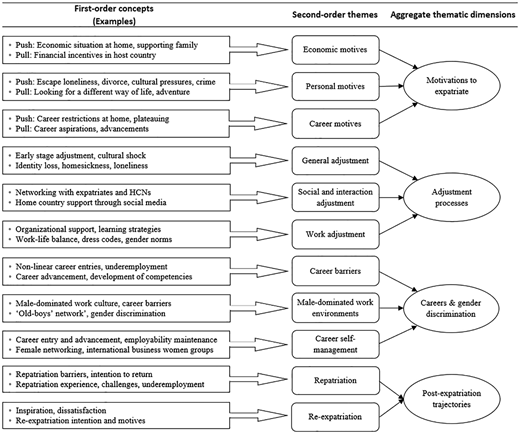
Applied conceptual framework of Gioia et al. (2013). Source: Authors’ own work
Results
The Journal of Global Mobility stands out with having published eight of the 34 articles reviewed, making it the most common outlet for publications on FSIEs, followed by Career Development International with three, and Cross Cultural and Strategic Management with two publications. The remaining articles are distributed across 21 different journals, each contributing one publication to the review (see Table 1).
Summary of the scientific journals
| Journal | Articles | References |
|---|---|---|
| Journal of Global Mobility | 8 | Colakoglu et al. (2018) |
| Harry et al. (2019) | ||
| Muir et al. (2014) | ||
| Myers and Thorn (2023) | ||
| Myers et al. (2017) | ||
| Nolan and Liang (2022) | ||
| Schreuders-van den Bergh and Du Plessis (2016) | ||
| Yorozu (2024) | ||
| Career Development International | 3 | Al Ariss (2010) |
| Thorn (2009) | ||
| Wechtler (2018) | ||
| Cross Cultural and Strategic Management | 2 | Selmer and Lauring (2011) |
| Tahir (2023) | ||
| Asia Pacific Business Review | 1 | Lauring and Selmer (2014) |
| Asia Pacific Journal of Human Resources | 1 | Lindsay et al. (2019) |
| British Journal of Management | 1 | Haak-Saheem et al. (2022) |
| Current Psychology | 1 | Zakaria and Yusuf (2023) |
| Equal Opportunities International | 1 | Bodolica and Spraggon (2008) |
| European Management Review | 1 | Selmer and Lauring (2010) |
| Frontiers in Psychology | 1 | Bozionelos (2020) |
| Gender in Management | 1 | Qin and Sekiguchi (2025) |
| Human Resource Development International | 1 | Stalker and Mavin (2011) |
| Human Resource Management | 1 | Bozionelos (2009) |
| International Journal of Business and Management | 1 | Fitzgerald and Howe-Walsh (2008) |
| International Journal of Manpower | 1 | Ho et al. (2023) |
| International Studies of Management and Organization | 1 | Vance and McNulty (2014) |
| Journal of Infection and Public Health | 1 | Yusuf et al. (2021) |
| Journal of Management Development | 1 | van den Bergh and Du Plessis (2012) |
| Journal of Organizational Psychology | 1 | Isakovic and Whitman (2019) |
| Journal of World Business | 1 | Myers and Pringle (2005) |
| New Zealand Journal of Employment Relations | 1 | Myers and Douglas (2017) |
| New Zealand Journal of Human Resources Management | 1 | Tahir and Savara (2019) |
| Personnel Review | 1 | Myers et al. (2022) |
| Women’s Studies Journal | 1 | Myers (2011) |
Source(s): Authors’ own work
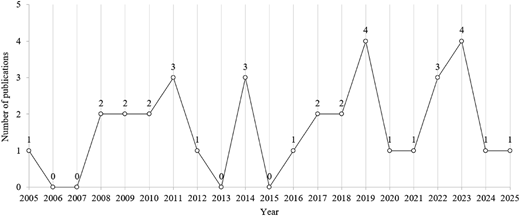
Most of the studies reviewed (25) employed qualitative methodologies, while eight adopted quantitative methods, and one utilized a mixed-method approach (see Table 2). All studies use cross-sectional data. Notably, six of the quantitative studies and the mixed-method study included gender as one variable of interest, instead of focusing exclusively on gender-related matters in the context of self-initiated expatriation. The publication dates skew slightly towards the last ten years, with 20 articles published after 2014. While this may indicate increased scholarly engagement with FSIEs in recent years, one should be careful interpreting it as such. Given the relatively recent recognition of SIEs as a distinct group (Suutari and Brewster, 2000), the publication trend might rather reflect the emergence of self-initiated expatriation as a research subject than a definitive increase in interest on FSIEs. The upcoming years will reveal whether this pattern evolves further into a sustained area of interest or remains a niche within expatriate research. This publication trend is illustrated in Figure 3.
Overview of the articles included in the review
| Authors | Year | Journal | Methoda | Expatriate type and sample size | Expatriate background | Home country | Host country | Themesb | Theoretical framework |
|---|---|---|---|---|---|---|---|---|---|
| Al Ariss | 2010 | Career Development International | 2 | SIEs; all genders (n = 43, 42% female) | Professionals (Business) | Lebanon | France | C | Modes of engagement |
| Bodolica and Spraggon | 2008 | Equal Opportunities International | 2 | FSIEs (n = 5) | Lower level | Moldova | Italy | A, B, C, D | Boundaryless careers, U-curve theory |
| Bozionelos | 2009 | Human Resource Management | 1 | SIEs; all genders (n = 206, 86% female) | Professionals (Healthcare) | Global mix | Saudi Arabia | B, C | / |
| Bozionelos | 2020 | Frontiers in Psychology | 2 | FSIEs (n = 10 FSIEs, 10 HCNs) | Professionals (Business) | China | UK | B, C | Double jeopardy, ethnic prominence |
| Colakoglu, Yunlu, and Arman | 2018 | Journal of Global Mobility | 2 | FSIEs (n = 20) | Professionals (Business) | Turkey | USA | B, C | Adult learning theory |
| Fitzgerald and Howe-Walsh | 2008 | International Journal of Business and Management | 2 | FSIEs (n = 6) | Professionals (Business) | Global mix | UK (Cayman Islands) | A, B, C | Boundaryless and protean careers, push-pull model |
| Haak-Saheem, Hutchings, and Brewster | 2022 | British Journal of Management | 2 | FSIEs (n = 51) | Professionals (Business) | Global mix | UAE | A, C | Boundaryless careers, career self-management, gender segregation |
| Harry, Dodd, and Chinyamurindi | 2019 | Journal of Global Mobility | 2 | SIEs; all genders (n = 25, 40% female) | Professionals (Academia) | African mix | South Africa | B, C | Person-environment fit theory |
| Ho, Seet, Jones, and Hoang | 2023 | International Journal of Manpower | 1 | FSIEs (n = 248) | Professionals (Business) | Vietnam | Global mix | A, D | Identity theory, role theory |
| Isakovic and Whitman | 2019 | Journal of Organizational Psychology | 1 | FSIEs (n = 321) | Lower level | Global mix | UAE | B | Social exchange theory, stress theory |
| Lauring and Selmer | 2014 | Asia Pacific Business Review | 1 | SIEs; all genders (n = 640, 24% female) | Professionals (Academia) | Global mix | Greater China | B | / |
| Lindsay, Sharma, and Rashad | 2019 | Asia Pacific Journal of Human Resources | 1 | SIEs; all genders (n = 248, 40% female) | Professionals (Business) | New Zealand | Global mix | D | Boundaryless careers, push-pull model, social capital theory |
| Muir, Wallace and McMurray | 2014 | Journal of Global Mobility | 2 | FSIEs (n = 25) | Professionals (Business) | USA | China | A, C | Boundaryless and protean careers, career construction theory, KCM |
| Myers | 2011 | Women’s Studies Journal | 2 | FSIEs (n = /) | / | New Zealand | Global mix | A, B | Life story framework |
| Myers and Douglas | 2017 | New Zealand Journal of Employment Relations | 2 | FSIEs (n = 21) | Various | New Zealand | Global mix | A, C, D | / |
| Myers and Pringle | 2005 | Journal of World Business | 2 | SIEs; all genders (n = 50, 52% female) | Various | New Zealand | Global mix | A, C | Career capital theory |
| Myers and Thorn | 2023 | Journal of Global Mobility | 2 | FSIEs (n = 21) | Professionals (Business) | New Zealand | Global mix | C, D | / |
| Myers, Inkson, and Pringle | 2017 | Journal of Global Mobility | 2 | FSIEs (n = 21) | Volunteers | New Zealand | Global mix | C | KCM |
| Myers, Thorn, and Doherty | 2022 | Personnel Review | 2 | FSIEs (n = 21) | Professionals (Business) | New Zealand | Global mix | A | KCM, push-pull model, SST |
| Nolan and Liang | 2022 | Journal of Global Mobility | 3 | SIEs; all genders (n = 193,29% female) | Professionals (Healthcare) | Global mix | Ireland | B | Black et al.’s model of CCA, U-curve theory |
| Qin and Sekiguchi | 2025 | Gender in Management | 2 | FSIEs (n = 30) | / | Global mix | Japan | B, C | Career-agency, person-environment fit theory |
| Schreuders-van den Bergh and Du Plessis | 2016 | Journal of Global Mobility | 2 | FSIEs (n = 21) | Professionals (Business) | / | Netherlands | A, B | CQ theory, self-determination theory |
| Selmer and Lauring | 2010 | European Management Review | 1 | SIEs; all genders (n = 428, 29% female) | Professionals (Academia) | Global mix | Nordic countries, Netherlands | A | / |
| Selmer and Lauring | 2011 | Cross Cultural and Strategic Management | 1 | SIEs; all genders (n = 428, 29% female) | Professionals (Academia) | Global mix | Nordic countries, Netherlands | B | Crossover theory |
| Stalker and Mavin | 2011 | Human Resource Development International | 2 | FSIEs (n = 12) | Professionals (Business) | Western mix | UAE | B, C | Social identity theory |
| Tahir | 2023 | Cross Cultural and Strategic Management | 2 | FSIEs (n = 30) | Professionals (Business) | Western mix | UAE | B | Boundary theory |
| Tahir and Savara | 2019 | New Zealand Journal of HRM | 2 | FSIEs (n = 14) | Professionals (Business) | New Zealand | UAE | B, C | Black et al.’s model of CCA |
| Thorn | 2009 | Career Development International | 1 | SIEs; all genders (n = 2,608, 48% female) | / | New Zealand | Global mix | A | Super’s career development theory |
| van den Bergh and Du Plessis | 2012 | Journal of Management Development | 2 | FSIEs (n = 21) | Professionals (Business) | Global mix | The Netherlands | A, B, C | Time-sequenced model |
| Vance and McNulty | 2014 | International Studies of Management and Organization | 2 | SIEs, AEs; all genders (n = 45, 64% female) | Professionals (Business) | USA | Europe | C | Vance’s career path model |
| Wechtler | 2018 | Career Development International | 2 | FSIEs (n = 11) | / | Global mix | Global mix | A, B | KCM |
| Yorozu | 2024 | Journal of Global Mobility | 2 | FSIEs (n = 22) | Professionals (Business) | Global mix | Japan | C | Neo-institutional theory |
| Yusuf, Zakaria, and Abdul-Talib | 2021 | Journal of Infection and Public Health | 2 | FSIEs (n = 16) | Professionals (Healthcare) | Malaysia | Saudi Arabia | B | U-curve theory |
| Zakaria and Yusuf | 2023 | Current Psychology | 2 | FSIEs (n = 22) | Professionals (Healthcare) | Malaysia | Saudi Arabia | B | Black et al.’s model of CCA, U-curve theory |
Source(s): Authors’ own work
aMethodology: (1) Quantitative; (2) Qualitative; (3) Mixed-method; bThematic dimensions: (A) Motivations; (B) Adjustment; (C) Careers; (D) Post-expatriation
The articles primarily include individuals from Western home countries (14), followed by mixed samples (12), and Asian countries (4). One study each examined FSIEs from Turkey, Lebanon, and a mix of African countries, while another did not specify a home country. Host destinations were predominantly in Western countries (11), followed by a global mix (10), the Middle East and Northern Africa (MENA) (8), and Asia (4). One article focused on South Africa. The majority of studies analyzed FSIEs in professional occupations (25), including healthcare workers (4). Only two studies explored FSIEs in lower-level jobs (e.g. cleaners, service workers), while one focused on volunteers. Six studies did not specify professional backgrounds. All studies examined the individual level, with only three studies additionally exploring aspects on the organizational level, such as diversity management or organizational support.
Thematic dimension 1: motivations to expatriate
FSIEs’ motivations to expatriate and seek employment abroad are discussed in 14 reviewed articles. These studies reveal clear push factors, such as limited career advancement or discrimination in home countries, alongside pull factors, including adventure or career opportunities.
Financial motivations play a critical role for FSIEs, though their significance varies across cultural and economic contexts. While Selmer and Lauring (2010) found that FSIEs in academia are generally less financially driven compared to their male counterparts, more recent research by Haak-Saheem et al. (2022) highlighted the importance of financial motives for professional FSIEs from Asia and MENA. Interestingly, these women are often motivated by a need to support their families’ economic well-being rather than personal financial gain. Similarly, by using a qualitative approach, Bodolica and Spraggon (2008) examined Moldavian FSIEs in Italy and identified economic instability and a need to improve family finances as strong push factors for those in lower-level occupations.
Likewise, personal relationships or their respective ending frequently influence FSIEs’ decisions to move abroad, often differing from the motivations observed among their male counterparts. In this respect, Myers and Pringle (2005) discovered that FSIEs were more likely than men to initiate expatriation following the end of a relationship. Similarly, Bodolica and Spraggon (2008) and Wechtler (2018) found that FSIEs used expatriation as a way to process personal emotional events, like divorce or separation, providing an opportunity to seek a personal and professional reset.
A recurring theme in the literature is the use of expatriation as a form of escape, often tied to gendered experiences in the home country. While both men and women in Myers and Pringle’s (2005) study viewed expatriation as an opportunity for change, FSIEs were twice as likely to see it as a means of escaping boredom, unsatisfying jobs, or constrained lives. Expatriation may be particularly appealing to women as a way to reclaim agency and redefine their life directions, as FSIEs seek to escape dissatisfaction with their lifestyle (Fitzgerald and Howe-Walsh, 2008), depression, work addiction, and emptiness (Wechtler, 2018).
For older FSIEs, the theme of escape takes on additional dimensions. Myers (2011) found that following major life transitions, such as children leaving home or parents being cared for, many women expatriate to escape their current lives and pursue “unfinished business”, such as youthful endeavors or long-held dreams. This aligns with associated findings by Myers and Douglas (2017) and Myers et al. (2022), who emphasized how older FSIEs are motivated by leaving behind daily routines, family roles, loneliness, and emotional disconnection as their children grow up.
Closely related to escape is the pursuit of independence, which often intersects with FSIEs’ personal and professional goals. In this regard, Fitzgerald and Howe-Walsh (2008) identified independence-seeking as a strong motivator for professional FSIEs in the Cayman Islands, reflecting their desire to establish autonomy in both their personal and professional lives. A decade later, Wechtler (2018) extended this understanding utilizing the kaleidoscope career model (KCM) (Mainiero and Sullivan, 2005), illustrating that FSIEs in their thirties expatriate to escape societal pressures that prioritize motherhood over career. Those women are leveraging expatriation as a means to assert control over their life choices. Similarly, by drawing on a gender segregation perspective, Haak-Saheem et al. (2022) found that professional FSIEs from Asia and MENA often expatriated to escape restrictive cultural and social pressures to gain greater freedom in both life and work.
In addition to push factors, the literature highlights several personal pull motives driving FSIEs to expatriate. A common theme is the desire for adventure and travel, while still seeking stability in terms of a secure location and a community that offers a sense of belonging (Fitzgerald and Howe-Walsh, 2008; Myers, 2011). Western professional FSIEs, in particular, initiate their expatriation in the search for adventure (Haak-Saheem et al., 2022). However, while host country culture, history, and location sometimes influence FSIEs’ decisions, they are rarely dominant motivators (Bodolica and Spraggon, 2008; Fitzgerald and Howe-Walsh, 2008; Muir et al., 2014). Instead, FSIEs often prioritize the overall opportunity to live abroad over the specific characteristics of the destination itself (Wechtler, 2018).
Personal pull factors also include social influences and lifestyle-driven choices. FSIEs are often inspired by the expatriate examples set by friends and family (Bodolica and Spraggon, 2008; Myers et al., 2022), engage in altruism or volunteer work (Myers et al., 2022), or seek lifestyles that align with their personal aspirations (Haak-Saheem et al., 2022; Muir et al., 2014). Married FSIEs’ often follow their husband’s international assignment or join local partners in the host country (Haak-Saheem et al., 2022; Van den Bergh and Du Plessis, 2012). Conversely, single and divorced FSIEs are more likely to expatriate for self-directed goals, such as pursuing new experiences or seeking personal growth, reflecting greater autonomy in their decision (Myers et al., 2022; Van den Bergh and Du Plessis, 2012).
Professional aspirations play a significant role in influencing FSIEs’ decisions to expatriate, often intertwined with broader personal goals. Fitzgerald and Howe-Walsh (2008) highlighted career as a key motivator, drawing on protean career theory (Hall, 1976) and boundaryless career theory (Arthur, 1994) to explain FSIEs’ self-directed approach to pursuing international employment opportunities. Similarly, Muir et al. (2014), utilizing career construction theory (Savickas, 2005), demonstrated how both career aspirations and personal factors influenced the decision of American FSIEs to expatriate to China. However, career motivations are not uniform across FSIE-populations and vary significantly based on cultural context. For single Western FSIEs in the UAE, career opportunities acted as a pull factor, drawing them to host countries for professional growth. In contrast, for FSIEs from Asia and MENA, career acted as a push factor, as restrictive cultural norms often limited their ability to work in their home countries (Haak-Saheem et al., 2022). Additionally, Wechtler (2018) highlighted that career dissatisfaction, rather than career advancement, was a primary motivator, with employment serving mainly as a means to facilitate relocation abroad. This trend was also noted by Myers et al. (2022) for older FSIEs, who were rather pushed to expatriate in response to toxic work environments, plateauing careers, and disengagement at work (Myers, 2011; Myers et al., 2022).
Gender and age appear to interact in shaping expatriation motives. Thorn (2009), in a quantitative study on New Zealand SIEs, found that while younger SIEs showed similar motivations across genders, distinct gendered patterns emerged with age. As they grow older, male SIEs increasingly prioritized career advancement, whereas FSIEs shifted their focus towards relationships and quality of life, with career considerations becoming less important. These findings suggest that motivations for expatriation vary not only by gender but also by the intersection with life stage and evolving personal priorities.
Beyond the established push-pull framework, the theme of ‘timing’ emerged as a key consideration in FSIEs’ decision-making. Fitzgerald and Howe-Walsh (2008) highlighted that professional FSIEs often relocate when they felt it was “the right time”. Similarly, Myers (2011) and Myers et al. (2022) emphasized that the timing of specific life events, such as relationship transitions, parents’ well-being, or children reaching adulthood, often serve as critical turning points to initiate expatriation, particularly for older FSIEs.
The motivations of FSIEs are frequently conceptualized through established theoretical frameworks, highlighting the diverse factors influencing their decision to expatriate. Push-pull models are often applied to categorize these motivations, capturing various elements, such as escaping societal constraints or pursuing adventure and career opportunities (e.g. Fitzgerald and Howe-Walsh, 2008). Career-driven motives, in particular, are often analyzed through boundaryless and protean career theory. These theories emphasize FSIEs’ self-directed approaches to navigating career advancement outside traditional organizational structures. However, our findings partly challenge these frameworks, which often assume voluntary, opportunity-driven mobility. For many FSIEs, particularly from emerging economies, motivations are also influenced by structural constraints and economic hardship, for example in response to restrictive societal norms or organizational exclusion in their home countries (e.g. Haak-Saheem et al., 2022). The KCM provides a lens to understand FSIEs’ non-linear career paths and shifting priorities over time, particularly when compared to men (e.g. Wechtler, 2018). In addition, socio-emotional selectivity theory (SST) (Carstensen, 2006) has been used to explore older FSIEs’ motivations for seeking emotionally fulfilling experiences and opportunities for self-discovery (Myers et al., 2022).
Thematic dimension 2: adjustment processes
Our review reveals a significant interest in FSIEs’ adjustment to the host country, with 20 articles addressing this topic. Working abroad often presents challenges like culture shock and navigating interactions with host country nationals (HCNs). Black et al.’s (1991) multi-dimensional model of CCA, consisting of general, interaction, and work adjustment, serves as a key framework and aligns with our identified second-order themes. General adjustment involves comfort with living conditions, while work adjustment relates to adapting to the professional environment, and interaction adjustment focuses on engaging with HCNs. We expand the latter sub-dimension to ‘social and interaction adjustment’, comprising interactions with home country nationals as well as other expatriates.
General adjustment. FSIEs face unique challenges in adapting to their host environments, often without the structured organizational support available to male and female AEs. For instance, Tahir and Savara (2019) found that New Zealand FSIEs in the UAE encountered issues with immigration, housing, and schooling of their children, but quickly learned to leverage social connections to mitigate these difficulties. Similarly, Malaysian FSIE nurses in Saudi Arabia struggled with accommodation, social relationships, societal customs, and a lack of support early in their journeys (Yusuf et al., 2021; Zakaria and Yusuf, 2023). Interestingly, FSIEs’ prior mobility experiences also contribute to adjustment. For instance, Bozionelos (2020) investigated Chinese FSIEs in the UK through a comparative interview study with HCNs. These FSIEs experienced fewer relocation difficulties, likely due to their familiarity with separation and moving across large distances in China.
Culture shock and navigating cultural differences are crucial aspects of FSIEs’ general adjustment. Upon arrival, FSIEs often experience a clash between their expectations and reality, resulting in frustration, moral discomfort, and disorientation (Bodolica and Spraggon, 2008). Similarly, Wechtler (2018) noted that emotional shock, including doubt, confusion, and fear, was followed by culture shock, as social support from home diminished and romanticized expectations of living abroad faded. According to the U-Curve theory (Oberg, 1960), this adjustment phase can last up to nine months. However, Zakaria and Yusuf (2023) reported that Malaysian FSIE nurses in Saudi Arabia adjusted within three months, crediting their personal determination as an accelerator of the adjustment process. This is astonishing as, in contrast to AEs, FSIEs often face the challenge of relocating without their families, leading to feelings of homesickness and missing their children, spouses, and families (Bodolica and Spraggon, 2008; Zakaria and Yusuf, 2023). Speaking of homesickness, Fitzgerald and Howe-Walsh (2008) identified that homesickness worsened when FSIEs had moved from densely populated to smaller countries. Although advancements in communication technology have made it easier for FSIEs to stay connected with their loved ones in recent years (Yusuf et al., 2021), time zone differences remain a persistent barrier for maintaining communication (Zakaria and Yusuf, 2023).
Gender-specific differences in general adjustment also emerged. Nolan and Liang (2022) found that FSIE medical doctors in Ireland demonstrated higher levels of general adjustment than their male counterparts. This observation contrasts with earlier findings on AEs, where no significant gender-based differences in adjustment were observed (Salamin and Davoine, 2015; Selmer and Leung, 2003). These results suggest that FSIEs may develop stronger coping strategies or benefit differently from host environments compared to male SIEs.
A recurring theme throughout the literature is the struggle with identity loss driven by the need to become immersed into a new cultural setting. In this regard, Van den Bergh and Du Plessis (2012) noted that professional FSIEs face ongoing challenges in balancing personal core values with adapting to the host culture, eventually letting go of certain aspects of their cultural identity. In support of this, Wechtler (2018) found that moving abroad often involves questioning and losing parts of one’s identity to fully embrace the experience. Additionally, Bodolica and Spraggon (2008) observed that FSIEs, who worked in lower-level jobs with higher qualifications, struggled with their new identities, lower status in society, and acceptance from locals, feeling disconnected from both their home and host countries. Identity struggles seem to be pronounced among FSIEs also because of conflicts with traditional gender roles. For instance, Myers (2011) reported that older FSIEs, who had previously defined themselves through their family roles, faced significant challenges in reshaping their identities abroad. This highlights the central role of family in shaping FSIEs’ identities, as Schreuders-van den Bergh and Du Plessis (2016), exploring professional FSIEs in the Netherlands through an interactive qualitative analysis, emphasized that emotional ties and commitment to significant others provided a stable and enduring foundation for FSIEs’ identities.
Social and interaction adjustment. Networking plays a pivotal role in FSIEs’ cross-cultural adaptation, serving as a critical facilitator for building connections and easing the adjustment process. Studies underscore the importance of formal and informal networks, engaging with mentors and connecting with other, often female, expatriates. For example, Zakaria and Yusuf (2023) found that Malaysian FSIE nurses in Saudi Arabia, successfully adjusted by engaging with mentors and connecting with home country expatriate networks. Similarly, in the same cultural and professional setting, Yusuf et al. (2021) highlighted that networking with fellow nationals helped FSIEs adapt more effectively by sharing practical insights into communication, local customs, and work styles. Proactive engagement in local activities and expatriate groups also alleviates feelings of exclusion among FSIEs. Fitzgerald and Howe-Walsh (2008) observed that FSIEs often take the initiative to participate in such activities, which fosters a sense of belonging and eases adjustment. However, establishing connections with HCNs can be challenging. For example, Bozionelos (2020) documented the difficulties of Chinese FSIEs in the UK, where language and cultural differences posed barriers building meaningful relationships. Similarly, Tahir and Savara (2019) reported that New Zealand FSIEs in the UAE often struggled to integrate into HCN-networks, feeling like outsiders during social gatherings. The same study highlighted a distinctive female challenge, as some FSIEs faced excessive attention from male HCNs fixated on Western women. To address this, they developed diplomatic strategies to balance unwanted and desirable interactions, thereby maintaining social harmony. Despite these challenges, the FSIEs maintained strong networks, particularly with other women, both local and foreign, which provided critical support during their gendered expatriation experience.
In addition to building local networks, continuous support from home is crucial for FSIEs’ adjustment. Studies consistently highlight the emotional and practical importance of maintaining connections with family and friends during expatriation. Yusuf et al. (2021) emphasized that support from home reduces emotional pressure for FSIEs, with social network tools providing consolation despite distance. Further, Colakoglu et al. (2018) found that financial and emotional backing from home was crucial during FSIEs’ initial stages of adjustment. Similarly, Schreuders-van den Bergh and Du Plessis (2016) observed that family support created a sense of responsibility and motivated FSIEs, fulfilling an important role in their adjustment journeys.
Language barriers are another prominent challenge for FSIEs, significantly impacting their adjustment. Qin and Sekiguchi (2025) identified that FSIEs in Japan faced difficulties in salary negations and the recognition of their skills, with cultural and linguistic differences compounding these challenges. However, long-term FSIEs reported feeling less pressure to conform over time, suggesting that confidence and familiarity with the host culture alleviates some of these difficulties. Similarly, Van den Bergh and Du Plessis (2012) reported that professional FSIEs in the Netherlands struggled with significant discouragement during language learning, often due to facing unrealistic expectations from colleagues and employers. Despite these challenges, Fitzgerald and Howe-Walsh (2008) found that FSIEs adopted proactive strategies, including engaging in local activities and active language learning, to facilitate adjustment.
Work adjustment. The literature highlights both the gender-related challenges FSIEs face and the adjustment strategies they employ to navigate work environments. Common difficulties include adapting to unfamiliar work styles, unexpected behaviors from HCNs, and unclear job descriptions, often compounded by limited organizational support (Bodolica and Spraggon, 2008). These challenges are intensified by cultural mismatch in working styles, which can create friction and hinder team collaboration, as observed among FSIEs from New Zealand in the UAE (Tahir and Savara, 2019). However, adjustment success in the workplace has been linked to improved job engagement, as demonstrated by Isakovic and Whitman (2019) in their quantitative study on FSIE service workers in the UAE. Drawing on stress theory (Kahn et al., 1964), the study highlighted how high levels of work adjustment positively influence FSIEs’ abilities to thrive in professional settings.
While gender disparities in work adjustment persist, evidence suggests these gaps may be gradually diminishing. For instance, Bozionelos (2009) found that FSIEs nurses in Saudi Arabia reported higher job satisfaction than their male counterparts, even in cultural environments with limited support for women. Looking at gender as an individual level boundary condition, Selmer and Lauring (2011) investigated the moderating role of gender differences among academic SIEs. By applying crossover theory (Westman, 2001), they hypothesized that the positive link between being married, work effectiveness and performance would be weaker for FSIEs. Contrary to expectations, their findings revealed no significant gender-based moderating effects. Similarly, Lauring and Selmer (2014) hypothesized that academic FSIEs in Greater China would achieve better work outcomes than male SIEs but found that differences were limited to FSIEs exhibiting only stronger job performance, further indicating narrowing gender differences.
The literature consistently underscores the critical role of gender-specific organizational support in facilitating FSIEs’ work adjustment and professional success. Isakovic and Whitman (2019) highlighted that perceived organizational support significantly enhances FSIEs’ work adjustment and job engagement. However, due to the frequent lack of structured support, FSIEs often take more proactive steps to develop professionally and adapt to their roles, underscoring their resilience and adaptability in comparison to their male counterparts. For instance, Myers and Pringle (2005) found that FSIEs were more likely than male SIEs to pursue formal qualifications, showcasing a strong commitment to continuous skill development. Similarly, Schreuders-van den Bergh and Du Plessis (2016) observed that FSIEs in the Netherlands frequently pursued external qualifications to compensate for lacking organizational support. Additionally, when faced with limited professional development options, FSIEs often turn to informal and self-directed learning. Stalker and Mavin (2011) identified that FSIEs often received fewer opportunities than HCNs, prompting them to rely on learning strategies and their informal network. These include coaching, obtaining certifications, and learning through interaction with HCNs. Extending this, Colakoglu et al. (2018), applying adult learning theory (Kolb, 1984), observed recurring learning cycles among highly-skilled FSIEs. Initially, these cycles focus on immediate career progression, but over time, they expand towards a deeper understanding of cultural, social, and political contexts of the host country. The healthcare sector, featuring a high share of women, illustrates the critical role of FSIEs’ self-directed learning and language acquisition. Zakaria and Yusuf (2023) found that FSIE nurses in Saudi Arabia experienced significant stress due to language barriers, affecting workplace communication with patients and colleagues. To overcome these challenges, those FSIEs engaged in proactive informal learning to acquire both language and communication skills, often describing themselves as “self-taught”. Further, Bodolica and Spraggon (2008) observed that FSIEs employed a range of learning strategies, including informal learning, pursuing formal qualifications, and participating in internships to integrate better into their professional environments. Tahir and Savara (2019) offered additional insights, showing that FSIEs’ self-learning capabilities and relationship-building skills enable better adjustment in the workplace.
Work-life balance (WLB) problems are a recurring and gender-specific theme in the literature. These challenges are particularly pronounced in environments where gender-related cultural expectations and workplace norms blur the lines between personal and professional life. Drawing on boundary theory (Ashforth et al., 2000; Nippert-Eng, 1996), Tahir (2023) highlighted the struggles faced by Western FSIEs in the UAE, where long working hours combined with traditional gender roles forced them to adapt to unfavorable local WLB norms. Similarly, Harry et al. (2019), applying person-environment fit theory (Kristof, 1996), revealed that academic FSIEs in South Africa experienced similar struggles, balancing demanding workloads with cultural expectations to prioritize family care over work. These challenges mirrored those of female HCNs, but FSIEs’ lack of support networks additionally strained personal relationships, leading some to remain single or separate from their partners. In Japan, Yorozu (2024) highlighted that professional FSIEs encountered particularly unfriendly work environments for female expatriates, amplifying gender-specific WLB difficulties. Likewise, Fitzgerald and Howe-Walsh (2008) noted that FSIEs in the Cayman Islands perceived workplace stressors as a primary barrier to achieving WLB, underscoring the significant impact of organizational environments on their overall well-being.
Dress code norms highlight another gendered aspect of FSIEs’ adjustment. Stalker and Mavin (2011) reported that Western FSIEs in the UAE had to conform to conservative dress codes and gendered cultural expectations at work. Similarly, Tahir and Savara (2019) found that New Zealand FSIEs in the UAE experienced difficulties adapting to local dress codes, further impacting their cultural adjustment. Among Malaysian FSIE nurses in Saudi Arabia, Zakaria and Yusuf (2023) noted that strict dress requirements, such as wearing abayas, initially caused discomfort, but over time, these norms were accepted, as shared cultural and religious identities helped ease adaptation. Interestingly, dress code expectations can also present challenges for women in reverse. Al Ariss (2010) discovered that Lebanese FSIEs wearing traditional Muslim headscarves in France encountered workplace discrimination due to their choice of dress, demonstrating how cultural bias around female dress codes persists even in liberal host countries.
The adjustment experiences of FSIEs are frequently analyzed through established theoretical frameworks. The multi-dimensional model of CCA is widely applied, categorizing adjustment into general, interaction, and work dimensions (e.g. Zakaria and Yusuf, 2023). This model is often complemented by the U-curve theory, which outlines the stages of adjustment over time (e.g. Nolan and Liang, 2022). However, the insights in this thematic dimension suggest that traditional adjustment models, such as Black et al.’s (1991) framework, may not fully capture the identity negotiation and gendered dynamics FSIEs face, particularly in culturally conservative environments. Several studies employed alternative theoretical approaches to explore specific aspects of FSIEs’ adjustment. For instance, Schreuders-van den Bergh and Du Plessis (2016) integrated self-determination theory (Deci and Ryan, 2000) and cultural intelligence (CQ) theory (Earley and Ang, 2003) to highlight the importance of self-efficacy in cultural adaptation. Additionally, social identity theory (Tajfel and Turner, 1979) has been utilized to examine the dynamics of social integration (Stalker and Mavin, 2011), while stress theory explained the interplay between FSIEs’ stress levels and adaptive behaviors (Isakovic and Whitman, 2019).
Thematic dimension 3: careers and gender discrimination
Although FSIEs often report personal and professional growth during their expatriation, working abroad also exposes them to substantial career barriers such as gender discrimination, underemployment, and exclusion from critical networks. Nineteen articles explore this thematic dimension.
In terms of dual disadvantages related to both gender and foreignness, Stalker and Mavin (2011) found that in the UAE, FSIEs receive less favorable benefits, financial packages, and job security compared to male expatriates and HCN women. However, regional and cultural nuances can shift these dynamics. Revealing a compelling difference when it comes to favored individual characteristics, Haak-Saheem et al. (2022) observed that Western appearance helped FSIEs in the UAE to access employment opportunities, while FSIEs from Asia and MENA relied more on language proficiency and cultural knowledge to navigate the labor market. Consolidating the notion that Western FSIEs may be granted certain privileges, Vance and McNulty (2014) found only minimal gender discrimination during the hiring process for American FSIEs in Europe. These findings suggest that job markets in certain regions may be more open to FSIEs, with Western appearance offering an advantage. In contrast, Al Ariss (2010) demonstrated how Lebanese FSIEs in France faced exclusion from the job market due to cultural biases against traditional Muslim attire.
Underemployment is another related critical issue, particularly for skilled FSIEs whose qualifications often go unrecognized. In this regard, Colakoglu et al. (2018) reported that highly-skilled FSIEs in the US frequently experienced non-linear career paths, including building careers from scratch, temporary jobs, and underemployment. Similarly, Bodolica and Spraggon (2008) noted that credential recognition issues forced many FSIEs into job roles below their qualifications. However, career stage and individual priorities also play a significant role in shaping these experiences. For example, Myers et al. (2017) found that older New Zealand FSIEs often chose underemployment voluntarily, engaging in volunteer work or as contract carers to escape from the demands of managerial roles. These findings further highlight the relevance of life stage, age, and national context in shaping FSIEs’ career outcomes.
Networking emerged as a pivotal factor for FSIEs’ career success, helping them navigate structural barriers, overcome challenges, and advance professionally. Van den Bergh and Du Plessis (2012) identified that relationship-building, mentorship, and career counseling, are critical components of FSIEs’ networking as these activities are deemed crucial for their career development. While these findings may not be exclusively gender-specific, Vance and McNulty (2014) examined the experiences of male and female expatriates in Europe, highlighting that FSIEs rely significantly more on networking as a career strategy to overcome structural barriers, secure opportunities, and promote their careers abroad. Similarly, Stalker and Mavin (2011), drawing on social identity theory, highlighted that Western FSIEs in the UAE strategically engaged in international business women’s groups and established female networking organizations. These groups blurred the lines between professional and personal lives, providing essential support for social, family, and professional concerns. Further, digital platforms and online communities emerged as powerful tools for FSIEs. For instance, Qin and Sekiguchi (2025) combined blog posts and interview data from female globally mobile employees in Japan to gain a deeper understanding of their experiences. These women participated in expatriate online communities, where they shared experiences and found support, which ultimately improved their career outcomes. Mentorship and expatriate networks further support FSIEs’ career trajectories. Colakoglu et al. (2018) found that highly-skilled Turkish FSIEs in the US leveraged HCN mentors and expatriate community networks to secure meaningful career opportunities. Beyond local networks, social support from home countries remains equally vital for FSIEs’ confidence and career progression. Van den Bergh and Du Plessis (2012) found that professional FSIEs in the Netherlands benefited from frequent contact with home networks through social media, which provided emotional and practical support to their careers.
One of the central motivators for relocation among FSIEs is the desire for growth and self-actualization. Indeed, the literature shows that FSIEs develop both professional and personal skills during their time abroad. Fitzgerald and Howe-Walsh (2008) discovered that professional FSIEs develop cross-cultural competencies, including communication, tolerance and adaptability, alongside technical and organizational skills. Myers and Pringle (2005) similarly noted that FSIEs focused on developing organizational, planning, and job-specific skills. However, a gendered distinction emerged. Male SIEs tend to prioritize technical and leadership skills, whereas FSIEs placed a greater emphasis on personal development. This includes building self-confidence and strengthening relationships. Older FSIEs, in particular, show remarkable personal growth through expatriation. Myers and Douglas (2017) identified that beyond employment skills, older FSIEs clarified their core values and life priorities. Although many older FSIEs initiated their expatriation primarily for personal reasons, Myers et al. (2017) found that they incidentally acquired career competencies, showcasing how personal and professional development often intertwine during expatriation. Myers and Thorn (2023) further emphasized that older FSIEs develop confidence, resilience, and engagement as key outcomes of their expatriation journeys.
A recurring theme is that FSIEs often view international work experience as a valuable asset for career advancement, yet their progress frequently encounters systemic barriers. Fitzgerald and Howe-Walsh (2008) reported that professional FSIEs generally perceive their time abroad as beneficial for their future career prospects. Similarly, Haak-Saheem et al. (2022) found that FSIEs from MENA leveraged their expatriation in the UAE as a springboard for career advancement. Regional differences, however, play a critical role in shaping these outcomes. In the Netherlands, FSIEs from Eastern Europe valued the country’s gender equality which supported their professional development (Van den Bergh and Du Plessis, 2012). Nonetheless, systemic barriers such as expensive childcare and negative attitudes towards foreigners persisted and impeded their progression.
Despite their ambitions, career stagnation remains a common experience for many FSIEs. Muir et al. (2014) documented diverse experiences among American FSIEs in China. While some FSIEs capitalized on their international roles to advance their careers, others felt limited by organizational barriers and “glass walls” between SIEs and AEs, such as insufficient support for expatriate family needs, including international school fees. Further, Colakoglu et al. (2018) noted that language barriers and accents often restricted Turkish FSIEs’ access to advanced career opportunities in the US. Similarly, Bozionelos (2020) found that Chinese FSIEs in the UK encountered various career obstacles, including language and cultural barriers. Surprisingly, positive stereotypes associated with Chinese ethnicity occasionally facilitated career opportunities, illustrating that cultural assumptions sometimes produce unexpected advantages.
The literature further reveals notable gender-related differences in career progression and priorities among SIEs. In South Africa, Harry et al. (2019) found that academic FSIEs experienced slower career progression than their male counterparts, primarily due to difficulties balancing professional responsibilities with personal life. These findings highlight how traditional gender roles and expectations disproportionately affect FSIEs, creating barriers to their careers. In contrast, Myers and Pringle (2005) reported more positive outcomes for New Zealand FSIEs, who achieved greater career growth and more favorable trajectories than male SIEs. This suggests that FSIEs may leverage unique strengths to excel in their careers abroad. Over time, career motivations often shift. Myers and Thorn (2023) observed that while older FSIEs experienced career development, their focus gradually shifted from pursuing long-term professional goals to aligning their careers with personal values.
A major barrier to FSIEs’ career advancements are male-dominated work environments, driven by entrenched societal and cultural norms. In the UAE, Tahir and Savara (2019) observed that cultural attitudes favoring men as leaders hindered FSIEs’ professional acceptance and career success. The masculine society often portrayed women as less confident and capable, limiting their leadership opportunities. Similarly, Stalker and Mavin (2011) noted that while Western FSIEs sometimes accessed positions unavailable to local women due to their ‘third gender’ status, they still faced discrimination. This included higher likelihoods of contract termination and exclusion from client meetings, which were often reserved for male colleagues. Gender barriers are not limited to the Middle East. In France, Al Ariss (2010) reported that FSIEs in director positions faced significant gender barriers, prompting some to exit corporate careers altogether. In Japan, Qin and Sekiguchi (2025), using career-agency (Tams and Arthur, 2010) and person-environment fit theory, highlighted how societal norms relegated FSIEs to tasks like serving drinks and cleaning, restricting access to career opportunities. These women had to work harder than men to reach top positions, while also considering gendered factors when navigating and negotiating their career paths. Additionally, Yorozu (2024), applying neo-institutional theory (DiMaggio and Powell, 1983; Meyer and Rowan, 1977), investigated the impact of male-dominated work culture and diversity management in Japan. The findings revealed that Japanese organizations are shaped by male-centered norms, leading to systemic gender bias. These biases were evident in human resource management (HRM) practices, which favored male employees for executive roles. Consequently, FSIEs were frequently assigned less important roles and experienced slower career progression. Even initiatives aimed at promoting diversity often fell short of addressing the root causes of male dominance in the workplace. A similar dynamic was noted in the UK, where Bozionelos (2020) found that Chinese FSIEs experienced gender discrimination across industries. Men advanced faster due to societal preferences for male leadership, demonstrating that gendered barriers transcend cultural contexts. Even in academia, FSIEs were marginalized. Harry et al. (2019) reported that academic FSIEs in South Africa faced discrimination as their ideas were often dismissed unless presented by local colleagues, with unmarried FSIEs encountering additional societal biases that devalued their opinions as compared to their married peers. However, some sectors proved more inclusive. Bozionelos (2009) found that in nursing, a female-dominated field, FSIEs in Saudi Arabia achieved greater success as gender biases favoring males were less pronounced.
Exclusion from the long-established presence of informal male-dominated networks, or “old boys’ clubs”, further represents a significant barrier to FSIEs’ advancement. This informal system, dominated by male expatriates and HCN men, operates as an exclusionary mechanism that is nearly impossible to access for FSIEs. Stalker and Mavin (2011) found this network prevalent across multiple sectors in the UAE, creating an environment where FSIEs faced exclusion and gender discrimination. Aggressive behaviors by male expatriates were normalized, and women often felt compelled to tolerate these situations to avoid professional backlash. Similar dynamics were found in the Netherlands, where Van den Bergh and Du Plessis (2012) noted that FSIEs’ inability to access these informal networks, coupled with not being part of the host nationality, significantly hindered career progression. Additionally, Fitzgerald and Howe-Walsh (2008) identified the ‘old boys’ network’ in the Cayman Islands, where FSIEs had to justify their decisions more than their male counterparts and struggled to gain acceptance. These exclusionary environments often created feelings of isolation and professional insecurity.
The reviewed studies draw on a range of theoretical frameworks to explain FSIEs’ career experiences. Central to this exploration are boundaryless and protean career theory, which highlight the self-directed and flexible career strategies that FSIEs employ to transcend traditional organizational boundaries (e.g. Fitzgerald and Howe-Walsh, 2008). Further, the KCM provides additional insights by focusing on how FSIEs’ career trajectories and life stages deviate from those of their male counterparts. Studies, such as the ones by Myers et al. (2022) and Wechtler (2018) underscore how FSIEs prioritize balance and authenticity in their careers while simultaneously addressing the unique challenges posed by their expatriation. Less frequently, gendered career challenges are explored using a gender segregation lens, as seen in Haak-Saheem et al. (2022). Frameworks like double jeopardy and ethnic prominence were used to examine the compounded disadvantages FSIEs face at the intersection of gender and ethnicity (Bozionelos, 2020). Yorozu (2024) applied neo-institutional theory to highlight how male-centered organizational structures and cultural norms perpetuate biases that hinder FSIEs’ career advancements. More broadly, while our findings show that FSIEs demonstrate strong agency in navigating their careers, their reliance on informal networks and exclusion from formal organizational structures suggest the need to expand career theories to better account for gendered institutional constraints.
Thematic dimension 4: post-expatriation trajectories
FSIEs have distinct post-expatriation experiences, with economic opportunity and family stability emerging as key drivers of return, while underemployment and ageism present significant challenges. Despite its relevance, this thematic dimension is the least researched, with only five studies addressing it.
Research highlights gender-differences and diverse drivers for FSIEs’ returns. In their quantitative study, Lindsay et al. (2019) found that New Zealand FSIEs are more likely to repatriate than their male counterparts. Utilizing the push-pull framework, the respondents were driven by economic opportunities, highlighting an increasing focus on career and financial considerations among FSIEs. At the same time, personal motives remained influential as Fitzgerald and Howe-Walsh (2008) reported that professional FSIEs in their study often returned to seek stability and reunite with family.
Economic disparities and systemic barriers significantly limit FSIEs’ experiences when it comes to repatriation. Bodolica and Spraggon (2008) noted that high incomes abroad and financial pressure at home hinder FSIEs in lower-level jobs from repatriating. These findings underscore the influence of socio-economic constraints on repatriation decisions. Additionally, Myers and Douglas (2017) highlighted that older FSIEs returning to New Zealand, faced underemployment and unemployment, as their expatriation experience is often undervalued due to gendered expectations and age-related biases. As such, some FSIEs redefine their professional trajectories post-expatriation. For example, Myers and Thorn (2023) reported that older FSIEs often rejected traditional employment, pursuing instead more meaningful, autonomous paths, including education, volunteerism, and sustainable living.
The literature further reveals a notable trend in terms of FSIEs opting for re-expatriation due to unsatisfying repatriation experiences or the pull of new opportunities abroad. Older FSIEs in the study by Myers and Douglas (2017) find the transition back home challenging and decided to re-expatriate. Similarly, Myers and Thorn (2023) reported that older FSIEs frequently planned to return abroad or divide their time between home and overseas. The transformative nature of international experiences also motivates re-expatriation, as Fitzgerald and Howe-Walsh (2008) observed that professional FSIEs, inspired by their expatriation experience, expressed a strong desire to engage in global mobility again.
In reference to theory, experiences of re-expatriation and post-return underemployment among FSIEs challenge traditional expatriation models, which were largely developed in the context of assigned expatriation and often assume a prespecified return, reintegration and continued organizational support. However, these assumptions rarely reflect the reality of self-initiated expatriation. Ho et al. (2023) offered a deeper theoretical perspective by integrating identity theory (Stryker, 1987) and role theory (Linton, 1936; Mead, 1934) to explore the re-expatriation intentions among Vietnamese highly-skilled female repatriates. Their findings emphasized the critical role of social identity, particularly the influence of significant others, in influencing the decision to re-expatriate. Family identity emerged as another dominant factor that drove FSIEs to expatriate again to pursue better opportunities for their families. In contrast, career identity, such as aspirations for job development and professional advancement, was a comparatively weaker factor in these decisions.
Discussion and future research agenda
This review systematically examined the literature on the expatriate subgroup of FSIEs, highlighting four key thematic dimensions in the extant research: motivations to expatriate, adjustment processes, careers and gender discrimination, and post-expatriation trajectories. In this section, we will discuss our key findings and outline directions for future research.
First, FSIEs’ motivations to expatriate are driven by a combination of personal, economic, and professional factors, often affected by FSIEs’ cultural and socio-economic backgrounds. Push factors, such as career stagnation, limited career opportunities, and gender discrimination are prevalent motivational forces (Haak-Saheem et al., 2022; Wechtler, 2018). Additionally, pull factors like adventure, personal freedom, and better career prospects also play a significant role (Fitzgerald and Howe-Walsh, 2008; Haak-Saheem et al., 2022; Muir et al., 2014). While many motives overlap with the overall SIE-population, some appear to be unique to FSIEs, such as escaping societal pressures prioritizing motherhood over careers (Wechtler, 2018). Further, FSIEs are less driven by financial incentives compared to their male counterparts (Selmer and Lauring, 2010) and gender-disparities become particularly pronounced in comparisons between older male and female SIEs (Thorn, 2009). Generally, FSIEs’ motivations tend to evolve over time, with older FSIEs demonstrating distinct motivational drivers. For example, older FSIEs from New Zealand engaged in low-paid or voluntary work to escape daily life, family roles, and loneliness (Myers and Douglas, 2017; Myers et al., 2022), mirroring a financially privileged background. Contrarily, economic motivational drivers are more prominent among FSIEs from emerging economies, who often accept underemployment to support their families financially (Bodolica and Spraggon, 2008; Ho et al., 2023). Additionally, FSIEs from the MENA region are often driven by the need to escape restrictive cultural norms, while Western FSIEs are more likely to expatriate for adventure or personal fulfillment (Haak-Saheem et al., 2022). These findings pinpoint that different subgroups of FSIEs exist and accentuate the prominent and multifaceted influence of socio-cultural and economic contexts as well as demographic variables in affecting FSIEs’ motivations. However, the existing literature has largely examined these factors in isolation, leaving gaps in understanding how intersecting variables, such as age, cultural and family background, and economic status jointly influence motivations to self-initiate expatriation. As such, more research is needed to examine the interplay of these vital factors in an integrated manner. One starting point could be the emerging debate on low status expatriates (e.g. Haak-Saheem et al., 2019). Similarly, future research might want to treat various home country backgrounds and the selection of host destinations with greater granularity, for instance, by means of qualitative inquiry. Further, longitudinal studies could explore how motivations to stay abroad develop over time in light of changing personal and career circumstances as well as in response to the experiences made in host countries.
Second, adjustment to the host country is a central focus in the literature on FSIEs. As such, cultural and social integration frequently emerge as hurdles for FSIEs, with language barriers, cultural differences, and feelings of exclusion being reported consistently. These challenges are exacerbated by the lack of structured organizational support, especially in sectors like healthcare, where language training is in particular essential (Zakaria and Yusuf, 2023). Additionally, FSIEs face unique gender-related challenges tied to cultural norms, such as conforming to local dress codes (Al Ariss, 2010; Zakaria and Yusuf, 2023), which often adds another layer of complexity to their adjustment processes that male SIEs do not face. Identity and status loss are another recurring theme, as FSIEs transitioning from family-centered roles, or working in jobs for which they are overqualified, often struggle to maintain their prior identity and social status. In light of these obstacles, FSIEs demonstrate proactivity and a certain degree of adaptability. They frequently leverage both formal and informal learning strategies to facilitate their integration into new environments. Similarly, FSIEs proactively seek out female networks, expatriate groups, and engage in community activities to build a sense of belonging. These proactive efforts not only support integration, but also enable FSIEs to overcome adjustment barriers more effectively (Tahir and Savara, 2019). While significant progress has been made in understanding FSIEs’ adjustment challenges, more nuanced research is needed to examine the long-term processes of adaptation. FSIEs are a heterogeneous group, influenced by factors such as occupation, age, and cultural background. Future research should identify the specific challenges FSIEs encounter across various occupational fields and cultural contexts. Further, scholars should explore how organizations can effectively support FSIEs in their adjustment through targeted initiatives, such as tailored support and training programs. FSIEs from culturally distant backgrounds may benefit from comprehensive cross-cultural training, while targeted support, like language training for healthcare professionals could address industry-specific challenges. A related, promising avenue is the investigation of the role of workplace inclusion and inclusion management practices that can assist in the creation of feelings of belongingness and being valued among FSIEs (e.g. Shore et al., 2011). Here, qualitative studies could firstly establish what inclusion means for FSIEs across country contexts and the drivers that facilitate perceptions of inclusion, paving the way for subsequent quantitative studies examining related effects on the work attitudes, behaviors, and integration of FSIEs. Unsurprisingly, Black et al.’s (1991) multi-dimensional model of CCA is the dominant framework for researching FSIEs’ adjustment. However, our review reveals that FSIEs’ adjustment experiences often extend beyond the scope of this model. Critics, such as Haslberger et al. (2013), argue that the CCA framework’s linear and static structure oversimplifies the complex nature of adjustment. They propose a more sophisticated perspective, framing expatriate adjustment as a continuous person-environment interaction that unfolds across work and non-work domains and encompasses cognitive, emotional, and behavioral dimensions. While this reconceptualization has been applied in research on SIEs (e.g. Agha-Alikhani, 2018), none of the studies in our SLR on FSIEs have adopted this approach. This gap is important, as a more holistic framework that is, in addition, also more profoundly informed by theory, could better capture and bring forward a fresh view on the complexities of FSIEs’ adjustment in host countries.
Third, the reviewed literature highlights expatriation as both a career opportunity and a challenge for FSIEs. While several studies highlight that international work experience often enhances FSIEs’ career development (Fitzgerald and Howe-Walsh, 2008; Muir et al., 2014), substantial barriers persist. In this regard, FSIEs frequently encounter gender discrimination, underemployment, and exclusion from male networks, hindering their career progress (Harry et al., 2019; Stalker and Mavin, 2011; Van den Bergh and Du Plessis, 2012). Gender discrimination remains a pressing issue, with its intensity varying across cultural and organizational settings. This highlights the importance of understanding the role of cultural and institutional contexts for FSIEs’ professional experiences. Male-dominated HRM systems and workplace cultures often marginalize FSIEs, limiting their access to higher-level managerial roles or involvement in decision-making (Yorozu, 2024). In contrast, some host countries provide a more equitable environment, with cultural values such as gender equality facilitating career growth, as reported for Eastern European FSIEs in the Netherlands (Van den Bergh and Du Plessis, 2012). Nonetheless, though in differing degrees, gender discrimination appears to persist and is found in the experiences of FSIEs regardless of culture, demographics, or prior experience. Despite these systemic barriers, FSIEs leverage informal networks, mentorship, and community support to advance their careers. These proactive strategies often compensate for the exclusion from traditional male-dominated networks and provide a platform for career growth. However, the limited focus on organizational-level factors in the literature leaves a critical gap in understanding how company policies and diversity initiatives can support FSIEs’ professional growth. The diverse career trajectories of FSIEs further underscore their heterogeneity as a group. FSIEs from emerging economies or those in lower-level positions frequently face underemployment due to limited recognition of their qualifications (Bodolica and Spraggon, 2008; Colakoglu et al., 2018). By contrast, Western FSIEs may benefit from positive stereotypes, which can facilitate access to better work opportunities (Haak-Saheem et al., 2022; Vance and McNulty, 2014). Additionally, older FSIEs’ career goals often shift from long-term professional ambitions to personal fulfillment (Myers et al., 2022). Future research is needed to further explore how the intersectionality of gender, cultural background, and occupational field influences FSIEs’ career trajectories. Moreover, we encourage research that examines the career benefits of expatriation at different life stages and when competency growth may plateau. Further, organizational-level or multi-level studies investigating the impact of diversity management practices, gender-sensitive mentoring programs, and inclusive workplace policies could offer vital insights for fostering equitable career opportunities for FSIEs. This includes assessing the perspectives of HRM professionals and managers to gather information on the implementation and focus of diversity and inclusion initiatives. In terms of theory, thinking is widely informed by boundaryless and protean career concepts, but do these frameworks adequately address the unique challenges faced by FSIEs from emerging economies, who frequently encounter underemployment and systemic discrimination? Combining multiple frameworks could address such questions in more depth. Some attempts have been made in this regard. For instance, Myers et al. (2022) combine the push-pull framework with SST and the KCM to understand the experiences of the particular group of older FSIEs. However, such integrative approaches remain underutilized. Accordingly, combining existing theoretical applications, such as neo-institutional theory (e.g. Yorozu, 2024) with person-environment fit theory (e.g. Qin and Sekiguchi, 2025), could provide deeper insights into how institutional norms and individual agency interact to shape FSIEs’ career trajectories. To further advance the theoretical understanding of FSIEs, we also suggest applying intersectionality theory as a promising lens. Intersectionality theory recognizes that individuals hold multiple, overlapping identities, such as gender, age, religion, ethnicity, and socio-economic background, which in combination affect their experiences. Our review highlights that FSIEs and, as such, their experiences are far from homogenous. For example, older Western FSIEs from privileged socio-economic backgrounds may face different opportunities and constraints compared to younger Muslim FSIEs from developing countries. These dynamics are further influenced by the host country environment, where cultural norms and societal attitudes inform how identities are perceived and experienced. Despite these complexities, few studies explicitly adopt intersectionality as a framework. Future research could use such a perspective to better capture within-group variation and offer a more nuanced understanding of FSIEs’ diverse experiences across different contexts.
Fourth, post-expatriation trajectories, though underexplored, seem to be associated with notable challenges for FSIEs. A recurring theme is underemployment and a lack of recognition for skills gained abroad, often leading to dissatisfaction and sometimes re-expatriation (Ho et al., 2023; Myers and Thorn, 2023). Older FSIEs are particularly affected, facing unique hurdles such as ageism and limited chances to find meaningful work (Myers and Douglas, 2017). When it comes to the reasons for repatriation, professional FSIEs return for family and stability, reflecting a shift in priorities as they age (Fitzgerald and Howe-Walsh, 2008). Conversely, FSIEs in lower-level positions encounter distinct constraints, with financial pressures and limited economic opportunities in their home countries acting as barriers to return (Bodolica and Spraggon, 2008). Once back, re-expatriation emerges as an important strategy for FSIEs, particularly for those seeking to address financial hardship or to support their families. In this sense, Ho et al. (2023) highlighted the influence of family caregiving responsibilities and better financial opportunities as key drivers for re-expatriation. The findings defy established theories on expatriation and gender roles, which have historically suggested that men pursue expatriation as the primary financial providers for their families (Shortland, 2011). This further emphasizes that FSIEs’ post-expatriation outcomes are largely driven by cultural and economic factors, and the perceived value of international experience in the home country’s labor market often determines the ease of career reintegration. Future research should explore FSIEs’ long-term career outcomes post-expatriation, examining how cultural norms, economic conditions, and family responsibilities interact to influence their reintegration experiences. Additionally, exploring organizational practices, such as career transition support, could help understand how to utilize the skills of returning FSIEs.
Fifth, we find some tentative evidence regarding similarities and dissimilarities between FSIEs and female AEs. FSIEs undertake expatriation independently. This autonomy allows FSIEs to align their expatriation with personal goals (e.g. Wechtler, 2018), but it also exposes them to challenges such as underemployment and gender discrimination (e.g. Colakoglu et al., 2018). Additionally, our review highlights that women from emerging economies frequently engage in self-initiated expatriation as a means to better provide for their families (Ho et al., 2023). This stands in contrast to findings in the assigned expatriation literature, where Hakim’s (2000) preference theory suggests that women often prioritize family responsibilities over career ambitions, leading to lower participation in international assignments. Despite these differences, there are notable parallels between FSIEs and female AEs. For instance, research on female AEs has highlighted the critical role of social support in facilitating adjustment (Caligiuri and Lazarova, 2002), a factor that is equally significant for FSIEs (Vance and McNulty, 2014). However, while AEs benefit from organizational resources that can ease adjustment and career development, FSIEs often lack such support. Consequently, FSIEs must rely on self-directed learning and informal strategies to navigate their professional environments (Stalker and Mavin, 2011), resulting in experiences that may differ significantly from those of female AEs. Future studies could explore whether self-initiation intensifies or reduces gender disparities in expatriation. Another interesting avenue would be a comparison between FSIEs and female AEs in terms of the experienced levels of gender discrimination and harassment while abroad. Moreover, examining appreciation and recognition of international experience and skills gained abroad, both for returning FSIEs and female AEs, and tracking the career trajectories of both groups upon repatriation would certainly help create a clearer picture of how and to what extent these two groups of female expatriates differ.
Sixth, while some studies have included gender as a variable (e.g. Lauring and Selmer, 2014; Lindsay et al., 2019; Selmer and Lauring, 2010), comprehensive comparisons between FSIEs and male SIEs remain limited. The few available studies suggest that FSIEs repatriate for distinct reasons (Lindsay et al., 2019), exhibit higher levels of general adjustment (Nolan and Liang, 2022), and report greater job satisfaction and performance (Bozionelos, 2009; Lauring and Selmer, 2014). However, FSIEs also face specific challenges, such as heightened discrimination in male-dominated environments. While the focused scope of this review allows for a deep understanding of FSIEs, it inherently limits the ability to draw direct comparisons with other expatriate groups. As such, the generalizability of our findings across the broader expatriate population is constrained. To expand on these findings, future research should aim to explore comparative dimensions and investigate the nuanced gendered experiences of FSIEs and male SIEs, considering how socio-economic and cultural factors shape these differences. Moreover, gender-specific challenges, such as balancing motherhood with professional responsibilities or managing disproportionate private-life burdens, remain underexplored in the literature. These dynamics can significantly influence FSIEs’ expatriation and repatriation experiences (Wechtler, 2018). Addressing these gaps could lead to a deeper understanding of the complex interplay between gender and self-initiated expatriation.
Seventh, in terms of the methods applied, the literature is largely characterized by small sample sizes and most studies rely on single-report, cross-sectional data. To address such shortcomings, longitudinal studies that investigate FSIEs’ experiences before, during, and after expatriation are needed, possibly incorporating data from supervisors, HCN coworkers, and/or spouses. Likewise, diary studies are deemed a promising approach to investigate FSIEs over time. In the context of gender dynamics and workplace discrimination, ethnographic research methods, proven effective in expatriate studies (e.g. Lauring and Selmer, 2009), could provide deeper insights. These methods would allow researchers to observe and analyze dynamics over time, enabling an in-depth and fine-grained understanding of FSIEs’ expatriation experiences. Another promising avenue, as elaborated earlier, is to further integrate multiple levels of analysis, such as the country or organizational level with the individual level to better account for the influences of cultural, socio-political, and organizational environments on FSIE-outcomes. In addition, investigating the role of family contexts appears to be a fruitful endeavor.
Eighth, when conducting this literature review, we observed that only a handful of articles originates from journals ranked highly, which may reflect several factors. First, the relative novelty of SIEs as a distinct expatriate subgroup may mean that research on FSIEs has yet to gain traction and momentum in journals regarded as top-tier. Second, the methodological approaches to be found in many studies on FSIEs, such as qualitative approaches and smaller sample sizes, may not fulfill the expectations of top-tier journals, which often favor large-scale, longitudinal survey studies or experiments as a result of adopting a positivist outlook on social phenomena. Third, the niche focus on FSIEs within broader expatriation and diversity research might limit its appeal to journals with broader scopes, explaining why most of the work appears in outlets specifically focused on global mobility or international careers. As the field evolves, future research could increase the share of studies on FSIEs in top-rated journals by embracing interdisciplinary and more sophisticated methodological approaches as outlined above. Table 3 provides a summary of our proposed future research directions.
Future research directions
| Key findings and research gaps | Future research directions |
|---|---|
| Motivations to expatriate | |
|
|
|
|
|
|
|
|
| Adjustment processes | |
|
|
|
|
|
|
| Careers and gender discrimination | |
|
|
|
|
|
|
|
|
|
|
| Post-expatriation trajectories | |
|
|
|
|
|
|
| Comparative research | |
|
|
|
|
|
|
|
|
|
|
| Theories and methods | |
|
|
|
|
|
|
| |
|
|
Source(s): Authors’ own work
Practical implications
Our findings offer practical insights for organizations, policymakers, and FSIEs themselves. First, organizations should implement targeted support initiatives during onboarding and throughout FSIEs’ tenure to enhance job engagement and retention. The literature underlines that FSIEs greatly benefit from mentorship and networking support. For example, Vance and McNulty (2014) show that FSIEs rely more on networks to overcome structural barriers than male SIEs, while Stalker and Mavin (2011) highlight the value of women-focused networks. These findings support the need for targeted, gender-sensitive support mechanisms, such as mentoring and networking programs. Several studies further indicate that, despite their strong drive for achievement, FSIEs are often excluded from formal HRM structures and decision-making processes, limiting their visibility and career progression (e.g. Van den Bergh and Du Plessis, 2012; Yorozu, 2024). Including FSIEs more explicitly in HRM strategies can help address these structural gaps and improve their long-term engagement and performance.
Second, policymakers should develop inclusive policies that promote gender equality, thereby reducing career barriers and gender discrimination to retain and attract female professionals. An interesting account of how such initiatives may be dependent on cultural values is provided by Stoermer et al. (2016). Moreover, simplifying visa and work permit processes and recognizing foreign degrees, issues frequently cited as hurdles for FSIEs (e.g. Bodolica and Spraggon, 2008; Colakoglu et al., 2018), can ease administrative burdens and encourage more women to undertake self-initiated expatriation. In addition, Zakaria and Yusuf (2023) found that FSIE nurses specifically face language-related challenges that hinder their workplace adjustment. This highlights the need for sector-specific onboarding and language support, particularly in healthcare and other frontline roles. Such support could be provided through collaborative efforts between employers and public institutions.
Finally, FSIEs themselves should take an active role in preparing for expatriation by seeking pre-departure and post-arrival training, advocating for their needs, and building social and professional networks. For example, Fitzgerald and Howe-Walsh (2008) show that engaging in cultural learning and local activities supports smoother adjustment, while Van den Bergh and Du Plessis (2012) highlight the importance of mentoring for both adjustment and career development. These strategies can significantly improve FSIEs’ cultural adaptation and long-term career success.
Limitations
As with any research, this study has limitations. First, our focus on English-language articles may have excluded relevant studies in other languages. However, English is widely accepted as the dominant language in international business contexts (Nickerson, 2005). Second, despite our comprehensive search efforts, our literature search may not have been exhaustive, possibly excluding relevant studies. Our search relied on titles, abstracts, and keywords, which might have led us to overlook articles without abstracts or with imprecise keywords. To overcome this issue, we employed cross-referencing techniques and added articles that did not initially appeared in our search results. Third, we acknowledge that the lack of external validation, for instance, through independent reviewers, could have introduced a degree of subjectivity into our analysis. Fourth, the majority of the studies reviewed focused exclusively on FSIEs, limiting the ability to make direct comparisons with male SIEs or female AEs. Thus, the lack of comparative data restricts, inter alia, more detailed insights into gender-specific differences or between expatriation types, which is a limitation of this study. Finally, the narrow focus on FSIEs allows a detailed exploration of this particular group but limits the generalizability of our findings to other expatriate groups.
Conclusion
This article advances the expatriation literature by offering the first systematic literature analysis on FSIEs. It, thus, complements previous literature reviews on SIEs, minority, and non-traditional expatriates. The review synthesizes findings across four thematic dimensions: motivations to expatriate, adjustment processes, careers and gender discrimination, and post-expatriation trajectories. By identifying trends, patterns, and gaps in the existing literature, the study provides a comprehensive understanding of FSIEs’ experiences and offers a solid foundation for future research on FSIEs.
This paper forms part of a special section “ONLY LITERATURE REVIEWS”, guest edited by Dr Jan Selmar, Prof Margaret Shaffer, Dr Yu-Ping Chen, Prof David S. A. Guttormsen, Prof Sebastian Stoermer, Prof Luisa Helena Pinto, and Prof Jakob Lauring.
Conflict of interest: The authors declare no potential conflict of interest.

