Blockchain technology (BCT) is a novel and disruptive innovation that can transform procurement processes in various industries, including the food sector. BCT can offer benefits such as transparency, traceability, security, and efficiency for procuring food products, which are essential for ensuring food security and quality. However, BCT faces several challenges that hinder its adoption and implementation in the food procurement domain, potentially impacting food security. Thus, this present work aims to identify the challenges of adopting blockchain technology in food Procurement 4.0 to support food security.
Eleven key challenges were identified through a literature search and are validated by domain experts. These challenges are modeled using the “fuzzy-Decision-Making Trial and Evaluation of Laboratory (fuzzy-DEMATEL)” technique. The fuzzy-DEMATEL technique allows us to explore the causal behavior of challenges that help further build strategic action.
The findings reveal that “lack of understanding and awareness (BTCP4)” and “immature legal acceptance/ regulatory policies (BTCP2)” are the most prominent barriers. The insights obtained from this work could be utilized by government agencies, policymakers and key industry players to prepare strategies to eliminate the challenges impeding the successful adoption of BCT in Procurement 4.0, thus ensuring food security for all.
The limitations of this research are listed here, and they can be taken up in future research. This research employed a fuzzy-DEMATEL technique contingent upon experts’ subjective judgments and preferences, which may result in biases and inaccuracies in data collection and analysis. The number of experts is also a serious concern for the present study. Future studies may apply an integrated modeling approach with more experts to realize the results better. Additionally, the readiness assessment for adopting BCT could be done in a contextual setting to understand challenges better.
To the best of the authors’ knowledge, the present work is the first of its kind to navigate blockchain challenges in Procurement 4.0 to ensure food security.
1. Introduction
Food security encompasses the availability, accessibility, use and stability of adequate, safe and nutritious food for everyone. It is a global concern affecting numerous individuals, particularly those in developing countries, due to population growth, climate change, natural disasters, conflicts, poverty and food waste. Thus, food security is crucial, and there is a dire need to adopt technologies that support food security. Blockchain technology (BCT) is one of such technologies having the potential to address the root causes and consequences of food insecurity by improving the visibility, traceability and confidence of the “food supply chain (FSC)” (Patel et al., 2023). In addition, it can aid in the creation of novel value propositions and business models for consumers, distributors, processors and food producers (Duan et al., 2020; Kamilaris et al., 2019). Food security is the capacity to consistently access a sufficient supply of safe and nutritious food that meets individuals’ dietary needs and preferences to maintain a healthy and active lifestyle (Walls et al., 2019). Food security is influenced by various factors, such as the constancy, utilization, affordability, reach and presence of the food supply and demand (Qi et al., 2015). In developing nations, the agricultural industry is essential for providing revenue, sustenance, and livelihood for millions of individuals, and implementing Procurement 4.0 can significantly enhance food security (Govindan et al., 2024). In the context of FSC, Procurement 4.0 focuses on digitalizing the procurement process by integrating data across the FSC (Bag et al., 2020). It has the potential to improve productivity and quality by allowing farmers and agribusinesses to implement advanced agricultural practices and technologies (Mavidis and Folinas, 2022). Additionally, it has the capability to enhance crop yield, minimize waste and guarantee food safety. It can also enhance income and livelihoods by providing access to additional resources and assets. Furthermore, it has the potential to promote innovation and competitiveness by utilizing data from a variety of platforms, thereby aiding in the development of social and economic systems and agricultural security in developing countries. Procurement 4.0 aims to improve the environmental sustainability, clarity and efficacy of procurement operations, while also promoting innovation and generating value for the company and its stakeholders (Bag et al., 2020).
Blockchain is poised to revolutionize numerous aspects of society and industry (Rana et al., 2022). BCT is a decentralized, distributed and immutable system of ledgers (Mohammed et al., 2023). In an effort to enhance food security, blockchain can be implemented in Procurement 4.0, which involves the digitalization of procurement processes (Yadav et al., 2023). It achieves this by providing complete visibility and traceability of food products, thereby guaranteeing the quality, safety and authenticity of food from its origin to the consumer. Without the necessity of intermediaries, it facilitates secure and transparent transactions among a multitude of parties (Saberi et al., 2019). The revolutionary advancement of BCT has garnered substantial recognition in a variety of industries and domains, such as finance, healthcare, logistics and supply chain management (SCM) (Chang et al., 2022). BCT has the potential to transform the FSC by enhancing traceability, productivity, sustainability and excellence (Cole et al., 2019). However, the FSC faces a variety of obstacles and impediments in the implementation of BCT, such as technological, organizational, regulatory and social concerns. (Duan et al., 2024). Furthermore, implementing BCT in the financial services sector is impacted by various factors exact to different regions and countries (Chiaraluce et al., 2024; Mohammed et al., 2023). These factors encompass the degree of economic development, the extent of digitalization, the presence of infrastructure and the awareness and acceptance of stakeholders (Yadav et al., 2023). Therefore, it is imperative to conduct a comprehensive analysis of the factors and repercussions of BCT implementation wherever any form of transaction is happening.
Nevertheless, the implementation of BCT for food security comes with significant challenges. This requires a comprehensive and integrated strategy that considers the FSC’s technological, economic, social and environmental dimensions (Chan et al., 2020). Furthermore, the concept of Procurement 4.0 is inextricably attached to the integration of BCT in the preservation of food security (Wünsche and Fernqvist, 2022). This concept entails the digitization of procurement procedures and methods by leveraging emergent technologies such as the “Internet of Things (IoT),” “artificial intelligence,” “big data” and “BCT” (Rane and Narvel, 2021). Procurement 4.0 optimizes the procurement of culinary products and services in a sustainable, effective, and efficient manner. This also fosters collaboration and innovation among the actors in the FSC (Krishnan et al., 2021). By enabling end-to-end visibility, traceability, and quality assurance, the food sector, which is a critical source of income, nutrition and livelihood for millions, can benefit from Procurement 4.0 and BCT. This will also reduce waste, facilitate cross-border trade, promote sustainability and empower farmers. Some of the challenges of adopting BCT include a lack of infrastructure, interoperability, regulations, standards, awareness, trust, skills, incentives and stakeholder collaboration. Additionally, these challenges are interlinked, which need a fresh perspective in dealing with them while going for the adoption of BCT. Thus, a need arises to make a comprehensive list of significant challenges and study the existing interrelationship so that a holistic plan could be prepared to adopt BCT in the context of Procurement 4.0. Thus, the present work is carried to address the following research objectives (RO):
To identify the challenges of BCT adoption in Procurement 4.0 to strengthen food security.
To analyze the causal relationship among the challenges of BCT adoption in Procurement 4.0.
To explore the critical challenges of BCT adoption in Procurement 4.0.
These ROs are addressed by identifying several key challenges to BCT for Procurement 4.0 to enhance food security. Fuzzy-DEMATEL methodology has been utilized to analyze the causal relationship and prioritization of challenges. Thereafter, the critical challenges are discussed, and implications are drawn based on the findings of the present study for the successful adoption of BCT in Procurement 4.0.
The organization of the manuscript is as follows: the next section provides an overview of the literature review, followed by the research methodology in section 3. Results and discussion are presented in sections 4 and 5, respectively. Finally, the concluding remarks are made in section 6.
2. Literature review
2.1 Blockchain technology and procurement 4.0
BCT is a decentralized database or ledger that records transactions and data among various participants in a secure and transparent manner. The information contained within each block is protected, and connections are established through the use of cryptographic techniques in BCT (Zhai et al., 2019). The outcome is a series of structures that are resistant to manipulation or modification. Smart contracts, identity verification, SCM and digital currencies are among the numerous applications of the BCT. In addition to improving efficiency, trust and creativity across various industries, BCT has the potential to reduce dependence on intermediaries such as banks, governments or auditors (Javaid et al., 2022). Procurement 4.0, a paradigm of Industry 4.0, optimizes supply chain performance and time management by integrating IoT and ICT (Rad et al., 2022). By integrating operations with suppliers, it standardizes procurement processes and enhances lead times. Implementing this paradigm necessitates substantial investments and specialized education programs; however, it results in enhanced cost performance, time savings and procurement flexibility.
BCT is transforming the procurement ecosystem by providing security, trust, traceability, transparency, smart contracts and distributed ledgers (Centobelli et al., 2022). It reduces fraud and costs savings by automating the procurement process. Blockchain also improves efficiency by monitoring each stage, thereby reducing the likelihood of lost or misfiled information (Nodehi et al., 2022). It facilitates auditing processes and provides timestamps for precise record-keeping. Internal data administration is facilitated by BCT, which enhances security and resilience to attacks (Zhang et al., 2020). It addresses internationalization challenges and encourages interoperability among e-procurement platforms. Blockchain serves as an immutable, decentralized and secure substitute for conventional procedures, serving as a trusted third party. Researchers have investigated the potential of BCT in procurement to improve the transparency, traceability, and trust of supply chains. Secure and immutable recordings of procurement transactions can be achieved through BCT, which mitigates the risk of fraud and guarantees the integrity of the procurement process (Weingärtner et al., 2021). Blockchain can enable real-time visibility into the movement of goods, improving SCM and reducing inadequacies in procurement (Yadav and Prakash Singh, 2022). The integration of blockchain in procurement can enhance supplier selection processes, ensuring procurement from trusted and verified sources. Blockchain can contribute to the digitization and automation of procurement processes, improving efficiency and reducing costs. The use of blockchain in procurement aligns with the broader trend of digitization and technological advancements in various industries. However, with several advantages of blockchain to excel in the procurement of food supply, it faces challenges. The list of challenges is listed below in Table 1, following an exhaustive search in existing literature.
2.2 Blockchain and food security
BCT is revolutionizing food security by providing a decentralized, distributed ledger that records transactions and data across a network (Alskaif et al., 2022). This technology enhances transparency, traceability, and security in FSC, providing real-time information on the origin, quality and movement of food products (Menon and Jain, 2024). Blockchain has the potential to enhance sustainability, accountability and efficiency by minimizing errors, costs and wastefulness (Upadhyay et al., 2021). It can address challenges like food fraud, food safety, food loss and waste. Blockchain applications in the food sector include IBM Food Trust, TE-FOOD, AgriDigital and Provenance (Xu et al., 2020). However, challenges like standards, interoperability, skills and social acceptance need to be tackled for smooth implementation.
Recent empirical research reinforces the practical relevance of blockchain in food systems. Granillo-Macías et al. (2024) presented case studies demonstrating blockchain’s role in improving food supply chain visibility. Anastasiadis et al. (2025) explored blockchain’s contribution to transparency and traceability in agri-food supply chains while identifying barriers such as interoperability and cost. Similarly, Sultan (2025)examined blockchain adoption in high-value food supply chains, emphasizing its impact on trust, governance and operational efficiency. These studies highlight the growing real-world applications of blockchain while revealing persistent issues of scalability, regulatory readiness and cost challenges that align closely with this study’s objectives.
BCT can enable the secure and unassailable recording of information related to food production, dispensation and distribution, allowing for better tracking and verification of food sources and quality (Galvez et al., 2018). By implementing blockchain in procurement, stakeholders can have real-time visibility into the movement of food products, reducing the risk of fraud, contamination and counterfeit goods (Rogerson and Parry, 2020). Blockchain can also facilitate efficient and reliable supplier selection, ensuring that food procurement is conducted from trusted and verified sources, thereby enhancing food safety and security (Patidar et al., 2023). The integration of blockchain in procurement can help achieve the overarching objective of a more sustainable and resilient food supply chain by addressing challenges such as food fraud, supply chain disruptions and inefficient procurement processes. Blockchain technology’s implementation in procurement for food security is consistent with the agricultural and food sectors’ general trend of technological advancements and digitization.
BCT is being utilized more frequently in procurement to enhance the resilience of the FSC and enhance food security (Rogerson and Parry, 2020). However, there is limited empirical evidence on its effectiveness in ensuring food security through blockchain-based Procurement 4.0 (Patidar et al., 2023). Govindan et al. (2024) recently suggest that blockchain serves as a driver for Procurement 4.0 to support food security; however, they also raise concerns over limited application and provide challenges that suggest require an in-depth study of challenges to provide support to the literature and managers in making strategies.
3. Methodology
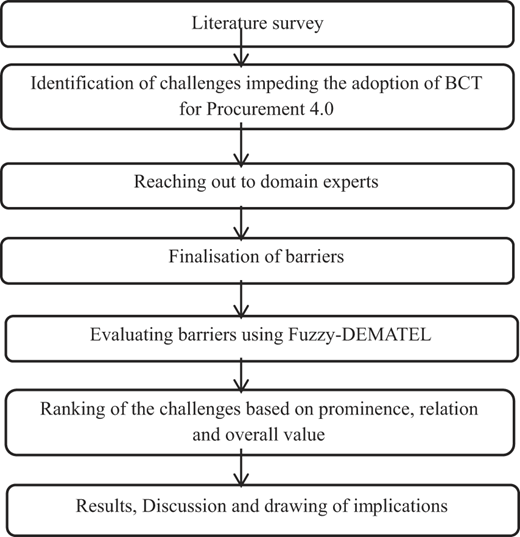
The research framework for the present study is shown in Figure 1. At first, an exhaustive literature search is conducted using online databases such as “Scopus, Emerald Insight, Wiley, ScienceDirect, Web of Science, IEEE Xplore and Google Scholar” with keywords (“barriers” OR “challenges” OR “hindrances” OR “impediment”) AND (“procurement 4.0”) AND (“food security” OR “agriculture supply chain” OR “food supply chain”). The search results are manually evaluated by the authors. Cross-references are also checked to ensure an exhaustive list of barriers. Furthermore, the list was subjected to a domain expert’s opinion to get the final list of barriers. These barriers are shown in Table 1. Thereafter, fuzzy-DEMATEL methodology is utilized to examine the causal relationship among the identified challenges.
3.1 Fuzzy sets theory
This work relates to a decision-making environment, and the decision-making process is always highly uncertain, dealing with linguistic and subjective forms. So, for controlling the subjectivity and fuzziness in the human judgment, Zadeh (1965) introduced the fuzzy set theory, which demonstrates the linguistic terms used in a decision-making process. In this process, all the mathematical operations are performed in an ambiguous environment. There are various fuzzy membership functions. This work utilizes fuzzy triangular numbers because of their simplicity to use (Kazancoglu et al., 2018). A “triangular fuzzy number (TFN)” Ã is shown as a triplet and a membership function µȂ is shown in equation (1):
Various mathematical operations are valid in the fuzzy environment such as addition, subtraction, multiplication, division, etc. let (1, m1, u1) and (2, m2, u2) are the two TFN then;
Addition: let (1, m1, u1) (2, m2, u2) = (1 + l2, m1 + m2, u1 + u2)
Multiplication: (, m1, u1) (2, m2, u2) = (
Similarly, subtraction and division are determined.
3.2 Fuzzy-DEMATEL
The fuzzy-DEMATEL data analysis technique has been adapted from Jassbi et al. (2011) and discussed below. The TFN is used, and five linguistic terms (Very High, High, Low, Very Low, No) are shown in Table 2.
Responses are taken from several experts through an indicator relationship matrix sheet (IRM sheet) in linguistic terms. The average value is considered for further calculation. Let there be a total “p” number of experts in the subset of “P,” i.e. “p” number of the fuzzy matrix such that.
Next, the assessment of expert preference using the averaging of the preferences (Chi-Jen and Wei-Wen, 2004):
The fuzzy matrix is written as:
They are known as the initial direction-relation matrix.
3.2.1 Normalization of direct relation matrix.
Normalize direct relation matrix is obtained from:
where and, .
3.2.2 Fuzzy total relation matrix
Then,
where and
And
The value of is taken from the Normalization of Direct relation matrix
3.3 Producing a casual diagram
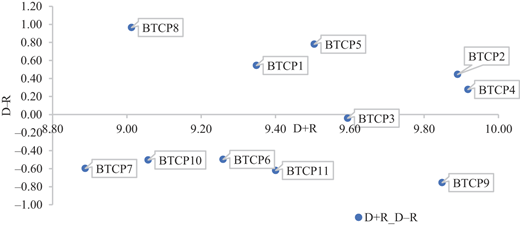
Total relation matrix is determined by adding the sum of row and column denoted as vector and respectively. Vector is known as the “prominence vector,” which is an indicator of vitality of the criterion. Similarly, by subtracting vector and , vector which is known as “relation vector,” classifies the criteria into a cause-and-effect group. After finding and needs to defuzzifying the vector and if the criteria having a positive value of, then it belongs to the cause group. Criteria having a negative value of is classified as an effect category. Graph plotted between is shown in Figure 2. Best non-fuzzy performance (BNP) method is used for defuzzification of the vector. BNP value for a TFN is given as:
4. Results analysis
4.1 Data collection and development of initial relational matrix
BCT adoption challenge for Procurement 4.0 has been identified from past literature and finalized after discussion with experts. Eleven challenges of BCT adoption have been identified and prepared a relationship matrix sheet in Excel and sent it to ten experts from Industry and Academia. Out of ten invited experts, only five experts filled the initial relationships matrix sheet. However, out of the five obtained sheets, three set of initial relationships matrix found to be satisfactory, as two failed due to similar fill-out. The three sets of responses has been utilized to compute the causal relationship. All three respondents are highly qualified they have minimum of master degree and minimum 15 years of experience. The experts were well aware about the Procurement 4.o and blockchain adoption benefits and challenges. Although three responses are considered sufficient for applying fuzzy-DEMATEL due to the expertise level of respondents, we acknowledge that a larger sample could enhance result’s generalizability and reliability. All the pairwise relationships have been asked on a five-point fuzzy linguistic scale as provided in Table 2.
4.2 Obtaining average fuzzy matrix
The value of all three initial relationships matrix has been converted into fuzzy terms between 0 and 1. The three-relationship matrix has been averaged to get the average relationship matrix using equation (2) to generate the average relationship fuzzy matrix Z as shown in Table 3.
4.3 Computation of normalize matrix X
By using equation (3), normalized matrix X has been obtained from the average relationship matrix Z shown in Table 4 in all three fuzzy terms, lower medium and upper value as (l, m, u).
4.4 Computation of total relation matrix T
The normalized matrix X has been utilized to compute the total relationship matrix using equation (4). The fuzzy total relationship matrix is separated into lower, medium, and upper total relationship matrices. After Di-fuzzifying using equation (5), the total relationship matrix was computed as the T matrix. The average value of the total relationship matrix T has been calculated, which is set as the threshold value of 0.4286. The cell value of matrix T greater than the thresholds value has been highlighted and shown in Table 5, which shows a significant relationship between the challenges.
4.5 Building a causal diagram and ranking of blockchain adoption challenges
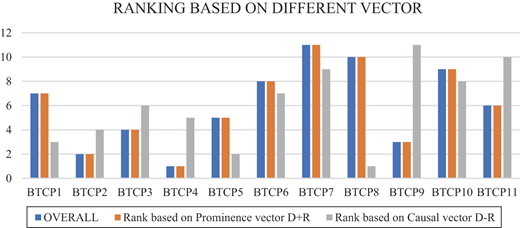
The total relationship matrix T has been utilized to compute the D and R vector, which is further used to compute prominence ((D + R) and relation vector (D-R). The prominence vector ranks the challenge, while the causal vector classifies the challenges into cause-and-effect groups, as shown in Table 6. The challenge whose causal vector is negative is called effect group, whereas a positive causal vector is termed a cause group challenge. The plot between D + R and D-R has been performed on the scattered plot to obtain a causal relationship graph (see Figure 2). A challenge below the x-axis is termed an effect challenge as a negative D-R value. The cause group challenge has a higher driving power D value and lower dependence power R-value, whereas the opposite is observed for effect group challenges. In our findings, six challenges are categorized as effect group challenges, while five are cause group challenges. The rankings of challenges based on prominence, relation, and overall value have been computed and presented in a graph shown in Figure 3.
Based on the findings, challenges like security issues (BTCP3), trust issues among various partners (BTCP6), behavioral resistance (BTCP7), lack of skills and expertise (BTCP9), limited infrastructure (BTCP10) and complexity in usage (BTCP11) are classified as effect group challenges whose relation value is negative. Additionally, lack of skills and expertise (BTCP9) has the lowest relational value of −0.7546 in the effect group, while security issues (BTCP3) are having relational value −0.043 has least negative relational value in the effect group. Challenges like high initial cost (BTCP1), immature legal acceptance/regulatory policies (BTCP2), lack of understanding and awareness (BTCP4), limited scalability (BTCP5), lack of government support and regulation (BTCP8) are grouped in the causal group with positive relational value. Lack of government support and regulation (BTCP8) has the highest relational value of 0.9653 in the cause group, while lack of understanding and awareness (BTCP4) has the lowest positive relational value of 0.2780 in the cause group. Thus, based on the relational value, lack of government support and regulation (BTCP8) has the highest rank or is termed as the most critical causal challenge, which influences almost every challenge except BTCP1. In contract to this, lack of skills and expertise (BTCP9) is the least important challenge, belongs to the effect group BTCP3, BTCP4, BTCP6 and BTCP11, while being affected by every challenge.
Based on the prominence vector obtained, shown in Table 5, lack of understanding and awareness (BTCP4) has the highest prominence D + R value of 9.92, while behavioral resistance (BTCP7) has the lowest value of 8.82 ranked at the bottom. However, based on the overall value computed, BTCP4 has the highest 9.922 overall value, and BTCP7 has the lowest value of 8.908. All the challenges have the same rank based on overall value computation and prominence values. Hence, it is termed as a lack of understanding and awareness (BTCP4) has the highest prominence as the most influential challenge, while behavioral resistance (BTCP7) is the least influential challenge.
5. Discussions
The present study utilized a fuzzy-DEMATEL methodology to explore the challenges to BCT adoption in food procurement to ensure food security. As BCT is the most appropriate technology that enhances traceability of the system, which directly enhances food security. In the procurement of food items, strong traceability is requiring to ensure food quality that provides consumer transparency. To support Procurement 4.0, BCT adoption is beneficial; however, a lack of adoption or application is found in research. Hence, this study identifies 11 challenges from the literature and experts’ opinions that the FSC faces while adopting BCT-based Procurement 4.0. The causal relationship among the challenges has been explored using fuzzy-DEMATEL.
Blockchain intervention faces challenges due to a complex regulatory environment and a lack of government support (Govindan et al., 2024). The regulatory environment is inconsistent among jurisdictions, with some being proactive and supportive while others being restrictive. Developers, consumers, and investors are all affected by this lack of support, which results in inefficiency and uncertainty. Furthermore, the demand and adoption of blockchain are restricted by a lack of comprehension and awareness (Aghaei et al., 2021; Dabić et al., 2021). This is the result of misconceptions regarding its security, reliability, and scalability. It is imperative to engage with stakeholders, cultivate a collaborative ecosystem for blockchain innovation, and increase education and communication about blockchain to address these challenges. These two challenges are mutually reinforcing and interrelated, as the absence of understanding and awareness can result in a lack of government support and regulation, and the reverse is also true (Aghaei et al., 2021). Therefore, it is important to address these challenges by increasing the education and communication of blockchain, engaging with the relevant stakeholders and policymakers, and fostering a collaborative and inclusive ecosystem for blockchain innovation.
5.1 Research implications
Several theoretical implications for the research on BCT and its implementations in the FSC are derived in this study. Initially, this investigation offers empirical evidence of the causal relationships between the challenges of BCT adoption for Procurement 4.0, including interoperability, governance, regulation, scalability, and latency. This study assesses the most influential and dependent challenges in order of their importance by employing an integrated fuzzy-DEMATEL approach. This can assist researchers in comprehending the interdependence and complexity of the factors that influence the adoption of BCT in the food industry.
Secondly, this study extends the existing literature on BCT and food security by exploring how blockchain can enhance food traceability, collaboration, operational efficiency, and trading processes in the FSC. By applying BCT in food procurement, this study shows how procurement activity in FSC can be modernized by eliminating the barriers to ensure smooth adoption of BCT. Using BCT in food procurement can also help address the issues of food fraud, food safety and food quality that are prevalent in the current food system.
5.2 Managerial implications
This study has several managerial implications for the food industry stakeholders who are interested in accepting BCT for Procurement 4.0. Firstly, this study delivers a comprehensive ranking of the challenges of blockchain adoption, such as interoperability, governance, regulation, scalability and latency. By understanding the relative importance and interdependence of these challenges, managers can prioritize their efforts and resources to overcome the most critical barriers and leverage the most beneficial opportunities. This can also help managers to align their blockchain strategies with their business objectives and stakeholder expectations.
Secondly, this study underscores the prospective positive effects of BCT in the context of food security, including enhanced operational efficiency, collaboration, traceability and trading processes. Managers can enhance customer trust and satisfaction, reduce information asymmetry and transaction costs and gain greater visibility and control over the FSC by implementing BCT. Furthermore, this can assist managers in adhering to the food safety and quality standards and regulations, as well as in responding promptly and effectively to any food-related incidents or crises. Thirdly, this study advocates a blockchain-based architecture which is decentralized and secure and can address the security and privacy issues of the food data. By using smart contracts and encryption techniques, managers can ensure the authenticity, integrity, and confidentiality of the food data and transactions and prevent any unauthorized access or manipulation. This can also help managers to protect their intellectual property rights and competitive advantages, and to avoid any legal or ethical disputes.
Finally, this study suggests to come up with a holistic approach for the implementation of blockchain in the food industry that can guide managers in selecting the appropriate approaches based on their needs and preferences. Managers can consider the existing use cases of blockchain and may evaluate the strengths and weaknesses for their organization to choose the best practices for implementing blockchain technology in their industry. This research provides practical insights for policymakers and organizations that are interested in utilizing BCT to improve food security and resolve procurement challenges. Stakeholders can navigate the complexities of blockchain adoption and capitalize on its transformative potential to establish more resilient and transparent procurement systems that can protect the global FSC by adopting a strategic, collaborative, and proactive approach. The forecasting framework has wider societal relevance as it enables regulators to develop forward-looking policies, strengthen traceability norms and enhance overall food-security governance. It also offers educators a foundation for updating curricula and preparing learners for emerging technological and ethical demands. For risk managers, the framework supports early detection of supply-chain vulnerabilities and informed planning, thereby contributing to a more resilient and trustworthy food system.
6. Conclusion, limitations and future scope
This study examined three research objectives related to BCT adoption for Procurement 4.0 to support food security. The first research objective is addressed is identifying 11 challenges from an exhaustive literature search and is being validated by domain experts. The second research objective is addressed by modeling the identified challenges through applying the fuzzy-DEMATEL approach. The findings suggest that five challenges belong to the cause group, while the other six challenges fall under the effect category. Cause group challenges are dominant and need to be eliminated first, as they influence the effect of group barriers. The third research objective is addressed by ranking the challenges based on prominence, relation and overall value in fuzzy-DEMATEL analysis. The findings indicated that challenges such as “lack of understanding and awareness (BTCP4)” and “immature legal acceptance/regulatory policies” (BTCP2) are the most critical challenges for the adoption of blockchain in Procurement 4.0 and food security. Blockchain technology has the potential to enhance transparency, traceability, security, and efficiency in the food sector, contributing to food security and quality. More research, development, investment, and infrastructure are needed to overcome the challenges of blockchain adoption for Procurement 4.0. The present work suggests a proactive and collaborative approach to address these challenges and leverage the benefits of blockchain technology for the food sector. By overcoming these obstacles, the potential of blockchain technology in the food sector can be realized, contributing to food security and quality.
The limitations of this research are listed here, and they can be taken up in future research. This research employed a fuzzy-DEMATEL technique contingent upon experts’ subjective judgments and preferences, which may result in biases and inaccuracies in data collection and analysis. The number of experts is also a serious concern for the present study. The study is based on the judgments of a limited number of domain experts. Future research should incorporate a larger and more diverse expert respondents or validate findings using case studies or survey-based empirical research to improve external validity. Future studies may apply an integrated modeling approach with more experts to realize the results better. Additionally, the readiness assessment for adopting BCT could be done in a contextual setting to better understand challenges.