

Activated carbon has found key applications in the adsorption of polluted industrial dyes in water. In this work, macadamia husk biochar (MHC) was prepared using a household pyrolysis kiln before being activated with phosphoric acid (H3PO4) to obtain macadamia-husk-activated carbon (MHAC). A preliminary study was made on two activation conditions of MHC:phosphoric acid (w/v), 1:1 and 1:3, for the removal of malachite green (MG) dye. Analysis of experimental results revealed that the adsorption process was highly controlled by the time of contact, MHAC particle size, MHAC dosage and initial dye concentration. With the use of an MHAC particle size of 125–202 μm, an MHAC dosage of 6 g/l and a contact time of 120 min, the removal efficiency reached >99% at an MG concentration of 40 parts per million (ppm) before being degraded to around 75% at 70–80 ppm MG. Impregnation with zinc nitrate hexahydrate (Zn(NO3)2·6H2O) on the MHAC surface could maintain a removal efficiency of >99% at all initial dye concentrations (40–80 ppm), so the maximum removal capacity increased to ∼130 mg/g.
Notation
1 Introduction
Large volumes of agricultural residues are produced annually. These residues could have negative environmental effects if their disposal is not performed appropriately. The utilization of agricultural waste has been widely studied to find suitable applications.1–7 Macadamia husks (MHs) are a source of waste in Thailand; macadamias are mainly grown in Chiang Mai, Chiang Rai and Loei, with only a few current uses in the country. The macadamia belongs to the Proteaceae family, which originates in Australia, and two edible varieties are integrifolia and tetraphylla.8 The husk accounts for 65% of the total weight of the whole nut, so attempts have been made toward finding suitable applications for this waste.9 The chemical composition of the MH is similar to that of natural wood with differences in structure and density, so one potential use of the MH is in the production of activated carbon (AC).10
AC from agricultural wastes shows well-developed pore structures and rich surface chemical groups, which leads to its high adsorption capability.11,12 Preparation of AC from agricultural wastes has two steps: heat treatment and then activation. Heat treatment by pyrolysis or carbonization is thermochemical conversion of biomass in an inert atmosphere (in the absence of oxygen) into carbon-rich solid charcoal (char), usually achieved at a temperature ranging from 400 to 600°C under high pressure and a controlled gas atmosphere.13–15 Subsequently, the char could be modified for adsorption so that the material could adsorb selectively and effectively by (a) activation with chemicals (potassium hydroxide (KOH), sodium hydroxide (NaOH), phosphoric acid (H3PO4), hydrochloric acid (HCl), zinc chloride (ZnCl2), copper (II) chloride (CuCl2)) at elevated temperatures6,14,16–21 or (b) a thermal process at a typical temperature of 750–1000°C.20 Activation of plant straw carbon has been reported to occur within the range 400–900°C.15 Many new techniques for the preparation of AC, such as activation under microwave radiation, air oxidation under boiling water and steam activation, have been reported.22–24
Many water pollutants, including dyes, antibiotics, heavy metals, fertilizers and pesticides, are reported to act as toxic chemicals and are considered major environmental concerns.25 The detrimental effects of water pollution include not only those on food sources but also long-term effects on human health. It was reported that many industrial dyes could react with deoxyribonucleic acid, with increased mutagenicity and carcinogenicity.18 Thus, removing organic dyes from wastewater is important because of their potential toxicity and staining properties.5
Malachite green (MG), a triphenyl methane dye, is used as an external medical disinfectant and anthelminthic as well as a dye in silk, wool, jute, leather, cotton, paper and acrylic industries26 due to its low cost, ready availability and efficacy. However, there are concerns regarding its carcinogenicity.27 Conventional methods used for dye removal from water are adsorption, ion exchange, oxidation and membrane separation. Sometimes these techniques are used in combination.28 Adsorption is better than other methods because of its simple operation, economics and efficiency.29
In this research, macadamia-husk-activated carbon (MHAC) was prepared using a simple apparatus to economize the preparation cost, to use as an adsorbent for the removal of MG dye. Char (macadamia husk biochar (MHC)) was first prepared from MHs using a household pyrolysis kiln. The kiln was designed to use for small-capacity pyrolysis of biomass. Activation of the macadamia char to obtain activated carbon (MHAC) was later done using phosphoric acid. The selected batch was further treated with zinc nitrate hexahydrate (Zn(NO3)2·6H2O) to improve the removal ability.
2 Materials and methods
2.1 Preparation of MHAC
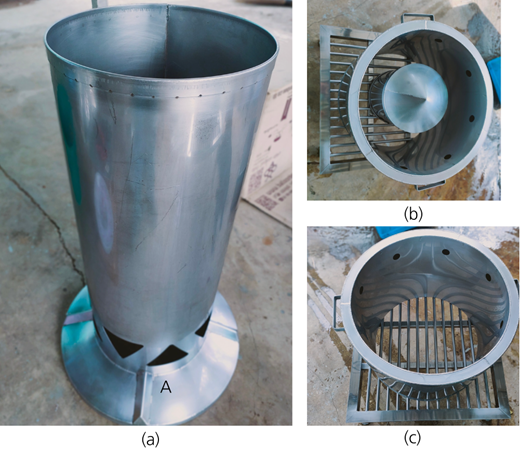
MHs were collected from Chiang Rai Province, Thailand. The MHs were washed with water to remove dust before drying in an oven. The carbonization process was carried out for 3 h, in according with the method of Wongcharee et al.,30 using a homemade gasifier pyrolysis kiln for household biochar production (Figure 1). The peak temperature measured at point A (Figure 1(a)), using an infrared thermometer, was ∼800°C, and the biomass capacity was around 1–3 kg. The yield of macadamia charcoal (MHC) was approximately 25.94%. After the pyrolysis, the MHC was ground to a size of around number 35 mesh size using a hammer mill. The MHC was further activated using phosphoric acid due to the its excellent ability in activation of biomass.12,21,31,32 To study the effect of the phosphoric acid content on activation efficiency, the carbonized charcoal was immersed in 85% phosphoric acid for 1 h with ratios of MHC to phosphoric acid (w/v) of 1:1 and 1:3. The samples are coded as 1-1MHAC and 1-3MHAC, respectively. The samples were dried and then heated up to the activation temperature of 500°C for 3 h in an electrical furnace (CWF laboratory chamber furnace, Carbolite Gero, UK). The activated MHAC was then washed with distilled water to remove residual chemicals until the pH of the filtrate reached a value of 6–7. The samples were then dried at 50°C for 12 h in an oven to obtain AC. The activated MHAC was further ground to various particle sizes in a ball mill. The milled MHAC was then screened to three particle sizes of 125–202, 202–279 and 279–470 μm.
To enhance the degradation efficiency further, 1, 2 and 3M zinc nitrate hexahydrate solutions were used for impregnation. The materials were mixed under sonication for 2 h before being fired at 400°C for 2 h. In this study, 1-3MHAC was selected for the impregnation.
The specific surface area and pore size of MHAC were determined using the Brunauer–Emmett–Teller (BET) method in nitrogen (N2) gas (Belsorp Mini II). The surface morphology of MHAC was investigated using a scanning electron microscope (SEM; Tescan Mira4), while the change in molecular structure was monitored using the Fourier transform infrared spectroscopy (FTIR) technique (Nicolet iS50). The specimen was directly placed on the diamond crystal of the FTIR apparatus in attenuated total reflection mode. The transmission was performed at a scanning wave number of 4000–400 cm−1 with a resolution of 2 cm−1 and 32 scans. The surface treatment was observed using the energy-dispersive X-ray spectroscopy (EDS) technique.
2.2 Removal of MG
In this study, the effects of the adsorbent particle size and dosages as well as the initial dye concentration on the removal capacity were first measured at different contact times (30, 60, 90 and 120 min). The effects of MHAC impregnated with zinc nitrate hexahydrate were later studied using the optimum conditions obtained from 2.1. The MG dye solution was prepared by dissolving the dye in distilled water to have the desired concentration. The concentration of MG used in all experiments was fixed at 50 parts per million (ppm) except those in Section 3.4, in which the dye concentrations were varied between 40 and 80 ppm. The solution was kept in a dark chamber for 24 h. Each experiment was carried out using 50 ml of the dye solution at an MHAC dosage of 6 mg/g. The experiment was performed at room temperature under continuous stirring at 150 revolutions/min. The dye removal ability was determined using a spectrophotometer (UV-5100, Metash) at a fixed wavelength of 665 nm. The calculation of removal efficiency and adsorption capacity (q t) at a specific time is shown in Equations 1 and 2, respectively.
where q e is the adsorption capacity (mg/g), C 0 is the initial concentration of the dye (mg/l), C t is the concentration of the dye at a specific time (mg/l), V is the volume of the dye solution (l) and M is the mass of the adsorbent (g).
It was noted that with the water the absorbance of MHAC in pure water (without MG dye) gave rise to ~98% due to the interference from the presence of the absorbent fine particles. The maximum removal efficiency in this experiment was ∼99%.
3 Results and discussion
3.1 Characterization of MHAC
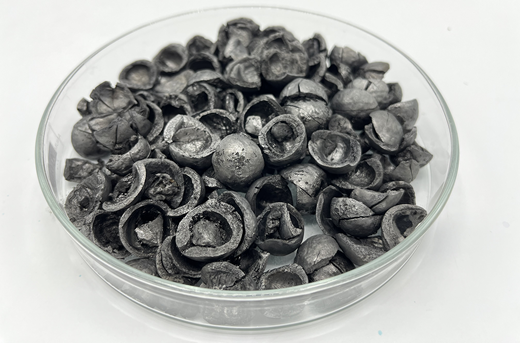
The MHC obtained from the present pyrolysis process is shown in Figure 2. The char has a black color with a shiny surface, suggesting the success of pyrolysis. This char was ground to the desired size and was further activated. The specific surface areas and pore sizes of MHC, 1-1MHAC and 1-3MHAC are presented in Table 1. The results indicated that the activation process could dramatically increase the surface area of the char, particularly in 1-3MHAC.
Surface areas and average pore sizes of MHC and MHAC
| BET surface area: m2/g | Average pore diameter: nm | |
|---|---|---|
| MHC | 6.2 | 2.7 |
| 1-1MHAC | 57.8 | 4.2 |
| 1-3MHAC | 123.5 | 1.9 |
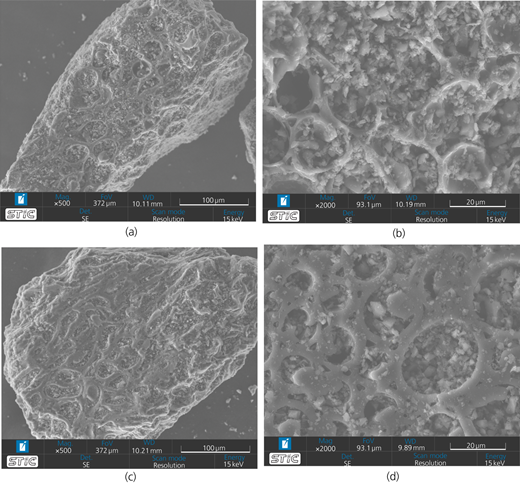
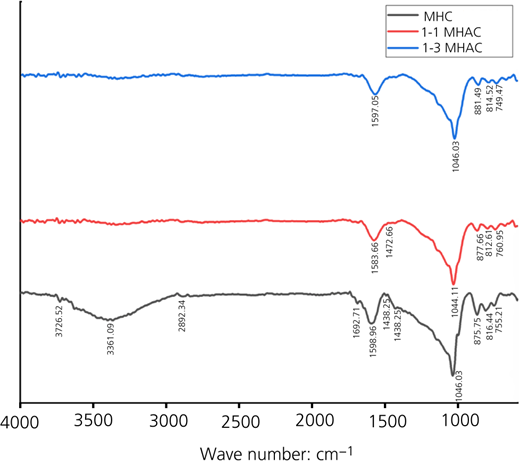
SEM micrographs of 1-1MHAC and 1-3MHAC are shown in Figure 3, indicating the surface roughness of both samples. The surface morphology of both 1-1MHAC and 1-3MHAC had a rough texture. FTIR spectra of MHC (before the activation), 1-1MHAC and 1-3MHAC are shown in Figure 4. The broad peak located at 3361 cm−1 was assigned to the O–H stretching vibration of phenolic or alcoholic groups and adsorbed water.21,33 This peak was strong in MHC, while it was suppressed in both 1-1MHAC and 1-3MHAC. The disappearance of the O–H group was possibly due to the reaction with the activating agent34 or the removal of the adsorbed water during activation at the high temperature (500°C). The other peaks were similar in all samples. The dominant peaks, which appeared at 1044–1046 cm−1, were assigned to the asymmetric vibration of the C–O stretching. The peak at 2912 cm−1 corresponded to the C–H stretching, the characteristic peak for cellulose, hemicellulose, wax and fat,35 which appeared at a very low intensity, indicating the decomposition of C–H bonds. Asymmetric vibration of the –CH2 group appears at 2892 cm−1.36 The peak at around 1738 cm−1, related to the C=O stretching vibration of acetyl, carbonyl and ester groups in hemicellulose and lignin,35 was not observed in this study. The peak at 1598 cm−1 was assigned to the aromatic symmetric stretching of C=C of lignin. The peak at ∼1438 cm−1 was assigned to the C–O stretching in cellulose and lignin. Furthermore, the peak ∼1044 cm−1 was attributed to C–C, C–OH, C–H ring and side group vibration of hemicellulose and pectin.17 However, the heights of the peak at 1438 cm−1 and those at the lower-wave-number region (755–885 cm−1) of MHC were higher than those of 1-1MHAC and 1-3MHAC, indicating success of the pyrolysis.
The EDS analysis results for 1-3MHAC treated with zinc nitrate hexahydrate are shown in Figure 5. The results indicated the existence of zinc oxide (ZnO) on the surface of the 1-3MHAC. The amount of zinc oxide increased from 0.3 to 0.6 wt% when the concentration of zinc nitrate hexahydrate was increased from 1 to 2 M. Further increasing the concentration of zinc nitrate hexahydrate did not result in a further increase in the content of zinc oxide on the surface, suggesting the saturation point using this method.
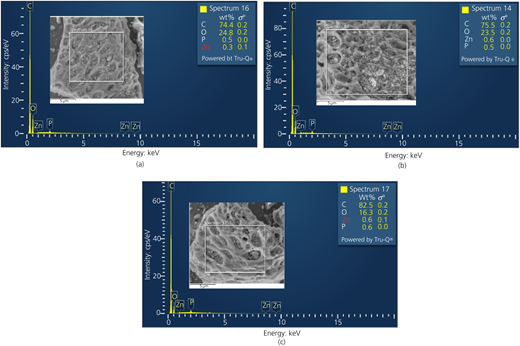
EDS analysis of the surface of 1-3MHAC treated with zinc nitrate hexahydrate: (a) 1 M; (b) 2 M; (c) 3 M. cps, counts per second
EDS analysis of the surface of 1-3MHAC treated with zinc nitrate hexahydrate: (a) 1 M; (b) 2 M; (c) 3 M. cps, counts per second
3.2 Effect of the particle size and contact time
The effect of particle size of 1-1MHAC and 1-3MHAC at an adsorbent loading dosage of 6 g/l on the removal efficiency is shown in Figure 6. The results showed that the removal ability of both 1-1MHAC and 1-3MHAC became better with the use of a smaller-sized absorbent. The removal capacity of 1-1MHAC with a size of 125–202 μm reached its maximum after 60 min of contact. 1-1MHAC with a larger size showed increased removal ability with an increase in contact time with the maximum values below 80%. 1-3MHAC with a size of 125–202 μm showed a higher removal ability than 1-1MHAC of the same size range at all contact times. 1-3MHAC with a size of 202–279 μm could reach the maximum removal efficiency at a contact time of 120 min, while that with a size of 279–470 μm showed a removal efficiency of only 85%. A similar trend was observed in methylene blue adsorption by zinc chloride-activated corn husk carbon.37,38 As the particle size decreased, the surface area exposed to the adsorption of methylene increased, so the removal occurred at a faster rate. Due to the superior performance, the particle size of 1-1MHAC and 1-3MHAC used in the next sections was in the 125–202 μm range.
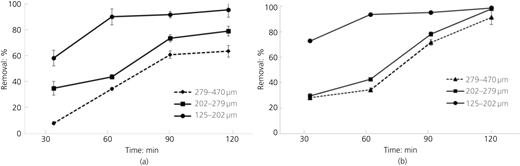
Effect of particle size on MG removal efficiency of (a) 1-1MHAC and (b) 1-3MHAC at various contact times (MG concentration: 50 ppm)
Effect of particle size on MG removal efficiency of (a) 1-1MHAC and (b) 1-3MHAC at various contact times (MG concentration: 50 ppm)
3.3 Effect of the adsorbent dosage
The effect of 1-1MHAC and 1-3MHAC dosages (0.18–6.0 g/l in twofold increments) on MG removal efficiency and removal capacity at a contact time of 120 min is shown in Figure 7. For 1-1MHAC, the removal efficiency increased sharply from 12 to 86% when the dosage was increased from 0.1 to 3.0 g/l before slightly increasing to a maximum value of around 100%. The removal capacity (q e), however, showed the opposite trend. q e decreased from 37 to 8 mg/g when the dosage was increased from 0.1 to 6.0 g/l. For 1-3MHAC, the removal efficiency increased more slowly from 14 to 100% when the dosage was increased from 0.1 to 6.0 g/l. q e decreased from 39 to 8 mg/g when the dosage was increased from 0.1 to 6.0 g/l.
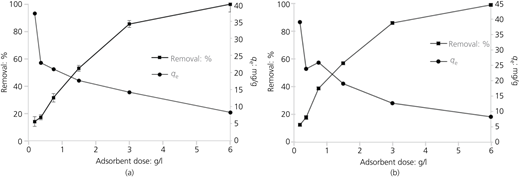
Effect of the adsorbent dosages on the MG dye removal efficiency of (a) 1-1MHAC and (b) 1-3MHAC (MG concentration: 50 ppm)
Effect of the adsorbent dosages on the MG dye removal efficiency of (a) 1-1MHAC and (b) 1-3MHAC (MG concentration: 50 ppm)
3.4 Effect of the initial dye concentration
The effect of the initial dye concentration on the removal efficiency and removal capacity of the MHAC at 120 min is shown in Figure 8. In this experiment, the dye concentration was varied from 40 to 80 ppm, while the MHAC dosage was fixed at 6 g/l. The results showed that the removal efficiency became lower when the initial dye concentration was increased. The removal efficiency decayed more rapidly in 1-1MHAC when the initial dye concentration was increased from 40 to 60 ppm. At a dye concentration of 70–80 ppm, there was no significant difference between the two MHAC types used. In both MHACs, q e steadily increased from 65–67 to ∼98–100 mg/g with increasing dye concentrations. The adsorption was governed by factors such as the surface area and pore size of the adsorbent, as well as the surface functional groups.12 The FTIR spectra showed that the prepared material had specific functional groups for color adsorption capacity.39 The carboxyl and carbonyl groups were reported to participate in the adsorption of direct red 12B dye on the surface of Simarouba glauca seed shell carbon.39
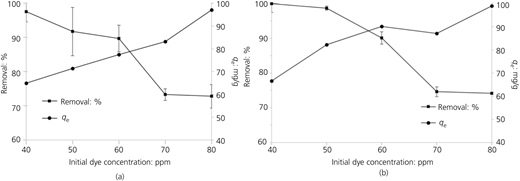
Effect of the initial dye concentration on the removal efficiency of (a) 1-1MHAC and (b) 1-3MHAC (the MHAC dosage was fixed at 6 g/l)
Effect of the initial dye concentration on the removal efficiency of (a) 1-1MHAC and (b) 1-3MHAC (the MHAC dosage was fixed at 6 g/l)
3.5 Effect of zinc oxide impregnation
From Section 3.4, the results showed that the removal efficiency decayed rapidly with the increase in the dye concentration. An attempt to improve the removal efficiency was done by impregnation with zinc nitrate hexahydrate of various concentrations (1, 2 and 3 M). The effect of the initial dye concentration (40–80 ppm) on the removal efficiency and removal capacity of the impregnated 1-3MHAC at 120 min is shown in Figure 9. The MG removal efficiency of bare 1-3MHAC is also included as a reference. The results revealed that the removal efficiency for 1 M was constant at 99% at dye concentrations between 40 and 70 ppm before decreasing to around 90% at 80 ppm. With the use of 2 and 3 M, the removal efficiency decreased to 97% at 80 ppm. The q e for all concentrations progressively increased from 66 to ∼120–130 mg/g with increasing dye concentrations. This result indicated that zinc nitrate hexahydrate could effectively be used to enhance the removal performance of MHAC. Effects of AC surface treatment with zinc oxide or zinc chloride on the degradation of chemical substances have been reported.7,17 Zinc oxide served as a catalytic active site and catalyzed the conversion process of the target substance.4
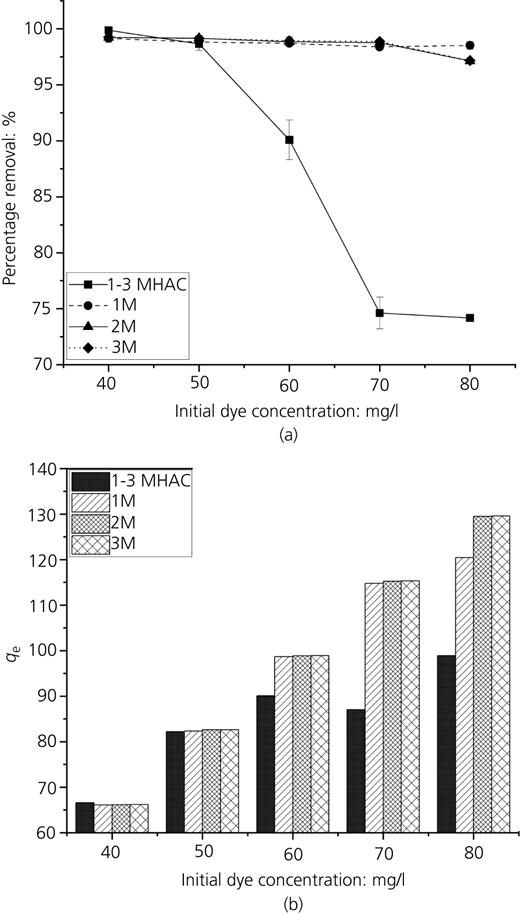
Effect of the concentration of zinc nitrate hexahydrate on MG dye (a) removal efficiency and (b) removal capacity with reference to 1-3MHAC
Effect of the concentration of zinc nitrate hexahydrate on MG dye (a) removal efficiency and (b) removal capacity with reference to 1-3MHAC
4 Conclusion
The study showed that MHAC prepared with a household pyrolysis kiln is an effective adsorbent for the removal of MG dye from polluted wastewater. A higher phosphoric acid activating agent ratio resulted in MHAC with a higher surface area. However, no significant difference in adsorption ability between the two MHACs was observed. Analysis of experimental results revealed that the adsorption process was highly controlled by the time of contact, MHAC particle size, initial dye concentration and MHAC dosage. With the use of an MHAC particle size of 125–202 μm, a contact time of 120 min and an MHAC dosage of 6 g/l, the removal efficiency reached 97–99% at an MG concentration of 40 ppm. A maximum qe of ∼98 mg/g was achieved at a dye concentration of 80 ppm. The removal capacity could be improved substantially, reaching a qe value of 130 mg/g, with impregnation with zinc nitrate hexahydrate due to an increase in catalytic active sites.
Acknowledgements
The publication fee is financial support by Mae Fah Luang University, Thailand. The authors thank Miss Priya Chinarat for assistance on sample preparation and testing. The research is supported by the National Science Research and Innovation Fund through Mae Fah Luang University.

