


This study aims to investigate the differences in spatial ability between students with a math learning disability and their normal peers.
To investigate these differences two groups, (60 students with a math learning disability) and (60 normal students) from fifth grade with a mean age (10.6 years) were administered with spatial ability test along with an IQ test. Students with a math learning disability were chosen using measures of the following: math learning disability questionnaire developed from learning disability evaluation scale – renormed second edition (LDES-R2) (McCarney and Arthaud, 2007) and the Quick Neurological Screening Test (Mutti et al., 2012), in addition to their marks in formal math tests in school.
Comparison between the two groups in four aspects of spatial ability resulted in obvious differences in each aspect of spatial ability (spatial relations, mental rotation, spatial visualization and spatial orientation); these differences were clear, especially in mental rotation and spatial visualization.
This paper contributes to gain more insights into the characteristics of pupils with a math learning disability, the nature of spatial abilities and its effect on a math learning disability. Moreover, the results suggest spatial ability to be an important diagnose factor to distinguish and identify students with a math learning disability, and that spatial ability is strongly relevant to math achievement. The results have significant implications for success in the science, technology, engineering and mathematics domain.
Introduction
Since the turn of the 20th century, researchers have increasingly been convinced that intelligence is not just one dimensional. They tried to identify different aspects of intelligence and define it as a multi-dimensional term (Gardner, 1991). Since that time, there has been clear evidence that spatial ability differs from other primary abilities (e.g. verbal comprehension, word fluency, or reasoning) (Flanangan and McDonough, 2018; Maresch and Posamentier, 2019) . This fact was the starting point for spatial ability research. The most common method for studying spatial ability was the factor analysis, which is a “statistical technique that examines the patterns of correlations among a large number of variables” (Hegarty and Waller, 2005; Gilligan et al., 2018). This technique tries to observe many variables, has the goal to find out common features among them and wants to reduce the number of constructs also called factors. Mathematically, a factor can be seen as a weighted sum of each of the variables and represents an underlying ability (Hegarty and Waller, 2005). When tests are loading on one of the factors, then they are called markers for that factor. When we are trying to find out the underlying factors of spatial ability, we have to use tests that include markers for the factors. For many decades of the 20th century spatial ability researchers, on the one hand, were searching for markers for factors and used a large number of tests with markers to identify underlying factors for spatial abilities and their relations (Carroll, 1993; Linn and Petersen, 1985; Lohman, 1988; Maier, 1998).
Since the end of the 20th century, researchers have assumed that it is not possible to establish one accepted factorial model for spatial ability (Glück et al., 2004). Investigators identified some possible reasons for that fact (e.g. probands use different strategies for the same tasks; some markers are not testing the factor they should; there is no consistent evidence for the separability of many factors). Because of these perceptions, researchers are now focusing on strategies, novel spatial ability dimensions such as dynamic spatial abilities or small-scale and large-scale spatial abilities, individual differences, and correlations of spatial ability with mental imagery and working memory (Wang and Carr, 2019). Nowadays we know that seeing is a very complex process which needs a third of your brain (Eagleman, 2011), and we are just at the beginning to find out more and more of how the process of seeing is working and how it influences spatial abilities of individuals (Eagleman, 2016).
Math learning disability and spatial ability
Spatial ability refers to one of the most important cognitive abilities that clearly affect math learning (Wheatly, 1998). Spatial ability has always been a good predictor for a math learning disability, where students with low spatial ability perform less well on mathematical tasks than their higher spatial ability peers (Van Garderen, 2006). Spatial ability is highly correlated with success in mathematics education (Hegarty and Kozhevnikov, 1999; Wang and Carr, 2020; Xie and Zhang, 2020). As an example, the study of Grazia et al. (2014) concluded that spatial ability predicts performance in mathematics and eventual expertise in science, technology, and engineering, and found that the variation of spatial ability explained about 60% of the variation in mathematical ability at (4,174) pairs of (12) year old students. The findings of the study of Unal (2009) indicated that there was a causal relation between spatial ability and geometry achieving level, where learners with low spatial abilities are more challenged geometry learners, whereas learners identified with high spatial abilities showed high levels in geometry achievement.
In theory, a math learning disability can result from deficits in the brain and cognitive systems that evolved to create secondary knowledge from primary systems, such as working memory (Geary et al., 1996). Some studies referred to spatial ability not only as a main associated deficit aspect but also as a possible cause of math learning disability. Spatial ability is one of the non-verbal learning disabilities that represent a deficit aspect at students with a math learning disability, whereas training and stimulus spatial ability, especially in the preschool stage can progress mathematic ability of students and reduce the risk of learning disability in elementary school (Yarmohammadian, 2014). Also, mathematic performance relates to spatial ability, where it appears to be used in specific and identifiable ways in the solution of mathematics problems (Xie and Zhang, 2020). This explains the importance of including spatial ability exercises for the mathematics curriculum, especially in primary school; therefore, we can develop mathematic achievement in the future and avoid math learning disability risks at later stages.
Description of spatial ability factors
Diverse factorial models of spatial ability research had been developed during the last two decades of spatial ability research. It is worth noting that specifically, the factors visualization, spatial relation, spatial orientation, and mental rotation are often designated as independent aspects of spatial ability. These four most frequently mentioned factors in literature are presented and described as follows:
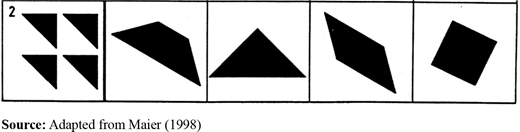
Visualization. Guilford defines the factor as “ability to think of changes in objects-changes in position, orientation, or internal relationship”(Lohman, 1996). In many models of spatial ability, the factor visualization is delineated as the general factor, as it is the most comprehensive one. Tests for this factor often show tasks with objects which are divided into several parts and rotated (Figure 1). The picture on the left shows four congruent, equal-sided and right-angled triangles. The task is to find out which of the figures on the right can be built from the four triangles on the left?
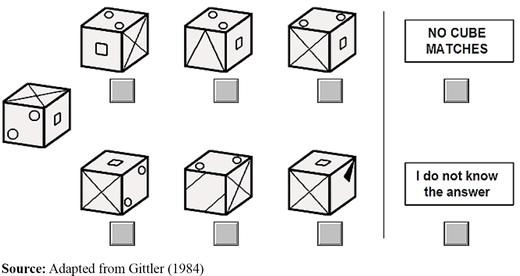
Also, very common is the three-dimensional (3D) Cube Test (Gittler, 1984). This test investigates whether one of the six cubes on the right side is the same cube as the one cube on the left side or whether the correct answer is “no cube matches”. If you do not know the solution, you have to choose the answer “I do not know the answer”. Each pattern at the side faces of the cube occurs only once, as in Figure 2.
Students with a math learning disability often reveal a deficit at the ability of visualization, where former studies such as (Garderen, 2006) indicated that gifted students perform better on spatial visualization measures than students with learning disability and average-achieving students. Also, using visual images was positively correlated with higher math word-problem-solving performance. Furthermore, using schematic imagery significantly and positively correlate with higher performance on spatial visualization measures; conversely, it was negatively correlated with the use of pictorial images.
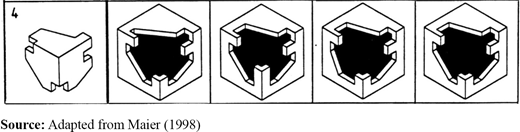
Spatial relations. Spatial relationships are the 3D relationships of objects in space, like relative position and distance apart (Miyake et al., 2001) this component of spatial ability focuses on realizing 2D and 3D objects in place. Figure 3 shows a common task: into which of the four cubes does the object on the left fit?
The spatial relations factor cannot be seen as completely independent from the visualization factor. They are similar because they both rely on executive functioning and visuospatial storage (Karaman and Toğrol, 2010).
Mental rotation. This factor comprises the ability to imagine the rotation of (simple) 2D and 3D objects. Geometrical objects have to be identified, often in varying positions, and have to be rotated mentally. 2D tasks display geometrical figures (e.g. the letter z or the number 2) in varying positions (either rotated or rotated and mirrored).
Tasks on mental rotation often do not only test the correct solution of the task but also the speed with which simple figures can be rotated mentally by the participants. In most cases, the decision is whether a rotated figure is identical to the original figure or not.
The process of mental rotation can be divided into four discrete stages of processing (Cooper and Shepard, 1973). At the first stage, individuals are encoding the stimuli and storing the information in working memory. The process of the second phase is rotating the mental representations. This stage of rotation is suggested to be a composite of several processes. Different parts of an object are often rotated separately. The third phase of processing involves a comparison of the stimulus representations to decide whether they are identical or not identical. Finally, during the fourth phase, individuals are responding positively or negatively, depending on the outcome of the comparison. The amount of the time used for encoding, comparing, and responding is nearly the same regardless of the angular disparity between the two shapes. Cooper and Shepard (1973) stated that only the second stage of processing (rotation of the mental representations) is affected by the orientation of the shape. Individuals who are unable to achieve a stable holistic internal representation of shape have to rotate the object several times. “High-ability individuals may be able to create more accurate internal representations” (Mumaw et al., 1984) of familiar and even unfamiliar shapes and can keep in mind the complete mental representation during the whole spatial rotation process. They are also able to encode and compare stimuli faster (Mumaw et al., 1984).
In many test samples, the data recorded show a linear correlation between the angle of rotation and the time needed for the solution. At the beginning of this research tradition, it was deduced from the test results “that mental rotation can be regarded as “analog”, which means that manipulation of the picture before the “inner eye” follows similar principles as real manipulation. This assumption has meanwhile been disproved in various aspects, as mental rotation is successful only with comparatively simple objects”. (Glück et al., 2004; citation translated).
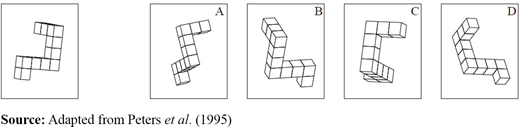
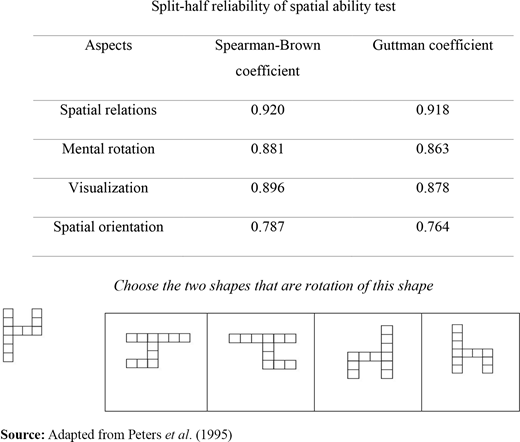
Figure 4 shows a typical task on mental rotation, published as the Mental Rotation Test (MRT) by Vandenberg, based on analyses by Metzler and Shepard (Peters et al., 1995), which of the four figures on the right are identical with the one on the left, composed of ten small cubes.
The mental rotation ability can be developed by training, and enhancing this ability correlate positively with the student math skills (Bruce and Hawes, 2015), this study indicated that young children from a wide range of ability levels could engage in, and benefit from, classroom-based mental rotation activities, and the study suggested some practical applications in a geometry program that combine 2 D and 3 D mental rotations. Children in the Lesson Study classroom showed large gains in their mental rotation skills during four months of Lesson Study intervention in the Math for Young Children research program.
Spatial orientation. This feature outlines the ability to find one's way in a 3D space mentally as well as in reality, whereby one has to move around in a spatial arrangement of objects. Typical tasks are to put pictures taken during a boat ride into the right order or to do the same with a sequence of pictures taken from a helicopter. Often the participants move in virtual, interactive surroundings to solve the tasks.
The acquisition of skills in spatial orientation can be identified in three hierarchical steps:
Orientation to landmarks: orientation to points of reference in the landscape (e.g. high-rise building, power pole, lighthouse).
Studying routes: linking landmarks with paths and routes.
Making map-like pictures: All the objects become interrelated so that relative positions, shortcuts, distances etc. can be deduced.
Spatial orientation is one of the spatial ability factors with the expectation that the individual moves mentally (move self) and is changing his/her mental perspective (Figure 5). Researchers have shown that when individuals change their egocentric perspective mentally, this leads to an activation of the left parietal-temporal-occipital junction, whereas when transformations are object-based (move object) and not individual-based, it leads to an activation of posterior areas mostly in the right hemisphere (Zacks et al., 1999). So, we can suggest that the factors visualization (move-object strategy) and spatial orientation (move-self strategy) are indeed different spatial abilities. Kozhevnikov and Hegarty (2001), after a study with the perspective-taking test, stated that apparently object manipulation ability and perspective-changing ability do not reflect the same construct.
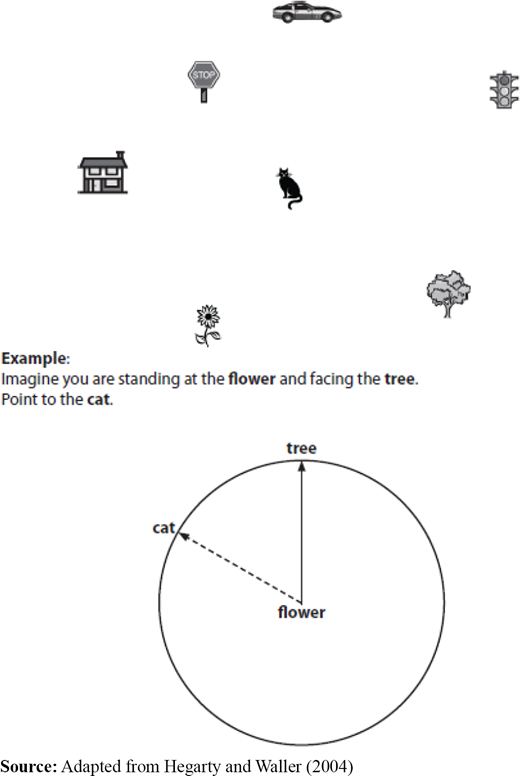
They also found out that individuals use a move-self strategy when they have to change their perspective with an angle of 90 degrees or more. If they have to rotate their position less than 90 degrees, they use move object strategies (Kozhevnikov and Hegarty, 2001). This is the reason why the Guilford-Zimmerman test is not an acceptable marker for spatial orientation because there are only tasks with differences in the angle of only about 30 degrees, and individuals mostly use move-object strategies to solve these tasks (Barratt, 1953).
Many former studies investigated the relation between all or some of the aspects of spatial ability, and other variables, such as the gender, the low academic achievement in math and other academic fields (Verdine, 2015; Hallowell and Okamoto, 2015); Wang and Carr, 2020; Xie and Zhang, 2020). Other studies investigated the effect of training spatial ability aspects on developing some skills for students with learning disabilities and normal students (Cheng and Mix 2012; Bruce and Hawes 2015; Şişman et. al., 2020). Therefore, this study was conducted to answer the question: are there differences in spatial ability between students with a math learning disability and their normal colleagues at the aspects of (spatial relations, mental rotation, visualization, spatial orientation)? The answer to this question will help in a better understanding of spatial ability and its effects and relation with a math learning disability.
Method
The main objective of the present study is to determine the differences in spatial ability aspects between the students with a math learning disability and their normal peers. That objective will participate in more understanding spatial ability and its relation with a math learning disability, also determining these differences can provide new diagnostics of math learning disability. To address this objective, the performance of two groups on the spatial ability test was compared in four aspects of spatial ability (spatial relations, mental rotation, visualization, spatial orientation). Also, the data analysis using a T-test was conducted to identify the differences and which aspects were the most differentiated among the groups.
Participants
The sample composed of (120) fifth-grade students from seven public primary schools in Egypt with mean age (10.6) years (SD= 0.44). The participants were divided into two groups: students with a math learning disability (60) and normal students (60). Identification of students with a math learning disability was carried out according to the learning disability definition of the National Joint Committee of Learning Disabilities (NJCLD) that is considered the most comprehensive definition of a learning disability (Hallahan and Kauffman, 2005), on the following basis:
The student's math marks in the first term test of fifth-grade school (the passing score 15/30 was the criteria).
The student’s math marks of the math learning disability questionnaire were developed from LDES-R2 (McCarney, and Arthaud, 2007) math sub questionnaire, and (Mundia, 2012). The score (41–60, medium difficulty) was used as a criterion.
The Quick Neurological Screening Test (QNST) (Mutti et al., 2012) to make sure that the deficits in math were due to neurological reasons that confirm they have a learning disability.
The IQ score on the Stanford Binet intelligence test (5th Ed.) with the whole test aspects. Students with a score of less than 90 on the scale were excluded (Critical score for the diagnosis of learning disabilities).
Also, all sample students were right-handed because of the later research orientation that indicated that this variable might affect spatial ability.
The normal students were selected so that they have more than average in last formal math tests, and they have no history of developmental, neurological, or learning problems. Also, they were from the same age, and there were no differences in IQ scores as stipulated in the Table 1 and 2 .
Materials
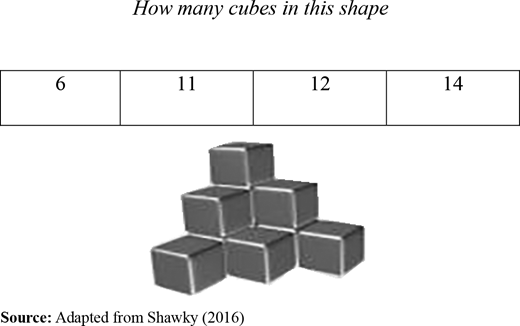
Spatial ability test. Spatial ability test (Shawky, 2016), this test consists of four parts with (40) questions that represent spatial ability aspects (spatial relations, mental rotation, spatial visualization, and spatial orientation). The test has (10) questions in each part. The first part contains questions of completing patterns and identifying different or similar shapes, the second part contains questions of mental rotation where the individual has one referential shape and four selections two of them are rotation of the referential shape with some angel and two are reflection(Figure 6), where the individuals have to choose the two rotation shapes, the third part contains questions of recognizing solids, so it contains five questions where the student have to recognize a given solid shape and identify the number of small cubes that compose it (Figure 7), another five questions about recognizing and identifying the small part that complete a big given cube, the fourth part contains questions of spatial orientation where the individual have nine objectives, and she/he has to identify the location of some objective when she/he is looking to another one. Each question of the (40) questions has one correct choice except the second part has two correct choices, and the student has to select the two choices to get the question mark. The test is limited by (25) min. The reliability of the test was conducted in (1,200) students. The correlation coefficients between the scores of each question and the total score ranged between (0.487) and (0.864), and reliability was also computed in the split-half method in ways (Spearman–Brown, and Guttman coefficients), and the results are shown in Table 1, and total Cronbach’s alpha factor of the test equaled (0.962) (Shawky, 2016):
Math learning disability questionnaire. It contains (20) terms about the common math procedural errors and conceptual math errors at students with a math learning disability. Its terms were developed from LDES-R2, McCarney, and Arthaud (2007) math sub questionnaire, and Mundia (2012) questionnaire. The questionnaire is conducted by the math teacher. It takes about (5) min from the math teacher to conduct it. The questionnaire responses differ in a five-point range between (never = 0) and (very frequently = 4). The test scale is divided into four diagnoses as follows: (0-20, normal), (21-40, simple disability), (41–60, medium difficulty), and (over 61) (intense difficulty).
The QNST. Mutti et al. (2012) is a norm-referenced screening assessment of the development of motor coordination and sensory integration. It is designed to be used for students of the age of five and older and can be given in approximately 20 to 30 min. Raw scores are interpreted in terms of functional categories. The QNST is designed to screen for neurological soft signs that may indicate challenges in motor coordination, daily functioning, and learning. The examinee completes a series of motor tasks sampling maturity of motor development, skill in controlling large and small muscles, motor planning and sequencing, sense of rate and rhythm, spatial organization, visual and auditory perceptual skills, and disorders of attention. The test refers to the scores over (50) as highly probable having neurological signs, the scores between (26 –50) as probable, and between (0 – 25) as normal students.
The Stanford–Binet intelligence scale fifth edition (SB5). This test is based on the schooling process to assess intelligence. It continuously and efficiently assesses all levels of ability in individuals with a broader range in age. The test measures five factors of cognitive ability: Fluid Reasoning, Knowledge, Quantitative Reasoning, Visual-Spatial Processing and Working Memory. Each of these factors is tested in two separate domains, verbal and nonverbal. The full test takes approximately (45–75) min to administer. The abbreviated test takes approximately (15–20) min.
Procedures
Firstly The samples of the study were selected according to the definition of learning disability of the NJCLD that is considered the most comprehensive definition of learning disability (Hallahan and Kauffman, 2005), so The sampling process conducted in the following steps, which consider the criteria of the definition:
From seven primary school (264) students were chosen, therefore their math marks in the last formal test, where they have low marks under (50%).
Then, their math teachers took time to assess these students on the math learning disability questionnaire, subsequently from them (178) students were chosen as they probably have math disabilities according to their teacher's questionnaire.
Then, the QNST was conducted on the (178) students to make sure that their low math level back to neurological reasons not to environmental reasons. From the (178) students, (67) students were chosen, therefore, they had over than (45) marks that indicate they had learning disabilities according to the questionnaire scale.
Then, the (67) were tested by the Stanford Binet intelligence test (the abbreviated battery) to exclude the cases of slow learning whose IQ score less than (90) degree (the moderate intelligence rate), and therefore (60) students were chosen to represent math learning disability group.
The normal group students (60) were chosen so that they have more than (60%) in the last formal math test, from the same fifth-grade classes, and they have no history of developmental, neurological, or learning problems. Homogeneity between two groups carried out in age, IQ score as in Table 2 (Maravelakis, 2019).
As shown in Table 2 there is no significant difference between the two groups in age or IQ test score.
Secondly, all participants were tested with the spatial ability test in separating small groups. The test took 25 min. The participant score conducted as the sum of the scores in the four subtests of spatial ability test (spatial relations, mental rotation, visualization, spatial orientation), in which the whole score is (40) and every subtest has (10) marks. All participants conducted the four subtests in a successive way without time spacing. Every subtest consists of ten questions and measures independent skill, then the data analysis of the four subtests was staged between the two groups as stipulated in the Table 3.
Differences between math learning disability and normal students in spatial ability
| Variable | Mean | SD | T value | Sig. of diff. |
|---|---|---|---|---|
| Spatial relations LD | 4.56 | 1.111 | 16,729 | P= 0.042* |
| N | 7.72 | 1.319 | ||
| Mental rotation LD | 4.08 | 1.225 | 17,963 | P = 0.016* |
| N | 7.85 | 1.468 | ||
| Spatial visualization LD | 4.16 | 1.182 | 20,129 | P = 0.014* |
| N | 8.18 | 1.243 | ||
| Spatial orientation LD | 3.73 | 1.150 | 21,296 | P = 0.015* |
| N | 8.09 | 1.336 | ||
| Whole score LD | 16.14 | 2.41 | 35,372 | P = 0.013 |
| N | 31.84 | 2.940 |
Notes:
LD = learning disability students; N = normal students; sig. of diff. = significance of the differences;
* = significant
Results
The main goal of this study was to investigate the differences between students with math learning disabilities and normal students in spatial ability. Differences had investigated in the whole score of spatial ability and in every aspect of spatial ability (spatial relations, mental rotation, spatial visualization, and spatial orientation), using T-test (Maravelakis, 2019). results represented in Table 3.
As predicted there were significant differences in performance on spatial ability test in whole score, t(59) = 35.37, p < 0.05 (p = 0.013) and subtests scores favor normal students; spatial relations t(59) = 16,729, p < 0.05 (p = 0.042), mental rotation t(59) = 17,963, p < 0.05 (p = 0.016), spatial visualization t(59) = 20,129, p < 0.05 (p = 0.014), and spatial orientation t(59) = 21,296, p < 0.05 (p = 0.015) with consideration the evenness between the two groups that confirms that math learning disability causes these differences. and the differences was more obvious at the third and fourth factors (Spatial visualization and Spatial orientation) than the other factors.
The scores of the math learning disability group fluctuated in the aspect of spatial relations between (3 – 9) with mean score (4.56) and (SD = 1.11), mental rotation aspect scores fluctuated between (2 – 6) with (M = 4.08; SD = 1.225), in the third factor of spatial ability the spatial visualization, the scores fluctuated between (2 – 6) with (M = 4.16; SD = 1.182), and the scores of spatial orientation factor fluctuated between (1–5) with (M = 3.73; SD = 1.150). Eventually, the whole score of the math learning disability group fluctuated between (13 – 27) with (M = 16.14; SD = 2.4). It was observed that the scores of the math learning disability group at the aspects of Spatial visualization and Spatial orientation was lower than the other aspects (spatial relations – mental rotations), that was expected according to the former researches (Pazzaglia and Mammarella, 2010) because these high functional skills are often weak at the students with math learning disabilities.
As well The scores of the normal group in the factor of spatial relations fluctuated between (5 – 10) with (M = 7.72; SD = 1.319), also mental rotation aspect scores fluctuated between (4 – 10) with (M = 7.85; SD = 1.46), and the spatial visualization aspect scores fluctuated between (4 – 10) with (M = 8.18; SD = 1.24), and the scores of spatial orientation factor fluctuated between (4–10) with (M = 8.09; SD = 1.34), and finally the whole score of the normal group fluctuated between (24 – 37) with (M = 31.8; SD = 2.9).
Discussion
As predicted spatial ability, differences were found in every aspect of the spatial ability test favor between normal math learning students and students with a math learning disability. The findings of this study confirm that deficit in spatial ability is a significant characteristic that distinguishes students with a math learning disability from normal students. These findings are consistent with the literature (Melsom, 2009; Pazzaglia, and Mammarella, 2010; Okamoto, and Weckbacher, 2014; Şişman et. al., 2020; Wang and Carr, 2020) and other studies that investigated the differences that distinguish students with a math learning disability which may help to further clarify the concept of learning disability. The results of the first section (spatial relations) were the least significant – maybe because of the primary tasks, which could be solved by many of the fifth-grade students. But this finding also confirms the results of previous studies such as from Weckbacher and Okamoto (2014) and other researchers, where a relation between spatial relation perception and math achievement was found. Differences in the factor of mental rotation that had been detected confirm that math learning disability is strongly related to the ability of mental rotation. Also, the mental rotation ability relates strongly with math achievement (Lerner, 2003; Sarama and Celements, 2009; Cheng and Mix, 2012; Drefs and D’Amour, 2014; Ontario Ministry of Education, 2014; Bruce, and Hawes, 2015; Xie and Zhang, 2020) where the students with math difficulties must have spatial ability (mental rotation) deficits, but the nature of this relation whence it is a causal relationship and which one of them causes the other, or all of them are just aspects of learning disabilities. This is an area for further research.
The results of this study also confirmed that less spatial visualization ability is one of the characteristics of spatial ability students. This is consistent with literature that illustrates the deficits of cognitive operations, which right side of brain conduct at learning disability students, where spatial visualization ability refers to the human cognitive ability to form, retrieve, and manipulate mental models of a visual and spatial nature Lohman (1996). Spatial visualization ability has also been found to correlate with mathematics achievement (Ben-Chaim et al., 1988; Gilligan et al., 2018; Xie and Zhang, 2020). Spatial visualization ability has been suggested to be important in mathematics, especially for geometry and for solving complex word problems (Brown and Wheatley, 1997; Burnett et al., 1979; Geary, 1996; Wheatley, 1990; Xie and Zhang, 2020). So it can be considered one of the causes of low achievement in math at students with math learning disability, where the lower performance of the students with learning disability on the spatial visualization ability tasks supports the findings of other studies in which students with learning disability typically perform less well on mathematical tasks that involve some spatial component than their higher-achieving peers (Van Garderen, 2006; Wang and Carr, 2020; Xie and Zhang, 2020). On the other side, spatial visualization has been considered to be a very important factor for success in the science, technology, engineering and mathematics domain (Wai et al., 2009; Şişman, et al., 2020).
Spatial orientation less performance at spatial ability students has been detected strongly, where students with a learning disability had lower scores than their normal peers, spatial orientation is one of the key capacities, which must be mature if a child wants to learn to read and write easily. The early childhood movement patterns like rolling, creeping, crawling, rocking and later walking, running, climbing, swinging all build a sensory “map” in the child’s brain of where she/he is in space at any particular time, so the weakness of this ability especially at students with math learning disability can negatively affect their math achievement and may interfere with early reading skills and some aspects of mathematics, geometry, chemistry, and anatomy. For example, Zorzi et al. (2002, cited in Van Garderen, 2006) found that participants with a deficit in spatial orientation also demonstrated a deficit in the ability to generate and use a mental number line, and Tartre (1990) found, that the low spatial orientation students had higher means for failure to solve set of geometric problems, and the results from this study suggest that spatial orientation skill appears to be used in specific and identifiable ways in the solution of mathematics problems.
Finally, we suggest spatial abilities to be main deficits aspects at math learning disability, which distinguish them from their normal peers and affect their math achievement, and even more, spatial abilities deficits can reduce their chances of joining STEM domain. Spatial abilities can be developed by training (Cheng and Mix, 2012; Weckbacher and Okamoto, 2014; Martin and Sanchez, 2014; Hallowell and Okamato 2015; Gutierrez, 2015; Bruce and Hawes, 2015; Verdine, 2015), where we can avoid the negative aspects of spatial ability deficits at students with a math learning disability. We also suggest spatial ability to be an important diagnose factor to distinguish and identify students with a math learning disability and that our spatial ability test can be a useful instrument in this regard.
The authors would like to thank the Editor (Prof Abeer Mahrous) to handle this manuscript. Thanks also go to two anonymous reviewers who profoundly improved the paper.

