The number of natural and man-made disasters is remarkable and threatened human lives at the time of occurrence and also after that. Therefore, an efficient response following a disaster can eliminate or mitigate the adverse effects. This paper aims to help address those challenges related to humanitarian logistics by considering disaster network design under uncertainty and the management of emergency relief volunteers simultaneously.
In this paper, a robust fuzzy stochastic programming model is proposed for designing a relief commodity supply chain network in a disaster by considering emergency relief volunteers. To demonstrate the practicality of the proposed model, a case study is presented for the 22 districts of Tehran and solved by an exact method.
The results indicate that there are many parameters affecting the design of a relief commodity supply chain network in a disaster, and also many parameters should be controlled so that, the catastrophe is largely prevented and the lives of many people can be saved by sending the relief commodity on time.
This model helps decision-makers and authorities to explore optimal location and allocation decisions without using complex optimization algorithms.
To the best of the authors’ knowledge, employee workforce management models have not received adequate attention despite their role in relief and recovery efforts. Hence, the proposed model focuses on the problem of managing employees and designing a disaster logistics network simultaneously. The robust fuzzy stochastic programming method is applied for the first time for controlling the uncertainties in the design of humanitarian relief supply chains.
1. Introduction
Natural disasters occur almost daily which results in many fatal injuries and deaths. For instance, the International Federation of Red Cross (IFRC) estimated 71,827 disasters from 2000 to 2010 (Chester, 1995). In 2014, several natural disasters (earthquake, tsunami, typhoon, flood, etc.) caused millions of victims, thousands of casualties and huge financial loss (Swiss, 2015). Only during 15 years between 2000 and 2015, there have been 800,000 lost lives just because of earthquakes (Shavarani, 2019).
The impact of disasters on people's lives and properties has attracted much attention from organizations, governments and policymakers around the world (Dubey et al., 2019a, b). This trend raises serious challenges for decision-makers to adopt the most effective means and strategies for dealing with crises (Modgil et al., 2020). Evidence shows that resource planning in times of crisis is not functioning properly (Jahre, 2017). Therefore, proper cooperation and flexibility should be provided in supply chain networks of crisis management (Medel et al., 2020), and decision-makers should focus their efforts on supply planning to increase resilience and accountability (Timperio et al., 2017). In addition, the number of casualties and financial losses of crisis can be significantly reduced through proper and efficient management and planning (Sharavani, 2019).
There are several factors in controlling and managing the supply chain in times of crisis. Timely supply and distribution of relief goods (Ghasemi et al., 2019), diagnosis of the severity of injuries and the classification of injured people into different triage, care and treatment of injured people (Ghasemi et al., 2019), construction of distribution centers with sufficient capacity in the right place (Guha-Sapir et al., 2012), etc. are among these factors. Hence, enough information about any crisis in an area to prevent and/or manage the crisis is essential (Dubey et al., 2018, Dubey et al., 2019a, b).
The first necessity after a disaster has occurred is medical services and also supplying the relief commodities. In this situation, we need some people to help and treat several injuries as quickly as possible. Staff in the Iranian Red Crescent Society divide into two groups (fixed forces and volunteer forces) to provide relief operations and medical mission, search and rescue. Shin and Kleiner define a volunteer as any individual who gives service without an expectation of a monetary compensation so they would be essential to help destroyed communities get back on their feet (Shin and Kleiner, 2003). On the other hand, once a disaster occurs, great demands for medical supplies such as water, food, shelters, medical equipment and other critical requirements will appear at affected areas and hospitals within a short time. As a result, a large number of medical supplies and commodities will be handed over. Consequently, the shortage of critical commodities will lead to more casualties. Once a catastrophic natural disaster happens, the required resources are often inadequate for the immediate treatment of all injuries. Therefore, it is extremely important in relief logistics to identify the priority of injuries regarding their severity, known as triage system which is “the process of evaluation and categorization of the sick, wounded or injury when there are insufficient resources for the medical care of everyone” (Weinerman et al., 1965).
Since the aforementioned issues have been rarely considered in previous studies, the need to design a supply chain network in times of crisis taking into account factors such as the classification of injured people in different triage, relief forces and the supply of various relief goods is inevitable. In addition, an effective approach that addresses various uncertainties and common disruptions in the crisis supply chain should be used. Due to existing several types of uncertainties in crisis supply chain (disruption in distribution centers and uncertain parameters) and the importance of balancing in solution robustness and model robustness, there is a need to have an efficient method to cope with the uncertainties and create a trade-off between supply chain costs (solution robustness) and responsiveness level (model robustness) simultaneously. Other studies on crisis supply chain have not considered all of the aforementioned items simultaneously in the supply chain network which may cause several problems such as cost overrun and casualties in the real-world disasters.
The purpose of the current study is to design a supply chain network in crisis to send relief goods and respond to injuries, as well as to classify people based on each triage. This classification makes it easier and faster to treat injuries. Also, it should be noted that relief forces are considered in this research, since one of the important components of the crisis supply chain is access to relief forces. The more the relief forces, the more effective the assistance to the injured people.
The questions of this study are as follows:
What is the importance of the classification of injuries based on each triage in the crisis supply chain and how can this concept be considered?
How considering the relief forces in the crisis supply chain help with network robustness?
How is the trade-off accountability between supply chain costs and network?
How can the uncertainties and disruptions in the crisis supply chain be resolved?
This paper presents a mathematical model to reduce the distribution costs of relief goods, construct distribution centers and use relief forces, as well as increase responsiveness and eliminate unsatisfied demands. In this model, it is assumed that the relief forces remove debris, provide medical services and assist the injuries. In addition, other assumptions are given in the proposed model related to the concept of triage (such as how long the injured people can survive, and the length of time the injured people should be cared for in the hospitals until complete recovery regarding each triage). Moreover, a robust possibilistic stochastic programming model is presented to deal with the disturbances and uncertainties associated with the parameters of the model. Robust programming creates a trade-off between the total cost of the supply chain network and responsiveness based on decision-makers' policies. In addition, the scenario-based stochastic programming deals with disruption of opening distribution centers. In order to cope with parameters' uncertainty, the possibilistic programming (fuzzy set theory) is considered.
The rest of this paper is structured as follows: In Section 2, the relevant literature is briefly addressed. The general description of the problem is provided in Section 3. Section 4 represents the proposed model for the relief logistics network and its application to a real-world case study. Finally, the paper concludes with results and conclusions and suggestions for further studies.
2. Literature review
Logistics of essential commodities and rescue operations are the most important activities after any earthquake to prevent the expansion of diseases and reduce the death rate. The greatest demand after a tremendous natural disaster with a lot of casualties happened within the first one or two days. If emergency first aid had been immediately handed out, 25 to 50% of casualties could have been rescued (Thiel et al., 1992). The emergency network design consists of a wide range of the model. Shrivastava et al. (1988) studied various large-scale disasters during the 1980s. Barbarosoğlu et al. (2002) proposed a hierarchical model for the rescue operations of helicopters during natural disasters.
Tzeng et al. (2007) designed a multi-objective model for minimizing the travel time and total costs as well as maximizing the minimal satisfaction in a relief delivery system. Improving the performance of the dissemination of relief goods was the most crucial factor in their research. Uncertainties in disasters have been addressed in humanitarian logistics. Balcik and Beamon (2008) proposed a stochastic model based on different scenarios to determine the number and locations of distribution centers in a relief network and the number of relief supplies to be stocked at each distribution center. Also, many studies have used robust optimization in humanitarian logistics. Jotshi et al. (2009) used robust optimization for the dispatching and routing of emergency vehicles in the phase of post-disaster with the support of data fusion. They consider an earthquake scenario with a large number of casualties needing medical attention. Falasca and Zobel (2011) proposed a two-stage stochastic mathematical model for procurement in humanitarian supply chains and showed its effectiveness by comparing its performance to a standard decision-making approach. Although other studies used the qualitative methods for the procurement of the humanitarian supply chain, they applied quantitative methods and improved purchasing decision-making processes. Doyen et al. (2012) presented a two-stage stochastic programming model where decisions are made for pre- and post-disaster rescue centers, the number of relief items to be stocked, the amount of relief item flows at each echelon and the amount of relief item shortage. They introduced a method based on Lagrangian relaxation for solving the problem within sensible computational time. Jabbarzadeh et al. (2014) presented a robust model for the blood supply in the course of disaster. They developed a model to assist in making a decision about blood facilities' locations as well as inventory cost facilities' allocation to blood donors. Şahin et al. (2014) developed a mathematical model to determine the number and location of containers as well as the amount and sort of relief commodities in order to check the possibility of utilizing freight containers for warehousing. The model was implemented in an earthquake case study. The results showed that utilizing containers as storage resources allowed consumers to use relief commodities as soon as possible. Dubey and Gunasekaran (2016) defined the sustainable humanitarian supply chain and identified three characteristics of a humanitarian supply chain network: agility, adaptability, alignment and further explore possible linkages using extant literature and interpretive structural modeling. They proposed an agile and adaptable alignment framework for humanitarian supply chain networks. Also, they linked sustainable development and ecology with disaster relief chains or humanitarian logistics and supply chain. Zokaee et al. (2016) developed a three-level relief chain model consisting of suppliers, relief distribution centers and affected areas. The uncertainty associated with parameters is addressed by employing robust optimization, where the uncertain parameters are independent and bounded random variables. The proposed model attempts to minimize the total costs of the relief chain and maximizes people's satisfaction level in the affected areas. Mohammadi and Yaghoubi (2017) proposed a bi-objective stochastic model for medical distribution to the affected areas in earthquake disasters and considered ten districts of Tehran city as a case study. Several types of triage were applied to display the degree of deterioration of patients. Hamidieh and Fazli-Khalaf (2017) extended a reliable closed-loop supply chain network for minimizing total costs and enhancement of responsiveness of the designed network. They considered the environmental issues with returning end-of-life products to refurbishing centers or plants. In this paper, a scenario-based approach together with a possibilistic programming method was applied to deal with the disruptions and uncertainties of parameters. They applied possibilistic programming method to tackle uncertain parameters. The results showed that the method had an appropriate performance for resolving the disruptions and uncertainties of parameters. Fazli-Khalaf and Hamidieh (2017) considered social responsibility in a bi-objective model to resolve the unresponsiveness problem in a supply chain network. The social responsibility factor was considered by maximizing the total reliability of transportation between nodes. They also took different transportation types into account. In that model, a scenario-based robust stochastic programming was presented to tackle the uncertainty of parameters. By increasing the uncertainty level, the performance of the desired model improved because it adjusts the risk-averseness and the model has a better function than the deterministic one. In other words, it is not possible to violate the constraint in a complete risk-averse status. Cao et al. (2018) designed a relief distribution network through a multi-objective model to reduce the victims and minimize the deviation of the number of victims in all areas by sending relief resources (bottled water, medications, etc.) on time. In this network, the external suppliers send the relief resources to the distribution centers, affected areas and finally to the hospitals. The model was applied to the earthquake in Wenchuan and was solved by the genetic algorithm. The results showed that a centralized relief distribution design can reduce the victims in all areas in balanced, unlike the commercial viewpoints that have different stakes, a decentralized network is more beneficial. Samani et al. (2018) presented a multi-objective model for the blood supply chain in disaster. Three objective functions were considered including the minimization of the costs of supply chain and unsatisfied demand as well as the total duration of blood delivery to demand nodes. Also, a combination of the possibilistic programming and two-stage stochastic programming methods were used to deal with uncertainties. Fazli-Khalaf et al. (2018) applied a possibilistic stochastic programming method to the supply chain of tire manufacturing to cope with the disruptions and uncertainties of parameters. Supplier, factory and customer are three levels of this network. They stated that the facility disruptions can be caused by a series of threats like equipment failure, delay in supply, labor strikes, etc. In addition, they tackle the disruption of facilities with a scenario-based stochastic programming. The model included the two objective functions of minimizing the supply chain costs and maximizing the satisfaction of customer demands. Fazli-Khalaf et al. (2019a) proposed a robust fuzzy programming method to deal with the uncertainties of parameters in the closed loop supply chain network of lead-acid battery. They applied the robust fuzzy programming method to cope with the uncertainties of parameters. Also, Fazli-Khalaf et al. (2019b) used a robust fuzzy programming method to solve the bi-objective mathematical programing model considering uncertainty. They implemented the model in a water distribution case study. The results revealed that the robust fuzzy programming method has better efficiency based on the mean value and standard deviation indexes. One of the problems of post-earthquake crisis management in developing countries such as Iran is the forecast of the available transportation network for crisis relief operations. Babaei et al. (2019) proposed a mathematical programming model with three main objectives of minimizing total travel time, total network length and maximum coverage of emergency areas for effective earthquake rescue operations. The results of the model implementation in the Tehran highway network showed that the minimum possible length for the emergency transport network is almost half of all its main roads. Zhang et al. (2019) proposed a three-stage and multi-objective programming model to address the emergency allocation problem by considering secondary disasters. The model tries to minimize transportation time, transportation costs and unsatisfied demand. Increasing the number of disaster victims shows the importance of providing timely and sufficient relief resources to save lives and reduce the effects of the disaster. The purchasing process is one of the most important factors in humanitarian procurement. Aghajani and Torabi (2019) introduced a nonlinear bi-objective mathematical model to minimize the purchasing and sourcing costs, taking into account the total costs and total points of suppliers as the first and second objective functions to save lives and reduce the effects of the disaster. The time and amount of the order were considered as two important decision variables. Yahyaei and Bozorgi-Amiri (2019) applied a robust optimization method to cope with the uncertainty in the humanitarian relief network. They used three types of facilities (unreliable distribution center, safety distribution center and shelter). Shelters are used for temporary accommodation of peoples. Ali Tolooie et al. (2020) proposed a two-stage three-level mixed-integer programming model for supply chain networks considering uncertainty and disruption in distribution centers and customer demand. The distribution centers were divided into two types (reliable and unreliable). Several scenarios were considered for customer demand and a probability for disruption of unreliable distribution centers. The failure of a facility center causes an additional transportation cost because another distribution center should satisfy the customers' demands. The model was implemented in a facility transportation case study. Akbarpour et al. (2020) investigated a relief supply chain for pharmaceutical items in two phases of pre-disaster and post-disaster by considering uncertain demands. In the pre-disaster phase, the pharmaceutical items are led from suppliers to central warehouses and in the post-disaster phase, the items are directed from suppliers and central warehouses to hospitals and affected areas. In order to hedge against the demand uncertainty, a scenario-based min-max robust bi-objective model was proposed. The objective functions included minimizing total costs and maximizing the minimum amount of fulfilled demand. The model was applied to a real case study in Tehran city. The findings demonstrated that increasing the responsiveness level of the network does not necessarily mean the enhancement inventory level in the pre-disaster phase, and suitable engagement with suppliers not only can reduce the unmet demands in the post-disaster, but also they can lead to reducing the total cost of the supply chain. Gilani et al. (2020) suggested a multi-objective mathematical programming model for sugarcane preparation and transportation. They also presented a robust possibilistic programming model to tackle the existing uncertain parameters and transportation disruptions. The results showed that the model was more efficient than the deterministic one based on the standard deviations and had a better performance in dealing with uncertainty. Ghasemi et al. (2019) extended a scenario-based stochastic programming for solving a multi-objective model implemented in transporting commodities to the affected areas in an earthquake disaster. They considered three objective functions including minimizing the proportion of not treated people to the total injured people, minimizing the number of undistributed commodities to the affected areas and minimizing the total cost of the network. In addition, several types of commodities (water, food, blood, tent and blanket) and temporary care centers together with hospitals were taken into account.
A classification of the literature review after 2010 is presented in Table 1 to illustrate existing gaps.
There has been no study that considers emergency relief volunteers, while the performance of volunteers in each field of relief assistance is very substantial and has significant effects in disasters. Also, the concept of triage has been paid less attention in disasters. Moreover, the length of time that injured people can survive until hospitalization, and the duration of hospitalization until complete recovery were not considered in previous studies. Furthermore, there is a need to have a method to cope with the uncertainties of parameters and adverse effects of disruptions in supply and demand in the disaster supply chain problem. The other notable point is that uncertainty of parameters in scenario-based reliable models is neglected which could be regarded as their deficiency (Fazli-Khalaf et al., 2017). As there are not enough historical data in supply chain networks, possibilistic programming methods are the most appropriate ones to model the uncertainties of parameters. Therefore, a fuzzy robust stochastic programming considering emergency relief volunteers and hospital triage is presented in this paper to deal with the uncertainties of the crisis supply chain network. It is notable that developing a mathematical model in the crisis supply chain by considering emergency relief volunteers, considering the assumptions related to triage in order to get closer to the real world, developing a robust fuzzy stochastic programming model to cope with the uncertainties of parameters and the adverse effects of disruptions in disaster supply chain network and also implementing the proposed model in a case study of 22 districts of Tehran and analyzing the results are the remarkable contributions of this study.
3. Methodology
To take the uncertainties of parameters into account and develop a model that is able to control the risk-aversion level of the output decisions, the robust possibilistic stochastic programming (RPSP) model is presented in this section. Then, the possibilistic programming method is introduced and the corresponding equivalent crisp model is formulated. Finally, the proposed hybrid RPSP model is extended based on presented robust and possibilistic programming models.
3.1 The robust stochastic programming model
Scenario-based programming models are not sensitive to the deviation of constraints and objective functions. On the other hand, robust programming can help to obtain the optimal solutions based on the risk aversion of decision-makers. The below scenario-based programming can suggest the robust programming model.
are the model decision variables. is defined as a design variable that is independent of scenarios, and is defined as a controlling variable which is identified by different scenarios. The amount of the design variable is specified once the model is solved and the amount of the controlling variable is determined based on the value of the design variable. The first constraint is defined as a controlling constraint, since the amounts of its parameters are independent of scenarios. The second constraint is defined as a structural constraint due to uncertain parameters. The objective function is optimized on the basis of the total value emanated from the design variables (Fazli-Khalaf et al., 2017).
The extended robust stochastic programming can be presented as follows:
The first and second parts of the objective function are the same as the objective function of the model (1). The third section of the objective function deals with controlling the solution robustness and minimizes the sum of objective function deviations from its expected value. Parameter b is defined as the sign of the optimality robustness importance term against the other terms and is considered as the penalty of the objective function.
3.2 Possibilistic programming model
The possibilistic programming model is presented as follows:
where x is the decision variable and are model parameters. It is assumed that parameters c, b and f are tainted with uncertainty. Also, it is assumed that uncertain parameters have triangular possibility distribution. With regard to the possibilistic programming developed by Pishvaee et al. (2012), the auxiliary equivalent crisp model can be formulated as follows:
In the above model, it is assumed that uncertain parameter c has the triangular membership function and can be represented as The objective function is modeled on the basis of the average value of uncertain parameters. Parameters correspond to satisfaction levels of uncertain parameters of constraints . Decision-makers determine the value of minimum satisfaction level of ambiguous parameters base on their risk aversion. Increasing satisfaction levels lead to the maximum risk aversion of output decisions. Defined satisfaction levels enable decision-makers to adjust model uncertainty level and optimize the extended model regarding their preferences.
3.3 The robust fuzzy stochastic programming model
The hybrid RPSP model is presented as follows:
where the objective function parameters c and d are uncertain with triangular possibility distribution regarding the expected values. Parameters and h are defined as the uncertain coefficients of model constraints and modeled based on the satisfaction rate (Fazli-Khalaf et al., 2017).
4. Problem definition and model formulation
4.1 Problem definition
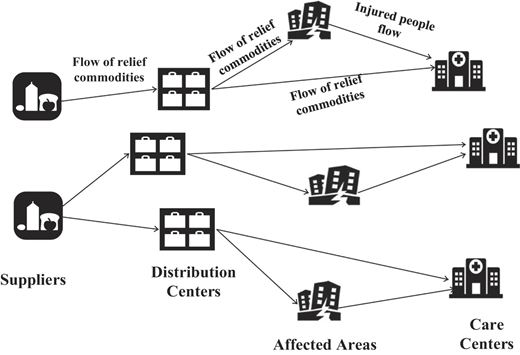
In this study, a mathematical model is presented to direct relief commodities and relief forces (fixed forces of Hilal e Ahmar organization, volunteer forces) to distribution centers, affected areas and hospitals. Figure 1 shows the structure of the disaster relief supply chain. It is assumed that the logistics network consists of four levels: suppliers, distribution centers, the set of affected areas and hospitals. Relief commodities are transferred from suppliers to the established distribution centers. The distribution centers are responsible for dispatching the relief commodities to the affected areas and hospitals. Moreover, there are nursing teams for classifying the injured people into several triage groups and taking them with particular triage from the affected areas to hospitals. Since the role of relief forces is substantial in the disaster supply chain and the lack of these forces in the supply chain network leads to a great catastrophe, in this network, the employing of relief forces is considered. In this model, the relief forces include debris removal, emergency squads and experts. The forces in charge of removing debris are present in the affected areas and emergency squads and experts are present in the affected areas and hospitals. It is clear if we have a greater number of relief forces to remove debris, the number of deaths will be lower and more people will survive. This paper sets maximum coverage for transferring the injured people from the affected areas to the hospitals due to limited access to routes and the difficulties of transferring the injured.
A hybrid robust fuzzy stochastic programming is extended to cope with uncertainties. The scenario-based stochastic programming model is applied to tackle the disruption of distribution centers. The robust programming creates a trade-off between the total costs of the supply chain network and responsiveness. The robust optimization tackles the preferred risk aversion or service-level function by expressing the values of critical input data in a set of scenarios. The approach results in a series of solutions that are progressively less sensitive to realizations of the model data from a scenario set. Mulvey et al. (1995) defined two measures of robustness: a solution to an optimization model is defined as a robust solution if it remains “close” to optimal for all scenarios, and is model robust if it remains “almost” feasible for all data scenarios. The robust optimization explicitly incorporates the conflicting objectives including total costs and responsiveness by using a parameter reflecting decision-maker's preference. Also, the uncertainties of some parameters such as the capacity of suppliers and distribution centers, transportation costs and the number of relief volunteers are incorporated into the model through possibilistic programming (fuzzy programming). In most of real-world situations, there may be no adequate historical data for uncertain parameters; hence, experts' judgments should be used for the estimation. As a result, suitable fuzzy numbers can be applied for each imprecise (i.e. possibilistic) data. In this situation, possibilistic programming approaches are used to solve the mathematical programming models with possibilistic data.
In the proposed robust fuzzy stochastic programming model, disruptions have different behavior in each scenario, which are indicated by the parameter showing the lost capacity of the distribution center i under scenario s. The scenarios generated in this model depend on three factors: type of fault, the time of the disaster and the capacity of the hospital. Areas are affected differently. The degree of disruption in distribution centers depends on the type of fault and in accordance with each of the faults of Mosha, Rey and the north of Tehran, distribution centers in each region face different disruptions. In this model, as it is clear from the parameter , there is no complete disruption in the distribution centers and the distribution centers can be used according to the degree of disruption. It is also noteworthy that a number of distribution centers, which are close to the affected areas and hospitals and satisfy demands, should be built under each scenario based on the degree of disruption in each area.
The assumptions of the proposed model are as follows:
The parameters of the number of injured people, transportation costs for relief commodities and injured people, holding cost for products, the number of relief volunteers, the capacity of distribution centers and suppliers are uncertain parameters and their amounts depend on disaster scenarios.
During a disaster, all the paid employees should contribute to rescue operations.
The capacity of distribution centers and hospitals is limited.
Each injured person based on his/her triage should stay in hospital for a specific time.
4.2 Model formulation
4.3 Mathematical model
The objective function of the proposed model consists of six components and tries to minimize the total supply chain costs consisting of the fixed cost of locating distribution centers , the cost of transferring the injured from affected areas to the hospitals , the transportation costs of aid commodities from distribution centers to the affected areas and hospitals and from suppliers to the distribution centers , the cost of utilizing volunteers and inventory cost of relief commodities in distribution centers . Each component of the objective function can formulate as given below:
4.3.1 Objective function
The first and second parts of the objective function show the mean value and the variance of the total costs and the robustness of the measure solution. The third part measures the model robustness by considering the infeasibility of the control constraint below.
4.3.2 Constraints
Equation (16) dictates the capacity of each hospital; and the injured who are carried to each hospital must be less than or equal the hospital's available beds. Constraint (17) shows the capacity of distribution centers and in presence of disruption, they may lose some or all of their capacity. In fact, the flow of commodities to distribution center must be less than or equal distribution center's capacity based on the smallest aid commodities. Constraint (18) shows the supplier capacity for each aid commodity. Constraint (19) specifies inventory level of relief commodities at the end of each period in distribution centers. Constraints (20) and (21) show unsatisfied demand of aid commodity type m at each hospital and affected area based on the requirement of individuals. Constraint (22) enforces that there is a balance in the number of injuries in the affected areas and hospitals. Constraints (23) and (24) demonstrate that if a hospital is assigned to the affected areas, then we can transfer injures there. Moreover, to aim this goal, the distance between these two nodes has to be less than radius coverage. Equations (25) and (26) show the shortage of relief forces in affected areas and hospitals. Equation (27) asserts that number of relief forces (all types) in affected areas and hospitals should be less than all workers in Hilal e Ahmar organization. Constraint (28) expresses that paid volunteers should join operation during the disaster. Equation (29) is the auxiliary equation of the robust model. Finally, Equation (30) defines binary and positive decision variables.
5. Model implementation
To illustrate and apply our proposed model, we consider the probable earthquake in Tehran as a case study whose outcomes are reported and analyzed.
5.1 Case study description
Based on statistical reports of the World Health Organization (WHO), there are 40 types of natural disasters throughout the world and 31 types of these disasters occur in Iran which leads to 120000 deaths between the years 1990 and 2010 (Mohamadi and Yaghoubi, 2017). The capital of Iran, Tehran, with a population of over 10 m is a dangerous region with several active faults; Mosha, Rey, Northern Tehran. After the occurrence of an earthquake, sending necessary commodities to the affected zones and transporting the injured to hospitals should be done in a planning horizon. For aiming this goal, a network is designed for 22 districts of Tehran in the case study. On the other hand, it is worth mentioning that 75% of killed people are related to the destruction of buildings during a disaster. If we do not consider a second disaster, this percent would be near to 90% for under developing countries such as Iran and in cities like Tehran with urban worn-out texture.
Wyss and Trendafiloski (2011) set injury-to-death ratio (IDR) at 3.6 for under developing countries such as Iran and Turkey (Wyss and Trendafiloski, 2011). Tabatabaie et al. (2010) applied three ranges of 1, 2, and 3 to the IDR and in this case study, this rate is equal to 3.
In total, 18 scenarios with the predetermined probability of are defined based on which fault is activated (Mosha, Rye, North Tehran), time of earthquake occurrence (day or night) and capacity of hospitals. Also, the demand for relief supplies has a dynamic behavior. In other words, within the early hours of a disaster occurrence, the affected areas urgently demand more goods and services, however, their demands decrease afterward. We consider two time periods corresponding to 24 hours and 24–72 hours after each earthquake scenario occurs (see Tables 2–4).
With regard to discussion with experts, 10 suppliers, 25 distribution centers and 37 hospitals are considered in the problem. For each region, we assign 1, 2 or 3 hospitals. The latitude and longitude Global Positioning System (GPS) coordinates of supplier points, distribution centers, affected areas and hospitals can be found on Google Maps. According to the following equation, we can calculate distances between nodes (Jabbarzadeh et al., 2014).
The relief suppliers are in four groups: food and water, medicine, blankets and tents. The considered unit for blood and water is liter, for food and medicine is kilogram, and for blankets and tents is number. A person needs 7-liter water, 2.5-kilogram food and 1 blanket during a day (Ghasemi et al., 2019). Regarding the fact that half of the buildings in Tehran will be destroyed or hardly damaged by active faults, Hilal e Ahmar should provide tents for half of the total families in Tehran (Asgary et al., 2007). Table 5 shows the number of families in each district is in Appendix section.
5.2 Numerical results
Computational results are represented in this section. The problem was solved using GAMS optimization software and CPLEX solver on a PC with Core i3 2.2 G.H and 4GB RAM. Located distribution centers in different scenarios are shown in Table 5.
While , λ = 1, confidence level = 0.5, and coverage distance = 11, 18 distribution centers were obtained as shown in Table 6. Table 6 also shows the construction of each distribution center under each scenario.
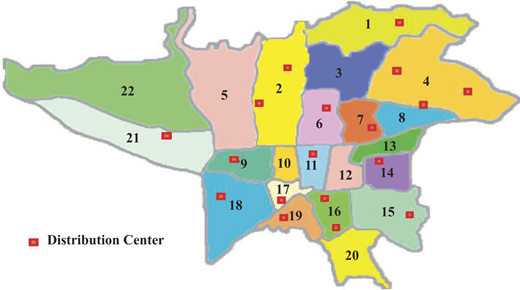
According to Figure 2, more distribution centers have been built in the central and southern zones of the city, as it is easier to access all zones, also, the central and southern zones should be given more attention due to their greater vulnerability and population.
In scenarios 3, 9 and 15, less rescue forces have been used because of the low severity of the disaster (due to the occurrence of the disaster during the day and the fault in the north of Tehran), however, in scenarios 2, 8 and 14, more rescue forces have been used because of the high severity of the disaster (due to the occurrence of the disaster at night and the fault in the south of Tehran).
5.2.1 Sensitivity analysis
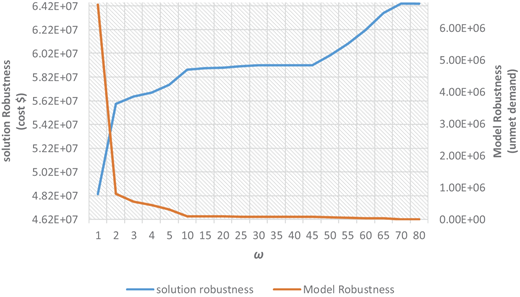
In this part, the sensitivity analysis is performed to determine an appropriate value for the risk-aversion weight to make a balance between solution robustness (close to optimal for all given scenarios) and model robustness (almost feasible for all given scenarios). A risk-averse decision-maker who strictly avoids demand shortage prefers to choose a higher value of ω. Conversely, a more risk-taker may consider a smaller value for ω and focus on decreasing the cost objective. Therefore, a different value for risk-aversion weight can trade-off between costs and unmet demand shown in Figure 3. This figure shows that increasing the value of ω, improves the cost (solution robustness) and unmet demand (model robustness) becomes worse.
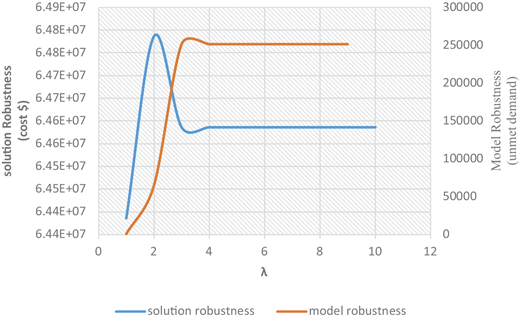
Now, we analyze the impact of variability weight at when unmet demand is at its lowest value in Figure 4. In different values of variability weight, we can see the sensitivity of model robustness and solution robustness. Figure 4 displays an unlike pattern for variability weigh in comparison to aversion weight. Greater value for λ results in increasing unmet demand and decreasing model robustness. At λ = 3 unmet demand reaches its higher point and then remains stable. For the variability weight between 1 and 2, a consistent rise in cost can be observed. Then the cost diminishes and finally for λ more than 3, it becomes stabilized.
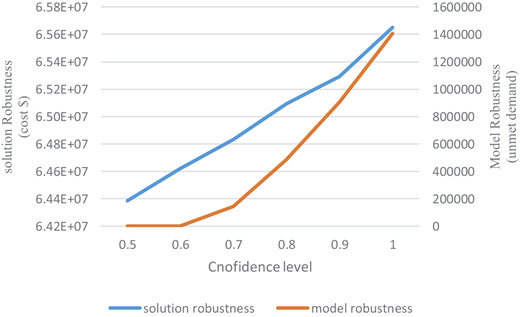
To investigate the efficient performance of the model, it is solved under different satisfaction levels (α1, α2, α3). are the parameters defined as triangular or trapezoidal fuzzy numbers. As it is shown in Figure 5, increasing satisfaction levels results in enhancement of the total cost and unmet demand which means decreasing model and solution robustness. Decreasing distribution centers and suppliers' capacity and the number of relief volunteers is the reason behind increasing the unmet demand.
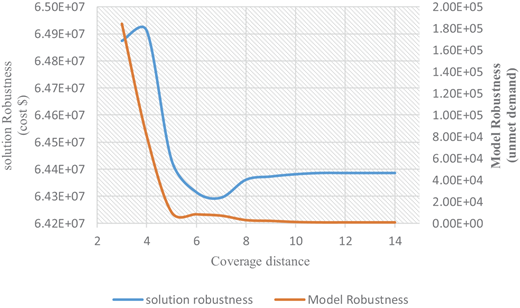
The study of variations in radius coverage of disaster-prone areas and hospitals seems vital because the roads may be blocked or damaged by a disaster and transferring injured would become extremely difficult. As seen in Figure 6, it is hard to find a meaningful relationship between model and solution robustness and radius coverage. However, increasing coverage distance for more than 11 km does not change the model and solution robustness.
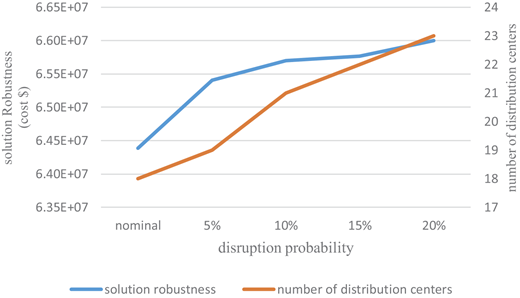
To analyze the impact of disruption probability on the network configuration (costs and number of facilities) different levels of failure probability are considered according to Figure 7 based on the first scenario. The obtained results show that by increasing the disruption probability, the model attempts to open more facilities and network cost increases.
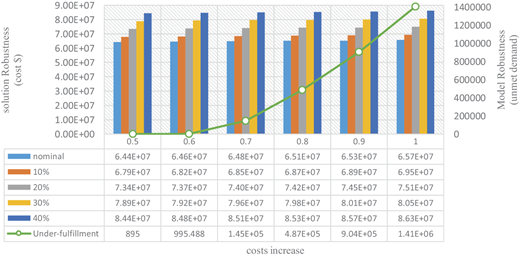
To perform sensitivity analysis, changes of solution robustness and model robustness regarding changes in costs and confidence level are displayed in Figure 8, and it could be understood from Figure 8 that enhancement of confidence level and costs of network results in decreasing model robustness and solution robustness.
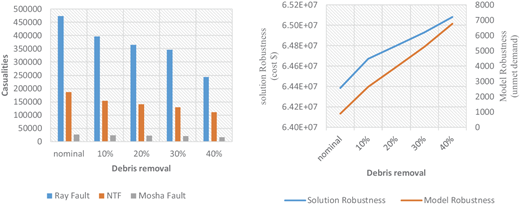
Finally, we complete the sensitivity analyses by examining the impact of changing the number of disaster relief volunteers who aid in debris removal and clean up on casualties and under fulfillment demand as depicted in Figure 9 increasing in cost could result in solution and model robustness.
6. Discussion
6.1 Theory implications
With an increase in the value of ω, the cost (solution robustness) improves and unmet demand (model robustness) becomes worse. Weight at when unmet demand is at its lowest value. It is hard to find a meaningful relationship between the model and solution robustness and radius coverage. However, increasing the coverage distance for more than 11 km does change the model and solution robustness. By increasing the disruption probability, the model attempts to open more facilities, and network cost increases. Increasing the satisfaction levels results in enhancement of the total cost and unmet demand which means decreasing model and solution robustness. Decreasing the capacity of distribution centers and suppliers and the number of relief volunteers is the reason behind increasing the unmet demand. Enhancement of confidence level and costs of network results in decreasing model robustness and solution robustness. At a larger value for λ results in increasing unmet demand and decreasing model robustness. At λ = 3 unmet demand reaches its higher point and then remains stable. Changing the number of disaster relief volunteers who aid in debris removal and clean up on casualties and under fulfillment demand results in increasing cost could result in solution and model robustness.
6.2 Practical and managerial implications
All over, the results show that there are many parameters affecting the design of relief commodity supply chain network in a disaster (earthquake) and also many parameters should be controlled so that, the catastrophe is largely prevented and the lives of many people can be saved by sending the relief commodity on time. Furthermore, the findings show some requirements are not met simply by spending money after the crisis, and a series of fundamental operations (such as strengthening buildings and establishing relief centers) must be performed before a disaster to avoid the damages. Also, the number of emergency relief forces is a substantial factor in order to save the lives of the injured people and decreasing the casualties. It should be noted that robustness in supply chain design is one of the main challenges for decision-makers. In addition, at the operational level and distribution of items and relief forces, ensuring the capacities of suppliers and distribution centers is of great importance. Some managerial implications are provided as follows to assist supply chain designers in the event of a disaster: (1) a conservative approach leads to higher costs. In other words, the more rigorous the approach to determining the parameters, the higher the costs of the entire network, (2) more information about the parameters will reduce the uncertainty and standard deviation as well as the costs, (3) the cost saving of the proposed model is more than deterministic model. Because when the uncertainties of the parameters are taken into consideration, the cost overrun is decreased, (4) perfect preparation before disaster (training, reinforcement of buildings, etc.) facilitates service and reduces costs, (5) diagnosing the triage of injuries and treating them based on the relevant triage can provide better care for the injured.
7. Conclusion
This paper presented a robust fuzzy stochastic programming model for the design of a relief logistics network under uncertainties. The model determined both location-allocation and evacuation decisions in different periods. The location problem consists of the number and location of distribution centers and allocation decisions concern the assignment of hospitals to affected areas and suppliers to distribution centers as well as specifying inventory levels. The model was extended to enable decision-makers to adjust the minimum satisfaction level of uncertain parameters and correlate supply and demand at lower costs. Increasing the satisfaction levels resulted in enhancement of the total cost and unmet demand that means decreasing model and solution robustness. Additionally, in the case study, it was shown how the balance of solution robustness (supply chain cost) and model robustness (unmet demand) can be achieved.
It should be noted that a conservative approach leads to higher costs. In other words, the more rigorous the approach to determining the parameters, the higher the costs of the entire network. More information about the parameters will reduce the uncertainty and standard deviation as well as the costs. Perfect preparation before disaster (training, reinforcement of buildings, etc.) facilitates service and reduces costs.
The proposed model can be applied to other cases for further studies. Also, different objective functions such as safety, environmental issues, social responsibility, reliability and equity based on the non-governmental organizations’ (NGOs) preferences can be incorporated into the proposed model. Moreover, assigning the volunteers to the tasks based on their abilities and preferences can be suggested for future research. Furthermore, other real-world assumptions can be considered for triage. The overall desire of humanitarian agencies is “do not harm”; hence, the implementation of reverse logistics practices can reduce environmental issues. In addition, the vehicle routing problem and different types of vehicles can be taken into consideration for future research.