Proper planning for the response phase of humanitarian relief can significantly prevent many financial and human losses. To this aim, a multi-objective optimization model is proposed in this paper that considers different types of injured people, different vehicles with determining capacities and multi-period logistic planning. This model can be updated based on new information about resources and newly identified injured people.
The main objective function of the proposed model in this paper is minimizing the unsatisfied prioritized injured people in the network. Besides, the total transportation activities of different types of vehicles are considered as another objective function. Therefore, these objectives are optimized hierarchically in the proposed model using the Lexicographic method. This method finds the best value for the first objective function. Then, it tries to optimize transportation activities as the second objective function while maintaining the optimality of the first objective function.
The performances of the proposed model were analyzed in different cases and its robust approach for different problems was shown within the framework of a case study. Besides, the sensitivity analysis of results shows the logical behavior of the proposed model against various factors.
The proposed methodology can be applied to find the best response plan for all crises.
In this paper, we have tried to use a multi-objective optimization model to guide and correct response programs to deal with the occurred crisis. This is important because it can help emergency managers to improve their plans.
1. Introduction
Many natural and unnatural disasters occur in the world every year and cause various financial and human losses. Disasters were responsible for thousands of deaths over the past decade (average 75,000 people per year). Deaths from some disasters including droughts and floods are now very low; however, earthquakes and tornados are the most deadly disasters today. On average, a disaster causes 14% damage to gross domestic product (GDP) and affects 11% of the population in different countries (Jemli, 2020). Despite various technological and scientific advances, it is still not possible to predict different events, as well. Therefore, the management of these events needs various plans including prevent and respond phases (Kelman, 2020). Preventive programs can reduce the damages of disasters to a limited extent; therefore, the response phase plays an important role in crisis management. The response phase includes various plans such as transferring the injured people to emergency centers, delivering goods to the affected people, managing the outflow of population, managing resources, etc. The importance of each plan varies at different stages, but it is important to transfer injured people to emergency centers in the early hours of the crisis as the response phase (Modgil et al., 2020; Medel et al., 2020).
Different variables including available vehicles, useable roads, transportation features and capacities of responsible emergency centers affect the response phase (Merz et al., 2020). Besides, uncertainty in the capacities of medical centers and the number of injured people, the uncertainty of the condition of the roads, the possibility of access to resources and occurred conditions increase related complexities in reality situations (Jin et al., 2015; Xu and Zhu, 2011). On the other hand, human judgments alone can lead to emotional and illogical decisions. Therefore, a logical model based on data can reduce human errors and increase efficiency by utilizing a plan based on effective logistical activities. It is noteworthy that human management can be very useful in small dimensions crises, but the necessary proper model is useful in crisis with high dimensions and complexities (Rodríguez-Espíndola et al., 2018).
Consequently, it is necessary to provide a suitable plan for transferring the injured to emergency and medical centers that offers the best solution based on the priority of the injured people, the variety of vehicles, their capacity, related transportation activities and the ability to update quickly. This paper proposes a developed multi-objective model to find the best (re-)plans for different logistical activities. Two objective functions are utilized in the proposed model including (a) minimizing the total number of unsatisfied injured people based on their priorities and (b) total transportation activities. These objectives are considered in the proposed model, hierarchically. In other words, this model optimizes transportation activities as the second objective function while maintaining the optimality of the first objective function. For this purpose, a priori Lexicographic method is utilized in this paper. It is noteworthy that the waiting time of different injured people based on their priorities is minimized according to the first objective function, as well. Moreover, the objective functions are determined during the planning horizon and could be updated for another planning horizon. This model could be updated using new data and information about the number of prioritized injured people, different available vehicles and predefined capacities, useable roads, responsible hospitals and their capacities. Furthermore, this model considers the difference among different types of injured people and transferring them among different types of vehicles in the nodes of the network. The performances and results of the proposed multi-objective, multi-type, mixed-integer model are presented using a case study according to different situations and conditions to find the best (re-)plan in the response phase. In summary, the research questions in this paper are as follows:
How can we consider the optimality of unsatisfied injured people along with minimum transportation activities in a model?
What are the effects of different types of injured people and vehicles in the response phase?
What are the effects of uncertain available vehicles and responsible centers?
How can the objectives of the previous planning horizon affect related results?
How can we model transshipped injured people among different vehicles at intermediate stops?
The summary of this paper is as follows: a literature review about logistics in crisis is presented in section 2. The research method is presented in section 3. Brief descriptions about multi-objective optimization and Lexicographic optimization are introduced in section 4. Section 5 presents the problem description and mathematical model of the paper. Research contributions are described in section 6. The case study and related results are provided in sections 7 and 8. Finally, discussions and conclusions are presented in sections 9 and 10.
2. Literature review
The logistic models for disaster management are increased significantly in recent years due to their advantage in the response phase (Kovacs et al., 2019). Many papers studied different mathematical models for presenting a new helpful solution in an emergency.
Some papers focused on pre-disaster plans. For example, Boostani et al. (2020) designed a three-level relief chain model to support sustainability in relief operations. Their model maximizes social welfare, minimizes total costs and the environmental impacts using the compromise programming method. Monzón et al. (2020) presented a pre-disaster model with uncertainty in demand and affected people and multiple criteria for the location of medical centers. Hong and Jeong (2020) presented an efficient disaster recovery center location-allocation-routing network schemes under the risk of facility disruptions.
Pre-disaster plans have limited effects on the occurred disasters in the real world (Richey et al., 2009). Therefore, some papers focused on post-disaster plans for disasters due to their importance. For example, collaborative logistics using multiple carriers in pickup and delivery service is studied in the paper of Dai and Chen (2012). They focused on a centralized collaboration framework and analyzed three profit allocation mechanisms to find the best plans. Yang et al. (2016) presented a multi-echelon logistics model with uncertain delivery lead time. Their model tried to keep inventory at an adequate level to increase customer service level using the ant colony algorithm. In another paper, a new approach is proposed for modeling the impact of tasks of production planning by Schmidt and Schäfers (2017). The supply chain's logistic objectives are controlled in this model, as well. They consider many objectives in different situations to find their effects on every logistic network. Liu and Zhang (2016) presented a model for medical resource allocation in a disaster to find minimum cost and maximum satisfaction. Demands could be updated in their model, as well. Their model predicts total demands at first and finds the best plan to satisfy them. Chiu et al. (2014) utilized a fuzzy multi-objective integrated logistics model to explore the best way of supply chain management. They considered demand fuzziness and transportation costs in their model.
Healthcare services and humanitarian logistics management play important roles in both pre-disaster and post-disaster plans (Ershadi and Shemirani, 2019; Ershadi et al., 2020). Barzinpour et al. (2014) designed a multi-objective location–allocation model in disaster relief logistics. They focused on minimizing the total costs of logistic activities and maximizing the satisfaction of being fair while distributing the items. A genetic algorithm is utilized to find the solutions in their model, as well. Najafi et al. (2013) designed a multi-objective optimization model for logistics planning. They considered different types of injured people, vehicles and goods for planning in the earthquake response phase. Ahmadi et al. (2015) presented a multi-depot location-routing model considering network failure, different vehicles and relief time. This model found the location of distribution centers based on travel times using a neighborhood search algorithm. Vanajakumari et al. (2016) focused on response time and the number of victims using a multi-objective functions model. Their model determined the location of centers, their inventories, routing, number and size of vehicles. Besides, three disaster scenarios are considered to reduce total demand uncertainty. Locations of shelters for the primary accommodation of people and coverage of demands after accommodation of people are studied as a two-stage mathematical model in the paper of Seraji et al. (2019). Their model considered the location of people, location of resources, the distance of locations and travel times to find the best plans. Chong et al. (2019) utilized a goal programming optimization model for logistic management. Their model considered both structured and non-structured information based on uncertainty from a humanitarian perspective. Wang and Hsu (2010) proposed a fuzzy linear program with risk analysis to find the best plan in the supply chain in disaster. They utilized fuzzy numbers to consider uncertainty in their proposed model. The final solutions of their model are defined according to determining risk level and trade-off analysis. Makui et al. (2019) presented a two-stage model for urban crisis management. A multi-objective model is considered to allocate injured people to emergency centers and a single objective linear model is utilized to allocate medical supplies to emergency centers in their model, as the first and second stages, respectively. A forward-reverse logistics model is presented in the paper of Kumar et al. (2017) to solve the logistic problems in disasters. They considered multi-echelon, multi-period, vehicle routing, a fixed number of suppliers and demands in their model. Artificial immune systems and particle swarm optimization are utilized to find the solutions and their results are compared in their paper. Rahafrooz and Alinaghian (2016) presented a multi-objective robust model based on distributive justice in relief distribution, the risk of relief distribution and total logistics costs. The pre-disaster and post-disaster supply abilities are considered in this model, as well. Djikanovic and Vujosević (2016) considered the capacities of location networks and related costs to propose a new integrated forward and reverse logistics model. They considered a comprehensive logistic network of suppliers and considered its different aspects in their model. Davoodi and Goli (2019) utilized hybrid Benders decomposition and variable neighborhood search to propose a disaster relief model. Vehicle routing, late arrival of relief vehicles, location of centers and affected areas are considered in their model to find the best logistic plan in a crisis. Yorvarak et al. (2017) focused on the similarity between logistics and electric circuits to present a logistics model and plans for disaster. They considered distance, delay time, speed of vehicles, distribution networks and storage capabilities in their model. Belkhouche and Lakas (2019) presented a new logistic model to carry out intelligent pickup and delivery missions. Their model could be utilized in disaster for improving response phase activities, as well. A bi-level programming approach is presented in the paper of Haeri et al. (2020) to improve relief logistics operations. They considered different goods and injured people in their model and tried to find the best plan according to the priorities of two different levels. They utilized real data of Kermanshah to show the efficiency of their model. Relief centers and recharge stations to cover a large-scale area with minimum and feasible incurred costs and waiting times are considered in the model of Shavarani (2019). Moreover, the Delphi method is utilized in the paper of Gossler et al. (2019) to determine the best practices of aid agencies for outsourcing logistics to commercial logistics service providers in disaster relief. Relief procurement processes are improved using a novel two-round decision model in the paper of Aghajani and Torabi (2019). Effects of social network analysis methodology within the humanitarian research community are studied in the paper of Tacheva and Simpson (2019), as well.
Due to the high importance of transportation effects on response phases, some papers tried to analyze these effects. The location of temporary relief centers with the dynamic routing of aerial rescue vehicles is studied using a hybrid metaheuristic algorithm in the paper of Alinaghian et al. (2019). They considered uncertain demand, inaccurate information and extensively damaged road networks, in their proposed model. Abounacer et al. (2014) presented a solution approach based on a heuristic algorithm for location–transportation problems. In this multi-objective model, total transportation, number of agents and non-covered demands within the affected area are considered as different objectives. Another paper focused on urban goods distribution using different vehicles and their capacities by Dell'Amico and Hadjidimitriou (2012). This model is considered a weighting and payment system to find the best plan. Babaei et al. (2019) considered the total travel time of emergency trips, the total length of the network and the provision of coverage to the emergency demand/supply points as three objectives to determine the set of roads of a transportation network that should preserve its role in carrying out disaster relief operations. Minimizing relief time, location costs, and the cost of route coverage by the vehicles are considered in the paper of Adarang et al. (2020) as a location-routing problem under uncertainty for providing emergency medical services during disasters.
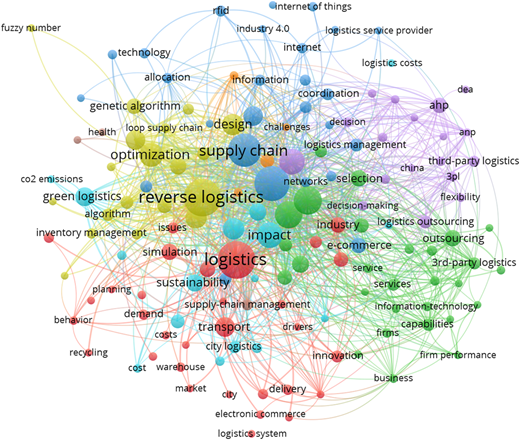
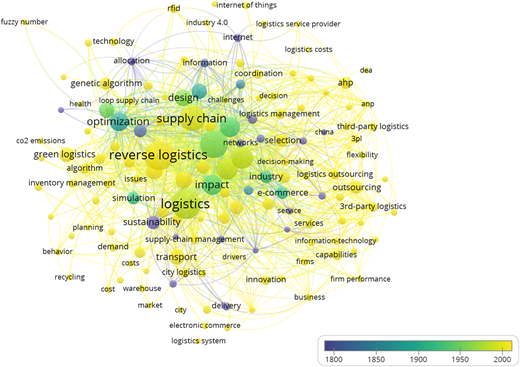
Moreover, the published research of Web of Science between the years 1980 and 2021 about the logistic models is analyzed using VOSviewer 1.6.10 software and related results are presented in Figures 1 and 2. A search with “Logistic Model” or other equivalent terms founds more than about 1,200 results. However, less than 50 of them focused on the logistic models in crisis. Besides, less than 15 papers present a multi-objective model for this aim due to related complexities between theoretical and practical aspects. They show that very few papers have focused on this issue in detail. To draw these figures, we extract information from different published papers about the logistic model (or other equivalent terms) in Web of Science datasets, first. Then, VOSviewer is utilized to visualize the relationships among the different numbers of papers based on their first keyword. It is noteworthy that “Logistic Model” or other equivalent terms is one of the keywords in the extracted information. Therefore, the first figure shows numerous published papers and the connections between them, and the second figure determines their years of publications. The first figure determines the existed complexities of logistic models and the second figure shows up-to-date papers in this field. Besides, different circles show the different number of articles according to their first keywords in Figure 1. The larger circles are associated with more articles with the same first keyword. The lines between circles show the relationships among their articles in terms of their references. Besides, VOSviewer 1.6.10 software clusters different circles in this figure into six-colored clusters based on their relationships. Figure 2 presents the same results according to the year of the published articles.
According to the literature review, many papers considered a single objective in their proposed models. Some papers presented a multi-objective model regardless of the priority of the objective functions. Effective details including different types of injured people and vehicles, the uncertainty of responsible medical centers, and the ability to move injured people between vehicles before reaching the destination are neglected in the papers of literature review. Moreover, the performances of many proposed models in the literature were not evaluated using a case study. Therefore, these gaps are considered in this paper. The contributions of this paper are summarized as follows:
A new multi-objective model is proposed in this paper to minimize unsatisfied prioritized injured people and vehicles in motion based on their priorities, hierarchically;
Different types of injured people, vehicles and nodes with predefined features are determined in this model. The utilized information can be updated, as well;
Besides, injured people can be transshipped among different vehicles at intermediate stops in the proposed model;
Lexicographic method and an exact CPLEX software are utilized in this model to find the advantages of both for optimizing transportation activities while maintaining the optimality of unsatisfied injured people based on their priorities;
To bring the model closer to reality, the objectives of the previous planning horizon are considered in this model;
A case study is considered to prove model results and performances.
3. Research method
This paper focuses on logistic activities using the proposed optimization problem and the multi-objective algorithm with the Lexicographic method for managing injured people transfer in a determined network. In summary, the answers to research questions in this paper are as follows:
The optimality of unsatisfied injured people is the main objective function in this paper. Besides, guiding transportation activities in a model leads to better plans in the response phase. Therefore, these objectives are considered hierarchically in the proposed model using the Lexicographic method;
Different types of injured people and vehicles are defined in the proposed model using different priorities, features and capacities;
Uncertain available vehicles, responsible centers and the number of injured people are considered in this model using different planning horizons;
Different objective functions about previous planning horizon are considered in this model, as well;
Transshipped injured people among different vehicles at intermediate stops is considered using appropriate constraints and variables in the proposed model.
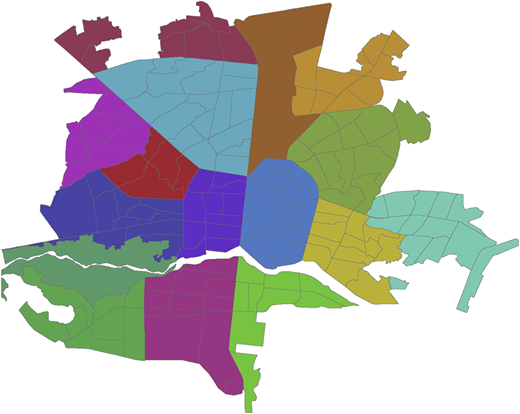
Therefore, accepted theories and principles are utilized in this applied research that solves defined problems and its results have immediate application for other research. Besides, it employs quantitative research to present its conclusions for the related policy-oriented issue. Hypotheses, variables, relationships, objectives and limitations of the proposed model are defined in GAMS 24.1.2. Furthermore, its performances are presented for a real case study in Isfahan city with 15 districts/160 areas and different node locations. ArcMap 10.5 is utilized to visualize the data and information about Isfahan city.
4. Theoretical background
4.1 Multi-objective optimization
A Multi-objective Optimization Problem (MOP) considers k different objectives. According to the conflict of objectives and different resource constraints, improving an objective leads to deteriorating at last another. Therefore, a set of Pareto-optimal solutions is presented for MOP. The general form of MOP with k different objectives, m inequality, and n equality constraints is as follows:
According to the research of Hwang and Masud (2012), all methods to find the solutions of MOP are divided as follows:
A priori methods: The most popular method to find solutions for MOP because of their relative simplicity in implementation. However, they provide less information about the preferences of the decision-makers before the analysis.
A posteriori methods: They provide more information about the preferences of the decision-makers in comparison with a priori methods. However, they need more computational complexity in implementation.
Interactive methods: These methods combine different features of a priori and a posteriori methods to find a better solution method for determining MOP.
4.2 Lexicographic optimization
According to the research of Rentmeesters et al. (1996), the Lexicographic method is one of the a priori methods where are all objective functions. This method tries to optimize the first objective base on its importance. Then, it finds the best value for the next objectives according to their importance and the optimization of previously optimized objectives. In other words, this method considers different ranks for different objectives. Therefore, it consists of solving a sequence of single-objective optimization problems to find the solution of MOP as follows:
In this method, is the optimal value of the jth objective function (). Next, another objective function is considered based on its rank and previous optimal values of objective functions are considered as constraints.
5. Problem description
The main problem in this paper is to find the best logistic (re-)plan for transferring unsatisfied prioritized injured people using different types of vehicles based on capacities of responsible centers. Different types of injured people and vehicles, the uncertainty of responsible centers, number of injured people, available vehicles and ability to move injured people between vehicles before reaching the destination are considered in this problem. The values of objectives including unsatisfied injured people and total transportation activities in the previous planning horizon are considered hierarchically in this problem, as well.
In this section, utilized assumptions and symbols are introduced to understand the structure of the model. Transporting injured people related to occurred crisis and the priority of different activities are considered in this paper as objectives. The managers can find the best program for the minor crisis response phase. However, responsible hospitals and medical centers, available resources, the number of injured people and accessible vehicles are uncertain after large-scale crises such as strong earthquakes, massive tornadoes, major floods, etc. Therefore, an optimization model can help the manager to organize available resources and support injured people. This model manages related shortages and created complexities. The proposed model in this paper has assumptions including: (a) Areas with injured people, responsible hospitals, useable roads and distances between different areas are determined; (b) Different vehicles such as ambulances, helicopters, trucks, etc. and their capacities and capabilities are determined in this paper; (c) Different types of injured people are defined and every type of them has determined priority; (d) Every type of vehicles can carry all types of injured people in the same transportation; (e) Different types of injured people can be transshipped among different vehicles at intermediate stops and it does not take any time; (f) Vehicles can transport injured people from demand areas to one or more areas with responsible hospitals; (g) The capacities of responsible hospitals and the number of different types of injured people in different areas are uncertain. Therefore, balance and unbalance numbers of injured people and hospital capacities are possible. This information can update based on new information; (h) Some information about the number of different available vehicles and useable roads between different areas are certain. This information can update based on another certain and determined information; (1) All types of injured people are not served when she/he has been transported using a vehicle but when delivered to a hospital.
Besides, let G = (N, E) be a network in which N (|N| = n) is a set of nodes (demographic regions) and E is a set of links (the main transport arteries). It is noteworthy that there are demand nodes, hospital nodes and middle nodes without demand or a responsible hospital.
Utilized parameters and variables in the proposed model are described as follows:Sets
Indexes
Parameters
- :
total number of unsatisfied injured people in the previous planning horizon;
- :
the total transportation activates in the previous planning horizon;
- :
the capacity of vehicles type to carry injured people;
- :
the importance of transportation activities of vehicle type based on its capacity;
- :
travel time between nodes and by vehicle (hour);
- :
priority of injured people type ;
- :
a large number;
Binary parameters
Variables
- :
number of unsatisfied injured people type in node till time; In other words, these injured people did not arrive at the center/hospital till time;
- :
number of vehicles type move from node to node at time ;
- :
number of injured people type move from demand node using vehicles type dispatching from node to node at time ;
- :
number of available vehicles type in node at time ;
- :
all number of injured people type in node at time ;
- :
the free capacity of hospital for injured people type at time ;
- :
number of vehicles type added to node at time ;
- :
number of injured people type transferred from vehicles type to other types of vehicles in the middle node at time ;
- :
number of injured people type transferred from other types of vehicles to vehicles type to in middle node at time ;
The proposed dynamic model utilized a mixed-integer, multi-type and multi-objective model to find the best plan for logistics in the response phase. Two objective functions are considered in this model, hierarchically. The first objective tries to minimize the total number of unsatisfied injured people at the end of the planning horizon (see Eq. 1). Besides, the second objective function modifies the selected plan to find the minimum transportation activities of vehicles based on their importance (see Eq. 2). According to the assumptions of the proposed model, serving injured people based on their priorities is the most important objective in the response phase. Therefore, the proposed model in this paper tries to minimize unsatisfied injured people in different areas and transportation activities of vehicles, hierarchically. The first objective function of the proposed model minimizes unsatisfied injured people in different areas and the second objective function tries to find minimum transportation activities. It is noteworthy that the proposed model tries to optimize transportation activities as the second objective function while maintaining the optimality of the first objective function. It leads to reduce the travel time of unsatisfied injured people. Besides, fewer injured people cause less lead-time of unsatisfied demand. Therefore, lead-time is considered in this model, indirectly. It is noteworthy that the total number of unsatisfied injured people and the transportation activities in the previous planning horizon could be considered in this multi-objective using parameters (,), as well. According to previous assumptions, sets, indexes, parameters and variables; the proposed model is described as follows.
As mentioned earlier, Eqs (1) and (2) are the first and second objective functions in this model and try to minimize the total number of unsatisfied injured people and the transportation activities at the end of the planning horizon, hierarchically. Constraint 3 determines the total number of unsatisfied injured people according to their types of demand nodes. Constraint 4 ensures that the dispatched injured people are not more than evacuated people at a specific demand node. Constraint 5 shows injured people flow and guarantee that no injured people abide in middle nodes. Constraint 6 considers authorized vehicles to carry injured people. Constraint 7 defines transmitted injured people among capable vehicles and allows injured people to switch between determined vehicles. Capacities of vehicles to transport injured people are considered in constraint 8. Constraint 9 considers the route of every vehicle type to determined arcs. The flow of all types of vehicles over every node is balance according to constraint 10. Constraint 11 considers the capacities of hospitals before assigning injured people to them. The last constraint determines the type of some variables (see constraint 12).
Therefore, the proposed multi-objective model considers both unsatisfied injured people and transportation activities as different objectives. The first objective is optimized using the Lexicographic method and an exact CPLEX software before minimizing the second objective. In other words, it tries to optimize transportation activities while maintaining the optimality of the first objective function. Therefore, the priority of the objective functions is considered in this model. Different details including different types of injured people and vehicles, the uncertainty of responsible medical centers, the objective functions in the previous planning horizon, and the ability to move injured people between vehicles before reaching the destination are considered in this model. These points make the proposed model applicable to real situations in comparison with other papers. Moreover, the performances and results of this model are evaluated using a case study in Section 7.
6. Research contributions
According to the literature review, there are different published research about logistic model problems. Though, there are less than 50 papers about the logistic model in crisis and less than 15 papers with a multi-objective model for this aim. The priority of the objective functions along with different types of injured people and vehicles, the uncertainty of responsible medical centers, and the ability to move injured people between vehicles before reaching the destination are neglected in these papers. Therefore, a new proposed multi-objective optimization model is presented in this paper to consider unsatisfied prioritized injured people, the transportation activities, and the waiting time of injured people based on other neglected details. In this model, travel time, variety of requests, population density, service capacity, and the different features of vehicles are defined, as well.
In addition to the above points, the Lexicographic optimization approach is utilized to minimize transportation activities as the second objective function while maintaining the optimality of the first objective function (minimum number of unsatisfied injured people based on their priorities). The CPLEX software is utilized to solve the model of this paper using GAMS 24.1.2 and ArcMap 10.5. Due to the existence of different situations in the real world, some scenarios are determined in the Isfahan using the different number of nodes, capacities of hospitals, features of vehicles and different injured people.
It is noteworthy that the transportation activities along with travel times and features of vehicles are not considered in many papers about the logistic model in crisis. It causes irrational logistics activities in the model when the capacity of emergency centers and the number of injured people are unbalanced. Therefore, the proposed model in this paper tries to cover this problem in different cases utilizing objective function about transportation activities along with another objective function related to the number of unsatisfied injured people. Besides, the values of objectives including unsatisfied injured people and total transportation activities in the previous planning horizon are considered in this model to guide future response phases.
7. Case study
The following is an instance with real data to present the performances of the proposed model and solution method. Isfahan city with 15 districts/160 areas with different population densities is considered for this purpose. More details are presented in Figure 3.
According to the expert's knowledge of several experts of Isfahan welfare organization, Isfahan ministry of health, and Isfahan municipality organization, the location of disaster-resistant hospitals in Isfahan, their capacities and ability to respond urgently, and 160 locations of different areas are considered as potential nodes or shelters, respectively. Every potential node can cover all areas, but there are different Euclidean distances between them.
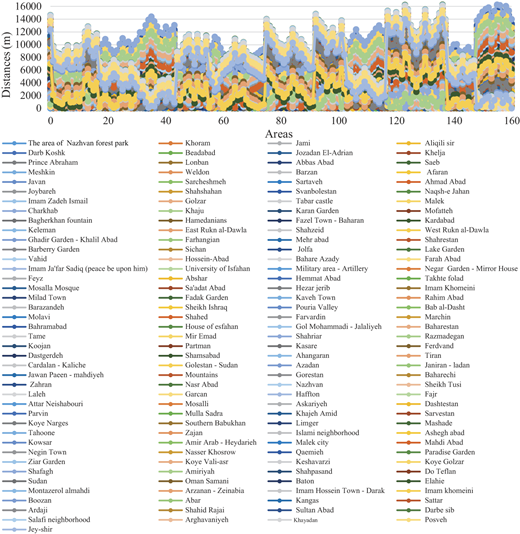
Besides, related travel times are variable based on traffic plans and vehicles. On the other hand, there are different travel times between different areas at different hours of day and night. Therefore, the average of them is considered for each type of vehicle in this paper. Utilized parameters, distances and names of 160 areas are presented in Table 1 and Figure 4, respectively.
In this case study, there are 1,660 low-level injured people, 1,610 high-level injured people, 23 helicopters, 91 ambulances, 1,660 hospital capacity for low-level injured people, and 1,610 hospital capacity for high-level injured people for a balanced situation. Unbalanced situations include:
Unbalanced-a situation: fewer hospital capacities in comparison with injured people;
Unbalanced-b situation: more hospital capacities in comparison with injured people.
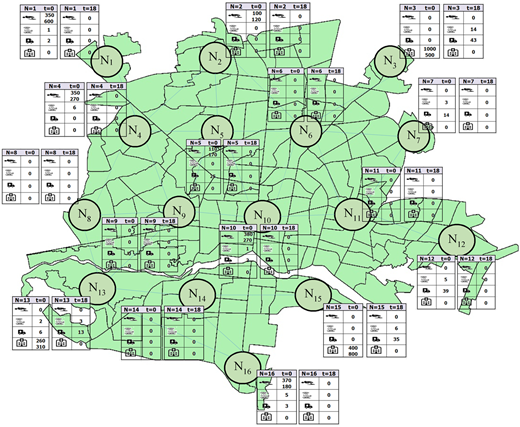
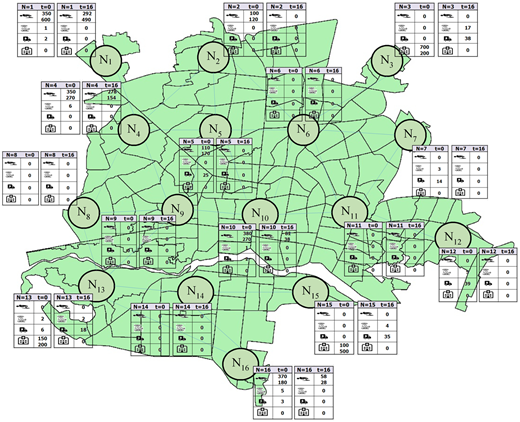
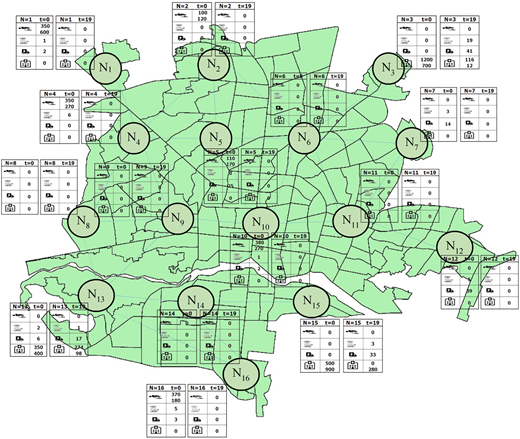
Besides, the different numbers [3,160] of areas are considered as nodes in every scenario. Every node could have all types of injured people, vehicles and hospitals with different capacities. These parameters are set randomly for all active nodes in each scenario. According to the proposed model, it is expected that the maximum injured people transferred to hospitals using minimum transportation activities of vehicles. Besides, the length of the planning horizon is variable for every scenario based on the number of active nodes and related distances. Figures 5–7, present one scenario with 16 active nodes at the beginning and end of the planning horizon for balanced and unbalanced situations, respectively.
8. Results
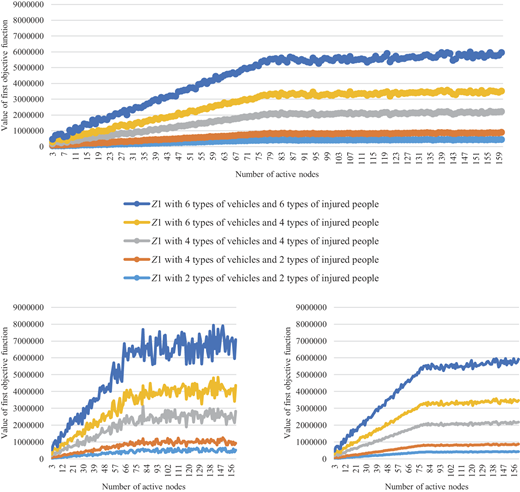
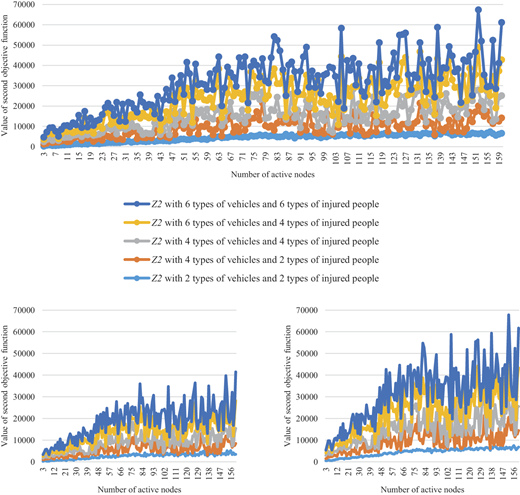
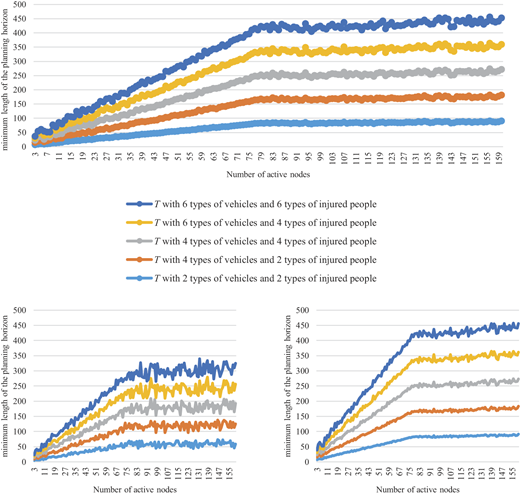
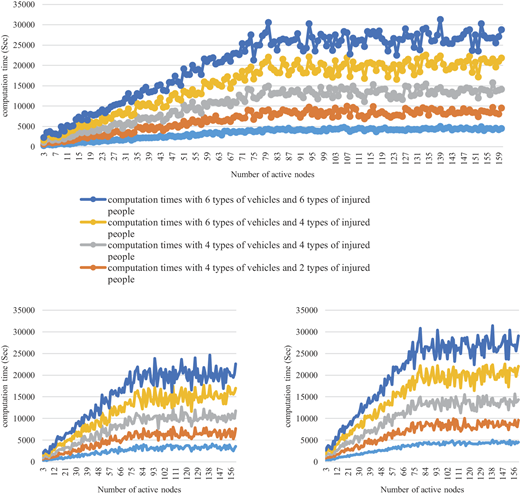
Final results of designed scenarios are evaluated using five different random situations to find the effects of different types of injured people, different types of vehicles and different capacities of hospitals according to active nodes using a 64-bit operation system laptop with Intel(R) Core (TM) i5-2410M CPU @ 2.30GHz and 4.00GB Ram. The average of results about the first objective function (), the second objective function (), length of the planning horizon () and computation time are presented in Figures 8–11, respectively. It is noteworthy that about 1,650 injured people with six levels, about 20 helicopters with three different types, about 90 ambulances with three different types, balance and unbalance capacities in hospitals for all types of injured people are considered for sensitivity analysis.
It is noteworthy that the uncertainty of occurred situations in different disasters is one of the most challenging problems. Besides, the lack of knowledge about available resources and updating information at different times increase related complexities for logistic models in crisis. Therefore, all of the mentioned points are considered in this paper to guide emergency managers and policymakers. Presented sensitivity analysis could determine the effects of different changes in final results. To bring the results closer to reality, related results about unbalanced situations are considered in sensitivity analysis, as well.
According to Figure 8, a smooth slope is created by adding the number of active nodes from 3 to 80. With the addition of active nodes from 80 onwards, the slope remains almost constant and little change is seen in it. This shows that the model has been able to well manage the increasing complexity of the problem on a large scale. Besides, the numbers of unsatisfied injured people in unbalanced-a situation are more than in other situations due to fewer hospital capacities in comparison with the numbers of unsatisfied injured people in this situation. Besides, there are more variations in the unbalanced-a situation, as well. It is noteworthy that there are fewer resources and capacities in comparison with the number of injured people in the early hours of occurred disasters. Therefore, the emergency managers should expect many changes in response plans in the early hours of occurred disasters. New information about the number of unsatisfied injured people and capacities of responsible emergency centers may change all plans of response phases. On the other hand, extra available capacities reduce these changes.
Unlike changes, changes follow an almost smooth trend with increasing active nodes. Figure 9 shows that transportation activities are strongly associated with active nodes. Also, the second objective functions in an unbalanced-a situation are less than in other situations due to fewer hospital capacities and related transportation activities. Moreover, the variations of are major in all situations. It shows the high sensitivity of transportation activities to occurred situations in response phases. It increases when there are available capacities in responsible emergency centers. Therefore, increasing the capacities in emergency centers cannot be effective without a suitable model for transportation management. It is clearly shown in Figure 9 and determines the importance of logistics in the crisis. However, the main goal is minimizing unsatisfied injured people in the response phase. Therefore, minimum unsatisfied injured people and optimum transportation activities are considered in the proposed model, hierarchically.
Figure 10 presents a smooth slope by adding the number of active nodes from 3 to 80 to find the minimum length of the planning horizon. With the addition of active nodes from 80 onwards, the slope remains almost constant and little change is seen in it. Therefore, the proposed model could find the proper plan to transfer injured people on a large-scale problem, as well. It is noteworthy that the lengths of the planning horizon in an unbalanced-a situation are less than other situations due to fewer hospital capacities and related transportation activities. However, there are more variations in an unbalanced-a situation in comparison with other situations. Therefore, the minimum length of the planning horizon depends on the number of unsatisfied injured people, available vehicles and capacities of responsible emergency centers. Besides, new information could change the length of the planning horizon. Consequently, emergency managers and policymakers could utilize the proposed model that considers all new information in different hours to re-plan the response phase to achieve better results.
According to Figure 11, a similar trend to Figure 10 is created by adding the number of active nodes for the average computation time. Therefore, the proposed model has good performance to find the proper plan for problems with large scales. It is noteworthy that the computation time in an unbalanced-a situation is less than other situations due to fewer hospital capacities and related transportation activities. Besides, finding minimum transportation activities increases the computation time significantly in comparison with allocating unsatisfied prioritized injured people to existed capacities in emergency centers. New information about available vehicles affects the computation time of final results, as well. To deal with this problem in real situations, emergency managers and policymakers present a transportation plan based on existed information to start the response phase. Then, new information is considered to change presented plans. The proposed model is compatible with the planning process in reality, as well. Therefore, the proposed model is reliable for planning.
9. Discussions
The results of different scenarios in different situations show that the proposed model in this paper could manage and find appropriate solutions for different problems with [3,160] active nodes, different types of vehicles and injured people, balance and unbalance situations. According to computational results, the average of the second objective function has the most variation in comparison with other results due to the random nature of different types of injured people and vehicles, capacities of hospitals and locations of different resources in each network. Computation time has significant variations for the same reasons, as well.
The uncertainty of occurred situations in different disasters, lack of knowledge about available resources and updating information at different times are of the most challenging problems that increase the complexity of occurred problems in disasters. They make finding the best plans impossible in real cases. Therefore, emergency managers and policymakers present a related plan based on existed information to start the response phase. Then, new information is considered to change their presented plans. Consequently, the proposed model in this paper considers an updateable approach to change the presented plans for transferring unsatisfied prioritized injured people using different types of vehicles. It can show the best plan based on existed information and re-plan it according to new information. Besides, objective functions in the previous planning horizons are considered in the proposed model, as well.
On the other hand, the proposed model has high stability to find the first objective function and the minimum length of the planning horizon for every scenario. It shows that this model can find the best plans for different situations to transfer injured people in the minimum length of the planning horizon based on available vehicles. Therefore, it is strongly recommended that the results of this model are applicable to the response phase of crisis management.
10. Conclusions
The high costs are appeared due to the lack of an efficient program in the early hours of occurred disasters. Therefore, the response phase needs quick and on-time activities to help injured people. Different objectives with different priorities are mentioned in emergency situations. Besides, some points including different types of injured people and vehicles, the uncertainty of responsible medical centers and the ability to move injured people between vehicles before reaching the destination increase the complexities of related problems. They make most of the existed models useless to find an acceptable plan in the early hours of disasters.
Therefore, a proposed multi-objective model is presented in this paper to transfer different prioritized injured people using different types of vehicles based on minimum waiting time for unsatisfied injured people and optimum transportation activities. On the other hand, the main objective in each response phase is minimizing injured people. Therefore, the proposed model considers minimizing unsatisfied prioritized injured people and optimum vehicles in motion based on their priorities, hierarchically. For this purpose, the lexicographic method is utilized to solve the proposed multi-objective model for transferring different types of injured people to responsible emergency centers based on their capacities and finding the best transportation plan with minimum activities.
Different types of injured people and related capacities of the responsible centers, balanced and unbalanced situations, different vehicles with determined capacities and speeds, waiting times of unsatisfied injured people and importance of transportation activities based on capacities of vehicles are considered in this model to find the best plan. Besides, uncertain available vehicles, responsible centers and the number of injured people are considered in this model using different planning horizons. In other words, utilized data and information in this model could be updated due to the uncertainty of data and information in disaster situations. It helps different emergency managers and policymakers to plan and re-plan all of the activities in the response phase due to their compatibility with real conditions. To bring the model closer to reality, transshipped injured people among different vehicles at intermediate stops are considered in this model. This point increases the dynamics of the proposed model and makes better use of vehicles.
Real information about Isfahan city is utilized to find the performances and sensitivity analysis of the proposed model about both objective functions, the length of the planning horizon and computation time. The different solutions are analyzed based on the different number of active nodes, different types of injured people, different capacities in emergency centers, different types of vehicles, balanced and unbalanced situation between the number of injured people and existed capacities. Different analyses show that the proposed model has good sensitivity to various changes and shows logical behaviors against them. Therefore, it can be supportive of emergency managers and policymakers to find the effects of different plans and re-plan them based on new information. Modeling the different scenarios and situations in this paper serves the same purpose.
In future studies, one can consider other details with non-Euclidean distances to design a new model. Applications of this model in other case study and comparison of sensitivity analysis related to different factors in different conditions could be considered in other research. Furthermore, different exact and meta-heuristic methods could be tailored based on their features to present the solutions for the response phase.
The authors wish to thank Dr. S. Ershadi and Dr. E. Mohaghegh, for providing the expert's knowledge used in this research. We also thank Eng. M. Afshari and Dr. M. Eghdami (experts of Isfahan welfare organization), Dr. N. Naderi and Dr. A. Binaee (experts of Isfahan ministry of health) and Dr. S. Ahmadi (expert of Isfahan municipality organization) for their cooperation for providing various information.
Conflict of Interest: The authors declared no conflict of interest.