This paper aims to advance theoretical understanding of the role of social entrepreneurship in fostering resource complementarity (RC), which is considered vital in times of crisis for building entrepreneurial resilience (ER) and community resilience (CR).
This study adopts a positivist philosophy and uses a deductive approach to develop its theoretical model and research hypotheses. Drawing on social capital theory, the model is tested using survey data collected through random sampling of non-governmental organisations (NGOs) operating in the Himalayan region, focusing on fostering community resilience via social entrepreneurship. A total of 388 responses were analysed using factor-based partial least squares (PLS)-structural equation modelling (SEM) with WarpPLS 8.0 commercial software.
The results support the research hypotheses. These findings indicate that social entrepreneurship plays a crucial role in RC during crises, thereby enhancing both ER and CR.
This study offers a valuable contribution to social capital theory by elucidating the role of social entrepreneurship in fostering RC. It further demonstrates how these dynamics enhance both ER and CR during times of crisis.
The study provides valuable guidance to NGOs and policymakers involved in disaster relief operations, highlighting how social entrepreneurship can promote RC and strengthen both ER and CR.
This study addresses a gap in the academic literature at the intersection of two disciplines: humanitarian operations management and entrepreneurship. It explores how these fields converge to tackle the complex challenges associated with disaster relief operations.
1. Introduction
Increasing frequency and severity of disasters (Sanderson et al., 2025), spanning natural catastrophes such as floods, earthquakes and wildfires (Miller et al., 2025), to complex socio-economic crises like epidemics and economic downturns (Ruggiero et al., 2024), have starkly revealed the shortcomings of conventional, state-centric response frameworks (Wei et al., 2024). These challenges frequently leave communities exposed and at risk, as official interventions often arrive too late, resources are distributed inefficiently and bureaucratic hurdles hamper swift action (Rayamajhee et al., 2022; Boudreaux et al., 2022). This persistent vulnerability underscores the urgent need for innovative and responsive approaches to disaster management (Pattinson and Cunningham, 2022). In this challenging landscape, social entrepreneurship has become an indispensable force (Van der Have and Rubalcaba, 2016; Ibrahim and El Ebrashi, 2017; Kruse, 2026; Althalathini, 2026). Unlike traditional actors, social entrepreneurs leverage innovative business models, local knowledge and cross-sector partnerships to bridge critical gaps in disaster preparedness, response and recovery (Starr and van Wassenhove, 2014; Sodhi and Tang, 2014; Dutta, 2017; Monllor and Murphy, 2017). Their initiatives range from developing early warning systems and mobilising rapid relief networks to empowering marginalised groups with the skills and resources to build resilience (Salvato et al., 2020). By addressing immediate humanitarian needs while simultaneously building long-term adaptive capacity, social entrepreneurs not only fill institutional voids but also catalyse systemic change (Nelson and Lima, 2020). Their flexible, community-driven strategies enable tailored solutions that are both sustainable and scalable, ultimately transforming how societies cope with and recover from crises (Morrish and Jones, 2020; van der Giessen et al., 2025).
Social enterprises, defined by their dual commitment to generating social value and maintaining economic sustainability, have emerged as crucial actors in addressing complex societal challenges, especially during times of crisis (Doherty et al., 2014; Battilana and Lee, 2014). These organisations mobilise local resources, bridge institutional voids and introduce innovative solutions that traditional businesses or government bodies may overlook (Stevens et al., 2015; Ciambotti and Pedrini, 2021). By leveraging their unique position at the intersection of social and economic spheres, social enterprises can foster inclusive growth, empower marginalised populations and drive systemic change within communities (Battilana et al., 2015). During disasters or periods of significant disruption, social enterprises often demonstrate remarkable agility and adaptability (Apostolopoulos et al., 2019; Althalathini et al., 2020; Müller et al., 2025). Their deep-rooted connections within local contexts enable them to identify urgent needs, coordinate rapid responses and marshal community support more effectively than external agencies (Kuckertz et al., 2023; Huang and Tate, 2025). For instance, social enterprises may facilitate access to essential services, such as health care, education or clean water, by collaborating with stakeholders across sectors (Adem et al., 2018; Shaheen et al., 2023; Mittermaier et al., 2023; Browder et al., 2025). They also create employment opportunities and promote skills development, contributing to long-term community resilience (CR) and economic recovery (Pullman et al., 2018; Lusiantoro and Pradiptyo, 2022).
Although previous studies have recognised the positive impact of social entrepreneurship on disaster recovery and sustainable development, the specific mechanisms by which social enterprises enhance CR remain poorly understood (Weaver and Blakey, 2022; Browder et al., 2025). In particular, it is not yet clear how social enterprises translate their innovative approaches and mission-driven activities into tangible improvements in a community’s ability to withstand shocks and adapt to changing circumstances (Ramus and Vaccaro, 2017). There is a growing need for empirical studies that examine how these organisations cultivate trust, build social capital and foster collective efficacy in the face of adversity (Loukopoulos et al., 2024; Panahi and Moayerian, 2025). Such studies are vital for uncovering the dynamic processes and relationships through which social enterprises operate in crisis contexts, as well as identifying the enabling factors that support their success. By illuminating these mechanisms, future research can inform policies and practices that amplify the transformative potential of social enterprises, ensuring that communities are better equipped to withstand and recover from future crises. Ultimately, a deeper understanding of these pathways will help bridge the gap between theory and practice, supporting more effective disaster recovery and sustainable development strategies. To address this research gap, this study aims to address the following research questions.
What are the associations of the social innovation and risk management of social entrepreneurship with the resource complementarity?
How is resource complementarity associated with the entrepreneurial resilience and the community resilience?
To address the research questions, this study adopts a positivist philosophical stance, emphasising objective observation and measurement. By using a deductive approach, the research uses survey-based data collection to test hypotheses derived from social capital theory (Bourdieu and Wacquant, 1992; Cope et al., 2007). This methodological choice enables a systematic, empirical examination of relationships and patterns in the collected data, thereby enhancing the validity and reliability of the study’s findings. To ensure data robustness, the study uses a pretested survey instrument with a seven-point Likert scale, which allows nuanced responses and greater measurement precision. Data collection was conducted among non-governmental organisations (NGOs) operating in villages and rural locations throughout the Himalayan belt. These regions are often inaccessible to mainstream disaster relief services due to significant logistical challenges. The NGOs targeted by the study are actively involved in training local communities to respond to crises and provide critical relief materials and assistance to disaster-affected populations. This intervention bridges the gap until official disaster-relief agencies arrive to coordinate evacuations and provide large-scale support. By focusing on these NGOs, the study captures valuable insights into grassroots disaster management strategies and the unique obstacles faced in remote Himalayan areas. This study contributes to the literature and further advances theoretical understanding in three ways. Firstly, the study clarifies the mechanisms through which social entrepreneurship converts social capital into resilience outcomes. Secondly, the study explains how resource complementarity (RC) is developed and sustained through social innovation (SI) and risk management (RM) practices. Thirdly, the study demonstrates how resilience emerges and cascades across organisational and community levels. These insights not only deepen current theoretical debates on social entrepreneurship and resilience but also establish a stronger foundation for future research examining collaborative responses to disasters and other complex societal challenges.
The remainder of this study is organised as follows. Section 2 offers a comprehensive theoretical background, establishing the foundation for the research focus. Section 3 presents the theoretical model alongside the research hypotheses. Section 4 details the research design, including the operationalisation of constructs, pretesting of instruments, sampling design and data collection strategy. Section 5 outlines the data analysis procedures and presents the study’s results. Section 6 discusses the findings in depth, highlighting this study’s contributions to theory, practice and policy and addressing limitations and proposing directions for future research. The final section provides concluding remarks that summarise the study’s key insights.
2. Theoretical background
The global landscape of disaster response is characterised by escalating frequency, complexity and interdependence of crises, which have exposed significant limitations in conventional humanitarian and governmental approaches (Miller et al., 2025). Despite decades of reform efforts, traditional crisis management frameworks often remain reactive, fragmented and insufficiently adaptive to the evolving nature of disasters (Malhouni and Mabrouki, 2025). This literature review critically interrogates the underexplored yet pivotal role of social entrepreneurship in disaster contexts, contending that such initiatives are not merely supplementary but essential alternatives to established models. Social entrepreneurs, through their embeddedness in local communities and capacity for rapid innovation, have demonstrated a unique ability to address gaps left by formal institutions – often outpacing bureaucratic systems in both immediate relief and long-term recovery. By examining the intersection of social entrepreneurship, social capital, resilience and disaster management, this review challenges prevailing assumptions and calls for a fundamental rethinking of how crises are approached by scholars, practitioners and policymakers alike. In the next subsections, this study critically examines the associations between social entrepreneurship and disaster management, RC and entrepreneurial resilience (ER) and CR and the social capital perspective.
2.1 Social entrepreneurship and disaster management
Social entrepreneurship is the pursuit of innovative, sustainable solutions to pressing social challenges, using market-based strategies to drive positive change (Wilson and Post, 2013; Vézina et al., 2019). Unlike traditional businesses, social enterprises place social impact at the core of their mission, while also maintaining the financial viability necessary for long-term operations (Doherty et al., 2014). In the context of disasters, social entrepreneurs frequently serve as both immediate first responders and key agents in long-term recovery efforts (Shepherd and Williams, 2014; Monllor et al., 2020). Their ability to bridge gaps left by public institutions and humanitarian organisations enables them to address urgent needs and facilitate lasting social transformation (Ibrahim and El Ebrashi, 2017). The deep embeddedness of social entrepreneurs within their communities allows them to respond rapidly, draw upon local knowledge and cultivate trust among diverse stakeholders (Lashitew et al., 2020). This proximity not only accelerates the delivery of aid but also ensures that interventions are culturally appropriate and tailored to specific local needs (Browder et al., 2025). Social enterprises play a vital role across the entire disaster response spectrum: from providing immediate relief, such as distributing essential goods, medical supplies and shelter, to supporting longer-term recovery by restoring livelihoods, rebuilding infrastructure and fostering economic regeneration (De Lima, 2023). Despite growing recognition of the role of social enterprises and social entrepreneurs in addressing humanitarian crises stemming from both natural and human-made disasters, critical understanding of the topic remains in its infancy (Guo et al., 2020; Lee et al., 2024).
2.2 Resource complementarity
RC occupies a complex yet pivotal position in disaster-driven social entrepreneurship when viewed through the lens of social capital (Moshtari, 2016; Rufat et al., 2024). Proponents argue that social capital, embodied in trust, networks and shared norms, enables the strategic combination of diverse resources during crises (Morsut et al., 2022). When formal institutions falter in disaster contexts, social entrepreneurs depend on their embedded networks to mobilise local knowledge, coordinate volunteers and blend external aid with community assets (Ibrahim and El Ebrashi, 2017). Trust lowers transaction costs, promoting rapid, flexible collaboration unhampered by bureaucracy (Grey and Garsten, 2001; Stephenson and Schnitzer, 2006). Furthermore, bridging social capital connects actors across sectors, spurring innovation by integrating varied capabilities and strengthening RC (Laursen et al., 2012). Conversely, a critical perspective underscores the limitations of social capital. Dense, tightly knit networks can restrict access to new information and outside resources, creating redundancy rather than complementarity (Mariotti and Delbridge, 2012). Social capital may also perpetuate existing inequalities, as marginalised groups typically lack access to influential networks, leading to uneven resource allocation (Campbell, 2020). Moreover, heavy dependence on informal, trust-based exchanges can undermine accountability and transparency, especially in high-stakes disaster scenarios, ultimately diminishing the effectiveness of resource integration (Abbas and Miller, 2025). Synthesising these perspectives reveals that the relationship between social capital and RC is highly contingent (Chung et al., 2000). The best outcomes arise from balancing bonding ties, which enable swift local coordination, with bridging and linking ties that bring in new resources and external support (Gu et al., 2025). Robust institutional frameworks and governance structures are also essential to promote inclusivity and accountability (Dubey, 2023). Therefore, in disaster social entrepreneurship, social capital can simultaneously enable and constrain RC, depending on network diversity, prevailing power dynamics and the broader institutional context (Lang and Fink, 2019).
2.3 Entrepreneurial resilience and disaster management
ER is the capacity of entrepreneurs to anticipate, withstand, adapt to and recover from disruptions, whether economic downturns, natural disasters or sudden market changes (Portuguez Castro and Gómez Zermeño, 2021; Tunçalp, 2025). This essential trait empowers businesses to not only survive crises but also to emerge stronger and drive innovation (Bullough and Renko, 2013). In the entrepreneurial context, disaster management entails proactive planning and strategic action to reduce risks, respond efficiently during emergencies and ensure swift recovery (Morrish and Jones, 2020). It encompasses four core phases: mitigation, preparedness, response and recovery. Entrepreneurs who embed these phases into their business strategies are better positioned to navigate uncertainty (Chirico et al., 2026).
Resilient entrepreneurs take proactive steps such as diversifying revenue streams, maintaining emergency reserves and leveraging technology to ensure business continuity (Conz et al., 2023). They also cultivate robust networks, including suppliers, government agents and partners, that offer crucial support during challenging periods (Azadegan and Dooley, 2021). Flexibility in decision-making and a readiness to pivot business models are essential aspects of resilience (Dubey et al., 2021; Chaubey, 2025). Effective disaster management complements resilience by offering a systematic approach to crisis management (Williams et al., 2017). For example, developing contingency plans, implementing clear communication systems and conducting risk assessments enable businesses to minimise losses and sustain operations (Settembre-Blundo et al., 2021). Moreover, resilience extends beyond survival; it fosters growth through adversity (Ellis et al., 2017). Entrepreneurs frequently gain valuable insights from crises, leading to enhanced strategies, greater innovation and a stronger competitive edge (Ireland and Webb, 2007). Hence, it can be argued that ER and disaster management are interconnected concepts vital to sustaining businesses in unpredictable environments. By uniting adaptability with structured planning, entrepreneurs can navigate challenges effectively and manage the crisis successfully (DeSantola and Gulati, 2017).
2.4 Community resilience
CR is the collective ability of a community to anticipate, absorb, adapt to and recover from various shocks and stresses while continuing to perform critical functions (Berkes and Ross, 2013; Lindberg and Swearingen, 2020). It is a multidimensional concept that encompasses economic stability, social cohesion, effective institutions and the capacity for adaptive learning and innovation (Sherrieb et al., 2010; Boston et al., 2024). A resilient community not only withstands disruptions, such as natural disasters, economic downturns or social upheavals, but also emerges stronger, building on the lessons learned to improve future responses and preparedness (Xiong and Li, 2024; McKie and Aitken, 2025). In the context of disaster studies, resilience is understood not simply as the ability to return to a pre-disaster state but as a dynamic process involving transformation, adaptation and long-term improvement (Olcese et al., 2024). Building resilience requires the active participation of multiple stakeholders who can mobilise resources, coordinate action and drive innovation (Rogers et al., 2016). Among these actors, social entrepreneurs stand out for their hybrid nature, combining a social mission with entrepreneurial strategies (Bonomi et al., 2021). Their ability to identify community needs, develop innovative solutions and leverage cross-sector collaboration makes them vital contributors to strengthening resilience (Altay et al., 2023; Owusu-Bio et al., 2026). By fostering networks, providing critical services and catalysing social change, social entrepreneurs help communities better prepare for, respond to and recover from disruptions, ultimately enhancing overall resilience and adaptive capacity (Razzano and Bernardi, 2024).
2.5 Social capital theory
Social capital theory, social entrepreneurship and humanitarian crises intersect in ways that are both promising and deeply contested (De Lima, 2023). At its core, social capital theory, popularised by thinkers such as Coleman (1990), Putnam (1993) and Bourdieu (2018), emphasises the value embedded in social networks, trust and norms of reciprocity (Carpiano, 2006). In humanitarian crises, where formal institutions are weakened or absent, these informal networks often become the primary mechanism for survival, coordination and resource distribution (Comes et al., 2020). Proponents argue that social entrepreneurship effectively leverages this social capital (Bhatt and Altinay, 2013). Social entrepreneurs can mobilise trust-based networks to deliver aid faster, tailor solutions to local needs and foster CR (Leyen et al., 2026). Unlike traditional humanitarian actors, they often operate with flexibility and innovation, using market-based approaches to address urgent problems such as access to clean water, health care or education in crisis settings (Kornberger et al., 2018). In this view, social entrepreneurship is not just complementary to humanitarian response; it is transformative, shifting beneficiaries from passive recipients to active participants (Reficco et al., 2021). However, the relationship between social capital and entrepreneurship in humanitarian settings is complex (Moshtari and Vanpoucke, 2021). While informal networks can enable rapid response and community empowerment, they may also reinforce existing inequalities or exclude marginalised groups (Pal and Nair, 2025). The reliance on social capital can privilege those with pre-existing connections, leaving vulnerable populations further isolated (Cattell, 2001). In addition, social entrepreneurship initiatives may sometimes struggle to scale or sustain impact, especially when external funding dwindles or when perceived failures erode local trust (Islam, 2020). Critics warn that market-based approaches risk prioritising efficiency over equity, potentially undermining the humanitarian ethos of impartiality and universality (Ratuva et al., 2021). Despite these tensions, the interplay between social capital, social entrepreneurship and humanitarian crises offers valuable lessons (Naranjo-Valencia et al., 2022). Effective humanitarian interventions increasingly recognise the importance of local networks, trust and participatory approaches (Stephenson, 2005). By harnessing social capital while addressing its limitations, social entrepreneurs and humanitarian actors alike can foster more inclusive, sustainable and resilient responses to crisis (Carrasco et al., 2024). Ultimately, the challenge lies in balancing innovation and flexibility with accountability, equity and ethical responsibility.
3. Theoretical model and research hypotheses
Drawing on social capital theory (Uekusa et al., 2022), this study addresses RQ1 and RQ2 by demonstrating that SI and RM serve as interconnected and foundational pillars of social entrepreneurship, shaping organisational responses to crisis contexts (Dwivedi and Weerawardena, 2018). While prior research often treats SI as a catalyst for new solutions to social problems and RM as a means of reducing uncertainty, the dynamic relationship between these dimensions is underexplored, particularly in disaster-prone environments. This study contends that their joint influence is realised through RC, defined as the strategic alignment, sharing and recombination of diverse resources across organisational boundaries (Gu et al., 2025). From a social capital perspective, RC is more than a transactional exchange of assets; it is embedded in the relational, cognitive and structural aspects of networks that foster trust, reciprocity and coordinated action (Zheng, 2010). Social enterprises, constrained by limited internal resources, rely on these relationships to secure complementary capabilities, knowledge and material support during crises (Ciambotti and Pedrini, 2021). SI facilitates the discovery and mobilisation of novel resource configurations, whereas RM enhances the capacity to anticipate, absorb and adapt to shocks. Together, they create the conditions in which RC can emerge and endure.
Nonetheless, the effectiveness of RC remains a subject of debate (Gu et al., 2025). Some scholars maintain that extensive inter-organisational collaboration strengthens adaptive capacity, while others caution that excessive reliance on external networks may entail coordination costs, dependency risks and possible mission drift (Mutebi et al., 2020). This tension is particularly acute in disaster settings, where swift decision-making and resource allocation are crucial. Therefore, this study maintains that the real value of RC lies in its ability to balance flexibility and coordination, enabling social enterprises to make the most of shared resources without undermining operational autonomy (Gu et al., 2025). Building on this discussion, the study further suggests that RC mediates the relationship between SI, RM and ER (Loukopoulos et al., 2024). ER is enhanced when social enterprises can effectively access and use complementary resources (Apostolopoulos et al., 2019). This heightened resilience, in turn, generates positive spill-over effects at the community level by sustaining key services, facilitating local recovery and strengthening collective adaptive capacities in disaster-prone regions. These ongoing debates are illustrated in Figure 1.
 The diagram presents six variables, S I, R M, R C, E R, C R, and A C, connected by directional arrows representing hypotheses. H 1 links S I to R C. H 2 links R M to R C. H 3 links R C to E R. H 4 links R C to C R. H 5 links E R to C R. E R also links to A C, and A C links to C R.
Theoretical model
Note(s):SI – social innovation; RM – risk management; RC – resource complementarity; ER – entrepreneurial resilience; CR – community resilience; AC – absorptive capacity
Source: Author’s own work
The diagram presents six variables, S I, R M, R C, E R, C R, and A C, connected by directional arrows representing hypotheses. H 1 links S I to R C. H 2 links R M to R C. H 3 links R C to E R. H 4 links R C to C R. H 5 links E R to C R. E R also links to A C, and A C links to C R.Theoretical model
Note(s):SI – social innovation; RM – risk management; RC – resource complementarity; ER – entrepreneurial resilience; CR – community resilience; AC – absorptive capacity
Source: Author’s own work
3.1 Social innovation and resource complementarity
SI enhances RC by optimising the combination and utilisation of various resources (Bhatt and Altinay, 2013). It brings together diverse humanitarian actors, such as governments, social enterprises and communities, so that financial, human and social resources work collaboratively (Kolk and Lenfant, 2015). By mobilising underused assets such as local knowledge and informal networks, SI ensures the effective integration of resources rather than waste (Lombardi et al., 2020). It promotes collaboration and minimises duplication through shared platforms and partnerships, increasing overall efficiency (Qureshi et al., 2021). Cross-sector collaboration draws on the unique strengths of each sector to generate richer collaborative experiences (Murphy et al., 2012). This dynamic recombination of resources creates more value than isolated efforts, making systems more adaptable and resilient (Miles et al., 2010). As a result, resources can be rapidly reorganised to address complex social challenges more effectively (Abramson et al., 2015). Based on these arguments, SI can be seen as enhancing RC among social enterprises, navigating crises and helping society respond more effectively to disasters. The following research hypothesis is therefore proposed:
The social innovation (SI) has a positive association with the resource complementarity (RC) on the social enterprises engaged in building a resilient community.
3.2 Risk management and resource complementarity
RM enhances the RC of social entrepreneurs in disaster-affected regions by fostering trust-based relationships and facilitating the coordinated use of resources through social capital (Behera, 2023; Ortiz et al., 2025). From a social capital perspective, robust RM reduces uncertainty and perceived vulnerability among stakeholders – including local communities, NGOs, governments and donors – making them more willing to share and combine resources (Panday et al., 2021). By systematically identifying, assessing and mitigating risks such as supply chain disruptions, governance failures and funding volatility, social entrepreneurs demonstrate reliability and competence (Ferdous et al., 2025). This strengthens both bonding social capital (strong ties within communities) and bridging social capital (connections across diverse groups), which are essential for accessing complementary resources such as knowledge, logistics, funding and local legitimacy (Mohiuddin and Yasin, 2023). Furthermore, structured RM practices enhance communication and transparency (Luo et al., 2024), align stakeholder expectations and reduce conflicts (Zheng et al., 2025). Ultimately, RM serves as a catalyst, transforming fragmented resources into synergistic combinations and amplifying the overall impact and resilience of social entrepreneurial initiatives (Awad and Martín‐Rojas, 2024). The preceding discussion leads to the hypothesis that the risk-management attribute of social entrepreneurs positively affects RC, enabling them to support communities during crises better:
The risk management practices of social entrepreneurs better support communities during crises and have a positive association with resource complementarity.
3.3 Resource complementarity and entrepreneurial resilience/community resilience
RC is vital for enhancing the resilience of social entrepreneurs during disasters and humanitarian crises (Shaheen et al., 2023). By integrating diverse assets, such as local knowledge, community trust, financial networks and technical expertise, social entrepreneurs can swiftly mobilise resources and coordinate responses to urgent challenges (Doh et al., 2019). This comprehensive strategy enables them not only to meet immediate needs more effectively, but also to anticipate and adapt to changing circumstances on the ground. Strategic partnerships with NGOs, government agencies and volunteers further strengthen the impact of social entrepreneurs by filling operational gaps and encouraging innovation (Kolk and Lenfant, 2015). Such alliances promote knowledge sharing, collaborative problem-solving and resource pooling, all of which are crucial for operating in volatile and unpredictable environments (Takahashi and Smutny, 2002). Through these complementary collaborations, social ventures can sustain service delivery, recover quickly from setbacks and build long-term capacity to support vulnerable populations, even when conventional systems are strained or inoperable (Ibrahim and El Ebrashi, 2017). Ultimately, RC enables social entrepreneurs to harness collective strengths, maintain their impact in the face of adversity and facilitate meaningful change where it is most needed. Based on these arguments, the following hypothesis is proposed:
Resource complementarity positively associates with the entrepreneurial resilience of social entrepreneurs during crises.
RC strengthens CR by enabling social enterprises to leverage diverse assets, including financial capital, local knowledge, networks and technology (den Hond et al., 2015; Visave and Aldrich, 2025). During crises, these combined resources enhance efficiency, adaptability and innovation more effectively (Karman, 2020). Complementarity also promotes risk-sharing and ensures continuity when certain resources are constrained (Van Mieghem, 2007). Furthermore, it deepens social capital and improves coordination among stakeholders (Chung et al., 2000; Chisholm and Nielsen, 2009). However, its effectiveness relies on strong collaboration and governance. Ultimately, strategically integrating complementary resources empowers social enterprises to better withstand disruptions and support communities in times of crisis (Barki et al., 2020; Lindberg and Swearingen, 2020). Hence, based on these arguments, the following hypothesis is presented:
Resource complementarity positively associates with the community resilience of the disaster-affected region.
3.4 Entrepreneurial resilience and community resilience
ER is essential for building stronger, more resilient communities (Bullough and Renko, 2013; Santoro et al., 2020). When entrepreneurs persist through economic shocks, natural disasters or market disruptions, they sustain local economic stability by safeguarding jobs, maintaining services and supporting supply chains (Steiner and Atterton, 2015; Salvato et al., 2020). Their capacity to innovate under pressure often yields creative solutions that directly address community needs, such as new distribution methods or essential services during crises (Monllor and Murphy, 2017). Resilient entrepreneurs inspire confidence and collective optimism, motivating others in the community to take proactive approaches rather than simply reacting to setbacks (Dimitriadis, 2021). This mindset cultivates a broader culture of problem-solving and adaptability (Von Ritter et al., 2025). Furthermore, when local businesses recover quickly, they accelerate economic regeneration and reduce reliance on external aid (Williams and Vorley, 2014). Moreover, entrepreneurial networks provide mutual support by sharing resources, knowledge and opportunities, thereby strengthening social cohesion (Li et al., 2015). In this way, individual resilience extends outward, reinforcing the community’s overall capacity to withstand and recover from adversity. Hence, the preceding arguments can be hypothesised as:
The entrepreneurial resilience of social entrepreneurs during crises due to disasters is positively associated with community resilience.
3.5 Control variable
In this study, absorptive capacity (AC) is used as a control variable, following prior learning-based literature (Cohen and Levinthal, 1990; Lane and Lubatkin, 1998; Zahra et al., 2009). AC refers to an organisation’s or an individual’s ability to recognise the value of new information, assimilate it and apply it to achieve desired outcomes (Zahra et al., 2009). Over time, the resilience of social entrepreneurs and communities tends to improve if they possess inherent survival instincts and cooperative behaviour during times of crisis. These characteristics enable them to quickly learn from their environment, adapt to changing circumstances and implement effective strategies for survival and growth. This ability is defined as AC in organisational studies (Cohen and Levinthal, 1990; Stentoft et al., 2023; Chaubey, 2025). Prior research suggests that organisations with higher levels of AC are better equipped to navigate uncertainty and recover from setbacks. Therefore, it is important to control for AC in this study to ensure that the observed outcomes are attributable to the variables of interest rather than to differences in learning and adaptation capabilities.
4. Research design
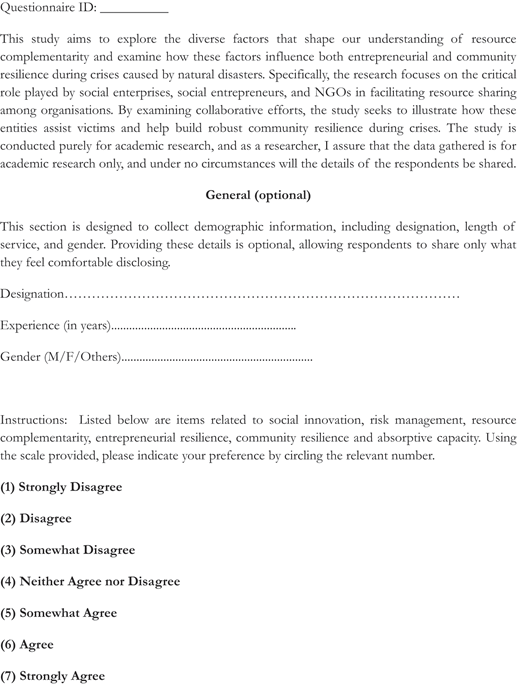
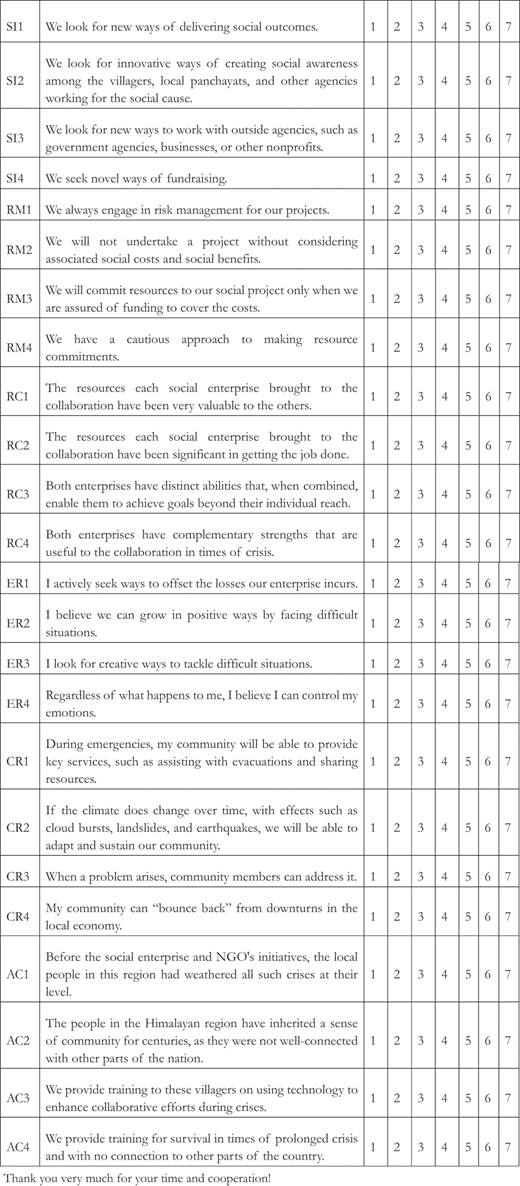
The present study is anchored in a positivist philosophy and uses a deductive approach to rigorously test the research hypotheses. To gather empirical data, a structured survey instrument was developed, using a seven-point Likert scale (1 = Strongly Disagree to 7 = Strongly Agree) as outlined in Appendix. The instrument design adhered closely to the established guidelines provided by Flynn et al. (1990) and Staniewski and Awruk (2018). Initially, scale items were adapted from reputable existing literature and subsequently pre-tested with eight field experts and seven subject matter experts to ensure clarity and eliminate potential ambiguities. This pre-testing phase was critical in refining the instrument for the target population. The core objective of the study is to examine the role of social enterprises, managed by social entrepreneurs and NGOs, operating in earthquake- and landslide-prone regions of Uttarakhand. These areas experience natural disasters annually, often resulting in temporary isolation from the mainland, which significantly hampers disaster relief teams’ ability to reach affected communities promptly (Molnar-Tanaka and Sammonds, 2025). In such challenging circumstances, social entrepreneurs and NGOs – supported by the National Disaster Relief Fund, state government agencies and corporate entities – play a pivotal role in providing immediate aid and long-term support. Their efforts were particularly prominent during the COVID-19 pandemic and the 2023 floods in the Himalayan region.
4.1 Operationalisation of the constructs
The measures used in this study were identified through an extensive review of the relevant literature. To ensure face validity, these measures were subsequently pretested with subject-matter experts. Each construct was operationalised as a multi-item reflective scale, thereby improving measurement reliability and validity. Details of these measures and their operationalisation are provided in Table 1. In addition, expert feedback was incorporated to refine the items and enhance the overall clarity and appropriateness of each measure.
Constructs operationalisation
| Construct | Measures | Literature |
|---|---|---|
| Social innovation (SI) | New ways of delivering social outcomes (SI1) | Adapted from Dwivedi and Weerawardena (2018) |
| Innovative ways of creating social awareness (SI2) | ||
| New ways to work with outside agencies (SI3) | ||
| Novel ways of fundraising (SI4) | ||
| Risk management (RM) | Understanding the various forms of risk associated with social projects (RM1) | Adapted from Dwivedi and Weerawardena (2018) |
| Understanding the social cost and social benefits of the social project (RM2) | ||
| Secured funding (RM3) | ||
| Cautious approach to making resource commitments (RM4) | ||
| Resource complementarity (RC) | Willingness to share the resources (RC1) | Adapted from Moshtari (2016) |
| Social impact of the shared resources (RC2) | ||
| Distinct abilities of each organisation (RC3) | ||
| Complementary strengths (RC4) | ||
| Entrepreneurial resilience (ER) | Ability to minimise the losses from risk (ER1) | Adapted from Santoro et al. (2020) |
| Stay optimistic about the future in times of crisis (ER2) | ||
| Creative ways to tackle the crisis and find new solutions for the problem (ER3) | ||
| Stay calm and positive in all situations (ER4) | ||
| Community resilience (CR) | Community members are supportive during times of emergencies (CR1) | Adapted from Lindberg & Swearingen (2020) |
| Adaptability (CR2) | ||
| Community members are capable of coping with the crises (CR3) | ||
| Ability to bounce back (CR4) | ||
| Absorptive capacity (AC) | Past experiences of dealing with such crises (AC1) | Adapted from Stentoft et al. (2023) and Chaubey (2025) |
| Sense of support and caring for each other (AC2) | ||
| Training for the use of technologies (AC3) | ||
| Training for survival in the toughest time (AC4) |
SI – social innovation; RM – risk management; RC – resource complementarity; ER – entrepreneurial resilience; CR – community resilience; AC – absorptive capacity
4.2 Data collection and non-response bias
Currently, over 500 NGOs of varying sizes operate across the eleven states of the Himalayan region. Many of these organisations operate in remote locations, often with only two to three staff members and rely heavily on support from residents and village panchayats. Their round-the-clock presence ensures that communities receive urgent assistance and vulnerability is mitigated until formal disaster relief teams arrive. Given that the target respondents were qualified professionals, the questionnaire was administered in English. This choice reflects the linguistic diversity among NGO staff, who are recruited from across India and acknowledges English as the most widely understood language within these organisations. Prior to initiating data collection, the researcher contacted the National Disaster Institute of Management to obtain a comprehensive directory (Surya and Saha Roy, 2015). This directory contains detailed information about experts, government agencies, NGOs and international NGOs involved in disaster relief operations. Each NGO listed in the directory maintains its own representatives and affiliates, many of whom are active in disaster-prone areas such as the Himalayan region. While the directory has proven invaluable for connecting with a wide range of experts from both practice and academia, the information is somewhat outdated. Since its publication, the number of NGOs involved in disaster management has grown significantly. Despite this, the directory served as a crucial starting point, enabling the researcher to efficiently identify and contact key stakeholders for the study. Building on this foundation, the researcher supplemented the directory’s information by consulting recent reports, government publications and professional networks. This approach ensured a more comprehensive and up-to-date list of relevant organisations and individuals, strengthening the reliability and depth of the data collection process.
Data were collected over a six-month period, from 17 November 2024 to 17 May 2025, resulting in 388 usable responses after data screening and quality-control procedures. To maximise participant reach and enhance the sample’s heterogeneity, the study used a multi-stage sampling strategy (Whittemore and Halpern, 1997). Specifically, respondents were recruited through multiple channels and successive sampling stages, enabling access to individuals with diverse demographic and experiential backgrounds. This approach was selected to improve sample coverage, reduce the likelihood of systematic exclusion of relevant subgroups and strengthen the representativeness of the final data set. The extended data collection window further facilitated the inclusion of participants across different contexts and time periods, thereby enhancing the robustness and credibility of the empirical findings. Specifically, emails were sent to 45 local NGOs and 15 international NGOs, requesting that these organisations circulate the survey among their representatives and teams working in the targeted hilly regions. These representatives were primarily involved in supporting social entrepreneurship and CR programs, making them ideal participants for the study. While it is challenging to determine the exact number of individuals who received the survey, estimates suggest that more than 1,100 potential respondents were approached. This figure is based on the NGOs’ commitment to distribute the survey internally to their relevant staff and field representatives. With 388 completed responses, the estimated response rate falls between 30% and 35%. This is a noteworthy achievement given the typically lower response rates associated with online surveys and the use of random sampling. The relatively high response rate can be attributed to the targeted distribution method, whereby the questionnaires were shared directly through established organisational channels (Anseel et al., 2010). Leveraging the trust and communication networks within these NGOs not only enhanced participation but also ensured that the data collected reflected the experiences of individuals actively engaged in SI and resilience-building efforts in challenging geographic settings (Ghafran and Yasmin, 2025). This methodological approach strengthens the reliability and relevance of the study’s findings.
To maximise participation, a referral sampling method was used, enabling broader outreach. However, this approach has inherent limitations, including the inability to determine the exact number of individuals who received the survey invitation. The study was conducted in accordance with the revised Helsinki ethical guidelines (Declaration of Helsinki, 2024) (cf. World Medical Association, 2025) involving human participants. All respondents were informed of the study’s purpose, and written documentation explained that participants’ confidentiality, especially those involved in pretesting, would be protected. Informed consent was obtained from each participant prior to their involvement. Furthermore, the survey instrument was designed to maintain privacy by not collecting personally identifiable information, such as gender, qualifications or other sensitive details. This approach ensured that participants’ identities remained anonymous and that their data was handled with the utmost care and in accordance with ethical standards.
The target respondents comprise 22.42% females (87/388) and 77.58% males (301/388). Since the designation field was optional, many respondents did not provide this information. However, most respondents did indicate their gender. Discussions with the respective NGOs’ senior managers revealed that NGOs operating in remote locations use well-trained individuals, many of whom hold qualifications from top institutions or have interned with senior professionals. In addition, many of these individuals frequently relocate to meet organisational needs. To ensure that non-response bias did not affect the reliability and validity of the study, wave analysis was performed on two waves of data for each item of the construct. A two-tailed t-test, as recommended by Armstrong and Overton (1977), was conducted. The p-values obtained for each item were greater than 0.1, and in most cases, exceeded 0.3, indicating that non-response bias is not a concern. Since this study lies at the intersection of operations management and entrepreneurship, additional qualitative measures were adopted (see Wagner and Kemmerling, 2010; Scheaf et al., 2023). For example, discussions were held with the respective NGOs regarding the respondents’ qualifications and backgrounds, as well as the reasons for not returning the questionnaire. These telephonic conversations further clarified any doubts about whether the respondents had sufficient knowledge to answer the questions or about the challenges they faced in returning the questionnaire after multiple rounds of follow-up.
5. Data analysis and results
This study uses WarpPLS 8.0 for statistical analysis, using factor-based PLS-SEM (Kock, 2024). This approach addresses several limitations of traditional PLS-SEM that have been criticised by scholars (Rönkkö & Evermann, 2013). While the concerns raised by Rönkkö and Evermann (2013) are valid, recent advancements have mitigated many of these issues without sacrificing the flexibility and distinctiveness of variance-based structural equation modelling (see Dijkstra and Henseler, 2015; Kock, 2024; Henseler and Schuberth, 2025). The present study seeks to evaluate the predictive and explanatory power of antecedent factors, including SI, RM and RC. Factor-based PLS-SEM is a well-established technique for such analysis (see Peng and Lai, 2012; Moshtari, 2016). Notably, this study is unique because these constructs have not previously been examined together in the literature, and there is no established theoretical framework predicting the relationships among SI, RM, RC, ER and CR. Therefore, PLS-SEM is especially suitable for path analysis in this context (Moshtari, 2016).
5.1 Measurement model reliability and validity
To evaluate the psychometric properties and construct validity of the measures used in this study, Tables 2 and 3 have been prepared. Both tables follow the Fornell and Larcker (1981) guidelines for reflective constructs. Table 2 shows that the individual factor loadings for each measurement item exceeded 0.7, exceeding the threshold of 0.5. The scale composite reliability (SCR) exceeded 0.7, meeting the required threshold and the average variance extracted (AVE) exceeded 0.5, also surpassing the threshold (Fornell and Larcker, 1981). As all three conditions are satisfied, the constructs demonstrate convergent validity. Table 3 presents the construct correlation matrix, with the leading diagonal (grey shaded cell) representing the square root of each construct’s AVE. Each diagonal entry is greater than the corresponding construct correlation values in the respective rows and columns, indicating that the constructs possess discriminant validity.
Measurement properties of constructs
| Construct | Items | Factor loadings (λi) | Variance (λi²) | Error (1-λi²) | SCR | AVE |
|---|---|---|---|---|---|---|
| Social innovation (SI) (α = 0.94) | SI1 | 0.89 | 0.80 | 0.20 | 0.96 | 0.84 |
| SI2 | 0.92 | 0.84 | 0.16 | |||
| SI3 | 0.92 | 0.85 | 0.15 | |||
| SI4 | 0.94 | 0.87 | 0.13 | |||
| Risk management (RM) (α = 0.93) | RM1 | 0.91 | 0.83 | 0.17 | 0.95 | 0.82 |
| RM2 | 0.90 | 0.81 | 0.19 | |||
| RM3 | 0.90 | 0.80 | 0.20 | |||
| RM4 | 0.91 | 0.82 | 0.18 | |||
| Resource complementarity (RC) (α = 0.82) | RC2 | 0.92 | 0.84 | 0.16 | 0.84 | 0.64 |
| RC3 | 0.85 | 0.72 | 0.28 | |||
| RC4 | 0.60 | 0.36 | 0.64 | |||
| Entrepreneurial resilience (ER) (α = 0.87) | ER2 | 0.91 | 0.83 | 0.17 | 0.94 | 0.83 |
| ER3 | 0.92 | 0.84 | 0.16 | |||
| ER4 | 0.91 | 0.84 | 0.16 | |||
| Community resilience (CR) (α = 0.9) | CR2 | 0.89 | 0.79 | 0.21 | 0.93 | 0.82 |
| CR3 | 0.92 | 0.85 | 0.15 | |||
| CR4 | 0.91 | 0.83 | 0.17 | |||
| Absorptive capacity (AC) (α = 0.95) | AC1 | 0.87 | 0.76 | 0.24 | 0.95 | 0.83 |
| AC2 | 0.92 | 0.84 | 0.16 | |||
| AC3 | 0.90 | 0.81 | 0.19 | |||
| AC4 | 0.92 | 0.84 | 0.16 |
α – Cronbach’s alpha value is used to assess the reliability of scales and instruments; SI – social innovation; RM – risk management; RC – resource complementarity; ER – entrepreneurial resilience; CR – community resilience; AC – absorptive capacity
Construct correlations
| Construct | SI | RM | RC | ER | CR | AC |
|---|---|---|---|---|---|---|
| SI | 0.92 | |||||
| RM | 0.36 | 0.90 | ||||
| RC | 0.43 | 0.59 | 0.92 | |||
| ER | 0.37 | 0.65 | 0.84 | 0.97 | ||
| CR | 0.30 | 0.56 | 0.84 | 0.84 | 0.96 | |
| AC | 0.41 | 0.40 | 0.57 | 0.44 | 0.40 | 0.97 |
The italic cell entries represent the square root of the AVEs; SI – social innovation; RM – risk management; RC – resource complementarity; ER – entrepreneurial resilience; CR – community resilience; AC – absorptive capacity
In addition to Fornell and Larcker’s (1981) method for assessing discriminant validity of reflective constructs, this study also follows Henseler et al.'s (2015) recommendation and conducts the Hetrotrait-Monotrait (HTMT) test. The HTMT values between the reflective constructs, presented in Table 4, are all less than or equal to 0.90, which is within the recommended threshold. Based on the results in Tables 3 and 4, the constructs demonstrate sufficient discriminant validity. Furthermore, based on the evidence in Tables 2, 3 and 4, it can be concluded that the constructs possess overall construct validity.
HTMT values
| Construct | SI | RM | RC | ER | CR | AC |
|---|---|---|---|---|---|---|
| SI | ||||||
| RM | 0.39 | |||||
| RC | 0.43 | 0.63 | ||||
| ER | 0.34 | 0.59 | 0.90 | |||
| CR | 0.27 | 0.6 | 0.88 | 0.89 | ||
| AC | 0.36 | 0.41 | 0.84 | 0.39 | 0.36 |
SI – social innovation; RM – risk management; RC – resource complementarity; ER – entrepreneurial resilience; CR – community resilience; AC – absorptive capacity
5.2 Common method bias
Common method bias (CMB) is a well-known issue associated with survey-based research that relies on respondents’ perceptions (Podsakoff et al., 2003). Although CMB cannot always be eliminated, it can be significantly minimised through careful methodological planning. Podsakoff et al. (2024) recommended several procedural remedies, including pretesting the questionnaire, collecting data from the target respondents, avoiding double-barrelled questions and validating responses using secondary reports or inputs from alternative sources. Following data collection, quantitative tests are essential to assess and address CMB, with the choice of tests depending on the specific analysis method used. For example, in PLS-SEM, commonly recommended tests include the full collinearity test and confirmatory factor analysis. Consistent with Kock and Lynn (2012), the variance inflation factor (VIF) for all latent constructs was calculated using WarpPLS 8.0 (see Table 5). In most instances, the VIF values were below the recommended threshold of 3.3 (Kock and Lynn, 2012). However, the VIF for RC was slightly above 3.3, suggesting potential multicollinearity bias. To address this, problematic items RC1, ER1 and CR1 were removed. After eliminating these items, VIF values for all constructs fell below the 3.3 threshold (see Table 6), indicating reduced multicollinearity and greater validity of the results.
5.3 Endogeneity test
Conducting an endogeneity test is a crucial preliminary step before hypothesis testing, as it addresses potential causal concerns that frequently arise in survey data (Guide and Ketokivi, 2015). In this study, four key values have been reported to assess endogeneity (see Table 7). Firstly, the Simpson’s paradox ratio (SPR) is 1, exceeding the established threshold of 0.7. Secondly, the R-squared contribution ratio (RSCR) is 1, which is well above the recommended minimum of 0.9. Thirdly, the statistical suppression ratio (SSR) is 1, surpassing the acceptable value of 0.7. Finally, the nonlinear bivariate causality direction ratio (NLBCDR) is 1, which is also above the 0.7 threshold. Collectively, these results indicate that causality is not a significant concern in the current analysis. Therefore, the data are considered robust for subsequent hypothesis testing, reducing the risk of biased or misleading results arising from endogeneity.
5.4 Hypothesis testing
The results of the hypothesis testing are summarised in the final structural model (see Figure 2). These findings provide robust empirical support for all five proposed hypotheses. Specifically, hypothesis H1, which posits that SI positively influences RC, is supported (β = 0.35, p < 0.01). Hypothesis H2, suggesting that RM positively affects RC, is also supported (β = 0.45, p < 0.01). Furthermore, hypothesis H3, which examines the impact of RC on ER, is strongly supported (β = 0.87, p < 0.01). In addition, hypothesis H4 (RC→CR) is validated (β = 0.34, p < 0.01), as is hypothesis H5, indicating a significant relationship between ER and CR (β = 0.49, p < 0.01). Collectively, these results highlight the central role of SI and RM in fostering RC, which, in turn, serves as a critical driver of ER. Both RC and ER emerge as key antecedents of CR. Notably, the strong effect of ER on CR underscores the importance of strengthening entrepreneurial capacity as a pathway to enhancing broader CR. Overall, the analysis demonstrates that targeted efforts to promote SI, effective RM and RC can have far-reaching effects on both individual and collective resilience outcomes.
 The diagram presents S I, R M, R C, E R, C R, and A C with path coefficients, significance values, and R squared values. S I influences R C with beta 0.35, P less than 0.01. R M influences R C with beta 0.45, P less than 0.01. R C influences E R with beta 0.87, P less than 0.01, and C R with beta 0.34, P less than 0.01. E R influences C R with beta 0.49, P less than 0.01, and A C with beta 0.11, P 0.02. A C influences C R with beta 0.03, P 0.28. R squared values are 0.47 for R C, 0.74 for E R, and 0.64 for C R.
Final model
Source: Author’s own work
The diagram presents S I, R M, R C, E R, C R, and A C with path coefficients, significance values, and R squared values. S I influences R C with beta 0.35, P less than 0.01. R M influences R C with beta 0.45, P less than 0.01. R C influences E R with beta 0.87, P less than 0.01, and C R with beta 0.34, P less than 0.01. E R influences C R with beta 0.49, P less than 0.01, and A C with beta 0.11, P 0.02. A C influences C R with beta 0.03, P 0.28. R squared values are 0.47 for R C, 0.74 for E R, and 0.64 for C R.Final model
Source: Author’s own work
The results indicate that AC has a positive and statistically significant impact on ER (β = 0.11, p < 0.05). This underscores the importance of learning ability and knowledge assimilation in enabling entrepreneurs to withstand and adapt to challenging circumstances. Entrepreneurs who actively acquire, assimilate and apply new knowledge are better positioned to innovate, pivot and sustain their ventures in the face of adversity, thus reinforcing their overall resilience. Conversely, the analysis reveals that AC does not exert a statistically significant effect on CR, as reflected by the coefficient (β = 0.03, p = 0.28). This suggests that, in the context of this study, the benefits of AC may be more pronounced at the individual or organisational level rather than directly influencing broader community outcomes. The pathways through which AC contributes to CR may be more complex, perhaps operating indirectly via other constructs such as ER, collective action or resource sharing. As such, future research would benefit from exploring the potential mediating or moderating roles of these factors and from considering AC as an independent variable in alternative model specifications. Interestingly, the analysis does show a positive and significant effect of AC on ER. This result highlights the crucial role that learning ability and knowledge absorption play in equipping entrepreneurs to respond to and navigate crises effectively. Enhanced AC appears to empower entrepreneurs to adapt, innovate and sustain their ventures in the face of adversity. These findings point to the importance of fostering learning-oriented environments and continuous capability development as strategies to strengthen entrepreneurial resilience, which may, in turn, contribute to broader CR over time.
Moshtari (2016) argued that, in addition to the above hypothesis testing, the explanatory power of the theoretical model (see Figure 2), is assessed using R2 (the coefficient of determination). The R2 statistic measures the proportion of variance in the dependent variable that is predictable from the independent variables. For instance, the R2 value for RC is 0.47, suggesting that SI and RM explain 47% of the total variation in RC. This indicates moderate explanatory power, as nearly half of the variance in RC is attributable to these predictors. In contrast, the R2 for ER is 0.74 and for CR is 0.64. These higher values indicate that SI, RM and RC explain a substantial proportion of the variance in ER and CR. Such results highlight the importance of these variables as significant determinants. High R2 values generally suggest that the model fits the data well and that the selected predictors are highly relevant in explaining the observed outcomes. Therefore, the findings reinforce the theoretical model’s robustness in capturing the complex relationships among the variables studied.
Table 8 presents the effect sizes for the key predictors in the model, offering valuable insight into the relative strengths of these relationships. For example, the effect size of SI on RC is 0.194, indicating a modest but meaningful influence. This suggests that as SI increases, RC also increases, though the effect is not particularly strong. In contrast, the effect size of RM on RC is slightly larger at 0.275, suggesting that RM plays a more notable role in shaping RC than SI. Furthermore, the effect size of RC on ER is 0.697, indicating a substantial and robust association. This high value underscores the critical importance of RC in predicting ER, suggesting that improvements in relational capital are strongly linked to better employee retention outcomes. On the other hand, the effect size of RC on CR is 0.253, reflecting a moderate relationship. While RC does influence CR, its role is less pronounced than its effect on ER. These findings illustrate the varying degrees of influence that different predictors exert within the model.
Effect sizes for path coefficients
| Construct | SI | RM | RC | ER | CR | AC |
|---|---|---|---|---|---|---|
| RC | 0.194 | 0.275 | ||||
| ER | 0.697 | 0.046 | ||||
| CR | 0.253 | 0.377 | 0.011 |
Table 9 reports the Q2 values for the model’s key outcome variables: RC (0.468), ER (0.65) and CR (0.618). The Q2 statistic, also known as the predictive relevance indicator, measures the model’s ability to predict data points that were not used in model estimation (Peng and Lai, 2012). A Q2 value greater than zero suggests that the model possesses predictive relevance for the corresponding endogenous construct (Peng and Lai, 2012; Moshtari, 2016). The Q2 value of 0.468 for RC indicates that the model has a moderate predictive capacity for this variable. For ER, the Q2 value is 0.65, indicating strong predictive relevance and suggesting the model is highly effective at forecasting employee retention. Similarly, CR exhibits a Q2 value of 0.618, indicating strong predictive power. These results collectively demonstrate that the theoretical framework is not only statistically sound but also practically useful in predicting key organisational outcomes.
5.5 Robustness test
To evaluate the robustness of the proposed model, a series of diagnostic tests was conducted covering model fit, reliability, validity, collinearity, predictive relevance and causality assessment (see Table 10). The results indicate that the model demonstrates satisfactory robustness and predictive capability. Firstly, the global model fit indices confirmed the structural model’s adequacy. The average path coefficient (APC = 0.394, p < 0.001), average R-squared (ARS = 0.691, p < 0.001) and average adjusted R-squared (AARS = 0.690, p < 0.001) were all statistically significant, indicating substantial explanatory power. Furthermore, the average block variance inflation factor (AVIF = 2.404) and average full collinearity variance inflation factor (AFVIF = 3.327) were within the acceptable thresholds, suggesting that multicollinearity was not a serious concern. The model also exhibited a high goodness-of-fit index (GoF = 0.731), exceeding the recommended benchmark for large effect sizes and indicating excellent overall model performance.
Robustness assessment of the theoretical model
| Assessment criterion | Measure | Value | Recommended threshold | Result |
|---|---|---|---|---|
| Model fit | APC | 0.394 (p < 0.001) | p < 0.05 | Supported |
| ARS | 0.691 (p < 0.001) | p < 0.05 | Supported | |
| AARS | 0.690 (p < 0.001) | p < 0.05 | Supported | |
| AVIF | 2.404 | ≤5.0 (ideal ≤ 3.3) | Supported | |
| AFVIF | 3.327 | ≤5.0 | Supported | |
| GoF | 0.731 | >0.36 | Excellent | |
| SPR | 1.000 | ≥0.70 | Supported | |
| RSCR | 1.000 | ≥0.90 | Supported | |
| SSR | 1.000 | ≥0.70 | Supported | |
| NLBCDR | 1.000 | ≥0.70 | Supported | |
| Reliability | Scale composite reliability (SCR) | 0.886–0.955 | ≥0.70 | Supported |
| Cronbach's alpha | 0.824–0.938 | ≥0.70 | Supported | |
| Convergent validity | AVE | 0.665–0.843 | ≥0.50 | Supported |
| Indicator loadings | 0.778–0.935 | ≥0.70 | Supported | |
| Discriminant validity | Fornell–Larcker criterion | Partially satisfied | √AVE > correlations | Marginal concern |
| Cross-loadings | RC4 cross-loaded on AC | Lowest cross-loadings preferred | Marginal concern | |
| Common method bias | Full collinearity VIF | 1.339–5.652 | <5.0 | Mostly supported* |
| Structural model | R² (RC, ER, CR) | 0.438, 0.774, 0.862 | ≥0.25 | Strong |
| Q² (RC, ER, CR) | 0.437, 0.731, 0.783 | >0 | Supported | |
| Collinearity | Block VIF | 1.275–5.291 | <5.0 | Acceptable |
| Causality assessment | Simpson’s paradox ratio (SPR) | 1.000 | ≥0.70 | Supported |
| Statistical suppression ratio (SSR) | 1.000 | ≥0.70 | Supported | |
| Nonlinear bivariate causality direction ratio (NLBCDR) | 1.000 | ≥0.70 | Supported |
APC = average path coefficient; ARS = average R2; AARS = average adjusted R2; AVIF = average block variance inflation factor; AFVIF = average full collinearity VIF; GoF = goodness of fit; AVE = average variance extracted; Q2 = predictive relevance
The reliability of the measurement model was assessed using both composite reliability and Cronbach’s alpha. SCR values ranged from 0.886 to 0.955, while Cronbach’s alpha values ranged from 0.824 to 0.938, substantially exceeding the recommended threshold of 0.70. These findings confirm the internal consistency and reliability of all latent constructs.
Convergent validity was supported by the AVE values, which ranged from 0.665–0.843, surpassing the recommended threshold of 0.50. In addition, all indicator loadings were statistically significant (p < 0.001) and generally exceeded the recommended level of 0.70, confirming adequate indicator reliability and construct convergence.
The predictive power of the structural model was further demonstrated through the coefficient of determination (R2) and Stone–Geisser’s predictive relevance (Q2). The endogenous constructs exhibited substantial explanatory power, with R2 values of 0.438 for RC, 0.774 for ER and 0.862 for CR. Similarly, all Q2 values were positive and substantial (RC = 0.437, ER = 0.731, CR = 0.783), indicating strong predictive relevance and out-of-sample predictive capability.
To assess CMB and multicollinearity, full collinearity VIF values were examined. Most constructs exhibited acceptable VIF values below the recommended threshold of 5. Although the RC construct exhibited a relatively high VIF, the overall results suggest that CMB is unlikely to threaten the validity of the findings.
Additional robustness was confirmed through WarpPLS 8.0 causality diagnostics. The SPR = 1.000, RSCR = 1.000, SSR = 1.000 and NLBCDR = 1.000, all exceeded their recommended thresholds. These results indicate the absence of Simpson’s paradox, statistical suppression and reverse causality issues, thereby strengthening confidence in the proposed causal relationships. Although the Fornell–Larcker assessment revealed relatively high correlations among RC, ER and CR, suggesting conceptual overlap, the overall evidence from reliability, convergent validity, predictive relevance, model fit and causality diagnostics supports the model’s robustness. Therefore, the results provide strong evidence that the measurement and structural models are reliable, valid and sufficiently robust for hypothesis testing.
6. Discussions
The results of this study advance the understanding of complex phenomena that necessitate a multidisciplinary perspective. Humanitarian relief efforts, particularly in disaster-prone regions, require a nuanced understanding of sociological, cultural and economic dynamics, given the significant resource and capacity requirements. Adopting an operations and entrepreneurship framework, this research elucidates the intricate interplay among social entrepreneurship, RC and CR, factors that collectively influence community survival during disasters. It further highlights the pivotal role of social entrepreneurs in enhancing local resilience. Empirical findings are derived from survey data collected from NGOs operating in the Himalayan region. This geographically challenging area has been frequently affected by landslides and cloudbursts in recent years. These disasters often sever connections with the mainland, complicating evacuation and relief operations. The study demonstrates how social entrepreneurship initiatives foster the development of local capacities to withstand and recover from such events, offering a valuable model for similarly vulnerable contexts. The results contribute not only to theoretical advancements in the field but also to academic scholarship more broadly, providing actionable insights for commercial organisations and policymakers engaged in disaster management and regional development. Nonetheless, the study acknowledges certain limitations, which present opportunities for further academic inquiry and refinement in future research.
6.1 Implications for theory
This study makes three important contributions to the literature on social entrepreneurship, social capital and resilience in disaster contexts. Firstly, it extends social capital theory by identifying RC as a critical mechanism through which social entrepreneurship generates resilience outcomes. While prior studies have established that social entrepreneurs leverage social networks to access resources and coordinate collective action (Bhatt and Altinay, 2013; Lang and Fink, 2019), the processes by which these networks translate into resilience-building capabilities remain underexplored. The findings of this study suggest that social entrepreneurship contributes to resilience not merely through resource mobilisation but through the creation of complementary resource configurations that enable actors to combine heterogeneous assets, capabilities and knowledge across organisational boundaries. By highlighting RC as an intermediate mechanism linking social entrepreneurship to resilience outcomes, this study advances a more nuanced understanding of how social capital is converted into adaptive capacity during periods of disruption. This contribution is particularly relevant in disaster-prone environments, where resilience depends less on the availability of individual resources and more on actors’ ability to integrate and collectively deploy diverse resources (Xiong and Li, 2024; McKie and Aitken, 2025).
Secondly, this study contributes to the emerging literature on interorganisational collaboration by identifying key antecedents of RC (Moshtari, 2016). Although RC has been recognised as an important determinant of collaborative effectiveness (see Moshtari, 2016), existing research has largely treated it as a static organisational condition rather than a dynamic capability that develops through ongoing interactions among stakeholders (den Hond et al., 2015; Moshtari, 2016). The findings of this study address this limitation by demonstrating that SI and RM play pivotal roles in fostering RC. Specifically, SI encourages organisations to transcend conventional operational boundaries and develop novel approaches to resource integration, while RM enhances preparedness, coordination and strategic responsiveness under conditions of uncertainty. Together, these factors facilitate the alignment of organisational capabilities and strengthen collaborative networks’ capacity to respond effectively to complex crises. By positioning SI and RM as enabling mechanisms, this study contributes to a more process-oriented understanding of how RC emerges and evolves within multi-actor systems.
Thirdly, this study enriches resilience scholarship by unpacking the relationship between RC, ER and CR. Existing research has generally examined ER and CR as distinct phenomena or has focused on their outcomes independently (Steiner and Atterton, 2015; Salvato et al., 2020). Consequently, limited attention has been given to the mechanisms through which organisational-level resilience contributes to broader community-level resilience, particularly during disasters (Wulandhari et al., 2022). The findings demonstrate that RC strengthens ER by enhancing organisational adaptability, resource flexibility and recovery capacity. More importantly, ER functions as a transmission mechanism through which the benefits of RC extend beyond individual organisations to the wider community. This finding suggests that resilience is not solely an organisational attribute but a multi-level phenomenon that emerges through interactions between organisational actors and their surrounding social systems. By revealing how ER translates organisational capabilities into collective adaptive capacity, this study provides a more integrated understanding of resilience formation across levels of analysis.
6.2 Implications for the practice and policy
The results of this study provide valuable insights into how social entrepreneurship can enhance collaboration among the various actors involved in addressing humanitarian crises resulting from disasters. This is particularly important in regions that are geographically isolated or poorly connected to the mainland, where disaster relief teams may encounter significant challenges in providing immediate assistance. In such circumstances, social enterprises, leveraging their unique capabilities, can play a crucial role in responding to disasters and delivering relief to affected communities. Moreover, the findings highlight the importance of RC during crises. This not only strengthens the ER of social enterprises but also contributes to building broader CR.
The study further underscores the need for policymakers to invest in initiatives that promote social entrepreneurship as a viable solution to humanitarian crises. In addition, it emphasises the pivotal role that NGOs can play in building local capacities, facilitating resource mobilisation and fostering partnerships that enhance the overall impact of disaster response efforts. Expanding on these insights, fostering closer collaboration among social enterprises, NGOs and government agencies can create a more agile, coordinated response to emergencies. By investing in capacity-building programs and supporting innovative social enterprise models, policymakers can ensure that relief efforts are not only immediate but also sustainable and tailored to the unique needs of vulnerable regions. Ultimately, this approach can transform the way humanitarian crises are managed, leading to more resilient and empowered communities.
6.3 Limitations of the study and future research directions
The study adopts a positivistic philosophical approach, which, while rigorous, may inadvertently constrain the exploration of alternative configurations or pathways within the field. In the context of complex causality, a likely feature in studies of entrepreneurial and CR, there is significant value in investigating multiple routes that may lead to these outcomes. Embracing a configurational approach, such as qualitative comparative analysis, can help capture this complexity and uncover the diverse mechanisms underlying resilience. Furthermore, reliance on perceptual data introduces the potential for respondent bias, which can affect the reliability and validity of the findings. To mitigate these concerns, future research should use longitudinal data collection methods to establish causal relationships over time and reduce the influence of transient perceptions. Complementing quantitative analysis with in-depth qualitative research, such as interviews, case studies or ethnographic methods, can further enrich understanding by uncovering nuanced perspectives and contextual factors that quantitative approaches might overlook. Expanding on these recommendations, future studies should consider integrating mixed-methods designs. This approach combines the strengths of both quantitative and qualitative research, offering a more comprehensive and robust understanding of the complex interplay between social entrepreneurship, resilience and community dynamics. By adopting diverse methodological strategies, researchers can generate more reliable, valid and actionable insights to inform both theory and practice in social entrepreneurship and disaster response.
7. Conclusion
I am pleased to present the conclusion of this study. While research at the intersection of operations management and entrepreneurship has attracted significant attention (Joglekar and Lévesque, 2013), studies on humanitarian operations and entrepreneurship remain underdeveloped. In the aftermath of the COVID-19 crisis, the need for such research has increased substantially (Kovács and Sigala, 2021; Altay et al., 2023). However, empirical research on the impact of social entrepreneurship on disaster relief programs remains limited. This study aims to bridge this important gap by providing new insights into how social entrepreneurship can influence disaster relief efforts. Still, I urge readers to interpret the findings within the specific context of this research. It is my hope that this work contributes meaningfully to academic scholarship and encourages further study in this vital area. Building on these findings, future research could explore the long-term effects of social entrepreneurship initiatives in diverse humanitarian settings. In addition, examining partnerships between non-profit organisations, government agencies and entrepreneurial ventures may reveal further strategies for effective disaster response. By highlighting these opportunities, this study seeks to inspire continued scholarly attention and practical innovation in the field.
The author gratefully acknowledges the Women and Inclusive Entrepreneurship Hub (formerly the Women and Inclusive Entrepreneurship Research Alliance – WIERA) for providing an intellectually enriching and collaborative research environment that fosters interdisciplinary scholarship in entrepreneurship, innovation, and inclusive development. The academic interactions and knowledge exchange facilitated through the Hub have contributed to the intellectual development of this research.
References
Appendix