The occurrence of disaster and crisis is increasing. They are complex as well as challenging for humanitarian organizations (HOs) and societies involved in disaster relief operations. This study examined the nexus between supply chain flexibility (SCF) and humanitarian supply chain performance (HSCP) among HOs with empirical evidence from HOs in Ghana.
The study employed the quantitative method to explore the interdependencies among the variables. In congruence with this, the study employed the purposive and convenience sampling technique to obtain information from 168 respondents. The analysis was done using SPSS version 23 and Smart PLS version 3.
The outcome indicates that intercluster coordination (ICC) plays a significant mediating role between SCF and HSCP.
The outcome of the study indicates that a closer and stronger relationship ensures proper channel use among the HOs. This will improve the performance of the supply chain of HOs and their ability to deal with supply chain uncertainties.
The discovery of this study provides empirical support to the resource-based view theory. Thus, practitioners in the humanitarian setting give priority to factors that could enhance flexibility in their supply chain as well as implement coordination strategies to achieve a responsive humanitarian supply chain (HSC) system in the quest to minimize the outcome of disasters.
Introduction
Recently, a number of disasters have prompted HOs to improve their aid operations to deal with critical situations (de Camargo Fiorini et al., 2021). A disaster can be man-made or natural (Maqbool and Khan, 2020; Dennehy et al., 2021). Man-made disasters include chemical spills, war and terrorism while natural disasters include floods, volcanic eruptions, disease pandemic and earthquakes (World Health Organization, 2019). Prominent disasters of the last decade include COVID-19 pandemic, 2018 Tsunami in Indonesia, 2015 flood disaster in Ghana, Hurricane Ida, 2021 floods in Germany, 2021 floods, landslides in China and Super Typhoon Rai in Philippines. Researchers (Scholten et al., 2019a, b; Gutjahr and Nolz, 2016) argue that disaster management is associated with high knowledge intensity, high urgency, high uncertainty and usually the duration is short. The problems and/or challenges associated with disaster management include procurement, planning, how to rapidly mobilize resources, distribution of supplies and warehousing locations (Pedraza-Martinez and Van Wassenhove, 2016; Maghsoudi et al., 2018). The humanitarian supply chain (HSC) ensures that relief and recovery materials reach victims at the right time, at the right location and in the right amount (Alem et al., 2021). Various stakeholders, including governments, national and international relief organizations and security agencies, are required to engage each other and coordinate their activities to ensure an effective and efficient relief operations (de Camargo Fiorini et al., 2021; Yadav and Barve, 2015). This is necessary because in the humanitarian context no single organization can solve all the ongoing problems and challenges (de Camargo Fiorini et al., 2021). Hence, efficient and effective coordination of aid activities to reduce cost and maximize efficiency requires that different actors in the network should work together (Tomasini and Van Wassenhove, 2009; Dubey et al., 2020). As a result, it is critical that any strategy adopted to manage the HSC should be a multifaceted approach, which will encompass the management of resource procurement and flow of supplies through humanitarian aid organizations and international agencies (Shareef et al., 2019a, b; Yadav and Barve, 2015) with flexibility (Altay et al., 2018a, b) to ensure that affected victims will receive the relief items promptly.
Even though various studies (Abualkhair et al., 2020; Anparasan and Lejeune, 2019; Zhang et al., 2019) have tried to establish optimization models and solutions for the HSC, using optimization of resources alone to manage the HSC is not enough (de Camargo Fiorini et al., 2021; Chandes and Paché, 2010). This is because HSCs are not just about point to point delivery of goods (Tomasini and Van Wassenhove, 2009). Also, each relief operation is distinct in terms of its cultural and political realities (Chandes and Paché, 2010). Lastly, the management of humanitarian supply chain includes organizations which are different in nature and vocation as per the services they offer (Chandes and Paché, 2010; Tomasini and Van Wassenhove, 2009).
In this study, it is proposed that flexibility – which reflects “the ability of a firm to respond to long-term or fundamental changes in the supply chain and market environment by adjusting the configuration of the supply chain” (Parast and Shekarian, 2019, p. 380) – is an important factor that could enhance the performance of HSC. Flexibility in the coordination of operations and resources are very important key factors of HSCP (Scholten et al., 2010). Supply chain flexibility (SCF) is seen as the ability of members in the chain to adjust their key processes by responding or adjusting to the dynamics in the environment and subsequently deliver value to their customers and ensure that profitability of the chain is guaranteed (Swafford et al., 2006; Merschmann and Thonemann, 2011). Aid organizations must have flexible systems and culture in order to function effectively in relief operations and complex environmental settings (Thomas, 2014). Maintaining a rigid and bureaucratic structure could derail the success of relief operations (Wise, 2006; Thomas, 2014). It is advisable for managers of aid organizations to adopt flexible spontaneous response in order to provide quick assistance and support to affected victims of a disaster (Wise, 2006). Being flexible will help the aid organizations to adjust and reconfigure the structure of their supply chain and work collaboratively to achieve success (Baharmand et al., 2017; Jermsittiparsert and Pithuk, 2019). Relief operations include different political systems, actors, cultures and government legislations (Pateman et al., 2013). Understanding the relationship between SCF and HSCP is a key area in research (Maleki Far et al., 2017; Jermsittiparsert and Pithuk, 2019). Studies on SCF are very uncommon and its relationship with firm performance are much fewer (Dangayach and Deshmukh, 2001; Sánchez and Pérez, 2005). This presents an opportunity for a study to examine the relationship between SCF and humanitarian supply chain performance (HSCP). Although, rich knowledge on varied drivers of HSCP (Rucha and Abdallah, 2017; Altay et al., 2018a, b; Banomyong et al., 2019; Najjar et al., 2019; Dubey et al., 2019; Jeble et al., 2019; Ivanov, 2020) exist, studies on how SCF could be used to drive supply chain performance (SCP) in the humanitarian setting is very scanty.
Again, various studies (Angel and Manuela, 2005; Sánche and Pérez, 2005; Candace et al., 2011) have concluded that SCF has a positive effect on performance. On the other hand, Fantazy et al. (2009) argue that the relationship between SCF and performance is negative. The authors recommended that researchers must carry out empirical studies to examine the nature and sharing of responsibility among the partners in the chain. In highly uncertain situations, such as those involving disaster relief activities, responsibility interdependence is more beneficial than task interdependence. It allows actors to concentrate their efforts on the contributions they make to their own and other clusters (Namagembe, 2020). Due to the complex nature and increase in the number of disasters, coordination and specialization has become essential and challenging (Schulz, 2008; Van Wassenhove, 2006: Oloruntuba, 2005; Beamon, 2004). Humanitarian relief operations involve various organizations (including host government, international and local non-governmental organizations [NGOs], United Nation institutions, military, donors and service providers) which provide different services either before, during or after a disaster (Jahre and Jensen, 2010). These organizations tend to specialize in specific areas, such as sanitation, water, medical care and camp management (Jahre and Spens, 2007). The organizations have their own systems and funding sources as well as operate independently. However, when these specialized and autonomous humanitarian institutions pull together their strength and resources, they can tackle coordination related problems. This was evident in 2004 and 2004/2005 Indian Ocean Tsunami and Darfur crises respectively. In both situations, the large nature of the disaster and complex settings undermined the effectiveness of coordination (Jahre and Jensen, 2010). Situations of this nature depict the importance of coordination with regards to preparedness and response (Oloruntuba, 2005). This explains why intercluster coordination is very key in humanitarian relief operations (Namagembe, 2020, Mutebi et al., 2020a, b; Jahre and Jensen, 2010). “Inter-cluster coordination is a cooperative effort among sectors/clusters” (Namagembe, 2020, p. 170). Even though intercluster coordination has received a lot of attention in the literature, exploratory studies on its role is still very limited (Namagembe, 2020). Thus, it is important to analyze the collaborative role of actors in relief activities and how the role of the organizations involved changes in the various levels of disaster management (namely mitigation, preparedness, response and recovery) (Jensen and Hertz, 2016). Coordination between HOs enables prompt response and enhance the overall effectiveness of relief efforts (Moshtari and Gonçalves, 2017; Singh et al., 2018a, b). This study is motivated by two major issues. First, the relationship between SCF and performance is plagued with mixed results. Thus, ICC as has been introduced as a mediator as recommended by Fantazy et al. (2009) to help clarify the ambiguity associated with the relationship between SCF and HSCP. Second, this study attempts to build a model for the integrated relationship between SCF and ICC and HSCP. This relationship has been rarely examined in extant literature, especially in the humanitarian and Sub-Saharan Africa context. The study is also in response to the exigent call by Anjomshoae et al. (2022) that researchers in HSCP should focus and examine interorganizational and collaborative performance measurement.
Recently, researchers and practitioners have turned their attention to HSCP (Haavisto and Goentzel, 2015; Tatham and Hughes, 2011; Blecken et al., 2009) because the demand for humanitarian assistance has increased significantly in the last decade (Anjomshoae et al., 2022). Conflict and violence displaced over 82 million people across the globe in 2020 (UNHCR, 2020). The occurrence and continuing consequences of the coronavirus pandemic in 2020 have also caused unprecedented humanitarian crises in the world. As a result, HOs have come under intense pressure to deliver aid in a more cost-effective way. The projects and programs of humanitarian institutions are either at a standstill, disrupted or operating at half capacity (The New humanitarian, 2020). However, there is no sign that future humanitarian crises could receive an effective response (Anjomshoae et al., 2022). Records from the World Bank suggest that by 2030, people who may need assistance in fragile and conflict-affected regions will reach 46% of the total world population (Besiou et al., 2021).
Again, after the Coronavirus crisis, donors have consistently demanded more transparency and accountability from humanitarian institutions (Cardoso et al., 2021). HOs are greatly scrutinized to ensure efficient and effective spending behaviour. Currently, quick response to crises by HOs is not sufficient anymore (Anjomshoae et al., 2022). Humanitarian institutions are expected to demonstrate sustainable and cost-effective operations (Paciarotti and Valiakhmetova, 2021). Thus, understanding the performance measurement system of HOs will help donors and all other stakeholders to appreciate the impact of humanitarian operations. This will increase the trust and support that stakeholders have for HOs (Anjomshoae et al., 2017, 2021).
Theoretical review and hypothesis development
The study used the resource-based view (RBV) theory to explore the association between flexibility, intercluster coordination and HSCP. According to Barney (1991), the RBV theory identifies factors that can drive HSCP. In the context of relief operations, the RBV argues that the performance of humanitarian supply chain is dependent on the resources that are rare, valuable imperfectly imitable and not substitutable, that is available to relief organizations. This resource could either be tangible or intangible (Barney et al., 2011), and an essential resource in the relief setting is flexibility. Flexibility in the relief supply chain may enhance intercluster coordination. In such regard, HSCP could be traced to the organization’s specific resources, such as flexibility and ICC. As such, Theriou et al. (2009) argue that an organization’s strategy must be defined in line with the organization’s unique resources and capabilities.
The concept of organizational capabilities was equated by Grant (1991) to core competencies (Hamel and Prahalad, 1990) and to routines of the organization (Nelson and Winter, 1982). Grant (1991) explicitly envisaged that organizational routines are defined as “regular and can be predicted in patterns of activities and sequence of coordinated actions. Grant (1991) again posits that deploying yielding resources creates a competitive advantage. On the same arguments, Amit and shoemaker (1993) explained the concept of capability as an “information-based, tangible and intangible process that could enhance the productivity of its resources and as well as flexible strategies and protection for its final products and services." The process of information gathering mechanisms represents the capabilities that allow firms to embed their knowledge assets, which include information, know-how and skills that are controlled by the firms into a value addition process (Grant and Baden-Fuller, 1995). More contributions to this perspective have been advanced by scholars, such as Kogut and Zander (1992); Nonaka (1994), who opined on the distinctive properties of knowledge (for example, lack of transferability, imitability, etc). Scholars claim that assets of knowledge represent the core source of economic benefit for a firm (Hall et al., 1992; Spender and Grant, 1996; winter, 1995) and to articulate a more restrictive form of RBV, which is knowledge base view of the firm. While extant literature (Hunt and Davis, 2012; Chae et al., 2014; Huo et al., 2016; Nandi et al., 2020) have employed the RBV to understand the mechanism between supply chain and firm performance, how SCF impact on HSCP through ICC has not yet been examined from the RBV perspective. This study, therefore, argues that building flexibility in the supply chain is a capability that could enable a humanitarian organization to acquire and deploy resources to facilitate prompt response amid ever-increasing and complex as well as challenging for humanitarian organizations (HOs) and societies involved in disaster relief operations. When the supply chain is flexible, the information channeled through the SC networks can be made with consistent conversation machinery to enhance HSCP (Sundram et al., 2018).
Conceptual framework and hypothesis development
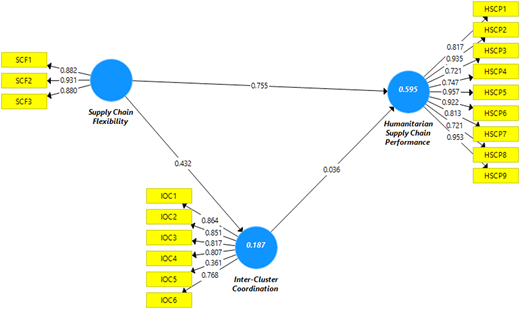
The framework in this study hypothesizes that intercluster coordination plays a significant role by mediating the relationship between SC flexibility and HSCP. The entire model expresses three types of variables: independent, mediator and dependent variable. The hypothesis development section discusses a detailed relationship amongst the variables as depicted in Figure 1 below. The framework (Figure 1) in this research hypothesizes that SCF has an effect on HSCP, but the relationship may not be direct or bivariate. The relationship may be influenced by ICC.
The effect of supply chain flexibility on humanitarian SC performance
Flexibility is recognized as a major response to ever-growing uncertainty and competition in the business environment. Researchers have acknowledged the relevance of SCF as a driver of competitive advantage and improve SCP (Olhager and West, 2002; Stevenson and Spring, 2007; Delic and Eyers, 2020). The first hypothesis of the study envisages that there exists an interaction between SCF and HSCP. SCF may be achieved via diverse sources, but it is more sustainable if it cannot easily be imitated. For HOs to minimize the implications of disaster, they strive for continuous improvement by making their supply chain flexible (Un, 2017; Delic and Eyers, 2020). Flexibility has a positive effect on SCP (Delic and Eyers, 2020). In the humanitarian setting, to enhance the ability of relief organizations to timely respond to chaotic situations during disaster, relief teams or networks are formed by stakeholders to alleviate the suffering of affected victims. Thereafter, the structure of the supply chain (SC) needs to be adjusted according to the problem of quantity and information from the disaster area as the situation changes. As events in disaster areas continue and the problems people face also change, it is important for aid organizations to develop flexible SC designs to deal with the situation effectively. Again, previous studies also showed that flexibility in the SC enable suppliers to operate efficiently (Chan et al., 2018; Cotteleer and Joyce, 2014; Ford et al., 2014; Giffi et al., 2014). A study conducted by Vickery et al. (1999) emphasized the relevance of SCF in driving the performance of firms SC. Again, studies of Sanchez and Perez (2005; Fantazy et al., 2011; Lummus et al., 2003; Tiwari et al., 2011; Tipu and Fantazy, 2014 confirmed SCF significantly affects SCP; however, how SCF influence SC performance in the humanitarian setting is still not adequately explored (Mensah et al., 2017). Hence, the effect of SCF on SCP within the humanitarian sector offers a pertinent research opportunity (Fantazy et al., 2011). In line with the above discussion, this study hypothesized that
SCF significantly affects humanitarian SCP.
The effect of supply chain flexibility on intercluster coordination
Recently, ICC has gained significant attention in the context of the humanitarian organization as an efficient strategy of disaster operations management (Moshtari, 2016; Prasanna and Haavisto, 2018; Dubey et al., 2019). However, it is important to note that ICC heavily relies on traditional SC concept (Namagembe, 2020). According to Moshtari (2016), SCF constitutes an important enabler of ICC. Prior studies by Dubey et al. (2017) and Selem et al. (2019) indicated that SCF enhances cluster relief operations and coordination. Again, Rao et al. (2010) indicated that SCF allows firms to tap into a responsive supply base to ensure a reliable supply of products. Hence, ICC remains a strategic resource that managers of a humanitarian organization can design and develop outcomes to meet their needs during disaster relief operations. The ability of firms to change supply networks with time and respond to competitors' changes enables the SC players to take advantage to improve their SCP (Madhaven, Koka and Prescott, 1998). Though there is yet a study to confirm the direct link between SCF and ICC, it is believed that the ability of a firm to timely respond to changes within and outside the SC could also be traced to enhance coordination within the system. Based on the above argument, the study hypothesized that
SCF significantly influence ICC.
Intercluster coordination on humanitarian supply chain performance
Coordination is seen as the resolution of interorganizational good conflict (Lawrence and Lorsch, 1967), and organizations can achieve high SCP through efficient management of SC activities (Malone and Crowston, 1994). Similarly, ICC is an important driver of SCP, and the need for coordination may arise as a result of pooled independence within the activities of players in the chain. The humanitarian SC is highly uncertain, and this is because systems are loosely coupled by nature (Liu et al., 2021). The players in the humanitarian SC need to balance their interests at all levels during decision-making (Wang et al., 2015). ICC enhances the ability of firms to better withstand uncertain SC operations through close coordination and facilitating intercluster dialogue (Zhao et al., 2019a, b). Several studies have confirmed the relationship between coordination and SCP (Zhao et al., 2019a, b). Previous studies have also shown that SC coordination enhances SCP (Sezen, 2008; Seo et al., 2014). Abdallah et al. (2014) further revealed a direct association between coordination and SC effectiveness. Although studies have not examined the effect of ICC on SCP in the humanitarian context, the study believes that the findings of the previous studies discussed above can be generalized to help understand the relationship between ICC and SCP. Such coordination within the cluster enables both humanitarian organization and their SC patterns to engage in intercluster planning-related practices (Cai et al., 2010). Based on the above discussion, effective coordination within various clusters among relief organization could directly enhance the performance of HSC. Hence, we anticipate that
ICC significantly influences SCP.
The mediating role of intercluster coordination
In terms of interorganizational factors, research in the business organization proves that when organizations face challenges in the SC, they often rely on the episodic network (i.e. short-term plans) as a means of combining internal and external experience with resources for a successful solution. In such cases, they may be strongly involved with other companies (Zacharia et al., 2011). Coordination is mentioned only in a few SCM research studies and in many studies in intraorganizational literature (Dubois et al., 2004). ICC concludes the expectation that all members of the various clusters in the SC network and allows coordination at all levels. ICC has been identified as a critical success factor for enhancing SCP (Hodgetts et al., 1999; Sohal et al., 2001). Several studies have shown that coordination could enhance SCP (Sezen, 2008; Seo et al., 2014; Abdallah et al., 2014; Zhao et al., 2019a, b), and other studies have also found a positive effect of SCF on ICC (Cao and Zhang, 2011; Moshtari, 2016; Dubey et al., 2017; Salem et al., 2019). However, there is yet an empirical study to examine the indirect contribution of ICC as a mediator in the relationship between SCF and SCP. We expect the association between SCF and HSCP to be strengthened through effective ICC. Thus, this study proposes that ICC mediates the nexus between SCF and HSCP.
ICC mediates SCF and HSCP.
Data and methodology
Data were collected from top-level managers or officers of humanitarian institutions including the National Disaster Management Organization (NADMO) and humanitarian nongovernmental organizations (NGOs) in Ghana. These managers were purposively selected to participate in the survey. This is because they possess the requisite knowledge to help answer the questionnaire. The respondents completed a structured questionnaire. Before distributing the questionnaire, the researcher explained and introduced the questionnaire to the respondents. They were informed that their participation in the survey is purely voluntary. In other words, they have the right to opt-in or opt-out in the survey. Respondents who agreed to participate in the survey used approximately 17 minutes to complete the questionnaire. The researcher responded to all ambiguities identified during the introduction and explanation of the questionnaire. Eligibility of the respondents was not difficult because they were all purposely selected from humanitarian institutions. To ensure a high response rate, respondents were promised that any information they provide would not be shared with a person or organization and that only the researcher would have access to the data. A total of 268 questionnaires were distributed, but 231 questionnaires were received. This represents a response rate of 86.19%. However, 198 questionnaires were used for analysis. Of the respondents, 101 (51%) were male and 97 (49%) were female. The majority of the respondents (91) hold a Higher National Diploma certificate, followed by bachelor’s degree holders (54) and master’s degree holders (53), respectively.
The instruments used to measure the constructs in the model were sourced from the extant literature. The first part of the questionnaire asked the participants to indicate whether they will like to participate in the survey or not. This was to provide the opportunity for the respondents to freely decide and consent to participate in the survey. The subsequent section of the questionnaire captured the respondents’ demographic profile. The last part of the questionnaire contained items that measured the latent variables. A five-point Likert scale indicating 5 = strongly agree to 1 = strongly disagree was used in the questionnaire. The items for HSCP were sourced from Kunz et al. (2014), Abidi et al. (2014); ICC from Inter-Agency Standing Committee (2013) and United Nations Children’s Fund (UNICEF) (2015a, b) and SCF from Kabra and Ramesh (2016).
Prior to the data analyses, the raw data were diligently checked for any form of error in an attempt to eliminate redundant, incomplete or incorrect data. The missing data were corrected using the expectation maximization procedure. The cleaned data were imported into the Statistical Package for Social Sciences (SPSS) and Smart PLS for analyses. While the SPSS was used for descriptive, normality, common method bias (CMB), nonresponse bias and exploratory factor analysis (EFA), Smart PLS was used for validation of the measurement items through dimensional reduction. Both direct and indirect relationships between the constructs were explored using Smart PLS-SEM. SEM’s stoutness makes it appropriate tool capable of testing the entire model simultaneously and assessing measurement errors. Details of the analysis are presented in the next section.
Result and discussion
Descriptive analysis
The mean and standard deviation are used to measure how well the statistical mean fits the observed data (Field, 2009). The result of the descriptive analysis is presented in Table 1. The result shows that HSCP scored a mean and standard deviation of (M = 3.905; StD = 1.042). SCF scored (M = 4.158; StD = 1.154) and ICC scored (M = 4.405; StD = 1.013). The result shows that the deviations from the mean values of all the constructs were minimal, indicating that the statistical or calculated mean does not vary from the observed mean. Table 1 further presents kurtosis and skewness, which are used to examine data normality. These two measures are recommended by Hair et al. (2010) as good measures to demonstrate the shape of the probability distribution of a statistical data. The rule of thumb is that majority of the constructs should be within −2 and +2. However, the result in Table 1 shows that SCF is not within the acceptable limits. This explains why PLS-SEM was used to analyze the data. The results of the correlation between the variables as shown in Table 1 indicate that the relationship between ICC, SCF and HSCP is positive (r = 0.442; r = 0.547). The result also showed a positive association between ICC and SCF (r = 0.448). Multicollinearity is absent in this study because the independent variables are not highly correlated (Pavlou et al., 2007; Spector and Brannick, 2010). It also provides evidence that SCF and ICC significantly influence HSCP.
Common method bias and nonresponse bias
With reference to Shashi et al. (2019), we evaluated CMB using Harman’s single factor test to validate the suitability of the constructs in the measurement model. According to Podsakoff et al. (2003), the one factor test as the Harman considers all the observed variables in an EFA and to assess whether a single factor accounts or explains more than 50% of the calculated variance. The result as presented in Table 2 below shows that the largest variance explained by a single factor is 41%, which is below the 50% threshold of the EFA using the principal component analysis extraction method. This confirms the absence of CMB in the dataset. Additionally, the correlation matrix was used to further validate the absence of CMB following the limitations of the Harman’s one factor approach. As per the recommendation of Saleh Mutar Al-Sukainy et al. (2007), the correlations among the main constructs should not exceed a recommended threshold to confirm the absences of CMB. The result in our study revealed that the correlations among the principal constructs are small (r < 0.9). This further confirms the Harman’s one factor test result; hence, there is no issue of CMB in this research model.
Again, in any survey, the best procedure to manage nonresponse bias is to ensure a high response rate (Oppenheim, 2001; Armstrong and Overton, 1977). Hence, the researchers in this study made necessary efforts to improve the response rate. The researchers first sought permission from the human resource department of the HOs selected for the study. The respondents were contacted after the researchers have been introduced by the human resource (HR) managers. The questionnaires were personally administered by the researchers. Guidelines and explanations were provided to help the respondents provide accurate answers to the questions. The respondents were assured of the anonymity and confidentiality of their responses. After a scrutiny of the received questionnaires, 198 were used for the analysis. Also, the procedure suggested by Oppenhiem (2001, p. 106) was used to investigate nonresponse bias in the survey sample. Following the procedure, the first 99 responses and the last 99 responses were considered as early responses and late responses, respectively. Afterward, a T-test analysis was employed to test for nonresponse bias. The results of the t-test analysis did not indicate any significant difference (See Appendix 1). Further t-test analysis of the sociodemographic characteristics was conducted (Oppenheim, 2001, p. 106; Armstrong and Overton, 1977, p. 397). Once again, there were no significant differences in age, gender and years of experience.
Measurement model
For measurement model validity and reliability, confirmatory factor analysis was conducted using Smart PLS version 3. The process employed the maximum likelihood estimation method for testing the validity and reliability of the constructs. The model measurement evaluation was conducted as a prerequisite for the structural model analysis. The model measurement evaluation comprised reliability and validity using Cronbach alpha (CA), composite reliability (CR) and average variance extracted (AVE). The result in Table 3 below shows that all the constructs had good scale reliability (i.e. CA and CR) were high than 0.7 (Fornell and Larcker, 1981; Henseler et al., 2015); hence, all the constructs had acceptable internal consistency and reliability. Additionally, AVE, which was also used to assess convergent validity of the constructs, was found above the 0.5 threshold. We further used variance inflation factors (VIFs) to examine the issue of multicollinearity. The collinearity statistics for both inner and outer (VIFs) meet the <3 threshold as recommended by Ringle et al. (2014). We also employed the Fornell–Larker criterion and heterotrait–monotrait (HTMT) ratio to assess discriminant validity of the model. The result provide evidence that our model has no issue of discriminant validity as the square root of the AVEs was higher than the within correlation among the variables in the model (see Appendix 2). The discriminant validity test was further explored using the HTMT ratio, and the HTMT threshold (<0.90) was met, which also confirms discriminant validity of the research model (see Appendix).
Testing of hypothesis
Once the measurement model evaluation meets all the reliability and validity thresholds, the next phase of the analysis is the structural model assessment and hypothesis testing via the variances of dependent variables in addition to the model’s predictive relevance using Stone-Geisser’s Q2, path coefficients and significance levels (t-values). We used the blindfolding procedure to estimate the Q2. The result as provided in Table 4 shows that ICC and HSCP recorded Q2 values of 0.105 and 0.261, which are above the threshold (>0). Again, the coefficient of determination (R2) was weak (0.187) and substantial (0.595) for ICC and HSCP, respectively. The implication is that SCF and ICC explain about 60% of variations within the SCP of HOs. The outcome of the analysis showed that the first (H1) hypothesis of the study which sought to examine the effect of SCF on HSCP was confirmed (B = 0.696; t = 17.220; p = 0.000; Sig < 0.005). The analysis also supported H2, which also envisage a positive significant association between SCF and ICC (B = 0.317; t = 4.992; p = 0.000; Sig < 0.005). The third hypothesis (H3), which states ICC positively influences HSCP, is also confirmed (B = 0.225; t = 4.366; p = 0.000; Sig<0.005). Hence, all the three direct hypotheses were supported (Table 5). Additionally, the study envisaged that ICC plays an essential mediating role in the link between SCF and HSCP. The result shows that ICC plays a significant indirect role in strengthening the link between SCF and HSCP (B = 0.071; t = 3.463; p = 0.000; Sig < 0.005) (see Figure 2).
Discussion of results
SC management remains a key component of disaster management since effectiveness, speed and efficiency in the supply of victims with food, health, shelter, water and sanitation remain important in the management of disaster (Abidi et al., 2014). This study assessed how SC flexibility could enhance HSCP via ICC using empirical evidence from HOs in a developing country. The outcome of the study revealed that all four (4) hypotheses were supported. The overall predictive relevance of the model was substantial (63%) in predicting HSCP. Our study showed that SCF has a significant direct impact on HSCP. The finding is in line with earlier studies that acknowledged the relevance of SCF as a catalyst of improved SCP (Olhager and West, 2002; Stevenson and Spring, 2007; Delic and Eyers, 2020). For HOs to minimize the negative effects of the disaster, they must strive for continuous improvement in SCF (Un, 2017; Delic and Eyers, 2020). Additionally, previous studies also indicated that flexibility in the SC enables suppliers to operate efficiently at all levels of the SC. Eventually, it will affect the performance of the SC which will allow relief network players to quickly adjust and respond to disasters (Chan et al., 2018; Cotteleer and Joyce, 2014; Ford et al., 2014; Giffi et al., 2014). This further demonstrates the relevance of SCF in ensuring prompt relief operations.
While the RBV theory posits that information administration within any SC system is to give accurate information between SC members in aid of functioning effectively to produce good results (Sundram et al., 2018) in a flexible SC, the information channeled through the SC networks can be made with consistent conversation machinery to enhance performance (Sundram et al., 2018). Thus, according to the RBV, SCF has been a catalyst as they can boost the identification, description and forecasting of complicated situations (Defee et al., 2010), which will improve the performance of the SCs to augment the performance of the firm (Leuschner et al., 2013). In the context of humanitarian operations, this finding offers pertinent information for HOs. The study is among the few attempts to add to the body of knowledge on the link between SCF and SCP, especially within the humanitarian setting.
Also, SCF has a significant positive effect on ICC. This implies that a more flexible SC has a significant positive effect on ICC among HOs. As indicated earlier, ICC has gained significant attention in the context of HOs as an efficient strategy for disaster operations management (Moshtari, 2016; Prassana and Haavisto, 2018; Dubey et al., 2019). The implication is that SCF constitutes an important enabler of ICC (Moshtari, 2016). Prior studies by Dubey et al. (2017) and Selem et al. (2019) indicated that SCF enhances cluster relief operations and coordination. Again, Rao et al. (2010) indicated that SCF allows firms to tap into a responsive supply base to ensure a reliable supply of products. It can be concluded that the ability of a firm to timely respond to changes within and outside the SC could also be traced to enhance coordination within the system. It is worth noting that this study is among the very first few attempts to confirm the direct link between SCF and ICC.
Additionally, the result demonstrated that ICC significantly impacts HSCP. The HSC is highly uncertain, and this is because systems are loosely coupled by nature (Liu et al., 2021). The players in the HSC need to balance their interests at all levels during decision-making (Wang et al., 2015). This outcome confirms the finding of Zhao et al. (2019a, b). ICC enhances the ability of firms to better withstand uncertain SC operations through close coordination and facilitating intercluster dialogue (Zhao et al., 2019a, b). Such coordination within the cluster enables both humanitarian organization and their SC patterns to engage in intercluster planning-related practices, which helps them to identify possible future emergencies or obligations for the SC players (Cai et al., 2010).
Finally, the study demonstrated that ICC plays an important mediating role between SCF and HSCP. ICC remains an essential wheel to drive SCP from a flexible SC (Hodgetts et al., 1999; Sohal et al., 2001). Thus, relief organizations with flexible SC and effective coordination among various clusters stand a high chance of efficiently and effectively alleviating the suffering among disaster affected communities or people.
Contribution to theory
The outcome of this study contributes to existing discourse on RBV theory by looking at the varying resources of HOs to assess their SCP during disaster relief operations. The real issue of the RBV is the uncertainties surrounding disaster occurrence in any jurisdiction, which is pivoted on the resources and capacities HOs possess. The resources that a humanitarian organization has such as workers' understanding, capacities, expertise, essentials, effective actions and operations and automation equipment will help them to perform during disaster relief operations. Based on the RBV, resources such as fallibility in SC expertise and ICC which have information sharing as a sub-component, personnel, science and comparative resources as the proficiency to adapt and merge to have an urge over the negative implications of a disaster, such as the COVID-19 pandemic. The outcome of the study confirms the assertion by the RBV that the rightful information shared between employees of HOs and proper ICC will improve their performance during disaster relief operations. This study provides a better understanding of the subtleties of this relationship value, which is often overlooked during a charity.
The role of SCF and ICC together effectively stimulate HSCs is less discussed in humanitarian literature. This study contributes to the existing literature by showing that SCF and ICC have both direct and indirect significant relationships with HSCP. Various studies (Chan et al., 2018; Cotteleer and Joyce, 2014; Ford et al., 2014; Giffi et al., 2014) have found a positive impact of SCF on firm SCP. This study shows that utilizing both SCF and ICC enhances HSCP. Again, this study bridges the gap in extant literature by showing that both SCF and ICC enhances SCP within the context of humanitarianism. ICC serves as an indirect intervening mechanism that enhances the relationship between SCF and HSCP. Consequently, SCF and ICC add to other known mediating variables (such as agility, SC integration and information sharing) that influence the relationship between SCF and the performance of HSCs.
In this regard, the two main areas of this study show its contribution to the validation of SC theories in a humanitarian setting. First, the study has sought to put forth immediate optimism using the humanitarian lens. Therefore, the study presents the theoretically driving empirical results of previous works by showing how SCF and ICC can enhance HSCP. Also, this study bridges the gap in the extant literature by showing that both SCF and ICC enhances SCP within the context of humanitarianism. Additionally, SCF and intercluster coordination were found to have a direct and significant relationship with the performance of HSCs. It must be stressed that the direct impact of SCF on the performance of HSCs was much higher than that of ICC. This finding adds to existing frameworks that try to identify the critical success factors of HSCs. Further, this study is among the first few attempts to develop a holistic picture of the relevance of SCF and ICC as critical enablers of HSCP and emergency management from a comprehensive approach.Appendix
Managerial implications
The study provides practical guidance to HOs involved in relief work. First, the study provides information on building a responsive HSC. Existing studies focus more on long-term relationships without focusing on the short-term relationships that are common in humanitarian operations. Owing to the increasing occurrence of disaster, there is growing discourse on how to reduce the impact of such disasters on human life; hence, there is the need to enhance HSCP by SCF. Second, ICC is found to mediate the relationship between SCF and HSCP. This suggests that managers must empower all levels of staff to make informed decisions on how systems can be coordinated and integrated and depart from the traditional unit-centered approach. In effect, managers must be innovative to understand both their internal and external environments to attain stronger SCP in humanitarian operations. Additionally, given that SCF showed a direct impact both on ICC and HSCP, managers must also pay much attention to the limited nature of resources during disaster relief operations and focus on strategies to adapt promptly to disruptions while minimizing the effects of disaster on victims.
Conclusion
The findings as discussed show that ICC played a significant mediating role between SCF and HSCP. It clearly shows that a closer and stronger relationship ensures proper channel use among members resulting in improved SCP of HOs and their ability to deal with SC uncertainties. The outcome of the study also empirically supports the RBV theory. The real issue of the RBV is the competition amongst different firms, which is pivoted on the resources and capacities they possess. According to the theory, when the SC is flexible, the information channeled through the SC networks can be made with consistent conversation machinery to enhance performance (Sundram et al., 2018). Thus, according to the RBV, SC flexibility has been a catalyst as they can boost the identification, description and forecasting of complicated situations (Defee et al., 2010), which will improve the performance of the SCs to augment the performance of the firm (Leuschner et al., 2013). The study concludes that SCF remains important in SC management in a highly uncertain environment. Even though SCF capabilities are an expensive initiative, it has the propensity to enhance the SC of HOs.
The outcome of this study demonstrated that flexibility play an essential role in improving HSCP; however, how flexibility in the SC is developed is silent in humanitarian literature, and further studies could consider exploring the drivers of SCF in the humanitarian setting. Also, while SCF has proven effective in enhancing HSCP, we believe that this mechanism may be contingent on certain capabilities that enable relief organizations to anticipate and predict effectively. Future studies could therefore explore how environmental orientation, sensing capabilities and information technology (IT) could moderate the relationship between SCF and HSCP. Additionally, there is the need for further research on the moderating role of IT/managerial capability on HSCP, collaborations and integration in different regions in Ghana with a much larger sample size than this current study. Also, there is the need for the application of the mixed methods of research, which are qualitative and quantitative in subsequent research, to get opinions of industry experts in the HSC.
References
Further reading
Appendix 1
Appendix 2
Appendix 3