Skip to article sections
Purpose

This study aims to identify key supply chain challenges and opportunities of the case of Hong Kong toy manufacturing company during the COVID-19 outbreak and develop a comprehensive structural relationship to rank them.

Design/methodology/approach

In this study, a toy model company in Hong Kong is considered to discuss about what challenges and opportunities have the biggest impacts on non-necessary goods companies and how to deal with different impacts on entire supply chain flow disruption during COVID-19. A semi-structured interview with five decision-makers from the company was made to give key challenges and opportunities scores. The Technique for Order of Preference by Similarity to Ideal Solution (TOPSIS) technique is used to establish the model and rank them afterward to overcome the challenges.

Findings

From the data analysis and results, “salary of employee” and “inconvenient transportation” have emerged as top and bottom key challenges respectively. The sequence of organized challenges in the list needs to mitigate one by one in this order to improve the supply chain performance. The “client's orders’ frequency, customer management” and “supplier/partner relationship management” are identified as the top and bottom respectively to develop the opportunities.

Research limitations/implications

These key challenges and opportunities are identified as contributing attributes and provide the way to measure to improve production, profits and sustainable growth of the toy manufacturing company during a pandemic. Moreover, it helps to improve the distribution level and good planning with appropriate decision making to manage the supply chain performance considering humanitarian aspects during a pandemic outbreak.

Originality/value

The novelty of this study is to identify the key supply chain challenges and opportunities measured by the TOPSIS method to rank them and consider the case of a Hong Kong toy manufacturing company as a case-based approach to measuring its performance during the COVID-19 outbreak.

Different products will undergo supply chain processes in different parts of the world to reduce costs and maximize profits. Under the impact, different countries have varied advantages in different processes in the supply chain (Hille, 2020; Pathak et al., 2021). The case of Apple mobile phone is worth noting in this regard. They are designed and tested in the USA. The core and assembly are outsourced to companies in different countries due to cost factors. Finally, the finished products are sold to different countries. In this context, we can divide the different chains of the supply chain into different countries. Although the supply chain is all over the world, the products need to be sold in the market on time. One part of the supply chain is interlocked with the other chains. In other words, as long as there is an accident or delay at one part of the supply chain, the supply chain's flow will be disrupted.

According to Bajpai (2021), China is currently the world's largest raw material production/processing country. Most of the items indispensable in daily routine are made in China, including toothbrushes, clothes, furniture, electronic products and so on. The development of China is mainly attributed to the suppliers and manufacturers in the supply chain because China's manufacturing costs are currently the lowest in the world (Bajpai, 2021). Under the prerequisite of profit maximization, China has become a leader in different industries because they have low-cost services for raw material processing and assembly.

At the end of 2019, COVID-19 (Armani et al., 2020) broke out in Wuhan China, causing factories in Wuhan to be affected. A large part of the supply chain was, fortunately, not greatly affected. This was due to the fact that the situation was not very grim and different companies still had different policies to respond. However, in March 2020, the whole world was almost invaded by COVID-19. At that moment, COVID-19 caught global attention (Kumar et al., 2022a). It is a pity that during that time, different areas of China implemented blockades around cities and towns. Although many production lines had already produced the output before the New Year holiday, due to the blockades the goods could not be sent out to other countries. As a result, most of the products were not exported leading to monumental losses and saturation of warehouses. In addition, during that time, the whole world started prohibiting global transfers including tourists and goods. These were some of the important antecedents of the disruptions in the supply chain. Many companies were out of the market because the products piled up in the warehouses could not find the outlets. It affected the cash flow of the companies in unimaginable ways.

COVID-19 pandemic has revealed that even the best of the developed nations have succumbed to the devastations inflicted on the global supply chains (Guan et al., 2020; Sarkis, 2020; Goel et al., 2021; Kumar et al., 2022b, c). The impact on transportation and warehousing was huge among all others. Most of the goods could not reach their destinations on time. Because the goods could not be distributed to the next level of the supply chain by transportation, warehouses faced over-loading issues due to piling up of unsold goods. In the wake of the pandemic, the prices of goods continued to increase due to the reduction in the supply of services by the transportation company. Even when the goods were exported, it did not bring any profits. The case of non-necessary goods companies was even worrisome as the demand for non-necessary goods was minimum to almost nil. Also with the increment in the transportation cost, the net profit plummeted considerably. Such companies are likely to gradually wean off from the market.

In this study, we studied the case of a toy model company based in Hong Kong to delve into the parameters having a major impact on non-necessary goods companies and how to deal with the different impacts of COVID-19. Owing to supply chain performance importance (Kumar et al., 2017), this study is often required to identify challenges and opportunities. As a result, the purpose of this study is to address them and to develop a comprehensive inter-relationship to prioritize them. With the aforementioned factors in mind, this study concentrated on the following research questions:

RQ1.

What are the essential key challenges and opportunities for the supply chain in the Hong Kong toy manufacturing company during COVID-19?

RQ2.

How to arrange them to manage and improve the supply chain performance?

The study proposed the following objectives: (1) Identifying the key challenges and opportunities for the supply chain in a toy manufacturing company. (2) Prioritizing the identified factors by using the TOPSIS approach.

The paper's structure is divided into the following sections. The literature review is presented revolving around the challenges and management of the supply chain in Section 2. Research methodology, analysis and results are discussed in section 3 and section 4 respectively. The discussions and findings and concluding remarks are explained in Section 5 and Section 6 respectively. Further, section 7 and section 8 are devoted to practical implications and scope of the future research respectively.

We conducted an in-depth review of various relevant literature for the current investigation in order to create a useful study. Literature on the supply chain, COVID-19, the supply chain structure of toy model company and the influence of COVID-19 in the supply chain are extracted in this section.

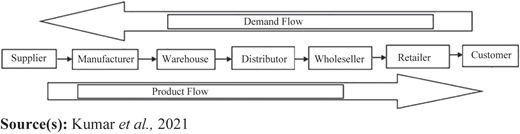
The set of operations coordinated by an organization to buy and manage supplies is referred to as the supply chain management (SCM) process (Oliver and Webber, 1982; Jha et al., 2021; Kumar et al., 2021). The supply chain is a network of enterprises that are involved in a variety of processes and activities that result in value being produced in the form of products and services in the hands of the end consumer via upstream and downstream links (Kumar et al., 2021; Christopher, 2016). The process starts from suppliers to end consumers and deals with the manufacturing company, distributors, wholesalers and retailers. Figure 1 represents the product flow and demand flow of the supply chain process.

The latest threat to global health has been identified as an outbreak of a respiratory disease known as Covid-19 (Fauci et al., 2020). COVID-19 was officially confirmed in December 2019. It was determined that a novel form of coronavirus, structurally similar to the virus caused severe acute respiratory syndrome (SARS) (Velavan and Meyer, 2020). The new coronavirus SARS that has found its habitat in Hubei, China has spread to many other countries. In addition, the World Health Organization (WHO) declared that based on China's ever-increasing case notification rate, a worldwide health emergency has emerged around the world. On March 11, 2020, the WHO classified the highly contagious COVID-19 virus as a global pandemic (Armani et al., 2020). In December 2019, the COVID-19 pandemic is believed to have begun in Wuhan, China. Symptoms range from mild fever, coughing and shortness of breath to serious respiratory problems that differ from person to person. A vast number of cases have been reported, all of which have resulted in death (Zhou et al., 2020b). Based on WHO data, the global mortality rate from COVID-19-related complications was predicted to be around 3.4% on March 3, 2020. Those with pre-existing medical issues and elderly people are more susceptible to the sickness (Zhou et al., 2020a). The unprecedented nature of the pandemic means threw the companies worldwide into a chaotic situation where there was no plan to deal with the pandemic consequently leading to devastating risks. Only 20% of 500 senior board members worldwide believed their organizations were prepared to deal with the substantial negative risks posed by the COVID-19 epidemic, according to a survey (McWilliams, 2020). Although the majority of COVID-19's short- and medium-term impacts are already known, the long-term implications remain unknown. Much of the global supply chain has been devastated by the pandemic (Araz et al., 2020), particularly for firms with streamlined and global supply chain systems. In fact, Sherman (2020) pointed out that about 94% of the famous companies witnessed outages caused due to COVID-19.

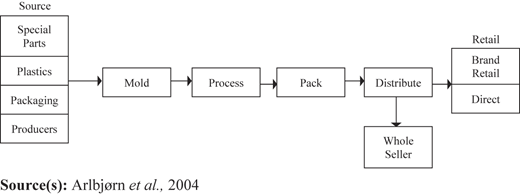
The suppliers and manufacturers of the toy model company are heavily dependent on China's production lines (Hille, 2020). It is due to fact that the production cost of toy models in China is the cheapest all over the world which is very beneficial for some small companies. XYZ Trading Co. Ltd is a die-cast car and plane model trading company. They have some products and also distribute some brands of the die-cast model. The company was founded in Japan. The company felt the need to have an office near the manufacturer that can make the whole supply chain flow smoothly and fast. So, they zeroed in on Hong Kong as a place where different countries could connect easily and speed up the flow. Moreover, Sun and Wing (2007) pointed out that Hong Kong has also been the biggest market for diecast models since 2000. The strategic location of Hong Kong makes it a feasible spot to facilitate communication with Chinese manufacturers. Emerging Markets (2019) pointed out that Hong Kong has a strong influence on China's economy where Hong Kong plays an important role as a distributor and wholesaler. It is because China's product costs can be dramatically reduced. As a result, in the Hong Kong office, the daily jobs are mainly dealing and confirming with the orders globally, managing the products from China's manufacturers, and managing the transportation with retailers. Also, there are some different brands in Hong Kong, it is mainly the role of wholesaler and distributor. The process of the supply chain of the Hong Kong toy manufacturing company is shown in Figure 2.

At first, the Company started product designing in Japan. The design process for the new product should start as early as one and a half years before production. It is because the creation of the diecast model is complex. It includes the model's architecture, movable parts, package design, production, etc. There are many sequences in the chain. The product cycle is of about four weeks. In other words, one or more product is launched after every four weeks. However, the cycle of a product is different from the designing cycle. They design a new product one and half years before for the next season. Designing cycle season refers to a whole year, which means they need to finish the new season product in December and launch the new product at an exhibition and show it to the retailer and customers. On the other hand, the product cycle is of four weeks which means one product is launched they only get extra four weeks to prepare the new product. The manufacturer will get the raw materials from the supplier in China. The manufacturer finished the new product before the last four production cycles. For example, product A needs to launch in May. The manufacturer must be finishing the product in April. It is because they calculate the delays in delivery and unknown factors like the production line problem. Generally, finished products will be kept in a warehouse in the factory. Because the storage cost in China is low (Li et al., 2017) and the flow of products is faster. Another factor is that the production volume of diecast models is limited, so their products are generally not produced continuously, so as long as they produce enough quantities, they can suspend and prepare for the production of new products.

The company's main distribution method is for the dealers to sell the stock to retailers. Because the diecast model itself has a limited quantity, there are very few repetitive manufacturing and customer customized needs. The Chinese factory will only launch one batch and limit the inventory quantity, so the distributor will pick up the goods according to the customer's demand. In fact, most of the volume will be sold. On average, less than 20% of the inventory will be placed in the distribution warehouse. In addition, the distributor needs to check whether the inventory is intact. Because the diecast model is easily damaged during transportation. Therefore, there will also be damaged goods received from customers and shipped from Chinese factories in the warehouse. And they will mainly use cross ducking (Apte and Viswanathan, 2010) to merge the goods needed by customers and distribute the goods to different retailers whether they are overseas or local.

In order to diversify risks and increase profits (Babich et al., 2007), they also sell different brands' diecast models to a wholesaler. But they rarely have stocks of different brands. Because they are mainly based on customers (retailers) the required quantity to request goods from different brand's distributors. But there is no perfect strategy in the world, so they will get some stocks because some customers issue or broken product by transportation.

Hong Kong's operating cost is extremely high, especially the rent of warehouses and offices. The second biggest cost is human resources. So, they need to make a decision carefully on resource allocation. The company has set the number of orders and shipments each time, so it does not affect the additional processing time that may increase for orders with a few goods. In local situations, they will use local land transport minivans to deliver goods to different places. In order to save costs, the goods are usually delivered only when minivans are fully loaded. Only get some time will be handed out during off-duty hours due to lack of retailer demand because of the goods problem need to be exchanged. In the overseas part, because the transportation cost is generally paid by the retailer, it will match the method they choose, but generally, it will be sent by the post office. The main reason is that the post office fee is generally lower cost but the delivery time will be longer (But also need to observe that are they choosing air shipping).

The process of relocating products from their typical final destination for the aim of recapturing value or proper disposal is known as reverse logistics (Sharma et al., 2021a; Rogers and Tibben-Lembke, 1999). In other words, it refers to the flow of goods in the opposite direction from the customer's hands. Genchev (2009) pointed out that Fortune 500 wholesale distribution companies are resorting to reverse logistics. For some industries with fierce competition, this is very important as reverse logistics represents the company's after-sales service and affects customers' consumer experience and company image. According to statistics from HobbyDigi (2021) shopping webpage, there are about 80 different car model brands in Hong Kong. In addition to comparing the details of car models of different brands, the problem of damage to the model itself due to external factors also needs to be dealt with. Because car models are generally fragile, they are easily damaged by external factors such as transportation, assembly, and so on. Therefore, in order to make up for the lost confidence of customers in purchasing defective goods, most companies have after-sales services. The service at the toy model level is mainly to communicate defective products to customers. Customers rarely do not understand the goods, so most of the services are about defective goods. The processing method in XYZ company is an exchange of new products and defective products.

Reverse logistics' main purpose is to recapture value. In the situation of the car model, most of the recycled goods are usually defective with missing parts. Of course, we already have considerable reverse logistics experience in XYZ company. Therefore, the companies in Hong Kong will have most of the fragile and missing parts for repair and resale. These are some simple ways to deal with it. But many items cannot be repaired. Usually, there are problems with model architecture and model surface paint problems. These cannot be repaired again and the car model is made of epoxy resin and plastic. If these substances are not handled properly, they will cause secondary damage to the environment (Epoxy Network, 2019). Therefore, reverse logistics is very important. In XYZ company, there are two ways to deal with it: the first is to send the car model back to the Chinese factory to re-modify the model into a new product. The second way is to sell the defective goods at a relatively cheap price. Based on the consideration of transportation cost, the second method will be more practical and acceptable. Because it is a huge expense to reverse a defective product, and it also affects the warehouse space. So it would be more reasonable to sell again at a cheaper price.

According to Global (2020), a market-leading automobile manufacturer needed to close its seven factories in South Korea due to a lack of certified suppliers for the fabrication of wiring harnesses for their automobiles. These suppliers happened to be located in Hubei Province. During the outbreak, the Hubei Provincial Government implemented a total blockade. The direct impact of this problem has affected 40% of the global automaker's network's total output, resulting in the suspension of the release of new models.

Regardless of the final changes, COVID-19 has made to the supply chain, the current status quo is certainly being observed under the microscope (HKGCC, 2020). Since Hong Kong is a key gear in the supply chain machine, any change in the way the world trades will affect the city. But even if there is a change, it will not happen overnight. First, the complex global supply chain will be difficult to dismantle. In addition, mainland China is not only unparalleled in terms of large-scale manufacturing capacity but also unparalleled in terms of having a highly skilled labor force and advanced facilities. Hong Kong will remain the main link between the Asian market and the markets in other regions of the world. In addition, in the current setup, shipping will also be affected, but to a lesser extent, commodities are still flowing, and all borders are still open to trade.

Any big disruption will jeopardize the global supply chain, because of China's supremacy as the “world factory” (Kilpatrick and Barter, 2020). More than 200 Fortune Global 500 firms have offices in Wuhan, which is worth mentioning. The most seriously afflicted provinces are the highly industrialized provinces where the disease broke out. Therefore, Chinese factories are affected by COVID-19, which has a negative impact on the supply chains of different large companies. Eroğlu (2021) pointed out that the outbreak caused by COVID-19 has restricted people's social freedom. As road transportation has been drastically reduced, industry, education and other activities have also been reduced including the greenhouse gas emissions. However, facts proved that this is not enough to curb air pollution from all pollutants. The biggest problem is that the entire environment causes delays in the supply chain. Therefore, companies in the renewable energy sector cannot obtain the required revenue. Their inability to pay daily expenses has a negative impact on the cash cycle.

Vasiev et al. (2020) pointed out that the national production has slowed down, and automobile parts, LCD panels and pharmaceuticals among the industries centered in Hubei, that have slowed down sharply. Manufacturing industries that have recently moved to other parts of Asia often rely on intermediate inputs from China, so the impact of China's slowdown in production cannot be avoided. Henriksen and Selwyn (2020) opined that companies wishing to transport raw materials or final products need to transport cargo held by air. Commercial flights have been banned owing to COVID-19 in order to restrict people's travel across the world. Due to the suspension or curtailment of passenger flights, freight that was formerly transported by these planes must find alternative modes of transportation, which is challenging due to travel restrictions and border closures. Some countries that use tourism and air transit stations have suffered economic blows due to the lack of economic benefits brought by passenger flow.

Tam et al. (2021) pointed out that the COVID-19 outbreak may cause delays in the treatment of myocardial infarction and may lead to worse clinical outcomes. Not only must all hospitals be prepared to deal with direct infections, but various healthcare professionals also need to predict how different care systems will be affected and act accordingly. Therefore, we can see the outbreak of COVID-19 in a medical system that is unpredictable and resource-allocated.

McKenzie (2020) proved that the main reason for global supply chain disruption is that most companies do not have comprehensive risk management plans. At the time, the world also underestimated the impact of COVID-19, rendering the risk management developed by many companies useless. The examples point out that in addition to the economic losses caused by COVID-19, human health is also threatened. Human beings no longer go out to consume as they did in the past, reducing non-daily expenditures because of the decline in living standards. During the COVID outbreak, the company continues to produce toys in order to meet demand and offer employment for its employees, as well as for social reasons. The procurement of resources and goods, their curation and storage and the proper, efficient, effective and timely supply of these goods and services as and when required are all part of its activities (Cozzolino, 2012). The “human” aspect in the humanitarian supply chain network always introduces an element of unpredictability, contributing to one of the key factors in the supply chain “resilience” (Ozbay and Ozguven, 2007; Blecken et al., 2009; Behl and Dutta, 2019). “Humanitarian logistics” refers to the activities of planning, implementing, and managing the efficient, cost-effective flow of commodities and materials, as well as related information, from point of origin to point of consumption in order to alleviate the suffering of vulnerable people (Thomas and Kopczak, 2005 p. 2). Logistics is defined as the procedures and systems involved in mobilizing people, resources, skills, and knowledge to assist vulnerable individuals affected by disaster for humanitarians (Van Wassenhove, 2006 p. 476). The framework was developed by Kunz and Gold (2017) by merging literature from the disciplines of sustainable and humanitarian SCM while Jauhar et al. (2021) focused on supplier selection for sustainable operations in the manufacturing company and Verma et al. (2022a, b) measured sustainability barriers toward operative Industry 4.0 in digital manufacturing. Oloruntoba and Gray (2006) set the goal to look into the nature of the humanitarian support supply chain and see how relevant certain business supply chain ideas, such as supply chain agility and humanitarian aid are. The study of Ertem et al. (2010) found to support, manage and solve the inefficiency and challenges in disaster relief procurement resource allocation that can be related to this difficult times such as a pandemic. Hence, Kabra et al. (2015) tried to investigate and prioritize the organizations' challenges in supply and distribution. Moreover, the use of blockchain technology is considered to reduce the impact of barriers to humanitarian SCM (Ozdemir et al., 2020). Verma et al. (2021) explained the use of big data to measure operational performance and Gupta et al. (2019) figure out the use of big data in humanitarian SCM.

COVID-19 has rendered the suspension of production from factories in China resulting in the relative price increase of most products such as electronic products, auto parts, clothes, and even some daily necessities. The reason is that the production is restricted and the costs of transportation, storage, services, and human resources have changed (Eroğlu, 2021; Global, 2020; Kilpatrick and Barter, 2020). Thus, it needs to mitigate the impact of COVID-19 on supply chain disruptions (Butt, 2021).

However, COVID-19 also has a positive impact on the environment. Because most people have reduced the risk of contracting diseases on the street due to the threat of COVID-19's influence and the suspension of production in factories has reduced air pollution. These seem to have a positive impact on the global environment. But in fact, we cannot calculate the environmental damage caused by medical treatment and more invisible factors. In particular, the development of renewable energy mentioned by Eroğlu (2021) is because of policies and investors who have not had enough cash flow to invest and cannot continue to operate in COVID-19. These are all we need to pay attention to because these effects will eventually be reflected in our living standards (McKenzie, 2020). From the previous literature, a total of nine key challenges and six opportunities are identified and described in detail in Table 1.

The following part discusses the case study and TOPSIS method:

The seminal paper of Eisenhardt (1989) has inspired and encouraged researchers to investigate a wide range of topics in order to develop concepts and theories based on case studies (on various challenges and opportunities of toy manufacturing company supply chain. The study has adopted this toy company to prioritize the heterogeneous challenges and opportunities parameters to the production using multi-criteria decision making. The study focuses on qualitative and quantitative methodologies based on semi-structured interviews and observational methods employed in the Hong Kong toy firm. At the beginning of this process, we identified some challenges and opportunities and created a set of questions to get the perspectives of various levels of target responders from the company's top management. This toy company is Hong Kong's leading toy manufacturer. Among the five departments of professional respondents, inventory management, purchasing, customer service, and transportation all made enthusiastic contributions to their businesses. These respondents have good experience and are leaders in their respective fields. The results of the demographic analysis are summarized in Table 2.

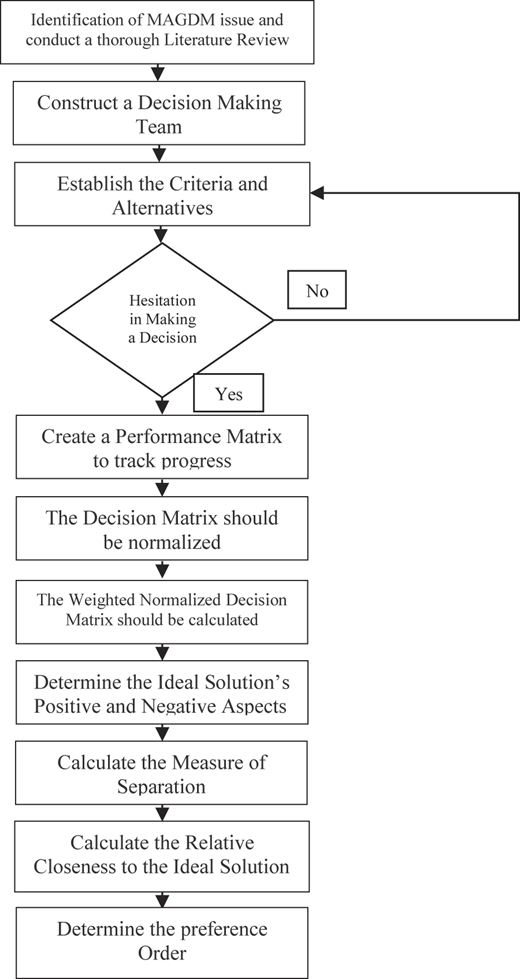
We identified five decision-makers among the respondents (DMs), following the collection of responses. From the current literature, nine challenges are identified as warehouse space is too tiny (C1), salary of employee (C2), inconvenient transportation (C3), influence of political factor (C4), lack of labor (C5), location between the company and the customers or raw materials is (C6), level of security issues (C7), costs of inventory management (C8) and difficulty in production (C9) have been considered to have been constructed. We also keep track of the study's research procedure. There are some opportunities to sustain this toy company during the COVID outbreak. These are transportation (E1), client's orders frequency (customer management) (E2), support service (E3), client's quantity (number of orders) (E4), planning and risk management (E5), and supplier/partner relationship management (E6). The flowchart of the current study's suggested research effort is shown in Figure 3.

The multi-criteria decision-making (MCDM) tool is used to place multiple factors. Hwang and Yoon (1981) introduced TOPSIS as the most generic MCDM technique, whereas Chen (2000) was the first to present it to deal with MCDM challenges in the face of ambiguity and doubt. Currently, a number of researchers have made use of the TOPSIS data (Singh et al., 2016ab; Kumar et al., 2021; Pathak et al., 2020). TOPSIS methodology is commonly used to solve decision-making problems and it is based on the deliberation that the best-selected solution is to close the ideal solution and far from the anti-ideal solution (Verma et al., 2022ab). Moreover, it is based on a comparison between all the alternatives included in the problems and used large-scale decision-making problems. Based on these parameters, this method is very appropriate to consider in this study. In this study, nine challenges and six opportunities were identified as criteria and five DMs were considered, and presently the TOPSIS approach is being used to deal with unstructured situations. Before applying the TOPSIS technique, the assumptions are double-checked, including the interrelationship between the independent and dependent factors. A decision makers-based strategy is used in this method to give parameter positioning with varied opinions (Wang and Lee, 2009; Singh et al., 2016ab). The TOPSIS model analysis was suggested by Do et al. (2020) to prioritize the essential parameters of the Vietnamese coffee industries for sustainability. Memari et al. (2019), Lei et al. (2020), Chen (2019), Garg and Kumar (2020), Garg and Kaur (2020), Rani et al. (2020), and Liu and Wang (2020) have all recently employed the TOPSIS approach in their research. In this study, the TOPSIS approach is used to measure these nine challenges and six opportunities and rank them in their units, all of which indicate the maximization of toy production. Only crisp (binary) and static values are considered in the traditional TOPSIS technique. In this case, linguistic variables are utilized to measure decision-makers evaluating criteria in this method, as indicated 1 for very low and 5 for very high on the scale. The TOPSIS approach includes the following steps to the extent that they are incorporated (Kumar et al., 2021; Pathak et al., 2020; Do et al., 2020):

  • Step 1: In matrix format, a MAGDM (multiple attribute group decision-making) problems can be represented succinctly as [xij]m*n based on m alternative and n criteria with ith decision-makers ratings and jth criteria. The decision matrix is written as follows:Appendix 

where number of alternative i = 1, 2, …, m and number of criteria j = 1, 2, …, n.

  • Step 2: The normalized decision matrix was created with equations (1). It has been made so that all of the data sets are equivalent in terms of measurement criteria in a single platform for matrix normalization. The normalized fuzzy decision matrix is then obtained (denoted by R).

(1)

Where i = 1, 2, …, n and j = 1, 2, …, m

  • Step 3: Develop the weighted normalized matrix, which is denoted by,

(2)

where i = 1 … n; j = 1 … m; and wj = weights of different attributes.

  • Step 4:Equations (3) to (6) are used to find the optimum solution. Because the perfect solution is not possible, we maximize each objective and criterion separately, then group the values and try to attain that value, then reduce the decision's distance and ultimately arrive at the ideal solution, which has the highest value.

(3)
(4)
(5)
(6)
  • Step 5: The next phase uses equations (7) and (8) to calculate the distance between each alternative and the positive and negative ideal solutions. The Euclidean distance between two TFNs A1(a1,b1,c1) and A2(a2,b2,c2) is calculated by,

(7)
(8)

Where i = 1, 2, …, m and j = 1, 2, …, n.

  • Step 6:Equation (9) is used to compute the alternative's CCi closeness coefficient:

(9)
  • Step 7: The closeness coefficient CCi depicts close to 1, represents the best ideal solution, and defines the rank of alternatives. The best choice has the shortest distance to the ideal solution, as well as the longest distance from the negative ideal solution.

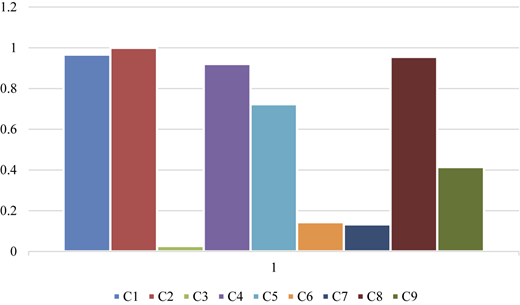
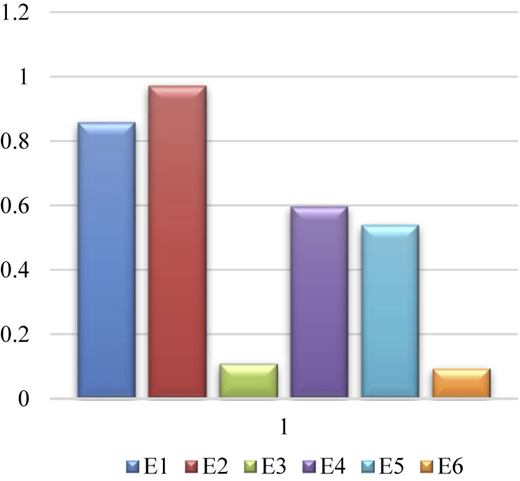
The suggested work's flowchart depicts the numerous TOPSIS procedures for determining the ranking of these identified significant issues as a critical topic in decision-making. To handle multi-attribute decision-making problems, this TOPSIS technique with virtual points (positive and negative ideal solutions) is often utilized. There are five decision-makers (DMs) with extensive experience (DM1 to DM5), are having good experience in this Hong Kong toy manufacturing company, and belong to the top levels of management. Thus, in this study, we considered a toy model company in Hong Kong that talks about a not-necessary (during COVID) goods company to deal with different challenges to mitigate them first and impacts of opportunities to maintain the operation of the entire SCM under the influence of COVID-19. We also attempted to construct a model that prioritizes them using the TOPSIS technique. Making strategic and tactical decisions for better toy manufacturing would be greatly aided by analyzing and prioritizing these main concerns. This section explains how to run this model with top and bottom rankings, as well as which variables should be prioritized. As a result, five decision-makers' opinions count, based on their expertise and strategic choices as they have given the weight of “0.25,” “0.25,” “0.25”, “0.125,” and “0.125,” respectively. Except for the location between the company and the consumers or raw materials, which is scored on a range of 1-very near to 5-very far, these nine challenges are rated on a five-point Likert scale of 1–5 (1-very easy to 5-very tough). On a five-point Likert scale of 1–5, these variables are assigned a score of influence on these six opportunities (1-very low, 2-low, 3-medium, 4-high and 5-very high). Tables 3–8 represent the TOPSIS technique stages that have been followed. Table 3 shows the DMs' scores and relative weights for each variable, while Table 4 shows the decision matrix's normalized values. The weighted normalized decision matrix, illustrated in Table 4, was created using the TOPSIS approach stages 2 and 3. Step 4 determines the positive ideal solution (PIS) and negative ideal solution (NIS), as shown in Table 4. Step 5 is also used to determine the separation of each parameter from the positive and negative ideal solutions, as illustrated in Table 6. Now, using Step 6, determine the relative closeness of each parameter to the ideal solution (closeness ratio), as shown in Table 8, and use the closeness ratio in Step 7 to determine the relative ranking of these parameters and their performance, as shown in Table 8 and Figure 4. The following steps are stated in order of execution of the TOPSIS method. The final rank of the key challenges is C2>C1>C8>C4>C5>C9>C6>C7>C3. From Table 8, we see that C2 (Salary of employee) has the highest CCi score is 1.00 while C3 (Inconvenient transportation) has the lowest CCi is 0.0268. Based on CCi scores, In Figure 5, a graph depicting the challenges and their outcomes has been plotted. The findings and outcomes reveal that C2 (Salary of employee) is recognized as the top challenge on the list and mitigate one by one in this order to improve the supply chain performance. Similarly, the steps follow to measure and find the priority for the different opportunities from Tables 3–8. The final rank of the effect parameter is E2>E1>E4>E5>E3>E6. From Table 8, we see that E2 (client's orders frequency, customer management) has the highest CCi score is 0.97008 while E6 (supplier/partner relationship management) has the lowest CCi is 0.09354. These key challenges and opportunities are identified as finding the way to measure to improve production and profits and sustainable growth (Sharma et al., 2021b) of the toy company. Moreover, it helps to improve the distribution level and good planning with appropriate decision making (see Tables 9–13).

The key challenges in the supply chain of toy manufacturing company arranged in the order of the priority revealed from the study are (1) Salary of employees, (2) Warehouse space is too tiny, (3) Cost of inventory management, (3) Influence of political factor, (4) Loss of labor, (5) Difficulty in production, (6) Location between the company and the customers or raw materials, (7) Level of security issues and (8) Inconvenient transportation. This result can help the management and DMs in addressing the hurdles in the supply chain process for non-essential goods. The salary of employees is shown to be the topmost challenge in ensuring a smooth supply chain process. It is, therefore, paramount to provide timely and adequate payments to the workers to avoid supply chain disruptions. Workers not receiving salaries or lower salaries has been a source of concern among the working population. The prevailing uncertainty about job security further throws them into the doldrums. In order to attain optimal productivity and consistency in terms of working quality and quantity, it is imperative to ensure that the workers receive their paychecks on time. This finding is in synchronize with Majumdar et al. (2020) where the social sustainability issue was studied for the clothing supply chain affected by COVID-19 while Karmaker et al. (2021) focused on sustainable supply chain performance to handle supply chain disruptions during the pandemic era. “Warehouse space is too tiny” emerged as the second most critical challenge in the hierarchy. In B2C e-commerce, warehouses are the backbone of product distribution (Srinivas and Marathe, 2021). The impact of COVID-19 on warehouses will be a long-term effect. In one region of the world, there is an outbreak or a transportation delay can result in dire consequences affecting supply chains throughout the globe due to warehouse closures or shortages, and deliveries are delayed. Cashing in on just-in-time (JIT) for receiving goods kept inventory costs down and effective space utilization for manufacturers. However, following COVID-19, firms faced inventory shortages, which in some cases resulted in entire production halting. Manufacturers will keep additional (buffer) inventory on hand to avoid future inventory shortages and production shutdowns. Amidst social distancing norms, this will further increase pressure on the warehouse space on account of extra inventory storage. Thus proper mechanisms have to be chalked out in order to optimize the warehouse space constraint depending upon the feasibility of the company. The capacity of warehouses has to be increased post-COVID to ensure larger inventory on hand to accommodate rising demand, as well as more room for social distancing. The next component in the list of challenges is “cost of inventory management”. The theoretical and managerial implications are explained in the following points:

This study adds to the research in various ways. Its goal is to conceive and empirically validate the impact of challenges and opportunities on their work process. First of all, it is among the first studies, focused on identifying the key supply chain challenges and opportunities of the case of Hong Kong toy manufacturing company during the COVID-19 outbreak and developing a comprehensive structural relationship to rank them. The study adds the literature support on identified nine challenges and six opportunities with the TOPSIS method. This research assists the theoretical building principles for new theories and it provides potential research areas to focus on, and existing literature provides the appropriate direction to rely on for this research activity. Although there is a lot of previous research on the challenges and opportunities of a toy manufacturing company, this study adds to it in terms of academics and industry research, in which everyone is involved in thinking about these challenges and opportunities. Leading to this toy company, the company's performance is measured by these difficulties and opportunities, which will contribute to future literature by demonstrating their relevance and giving consumers the ability to choose their requirements and expectations to get benefits. Furthermore, this study includes instructions for using them in the present business to analyze and manage the production and execution of the program in a methodical manner and humanitarian aspects. The findings suggest that “salary of employee” and “inconvenient transportation” have emerged as top and bottom key challenges respectively that affect supply chain performances. While the “client's orders frequency, customer management” and “supplier/partner relationship management” are identified as the top and bottom respectively to develop the opportunities. Consequently, in that sense, the supply chain performance of toy manufacturing companies makes a good contribution to literature.

The TOPSIS technique is used to establish the model and rank them afterward to overcome the challenges. The sequence of organized challenges in the list needs to mitigate one by one in this order to improve the supply chain performance. These key challenges and opportunities are identified as contributing attributes and provide the way to measure to improve production and profits and sustainable growth of the toy company during a pandemic. The findings of this study will be useful to practitioners and society in humanitarian aspects. As a result, the current toy business benefits from the ability to make suitable decisions based on performance. The ranking of these challenges and opportunities characteristics assist the company in improving its business and executing its processes successfully to improve productivity during the COVID-19 outbreak. In various aspects, toy manufacturing company takes care of its employees of humanitarian challenges to provide their salary and level of security issues on time. It also aims to be humanitarian by providing support services, supplier management, partner relationship management, and aiding its employees during pandemics at any time and in any location.

The main goal of this research was to analyze the TOPSIS method's forward-looking technique for identifying supply chain performance is appropriate for all indicated factors. The TOPSIS approach is used to acquire the final ranking preference in decreasing order, allowing for the comparison of relative performance. Analyzing the company's top management opinion judgment, the study covers the essence of these nine challenges and six opportunities. Making strategic and tactical decisions for better toy manufacturing would be greatly aided by analyzing and prioritizing these main concerns. This section explains how to run this model with top and bottom rankings, as well as which variables should be prioritized. Based on data analysis, the salary of employees, warehouse space is too tiny and costs of inventory management have emerged as the top three key challenges with high closeness coefficients as “1.00”, “0.96683”, and “0.95547”, respectively. While the client's orders frequency (customer management), transportation, and clients quantity (no. of order) are identified as the top three key opportunities with high closeness coefficients as “0.97008”, “0.85593”, and “0.5943” respectively. These key challenges and opportunities are identified as finding the way to measure to improve production and profits and sustainable growth of the toy company. To recover from COVID-19, the operating model of the premier toy manufacturing firm is to strive for the desired trademark position on the market by developing novel items, vigorous product marketing, and high product shelf availability. This COVID-19 has an impact on this Hong Kong-based toy model manufacturer, which deals with a variety of issues. Thus, we see the instance required to identify these challenges and opportunities which impact the supply chain performance of non-essential goods enterprises and explore to deal with COVID-19's various effects. As a result, the purpose of this work is to address them and develop an inclusive inter-relationship in order to prioritize them. To some extent, toy demand was badly impacted during COVID, so the company decided to maintain production and buffer levels accordingly. The strategic planning for good production and taking care of employees with all safety measures during COVID are important to understand. Therefore, it is suggested that everything must be meticulously designed in order to anticipate and handle all possible scenarios before any program is implemented.

One of the study's shortcomings is that the decision and opinions were obtained from only the top management level of the company. It was a very tough time during the COVID-19 outbreak for the company to maintain the level of production according to the demand. It has been noticed and recommended by the findings and results that “Location between the company and the customers or raw materials”, “Level of Security issues”, and “Inconvenient transportation” are the bottom three challenges that must be avoided first to improve the supply chain process. Similarly, “Planning and risk management”, “Support service”, and “Supplier/Partner Relationship Management” are bottom the key opportunities to enhance and manage the supply chain process. The future study may consider all toy manufacturing companies and generalize with some other key challenges and opportunities that provide a path to excellence. A hybrid method (particularly TOPSIS and VIKOR) can be utilized to evaluate the model and boost the power of relative supply chain performance in a future MCDM-based investigation. Moreover, this study can explore to identify humanitarian supply chain challenges and opportunities during and after the COVID crisis, and a comparative study can be done in future studies.

This paper forms part of a special section “The COVID19 impact on humanitarian operations: lessons for future disrupting events”, guest edited by Bhavin Shah, Guilherme Frederico, Vikas Kumar, Jose Arturo Garza-Reyes and Anil Kumar.

The authors would like to thank the two anonymous reviewers, Associate Editor, and Editor-in-Chief for their valuable comments and suggestions that helped to improve the manuscript.

Funding: The authors received no financial support for the research, authorship and/or publication of this article.

Declaration of conflicting interests: The authors declared no potential conflicts of interest with respect to the research, authorship and/or publication of this article.
Abdolazimi
,
O.
,
Esfandarani
,
M.S.
,
Salehi
,
M.
,
Shishebori
,
D.
and
Shakhsi-Niaei
,
M.
(
2021
), “
Development of sustainable and resilient healthcare and non-cold pharmaceutical distribution supply chain for COVID-19 pandemic: a case study
”,
The International Journal of Logistics Management
, Vol. 
ahead-of-print
No. 
ahead-of-print
.
Adikaram
,
A.S.
,
Naotunna
,
N.P.G.S.I.
and
Priyankara
,
H.P.R.
(
2021
), “
Battling COVID-19 with human resource management bundling
”,
Employee Relations: The International Journal
, Vol. 
43
No. 
6
, pp. 
1269
-
1289
.
Agyabeng-Mensah
,
Y.
,
Ahenkorah
,
E.
,
Afum
,
E.
and
Dacosta
,
E.
(
2020
), “
Green warehousing, logistics optimization, social values and ethics and economic performance: the role of supply chain sustainability
”,
The International Journal of Logistics Management
, Vol. 
31
No. 
3
, pp. 
549
-
574
.
Albanesi
,
S.
and
Kim
,
J.
(
2021
), “
Effects of the COVID-19 recession on the US labor market: occupation, family, and gender
”,
Journal of Economic Perspectives
, Vol. 
35
No. 
3
, pp. 
3
-
24
.
Ali
,
M.H.
,
Suleiman
,
N.
,
Khalid
,
N.
,
Tan
,
K.H.
,
Tseng
,
M.L.
and
Kumar
,
M.
(
2021
), “
Supply chain resilience reactive strategies for food SMEs in coping to COVID-19 crisis
”,
Trends in Food Science & Technology
, Vol. 
109
, pp. 
94
-
102
.
Araz
,
O.M.
,
Choi
,
T.M.
,
Olson
,
D.L.
and
Salman
,
F.S.
(
2020
), “
Data analytics for operational risk management
”,
Decision Science
, Vol. 
51
No. 
6
, pp. 
1316
-
1319
.
Ariyani
,
D.T.
,
Aulia
,
I.F.
,
Suryobuwono
,
A.A.
and
Marlita
,
D.
(
2020
), “
Switch potential of the users from using public transportation to private transportation as an impact of pandemic covid-19 (Case study in Jabodetabek 2020)
”,
Advances in Transportation and Logistics Research
, Vol. 
3
, pp. 
143
-
151
.
Arlbjørn
,
J.S.
,
De Haas
,
H.
,
Caspersen
,
R.
,
Johansen
,
J.
and
Nørmølle
,
J.
(
2004
), “
Increasing change readiness by developing supply chain competency: experience from industry
”,
Proceedings of the 16th Annual Conference for Nordic Researchers in Logistics, Linköpings
Universitet
,
Linköping
, pp.
71
-
88
.
Armani
,
A.M.
,
Hurt
,
D.E.
,
Hwang
,
D.
,
McCarthy
,
M.C.
and
Scholtz
,
A.
(
2020
), “
Low-tech solutions for the COVID-19 supply chain crisis
”,
Nature Reviews Materials
, Vol. 
5
No. 
6
, pp. 
403
-
406
.
Apte
,
U.M.
and
Viswanathan
,
S.
(
2000
), “
Effective cross docking for improving distribution efficiencies
”,
International Journal of Logistics
, Vol. 
3
No. 
3
, pp. 
291
-
302
.
Babich
,
V.
,
Burnetas
,
A.N.
and
Ritchken
,
P.H.
(
2007
), “
Competition and diversification effects in supply chains with supplier default risk
”,
Manufacturing and Service Operations Management
, Vol. 
9
No. 
2
, pp. 
123
-
146
.
Bajpai
,
P.
(
2021
), “
Why China is ‘the world's factory'
”,
available at:
https://www.investopedia.com/articles/investing/102214/why-china-worlds-factory.asp (
accessed
 5 July 2021).
Bartholdi
,
J.J.
and
Hackman
,
S.T.
(
2008
), “
Warehouse and Distribution Science: Release 0.89
”,
Supply Chain and Logistics Institute
,
Atlanta
, p.
13
,
available at:
https://www.scl.gatech.edu/sites/default/files/downloads/gtscl-warehouse_science_bartholdi.pdf (
accessed
 26 January 2022).
Behl
,
A.
and
Dutta
,
P.
(
2019
), “
Humanitarian supply chain management: a thematic literature review and future directions of research
”,
Annals of Operations Research
, Vol. 
283
No. 
1
, pp. 
1001
-
1044
.
Blecken
,
A.
,
Hellingrath
,
B.
,
Dangelmaier
,
W.
and
Schulz
,
S.F.
(
2009
), “
A humanitarian supply chain process reference model
”,
International Journal of Services, Technology and Management
, Vol. 
12
No. 
4
, pp. 
391
-
413
.
Butt
,
A.S.
(
2021
), “
Strategies to mitigate the impact of COVID-19 on supply chain disruptions: a multiple case analysis of buyers and distributors
”,
The International Journal of Logistics Management
, Vol. 
ahead-of-print
No. 
ahead-of-print
. doi: .
Chen
,
C.T.
(
2000
), “
Extensions of the TOPSIS for group decision-making under fuzzy environment
”,
Fuzzy Sets and Systems
, Vol. 
114
No. 
1
, pp. 
1
-
9
.
Chen
,
P.
(
2019
), “
Effects of normalization on the entropy-based TOPSIS method
”,
Expert Systems with Applications
, Vol. 
136
, pp. 
33
-
41
.
Christopher
,
M.
(
2016
),
Logistics and Supply Chain Management
, (5th ed.) ,
The Financial Times, Pearson
,
London
.
Cozzolino
,
A.
(
2012
), “
Humanitarian logistics and supply chain management
”, in
Humanitarian Logistics
,
Springer
,
Berlin and Heidelberg
, pp. 
5
-
16
.
Do
,
T.N.
,
Kumar
,
V.
and
Do
,
M.H.
(
2020
), “
Prioritize the key parameters of Vietnamese coffee industries for sustainability
”,
International Journal of Productivity and Performance Management
, Vol. 
69
No. 
6
, pp. 
1153
-
1176
.
Eisenhardt
,
K.M.
(
1989
), “
Building theories from case study research
”,
Academy of Management Review
, Vol. 
14
No. 
4
, pp. 
532
-
550
.
Emerging Markets
(
2019
), “
Explainer: how important is Hong Kong to the rest of China?
”,
available at:
https://www.reuters.com/article/us-hongkong-protests-markets-explainer-idUSKCN1VP35H (
accessed
 5 July 2021).
Eroğlu
,
H.
(
2021
), “
Effects of Covid-19 outbreak on environment and renewable energy sector
”,
Environment, Development and Sustainability
, Vol. 
23
No. 
4
, pp. 
4782
-
4790
.
Epoxy Network
(
2019
), “
Is epoxy dangerous to people or bad for the environment?
”,
available at:
https://epoxynetwork.com/is-epoxy-dangerous-to-people-or-bad-for-the-environment/ (
accessed
 5 July 2021).
Ershadi
,
M.M.
and
Ershadi
,
M.S.
(
2022
), “
Logistic planning for pharmaceutical supply chain using multi-objective optimization model
”,
International Journal of Pharmaceutical and Healthcare Marketing
, Vol. 
16
No. 
1
, pp.
75
-
100
, doi: .
Ertem
,
M.A.
,
Buyurgan
,
N.
and
Rossetti
,
M.D.
(
2010
), “
Multiple-buyer procurement auctions framework for humanitarian supply chain management
”,
International Journal of Physical Distribution and Logistics Management
, Vol. 
40
No. 
3
, pp. 
202
-
227
.
Fauci
,
A.S.
,
Lane
,
H.C.
and
Redfield
,
R.R.
(
2020
), “
Covid-19-navigating the uncharted
”,
The New England Journal of Medicine
, Vol. 
382
, pp. 
1268
-
1269
.
Franco
,
C.
and
Alfonso-Lizarazo
,
E.
(
2020
), “
Optimization under uncertainty of the pharmaceutical supply chain in hospitals
”,
Computers and Chemical Engineering
, Vol. 
135
, pp. 
1
-
13
,
106689
.
Garg
,
H.
and
Kaur
,
G.
(
2020
), “
Extended TOPSIS method for multi-criteria group decision-making problems under cubic intuitionistic fuzzy environment
”,
Scientia Iranica
, Vol. 
27
No. 
1
, pp. 
396
-
410
.
Garg
,
H.
and
Kumar
,
K.
(
2020
), “
A novel exponential distance and its based TOPSIS method for interval-valued intuitionistic fuzzy sets using connection number of SPA theory
”,
Artificial Intelligence Review
, Vol. 
53
No. 
1
, pp. 
595
-
624
.
Genchev
,
S.E.
(
2009
), “
Reverse logistics program design: a company study
”,
Business Horizons
, Vol. 
52
No. 
2
, pp.
139
-
148
.
Giri
,
G.
and
Manohar
,
H.L.
(
2021
), “
Factors influencing the acceptance of private and public blockchain-based collaboration among supply chain practitioners: a parallel mediation model
”,
Supply Chain Management: An International Journal
, Vol. 
ahead-of-print
No. 
ahead-of-print
.
Global
,
E.Y.
(
2020
), “
COVID-19: how to build supply chains resilient to disruption
”,
Multidisciplinary Professional Services Organization
,
available at:
https://www.ey.com/en_eg/consulting/how-to-build-a-supply-chain-thats-resilient-to-global-disruption (
accessed
 4 July 2021).
Goel
,
R.K.
,
Saunoris
,
J.W.
and
Goel
,
S.S.
(
2021
), “
Supply chain performance and economic growth: the impact of COVID-19 disruptions
”,
Journal of Policy Modeling
, Vol. 
43
No. 
2
, pp. 
298
-
316
.
Guan
,
D.
,
Wang
,
D.
,
Hallegatte
,
S.
,
Davis
,
S.J.
,
Huo
,
J.
,
Li
,
S.
,
Bai
,
Y.
,
Lei
,
T.
,
Xue
,
Q.
,
Coffman
,
D.M.
and
Cheng
,
D.
(
2020
), “
Global supply-chain effects of COVID-19 control measures
”,
Nature Human Behaviour
, Vol. 
4
, pp. 
577
-
587
.
Gupta
,
S.
,
Altay
,
N.
and
Luo
,
Z.
(
2019
), “
Big data in humanitarian supply chain management: a review and further research directions
”,
Annals of Operations Research
, Vol. 
283
No. 
1
, pp. 
1153
-
1173
.
Henriksen
,
S.
and
Selwyn
,
M.
(
2020
), “
How to protect global supply chains under threat from the COVID-19 pandemic
”,
available at:
https://www.weforum.org/agenda/2020/05/global-supply-chains-are-under-imminent-threat-from-the-covid-19-pandemic/ (
accessed 5 July 20221
).
Hille
,
K.
(
2020
), “
The great uncoupling: one supply chain for China, one for everywhere else
”, Vol. 
6
,
Financial Times
,
available at:
https://www.ft.com/content/40ebd786-a576-4dc2-ad38-b97f796b72a0 (
accessed
 5 July 2021).
HKGCC
(
2020
), “
Supply chain strains
”,
available at:
https://www.chamber.org.hk/en/information/the-bulletin_detail.aspx?id=535 (
accessed
 3 July 2021).
HobbyDigi
(
2021
), “
Online shopping website
”,
available at:
https://www.hobbydigi.com/en_us/model-car/region/hong-kong (
accessed 5 July 2021
).
Hwang
,
C.L.
and
Yoon
,
K.
(
1981
),
Multiple Attributes Decision Making Methods and Applications
,
Springer
,
Berlin and Heidelberg
.
Jauhar
,
S.K.
,
Pant
,
M.
,
Kumar
,
V.
,
Sharma
,
N.K.
and
Verma
,
P.
(
2021
), “
Supply chain and the sustainability management: selection of suppliers for sustainable operations in the manufacturing industry
”,
Chapter 4, Sustainability in Industry 4.0: Challenges and Remedies
,
CRC Press, Taylor & Francis
,
Boca Raton, FL
, pp.
75
-
93
.
Jha
,
A.
,
Sharma
,
R.R.K.
,
Kumar
,
V.
and
Verma
,
P.
(
2021
), “
Designing supply chain performance system: a strategic study on Indian manufacturing sector
”,
Supply Chain Management: An International Journal
, Vol. 
27
No. 
1
, pp. 
66
-
88
.
Kabra
,
G.
,
Ramesh
,
A.
and
Arshinder
,
K.
(
2015
), “
Identification and prioritization of coordination barriers in humanitarian supply chain management
”,
International Journal of Disaster Risk Reduction
, Vol. 
13
, pp. 
128
-
138
.
Karmaker
,
C.L.
,
Ahmed
,
T.
,
Ahmed
,
S.
,
Ali
,
S.M.
,
Moktadir
,
M.A.
and
Kabir
,
G.
(
2021
), “
Improving supply chain sustainability in the context of COVID-19 pandemic in an emerging economy: exploring drivers using an integrated model
”,
Sustainable Production and Consumption
, Vol. 
26
, pp. 
411
-
427
.
Kilpatrick
,
J.
and
Barter
,
L.
(
2020
), “
COVID-19: managing supply chain risk and disruption
”,
Deloitte
,
Toronto, ON
,
available at:
https://www2.deloitte.com/global/en/pages/risk/cyber-strategic-risk/articles/covid-19-managing-supply-chain-risk-and-disruption.html (
accessed
 5 July 2021).
Kumar
,
V.
,
Verma
,
P.
,
Sharma
,
R.R.K.
and
Khan
,
A.F.
(
2017
), “
Conquering in emerging markets: critical success factors to enhance supply chain performance
”,
Benchmarking: An International Journal
, Vol. 
24
No. 
3
, pp. 
570
-
593
.
Kumar
,
V.
,
Verma
,
P.
,
Jha
,
A.
,
Lai
,
K.K.
and
Do
,
H.M.
(
2021
), “
Dynamics of a medium value consumer apparel supply chain key parameters
”,
International Journal of Productivity and Performance Management
, Vol. 
71
No. 
2
, pp. 
445
-
476
.
Kumar
,
V.
,
Verma
,
P.
,
Mittal
,
A.
,
Panduro
,
J.A.T.
,
Singh
,
S.
and
Paliwal
,
P.
(
2022a
), “
Adoption of ICTs as an emergent business strategy during and following COVID-19 crisis: evidence from Indian MSMEs
”,
Benchmarking: An International Journal
, Vol. 
ahead-of-print
No. 
ahead-of-print
. doi: .
Kumar
,
V.
,
Ya
,
K.Z.
and
Lai
,
K.K.
(
2022b
), “
Mapping the key challenges and managing the opportunities in supply chain distribution during COVID-19: a case of Myanmar pharmaceutical company
”,
Journal of Global Operations and Strategic Sourcing
, Vol. 
ahead-of-print
No. 
ahead-of-print
. doi: .
Kumar
,
V.
,
Ha
,
N.T.T.
,
Mittal
,
A.
and
Lai
,
K.K.
(
2022c
), “
The production and distribution of face masks to other countries: a strategic approach of Taiwan during COVID-19 outbreak
”,
Journal of Global Operations and Strategic Sourcing
, Vol. 
ahead-of-print
No. 
ahead-of-print
. doi: .
Kunz
,
N.
and
Gold
,
S.
(
2017
), “
Sustainable humanitarian supply chain management–exploring new theory
”,
International Journal of Logistics Research and Applications
, Vol. 
20
No. 
2
, pp. 
85
-
104
.
Kurniawan
,
R.
,
Zailani
,
S.H.
,
Iranmanesh
,
M.
and
Rajagopal
,
P.
(
2017
), “
The effects of vulnerability mitigation strategies on supply chain effectiveness: risk culture as moderator
”,
Supply Chain Management: An International Journal
, Vol. 
22
No. 
1
, pp. 
1
-
15
.
Lei
,
F.
,
Wei
,
G.
,
Gao
,
H.
,
Wu
,
J.
and
Wei
,
C.
(
2020
), “
TOPSIS method for developing supplier selection with probabilistic linguistic information
”,
International Journal of Fuzzy Systems
, Vol. 
22
No. 
3
, pp. 
749
-
759
.
Li
,
J.
,
Huang
,
R.
and
Dai
,
J.B.
(
2017
), “
Joint optimisation of order batching and picker routing in the online retailer's warehouse in China
”,
International Journal of Production Research
, Vol. 
55
No. 
2
, pp. 
447
-
461
.
Liu
,
X.
and
Wang
,
L.
(
2020
), “
An extension approach of TOPSIS method with OWAD operator for multiple criteria decision-making
”,
Granular Computing
, Vol. 
5
No. 
1
, pp.
135
-
148
.
Luckstead
,
J.
,
Nayga
,
R.M.
 Jr
and
Snell
,
H.A.
(
2021
), “
Labor issues in the food supply chain amid the COVID-19 pandemic
”,
Applied Economic Perspectives and Policy
, Vol. 
43
No. 
1
, pp. 
382
-
400
.
Majumdar
,
A.
,
Shaw
,
M.
and
Sinha
,
S.K.
(
2020
), “
COVID-19 debunks the myth of socially sustainable supply chain: a case of the clothing industry in South Asian countries
”,
Sustainable Production and Consumption
, Vol. 
24
, pp. 
150
-
155
.
McGowan
,
M.
(
2005
), “
The impact of shifting container cargo flows on regional demand for US warehouse space
”,
Journal of Real Estate Portfolio Management
, Vol. 
11
No. 
2
, pp. 
167
-
185
.
McKenzie
,
B.
(
2020
),
Beyond COVID-19: Supply Chain Resilience Holds Key to Recovery
, Vol. 
24
, p.
20
.
McWilliams
,
L.
(
2020
), “
Ernst and Young Report: nearly 80% of board members felt unprepared for a major risk even like COVID-19: EY survey
”,
Press release on 20 April 2020
,
available at:
https://www.ey.com/en_us/news/2020/04/nearly-80-percent-ofboard-members-felt-unprepared-for-a-major-risk-event-like-covid-19-ey-survey (
accessed
 5 July).
Memari
,
A.
,
Dargi
,
A.
,
Jokar
,
M.R.A.
,
Ahmad
,
R.
and
Rahim
,
A.R.A.
(
2019
), “
Sustainable supplier selection: a multi-criteria intuitionistic fuzzy TOPSIS method
”,
Journal of Manufacturing Systems
, Vol. 
50
, pp. 
9
-
24
.
Mogaji
,
E.
,
Adekunle
,
I.
,
Aririguzoh
,
S.
and
Oginni
,
A.
(
2022
), “
Dealing with impact of COVID-19 on transportation in a developing country: insights and policy recommendations
”,
Transport Policy
, Vol. 
116
, pp. 
304
-
314
.
Moore
,
K.R.
,
Whyte
,
N.
,
Roberts
,
D.
,
Allwood
,
J.
,
Leal-Ayala
,
D.R.
,
Bertrand
,
G.
and
Bloodworth
,
A.J.
(
2020
), “
The re-direction of small deposit mining: technological solutions for raw materials supply security in a whole systems context
”,
Resources, Conservation and Recycling: X
, Vol. 
7
, pp. 
1
-
15
, 100040.
Oliver
,
R.K.
and
Webber
,
M.D.
(
1982
), “
Supply-chain management: logistics catches up with strategy
”,
Outlook
, Vol. 
5
No. 
1
, pp.
42
-
47
.
Oloruntoba
,
R.
and
Gray
,
R.
(
2006
), “
Humanitarian aid: an agile supply chain?
”,
Supply Chain Management: An International Journal
, Vol. 
11
No. 
2
, pp. 
115
-
120
.
Ozbay
,
K.
and
Ozguven
,
E.E.
(
2007
), “
Stochastic humanitarian inventory control model for disaster planning
”,
Transportation Research Record
, Vol. 
2022
No. 
1
, pp. 
63
-
75
.
Ozdemir
,
A.I.
,
Erol
,
I.
,
Ar
,
I.M.
,
Peker
,
I.
,
Asgary
,
A.
,
Medeni
,
T.D.
and
Medeni
,
I.T.
(
2020
), “
The role of blockchain in reducing the impact of barriers to humanitarian supply chain management
”,
The International Journal of Logistics Management
, Vol. 
32
No. 
2
, pp. 
454
-
478
.
Pathak
,
D.K.
,
Verma
,
A.
and
Kumar
,
V.
(
2020
), “
Performance variable of GSCM for sustainability in Indian automobile organizations using TOPSIS method
”,
Business Strategy and Development
, Vol. 
3
No. 
4
, pp. 
590
-
602
.
Pathak
,
D.K.
,
Verma
,
A.
and
Kumar
,
V.
(
2021
), “
GSCM barriers to sustainable development in Indian manufacturing organizations: a mixed-method approach
”,
International Journal of Logistics Systems and Management
(
Accepted
).
Radulescu
,
C.V.
,
Ladaru
,
G.R.
,
Burlacu
,
S.
,
Constantin
,
F.
,
Ioanăș
,
C.
and
Petre
,
I.L.
(
2021
), “
Impact of the COVID-19 pandemic on the Romanian labor market
”,
Sustainability
, Vol. 
13
No. 
1
, pp. 
1
-
23
.
Rani
,
P.
,
Mishra
,
A.R.
,
Rezaei
,
G.
,
Liao
,
H.
and
Mardani
,
A.
(
2020
), “
Extended Pythagorean fuzzy TOPSIS method based on similarity measure for sustainable recycling partner selection
”,
International Journal of Fuzzy Systems
, Vol. 
22
No. 
2
, pp. 
735
-
747
.
Rogers
,
D.S.
and
Tibben-Lembke
,
R.S.
(
1999
),
Going Backwards: Reverse Logistics Trends and Practices
, Vol. 
2
,
Reverse Logistics Executive Council
,
Pittsburgh, PA
.
Sarkis
,
J.
(
2020
), “
Supply chain sustainability: learning from the COVID-19 pandemic
”,
International Journal of Operations and Production Management
, Vol. 
41
No. 
1
, pp. 
63
-
73
.
Schumacher
,
R.
,
Glew
,
R.
,
Tsolakis
,
N.
and
Kumar
,
M.
(
2020
), “
Strategies to manage product recalls in the COVID-19 pandemic: an exploratory case study of PPE supply chains
”,
Continuity and Resilience Review
, Vol. 
3
No. 
1
, pp. 
64
-
78
.
Sharma
,
N.K.
,
Kumar
,
V.
,
Verma
,
P.
and
Luthra
,
S.
(
2021a
), “
Sustainable reverse logistics practices and performance evaluation with fuzzy TOPSIS: a study on Indian retailers
”,
Cleaner Logistics and Supply Chain
, Vol. 
1
, pp. 
1
-
18
.
Sharma
,
N.K.
,
Chen
,
W.K.
,
Lai
,
K.K.
and
Kumar
,
V.
(
2021b
), “
Sustainability performance measurement methods, indicators and challenges: a review
”, in
Sustainability in Industry 4.0: Challenges and Remedies
,
CRC Press, Taylor & Francis, Boca Raton, FL
, pp. 
179
-
199
.
Sherman
,
E.
(
2020
), “
94% of the fortune 1000 are seeing coronavirus supply chain disruptions: report
”,
Fortune
,
New York
,
available at:
https://www.thehackettgroup.com/news/fortune-94-of-the-fortune-1000-are-seeing-coronavirus-supply-chain-disruptions-report/ (
accessed
 5 July).
Singh
,
R.K.
,
Gupta
,
A.
,
Kumar
,
A.
and
Khan
,
T.A.
(
2016a
), “
Ranking of barriers for effective maintenance by using TOPSIS approach
”,
Journal of Quality in Maintenance Engineering
, Vol. 
22
No. 
1
, pp. 
18
-
34
.
Singh
,
R.K.
,
Kumar
,
R.
and
Kumar
,
P.
(
2016b
), “
Strategic issues in pharmaceutical supply chains: a review
”,
International Journal of Pharmaceutical and Healthcare Marketing
, Vol. 
10
No. 
3
, pp. 
234
-
257
.
Srinivas
,
S.S.
and
Marathe
,
R.R.
(
2021
), “
Moving towards ‘mobile warehouse': last-mile logistics during COVID-19 and beyond
”,
Transportation Research Interdisciplinary Perspectives
, Vol. 
10
, 100339.
Sun
,
H.
and
Wing
,
W.C.
(
2005
), “
Critical success factors for new product development in the Hong Kong toy industry
”,
Technovation
, Vol. 
25
No. 
3
, pp. 
293
-
303
.
Tam
,
C.C.F.
,
Cheung
,
K.S.
,
Lam
,
S.
,
Wong
,
A.
,
Yung
,
A.
,
Sze
,
M.
,
Fang
,
J.
,
Tse
,
H.F.
and
Siu
,
C.W.
(
2021
), “
Impact of coronavirus disease 2019 (COVID‐19) outbreak on outcome of myocardial infarction in Hong Kong, China
”,
Catheterization and Cardiovascular Interventions
, Vol. 
97
No. 
2
, pp.
E194
-
E197
.
Thomas
,
A.S.
and
Kopczak
,
L.R.
(
2005
), “
From logistics to supply chain management: the path forward in the humanitarian sector
”,
Fritz Institute
, Vol. 
15
No. 
1
, pp. 
1
-
15
.
Van Wassenhove
,
L.N.
(
2006
), “
Blackett memorial lecture. Humanitarian aid logistics: supply chain management in high gear
”,
Journal of the Operational Research Society
, Vol. 
57
No. 
5
, pp. 
475
-
489
.
Vasiev
,
M.
,
Bi
,
K.
,
Denisov
,
A.
and
Bocharnikov
,
V.
(
2020
), “
How COVID-19 pandemics influences Chinese economic sustainability
”,
Форсайт
, Vol. 
14
No. 
2
, pp. 
7
-
22
(
eng
).
Vătămănescu
,
E.M.
,
Dabija
,
D.C.
,
Gazzola
,
P.
,
Cegarro-Navarro
,
J.G.
and
Buzzi
,
T.
(
2021
), “
Before and after the outbreak of covid-19: linking fashion companies' corporate social responsibility approach to consumers' demand for sustainable products
”,
Journal of Cleaner Production
, Vol. 
321
, pp. 
1
-
15
, 128945.
Verma
,
P.
,
Kumar
,
V.
,
Mittal
,
A.
,
Rathore
,
B.
,
Jha
,
A.
and
Rahman
,
M.
(
2021
), “
The role of 3S in big data quality: a perspective on operational performance indicators using an integrated approach
”,
The TQM Journal
. doi: .
Verma
,
P.
,
Kumar
,
V.
,
Mittal
,
A.
,
Gupta
,
P.
and
Hsu
,
S.C.
(
2022a
), “
Addressing strategic human resource management practices for TQM: the case of an Indian tire manufacturing company
”,
The TQM Journal
, Vol. 
34
No. 
1
, pp. 
29
-
69
.
Verma
,
P.
,
Kumar
,
V.
,
Daim
,
T.
,
Sharma
,
N.K.
and
Mittal
,
A.
(
2022b
), “
Identifying and prioritizing impediments of industry 4.0 to sustainable digital manufacturing: a mixed method approach
”,
Journal of Cleaner Production
, Vol. 
356
, pp. 
1
-
20
.
Velavan
,
T.P.
and
Meyer
,
C.G.
(
2020
), “
The COVID-19 epidemic
”,
Tropical Medicine and International Health
, Vol. 
25
No. 
3
, pp. 
278
-
280
.
Wang
,
T.C.
and
Lee
,
H.D.
(
2009
), “
Developing a fuzzy TOPSIS approach based on subjective weights and objective weights
”,
Expert Systems with Applications
, Vol. 
36
No. 
5
, pp. 
8980
-
8985
.
Whipple
,
J.M.
,
Voss
,
M.D.
and
Closs
,
D.L.
(
2009
), “
Supply chain security practices in the food industry
”,
International Journal of Physical Distribution and Logistics Management
, Vol. 
39
No. 
7
, pp. 
574
-
594
.
WHO (World Health Organization)
(
2020
), “
WHO director-general's opening remarks at the media briefing on COVID-19
”,
available at:
https://www.who.int/dg/speeches/detail/who-director-generals-opening-remarks-at-the-media-briefing-on-covid-19 (
accessed
 5 July 2021).
Zhou
,
F.
,
Yu
,
T.
,
Du
,
R.
,
Fan
,
G.
,
Liu
,
Y.
,
Liu
,
Z.
,
Xiang
,
J.
,
Wang
,
Y.
,
Song
,
B.
,
Gu
,
X.
and
Guan
,
L.
(
2020a
), “
Clinical course and risk factors for mortality of adult inpatients with COVID-19 in Wuhan, China: a retrospective cohort study
”,
The Lancet
, Vol. 
395
No. 
10229
, pp. 
1054
-
1062
.
Zhou
,
M.
,
Zhang
,
X.
and
Qu
,
J.
(
2020b
), “
Coronavirus disease 2019 (COVID-19): a clinical update
”,
Frontiers of Medicine
, Vol. 
14
No. 
2
, pp. 
126
-
135
.
Tabaklar
,
T.
,
Halldórsson
,
Á.
,
Kovács
,
G.
and
Spens
,
K.
(
2015
), “
Borrowing theories in humanitarian supply chain management
”,
Journal of Humanitarian Logistics and Supply Chain Management
, Vol. 
5
No. 
3
, pp. 
281
-
299
.
Licensed re-use rights only

Data & Figures

Figure 1

Demand and product flow of supply chain process

Figure 1

Demand and product flow of supply chain process

Close modal
Figure 2

Supply chain of Hong Kong toy manufacturing company

Figure 2

Supply chain of Hong Kong toy manufacturing company

Close modal
Figure 3

Flowchart of the proposed research work

Figure 3

Flowchart of the proposed research work

Close modal
Figure 4

Rank of the key challenges variable

Figure 4

Rank of the key challenges variable

Close modal
Figure 5

Rank of the variable

Figure 5

Rank of the variable

Close modal
Table 1

Relevant literature review

SNSupply chain challengesDescriptionsSources
1Warehouse space is too tiny (C1)The provided space use to keep inventory according to the demand but it is affected during COVID-19Bartholdi and Hackman (2008), McGowan (2005) 
2Salary of employee (C2)Pandemic creates HR bundles, e.g. payroll and thus, company applies some HR strategies such as deferment of salary increasement, non-payment leave and temporary pay reductionErshadi and Ershadi (2022), Adikaram et al. (2021) 
3Inconvenient transportation (C3)During COVID and lockdown, moving goods from one place to another is not so easyMogaji et al. (2022), Ariyani et al. (2020) 
4Influence of political factor (C4)The political instability influence interrupts and destroys supply chain processButt (2021), Abdolazimi et al. (2021) 
5Lack of labor (C5)Demand of labourforce is high but not easily available during COVID crisesRadulescu et al. (2021), Albanesi and Kim (2021) 
6Location between the company and the customers/market or raw materials (C6)Location between the company and the customers/market or raw materials is difficult to supply materials and productsVătămănescu et al. (2021), Moore et al. (2020) 
7Level of Security issues (C7)More likely to engage supply chain partners in security-related issues and information exchangeWhipple et al. (2009), Luckstead et al. (2021), Ali et al. (2021) 
8Costs of Inventory management (C8)High price form supplier and other costs evolving logistics lead to increase high operational cost and to manage inventoryAgyabeng-Mensah at al. (2020), Kurniawan et al. (2017) 
9Difficulty in Production (C9)It needs to maintain the channel of production and distributionGiri and Manohar (2021), Singh et al. (2016a, b) 
SNSupply chain opportunitiesDescriptionsSources
1Transportation (E1)Due to pandemic restrictions, it is challenging to select transport method based on high price, time allowance and mode of methodAgyabeng-Mensah at al. (2020), Schumacher et al. (2020) 
2Client's orders frequency (Customer Management) (E2)High demand tends to high order frequencyAgyabeng-Mensah at al. (2020), Schumacher et al. (2020) 
3Support service (E3)In order to provide good support service, they need to enhance employees' skills and good trainingGiri and Manohar (2021), Singh et al. (2016a, b) 
4Client's quantity (no. of order) (E4)Due to high demand, number of clients might increase in pharmaceutical market.Kurniawan et al. (2017), Franco and Alfonso-Lizarazo (2020) 
5Planning and risk management (E5)Risk management culture positively facilitates to supply chain visibility and supplier developmentSchumacher et al. (2020), Franco and Alfonso-Lizarazo (2020) 
6Supplier/Partner Relationship Management (E6)Relationship management is an essential tool among suppliers, customers and companyGiri and Manohar (2021), Singh et al. (2016a, b) 
Table 2

Summary of demographic details

ProfileClassificationNo. of DMsPercentage
RespondentsMale240%
Female360%
Type of industryManufacturing sector00%
Service sector5100
Other00%
Age21–30 years00%
31–40 years120%
41–50 years240%
Above 50 years240%
Work experience0–5 years00%
6–10 years240%
Above 10 years360%
EducationIntermediate/diploma480%
Bachelors120%
Post graduate and above00%
Department of respondentsInventory management240%
Purchasing120%
Customer service120%
Transportation120%
Other00%


C 1

C 2

.

.

.

C n

A 1

x 11

x 12

.

.

.

x 1n

A 2

X 21

.

.

.

.

.

.

.

.

.

.

.

.

.

.

.

.

.

.

.

.

.

.

.

.

.

.

A m

X m1

.

.

.

.

X mn

r11

r12

.

.

.

r1n

r21

r22

.

.

.

r2n

.

.

.

.

.

.

.

.

.

.

.

.

.

.

.

.

.

.

rm1

rm2

.

.

.

rmn

v11

v12

.

.

.

v1n

v21

v22

.

.

.

v2n

.

.

.

.

.

.

.

.

.

.

.

.

.

.

.

.

.

.

vm1

vm2

.

.

.

vmn

Table 3

Linguistic code for evaluating criteria

Linguistic scaleScale
Very Low1
2
3
4
Very High5
Table 4

The scores of the decision matrix and weight from different DMs' suggestions

SNWeight→0.250.250.250.1250.125
DM1DM2DM3DM4DM5
1Warehouse space is too tiny (C1)53555
2Salary of employee (C2)54555
3Inconvenient transportation (C3)11221
4Influence of political factor (C4)43544
5Lack of labor (C5)52354
6Location between the company and the customers or raw materials (C6)13112
7Level of Security issues (C7)13111
8Costs of Inventory management (C8)54533
9Difficulty in Production (C9)32333
Table 5

Normalized and weighted values of decision matrix

SNWeight0.250.250.250.1250.125
DM1DM2DM3DM4DM5DM1DM2DM3DM4DM5
1C10.441940.341880.4490140.466250.48564C10.110490.085470.112250.058280.06071
2C20.441940.455840.4490140.466250.48564C20.110490.113960.112250.058280.06071
3C30.088390.113960.1796060.18650.09713C30.022100.028490.044900.023310.01214
4C40.353550.341880.4490140.3730.38852C40.088390.085470.112250.046630.04856
5C50.441940.227920.2694090.466250.38852C50.110490.056980.067350.058280.04856
6C60.088390.341880.0898030.093250.19426C60.022100.085470.022450.011660.02428
7C70.088390.341880.0898030.093250.09713C70.022100.085470.022450.011660.01214
8C80.441940.455840.4490140.279750.29139C80.110490.113960.112250.034970.03642
9C90.265170.227920.2694090.279750.29139C90.066290.056980.067350.034970.03642
Table 6

Positive and Negative ideal solution

DM1DM2DM3DM4DM5
Positive ideal solution0.110490.113960.112250.058280.06071
Negative ideal solution0.022100.028490.022450.011660.01214
Table 7

Distance from the positive (di+) and negative ideal solution (di)

SNDM1DM2DM3DM4DM5DM1DM2DM3DM4DM5
1C10.00000−0.028490.000000.000000.00000C10.088390.056980.089800.046620.04857
2C20.000000.000000.000000.000000.00000C20.088390.085470.089800.046620.04857
3C3−0.08839−0.08547−0.06735−0.03497−0.04857C30.000000.000000.022450.011650.00000
4C4−0.02210−0.028490.00000−0.01165−0.01215C40.066290.056980.089800.034970.03642
5C50.00000−0.05698−0.044900.00000−0.01215C50.088390.028490.044900.046620.03642
6C6−0.08839−0.02849−0.08980−0.04662−0.03643C60.000000.056980.000000.000000.01214
7C7−0.08839−0.02849−0.08980−0.04662−0.04857C70.000000.056980.000000.000000.00000
8C80.000000.000000.00000−0.02331−0.02429C80.088390.085470.089800.023310.02428
9C9−0.04420−0.05698−0.04490−0.02331−0.02429C90.044190.028490.044900.023310.02428
Table 8

Summary of the closeness ratio and ranking

di+diCCiRank
1C10.000810.023660.966832nd
2C20.000000.0277111st
3C30.023240.000640.026809th
4C40.001580.018250.920184th
5C50.005410.014140.723285th
6C60.020190.003390.143927th
7C70.021220.003250.132698th
8C80.001130.024310.955473rd
9C90.008350.005910.414626th
Table 9

The scores of the decision matrix and weight from different DMs' suggestions

SNWeight →0.250.250.250.1250.125
DM1DM2DM3DM4DM5
1Transportation (E1)52454
2Client's orders frequency (Customer Management) (E2)44555
3Support service (E3)23152
4Client's quantity (no. of order) (E4)24435
5Planning and risk management (E5)44233
6Supplier/Partner Relationship Management (E6)14123
Table 10

Normalized and weighted values of decision matrix

SNWeight0.250.250.250.1250.125
DM1DM2DM3DM4DM5DM1DM2DM3DM4DM5
1E10.615460.227920.503950.507670.4264E10.153860.056980.125990.063460.05330
2E20.492370.455840.629940.507670.533E20.123090.113960.157490.063460.06663
3E30.246180.341880.125990.507670.2132E30.061550.085470.031500.063460.02665
4E40.246180.455840.503950.30460.533E40.061550.113960.125990.038080.06663
5E50.492370.455840.251980.30460.3198E50.123090.113960.062990.038080.03998
6E60.123090.455840.125990.203070.3198E60.030770.113960.031500.025380.03998
Table 11

Positive and Negative ideal solution

DM1DM2DM3DM4DM5
Positive ideal solution0.153860.113960.157490.063460.06663
Negative ideal solution0.030770.056980.031500.025380.02665
Table 12

Distance from the positive (di+) and negative ideal solution (di)

SNDM1DM2DM3DM4DM5DM1DM2DM3DM4DM5
1E10.00000−0.05698−0.031500.00000−0.01333E10.123090.000000.094490.038080.02665
2E2−0.030770.000000.000000.000000.00000E20.092320.056980.125990.038080.03998
3E3−0.09231−0.02849−0.125990.00000−0.03998E30.030780.028490.000000.038080.00000
4E4−0.092310.00000−0.03150−0.025380.00000E40.030780.056980.094490.012700.03998
5E5−0.030770.00000−0.09450−0.02538−0.02665E50.092320.056980.031490.012700.01333
6E6−0.123090.00000−0.12599−0.03808−0.02665E60.000000.056980.000000.000000.01333
Table 13

Summary of the closeness ratio and ranking

di+diCCiRank
1E10.004420.026240.855932nd
2E20.000950.030690.970081st
3E30.026810.003210.106915th
4E40.010160.014880.59433rd
5E50.011230.013100.538424th
6E60.033180.003420.093546th
Table A1

Abbreviations (Complete explanations of abbreviations used in this study)

SCMSupply chain management
LSCMLogistics and Supply Chain Management
HSCMHumanitarian Supply Chain Management
COVIDCorona Virus Disease
TOPSISTechnique for Order of Preference by Similarity to Ideal Solution
WHOWorld Health Organization
EYEarnest Young
HKGCCHong Kong General Chamber of Commerce
LCDLiquid-Crystal Display
MCDMMulti-Criteria Decision-Making
MAGDMMultiple Attribute Group Decision-Making
PISPositive Ideal Solution
NISNegative Ideal Solution
DMDecision Makers
VIKORVlseKriterijumska Optimizacija I Kompromisno Resenje
SARSSevere Acute Respiratory Syndrome
TFNsTriangular Fuzzy Numbers
JITJust-in-Time
B2CBusiness to Customer

Supplements

References

Abdolazimi
,
O.
,
Esfandarani
,
M.S.
,
Salehi
,
M.
,
Shishebori
,
D.
and
Shakhsi-Niaei
,
M.
(
2021
), “
Development of sustainable and resilient healthcare and non-cold pharmaceutical distribution supply chain for COVID-19 pandemic: a case study
”,
The International Journal of Logistics Management
, Vol. 
ahead-of-print
No. 
ahead-of-print
.
Adikaram
,
A.S.
,
Naotunna
,
N.P.G.S.I.
and
Priyankara
,
H.P.R.
(
2021
), “
Battling COVID-19 with human resource management bundling
”,
Employee Relations: The International Journal
, Vol. 
43
No. 
6
, pp. 
1269
-
1289
.
Agyabeng-Mensah
,
Y.
,
Ahenkorah
,
E.
,
Afum
,
E.
and
Dacosta
,
E.
(
2020
), “
Green warehousing, logistics optimization, social values and ethics and economic performance: the role of supply chain sustainability
”,
The International Journal of Logistics Management
, Vol. 
31
No. 
3
, pp. 
549
-
574
.
Albanesi
,
S.
and
Kim
,
J.
(
2021
), “
Effects of the COVID-19 recession on the US labor market: occupation, family, and gender
”,
Journal of Economic Perspectives
, Vol. 
35
No. 
3
, pp. 
3
-
24
.
Ali
,
M.H.
,
Suleiman
,
N.
,
Khalid
,
N.
,
Tan
,
K.H.
,
Tseng
,
M.L.
and
Kumar
,
M.
(
2021
), “
Supply chain resilience reactive strategies for food SMEs in coping to COVID-19 crisis
”,
Trends in Food Science & Technology
, Vol. 
109
, pp. 
94
-
102
.
Araz
,
O.M.
,
Choi
,
T.M.
,
Olson
,
D.L.
and
Salman
,
F.S.
(
2020
), “
Data analytics for operational risk management
”,
Decision Science
, Vol. 
51
No. 
6
, pp. 
1316
-
1319
.
Ariyani
,
D.T.
,
Aulia
,
I.F.
,
Suryobuwono
,
A.A.
and
Marlita
,
D.
(
2020
), “
Switch potential of the users from using public transportation to private transportation as an impact of pandemic covid-19 (Case study in Jabodetabek 2020)
”,
Advances in Transportation and Logistics Research
, Vol. 
3
, pp. 
143
-
151
.
Arlbjørn
,
J.S.
,
De Haas
,
H.
,
Caspersen
,
R.
,
Johansen
,
J.
and
Nørmølle
,
J.
(
2004
), “
Increasing change readiness by developing supply chain competency: experience from industry
”,
Proceedings of the 16th Annual Conference for Nordic Researchers in Logistics, Linköpings
Universitet
,
Linköping
, pp.
71
-
88
.
Armani
,
A.M.
,
Hurt
,
D.E.
,
Hwang
,
D.
,
McCarthy
,
M.C.
and
Scholtz
,
A.
(
2020
), “
Low-tech solutions for the COVID-19 supply chain crisis
”,
Nature Reviews Materials
, Vol. 
5
No. 
6
, pp. 
403
-
406
.
Apte
,
U.M.
and
Viswanathan
,
S.
(
2000
), “
Effective cross docking for improving distribution efficiencies
”,
International Journal of Logistics
, Vol. 
3
No. 
3
, pp. 
291
-
302
.
Babich
,
V.
,
Burnetas
,
A.N.
and
Ritchken
,
P.H.
(
2007
), “
Competition and diversification effects in supply chains with supplier default risk
”,
Manufacturing and Service Operations Management
, Vol. 
9
No. 
2
, pp. 
123
-
146
.
Bajpai
,
P.
(
2021
), “
Why China is ‘the world's factory'
”,
available at:
https://www.investopedia.com/articles/investing/102214/why-china-worlds-factory.asp (
accessed
 5 July 2021).
Bartholdi
,
J.J.
and
Hackman
,
S.T.
(
2008
), “
Warehouse and Distribution Science: Release 0.89
”,
Supply Chain and Logistics Institute
,
Atlanta
, p.
13
,
available at:
https://www.scl.gatech.edu/sites/default/files/downloads/gtscl-warehouse_science_bartholdi.pdf (
accessed
 26 January 2022).
Behl
,
A.
and
Dutta
,
P.
(
2019
), “
Humanitarian supply chain management: a thematic literature review and future directions of research
”,
Annals of Operations Research
, Vol. 
283
No. 
1
, pp. 
1001
-
1044
.
Blecken
,
A.
,
Hellingrath
,
B.
,
Dangelmaier
,
W.
and
Schulz
,
S.F.
(
2009
), “
A humanitarian supply chain process reference model
”,
International Journal of Services, Technology and Management
, Vol. 
12
No. 
4
, pp. 
391
-
413
.
Butt
,
A.S.
(
2021
), “
Strategies to mitigate the impact of COVID-19 on supply chain disruptions: a multiple case analysis of buyers and distributors
”,
The International Journal of Logistics Management
, Vol. 
ahead-of-print
No. 
ahead-of-print
. doi: .
Chen
,
C.T.
(
2000
), “
Extensions of the TOPSIS for group decision-making under fuzzy environment
”,
Fuzzy Sets and Systems
, Vol. 
114
No. 
1
, pp. 
1
-
9
.
Chen
,
P.
(
2019
), “
Effects of normalization on the entropy-based TOPSIS method
”,
Expert Systems with Applications
, Vol. 
136
, pp. 
33
-
41
.
Christopher
,
M.
(
2016
),
Logistics and Supply Chain Management
, (5th ed.) ,
The Financial Times, Pearson
,
London
.
Cozzolino
,
A.
(
2012
), “
Humanitarian logistics and supply chain management
”, in
Humanitarian Logistics
,
Springer
,
Berlin and Heidelberg
, pp. 
5
-
16
.
Do
,
T.N.
,
Kumar
,
V.
and
Do
,
M.H.
(
2020
), “
Prioritize the key parameters of Vietnamese coffee industries for sustainability
”,
International Journal of Productivity and Performance Management
, Vol. 
69
No. 
6
, pp. 
1153
-
1176
.
Eisenhardt
,
K.M.
(
1989
), “
Building theories from case study research
”,
Academy of Management Review
, Vol. 
14
No. 
4
, pp. 
532
-
550
.
Emerging Markets
(
2019
), “
Explainer: how important is Hong Kong to the rest of China?
”,
available at:
https://www.reuters.com/article/us-hongkong-protests-markets-explainer-idUSKCN1VP35H (
accessed
 5 July 2021).
Eroğlu
,
H.
(
2021
), “
Effects of Covid-19 outbreak on environment and renewable energy sector
”,
Environment, Development and Sustainability
, Vol. 
23
No. 
4
, pp. 
4782
-
4790
.
Epoxy Network
(
2019
), “
Is epoxy dangerous to people or bad for the environment?
”,
available at:
https://epoxynetwork.com/is-epoxy-dangerous-to-people-or-bad-for-the-environment/ (
accessed
 5 July 2021).
Ershadi
,
M.M.
and
Ershadi
,
M.S.
(
2022
), “
Logistic planning for pharmaceutical supply chain using multi-objective optimization model
”,
International Journal of Pharmaceutical and Healthcare Marketing
, Vol. 
16
No. 
1
, pp.
75
-
100
, doi: .
Ertem
,
M.A.
,
Buyurgan
,
N.
and
Rossetti
,
M.D.
(
2010
), “
Multiple-buyer procurement auctions framework for humanitarian supply chain management
”,
International Journal of Physical Distribution and Logistics Management
, Vol. 
40
No. 
3
, pp. 
202
-
227
.
Fauci
,
A.S.
,
Lane
,
H.C.
and
Redfield
,
R.R.
(
2020
), “
Covid-19-navigating the uncharted
”,
The New England Journal of Medicine
, Vol. 
382
, pp. 
1268
-
1269
.
Franco
,
C.
and
Alfonso-Lizarazo
,
E.
(
2020
), “
Optimization under uncertainty of the pharmaceutical supply chain in hospitals
”,
Computers and Chemical Engineering
, Vol. 
135
, pp. 
1
-
13
,
106689
.
Garg
,
H.
and
Kaur
,
G.
(
2020
), “
Extended TOPSIS method for multi-criteria group decision-making problems under cubic intuitionistic fuzzy environment
”,
Scientia Iranica
, Vol. 
27
No. 
1
, pp. 
396
-
410
.
Garg
,
H.
and
Kumar
,
K.
(
2020
), “
A novel exponential distance and its based TOPSIS method for interval-valued intuitionistic fuzzy sets using connection number of SPA theory
”,
Artificial Intelligence Review
, Vol. 
53
No. 
1
, pp. 
595
-
624
.
Genchev
,
S.E.
(
2009
), “
Reverse logistics program design: a company study
”,
Business Horizons
, Vol. 
52
No. 
2
, pp.
139
-
148
.
Giri
,
G.
and
Manohar
,
H.L.
(
2021
), “
Factors influencing the acceptance of private and public blockchain-based collaboration among supply chain practitioners: a parallel mediation model
”,
Supply Chain Management: An International Journal
, Vol. 
ahead-of-print
No. 
ahead-of-print
.
Global
,
E.Y.
(
2020
), “
COVID-19: how to build supply chains resilient to disruption
”,
Multidisciplinary Professional Services Organization
,
available at:
https://www.ey.com/en_eg/consulting/how-to-build-a-supply-chain-thats-resilient-to-global-disruption (
accessed
 4 July 2021).
Goel
,
R.K.
,
Saunoris
,
J.W.
and
Goel
,
S.S.
(
2021
), “
Supply chain performance and economic growth: the impact of COVID-19 disruptions
”,
Journal of Policy Modeling
, Vol. 
43
No. 
2
, pp. 
298
-
316
.
Guan
,
D.
,
Wang
,
D.
,
Hallegatte
,
S.
,
Davis
,
S.J.
,
Huo
,
J.
,
Li
,
S.
,
Bai
,
Y.
,
Lei
,
T.
,
Xue
,
Q.
,
Coffman
,
D.M.
and
Cheng
,
D.
(
2020
), “
Global supply-chain effects of COVID-19 control measures
”,
Nature Human Behaviour
, Vol. 
4
, pp. 
577
-
587
.
Gupta
,
S.
,
Altay
,
N.
and
Luo
,
Z.
(
2019
), “
Big data in humanitarian supply chain management: a review and further research directions
”,
Annals of Operations Research
, Vol. 
283
No. 
1
, pp. 
1153
-
1173
.
Henriksen
,
S.
and
Selwyn
,
M.
(
2020
), “
How to protect global supply chains under threat from the COVID-19 pandemic
”,
available at:
https://www.weforum.org/agenda/2020/05/global-supply-chains-are-under-imminent-threat-from-the-covid-19-pandemic/ (
accessed 5 July 20221
).
Hille
,
K.
(
2020
), “
The great uncoupling: one supply chain for China, one for everywhere else
”, Vol. 
6
,
Financial Times
,
available at:
https://www.ft.com/content/40ebd786-a576-4dc2-ad38-b97f796b72a0 (
accessed
 5 July 2021).
HKGCC
(
2020
), “
Supply chain strains
”,
available at:
https://www.chamber.org.hk/en/information/the-bulletin_detail.aspx?id=535 (
accessed
 3 July 2021).
HobbyDigi
(
2021
), “
Online shopping website
”,
available at:
https://www.hobbydigi.com/en_us/model-car/region/hong-kong (
accessed 5 July 2021
).
Hwang
,
C.L.
and
Yoon
,
K.
(
1981
),
Multiple Attributes Decision Making Methods and Applications
,
Springer
,
Berlin and Heidelberg
.
Jauhar
,
S.K.
,
Pant
,
M.
,
Kumar
,
V.
,
Sharma
,
N.K.
and
Verma
,
P.
(
2021
), “
Supply chain and the sustainability management: selection of suppliers for sustainable operations in the manufacturing industry
”,
Chapter 4, Sustainability in Industry 4.0: Challenges and Remedies
,
CRC Press, Taylor & Francis
,
Boca Raton, FL
, pp.
75
-
93
.
Jha
,
A.
,
Sharma
,
R.R.K.
,
Kumar
,
V.
and
Verma
,
P.
(
2021
), “
Designing supply chain performance system: a strategic study on Indian manufacturing sector
”,
Supply Chain Management: An International Journal
, Vol. 
27
No. 
1
, pp. 
66
-
88
.
Kabra
,
G.
,
Ramesh
,
A.
and
Arshinder
,
K.
(
2015
), “
Identification and prioritization of coordination barriers in humanitarian supply chain management
”,
International Journal of Disaster Risk Reduction
, Vol. 
13
, pp. 
128
-
138
.
Karmaker
,
C.L.
,
Ahmed
,
T.
,
Ahmed
,
S.
,
Ali
,
S.M.
,
Moktadir
,
M.A.
and
Kabir
,
G.
(
2021
), “
Improving supply chain sustainability in the context of COVID-19 pandemic in an emerging economy: exploring drivers using an integrated model
”,
Sustainable Production and Consumption
, Vol. 
26
, pp. 
411
-
427
.
Kilpatrick
,
J.
and
Barter
,
L.
(
2020
), “
COVID-19: managing supply chain risk and disruption
”,
Deloitte
,
Toronto, ON
,
available at:
https://www2.deloitte.com/global/en/pages/risk/cyber-strategic-risk/articles/covid-19-managing-supply-chain-risk-and-disruption.html (
accessed
 5 July 2021).
Kumar
,
V.
,
Verma
,
P.
,
Sharma
,
R.R.K.
and
Khan
,
A.F.
(
2017
), “
Conquering in emerging markets: critical success factors to enhance supply chain performance
”,
Benchmarking: An International Journal
, Vol. 
24
No. 
3
, pp. 
570
-
593
.
Kumar
,
V.
,
Verma
,
P.
,
Jha
,
A.
,
Lai
,
K.K.
and
Do
,
H.M.
(
2021
), “
Dynamics of a medium value consumer apparel supply chain key parameters
”,
International Journal of Productivity and Performance Management
, Vol. 
71
No. 
2
, pp. 
445
-
476
.
Kumar
,
V.
,
Verma
,
P.
,
Mittal
,
A.
,
Panduro
,
J.A.T.
,
Singh
,
S.
and
Paliwal
,
P.
(
2022a
), “
Adoption of ICTs as an emergent business strategy during and following COVID-19 crisis: evidence from Indian MSMEs
”,
Benchmarking: An International Journal
, Vol. 
ahead-of-print
No. 
ahead-of-print
. doi: .
Kumar
,
V.
,
Ya
,
K.Z.
and
Lai
,
K.K.
(
2022b
), “
Mapping the key challenges and managing the opportunities in supply chain distribution during COVID-19: a case of Myanmar pharmaceutical company
”,
Journal of Global Operations and Strategic Sourcing
, Vol. 
ahead-of-print
No. 
ahead-of-print
. doi: .
Kumar
,
V.
,
Ha
,
N.T.T.
,
Mittal
,
A.
and
Lai
,
K.K.
(
2022c
), “
The production and distribution of face masks to other countries: a strategic approach of Taiwan during COVID-19 outbreak
”,
Journal of Global Operations and Strategic Sourcing
, Vol. 
ahead-of-print
No. 
ahead-of-print
. doi: .
Kunz
,
N.
and
Gold
,
S.
(
2017
), “
Sustainable humanitarian supply chain management–exploring new theory
”,
International Journal of Logistics Research and Applications
, Vol. 
20
No. 
2
, pp. 
85
-
104
.
Kurniawan
,
R.
,
Zailani
,
S.H.
,
Iranmanesh
,
M.
and
Rajagopal
,
P.
(
2017
), “
The effects of vulnerability mitigation strategies on supply chain effectiveness: risk culture as moderator
”,
Supply Chain Management: An International Journal
, Vol. 
22
No. 
1
, pp. 
1
-
15
.
Lei
,
F.
,
Wei
,
G.
,
Gao
,
H.
,
Wu
,
J.
and
Wei
,
C.
(
2020
), “
TOPSIS method for developing supplier selection with probabilistic linguistic information
”,
International Journal of Fuzzy Systems
, Vol. 
22
No. 
3
, pp. 
749
-
759
.
Li
,
J.
,
Huang
,
R.
and
Dai
,
J.B.
(
2017
), “
Joint optimisation of order batching and picker routing in the online retailer's warehouse in China
”,
International Journal of Production Research
, Vol. 
55
No. 
2
, pp. 
447
-
461
.
Liu
,
X.
and
Wang
,
L.
(
2020
), “
An extension approach of TOPSIS method with OWAD operator for multiple criteria decision-making
”,
Granular Computing
, Vol. 
5
No. 
1
, pp.
135
-
148
.
Luckstead
,
J.
,
Nayga
,
R.M.
 Jr
and
Snell
,
H.A.
(
2021
), “
Labor issues in the food supply chain amid the COVID-19 pandemic
”,
Applied Economic Perspectives and Policy
, Vol. 
43
No. 
1
, pp. 
382
-
400
.
Majumdar
,
A.
,
Shaw
,
M.
and
Sinha
,
S.K.
(
2020
), “
COVID-19 debunks the myth of socially sustainable supply chain: a case of the clothing industry in South Asian countries
”,
Sustainable Production and Consumption
, Vol. 
24
, pp. 
150
-
155
.
McGowan
,
M.
(
2005
), “
The impact of shifting container cargo flows on regional demand for US warehouse space
”,
Journal of Real Estate Portfolio Management
, Vol. 
11
No. 
2
, pp. 
167
-
185
.
McKenzie
,
B.
(
2020
),
Beyond COVID-19: Supply Chain Resilience Holds Key to Recovery
, Vol. 
24
, p.
20
.
McWilliams
,
L.
(
2020
), “
Ernst and Young Report: nearly 80% of board members felt unprepared for a major risk even like COVID-19: EY survey
”,
Press release on 20 April 2020
,
available at:
https://www.ey.com/en_us/news/2020/04/nearly-80-percent-ofboard-members-felt-unprepared-for-a-major-risk-event-like-covid-19-ey-survey (
accessed
 5 July).
Memari
,
A.
,
Dargi
,
A.
,
Jokar
,
M.R.A.
,
Ahmad
,
R.
and
Rahim
,
A.R.A.
(
2019
), “
Sustainable supplier selection: a multi-criteria intuitionistic fuzzy TOPSIS method
”,
Journal of Manufacturing Systems
, Vol. 
50
, pp. 
9
-
24
.
Mogaji
,
E.
,
Adekunle
,
I.
,
Aririguzoh
,
S.
and
Oginni
,
A.
(
2022
), “
Dealing with impact of COVID-19 on transportation in a developing country: insights and policy recommendations
”,
Transport Policy
, Vol. 
116
, pp. 
304
-
314
.
Moore
,
K.R.
,
Whyte
,
N.
,
Roberts
,
D.
,
Allwood
,
J.
,
Leal-Ayala
,
D.R.
,
Bertrand
,
G.
and
Bloodworth
,
A.J.
(
2020
), “
The re-direction of small deposit mining: technological solutions for raw materials supply security in a whole systems context
”,
Resources, Conservation and Recycling: X
, Vol. 
7
, pp. 
1
-
15
, 100040.
Oliver
,
R.K.
and
Webber
,
M.D.
(
1982
), “
Supply-chain management: logistics catches up with strategy
”,
Outlook
, Vol. 
5
No. 
1
, pp.
42
-
47
.
Oloruntoba
,
R.
and
Gray
,
R.
(
2006
), “
Humanitarian aid: an agile supply chain?
”,
Supply Chain Management: An International Journal
, Vol. 
11
No. 
2
, pp. 
115
-
120
.
Ozbay
,
K.
and
Ozguven
,
E.E.
(
2007
), “
Stochastic humanitarian inventory control model for disaster planning
”,
Transportation Research Record
, Vol. 
2022
No. 
1
, pp. 
63
-
75
.
Ozdemir
,
A.I.
,
Erol
,
I.
,
Ar
,
I.M.
,
Peker
,
I.
,
Asgary
,
A.
,
Medeni
,
T.D.
and
Medeni
,
I.T.
(
2020
), “
The role of blockchain in reducing the impact of barriers to humanitarian supply chain management
”,
The International Journal of Logistics Management
, Vol. 
32
No. 
2
, pp. 
454
-
478
.
Pathak
,
D.K.
,
Verma
,
A.
and
Kumar
,
V.
(
2020
), “
Performance variable of GSCM for sustainability in Indian automobile organizations using TOPSIS method
”,
Business Strategy and Development
, Vol. 
3
No. 
4
, pp. 
590
-
602
.
Pathak
,
D.K.
,
Verma
,
A.
and
Kumar
,
V.
(
2021
), “
GSCM barriers to sustainable development in Indian manufacturing organizations: a mixed-method approach
”,
International Journal of Logistics Systems and Management
(
Accepted
).
Radulescu
,
C.V.
,
Ladaru
,
G.R.
,
Burlacu
,
S.
,
Constantin
,
F.
,
Ioanăș
,
C.
and
Petre
,
I.L.
(
2021
), “
Impact of the COVID-19 pandemic on the Romanian labor market
”,
Sustainability
, Vol. 
13
No. 
1
, pp. 
1
-
23
.
Rani
,
P.
,
Mishra
,
A.R.
,
Rezaei
,
G.
,
Liao
,
H.
and
Mardani
,
A.
(
2020
), “
Extended Pythagorean fuzzy TOPSIS method based on similarity measure for sustainable recycling partner selection
”,
International Journal of Fuzzy Systems
, Vol. 
22
No. 
2
, pp. 
735
-
747
.
Rogers
,
D.S.
and
Tibben-Lembke
,
R.S.
(
1999
),
Going Backwards: Reverse Logistics Trends and Practices
, Vol. 
2
,
Reverse Logistics Executive Council
,
Pittsburgh, PA
.
Sarkis
,
J.
(
2020
), “
Supply chain sustainability: learning from the COVID-19 pandemic
”,
International Journal of Operations and Production Management
, Vol. 
41
No. 
1
, pp. 
63
-
73
.
Schumacher
,
R.
,
Glew
,
R.
,
Tsolakis
,
N.
and
Kumar
,
M.
(
2020
), “
Strategies to manage product recalls in the COVID-19 pandemic: an exploratory case study of PPE supply chains
”,
Continuity and Resilience Review
, Vol. 
3
No. 
1
, pp. 
64
-
78
.
Sharma
,
N.K.
,
Kumar
,
V.
,
Verma
,
P.
and
Luthra
,
S.
(
2021a
), “
Sustainable reverse logistics practices and performance evaluation with fuzzy TOPSIS: a study on Indian retailers
”,
Cleaner Logistics and Supply Chain
, Vol. 
1
, pp. 
1
-
18
.
Sharma
,
N.K.
,
Chen
,
W.K.
,
Lai
,
K.K.
and
Kumar
,
V.
(
2021b
), “
Sustainability performance measurement methods, indicators and challenges: a review
”, in
Sustainability in Industry 4.0: Challenges and Remedies
,
CRC Press, Taylor & Francis, Boca Raton, FL
, pp. 
179
-
199
.
Sherman
,
E.
(
2020
), “
94% of the fortune 1000 are seeing coronavirus supply chain disruptions: report
”,
Fortune
,
New York
,
available at:
https://www.thehackettgroup.com/news/fortune-94-of-the-fortune-1000-are-seeing-coronavirus-supply-chain-disruptions-report/ (
accessed
 5 July).
Singh
,
R.K.
,
Gupta
,
A.
,
Kumar
,
A.
and
Khan
,
T.A.
(
2016a
), “
Ranking of barriers for effective maintenance by using TOPSIS approach
”,
Journal of Quality in Maintenance Engineering
, Vol. 
22
No. 
1
, pp. 
18
-
34
.
Singh
,
R.K.
,
Kumar
,
R.
and
Kumar
,
P.
(
2016b
), “
Strategic issues in pharmaceutical supply chains: a review
”,
International Journal of Pharmaceutical and Healthcare Marketing
, Vol. 
10
No. 
3
, pp. 
234
-
257
.
Srinivas
,
S.S.
and
Marathe
,
R.R.
(
2021
), “
Moving towards ‘mobile warehouse': last-mile logistics during COVID-19 and beyond
”,
Transportation Research Interdisciplinary Perspectives
, Vol. 
10
, 100339.
Sun
,
H.
and
Wing
,
W.C.
(
2005
), “
Critical success factors for new product development in the Hong Kong toy industry
”,
Technovation
, Vol. 
25
No. 
3
, pp. 
293
-
303
.
Tam
,
C.C.F.
,
Cheung
,
K.S.
,
Lam
,
S.
,
Wong
,
A.
,
Yung
,
A.
,
Sze
,
M.
,
Fang
,
J.
,
Tse
,
H.F.
and
Siu
,
C.W.
(
2021
), “
Impact of coronavirus disease 2019 (COVID‐19) outbreak on outcome of myocardial infarction in Hong Kong, China
”,
Catheterization and Cardiovascular Interventions
, Vol. 
97
No. 
2
, pp.
E194
-
E197
.
Thomas
,
A.S.
and
Kopczak
,
L.R.
(
2005
), “
From logistics to supply chain management: the path forward in the humanitarian sector
”,
Fritz Institute
, Vol. 
15
No. 
1
, pp. 
1
-
15
.
Van Wassenhove
,
L.N.
(
2006
), “
Blackett memorial lecture. Humanitarian aid logistics: supply chain management in high gear
”,
Journal of the Operational Research Society
, Vol. 
57
No. 
5
, pp. 
475
-
489
.
Vasiev
,
M.
,
Bi
,
K.
,
Denisov
,
A.
and
Bocharnikov
,
V.
(
2020
), “
How COVID-19 pandemics influences Chinese economic sustainability
”,
Форсайт
, Vol. 
14
No. 
2
, pp. 
7
-
22
(
eng
).
Vătămănescu
,
E.M.
,
Dabija
,
D.C.
,
Gazzola
,
P.
,
Cegarro-Navarro
,
J.G.
and
Buzzi
,
T.
(
2021
), “
Before and after the outbreak of covid-19: linking fashion companies' corporate social responsibility approach to consumers' demand for sustainable products
”,
Journal of Cleaner Production
, Vol. 
321
, pp. 
1
-
15
, 128945.
Verma
,
P.
,
Kumar
,
V.
,
Mittal
,
A.
,
Rathore
,
B.
,
Jha
,
A.
and
Rahman
,
M.
(
2021
), “
The role of 3S in big data quality: a perspective on operational performance indicators using an integrated approach
”,
The TQM Journal
. doi: .
Verma
,
P.
,
Kumar
,
V.
,
Mittal
,
A.
,
Gupta
,
P.
and
Hsu
,
S.C.
(
2022a
), “
Addressing strategic human resource management practices for TQM: the case of an Indian tire manufacturing company
”,
The TQM Journal
, Vol. 
34
No. 
1
, pp. 
29
-
69
.
Verma
,
P.
,
Kumar
,
V.
,
Daim
,
T.
,
Sharma
,
N.K.
and
Mittal
,
A.
(
2022b
), “
Identifying and prioritizing impediments of industry 4.0 to sustainable digital manufacturing: a mixed method approach
”,
Journal of Cleaner Production
, Vol. 
356
, pp. 
1
-
20
.
Velavan
,
T.P.
and
Meyer
,
C.G.
(
2020
), “
The COVID-19 epidemic
”,
Tropical Medicine and International Health
, Vol. 
25
No. 
3
, pp. 
278
-
280
.
Wang
,
T.C.
and
Lee
,
H.D.
(
2009
), “
Developing a fuzzy TOPSIS approach based on subjective weights and objective weights
”,
Expert Systems with Applications
, Vol. 
36
No. 
5
, pp. 
8980
-
8985
.
Whipple
,
J.M.
,
Voss
,
M.D.
and
Closs
,
D.L.
(
2009
), “
Supply chain security practices in the food industry
”,
International Journal of Physical Distribution and Logistics Management
, Vol. 
39
No. 
7
, pp. 
574
-
594
.
WHO (World Health Organization)
(
2020
), “
WHO director-general's opening remarks at the media briefing on COVID-19
”,
available at:
https://www.who.int/dg/speeches/detail/who-director-generals-opening-remarks-at-the-media-briefing-on-covid-19 (
accessed
 5 July 2021).
Zhou
,
F.
,
Yu
,
T.
,
Du
,
R.
,
Fan
,
G.
,
Liu
,
Y.
,
Liu
,
Z.
,
Xiang
,
J.
,
Wang
,
Y.
,
Song
,
B.
,
Gu
,
X.
and
Guan
,
L.
(
2020a
), “
Clinical course and risk factors for mortality of adult inpatients with COVID-19 in Wuhan, China: a retrospective cohort study
”,
The Lancet
, Vol. 
395
No. 
10229
, pp. 
1054
-
1062
.
Zhou
,
M.
,
Zhang
,
X.
and
Qu
,
J.
(
2020b
), “
Coronavirus disease 2019 (COVID-19): a clinical update
”,
Frontiers of Medicine
, Vol. 
14
No. 
2
, pp. 
126
-
135
.
Tabaklar
,
T.
,
Halldórsson
,
Á.
,
Kovács
,
G.
and
Spens
,
K.
(
2015
), “
Borrowing theories in humanitarian supply chain management
”,
Journal of Humanitarian Logistics and Supply Chain Management
, Vol. 
5
No. 
3
, pp. 
281
-
299
.

Languages

or Create an Account

Close Modal
Close Modal