The purpose of this paper is to identify the specific stages of the humanitarian logistics process in which the agile and lean principles are needed.
To achieve this purpose, the authors propose an original conceptual framework and apply it to evidence from a “best practice” case study in the humanitarian sector: the United Nations World Food Programme and its efforts in the Darfur (Sudan) crisis.
Although several previous works introduced the agile principle as suitable for disaster relief, when and how to embrace the agile and lean principles remained unclear. This paper demonstrates the proper combination of the agile and lean principles in disaster relief phases. The correspondence is based on the coincidence of the objectives that arises in every stage and that each principle is capable of achieving.
Further empirical research is needed to support the framework and to enrich the results that arise from this first explorative work.
The proposed framework is targeted at leading actors involved in the operation and planning of humanitarian logistics when a crisis emerges. This approach, which is based on the combination of the agile and lean principles, is not exclusive to the humanitarian sector. This perspective may be useful to create business logistics that address disruptions to traditional supply chain flows and other forces that disrupt logistics, production and information handling.
The paper clarifies how agility and leanness should be emphasised in specific stages of the humanitarian logistics process, to reach a higher level of effectiveness and efficiency when planning disaster relief.
1. Introduction
Humanitarian operations have received increasing interest both from logistics academics and practitioners as a result of the dramatic increase in both natural and man‐made disasters (Kovács and Spens, 2011, 2007).
The logistics strategy of humanitarian organisations facing disaster events must be developed under a set of principles capable of creating a prompt, effective response because time saved means lives saved. In several academic works, the agile principle has been linked to emergency and humanitarian operations according to the urgent effectiveness objective of the disaster relief logistics (Charles et al., 2010; Scholten et al., 2010; Kovács and Spens, 2009; Pettit and Beresford, 2009; Taylor and Pettit, 2009; Oloruntoba and Gray, 2006; Towill and Christopher, 2002).
Supply‐chain agility is thus developing as a major field of research, especially regarding humanitarian logistics in disaster relief operations, which face extreme conditions due to the high uncertainty level of disasters, compared to business logistics (Charles et al., 2010).
The agile principle does not exclude the lean principle; rather, the two principles can work within the same supply chain at different moments (Scholten et al., 2010; Narasimhan et al., 2006; Christopher, 2005; Aitken et al., 2002; Childerhouse and Towill, 2000; Mason‐Jones et al., 2000; Naylor et al., 1999), and may also coexist within the emergency supply chain (Scholten et al., 2010).
Agile and lean principles adopted in humanitarian aids can ensure the effectiveness and efficiency of the entire emergency supply chain. But the specific phases of the humanitarian logistics process in which agility and leanness are applied have yet to be determined.
No theoretical and empirical studies have examined the combination of the agile and the lean principles in relation to the specific stages of the humanitarian supply chain. The present paper is an attempt to fill this gap by addressing the following research question:
RQ. In which specific stages of the humanitarian logistics process are agility and leanness needed?
A proper combination phase/principle provides an interesting opportunity to understand how to develop and implement a real effective and efficient use of the resource within humanitarian operations to aid the major number of people in their survival.
Also, a more strategic use of the resources allows humanitarian organisations to raise donor trust and long‐term commitment by increasingly sceptical benefactors. In fact, “donors increasingly demand accountability, transparency and value for money in return for their sponsorship of humanitarian aid agencies” (Scholten et al., 2010, p. 623), which are measured through performance metrics and accountability standards (Thomas and Kopczak, 2005).
In pursuit of the aim of the paper, we propose an original framework that is applied to evidence from a best practice case study in the humanitarian sector.
We believe that the accumulated experience of organisations that primarily deal with crises can provide an excellent example to understand a supply‐chain organisation during disaster relief operations. The business sector could learn from these organisations to improve the agility level of their supply chain (Charles et al., 2010). However, although many authors have discussed shared learning opportunities between business and the humanitarian sectors (Van Wassenhove, 2006; Oloruntoba and Gray, 2006), with the exception of a paper by Charles et al. (2010), the literature has yet to embrace our perspective. Instead, much more consideration is given to the contributions that business can make to the humanitarian sector than the reverse. To fill this gap and in line with our perspective, we have chosen the case of the United Nations World Food Programme, which is the most important logistics service provider for humanitarian emergencies and may provide a set of best practices that can be used by both the humanitarian and business sectors.
Based on the literature review, in Section 2, we present a conceptual framework that proposes a correspondence between principles and stages in humanitarian supply chains. The research methodology that applies this framework to empirical evidence is then described in Section 3; we chose a case study of a best practice that represents the finest approach to our scientific inquiry (Yin, 2003). Our best practice case involves the World Food Programme (WFP), which is the most important logistics service provider for international humanitarian emergencies (Section 4). In Section 5, the main research results are explained. We assess the conformity of WFP supply chain to our framework, and we discuss when and how to embrace the agile rather than lean principle according to the stages of disaster relief. In the final section (Section 6), limitations are discussed and suggestions are provided for future research.
2. Literature review
2.1 Leanness and agility
It is likely that there will exist the need for both “lean” and “agile” supply‐chain solutions within the same business so that it could be useful to consider “different contexts in which the ‘lean’ and the ‘agile’ paradigms might work best” (Christopher, 2005, pp. 118‐9).
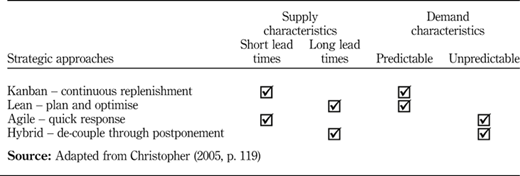
Christopher (2005) proposes four broad generic supply‐chain strategic approaches based on lean and agile principles dependent upon the combination of supply/demand characteristics, summarised in Table I and where “supply characteristics” refers to the lead time of replenishment (“short lead times” or “long lead times”) and “demand characteristics” refers to the predictability of demand that is mainly measured by the variability (“predictable” or “unpredictable”).
Much has been written about lean thinking, often with reference to the automobile industry, where the word “lean” was coined by John Krafcik (Womack et al., 1990). Leanness refers to doing more with less, and it owes its origins to the Toyota Production System. The lean supply‐chain approach mainly seeks to minimise the inventory of components and the work‐in‐progress and to move towards a just in time environment.
Childerhouse and Towill (2000) propose that leanness is particularly relevant when demand is relatively stable and predictable. In particular, the lean principle responds to more predictable demand by continuous replenishment, when the lead time is short (in Table I, “Kanban”), and by planning and optimisation, when the lead time is long (in Table I, “Lean”) (Christopher, 2005).
The agile principle is used when unpredictable demand is combined with a short lead time (in Table I, “Agile”). The concepts of emergency and humanitarian logistics have been linked to the agile principle in several academic contributions (Charles et al., 2010; Scholten et al., 2010; Kovács and Spens, 2009; Pettit and Beresford, 2009; Taylor and Pettit, 2009; Oloruntoba and Gray, 2006; Towill and Christopher, 2002); this principle has also been closely linked to theories of unexpected shock that affect supply chains (Van Wassenhove, 2006; Lee, 2004).
The focus on agility from the supply‐chain perspective emerged in 2001 and was initiated by Van Hoek et al. (2001). Supply‐chain agility is usually defined as the ability to respond to unanticipated changes (Sheffi, 2005). According to Lee (2004), the main objectives of an agile supply chain are to respond quickly to short‐term changes in demand (or supply) and to smoothly handle external disruptions (Charles et al., 2010).
An agile supply‐chain needs a massive and periodic source of employment (Peck, 2005), and it cannot be reached with a low cost level (Lapide, 2006; Gattorna, 2006). In cost configuration, “reasonableness” is the perspective to maintain in response to uncertainty (Hofman and Cecere, 2005). The availability of the good/service is linked to the reasonable cost, which is in contrast to cost efficiency; efficiency is typical of the lean approach (Towill and Christopher, 2002). The ability to respond with a high priority, according to supply and demand, may mean that the redundant capacity can be used exclusively to face unexpected events. However, the redundant capacity, that is the overflow of traditional activity, represents a cost that has to be sustained to face the unpredictable.
The concept of agility goes beyond the level of the single firm. It refers to the entire supply chain to which the company belongs and has some particular characteristics. The following rules are considered as valid to ensure proper agility along the entire supply chain (Christopher, 2005):
communication about the situation to partners;
creation of a net with suppliers;
postponement projection;
low‐cost stock;
construction of a dependable logistics system through the creation of a stable net with 3PLs; and
formation of a team to implement the emergency plan.
Thus, an agile supply chain has to be oriented towards the market (market sensitive) and has to feature a continuous exchange of (virtual) information flow among the actors, who have to collaborate (process alignment) and generate a network (network based) (Christopher, 2005).
The agile principle does not exclude the lean principle; rather, the two principles can work within the same supply chain at different moments (Scholten et al., 2010; Narasimhan et al., 2006; Christopher, 2005; Aitken et al., 2002; Childerhouse and Towill, 2000; Mason‐Jones et al., 2000; Naylor et al., 1999).
Specifically, Christopher (2005) considers a de‐couple point through postponement when lead times are long and demand is unpredictable (in Table I, “Hybrid”). According to Childerhouse and Towill (2000), when the market is volatile or uncertain, “leanness needs to be decoupled from part of the supply chain process and combined with agility into a hybrid ‘leagile’ strategy where lean principles are applied downstream in the chain and the concept of agility upstream” (Scholten et al., 2010, p. 627). If we refer to Christopher and Towill (2001), there are other practical ways of marrying the lean and agile paradigms, besides the decoupling point: the Pareto curve approach and the separation of base and surge demands.
Lean and agile paradigms may also coexist within the emergency supply chain (Scholten et al., 2010), but the specific phases of the humanitarian logistics process in which the leanness and agile principles are applied have yet to be determined.
In the next section, the typical stages that constitute the emergency process are described.
2.2 Stages in the humanitarian supply chain
Kovács and Spens (2009, 2007) review various systems used by previous authors to classify the different phases that follow a disaster (Altay and Green, 2006; Pettit and Beresford, 2006; Van Wassenhove, 2006; Lee and Zbinden, 2003; Thomas, 2003; Nisha de Silva, 2001; Long, 1997).
The various definitions are essentially similar and refer to three specific moments:
- (1)
preparedness;
- (2)
immediate response; and
- (3)
reconstruction.
Preparedness is used to avoid the gravest possible consequences of a disaster.
This phase is crucial, because it is the phase in which the physical network, IT systems and the bases for collaboration are developed (Kovács and Spens, 2007). In particular, network design is very important to shorten response times. As an example of preparedness, “pre‐positioning critical relief supplies in strategic locations around the world is a strategy recently implemented by some humanitarian relief organizations to improve their capacities in delivering sufficient relief aid within a relatively short timeframe” (Balcik and Beamon, 2008, p. 102). Other contributions are related to the “last mile distribution” (Balcik et al., 2008) and inventory modelling (Beamon and Kotleba, 2006).
The immediate response phase has two main consecutive objectives:
- (1)
to respond by activating the “silent” network or “temporary networks”, as defined by Jahre et al. (2009); and
- (2)
the second objective is to restore in the shortest time possible the basic services and delivery of goods to the highest possible number of beneficiaries.
In reference to the first objective, connections to feasible donors, suppliers, other NGOs and other partners are created in the first phase but are not activated until the catastrophic event takes place. To form these networks, a contingency team is formed, according to the event type and to the estimated damage, whose main aim is to create proper channels for information and material flows.
In reference to the second objective, as Kovács and Spens (2007) mentioned, the immediate response links humanitarian demand, supply and fulfilment management, and operates under a shortage of resources and information. As highlighted by Van Wassenhove (2006, p. 480), “at the start, it is speed at any cost and the first 72 hours are crucial”.
In the immediate response collaboration and coordination among all the actors involved in humanitarian emergency deserve great attention (Balcik and Beamon, 2008; Kovács and Spens, 2009, 2007; Maon et al., 2009; Tomasini and Van Wassenhove, 2009a).
The reconstruction phase aims to address the problem from a long‐term perspective. The effects of a disaster can last for a long period of time and have severe consequences for the affected population. Unfortunately, this phase is generally neglected, often due to the shortage of funds (Kovács and Spens, 2007).
In terms of operational performance the interesting part about the transition between the stages is the shift in focus from speed to cost reduction (Tomasini and Van Wassenhove, 2009b, p. 550).
Having briefly described the different stages that constitute the humanitarian logistics process, it remains to be determined which principle is more appropriate (lean and/or agile) for each specific phase.
In the next section, a correspondence between lean and agile principles and the typical stages that constitute the emergency process is proposed.
2.3 Correspondences between principles and stages in humanitarian supply chains: a proposed framework
From the aforementioned literature, the following conclusions emerge:
the agile principles are suitable to address the extreme conditions faced by humanitarian emergency, but the lean principles may also be useful; while agility supports effectiveness and speed, leanness is focused on efficiency and cost saving (Section 2.1); and
the emergency process comprises various phases; essentially, we may refer to preparedness, immediate response – responding and restoring – reconstruction, shifting in focus from speed to cost reduction (Section 2.2).
An agile supply chain is the most appropriate response to the extreme conditions faced by humanitarian emergency; it must be effective and respond as quickly as possible, it requires a massive and periodic employment source and has a high cost level.
Therefore, agility is not sustainable along the entire humanitarian logistics process in disaster relief operations and for a long period of time. Even if it were possible to sustain agility, however, it would be unnecessary to do so.
Each stage of the process has a specific objective to be achieved and each objective can be obtained with the application of specific principles. The correspondence stage‐principles is based on the coincidence of the objectives that arise in every stage with the objectives that each principle can achieve.
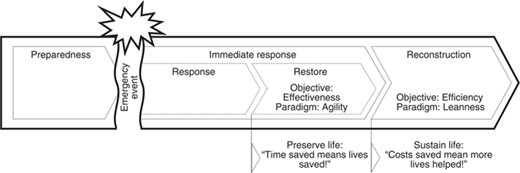
In humanitarian supply chains, the effectiveness ensures that we are saving time and time saved means more lives saved; the efficiency ensures that we are saving costs and costs saved mean more lives helped.
In particular, the specific phase whose objective (saving time that means more lives saved) can be satisfied by agility (ensuring effectiveness and speed) is the restoring stage. The reconstruction stage has a different objective (saving costs that means more lives helped) that specifically corresponds to the characteristic of the lean principle (guarantying efficiency and cost saving).
In this work we propose the correspondence stage‐principles only referring to restoring and reconstruction phases. We focus the attention on those operative stages that require an extremely substantial use of resources; in these cases the dimension of resources invested is particularly important in comparison with the other two phases, the preparing stage and the responding stage.
To allow organisations to achieve their objectives of effectiveness and efficiency much can be done during the planning activities: in fact it is during preparedness and response phases that agility and leanness are designed and developed within the process to be used in the last two phases (restore and reconstruction).
Based on the above considerations, we propose a framework to determine the specific stages in which the agile and lean principles are needed to address humanitarian logistics (Figure 1).
The correspondence is based on the coincidence of the objectives that arise in every stage with the objectives that each principle is capable of achieving:
The agile principle guides the restoring stage in the immediate response in accordance with the urgent effectiveness objective.
The lean principle guides the reconstruction stage in accordance with the efficiency objective.
Agility is applied upstream in the chain and lean principles are applied downstream.
3. Research approach
To gain deeper insight into the combination of the lean and agile supply‐chain strategies during the specific stages of the logistics process in the context of a humanitarian emergency, an exploratory case study approach was used.
The importance of case study research in the social sciences and in management is widely acknowledged (Seuring, 2008; Flyvbjerg, 2006; Yin, 2003; Patton and Appelbaum, 2003; Stuart et al., 2002; Ellram, 1996; Stake, 1995; Hamel, 1993; Eisenhardt, 1989). Logistics researchers have also advocated for the use of case study research as an approach to scientific inquiry (Aastrup and Halldorsson, 2008; Skipworth and Harrison, 2004; Voss et al., 2002).
The empirical phase of this research employs the case study approach because it is useful for exploring areas where theory is still developing and because it enables the researcher to gain an in‐depth understanding of “complex phenomena” that are difficult to investigate using other techniques (Eisenhardt and Graebner, 2007; Yin, 2003, p. 2; Harrison, 2002; Voss et al., 2002; Meredith, 1998; Ellram, 1996; Eisenhardt, 1989). Moreover, Ellram (1996) concludes that case studies are excellent for providing detailed explanations of best practices.
The single case study approach that is applied in this analysis generates in‐depth information on a single organisation using a variety of sources, including technical artefacts (e.g. physical structures and service offerings), interviews, documents and archival material, to triangulate the data within the case. The triangulation of data collection methods from different organisational sources increases the reliability and validity of the results (Yin, 2003; Voss et al., 2002; Easterby‐Smith et al., 2002; Eisenhardt, 1989).
We have chosen to analyse the case of the United Nations World Food Programme, which is involved in international missions related to humanitarian crises and is the most important logistics service provider for such emergencies.
This case was chosen based on the relevance of the humanitarian logistics operator, which is capable of providing a set of best practices to both the humanitarian and business sectors.
The case of the WFP is briefly described in the section below. After introducing WFP, the first part of this section describes the UN Agency Operations. The second part describes the typical agile characteristics of the EMergency OPerations (EMOPs). The third part focuses on a specific EMOP that took place in Darfur (Sudan). After reading this case study, it is possible to identify the distinctive stages of WFP humanitarian emergency process, their objectives and the principles that are appropriate to reach those objectives.
We performed an in‐depth verification only in relation to the applicability of the agile principle because agility is the more pressing topic in recent academic and practitioner literature on emergency and humanitarian logistics.
4. The United Nations World Food Programme: a case study
The WFP is the UN front‐line agency in the global fight against hunger. Founded in 1961, it is the largest humanitarian agency worldwide. In the ongoing effort to alleviate global hunger and poverty, WFP uses food as the vehicle to meet emergency needs and to support economic and social development. Most notably, WFP provides the logistical support that is necessary to deliver the right amount of commodities to the right groups of beneficiaries at the right time. More generally, it works to place hunger at the centre of the international agenda by promoting policies, strategies and operations that directly benefit the poor and hungry people of the world.
4.1 WFP activities and review of its operations and operational pattern
Operationally, WFP is active in four “settings”:
- (1)
emergency;
- (2)
recovery;
- (3)
development; and
- (4)
special operations.
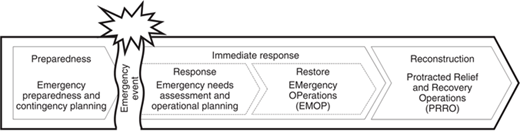
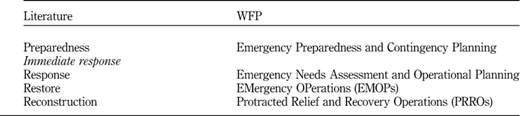
When there is an emergency, the Emergency Preparedness and Contingency Planning team makes sure that WFP is ready act at any time because time saved means lives saved. In the early days of an emergency, WFP quickly establishes how much food assistance is needed and the best way to deliver that assistance to the hungry. To do so, they work with emergency assessment teams. On the basis of the assessment, WFP draws up a detailed plan of action and budget, which is called the Emergency Needs Assessment and Operational Planning. Equipped with the answers, WFP draws up an EMOP, which includes a plan of action and a budget. This lists who will receive food assistance, what rations are required, the type of transport WFP will use and which humanitarian corridors lead to the crisis zone.
EMOPs usually last for between three and 12 months. If further assistance is required, WFP prepares a Protracted Relief and Recovery Operation (PRRO) that helps to sustain disaster‐hit communities as they re‐establish livelihoods and stabilise food security, in the more efficient way so that costs saved mean more lives saved.
In addition to its emergency relief and recovery operations, WFP is deeply involved in other initiatives. WFP development aid, which is delivered through Development Operations, temporarily frees the poor of the need to provide food for their families and gives them time and resources to invest in lasting assets, such as better housing, clinics and schools and new agricultural skills and technology.
Moreover, Special Operations are designed to speed up the movement of food aid, regardless of whether the food is provided by the agency itself. Special Operations are short term in nature and usually complement EMOPs or longer rehabilitation projects (PRROs). Typically, they involve logistics and infrastructure work and are designed to overcome operational bottlenecks.
Initially, WFP was a development agency that had only minor involvement in EMOPs, but it has gradually become the main focus of operations; more than a third of the total official development assistance has been directed to emergencies.
The EMOPs of WFP cover three main categories of crisis:
- (1)
sudden disasters, including natural disasters that affect food access or cause population displacements, or both, and which require special UN coordination procedures;
- (2)
slow‐onset disasters, which are usually droughts and crop failures; and
- (3)
complex emergencies, which may involve conflict, widespread social and economic disruption and large population displacements and which usually require UN coordination.
In particular, EMOPs can help needy populations by distributing items or through other initiatives, such as food aid in exchange for reconstruction work. These operations are primarily funded by targeted donor contributions in response to a WFP appeal.
In the case of longer‐term projects, WFP prepares a PRRO. These projects aim to sustain communities that are hit by disasters by restoring livelihoods and by stabilising food security; they have four key components:
- (1)
food for education and training, wherein food is used as a source of encouragement to women, teenagers and ex‐combatants to learn new skills;
- (2)
extended relief by providing for returning refugees, internally displaced people, and acutely malnourished and vulnerable households;
- (3)
relief for refugees and assisting refugee populations; and
- (4)
food for recovery through the establishment of food‐for‐work programmes.
From an operational point of view, WFP, together with many other UN agencies, has moved towards a more organised response model and has adopted the so‐called cluster approach with a clear aim of strengthening the overall response capacity and the response effectiveness. It does so by leveraging the effort in five key ways. First, it ensures that sufficient global capacity is built and maintained in all of the main areas of response, which further ensures timely and effective responses to unforeseen crises. Second, it secures predictable leadership in all of the main aspects of response by the nomination of “cluster leads” charged with the responsibility for ensuring that response capacity is in place. Third, the cluster approach is designed around the concept of partnerships among the UN agencies, international organisations and NGOs. Fourth, it makes the cluster leaders accountable to the Emergency Relief Coordinator for building a more predictable and effective response capacity, in line with Inter‐Agency Steering Committee agreements. Fifth, and finally, the approach should help improve strategic field‐level coordination and prioritisation in specific aspects of response by locating specific responsibility for leadership and coordination with the competent operational agency.
Over the years, boosted by its important role in the Sudan, the cluster approach has confirmed the logistics leadership of WFP in emergencies worldwide.
4.2 Some characteristics of agility in EMOPs
The agile approach used by WFP in the immediate response to a crisis that occurs through its EMOPs fully corresponds to the rules of agile for the supply chain (Christopher, 2005):
- (1)
communication about the situation to partners;
- (2)
creation of a net with suppliers;
- (3)
postponement projection;
- (4)
low‐cost stock;
- (5)
construction of a dependable logistics system through the creation of a stable net with 3PLs; and
- (6)
formation of a team to implement the emergency plan.
Specifically, with regard to information sharing along the chain (1), it is noteworthy that WFP utilises an information and communication technology‐sharing network that is based on SAP's commercially available enterprise resource planning software and that permits the global real‐time connection of actors in the chain at different levels to share information that is relevant to ongoing projects and current situations. The information and communication technology‐sharing network involves a telephone network (Food‐sat) that permits free remote calls from any WFP office in the world and a radio network that is used to contact staff in the field.
Concerning the creation of collaborative relationships with suppliers (2), the first to be chosen are those who can respond fastest and who are nearest to the emergency, even if the cost is higher. When no suppliers are located near the emergency, certain suppliers are used that have become “institutional” due to their reliability and responsiveness to the needs of WFP during past events. In the emergency phase, in contrast to the development phase where policy follows the rules of an auction, the manager who is responsible for logistics can choose a preferred supplier without consulting the board as long as the budget and the need for urgency are observed. This is why fruitful and lasting collaborations have characterised the modus operandi of WFP over the years. WFP has also developed close working relationships with militaries that are free of any direct cost. During the Israel‐Lebanon crisis, for example, the earliest assistance was provided by the navy.
Postponement and the creation of buffer supplies ((3) and (4)) are strongly interrelated. In the case of WFP, the former is exclusively related to the so‐called “logistics postponement” (Yang et al., 2004) and therefore to a particular organisational strategy and stock management along the supply chain that combines “time and place” postponement (Bowersox and Closs, 1996). Once relationships with suppliers are established, WFP enables those suppliers without anticipating the necessary activities. Instead, WFP postpones the activities for as long as possible while respecting the minimum nutritional levels set down for formal food aid. In the case of non‐food aid, stores are set aside to maintain stocks. The basic stocks are located in the agency's two main warehouses in Brindisi and Dubai, where surplus goods from previous missions are stored in anticipation of the next need. These are not only non‐food‐aid materials but also long‐term food supplies.
The main logistics partner of WFP (5) is the global courier company TNT, which provides operational assistance, using its own assets, and training courses and consultancy. This important partnership thus supports WFP not only in terms of strictly logistical activities but also with extra services and added value in the form of integrated logistics, thus realising cross‐learning opportunities between the business and humanitarian sectors.
The contingency projects and the establishment of a team to manage the crisis (6) are planned by the unit that is responsible for logistics. In particular, is the teams are formed in the “Emergency Needs Assessment and Operational Planning”. Step by step, a task force is raised that comprises various key actors, each of whom is responsible for a critical managerial area: operations, fundraising, policy and administration. In some cases, other specialist operators may be co‐opted. At the organisational level, the following stable organisational units operate in the operation department: support of the “Analysis, Assessment and Preparedness Service”, “Emergency Needs Assessment Branch”, “Emergency Preparedness & Response Branch” and the “Vulnerability Analysis and Mapping Branch”.
An excellent example of the implementation of the agile principle in WFP EMOPs is the case of Darfur in Sudan.
4.3 WFP EMOP in Sudan
Since 2006, Sudan has represented the most complex humanitarian challenge for WFP, and large‐scale humanitarian assistance in conflict‐affected areas will continue to be needed in 2011.
With an emergency budget of US$697 million to meet its strategic objective of assisting those affected by the conflict, WFP expected to provide food assistance to 5.6 million vulnerable people. WFP presence on the ground was limited to Darfur, the South, the East and the transitional “Three Areas”. Among these, Darfur represented the largest humanitarian emergency in the world, accounting for more than 70 per cent of WFP budget for Sudan and requiring food for more than two million internally displaced persons.
The combined impact of persistent drought and the conflict further complicates the situation in the central and eastern regions. Malnutrition rates in the states of Kassala and the Red Sea are consistently above emergency levels while communities in the Three Areas (Abyei, Blue Nile and South Kordofan) face significant challenges resulting from a serious lack of infrastructure. In those states, WFP provides assistance to about 300,000 people. The objectives and timing of the operations are fully harmonised with the United Nations Development Assistance Framework, which targets a total of approximately half a million people.
Operationally, the UN Humanitarian Air Service (UNHAS), which is operated under WFP guidance, has been used by all relief organisations working in Sudan to reach the field locations. In 2007, UNHAS transported 160,000 passengers from about 170 humanitarian agencies and non‐governmental organisations. In 2008, its budget of US$77 million was expected to provide transportation to about 15,000 humanitarian passengers each month. At the same time, road repair and mine clearance projects were undertaken in South Sudan.
Specifically, two WFP units significantly supported the response. The “Commodity Movement Processing and Analysis System” is a monitoring tool that tracks all commodities with the aim of increasing efficiency coordination in the supply pipeline. It is updated daily, and the data are consolidated at the regional level in an Oracle database. The “Fast IT and Telecommunications Emergency and Support Team” (FITTEST) was launched in 1998 and is one of the main cells within WFP “Field and Emergency Support Office”. It provides rapid intervention in emergencies and support to large‐scale humanitarian operations as part of an existing project or as a stand‐alone “turnkey” solution that involves total coordination, technical support, assistance with all documentation, budget tracking and other such services. FITTEST delivers comprehensive information and communication technology services in the fields of telecommunications (radio, telephone and satellite), IT (hardware, software, computer networks, Lotus Notes, WINGS, internet and e‐mail) and electricity supply (including wiring, power rectification equipment, solar power and generators). The specifications of FITTEST information and communication technology and its engineering teams are designed to respond to emergencies within 48 hours, and its current inventory, which is worth US$3.1 million, is sufficient to deal with three complex emergencies simultaneously. In addition to emergency preparedness and response, FITTEST is mandated to implement WFP Minimum Security Telecommunications Standards and the UN‐wide Minimum Operating Security Standards for WFP and for other UN operations worldwide.
The combination of logistics improvements has also benefited from the Supply Chain Optimisation Project, which was initiated in 2004 and uses the integrated supply‐chain concept as a primary means of improving overall performance. This project approach has been markedly field oriented, and many of the proposed improvements have been based on feedback and suggestions received from country offices on the improvement of current supply‐chain performance. Three main objectives have been defined: shorter, predictable lead times; the on‐time delivery of food commodities to country offices; and the maximisation of available resources.
In the context of WFP, one of the primary means of improving supply‐chain performance is a radical shift from the more traditional supply‐chain model, which can often result in suboptimisation, to a more integrated approach. This new approach has been evident during operations in the Sudan, where the Supply Chain Optimisation Project has been put in place and is aligned with the New Business Model/Project Planning Tool. Two new tools are now available as well: the import parity tool, to help determine the best purchasing source in terms of cost and on‐time delivery; and the lead‐time tool, for the purpose of call‐forwarding and cargo‐planning purposes in relation to international purchases.
This integrated pattern, together with a focused distribution of resources, has allowed WFP to gradually reduce the complexity of the supply chain by concentrating on a precise response typology while reducing the variety of the supply.
Additionally, WFP anticipated any possible postponement problem by aligning the demand for commodities with supply. To that extent, the homogeneous Sudanese market and the emergency situation facilitated the response and alignment.
The consistent application of the agile principle in Sudan brought an unprecedented level of operational effectiveness such that 560,000 metric tons of food aid were delivered between April 2004 and December 2005, resulting in the highest monthly delivery rate.
5. Conclusions
From the analysis of the process of delivering humanitarian aid, the conclusion emerges that WFP uses the agile principle in the EMOPs. According to the urgent effectiveness objective of this stage, the agile principle seems to be the most appropriate.
Although this study only performed an in‐depth verification of the applicability of agility, we may also consider that the lean principle is used in PRROs. In fact, according to the efficiency objective of this stage, the lean principle appears more appropriate.
Moreover, having considered the relevant theoretical literature and described the process of delivering humanitarian aid though a case study of WFP emergency supply chain, we can now propose that the empirical phases, which concern the emergency relief process of WFP, correspond to the theoretical phases, which relate to the process of recovery after a catastrophic event (Table II).
Therefore, WFP humanitarian supply chain exhibits the following:
the agile principle – according to the objective of urgent effectiveness – in the EMOP stage, which corresponds to the restoring stage in the immediate response; and
the lean principle – according to the objective of efficiency – in the PRRO stage, which corresponds to the reconstruction stage.
Our conclusion affirms that the agile principle is adopted in the restoring stage and the lean principle is adopted in the reconstruction phase.
The strategic arrangement adopted by WFP thus follows the theoretical framework, in terms of stages, objectives and principles (Figure 2).
Although several previous studies introduced the agile principle as suitable for disaster relief, when and how to embrace the agile and the lean principles remained unclear.
This paper describes the combination of agile and lean principles that should be used according to the phases of disaster relief. It offers several insights for both humanitarian logisticians and academics throughout the proposed framework and the reflections arising from the case study.
Lean and agile principles are both needed in specific stages of the humanitarian logistics process.
This consideration may help practitioners to better focalise on a real effective and efficient use of the resource within an humanitarian operation. In doing that they will also have better opportunities in obtaining more limited donations by increasingly sceptical benefactors.
It could also be useful to better manage the coordination of different actors (humanitarian organisations, governments, military, civil society, etc.) working together and combining their capacity and competences to relieve human suffering when a humanitarian emergency strikes. Getting these different actors to work together requires to know phases, objectives and guide principles that must inspire their action.
This approach, which is based on a combination of the agile and the lean principles, is not exclusive to the humanitarian sector.
This perspective may be useful in business logistics when dealing with disruptions that affect traditional supply‐chain flows and their logistics, production and information handling. In the humanitarian sector, an effective reaction to unpredictable events results in human lives saved, whereas in the business sector, it may provide, at least, a strong competitive advantage or it may contribute, in severe cases, to the survival of the firm.
6. Limitations and future directions
This study has certain limitations that can be addressed in future research. Although this exploratory study has provided an original and significant step in clarifying when to embrace the agile and the lean principles in terms of their coincidence with the objectives of phases in the humanitarian process, further research should strive to extend the analysis.
It might be valuable to focus empirical analysis on the adoption of the lean principle in the reconstruction stage. Additionally, further investigation might consider additional humanitarian organisations.
Within WFP case, it might be interesting to consider the application of leanness and agility in the logistics process of Special Operations, more comparative cases of EMPO, and the application of the lean approach to PRRO.
Besides combining lean and agile principles with those operative stages that require an extremely substantial use of resources in the humanitarian supply chain, it could be useful discuss their applicability in the other two phases (preparedness and response). It could also be helpful to consider if the proposed ways to marry lean and agile principles in the business sector (i.e. de‐coupling point, Pareto curve, etc.) can be used in the humanitarian context.
Moreover, the issues raised in the present study can be taken as starting points for further interesting analyses of supply‐chain governance. Relationships between the logistics provider (humanitarian, in this case) and the suppliers of assets and services (involved at the moment of the disaster) are very critical to the supply chain. Therefore, it would be interesting for future research to investigate whether the humanitarian logistics provider that is devoted to emergency management can be considered the “orchestrator” of the entire logistics chain.
References
About the authors
Alessandra Cozzolino is an Assistant Professor in the Department of Management at Sapienza University of Rome. She received her PhD in Management and Finance in 2007 and her MSc degree in Management and Business Administration in 2003 from the Sapienza University of Rome. Her research interests are supply chain management, logistics services providers strategies, sustainable operations and humanitarian logistics. Alessandra Cozzolino is the corresponding author and can be contacted at: alessandra.cozzolino@uniroma1.it
Silvia Rossi is a Senior Research Fellow at the Supply Chain Research Centre, Cranfield School of Management. She gained her PhD in Economics and Finance in Business Management in 2008 and her MSc degree in Management and Business Administration from the Sapienza University of Rome in 2004. Her research focus is in the areas of supply chain strategy, reverse logistics, sustainability and humanitarian logistics.
Alessio Conforti is a Manager at the European Investment Fund (Group of European Investment Bank) and a Researcher in the EIF Research and Market Analysis Unit. Prior to this tenure, he acted as Resource Mobilization Officer for the World Food Programme. He holds a PhD in Economics from the University of Roma Tre, and an MBA from London Business School. He is active as Visiting Researcher and has published in the fields of macroeconomics, international finance, economic growth, and humanitarian logistics.