The purpose of this paper is to identify chain coordinators and to explore their roles. The paper also highlights certain advantages of coordination, specific competencies of the coordinators, and challenges in the coordination.
This is a case study research. The data were collected through interviews, observations, and personal experiences of working as a logistics manager and a project manager in the 2005 South Asian earthquake.
The coordinated organizations manage a number of complex relationships to respond to the disasters effectively and efficiently. An umbrella organization plays a chain coordinator role in horizontal coordination. The umbrella organization leads, directs, and makes major decisions. A country director/programme manager acts as a strategic coordinator in vertical coordination. However, logistics managers, procurement managers and project managers (operations coordinators) also handle coordination activities. The coordinators’ tangible (finance, technology, and people) and intangible (leadership, extra efforts, relevant experiences and education, relationship management skills, research abilities, and performance measurement skills) assets are the key determinants of chain‐coordination success. The success of coordination is achieved if these characteristics of the coordinators are effectively matched with the unpredictable nature of humanitarian relief chains. However, coordination does not guarantee success in all situations because organizations may face coordination challenges such as cultural and structural differences.
This paper provides specific and detailed information from the selected humanitarian relief chains of the South Asian earthquake 2005. The paper explores the useful and enhanced understanding of fundamentals to achieve the success of coordination in the chains. Therefore, it is an endeavour to enable a better practical strategy for chain coordinators/managers.
The conceptual and empirical research on the characteristics of chain coordinators and their impact on coordination success is very limited. This paper provides new thoughts to investigate relationships between the characteristics of chain coordinators or coordination and the success of humanitarian relief chains.
Introduction
Coordination is the core of supply chain management. The objective of coordination in humanitarian relief chains (HRCs) is to respond to man‐made or natural disasters effectively. These disasters cause loss of lives, shortage of food and water, and structural damages. For example, Oloruntoba and Gray (2009) believed that Chinese earthquake killed more than 67,000 people in 2008. Similarly, in Cyclone Nargis (in Myanmar), about 78,000 people lost their lives. The most recent natural catastrophe of Christchurch earthquake (New Zealand, 2010 and 2011) and Tokyo tsunami (Japan, 2011) cost millions of dollars to rehabilitate the areas. The coordination among organizations is a necessity in such circumstances because it is almost impossible for a single organization to fulfill the needs of people affected or rebuild the infrastructure. Hence, different organizations come together to react to these disasters. They provide food, water, tarps, shelters, medicines, and other supplies to the affected people. They also assist in reconstruction of the damaged infrastructure. These organizations often share their resources and work together to complete these objectives. This system of interdependency is called coordination. Balcik et al. (2010) defined the term coordination as “the relationships and interactions among different actors operating within the relief environment” (p. 23).
The chain‐coordination mechanism is defined as “a set of methods used to manage interdependencies between organizations” (Xu and Beamon, 2006, p. 4). In commercial chains, Spekman et al. (1998) and Cao et al. (2008) believed that the coordination system brings together the sequential‐interdependent activities of organizations such as suppliers and retailers. These organizations coordinate tangible and intangible assets such as organizational processes, people, management skills, and experiences. They align existing resources with these coordinated assets as well as equally share benefits and risks to manage globally scattered chains. In HRCs, this mechanism occurs among different organizations such as among international relief actors, among international relief actors and local organizations, and among relief (both local and international) actors and private or government organizations (Balcik et al., 2010).
It appears that there is no standard definition of chain coordination because of different nature of businesses and perceptions mentioned above (e.g. Spekman et al., 1998; Xu and Beamon, 2006; Cao et al., 2008; Balcik et al. 2010). However, it can be defined as a process whereby the activities of interdependent organizations are brought together to achieve certain objectives. Furthermore, the chain coordination can be explained vertically and horizontally. This is precisely what Balcik et al. (2010) posited that the vertical coordination refers where organizations coordinate with upstream and downstream activities. For instance, if a non‐government organization (NGO) coordinates with transport companies to complete certain objectives, this would be an example of the vertical coordination. The vertical coordination is an “arrangement between buyer and seller, entered into freely, to facilitate a mutually satisfying exchange over time, which leaves the operation and control of the two businesses substantially independent” (Hughes, 1994, p. 5). The vertical coordination occurs between parts of the chains and the horizontal coordination takes place within a part of a chain (Fearne, 1998). In the horizontal coordination, different organizations coordinate with each other and mange interdependencies at the same level. A case of the horizontal coordination would be if one NGO coordinates with a second NGO (Balcik et al., 2010). “Linkages,” “alliances,” “value‐added chains,” and “partnerships” are examples of the horizontal or vertical collaboration (Fearne, 1998, p. 224).
One of the current discussions is who possess the control of chain‐coordination activities. Moreover, what prerequisite characteristics (competencies and resources) are required to achieve the success of vertical and horizontal coordination has become a pivotal question. These characteristics can be seen as tangible resources (skilled workers, technology, reliable transport, and finance) and intangible assets (leadership, relevant education, and experiences) (Akhtar et al., 2010). The success of coordination among different organizations depends on these characteristics of chain coordinators. The questions arise who are the chain coordinators and why do we need them. Chain coordinators can be defined as key players who are involved in major decision making, leading, and controlling of main coordination activities (Mehta et al., 2003; Akhtar et al., 2010). The coordinators provide a leadership to the network of organizations. Their leadership manages a portfolio of customers, customer priorities, customer centricity, and resolve conflicts. They also assume the role of managing and building infrastructure, information systems, training programs, and communication (Galbraith, 2001). In HRCs, the coordinators are often central to the success of coordinated organizations because they lead a number of pivotal activities such as recruiting and retaining paid workers or volunteers, managing and developing staff, managing communication and information, allocating resources, managing accounts and funds, guiding senior managers, and building effective working relationships with relevant decision makers of involved parties like government or other NGOs.
The role of a chain coordinator is either played by an organization or a person. In commercial chains, previous research (Bessant et al., 2003; Belaya et al., 2009) showed that big powerful retailers or distributors are referred to as chain coordinators. For instance, Smith (2006) considered Tesco (a big UK‐based retailer) as chain coordinator. A number of studies (Mehta et al., 2003; Heggde, 2008; Cao et al., 2008) also regarded persons as chain coordinators. For example, Mehta et al. (2002) identified sales managers as chain coordinators. Kemppainen and Vepsalainen (2003), Rosenbloom (2004), and Heggde (2008) believed that top sales and marketing executives, chief executes officers, or managing directors play the role of chain coordinators. In HRCs, the terms umbrella organization or natural chain coordinator have been used. The example of such organizations is World Food Programme (Balcik et al., 2010).
The term chain coordinator also has a number of variants such as chain captain, chain champion, chain manager, chain master, chain leader, senior marketing managers, directors, and CEOs. These alternative names are, sometimes, used interchangeably (Mehta et al., 2003; Rosenbloom 2004; Akhtar et al., 2010). The terminology used depends on an organization's chart or a study's focus. This study uses the terms umbrella organization and chain coordinator.
However, little is known about what characteristics are required for an effective and efficient management of coordination, particularly, in HRCs (Pettit and Beresford, 2009). A number of studies (Beamon and Balcik, 2008; Oloruntoba and Gray, 2009; Balcik et al., 2010) described some factors leading to the success or failure of coordination activities in HRCs. Pettit and Beresford (2009), based on the literature from commercial chains, presented some critical success factors for HRCs. In automobile industry, Mehta et al. (2003) empirically analyzed the relationships between leadership skills of a chain coordinator and performance. Their results also showed that some competencies and practices could be effective in one situation but ineffective in other circumstances. In such uncertain conditions, chain coordinators need to adopt adaptable approaches to monitor, lead, control, and make decisions about activities of chain coordination. Furthermore, Mehta et al. (2002) found that only few organizations have officially chain coordinators’ position within their organizations’ charts. Kale et al. (2002) also found that 37 percent of companies have formal and informal teams for coordinating activities. There is, however, a lack of empirical investigation that identifies chain coordinators and explores their roles in HRCs coordination.
In order to fulfill this gap, this empirical study:
scrutinizes the literature on chain coordinators and their roles;
identifies chain coordinators and explores their roles from the selected chains of 2005 South Asian earthquake (SAE); and
also highlights certain advantages of coordination, specific competencies of the coordinators, and challenges in coordination.
This paper is further structured into six sections. The first section presents background information from the literature. The second section outlines method and data collection. The third section highlights the facts of 2005 SAE and the structures of involved organizations’ chains. The results are presented in fourth section. The penultimate section provides discussion while the final section summarizes some conclusions and future research.
Background
A number of coordination efforts were made in commercial chains in the recent past. For instance, Zineldin and Bredenlow (2003) stated that more than 20,000 organizations were coordinated worldwide between 2001 and 2003. The number only in the USA rose by 25 percent each year from 1987 to 2003. Furthermore, Bamford et al. (2004) believed that more than 5,000 collaborative enterprises were launched worldwide between 1999 and 2004. On the other hand, 60‐70 percent of such enterprises failed to achieve their coordination objectives (Spekman et al., 1996; Zineldin and Bredenlow, 2003; Bititci et al., 2009). For example, IKEA (a Swedish furniture company); Royal Dutch Airlines and Northwest Airlines; GM and Daewoo Group; Ericsson and Honeywell; Publicise Communication; and Foote, Cone and Belding did not fulfill their coordination expectations because of ineffective leadership and lack of experiences (Pangarkar, 2009). Apart from these for‐profit companies, it is generally believed that a number of humanitarian organizations also failed to achieve their desired coordination goals. For instance, Stoddard et al. (2007) believed that the cluster approach of the NGOs involved in SAE was failed to achieve the coordination objectives.
Chain coordinators act as a catalyst and pillar to ensure the effective coordination that is aligned, agile, adaptable, flexible, and productive for all coordinated organizations. The effective coordination improves information flow within and across chains. It also helps to gain enhanced control over the production, delivery of products, receiving donations, costs, and service quality. These factors are the key determinants of the effective coordination. The success or failure of coordinated organizations often depends upon who assumes chain coordination, and how the coordination is managed. Wong et al. (2005) blamed those chain coordinators who cannot develop effective relationships with chain partners. Such coordinators perform below expectations, and they are considered as a major source of failure. Patzelt and Shepherd (2008) also believed that ineffective chain coordinators are one of the main reasons of underperforming of coordinated organizations. These coordinators failed to build trust and keep a balance of power among chain players. Chain coordinators need to reconcile different coordination aspects such as spiritual leadership, effective resources’ utilization, timely and accurate sharing of information, relevant experience and education, relationship management, sustained commitment, research abilities, and performance measurement (Kale et al., 2001; Mehta et al., 2003; Narayanan and Raman, 2004; Kaplan and Norton, 2008). Furthermore, given the most recent global developments such as economic downturns and unstable political environments in certain countries has made it more difficult to achieve chain‐coordination objectives. Successfully meeting such objectives, even in challenging environments, often depends on the development of certain characteristics which successful chain coordinators must possess (Patzelt and Shepherd, 2008).
Research method and data collection
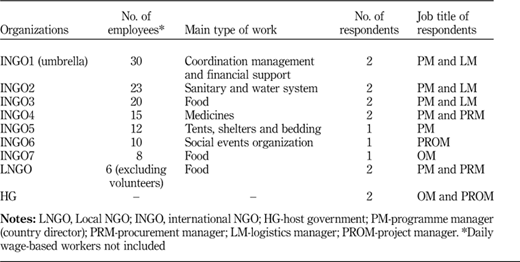
The sample consisted of eight medium‐ and large‐sized NGOs (one local and seven international NGOs) and the host government (see Table I). A total of 15 semi‐structured interviews were conducted from six program managers (country directors), three logistics managers, two procurement managers, two operations managers, and two project managers complemented by personal observations and experiences. The interviews were performed in the cities (Muzaffarabad, Bagh, and Rawalakot) of Pakistan‐occupied Kashmir.
As the research area is in developing process (Pettit and Beresford, 2009), a case study is a primary means of exploring field conditions and semi‐structured interviews help to get detailed and specific information. Moreover, the interviews with questionnaire produce better response rate and valid results (Meredith and McCutcheon, 1993; Denscombe 2003). Furthermore, there is a general distrust of other data collection techniques and lack of understanding of modern operations research and chain‐coordination concepts, particularly, in developing countries like Pakistan. Mehta et al. (2003) believed that in such circumstances semi‐structured interviews are more suitable for pre‐defined objectives of the study.
The objectives were to identify chain coordinators and to explore their roles and specific competencies. An open‐ended questionnaire was used to achieve the study objectives. The questionnaire was divided into two parts. The first part consisted of the questions which identified chain coordinators, and the second part explored their roles and competencies, benefits, and challenges of coordination (see questionnaire in Appendix).
The sample members were invited for volunteer participation in this research. This process was completed by contacting through telephone or in person visits. Purposive sampling was used for selecting the respondents because of two reasons. First, it helped to include the samples who meet the criteria. The criteria were to approach a cluster of organizations which worked together and also to involve the head of each organization who make major decisions regarding coordination. The cluster of coordinated organizations (host government, one local NGO, and seven international NGOs) was selected. Program managers/country director (head of the organizations) were asked which chain player or a person makes the major decisions in their chains and why (see Part 1 of the questionnaire in Appendix). The (program managers/country director) job titles of the head of organizations vary and it depends on their organizational structures. In the same chains, then logistics managers, procurement managers, and project managers also confirmed the identification of chain coordinators. Their opinions showed the consistency with the country directors’ views. This process indentified the chain coordinators. The respondents were also asked about their roles and benefits of their coordination approach. The competencies and challenges they faced were also investigated (see Part 2 of the questionnaire in Appendix). Second, the purposive sampling was used to obtain quality information from the targeted samples. The majority of the respondents were from middle and top management which provided confidence in the quality of given information.
Each interview was consisted formal and informal data collection. The formal part of interview was more than 60 minutes long and detailed notes were taken after getting permission from the respondents. In addition to this, immediately after interviews, informal conversations were also made with the respondents to check whether they had anything else to add. Audiotape recording was not allowed due to sensitivity of the topic and confidentiality rights of the respondents. The informal discussion with the respondents continued during field work. Furthermore, the data from interviews were double checked with the informal discussions. Secondary data was also used such as field notes, notes from presentations and meetings, notes from observations, internal reports, and proposals of involved NGOs. Moreover, the literature was used to support the arguments where possible. The results were triangulated by using these multiple resources which ensured reliability and validity (see Ellram, 1996).
Earthquake and structures of organizations
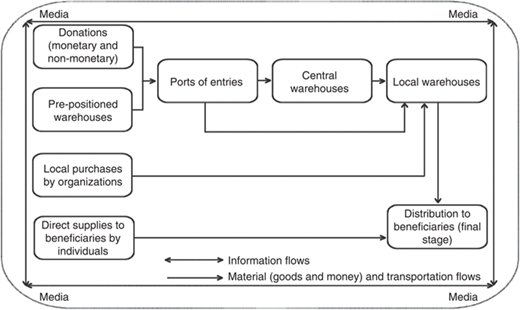
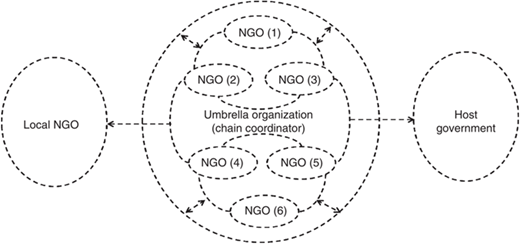
This section presents the facts of 2005 SAE and coordinated organizations’ structures. The Figures 1 and 2 were established based on personal experience of working with the NGOs as a logistics manager and a project manager. In addition to this, the information obtained during the interviews was also used to develop the model shown in Figure 2.
2005 SAE
The 2005 SAE occurred on October 8, 2005, at 08.50 a.m. (according to Pakistan standard time). The moment magnitude of the earthquake was 7.6 (Hicks and Pappas, 2006, Mulvey et al., 2008). This earthquake was considered one of the biggest natural disasters in the area. It hit the areas of Pakistan‐occupied Kashmir, Indian‐occupied Kashmir, and Afghanistan. The worst hit areas were cities of Pakistan‐occupied Kashmir. These cities were Muzaffarabad, Bagh, and Rawalakot, particularly, local areas such as Jabuta‐Kohukot and Ali Sojal. In these areas, the main infrastructure including roads, hospitals, schools, armed forces, and police were paralyzed. Some areas of North‐West Frontier Province of Pakistan were also badly damaged. According to the newspaper (Jang) and Mulvey et al. (2008), more than 86,000 people died and 100,000 people were injured in Pakistani‐occupied Kashmir. Later, hundreds and thousands of people were displaced to temporarily shelters. According to the Illinois International Review, over US$5.4 billion worth of aid was sent to help the affected region and people.
Structure (vertical coordination) of involved HRCs
The structure of involved HRCs is illustrated in Figure 1. The Figure 1 also represents the vertical coordination between parts of the NGOs chains. The solid arrows represent material (goods and money) and transportation flows from one point to another point. Double‐headed arrows (covering the figure from four sides) show information flow across the chains. The chains were consisted of donations, pre‐position warehouses, purchases by organizations, direct supplies by individuals, port of entry, central warehouses, local warehouses, and distribution to beneficiaries (final stage).
The first stage of the chains started from donations that came from different sources such as governments, charity organizations, corporations, and individuals. These donations were used to purchase supplies. The supplies (from pre‐position warehouses) were moved to the port of entry which was normally prevailed near to the sea or airports. Then the supplies were transferred to central warehouses that were suited in the host country or city. The goods were then shipped to local warehouses which were hired or established near to distribution points. The supplies from the port of entry were also directly moved to local warehouses depending on availability of the transport. Goods also came from individuals who personally purchased and directly distributed them to the beneficiaries. Sometimes, NGOs also purchased from local markets to meet emergency demand. This distribution was performed either from local warehouses or by transporting/distributing on the spots. The final stage of the selected chains was distribution of relief items.
These supplies were practically impossible to reach all the beneficiaries without reliable transportation (airplanes, ships, rails, and trucks). The links of transportation with important points are combined with material flows. Double‐headed arrows (horizontal side) show information sharing across different stages of chains. Double‐headed arrows (vertical side) depict information sharing within departments of the NGOs. In addition to this, media, usually not part of the chains, played a key role to attract donors and provide situation awareness of areas and people affected.
Structure of horizontal coordination
Figure 2 illustrates the structure of horizontal coordination among nine involved organizations (six international NGOs, an umbrella organization (this was also an international NGO), a local NGO, and the host government). Each small ellipse (with numbering (1)‐(6)) represents the international NGOs (except of the umbrella organization), the bigger circle or ellipse (covering small ellipses, with numbering 1‐6) depicts the umbrella organization, and the medium‐sized circles (on both sides of the bigger circle) show the local NGO and the host government. The dotted‐connectors (covering by the big circle) link (6) involved NGOs’ chains, and double‐headed arrows associate the NGOs’ chains with the umbrella organization's chain. Single‐headed arrows link all involved (international) NGOs’ chains with the local NGO and the host government. All involved international NGOs were from the same country[1]. The figure summaries the coordination among the involved organizations and benefits of this coordination are discussed in Findings section.
Findings
The data collected produced a wide range of fruitful information. The results are structured according to the questionnaire. The identification of chain coordinators is presented followed by the advantages of coordination and coordinators’ competencies. Additionally, the challenges and problems in coordination are also reported.
Chain coordinators
The results revealed that the umbrella organization played the role of chain coordinator in horizontal coordination. The umbrella organization leaded and directed others involved NGOs. It also made major decisions with collaboration of involved NGOs and donors.
In vertical coordination, country directors/program managers acted as chain coordinators. The country directors, called strategic coordinators, played a pivotal role in national‐ and international‐strategic operations. Strategic coordinators leaded and made all major decisions across their own chain. Strategic coordinators make decisions on evacuation or the prohibition of specific projects and activities. Their decisions are the final and nobody can overrule them. They make these decisions with the collaboration of key donors and their own top management who sent them for specific tasks in a country. An example of such decision was noted when one NGO (which was providing bedding and constructing shelters) decided to move to another country. This decision was made jointly by the strategic coordinator of the NGO and the ambassador of the country. These coordinators are also responsible for hiring, managing, and directing staff. Another example was the hiring of all national staff and deciding their salaries ranges. The strategic coordinator of the NGO (in which I – main author – was working as a logistic manager and project manager) hired about 15 middle‐level management staff including logistics managers, project managers, stock controllers, engineers, and operations managers. He also gave authority to these managers to hire their own team members; however, the pay scale for each position was decided by the strategic coordinators. In addition to this, they allocate financial resources and provide infrastructure and communication systems.
It was also found that logistics managers, project managers, and procurement managers (operations coordinators) are involved at operational level of chain coordination. These managers often perform dyadic‐relationships management with suppliers. Hence, formal‐ and informal‐coordination teams exist under the direction of strategic coordinators.
Regarding education and experience of the coordinators; strategic coordinators’ experience ranges from 10 to 30 years. They had Master's degree, and 67 percent of these managers specialized in management or development studies. The operations coordinators had Bachelor's degree in different fields, and their experience varies from 5 to 10 years.
Coordination advantages
The coordinated organizations had created several advantages. They had better capabilities, resources, and management which made them to respond to the disaster effectively.
Better capabilities and resources
The general purpose of each involved NGO was to assist the earthquake affected people and areas by sharing resources and competencies. The alliance structure of involved NGOs provided better capabilities and resources such as leadership, communication infrastructure, and finance. A program manager of food chain believed:
This (coordination) does not only strengthen our financial resources with multi‐skilled workers but also provides us with a central strategy under one direction and leadership of the umbrella organization.
The leadership is defined as an overall method of management skills employed by the umbrella organization which provided a platform for the coordination of NGOs involved. The umbrella organization leadership provided directions and central strategy that reminded them why were they there? The answer could be to provide adequate supplies, save people from suffering, and solve the problems. The joint planning and organizing with consultation and participation of all involved NGOs helped to solve the problems. The activities were divided among chain actors for better results. The main coordinated functions were: planning, organizing, leading, and controlling.
Planning: strategic planning for coordination activities such as construction of shelters, distribution of supplies, surveys for fair distribution of supplies, coordination with the local NGO and the host government.
Organizing: allocation of resources (budget, transportation, and people) and dividing of the responsibilities for coordination activities among the NGOs (who will provide what – medicine, food, tents, and other supplies).
Leading: managing day‐to‐day conflicts and problems, effective communication, documentations, and motivating the chain partners.
Controlling: handling day‐to‐day activities such as complaints, setting priorities, accomplishing short‐term objectives, inspecting warehouses, monitoring the flows of supplies and surveys.
The umbrella organization also needed to make efforts in sharing appropriate information with other partners. The information sharing among the NGOs was the key to success for coordination. A logistic manager said:
The timely and accurate availability of information eliminates unwanted processes, steps, and ultimately cuts our logistic costs. Information sharing emphasizes higher levels of relationships, and it provides capabilities to improve quality, reduce costs, and risks of disruption. Information sharing means demand information such as inventory status, capacity plans, and shipment schedules. This information also included the need assessment of the affected areas. Based on the information, we requested (through proposals) further resources from our main head office.
It was important not to ignore any kind of information; however, chain coordinators often focussed on information about the affected areas (need assessment), logistics, and warehouse inventory. The real level of efforts of coordinators for coordination activities like meetings, communication, appropriate information sharing, travelling, documentation, and devoting time for these activities were crucial factors for the success of chains’ coordination.
The organizations also needed a suitable coordination budget for their activities. Coordination resources referred to specific type of resources that enabled organizations to achieve their coordination success. For example, chain coordinators required financial and human resources to implement their plans into actions. Human resources were required to create an alliance management team that assisted in coordinating tasks among the NGOs. It was obvious that these teams could not work effectively without sufficient financial resources which came mainly from donors. The program manager of the umbrella organization revealed:
Financial resources enable us to arrange coordination activities like meetings, to travel, to acquire effective information technology, to arrange office equipment, and to employ qualified staff. These available resources for the coordination activities are vital for our success of coordination.
To answer another question, the program manager of the umbrella organization stated:
Our coordination strategy provides a platform of capabilities and resources to act together and serve as many people as we can.
He quoted an example of establishing the village camp. The camp was established to accommodate 289 people. These people moved from near the border area (the line of control between India and Pakistan) because of bad weather (snow and continuous raining) which made their homes unsafe for living. The houses were already badly damaged due to the earthquake. To answer the question, what sorts of resources were coordinated in this situation? He mentioned that they shifted the people by using all involved NGOs’ vehicles. The umbrella organization divided responsibilities among the NGOs; J (NGO) (see footnote 1) provided food, N (NGO) was responsible for tents and bedding requirements, P (NGO) arranged toilets and water, and medicine was provided by X (NGO). In addition to this, the local NGO provided all man power (frontline workers). These volunteers and paid workers helped in pitching tents, establishing sanitary, and security systems for the camp. He also mentioned that they are concurrently accommodating more than a thousand people in the city camp, and they worked on the same principles of coordination and dividing responsibilities among the NGOs.
Superior financial and non‐financial capabilities of other NGOs involved were also vital for coordination success. For instance, abilities of NGOs involved such as knowledge, leadership qualities, and experience were also considered a source of success. In short, a combination of monetary and non‐monetary resources of the umbrella organization and other coordinated organizations made it possible to provide sufficient food, medical facilities, tarps, bedding, sanitary systems, tents, and shelters to the earthquake victims.
Costs reduction
A program manager said:
We are working together for an effective and efficient response to the disaster. The aim of coordination is to minimise different costs and maximize benefits for the people affected by the earthquake.
It was difficult for the NGOs to control costs because of demand uncertainty. There were four dominating costs: transportation costs, inventory holding costs, distribution costs, and administration costs.
Transportation played a major role and it accounted for a significant percentage of costs. Generally, (road) transportation costs (within the host country) were high because transport operators increased the fare due to the high demand. To answer a question another program manager summarized:
We are paying high fares for (road) transportation because of bad weather and high demand of the products.
However, availability of stock is more important than costs and the coordination of involved NGOs helps […]. For example, the transportation costs were reduced by sharing vehicles and sending bulk supplies.
A logistics manager said:
When it is possible, we ship supplies together. The strategy of combining different items and sending them through one shipment decreases costs. Furthermore, vehicles are shared by the NGOs officials for meetings and visiting the affected areas, which reduced numbers of vehicles hired, consequently minimizing costs.
The inventory holding cost was challenging due to variation in the demand and damaged infrastructures. It was hard to find reliable warehouses near to the distribution locations. Therefore, central warehouses were hired in the cities from where supplies were shifted to temporary warehouses established next to the distribution locations. These warehouses were shared by the NGOs to reduce inventory holding costs. This also reduced the number of staff who controlled the warehousing activities and inventories.
Distribution costs were high due to lack of time and huge amount of materials. The fare for trucks and vehicles was also high due to the high demand and risk (sliding, aftershocks, bad weather, and faulty roads). The fare for these vehicles was charged about 200 percent more than the normal rates. Trucks and local vans were mostly shared for distributing supplies to the beneficiaries.
Administration costs were reduced by sharing offices, kitchens, and accommodations. A house was hired for administration activities. This house was used (as an office) by management and administration staff (of all involved international NGOs) as a communication hub for preparing reports and conducting meetings. In addition, kitchens and accommodation facilities were also shared by the staff members.
Coordinators’ competencies
The strategic and operations coordinators acted as a communication hub in the chains. These coordinators were responsible for planning, organizing, stuffing, directing, coordinating, budgeting, and controlling of major national and international operations. The coordinators constant communication with suppliers and transport department was a determining factor to make sure the deliveries were on time. They bridged the gap between upper management/donors and frontline workers/beneficiaries. These people were engaged in a wide range of activities like contracting, negotiating, relationship management, meetings, supplies control, purchasing, procurement, measuring performance, warehouses management, attending conferences, conducting surveys, and preparing reports. They needed different competencies for performing these activities and some of these competencies are summarized in the following points.
Chain coordinators’ competencies
The abilities of chain coordinators (as a person) were important in achieving the success of coordination. The following characteristics were key sources for the success of coordination:
- (1)
Adaptive leadership: chain coordinators’ competencies such as innate or acquired adaptive leadership played a major role in the success of coordination. The adaptive leadership was more oriented toward flexibility and adaptability of changing circumstances. For instance, a program manager stated:
We use adaptive and re‐adaptive approaches to solve conflicts with local suppliers. Moreover, we make decisions and also consult with colleagues at the same level.
It involves collective decision making which have a positive impact on the success of coordination.
- (2)
Experience and education: the previous disasters management experience and relevant education assisted them to understand certain risks and opportunities. For example, the chain coordinators who could understand multiple languages were in better position to negotiate with local suppliers, contractors, and local government officials. Multiple language skills (writing, speaking, listening, and reading) helped in writing proposals and reports, presenting presentation in meetings, and conducting surveys. Similarly, experienced chain coordinators were more effective and efficient in emergency decision making and situation handling. An operational manager believed:
The experience of working in natural disasters is main factor that makes success.
- (3)
Relationship management: chain coordinators also depended on personal relationship management skills. The personal relationship management with local suppliers and shelters’ contractors played a pivotal role for timely availability of material and men power. For example, it was difficult to find suitable material and skilled workforce due to limited number of suppliers and insufficient availability of skilled workers in the area. A project manager stated:
Mostly skilled workers are busy in constructing their own houses. In such circumstances, construction of the shelters’ project is challenging. The availability of material and skilled workers is managed by using personal contacts and relationship management skills. Furthermore, multiple constructors have been hired to complete the project on time.
- (4)
Research abilities: different surveys were conducted for the fair distribution of supplies and the allocation of shelters’ ownerships. A program manager summarized:
The surveys help to identify people in the biggest need […]. We are responsible for designing and conducting the surveys for the fair distribution of the relief items and the shelters.
In this regard, their research skills helped them in designing suitable questionnaire and using appropriate methods for data collection which could achieve validity and reliability of their objectives. Moreover, the basic statistical tools were also used to analyze the surveys’ results. The relief items and the shelters were provided based on the results of these surveys. Furthermore, the surveys’ reports were sent to top management who used the reports to show the progress to certain donors.
- (5)
Performance and measurement: the performance of HRCs is different from commercial chains; however, the performance of HRCs also shares some characteristics of commercial chains. In 2005 SAE, chain coordinators, particularly strategic coordinators, were accountable for better performance. Performance measurement helped chain coordinators to make better decisions, provide feedback, and motivate employees for better performance. Therefore, performance measurement was vital for them as well for future inputs (donations). The performance was measured by using different variables such as acceptance of proposals by the donors, amount of donations received, delivery time, completion of projects on time, quality of shelters, inventory costs, distribution costs, transportation costs, response time, flexibility, fair distribution, satisfaction of donors and beneficiaries. Chain coordinators used financial, research, and statistical skills for measuring these variables. In the last interview, an operations manager expressed:
Unfortunately our proposal has not been accepted to continue working in Kashmir and we have to go back. It is not because of our progress. Top management has decided to work in another country.
Challenges and problems in coordination
Despite coordination benefits, there were certain challenges that hurdled the success of coordination. These challenges are summarized in the following points:
Cultural conflicts: culture can be described as everything that “people have, do and think” as a member of organizations (Ferraro, 1990, p. 18). To answer a question, a procurement manager stated:
We have different ways of working and thoughts which created conflicts in certain situations, For example, the management of one NGO did not agree with the cluster approach. We also have culture conflicts with the local NGO. This raised the issues among the NGOs and delayed decisions making.
Structure: the centralized and decentralized structures of management were found in the NGOs. In the centralized structure, top management make major decisions while in the decentralized system middle‐ or lower‐level managers are responsible for main decision making. The thinking level of both top and middle management was found different which created certain problems or delays in decision making.
Coordination costs: the NGOs had limited resources (time and money) for coordination activities. The smaller NGOs especially could not afford additional costs: for instance, costs for meeting, travelling, and hiring special staff for coordination activities.
Waste of time in coordination meetings: it was observed that certain meetings had no clear purpose and outcomes which wasted precious time. For example, the umbrella organization has several meetings with the NGO which moved to another country. They discussed future projects even the management was almost sure that they will soon migrate to another country. Similarly, some meetings with the government officials had no clear outcomes. This is what precisely Volz (2005) found that UN agencies organized coordination meetings (up to 72/week) and most of which had no clear aims.
Lack of cooperation from government officials: lack of cooperation was noticed from the government officials. For example, it was hard to get wood from the local suppliers for construction of the shelters because of government sanctioned for supply of wood. A special request was made to the government officials to solve the issue, however, government officials denied even to meet. To answer a question, an operations manager said:
The host government is ok, but it is not very cooperative what we are expecting and it negatively impacts on our operations sometimes.
Limited funding: the NGOs had limited funding and time for certain projects. They had to complete the projects on time with scarce availability of funding. This created problem for other involved NGOs which were continuing their operations under the direction of the umbrella organization. For example, one NGO (which was providing bedding and constructing shelters) went back due to lack of financial resources and broke the coordination circle. This created problems for other coordinated NGOs to find out alternative sources of supplies for people affected.
Lack of skilled workers: the shortage of skilled workers is often common in disasters. There was a shortage of constructors, language translators, doctors, logistics managers, project managers, supply chain managers, engineers, and trained operational staff.
Suppliers and costs: the cost of material was increased due to few suppliers available.
Language barriers: the meetings and conferences were held in English with no translation in other languages like Japanese or Urdu. The staff members from certain countries and the local NGOs were not able to fully understand English which ceased them attending the events. The local area representatives, particularly, were not able to understand English which made it difficult to communicate between the beneficiaries and the NGOs staff.
Discussion
In commercial chains, Mehta et al. (2002) found that only few organizations officially have chain coordinators’ position within their organizations’ charts. Kale et al. (2002) also believed that 37 percent of companies have formal and informal teams for coordinating activities. A number of studies (Kale et al., 2002; Rosenbloom, 2004) have found different organizations positions as chain coordinators. These positions are CEOs, sales managers, proprietors, and business development managers; hence there is no agreement of single position for a chain coordinator. Therefore, the identification of chain coordinators was one of the major challenge and objective for this study, particularly, in HRCs.
The process of the chain coordinators identification is described in methodology section. First, the organization (umbrella organization as a chain coordinator) was identified as chain coordinator based on certain characteristics such as its leadership, resources, and number of employees. In addition to this, the head of organizations also confirmed this during the interviews. They stated that they had several meetings to decide the umbrella organization which would play a leadership role. Second, the persons were identified as chain coordinators. This process was completed in two steps. In the first step, the head of organization were asked who they think the chain coordinators are and why. The same question was asked from the project managers, logistics managers, operations managers, and procurement managers.
This study also reported that formal and informal chain‐coordination teams exist because project managers, logistics managers, operations managers, and procurement managers also perform coordination activities at operational levels. Consequently, no single person handles the coordination functions within chains and the results are consistent with Kale et al. (2001) who also identified coordination teams. However, head of the NGOs acted as strategic coordinator, and the results support Rosenbloom (2004) and Heggde (2008). These reseachers also believed that the head of organizations such as directors or CEO could be the chain coordinators.
The semi‐cluster approach was used by involved NGOs, and it helped them to avoid the duplication of activities. Balcik et al. (2010) believed that the cluster approach is characterized by nine different sectors including health, logistics, telecommunication, and nutrition. This approach was proposed in 2005 and widely criticized by some authors such as Stoddard et al. (2007). They believed that local NGOs are ignored in this approach because the most of activities are controlled by the international NGOs and often these NGOs play a leadership role rather than local NGOs. In the present case, however, the coordination with the local NGO made the approach successful.
Conclusion and future research
The umbrella organization leads, directs, makes major decisions, and effectively manage a number of complex relationships in chains. Strategic chain coordinators (country directors/program managers) are involved at more than two stages of the chains, and they keep connected national and international relief operations. Operations coordinators (logistics managers, project managers, and procurement managers) often handle dyadic relationships of the chains. Chain coordinators’ tangible resources (finance, technology, and people), intangible assets (relevant education, experience, leadership, relationship management skills, research abilities, and performance measurement skills), and the extra efforts (extra time and hard work) they put into coordination functions are the key determinants of coordination success in HRCs. The coordination among NGOs is particularly a necessity when organizations individually cannot effectively respond to big disasters. The coordinated efforts of NGOs give the advantages of producing better competencies and resources. These tangible and intangible competencies make organizations more powerful to respond to emergency circumstances. Chain‐coordination functions such as strategic (flexible) planning, organizing, communication policies, leading, and controlling are influenced by the characteristics chain coordinators. The success of coordination is achieved if the chain coordinators play their roles effectively to manage these functions and put their extra efforts. The success of coordination contributes in acceptance of proposals, amount of donations received, delivering supplies and completing projects on time, quality, reduction of costs, quick‐response time, flexibility, fair distribution of supplies, donors, and beneficiaries’ satisfaction.
The good leadership of umbrella organization, coordination, and cluster approach is not enough to guarantee success. Organizations may face problems such as cultural conflicts, structural differences, increasing coordination costs, unnecessary coordination meetings, limited funding, language barriers, lack of cooperation from the host government, shortage of skilled workers, and suitable suppliers.
Future academic research requires investigating the links between characteristics of the chain coordinators and coordination outcomes (performance). It seems that the chain coordinators often are not fully in control of chain‐coordination processes. This is one of the main reasons most of collaborative efforts among NGOs are failed to achieve their expected objectives. Furthermore, what does mean by the success of coordination for key chain actors like donors and the chain coordinators and how it can be measured? Finding answers to these questions contribute to keep entire chain system functional as well as beneficial for all parties involved.
The authors wish to thank the reviewers, editorial board and a coordinator (Sushil Kaur) for their constructive feedback and comments.
Note
The real names of the NGOs or the country are not mentioned for reasons of confidentiality rights.
References
Web references
Appendix. Questionnaire
Part 1
- (1)
Do you mind to specify job title?
- (2)
How many years of work experience do you have in coordinating the activities of HRCs?
- (3)
Please state your formal level of education.
- (4)
Do you have any disaster‐management related education? If yes, please specify.
- (5)
Do you have a chain coordinator (s) in your organization? If no, who is (are) responsible for chain coordination activities with chain players?
- (6)
Which organization (s) makes the major decisions in your network of coordination? Explain why?
- (7)
Who (as a person) makes the major, particularly, coordination decisions in your organization? Explain why?
Part 2
- a.
Thinking about the issue of chain coordination, activities, and problems………
- (1)
What are the benefits of chain coordination?
- (2)
What are the responsibilities (you involved) of the chain coordinator in your organization?
- (3)
What kind of the information is required for effective coordination with your chain partners?
- (4)
What coordination resources are needed for more effective chain coordination?
- (1)
- b.
Thinking about relevant experience, education, and skills………
- (1)
Do you think any specialized experience is needed to become an effective chain coordinator? What kind?
- (2)
Do you think any specialized education is needed to become an effective chain coordinator? What kind?
- (3)
Do you suggest specialized competencies for a chain coordinator? Which competencies?
- (4)
Can you suggest anything for effective measurements of chain coordination performance?
- (1)
- c.
Thinking about problems and conflicts
- (1)
What kind of the problems do you face in coordinating with chain players? Any examples?
- (2)
Do you have conflicts with your chain partners? Any examples
- (3)
How do you manage conflicts with chain partners? Any examples?
- (1)