


The purpose of this paper is to provide future researchers with a framework for conducting research in the unique field of humanitarian logistics.
The authors categorized humanitarian logistics research articles. Borrowing from the theory of constraints and management information systems literature, the authors developed a framework for research.
The review of humanitarian logistics literature indicates that researchers have begun to lay the foundation for a core body of knowledge. While there is a growing body of research in humanitarian logistics, it is predominately focused on the area of planning.
This effort categorizes past research using elements of logistics, develops a framework for research in humanitarian logistics, and recommends areas for further research.
Introduction
Whether in the form of an earthquake, hurricane, tsunami, influenza pandemic, or terrorist attack, the next major disaster is closer than we might think. The World Disasters Report 2009: Focus on Early Warning, Early Action, states that over 7,000 disasters occurred between the years 1999 and 2008. The human death toll from these disasters was 1.2 million with costs exceeding one trillion dollars (IFRC, 2009b).
In a humanitarian crisis review of the last four decades, Kent (2004) concluded that humanitarian operations have become big business and a major concern in the international community. Other authors have stated that these operations are approximately 80 percent logistics (Bonney, 2005; Trunick, 2005). Therefore, in large part the success of any humanitarian operation is directly attributable to the logisticians’ efficiency and effectiveness in getting the necessary people and supplies to the right place quickly.
Within the growing body of humanitarian logistics literature there is little reference or application of well‐established supply chain concepts (Oloruntoba and Gray, 2006). In fact, the literature often states that humanitarian logistics is decades behind the commercial sector in the areas of recognition, utilization, and resources (Jahre et al., 2009; Thomas and Fritz, 2006; Whiting and Ayala‐Öström, 2009).
In stark contrast to the commercial supply chain, the humanitarian relief supply chain entails working with an ad hoc team of organizations in extremely difficult and unpredictable circumstances. The humanitarian relief supply chain has only recently been given serious consideration as a supply chain management discipline. What has been written to date about humanitarian logistics has been largely practitioner‐oriented.
In this paper, we propose a research framework based on the categorization of past research that should provide future researchers with a starting point for research in the area of humanitarian logistics. To that end, several research questions will be addressed:
RQ1. What has been the primary focus of humanitarian logistics research?
RQ2. What models have been proposed/tested?
RQ3. What are the areas identified for future research?
The paper is organized as follows. We begin with a brief discussion of the definitions and methodology used in the study. We then describe the complexities of humanitarian relief. After content analyzing the literature, we borrowed from the theory of constraints to develop a research framework. We conclude by proposing directions for future research.
Definitions
To establish a common point of reference, it is necessary to provide key definitions of terms that are used throughout this paper. The three definitions of primary concern are disaster, logistics (management), and supply chain management.
The International Federation of Red Cross and Red Crescent Societies (IFRC, 2009a) defines disaster as “a sudden, calamitous event that seriously disrupts the functioning of a community or society and causes human, material, and economic or environmental losses that exceed the community's or society's ability to cope using its own resources. Though often caused by nature, disasters can have human origins.” It has been argued that the most accurate definition of disaster comes from the Emergency Events Database, more commonly referred to as the EM‐DAT, which includes slow onset disasters such as famine (WHO and CRED, 2010). These events are certainly devastating to those affected; however, they do not represent severe logistic challenges. It is immediate need, short response time, and possibly devastated infrastructure that truly stress the humanitarian logistics system. Therefore, we chose to use the definition of disaster given above because the IFRC is the world's largest humanitarian relief organization with the most complex needs (Bonney, 2003; Jahre et al., 2009). This definition of disaster expressly excludes drawn out events such as famine and drought. It also excludes war, which belongs to a separate category because humanitarian organizations will not get involved during active military engagement (Van Wassenhove, 2006).
Van Wassenhove (2006) delineates disasters as either natural (e.g. hurricane) or man‐made (e.g. terrorist attack). The current study focusses on the expedited logistics response to “sudden, calamitous events” whether natural or man‐made.
Most of the literature we reviewed focussed on logistics. However, a growing number of articles expanded their scope to include the functions of supply chain management. Unfortunately, much of the literature uses the terms supply chain management and logistics interchangeably with many practitioners stating that the difference between the two terms is simply semantics (Howden, 2009). For a formal distinction, the Council of Supply Chain Management Professionals (CSCMP), previously the Council of Logistics Management, defines both logistics (management) and supply chain management.
Logistics (management): that part of supply chain management that plans, implements, and controls the efficient, effective forward and reverse flow and storage of goods, services, and related information between the point of origin and the point of consumption in order to meet customers’ requirements (CSCMP, 2009).
Supply chain management: encompasses the planning and management of all activities involved in sourcing and procurement, conversion, and all logistics management activities. Importantly, it also includes coordination and collaboration with channel partners, which can be suppliers, intermediaries, third‐party service providers, and customers. In essence, supply chain management integrates supply and demand management within and across companies (CSCMP, 2009).
The Fritz Institute, a San Francisco‐based non‐profit organization specializing in the logistics of humanitarian relief, worked with a large number of logisticians to develop a unique definition for humanitarian logistics.
Humanitarian logistics: the process of planning, implementing, and controlling the efficient, cost‐effective flow and storage of goods and materials, as well as related information, from the point of origin to the point of consumption for the purpose of alleviating the suffering of vulnerable people. The function encompasses a range of activities, including preparedness, planning, procurement, transport, warehousing, tracking and tracing, and customs clearance (Thomas and Kopczak, 2005, p. 2).
Methodology
We conducted a search for journal articles using subject terms “logistics” or “supply chain management” plus “disaster,” “emergency,” “humanitarian,” and “relief” within four research databases (EBSCOHOST, ABI/Informs, Academic Search Premier, and Google Scholar). Although the review was concept‐centric, the journals of primary interest were from the following disciplines: supply chain management, industrial engineering, operations management, and operations research. As articles were reviewed, other cited works were added. Because of the scope of this search (i.e. exclusion of slow onset disasters), the journal articles reviewed in this paper cannot be considered an exhaustive collection of humanitarian logistics works.
Because qualitative research is interpretative in nature, it is recommended that the values, biases, and judgment of the researcher be explicitly stated (Creswell, 1994). One author has significant a priori knowledge of logistics, which has been accumulated throughout a 20‐year career in logistics with experience in the areas of air transportation, deployment planning, inventory management, obsolescence mitigation, operations management, and vehicle maintenance. The other authors are active researchers in supply chain management.
A significant limitation of this study is that validity and reliability in qualitative research is controversial. Some posit that qualitative researchers have no single stance or consensus concerning validity and reliability (Leedy and Ormrod, 2001). In this research effort, internal validity was sought among the data gathered through inter‐rater agreement on the categorization of the articles. The authors identified six key elements of logistics: organization's personnel, equipment/infrastructure, transportation, information technology/communication, planning/policies/procedures, and inventory management. After a brief explanation of definitions and intentions, the authors identified content areas of the articles. Initial agreement was 86 percent. Areas of disagreement were addressed and corrected based on consensus. External validity is somewhat more problematic. The nature of the study limits the generalizability. However, given the same literature, replication of the results should be possible.
Complexities of humanitarian logistics
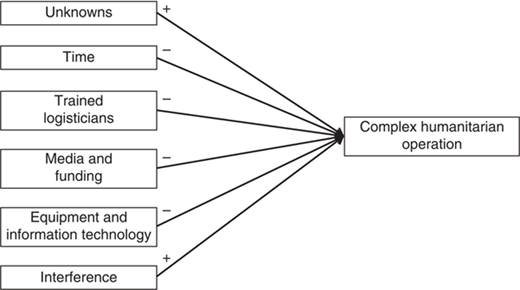
Humanitarian logistics is an incredibly challenging process. A great deal of the practitioner‐oriented literature stresses the complex nature of disaster relief. As this review is more concerned with logistics areas in the research articles reviewed, we provide a brief explication of the complexities. Figure 1 is a graphical representation of these complexities.
Unknowns
Unlike logisticians in the private sector, humanitarians are always faced with the unknown (Van Wassenhove, 2006). As one would expect, the greatest unknowns in humanitarian logistics are the time, place, and severity of a disaster in terms of both people and property. However, more specific factors influence the efficiency and effectiveness of the logistics response. Chief among these concerns are the amount, type, and usability of infrastructure (e.g. bridges) and equipment (e.g. material‐handling equipment).
Time
The importance of a timely response is much different in the humanitarian sector than in the commercial sector. While a delay in the commercial supply chain is costly in terms of productivity and/or customer satisfaction, a delay in the humanitarian supply chain could literally mean the difference between life and death for those most severely impacted by the disaster.
Trained logisticians
There is a dearth of logisticians who can plan, assess, and coordinate human and material resources for relief operations (Chikolo, 2006). Retaining qualified personnel is a challenge as well. Dr Thomas and Fritz (2006) from the Fritz Institute stated that personnel turnover can be as high as 80 percent, largely attributable to the lack of a clearly defined career path, professional association, or community of practice. The loss of these experienced logisticians can have a significant negative effect on an organization because experience has been found to be more important than disaster plans (Eriksson, 2009).
The media and funding
Media involvement and the way funds are raised for relief operations are inextricable. The powerful images captured by the media following a disaster can exert a great deal of pressure on governments, aid agencies, and even donors (Katoch, 2006). Donors react with generosity to well‐publicized disasters, but tend to lose interest when disasters are not covered extensively by the media.
Another issue is that news media view crises as a commodity. Several authors highlight the disparity in media coverage by comparing the well‐publicized tsunami of 2005 to the less‐publicized disasters in Africa, Iran, and Turkey (Bennett and Kottasz, 2000; Moeller, 2006).
Equipment and information technology
Because people tend to donate money expecting to directly help those impacted by the disaster, funding for necessary equipment and information technology has been limited (Oloruntoba and Gray, 2006; Thomas and Mizushima, 2005). The need for equipment may be obvious; however, the need for a robust inventory tracking system is often not recognized by donors (Whiting and Ayala‐Öström, 2009).
It is not unusual for aid agencies to have multiple incompatible information systems in the field. Information typically exists in silos preventing these agencies from collecting organization‐wide metrics (e.g. resource, output, and flexibility performance measures) (Maspero and Itmann, 2008). Therefore, what is missing is an effective logistics information system that could be the repository of data regarding the effectiveness of suppliers and transportation providers, cost and timeliness of response, appropriateness of donated goods, and the management of information (Chikolo, 2006).
Interference
Corruption has plagued almost every disaster relief effort in the developed as well as the developing world (Thomas and Fritz, 2006). Human interference in the distribution of aid can come in many forms such as political grand standing and dishonesty among the individuals distributing supplies (McEntire, 1999; McLachlin et al., 2009).
The current state of humanitarian logistics research
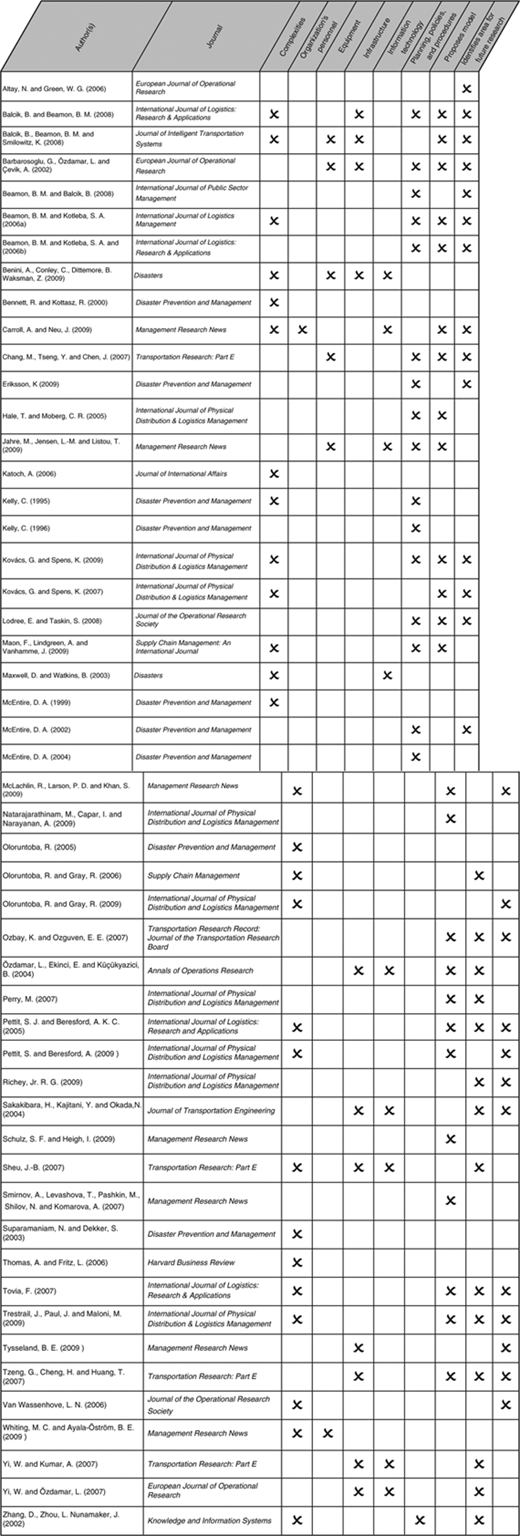
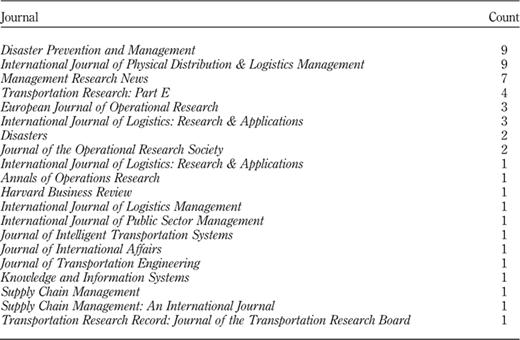
Our review of the literature netted 51 journal articles and we analyzed the content of each. We also read many more practitioner‐oriented articles and examined web sites in order to develop an understanding of this phenomenon. To answer the research questions, articles are also classified by whether a model was developed or areas for future research were presented.
Analysis
Table I shows the results of the content analysis of the research articles. It is important to note that at present humanitarian logistics research seems to be getting increased attention as a substantive field of research. Table II displays the collection of journals from which the articles were found. After reviewing and identifying content areas of the articles, we sought to answer the research questions.
RQ1. What has been the primary focus of humanitarian logistics research?
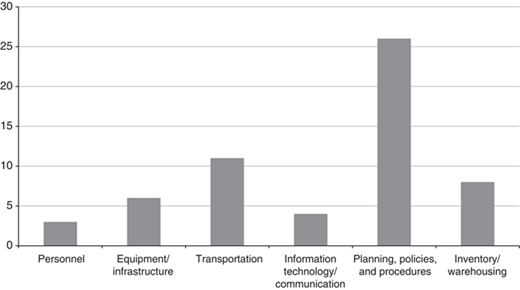
In their review of humanitarian logistics academic literature, Kovács and Spens (2007) concluded that most of the humanitarian literature concentrated on the preparation or planning phase. We confirm their finding. Of the 51 academic articles reviewed, 27 focussed on planning, policies, and procedures. Figure 2 is a histogram of the studies by the element of humanitarian logistics.
RQ2. What models have been proposed/tested?
In total there were 27 models presented in the literature reviewed. The models presented in the research fit into one of three areas: frameworks (five), planning (13), or transportation (nine). We discuss each model below.
Framework models
In relatively new fields of research, developing a conceptual framework to guide empirical inquiry is important. Of the articles reviewed, five included frameworks. The first two frameworks provide practical information for logisticians in the field. The other three frameworks provide theoretical considerations for future researchers.
In their 2002 article, Zhang, Zhou, and Nunamaker developed a knowledge management framework to support decision makers during humanitarian relief operations. They state that the knowledge base would evolve incrementally and transcend current limitations and redundancies. Their work addresses one very important element of logistics, information technology. Kovács and Spens (2007) address other, broader aspects of humanitarian logistics. They created a framework for practitioners to use in the field to plan and execute humanitarian operations. Their model includes three phases: preparation, immediate response, and reconstruction. Each of the phases is linked to a regional (i.e. operational) view as well as an extra‐regional (i.e. strategic) view. The respective regional views are disaster prevention and risk management, crisis management, and continuity planning. The corresponding extra‐regional views are strategic planning, short‐term project management, and long‐term project management.
Following the practitioner level frameworks of Zhang et al. and Kovacs and Spens, Carroll and Neu (2009, p. 1024) developed a theoretical framework that depicted the current state of humanitarian logistics as fragmented with many participants, which generates “volatility, unpredictability, and asymmetry.” They constructed a comprehensive model to close the development gap between the current, functional state of humanitarian logistics and supply chain management to the future, flexible, and agile state. They also proposed a set of universal techniques that will lead to “collaborative flexibility and efficient logistics for disaster response, which will generate robustness and versatility” (Carroll and Neu, 2009, p. 1034). Much like the work of Carroll and Neu, Jahre et al. (2009) developed a three‐dimensional framework for theoretical development of research within the humanitarian supply chain. Their matrix combined the concepts of networks, coordination, and structure. Networks can either be permanent or temporary, which acknowledges that humanitarian operations exist between crises (Jahre et al., 2009). Coordination occurs vertically among all levels of the supply chain as well as horizontally among other humanitarian organizations. To strike a balance between response time (effectiveness) and cost (efficiency), organizations make decisions regarding centralized or de‐centralized structures. Using this model, the authors explained how they intend to undertake case studies involving the IFRC, United Nations Joint Logistics Centre, and peacekeeping operations. Richey (2009) developed a disaster recovery pyramid using four theoretical perspectives: the resource‐based view of the firm, communications theory, competing values theory, and relationship management. He stated that this was the first attempt to theoretically support research in humanitarian logistics and called for multiple research streams in this important area of supply chain management.
Our proposed framework builds on the previous practitioner and theoretical work, but differs from these five frameworks in two ways. First, we review and categorize the literature using six key elements of logistics (organization's personnel, equipment/infrastructure, transportation, information technology/communication, planning/policies/procedures, and inventory management). Second, we develop a research framework to facilitate future research in the area of humanitarian logistics.
Planning models
Many authors focussed exclusively on planning, policies, and procedures. Although Hale and Moberg's (2005) model is concerned with preparing the supply chain for disaster rather than the logistical response to a disaster, it proposed a viable site selection tool that could benefit humanitarian relief efforts. Their secure site selection model combines recommendations from disaster management agencies, service expectations, and location science.
Pettit and Beresford (2005) combined field research findings with military and non‐military response models to develop a refined model for logistics requirements in disaster. The authors reported that theirs was the first attempt to draw together all the main components of emergency logistics response.
Beamon and Kotleba published two research articles regarding inventory management in humanitarian logistics. In their first article, Beamon and Kotleba (2006a) developed and tested three different inventory management strategies as applied to the humanitarian response in the Sudan. Of the three models tested, they concluded that the mathematical model proved to be the most robust. In their second article, Beamon and Kotleba (2006b) developed a prepositioned warehouse model to respond to disaster. This model was for a single item where order quantities were independent and demand was assumed to be continuous.
Chang et al. (2007) developed two stochastic programming models to determine resource distribution during disasters. They demonstrated the effectiveness of the model by using flood data from Taiwan. Lodree and Taskin (2007) used newsvendor models to determine appropriate disaster relief inventory levels. The inventory management study by Ozbay and Ozguven (2007) developed a model of the time‐dependent inventory planning and management problem that can be used for pre‐ and post‐disaster planning. Focussing on the field‐based findings following the 2004 tsunamis that effected Indonesia and Sri Lanka, Perry (2007, p. 409) developed a holistic/inclusive planning model to “guide natural disaster planners as well as add to academic discourse.”
Balcik and Beamon (2008) addressed the facility location problem by developing a mathematical model to determine the number and locations of distribution centers and the amount of prepositioned material. To develop their parameters, they used data from the National Geophysical Data Center on 639 disasters from 1900 to 2006. Balcik et al. (2008) developed and illustrated a last mile distribution model. This model used a two‐phased mixed integer approach to develop a delivery schedule for each vehicle within a fixed set. It also allocated resources with regard to supply, vehicle constraints, and required delivery times.
Kovács and Spens (2009) constructed a conceptual model that logisticians can use to identify potential challenges when preparing a response to disaster. Trestrail et al. (2009) developed a mixed‐integer program tool to improve supplier bid pricing for Title II food aid. Using post award bidding data, their model matched USDA awards 95 percent of the time. They reported that this model can improve bid effectiveness, improve carrier selection, and optimize total cost. Maon et al. (2009) developed a theoretical, dual cycle model of disaster relief. The first part of the model is the reaction and recovery cycle, which includes the response, relief actions, and reconstruction. The second part of the model is the prevention and planning cycle, which includes preparedness and mitigation.
Transportation models
Several models focussed on transportation routing. Barbarosoglu et al. (2002) proposed a hierarchical multi‐criteria methodology for helicopter logistics planning. Their hierarchy includes the top level where tactical decisions are made and the base level where routing and loading decisions are made.
Özdamar et al. (2004) developed a mathematical model for vehicle routing. It uses a heuristic approach to address the linear problem of commodity flow and the integer problem of vehicle routing. They demonstrated the usefulness of the model with data from the 1999 Izmit, Turkey earthquake.
Sakakibara et al. (2004) used a topological index to measure dispersion/concentration of the road network in a heavily damaged area of Japan following an earthquake. They demonstrated that the topographical index can be a valuable tool for measuring the possibility of transportation node isolation following a disaster.
Oloruntoba and Gray (2006) developed an agile supply chain for humanitarian aid model. Their model highlighted areas where academics can work toward concept development. They address two main areas: lean performance measures acceptable to donors and agile information systems suitable for aid recipients.
Sheu (2007) used a hybrid fuzzy clustering‐optimization approach to disaster distribution efforts. Using data from a Taiwan earthquake, Sheu tested this theoretical model. The results showed the potential to improve the performance of the logistics system by nearly 31 percent. Tzeng et al. (2007) constructed a distribution model using fuzzy multi‐objective programming. They tested the effectiveness of the model using data obtained following an earthquake in Asia in 1999.
Tovia (2007, p. 173) developed an emergency response model that was used “to assess the logistics resources required to evacuate, shelter, and protect the population in a timely fashion.” Using data from the National Hurricane Center, Tovia's model showed that areas most prone to hurricanes are not capable of providing evacuation and shelter services because of current operating policies and the lack of resources.
Yi and Kumar (2007) presented a metaheuristic of ant colony optimization to address supply delivery and evacuation of wounded personnel. This method breaks the transportation problem into two parts: vehicle route construction and commodity dispatch. In another routing paper, Yi and Özdamar (2007) proposed a mixed integer multicommodity network flow model, which they illustrated using planning data for a possible severe earthquake in Turkey.
RQ3. What are the areas identified for future research?
From the articles reviewed, we use our proposed framework to categorize recommended areas for future research. Recommendations to continue work on an author's specific model (Balcik and Beamon, 2008; Balcik et al., 2008; Barbarosoglu et al., 2002; Beamon and Kotleba, 2006b; Chang et al., 2007; Lodree and Taskin, 2007; Ozbay and Ozguven, 2007; Pettit and Beresford, 2005; Sakakibara et al., 2004; Tovia, 2007; Tzeng et al., 2007) were not included.
Planning, policies, and procedures are where most authors recommended future research. Altay and Green (2006) suggested that researchers look at organization and network structures that would facilitate communication and coordination among the multiple humanitarian organizations. They also recommended that recovery planning, damage assessment, and business continuation be explored (Altay and Green, 2006). Other strategic research topics were presented by Van Wassenhove (2006), such as supply chain design and management, risk management, and coordination and strategic alliances.
Beamon and Kotleba (2006a) suggested that research is needed to analyze the characteristics, develop a classification system, and quantify correlation of relief items. They also expressed a need to determine the true back‐order costs within humanitarian logistics (Beamon and Kotleba, 2006b).
In a more conceptual context, Beamon and Balcik (2008) highlighted the need for performance measurement in the areas of community involvement and empowerment, community development, and combined relief/development missions. Pettit and Beresford (2009) suggested a macro evaluation of the capabilities of humanitarian supply chains and the measurement of their effectiveness. Oloruntoba and Gray (2009) stated that we need a better understanding of how institutional or organizational customers think and what motivates them in the humanitarian context.
In an inventory‐related area, Trestrail et al. (2009) recommended further study into the efficiency impacts of foreign sourcing and prepositioning to promote or dispute these government proposals. It was further recommended that researchers need to define and explore various units of analysis, determine the relevance of supply chain tools and techniques, and study other logistics functions (e.g. marketing) within humanitarian logistics (McLachlin et al., 2009).
With regard to the other four areas, Beamon and Kotleba (2006a) recommended further anaylsis into the qualitative factors affecting humanitarian logistics such as the effectiveness of relief personnel, the amount and quality of infrastructure, and the quality of information. Information technology recommendations included advances to support dynamic resource allocation decisions (Altay and Green, 2006) as well as improvements in systems and technology, project management, performance measurement and scorecards, and process standardization and controls (Van Wassenhove, 2006). There were no specific recommendations for equipment research.
Research framework for humanitarian logistics
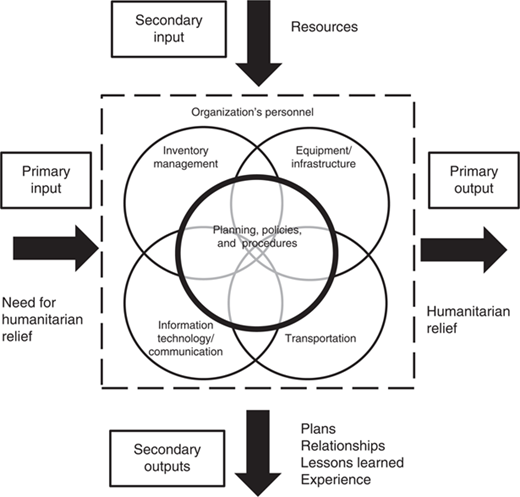
To develop the proposed research framework, we applied the first step of theory of constraints integration to humanitarian logistics, which is to define and scope the system. The theory of constraints is an overall management philosophy for running or improving an organization that is well suited to model complex systems (Sullivan, 2009). We identified the elements of logistics that make up the system, the boundaries, the primary and secondary inputs, and outputs of humanitarian logistics. By establishing the humanitarian logistics parameters, the phenomenon can be effectively studied.
The elements of humanitarian logistics are the organization's personnel, equipment/infrastructure, transportation, information technology/communication, planning/policies/procedures, and inventory management. These elements were selected after careful review and discussion of the logistics literature. They are also a slight modification of a model presented in a study from the management information systems discipline (Nolan and Wetherbe, 1980). The elements are a means to classify the literature reviewed and provide focus areas for improving research in humanitarian logistics.
In Figure 3, the humanitarian logistics system boundary is the dotted line that separates the components of humanitarian logistics from its environment. The boundary represents the sphere of control of the logistician and is represented by a dotted line to signify the influence environment can have on logistics and the possible influence that logisticians can have on their environment.
The primary input into this system is the need for humanitarian relief and the reason for the system's existence – everything done up to the point of the relief request is preparation. The humanitarian logistics system operates in a steady state environment. That is, the primary input does not generate the system, but rather the response from the system. It has been argued that planning would be a primary input; however, we stress that planning is a steady state action and not a response action.
Secondary inputs are the resources needed to respond to those requests. These inputs are the material requirements, predominately monetary donations, needed for the system to function. In past relief operations, unwanted goods have inundated warehouses and water and aerial ports, hampering logistics operations. Subsequently, aid agencies encourage donors to give money rather than goods (Murray, 2005; Trunick, 2005).
The primary output of the system is humanitarian relief. “A successful humanitarian operation mitigates the urgent needs of a population with a sustainable reduction of their vulnerability in the shortest amount of time and with the least amount of resources” (Van Wassenhove, 2006, p. 480). Secondary outputs can include, but are not limited to, on‐the‐shelf plans for the next disaster, relationships with other humanitarian organizations, experience in disaster response, and organizational lessons learned.
Conclusion and future research
The review of humanitarian logistics literature indicates that researchers have begun to lay the foundation for a core body of knowledge. In fact, prominent researchers in this field of study state that academic research in humanitarian logistics and supply chain management is still in its infancy (Tatham et al., 2009). There is a growing body of research in humanitarian logistics, predominately in the area of planning.
The intent of this proposed framework is to identify and classify humanitarian logistics research that has been done thus far and to provide a roadmap to guide future research efforts. Based on our framework and review of the literature, we recommend further research in the areas of the organization's personnel, equipment/infrastructure, transportation, information technology/communication, and inventory management as they relate to the humanitarian logistics.
Future personnel studies could address the complex nature of recruiting, training, retaining, and deploying humanitarian logisticians. Additionally, for the purposes of this paper we used the term organization's personnel generically. In reality, personnel may also include volunteers and helpful victims. It may be useful to study each type of personnel separately as well as how to successfully integrate them. Equipment/infrastructure studies could address the complexities of purchasing, positioning, and deploying non‐expendable resources needed to respond to disasters and methods to overcome non‐availability of roads, rail, bridges, and the like. Transportations studies should focus on the final leg of humanitarian distribution as it continues to pose significant challenges. Information technology/communication is a fertile area for future research especially in the area of common use, hardware and software. Inventory management studies could address the challenges of determining how much and where to position supplies for disaster relief.
Our proposed research framework could improve both the rigor and relevance of humanitarian logistics research. The framework can be used by future researchers to ground their work to the key elements of logistics. It could also link academic research to practitioner needs by directing researchers to the lesser studied elements of humanitarian logistics. With focussed research, academicians can provide broad contributions to this unique and challenging area of supply chain management.
The authors would like to thank Dr Peter Tatham for his encouraging words and his insightful comments that helped to improve this paper. The authors also appreciate the helpful comments of an anonymous reviewer. An earlier working version of this paper was accepted as a referred research paper for the Decision Sciences Institute – Annual Conference 2010. The views expressed in this paper are those of the authors and do not reflect the official policy or position of the United States Air Force, Department of Defense, or the US Government.
References
About the authors
Robert E. Overstreet is a Doctoral Student in the Department of Management, College of Business, Auburn University, Auburn, Alabama. He received his BBA from Campbell University and his MS in Logistics Management from the Air Force Institute of Technology. Robert E. Overstreet is the corresponding author and can be contacted at: robert.overstreet@auburn.edu.
Dianne Hall is an Associate Professor of Management Information Systems at Auburn University. She holds an undergraduate degree in business from the University of Texas, a Master's degree in Business Administration with a minor in Accounting and a minor in Computer Science, and a doctorate in Information and Operations Management, both from Texas A&M University. She is an active researcher; her work appears in academic and practitioner journals such as Decision Support Systems, Communications of the Association of Computing Machinery, Communications of the Association for Information Systems, International Journal of Logistics Systems and Management, International Journal of Logistics: Research and Applications, Knowledge Management Research and Practice, and the Journal of Information Technology Theory and Application. Her work has also appeared in several books and she has over 20 years of consulting experience. Her current research interests include applications of information technologies in support of knowledge management, healthcare, supply chain resiliency, and contingency planning, as well as enhanced decision‐making processes.
Joe B. Hanna (PhD, New Mexico State University) currently serves as Department Chairperson and Professor of Supply Chain Management in the College of Business at Auburn University. Dr Hanna has authored or co‐authored numerous journal articles and a logistics textbook and has participated in government‐funded transportation research. He is also an active member of several professional organizations and regularly conducts professional training seminars for various organizations. Dr Hanna's area of interest in supply chain management allows him to instruct undergraduate, graduate, and executive education students at Auburn University. Prior to entering academia, Joe gained professional experience working for Phillips Petroleum (now ConocoPhillips), Phillips 66 Chemical Company (now ChevronPhillips Chemical Company), and Coopers and Lybrand (now PricewaterhouseCoppers).
R. Kelly Rainer, Jr is George Phillips Privett Professor of Management Information Systems at Auburn University, Auburn, Alabama. He received his BS in Mathematics from Auburn University, his DMD from the University of Alabama in Birmingham, and his PhD from the University of Georgia.

