


The purpose of this paper is to reflect on the editorial operations underpinning the Journal of Humanitarian Logistics and Supply Chain Management in light of the review process and the quality of articles. It further outlines the articles in the special issue and relates them to the scope of the journal.
The editorial processes of the journal are analysed and reviewed.
The journal draws on a variety of research streams in humanitarian logistics; it is concluded that there is a need to stress the importance of research with managerial insights for humanitarians still further.
Humanitarian logistics is an emerging field and, unsurprisingly, there is still a lack of good empirical research and research with rigor as well as relevance. Based on submission statistics it can be concluded that the field has already reached a global dimension.
There is still a lack of empirical studies in humanitarian logistics research regardless of methods. However, an explicit discussion of managerial implications alongside theoretical conclusions would be essential in order to lead to any social and practical implications of the research.
These reflections on the editorial processes of JHLSCM as a new journal are used to raise the transparency of these processes.
The article shows how global the field of humanitarian logistics research has become, already, throughout the first year of the journal.
1. Introduction – from establishing the journal to setting first standards
This is the second issue of the Journal of Humanitarian Logistics and Supply Chain Management (JHLSCM), yet the journal has a considerable history already. It grew out from a large research network, which subsequently established a “base” in the HUMLOG Institute and reached out to even more organizations and more researchers. Discussions of a journal, as well as the institute, reach back to a meeting at the Cardiff/Cranfield Humanitarian Logistics Initiative's (CCHLI) conference in 2007. Finally, in 2009, the discussions with a publisher were also initiated, and in 2010 the journal was ready to issue a first call for papers. It received its very first submission on March 2, 2010. The first number of the journal (May 2011) was a special issue that drew on contributions from the journal's Editorial Advisory Board. This board is integral to the operations of the journal in many ways: as strategists, contributors, reviewers, and marketers, to name but a few roles. The same first issue outlined the scope of the journal and, in particular, called for papers that would combine scientific rigor with managerial relevance. At the same time, the editors made a commitment to publish papers emerging from the many different background disciplines that come together to deliver humanitarian logistics and supply chain management in a broad sense.
This paper reflects over the editorial operations of the JHLSCM in light of the review process and the quality of papers. It relates back to scope of the journal as outlined on the journal web site and in the introductory paper of the first issue. Furthermore, it outlines the papers in this issue and relates them to the scope of the journal.
2. Reflections around editorial processes
Scientific journals are judged by their quality, which, itself, depends on the quality of their contributions. Editors and reviewers thus play a double role: they contribute to the improvement of contributions through critical but constructive comments, and they see to it that standards of “good science” are adhered to. Indeed, Carter and Ellram (2010) put it nicely, describing these roles as “gatekeepers” and “gardeners.”
Apart from the actual content of published papers, other quality measures have been suggested for journals including: acceptance (or rather, rejection) rates, citations (or impact factors), and immediacy, which can again be captured through citations to a journal. That said, a journal's quality can also be seen in the way it impacts on practice, or is discussed in the media. The latter is perhaps more difficult to measure, nonetheless, publishers have come to appreciate the emerging role of social media as a means of disseminating research findings. Examples of this genre related to logistics include Elsevier Transportation's facebook site, the Journal of Operations Management's online discussion forum, and countless blogs that reflect on recent research results. A prime example of the impact of such discussions is Björk et al.'s (2010) paper on open access and the immediacy of results which was originally published in the (high‐impact factor) open access journal PLoS One, and was then downloaded over 6,000 times within three months of its publication, quoted in Nature and Science, and even a Science Podcast, in addition to numerous blogs.
Yet at this point, and notwithstanding the history of JHLSCM mentioned earlier, there has only been a short time between the publication of the first issue of JHLSCM and its consideration by researchers, humanitarians, and/or the media. Thus, at this early stage, we can only reflect upon the editorial process and acceptance rates plus, of course, the very content of the journal itself.
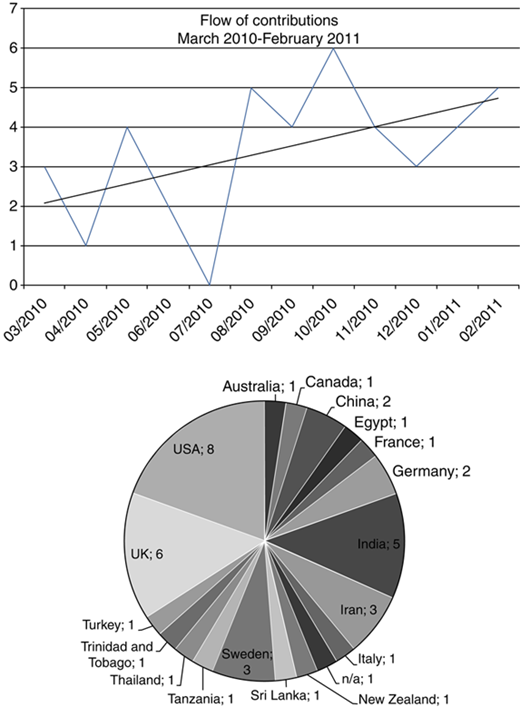
The scope of our first reflection is, therefore, the one year that has elapsed since the original call for papers was published, i.e. consideration of the stream of contributions between March 2010 and February 2011. During this time the journal received a total of 41 papers plus numerous other queries along the lines of “does this fit into the scope of the journal?,” “would you be interested in this type of research?,” etc. Overall, the journal has had a steady flow of contributions over this first year after the initial call for papers (see Figure 1) and is showing an anticipated rising trend. Most interestingly (and gratifyingly), the call has been heard around the world, with contributions emanating from 19 different countries. Furthermore, the countries of contributors show a nice mix, even though these reflect contributor's affiliations and do not take academic and practitioner migration patterns into account.
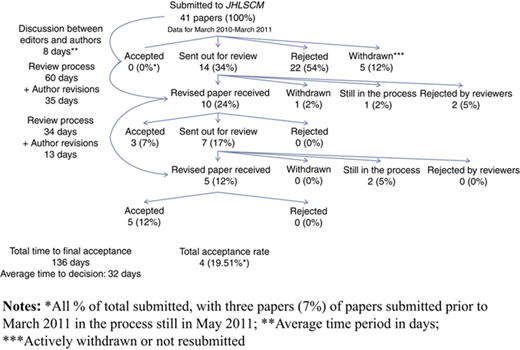
Considering the contributions that have been submitted, JHLSCM's theoretical acceptance rate is 19.51 percent, which represents quite a high figure if compared to, for example, the 8 percent of acceptance rate at the Journal of Supply Chain Management (for 2008‐2009[1]). However, this raw figure includes the special issue that formed the basis of the first edition of JHLSCM. A more comprehensive picture of the process can, therefore, be seen in Figure 2.
As might be anticipated, the lowest acceptance rate is in the first step of the process, the editorial review. This is not only a quality check but also reflects the fact that many of the papers submitted are quite simply outside the scope of the journal. Perhaps more surprising, however, is that many authors never get beyond this initial stage and do not resubmit their paper in light of these first comments. It is also accepted that there is clearly room for improvement in the review process that is currently taking rather longer than the published guidelines would suggest. Reviewers also need to remain true to the scope of the journal as well as the content of the review itself. Here, Carter and Ellram's (2010) paper has been a very useful resource to provide guidance to reviewers.
An analysis of the contents of submissions shows that JHLSCM has received a good mix of papers. Contributions have included qualitative as well as quantitative studies, though the latter was dominated by OR models with a discussion of their potential application rather than surveys or (applied) operations management studies. The journal also received several conceptual pieces. Unfortunately, a large number of submissions (an astonishing 41 percent) did not fit with the scope of the journal in that they did not consider the humanitarian context or were not focussed on logistics and supply chain management. Furthermore, even some humanitarian logistics papers fell out of scope of the journal, particularly reflecting the low feasibility of many proposed models. In this respect, the editors strongly hold the view that such feasibility, practicality, and managerial implications are crucial to the social impact of individual papers, as well as of the journal overall.
3. The papers in this issue
The papers presented in this volume demonstrate a wide variety of research approaches, as well as ways in which researchers can contribute to the widening body of humanitarian logistics literature. The pre‐existing humanitarian logistics literature does, of course, provide researchers with an agenda for research, as well as emphasizing the requirement for investigation and application of quantitative models in a procurement context. This issue of the journal adds to the existing literature by demonstrating the applicability and effectiveness, in the context of humanitarian relief procurement, of an analytic modeling technique based on uncertainty, such as stochastic programming with recourse. In addition, an paper that uses a simulation model has been included, providing another example of the ways in which humanitarian logistics research is being carried out, and how it can contribute to the challenging issues of coordination in the relief supply chain. A qualitative paper is also part of this journal issue, as it helpfully demonstrates how an increased understanding of the challenges involved in humanitarian logistics can raise awareness of important issues that need to be addressed in order to improve effectiveness and efficiency.
In the paper “Research in humanitarian logistics,” Overstreet, Hall, Hanna, and Rainer aim to provide future researchers with a framework for conducting research in the specific field of humanitarian logistics. The authors developed their framework through categorizing humanitarian logistics research papers and then applying the theory of constraints and management information systems literature. These authors’ review of humanitarian logistics literature presents the first clear indication that researchers have begun to lay the foundation for a core body of knowledge – however, in doing so they recognize that, although there is a growing body of research in humanitarian logistics, it is predominately focussed on the area of planning. The researchers therefore lay out an agenda for research recommending, in particular, further investigation in the areas of an organization's personnel, equipment/infrastructure, transportation, information technology/communication, and inventory management as they relate to the humanitarian logistics.
The paper by Sandwell, “A qualitative study exploring the challenges of humanitarian organizations,” adopts a two‐dimensional multi‐strategy research design, in order to identify the underlying issues of humanitarian disaster relief logistics and to provide an understanding of the challenges facing humanitarian organizations in a wider context. The first dimension, complementarity, incorporates two different research methods. The first involves a comprehensive literature review of issues affecting humanitarian logistics and, at a more strategic level, the characteristics of humanitarian organizations. The second method consists of interviews with humanitarian logistics practitioners, which was facilitated (the second dimension) by the first. The facilitation element took the conceptual framework of issues (and causes), developed from the literature review concerned with logistics, to inform the development of an interview guide. The findings, gained from the combined efforts of a thorough literature and the input of the practitioners, indicate that operational issues encountered in humanitarian logistics are symptomatic of wider issues affecting humanitarian organizations. In recognizing this, challenges were identified that, if overcome, could make for more effective relief missions. In particular, the research raises an awareness of the characteristics of humanitarian organizations that may well be acting as barriers to greater effectiveness and efficiency in all aspects of their operation (including that of logistics), and the resultant model provides a catalyst for further research and discussion.
Falasca and Zobel, in their paper “A two‐stage procurement model for humanitarian relief supply chains” argue that procurement in humanitarian contexts is a topic that has previously only been discussed in a qualitative manner in the literature. They argue, therefore, that there is a need to develop quantitative models to support and improve procurement in the context of humanitarian relief efforts. The authors present a two‐stage stochastic decision model for procurement, and use an illustrative example to compare its effectiveness with respect to a standard solution approach. Their results indicate that the new approach is able to capture and model both the procurement process, together with the uncertainty inherent in a disaster relief situation and is, thereby, able to support more efficient and effective procurement plans. In addition, the authors suggest a number of extensions to the model that could be implemented and, thereby, also address the specific needs of a particular organization and its procurement process. In doing so, this approach would provide practitioners with a new method to quantitatively assess and improve their procurement decision processes.
In a further papers that focuses on procurement, Alpertem and Buyurgan present “An auction based framework for procurement operations in disaster relief” in order to address the problems of coordination for suppliers of goods and their partnerships, such as local humanitarian organizations, private companies, and standby partners, where the organizational constructs may be less well developed. The problems that arise from poor coordination lead to poor responsiveness, and also hinder timely procurement of required goods. The authors therefore propose an auction‐based framework for procurement of goods which is suitable as a single coordinating platform in disaster relief logistics. They then use a simulation model to evaluate and tune system‐level design parameters. Their findings indicate that design parameters greatly affect the behavior and responsiveness of the system and the performance of the auction‐based framework in different problem instances. However, even though the presented framework was inspired by real‐life applications, it has not (to date) been implemented in actual disaster relief operations and the authors fully accept that further work is needed to evaluate the framework's practical applicability. The proposed framework does, nevertheless, offer a background for coordination during disaster relief operations, which provides opportunities for those involved to act as a set of organized entities. It would also help those entities coordinate their efforts to enhance the overall capabilities of local governments and NGOs.
4. Final remarks
The papers forming this issue have been drawn from a broad range of those submitted to JHLSCM. It includes a conceptual paper as well as two quantitative models (one of which incorporates a simulation model), and a qualitative study. These papers demonstrate the wide range of research of interest that is applicable to JHLSCM. However, the importance of evaluating and demonstrating the managerial implications for humanitarians cannot be stressed enough. Thus, we hope to receive more papers that are well founded on empirical evidence – or, as the editorial in the first issue stated, that combine scientific rigor with managerial relevance.
Note
See JSCM web site at www.wiley.com/bw/journal.asp?ref=1523‐2409

