– The purpose of this paper is to contribute to a greater understanding of the challenges of civil military logistical cooperation, coordination and collaboration in humanitarian relief logistics.
– Systematic literature review of academic journals.
– This paper has four main findings. First, a categorisation of humanitarian logistics literature is achieved through a systematic review. Second, a classification of military involvement in humanitarian relief logistics is presented. Third, the research substantiated systematic differences in the kinds of military cooperation not only due to stage of operations but also depending upon whether the disaster is “natural” or “manmade”. Fourth, the research identifies the challenges of civil military logistical cooperation, coordination and collaboration and posits recommendations to overcome the identified challenges.
– This paper represents an exploratory study and provides the basis for further research on cooperation, coordination and collaboration between military and civilian agencies in humanitarian operations. The paper sets a research agenda for academics.
– This paper is the first to offer practical guidance to military commanders and managers of humanitarian agencies on solutions and recommendations to overcome the challenges to civil military logistical cooperation/coordination in humanitarian operations.
– The area of civil military logistical cooperation/coordination has received limited consideration within the humanitarian aid logistics literature to date. This paper is designed to redress this shortfall. As a result, it is hoped that it will act as a catalyst for further research and to widen and deepen the resultant debate with a view to improving the outcome for those affected by current and future disasters.
1. Introduction
Military participation in humanitarian aid operations in cases of conflict or natural disasters is not a new phenomenon. International and national military forces often play an important role in providing support during disasters due to their strength in logistical and organisational structure (Apte, 2009; Barber, 2011; Heaslip, 2011; Heaslip et al., 2012). The ability to quickly establish presence in the disaster zone whilst delivering large volumes of relief in the hours and days following a disaster helps to reduce the “gap of pain” that has been described as the time between the demand for aid and the time in which the aid is provided (Heaslip, 2011).
There have been many scholarly articles written that describe the activities that occur during disaster relief operations in more detail (see, e.g. Baker et al., 2002; Barbarosoglu et al., 2002; Hale and Moberg, 2005; Pettit and Beresford, 2005; Hoffman, 2006; Yi and Ozdamar, 2007; Apte, 2009). However, there is very little that has been published in mainstream academic logistics literature that explicitly considers the involvement of military forces with relief agencies in the delivery of aid during a disaster as it evolves over time.
The challenge of achieving civil-military engagement in the context of a complex emergency (such as Afghanistan) is unquestionably more difficult than in response to a natural disaster (such as Haiti) (Rietjens et al., 2007; Kovács and Tatham, 2009; Balcik et al., 2010; Heaslip, 2011; Cross, 2012). As the humanitarian community is more inclined to accept military actors during a natural disaster (Kovács and Tatham, 2009; Balcik et al., 2010; Cross, 2012) the context of this paper is natural disasters (such as the Indian Ocean Tsunami, Pakistani floods, Hurricane Katrina, the earthquake in Haiti and more recently Hurricane Sandy).
Although it seems that there could be a fundamental philosophical difference in the rationale for the collaboration of humanitarian organisations and military forces, the UN Security Council has used global military forces to create a protective environment for humanitarian operations, for example, UN Security Council Resolution (UNSCR) 794 for Somalia, UNSCR 1199 for Kosovo, UNSCR 1497 for Liberia and UNSCR 1778 for Chad. Therefore the doctrines of intended deployments in the past have been quite distinctive but over the last decade many military doctrines have included humanitarian doctrinal aspects (Rietjens et al., 2007; Australian Army, 2009; Barber, 2011). In natural disasters – the focus of this paper – the doctrines of a deployed military force and the humanitarian community are more aligned than a complex emergency where there are distinct differences (Cross, 2012; Heaslip et al., 2012).
By utilising a systematic literature review this paper demonstrates the paucity of civil-military debate in academic logistics literature. It then separates the disaster management cycle (DMC) into different phases to demonstrate that not only are different supply chain (SC) management practices required for each phase, so too is the civil-military logistical involvement. This is the first attempt to highlight the different civil-military challenges associated with logistical support to the different disaster management phases.
The paper is organised into six sections. The next section provides a description of the systematic review protocols used in examining the literature. This is followed by an examination of the DMC and the different SC management practices required for each phase. This is followed by an analysis of the 5C's (cooperation, coordination, collaboration, communication and compassion), which leads to a discussion of the different challenges of civil-military logistical involvement throughout the different phases in the DMC. The concluding discussion covers implications for practitioners and suggestions for future research.
2. Methods
Research in humanitarian logistics is generally on the rise (Kovács and Spens, 2011), the recently established Journal of Humanitarian Logistics and Supply Chain Management (JHLSCM) and the new Emerald reading list on humanitarian logistics (Kovács and Haavisto, 2012) can attest to this. Whilst there is a growing interest of inter-agency coordination within humanitarian logistics (Kovács and Spens, 2011; Rutner et al., 2012), regretfully there is a paucity of peer reviewed material in academic logistics journals on the best use of military assets in humanitarian relief.
As opposed to previous studies that have investigated published research in logistics across a variety of topics and methodologies, the purpose of this study is to focus on the use of military assets in humanitarian logistics research. Our goal is to identify and evaluate past research trends in this area, determine if any gaps exist in this literature, and then based on this insight uncover opportunities for future research.
A systematic, quantitative review, following suggestions for methodological rigour in reviewing management literature more generally (e.g. Thorpe et al., 2005; Rousseau et al., 2008; Denyer and Tranfield, 2009) was undertaken. The review was limited to double-blind peer reviewed journal articles published in this field’s top-tier journals, as described below. Consistent with prior approaches to identifying relevant articles, such as Kovács and Spens (2007), Rashman et al. (2009) and Nielsen (2010), those articles that contained the word “Humanitarian” and/or any of the phrases “Disaster”, “Humanitarian Aid”, “Humanitarian Logistics”, “Humanitarian Operations” or “Humanitarian Supply Chains”, in either their titles, abstracts or full texts were identified. Keyword searches were chosen as a method for sampling literature instead of a content analysis, because academic research discussing the use of military assets in humanitarian relief is quite limited. As proposed by Tranfield et al. (2003) a scoping study using the above synonyms were refined to include:
“logistics” and “supply chain management”;
“humanitarian logistics” and “humanitarian aid”;
“humanitarian” and “military”;
“humanitarian aid” and “armed forces”;
“disaster relief”’ and “military”;
“disaster relief” and “armed forces”;
“emergency” and “military”; and
“emergency” and “armed forces”.
McKinnon’s (2013) citation-based study identified the 11 most influential journals in the logistics field. McKinnon’s study included the most recent ratings of logistics and SC journals in the main listings used for business-related publications in the UK (Association of Business Schools (ABS) star rating), Germany (Jourqual and Handelsblatt) and Australia (ABDC). SC management and logistics researchers usually rely on the implicit quality rating of a particular journal (Menachof et al., 2009; McKinnon, 2013), rather than formally applying any quality assessment criteria to the articles they include in their reviews (i.e. refereed journals are “better” than practitioner journals). Papers were selected from ABI/Inform and EBSCO, which are considered two of the most complete databases in management (Khan et al., 2012; Thomé et al., 2012). Established influential journals tend to shape the theoretical and empirical work in a field by setting new horizons for inquiry within their frame of reference (Furrer et al., 2008). Therefore it was felt that this approach provides an accurate and representative picture of relevant scholarly research.
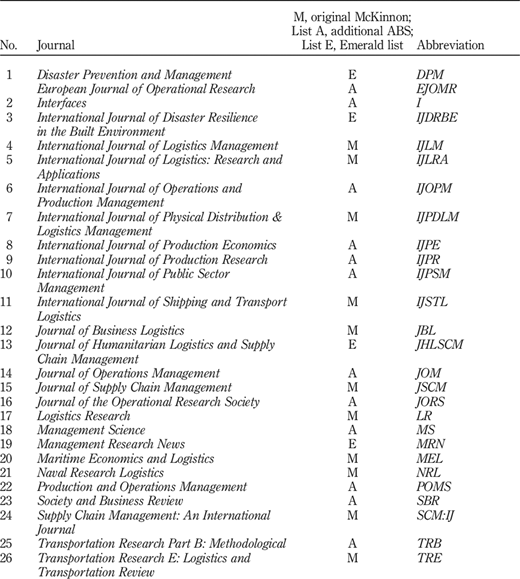
To ensure that a broader spectrum of logistics and operations management literature was reviewed 15 additional journals were incorporated 11 of these additional journals were from the ABS[1] list that contained articles addressing humanitarian logistics topics. The remaining four journals were identified on the new Emerald reading list on humanitarian logistics (Kovács and Haavisto, 2012) as being influential in the field and were added to the review.
The resulting 26 journals included in this study are listed in Table I. As a first cut, our goal was to identify all articles that investigated humanitarian logistics issues published in the set since 2006. 2006 was chosen as the cut-off point because the seminal article on humanitarian logistics, “Humanitarian aid logistics: supply chain management in high gear” by van Wassenhove (2006) was published at this time.
Due to the nature of the systematic review, journals that did not satisfy the initial search criteria, not included on the ABS list or not listed on the emerald humanitarian reading list were excluded. Journals that fell into this category included armed forces and security, disasters, international peacekeeping and parameters. Whilst the authors acknowledge that these journals address issues relating to the deployment of military forces in humanitarian emergencies they are not focused on logistics and/or humanitarian logistics. Furthermore, as the purpose of this research is to identify what if any literature address the involvement of military assets in “mainstream” academic logistics literature the above journals were excluded from this study.
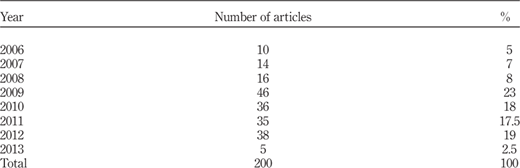
Table II shows the number of papers that were included according to the inclusion criteria within the period 2006-2013. The evolution clarifies that humanitarian logistics is a relatively recent issue and that the largest part of studies were published within the period 2009-2013. The figure related to year 2013 is partial because the systematic review terminated on March 2013. The highest number of publications was in the year 2009 and after that year the number decreases. One possible explanation for this rise in 2009 is that authors were drawn to humanitarian logistics issues after the 2007 Tsunami and the Pakistani earthquake.
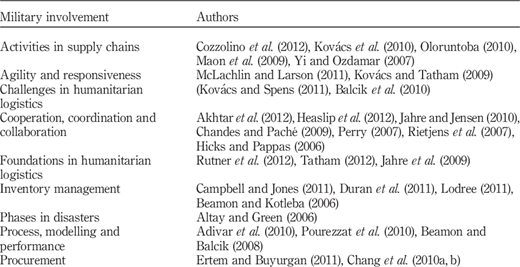
The articles were then classified into different categories that focused on military involvement in humanitarian logistics. The categories were an expansion on the work previously completed by Kovács and Haavisto (2012). The articles were placed into one of the categories shown in Table III based on the primary topics found in both the titles and abstracts as per Tranfield et al's. (2003) suggestion.
Doing this was straight forward and in only two cases was it determined that multiple topic areas were equally emphasised. Upon further examination of these two articles, it became apparent that they both dealt with the broader issue of cooperation, coordination and collaboration, the fourth topic listed in the table.
The wide range of journals provides a broad and deep analysis given that prior reviews in the humanitarian logistics field when compared to earlier studies that only considered subsets of these journals (e.g. Balcik et al., 2010; Tatham, 2012). Nevertheless, it is clear from this systematic review that the literature on military involvement in humanitarian logistics is limited. Table III identifies the 35 publications which focused on the military involvement in humanitarian logistics. Examining the literature reinforces the use of militaries in humanitarian operations (Balcik et al., 2010; Heaslip et al., 2012; Rutner et al., 2012). Flexibility and agility required in disaster relief operations are conditions that stand out in the military SC. For some (Altay and Green, 2006; Kovács and Tatham, 2009) humanitarian logistics would benefit from military support for ensuring effectiveness, setting aside political and security reasons, because the structure for command and control, such as in the military, is critical in case of chaotic situations (war or disaster).
The literature frequently highlights that commonalities exist between military and humanitarian logistics such as: both have dynamic and uncertain demand patterns, face difficulties due to degradation of the local physical infrastructure as well as to the absence of certain governmental functions, attend injured and traumatised victims and are in constant observation of the media (Balcik et al., 2010; Kovács and Tatham, 2009; Tatham and Pettit, 2010). The topic of inventory management receives considerable attention in the literature (Beamon and Kotleba, 2006; Campbell and Jones, 2011; Duran et al., 2011; Lodree, 2011). This is most likely as a result of commonalities regarding inventory management, because of instability and uncertainty concerns about issues of fleet management, packing, routing and delivery of supplies within specified time windows are compounded during times of disaster and conflict.
The nature of humanitarian aid delivery, peace-making and keeping has become more complex over the past few decades which have reflected on the complexities and nature of military involvement in assisting the provisioning and support of logistical aid (Jahre et al., 2009). The request for military responses to a natural disaster can depend upon the scale and urgency of the disaster, the level of preparedness, the prior established relationships between the affected host and assisting nation; politics and policy of the host nation; geographical proximity and whether the assisting country has the availability of military assets to give for assistance (Rietjens et al., 2007; Jahre et al., 2009; Heaslip et al., 2012). Table III demonstrates that the most under-researched area in logistics literature of military involvement in humanitarian logistics is phases in disasters. The area that has received the most attention is cooperation, coordination and collaboration. The following sections will discuss both of the above mentioned topics.
3. Phases of DMC
The variety of disasters in type and predictability has important implications for military involvement in humanitarian logistics. Jahre et al. (2009) suggest that the efficient SC model is the best solution for a development aid SC and/or for reconstruction, and the responsive SC model would be the best design in immediate relief. This distinction presupposes the commonly accepted notion of disaster relief being able to be categorised into various phases.
At minimum, there is a distinction made between preparedness vs post-disaster activities (e.g. van Wassenhove, 2006), though Altay and Green (2006) differentiate mitigation from preparedness and further distinguish between immediate relief vs recovery activities post-disaster. Many humanitarian organisations adopt a more circular, learning loop model that links these phases to each other, borrowing from Safran's (2003) disaster relief cycle. Furthermore, there is a general distinction made between disaster relief vs development aid (van Wassenhove, 2006), which is mirrored in the mandates of humanitarian organisations (Kovács and Spens, 2009).
van Wassenhove's (2006) disaster taxonomy builds on the question of predictability when distinguishing between sudden (rapid)-onset vs slow-onset disasters and natural vs man-made ones. Listou (2008) distinguishes between natural and man-made disasters from a peacekeeping and crisis management perspective. Kovács and Spens (2009), on the other hand, find it difficult to categorise disasters in Ghana in van Wassenhove's taxonomy as the distinction between sudden- vs slow-onset disasters become blurry for insect infestations and drought, whereas the natural/man-made divide is disputable when it comes to soil erosion, for example. Holguín-Veras et al. (2012) add the dimension of the scale of the disaster, which is one of the aspects – alongside socio-economic, conflict situation, environmental situation, infrastructure and governmental situation superimposed to the van Wassenhove taxonomy by L’Hermitte et al. (2013).
Disasters are subject not only to the dynamics of knowledge but also distance, criticality and time pressure during both the planning and response phases. There are three key elements preparedness, response and recovery, which cannot be designated to specific time periods, but all, are consistently part of the preparation – reaction process (Kovács and Spens, 2007). The nature of the disaster relief activities differs not only across these different types of disasters, but also with respect to the duration of disaster relief programme. A generic differentiation can, therefore, be made between long-lasting events that are characterised by continuous aid work (e.g. famine relief), and disasters in which initial problems can be overcome in relatively short order (Kovács and Spens, 2007).
Within the literature (Kovács and Spens, 2007; Listou, 2008; Jahre et al., 2009; Heaslip et al., 2012) there is agreement that different operations can be distinguished in the times before a disaster strikes (the preparation phase), instantly after a disaster (the immediate response phase) and in the aftermath of a natural disaster (the reconstruction phase). Not surprisingly, different logistical requirements, resources and skills are needed for the three distinct phases of disaster relief. The following sections examine military involvement in across the three phases of disaster relief.
3.1 Preparedness phase
Preparedness is the key to successful disaster responses (Kovács and Spens, 2007; Pettit and Beresford, 2009) and incorporates five key SC requirements – establishing the overarching coordination and disaster management framework; establishing logistic operations and process management; human resource management; knowledge management and preparing financial resources (van Wassenhove, 2006). Preparedness SC requirements lie mainly in the “assessment & planning” component of the humanitarian SC, with elements of procurement, warehousing and transport depending on whether pre-positioning strategies are used.
Procurement strategies can include contracts and “framework agreements” with local and international suppliers for key relief items and can drastically simplify the procurement process in the initial surge (Ertem et al., 2010). “Postponement” through such agreements can provide “demand-led inventory management” that enables “the assignment of relief supplies to be as rapid as appropriate” which reduces the need for excessive pre-positioning of inventory. An “Auction”-based strategy where the suppliers are the bidders and the auctioneer represents a “humanitarian aid coordinating platform”, for example, the United Nations Joint Logistics Centre (UNJLC), may promote the procurement and allocation of resources to those agencies that can more effectively distribute the aid (Ertem and Buyurgan, 2011).
Military procurement requirements, however are defined both in terms of what is to be developed and produced, and the manner in which the procurement efforts are distributed among R&D, production and support (Pettit and Beresford, 2005). Clearly, as procurement budgets are limited, a preference for a certain type of weapon or for specific phase of procurement has some trade-offs in terms of the direction and scope of military preparations. One such trade-off is between military readiness and long-term economic efficiency. For example, the production of a large variety of machinery, intended to enhance preparedness against a wide spectrum of threats, precludes the possibility of conducting economics of scale. Additionally, the production of a large stock of spare parts raises inventory costs. Another trade-off concerns the zero-sum relations between different stages of procurement. Investing more resources in R&D leaves fewer resources for production and support. Other preparedness models are based on minimum-maximum decision rules for retailers participating in the SC (e.g. Lodree, 2011).
The UN's World Food Program (WFP) is the largest humanitarian logistics operator. Its role is the lead for the logistics cluster approach for the UN (van Wassenhove, 2006). As such its global locations of warehouses are shared with other NGOs for inventory storage similar to the allied military collaborative logistical support units located globally. What is missing to date is collaborative civil-military global warehousing. Although in Afghanistan civil-military joint support services and warehousing occurs in some provinces (Listou, 2008).
3.2 Immediate response phase
The immediate response is focused on saving lives and preventing further damage, it aims to provide immediate assistance to maintain life, improve health and support the morale of the affected population (Eriksson, 2009). Humanitarian operations are most reliant on logistics and SC support during the response phase (Akhtar et al., 2012; Rutner et al., 2012); however the scale of this response and reliance may also be directly linked to disaster types. Response SC requirements draw on all humanitarian SC elements; though critically in the areas of procurement, cold storage, transport and distribution of humanitarian relief stores. To respond effectively humanitarian organisations must also have experienced staff, appropriate communication and information flows, and funding lines available (Kovács et al., 2010; Campbell and Jones, 2011). The humanitarian SC is established during the response phase should be based on the needs assessment completed. If the operation is sustained over a longer time frame, the SC should progressively change and become more structured (Maon et al., 2009). The nature of this phase dictates high volumes of supplies must be delivered in the most responsive means possible (Cozzolino et al., 2012).
‘The nature of a particular disaster or emergency largely determines the form of the response and the mix of military and non-military resource allocation.’ (Pettit and Beresford, 2005, p. 314). According to Chandes and Paché (2009), the participation of the military in humanitarian operations can be considered positive because there is no single organisation with the ability or competence to solve every problem generated in an emergency situation. Pettit and Beresford (2005) also defend a humanitarian logistics framework combining military and NGO experience in cases of disaster relief and recovery. Military support for natural disasters are widely used due to the capacity and asset availability required to support the surge demands (Rietjens et al., 2007). Military organisations have the robustness to operate in harsh field conditions and are capable of 12-hour response operations on a large scale (Kovács and Tatham, 2009). The structured command and control systems coupled with appropriate asset capabilities that sustain the military personnel are not found in most NGOs or IOs.
3.3 Reconstruction phase
Reconstruction activities aim to bring the emergency under control such that the affected population is capable of resuming responsibility, all systems are returned to a normal or better state, and communities are returned to their pre-disaster conditions (including livelihood, homes and infrastructure) (Campbell and Jones, 2011). Reconstruction SC requirements draw equally on all humanitarian SC elements; though the urgency and volume of product flow is generally lower than during the initial response. Once disaster operations have reduced, SCs should either be terminated or transferred (Maon et al., 2009).
This phase sees the shift in focus from speed to cost reduction, with reconstruction's objective being “costs saved means more lives helped” (Cozzolino et al., 2012, p. 21). Collaboration is essential during this phase, particularly when considering that funding lines and resources will become harder to secure (Kovács and Tatham, 2009). During the post-disaster reconstruction and rehabilitation phase of a disaster response, logistic needs shift to support rehabilitation and long-term recovery. Throughout this phase the focus will be on community resilience and environmental issues.
Military actors are increasingly expanding their role into this sector. The Australian Army's Adaptive Army concept, for example, identifies “Population Support” as one of the five lines of operation that will be pursued to account for the future operating environment (Australian Army, 2009, p. 52). Land Force logistic capacity forms an important component of this line of operation, particularly in the delivery of aid to remote and austere locations within a joint force area of operations (Australian Army, 2009). In the UK, when the military becomes involved in humanitarian assistance of a sustained nature this is referred to as peace support operations (Rietjens et al., 2007; Heaslip et al., 2012). In the USA, these missions are referred to as complex contingency operations (United States Department of Defense, 2008).
4. 3C's (cooperation, coordination, collaboration)
The need to team up with commercial actors in the SC is well known also within defence logistics. Listou (2011), Johnsen et al. (2009) and Humphries et al. (2007), discuss supplier relations and outsourcing in the defence sector. However, civil military collaboration is difficult (Rietjens et al., 2007; Heaslip et al., 2012). There seem to be two main conceptual streams, i.e. “cooperation” and “coordination”, and a plethora of acronyms such as: NATO CIMIC[2], EU CIMIC[3], CIMCO[4], CMO[5], CMCoord[6] (De Conning, 2007).
4.1 Cooperation
Cooperation refers to a maximum state of civil military coordination where there is a range of cooperative relations between the humanitarian community and a military force that is not regarded as a combatant force, typically including joint planning, division of labour and sharing of information (OCHA, 2003). The UN and NATO understanding of cooperation and coordination seem to be reversed, because in the NATO context, cooperation is understood to imply a less binding relationship than coordination, and NATO argues that the humanitarian community will be willing to cooperate, but not coordinate, and therefore they use cooperation (NATO, 2004). Consequently the challenges facing effective civil-military collaboration are often seen as insurmountable.
The host nation's military in natural disasters are often in the initial response with domestic emergency teams. All teams typically fall under the control of the local or central government organisation. Examples of military cooperation include the natural disasters in Samoa, Haiti and New Orleans. In these disasters, military transport was utilised to evacuate victims and to transport aid workers and aid into the area. They respond quickly with supplies located within country or from allies’ stores located in the region (Kovács and Spens, 2009).
4.2 Coordination
From a UN perspective, coordination refers to a spectrum of relations that range from coexistence to cooperation. This UN coordination concept has been developed in the context of humanitarian civil military coordination, where coexistence refers to a situation where the minimum necessary information is being shared between the humanitarian community and a military combatant force (De Conning, 2007). This would typically include sharing of information about security, movement of humanitarian convoys and the management of shared resources, for example a port or airport (Rietjens et al., 2007).
Each military operation is unique in the sense that type of mission, geographical area, force package and organisational structure (e.g. NATO, UN or EU forces) differs, and thus defence organisations might have other SC objectives than what commercial actors have (Listou, 2011). Still, it is reasonable to believe that coordination among SC partners, integration of business operations, and efficient management of information, as argued by Mortensen and Lemoine (2008), would create value also in defence SCs.
4.3 Collaboration
The literature associated with collaboration in humanitarian SCs is just emerging (McLachlin and Larson, 2011). Besides the civil military collaborative discussions the humanitarian SC literature has concentrated on coordination in relief chains (Akhtar et al, 2012); prepositioning and preparedness collaborative efforts by suppliers (Campbell and Jones, 2011); coordination of relief efforts (Hicks and Pappas, 2006); and case studies such as the Indonesian relief efforts (Volz, 2005).
Collaboration can take place at different stages along the relief chain (Oloruntoba and Gray, 2006), such as during contingency planning, need assessment, appeals, transportation management or last-mile distribution (Kovács and Spens, 2007). While collaboration during an actual disaster (Kovács and Tatham, 2009), especially at field level, seems to be more common, and has been enhanced through the setup of the UN Joint Logistics Centre (Jahre and Jensen, 2010), there is a specific need for better, continuing collaboration after an operation, in preparation for the next one (Heaslip et al., 2012).
In practice the cluster systems such as CARE International in their collaborative pre-positioning of preparedness locations have emerged (Duran et al., 2011). Attached to these practices are standing offer arrangements and procurement collaborative strategies. Procurement efficiencies and synergies can be gained by effectively coordinating supplier-buyer alliances, continuous replenishment, vendor management and consignment (Balcik et al., 2010). Transportation in humanitarian relief operations, due to prohibitive costs (Pedraza et al., 2011), is often outsourced in collaborative arrangements with specialised commercial companies (Balcik et al., 2010). As such, agencies must consider outsourcing (contracting assets, hiring local fleets or contracting 3PL providers) or collaborating (working with other agencies to own, hire or contract assets). Organisations with their own fleets or specific lease arrangements, will pursue either a centralised (fleets are managed centrally from their HQs, like the ICRC's Fleet Management Unit); hybrid (management is shared between regional and national offices, like the IFRC and WFP); or decentralised fleet management strategy (managed in-country like WVI) (Pedraza et al., 2011).
The donation, delivery and construction of a hospital and supplies during a storm in Haiti, represents humanitarian and reconstruction work that is conducted by the international community (Heaslip et al., 2012). However, these projects, and hundreds of others like them, were, and continue to be, delivered by American, Australian, British, Canadian, Dutch and many other militaries involved in humanitarian operations. Barber (2011) describes some of the military logistics contribution to the Haitian earthquake disaster in 2010. The helicopter carrier USS Bataan and three large dock landing ships as well as two US survey/salvage vessels created a sea base for the rescue efforts. The French Navy provided the Navy ship, the Francis Garnier and an amphibious transporter, the Siroco. The US hospital ship, USNS Comfort, was extensively used for emergency operations of over 600 casualties of the earthquake. The US Navy contribution to the Haiti disaster was 17 ships, 48 helicopters and 12 fixed-wing aircraft together with 10,000 sailors and Marines. The US Navy delivered 32,400 gallons of water and 532,440 bottles of water, over 100,000 meals and massive medical supplies after five days. A similar armada provided a floating hospital and recreation base around East Timor during 1999-2000.
5. Recommendations
During humanitarian relief operations, strongly motivated people in both camps (i.e. civil and military) usually find ways to surmount barriers that they encounter, but valuable time is lost inventing and reinventing these solutions. At a philosophical level, it is noted that NGOs are uncomfortable with the military, but in the field there is often effective cooperation (Listou, 2011; Rutner et al., 2012). As personnel security in relief operations becomes a growing concern for the relief community it follows that interaction with the military is set to grow (Cross, 2012). The points discussed here are not in any way intended as the ultimate solution, but rather as a starting point for further discussions.
5.1 Planning
The military have a very clear idea of what is meant by levels of strategic, operational and tactical planning, this is not necessarily true of the aid community (Rietjens et al., 2007; Kovács and Tatham, 2009). Holguin-Veras et al. (2012) state that an organisational structure provides the framework in which to implement strategy, therefore, a military logistics organisation will have its leadership and boundaries defined by its structure and controlling mechanisms. Firms make decisions to select or shift their structures as deemed appropriate considering internal resources and environmental conditions (Daugherty, 2011). Only recently, the military has been forced to re-evaluate its tasks and responsibilities in humanitarian operations (Akhtar et al., 2012). The goal of these changes is to create a new military organisational structure and processes (i.e. flattening structure, decentralising processes, aligning structure and processes and increasing flexibility). The perceptions of flatter structure and decentralised processes should predict organisational effectiveness (Bjornstad, 2011). Also, decentralisation has been shown to increase an organisation’s flexibility and ability to adapt to continually changing environment (Rutner et al., 2012). The net result is that the logistics structure must have the ability to adapt to different levels of formalisation and integration, necessary traits in a humanitarian operation (Kovács and Tatham, 2009; Kovács et al., 2012). Furthermore the use of outsourcing and partnering agreements will most likely increase in the future (Listou, 2011). Hence, to ensure efficient and effective logistics support in operations, the ability to work closely with commercial actors will be a critical asset.
5.2 Finance
Funding structures can impede the humanitarian community in delivering aid in a timely and efficient manner. The military often have access to substantial discretionary funds, whilst the humanitarian relief community must go through much longer processes to secure funding (Kovács and Tatham, 2009). Mechanisms need to be developed to facilitate the swift transfer of funds from donors to NGOs that would allow NGOs to respond more quickly to urgent needs in areas where there is an international military presence and preclude the need or temptation for militaries to fill these roles themselves (Green and Kolesar, 2004).
A more positive development has been the donors’ insistence on receiving detailed plans from agencies they fund; this encourages aid agencies to plan more strategically, by outlining their objectives, outputs, impact, activities and outcomes (Holguin-Veras. et al., 2012). This approach encourages the organisations receiving funds to manage projects effectively and efficiently and work towards a strategic end that benefits the broader stakeholder community and complements, rather than duplicates or erodes, the work of other intervening agencies.
5.3 Human resources
The issue of selection and recruitment remains the cornerstone for effective logistical management in civil military collaboration. As in business logistics the quality of people is critical in the delivery of humanitarian aid (Kovács et al., 2012), particularly those that have the skill set to operate complex logistical systems. The implications for training and the costs of solutions are important in this regard. Innovation in problem solving is needed, along with the importance of understanding the sources of uncertainty in the humanitarian SC. Military logisticians are highly trained, have the knowledge and the systems knowledge to manage in country flows (Barber, 2011).
As no two militaries and no two humanitarian agencies are the same calls persist for more cross-fertilisation to take place (Balcik et al., 2010; Akhtar et al., 2012) within military, UN agency and NGO training programmes and contingency planning. The skills and approaches used and the personalities of the people involved matter to coordination outcomes (Kovács and Tatham, 2009; Kovács et al., 2012). An innovation in this area is the use of military logisticians working side by side with humanitarian logisticians and being mutually supportive. Examples include Irish military logisticians in Haiti working for WFP, Australian logisticians in Sudan and Nigeria working alongside UN relief workers on some UN humanitarian missions and military logisticians in Somalia training and managing the SCs of relief food distributions with UNICEF. Efforts are underway to encourage military and civilian personnel to participate in joint workshops and exercises (e.g. Exercise Viking – a European interagency exercise) to study subjects of mutual interest, and to learn about each other’s perspectives.
For some military forces the bulk of their deployments in the last 20-30 years have been for humanitarian operations or peace keeping/enforcement. Thus, disaster relief and humanitarian operations provide significant theatres for training and testing of military capabilities. Similar to the embedding of military personnel with humanitarian organisations the embedding of humanitarian logistics personnel with military forces could be seen as an attractive “selling point” for the concept of cooperation.
In addition to long-term engagements, defence forces participate in project-based assignments (Rutner et al., 2012), delimited in time and scope, for example responding to the Indian Tsunami or Haiti. These operations often require a different service with different resources, a different mission, and different logistics structure (Listou, 2011). For such operations, resources from the permanent defence structure need to be combined in new ways. These resources will not be accessible for the permanent structure during operations. As previously recognised by Listou (2011) further research is required to investigate how SCs for such short term, limited deployments impact on logistics arrangements for the permanent, static structure of the defence.
5.4 Communications
In many cases, the use of different “language” and terminology seem to obscure any understanding of common objectives between the actors (Rietjens et al., 2007; Balcik et al., 2010; Heaslip et al., 2012). Indeed it is questionable whether the various actors even have common objectives; perhaps it is more correct to say that each organisation will have its own objectives, but that they should all work towards a common purpose or vision.
Standardisation to support packaging and kitting which assists tracking, usage and distribution needs to beneficiaries is taking place in humanitarian logistics (Heaslip, 2013). Further standardisation of language is required. There needs to be mechanisms for collecting information (e.g. inventory requirements) but equally importantly, for producing useful knowledge from that information (Day et al., 2009; Pourezzat et al., 2010). There must be an expedient means of conveying knowledge to those who need it. To assist in the distribution of information, transparency needs to permeate across all organisations military and humanitarian which will provide answers rather than obscuring questions due to institutional resistance. Furthermore, as language and communication has proven to be a barrier (Rondon et al., 2012) it may prove beneficial to use neutral language when describing coordination meetings. This gesture would avoid misperceptions and mistrust (Tatham and Kovács, 2010).
6. Conclusion
van Wassenhove (2006) remarks that, in the harsh reality of a disaster, the lines between the military and humanitarians have sometimes been blurred. Recent experiences in Iraq, Somalia, Haiti and Rwanda have proven that closer coordination among NGOs and the military can more effectively serve the goal of delivering assistance in complex humanitarian emergencies. This research is the first to present civil military challenges in humanitarian operations broken into phases identified as the DMC.
Our review demonstrates that there is a need for those involved in humanitarian logistics to reflect on the lessons learnt from civil military humanitarian assistance. Furthermore, the most beneficial contribution of the military depends upon the situation. In natural disasters, the greatest impact of military involvement is in the crucial life sustaining days immediately after the event. In contrast, in man-made complex emergencies, military assistance to the logistical provision of aid is more beneficial when widespread military expertise is provided over time.
The military's primary mission in disaster response is to establish a secure environment and make it possible for relief organisations to operate, providing transportation and communication (Rietjens et al., 2007). A secondary mission concerns the creation of conditions that will permit the return of the disaster area to normality, but this is a controversial mission that requires the military to perform duties different from its primary responsibility of ensuring a secure environment (Barber, 2011; Cross, 2012). Nonetheless, these two missions are often blurred in disasters. Although it is an important point to be considered, this applies only for military forces acting in international operations and mainly in case of conflicts, not in the case of natural disasters, such as the scope of the present investigation.
Finally, it is clear that simply providing security will not be enough for military forces in an environment where perceptions and ideas are centres of gravity in the conflict. Theatres of operation in the complex fragile state of emergency are dynamic, changing environments. A universally applicable model of civil military logistical cooperation is therefore difficult if not impossible to obtain. Our review provides evidence that civil military logistical cooperation will therefore continue to evolve.
References
Further reading
Notes
The ABS Academic Journal Quality Guide is a hybrid based partly on peer review, partly on statistical information relating to citation, and partly upon editorial judgements following on from the detailed evaluation of many hundreds of publications over a long period.
The NATO definition of Civil Military Cooperation (CIMIC) is the coordination and cooperation, in support of the mission, between the NATO Commander and civil populations, including national and local authorities, as well as international, national and non-governmental organisations and agencies.
The EU definition of CIMIC is the coordination and cooperation, in support of the mission, between military components of EU led Crisis Management Operations and civil role players (external to the EU), including national population and local authorities, as well as international, national and non-governmental organisations and agencies.
The European Union (EU) is now also developing a new “Civil Military Coordination (CIMCO)” concept.
CMO is the activities of a commander that establish, maintain, influence, or exploit relations between military forces, governmental and non-governmental civilian organisations and authorities, and the civilian populace in a friendly, neutral, or hostile operational area in order to facilitate military operations, to consolidate and achieve operational US objectives. Civil military operations may include performance by military forces of activities and functions normally the responsibility of the local, regional, or national government. These activities may occur prior to, during, or subsequent to other military actions. They may also occur, if directed, in the absence of other military operations. Civil military operations may be performed by designated civil affairs, by other military forces, or by a combination of civil affairs and other forces.
UN Humanitarian Civil Military Coordination (UN CMCoord). The essential dialogue and interaction between civilian and military actors in humanitarian emergencies that is necessary to protect and promote humanitarian principles, avoid competition, minimise inconsistency, and when appropriate pursue common goals. Basic strategies range from coexistence to cooperation. Coordination is a shared responsibility facilitated by liaison and common training.