– The purpose of this paper is to propose first, a comprehensive model of the concept of agility in a humanitarian logistics context, and second, to generate a research agenda to test and operationalise this model.
– The paper draws on the dynamic capabilities model originated by Teece and uses a topical literature review of research in various business disciplines in order to reflect on the concept of agility in a humanitarian logistics context, to demonstrate that its current scope needs to be widened, and to propose an alternative approach.
– The proposed model extends the existing concept of agility in a humanitarian logistics context by integrating agility drivers, responsive and flexible operations, agility enablers, and strategic level agility capabilities into a single model.
– Further research should focus on the nature of the risks/uncertainties encountered by humanitarian organisations, the interactions between the strategic and operational levels of such an organisation, and the impact of strategic level agility capabilities on field responsiveness and flexibility.
– This paper brings new insights into the concept of agility in a humanitarian logistics context and contributes a model that reflects a more comprehensive understanding of this concept. In particular, it demonstrates that agility stems from strategic decisions and managerial practices.
1. Introduction
Agility is an essential attribute of any organisation operating in an uncertain environment as it underpins the organisation’s ability to respond more rapidly and effectively to changes (Lee, 2004). Since humanitarian organisations typically operate in unstable environments, they need to embrace an agile strategy that enhances their capacity to respond to such risk and uncertainty (Charles et al., 2010). Besides demand, supply, and process risks and uncertainties (Balcik and Beamon, 2008), humanitarian organisations have to deal with complex contextual factors (L’Hermitte et al., 2014). These impose significant constraints on operations because humanitarian organisations frequently operate in the least developed countries where, for example, infrastructure is inadequate, the political environment is unstable, and/or violent conflicts are taking place (Long and Wood, 1995).
In the final report of its Policy and Research Conference held in 2011, the United Nations Office for the Coordination of Humanitarian Affairs (OCHA) identifies agility as a priority research theme (OCHA, 2012). However, although agility is repeatedly mentioned in the humanitarian logistics literature, there is as yet no settled definition or understanding of the concept. This paper is designed to remedy this deficiency through the development of a multi-level organisational view of supply chain agility. In other words, it considers the concept across multiple levels of an organisation rather than, as is often the case, solely at the operational level. In doing so, it begins with the premise that “agility is a business-wide capability that embraces organisational structures, information systems, logistics processes and, in particular, mindsets” (Christopher and Towill, 2001, p. 236). Thus, supply chain agility not only reflects the flexibility and responsiveness of logistics and supply chain operations, but also the support provided by the strategic level to the operational level of an organisation. In other words, this paper intends to demonstrate that supply chain agility requires managerial and leadership inputs, i.e. that supply chain agility encompasses more than simply prepositioning supplies or swiftly deploying experts and assets to the field. It requires a managerial and leadership understanding of the problems encountered on the ground, of the resources needed to overcome these problems, and of the strategies to develop in order to appropriately support the logistics and supply chain activities in the field.
The paper draws on the dynamic capabilities model (DCM) and uses a topical literature review of research conducted on agility in a business context and, in particular, within the agile manufacturing, software development, and supply chain disciplines. It reviews the approaches adopted in these fields in order to reflect on the concept of agility in the humanitarian context, to widen the current perception of its scope, and, ultimately, to contribute a new model of humanitarian supply chain agility. The resultant aims of the paper are first, to propose a comprehensive conceptual model of agility in the context of humanitarian logistics and second, to generate a research agenda to test and operationalise this model.
The remainder of the paper is organised as follows. Section 2 defines the concept of agility. Section 3 presents the theoretical premises used in the paper. Section 4 reviews the contributions of prior research on agility in various business disciplines and, on this basis, Section 5 identifies the gaps in the current humanitarian logistics literature. An alternative approach to agility is proposed in Section 6 before an agenda for future research is suggested in Section 7. Next, the value and limitations of the work are identified in Section 8 and Section 9 synthesises the research.
2. Agility as the adaptive capacity of the whole organisation
Due to the complexity of their environment, organisations cannot anticipate all disruptions. Rather, they need to take a comprehensive and proactive approach to uncertainties in order to be prepared to manage multiple and unexpected events (Mitroff and Alpaslan, 2003). To do so, organisations typically choose a strategy that builds in redundancy along the supply chain (e.g. in terms of inventory or other operational capacity), or one that is designed to increase agility by developing their adaptive capacity at the organisational level (Chopra and Sodhi, 2004; Sheffi and Rice, 2005; Tang, 2006). However, according to Sheffi and Rice (2005), redundancy generates costs. It also yields limited benefits because capacity is built at the operational level in response to a specific risk at a specific place. By contrast, investing in organisational agility fosters capacity building and development at the organisational level (i.e. the internalisation within the organisation) and enables organisations to leverage a set of capabilities across their operations. In other words, organisational agility contributes to the development of an internal adaptive capacity that, in turn, enables an organisation not only to respond to the issue at hand, but also to future uncertain and complex situations (Gunasekaran, 1998; Somers, 2009).
Thus, a distinction should be made between building capacity in terms of operational redundancy that inevitably increases costs (Gattorna, 2009) and developing an adaptive capacity at the organisational level, i.e. building the deep-rooted capabilities that underpin organisational agility and enable the organisation to mitigate risks and adapt to unpredictable circumstances (McCann and Selsky, 2012). McKinsey & Company (2006) argue that this latter type of agility leads to higher operational performance and cost-efficiency, especially when it is standardised and integrated into routine processes (Weick and Sutcliffe, 2001). Thus, organisations should consider the costs and benefits of both agile strategies and, when possible, supplement risk buffering by strategic risk management practices (Giunipero and Eltantawy, 2004).
Following on from the above discussion, this paper adopts a multi-level approach to the concept of agility, i.e. it will be considered both at the operational and at the strategic levels. We start from the premise that agility is needed to respond to operational disruptions that negatively impact on the movement of humanitarian aid. In this sense, our paper is about logistics and supply chain agility, i.e. conducting flexible and responsive operations in order to overcome disruptions.
We define flexibility as the ability to change what is being done at the operational level. Humanitarian organisations need to adapt their operating routines in different ways. Among other things, they need to be able to change the delivery location, the mode of transport used, and/or the transport routes as a result, for example, of bad weather, infrastructure breakdown, or changing security conditions (McGuire, 2011). We define responsiveness as the ability to swiftly identify operational risks and opportunities and to respond to them in a timely manner. Clearly, flexibility and responsiveness are two essential components of operational agility as, for example, contended by Charles et al. (2010). However, we argue that focusing on operational level capabilities is not sufficient and that logistics and supply chain agility requires strategic inputs, i.e. strategic level capabilities.
With the above discussion in mind, we define agility as follows:
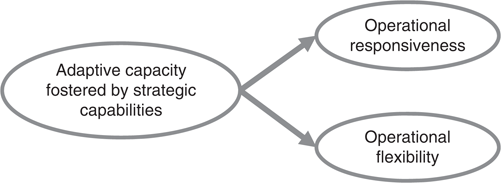
Agility is the adaptive capacity of an organisation as a whole to build strategic capabilities that support operational responsiveness and flexibility in order to manage existing or arising risks, uncertainties, and opportunities in the logistics and supply chain environment.
Figure 1 illustrates this definition and the concept of agility as it is used in this paper.
3. Theoretical insights
This paper builds on Teece’s DCM to examine the concept of agility. We do not pretend to offer an exhaustive review of the DCM literature but to provide an overview of the initial papers and of some of the more recent studies in order to demonstrate how this paper is developed from the DCM. The DCM is a theory of firm performance originated by Teece in the 1990s (Teece and Pisano, 1994; Teece et al., 1997). Teece et al. (1997, p. 516) define dynamic capabilities as “the ability to integrate, build, and reconfigure internal and external competences to address rapidly changing environments”. The model provides a structure that aims to explain how and why organisations capture a competitive advantage (Teece et al., 1997) but differentiates itself from other strategic management theories by integrating various levels of resources (e.g. assets, skills, processes, procedures, structures, and systems) and by considering their (re)deployment, (re)configuration, and (re)combination in response to rapid changes in the environment (Teece et al., 1997; Teece, 2009). From that perspective, the dynamic capabilities approach goes beyond technical fitness (i.e. operational skills) and embraces external fitness, i.e. how well the organisation adapts to the requirements of the environment in which it operates (Helfat et al., 2007). In other words, sustained performance depends more on the orchestration of organisational resources to fit the requirements of an unstable business ecosystem than on the traditional factors of success, such as cost control, quality management, or optimisation of inventories (Teece, 2007).
The DCM was developed for profit-oriented organisations, as evidenced by its goal of gaining a sustained competitive advantage that ensures market share and superior profitability (Teece, 2007). It is, however, argued that it can be equally applied to non-profit organisations because they also have to adapt their resource bases to manage change and complexity (Helfat et al., 2007). Thus, four aspects of the DCM are highly relevant to this paper (and these will underpin the construction of the conceptual model in Section 6). First, its emphasis on timely responsiveness and adjustment of organisational resources (Teece and Pisano, 1994; Teece et al., 1997; Teece, 2007) makes it relevant to the turbulent environment and challenges faced by humanitarian organisations. Indeed, a core component of humanitarian work is the need to continuously reconfigure operations in order to adapt to unpredictable and disruptive events, reduce their negative influence on performance, and effectively/efficiently deliver the relief items to the disaster-affected populations (Tomasini and Van Wassenhove, 2009; Hobbs et al., 2012).
Second, the DCM is appropriate for studying the concept of agility in light of the three capabilities making up Teece’s model, i.e. the capability to first, sense environmental forces and changes, second, seize opportunities by aligning resources, and third, continuously adapt resources to overcome threats (Teece, 2007, 2009). These capabilities reflect not only the need to manage risks and uncertainties, but also to take advantage of opportunities (a key point that is developed later in the paper).
Third, the DCM emphasises the need for a systems view of the organisation. Whilst it is fully accepted that capabilities are embedded into operational processes, the underpinning idea of the DCM is that these capabilities transcend operational skills and are deeply inherent in strategic decision-making (Teece et al., 1997; Eisenhardt and Martin, 2000; Teece, 2007). They are, therefore, fundamentally strategic (Teece, 2012) but, as the operational and strategic levels of capabilities are closely intertwined (Helfat et al., 2007; Helfat and Winter, 2011), Teece (in his interview with Kleiner, 2013) further argues that an organisation must take a systems level perspective.
Fourth, the DCM distinguishes between capabilities and the “micro-foundations” that support the development of such capabilities. “Micro-foundations” are diverse and include organisational skills, processes, systems, decision rules, and structures (Teece, 2007, 2009). The distinction between these elements that underpin an organisation’s capabilities and the capabilities themselves is important and will be used later in the development of the conceptual model of agility in the form of agility enablers and agility capabilities.
The next section follows on from the above theoretical insights and examines the contributions of the literature to the concept of agility in a business context.
4. Business disciplines’ approach to agility
The literature on agility is well-established in various business disciplines and, in particular, in the fields of agile manufacturing, agile project management, agile supply chain management, and supply chain risk management. This section considers some relevant articles within these fields to understand how the literature in a business context is positioned in relation to the above-mentioned theoretical framework and the extent to which their contributions apply to the field of humanitarian logistics. In particular, this section deals with the major points addressed in the above-mentioned business disciplines, i.e. why agility is needed, how agility is approached, and what it takes to be an agile organisation.
4.1. Why is agility needed?
Risk and uncertainty exist in all business environments (Giunipero and Eltantawy, 2004) but, since businesses vary, the exposure to and the magnitude of risk/uncertainty differ from industry to industry (Rao and Goldsby, 2009; Sodhi et al., 2012), as well as between the humanitarian and the commercial sectors (Metcalfe et al., 2011). Since the beginning of the 2000s, the literature on supply chain risk management has developed and the nature of the risks and uncertainties encountered by business organisations has been clearly identified (Tang, 2006; Rao and Goldsby, 2009) with supplier failure, reduced product life cycles, demand for more product variety, and changing customer requirements being examples of the risks/uncertainties generating supply chain disruptions in a business context (Swafford et al., 2005). In practice, these are all supply chain-related risks and uncertainties, i.e. they are associated with supply, demand, and processes (Tang and Tomlin, 2008; Sodhi et al., 2012). As pointed out by various authors (e.g. Christopher and Peck, 2004), these risks and uncertainties generate supply chain vulnerability and should be managed by building agility (Christopher and Towill, 2001). However, beyond these specific areas of risk/uncertainty, multiple macro-environmental factors exist that cannot be ignored, if only because the level of macro-environmental instability is considered by many authors to be increasing (e.g. Christopher and Holweg, 2011).
In the business and supply chain literature, various authors (e.g. DeLoach, 2000; Kleindorfer and Saad, 2005; Waters, 2007; Trkman and McCormack, 2009) consider the risks/uncertainties generated by the wider external environment. Going one step further, Christopher and Peck (2004) categorise risks into three categories: the risks internal to the firm, those external to the firm but internal to the supply network, and those external to the network. Authors studying the wider external risks mention, among other things, technology (Sodhi and Lee, 2007; Trkman and McCormack, 2009), terrorist and security issues (Kleindorfer and Saad, 2005; Peck, 2012), natural and technological disasters (Trkman and McCormack, 2009), competition (Manuj and Mentzer, 2008), political instability and changes in government policy (Rao and Goldsby, 2009), as well as market fluctuations (Rao and Goldsby, 2009; Sodhi and Tang, 2012) as sources of risk/uncertainty. Especially when addressing the concepts of supply chain vulnerability and resilience, academic authors (Peck, 2012; Wright, 2013), universities (Cranfield University, 2003), consultancy agencies (Deloitte, 2012), and international organisations (World Economic Forum, 2012) discuss the impact of the macro-environment and external uncontrollable factors on logistics operations and the need for a comprehensive approach to supply chain risk management.
This approach to macro-environmental uncontrollable disruptions is relevant to humanitarian organisations because they operate in highly complex and dynamic field environments and their actions cannot be separated from the broader context. The wider external environment generates operational risk/uncertainty and negatively impacts on logistics operations by disrupting/interrupting the flow of humanitarian supplies. External factors (i.e. the socio-economic, physical, infrastructure, government, and security situational factors) greatly affect the nodes (e.g. ports or warehouses) and linkages (e.g. roads) along the humanitarian supply chains. These disruptions generate costs, limit access, constrain capacity, and lead to security issues (L’Hermitte et al., 2014). Be they predictable or sudden, the external risks/uncertainties cannot be easily removed or even mitigated because they come from external sources beyond the control of organisations (Trkman and McCormack, 2009) and in the context of increasingly complex and multi-dimensional humanitarian crises (Kent, 2011). Thus, like supply chain-related disruptions, external factors demand the capacity to continuously adapt and reconfigure logistics operations and, therefore, to build agility.
In summary, agility is needed in response to a wide range of risks/uncertainties and, in particular, internal, supply chain, and external ones. We now consider the extent to which a business-wide approach is needed to manage these risks and uncertainties.
4.2. How is agility approached in the business disciplines?
In the 1990s, the field of operations management moved from an operations-centred to a wider business approach in order to gain an in-depth understanding of the agile manufacturing enterprise (DeVor et al., 1997). Thus, various academics explore how the strategic and operational levels of an organisation interact to build agility and enable shop-floor workers to carry out dynamic operations. For example, Goldman and Nagel (1993) argue that agile manufacturing is strategically focused (rather than operationally focused) and, therefore, requires significant managerial input and responsibility, rather than solely being considered a technical or production responsibility. Likewise, Roth (1996) suggests that agile manufacturing should move from a shop floor-oriented approach to a macro-view based on combinative capabilities built at the corporate level. Along the same lines, Vázquez-Bustelo et al. (2007) establish relationships between strategic assets owned by agile organisations (agile human resources, value chain integration, concurrent engineering, agile technologies, and knowledge management) and manufacturing performance.
Similar multi-level approaches can be found in other disciplines. For example, it has been recognised in the broader strategic management literature that agility must encompass all levels of an organisation, and that its development and maintenance require leadership and management commitment (McCann and Selsky, 2012). Similarly, in the field of software development, Appelo (2011) and Cobb (2011) assert that there are different levels of agility and that agile practices cannot be adopted without executive and senior management action. Taking this strategic perspective further, Appelo (2011) argues that leaders and managers have the responsibility to develop an agile system, to protect this system, and to direct it (i.e. to articulate a shared purpose and direction). By doing so, leaders and managers ensure that the organisation is able to maintain a sustained level of performance even when adapting to risk, uncertainty, and changes.
One particular agile methodology in the field of software development, Scrum, has merit because it highlights the necessary interface between the different levels of an organisation in order to solve complex adaptive problems (Schwaber and Sutherland, 2013). In particular, the Scrum framework defines the main roles and responsibilities within the organisation and differentiates between those of the “Team” (i.e. the technical level) and those of the “ScrumMaster” (who acts both as a leader and a servant for the Team). A Team is self-governing, i.e. it is empowered to organise and manage its own work. Thus, the operational level of the organisation knows what has to be done, and also how to do it well by adapting methodologies and making them fit the requirements of the environment. On the other hand, the ScrumMaster is not only in charge of ensuring that the Team understands what has to be achieved at the operational level, but also he/she acts as a facilitator. Thus, the ScrumMaster facilitates and coordinates the work of the Team, and protects it from external interference and hindrances that prevent it from operating properly (Schwaber, 2004). The key message that the Scrum methodology conveys in the context of this paper is that agility is built with the support of the leadership/management level and, therefore, requires a multi-level approach.
The relevance of this multi-level approach to humanitarian logistics is best illustrated by an example compiled from actual situations encountered in the field by the United Nations World Food Programme (WFP) (WFP, 2012, 2013a, b, c). When heavy rains are forecast to make roads impassable, a humanitarian organisation can recognise the threat (the lack of access to those in need) and, consequently, stockpile supplies at the point of delivery before the rainy season. This illustrates the redundancy-based approach to risk management mentioned in Section 2. Instead of (or in addition to) building buffer stock, the organisation can decide to switch transport from road to barge because the water levels in the rivers make access by barge possible. In doing so, the organisation is able to increase its efficiency because greater volumes of supplies are delivered more quickly by using barges. However, to reconfigure the delivery process, the support of the strategic level of the organisation is essential. For example, the organisation needs decentralised authority to address risks and uncertainties (i.e. field workers are empowered to make rapid and informed decisions), appropriate skills and expertise (e.g. field workers have a good knowledge of the field conditions, make good local contacts with barge owners, etc.), and the required staff attitude (problem-solving, creative, and able to recognise an opportunity).
If transporting the humanitarian supplies by barge is not possible, the organisation can make the decision to mobilise a fleet of heavy-duty vehicles (able to pass along the muddy roads), together with a team of mechanics and the spare parts needed for maintenance and repairs. In the same way as in the previous instance, the support of the strategic level of the organisation is critical, i.e. developing capacity (owning, or access to, a fleet of vehicles), making information regarding resource availability accessible, and building an appropriate organisational structure. The structural arrangements not only involve a dedicated fleet team whose skills and expertise make it possible to swiftly set up a fleet hub in an adverse environment, but also the facilitation of cooperation between the different entities within the organisation (e.g. between the country office and the fleet team).
This example demonstrates that agility transcends operations. Agility not only reflects the flexibility and responsiveness of the operational level, but also the support provided by the strategic level of the organisation in order to remove as much risk and uncertainty as possible from the operational level and make it operate effectively and efficiently (Schwaber, 2004; Appelo, 2011). This example also shows that agility is not only about overcoming threats. As mentioned previously in the discussion regarding the DCM literature, the concept is also about seizing opportunities (in the example, to increase efficiency by delivering higher volumes of supplies more rapidly by using barges).
The investigations presented in this sub-section clearly demonstrate that achieving agility involves decisions and responsibilities at multiple levels. After having established that agility requires a systems approach, it is now necessary to determine how agility is created, i.e. what it takes to be an agile organisation.
4.3. What does it take to be an agile organisation?
Based on the DCM approach, this sub-section aims to identify the strategic level agility capabilities as well as the “micro-foundations” underlying agility (Teece, 2007, 2009). The “micro-foundations” are called agility enablers in this paper.
4.3.1. Strategic level agility capabilities
From the broader management literature, four strategic level agility capabilities can be identified. These are first, being purposeful, second, being action-focused, third, being collaborative, and fourth, being learning-oriented. Whilst this framework is mainly derived from McCann and Selsky’s (2012) work, the contributions of additional authors are also considered.
First, an organisation is purposeful when it has a clear direction for action that drives meaningful results throughout the whole organisation (Drucker, 1994; McCann and Selsky, 2012). Second, an organisation is action-focused when it proactively and reactively manages risks and opportunities to fulfil this purpose (McCann and Selsky, 2012). Thus, these two first capabilities are about building a shared vision and a constant state of readiness in order to ensure that staff are able to recognise and respond swiftly and successfully to turbulence (Redding and Catalanello, 1994).
The third agility capability, that of being collaborative, relates to the building and sustaining of valued internal and external relationship networks in order to solve problems and achieve common outcomes collaboratively (McCann and Selsky, 2012). Fourth, being learning-oriented means that an organisation systematically and critically evaluates practices and processes in order to raise its capacity to continuously adapt and transform in response to turbulent environments (Redding and Catalanello, 1994). Several authors (see Bowles, 2004) argue that agility stems from the creation of continuous learning processes, i.e. considering, at the strategic level of the organisation, what is being done at the operational level, and improving future planning accordingly.
The above-mentioned four capabilities are perceived to be the dynamic capabilities that a humanitarian organisation should build at the strategic level in order to elevate its capacity to respond to the rapid changes encountered in the field and that prevent uninterrupted logistics and supply chain operations. The relevance of these four capabilities to the field of humanitarian logistics is established in the literature (albeit not in direct relation to the concept of agility). Thus, several authors mention that humanitarian organisations are purposeful organisations acting to fulfil a clear mandate, i.e. saving lives (e.g. Beamon and Balcik, 2008; Tomasini and Van Wassenhove, 2009). Similarly, Maon et al. (2009) argue that, in the humanitarian sector, action is typically supported by a value-driven culture and strong commitment to the organisational purpose.
The strategic inputs enabling an organisation to be action-focused are also addressed in the humanitarian context. For example, according to Seal and Bailey (2013), building readiness and supporting timely action requires, among other things, a physical local presence as well as the availability of sufficient human, material, and financial resources. Along the same lines, Gatignon et al. (2010) demonstrate that decentralising logistics operations enables rapid responses when supported by standard logistics processes, appropriate information systems, and adequate skills.
The importance of collaboration is widely studied in the humanitarian logistics literature because responding to a disaster inevitably goes beyond the capacity of a single organisation (Thomas and Kopczak, 2005). Thus, Balcik et al. (2010) argue that both vertical (among supply chain partners) and horizontal coordination (among different relief actors) contribute to reducing the response time and to deploying humanitarian supplies more rapidly. Further authors studying the benefits of collaboration in humanitarian logistics include Thomas and Fritz (2006) (partnerships between humanitarian and commercial organisations), Schulz (2008) (horizontal cooperation between humanitarian organisations), and Jahre and Jensen (2010) (cluster coordination).
The relevance to the humanitarian context of the last agility capability, i.e. being learning-oriented, is also covered by a number of authors (e.g. Tatham and Spens, 2011; Lu et al., 2013). In particular, Tomasini and Van Wassenhove (2009) explain that sharing the lessons learned prevents humanitarian organisations from reinventing the wheel and, thus, enables them to make faster and better decisions. Similarly, HAP (2013) argues that learning from past experiences and translating the lessons learned into improved actions contribute to continuously improving humanitarian interventions.
4.3.2. Agility enablers
As mentioned earlier, the DCM distinguishes between capabilities and the “micro-foundations” that underpin those capabilities (Teece, 2007, 2009). Following this lead, we argue that the four above-mentioned capabilities (being purposeful, action-focused, collaborative, and learning-oriented) cannot be developed without the deployment of organisational resources and, in particular, people, processes, and technology. The commonly accepted people-process-technology framework used in a range of management areas has been chosen as it reflects the work of a number of authors on the DCM (such as Teece, 2007, 2009) and on agility (such as Sharifi and Zhang, 2001 and Gattorna, 2006). We call people, processes, and technology the three agility enablers.
The first agility enabler emphasises the role of people in achieving agility, as considered by Sherehiy et al. (2007) who review the literature regarding workforce agility. Among other things, an agile workforce is experienced, multi-skilled, adaptable, technologically savvy, team-oriented, able to handle uncertainty and stress, as well as proactive and creative in dealing with threats and opportunities. For Maskell (2001), agility comes from educated and trained people who understand the organisation’s vision and have the authority to make decisions to fulfil it. Similarly, Cockburn (2007) and Appelo (2011) argue that people are the agents of agility since their knowledge, creativity, motivation, diversity, and personality are at the root of innovation and agility.
Second, the “process” element should be understood as reflecting the way an organisation establishes structures and systems to achieve its core purpose. “Process”, therefore, relates to the definition of roles, the location of authority, relationships, as well as communication. According to the detailed discussion to be found in Sherehiy et al. (2007), an agile organisation has not only an organic team-based structure that is able to rapidly respond to change, but it also promotes internal differentiation (the specialisation of different parts of the organisation). The authors also mention coordinating mechanisms between functions and units, clarity of purpose, open communication, and distributed decision-making as further organisational agility facilitators. This echoes Appelo’s (2011) and Cobb’s (2011) views of the structure of an agile organisation which should be made of self-organised and empowered teams with different roles and constant interactions with each other to increase cross-functional synergies.
Third, technology as an agility enabler has been widely studied in the operations management literature. For example, Gunasekaran (1999) highlights the integrating and coordinating role of information technology, and Kidd (1994) observes how technology enables organisations to leverage skills and knowledge. The impact of technology on agility has also been analysed within the supply chain discipline. For example, Christopher and Lee (2004) explain that information technology improves supply chain confidence and, thus, increases market sensitivity (organisations become demand-driven and respond to the actual customer demand), creates virtual supply chains (instead of inventory-based supply chains), promotes relationships, and facilitates process integration across the supply network (Christopher, 2000, 2011). Similarly, Power et al. (2001) observe that computer-based technology facilitates supply chain agility and promotes better operational outcomes.
A number of authors have demonstrated the relevance of these three agility enablers to humanitarian logistics. Thus, the importance of people and human capacity building, and, in particular, the importance of the right level of technical, managerial, and personal skills in humanitarian logistics have been widely covered (e.g. Thomas and Mizushima, 2005; Whiting and Ayala-Öström, 2009; Kovács et al., 2012; Allen et al., 2013). In addition, well-established processes have been recognised as essential to the optimisation of humanitarian logistics operations and the ability of humanitarian organisations to achieve service quality and timely deliveries (Blecken, 2010; Logistics Cluster, 2013; Buddas, 2014; Larson, 2014). The positive role of technology in humanitarian logistics and, in particular, information technology, has also been extensively addressed in prior research. For example, Scholten et al. (2010) argue that information technology is an essential component of agility. This is because technology improves the accuracy and timeliness of the flow of information, fosters supply chain integration, supports decision-making, and accelerates the deployment of resources (Howden, 2009; Pettit and Beresford, 2009; Blansjaar and Stephens, 2014).
It follows from these discussions that the four agility capabilities and the three agility enablers play an essential role in the building of agility. However, individually, none of these elements is sufficient. They are collective providers of agility requiring a systems approach but, taken separately, they do not represent agility (Dove, 1996). The elements developed in this section will guide the building of the conceptual model and the exploration of possible areas of research later in the paper. Before doing so, the next section reviews the humanitarian logistics literature on agility and identifies research gaps based on the business disciplines’ contributions as discussed above.
5. Research gaps in the current humanitarian logistics literature
The humanitarian logistics literature was searched to identify the studies relevant to agility and consider them in light of the above discussions. In addition to the small number of books dedicated to humanitarian logistics, peer-reviewed articles were sought using the abstract search of the ProQuest, Business Source Premier, and SciVerse Scopus databases with the following keywords and Boolean operators:
“humanitarian logistics” OR “humanitarian supply chain*” OR “humanitarian action” OR “humanitarian aid” OR “humanitarian assistance” OR “humanitarian relief” OR “disaster relief”
AND:
“agility” OR “flexibility” OR “responsiveness”.
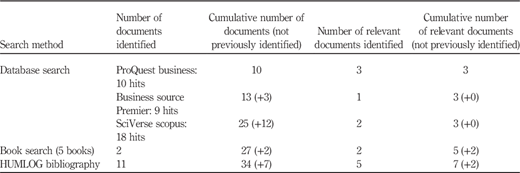
The first set of keywords reflect those used in the main literature reviews conducted in the field of humanitarian logistics (i.e. Kovács and Spens, 2007; Overstreet et al., 2011; Kunz and Reiner, 2012; Leiras et al., 2014). In addition, it should be noted that, in this paper, agility, flexibility, and responsiveness are not seen as interchangeable (as mentioned earlier, flexibility and responsiveness are the operational components of agility). However, as the terms agility, flexibility, and responsiveness are sometimes used interchangeably in the literature (Li et al., 2008), they were brought together in the database search in order to not overlook any relevant study. Next, the HUMLOG bibliography developed by Professor Peter Tatham (HUMLOG, 2014) and which provides an extensive list of journal articles, book chapters, and conference papers relating to the field of humanitarian logistics was perused. As shown in Table I, a total of 34 documents were identified.
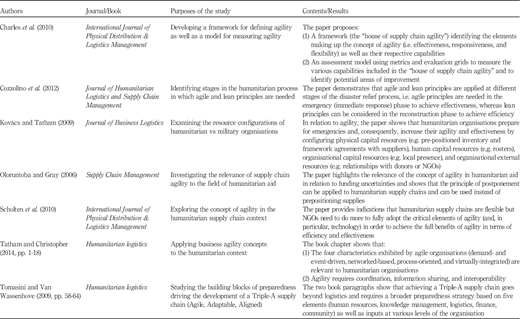
These 34 documents were considered individually and only those providing an insight on the way that the concept of agility is studied in the humanitarian logistics context were selected. To do so, the title and abstract of each document were examined and any irrelevant material excluded. The documents whose titles and abstracts were not sufficient to assess relevance were read in full. This process generated a list of seven relevant studies (five academic papers and two book chapters) that are presented in Table II.
These documents are now reviewed based on Section 4’s discussions in order to identify why agility is needed in humanitarian logistics and how the concept of agility is currently approached in this discipline.
5.1. Why is agility needed in humanitarian logistics?
First, the documents are reviewed in order to identify the nature of the operational risks and uncertainties that justify the building of agility. Although the broader humanitarian logistics literature widely covers the highly disruptive environment in which humanitarian organisations operate (see Kunz and Reiner, 2012), the studies in Table II mostly limit agility to supply chain-related risks and uncertainties. For example, Cozzolino et al. (2012) use Christopher’s (2005) model of agile vs lean supply chains and, on this basis, consider agility as a response to unpredictable demand and short lead times. In other words, they study agility only in response to supply chain risks and uncertainties and not in response to contextual factors external to the supply chain. Similarly, although they mention that humanitarian organisations operate in unstable external environments, Charles et al.’s (2010) agile capabilities and metrics are predominantly derived from the manufacturing environment and, therefore, mainly address risks and uncertainties in relation to demand, supply, and processes. This perspective is also found in Scholten et al. (2010) where the constraints mentioned relate to unanticipated demand, the uncertainty of supply, and the lack of process integration. Going one step further, we note that none of the documents listed in Table II clearly categorises the risks/uncertainties encountered by humanitarian organisations and that require them to build agile supply chains. Thus, it appears that there is still a need for understanding and categorising all risks/uncertainties that justify the building of agility in humanitarian logistics (i.e. beyond the supply chain-related risks and uncertainties).
5.2. How is agility approached in humanitarian logistics?
Next, Table II’s documents are reviewed to ascertain the organisational level at which agility is being studied (operational and/or strategic), as well as to determine if the strategic mechanisms of agility are identified. In the first document of Table II, Charles et al. (2010) develop a model to measure the agility of humanitarian and commercial supply chains. To this end, they identify the main components of agility (i.e. effectiveness, responsiveness, and flexibility) as well as the capabilities and metrics associated with these components. However, these capabilities cannot be seen as dynamic capabilities because they are primarily operational (e.g. volume flexibility, delivery flexibility, completeness, velocity, etc.). In other words, Charles et al. (2010) do not identify the strategic level capabilities needed to support supply chain agility. Similarly, Cozzolino et al.’s (2012) analysis of agility is operationally-focused. For example, these authors associate agility with the building of redundant operational capacity, the rapid mobilisation of air transport, and the swift deployment of an emergency team of IT, telecommunication, and electricity specialists. Oloruntoba and Gray’s (2006) study of the applicability of the concept of postponement in a humanitarian context is also focused on operations. In particular, these researchers highlight the potential of postponement as an improved means of responding to the actual demand of beneficiaries and increasing flexibility in the field.
Taking a different view, Tatham and Christopher (2014) argue that agile organisations (commercial or humanitarian) exhibit four characteristics, i.e. they should be demand- and event-driven, network-based, process-oriented, and virtually integrated. Whilst these characteristics clearly require a business-wide approach to the concept of agility, the authors do not go as far as recognising agility in humanitarian logistics as fundamentally strategic and they do not explain how humanitarian organisations achieve the four characteristics. In the same way, Scholten et al. (2010) argue that agility goes beyond operational flexibility and that humanitarian organisations can do more to fully adopt the most beneficial elements of agility (which these authors state to be market sensitivity, virtual integration, process integration, and network integration). In particular, they highlight the essential role of technology to achieve agility. This implies, arguably, that agility requires strategic inputs but the authors do not explicitly take up this position. Tomasini and Van Wassenhove (2009) touch upon the need for an integrated and organisational approach to supply chain agility when they explain that a “Triple-A” supply chain (i.e. Agile, Adaptable, and Aligned) requires strategic inputs in terms of human resources, knowledge management, logistics, finance, and community. However, Tomasini and Van Wassenhove (2009) only briefly mention this approach at the end of their book chapter which is focused on preparedness. In addition, their analysis does not extend to the capabilities needed to deploy the five mentioned enablers. Similarly, Kovács and Tatham (2009) show that agility stems from the humanitarian organisations’ ability to configure their available resources and, in particular, their physical, human, capital, and external organisational resources in order to swiftly respond to emergencies. However, as in the previous instance, they do not identify the set of capabilities needed to deploy these resources.
Thus, the primary focus of the humanitarian logistics literature relating to agility remains firmly rooted in operational level considerations. This does not mean that the various authors see the strategic level as insignificant but, to date, the way and the extent to which managerial and leadership decisions and practices contribute to logistics and supply chain agility in a humanitarian context have not been studied. These elements are considered in the model of agility presented in the next section.
6. Alternative approach to agility in humanitarian logistics
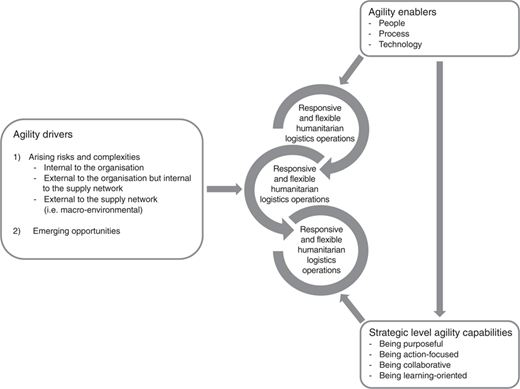
The following conceptual model of agility has been developed by using the previous discussions regarding the encountered risks and uncertainties impacting on logistics and supply chain activities (Section 4.1), the need to consider agility at the operational and at the strategic level (Section 4.2), and the four strategic level agility capabilities supported by three agility enablers (Section 4.3). In addition, four aspects of the DCM are reflected in the model. First, the model shows that agility is not only a response to arising risks and uncertainties, but also to emerging opportunities. Second, the model includes four dynamic capabilities that go beyond operational skills, are deeply inherent in strategic decision-making, and enable an organisation to adapt to the requirements of an unstable environment. Third, the model distinguishes between the actual capabilities and the enablers that support the development of the capabilities (also called “micro-foundations” by Teece). Fourth, the model takes a systems view of the concept of agility and shows that the operational and strategic levels of the organisation must interact to create agility.
Thus, Figure 2 includes four distinct elements:
agility drivers;
responsive and flexible humanitarian logistics operations;
agility enablers; and
strategic level agility capabilities.
The agility drivers are those forces that push an organisation to respond (Sharifi and Zhang, 2001). Figure 1 identifies two types of agility drivers, i.e. risks and opportunities. Christopher and Peck’s (2004) categorisation of risks (discussed earlier) has been integrated into the model because it demonstrates that risk and uncertainty are not only generated within the organisation and the supply network, but also by the turbulence created by the macro-environment (as mentioned earlier, a point that is particularly relevant in the humanitarian context). As further illustrated in Figure 2, agility drivers make continuous adaptation and reconfiguration of the humanitarian logistics and supply chain operations necessary. In other words, to appropriately respond to the agility drivers, humanitarian logistics operations need to be flexible and responsive. This cannot be fully achieved without taking a systems level view, i.e. without the whole organisation developing agility capabilities (Sharifi and Zhang, 2001). Therefore, the model integrates the four strategic level agility capabilities identified earlier, namely being purposeful, action-focused, collaborative, and learning-oriented. Agility capabilities are built by deploying the associated agility enablers which consist of people, processes, and technology. Thus, the model summarises why an organisation needs to build agility (the agility drivers) and how it should pursue agility by deploying agility enablers in order to build strategic level capabilities that support responsive and flexible operations.
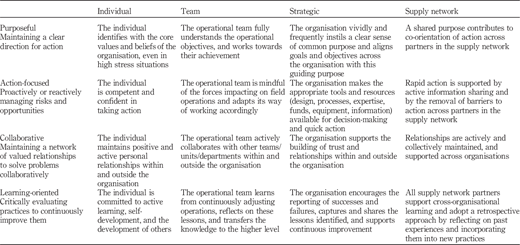
In order to better elucidate how the strategic level agility capabilities are built by deploying the agility enablers, Table III describes the agility capabilities at four different levels of an organisation (individual, team, strategic, and supply network) by drawing on the research conducted by Redding and Catalanello (1994) and by McCann and Selsky (2012). This table illustrates how people, processes, and technology underpin the development of the agility capabilities. For example, and in relation to the field of humanitarian logistics, the individual and team levels show that managers and leaders have a role to play in the recruitment and the development of people in order to make them able to meet the requirements of the field (Kovács et al., 2012), i.e. to make them purposeful, action-focused, collaborative, and learning-oriented. Whilst being important at all levels, processes play a significant role at the operational level of a humanitarian organisation and must be appropriately developed and deployed by leaders and managers. They not only support more effective decision-making and make the organisation an action-focused organisation (Blecken, 2010; Larson, 2014), but they also enable the organisation to capture and share the lessons from the field (thereby making the organisation learning-oriented) (HAP, 2013). Technology is also essential at all levels. For example, technology can support individual learning (e.g. e-learning) (Blansjaar and Stephens, 2014) as well as communication throughout the organisation and with entities outside the organisation (Balcik et al., 2010; Scholten et al., 2010) in order to make it action-focused and collaborative.
Thus, Table III reflects the decision space for leaders and managers, and emphasises that an organisation builds agility in all directions, i.e. downwards, upwards and around (McCann and Selsky, 2012). As a consequence, the strategic level of an organisation needs to take a systemic perspective, i.e. consider how the parts of the system interrelate (Senge, 2006), how to configure and reconfigure these elements to fit the requirements of the environment, and how to build agility at all four levels concurrently (individual, team, organisation, and supply network) and in an aligned way (Redding and Catalanello, 1994; McCann and Selsky, 2012). Importantly, and as will be mentioned in the next section, Table III has been developed to operationalise the model of agility and, therefore, can be used to further investigate the mechanisms of agility building, i.e. to understand how logistics and supply chain agility is supported by the development of capabilities at the four levels and by their interactions.
7. Research agenda
Moving forward from the above discussions, it is argued that the concept of agility in a humanitarian logistics context is currently incomplete. Three research directions are, therefore, suggested. First, research should be undertaken to gain a better understanding of the agility drivers and, in particular, the risks and uncertainties encountered by humanitarian organisations. This paper mentions four types of risks/uncertainties (demand-, supply-, process-related, and environmental) classified into three categories (those internal to the organisation, those external to the organisation but internal to the supply network, and those external to the supply network). However, further investigations are needed to validate this approach and, in particular, to determine the nature and the frequency of the risks encountered, as well as to accurately identify, categorise, and analyse the severity of their impacts on the logistics activities of humanitarian organisations. Thus, Christopher and Peck’s (2004) model introduced earlier can be used as a starting point to better understand the risk environment in which humanitarian organisations operate and that justify the building of agility. Going one step further, research should also focus on the risks and uncertainties applicable to different categories of disaster situations and operational environments (L’Hermitte et al., 2014). In summary, the following research questions remain to be addressed:
RQ1. What is the nature of the risks/uncertainties encountered by humanitarian organisations that justify the need for agility?
RQ2. What is the frequency of occurrence of these risks/uncertainties?
RQ3. What are the potential impacts of these risks/uncertainties on logistics operations?
RQ4. How severe are the impacts of these risks/uncertainties on logistics operations?
RQ5. Are the risks/uncertainties encountered by humanitarian organisations different according to the nature of the disaster environment in which they operate?
Second, given that agility is not a quick fix (Cobb, 2011) but an integrated system (Gunasekaran, 1998; Sanchez and Nagi, 2001), humanitarian organisations should understand what it takes to be able to conduct agile operations in their particular context. This paper argues that operating in a continuously changing and unpredictable environment is a challenge that involves not only the operational level, but the organisation as a whole. In other words, supply chain agility requires a strategic approach. As the humanitarian logistics literature does not provide any multi-level analysis of the concept of agility, research efforts should focus on exploring how the strategic and operational levels of an organisation interact to create logistics and supply chain agility. In particular, research is needed to determine how, in a concrete sense, humanitarian organisations create agility by deploying agility enablers and building capabilities to support field operations. In relation to the model presented in Figure 2, these investigations relate to the agility enablers and strategic level agility capabilities. To do so, researchers could usefully employ Table III that was developed to understand how the agility enablers contribute to the building of the strategic level agility capabilities. This table describes the four agility capabilities (being purposeful, action-focused, collaborative, and learning-oriented) at four different levels (individual, team, strategic, and supply network) in order to understand how these elements interact to create agility. The development of scale items to measure the agility capabilities at the four different levels as well as a statistical technique (such as a factor analysis) could be used to investigate these issues. In doing so, academic research will be able to provide practical and actionable prescriptions for humanitarian organisations. In summary, following research questions remain to be addressed:
RQ6. How do the individual, team, strategic, and supply network levels of an organisation interact to build agility capabilities?
RQ7. How do the strategic level agility capabilities correlate to each other to create agility?
Third, it is contented that the development of strategic level agility capabilities is not an end in itself, but a means to achieve flexibility and responsiveness in the field in order to prevent the ongoing exposure to highly disruptive events from negatively impacting on performance (Weick and Sutcliffe, 2001). Therefore, empirical research should be conducted to study the impact of developing strategic level agility capabilities on operational flexibility and responsiveness. In relation to Figure 2’s model, these investigations relate to the impact of the strategic level capabilities on the responsive and flexible operations represented at the centre of the model. These relationships can be explored by drawing on prior research conducted, for example, in the fields of agile manufacturing (Vázquez-Bustelo et al., 2007; Hallgren and Olhager, 2009) or agile supply chain management (Gligor and Holcomb, 2012; Whitten et al., 2012). In particular, a statistical technique such as structural equation modelling could be used to test the structural relationships between variables and, thus, address the following research questions:
RQ8. What are the structural relationships between the four strategic level agility capabilities and the responsiveness of humanitarian logistics and supply chain operations?
RQ9. What are the structural relationships between the four strategic level agility capabilities and the flexibility of humanitarian logistics and supply chain operations?
8. Value and limitations
This paper is designed to bring new insights into the concept of agility in the field of humanitarian logistics and to provide a more comprehensive framework for analysing agility in this context. In particular, it is argued that limiting agility to the operational level is suboptimal and that widening the scope of the concept is valuable as a means of gaining a better understanding of agility. To achieve this, the paper identifies a number of relevant components and their conceptual relationships. In particular, it integrates the notions of agility drivers, responsive and flexible operations, strategic level agility capabilities, and agility enablers into a single model. This model is the main contribution of the paper. It not only offers potential for future research, but also provides the basis for a practical approach to agility in humanitarian logistics. It is, thus, a step towards an improved understanding of the nature of the strategic decisions that humanitarian organisations might take to improve their supply chain agility. In particular, this paper intends to help managers and leaders understand that agility goes beyond the prepositioning of supplies, the swift deployment of a team of specialists, or the rapid organisation of airdrops to deliver humanitarian supplies to remote and unstable locations. Whilst these elements, undoubtedly, contribute to supply chain agility, we argue that they are not sufficient and that managerial and leadership input is also necessary. This includes, for example, the understanding of the problems encountered at the field level, the recognition of the skills and tools needed to overcome these problems, the achievement of the right balance between the need for formal processes and procedures that enhance responsiveness and decentralised initiative that fosters flexibility, the assessment of the current internal abilities (as well as the gaps), and the development of strategies to quickly and appropriately fill the gaps (e.g. through training or the development of collaborative networks).
However, given that this paper is conceptual in nature, the relevance of the approach and the model need to be scientifically and empirically tested. In addition, a number of issues remain to be explored, as explained in detail in the previous section.
9. Summary
This paper reflects on the concept of agility in the humanitarian context. It argues that the current ways of addressing agility in the humanitarian logistics literature are incomplete and proposes a more comprehensive definition and picture of the concept. Drawing on the DCM and following the lead of researchers in other disciplines, the chosen approach goes beyond operational agility to embrace a multi-level perspective in which the strategic and operational levels of the organisation interact in order to manage disruptive events appropriately. The paper identifies three research gaps in the current humanitarian logistics literature. They relate to the types of risks/uncertainties that justify the building of agility (not only demand-, supply-, and process-oriented risks/uncertainties, but also contextual ones), the need to approach agility as a system (i.e. from a strategic and operational perspective), and the identification of the strategic components of agility. These gaps are partially addressed by conceptualising a comprehensive model of agility in a humanitarian logistics context. This model suggests that agility enablers and strategic level capabilities support responsiveness and flexibility at the operational level in response to agility drivers (i.e. risks and opportunities). Since this paper is conceptual in nature, empirical research is needed to validate this approach. To this end, a research agenda is proposed.
References
Corresponding author
Cécile L’Hermitte can be contacted at: cecile.lhermitte@utas.edu.au