


– The purpose of this paper is to explore the underlying strategic mechanisms of agility in a humanitarian logistics context. Based on the research conducted in business disciplines, the paper empirically examines a set of four strategic dimensions (being purposeful, being action-focused, being collaborative, and being learning-oriented) and identifies an emergent relationship between these capabilities and agile humanitarian logistics operations.
– Leadership and management actions perceived to support the four capabilities were identified and used as a basis to complete the exploratory research. Specifically, a case study with the United Nations World Food Programme (WFP) was undertaken and, in this context, a qualitative analysis of 29 face-to-face interviews with humanitarian logistics experts working for WFP was conducted.
– The research corroborates the relevance of the four strategic-level capabilities to the humanitarian logistics context and confirms that these capabilities play a role in the development of agility in humanitarian operations. The work also identifies a set of key strategic decision-making areas that relate to the building of agility.
– Additional research is needed to further investigate and measure the strategic-level capabilities and to quantify their impact on operational agility. Further research should also be undertaken to extend this study to a wider range of humanitarian organisations.
– This paper is the first empirical research that takes a strategic approach to the concept of agility in humanitarian logistics. It highlights that the leaders and managers of humanitarian organisations have a significant role to play in the building of an agile system.
1. Introduction
Humanitarian organisations typically operate in highly complex, dynamic, and uncertain environments (Van Wassenhove, 2006). In a supply chain context, these uncertainties relate not only to unpredictable and changing demand and supply patterns (Balcik and Beamon, 2008; Charles et al., 2010), but also to the many contextual factors that interrupt, or at least disrupt, the flow of humanitarian supplies. Such contextual factors include the lack and/or destruction of the logistics infrastructure, communication challenges, the inadequacy of the logistics resources available locally (e.g. for storage and transport), weather-related disruptions, as well as insecure and corrupt environments (Tatham and Pettit, 2010; L’Hermitte et al., 2014). The fact that humanitarian organisations are involved in multiple ad hoc supply chain operations and typically work in highly diverse operational environments (Merminod et al., 2014) increases both their risk exposure and the complexity/uncertainty that they have to manage.
The many disruptions and constraints encountered in the field are barriers to effective and efficient supply chain operations. They create bottlenecks, increase lead times, bring about delays, lead to cargo losses, and raise the costs of delivering the right humanitarian items to the right place, at the right time, and in the right quantities (L’Hermitte et al., 2014). Therefore, in order to ensure the continuity of their supply chain operations, humanitarian organisations need to build and maintain agile capabilities. In other words, they need to be able to develop and implement swift adjustments in response to changing environments and disruptive events along the supply chain.
As observed by L’Hermitte et al. (2015) who reviewed the humanitarian logistics literature on agility, the concept and its importance have been repeatedly discussed. For example, Cozzolino et al. (2012) and Scholten et al. (2010) note that agility is essential in the humanitarian context due to the life-saving objective guiding the work of aid agencies. Other authors (Gattorna, 2006; Tatham and Christopher, 2014) argue that, due to the complexities and dynamics encountered in humanitarian environments (e.g. uncertainties as to when and where disasters will strike as well as the extremely fast-moving and unpredictable local conditions), agility is the key to successful humanitarian operations. This can be illustrated by recent disaster situations such as the 7.8-magnitude earthquake in Nepal in April 2015 where the scale of the disaster, the high level of transport and communication infrastructure destruction, the limited capacity of the Kathmandu airport and its resultant inability to cope with the flow of humanitarian supplies, as well as the topographic characteristics of some of the areas struck (i.e. mountainous areas with limited road access) have led humanitarian organisations to find agile solutions to overcome these challenges and get the urgently needed life-saving supplies on the ground. This included swiftly activating the Logistics Cluster[1], coordinating the relief efforts to deal with the large-scale humanitarian needs and to avoid gaps and/or overlaps, using military resources, mobilising a truck fleet to reach the areas accessible by road as well as helicopters to access the isolated locations, and arranging storage outside Kathmandu and Nepal to prevent congestion at the points of entry (Logistics Cluster, 2015). In the same way, agility was essential in the aftermath of Cyclone Pam (March 2015) in order to rapidly mobilise resources and deliver relief items to the affected inhabitants of the remote islands in the archipelago of Vanuatu. To this end, emergency supplies that were pre-positioned in humanitarian depots in Dubai and Malaysia were swiftly deployed, mobile warehouses built, communication re-established, and the supplies delivered to those in need by any means possible including trucks, boats, helicopters, and/or air taxis (WFP, 2015).
L’Hermitte et al. (2015) argue that, within the current humanitarian logistics literature, the concept of agility is mostly studied at the operational level and framed as the ability to conduct responsive and flexible operations. This operational approach is not only taken by academics, but also by practitioners, possibly because the latter mainly focus on their daily routine and on the need to rapidly solve problems at the operational level without considering the potential root causes of these problems at a higher level of the organisation (Pedraza-Martinez et al., 2013). This operational focus may also relate to the perception of logistics as an operational function of humanitarian organisations rather than a strategic one (Whiting and Ayala-Öström, 2009).
However, L’Hermitte et al. (2015) establish that focusing solely on operational considerations significantly limits the scope of the concept of agility and, therefore, constitutes an important research gap. They further argue that humanitarian logistics agility requires a strategic approach and that agile operations are the result of decisions and actions of leaders and managers. Using the contributions of prior research on agility in a business context, L’Hermitte et al. (2015) develop an extended model of agility in humanitarian logistics, and identify four strategic-level agility capabilities (being purposeful, action-focused, collaborative, and learning-oriented) as well as three sets of agility enablers (people, processes, and technology).
This paper focuses on the cornerstone of L’Hermitte et al.’s (2015) conceptual model, i.e. on the four above-mentioned capabilities. It explores their empirical relevance to the humanitarian environment and contributes to understanding how they support the development of agility in humanitarian logistics. Doing so is necessary because, although L’Hermitte et al. (2015) argue that the capabilities need to be developed at the strategic level of a humanitarian organisation in order to enhance the organisation’s operational capacity to appropriately respond to unpredictable and disruptive events, their research remains conceptual and has not been supported by empirical evidence. The purpose of this paper is, therefore, to address this limitation by presenting exploratory research that examines the following question:
How do the four strategic-level capabilities contribute to the development of field-level agility in humanitarian logistics?
The remainder of this paper is structured as follows. Section 2 provides an overview of the four strategic-level capabilities outlined earlier. Section 3 presents the qualitative methodology before Section 4 examines the research findings. Next, Section 5 discusses these results and Section 6 considers the contribution, implications, and limitations of this study. Section 7 provides concluding comments.
2. The strategic dimensions of agility
Initially developed in the manufacturing discipline (e.g. Goldman and Nagel, 1993), the concept of agility has been subsequently studied in strategic management (e.g. McCann and Selsky, 2012), supply chain management (e.g. Christopher, 2000), and project management (e.g. Appelo, 2011). According to the above-mentioned authors, agility transcends the technical, operational and functional levels of an organisation, and agile organisations exhibit a number of deep-rooted capabilities developed across the organisation as a whole. Therefore, through a detailed consideration of the well-established literature on agility in a business context and, especially, in the above-mentioned fields, L’Hermitte et al. (2015) argue that the achievement of agility in humanitarian field operations is supported by four distinctive but mutually reinforcing capabilities that need to be developed and sustained at the highest level of a humanitarian organisation.
The first strategic-level capability, being purposeful, is the ability to maintain a clear direction for action throughout the whole organisation. It is the foundation capability and serves as a reference point that sustains a strong identity whilst, at the same time, contributing to focusing and guiding action (McCann and Selsky, 2012). A clear purpose is necessary to steer individuals, teams and the whole organisational system when they are exposed to unexpected and disrupting circumstances (Appelo, 2011). Thus, a clear purpose enhances agility because it provides perspective and direction, assists people and teams in setting the right priorities and, ultimately, establishes a foundation for acting confidently in stressful and ambiguous work situations (McCann and Selsky, 2012).
The second strategic dimension of agility, being action-focused, is about building readiness to be able to respond to risks, uncertainties, and opportunities occurring along the supply chain. In particular, being action-focused is about providing operational staff with appropriate tools that enable them to recognise and manage field contingencies in a swift and effective manner in order to avoid or mitigate negative impacts on logistics operations. The required tools are varied but include an appropriate level of skills, adequate resources, clear and standardised processes and procedures to deal swiftly with common operational situations, delegated authority to enhance flexibility, short decision-making lines and rapid approval protocols, effective leaders who drive action, as well as the availability of accurate and timely information that supports fast decision making and responsiveness. The combination of these elements contributes to the development of readiness and to the building of agility (Weick and Sutcliffe, 2001; Appelo, 2011; McCann and Selsky, 2012).
The third strategic-level capability associated with agility, being collaborative, relates to the building and sustaining of internal and external relationships in order to solve problems collaboratively. Being collaborative is an essential capability because agility cannot be built by a single person or a single organisation. Rather, agility stems from people and organisations calling on each other and building a collaborative and integrated network of relationships both internally and across the supply network. Well-developed relationships are essential to agility building because they enable people and organisations to deal with problems that go beyond their own ability to solve (McCann and Selsky, 2012). Therefore, it is important that staff are familiar with the roles and responsibilities of others beyond the confines of their own job, and that they appreciate how they can collaboratively overcome disruptions (Weick and Sutcliffe, 2001). It is also essential that leaders and managers develop mechanisms to support not only trust and coordination throughout and beyond the organisation, but also the integration of the different parts of the organisation (Tatham and Kovács, 2010; McCann and Selsky, 2012).
The fourth strategic dimension of agility, being learning-oriented, is the ability to identify and capture past experiences, to critically evaluate and absorb them, and to share lessons in order to improve practices. Being learning-oriented is an integral part of agility because past ways of operating may no longer be appropriate and/or efficient/effective enough. Therefore, an organisation should continuously look for new solutions, create and transfer knowledge, and modify its plans and ways of functioning accordingly (Garvin, 1993; Weick and Sutcliffe, 2001). Similarly, McGill et al. (1992) take the view that responding proactively, rapidly, and effectively to changes in the environment requires the development of learning practices. Thus, to be agile, an organisation needs to continuously question how it operates and the adequacy of its responses to disruptions. To this end, an organisation learns from past experiences, ensures that appropriate action is taken as a result of these experiences, and shares lessons to improve future ways of working. In other words, by developing learning, an organisation goes beyond fixing immediate problems and reconsiders systemic issues involving the organisation as a whole (Redding and Catalanello, 1994; Senge, 2006).
This strategic approach to agility has, to date, not been taken in the humanitarian logistics discipline that primarily associates agility with operational level considerations. For example, practitioners frequently relate agility to logistics skills and the ability of logisticians to adapt operations. This includes, among other things, expertise in shipping that enables an organisation to use both regular container ships and chartered vessels to increase flexibility (WFP Logistics, 2015). For practitioners, adapting to changes and disruptions along humanitarian supply chains is also associated with the ability to find creative solutions and to fix immediate problems at the operational level (WFP, 2013a, b, 2014).
Whilst a number of higher level considerations are mentioned in professional sources, they are not related to the development of strategic capabilities and they are not part of an integrated view of agility at the organisational level. These considerations include, for example, the creation of a centralised information management unit that supports timely and informed action, as well as the use of technological tools such as geospatial technology and early warning systems to enhance preparedness (WFP, 2013c) or the development of an IT platform that supports cargo visibility along humanitarian supply chains (GT Nexus, 2010). Organisational learning is also mentioned in professional sources where, for example, the United Nations (UN) World Food Programme (WFP, 2009) notes that evaluating past experiences and sharing lessons are necessary to capture and build organisational knowledge and to improve performance. However, WFP does not relate such organisational learning practices to agility and also acknowledges that, to date, no formal mechanisms are in place to disseminate lessons from evaluations in a timely and effective manner.
Like practitioners, academics do not associate agility in humanitarian logistics with the development of deep-rooted capabilities and, rather, see agility mainly as an operational ability (L’Hermitte et al., 2015). This includes, for example, the ability to swiftly evaluate the needs of those affected in the aftermath of a disaster (Charles et al., 2010), to deploy emergency teams to the field at short notice (Cozzolino et al., 2012), as well as to rapidly adapt the type and/or the volume of the relief items delivered (Charles et al., 2010).
Oloruntoba and Kovács (2015) consider agility not only as a response to the unpredictability of the humanitarian needs, but also to funding uncertainties, to the heterogeneity of the humanitarian organisations involved in the supply networks, and to the evolving nature of the humanitarian work that includes the full spectrum from emergency to development responses. A number of authors also go into the details of the agility mechanisms. For example, Altay and Pal (2014) focus on the use of clusters and argue that this approach speeds up information sharing, facilitates coordination, and improves information quality. This, ultimately, supports prompter and better humanitarian responses. Thompson et al. (2006) highlight the important role of information technology and, in particular, decision support systems in facilitating timely decisions such as those related to resource acquisition and allocation, as well as task assignment. Thus, decision support systems contribute to improving humanitarian responses in complex and swiftly changing decision-making environments. Altay et al. (2009) identify a number of strategic planning activities that support humanitarian logistics operations, such as the development of internal and external coordination plans, the improvement of trust and communication throughout the entire supply network, the creation of cross-functional teams, and the establishment of long-term relationships with carefully selected suppliers. Similarly, Dubey and Gunasekaran (2016) argue that the performance of humanitarian supply chains depends on long-term capacity building that includes the integrated development of a number of elements such as information sharing, training, situational awareness, responsiveness, flexibility, and adaptability. Going one step further, Dubey et al. (2015) study the impact of agility (in the authors’ analysis, agility is comprised of dynamic sensing, responsiveness and flexibility) on the logistics and life-saving performance of humanitarian organisations which includes reducing the number of casualties, improving response time, reducing stock-outs, and increasing delivery quality. The authors also consider the essential role of leadership in this process.
The above studies discuss several key dimensions related to the concept of agility but they do not consider agility as the result of the integrated development of organisational capabilities. On the other hand, a number of authors discuss the relevance of the four above-mentioned strategic dimensions to the field of humanitarian logistics (e.g. Maon et al., 2009; Tomasini and Van Wassenhove, 2009; Balcik et al., 2010) but their research is not in relation to the concept of agility. The first steps in that direction are those of L’Hermitte et al. (2015) who have developed, and considered the applicability of, the four strategic-level agility capabilities to the humanitarian context but their work remains conceptual. We, therefore, aim to explore these four strategic dimensions of agility in order to demonstrate empirically that they are relevant to the humanitarian logistics context, and also that they play a role in the ability of humanitarian organisations to conduct agile field operations. In other words, we posit that building deep-rooted strategic capabilities that underpin capacity building at the whole organisational level supports operational agility. Figure 1 presents this organisational view of agility.
The remainder of this paper is designed to consider the validity of the above perspective. In line with what Saunders et al. (2009) consider to be exploratory research, our study is motivated by the need to understand a phenomenon about which little is known and that can only be conceptually delineated. To this end, qualitative data were collected and analysed, as is explained in the next section.
3. Methodology
3.1. Collecting data: case study research and interviews with humanitarian logistics experts
A single case study is used in order to explore the four strategic-level capabilities. A case-based approach is appropriate to the current research because case studies support exploratory research and help clarify the boundaries of ill-defined concepts (Yin, 2003). They also enable researchers to study the complexity of logistics and supply chain management issues and to contribute to management practice and policy (Seuring, 2005). Thus, in the absence of prior empirical research on the strategic determinants of agility in humanitarian logistics, and given the intricacies underlying the concept of agility (see, e.g. Sherehiy et al., 2007), a case study approach is expected to facilitate research exploration and to provide a real-life narration of the strategic mechanisms underpinning agility in humanitarian logistics. In other words, in light of Eisenhardt’s (1989) suggestion, a case study is used in this research in order to observe and understand the dynamics of the studied phenomenon within a real-life setting.
Given the large variety of humanitarian organisations operating in disaster relief environments (Kovács and Spens, 2007) and, arguably, the different ways of achieving agility, our research is focused on one single organisation, i.e. UN, WFP. WFP has been selected because it constitutes a critical case (Yin, 2003) due to the expertise of this organisation in the field of humanitarian logistics. This expertise has resulted in WFP being appointed leader of the UN Logistics Cluster (2016) (see footnote 1) and to be granted the 2014 European Supply Chain Excellence Award in the category “Austere Environments and Contingency Logistics” (Logistics Manager, 2014). WFP also assists other UN and non-governmental organisations (NGOs) as a provider of logistics services in addition to conducting its own supply chain activities (WFP Logistics, 2013). In this context, the selection of WFP is information-oriented, i.e. based on the expectation that the data collected will be relevant to the research topic (Flyvbjerg, 2006).
Within the framework of the above-mentioned case study, the data were collected by means of a series of 29 face-to-face interviews that were conducted at WFP’s global headquarters in Rome with staff working at the strategic and at the operational levels of the organisation. Given the multi-level perspective of our research, interviewing staff at both levels was necessary to gain a strategic as well as a field perspective. The participants (e.g. logistics officers, logistics coordinators, logistics cluster officers, emergency preparedness and response officers, heads of logistics, directors and deputy directors working in logistics) were selected for their extensive experience (e.g. 27 of them have been working in humanitarian logistics for over ten years). The sampling was, therefore, purposive, i.e. respondents were selected based on the type of information needed and their ability to provide the most relevant insights in relation to the research (Saunders et al., 2009). The participants included:
nine field workers (logistics staff with previous field experience as well as logistics staff still working on the ground);
nine support staff working at the headquarters in functional positions; and
11 managerial staff working at the headquarters in middle and senior management positions.
The average interview duration was some 40 minutes. Both unstructured and guided interviews were conducted, noting that these two techniques are commonly used in exploratory research and in early data collection stages (Olson, 2011). The questions focused on each of the four strategic-level capabilities, as indicated in Table I.
The aim of case-based research is the creation of knowledge and the formulation of theoretical insight related to a given phenomenon of interest. However, the type of knowledge created differs on the basis of the roles and interplay of theory and empirical data in each case study (Ketokivi and Choi, 2014). Thus, according to Ketokivi and Choi (2014), the purpose of case-based research can be either theory generation, theory testing, or theory elaboration. Our research uses prior theoretical knowledge that delineates the areas of investigation, identifies the constructs of interest, and shapes the conceptual design of agility. In particular, our study builds on the work of L’Hermitte et al. (2015) who make use of the dynamic capabilities model (Teece and Pisano, 1994; Teece et al., 1997) and draw on the existing business literature on agility in order to conceptualise the organisational view of agility and to identify the four strategic capabilities expected to support agile humanitarian logistics operations. Therefore, our case-based research emphasises Ketokivi and Choi’s (2014) theory testing approach that, according to the authors, is about situationally grounding a general theory. In other words, our research tests L’Hermitte et al.’s (2015) theoretical propositions by contextualising them and collecting and analysing empirical data on the four capabilities within the context of WFP.
3.2. Making sense of the data: qualitative content analysis
To make sense of the interview data, a qualitative content analysis was conducted. Content analysis is a social research method commonly used for scientifically and systematically studying text data, and, in particular, for evaluating, classifying, and categorising their content (Churchill, 2013). Content analysis has been recognised as an appropriate method to study qualitative data in case study research (Kohlbacher, 2006) and has previously been used in the humanitarian literature (e.g. Scholten et al., 2014).
To support this analysis, a categorisation and coding system was used. According to Weber (1990), categorisation involves the delineation of meaningful categories used to group similar text content together. As our research is linked to an existing body of knowledge, our analytical framework is derived from a priori categories, i.e. categories previously established in the literature. The predetermined categories of our content analysis are those described in Section 2, i.e. being purposeful, action-focused, collaborative, and learning-oriented.
Beyond these four strategic-level capabilities, 13 sub-categories were derived from the literature on agility in a business context and, more specifically, from the following key sources used by L’Hermitte et al. (2015): McGill et al. (1992), Redding and Catalanello (1994), Weick and Sutcliffe (2001), Gattorna (2006), Sherehiy et al. (2007), Appelo (2011), Christopher (2011), and McCann and Selsky (2012). This literature was reviewed and, following Churchill’s (2013) recommendation, enlightening categories were selected, i.e. categories which produce a breakdown of content that is analytically relevant and coherent. Specifically, the sub-categories were developed to reflect the properties of the investigated phenomena (Berg, 2007), namely, the four strategic-level capabilities as conceptualised and described by L’Hermitte et al. (2015). The sub-categories are, therefore, said to be deductive (Berg, 2007). The resultant categorisation framework and coding scheme are presented in Table II.
The first and second sub-categories listed in Table II reflect the fact that to be purposeful, an organisation needs a clear purpose that guides and focuses action in disruptive environments (McCann and Selsky, 2012). The next six sub-categories are the elements driving action. Thus, individual skills and personal attributes (e.g. being problem solving and creative) support people’s ability to act and react rapidly and in a confident manner (McCann and Selsky, 2012). These individual skills/attributes should be supported by the swift deployment and redeployment of resources (McCann and Selsky, 2012) across operations. Going one step further, standardised and effective processes and procedures are essential to support swift resource (re-)deployment as well as routine decision making and, ultimately, to ensure a smooth-flowing logistics pipeline (Christopher, 2011). Decentralisation of decision making as well as empowerment also promote action by making teams able to manage their own work and act appropriately in order to respond to the turbulence in their operational environment (Appelo, 2011). Similarly, effective leaders who sense the environment and are able to be decisive and drive action in order to cope effectively with the requirements of this environment are critical to support swift action (Gattorna, 2006). According to Christopher (2011), an action-focused organisation also needs information technology that enhances visibility and facilitates process integration, relationships as well as rapid decisions.
The ninth and tenth sub-categories reflect the fact that an organisation needs to build and maintain active internal and external relationships in order to be able to call on partners when dealing with turbulence and problems beyond its own ability (McCann and Selsky, 2012). Most importantly, the multiple dependencies between functional teams make cross-functional communication and coordination necessary (Appelo, 2011). The last three sub-categories relate to learning-orientation. Especially, identifying past operational successes and failures, critically evaluating these past experiences to re-evaluate and improve current practices, and sharing these lessons enable an organisation not only to create and transfer knowledge, but also to improve its operations as well as the management of change and uncertainty (Redding and Catalanello, 1994; Weick and Sutcliffe, 2001).
A manual approach based on a colour system was adopted to process the 29 interview texts and to relate the data to the analytical framework presented in Table II. The content of each interview was carefully reviewed by the lead researcher in order to code the relevant units of analysis. As recommended by Hsieh and Shannon (2005), units of analysis that appeared to be relevant but could not be coded were identified and subsequently reviewed to determine if they represented a new category/sub-category. This was perceived to be an important part of the overall process because, as noted by Schilling (2006), the actual content of the interviews may transcend the boundaries of the predetermined categories. Indeed, as will be further explained in the next section, one new sub-category was identified. Next, the units of analysis associated with one particular sub-category were pieced together and analysed in order to derive meaning from the data (Zhang and Wildemuth, 2009). This analysis is presented in the next section.
As categories are supposed to be mutually exclusive, the coding process should, theoretically, be straightforward. However, in reality, and as observed by Zhang and Wildemuth (2009), overlaps exist and it may sometimes be difficult to assign a code to a particular passage. To overcome this issue and to increase the reliability of our research, the coding was discussed within the research team and tested on a sample of text, as suggested by Schilling (2006) and by Zhang and Wildemuth (2009). In addition, in order to prevent any bias in the coding and in the subsequent analysis of the data and, ultimately, in order to confirm the validity of our results, two co-researchers controlled the way the interview content was used and interpreted in the paper. The next section presents the findings of our content analysis.
4. Findings of the content analysis
The presentation of our findings is guided by the categories and sub-categories identified in prior research and used to code the interview data (see Table II). Zhang and Wildemuth (2009) suggest that the presentation of the content analysis results should balance description and interpretation. We, therefore, report representative quotations to support our analysis and our conclusions. The reference attached to each quotation reflects the three categories of respondents identified above (FW1-9 for field workers, SP1-9 for support staff, and MA1-11 for managerial staff) and the sequence number in the interview document.
4.1. Being purposeful
The analysis of the data demonstrates that the first strategic-level capability, i.e. being purposeful, plays an important role in the building of agility. More specifically, the interview data confirm that a clear purpose provides perspective and sustains a positive identity, even in turbulent environments. For example, Field Worker No. 6 states that “we have a clear mission statement, to fight hunger, everyone knows that” (FW6-04). Similarly, Field Worker No. 3 mentions that “the purpose is all around us, there are pictures everywhere in the building. We know that our purpose is to deliver whatever whenever” (FW3-02). The interview data also indicate that a clear purpose provides a direction for action. As pointed out by Support Staff No. 4, “you really have to know what the purpose is and find the ways to work towards meeting or achieving that purpose” (SP4-01). Similarly, Field Worker No. 2 indicates that “everything is guided by the final objective that is to deliver” (FW2-03). Thus, the interview data show that having a clear organisational purpose provides the perspective that orients behaviour, i.e. the perspective against which the decisions and actions are taken and the priorities are set.
Most importantly, in order to support agility, this organisational purpose should be clearly understood and shared at all levels of the organisation. According to Managerial Staff No. 7, “each and every unit or division should see their part simply as a chain in the overall system that is connected with the purpose of serving the beneficiaries” (MA7-05). When the actions of some parts of the organisation are not guided by the common organisational purpose, this impedes agility: “at headquarters […], because people are focused more on processes and all that, sometimes, it [the purpose] does get lost. When you say ‘did you get this signature here or who approved that?’, that kind of things, sometimes it tends to get in the way” (MA7-06). It is, therefore, essential to recognise that “the ultimate goal is to save lives, not to be bureaucratic” (MA9-05), and to define a common value-driven agenda that focuses action and supports priorities and rapid decisions across all levels of the organisation.
Beyond the organisational boundaries, agility should be supported by a common purpose shared by all the partners participating in the relief effort. However, “the problem is that organisations have different roles and perspectives and, because of this, decision making takes more time” (MA8-01). Similarly, the operational choices made to overcome disruptions may differ, especially when humanitarians and the military operate together: “the army mitigates threats by increasing the number of arms, this is a bunker approach. The humanitarians prefer to use other strategies, arms are a last resort” (FW5-05).
To summarise this section, a clear overall purpose that guides action contributes to the ability of humanitarian organisations to make swift decisions and, ultimately, to deliver relief items in a timely manner. Therefore, leaders and managers have a clear role to play in sustaining a strong and value-driven identity that prompts commitment, provides a clear direction for action and supports agility. They should also define a common agenda that is well understood and unambiguously supported not only within the organisation (and at all levels of the organisation), but also among the various actors participating in the supply network.
4.2. Being action-focused
The interview data confirm that the six elements associated with being action-focused (see Table II) are essential to the building of agility, as demonstrated below.
4.2.1. Appropriate skills and personal attributes
A number of interviewees explain how skills, experience, and personal attributes enhance agility. Thus, according to Field Worker No. 6, “the final stage of an organisation’s resilience and flexibility relies on people” (FW6-17). “So Pakistan, it’s a super agile country office. I don’t know how many emergencies they’ve done, it happens every year. They’re all ready […], it’s an adaptive group of people. Some country offices, they don’t have experienced staff to cope with a major emergency” (FW6-19). Similarly, Field Worker No. 8 considers that “the experience of the field workers, their motivation, their mindset, and the commitment of the staff in the most remote locations contribute to the highest level of agility” (FW8-04). Going one step further, this respondent explains that “if, for example, we have to respond to sudden circumstances in country X or Y, we will always have in WFP’s staff members, two or three colleagues who know this country very well and who can be immediately deployed to solve the problem. This is due to the international nature of WFP, we have colleagues from all five continents. This is a great strength, in my opinion, this contributes to flexibility” (FW8-06).
4.2.2. Adequate level of resources and rapid resource (re-)deployment
An adequate level of other resources is also critical to the building of agility. In particular, a number of interviewees highlight the importance of funding and how slow and inflexible approaches to funding impede agility. Since commercial organisations do not depend on funds that are voluntarily provided, funding is not identified as an agility factor in the research on agility in a business context. It has, however, been recognised as an essential element that impacts on the capacity to respond of humanitarian organisations, and on the speed and flexibility of their response (Redvers, 2014; Wakolbinger and Toyasaki, 2014). Thus, Managerial Staff No. 3 mentions that “everything is driven by donors” (MA3-03) and Field Worker No. 3 confirms that “all depends on funding. If funding is there, then everything goes well and quickly. If no funding is there, nothing happens” (FW3-06). Thus, “the main bottleneck is that we do not have resources sitting somewhere that we can tap at any point in time. […] We depend on the resources that are voluntarily given to us, then, timeliness can become an issue” (MA2-06).
In addition to funding, the interview data indicate that agility depends on the rapid deployment and redeployment of resources, e.g. “the capacity, in the case of emergencies, to deploy aircraft and stocks” (FW9-08). Resources also include “a fleet of 650 trucks owned by WFP and deployed in about 20 countries. […] There are different circumstances that require the deployment of our trucks. For example when there are access problems, we deploy special trucks” (SP3-01). In addition, “we have been implementing regional intervention fleets. This supports agility. […] To respond to an emergency, usually in difficult environments, vehicles need to be deployed within one week. Otherwise, it is too late” (SP3-03). Support Staff No. 9 confirms that the development of regional truck fleets is “a very useful initiative because you reduce the lead time to get trucks to the field of operations in an emergency […], helping with the organisation’s ability to respond in a more timely and effective fashion” (SP9-01).
4.2.3. Suitable processes and procedures
Suitable processes and procedures are perceived to be essential to agility building because they enable field staff to quickly deal with common operational situations. As observed by Managerial Staff No. 9, “predefined processes and procedures streamline action and provide direction to people working in complex and sudden emergencies” (MA9-01). However, at the operational level, overly strict processes and procedures can become an impediment to agility. For example, Field Worker No. 3 mentions that “it is important to avoid putting people into a tunnel. Field workers should not be compelled to stick to procedures that are too strict” (FW3-08). Therefore, “one of the challenges here is to strike a balance between being guiding but not being restrictive because we work in many countries and the circumstances under which our various country offices and various field projects are operating are really significantly different from one another. But there are also a number of common denominators that apply across the globe. So it is basically striking a balance, issuing guidelines that are not how to switch off and fix the dishwasher but, basically, laying down the ground principles” (SP4-05).
Striking such a balance is made difficult by the governance model of humanitarian organisations because they are accountable to their donors and need to ensure that the requirements put on them by donors are met. “Especially for humanitarian agencies or publically funded organisations like ours, you have the obligation to account to the public how the resources that you have been entrusted with have been utilised. […] I think that is really one of the differences between us and the private sector because, for example, in the private sector, as a unit manager, you probably have more span of control, a certain type of decisions that you can take. That tends to be limited for us, so this really has an impact on agility. If you look at our procurement processes, we have to, for the most part, buy through tenders. That takes time, you have to send out the tender, give sufficient time to the suppliers to respond, then do your analysis, then get a committee in here to sit and, sometimes, it’s not easy to constitute those committees because members travel. So either you get a replacement or you have to set the meeting at a different date, and then once you go through this committee, depending on the value, there are different levels of approvals and everybody has to sign off” (MA7-07).
Nevertheless, the interview data make it clear that, sometimes, it is necessary to circumvent the established rules. In this respect, agility depends on the ability to have direct access to key decision makers and to have in place quick decision-making processes. As pointed out by Managerial Staff No. 6, “not all procedures can be complied with in emergency situations” (MA6-13). Field Worker No. 2 confirms that “sometimes, there are strict procedures that need to be bypassed. WFP can do this” (FW2-04). This point is illustrated by Field Worker No. 9: “if in 5 minutes I need an airplane for Iraq, it is possible to go to the top level and to make it happen […], this is a red line that enables you to get a quick decision, a waiver, somebody who commits and says ‘go ahead’, send an airplane and we will fix it later” (FW9-08).
Managerial Staff No. 9 summarises the above discussion by saying that “processes and procedures are about building a high performance machine while keeping things clean” (MA9-11).
4.2.4. Self-organised and empowered teams
The analysis of our data suggests that humanitarian organisations need to decentralise authority and empower the field because “a lot of hierarchy does not support agility” (FW3-05). Thus, “it is important to let field workers know what has to be achieved and to let them decide how to achieve it” (FW3-10). Support Staff No. 4 also explains that empowering teams includes letting the country offices adapt and refine the previously mentioned procedures because specific conditions exist in each operation: “some country offices go ahead and develop their standard operating procedures for a particular activity which is broadly described in the normative guidelines where […] the minimum requirements are spelt out which need to be met but, sometimes, you need to go further into the detail” (SP4-11).
Adjusting procedures to respond to the requirements of specific operational environments supports agility because teams are able to better manage and streamline their own work. In addition, as confirmed by a number of interviewees, “decentralising authority at the country level enhances agility” (SP2-09) because “the decision is much closer to the beneficiaries and much faster” (MA5-10). For this reason, “there is a trend to shift the centre of gravity to the field, to decentralise decision making and to empower teams” (MA9-07).
4.2.5. Effective leadership
As mentioned earlier, this paper highlights the crucial role of strategic leadership in agility building. Importantly, interviewees also see operational leadership as an essential component of agility and, in particular, of rapid decision making. Thus, effective leaders are seen by the interviewees as individuals who are not hesitant and are able to make the appropriate decisions to meet the requirements of the field. For example, Field Worker No. 4 mentions that “agility comes from leaders who make decisions, not from administrators who only apply the rules” (FW04-07). Field Worker No. 6 confirms that “it depends a lot of the individual, namely the country director” (SP6-02) but “with the right people at the right decision making place, yes, it works” (SP6-18).
4.2.6. Availability of information
The interview data also provide insights on the importance of information in the development of agility and, in particular, logistics and risk-related information. In regard to logistics information, Managerial Staff No. 1 explains that “we are heavily using outsourced services. […] A transporter delivers the goods to a warehouse, from the warehouse, it’s delivered to another transporter, the transporter delivers to a mill, a mill delivers, etc. […]. So at each point, the condition and the quantity of goods is established, is recorded, on paperwork or in the system, and this is, practically, the point where you know what you have, in what condition you have it, and between whom the passage happens” (MA1-01). Being able to assess the status and the location of the stock in warehouses and in transit supports agility, i.e. it increases visibility and, in turn, enhances swift decision making and the rapid deployment/redeployment of resources.
In addition to logistics information, risk-related information is also perceived to be essential to the creation of agility and, more specifically, to assist decision making in uncertain situations. Thus, Support Staff No. 9 mentions that “we have done a lot of investment in early warning, analysis, and vulnerability mapping, which allows us to look a little bit further ahead, to anticipate potential shocks that can happen. Knowing what is coming there, we may already start to wrap up or gear up a potential response or send people into a place. Using the example of the Philippines, Typhoon Haiyan, just in November [2013], we had seen that typhoon developing and heading that way and before it even hit, we had already sent the people […] to the Philippines, to be there already and already to establish networks” (SP9-08).
4.2.7. Extensive field presence
In addition to the six above-mentioned elements, the interview data highlight an additional factor, i.e. the physical presence of an organisation in the field, as an essential antecedent to the development of readiness and to the building of agility. Field presence is mentioned by three interviewees. Thus, Field Worker No. 8 observes that “what contributes to WFP’s highest level of agility is its field presence. […] This is what distinguishes us, we have warehouses, trucks, offices, colleagues in the most remote locations of the world” (FW8-04). According to Managerial Staff No. 6, “WFP has this logistics structure in place in all countries of the world, with positions in all ports”. Going one step further, Support Staff No. 9 explains how field presence differentiates WFP from other agencies and how this contributes to agility: “we have the deep field presence. Many organisations haven’t, they might get the country level, the capital level, whereas WFP is going down into the deepest parts of the country where we may be the only organisation represented in places, so we have that kind of coverage. That does cater towards our agility because we have […] some kind of connection or network already out there so that, once something strikes, well, we’re not starting from scratch. We have something in place” (SP9-07).
It can be concluded from the discussions in Sections 4.2.1-4.2.7 that action focus is a key element in agility building. In particular, leaders and managers can support flexibility and responsiveness in the field by building workforce agility; setting up mechanisms to make resources available in a timely manner; developing broad processes and procedures that streamline action without being too prescriptive and without preventing adaptability; empowering those working in the field and locating decision making close to the point where action is needed; having leaders in place who do not shy away from making decisions; making the right information available to the right people at the right time; and establishing a deep field presence that supports responsiveness in emergency situations.
4.3. Being collaborative
The interview data also reveal that the third agility capability, i.e. being collaborative, is critical to the building of agility. Especially, the importance of well-developed collaborative relationships is highlighted in a number of interviews and participants explain how collaboration must be developed at different levels, i.e. at the individual level, as well as inside and outside the organisation. At the individual level, “rotations are important. They enable staff members to meet a lot of people and create a network of people. Then, you know who can help you and who you can contact directly” (FW3-04). Some interviewees also mention the importance of the relationships between the field and the regional bureaux in order to solve problems collaboratively. For example, according to Field Worker No. 6, “in the field, you rely a lot on the regional bureau. […] If you have an issue, you call them. […] For example, you have a staffing issue, you work in an emergency, you need someone quickly, your first port of call will be to discuss with the regional bureau” (FW6-08).
Externally, collaborative relationships are needed with a number of actors and, among them, with national authorities because “we are invited by the host government” (FW6-03). External collaboration is also necessary among humanitarian organisations: “you know the NGO that works in the area, you call the head of logs there” (FW6-13). Thus, formal and informal contacts with the various participants to the relief effort enable field workers to solve problems more effectively and in an agile manner. However, external collaboration and agility can be impeded if organisations have different mandates. Therefore, there is “the need for developing better coordination mechanisms between organisations with different mandates, in particular between humanitarian organisations and the military” (FW5-01) because “a lack of mutual understanding impedes effectiveness” (FW5-06).
Beyond collaboration, creating an integrated system, i.e. eliminating silos between the different parts of the organisation to facilitate collaborative problem solving and agility is essential. For example, Managerial Staff No. 5 explains why integration is needed at the functional level: “more supply chain integration is needed to move away from silos, namely demand pipeline (how much, when, and where), procurement, logistics, and financing (donors). Before, the linkages between those elements were sequential, now it is more back and forth” (MA5-01). Thus, in order to streamline the flow of goods, functions need to clearly understand each other’s roles and constraints. This concerns, in particular, “the programme function that defines the needs and the strategy, and the logistics function that takes whatever they are given and make deliveries happen. […] Until now, they have not understood each other. So now, we try to make sure that programme people understand what an operation is in terms of logistics and that the logistics people understand the constraints of the programme function when they define their strategy” (FW9-11). As a consequence, agility depends on the ability of a humanitarian organisation to break down functional silos and on the ability of the different parts of the organisation not only to understand each other’s constraints, but also to work together in order to support responsive and flexible operations.
This section’s discussions demonstrate that managing disruptions and constraints can be achieved by joining forces. Therefore, agility depends on leaders’ and managers’ inputs in terms of building trust, coordination, and integration. This should not only occur internally, i.e. between the different parts and levels of an organisation, but also externally, i.e. between the various participants in the relief effort and the components of each supply chain.
4.4. Being learning-oriented
The last strategic dimension of agility (i.e. being learning-oriented) and the role of learning in agility building are captured in the interviews. Specifically, the data indicate that the identification of past experiences (both previous operational failures as well as successes) is essential. Thus, “there is, as part of the protocol, the requirement to perform lessons learned and after-action reviews. So it is now instituted. […] We have actually created lessons learned packages, lessons learned exercises, packages and tools that when teams go out, they have already ready-made guidance and templates of a systematic way to conduct lessons learned” (SP9-12). Most importantly, to create agility, learning should not be limited to the identification of past experiences, but should be followed by the critical evaluation of those experiences. Thus, past experiences should be analysed and this analysis used to improve the current practices that are no longer sufficiently relevant to the situations encountered in the field. As observed by Managerial Staff No. 9: “the objective is to identify […] what can be done to make WFP’s processes faster and more streamlined. […] All this enables the field to be responsive because they are provided with the right tools” (MA9-08).
However, Field Worker No. 3 makes it clear that critically evaluating practices should not be a bureaucratic, but rather a practical exercise: “if learning is about writing another procedure, it is constraining and does not support flexibility and responsiveness” (FW3-11). In addition, such critical evaluation of past experiences should be continuous: “not reinventing the wheel is important but in the field, everything changes all the time so wheels need to be changed all the time” (FW3-09).
After having identified relevant experiences and critically evaluated practices in the light of these experiences, the learning process should include a further step, i.e. the dissemination of the lessons across operations and across structural units. This enables teams to use methods and techniques already tried and successfully tested in the field and, therefore, to speed up their decision making and enhance their anticipatory and adaptive skills. Doing so is all the more important as “Dakar colleagues may be more knowledgeable about certain aspects than Bangkok colleagues. […] Naturally, a certain expertise develops in one bureau because that’s the type of issues that are usually occurring in that bureau, but that does not mean that it’s never going to happen in another bureau” (MA1-04).
However, although the need for learning is frequently emphasised in the field of disaster relief, it is not yet institutionalised in the humanitarian sector, as observed by IRIN (2014) and as confirmed by the interview data. According to Support Staff No. 6, “there is always something more important to do, this is not a priority. So the recommendations are not followed up. This is a shame because people in the field often face similar situations” (SP6-05). Similarly, Field Worker No. 8 complains: “how many times we have to reinvent the wheel, to put things in place again! Overall, we are more action-oriented than focused on the analysis of the action. […] And yet, this [learning] can be beneficial if this prevents us from redoing things, from reinventing things that have already been developed” (FW8-08).
The findings of this section indicate that organisational learning has the ability to enhance agility but is not used to its full potential. In other words, WFP still needs to develop an integrated system that institutionalises and systematises learning in order to better support agility in the field.
4.5. Quantitative approach to the interview data
Although the aim of this paper is to derive qualitative meaning from the interview data in order to explore the relevance and contribution of the four strategic-level capabilities to agility in humanitarian logistics, Berg (2007) notes that content analysis is a flexible research method that lends itself to a quantitative approach, for example when the textual elements are tallied. We have, therefore, reported in Table III the topics raised by each interview participant and we have totalled these numbers up.
This table shows that collaboration (i.e. building relationships and solving problems collaboratively) is the sub-category most frequently mentioned by the interview participants (the topic was raised by 20 out of 29 participants). It is followed by the availability of suitable processes and procedures (raised by 18 participants) and by the institutionalised identification of past operational successes and failures (raised by 14 participants). These three sub-categories, which are mentioned by at least half of the interviewees, reflect the significance of the three following organisational capabilities: being collaborative, being action-focused, and being learning-oriented. It should also be noted that the eight sub-categories mentioned by at least one-third of the participants (in addition to the three previously mentioned sub-categories: the availability of a clear organisation’s purpose, appropriates skills and personal attributes, an adequate level of resources, self-organised and empowered teams, as well as the integration of the different parts of the organisation) represent the four capabilities studied in this paper. We are aware that no statistical inference can be performed on this basis and that the numbers presented in Table III do not necessarily reflect the relative importance of each sub-category. However, we note that the topics most frequently raised by the interview participants reflect the four strategic-level agility capabilities identified by L’Hermitte et al. (2015) and this confirms that each of them play a role in the building of agility in humanitarian logistics, as will be further discussed in the next section.
5. Discussion
The findings from the WFP case study provide supporting evidence that the four strategic-level capabilities (being purposeful, being action-focused, being collaborative, and being learning-oriented) are empirically relevant to the humanitarian logistics context and that they support the development of agility. This confirms that these capabilities, initially derived from a review of the business literature on agility, can be transferred to the humanitarian sector. The analysis of the interviews also illustrates the role played by the components making up the four capabilities, i.e. by each of the sub-categories and, thereby, provides information about the rationale behind the contribution of the strategic capabilities to agility.
First, this study shows that a strong purpose focuses action and drives meaningful results in the humanitarian environment. In other words, a strong and shared humanitarian mandate supports rapid decisions and responses, and provides individuals and teams with a direction through the obstacles and challenges encountered in the field. However, in order to fully support agility, the organisational purpose should not only be well understood and serve as a beacon in the field, but it should also be used to guide action and set priorities at all levels of the organisation and, in particular, in central offices.
Second, this research demonstrates that swift action and flexibility in the field can be supported by a number of tools including individual skills and personal attributes, adequate resources rapidly deployed/redeployed, standardised processes and procedures to deal with common operational situations, short decision-making lines to manage exceptional emergency circumstances, delegated authority to facilitate and speed up decisions and increase flexibility, decisive leadership to make things happen, timely and accurate information to assist the decision-making process and adaptability, as well as an extensive field presence to enhance field knowledge, the development of local networks, and responsiveness. The above elements enable an organisation to build readiness and to reactively and proactively manage change and uncertainty. Going one step further, the interview data illustrate how these elements interrelate with each other. For example, the availability of resources must be supported by adequate information systems that provide visibility as to which resources are available and where, as well as by appropriate procedures allowing for their rapid (re-)deployment. Similarly, a compromise has to be found between the need to standardise processes and procedures to support rapid routine decision making, and the need to decentralise authority and to empower teams in order to enable them to adapt to the specific circumstances prevailing in each operation. We conclude from this discussion that the agility factors cannot be considered in isolation and that a systems approach to agility is needed.
Third, building and maintaining internal and external relationships, i.e. being collaborative, enables logistics teams to be more responsive. Internally, this is because other functions (such as programming) better understand the constraints of logisticians and their need for flexibility, and take these factors into account when preparing the relief response. Externally, it is important to build a relationship network that can be called on to obtain support and overcome some of the issues encountered in the field. In other words, agility is generated by people and organisations working together and dealing with problems that go beyond their individual ability to solve.
Finally, the interview data provide evidence that the fourth capability (being learning-oriented) has not been fully developed by WFP and this confirms WFP’s report (2009) mentioned earlier in Section 2. This report shows that organisational learning has not yet been considered as a priority and that WFP’s current learning mechanisms should be improved to better translate knowledge into practice. Doing so is all the more important as the interviewees clearly indicate that organisational learning has the potential to support agility and, in particular, better operational solutions and swifter responses. However, the interviewees also mention that, to support agility, the lessons learned need to be shared rapidly, i.e. before they become obsolete, and should be used to improve future work rather than to increase control and bureaucracy.
Given its exploratory nature, the role of this research is not to establish categorical cause and effect relationships between the four capabilities and the agility of logistics operations. It is also not its role to rank the categories and sub-categories by order of importance. As previously explained, our study is motivated by the need to understand a research phenomenon that has only been delineated conceptually and about which little is known. Accordingly, this paper establishes an emergent relationship between the strategic and operational components of agility, and calls for further research to be conducted in order to determine the strength of this relationship and to better delineate the intricate dynamics behind the building of agility.
That said, the significance of our work lies in the confirmation that the extended and multi-level approach to agility conceptually developed by L’Hermitte et al. (2015) is empirically relevant, and in the demonstration that creating and sustaining agility requires humanitarian organisations to concurrently consider a large number of factors. As a consequence, building agility requires a systems view as well as leadership inputs, and cannot be considered as a technical and functional responsibility only. In other words, agility transcends operational matters, i.e. technical and functional skills as well as creativity and reactive adjustments in the field. This paper demonstrates that, on top of these operational factors, agility originates from structural arrangements and an organisation’s internal behaviour. It is, therefore, essential for academics and practitioners to gain a better understanding of the dynamics behind the concept in order to make appropriate recommendations and to set the right conditions for agile operations.
It is also argued that this study advances L’Hermitte et al.’s (2015) work through an improved understanding of the underlying structure of, and the rationale behind, the four strategic dimensions of agility and by providing a list of strategic decision-making areas that make up and support their development. Going one step further, the initial categorisation framework (that included four categories and 13 sub-categories, as presented in Table II) has been refined and extended, so that the underlying mechanisms of agility better fit the particular environment in which humanitarian organisations operate. Our research, therefore, contributes to a better understanding of how the four strategic dimensions support logistics and supply chain agility. In particular, it highlights four important elements in the context of humanitarian logistics operations.
First, one additional determinant, i.e. the physical presence of humanitarian organisations in the field, has been identified as a factor that actively contributes to readiness and the development of agility in a humanitarian logistics context. This factor is particular to the humanitarian environment and does, therefore, not stand out in the literature on agility in a business context. However, in the humanitarian literature, the essential role of a local presence in the ability of an organisation to timely respond to emergencies is recognised (e.g. Kovács and Tatham, 2009; Seal and Bailey, 2013).
Second, the interviews capture the key role of funding in humanitarian operations. More specifically, the content analysis confirms the research of other authors (e.g. Wakolbinger and Toyasaki, 2014) and demonstrates that slow and inflexible funding represents a financial constraint which impedes the prompt response of humanitarian organisations. The interview data also highlight that the processes and procedures of voluntary funded organisations must reflect donors’ expectations and requirements and are, therefore, more constraining than the processes and procedures in the business sector. This, in turn, impacts on the degree of authority and control that humanitarian organisations can delegate to the field staff. As pointed out by a number of interviewees, a balance needs to be struck between the need for formal processes and procedures that enhance and support accountability to donors and the decentralised (as well as more flexible) practices that support the ability of the operational staff to adapt to the specific field circumstances.
Third, whilst the literature on agility in a business context (e.g. McCann and Selsky, 2012) mentions the importance of studying agility beyond the boundaries of an organisation, the relevance and the scope of this consideration are more far-reaching in the humanitarian context. In the humanitarian logistics literature, the large variety of the participants within the supply network is extensively studied (e.g. Kovács and Spens, 2007) and the significance of external cooperative and collaborative relationships in humanitarian operations is thoroughly analysed (e.g. Balcik et al., 2010). Our research contributes to these discussions by confirming that inter-organisational relationships, coordination, and collaboration are essential to the development of agility. In particular, our analysis indicates that the various participants in the relief effort should develop mutual understanding, align (or at least reconcile) their respective purposes, share information, undertake joint planning, and learn from each other in order to improve operations and to support faster decisions and timely responses.
Fourth, in line with prior research (WFP, 2009; Kruke and Olsen, 2012), the interviews reveal that the existing learning practices involve information gathering, processing as well as partial sharing rather than organisational knowledge creation. In other words, learning is currently not supported by a systematic, continuing, and dynamic framework (von Krogh et al., 2000). To implement such a framework, tacit knowledge, i.e. knowledge gained from practical experiences and individual perceptions (Nonaka and Takeuchi, 1995), needs to be immediately captured and simultaneously shared in order to accelerate the learning cycle and prevent lessons from becoming obsolete before being disseminated (Redding and Catalanello, 1994). Leveraging individual knowledge and making it available to others (Nonaka, 1998) can be achieved by developing collective and participatory projects that turn a globally interconnected community of practice (here the field workers) into creative thinkers and sharers of experiences (Shirky, 2011). Most importantly, this should be an intra- as well as an inter-organisational endeavour (Nonaka and Takeuchi, 1995).
To this end, leaders and managers need to place the whole area of learning higher up the agenda and the organisational level, i.e. to institutionalise learning practices. Thus, in order to support and improve future work, leaders and managers of humanitarian organisations have an essential role to play in developing an organisational learning system that captures what works well and what does not work well in the field, that reflects on these experiences, that translates the lessons identified into improved and more relevant skills, processes and procedures, and that shares best practices across operations in a timely and relevant way.
6. Contribution, implications, limitations, and further research
Overall, the results of our research establish that, in the humanitarian logistics context, agility transcends operations, requires a strategic approach, and needs to be built into the organisation. Since academic studies on agility in humanitarian logistics have, to date, mostly been operationally focused, the main contribution of our work is to extend the current perception of agility in a humanitarian context by empirically investigating a range of strategic-level practices that influence the agility of humanitarian logistics and supply chain operations. Thus, as previously touched upon by a number of researchers in the field of humanitarian logistics (e.g. Kovács and Tatham, 2009; Tomasini and Van Wassenhove, 2009) and more recently argued by L’Hermitte et al. (2015), it is essential to take a systems approach to agility and to integrate strategic decision making into the analysis in order to gain a more comprehensive understanding of the concept. More concretely, our research emphasises the following key strategic decision-making areas:
supporting a clear and value-driven organisational purpose;
aligning actions at all levels to this overall purpose;
capturing and developing technical and personal/inter-personal skills;
developing and maintaining an adequate level of resources;
setting up suitable processes and procedures for common operational situations;
empowering operational teams;
identifying and putting effective leaders in place;
making the right information available to the right people at the right time;
maintaining a deep physical presence in the field;
developing and sustaining internal and external relationships;
eliminating silos and integrating the different parts of the organisation;
capturing insights from past operational failures and successes;
reflecting on past experiences and improving practices accordingly; and
sharing the lessons throughout the organisation, across operations, and across the supply network.
On this basis, our research delineates agility in the humanitarian logistics context as an intricate concept made up of multiple interrelated elements that humanitarian organisations need to understand in order to be fully agile. As such a systems view of agility has, to date, not been explored empirically in the humanitarian logistics literature, this paper makes a significant contribution to the research on agility in the humanitarian logistics context.
The implications of this work are both research-oriented and practical. From an academic perspective, our study opens new areas of research by emphasising the need for academics to broaden the scope of their research and to move the study of agility from a narrow operational to a wider strategic focus. In other words, researchers should not limit their studies on agility to logistics matters and to immediate action, but should also concentrate on the strategic mechanisms supporting the ability to take immediate action and to conduct agile logistics operations. Taking a more comprehensive approach is all the more important as agility is needed not only to respond to short-term change and disruptive events in the field, but also to adjust rapidly to different supply chain environments, i.e. to move from one operation to another as effectively as possible.
In addition to having relevance to the humanitarian logistics research discipline, this paper has clear practical implications. In particular, leaders and managers of humanitarian organisations need to recognise that logistics skills and operational excellence are not the only determinants of agility, and that their decisions can positively or negatively impact on the supply chain agility of their organisation. In other words, logistics expertise (e.g. in warehousing, shipping, or fleet management) and operational capacity building (e.g. prepositioning) are important agility factors, but they are not sufficient and should be supported by organisational capacity building. Thus, the responsibility for building a system that enables field workers to be responsive (i.e. to identify and manage risks, uncertainties, and opportunities) and flexible (i.e. to adapt operations) lies with the highest levels of management and leadership. It follows that leaders should elevate agility to the strategic level of their organisations and develop an appropriate agenda for supporting field operations in turbulent environments. This includes the way the organisation is structured, provides clarity of purpose, makes decisions, (re-)deploys or secures access to resources, eliminates internal barriers, collaborates with other organisations involved in the relief effort, identifies and analyses best practices, and facilitates their sharing throughout the organisation.
Five limitations need to be considered in relation to this research. First, developing a coherent model that includes a comprehensive set of practices requires collecting data from different sources, i.e. different organisations. According to Pagell and Wu (2009) who use ten cases to study the concept of sustainability in supply chain management, this is because organisations differ in the way they operate (in relation to our research, in the way they create agility) and because an exhaustive bundle of best practices cannot be reflected in a single organisation. As a consequence, further investigation is called for to study the concept of agility in different organisational contexts.
Second, the case study selected solely uses one source of data collection (i.e. interviews). Although Yin (2003) argues that a large number of academic studies rely on a single source of evidence, he also contends that data triangulation (i.e. the collection of data from multiple sources) is more appropriate in order to corroborate findings and, therefore, develop a more compelling argument. Further studies should, therefore, attempt to replicate/refine/develop our research by using different sources of evidence. This includes, for example, quantitative data collected through the use of a survey questionnaire.
Third, this research is exploratory in nature and covers a large number of categories and sub-categories. It is, therefore, not possible to analyse each of these elements in depth and future investigations should consider the contribution of each sub-category to agility in greater detail. Going one step further, content analysis is an ineffective method for scientifically establishing causal relationships (Berg, 2007). Therefore, there continues to be a need for measuring the capabilities and for quantifying the impact of organisational capacity building (i.e. the four strategic-level capabilities) on field agility. Doing so will enable academics to move to the explanatory stage of research, i.e. to establish cause and effect relationships, and to better understand how the strategic and operational levels of a humanitarian organisation interact.
Fourth, since this research relies on a single case study, the findings are context-dependent and may not be fully applicable and transferable to other organisations. A previously explained, WFP was selected for its expertise in humanitarian logistics and, arguably, serves as a best practice reference point for humanitarian organisations. However, there is a large variety of humanitarian organisations and they do not form a homogeneous whole. They are not only very different in nature, but also in their motivation, size, scope of intervention, or modes of operations (Long and Wood, 1995; Kovács and Spens, 2007). For this reason, our findings should be understood in relation to WFP and, as previously mentioned, further investigations should be undertaken to extend this research to a wider range of humanitarian organisations.
That said, we argue that this research transcends its empirical context (i.e. WFP) and addresses issues that have a broader theoretical appeal. As explained by Ketokivi and Choi (2014), whilst contextual idiosyncrasies are an integral part of case-based research emphasising theory testing, a sense of generality follows from considerations that go beyond the framework of the study and are, therefore, of interest and applicable to other organisations.
Finally, as mentioned in the introduction, our research focuses on one part of L’Hermitte et al.’s (2015) model of agility, i.e. on the four strategic-level capabilities. In other words, this paper does not directly study the specific role of the three sets of agility enablers (people, processes, and technology) also identified by L’Hermitte et al. (2015), although some linkages have been considered. Additional research is, therefore, needed in order to explore how these agility enablers underpin and support the four strategic-level capabilities, and how these resources can be used in order to create and maintain agility and, ultimately, enhance the responsiveness and flexibility of humanitarian logistics operations.
7. Concluding comments
This research follows the lead of academic researchers who have investigated the concept of agility in a business context and concluded that the focus of agility needs to move from the operational to the strategic level of an organisation. In addition, this paper uses L’Hermitte et al.’s (2015) conceptual work and, in particular, the four strategic-level agility capabilities (being purposeful, being action-focused, being collaborative, and being learning-oriented) which, according to these authors, enhance the agility of humanitarian logistics operations. Our research also draws on the contributions of the well-established research conducted in the business fields of agile manufacturing (e.g. Sherehiy et al., 2007), agile software development (e.g. Appelo, 2011), agile strategic management (e.g. McCann and Selsky, 2012), and agile supply chain management (e.g. Christopher, 2011) to identify the key elements that make up and enable the above capabilities. Having established the analytical framework, a case study of WFP and a qualitative content analysis of interviews with experts in the field of humanitarian logistics are used in order to gain a better understanding of the underlying mechanisms of agility in humanitarian logistics. This analysis provides evidence to support the relevance and the contribution of the four strategic-level capabilities to humanitarian logistics agility.
Overall, this paper is the first empirical research that takes a strategic approach to the concept of agility in humanitarian logistics. It is, thus, anticipated that it will help the leaders and managers of humanitarian organisations to understand the underpinning factors in the development of logistics and supply chain agility and, especially, to understand that agility is a business-wide capacity that requires substantial managerial and leadership input and commitment. The research is also designed to assist leaders and managers in making more informed and effective decisions and, ultimately, in increasing humanitarian organisations’ control over their logistics and supply chain operations.
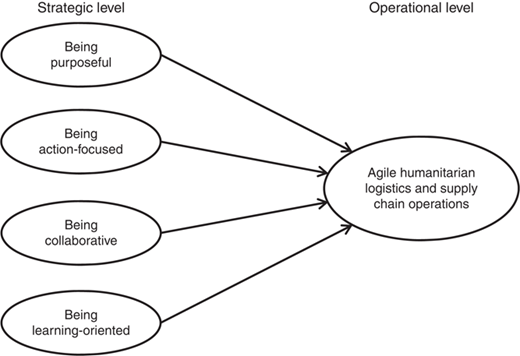
Organisational view of agility in humanitarian logistics
Organisational view of agility in humanitarian logistics
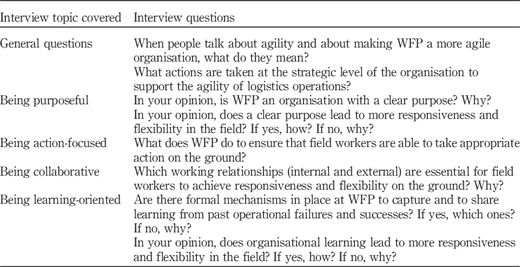
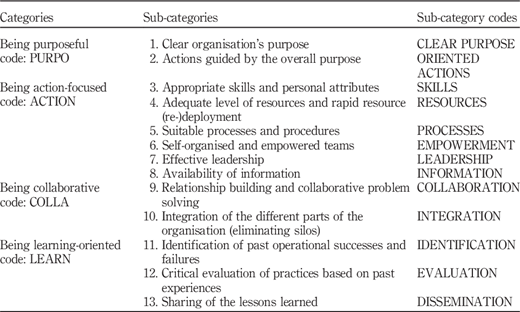
Categorisation framework and coding scheme
Categorisation framework and coding scheme
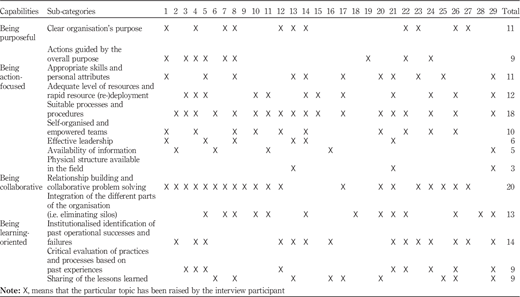
Quantitative approach to the interview data
Quantitative approach to the interview data
References
Corresponding author
Cécile L’Hermitte can be contacted at: cecile.lhermitte@utas.edu.au
The authors would like to thank the United Nations World Food Programme (WFP) and, in particular, Adrian van der Knaap who made this research possible. The authors are also grateful to the interview respondents for their time and their valuable contribution.
Note
The Logistics Cluster (2016) is a coordination mechanism that enhances partnership, facilitates information sharing, and coordinates logistics activities among United Nations (UN) agencies and between UN agencies and other humanitarian organisations in order to achieve a better use of resources, to increase capacity, and to improve the quality of the response.

