– The purpose of this paper is to collect information about barriers and enablers experienced by international experts when transferring medical equipment to countries affected by humanitarian emergencies and to discuss the suitability of the principles of “openness”, “interconnections” and “non-linearity” of systems to understand the nature of the barriers and enablers as described by the international experts.
– In this study, six semi-structured interviews were conducted with experts from humanitarian organizations. The interviews were based on a simplified model of the transfer of medical equipment adapted from supply chain literature. The model ensured that all the process steps undertaken by humanitarian organizations were considered. Afterwards, the interviews were transcribed and structurally analysed to derive barriers and enablers. Finally, the results were described in light of three theoretical principles of systems thinking.
– In total, 14 types of barriers and 12 types of enablers were uncovered that illustrate the complexity of transferring medical equipment in humanitarian emergencies. The paper concludes with a proposal for future research to investigate if, and how, an approach guided by systems thinking could help to create a designated space for the formulation of original, synergetic solutions that address the identified barriers.
– This study is the first to explore the specific logistic challenges implicit in the transfer of medical equipment in humanitarian emergencies with a lifecycle perspective. Furthermore, the concept of systems thinking is rather novel in the field of transfer of medical technology.
Introduction
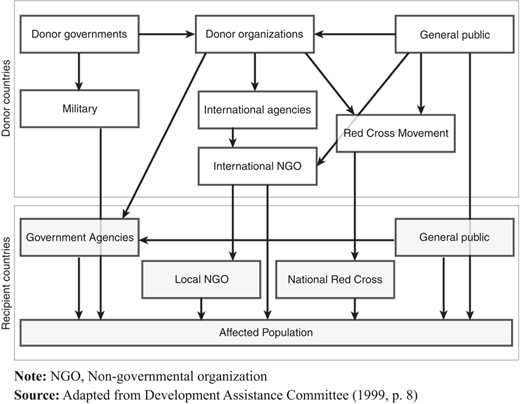
The provision of healthcare during humanitarian emergencies is complex. Humanitarian emergencies are events that disrupt the livelihood and ongoing services of a population and include conflicts or epidemic outbreaks, climate or geophysical related disasters (Leaning and Guha-Sapir, 2013). The international response to humanitarian emergencies involves the (often sudden) mobilization of several stakeholders including donors, humanitarian organizations and service providers (Figure 1). This mobilization involves multiple information, financial, human and material resources. Within all the actors, humanitarian organizations (such as Médecins Sans Frontières, Merlin) are service providers with a robust logistic and cooperative capacity to enable the continuous flow of activities and resources for the provision of healthcare. This includes, assessing, procuring, categorizing and storing a variety of resources, such as medical equipment. There are formal mechanisms (i.e. principles, policies and standards) build from field and logistic experience to guide the activities of humanitarian organizations (World Health Organization 2005; Giannou and Baldan 2009; Norton et al., 2013). Nonetheless, there are differences in the way these organizations work in terms of their involvement with local affected populations and in terms of the quantity of items they deploy. Also, in some cases individuals travel on their own initiative and responsibility to provide healthcare to the affected population (Krin et al., 2010; Redmond et al., 2011).
Healthcare needs differ according to the type of emergency, its intensity and location (Gardemann, 2002). Natural disasters tend to result in more complex wounds (requiring a variety of specialists) and poorer populations tend to be vulnerable to epidemic outbreaks. So depending on whether it is an earthquake in Haiti, a drought in Sudan or conflict in Syria, humanitarian organizations face different barriers and need different logistic systems to be in place in order to provide lifesaving services to affected communities (Kovács and Spens, 2009). There is the need to deploy a whole logistic system including, e.g. medical equipment, vehicles, energy generators, information and medical and logistic expertise, to work in multicultural teams and train local staff (Chu et al., 2011). Because of the need to set up this “replacement” healthcare system, humanitarian organizations offer a higher (and temporary) healthcare quality than the one previously existing in the disaster-affected area. After the immediate disaster phase, the follow-up of the humanitarian healthcare system is dependent on varying priorities and budget. The transition process to recovery is known to be a “gap” that can take weeks to several months (United Nations, 2006).
Medical device ecosystem
Medical devices, and complementary equipment, are an essential part of the necessary logistic system to provide healthcare. Their use is highly regulated because of its involvement with the management of human lives (European Commission, 2010b; Global Harmonization Task Force, 2005). Medical devices and complementary accessories are defined and regulated by different international relevant bodies (European Commission, 2010a; US Food and Drugs Administration, 2014). According to the International Medical Device Regulators Forum, a “Medical device” is defined as “any instrument, apparatus, implement, machine, appliance, implant, reagent for in vitro use, software, material or other similar or related article, […] used, alone or in combination […] for one or more of the specific medical purpose(s) […]”. (Global Harmonization Task Force, 2012, p. 6). In addition, medical devices are also classified according to their intended purpose and interaction with the human body (European Commission, 2010b).
These regulations allow manufacturers to collectively provide the same conditions of manufacturing and sales, continued use and disposal in order to ensure that the medical equipment is safe to use. Safety is an important aspect of a healthcare system and of medical equipment. The more complex medical procedures are, the more complex medical equipment is and the more chances there are for incidents to occur.
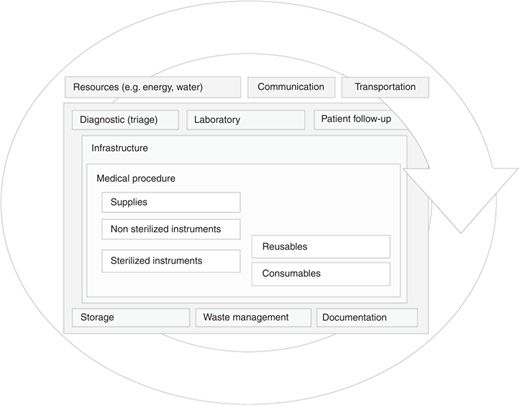
The performance of all medical equipment is dependent on the presence of an “ecosystem” (Figure 2). It includes, e.g. dependency/reliance on accessories and complementary equipment, dedicated infrastructure requirements (e.g. lead shielding, gas scavenging and heat exhaust), compatible energy sources and tools for handling procedures throughout lifespan (e.g. cleaning, disposal). Besides the technological and logistical components of this “ecosystem” there is the need for trained, knowledgeable experts to both use and maintain medical equipment (Cheng, 2007).
Technology transfer in humanitarian emergencies
The term “technology transfer” can be defined as the process of movement of physical assets, know-how and/or technical knowledge from one entity to another (Souder et al., 1990; Bozeman, 2000). For technology transfer to be successful the receiving entity, the transferee, can effectively utilize the technology transferred and eventually assimilate it (Ramanathan, 2009).
In humanitarian emergencies, the transfer of medical equipment to a disaster-affected area has consequences for the servicing contracts and safety standards of healthcare provision, on both short and long term (World Health Organization, 2008; Dzwonczyk and Riha 2012; Adjabu et al., 2014). Medical devices are supplied from a variety of sources (including direct purchase at manufacturers and suppliers and donation from different organizations) (Organization of Health Services Delivery, 2000) and humanitarian organizations are responsible to ensure their functioning through continuous support. The logistics involved in this process extent beyond immediate response logistics, and include choosing equipment and expertize according to logistic limitations, organizing, servicing and assuring the continuity of healthcare provision.
Although there is evidence of countless complex barriers that represent threats to the performance of the humanitarian aid system, the experience of humanitarian aid organizations when transferring medical equipment in humanitarian emergencies, particularly to countries with low-resource settings, is unsystematically described (World Health Organization, 2010; Tatham and Houghton, 2011).
Systems thinking
There is a growing interest from the international academic community and from humanitarian organizations on the challenges and accountability of humanitarian aid (Kovács and Spens, 2009). The variety of disciplines and research themes reflect the broad nature of the humanitarian field and includes amongst others logistics (Mays et al., 2012; Kovács and Spens, 2009) and supply chain management (Whybark et al., 2010; Oloruntoba and Gray, 2009; Richey, 2009). One of the current growing perspectives is the perspective of systems thinking. Systems thinking is overarching of theories that share its general principles, such as Cybernetics (Ashby, 1957), Complexity theory (Cilliers, 1998) and Socio-Technical Systems and has been used by fields as diverse as biology, engineering and organizational management (Peters, 2014). In the field of organizational management, systems thinking aims to use systems theory to address complex problems typically found in “real world” settings, such as the ones found in the humanitarian aid sector (Jackson, 2003; Ackoff, 1974).
A system is defined by Meadows (2008) as a structure composed of a set of elements interconnected with the purpose of accomplishing a determined (system) function. System thinking, as an analysis tool, promotes the comprehensive understanding of a system as a whole, rather than through individual elements composing the system. The use of systems thinking implies a shift in mentality in humanitarian organizations, from a goal-centred orientation to a continuous adaption orientation, in which processes and activity outcomes (e.g. achievements, barriers) are seen as emerging and uncertain (Senge, 1990b; Stacey, 1995; Adam and Savigny, 2012).
It is important to define the meaning of complexity, as opposed to complicatedness, of the transfer of medical devices in humanitarian emergencies. Complexity is a defining property of a system. Whereas a complicated system (e.g. medical device, protocol of infection control) is possible to build and oversee, even when requiring very specialized knowledge, a complex system is not. Similarly to an example of a jet airliner from Dekker et al. (2011), when a medical device is introduced in a transfer process involving differing cultures, priorities and changing needs, the conditions for it to function become more difficult to define. The following three basic principles of systems thinking contribute to the understanding of the complexity of medical equipment and technology transfer within humanitarian emergencies: openness, interconnectedness and non-linearity.
These three basic principles of systems thinking do not, alone, provide a comprehensive understanding of systems thinking nor its application. However, they provide a “grip” to that understanding, because they reveal insights on both the structure and the behaviour of complex systems. Openness is an important principle because it justifies the need to broaden the unit of systems analysis, from a closed and isolated perspective to one that represents a system, entirely from how it is shaped. Interconnectedness is an essential principle to system analysis because it highlights the relevance of relationships rather than single actors and actions. Finally, non-linearity relates the previous two principles with the behaviour of a system, which is relevant from a planning perspective. The definition of the core components of a systems-driven approach is not consensual (Waterson, 2009), and principles do not relate to each other in a structural way, possibly given its nature as a knowledge form.
Openness
Complex systems are open systems which co-evolve with their external environment, or external context (Katz and Kahn, 1967; Trist and Labour, 1981; Bertalanffy, 1950; Jeffrey and Salancik, 2003). The study of such systems describes organizations as activity systems that are influenced and influence their external environment. Events happening externally from the organization affect the ongoing activities within the organization.
Humanitarian aid and disaster relief is influenced by several external factors, such as the preparedness of local population, differences in disaster nature and magnitude and long-term efforts to support local recovery (e.g. donor competition) (Kovács and Spens, 2009; Fawcett and Fawcett, 2013). These factors affect the effectiveness of humanitarian aid approaches rendering them successful (or not). Successful examples that point to the need of humanitarian organizations to be aware of these factors include adjusting humanitarian programmes to local practices (i.e. cultural, technical) and allowing for planning flexibility (Ramalingam, 2013; de Savigny et al., 2012).
Interconnectedness
The analysis of a determined organizational barrier in a complex system cannot be reduced to the analysis of its system elements (e.g. people, tasks, technology, organization) as individual units, because of the relevance of interrelationships and interdependencies that, together, contribute to a system behaviour and function realization (Ackoff, 1974; Meadows, 2008; Flood and Jackson, 1991; Jackson, 2003). Furthermore, complex systems have different dimensions that characterize the function of a system, beyond and across its structuring elements (e.g. “safety” dimension must relate to all elements or functions of a system). This interdependence perspective challenges the traditional cause-effect reasoning and proposes instead, a reasoning of range of causes-range of effects. The result of such interdependencies is a complex system behaviour in which there is not a single matching cause or solution for a determined barrier. Instead, there are multiple. This means that a determined barrier can result from different combinations of actions and the degree of dependency amongst system elements (Waterson, 2009). Therefore, including different perspectives of a barrier is important to have a holistic perspective of the range of existing causes and solutions.
Many of the logistic problems dealt with by humanitarian aid organizations have a complex nature (Moshtari and Gonçalves, 2011; Tatham and Houghton, 2011). This nature is characterized by numerous (and often uncertain) individuals, institutions and countries and a variety of socio-economic dimensions. All of these stakeholders, their activities and decisions depend directly or indirectly on each other to deliver aid and address humanitarian problems. For example, the multiplicity of factors leading to HIV incidence in refugee camps might involve different dimensions, such as deprived access to immunization, family planning, rape, illiteracy and social exclusion. A solution focused on a single dimension may never address the problem completely. Furthermore, the dependence degree of these dimensions and institutions can strengthen the polarity of solutions. For example, most aid service providers see donors, rather than beneficiaries, as their clients (Nielsen and Santos, 2013). This results in a tighter connection of aid services to policy goals than to goals of beneficiaries.
Non-linearity
Complex systems have a particularly dynamic/emergent and non-linear behaviour owing to the interconnectedness principle mentioned above. This means that the interconnected system elements and dimensions that make up an organization’s behaviour, affect each other by means of feedback interactions which can either maintain, reinforce or weaken a certain behaviour. The fact that they may affect each other in different ways and different intensities results in a non-linear chain of influence between elements and dimensions. This means that different combinations of feedback interactions will emerge and, on the long-term, trigger different results (Senge, 1990a; Meadows, 1999).
In humanitarian aid, these feedback interactions lead to the transformation of small decisions of one organization into large consequences on the long term, at the humanitarian system level. Disasters (and aid dependency) are caused by this kind of feedback and interrelationships (Ramalingam et al., 2008). The different perspectives of stakeholders are representative of trends that exert feedback on determined decisions. For example, where one sees cheaper equipment for more people, others see less safe healthcare patterns. Once again, a solution focused on a single dimension may not address a problem completely and may also lead or build-up to new/underlying problems in other dimensions and to other stakeholders. Addressing problems in humanitarian aid with a systems perspective means acting on all of their dimensions, with both short-term goals, and long-term guiding visions, as opposed to long-term assurances that are implicitly not possible to design due to the unpredictability of feedback interrelationships.
Focus and aim
This study focuses on the transfer of complex medical equipment within humanitarian emergencies, particularly those in countries with low-resource settings. The aim of this study is twofold. First, the study collects information about barriers and enablers experienced by international experts when transferring medical equipment to countries affected by humanitarian emergencies. Second, these findings are used to discuss the suitability of the principles of “openness”, “interconnectedness” and “non-linearity” from systems thinking to understand the systemic nature of the barriers and enablers as described by the international experts. This study contributes to uncover knowledge about the systemic implications of humanitarian logistics and is valuable to the redesign of organizational practices.
Methods
Semi-structured interviews with experts from international aid organizations with experience in coordinating or handling the transfer of medical equipment were conducted. The interviews were based on a simplified model of the transfer of medical equipment within humanitarian emergencies adapted from supply chain literature (Baldini et al., 2012). The use of this simplified model was aimed at assuring consideration for all the inter-departmental process steps undertaken by international aid organizations when transferring medical equipment in humanitarian emergencies. The transfer process composed of five phases occurring in different contexts:
Context x represents the place of origin of international aid organizations and includes the following phases:
supply, includes the medical equipment manufacturing and sales; and
procurement and stock, includes the arrangement of medical equipment in kits and the purchasing process from non-governmental organizations (NGOs).
Context y represents the place of destination of international aid organizations and includes the following phases:
deployment and set up (context y), includes the transport and installation of medical equipment in order to be used by humanitarian experts; and
use and servicing (context y), includes all activities performed by humanitarian experts.
Context y’ represents the long-term perspective of context y, after international aid organizations have left:
Handover (context y’), includes the disposal or further use of medical equipment in the settings of the affected country.
Despite the fact that the previously mentioned studies focus on specific disasters or locations, this study explores the logistic complexity that organizations face while working with a variety of disasters and locations. Interviewees were asked to recall and describe an experience when transferring medical equipment in a humanitarian emergency. During their description they were systematically asked to specify the activities performed per phases of the simplified model and if a problem was mentioned, they were asked to elaborate how the problem was addressed. Afterwards a set of general questions was made related to the adequacy characteristics of medical equipment and the implications of working in different contexts and with different kinds of humanitarian aid projects.
Data analysis
The interviews were transcribed and iteratively analysed with a structural coding approach (Saldaña, 2013; Guest et al., 2011). This coding method is appropriate for interview transcripts where phrases from content represent a topic related to the research question used to frame the interview. The transcript codes were categorized and conceptualized based on the exploration of experienced barriers (i.e. physical, psychological or relational, safety or time obstacles to the course of activities) and enablers (i.e. personal or organizational mechanisms to address perceived barriers during the course of activities) throughout the process of transferring medical equipment in humanitarian emergencies. Later on, the frequencies were derived on the basis of the number of individual participants who mentioned a particular topic.
Findings
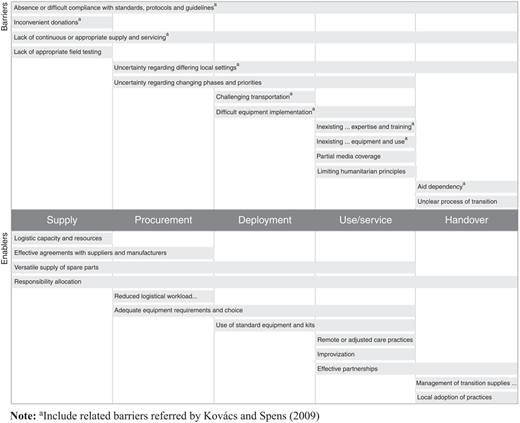
The findings of this study contribute to the understanding of the work of humanitarian logistics by uncovering a variety of barriers and enablers from the perspective of humanitarian experts. In total six interviews were conducted with experts from two international organizations. The experts included two biomedical referents (I1, I3), one referent for anaesthesia (I2), one procurement officer (I4), one anaesthesiologist and consultant (I5) and one biomedical consultant (I6). From the conducted interviews 14 types of barriers and 12 types of enablers were identified. These are illustrated in Figure 3. In total 164 barrier quotes and 70 enabler quotes were categorized. Ten types of barriers and seven types of enablers were commonly mentioned by three or more interviewees.
Barriers
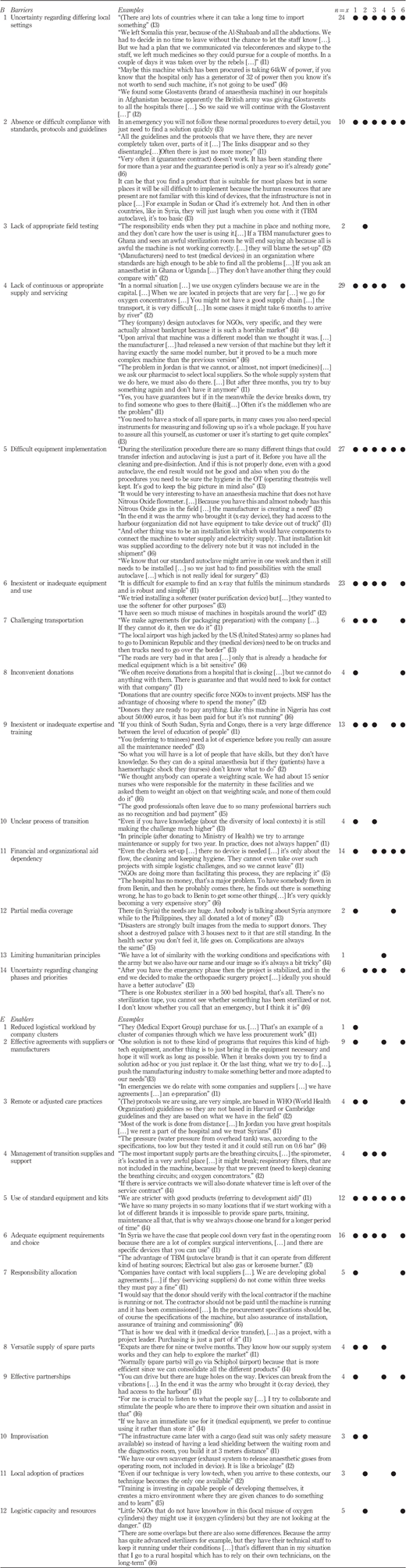
There were three types of barriers commonly mentioned by all interviewees: “Difficult equipment implementation” (n=27), “Uncertainty regarding differing local settings” (n=24) and “Absence or difficult compliance with standards, protocols and guidelines” (n=10). In addition to these three, “Lack of continuous or appropriate supply and servicing” (n=29) has been the most frequently mentioned type of barrier. These three barriers deserve to be further elaborated as they represent, due to the consensus and frequency they are mentioned with, the most evident barriers of transferring complex medical equipment in humanitarian emergencies. The complete list of barrier and enabler types, examples and the respective quantity of references can be found in Table AI.
First, “Difficult equipment implementation” is related to the difficulties of transporting, setting up and using medical equipment as a complete “ecosystem”. Difficulties and delays are caused by misaligned timings of arrival of complementary equipment and experts, by the responsibility to establish a comprehensive system in place and on time, and by the continuous manifestation of unplanned needs. The interviewees specifically mentioned the dependency on complementary products (e.g. cables, software, spare parts and cleaning filters) and running processes (e.g. maintenance or hand hygiene) and the fact that medical equipment itself is not sufficient to carry out healthcare activities. Furthermore, absence of transport equipment and additional products to deal with substandard local resources and environment, such as water softeners and dehumidifiers, were also mentioned. This dependency leads to side problems that cannot be addressed. The expression of needs from international doctors is based on what they have seen in Western hospitals. But often, the complexity of technologies in Western hospitals needs to be balanced with the possible technique in the field. Also, technologies that offer functions to which there is no possible use, induce false needs.
Second, “Uncertainty regarding differing local settings” is related to a diversity of variables across the world that affect procurement and healthcare decisions. Socio-economic and cultural variables were mentioned in relation to attitude towards learning and literacy levels. Infrastructure variables were also mentioned and included physical configuration and energy supply power of different hospital types, quality and number of available equipment and the respective perceived value by local medical staff. Interviewees also mentioned the relevance of climate seasons and the geographic location of equipment suppliers for planning and medical equipment choices. Differing customs bureaucracy and political instability were appointed reasons to delays and unsafe working conditions, respectively.
Third, the barrier “Lack of continuous or appropriate supply and servicing” includes allusion to the uncertainty about production and supply continuity due to difficulties that companies face in the humanitarian market. Besides that, interviewees provided several examples of the lack of commitment or clarity of suppliers and manufacturers regarding the provision of services, such as maintenance or repair. In practice, agreements might not actually work given that appointed/available technicians are not adequately prepared. The reliance on local resources also extends to supply of substandard oxygen or medicines. This barrier also relates to the lack of experience and capacity from innovative, but small manufacturers to supply adequately and timely. Although most of these issues occur during procurement, they extend to the handover phase, because humanitarian organizations leave. Here, the supply chain, logistic planning and relationship with original manufacturers is interrupted or even lost, leading to an unsustainable transfer of medical equipment.
Finally, “Absence or difficult compliance with standards, protocols and guidelines” (n=9) was consensually mentioned as a logistic challenge. Standardization of medical equipment or procurement processes represent barriers due to a diversity of reasons. These reasons include the absence or the inadequacy of medical equipment standards, often leading to unsafe functioning or a negative perception from local doctors of the equipment used by humanitarian organizations. Alternatively, if standards do exist there is often a problem of compliance. They are either not applicable in emergency settings, due to either time or financial constraints. Or they are not followed due to limitations caused by the existing local infrastructure, because there is medical equipment already available or because of a preferred proximity of maintenance or supply services.
Enablers
The type of enablers that were most frequently mentioned were “Adequate equipment requirements and choice” (n=16), “Use of standard equipment and kits” (n=12) and “Effective agreements with suppliers or manufacturers” (n=9). “Adequate equipment requirements and choice” includes several “adequacy” characteristics, such as simplicity of equipment and language use, robustness, trustful calibration, versatility of energy sources and supply readiness. Adequacy also includes, according to the interviewed experts, being appropriate to the care provided. Organizations with ample capacity and experience can deduce the necessary equipment from the type of medical procedures being done in the different types of humanitarian emergency.
The “Use of standard equipment and kits” is a way how humanitarian organizations deal with the uncertainty of procurement and logistics. First, this is a way to control quality and ensure the organization is familiar with the equipment and the suppliers. Standardized equipment ensures transparent criteria of choice and a uniform inventory of spare parts. Second, the elaboration of kits with the basic complementary equipment guarantees, at least in part and for the initial phase of an emergency, the completion and portability of the medical equipment “ecosystem” and also its readiness for international transport.
Finally, the enabler “Effective agreements with suppliers or manufacturers” includes three purposes of engaging effectively with suppliers and manufacturers. There are agreements for servicing and follow-up during a period of time, in which suppliers often partner up with suppliers located closer to the affected country to perform maintenance or training and they take in equipment to repair. Deployment agreements consist of additional tasks suppliers carry out to prepare medical equipment for a secure transport. The third purpose agreements include a long-term perspective in which the manufacturer and the organization are engaged in improving the medical equipment and the manufacturer uses that learning experience to successfully enter a future market.
Systemic nature of barriers and enablers
The barriers found in this study illustrate the logistic complexity of healthcare provision in humanitarian emergencies. There are numerous stakeholders and processes interrelated throughout the whole transfer process, which possibly contribute to hinder the transfer of medical equipment and ultimately the provision of healthcare. The following sections describe the barriers and enablers described by experts according to the three principles described above of openness, interconnectedness and non-linearity of systems thinking.
Openness
The logistics involved in humanitarian aid are affected by a great unpredictability in terms of three factors: different types of regional contexts and type of disaster, different disaster relief phases and different types of organizations (Kovács and Spens, 2009). Kovács reviews how challenges like security, usability of infrastructure, local presence and time of response and limitation in collaborations relate to these differences.
Throughout the whole process of transfer of medical equipment in humanitarian emergencies, these three varying external factors produce particular effects on healthcare. In the following paragraph, these effects are described and exemplified with numbered barriers and enablers (Table AI):
Different locations and disaster types determine:
the diversity of healthcare needs and the required medical equipment (E6);
the different education level available to collaborate (B9);
customs efficiency in terms of time and implicit restrictions (B1);
availability of local supplies (B4) (e.g. water quality, oxygen cylinders) (B4); and
medical equipment and medicines adequacy in terms of atmospheric and security conditions (B1).
Different phases of aid mean:
changing healthcare priorities in time (B14);
following protocols is not always possible (B2); and
a prioritization in healthcare needs which might not be adequate (certain general medical needs such as pregnancy complications do not strictly occur during an emergency, but still represent a large part of the problems addressed) (B12).
Different organizations conducting overlapping programmes results in:
a diversity of equipment, supply parts and components (B1); and
misalignment of practice standards (e.g. between large and small organizations) (E12).
Additionally, ten of the 23 logistic barriers mentioned by Kovács and Spens (2009) were also identified in this study and are marked in Figure 3 with the character “a”.
Interconnectedness
The following examples of barriers to handling of medical equipment illustrate the interconnectedness in this system’s structure (i.e. involving other physical elements and processes). This interconnectedness means that there is a network of dependent and complementary elements that function as a whole and are essential to guarantee the successful transfer of medical equipment in humanitarian emergencies (system’s function).
The biomedical referents stated:
We didn’t only need the x-ray to be installed but the software had to work, electricity connections, shielding, transport from the harbour.
During the sterilization procedure there are so many different things that could transfer infection and autoclaving is just a part of it.
The procurement officer mentioned:
We know that if we need spare parts or if we need maintenance it is very important that they can be supplied on the spot, especially maintenance.
Medical equipment is an essential part, but as one biomedical referent said, “only a part” of extensive healthcare processes. More activities and equipment need to be in place for them to function and this means they are tightly coupled. To a lesser extent, other issues, or looser connections are also influencing the safe/successful use of medical equipment. For example, if medical equipment is perceived as not useful or offensive, or if it is donated, careless of whether it can function or not, because it is too expensive to import back and reuse. This can ultimately lead to useless or less safe transfer. The previous example shows that the problems faced by international experts have a multiplicity of dimensions. This is evident from the relation between the identified barriers and enablers. Although mechanisms are in place, and being developed, to address different barriers (e.g. the adoption of different supply mechanisms and improvisation are used to deal with uncertainty, use of own standard equipment to increase safety by reducing diversity and training and supplies provision to address the broken supply chain and lack of expertise in the handover phase), barriers are still present. Addressing the challenges from humanitarian organizations requires a holistic overview of elements, roles and relationships involved in producing barriers. This means that multiple approaches from different actors are needed (Ramalingam et al., 2008).
Non-linearity
From a logistic system point of view, and with a long-term perspective, there is evidence from the emergent (and unpredictable) behaviour of this system. The biomedical referents and consultant stated:
You can have your planning (deployment phase), but then it still does not always succeed.
We tried installing a softener (water purification device) but […] they (local staff) wanted to use the softener for other purposes.
The time to resolve all these things was just more than what it was planned for. (Normally) the machine works, you connect and it runs, but that was not the case in this situation, at all.
Given the diversity and constant change of contexts, the relationships between different, and often uncertain, stakeholders also change. This leads to an incremental build-up of latent barriers and loss of control, evident in barriers, such as “Protocols not always followed”, “Process of transition is unclear”, “Safety compromise due to equipment limitations” and “Uncertainty of production and supply continuity”. These barriers require humanitarian organizations to be flexible to deal with uncertainty. This study identified some of the mechanisms humanitarian organizations use to cope with uncertainty, such as “Improvisations” and “Partnerships”. First, when faced with organizational and logistic constrains it is often the staff in the field who takes the measures to assure the continuity of healthcare provision. The referent for anaesthesia mentioned:
How the machines will be localized might not be the same in low-income countries. […] In a lot of western hospitals […] the corridors are going around (the operating rooms). While in LIC […] corridors go in the middle. This is very important because when you have a machine of anaesthesia that you need to connect a scavenger system (exhaust system to release anaesthetic gases from operating room) […] in LIC […] you have the machine very far from the windows. So you need to make a whole situation how to scavenge the gas to the other side.
Also, opportunities for partnerships with other organizations, local and international, allow barriers to be overcome, as mentioned by the biomedical referent and the biomedical consultant:
In the end it was the army who brought it (x-ray device), they had access to the harbour (organization did not have equipment to take device out of truck).
For me is crucial to listen to what the people say. […] I try not to assume there is anything, just observe and know what is really going on before acting and also before investing […]. I try to collaborate and stimulate the people who are there to improve their own situation and assist in that.
The unanticipated activities that humanitarian organizations carry out to cope with uncertainty contribute to the non-linearity and unpredictability within the system. This is because new (feedback) interactions occur within and amongst the organizations. And because organizations might have differing perspectives, and thus differing lines of action. For example, complying with humanitarian principles (B13) is contradictory to collaborating with the military (E9). Emphasis on knowledge transfer through training (and experience) (E11) is threatened by the exodus of trained staff or by practice with inadequate skills (B9). And finally, deploying a whole system can be seen as inevitable (B5) or as an unsustainable replacement (rather than reinforcement) of ongoing healthcare services (B11). These differing perspectives can either support or be disincentive to the way activities are carried out. Because of the power of the diverging perspectives, feedback interactions trigger unforeseen lines of action and outcomes.
In summary, systems thinking allows us to understand the systemic characteristics of the experienced barriers by experts in humanitarian organizations. Medical equipment logistics and transfer, as part of a larger humanitarian aid effort, are susceptible to unpredictable external influences, involve numerous processes and people, often unexpectedly engaged in addressing problems, on the short term and finally, its success is ultimately perceived in different perspectives. From a systems perspective, this has implications in the planning from humanitarian organizations, in the way they define medical equipment requirements and servicing collaborations.
Implications for practice and critical considerations
In order to address the complex barriers identified in this study, there is the need for a collaborative, multidimensional approach to promote an adaptable, more inclusive action, and a balance between short- and long-term priorities. The WHO also stated that humanitarian emergencies (such as an outbreak of Ebola) are dependent on diverse aspects, including the condition of local healthcare systems that require various approaches to address rather than just the transfer of medical technology (World Health Organization, 2015). An approach guided by systems thinking, could help to create a designated space for the formulation of original, synergetic solutions that embed a diversity of perspectives and values.
In particular regarding the provision of healthcare in humanitarian settings, such a systems thinking based approach means that concrete steps need to be undertaken. First, technology transfer programmes need to be diversified to cope with the uncertainty (caused by the openness of the humanitarian system and its non-linear behaviour). While this opens up opportunities for innovation it requires a certain degree of experimentation. Second, programmes need open-ended solutions as part of adaptive/continuous learning process. This means that programmes are required to be planned with no expected implementation result, but must allow the transformation of results to happen by the action of different stakeholders, who continuously maintain the programme and allow it to be adaptable. Such a requirement requires a considerable engagement and sense of trust amongst stakeholders that may be difficult in situations such as conflict or a large scale epidemics. And third, participatory approaches promote the active participation of the different stakeholders including local capacities and different disciplines. The result is a potentially innovative solution emerged from the group of stakeholders, but with no specific owner.
If we consider, for example, the medical equipment transfer implied in the surgical response to natural disasters, and more specifically the need to have sterilization equipment, such a systems thinking based approach could help to overcome barriers currently faced such as equipment implementation and handover. Across procurement, logistics and medical operations the participation of different stakeholders (e.g. local governmental agencies, healthcare practitioners and logistic managers) is key for the design of adaptable, modular programmes related to hygiene management, to business models and autoclave design and professionalization of maintenance.
In the adjacent field of design for sustainability, several models of systems design and change have been proposed that embrace, amongst others, openness, interconnectedness and non-linearity of complex systems and offer potential perspectives that could help to tackle the barriers faced by humanitarian organizations (Joore and Brezet, 2015; Jones, 2014; Davis et al., 2014; Dubberly, 2010; Elzen et al., 2004). Research about the suitability of such approaches is outside the scope of this paper, but should be further investigated.
In the perspective of increasing recognition of the role of science in society, as described in the Rome Declaration for Responsible Research and Innovation (Italian Presidency of the European Union, 2015), this study stresses the importance of exploring and understanding systems with a complex nature, using a multidisciplinary approach. Societal challenges, such as climate change and related displacement, conflict or social inequity are increasingly interconnected and present in the agendas of businesses and organizations. The authors argue that the subject of this study is one example of the application of systems thinking to address complex problems. Other fields, related to relief as well as to development, where networks of national and international organizations create interconnected systems to carry out technology transfer, may potentially benefit from this way of planning and organization.
Research limitations
The low number of interviews carried out limits this study. In the future, a similar research setup should be used with a larger number of international experts from different organizations. The research would benefit if access to and availability of experts is formally arranged. And although the study is limited to the experience of international aid providers, the experience of local experts should be researched. Second, a difference between interviewees was seen. Interviewee 1, as opposed to Interviewee 5, for example, demonstrated a larger awareness about systems thinking whereas others, possibly due to personal characteristics, keep their descriptions to an operational level. Group interviews or focus group are potential techniques to overcome these differences, because they creates a space for open discussion where participants stimulate each other to participate. Furthermore, several activities can help to reduce the dissimilarity in their awareness, for example an introductory presentation of systems thinking and using the simplified model to map the existing relations and interdependencies. The simplified model helped to structure the inquiry and to induce all interviewees to describe the different phases of medical equipment, to relate them and critically reflect upon them. The identified barriers and enablers reflect the consideration for aspects implicit in the simplified model, such as sustainability (e.g. B10, E4, E11) and the multi-context nature of the work (e.g. B1, E12). Conversely, the same simplified model made analysis of the answers difficult, because these are forced into silos instead of seen as interconnections.
The barrier types “Lack of adequate field testing” and “Limiting humanitarian principles”, and the enabler type “Reduced logistical workload by company clusters” were mentioned more than once by one interviewee. Although these results are based on the experience of a single interviewee, they are considered relevant given the diversity of examples provided. Although the results of this study were compared to the findings of Kovács and Spens (2009), a formal validation of the barriers and enablers should be carried out. In addition, the authors suggest that this study would benefit from complementary applied case studies where systems thinking is implemented to address, or circumvent the logistic barriers described by the experts in this study. These future studies should include the participation of both national and international humanitarian organizations to validate the predicted impact of the proposed approach.
The introduction of systems thinking in this paper was purposely simplified in three general concepts. Given that this is a relatively new perspective in humanitarian aid, it is the authors’ conviction that in order to grasp the value of systems thinking, a simple starting point should be taken by looking at a small number of characteristics in order to make the learning more practical and tangible. This is in line with the criticism from Collopy (2009) about the over-difficulty of systems thinking application.
Conclusions
The findings of this study indicate that humanitarian logistics play a very relevant role in healthcare provision during humanitarian emergencies. This study revealed types of barriers and enablers experienced by experts from humanitarian organizations. The uncovered types of barriers are, each caused by a diversity of reasons and the types of enablers, although not strictly related, illustrate the kind of mechanisms humanitarian organizations use to deal with barriers. Afterwards, the principles of “openness”, “interconnectedness” and “non-linearity” from systems thinking were used to discuss, and confirm, the systemic nature of the barriers and enablers as described by the experts.
The evidence of the systemic nature of barriers and enablers found in this study indicates that humanitarian organizations would benefit from further research about how a systems thinking approach would improve the logistic experience on the short and on the long term of humanitarian emergencies. This study contributes to uncover knowledge about the systemic implications of humanitarian logistics and is valuable to the redesign of organizational practices. Because the logistics implicit in the transfer of medical equipment must often replace commercial, social and technical functions, collaborations and a long-term perspective are potential aspects to learn how to continuously support the provision of healthcare after humanitarian emergencies.
References
Appendix
The authors thankfully acknowledge the time made available by the interviewed experts of this study. This project is financed by a dissertation grant from Fundação para a Ciência e Tecnologia (FCT – PTDC/SAU-SAP/118838/2010).