– Both the military and non-military organizations (NMO) bring assets, skills, and capabilities to a humanitarian crisis, however, their capabilities and competencies are very diverse. Identification of the specific competencies and capabilities that are core to these types of organizations can enable better planning by both military and NMOs, allowing them to achieve greater effectiveness and efficiency in the humanitarian response. The purpose of this paper is to explore the core capabilities of the military and NMOs engaged in humanitarian operations.
– The work builds on existing literature on the core competency of the corporation. The authors extend the concept of the ability to identify, cultivate, and exploit the core capabilities in the private sector to the organizations that want to respond efficiently and effectively to disasters. The authors develop a core competencies test for such organizations.
– The research identifies the competencies and capabilities that are core to the US military and NMOs for humanitarian assistance and disaster relief. By identifying such abilities the authors establish a vein of research for exploring the role of such organizations to facilitate greater understanding among academics, policy makers, and decision makers in public administration, public health, and international aid.
– Existing literature in humanitarian logistics does not adequately address identification of those competencies and capabilities that are core to the military organizations and NMOs and are most needed during the operational life cycle of a humanitarian crisis. In addition to identifying them, the authors compare the core capabilities of the military and NMO.
Introduction
When major disasters strike, international non-governmental organizations (NGOs), UN agencies, inter-governmental humanitarian organizations (HOs), national societies, governmental organizations, military institutions, and many others move quickly to provide relief. It is common for such organizations to arrive at a disaster site or other affected area with limited understanding of the needs of the population, which other organizations are operating in the area, and what capabilities the different organizations on the ground possess. The lack of understanding between the military and HOs about their capabilities can lead to duplication of effort and inefficiency (Gourlay, 2000; Seipel, 2011; Heaslip and Barber, 2014). In the early stages of a disaster response, the duplication of effort takes place during the assessment of needs on the ground and prioritization of critical tasks. The basis for the UN Cluster Approach is to ensure the proper coordination of organizations responding to a humanitarian crisis addressing common gaps and weaknesses, setting priorities, allocating responsibility, avoiding duplication to improve the overall international response. The UN cluster focus on coordination among significant players facilitates a better understanding of their respective capabilities and competencies resulting in superior response operations.
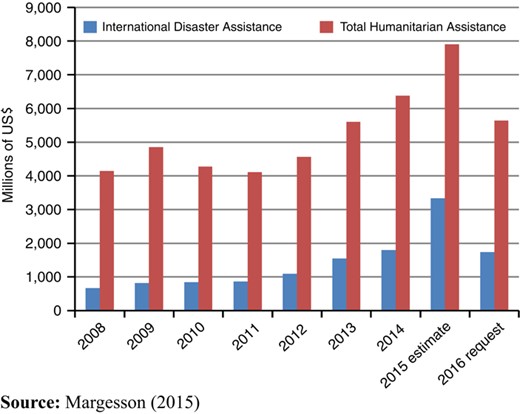
In spite of overall budget cuts (Tritten, 2015), realignment, and restructuring, the US Department of Defense, has identified humanitarian assistance and disaster response as a key mission to promote security around the world (Kaplan, 2007; United States Cooperative Strategy for 21st Century Seapower, 2015). In the last decade, the USA has responded to many major disasters. Figure 1 shows the humanitarian assistance in millions of US dollars provided by the USA since 2008 (Margesson, 2015).
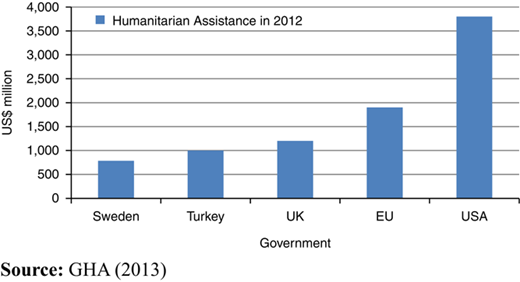
In 2012 alone, the USA spent US$3.8 billion in humanitarian assistance (Global Humanitarian Assistance Report, 2013). Figure 2 shows the humanitarian assistance by the top five governments – or, in the case of the European Union (EU) – organization of governments – around the world.
Although the US military has a history of responding to humanitarian crises, there are significant areas where the effectiveness and efficiency of the response, as well as the coordination with non-military and NGOs, could improve (GAO, 2010).
The trend of frequency and scope of natural hazards (or what are commonly referred to as “natural disasters”) has been positive (though the number of disasters per year is less than the maximum so far, in 2005). Due to population growth, and more people moving into disaster prone areas such as the littoral (Leaning and Guha-Sapir, 2013), it is desirable to learn from the lessons of the past and determine how collaboration between military and non-military organizations (NMO) may be more effective in providing disaster relief efforts. From 1970 to 2015, the number of natural disasters has increased from 81 events per continent to 346 (EM-DAT, 2016). In the past, responses to disasters from HOs that include inter-governmental organizations (IGOs) and NGOs and other NMOs have been described as not having been adequately effective or efficient (Thomas and Kopczak, 2005), particularly in the immediate response phase that involves coordination of supply and unpredictable demand in getting the necessary items to disaster victims in face of the last-mile distribution issues (Kovács and Spens, 2007). Some of the problems experienced may lie in the fact that in the immediate hours following a disaster event the availability of resources and suppliers may not be known (Tomasini and van Wassenhove, 2009).
Literature review
Apte and Yoho (2010) conducted research to identify those competencies and capabilities that are core to the US Navy and NMOs during humanitarian assistance and disaster response operations. In this research, we define the NMOs to include NGOs. The NMOs may also include governmental organizations or agencies such as the United States Agency for International Development.
After the 2010 Haiti earthquake, the World Food Program (WFP) setup logistics operations on a large scale in spite of the shattered infrastructure and logistical challenges. These maneuvers delivered the much needed nourishment to almost two-thirds of the population in the affected areas in Haiti. The WFP logistics teams also moved swiftly into Japan after the tsunami in 2011 upon the host government’s request. The response to a sudden onset humanitarian crisis often involves a request for the military to deliver critical materiel and services to enable, augment, or expand the scope of assistance rendered by NMOs (Apte and Heath, 2011). Within the humanitarian assistance operations literature it has been stated that preparing for a humanitarian crisis primarily involves managing the logistics of potential response operations (Apte, 2009; Van Wassenhove, 2006; Thomas and Mizushima, 2005). In all disasters, an effective and efficient humanitarian response is found to depend on, among other factors, the ability of logisticians to procure, transport, and receive supplies at the site of a humanitarian relief effort (Thomas, 2003; Balcik et al., 2010; Whybark, 2015).
Disasters and war share several attributes, such as the presence of displaced, injured, and vulnerable persons, and the need for functioning infrastructure and life support to include potable water, functioning wastewater facilities, and access to medical care. In certain ways identifying the capabilities and competencies to excel in disaster response is similar to preparing for combat situations that requires accumulating intelligence about the various players and how they operate (Daniels, 2012). After a disaster, a military organization may be one of the first official organizations to arrive in the affected area; this may occur due to their unique abilities such as strategic and vertical lift as well as communications. More often, the local community in the host country is the first to respond, then agencies of the host government, then the NMOs already in the area, and then the external organizations. One issue the military organizations need to deal with is their limited understanding of what the other organizations, such as NMOs are involved in the relief effort and the capabilities they can provide (Daniels, 2012; Nguyen and Curly, 2013; Harper et al., 2013). Both the military and NMOs bring assets, skills, and capabilities to a humanitarian crisis, however, the capabilities and capacities of each are far from homogeneous. The unique and overlapping core capabilities and competencies of the military and NMOs are not well understood in the context of humanitarian assistance and disaster relief.
Several studies have been conducted and reported in the literature related to humanitarian logistics (Apte, 2009; Tomasini and Van Wassenhove, 2009; Marx, 2009; Gibbons, 2007; Waugh and Streib, 2006; Alexander, 2003), military logistics (Kress, 2002; Van Creveld, 2004; Lynn, 1993; Smith, 2007; Prebelič, 2006), and the similarities and differences between the two (Pettit and Beresford, 2005; Jahre et al., 2009; Kovács and Tatham, 2009). Tomasini and Van Wassenhove (2009) discuss information and knowledge management, supply chain management, and collaboration and coordination in the context of HOs and private firms. Rietjens et al. (2014) use a value chain perspective in the context of stabilization and reconstruction operations which is a useful approach though in a different context which is not focussed explicitly on disaster response nor is it focussed on core competencies of organizations. Rietjens et al. (2004) use a decision theory approach to assist an executive with determining what humanitarian assistance will be provided based upon a scoring system. A decision approach using scoring can be quite useful, however; our contribution in this research is to focus on the types of competencies different organizations bring to the disaster response situation rather than scoring what assistance should be prioritized. Kovács and Tatham (2010) and Kovács et al. (2012) identify important logistics skills necessary for the effective conduct of humanitarian assistance and disaster response operations. Allen et al. (2013) look at individual job profiles and task training to identify potential gaps or opportunities in education or training. The key difference between our work and that of Kovács and Tatham (2010), Kovács et al. (2012), and Allen et al. (2013) is that we focus on institutional competencies rather than individual skills or jobs. Moreover, humanitarian logistics and operations have been described as humanitarian supply chain and response supply chain (Beamon, 2004; Oloruntoba and Gray 2006; Kovács and Spens, 2007; Beamon and Balcik, 2008; Pettit and Beresford 2009; Day et al., 2012) in the literature. Therefore we also reviewed articles that discuss the competencies and capabilities of the supply chains. Oloruntoba and Gray (2006) in comparing the structure of humanitarian supply chain with business supply chain state that the unknown nature of the humanitarian supply chain necessitates the competency in information management and coordination for the organization owning the supply chain.
During a disaster, resources are limited even though military organizations and many NMOs converge on an affected area. When a disaster occurs it is necessary for the officials managing the relief to understand what the capabilities are of the responding organizations. Daniels (2012), Nguyen and Curly (2013), and Harper et al. (2013) selected and examined a number of NGOs in order to build a knowledge base of organizations working in Europe, the Pacific Rim, South America, and the Caribbean with a specific goal of helping the European Command, the Pacific Command and the Southern Command of the US Department of Defense. The authors identify and provide capabilities for successful humanitarian operations such as health care capability, capacity building, and education and training. Health care capability encompasses providing basic medical care to patients, treatment and prevention of diseases, and maternal and childbirth wellness. Capacity building consists of infrastructure development, supporting local community in developing their own capabilities to be self-sufficient. Education/training capability comprises of providing basic literacy and vocational training. Disaster response provides information about relief to victims after natural or man-made disaster strike.
The reviewed articles explore either military capabilities, or NMO capabilities or those NMO capabilities the military organizations are interested in for humanitarian operations. What have not been identified in the literature are those competencies and capabilities that are core to the military organizations and NMOs and are most needed during the operational life cycle of a humanitarian crisis. However, none of the literature mentioned explicitly recognizes the core capabilities of the military and NMO to compare them. Our research focusses on the core capabilities of the military and NMO in their support to humanitarian operations with respect to disaster response. Our work builds upon the seminal work by Prahalad and Hamel (1990) on the core competency of the corporation. We contribute an interesting idea applying the Prahalad and Hamel model from the commercial sector to compare capabilities and competencies of the humanitarian community with those of the military organizations.
Core competencies test
The ability of organizations to function efficiently and effectively during disaster response operations depends in some part on their ability to identify, cultivate, and exploit their core capabilities; this is especially true during times of economic austerity, when organizations must make the best of scarce resources.
Prahalad and Hamel (1990) introduce three tests to identify those competencies that are “core” to a commercial firm: the capability must not be easy for competitors to imitate, it must be able to be leveraged across a wide variety of products or markets, and it must contribute to the needs of the final customer or end-user. Building upon the idea of core competencies we identify three analogous tests to identify those capabilities that may be considered core to organizations that provide humanitarian assistance and respond to disasters.
First, the capability should be unique to the organization and not easily imitated by competitors. The uniqueness of a capability reduces the chance that it may become redundant should other organizations wish to contribute to the same relief effort and would likely make it core. HOs, specifically NGOs, often must compete for scarce funding. The survival of NGOs often depends on their unique competency and capability to convince donors of their ability to provide humanitarian assistance and disaster relief. Therefore, a strategy that NGOs may adopt is to develop a unique capability or focus on a target niche need. The uniqueness can be the organization’s ability to get access to a specific geographical location; providing relief in hard to reach locations where the need exists and other organizations do not have access (examples include the work of Partners in Health (PIH) in Haiti, Riders for Health, and Medecins Sans Frontièrs (MSF)). Alternatively, the uniqueness may refer to a specific service that the organization provides, such as the provision of nutritional supplements, or specific treatments, or the provision of vaccines. Examples of organizations that provide unique medical and nutritional services include valid nutrition, Gheskio, and emergency.
Large organizations also compete for funds and ability to get access to specific geographical location can differentiate them as well. The IGO International Organization for Migration (IOM) is recognized for its unique ability to implement field operations in difficult to access areas, such as Iraq and Afghanistan. In addition, large HOs may want to acquire and maintain unique capabilities to explore possible economies of scale, economies of scope, and learning effects. In such cases, large organizations can leverage the size, scale, and scope of the operations to reduce marginal costs and improve their deployment and implementation. These organizations derive large percentages of their funding due to donor’s identification with a unique capability or expertise. For instance, the WFP is the world’s largest HO with a mandate to end global hunger. Donors identify WFP as the leading UN agency providing food assistance and promoting food security to vulnerable populations. United Nations International Children’s Emergency Fund (UNICEF) is largely associated with vaccination programs and support for vulnerable populations (in addition to children); MSF with medical emergency support; and United Nations High Commission for Refugees (UNHCR) has built a strong brand and reputation as the UN Refugee Agency that has allowed donors to concentrate funding to UNHCR when addressing diverse aspects of migration. In all the examples above (involving diverse organizations such as UNHCR, WFP, MSF, IOM, Riders for Health, and PIH), each organization developed its capabilities over the course of decades. It is not easy for other organizations to quickly imitate or provide alternative services that would compete with the incumbents. Hence, the capabilities are “core” to such HOs.
A second test to identify a core competency to HOs refers to its ability to provide humanitarian relief services in a wide variety of situations and contexts. That is, the ability to operate in different types of disasters (e.g. typhoons, earthquakes, tsunamis, drought, etc.), different geographical areas (e.g. Asia, Africa, etc.), with different types of populations (e.g. different languages, ages, religions), or through different types of services or programs (e.g. emergency response, development programs, etc.).
In the humanitarian logistics literature disasters have been classified by different characteristics such as cause, speed of onset, location. Van Wassenhove (2006) and Ergun et al. (2008) classify disasters on the basis of cause and speed of onset. Apte (2009) classifies them by speed of onset and dispersion in order to understand the complexity of humanitarian operations. Eßig and Tandler (2009) classify them, additionally based on disaster occurrence and frequency, and the population density in the affected area. Tatham et al. (2013) classify the disasters in more detail by listing parameters affecting the preparation for and response to the disasters. World Vision International (WVI), with over 45,000 staff and operating in more than 90 countries, is the largest NGO in the world. Through its integrated and holistic implementation of its mission, they provide a range of humanitarian services including: emergency relief to people afflicted by conflict or different types of disasters; sustainable and community-based development; promotion of justice to change unjust structures disproportionately affecting the poor; and partnerships with local churches to expand its reach to the population in need. Moreover, WVI’s presence in over 90 countries allows it to reach beneficiaries all over the world. The International Red Cross and Red Crescent Movement provide another good example of an organization that is capable of providing humanitarian services in a variety of contexts. The RCRC movement comprises the world’s largest humanitarian network, providing “protection and assistance to people affected by disasters and conflicts” (IFRC, 2016). Through their 190 National Societies, the RCRC movement has a global presence supporting efforts in both Christian and Muslim dominated regions.
Finally, a core competency should make a substantial contribution to the final customer or end-user. In the humanitarian sector, organizations can develop their core competencies to meet the demands of a donor or the needs of beneficiaries. Through significant investment in fundraising, reporting, and accounting capacity an organization can build its ability to generate appeals, write reports and manage donor relations to improve access to a steady stream of funds. The UNHCR is an example of an UN agency that has developed a core competency in terms of program evaluation, donor reporting, and fundraising. The IOM’s Displacement Tracking Matrix (DTM) was designed as comprehensive system to collect and disseminate data on internally displaced persons. The DTM meets HO’s need for accurate information and strengthens their capacity when responding in a humanitarian effort. Alternatively, HOs can focus on specific capabilities geared toward the end-relief received by the affected populations. For instance, to be more effective in East Asia, WVI adopted a different and novel approach. Instead of offering its traditional programs, it actively engaged and surveyed the affected population to better understand their needs. Careful analysis of the beneficiaries’ responses led to the design of new services that could address the local population’s needs (Chandra, 2015).
Part of the third test is also that the capability provides public good (Samuelson, 1954). A public good is non-rival and non-excludable. That is, benefit of the good by one individual does not limit the benefit to others, and it is not possible to exclude individuals from benefitting from the good, respectively. The United Nations Cluster Approach provides an example of a public good, providing necessary coordination to avoid gaps and overlaps in the delivery of humanitarian relief when a disaster occurs. If the good provided is non-excludable, but rival, then it is known as a common pool resource (Ostrom, 1990). Through the Cluster Approach a number of UN agencies provide this common pool resource. A very successful example is the WFP lead in the logistics cluster providing common logistics resources to a number of organizations operating in the humanitarian theater.
Core capabilities in humanitarian operations
We review the core capabilities of non-military HOs and the military in humanitarian operations, by adopting a three-pronged effort: reviewing the literature, implementing a survey, and analyzing recommendations in The Sphere Project. By discounting capabilities that might be specific to organizations main services, we arrive at the core capabilities in humanitarian operations.
Because war and disaster response have common characteristics, it is only natural that the military and some HOs share some core capabilities. However, we submit that some capabilities are intrinsic to the military or to HOs. These intrinsic capabilities may be identified by looking at institutional internal documents (such as mission or posture statements and strategic plans) or past performance in operations.
The different phases of humanitarian operations, generally divided in terms of preparedness, relief response, recovery, and development (Kovács and Spens, 2009; Pettit and Beresford, 2005), have specific needs that can be better supported by a diverse set of competencies. For instance, preparedness is characterized by activities that take place prior to a disaster which focus either on mitigating some negative consequences or completely avoiding them. In this sense, information sharing among organizations, collaboration and joint governance can play important roles. In the immediate aftermath of a disaster, during the relief response phase, organizations rush to provide relief to beneficiaries. In such context, the ability to react quickly and effectively is essential. Hence, information that provides situational awareness, rapid and accurate needs assessment capability, and logistics ability to establish immediate health services support, and ability to quickly setup operations are all critical. For instance, Kovács and Spens (2007) state that during the response phase demand management, supply management and fulfillment are important. Tomasini and van Wassenhove (2009) cite information and knowledge management to be critical. Apte (2009) points out that information management is the key for demand assessment; and that distribution and supply are significant factors in a response supply chain. During the recovery phase, humanitarian operations are more established and organizations can focus on the efficiency and reliability of the systems and processes put in place. In this phase organizational capabilities in supply, and deployment and distribution are very important. Kovács and Spens (2007) describe that during reconstruction coordination and collaboration are core competencies for an organization delivering relief.
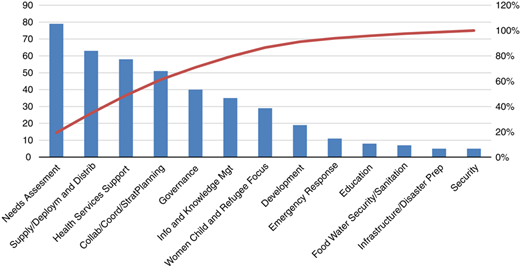
HOs responding to natural or man-made disasters must face a wide range of after effects influenced by their scale and scope. The specific needs during the different phases and the range of after effects require HOs to provide essential relief services and develop intrinsic capabilities. To better understand such intrinsic capabilities, we conducted a two-stage informal survey exercise of 30 humanitarian logisticians of a diverse set of NGOs. Those surveyed belong to organizations such as UNICEF, World Vision, Norwegian Refugee Council, MSF, WFP, UN (Darfur) and the International Commission on Missing Persons, among others. The first stage involved asking each of the survey participants to draw upon their professional experience and create a list of those capabilities that mattered most during a disaster response operation. Next, participants were asked to create a list of HOs they were aware of that contributed to disaster response operations. The list of capabilities was then organized as rows and the organizations as columns to create a table and participants were asked to mark the cell if the organization was competent in that capability. Organizations participants listed included, but were not limited to, UNICEF, World Vision, CARE, WHO, MSF, IRC, and WFP UNV. The survey was intended to explore those capabilities that matter most and which organizations among NGOs have those capabilities. The top capabilities humanitarian practitioners cited included supply deployment and distribution, needs assessment, collaboration, health services, governance, food and water security/sanitation, information and knowledge management. Figure 3 shows the survey results. Among the core capabilities, survey respondents mention that needs assessment, supply, deployment and distribution, health services support, collaboration, governance, and information and knowledge management account for 80 percent of all core capabilities.
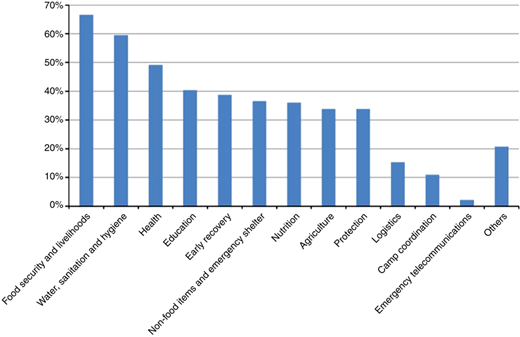
The remaining 20 percent include capabilities such as vulnerable populations, water, sanitation, education, infrastructure, food, security, etc. Interestingly, there is a significant overlap of the remaining 20 percent overlaps and specific services provided by HOs. For instance, Figure 4 shows the results of a survey capturing HOs main products and services (Moshtari, 2016).
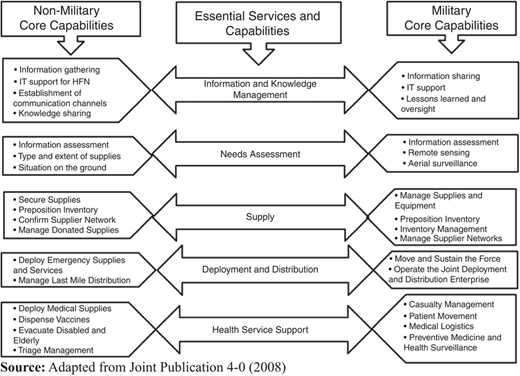
Some of these specific capabilities are also captured in The Sphere Project. In particular, Sphere has established four core competencies that it considers critical. These must be assessed and, if necessary, addressed for disaster response to ensure that stable conditions exist for the population to endure and pull through. The core competencies are: water supply, sanitation, and hygiene promotion; food security and nutrition; shelter, settlement, and non-food items; and health action (The Sphere Project, 2011, pp. 4-5). Since several core capabilities are intrinsic to HOs and specific to its services delivered in the remainder of the text we focus on the capabilities that are essential to delivering aid to address the needs of those affected, but are also shared broadly with the military. We summarize them in Figure 5.
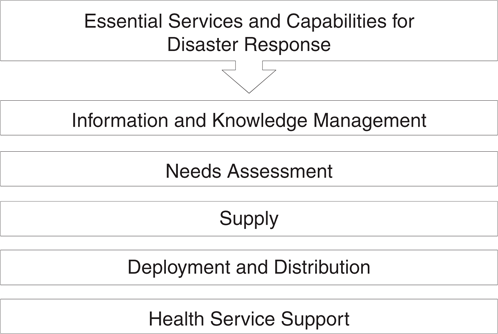
The collection, organization, and synthesis of information into knowledge are necessary for preparing the initial needs assessment and for managing efforts on a continuous basis. The needs assessment is critical for determining the scale and scope of disaster aid that must be delivered to the affected area as well as the local capacity to receive, organize, distribute, and manage the aid. We refer to “supply” generally as those activities involved with the procurement, staging, warehousing, and managing of inventory to support the disaster response. Deployment and distribution refers to the movement and distribution of the supplies from their point of origin to their point of consumption. Health service support is treated separately from other relief activities because it is likely the service with the greatest scarcity and demand during the initial stages of a disaster response. We now discuss the core capabilities of the US military and NMOs with respect to the essential services and capabilities needed to effectively respond to a natural disaster.
Information and knowledge management
Information and knowledge management are necessary to develop an understanding of the impact caused by a natural disaster. Information management enables an organization to determine the “who, what, when, where, how and how much” of a disaster. For example, when did the disaster occur? Who is affected? What infrastructure and services are no longer functioning? Where is the greatest need for disaster aid? How should the disaster response be coordinated with local authorities? And, how much relief aid is necessary? These questions are not, of course, exhaustive but they illustrate the types of information that will be collected as well as demonstrate the necessity of synthesizing their answers in order to develop plans that can achieve an effective disaster response.
Information collection by the military is referred to as intelligence gathering and the military has specific types of methods, equipment, and trained staff to develop an operational picture of the “battle space”. Both the military and HOs are largely reliant upon news sources, government releases of information and contacts on the ground for information in the aftermath of a natural disaster. The information gathered by humanitarian practitioners or volunteers are invaluable for information and knowledge management. The “boots on the ground” personnel often know the local environment well, either due to their origin or due to their extensive knowledge, gathered over time, and/or across other disasters. The military has access to satellite and aerial reconnaissance assets that are capable of developing a very clear picture of the state of the infrastructure and population on the ground. The military heavily depends on this core competency, so they developed it over time. Since HOs do not depend on it as much, they have not developed it as thoroughly as the military. In addition to remote sensing and aerial reconnaissance capability, the military may deploy special operations forces to provide an accurate description of conditions in specific areas. “Special forces” are especially trained to enter an adverse environment for the purpose of establishing landing zones and collecting intelligence. The use of technology like UAVs is increasing among HOs as we write. Due to the criticality of data gathering especially at the time of the conflict HOs may not be as good as the military in this capability. The Cluster Approach, used for the first time after the 2005 Pakistani earthquake, serves as a main information broker for different sectors (i.e. shelter, health, nutrition, protection) during humanitarian operations. Among its main roles, the cluster allows organizations to have access to collective intelligence on needs assessment and existing gaps, prioritizing actions, informing strategic decisions, and coordinating organizations and actions. WFP’s logistics cluster is well known for its capability to broker logistics information, assess logistics needs and gaps, setup priorities, and coordinate action among HOs during disasters.
The gathered information has to be converted to knowledge and integrated into the organizations. This is especially important in both the communities. In military the rotation of tours done makes it necessary to transfer the information as knowledge to retain this capability, so that it is not individual specific. Knowledge management in terms of lessons learned is a core capability for military organizations. The same can be said about NMO where the high-turnover rate of the staff and limited resources necessitate the management of knowledge. At the same time, NMO often struggle with retaining the knowledge gathered by its people in the field. Thomas (2003) estimates that HOs often experience an 80 percent turnover of field logisticians. Gonçalves (2011) describes the feedback mechanism by which high-stress levels increase personnel turnover and limit the fraction of learning that these organizations can retain. Hence, despite being of critical importance, unlike their military counterparts, NMO often struggle with this core competency.
Needs assessment
Needs assessment is the second essential capability that must be cultivated by all the organizations involved in humanitarian operations. However, the way in which the military and NGOs describe needs assessment are very different. The military will be more likely to describe needs assessment as requirements generation whereby there is a mandate to generate a high-fidelity operational picture of what is happening in the area of responsibility. For the military, the needs assessment involves the fusion of all-source intelligence that can be collected by human, electronic sensor, and imagery assets to generate situational awareness; the end product is a statement of the capabilities required to accomplish a specific mission, defined in terms of its duration, scope, and chain of command. To the extent that the military is able to share information over unclassified systems with HOs the information collected from their unique assets can be very valuable for generating higher quality assessments of the needs of the humanitarian operation.
For HOs, needs assessment in the event of a disaster tends to be gaining awareness of the size of the affected population so that calculations may be made to determine the type and volume of aid that must be sent to the area and a project plan can be developed to deliver the aid. For example, the WFP calculates quantities of food to be delivered to various locations based on needs assessment surveys that take into account size and scope of the affected population (De Angelis et al., 2007). The International Federation of the Red Cross gets national societies involved in the needs assessment phase to ensure that local knowledge is properly accounted for and integrated into the assessment. Without knowing what the needs are, HOs may find themselves in a tough situation. For instance, it is common for HOs to receive unsolicited in-kind donations. Often, such unsolicited managing donated supplies which may or may not be necessary or suitable for the given disaster (Samii et al., 2003; Apte, 2009). Over the years the practice of needs assessment in humanitarian response has improved significantly, borrowing from the military repertoire. Over 40 years ago, when humanitarians would be deployed to assess the impact of a disaster, they may not have the proper tools, training, or resources. Today, major HOs have created Rapid Assessment Teams that can be deployed quickly and have a proper composition, including experts in many fields such as communications, health, nutrition, logistics, etc. to provide a comprehensive assessment of the beneficiary needs.
Supply
The third essential capability as shown in Figure 1 is supply. The supply capability includes procurement, staging, warehousing, and inventory management. This capability enables an organization to be ready for catastrophic events (Apte, 2009; Van Wassenhove, 2006) and may be considered a form of capacity expansion (Salmeron and Apte, 2010). Due to the high uncertainty associated with the impact of disasters and the resulting beneficiary needs, ability to supply is a critical capability for organizations involved in disaster response. The high volatility in demand makes it difficult for HOs to implement traditional supply management solutions. Still, the organizations have adapted to include long-term supply and capacity agreements with major suppliers. While the organizations may not be able to guarantee specific quantities, they can contract on the timely delivery of items when a disaster strikes. In addition, NMO providing different relief services (e.g. transport, shelter, protection, etc.) often resorted to individual procurement processes. More recently, organizations have moved to centralized procurement, to avoid duplication, to consolidate volumes and reduce costs, as well as coordinate procurement with inventory management practices, including prepositioning.
Prepositioning, an inherent aspect of supply, allows for a faster response, better procurement planning, and improvement in distribution costs (Ergun et al., 2010). For both the military and NGOs this will entail reviewing any pre-staged or prepositioned materials and determining their suitability for the particular disaster as well as determining how the supplies will be moved from their point of origin to the final point of consumption. The military has a core capability in the management of large stores of supplies in the case of a contingency as well as all of the necessary material handling equipment and professional supply professionals to move materiel quickly.
In addition to managing supplies that may have been warehoused in preparation for a disaster, NGOs must often manage unsolicited donated supplies. Unsolicited donations are a characteristic only to NMO and due to uncertainties of demand and supply is as much a blessing as a curse. Any lack of information about specific characteristics of the affected area will make it harder to secure the appropriate types of supplies. After 2010 Haiti earthquake WFP first provided high-energy biscuits and then within weeks they delivered rice, beans, oil, sugar, and salt to the hospitals, orphanages, and communities in the affected areas.
Deployment and distribution
The military possesses unique transportation assets that provide essential deployment and distribution capabilities during a natural disaster. Both strategic airlift and sealift capabilities that can roll-on, roll-off equipment, materiel, and personnel are available in quantities and within lead times that very few other organizations are capable of delivering. Large transport aircraft capable of landing on short, unimproved airfields, for example, are very important for some types of disaster responses. Ships with shallow drafts or landing craft that can move directly from the sea to shore without a need for a dock are useful when the ports are damaged or too congested to receive the volume of aid that is flowing in from external sources (Apte et al., 2013). And when the airports may be inadequate for receiving the necessary aid to support the relief, the military has the capability to bring large numbers of helicopters off-shore that can operate independently of support from land in order to deliver supplies to specific locations in need.
Similarly, but with fewer resources, the WFP, the UN agency that leads the logistics cluster provides logistics resources to other organizations operating in the humanitarian theater free of charge. Frequently, local and smaller NGOs do not have the capability to access remote areas or areas with inadequate or destroyed infrastructure. The WFP and other international organizations often collaborate with the military to implement the programs. These can include also the air transport of passenger and cargo for humanitarian UN agencies and implementing NGO partners through the United Nations Humanitarian Air Service. It is common for small NGOs that respond to a disaster to typically depend upon contracted or regularly scheduled commercial flights in order to move staff and supplies to the affected area.
Despite the challenging environment, deployment, and distribution is a core competency for most organizations as they need to deploy personnel, equipment, materials, food, and non-food items to provide relief and respond to the disaster. Typically, reaching the final beneficiary, also known as − last-mile distribution − is a major challenge to organizations. A number of major organizations, including UN agencies such as WFP, focus on the primary and secondary bulk distribution, leaving the more granular, local and costly last-mile distribution to local NGOs or implementing partners. The ability of such organizations to reach beneficiaries in remote and hard to reach areas constitutes a core competency.
Health services support
Both the military and NGOs work toward the same objective when it comes to providing health services: relieving pain and suffering in addition to preventing fatalities. However, the military possesses hospital ships as well as rapidly deployable field hospital and surgical units that are capable of deploying rapidly while managing the logistics of supply and the transfer of patients to higher levels of care in a cohesive manner. The collection of theater data is also part of the process. Historical knowledge and mindset helps the military in managing the health support services.
In contrast, NMO providing health services support work with any existing infrastructure still available and operational. At the same time, different organizations may adopt drastically different approaches to their services. For instance, MSF will send a team of international doctors, nurses, equipment, and materials and will operate independently of existing local resources and personnel, even if they could complement theirs. At the same time, MSF will provide a broad range of services that it deems necessary in the more critical times, however, may depart as the situation improves. The International Medical Corps operates very differently involving local resources and local staff and even training them, with an explicit goal of building local capacity and frequently remaining in a disaster affected area well past the critical phase. After the 2010 Haiti earthquake and the cholera epidemic following that, UNICEF escalated their relief operations to meet the critical want in water and sanitation to provide proper health care to the children. UNICEF is the largest buyer of vaccines in the world. In 2012, UNICEF procured close to two billion doses of vaccine and over 500 million syringes reaching 36 percent of the world’s children (UNICEF, 2013).
Key findings
Due to the diversity of disasters, NGOs may have to source some medical capabilities from many other organizations, or network of volunteers, and then form those individuals into teams to provide care. In addition to providing general medical supplies, specific requirements also have to be managed (such as the proper vaccine during a pandemic). Similar to the military, some NGOs have setup medical boats to provide medical services in remote areas. Analogously, other small organizations, like Expedicionários da Saúde, promote expeditions of volunteer physicians and nurses to provide medical assistance in remote areas of Brazil. Figure 6 describes the core capabilities of both the US military and NMOs and matches them to the essential services and capabilities required to effectively respond to a natural disaster.
Summary and conclusion
This research identifies those competencies and capabilities that are core to the US military and NMOs. The military brings strong competency in movement, transportation, material management, rapidly deployable state-of-the art trauma and general medical care, and strong intra-organizational communication systems. Non-military HOs typically have a deeper understanding of the dynamics on the ground and know the types of assistance necessary to ensure social and institutional restoration as quickly and effectively as possible. Knowing which capabilities are “core” frees up resources of different institutions from duplicating the efforts of other organizations they may frequently work within areas affected by disaster. Further, this framework is a useful starting point for developing a multi-national, multi-agency coordinated response framework for military and NMO for disaster response around the world. Such response frameworks should be the responsibility of multi-national organizations such as the UN, EU, or ASEAN.
Further, this work contributes to the theoretical foundation of research exploring similarity and differences in military and NMO approaches to disaster response. Namely, this work focusses on the core competencies of military and NMO. It is our hope that follow-on empirical and case study research will build upon this work and contribute to the growing body of research in the area of military and non-military collaboration in humanitarian assistance and disaster response. Such research should further explore the role of the military, non-military, and NGOs in humanitarian assistance and disaster response to facilitate not only greater understanding within the field of operations management but also across disciplines to include academics, policy makers, and decision makers in public administration, public health, and international aid.
With continual downward pressure on military spending in the USA as well as other countries, it is anticipated there will be fewer resources available for disaster response in the future. Figures 1 and 2 show the degree of American largesse. Should the USA reduce the number of responses it makes or reduces the size of the response in terms of resources, our work points out to other nations as well as organizations such as the EU, UN, and ASEAN what the potential gaps may be that will need to be covered by other countries.
Finally, though our research is focussed on the US military and its interaction with domestic and international NMOs, we believe that our ideas can be applied to other military organizations concerning core capabilities and competencies. Future research investigating the capabilities of the militaries of other countries might lead to the development of “regional capability maps” that could assist both governmental and non-governmental agencies in their disaster planning processes.
References
Further reading
© Published [2016]. This article is a US government work and is in the public domain in the USA. US Navy.