The purpose of this paper is to steer the logistics efforts during different phases of cash and voucher and lead aid assistance operation to right destination by analyzing logistics data and converting it to feasibility information.
This research paper depends basically on a quantitative approach by depending on previous references relevant to this topic. Furthermore, interviews with experts in the field consider the dependable references for this research paper.
There are many findings in this research paper such as a simply logistics algorithm that could help logistics experts to determine the key components in market supply chains and draw different scenarios to clarify the full picture.
This research paper can be considered as reference for advance research papers in future. Furthermore, it stimulates academic researchers to open a serious discussion about logistics data analysis in all phases because it considers as a good source for decision-making information.
1. Introduction
Cash and voucher (C&V) modalities have many definitions that have the same common specifications, herein some of definitions due to different humanitarian organizations as following. Cash-transfer programming (CTP) in emergencies is one form of humanitarian responses that can be used to address basic needs and/or protect establish or re-establish livelihoods (IFRC and ICRC Guidelines for CTP). Transfer of resources using market mechanisms is a response to problem of “access” not “availability”, e.g. people cannot afford food, where there is no shortage (WFP). Cash transfers are assistance to beneficiaries in the form of cash payments, bank transfers or mobile money. Beneficiaries can meet their own needs in the marketplace (CaLP). In result, there are many kinds of humanitarian financial assistances mentioned under many modalities such as commodity voucher, cash-based transfer (CBT), CTP, C&V, value voucher and so on. Within this research, we will focus on voucher programmes as the main terminology that presents roughly all above-mentioned modalities. There are many reasons to choose voucher programmes as the core of this research. First, distinct kinds of vouchers allow variations in the level of commodities to be distributed and can provide goods and services as long as shops and service providers are functioning, guaranteeing the beneficiaries will receive the established amount of goods/services in the case of price fluctuation (DG ECHO, 2013a, b, c). Thereby, concerning about voucher in this research allows us to simplify our calculations because beneficiaries will get specific goods and services with fixed prices approximately. In addition, voucher programme owns specific aspects in terms of specific value, specific levels of commodities or services, specific distribution’s areas and other. Therefore, all these specific factors allow us to study promptly the impacts of voucher intervention on market supply chains and, then, extract the ultimate results in a clear manner. Thus, this research is going to focus on voucher programmes because we can determine exactly the targeted market and its relevance supply chains, for example studying e-voucher winter clothes project by UNICEF, that have been implemented in Syria since many years, which is feasible because we know targets, prices, sales points, beneficiaries needs and distinct kinds of given commodities (winter clothes for children), whereas any unconditional cash programmes by humanitarian organizations would complicate the research because of several needs of beneficiaries; therefore, we cannot determine where cash will be spend exactly, thereby discouraging the study on the impacts on relevance market supply chains. In result, research is going to concern voucher programmes to limit the scope of research and avoid any unnecessary deviations from research’s goals.
Ultimately, all these modalities have approved their effective and efficiency, thereby encouraging humanitarian community to recommend them as appropriate solutions in all stages (mitigation, preparedness, disaster and recovery). The following citation expresses their importance “Where markets and operational contexts permit, cash-based programming should be the preferred and default way of support” Report of the Secretary-General (Pan Kei Moon) for the World Humanitarian Summit 2016. Nowadays, we witness the expansion of these modalities among countries such as Haiti, Somalia, Pakistan, the Philippines, DRC and lately in Syria.
In spite of that, a major role is being played by a logistics team nowadays than before; now they are responsible for monitoring local markets and assuring the proper functioning of market supply chains because every different processes in all different stages (mitigation, preparedness, disaster and recovery) have an impact on local markets; therefore, C&V-based assistances only work when we monitor markets’ supply chains and maintain our own segregated supplementary supply chains when needed (The Cash Learning Partnership, 2018). Nowadays, logistics team supports voucher programme functions in many stages, and this support is translated into many activities such as monitoring market and its supply chains, monitoring availability of commodity, observing voucher behaviour in respect to market supply chains, submitting advices in terms of logistics support services, confirming disbursements against entitlements, distrusting C&V to beneficiaries according to procedures and so on. Thereby, there is an essential need to establish modern algorithms that could give quick analysis of market supply chains’ behaviour at glance when inserting the necessary logistics inputs. Of course, this paper does not come under mathematics research studies; on the contrary, it attempts to build the simply algorithms that could be used even by non-logistics experts. Eventually, herein below, the research plan has been sequenced. First, this paper is going to discuss different mechanisms to monitor and evaluate market supply chains’ performance and voucher impacts; thereafter, the paper is going to discuss key affected logistics factors relevant to market supply chains. In addition, the research is going to analyze when and how logistics team must help and uphold market’s supply chains by direct interventions. Then, research discusses deeply how could the algorithm be combined logically with the previous logistics factors that would be used to monitor supply chains’ functions within local market subject to voucher programme. Consequently, there are many relevance recommendations given about benefits. Herein, mentioned below is the plan of this research:
mechanisms to monitor markets supply C&V performance;
relevance factors that affect market supply chains;
suitable time and types for logistics interventions besides voucher programme;
chained algorithm to analyze market supply chains and voucher performance; and
final recommendations.
2. Mechanisms to monitor markets supply chains and voucher performance
Implementing C&V projects requires different skills to manage in-kind transfers. If logistics are often simpler, there is a need for additional administrative and finance capacity. Furthermore, assessments and monitoring need to include analysis of markets and distribution networks (DG ECHO, 2013a, b, c). The extract from previous citation that is finding out mechanisms is so essential, especially in the case of analysis of market supply chains affected by voucher programs because mechanisms are tools to measure whether all functions within entirely market supply chains perform well. By default, any kind of resource transfer may impact markets and local economies. For CBT, the market assessment must demonstrate whether there is sufficient supply or traders can increase the supply of the necessary commodities and evaluate the risk of causing or contributing in inflated prices of key goods. For in-kind transfers, the risk is likely causing deflation in the prices of key goods, which, for example, can disrupt local production cycles (DG ECHO, 2013a, b, c). This paper will focus on three categories as below, but not limited to, apart from any economic growth trends, exchange rate fluctuations, imports and exports, employment, inflation rates, geospatial information, insecurity, distances and sudden changes in the economy or government policies that could have serious and lasting effects.
2.1 Measuring ability and accessibility of local markets
The feasibility of C&V rests on the expected future ability of markets to respond to increased demand, if cash or vouchers were provided, and not simply on the state of the market before any intervention. Decision making should include the consideration of possible measures that could be taken to address any market constraints (e.g. addressing constraints facing traders such as capital, credit, storage and transport). Seasonal, regional and global trends can all influence prices. Likewise, the ability of traders to ensure timely supply at an appropriate price and quality may be critical. Therefore, potential impacts on markets by distinct types of transfers should also be considered (Levine and Bailey, 2015).
Prices are an overarching indicator that provides key information such as the outcome of supply and demand forces; they can give a timely insight into many different drivers that influence the functioning of a market and that are relevant for assistance programming. Of course, analyzing markets’ prices looking at three aspects:
the structure, as actors and institutions for supply and demand, barriers to entry as a market player, trends in production and market catchments;
the conduct, as competition levels, rules and standards as well as contract enforcements; and
the performance, as different methods of price analysis such as seasonality and volatility, market integration, profit margins and income generation, and purchasing power patterns (Caccavale and Flämig, 2017).
Furthermore, there are other indicators such as a flexibility indicator that is needed to meet the most pressing needs especially the heterogeneous needs of individual disaster – affecting households and individuals. Cash provides the flexibility to move beyond a standard kit/ration that meets the average needs of a household. Conversely, a restricted type of markets or poor ones may have a larger impact on a specific objective that presents to help beneficiaries and small traders indirectly (DG ECHO, 2013a, b, c).
In result, the analysis mostly focuses on price changes over time, besides other indicators, because of the issue of price volatility, which is likely to transmit uncertainty when price fluctuations are not predictable, could usually reflect the market supply chains’ ability and beneficiaries’ accessibility in the field.
2.2 Measuring agility of market supply chains
The agile supply chain refers to the use of responsiveness, competency, flexibility and quickness to manage how well a supply chain entity operates daily. The agile supply chain uses real-time data and updated information to leverage current operations and real-time data against demand forecast, which helps to improve the overall efficiency and productivity of the given entity. Another key benefit of agility in the supply chain is focusing on avoiding potential shortages and eliminating excessively stocked inventory (Robinson, 2016).
Mostly, local market supply chains in the developing world that comply to voucher programmes are often fragmented and inefficient that is resulting in higher prices, greater losses and less access to commodities for the poorest. Millions of small- and medium-sized businesses and smallholder farmers are made poorer by the inability to access markets and support themselves. For example, most smallholder farmers worldwide produce barely enough to feed their families. Difficult access to agility logistics functions impedes investment and that means the loss of a harvest can push entire communities into hunger. For example, poor transport links hinder trade and drive prices up.
In fact, many concerns are raised by logistics experts when assessing the agility of supply chains for one or more markets that subject to voucher modality; herein below, some basic questions are given that are always faced by experts:
Are the people we support getting the best value for money with their cash assistance?
Are they able to cover their basic daily requirements or are shop prices too high due to inefficient or disrupted supply chains?
Is the quality of the commodities they buy safeguarded?
Can the retail sector supply the additional demand generated by our CBT, month after month?
In areas where voucher modality operates, the experts study local retail conditions, supply chain networks, prices and potential bottlenecks or inefficiencies that they can help to remove. Logistics experts may help selected wholesalers and retailers to plan to avoid potential supply breaks and negotiate better prices from suppliers and transporters. They work across the entire supply chain with a broader goal to improve retail management in local markets and ensure that the beneficiaries have access to excellent quality commodities that are consistently in stock and available at fair prices. Logistics experts also support retailers to better manage their inventories, purchase their stocks, and arrange transport and storage so that they can provide the best possible service to all beneficiaries appropriately. Finally, logistics team could propose ideal logistics solutions to humanitarian problems. Although the focus also lies on how best we support the people we serve, working on strengthening retail supply chains that help entire communities who shop at the same stores. Furthermore, after the end of operations, logistics experts can say “we leave behind a more robust, sustainable and competitive sector at affordable prices and poor families reap the benefits of supply chain efficiencies” (World Food Programme, 2018a, b, c, d, e). In result, assessing the agility of market supply chains is a critical mechanism for understanding the ongoing voucher performance because increasing agility inside local market supply chains means serving beneficiaries effectively at fair prices.
2.3 Procurement logistics
There is another tool to monitor macroeconomics and market’s logistics behaviour, some of research works use terminology called “Procurement logistics” that consists of activities such as market research, requirements planning, make-or-buy decisions, supplier management, ordering and order controlling. The targets in procurement logistics might be contradictory, for examples, maximizing efficiency by concentrating on core competencies, outsourcing while maintaining the autonomy of the organization, or minimizing procurement costs while maximizing security within the supply process. Thereby, procurement logistics principles could be feasible to leverage local traders’ capacity and evaluate the solidity of market supply chains.
A good example on procurement logistics is what happens instantly after a disaster strikes, relief organizations conduct an initial assessment (usually within one day after occurrence). The expected quantity of supplies required to meet the relief needs of the affected population is estimated (Thomas, 2003) as well as pre-positioned supplies, already available at the organizations warehouses, are evaluated. Relief items, which need to be procured from suppliers, are determined (Balcik and Beamon, 2008). As a next step, this assessment is translated into supply requirements. Demand for relief supplies varies in terms of magnitude, criticality and type of required materials that are mostly too highly unpredictable (Kovács and Spens, 2007). In result, using procurement logistics mechanism to assess the local market is a key tool to know precisely the realistic results in terms of voucher performance, market supply chains and local suppliers.
3. Relevance factors that affect on market supply chains
Indeed, many factors could influence the functioning of market supply chains, consequently, that leads to positive or negative effects on voucher behaviour. Furthermore, in some cases, voucher behaviour itself could be a positive or negative factor that affects market supply chains. For examples, a voucher programme encourages local smallholder traders to improve themselves, stand up again and stimulate their local economic activities among market supply chains. On the contrary, the voucher programme sometimes has negative impacts on market supply chains such as prices inflation, huge demand on specific commodities, competition on transportation services and so on. Therefore, this research intends to study precisely the accountable factors that could be measured mathematically. After that, we could consolidate these factors and make them components of the simply algorithm that could be used in monitoring impacts of both voucher behaviour and market supply chains, thereby using the extracted results to correct whole operations relevant to voucher programme and market supply chains. The key logistics factors vary, but not limit to, and herein below the important ones. Of course, we could add or remove some of them depending upon the nature of specific operation.
3.1 Availability and accessibility of commodities in market
This is the first basic stone to build successful market supply chains and successful voucher programs. Without availability and accessibility of stock, upstream market supply chains and local purchase, appropriate local markets do not exist that could address the local needs adequately. There are a lot of examples; therefore, let us take WFP case as first instance. WFP works with local retailers through its cash-based assistance transfers and helps make local commercial markets more professional and efficient. Lower costs translate into lower prices, giving vulnerable people the possibility of having more money to meet their basic needs. In Jordan, WFP’s retail engagement strategy changed the existing contractual arrangement and has boosted so far by 8 per cent the purchasing power of 80,000 Syrian refugees living in the sprawling Zaatari refugee camp. Working with the camp’s shopkeepers to use their store’s itemized sales data, WFP is in the process of helping them to make their supply chains more efficient (sourcing and delivery) with a potential to further reduce selling prices (thus, further increase purchasing power) by another 7–9 per cent (World Food Programme, 2018a, b, c, d, e). Available stock in market and strength pipeline are fundamental issues that affect voucher programme and market supply chains; therefore, it considers as a startup point for any planning regarding the voucher programme and market supply chains.
The second example that highlights the importance of upstream market supply chains and limitations in terms of availability and accessibility of market is related to the joint venture report by many humanitarian organizations that analyzes the market supply chains in Yemen and how it addresses the needs of people, the mentioned report says “they found that in the west of Yemen, two market systems are operating semi-independently of one another. Divided by the line of conflict, the north-west and central-west of the country is supplied primarily by the port Al Hudaydah, while the south west of the country is supplied by the port of Aden. The two supply networks have varying availability of goods, and different distribution mechanisms, with Al Hudaydah supplying vendors through a wholesale distribution network for most products, whereas distributors in Aden tend to directly supply vendors in neighbouring governorates. The port of Al Mukalla and the cooking gas producers of Marib are the exceptions to this trend, supplying vendors across the west of Yemen” (CMWG, 2017). Therefore, it can be said that market supply chains in Yemen are provided with commodities in line with limitations that hinder availability and accessibility of market.
Third example demonstrates the importance of local productions in addressing the needs of market in low prices. Even a plentiful harvest can have its downsides. Inadequate capacity to store market and transport food surpluses causes food prices and quality to drop. Farmers are unable to put their produce for sale at a premium when demand is highest, food is wasted and spoiled, and market volatility is sharpened. There are many other examples in terms of supporting local production that can have a positive influence such as supporting smallholder farmers through the facilitation of credit, capacity development and access to markets (World Food Programme, 2018a, b, c, d, e). Consequently, local production would get strengthen in all times and support voucher modality and market supply chains; furthermore, local production would be considered as a main resource for market supply chains and facilitate the implementation of voucher modality.
3.2 Capital and cash flow
According to experts in fields, the capital is considered as an extreme key factor because without enough capital, there is no commodity procurement, transportation, stockpile, voucher programme processing and so on. Therefore, all experts agree together that capital streamlines all processes of market supply chains; therefore, voucher programme experts and logistics team always study the assets and financial capacity for whole traders, small traders, transporters, distributors and so on.
For example, in the case of traditional aid assistances, the relevance organizations might have worked with a maximum of 10–20 suppliers for their needs in a country, on large framework agreements, but now in a voucher modality, they might have up to 300 vendors serving the beneficiary needs (each on a much smaller scale). Many agencies are now recognizing the value of engaging in market strengthening and market support activities to aid recovery and stimulate trade in the immediate geographical and economic vicinity of affected populations. Activities vary from rebuilding infrastructure, supporting micro-traders in seeking credit/scaling up, or giving grants to supporting micro-traders to recover (to buy fuel, to repair their shops, etc.). These are the small and simple traders who are oftentimes affected by the emergency themselves and can be beneficiaries. Therefore, they need to support them with logistics and financial services. In result, any new voucher project needs to study the subject market critically, relevant to its logistics, and financial capacities before issuing any project (Logistics Cluster, 2014).
Furthermore, the humanitarian organizations should pay attention to new term known as supply chain finance likewise supplier finance or reverse factoring is a set of solutions that optimize cash flow by allowing businesses to lengthen their payment terms to their suppliers. This results in a win-win situation for the buyer and supplier. The buyer optimizes working capital, and the supplier generates additional operating cash flow, thus minimizing risk across the supply chain (Prime Revenue, 2018).
In result, cash flow, funding and payment terms are essential issues in voucher modality and market supply chains; therefore, voucher programme’s contracts with traders must stipulate about payment terms critically and, likewise, periodical payments and advance funds that could submit to traders for starting up; voucher logistics experts must teach small traders and household traders about optimal methods of payments to their suppliers that leverages their position in market and enable them to get best prices and discounts. In addition, voucher and logistics experts must establish the critical invoicing system that grantees the fund of organization spends in its place and grantees the traders’ entitlements pay orderly and immediately. Thus, organization ensures that cash flow is under control; otherwise, any chaos in payments against invoices and logistics services could lead to huge claims and interruptions in market supply chains.
3.3 Contracting and ordering lead time
The contracting and ordering functions are considered as complex issues in the procurement cycle and sometimes the most effective functions in reducing costs and expenditures. There is a fundamental difference between traditional humanitarian aids and voucher modality in terms of procurement process and scales. For instance, traditional humanitarian response usually uses the large competitive procurement processes, awarding sole business to the best bidder. This method is still useful and can achieve consolidation-related cost efficiencies, but that differentiates in the case of voucher modality because we also need to broaden our methods and design processes that allow us to contract with many local suppliers. The good example that demonstrates the mainly idea is WASH project in Pakistan, where an assessment shows that markets around affected beneficiaries are fully functioning with many small stores in communities and camps replete with hygiene items. Indeed, there are many benefits of working with many as opposed to a single award contract in this scenario and, on the other hand, this imposes a lot of complex processes, large scale of transactions, and huge administration and logistics documents (Logistics Cluster, 2014).
To sum up, when voucher modality is implemented within a specific market, experts must assure that contracting, ordering, and other procurement processes could meet the final needs of beneficiaries; otherwise, it would create seriously interruptions in market supply chains dramatically. Generally, the definition of the lead time is the latency between the initiation and execution of a process. In industry, lead-time reduction is an important part of lean logistics (Antunes et al., 2016). A more conventional definition of lead time in the supply chain management’s point of view is the time from the moment the customer places an order (the moment the supplier learns of the requirement) to the moment it is ready for delivery. In the absence of finished goods or intermediate (work in progress) inventory. It is the time, which an order is taken to a manufacture without any inventory other than raw materials. The Chartered Institute of Procurement & Supply identifies “total lead time” as a combination of “internal lead time” (the time required for the buying organization’s internal processes to progress from identification of a need to the issue of a purchase order) and “external lead time” (the time required for the supplying organization’s processes, including any development required, manufacture, dispatch and delivery) (CIPS, 2012).
Of course, all above definitions appear obviously the important of lead-time term in supply chain generally and within market supply chains especially, by default, implementation voucher programme in specific market would require agile logistics functions from traders to replacement any stock out with recovery ones. Of course, minimized lead-time leads to minimized costs of huge stockpiling and minimizes likeliness of stock run out.
Therefore, focus on lead-time issue in market supply chains and voucher programme is vital because minimized lead-time reflects agility in market supply chains, thereby resulting in agility in voucher programme implementation.
3.4 Transport capacity and fuel
Generally, the definition of transportation refers to the movement of product from one location to another as it makes its way from the beginning of a supply chain to the hands of final customer. This requires a new broad look at the business of transportation supply chain, including supply chain management, logistics and procurement. Therefore, the logistics experts harness the transportation functions as much valuable tool to enhance and execute the whole market supply chains. On the contrary, the non-understanding of transportation role in supply chains could cause many adverse effects. For example, when freight costs are high, even seemingly small oversights can result in unneeded expenses, hence causing cut into overall profit margins. In addition, probably more detrimental to budgeting because of the hidden cost of transportation in a poor supply chain. When getting goods from one point to another is a crucial aspect of business, ensuring that this process is the most efficient becomes a huge economic concern. This is especially true in large enterprises and the obvious connection between visibility of freight and the transportation economics becomes easy to see. Even in smaller businesses where the margins are rather low, transportation costs are still a crucial element of creating profitability (Robinson, 2015). Thus, we can result from above explanation that transportation is a crucial issue in all kinds of aid relief operations either voucher or direct aid assistance; therefore, logistics experts must study local transportation capacity before commencing with drawing for any humanitarian operation or, otherwise, all their efforts will be wasted easily because of transportation fail to meet the fundamental needs of humanitarian operation. In result, transportation considers within market supply chains as a key element because low transportation means added value for both local markets and voucher beneficiaries. Of course, transportation is functioning well where there is enough fuel in appropriate prices which considers else the key element in market supply chains. Because fuel is a critical issue that is affected dramatically with general supply chain functions especially on market supply chains.
Both voucher modality and direct aid assistance will need trucks to deliver the assistance items in question, thereby that means the transportation needs to enough fuel always with constantly level. For example, fuel is always in demand, particularly when it is scarce – a common situation during an emergency. To keep the relief operation vehicles well supplied with fuel and lubricants, a meticulous gas mileage record must be established based on the routes taken. Sometimes it is possible to get credit at a gas or petrol station, and vehicles are refuelled upon the presentation of authorized coupons. This very convenient solution eliminates having to store and supply fuel (Pan American Health Organization, 2001). Another realistic example extracts from report about Yemen, where the shortage of fuel was reported across Aden and the south west of the country, which subsequently resulted in transportation issues, longer restocking times and dysfunctional market price mechanisms for essential products. Then, this would have severe repercussions across the centre west and north-west of the country. Rapidly increasing fuel costs have impacted upon all sectors of the market, with many communities now financially and physically unable to access their local markets (CMWG, 2017).
To recap, each of market supply chains, direct aid assistances and voucher modality will need transportation in all stages that is possible only when fuel is available with constant amounts and prices. Therefore, logistics experts should grantee this matter and know the expected level of fuel that will be needed during the period of planning before they commence with serious operation.
Furthermore, some of humanitarian organizations start new initiatives that aim to provide transporters or party that responsible for transportation with enough share of fuel that will be used in the transportation of assistance items.
3.5 Storage capacity
Storage capacity that is possessed by small traders and wholesalers is an essential issue in the design of market supply chains because this issue affects directly the inventory level and the total available stocks that could meet the needs of the beneficiaries as and when required. In addition, stockpiling represents a large cost to small traders and wholesalers who participate in voucher programme. This is made up of the cost of the inventory itself, plus the cost of transporting the goods, cost of managing the goods (labour, fumigation, repackaging, etc.) and keeping the goods in warehouses. Thereby, the role of logistics experts is learning small traders and wholesalers to make inventory available at the lowest possible cost. To achieve this, the small traders and wholesalers must ensure to keep balance between supply and demand by establishing minimum holding stocks to cover lead times. To achieve this, they must liaise constantly with the voucher programme planners to keep abreast of changing needs and priorities. Besides that, the warehouse must always have sufficient stocks to cover the lead-time for replacement stocks to avoid stock-outs (White, 2015).
Furthermore, storage facilities is considered as much important node in market supply chains because warehouse processes should be examined to find areas of eliminating waste of resources and non-value-added steps. For example, one area that small traders and wholesalers should always be working on is the reduction of unnecessary inventory. The accumulation of inventory requires money and resources to store and maintain it. By reducing unnecessary inventory, thereby small traders and wholesalers can minimize warehousing space and handling, in turn reducing overall costs (Murray, 2018).
Consequently, the adequate storage capacity of traders could enhance the ability of market supply chain; furthermore, the planning for appropriate inventory levels will contribute to conducting voucher modality smoothly without interruptions and streamline the functions of market supply chain.
3.6 Traders capacity
The local traders’ capacity is considered as a sensitive issue in market supply chains because traders are main actors in market. Furthermore, increase in traders’ capacity could translate as increase in addressing of beneficiaries’ needs.
Of course, traders must build their own supply chains, either short or long ones, in an appropriate manner; therefore, they commence with establishing lean market supply chains that are free from any kind of waste and losses. In addition, organizations that enhance voucher modality commence to teach traders the terms of lean supply chains, and how to build it effectively.
The traders are encouraged to use lean supply chain management if they want to streamline their processes by eliminating waste and non-value-added activities. Traders may have several areas in their market supply chain where waste can be identified as time, costs or inventory. To create a leaner supply chain, traders must examine each area of the market supply chain because lean supply chain management requires businesses to examine every process in their supply chain and identify areas that are using unnecessary resources, which can be measured in dollars, time or raw materials. This will improve the traders’ competitiveness as well as improve the traders’ overall profitability (Murray, 2018).
In other words, we can say that traders must enhance themselves by building cutting edge and lean supply chains that address the beneficiaries’ needs with an appropriate manner.
3.7 Beneficiaries’ needs
Now, we proceed to the fundamental issue in voucher modality and market supply chains that is beneficiaries’ needs because all functions in market supply chain is drawing to address these needs effectively and efficiently. Unfortunately, some of humanitarian organizations forget this fact and commence to draw their humanitarian supply chain due to their goals only apart from beneficiaries’ interests.
In the realistic instance, one of field researchers observed that the humanitarian organizations are running operations in a survival mode, as they are dependent on funding from donor organizations. At the end of programme, they exit without achieving realistic physical results, whereas there is still a need to provide small-scale aid and basic nutrition services. As we talk about supply chain integration here, future work should consider beneficiaries as commercial supply chains integrate consumers into their chain, and humanitarian organizations need to communicate properly to beneficiaries and hear their voices to create sustainable communities. Moreover, local actors are important for communicating to the local communities, as they are well aware of the needs of the affected population. The local actors can also enable humanitarian organizations to quickly scale up their capacities while continuing to provide humanitarian services to the beneficiaries. For instance, the International Federation of Red Cross and Red Crescent Societies (IFRC) has been building scalability into their supply chains to be more sustainable and to allow them to scale up quickly by cooperating with local bodies (Tabaklar, 2018).
In other words, beneficiaries’ needs are the aims of all functions of market supply chains; otherwise, all humanitarian supply chains are fund wasting. In addition, it may affect adversely on entire humanitarian operations.
4. Suitable time and types for logistics interventions beside to voucher programme
When is the best time of logistics intervention? Where is the best place for logistics intervention? What is the best approach for intervention? All these questions are raised by logistics team after they have studied precisely the above relevance logistics factors especially when studies indicate interruptions in market supply chains. Thereby, logistics team extracts that there is an urgent need to intervene directly besides voucher programmes. Let us clarify these points through below explanation.
Depending upon distinct kinds of disasters, there is likely one or more over-effective logistics factors as described above that could impact adversely market or functioning of market, not complying with appropriate status, thereby highlighting the role of directly logistics interventions. Of course, there are distinct kinds of logistics interventions that could manipulate deficits of market or stimulate local markets by many mechanisms.
Indeed, this research paper is going to highlight on distinct kinds of logistics interventions that relate to humanitarian organizations, which are acting in various areas worldwide. Furthermore, this paper is going to study the best time and terms for logistics interventions besides voucher programme. Some empirical examples are given as below.
First instance, when local production fails to meet the basic needs of beneficiaries, logistics employees must study this case and, then, find out the empowering mechanics to enhance market supply chains’ functions, likewise providing formers with livestock so that they could produce in large volumes for local markets.
There is obvious example related to this matter. Globally, WFP spends $40m in commodities every year from smallholders with plans to triple that in the coming years. Furthermore, WFP has signed long-term agreements with six selected local mills to produce fortified wheat flour for its programmes. Therefore, the wheat flour production has grown from nothing to 70,000 metric tons, and the source of which is 20 per cent of local farmers. They also support the millers to grow their businesses into sustainable ventures and commercialize their production so that they can access markets beyond WFP (World Food Programme, 2016).
Second instance, when local formers, traders and wholesalers have weaknesses in their capacities that are not enough to cover local needs of beneficiaries. Herein, logistics employees must study distinct aspects of their capacities and determine the bottlenecks, and then, they could propose the appropriate solutions that fit to handle the bottlenecks wisely and, likewise, providing with advance cash credits, necessary tools, especially electronic tools, training them on modern approaches, supporting importers to import the specific commodities and so on. The realistic instance appears in terms of Somalian voucher programme case, the traders in Somalia who cited the lack of demand as one of the top business constraints, so by creating more effective demand, the cash programme caused directly benefit traders operating in the areas where cash was distributed. Competition between traders is also very strong, and this additional demand put pressure on traders to meet supply requirements. To help ensuring that traders could supply the required goods, some NGOs informed traders about the project ahead of time; therefore, traders interviewed all reported that they were able to meet demand, albeit after dealing with difficulties such as poor road conditions (Longley et al., 2012/2018).
Third instance, fuel availability may affect adversely on market supply chains; therefore, logistics intervention becomes vital and, herein, logistics team could arrange contracting, ordering and distributing enough amounts of fuel on relevance-contracted transportation vendors in such way market supply chains function without interruptions.
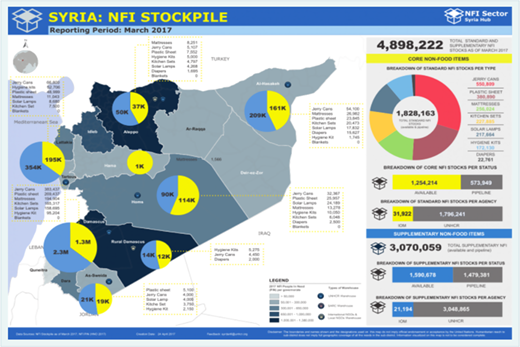
Forth instance, when threats and risks are extremely high in a specific area and there is a huge possibility that all roads and supply chain networks are hindered. Then, the right preparedness action is to keep additional stockpile in temporary and permanent warehouses within a specific area in such way that logisticians could submit urgent aids to beneficiaries continually when supply chain networks would cut down. Herein below a map is given that is the good example of stockpile concerns; the map presents in details the figures within Syrian NFI Stockpile Report (March 2017) issued by HOs that indicates the levels of different relief items in different areas of Syria and how humanitarian organizations attempt to keep reserved stockpile even in severe conflict areas for any quick responses (Figure 1).
In other words, keeping serious plans related to logistics interventions in market besides voucher programme is always essential strategy to overcome the sudden logistics hurdles and prevent any interruption in supply to beneficiaries. Of course, above examples demonstrate the terms and times of appropriate logistics interventions and, for these reasons, this research will commence in next paragraph to build a simply chained algorithm that help logisticians to understand the behaviour of market supply chains and then take decisions about times and terms of appropriate logistics interventions besides voucher programme.
5. Chained algorithm to analyze market supply chains and voucher performance
The previous sections discussed in detail the different elements that could impact market supply chains, thereby resulting sometimes in the adverse impacts such as interruptions, delays, failures and non-settlement that are caused by voucher programmes or other reasons. Initially, this research aims to manipulate logistics data to know exactly the performance of market supply chain under potential impacts of voucher implementation.
Therefore, this research compiled the information from diverse sources such as informal interview with logistics experts, references and official reports about monitoring the performance of voucher programme, market supply chains, and settlement of markets in cooperation with many experts and organizations from humanitarian field. Furthermore, these specific elements could be combined in one chained algorithm that could serve monitoring market supply chains. Of course, the proposed calculations would be smoothly apart from any complex mathematics. In this paper, focus is on non-sophisticated mathematics because algorithm would be used by non-mathematic experts.
Therefore, this research proposed below created an algorithm that predicts the protentional scenarios against inserting logistics inputs and, in addition, its extracted result could be considered extremely in next decisions in terms of market supply chains and supporting voucher programs because the extracted result indicates where are the bottlenecks and hurdles in distinct stages of market supply chains.
In sequence, decision makers could determine the optimal logistics interventions likewise provision relevance parties with necessary supports directly such as transportation, capital, fuel or even aid food stockpile. Herein below the components of potential algorithm are given:
Availability & Accessibility of Commodities in Market ⩽ Capital& Cash Flow ⩽ Contracting & Ordering Lead-Time ⩽ Transport Capacity& Fuel ⩽ Storage Capacity ⩽ Traders’ capacity ⩽ Beneficiaries’ Needs.
In the above-created chained algorithm, components are link together with symbol “LESS or Equal” “⩽” because all relevance components must own enough capacities to achieve the final goal of market supply chain that addresses final beneficiaries’ needs. In some cases, once or more one components could own high capacity more than others and that considers as positive indicator by some logistics experts because that means market supply chains have self-ability to support voucher processes. In spite of that, most references refer to surplus capacities for some of components with bad indicator because that means unnecessary losses related to funds, for example, huge warehouse that is not almost occupied fully in most times is considered as losses for capacity and money.
Of course, the above algorithm depends on elements that could be measured during specific period even week/s, month, biannual and annual. On the other hand, this algorithm intends to use the above elements; that describe in detail previously; that must measure orderly due to specific standards. Of course, the lowest capacity for one of components will be taken into consideration during the calculation of the result of above algorithm. And it leads to fall apart of all functions of market supply chains because of all functions will suffer from severe interruptions per lowest capacity related to once of functions. Let us explain the principle of algorithm in few examples as below.
First example, there is a shortage related to fuel in local market that use in specific transportation modules; thereby, there is decreasing in relevance transportation capacity definitely. Subsequently, the amounts of available commodities in local market would be reducing to equal available transportation’s capacity. In result, the algorithm’s result will down to fit the lowest capacity among all components that is representing herein with amount of available fuel that effects on the rest components of chained algorithm and by default it could impact on performance of entire market supply chains. Even if there is a large capacity of available commodity or transportation capacity exceeds the needs, the beneficiaries would receive only the limited amount of commodity that could be transferred by limited transportation capacity due to the limited fuel.
Second example, there is a limitation in commodity that does not address the expected needs and, in this case, there are the huge volumes of transportation capacity, handling forces, fuel, storage capacity and others, that will convert gradually to useless elements because limited proportions components and that will affect adversely other components, in other words, reducing the ability of all market supply chains’ functions and diminishing voucher effectiveness.
For more understanding about working mechanism of this algorithm, let us take empirical example that demonstrates how to calculate results exactly. Let us suppose that an assessment team visits disaster-affected area, called territory A; depending upon the occurrence of disaster and their observations that affected people will urgently need wheat flour that is usually used in their daily basic meals and, also, they estimate the following preliminary figures:
number of affected people is around 20,000 persons; and
the white flour amount that is needed for each person is around 2 kg per day.
Indeed, the basic infrastructure is destroyed during disaster, so there is neither warehouse nor mill facility that will help in the provision of necessary wheat flour. Due to preliminary inquiries, quick response logistics team discovers that there is appropriate mill facility in the neighbourhood area, called territory B; they assume it could address the needs of wheat flour.
Therefore, logistics team will use the previous algorithm to estimate what logistics capacities would need exactly to build adequate market supply chains from origin B until final distribution A; herein below the necessary components are calculated:
Commodity and pipeline: according to mill owner assumption, he has adequate pipeline to receive wheat (raw material); consequently, the mill owner will need around 45 MT of wheat daily (plus 10 per cent as production losses) to address the needs of 20,000 beneficiaries; thus, mill needs agile pipeline that provides around 49.5 MT of wheat daily (45 MT for production and 4.5 MT for production losses) at least.
Capital: of course, this operation will need budget that covers commodity, production, transportation, fuel, handling, storage, employee’s salary, 10 per cent as administrative expenditures and other expenditures. Therefore, logistics team will allocate the necessary resources monthly to perform all above activities and sometime pay in advance.
Contracting and ordering lead time: the estimated period of relief response operation will last three months at least; therefore, procurement section must sign contract at least for three months; of course, it is preferably to stipulate that contract could extent for either 6 or 12 months automatically after mutual approvals. By default, the daily ordering amount must equal daily needs (40 MT) + spare margin (5 MT); therefore, the estimated daily ordering equals 45 MT. Procurement unit and logistics team must contract promptly with transportation in addition to appropriate employees that will be needed in the warehouse facility and distribution process.
Transportation: the specific shipment of wheat flour with weight 45 MT will need trailer with load-capacity equal at least to 45 MT daily. Of course, selection and contract with appropriate vendor who will be responsible of logistics team.
Handling forces: this specific shipment will need enough number of manpower for offloading, stacking, inspection and recording; therefore, it is supposed to have around 40 employees to do that daily. Of course, select and contract with an appropriate vendor who will be responsible of logistics team.
Storage facility: the specific shipment (45 MT) will need enough space to store and distribute it; therefore, logistics team supposed to install wiikhall tent (temporary facility) that is enough to store around 60 MT, so there is enough space to store spare amount and conduct distribution process smoothly.
Traders: herein the trader is mill owner, so logistics team will study the ability of owner to do milling, purchase and pick up around 49.5 MT daily; therefore, a trader must have cash flow and financial capacity that could cover all expenditures for at least a month. Furthermore, the specific mill must produce at least 20,000×2 kg=40,000 kg=40 MT to meet daily needs from wheat flour, of course, any surpluses exceeding 40 MT will be so much useful, for example 5 MT as spare margin.
Beneficiaries: the final aim for this cycle is the final beneficiaries, and logistics team is supposed to distribute 2 kg per day for each person out of 20,000 beneficiaries which is a key indicator for successful market supply chain to achieve its mainly goal that is serving affected people in an effective way.
At the end, the logistics team could build their market supply chain that is enough to serve 20,000 persons who need wheat flour as shown in below algorithm:
Raw wheat commodity=49.5 MT daily ⩽ capital that cover all mentioned costs for at least one day & ordering at least 49.5 MT of wheat ⩽ordering one trailer with weight-load 45 MT from contracted transportation vendor on daily basis with enough fuel ⩽ warehouse capacity that enough for 60 MT ⩽ mill owner with enough capacity to cover his expenses adequately & cash flow cover all services for at least one day ⩽ 40 persons employed to distribute and handle 45 MT to 20,000 beneficiaries daily ⩽ 2 kg per day for each persons out 20,000 affected people daily.
Table I demonstrates logistics prerequisites daily to achieve the main goal (2 kg per day for each beneficiary), any amendment in one component’s value that means changes in most of components’ values.
The above empirical examples are simple and include one item only and, by default, the issue will be more difficult and complex when affected people will need distinct kinds of relief items, from different origins and from different resources.
In addition, the above algorithm could describe as “If chained functions do well” because shortage in one of the combined components effects adversely other components; therefore, the relevance chained functions will start from first objective; available of specific commodity; and finish with final objective that aims to meet fundamental needs of beneficiaries. In addition, the middle components participate substantially in an algorithm in either positive or negative manner. In spite of availability of local production, the weaknesses or shortages in one or more of components such as funds, transportation, stores, traders’ capacity, cash reimbursements, fuel, contracting, orders management and others could reduce constantly the responses to people in needs. Objectively, the capacity of each component will decrease gradually to comply with the capacity of the most weakness component. Now let us clarify the above explanations by more complex case; let us suppose that previous assigned logistics team will take place the assessment for local market supply chains and if the specific market could meet the diverse needs of beneficiaries after while of disaster occurrence. After quick assessment, logistics team finds out that there are many urgent needs in affected area such as blankets, water, kitchen sets, clothes, canned food and others. The delivery of these commodities will need adequate market supply chains; herein, Table II demonstrates the ideal logistics capacities that will need to deliver these commodities for the first time in emergency response.
Albeit available capacity extremely, logistics team finds out that transportation capacity would reduce 30 per cent according to many reasons such as fuel limitation and bad maintenance of trucks; therefore, the result will be as follows (Table III).
As we can see in above table that availability of commodities is still the same in spite of the fact that delivery of different commodities is just enough for 14,000 beneficiaries because of reducing transport capacity by 30 per cent; furthermore, all other logistics capacities become surplus and their usage proportions as given as follows:
Availability & Accessibility=17,150 tons ⩽ Capital & Cash=116,900 $ ⩽ Contracting=different contracts “outputs enough for 14,000 beneficiaries only ⩽ Ordering Lead-time=One Week ⩽ Transport capacity=381 trucks ⩽ Fuel=enough for 381 trucks ⩽ Storage capacity=17,150 M2 ⩽ Traders capacity=enough to handle different commodities for 14,000 beneficiaries ⩽ Beneficiaries” Needs for only 14,000 beneficiaries.
In fact, we still use symbol “⩽” instead of symbol “=” because of a lot of above logistics components would likely fail to avail to the right capacity. Herein, we can see exactly the significant role played by logistics team in terms of supporting market supply chains and voucher implementation because they could take appropriate actions to diminish weaknesses from different logistics functions, regarding to our example, the logistics team could support transportation by availing fuel to local transporters and support local maintenance workshops to expand their activities.
By default, there are pros and cons of this algorithm. First, herein some negative points are given as below:
The specific algorithm is extreme sensitive and needs correct data; otherwise, the extracted result will not reflect the facts on ground, which objectively will lead to wrong decisions, thereby affecting the people in need.
This specific algorithm needs to compile various data to reach the intended result and spend a lot of time and efforts.
This specific algorithm needs to critically analyze and that is not easy in the time of an emergency. Therefore, it preferably prepares it in preparedness phase then updates it in next phases later due to changeable factors.
Each of component needs to be calculated in a segregated manner due to the proposed crucial standards by experienced employees and then all components needs to integrated due to the lowest value; therefore, it requires the crucial calculations to match the lowest capacity related to components, otherwise, the ultimate results would not represent the ground facts.
On the contrary, herein many positive points related to this specific algorithm as below:
This algorithm is dynamic, and its figures could change at glance when one of the components has changed due to field circumstances.
This algorithm is created for non-professional employees and it needs for basic knowledge in mathematics, thereby it can be used smoothly without complexes.
This algorithm is a key that demonstrates the market supply chain capacity that covers beneficiaries’ needs realistically; therefore, logisticians could determine the portion of deficit in market and how could it be handled.
This algorithm describes the bottleneck points in market supply chains by highlighting on the lowest values and bottlenecks in distinct stages; thus, logisticians could handle them in future gradually.
This algorithm owns un-fixed components that could be amended anytime to fit the fluctuation nature relevant to humanitarian operation; by default, we can add new components or remove unneeded components according to an appropriate algorithm due to field circumstances.
This algorithm is the valuable tool to monitor the positive and negative effects on market due to voucher programmes; therefore, it must be calculate on a regular basis and the results should be reported officially to in-line management, thereby, enabling management to address bottlenecks promptly.
6. Final recommendations
This research strongly recommends finding appropriate mechanisms that enable logistics team within any voucher programme to monitor mutual impacts of voucher behaviour and its market supply chains because it is so important to follow up any change in terms of market supply chains even positive or negative. This research discusses the three mechanics that are measuring market ability and accessibility, measuring agility supply chains and measuring capability of logistics procurement. All of them are important tools according to many logistics experts but not limited to these methods. Indeed, each case of voucher programme worldwide deserves to study separately because each market has specific behaviour in response to voucher impacts that appears obviously as changes in markets supply chains’ functions.
Therefore, logistics experts recommend strongly to study each case of voucher modality and determine the appropriate methods to monitor market supply chains’ functions under effects of voucher programme, Of course, this evaluation must conduct continually on timely basis; otherwise, logisticians cannot measure changes in a right manner. Apart from the number of methods, the compiled data must be precisely as possible; otherwise, the monitor and evaluation results can give wrong indicators about impacts of voucher programme on market supply chains performance vice versa.
Definitely, the role of logistics team within voucher programme is vital because they work hard to map the weakness points in specific local markets; of course, they are responsible for choosing appropriate mechanisms to evaluate the nature of market supply chains before, upon and after voucher programme implementation and that gives a clear picture about the impacts of voucher programme on market behaviour and its supply chains. Thereafter, the logistics team could determine smoothly the relevance logistics factors and how could build them in one algorithm that streamlines evaluation of market supply chains capacity any time. This research discusses the relevance factors that could impact market supply chains and voucher implementation; this research paper discusses the key logistics factors such as transportation, storage capacity, final beneficiaries’ needs, cash flow management and others. Of course, each attribute of market supply chains could be affected extremely by one of logistics factors as mentioned above, for example, geopolitical factors could be majority factors that could impact extremely entire humanitarian operation. Of course, there is another example that is a safe factor because safe is an essential factor that could impact whole humanitarian operation especially in last-mile phase; indeed, if safe level is low in destination area, so we would not able to build market supply chains that reach to destination territory smoothly; therefore, it will become difficult to conduct any kind of voucher modality. In other words, determining relevance logistics factors that affect voucher programme performance and its market supply chains’ ability is so important because any failure in determination of relevance factors would hinder whole operation, causing limitation of effectiveness and unneeded interruptions in humanitarian aid efforts.
Any case study must focus on voucher programme, its market supply chains, and relevance logistics factors that lead to know properly the bottlenecks, their places and relevance factors that caused them. Of course, these hurdles must address the proposed solutions that could improve the performance of voucher programme and its market supply chains dynamically. For example, submission advance devices and training to small traders could facilitate voucher programme processes extremely and avoid them any mistakes; likewise, meeting with involved traders periodically and revising their invoices precisely could avoid lot of obstacles and let the cash flow with more feasibility. In other words, revising performance of voucher programme and its market supply chains periodically is a vital issue; even if all indicators refer to affirmative situation, we still need to determine which are the functions that need improvement. In addition, determining what are the appropriate logistics interventions in need and when is the ideal time for interventions. Thereafter, logisticians could evaluate whether these interventions achieve their goals affirmatively. Ultimately, there is a key point that must clarify precisely, all above mechanisms, assessments, monitoring and analyzing relevance logistics factors that could be implemented on other modalities such as direct cash interventions, cash-transfer programmes, in-kind donation and others. Therefore, these methods could be considered as feasible in other cases.
Eventually, the key result for this research that created chained algorithm/s that are going to use by logisticians to analysis market supply chains that respond to voucher programme to know if the distinct functions are work well. We will need right logistics inputs that are compiled from field and, then, study all assumptions, scenarios and results. In this way, logisticians could follow up behaviour of market supply chains under voucher programme impacts and analysis results step by step. Thereby, logistics team would propose the right logistics interventions related to specific market to avoid any severe interruptions to the beneficiaries in case any of market supply chains’ functions fail to address the needs. These algorithms consider simply and address the needs of voucher programme logisticians and maybe developed in future to become as advanced excel table or advance computerizing system to address increasingly needs by voucher programme logisticians to analysis the behaviour of voucher programme and functioning of market supply chains.