


Current centralized humanitarian aid deployment practices may encourage urbanization thereby weakening short- and long-term resiliency of lower-income countries receiving aid. The purpose of this paper is first, to explore these shortcomings within the peer-reviewed literature and, second, propose a starting point for a solution with a decentralized humanitarian aid deployment (DHAD) framework.
The authors conducted a focused, qualitative review of available and relevant literature.
The literature reviewed demonstrates that current centralized humanitarian aid deployment models lack meaningful engagement of local assets while indicating a plausible connection between these same models and disaster urbanization. Next, the literature shows introducing a new decentralized model could represent a sustainable aid deployment standard for that country’s specific response, recovery, mitigation and planning opportunities and constraints.
The next step is to develop a working DHAD model for a lower-income country using a multi-layered, GIS analysis that incorporates some or all of the socioeconomic and environmental variables suggested herein.
The practical potential of the DHAD framework includes establishing the impacted country in the lead role of their own recovery at the moment of deployment, no longer relying on foreign logistics models to sort it out once aid has arrived.
This paper discusses a topic that much of the literature agrees requires more research while suggesting a new conceptual framework for aid deployment best practices which is also largely absent from the literature.
1. Introduction
Delivering aid into a country in crisis that dictates or encourages even the slightest shift in population (e.g. asking farmers or fisherman to “urbanize” and sell flowers) violates the humanitarian principles of humanity and impartiality. Furthermore, centralized deployment of humanitarian assistance that focuses solely on operational logistics ignores both short- and long-term effects on lower-income countries experiencing a disaster. In 2010, the number of people living in or just outside city centers in permanent slums surpassed 1bn for the first time (Duijsens, 2010) and this number is continuing to climb fueled, in part, by the increase in frequency and intensity of disasters. In 2015, the world population of 7.3bn was projected to be 9.7bn by 2050 (UN, 2015). Global wealth per capita trends suggest that higher-income countries will tend to get richer while lower-income countries will be poorer (Kohlhase, 2013). Being poor is one of the most significant factors leading to heightened vulnerability (Tierney, 2006; Julca, 2012; Manyena et al., 2011) and so this projected gap in wealth sets the stage for continued disaster response-related urbanization unless a fundamental change takes place in the way aid enters a country. Lower-income countries will not be able to realize adequate buildings and infrastructure to adapt to the present rate of urbanization. This means the aid community is going to find itself firmly in the middle of more urban crises in the next decade and beyond (Earle, 2017).
This connection that exists between current aid deployment and rapid, unplanned “disaster urbanization” violates humanitarian principles by actively encouraging migration patterns within a sovereign nation that would not otherwise occur without the infusion of this concentrated resource. Centralized aid camps are the embodiment of the “aid magnet” theme, acting as a stepping stone for permanent migration from rural areas for those not directly impacted by the disaster. In total, 60 percent of internally displaced persons (IDP’s) and 80 percent of refugees reside in urban areas – many choosing to move toward established cities than remain in temporary camps (Park, 2016). “For the landless peasants, the refugee center represents the first step in a permanent migration to a city or another population center” (Belcher and Bates, 1983). Cities do, however, offer scalable consumer markets, financial might (banks), regional and international transportation, more advanced communications, and political power. “Unregulated and poorly planned rapid urbanization has increased the exposure and vulnerability of urban populations to both natural disasters and complex emergencies” (The Sphere Project, 2015). Indeed, imported resources that immediately exceed the existing state of a lower-income country define these developmentally harmful aid magnets. “By servicing camps, the humanitarian sector has created incentive for people to become permanently relocated and increasingly urbanized” (Slim, 2015). Temporary disaster response orphanages, for example, have been overrun by outlying populations, leading to squalid and dangerous conditions for all those in need, with mortality rates exceeding those in rural areas untouched by the disaster (Winthrop, 2010). In short, future resiliency can be improved when any form of aid deployment is accountable to all sectors of an economy in crisis – not just those that can survive in and around a city.
While the literature was rich in foreign supply chain logistics models evaluated in a vacuum, there was a lack of research on country-specific humanitarian supply chain models that integrated local resources (Behl and Dutta, 2018). Additionally, an absence of literature into aid deployment best practices leads our study to suggest broadening the criteria that govern where humanitarian aid first deploys into lower-income countries. This concept of decentralized humanitarian aid deployment (DHAD) proposes a best practice model where resource deployment into a sovereign nation would follow an ethically grounded, multidisciplinary and country-specific plan that uses a network of decentralized, pre-planned sites to support countrywide economic stability. Today, however, the focus remains on the humanitarian organization and how their foreign aid templates can impose a framework on a region in need (Bealt and Mansouri, 2018). The proposed DHAD model should not be confused with a more advanced or alternative “pre-positioning” of aid in lower-income countries. Pre-positioning of aid centers tend to reinforce country-agnostic templates focused largely on logistical results. Additionally, the literature demonstrates that, under no circumstance, should any form of aid be imposed on an impacted nation and priority should always be given to strengthening local capacities by employing, purchasing and trading locally (IFRC, 1994; Winthrop, 2010). Accounting for the economic, social and environmental opportunities and constraints of each country is the foundation that will drive new, multisectoral and multidimensional thinking in aid deployment. “Aid delivery must adapt by using a geographically targeted, multi-sectoral, and participatory approach” (Parker and Maynard, 2015). Furthermore, humanitarian organizations’ focus on free services, or cheap options, is not a viable methodology and should be replaced with meaningful, local partnerships that will ultimately save more lives (Bealt et al., 2016).
2. Purpose
The purpose of this focused literature review and qualitative study is to develop a foundation of thought that supports the use of country-specific, decentralized points for humanitarian aid deployment in response to disasters in lower-income countries. The objectives of the study are two-fold. First, the research will demonstrate that centralized aid delivery frameworks could result in an “aid magnet” that contributes to disaster urbanization. Second, this study develops preliminary criteria for lower-income countries to receive aid based on existing local opportunities combined with socioeconomic, environmental and ethical considerations surrounding that specific country. At this stage in the ongoing research, the concept of pre-planned, country-specific and sustainable aid deployment assumes the label of DHAD. Finally, the purpose of this study is not to assign blame. It is understood herein that humanitarian intentions are, for the most part, good and that current aid delivery methodologies have good intentions. Any terms in this study that directly or indirectly connote culpability are intended to constructively criticize the beaten path of aid deployment and not those who courageously walk it.
3. Methodology
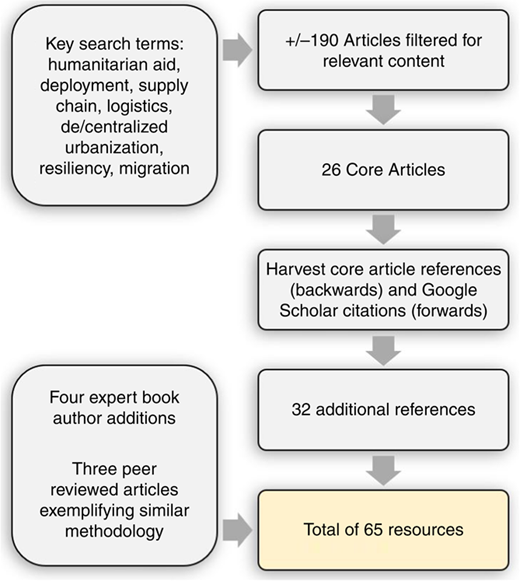
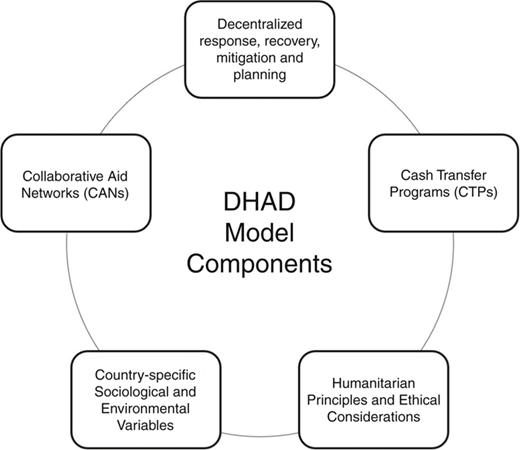
A focused, qualitative literature review of relevant work supports this study. The decision to pursue a qualitative framework supports the multisectoral nature of disaster management, many components of which commonly utilize qualitative analysis (Phillips, 1997). It is also common in the literature to use a focused review to establish a context to form the basis for a novel concept, a theoretical model, or future research (e.g. Cowan et al., 2005; Schober and Annis, 1996; Yilmaz and Youngreen, 2016). The direction of this research resembles a theory generated from the data, which, in this case, was derived from the focused literature review (Creswell and Creswell, 2018). The focused review built on itself by first reading approximately 190 abstracts and conclusions of potentially related articles. Articles that were deemed even “slightly relevant” or “likely relevant” were read completely for further assessment. Next, 26 core, peer-reviewed articles were retained for being significantly relevant to this topic. Finally, the 26 core articles expanded the list of citations in two ways. First, by using the core articles’ references to look backward in time for additional relevant sources and, second, by looking forward at articles that cited those core references. Three citations were added outside of this matrix to support the use of a focused literature review for this study. With four expert book author additions, this resulted in a total of 64 citations (see Figure 1). Since there was limited research directly addressing aid “deployment” (i.e. delivery), it became necessary to broaden the parameters to include some aid “distribution” models (i.e. resources already on the ground). The core literature was mostly responsible for creating the two parts of the central theme (see Purpose section) while also developing four supporting sub-themes. These supporting themes were not preconceived. Instead, they presented themselves as prevalent sub-topics within the 26 core articles. For example, a citation reviewing humanitarian logistic structures would reference the need to use collaborative aid networks (CANs) or cash transfer programs (CTPs) in the future. In this focused review, once more than two comprehensive study citations referenced a factor like this, it was evaluated for relevancy opposite the central theme. This thematic hierarchy ultimately defined the DHAD key components and the construct of this study (see Figure 2). Initial keyword searches included the words humanitarian, logistics, deployment, urbanization, supply chain, de/centralized and migration alternated in various Boolean arrangements but generally with the word humanitarian or the phrase humanitarian aid as the lead search term. Examples of databases accessed through the Georgetown University library included Academic Search Planner, ProQuest Central and Emerald Intelligence. Google Scholar was primarily used to dynamically investigate who cited core articles as each of them became part of the project.
4. Focused literature review/discussion
4.1 Decentralization
The humanitarian aid industry receives criticism for not supporting locally driven, long-term recovery, mitigation and future planning of the countries it seeks to help (Bealt and Mansouri, 2018; Kunz and Reiner, 2012; Winthrop, 2010; Fengler and Kharas, 2010). Sovereign nations under duress from a disaster must formally request help from the international community. “The process of consent cannot be retroactive but must precede humanitarian action” (Slim, 2015). The next step is the deployment of aid into that country. It is at this, often pressure-filled, juncture that the aid community must uphold the international humanitarian principles that govern their involvement. The literature will demonstrate that deploying aid into countries using one-dimensional foreign logistics models or frameworks based solely on cost efficiency (Anaya-Arenas et al., 2014) may represent a type of response to the immediate needs but fails to support the other three components to the disaster cycle: long-term recovery, mitigation and future planning. This lack of substantive planning all but ensures that when the next disaster strikes the same country, it will meet an equal or greater state of aid-dependent vulnerability. This study further posits that the current centralized aid deployment practices contribute to “disaster urbanization” that immediately translate into greater urban vulnerability while weakening rural sectors of the countrywide economy. While most of the research cited will lay the foundation for the overarching themes of this study, critical analysis of some citations will occur to the same end. This central theme has two complementary components as follows. Current centralized humanitarian aid deployment practices may encourage urbanization thereby weakening short and long-term resiliency of lower-income countries receiving aid. Introducing a new decentralized model would represent a sustainable aid deployment standard for that country’s specific response, recovery, mitigation and planning opportunities and constraints.
Aid deployment (and subsequent distribution) models that fail to account for specific socioeconomic and environmental factors of the impacted country have limited their chances for success before getting started. From the moment of deployment, foreign logistical supply chain templates do not look at local resources as an integral part of their effort. These models even boast of their country-agnostic capabilities which implies that any low-income population in need is incapable of meaningfully participating in their own recovery. Furthermore, if the model advocates for a single major point of resource distribution (like most do), this is considered only for its efficiency within the model itself and not if the creation of a single “resource magnet” will contribute to disaster migration within the country being served. For example, Anaya-Arenas et al. (2014) discuss in detail the location and network design drawbacks accompanied by considerable routing problems within current aid deployment models but fail to use the word “local” once. This symbolic omission is not a misstep on the researcher’s part but an accurate summation of foreign-based logistical aid models that lack meaningful incorporation of local assets in their processes. Anaya-Arenas et al. (2014) also demonstrate the absence of long-term resilience constructs or the effects of population stability in their review. Balcik et al. (2010) recommend two “low cost” distribution models both of which refer to a closed, foreign-only supply chain mechanism. This type of cut and paste, exclusive approach is a result of paternalistic mission statements that prevent locals from, at a minimum, sharing a lead role in their recovery. Jaller and Holguín-Veras (2012) advocate for the aid magnet model by praising the US National Response Plan “where at the top large flows of cargo are moved by a relatively small number of very large distributions centers.” The only reference in this study to locals is the assignment of blame for supply chain inefficiency. There is no mention of how any local population is expected to systematically participate in a foreign logistical framework but Jaller and Holguín-Veras (2012) ultimately concede that local engagement merits further exploration. Other comprehensive literature reviews find relatively little attention to supply chain management in the humanitarian context. “The field of supply chain management has been researched in depth by various studies, while its humanitarian aspects have been exhaustively discussed by only a handful of researchers” (Behl and Dutta, 2018). Other peer-reviewed works go as far as suggesting that current foreign aid frameworks should abandon any notion of contributing to long-term development and sustainability as they are currently doing more harm than good (Audet, 2015). “If emergency relief and development assistance still exist in two different operational realms today, it is because there are ever-growing obstacles to constructing a smooth and logical transition between their specific phases” (Audet, 2015). These barriers between phases of the disaster cycle ensure that local capacity revolves around an ongoing aid-based response phase with little hope of the impacted nation propelling itself into a more autonomous mitigation and planning opportunity.
The Sendai Framework for Disaster Risk Reduction 2015–2030 offers international guiding principles to improve resiliency through better risk awareness, planning and mitigation with an emphasis on the impacted nation taking a lead role in their response, recovery and rebuilding. “It is necessary to empower local authorities and local communities to reduce disaster risk, including through resources, incentives and decision-making responsibilities” (UNISDR, 2015). The Sendai Framework also calls for academic research of emerging disaster risks that emphasize regional and local applications (UNISDR, 2015). Winthrop (2010) suggests a common model or language is needed to drive both local and international aid with more resources focused on disaster preparedness. This position acknowledges the cyclical nature of disaster management and that any response model, for better or worse, is also a referendum on recovery, mitigation and planning. Fengler and Kharas (2010) discuss a coordinated decentralized effort and a need to move away from traditional aid frameworks that “have no inherent incentive to coordinate or share information. Their primary focus is to show tangible results for their specific investments in order to communicate back to their stakeholders.” Joaquin (2012) argued that decentralization could lead to the inequitable distribution of resources but this study is referencing the decentralization of NGO mandates and not how aid is deployed into a country. Joaquin (2012) supports the idea of multiple NGOs and outside organizations operating under a single sovereign governance that bases aid deployment on a country-specific framework as a means of unifying foreign response.
A chance for a better life, economic opportunity or safety fuels rapid urbanization. But this migration toward urban centers can put a sustained strain on existing physical and social infrastructure. The world population of 7.3bn is projected to be 9.7bn by 2050, with only nine countries (Ethiopia, Pakistan, India, Nigeria, the Democratic Republic of the Congo, United Republic of Tanzania, USA, Indonesia and Uganda) accounting for 50 percent of this increase (UN, 2015). If current wealth per capita trends remain constant, the world will be wealthier in 2050. But if this trend is unaltered, gaps in wealth will likely grow larger between the lower-income countries in Africa and Latin America and the higher-income countries, like the USA and in Europe (Kohlhase, 2013). Common vulnerabilities associated with the state of being poor include lower quality (less resilient) housing, lack of transportation options, more vulnerability to loss of employment after a disaster, and less ability to navigate post-disaster relief bureaucracies (Tierney, 2006). Whatever the subconstructs of vulnerability include, the overriding factor is poverty (Manyena et al., 2011). “The likelihood that natural hazards will turn disastrous is much greater in poorer countries. Low-income settlements are often the most vulnerable” (Julca, 2012). Heightened vulnerability to natural disasters and terrorism are among the more obvious effects of rapid or unplanned urbanization but losing strong connections to rural support sectors could be one of the most significant consequences for urban centers (Kohlhase, 2013). Decreasing a low-income country’s rural food production potential by encouraging disaster urbanization can mark the beginning of that country’s long-term dependency on foreign aid and assistance. The literature ubiquitously views disasters as tragic opportunities to improve the impacted area. Yet without opportunity to lead the recovery, mitigation, and planning phases, the local population will continue to live at subsistence or high poverty levels, justifying an ongoing response-centric silo of aid.
The 1980s found two scholarly articles that directly support the DHAD concept. Belcher and Bates (1983) analyzed the Guatemalan earthquake of 1976 and the impact of Hurricane David in the Dominican Republic of 1979. Their research showed plainly that countrywide socioeconomic factors played a vital role in the decision of a disaster migrant to become a permanent urban dweller regardless of whether the event had directly impacted that individual. “The almost inescapable conclusion must be drawn that the migration was produced by economic opportunity created by the earthquake and not by economic loss. In an underdeveloped, poor rural community, people often have little to lose in such an event. They are so poor already that a disaster makes little difference, except that it offers employment opportunity and sometimes opportunity to benefit from the aid which pours in from outside” (Belcher and Bates, 1983). This study defines “disaster migration” and concludes that central refugee centers prompted an influx of permanent disaster migrants to urban centers from rural areas. Next, several texts recognize Anderson (1985) as a landmark article about the need to improve the relationship between humanitarian aid and long-term development. With the visual aid of a Mobius strip representing the cyclical relationship between response, recovery and mitigation, Anderson (1985) asserted that seeing disasters as a failure of development is essential. Therefore, development was the process of improving resiliency opposite future disasters. “The challenge before us is to face the role that vulnerability plays and devise essentially new approaches to disaster relief and development that anticipate vulnerabilities before crises become disasters” (Anderson, 1985). Both Belcher and Bates (1983) and Anderson (1985) mark the beginning of a drought of scholarly contributions on this topic. In 2012, Kunz and Reiner conducted a literature review using both qualitative and quantitative methods and found that “there is a scarcity of research related to ongoing aid operations, slow-onset disasters and human-made catastrophes. Regarding the distribution of literature onto the phases of a disaster, it was concluded that very little attention is being paid to reconstruction.” This study provides support to the central theme and supporting sub-themes within this article by mentioning the need to analyze and include social and environmental factors related to the reconstruction phase.
Foreign aid deployment and distribution templates tend to be focused on their own supply chain efficiencies, failing to account for longer-term impacts, like disaster urbanization, within that specific country. Anaya-Arenas et al. (2014) reviewed several thousand articles, ultimately focusing on a few hundred articles centered around aid supply chains deployed immediately after disasters struck. This study concluded that monothematic aid models were “mainly static and seek to optimize a single objective (either cost minimization, covering maximization in distance or quantity or rapidity) and this, during a single period” (Anaya-Arenas et al., 2014). This same study found systemic flaws with areas chosen for resource staging after the disaster hot zone is determined. This is largely a result of considering logistical, environmental and economic opportunities and constraints under duress after a crisis has already occurred. Next, Parker and Maynard (2015) conducted a literature review and interviews with practitioners to assess area-based deployment of aid opposite the context of rapid urbanization. “The participatory, multi-sector nature of area-based approaches requires a skill set that may differ from traditional “delivery” focused humanitarian assistance; this requires further investigation” (Parker and Maynard, 2015). Two other relevant conclusions from this study strongly support the theory put forth by this paper. First, this research recommends the inclusion of local governments from the moment of deployment with transparency and accountability guiding the relationship. And second, the study proposes linking the deployment and distribution of all aid to existing regional planning policies (Parker and Maynard, 2015). Finally, the Inter-Agency Standing Committee (Inter-Agency Standing Committee (IASC), 2010) concluded that rapid urbanization and the reduction in rural populations demanded a “paradigm shift” in humanitarian aid models toward the use of local and community-based partnerships. They concluded that these partnerships delivered aid more efficiently and transparently while possessing “parallel responsibilities in development sectors to sustain relief investments in disaster risk management, early recovery, and reconstruction” (Inter-Agency Standing Committee (IASC), 2010). This is direct testimony to the untapped potential that the response phase has relative to recovery, mitigation and planning.
In the Haiti earthquake response of 2010, aid workers experienced the aid magnet phenomenon first hand. They could not distinguish the state of need between those directly impacted by the quake and those who were attracted from outlying areas to the centralized aid deployment near Port-au-Prince because of their existing high states of vulnerability (Durocher et al., 2016). This magnetic connection between centralized aid infusion and disaster migration needs to be presented as highly plausible. Since there is minimal, direct research on this supporting point, it will not be a goal to prove this explicitly. Durocher et al. (2016) also noted a concerted effort by foreign NGO’s to work in a vacuum and recommends replacing these highly reactive interventions with more deliberate and planned mechanisms. “Circumventing local structures may have led to greater short-term efficiency but participants, both Haitian and expatriate, saw this approach as a missed opportunity to reduce future vulnerabilities” (Durocher et al., 2016). NGOs made many promises after this disaster to improve local participation but the inequity created by a history of resource centralization was not supported by any change in their governing policies (Hsu and Schuller, 2019). “The presence of NGOs throughout history has reinforced centralization, it was particularly true after the post-quake influx” (Hsu and Schuller, 2019). Implementing a foreign supply chain on the fly during a crisis ensures that the initial response will not contribute to increased resiliency in the future. However, the criticism of the current centralized model does not necessarily extend to the UNOCHA cluster framework for aid sectors on the ground. This model promotes the clear coordination of 11 sectors like food security, shelter and protection. Cluster principles could be incorporated into the DHAD model by, for example, creating a network of smaller clusters instead of one or two massive ones. A countrywide network would coordinate as one but possess the agility to respond to the needs and opportunities at its specific location. The diversity and agility of this concept would discourage disaster migration and immediately support the recovery of all the impacted country’s economic sectors. This supports the concept of treating the whole patient that has suffered an injury instead of treating only the wound. Stumpenhorst et al. (2011) do criticize the UN cluster model for its lack of consideration for long-term recovery and a systemic need to improve communications among actors. “A long-term planning perspective needs to be included in the early planning of emergency relief efforts. NGOs need to convince their donors to agree to basket funding of relief activities and to assign at least part of the donations for long-term re-development rather than short-term aid” (Stumpenhorst et al., 2011). It is not warranted, however, to consider these criticisms intrinsic to the cluster mechanism but more of a statement about the larger aid ecosystem in which the cluster model resides.
The USA, a higher-income, modernized country, still has more than 95 percent of its land classified as rural but that vast area is home to only 19 percent of its population (Hales et al., 2014). A foundation of the decentralized approach to aid deployment into lower-income countries is the belief that cities (also defined as a concentration of resources) cannot survive without support from rural economic sectors like agriculture, mining, tourism and forestry (Hales et al., 2014). These lower-income, rural populations typically face physical isolation, limited economic diversity and high poverty rates (Hales et al., 2014). The vulnerability level of rural communities can directly affect countrywide or even global considerations like the extent of deforestation, and sediment and pollution levels in waterways. In Haiti, for example, a historically marginalized rural population unsustainably harvested all species of trees for cooking fuel which led to massive deforestation. By 2010, less than three percent of Haiti’s forest cover remained (DesRoches et al., 2011). Population stability is recognized as an essential component of a resilient society while rapid changes in population can adversely affect preparation and mitigation (Cutter et al., 2014). “A massive influx of population can overwhelm existing infrastructures” (Cutter et al., 2014). Cutter et al. (2014) also cite environmental variables, like agricultural resiliency, as a factor in regional recovery.
Aid camps lose 60 percent of IDP’s and 80 percent of refugees to the attraction from city centers (Park, 2016). Poorer countries, where the last 40 years have seen a 326 percent increase in their urban populations, will not be able to develop adequate buildings and infrastructure to adapt to the present rate of urbanization. Forecasts predict that by the year 2050 more than 70 percent of the global population will reside in urban areas (Park, 2016). More than a billion men, women and children occupy permanent slums worldwide. This growing population is “largely made up of people with low education and limited financial means. They therefore usually have no other option than to live in informal settlements, characterized by a lack of basic infrastructure and absence of services” (Duijsens, 2010). It is important to note that the low education reference by Duijsens (2010) is not synonymous with a lack of skills. Many of these people have rural skill sets, like farming or fishing, that do not readily transfer to an urban setting. Despite a general agreement that rapid and unplanned urbanization directly contributes to increased vulnerability, “there is little consensus or convergence within the humanitarian community on what constitutes clear best practice, in part because of the need to consider urban slums, peri-urban areas, degree of functioning governance and baseline economic profiles among other variables” (The Sphere Project, 2015). A critical connection to creating a best practice in this context lies with the creation of a new aid deployment model that puts the local population in maximum control of their recovery. “One key area that can help bridge the humanitarian development divide is greater engagement with municipal authorities. Moving beyond simply informing local governance actors of their plans, and getting consent, responders to humanitarian crises should, where possible, be striving to find more substantive ways to engage” (Earle, 2017). Bealt et al. (2016) determined that concentrated efforts to include local communities in the planning and implementation of aid deployment “will help save the lives of vulnerable populations post-disaster.” Holguín-Veras et al. (2012) determined that locals can exploit existing social networks to create efficient, locally managed deployment of aid that exceeds the performance of foreign models that must start from scratch under duress. Kunz and Reiner (2012) point to a glaring lack of research in the development or reconstruction phase while noting the need to incorporate local assets in future studies as a means to improve overall deployment and ultimately distribution potential. Manyena (2016) uses the Sendai Framework as a basis for their quantitative and qualitative research, concluding that local resources and local investment are the appropriate mechanisms to address disasters that are defined by both external and internal country factors. This position is common in the literature (Bealt et al., 2016; Holguín-Veras et al., 2012; Kunz and Reiner, 2012; Manyena, 2016) but that recurrent finding demonstrates the ongoing lack of connection in the field to local empowerment and to that first step that comes after a sovereign nation asks for help – deployment. A decentralized model (DHAD) of aid deployment answers the call for best practices by addressing all four components of the disaster cycle with local assets assuming a lead role in a national recovery.
4.2 Existing local networks
A single-minded mechanism whose sole interest is achieving efficiency in the deployment of goods without looking at the multisectoral implications, locally driven possibilities, or long-term suitability, is destined only to be relevant to the short-term response phase. Jaller and Holguín-Veras (2012) refer to locals in the sole context of “the impacts of manpower restrictions.” The term manpower carries with it a low level, rudimentary and non-decision making connotation. This study acknowledges that the Sphere Project standards suggest that distribution (implying deployment as well) may need to address the capacity and convenience of the impacted nation and not the convenience of logistics models (Jaller and Holguín-Veras, 2012). However, without the meaningful, top-level inclusion of local assets, it is difficult to see how the convenience of logistics models is not still the primary objective. The study by de la Torre et al. (2012) interviewed 32 representatives from NGOs and reviewed relevant literature, but still largely saw local resources as a limitation. “Monitoring a population to understand its needs and developing relationships with local leaders to ensure orderly and fair distribution takes significant resources” (de la Torre et al., 2012). However, the same study did recognize a need for more flexible and agile aid delivery and deployment mechanisms. Balcik et al. (2010) conducted a literature review of commercial supply chain management and humanitarian supply chain management to see what crossover concepts and frameworks were applicable. Here again, aid actors attempt to take logistical concepts that work well in a vacuum, or another country, and try to apply them to an unknown disaster setting. The results from Balcik et al. (2010) do not recommend a framework that seeks to engage or empower local residents while the phrase “collaborative procurement” in this study refers to collaboration exclusively among NGOs. Bealt et al. (2016) conducted a qualitative and quantitative methodological study including a comprehensive literature review and an online survey. The goal was to uncover barriers to better cooperation between humanitarian operations and local assets. The findings revealed that, while the top-level decision making of aid delivery excludes local participants, the key to saving more lives in the future is improved relationships between foreign aid operations and local service providers (Bealt et al., 2016). Notable in Bealt et al. (2016) is that the majority of tasks (over 80 percent) asked of local service providers were labor, transport or other rudimentary or repetitive work. Research conducted by Holguín-Veras et al. (2012) concluded that aid operation inefficiencies were attributable to a lack of connectivity with the local logistic networks. “Integration with a local network enables the foreign relief group to take advantage of the local knowhow and the human and technical resources of the local partner, as well as the legitimacy that the local network may have with the population” (Holguín-Veras et al., 2012). These local CANs could mobilize their forces in a fraction of the time it would take to essentially build it from scratch (Holguín-Veras et al., 2012). “The local capacity principle combines the autonomy and self-determination of political ethics with the principle of grassroots effectiveness and sustainability in community development ethics” (Slim, 2015). Bealt and Mansouri (2018) conducted a systematic literature review and found that impacted communities are able to quickly form ad hoc CANs whose logistical capabilities outperform humanitarian organizations. “Highlighting these collaborative partnerships draws attention to the wealth of knowledge and the vast pool of skills already in existence within communities, and the breadth of resources that could be harnessed through collaborative partnerships between CANs and the humanitarian community” (Bealt and Mansouri, 2018). This is a common foundation between CANs and the proposed DHAD model, and why the existing CAN mechanism strongly supports the potential of the DHAD concept. Based on these findings, the first sub-theme of this study has revealed itself: CANs directly support DHAD. These existing networks embody the local potential that the DHAD model advocates for nationally. CANs are the potential that FEMA’s “whole-community” promotes in the USA disaster management best practices. Encouraging a local matrix to take a lead role is a declaration that the impacted city or region can do more than provide “manpower.” The DHAD model is an aggregation of all those voices saying that, as a country, we can do more to participate in our own recovery.
4.3 Cash supporting sovereignty
While there has been a recent surge in the popularity of CTPs, the concept has existed since the late nineteenth century. The realization, then and now, is that CTPs allow individuals in need to participate in their own recovery and immediately reduce their vulnerability while stimulating the local economy. Today, however, there is more proof that it works as part of the modern aid ecosystem. “Evidence is mounting that CTPs can address the multi-dimensional causes of poverty and vulnerability in a cost-effective way” (Thompson, 2014). CTPs align aid with what people need at that moment instead of what NGOs are mandated and equipped to dispense. “Local markets have responded to cash injections without causing inflation and it has generated positive impacts on local economies. With the growth of digital payments systems, cash can be delivered in increasingly affordable, secure and transparent ways” (ODI, 2015). Therefore, this second sub-theme posits that CTPs directly support DHAD. The CTP mechanism encourages every donor dollar to not only be in response to an immediate need but also a step toward recovery and longer-term resiliency. If current aid practices are analogous to a foreign, external life support machine for a patient that is presumed dead without it, then CTPs are an alternative system that allows the patient’s own body to heal itself with some localized help. In theory, this results in more long-term resiliency for the impacted population and directly aligns with the principles of DHAD.
The protracted Syrian war has seen more than 500,000 lives lost and is presently responsible for over 6.2m IDPs (ACAPS, 2018). This has been one of the most successful CTP settings in recent years (CaLP, 2018; ICRC, 2017; UNHCR, 2017). CTPs can be used in preparation, response, recovery and mitigation phases while emphasizing localization. These cash transfers are agile and cut across several need sectors in real time (ICRC, 2017). In Jordan in 2016, improved monitoring and evaluation revealed that 64 percent of Syrian refugees felt that CTPs had a positive effect on their well-being and recovery (UNHCR, 2017). “The substantial benefits associated with using cash include: driving efficiencies and innovation in the delivery of aid, increasing the effective use of limited aid dollars in achieving outcomes, enhancing the dignity and choice of beneficiaries, improving the traceability of how aid funds are used and stimulating crisis-struck economies from the bottom up” (CaLP, 2018). In 2016, the Grand Bargain, a set of international donor guidelines, noted the efficacy of cash in empowering the impacted population while stating that this mechanism is underutilized (IOM, 2016). Another international set of standards for donors, Good Humanitarian Donorship (GHD), calls for the immediate and more widespread consideration of CTPs. Its latest guiding principle, listed as a modality of humanitarian assistance, asks donors to “systematically consider the use of cash transfers alongside other modalities according to context, in order to meet the humanitarian needs of people in the most effective and efficient manner” (GHD, 2016). Like CANs, CTPs promote multisectoral and locally empowered recovery, and both could become more potent under the umbrella of a country-specific, decentralized, deployment foundation like the DHAD model. DHAD would take the momentum from these programs and ensure that locally driven response and short-term recovery translates efficiently into long-term recovery, mitigation and planning. This would quiet criticism that accompanies traditional, centralized aid camps that are said to be good for the repeat business of aid while turning a blind eye toward future resilience and autonomy (Slim, 2015). Within the DHAD model, a CTP donor dollar for response would also be a dollar toward future resiliency.
4.4 Country-specific variability
Lower-income countries need to remake disaster response in their own image. Each vulnerable nation in Africa, for example, has different needs and quantifying those country-specific variables is a crucial step in replacing foreign response templates with a response plan native to that sovereign nation. “African countries need to invest in research to develop an enhanced understanding on the concepts involved in “disaster,” including the meanings of terminologies such as risk, vulnerability, and resilience that are consistent with African languages, traditions, and cultures” (Manyena, 2016). A means to measure the specific vulnerabilities of an area is available in the form of vulnerability indexes (Frazier et al., 2013). “Recognizing the uneven distribution of socioeconomic factors and how they intersect with physical hazards is important for effective community-level hazard mitigation and efficient allocation of limited resources” (Frazier et al., 2013). These first two literary contributions help define the third sub-theme as socioeconomic and environmental variables should form DHAD criteria. Rashid (2018) developed a multiple-criteria, weighted model to analyze migration within Malaysia’s Klang Valley Region. Understanding the many factors or tipping points that makes up migration decision selectivity is a key to understanding which areas are likely to lose or gain people in the future (Rashid, 2018). This study utilized GIS modeling tools to layer the data from seven variables and produce zones on a map with high to low migration potential. These variables included affordable housing areas, new residential areas, areas with an acceptable cost of living, areas which are near a place of work, areas with good physical and environmental features, areas with good social and community living, and areas with good housing potential. While this index may not be directly transferable to a DHAD country-specific model, the process is similar to how DHAD criteria could produce a network of decentralized but socially and environmentally sustainable aid deployment sites across a country. Ideally, this planning mechanism features local stakeholders at the helm. Next, Cetinkaya et al. (2016) examined an area along the Turkish border to determine the highest suitability to locate Syrian refugee camps. The 19 weighted variables from this study had four main criteria categories as follows: geographical (e.g. proximity to wind), risk related (e.g. earthquake), infrastructure (e.g. proximity to a roadway) and social criteria (e.g. proximity to local population). “Finding a suitable site for a refugee camp requires a multi-criteria approach and high levels of accuracy and reliability in the resulting maps, in order to be relevant for decision making and the design of humanitarian plans” (Cetinkaya et al., 2016). There is little doubt that this level of analysis and synthesis would improve current aid deployment practices and set them up for long-term success after addressing immediate response needs. Therefore, it is critical that these types of vulnerability indexes guide DHAD implementation. From these studies, an example of the DHAD criteria can begin to take shape (see Figure 3).
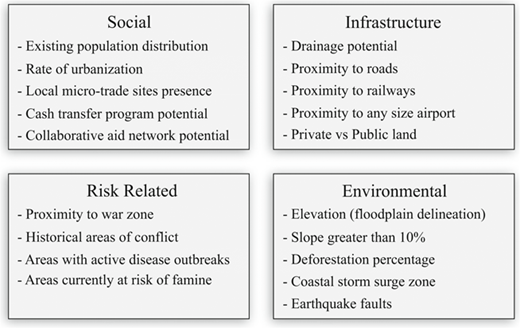
Preliminary, non-specific country example of sub-indexes and variables for DHAD criteria
Preliminary, non-specific country example of sub-indexes and variables for DHAD criteria
Two decades ago, Morrow (1999) noted that “emergency planners, policy-makers and responding organisations are encouraged to identify and locate high-risk sectors on Community Vulnerability Maps” (Morrow, 1999). This type of planning tool defines itself as one of the ways that $1 spent in the planning phase of the disaster cycle can save $6 in response (NIBS, 2018). There are two other vital findings from Morrow (1999) relevant to DHAD implementation. First, identification of pre-disaster vulnerabilities in a population is not synonymous with helplessness or lack of agency. And second, planners who “make full use” of local residents will increase the chances of that community’s survival (Morrow, 1999). This infers that the greater good, or highest short and long-term survival rate, can be supported by this type of pre-disaster community vulnerability mapping. Cutter et al. (2010) identified five components of disaster resilience applicable to weighted evaluation and geospatial analysis. These include social resilience, economic resilience, institutional resilience, infrastructure resilience and community capital (Cutter et al., 2010). “One approach to developing spatial indexes for vulnerability and risk with GIS is based on a site selection technique. This is the idea of answering a question by overlaying and comparing a variety of spatial variables to create a final index score or match site selection criteria” (Tomaszewski, 2014). This kind of resilience mapping based on a variety of environmental and non-environmental factors in a lower-income country has the potential to move DHAD from conceptual to actionable in any phase of the disaster cycle. Identifying multiple locations in a country suitable for aid deployment based on country-specific, weighted variables is a gateway to more sustainable aid deployment. Analysis of a country might produce 20 viable sites within that nation’s aid deployment network. If a disaster heavily impacts four of those locations, then a network of 16 sites remain to band together, receive aid and attempt to heal as one body – as a nation. Once the disaster has passed and the long-term recovery phase has begun, the same mapping interface can be used to rebuild more sustainably – avoiding things like earthquake fault lines and floodplains when rebuilding roads, schools or hospitals. No matter the pace or level of rebuilding that a lower-income country can afford, a disaster can lead to greater resiliency with a national vulnerability DHAD map guiding the next steps.
4.5 The ethics of deployment
Thinking of a lower-income nation in distress as a sovereign entity is a key tenet of this final sub-theme and, indeed, of this study. No matter level of income, a sovereign nation must be regarded as having the capability of taking an active role in their disaster management cycle. A natural reaction to seeing someone in obvious need (e.g. a person in a wheelchair blocked by fallen debris) is to unquestioningly rally support and jump in (Manley and Kim, 2012). A decent and timely response by the international aid community still guides our global hearts in the direction of the greatest need. That said, deployment, in any capacity, into a sovereign nation requires more guidance than our hearts can give. We must look at historical international guidelines and ethical considerations to consistently and equitably govern the global response to crises. This leads us to the last sub-theme: international guidelines and ethical considerations must form the basis for aid deployment into any nation. The four international humanitarian guiding principles contribute to the foundation that legitimizes the DHAD process. Two of these principles (humanity and impartiality) are most relevant to this discussion. In part, humanity states that “the purpose of humanitarian action is to protect life and health” while impartiality asserts that “humanitarian action must be carried out on the basis of need alone” (UNOCHA, 2012). This paper submits that both of these principles were not intended for consumption within 30 days of a disaster but that there is no dimension of time that qualifies their intent. In 1991, a UN resolution proclaimed that “disaster-prone countries should develop special emergency procedures to expedite the rapid procurement and deployment of equipment and relief supplies” (UN, 1991). This 28-year-old sentence is the embodiment of the DHAD framework where all countries take a lead role in planning for the next disaster. No matter the present state of vulnerability, this type of planning overlay can increase the state of readiness and resiliency of any group (Manley and Kim, 2012; Cutter et al., 2010). The international Red Cross Code of Conduct supports this idea of intrinsic capabilities within a vulnerable population. “The ICRC recognizes that disaster management is only successful when the recipients are fully involved in the design, management, and implementation of aid programs” (Geale, 2012). A request to enter a sovereign nation symbolizes respect for the unique cultural capabilities, social mores and habits of all impacted communities. “The process of consent cannot be retroactive but must precede humanitarian action” (Slim, 2015). This is the moment – and not a moment later – when an impacted nation must set forth its guidelines for receiving aid that contains its unique and indigenous vision for deployment, distribution and long-term development. Without this dictum, the aid community will continue to follow its heart toward a response-centric and centralized deployment driven by foreign logistics models.
The Grand Bargain’s donor guidelines outlined in 2016 acknowledged “that faced with the reality of our woefully under resourced humanitarian response, the status quo is no longer an option. This requires us to innovate, collaborate and adapt mind-sets” (IOM, 2016). The second tenet of this document specifically calls for more support of locally driven programs and this theme is reiterated consistently throughout the Grand Bargain. The GHD guidelines also emphasize strengthening the impacted nation’s role through local planning, mitigation and response (GHD, 2016). One suggestion for achieving this is through the reduction in donor earmarks, allowing for greater flexibility based on the needs on the ground as determined by local stakeholders. As it relates to urbanization, the ninth principle of the GHD states that humanitarian aid must be “supportive of recovery and long-term development, striving to ensure support, where appropriate, to the maintenance and return of sustainable livelihoods and transitions from humanitarian relief to recovery and development activities” (GHD, 2016). This direct connection between response, recovery, mitigation and then future planning activities is at the core of the DHAD construct.
A logistics model that met with success in another, likely higher-income, country does not automatically qualify it for use delivering disaster aid. Revisiting the historical basis of humanitarian ethics is a critical mirror to hold up to new or existing aid deployment frameworks. A disaster that strikes a sovereign nation impacts that entire nation – not merely where one can observe fallen buildings, overturned boats or media portrayals of the dead. The principle of distributive justice offers that “preparedness should ensure that the benefits and burdens imposed on a population by an emergency and the need to cope with its effects are shared uniformly and fairly” (AHCA, n.d.). Planning activities intent on minimizing death and injury must consider the concept of distributive justice (AHCA, n.d.). How will rural populations be affected by an earthquake at a city center 100 miles away? What capabilities do these rural populations have and how can they help without increasing their current state of vulnerability? The fair deployment of foreign aid dictates that goods and services provided are sustainable once the aid worker goes home. Medical treatments, for example, that are not locally available may help a single patient during a crisis but should be used judiciously as they may ostracize local responders and scuttle long-term community resiliency (Asgary and Junck, 2013). This adds a layer of complexity to that heartfelt, assumptive-based aid reaction (helping that person in a wheelchair) discussed earlier. Professional training may have instilled a sense of duty to a responder that interprets the Do No Harm principle as treating and reducing harm in the moment by any means. This, however, generally results in a reduction to the overall benefit (AHCA, n.d.). Therefore the principle of utilitarianism is arguably a more suitable ethical foundation for the humanitarian disaster cycle. This principle claims “that the ultimate good is always the greatest happiness of the greatest number of sentient beings, whereby everyone, including the moral agent, counts for one unit and no one counts for more than one” (Zack, 2006).
Medical doctor and professor of international health, Hans Rosling, labeled this paradox of serving the greater, long-term good as the cruel calculus that accompanies poverty (Rosling et al., 2018). When faced with the choice of treating only those children who came to a central hospital in Mozambique or going out into more remote areas to train local health workers in basic community healthcare, Rosling knew he could do more good by teaching locals about how to treat diarrhea, pneumonia or malaria before they became lethal. He surmised that by staying in the central hospital, he was making less than two percent of the impact he could have elsewhere (Rosling et al., 2018). This might mean that without Rosling on-call in the hospital, a baby at that facility would die that he could have saved. “It felt almost inhuman to look away from an individual dying child in front of me and towards hundreds of anonymous dying children I could not see” explains Rosling et al. (2018). But the principle of utilitarianism allows one to look at all the babies in that region that would die today, tomorrow and next year (Geale, 2012). Rosling concluded that empowering locals would save more lives over time. The IFRC Code of Conduct (1994) supports the criteria for aggregate benefit over time. “All relief actions affect the prospects for long-term development, either in a positive or a negative fashion” (IFRC, 1994). Strictly interpreted, this notion supports the DHAD tenet that a single bag of rice, a bottle of water or medication delivered today must be part of a long-term, country-specific vision that provides the greatest good to the greatest number of people.
While utilitarianism influence on humanitarian ethics is subjective, guiding documents like the Sendai Framework, international donor guidelines and the IFRC Code of Conduct appear to support this governing ideal. In practice, however, aid actors must embrace some ethical foundation that leads to an agreed upon state in which it is acceptable to leave the impacted population. The current top-down aid deployment framework receives criticism for being “the kind of aid that tends to be delivered paternalistically and soon sees people back in their original state of powerlessness, vulnerability and risk” (Slim, 2015). John Rawls argued that equality takes place fairly as long as those who are not as well off, are not left in a state that is worse than before the disaster struck. “Rawls does not believe that government need make provision for equality of distribution, provided that any new set of rules or institutions does not leave those who are less well off worse off than they were before” (Zack, 2006). Arguably, the current aid deployment and distribution models are using Rawls as their guide. By not emphasizing – indeed championing – the planning, mitigation and long-term components of the disaster cycle, these contemporary aid frameworks are turning away from utilitarianism. John Locke and Thomas Hobbes discussed the state of nature ad infinitum. Both philosophers “implied that even if there never were a state of nature in human history, positing it afforded political theorists an idea of human life without government, to which human life with government could be compared and justified” (Zack, 2006). Similarly, international aid deployment could be compared and justified by imagining its absence. Envision a disaster, like the Haiti earthquake in 2010, with no international response. Moving beyond our heartfelt indignation at this idea, how would that sovereign nation have faired? To what extent would disaster urbanization have occurred with no external influence? How many post-earthquake deaths? This idea of ignoring post-disaster human suffering is unacceptable other than to consider the opposing sides of Rawls’ acceptable state of nature and utilitarianism that tends to look at the impact of a disaster over time to determine the greatest good. Today’s vernacular summarizes this as the difference between just bouncing back and the idea of bouncing forward. “The notion of bounce forward is to see disaster as an opportunity for local livelihood enhancement rather than as a simple return to status quo ante” (Manyena et al., 2011). After a disaster, the immediate activity may appear closer to just returning to a pre-disaster state – whatever that might have been. However, this paper posits that bouncing forward and serving the greatest good over time must be the prevailing mandate at the moment of deployment until the last foreign aid worker leaves. C.S. Lewis called this the ethics of first and second things whereby he described that one could not arrive at second things if they take place first. “Violating the nature of first and second things has consequences ethical in nature” (Veil et al., 2013). Applied here, this means that a choice of partial good (focusing predominantly on those with immediate needs) over that of the total good (including long-term sustainability) will result in the loss of the partial good anyway. All aid must contribute to future resiliency lest the aid community own the perception of purposefully creating future business for itself. The DHAD ethical foundation supports the greater good through local empowerment and recognizes that this might be at the peril of a single child. While this utilitarianism-based framework carries that cruel calculus, over time, it responds better to the ultimate mandate of saving more lives.
5. Conclusion
This focused qualitative literature review uses gaps and corroboration within the literature on the specific topic of aid deployment into a sovereign nation to demonstrate plausible culpability that current centralized humanitarian aid deployment models have in contributing to disaster urbanization while not supporting locally empowered recovery. Next, the literature has shown that the concept of DHAD could meaningfully contribute to all four components of the disaster cycle and not a one-dimensional focus on response. Four DHAD sub-themes support this central premise. Existing, local deployment and distribution matrices, known as CANs, connect their potency to the sustainable deployment framework of DHAD. Similarly, CTPs identify themselves as another existing component that would directly invigorate and complement the use of DHAD. A foundation to create a weighted index takes shape using relevant literature and provides a practical segue to employ the DHAD concept outside of academia. The intent is to take the first step toward a deployment model that can be visualized and acted upon in the shortest possible timeline. Finally, international humanitarian principles, donor guidelines and historical, ethical foundations were discussed to elucidate the context and responsibilities inherent in entering a sovereign nation with aid. This helped establish the reasoning behind why principled aid delivery starts, not upon arrival, but with the decision of how to deploy responsibly. These ethical considerations also demonstrate that the aid community has a more significant contribution to make to those in need than delivering an efficient logistical response.
6. Future research
While the literature has shown support of the DHAD componentry, the increase in frequency and intensity of disasters due to climate change (UNISDR, 2015) does not contribute to the DHAD rational in this initial study. The assumption is that climate change force multipliers will further justify the DHAD construct. This is a potential area of future research. The second area for future research, currently underway, is a case study for a lower-income country that further refines the DHAD approach. This will include a multi-layered, GIS analysis that incorporates some or all of the socioeconomic and environmental variables suggested herein. A country-specific, actionable plan that, regardless of the inconsistencies or pace of funding, can guide locally empowered risk reduction and sustainable development is the goal. The first implementation partner may be an entity like the United Nations Development Assistance Framework who could help turn the approval of aid deployment in a sovereign nation into more than a rubber-stamped formality. This is the moment when a DHAD aid deployment policy could shape how aid addresses that nation’s vulnerabilities today, tomorrow and in ten years.
The authors would like to acknowledge the Georgetown University Master’s Program in Emergency and Disaster Management for the support of this paper and related ongoing research. The authors would also like to thank the two anonymous reviewers for providing time and feedback which resulted in a better final product.
Glossary
- CAN
collaborative aid network
- CTP
cash transfer program
- DHAD
decentralized humanitarian aid deployment
- FEMA
federal emergency management agency
- GHD
good humanitarian donorship
- GIS
geographic information systems
- IASC
inter-agency standing committee
- IDP
internally displaced person
- ICRC
international committee of the red cross
- IFRC
international federation of red cross and red crescent societies
- NGO
non-governmental organization
- UNDAF
united nations development assistance framework
- UNFCCC
united nations framework convention on climate change
- UNOCHA
united nations office for the coordination of humanitarian affairs

