


As humanitarian logistics (HL) functions in complicated, changing and ambiguous situations, all people, particularly the educated youth, have to know how to control the situation and assist victims, which are best achieved through formal education and training. Teaching at university has been extensively used in the context of business logistics. However, education in HL is a poorly researched field and, consequently, this article explores education for sustainable development in HL. The study addresses the following research question: How the teaching of HL at university can help to increase HL performance (HLP) and to reduce suffering.
A covariance-based structure equation modeling (CB-SEM) is implemented on the basis of confirmatory factor analysis.
The results show that the association between the explanatory variables and the dependent variable (HLP) is mediated by sustainability, and that the teaching of HL at university plays a vital role in enhancing HLP and is therefore a very suitable approach for sustainable development in HL. This direct approach is creative, informative and productive practice for both students and teachers.
In spite of the growing number of activities and courses in supply chain and logistics education, no study, to the best of our knowledge, has empirically analyzed the critical topic of whether or not education can bring sustainable development in HL. In order to save lives and reduce the suffering of victims, this study attempts to fill this gap.
1. Introduction
Due to the increasing intensity and frequency of both natural and manmade disasters, the consequent human suffering has increased. In the last few years, around 20 million people in emerging countries have been affected by climate-related hazards (Maikhuri et al., 2017; Anparasan and Lejeune, 2017; Khan et al., 2019c). Between 1998 and 2017 natural disasters killed almost 1.3 million people, affected more than 4.4 billion and economic losses occurred about 2,908bn US$ (Wallemacq, 2018a). Fortunately, in 2017 the effect of natural disasters was considerably lower than the last 10 years average. Anyhow, in term of assets lost it is the second most costly year in the last 10 years, the first one is the year of 2011 (Wallemacq, 2018b). In addition, in 2018 worldwide, the recorded disaster events were 315, casualties occurred 11,804 deaths, affected more than 68 million persons whereas assets losses were almost 131.7bn US$. In addition, the most affected region was Asia continent (CRED CFROTEOD, 2019). Similarly, in 2019 around the world, there were 396 natural disasters occurred, killed around 11,755 people, affected 95 million, and while assets losses in total around 130bn US$. It shows that the number of disasters in 2019 was greater than the average of the last 10 years as were 343 disaster events recorded in The Emergency Events Database (EM-DAT). On the basis of region, Asia was the most affected continent with 40% of all disaster occurrence, accounting for 45% of the total casualties and other 74% of the population affected by disasters worldwide in 2019 (CRED CFROTEOD, 2020). Moreover, from 1970 to 2010, around 980,000 casualties occurred in South Asia and more than that were seriously affected, while assets losses totaled almost 105bn US$. A total of 1,333 major disasters were recorded (Ahmed, 2013; Khan et al., 2019c).
In South Asia, Pakistan frequently faces both natural and manmade disasters, with both sudden and slow onset. Since its independence, except wars with the neighbor country India, Pakistan was the main ally in the war against extremism led by the United States, the country lost around 50 million civilians and approximately six million security force persons. In 2013, 5,379, in 2014, 5,496, in 2015, 3,682, in 2016, 1830, and in 2017, 924 individuals were martyred in Pakistan in radical attacks (Gillani et al., 2020). On the other hand, the impact of natural disasters on Pakistan can be determined from the fact that from 1993 to 2002 around 6,037 and 8,989,631 people were killed and affected, respectively (Khan, 2007). Haris et al. (2019) pointed out that between 2000 and 2018 Pakistan was placed in the 4th position on the list of countries to lose 73,338 persons consequently of 15 earthquake disasters. From 2010 flooding, Pakistan lost almost 5.8% of GDP, while affecting 20 million individuals (Cheema et al., 2016). Similarly, from 2010, floods have occurred every year in Pakistan killed 1,229 people only in June 2015 (Debarati et al., 2016). Furthermore, Pakistan has different climatic zones ranging from the mountains to the desert along with the Arabian Sea. Therefore, between 1971 and 2001 the coastal areas of Pakistan were hit by 14 cyclones. Besides, most of the country's land area is frequently subject to monsoon rains, humidity storms, cloudburst storms, heatwaves and drought. Along with flooding, the country is located on an 850-km-long geological fault line, which has caused many earthquakes from 1935 to 2015 (Cheema et al., 2016; Khan et al., 2020b) whereas around 280 people died from October earthquake in 2015 and affected more than 1.5 million Pakistanis (Debarati et al., 2016).
The magnitude and frequency of disaster affects can be different among victims, depending on people's financial position, aid they receive and education of the people in the area affected (Sawada and Takasaki, 2017). Natural and man-made disasters place extreme pressure on the governmental and nongovernmental organizations to provide relief aid. Growing disaster damages need countries to manage the losses more efficiently and proactively (Raschky and Chantarat, 2020). Therefore, humanitarian logistics (HL) is one of the main activities following a disaster and plays a central part in the success of disaster relief operation (DRO). However, humanitarian organizations (HOs) have not yet recognized or defined this reality (Bealt et al., 2016). Furthermore, HOs do not retain an appropriate number of expert staff members in their teams and also do not provide appropriate HL training (Bealt et al., 2016). This shows that HL maintains the lowest position within HOs, despite being a process that can lead to the success or failure of DRO (Khan et al., 2019a, b, c, 2020a; Nurmala et al., 2017a). The contribution and cost of logistics amount to almost 80% of the DRO (Thomas, 2003).
Correct and clear information of the disaster-prone area and knowledge transfer is the key to HL performance (HLP) (Behl and Dutta, 2020), but it can be lost due to staff changes within any organization (Dubey et al., 2016). Besides, numerous logisticians are not proficient in logistics and often are volunteers who want to help afflicts and generally they have no professional HL education. Employee turnover (Dubey et al., 2016) and lack of professional logisticians can hinder the HL processes; nevertheless the affected need instant help. This unfortunate industry of disaster creates risk and opportunity for people, especially young people aged from 20 to 35 years. Given this reality, it is particularly significant for teachers to make sure that the present generation of students graduate with skills that can prepare them to support the victims of the disaster, along with the ability to be flexible and practical. Therefore, the preferred way is that the youth should have elementary information of HL in order to start work in the relief operation at the disaster site. Whereas learning through courses plays a significant role in changing one's viewpoint or attitude (Chen and Ho, 2020). Similarly, the teaching of HL can enhance HLP by involving educated volunteers in the disaster prone area (Goffnett et al., 2013). Therefore, it can be argued that the teaching of HL can prepare students to become professional in the field because professional logisticians are rare, especially in the case of Pakistan and other developing countries.
The HL literature broadly conceptualizes the education/training of HL in multiple ways. Stuns and Heaslip (2019) explored the effectiveness of HL training for the Red Cross Emergency Response Unit using quantitative data collected in a field survey. More importantly, Lu et al. (2013) explained four learning mechanisms theoretically. In addition, Bölsche et al. (2013) presented invaluable insights of education and skill in HL on multiple levels on the basis of European education framework. Similarly, Lu et al. (2013) focused on disaster preparedness education of medical students. Furthermore, Khan et al. (2020b) used a theoretical model for the teaching of HL at university, to explain the importance of an HL course for students and teachers; however, this study did not prove it statistically. As mentioned, in the literature, professional HL education is lacking in the current educational system of Pakistan. Therefore, the teaching of HL is being realized. Anyhow, to fill this gap, the present study expands on the foundation developed by Khan et al. (2020b) to ensure that HL curricula at university can help to save lives, reduce human suffering and bring sustainable development by overcoming the problem of lack of expert logisticians and high employee turnover through volunteers and professional humanitarian logisticians as produced by universities.
As discussed, the effect of education on HLP has hence remained unexplored statistically. Henceforth, this study attempts to make a small contribution to fill the above mentioned gap by focusing on the teaching of HL at university. The study has three primary objectives: (1) to statistically investigate the mutual relationships among the variables of the model proposed, (2) to enhance our understanding about HL and to promote HL knowledge in society, particularly among universities students and (3) to advance learning concerning HL for sustainable development and helping the victims. More specifically, the study addresses the following research question: How the teaching of HL in universities can help to enhance HLP to save lives. To attain the study objectives, this research implements CB-SEM on the basis of CFA through the SmartPLS package.
This study framework indicates that HLP occurs through sustainable learning of HL, which in turn occurs through the proposed variables of the teaching of HL at university. The important contributions of the article are as follows. Along with the provision of HL education for sustainable DRO, the article provides an opportunity to train students through the important skills and capabilities to become active logisticians in the unfortunately growing industry of disaster as characterized by an environment of uncertainty, complexity and urgency. Students can gain exposure to HL concepts and the knowledge of how to be effective logisticians. In addition, the primary rationale for the teaching of HL at university is to assist afflicts through educated youth as they have an understanding of HLP and also to increase students' employability to work with HOs and the National and Local Disaster Management Authority of Pakistan. The findings of this article will contribute to the discussion around the complex and challenging issue of teaching HL at university, which will increase not only research and development (R&D) opportunities but also help in skills, career building and information sharing that can further enhance HLP through sustainable learning. The results have theoretical contributions for HL and pave the way for further advances in relief operation. Research gaps are identified, and recommendations are given for further studies to enhance HLP.
The study is organized as follows. Part 2 discusses the theoretical model and hypotheses development. Part 3 describes the study methodology. Part 4 indicates the analysis and findings of the research. Part 5 discusses the contributions and limitations of the study followed by the research conclusion.
2. Theoretical model and hypotheses development
A possible way to overcome the huge gap between short-term relief and sustainable development is to start the teaching of HL. HL activities encompass procurement, carriage, tracking, custom approval, warehousing and last mile distribution (Thomas, 2003). The in-country operation includes the basic logistics activities ranging from procurement at the disaster start point to the last mile distribution of relief items, covering all logistics activities in the country affected (Lu et al., 2013). There must be balance between speed, accuracy and cost with regard to the goods, type, quantity and delivery following a disaster (Van Wassenhove, 2006). Currently HL is not attracting full training concentration even though it can cause the success or failure of any DRO. Some HOs wish to train and educate their employees but they do not know where and how to do it. Besides, in the absence of the teaching of HL, educated youth participate in the relief distribution without any proper understanding (Bölsche et al., 2013). Therefore, more planning regarding the transparent distribution of relief items, logistics skills development, in-kind relief items, etc. is needed.
Sustainability is perceived based on cultural, economic and environmental factors (Kuhlman and Farrington, 2010). The UN 2030 Agenda for sustainability aimed to take action in the area which is critically important for humans. Leaders around the world agreed on this strategy to utilize the resources and to improve the world. In this regard, education is therefore recognized as the central activity for sustainable development, which is also discussed in the UNESCO educational conference. Furthermore, sustainable growth in HL requires the societies' transformation, where educational activity can be perceived as a theme of the transformation and is a vital driving force. For effective and sustainable HL, it is the responsibility of everyone to gain the important knowledge regarding HL, where they can advance their capabilities, creativities, self-reliance and ability to work as a team member. The required capability and self-reliance are imperative for logisticians. The role of proficiencies has been known in the context of higher education in supporting and empowering logisticians, where education is acknowledged as one of the key aspects of the change toward sustainability (Dlouhá and Pospíšilová, 2018).
The education of HL is a demanding task, as each relief response is different around the globe (Stuns and Heaslip, 2019). Therefore, humanitarian education is vital at university for sustainable operation at disaster sites. Proper experience and education in the humanitarian side can improve the search for a suitable response (Aguilar and Retamal, 2009). The teaching of HL aims to educate students and other stakeholders regarding HL. Teaching can provide up-to-date information with a focus on some specific issues and topics because the curricula can be easily updated (Ahmad et al., 2018). Along with volunteer work, HL students can publish research papers, where stakeholders of disaster can implement it for sustainable relief operations (Goffnett et al., 2013).
The foundation of the theoretical model of the present study is grounded on human capital theory (HCT). HCT was first presented by Becker (1962) and Rosen (1976) who found that the set of skills and capabilities embedded in individuals can be increased with education and training. Every worker accumulates human capital which should increase in the marketplace as they bring more effectiveness and expertise to their job tasks. A worker's market value should increase theoretically with the increase in his/her degree of training and education he/she receives. A worker's formal education degree or training certificate acts as a signal of his/her skills and productivity aside from his/her actual embedded human capital (Spence, 1978). In recent years, HCT has emerged as a powerful explanation of how education is applied effectively for sustainable development and to gain competitive advantage.
The HCT highlights the significance of formal education in different sectors. In addition, the concept of trainability based on HCT also suggests that a formal school or college graduate can learn from training quickly, as already adopted in manufacturing and development sectors. Simultaneously, an organization can provide training at cheaper cost and can educate its employees more easily because of the above properties (Tachibanaki, 2011). Educated and trained people can use machines and other modern resources skillfully. Also, their decision power increases and they can decide quickly when an uncertain situation arises or in the field or during work. Both education and training socialize people to function effectively and efficiently in society and economy because schooling and training motivate people to be cooperative and patient, and to take responsibility and roles in leadership, etc. This idea does not describe the economic value of education and training but emphasizes the mental and social well-being of an individual, which are likely to raise a group's productivity, especially in the case of HL. In other words, it is useful in modern society where team production is common, and concerned with an organizational explanation (Tachibanaki, 2011).
Bahr (2014) explored the potential differentiated returns across 23 educational fields and found positive returns for more technical and practical fields like engineering, construction and nursing, etc. and negative returns for more theoretical fields. Heaslip et al. (2018) found that the humanitarian settings tended to concentrate on the significance of education in terms of accomplishing their objectives efficiently and timely. Therefore, the subject of HL which will bring a positive return to its teaching in school and colleges. Bahr (2014) also concluded that some noncredentialed students had larger returns than credentialed students; the difference was due to the coursework taken by the student. Hence, it can be argued that HL education may help to bring sustainable development in humanitarian settings. In addition, any organization hiring and utilizing educated logisticians will enhance the sustainable development of the organization. Based on HCT, it can therefore be argued that R&D, skill building, career building and information sharing playing significant roles in bringing sustainability in humanitarian setting and can further enhance HLP.
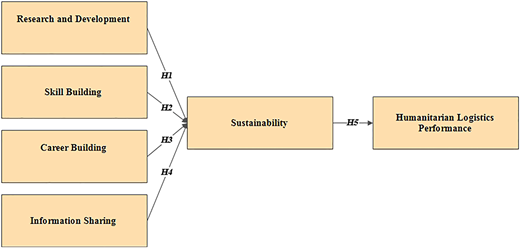
In view of the specific features stated above, six variables (Karunasena and Amaratunga, 2016; Abidi et al., 2015; Bölsche et al., 2013; Khan et al., 2020b) should be measured as playing an important role in education for sustainable development in HL (Figure 1): research and development (R&D) (Karunasena and Amaratunga, 2016), career building (Rapado-Castro et al., 2015; Raabe et al., 2007), skill building (Karunasena and Amaratunga, 2016; Dlouhá and Pospíšilová, 2018), information sharing (Abidi et al., 2015), sustainability (Karunasena and Amaratunga, 2016; Dlouhá and Pospíšilová, 2018) and HLP (Bölsche et al., 2013). These six variables are differentiated from other HL variables, because these concepts are so vital in education. Academics and practitioners have to implement their own policies concerning actions aimed at enhancing these concepts, as it is important to urge their practitioners to adopt such practices.
2.1 Research & development (R&D)
The platform for R&D is possible through the teaching of HL at university which is vital for effective HL. In other words, the teaching of HL can enhance R&D capacities to provide opportunities for HL sustainability. This is especially related to increasing interest in R&D within universities, because most universities have sufficient funds for R&D regarding publication of papers and conducting awareness programs to develop a culture related to HL. That may change the attitude of students and teachers toward the response to any disaster by applying a scientific approach instead of a conventional one (Karunasena and Amaratunga, 2016). Hence, it can be argued that continual R&D activities in humanitarian settings can bring sustainability in the HL process. In addition, Goffnett et al. (2013) stated that the practice at the disaster site voluntarily may enable students and faculty members to explore sustainable HL through R&D. About the role of sustainability in the connection between R&D; thus, it can be hypothesized that:
R&D is positively related to sustainability.
2.2 Skill building
Skills basically refer to the acquired ability of a person to perform an exact activities or tasks more effectively on the basis of training and education (Rajakaruna et al., 2017). Social cognitive theory describes psychosocial functioning in terms of a triadic mutual relationship. In the relationship model, personal factors such as self-confidence and environmental events all function as interrelating elements that impact each other bidirectionally. This involves increasing competency through mastery modeling (formal education), strengthening persons' belief in their skills so they make better utilization of their talents and increasing self-motivation through goal systems. The people can apply their new skills in the organization to bring success. Also, human competencies need skills to improve the functioning of the organization (Bandura, 1988). Dubey et al. (2018) stated that accurate skill can help the organization by itself in a situation where there is uncertain environment. In addition, Karunasena and Amaratunga (2016) stated that the teaching of HL is the primary source that can increase skills building of those involved. Similarly, Bandura (1988) stated that formal education teaches general instructions and tactics for dealing with multiple situations instead of merely specific response. In term of humanitarianism, HL mostly has a lower priority within HOs, whereas about 40% waste is occurred (Bealt et al., 2016) due to a number of reasons including lack of expert logisticians (Heaslip and Barber, 2014) and employee turnover (Nurmala et al., 2017b). Therefore, based on the proceeding discussion, it can be argued that the implementation of formal education can increase skills and confidence building in group tasks and interactions that can solve the problems of expert logisticians and employee turnover, which can bring sustainability in the HL process; hence, it can be proposed that:
Skill building is positively related to sustainability.
2.3 Career building
The key issues of career management in the work organizations comprise career planning and employment issues and components related to managing work and coping with stress during work career. Vuori et al. (2012) found that better career building can bring competitive advantages inside work organizations. Hence, different interventions such as formal education, training, etc. have been established for developing career building (Sosik and Godshalk, 2000). Similarly, Raabe et al. (2007) stated that career building requires a great level of personal initiative, including getting the highest level of formal education and training. On the basis of social learning theory (Bandura and Walters, 1977), formal HL education would seem to provide a useful target for intervention and sustainable development in HOs. This is because, in other settings based on social learning theory, careers building (mental health and career outcomes) programs have been successful during stressful situations and for sustainable development (Caplan et al., 1989; Vuori et al., 2008). The urgency, complexity and uncertainty in humanitarian setting is a common phenomenon (Khan et al., 2019c). Therefore, employees are greatly expected to keep up with the needs of their works and to continue their progressively longer careers vigorously and well-motivated. Similarly, Vuori et al. (2012) indicated that those who are well prepared and spiritually ready to manage their careers are also ready to deal with the ever changing circumstances, to adjust to their work environment and to make plans for achieving settled goals and to maintain their employability for sustainable HL operation. Therefore, relying on the previous findings, this study argues that career building of the actors involved in DRO will have a positive effect on sustainability in HL process. Hence, it can be proposed that:
Career building is positively related to sustainability.
2.4 Information sharing
HL subjects can provide ways for proper interaction and accurate information sharing of the disaster-prone area, which is the key to sustainability in DRO. Also, uncertainty is one of the key characteristics of DRO, which directly affects information sharing. The presence of withholding information in logistics leads to a problem called the bullwhip effect (Lee et al., 1997), whereas information sharing can bring sustainability in SC. In addition, sustainable HL has a great effect on saving lives, reducing people suffering and contributing to growth (Yigitbasioglu, 2010). Likewise, the combination of sustainable development and HL management was also recommended by Stenson (2006). In addition, the achievement of sustainable performance depends on information sharing (Haavisto and Kovács, 2014) supported by game theory (Xu and Beamon, 2006) and organizational information processing theory (OIPT) (Ataseven et al., 2020). Game theory is a real quantitative technique to investigate the strategic behavior between at least the two actors involved in the process and their actions are interactive. Moreover, OIPT sheds light on the relationships between HL and sustainable development in this extremely uncertain setting. Similar to Ataseven et al. (2020), this study proposes that the information sharing capability of the organization becomes extremely critical in an uncertain situation (Galbraith, 1973). Every organization needs not only internal but also external information for smooth functioning (Thompson, 1967). In order to enhance the information sharing capability to cope with the problems caused by an extremely uncertain environment, organizations apply managerial approaches with the stated aim of bringing sustainability in the HL process. Furthermore, Kapucu et al. (2013) found that continuous operation was the key element of sustainability, whereas challenges can be solved through the best managerial theories based on information sharing. Therefore, based on proceeding findings, it can be argued that information sharing can further help to bring sustainability in HL, which was hypothesized in this study as follows:
Information sharing is positively related to sustainability.
2.5 Sustainability
Donors are the most important stakeholders with the greatest power in relief operations (Khan et al., 2019a). Hence, they are ready to exercise their power to pressurize the HOs for sustainability in the HL efforts (Tomasini and Van Wassenhove, 2009; Ataseven et al., 2020). Sustainability is a very new and less clarified stream in the field of HL. However, sustainability awareness are imperative and a matter of interest for researchers and practitioners. In HL, sustainability goals are related to saving lives, reducing people suffering and also contributing to the developmental phase of the disaster (Haavisto and Kovács, 2014; Haavisto and Kovacs, 2013). Similarly, in the business field, stakeholders are increasingly pressurizing the firms to adopt a sustainability approach (Kassinis and Vafeas, 2006; Correia, 2019). Sustainable behavior contributes to a firm's returns by increasing revenue and staff output, decreasing energy, water, waste, materials expenses, turnover and risks (Willard, 2012), and lowering volatility of their stock prices and positive financial returns through market value and customer satisfaction. In addition, a lack of sustainable behavior leads to a high risk and lack of customer satisfaction (Correia, 2019). As stated by Haavisto and Kovacs (2013), the main difference between companies and HOs is that companies make profit for their shareholders whereas HOs work to save lives, reduce the suffering of people and contribute to development. All of these goals are linked with sustainability. Therefore, it could be argued that sustainability are no longer a choice but are very important in humanitarian settings. Instead of a burden, they are critical for saving lives, decreasing the suffering of people and for development. Hence, it can be proposed that:
Sustainability are more likely to enhance HLP.
3. Research design and methodology
3.1 Survey instrument development
On the basis of previous assumptions, the authors used an online questionnaire created in Google drive, to test the reliability, discriminate validity, goodness of fit and psychometrical soundness of the hypothesized model. Henceforth, the measurement indicators were selected on the basis of a thorough review of the present literature and recommendations by experts in the field. The study model included one dependent, one mediate and four independent variables adopted from Khan et al. (2020b). Among the constructs of the study, R&D was measured by five items adopted from Chiesa et al. (2009), Stahl et al. (2019), Lau et al. (2018) and Bölsche et al. (2013), career building by five items adopted from Lau et al. (2018), skill building by five items adopted from Lau et al. (2018) and Bölsche et al. (2013), information sharing by five items adopted from Lau et al. (2018) and Bölsche et al. (2013), sustainability by five items adopted from Karunasena and Amaratunga (2016) and Bölsche et al. (2013), and HLP by five items adopted from Bölsche et al. (2013).
Altogether the questionnaire had 30 items that were rated by the respondents on a 5-point Likert scale (a score of 1 represents “Never, Strongly disagree, not probable and very untrue of what I believe,” whereas, a score of 5 denotes “Always, Strongly agree, Very probable and Very true of what I believe”. As using coarser scale points is convenient for the respondents to read out the complete scale list and to answer on a specific issue (Nurunnabi and Kamrul Islam, 2012; Elbeck, 1987). In addition, using the 5-point scale is unstable and inconsistent as compared to a finer scale (Smith et al., 2008). Every scale point has advantages and disadvantages, but this is beyond the scope of the article. The items as a whole are based on present measurements and studies in English language (see Table A1). Very small changes were made when appropriate in the present context. After the questionnaire was drafted, it was reviewed by some expert professors and managers from the relevant field. Based on their comments the questionnaire was modified to indicate correctly the context of education for sustainable development in HL. After a pilot test, small changes were made to the questionnaire to prepare it for data collection.
3.2 Sample collection
To test the study hypothesizes, the online questionnaire was distributed and shared among business administration teachers, students and HO professionals from Pakistan. Along with national background of the author, Pakistan was selected due to number of reasons. In Pakistan there are variety of individuals, cultures, customs and physiographies. Moreover, Pakistan has a range of vast landscapes and environment, huge rivers, deserts and productive plains, bushy jungles and high mountains; therefore, the study finding can be generalized. On the other hand, unfortunately, Pakistan is a good receiver of both types of disasters. In HL and social protections and in emergency response, the government and HOs face challenges which are similar to other developing countries. Also, Pakistan has a very long history of refugees from Afghanistan; therefore, other countries can benefit from the study findings. Finally, along with various kinds of universities (public, private), IHOs, HOs under the umbrella of UN, and local HOs are working in Pakistan.
The authors identified the basic information of the respondents with the help of the university sites and HOs https://reliefweb.int/organizations and https://pakngos.com.pk/ngos databases. Furthermore, some respondents were contacted through different social networks such as facebook messenger, LinkedIn etc. The questionnaire (demographic section) confirmed the required education of the respondents for the survey. If they did not have the required education then their responses were not included in the survey. It was deployed to ensure the widest likely range of feedback and to support the generalizability of the research findings.
3.3 Data collection
The online questionnaire was distributed along with a brief introductory note regarding the purpose of the data collection that was attached. The respondents chose to remain anonymous; therefore, their names will be kept confidential and will not be published. A “critical suggested minimum sample size” is 200 for the SEM as this is considered to offer an appropriate statistical power for data examination (Hoelter, 1983; Sivo et al., 2006). Out of 380 questionnaires sent out, 290 responses were obtained. After excluding inappropriate responses, 207 remained as the valid sample for evaluation.
Followed the study of Armstrong and Overton (1977), bias response was compared with earlier responses (first and last 30%) and assumed that the late respondents are similar to nonrespondents (Armstrong and Overton, 1977). The study found no statistical dissimilarity for each item and p > 0.25 was observed for all measurement items. Therefore, nonresponse bias was not a major concern in this study.
The set of formative indicators allow scholars to measure a multiple indicators and multiple causes (MIMIC) model (Bollen and Davis, 2009; Diamantopoulos and Winklhofer, 2001) to evaluate the external and internal validity of formative constructs. On the other hand, the set of reflective constructs scholars can evaluate item loadings and evaluate different measures of construct reliability and validity (Peng and Lai, 2012). Relying on the previous literature, as the study model is reflective using CB-SEM. Also, this study used modified scales from the literature, applied CFA to check convergent validity and discriminant validity (Dubey et al., 2018; Chen and Paulraj, 2004). Therefore, multiple measures were applied to test the items' reliability, validity, GoF and psychometrical soundness. Pearson's coefficients were estimated through adjusted and unadjusted R square (R2). For reliability, Cronbach's alpha and the composite reliability (CR) were used. Factor loading and average variance extracted (AVE) were used to measure convergent validity. The Fornell–Larcker criterion and Heterotrait-Monotrait Ratio (HTMT) were used to assess discriminant validity. SRMR, NFI and d_ULS, d_G and Chi-Square were applied for measuring GoF. (Q2) r Stone–Geisser indicator was applied to examine the predictive validity. Multicollinearity was estimated by the variance inflation factor (VIF). Lastly, t-test was used for measuring the psychometrical soundness of the study model. The CB-SEM method comprises six constructs and 30 reflective measured parameters (items).
As in all application of statistics, it is not a matter of a method being “good” or “bad”, but rather it is a matter of well understanding what the technique is. In the last decade, CB-SEM was the superior method for measuring complex relationship between indicators and latent variables. In realty, until around 2010, there were far more studies used CB-SEM rather than partial least-square SEM (PLS-SEM). Currently, the number of research studies using PLS-SEM are incredibly increasing as compare to CB-SEM (Hair et al., 2019). Hair et al. (2016) and Garson (2016) stated that CB-SEM is used especially in the primary social sciences much more widely than PLS-SEM. PLS method has several characteristics, therefore, leads to use in various fields including operations management for path analyses with latent variables. As these variables are generally conceptualized as factors in SEM. Despite these characteristics, PLS methods has a key problem: unlike CB-SEM, they do not deal with factors, but with composites, and intrinsically do not completely account for measurement error. It further leads to biased parameters, whereas CB-SEM shares the property of statistical reliability (Kock, 2019). In general, PLS-SEM is favored as a predictive technique, whereas CB-SEM is preferred when the purpose of research is confirmatory modeling. In addition, CB-SEM has superior statistical technique for reflective models, whereas in formative models, PLS-SEM can be used (Garson, 2016; Henseler et al., 2012). Moreover, the key difference between CB-SEM and PLS-SEM is that CB-SEM is based on common factors variances whereas PLS considers overall variances. Furthermore, CB-SEM is based on CFA and PLS-SEM is based on principal component analysis (Peng and Lai, 2012). PLS-SEM does not use GoF measures, which are a significant feature of CB-SEM (Garson, 2016). Similarly, CB-SEM is mostly used for validation of established theory and to assess model parameters that reduce the differences between the observed sample covariance matrixes. The model of common factor includes for analysis only common variance in the data and removes the specific variance and the error variance from the analysis before examining the theoretical model. The only limitation of the CB-SEM method is the removal of specific variance that could justifiably be applied to predict the dependent variables in the theoretical model (Hair et al., 2017). In addition, PLS modeling uses mostly validated scales composed of multiple items which enhance reliability and model performance rather than single-item measures. Nevertheless, item reliability is not a problem as it may be supposed that measurement is without error or close to it. Correspondingly, single-item variables can lead to identification and convergence issues in CB-SEM (Garson, 2016). In contrast, in CB-SEM, the global scalar function is applied on the basis of most GoF measures, thereby minimizing the residuals reflecting the variation between the observed and the implied model covariance matrices. This advantage of CB-SEM is a major reason it is ideal for confirmatory research. The CFA used in CB-SEM pursues optimal factors which reproduce the covariation among the variables. Estimations of parameter tend to be very accurate in CB-SEM instead of PLS-SEM (Hair et al., 2016). Relying on the prevailing discussion of the previous literature, as the study model is reflective based on CFA, without single items for any construct, the authors decided to use CB-SEM rather than PLS-SEM. Moreover, De Winter and Dodou (2016) described that results from CFA and PCA were usually comparable and that there is no basis to propose that either method is more perfect. There are some arguments in favor of and against every approach; anyhow this is beyond the scope of the study.
4. Analysis and results
After adopting a conceptual model, the indicators were turned into measurable variables. This research explores how the adopted variables of HL education lead to a measurement of sustainability that further enhance HLP. It was vital that the items were properly and accurately applied in a similar context by all respondents so that the constructs matched with the study objectives (validity). Thus, the questions were included in term of factors and significance in the questionnaire. Gender, age, position and qualification were collected and the information was analyzed after screening for normality. Similarly, missing and inappropriate responses were discarded from the dataset as per the criteria. The remaining 207 responses with 30 items were analyzed for SEM. A two-step approach was used including checking the reliability and validity with CFA (see Table A1). For SEM, different GoF indexes were applied with SmartPLS software for this reflective model (Garson, 2016).
Construct operationalization
| S/No. | Constructs and items | References |
|---|---|---|
| Research and development | ||
| 1 | The Humanitarian Logistics Course can enhance students' interest in research and development in Humanitarian Logistics Sector, through the use of various teaching methods/practices | Lau et al. (2018) |
| 2 | The course can increase students' creativity, learning ability, knowledge development and responsible practice/s in research and development | |
| 3 | Through the Humanitarian Logistics Course, students can plan their staff requirement, placement and development | Bölsche et al. (2013) |
| 4 | The concerned course can give an opportunity to the students to receive proper training | Chiesa et al. (2009, Stahl et al. (2019) |
| 5 | It can reduce research and development risks and uncertainty (uncertainty is the difference between the information needed to effectively perform HL activities and the actual available information) | Chiesa et al. (2009) |
| Career building | ||
| 1 | I want to be associated with my country's humanitarian logistics sector | Lau et al. (2018) |
| 2 | There is a higher chance for me to get a better job in the humanitarian logistics industry, after my graduation | |
| 3 | I have a great interest in the course, since the human capital in this sector is deficient, and the intensity and frequency of disasters is constantly increasing | |
| 4 | This program/course is helpful in every professional unit associated/related with humanitarian logistics industry | |
| 5 | It can create employment opportunities through an increase in humanitarian logistics units | |
| Skill building | ||
| 1 | The Humanitarian Logistics Course can provide branch specific knowledge, practical experience/s and the required ability for their successful implementation | Bölsche et al. (2013) |
| 2 | It can connect theoretical knowledge with practical application/s | Lau et al. (2018) |
| 3 | It can increase students' professional competence, flexibility, adaptability and pro-activity | |
| 4 | It can successfully transmit job-specific-skills to the students, since it helps in making the students more confident and flexible to acquire the required change/s | |
| 5 | The students can perform humanitarian logistics activities systematically, after graduation; since it enhances their managerial and decision making abilities | |
| Information sharing | ||
| 1 | The course can provide me with updated information related to the industry's development | Lau et al. (2018) |
| 2 | In general, program outcomes can fit-in with my initial expectations of information sharing | |
| 3 | The course can offer me with better communicative and rhetorical abilities | Bölsche et al. (2013) |
| 4 | It can provide me, not only with the ability to lead negotiations but also to efficiently clarify the concerned point of view | |
| 5 | The Humanitarian Logistics Course can help me build up networks of/with people within the industry | Lau et al. (2018) |
| Sustainability | ||
| 1 | The course can enhance consideration/s for the incorporation of sustainable concepts in humanitarian logistics practices | Karunasena and Amaratunga (2016) |
| 2 | The course can bring continuous and sustainable formal procedures for the monitoring and evaluation of implemented projects | |
| 3 | The course can overcome continuous and sustainable ambiguities in the prevalent Solid Humanitarian Logistics practices and policies with responsible authority | |
| 4 | It can provide experience/s of practical situations and the skill/s to handle rapid change, in low information and complex environments, along with Human Resource Management skills | Bölsche et al. (2013) |
| 5 | Through the course of Humanitarian Logistics, the on-going issue of employee turn-over can be controlled | |
| Humanitarian logistics performance | ||
| 1 | Through the course of Humanitarian Logistics, the students can plan and control procurement and logistic activities | Bölsche et al. (2013) |
| 2 | The course can provide a platform to the students to perform and lead complex professional or vocational activities and projects, individually | |
| 3 | Through the Humanitarian Logistics course, students can familiarize with the processes involved in the relief of the needy victims, after a disaster | |
| 4 | Through the Humanitarian Logistics Course, students can handle occupational risks responsibly | |
| 5 | This course can help in increasing the number of professional volunteer logisticians and participants | |
4.1 Descriptive statistics
All questionnaire measures, instructions and exercises were conducted in Pakistan. Participants were 207 professionals from HOs, teachers and students from KPK Pakistan. A total of 72.5% respondents were male and the majority (50.2%) were aged from 25 to 34 years. A total of 46.9% respondents were MBA/MS/MPhil and the remaining were PhD and Bachelor/BBA degree holders. Mean, Std. deviation and variance were also identified, as seen in Table A2.
Demographic information
| Variable | Classification of variables | Valid | Frequency | Percentage | Mean | Std. Deviation | Variance |
|---|---|---|---|---|---|---|---|
| Gender | Male Female | 207 | 150 57 | 72.5 27.5 | 1.72464 | 0.447780 | 0.201 |
| Age | 18–24 years 25–34 years 35–44 years 45 years or older | 207 | 47 104 44 11 | 22.7 50.2 21.3 5.3 | 3.08 | 0.817 | 0.668 |
| Qualification | PhD MBA MA/MSc BBA Bachelor's degree | 207 | 60 71 26 27 23 | 29.0 34.3 12.6 13.0 11.1 | 2.43 | 1.205 | 1.451 |
| Position | Student Teacher Researcher Professional | 207 | 68 37 46 56 | 32.9 17.9 22.2 27.1 | 2.43 | 1.327 | 1.761 |
4.2 Assessment of measurement model
4.2.1 Adjusted and unadjusted R square
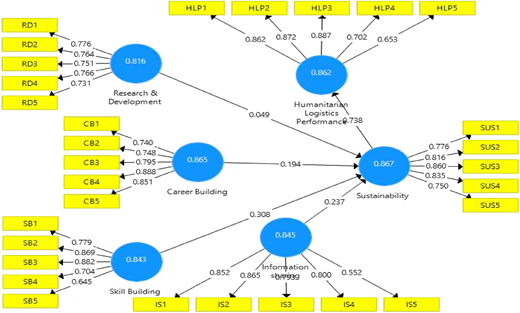
The first measure is Pearson's coefficients R square (R2), which is used to assess the variance of the mediating and response variables. In this study R2 and adjusted R2 values were very close at 0.572 and 0.564 for sustainability, respectively, and HLP values were 0.479 and 0.476, respectively (Table A3). Consequently, the values indicate a large effect size and a good fit model (Cohen, 1988).
Adjustment quality for the SEM model
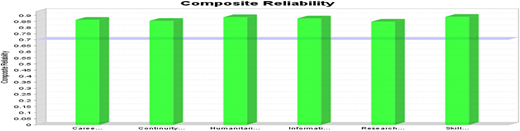
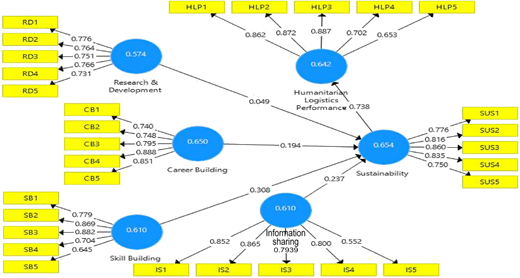
| R square | R square adjusted | Cronbach's alpha | Composite reliability | AVE | |
|---|---|---|---|---|---|
| Research and development | 0.865 | 0.849 | 0.650 | ||
| Skill building | 0.862 | 0.889 | 0.642 | ||
| Career building | 0.845 | 0.864 | 0.610 | ||
| Information sharing | 0.816 | 0.876 | 0.574 | ||
| Sustainability | 0.544 | 0.543 | 0.843 | 0.856 | 0.610 |
| Humanitarian logistics performance | 0.471 | 0.465 | 0.867 | 0.886 | 0.654 |
Note(s): AVE = Average variance extracted
4.2.2 Reliability of the measurement model
Cronbach's alpha measures the internal consistency reliability of a construct. In the present study, Cronbach's alpha was above 0.70, which shows a good fit model (Hair et al., 2009) and demonstrates a high reliability, as seen in Table A3 and Figure 2.
On the other hand, CR is a more lenient reliability criterion and has the same cut off ≥0.70 as for Cronbach's alpha (Chin, 1998; Henseler et al., 2015). The present study model had higher CR values for all variables than the recommended value of ≥0.70 (Chin, 1998). Hence the model is well fit in terms of reliability (see Table A3 and Figure 3).
4.2.3 Validity of the measurement model
Cronbach's alpha and CR cannot confirm the validity of the construct; thus a construct may not be valid without being reliable (Neuman, 1994). Hence convergent and discriminant validity must be analyzed. In this study all constructs surpassed ≥0.70, the minimum cut-off score for factor loadings, and AVE for all constructs were ≥0.50 (Chin, 1998), representing no problem with convergent validity, as summarized in Table A3 and Figure 4.
After the measurement model was assessed by discriminant validity, it can be used if a latent variable accounts for more variance in its related indicator variables than it shares with other constructs in the similar model (Fornell and Larcker, 1981). Based on the Fornell–Larcker criterion, no problem with discriminant validity was found (Hair et al., 2017) (see Table A4). In contrast, for discriminant validity, Voorhees et al. (2016) the preferred measure is HTMT for CB-SEM.
Discriminant validity with the Fornell–Larcker criterion values
| CB | SUS | HLP | IS | R&D | SB | |
|---|---|---|---|---|---|---|
| Career building | 0.750 | |||||
| Sustainability | 0.609 | 0.739 | ||||
| Humanitarian logistics performance | 0.609 | 0.692 | 0.781 | |||
| Information sharing | 0.603 | 0.650 | 0.596 | 0.765 | ||
| Research and development | 0.626 | 0.603 | 0.580 | 0.588 | 0.729 | |
| Skill building | 0.612 | 0.689 | 0.626 | 0.659 | 0.703 | 0.785 |
Note(s): CB= Career building, SUS = Sustainability, HLP = Humanitarian logistics performance, IS = Information sharing, R&D = Research and development, SB= Skill building
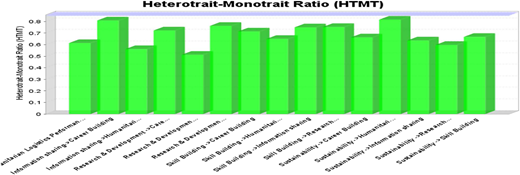
Therefore, the HTMT ratio was applied to the correlation approach, which is more appropriate than the other approaches in measuring discriminant validity. In the present study, the HTMT criterion had a cut-off score of ≤0.85 (Henseler et al., 2015) and all constructs were less than the cut-off value; thereby demonstrating no problem with discriminant validity, as seen in Figure 5.
4.2.4 Goodness of fit (GoF) of measurement model
The second phase is to measure the model fit of the SEM. GoF in CB-SEM is good for a causal model and to test the five hypotheses. Model GoF replicates how well the proposed model among the indicators produces the covariance matrix and also compares the hypothesized model with the real information. If the associations are consistent with each other, the model can be considered well fit. There are approximately 24 fit indexes that have been equally preferred (Klem, 2000). As per the proposed model quality, various fit indexes were used through SmartPLS.
The standardized root mean square residual (SRMR) can be used for absolute fit indices, as it replicates the average magnitude of variances. A lower value of SRMR indicates a good fit. In this study the score of SRMR was <0.08 [114] (Table A5). Hence on the absolute fit indices' parameter, the study model provides a good fit (Henseler, 2017). The d_ULS and d_G are measures that quantify how strongly the structured model correlation matrix differs from the model-estimated correlation matrix. Lower d-ULS and d_G values indicated a good fit model. As seen in Table A5, the observed values of d-ULS and d_G were 2.219 and 0.867, respectively, which were lower than the estimated model values of 3.087 and 0.902, respectively, which further indicates that the model is well fit (Henseler, 2017).
Fit summary
| Saturated model | Estimated model | |
|---|---|---|
| SRMR | 0.069 | 0.081 |
| d_ULS | 2.219 | 3.087 |
| d_G | 0.867 | 0.902 |
| Chi-square | 981.219 | 1007.352 |
| NFI | 0.714 | 0.707 |
Note(s): SRMR = Standardized root mean square residual, d_ULS = The unweighted least squares discrepancy, d_G = geodesic discrepancy, NFI = Normed fit index
Next, NFI was measured for this model. NFI values of ≥0.9 indicate the best fit. The big limitation of this index is that if the model is more complex, the value will be high and vice versa. The value was 0.714, which is above the estimated threshold level (0.707), indicating a good fit model. Finally, chi-square test is the only inferential statistic in SEM used for GoF. This test compares the theoretical model with the empirical one. In addition, it is important to have a large sample size to increase the precision of construct estimation. The chi-square value of 981.219 (Table A5) was very close to the estimated model value of 1007.352, which also showed that the model is a good fit in absolute fit indices (Iacobucci, 2010).
4.2.5 Multicollinearity in reflective models
Since the data were collected from a single source, multicollinearity was analyzed (Podsakoff et al., 2003). A rule of thumb is that multicollinearity can arise when the VIF coefficient is greater than 4.00, although some researchers have used 5.00 or 10.00 as a cut-off (Hair et al., 2010). In this study, multicollinearity was analyzed through VIF in SmartPLS. The results show (Table A5) that each item had a VIF value less than 3, which confirmed the absence of any multicollinearity between the variables (explanatory and response) that may have led to problems in analyzing the CFA result.
4.2.6 Predictive accuracy' criteria (estimation with blindfolding)
For cross validity strategy, the validated redundancy and communality constructs and indicators in reflective model blindfolding approach, also known as Stone-Geisser (Q2), can be used. The (Q2) measures how closely the model approaches its projected position. The values of a well fit model are always around 1, which indicates authenticity without errors (Ringle et al., 2014). The Q2 values in the present research (Table A7) were 0.292 and 0.331 for sustainability and for HLP, respectively, which denote a high effect size and well fit model (Cohen, 1988).
The indicators of the predictive validity (Q2) r Stone–Geisser indicator
| Construct cross-validated redundancy | |||
|---|---|---|---|
| SSO | SSE | Q2 (=1-SSE/SSO) | |
| Research and development | 1695.000 | 1695.000 | |
| Skill building | 1695.000 | 1695.000 | |
| Career building | 1695.000 | 1695.000 | |
| Information sharing | 1695.000 | 1695.000 | |
| Sustainability | 1695.000 | 1199.598 | 0.292 |
| Humanitarian logistics performance | 1695.000 | 1134.281 | 0.331 |
4.2.7 Psychometrical soundness of the study model
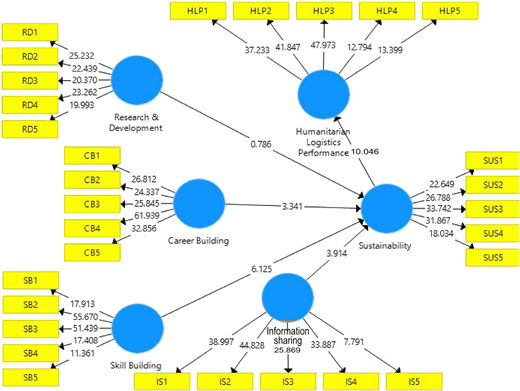
In this research, both CB-SEM and CFA were implemented. The CFA results are presented in Table A2. The 30 items containing six variables satisfied the reliability and validity criteria, along with GoF of SEM. Furthermore, the study model parameters were evaluated through t-statistics with bootstrapping procedure of 5,000 samples following the recommended SmartPLS defaults (Hair et al., 2016) in order to prove the significance of the psychometrical soundness. t-value is clearly above the minimum threshold of 1.96 (p < 0.05) (Hair et al., 2016) for the five hypotheses of the study model, whereas one variable (R&D) is insignificant, as seen in Figure 6 and Table A8. Hence, the HO was accepted in all cases except for R&D.
Summary of the findings supportive of the study hypotheses
| Path coefficients | ||||||
|---|---|---|---|---|---|---|
| Mean, STDEV, t-values, p-values | ||||||
| Original sample (O) | Sample mean (M) | Standard deviation (STDEV) | t statistics (|O/STDEV|) | p-values | Supported? | |
| R&D - > SUS (H1) | 0.049 | 0.047 | 0.063 | 0.786 | 0.432 | No |
| SB - > SUS (H2) | 0.308 | 0.310 | 0.050 | 6.125 | 0.000 | Yes |
| CB - > SUS (H3) | 0.194 | 0.194 | 0.058 | 3.341 | 0.001 | Yes |
| IS - > SUS (H4) | 0.237 | 0.240 | 0.061 | 3.914 | 0.000 | Yes |
| SUS - > HLP (H5) | 0.738 | 0.739 | 0.039 | 19.046 | 0.000 | Yes |
Note(s): R&D = Research and development, SB = Skill building, CB = Career building, IS = Information sharing, SUS = Sustainability, HLP = Humanitarian logistics performance
4.3 Summary
The statistical analyses show that the model fits the data well and that every parameter of the model was accurately interpreted. As the framework was theoretically specified based on the study data, each round of the model was tested statistically. CFA was applied for measuring the reliability and validity, as shown in Table A3. After the CFA confirmation, different fit indexes were applied to measure SEM. All constructs of the hypothesized model showed high reliability and validity. For the path analysis, Student t-test and p-value were applied to measure the psychometrical soundness of the model. All five study hypotheses were significant at t-test ≥ 1.96 and p < 0.05, except for the R&D construct.
5. Discussion
HL is the activities and structures that are elaborated to mobilize individuals, resources and skills and knowledge to assist victims of disaster. Successful HL decreases the number of causalities, recognizes the urgent needs of the survivors, provides help for sustainability, and decreases the victims' vulnerability within the minimum amount of cost, time and resources. Hence, the study aimed to investigate whether education can play a role in sustainable development in HL. As noted above, a special kind of education relevant to soft skills enhancement is lacking in the current educational system. Research papers that have focused on HL education have mainly focused on education from different angles. For example, Bölsche et al. (2013) concentrated on the enhancement and development of skills and competencies for international education programs. Similarly, Lu et al. (2013) proposed 4 (hiring, doing, observing and searching) learning techniques for logisticians to gain knowledge, as an applied organization learning theory. Goffnett et al. (2013) examined the literature on HL and service-learning and assessed the combination of concepts. Aguilar and Retamal (2009) focused on the learning in disasters and the support to manage the outcomes that natural and man-made disasters have in child development. Gallas (2003) and Aguilar and Retamal (2009) indicated that the integration of recreational and learning activities offers good experiences that in turn leads to an opportunity for all students to spread their knowledge of the globe and to spread their new knowledge properly. Fuzzy rule-based learning techniques were used by Rodríguez et al. (2011) to help HL policymakers to evaluate the loss occurring after a disaster struck with uncertain and incomplete data. As mentioned, logistics play an imperative role in DRO. Still, a number of HOs ignore this importance (Kovács and Spens, 2007) and even at university the subject of HL is not taught academically in Pakistan. Therefore, the study is different from the previous published work, although the study follows the previous work (Alfalla Luque and Machuca, 2003; Goffnett et al., 2013; Khan et al., 2020b) to empirically evaluate the study framework with the stated intention of starting the teaching of HL at university in Pakistan.
The approach will enable the students to learn the real situation of HL and to help the people of the disaster-prone area through their university learning. In addition, the course provides opportunities to study the broader scope of HL issues and challenges of both natural and man-made disasters, as well as sudden- and slow-onset disasters. It shows that the course has a broader scope which covers HL, humanitarian relief, disasters challenges and issues and solutions. The knowledge in the course provides a standard methodology to the students which they can apply once they enter into the job market.
As shown in the literature, the teaching of HL at university brings sustainable development in HLP, offers R&D opportunities and develops students' skills of HL, which in turn raise their employability in the unfortunate industry of disasters. Skills of logistics further enhance the professional career of the students. In addition, an HL course can help in the collection of useful information following a disaster, which is vital for HLP.
5.1 Contributions to theory
In this study, human capital theory (HCT) was employed, to investigate whether the teaching of HL can bring sustainable development in HLP. Based on the study results, it could be argued that the present study offers some useful theoretical contributions. Firstly, there is an agreement in the literature that skill building is one of the factors can introduce sustainability into an organization based on cognitive theory. To date, little is known about how skills building can bring sustainability in humanitarian settings. Bandura (1988) stated that for proper utilization of competency in an organization skill is needed. Thus, the empirical results of the present study clearly suggest that skills building greatly increase sustainability in logistics in term of disaster through solving the problem of expert logisticians and employee turnover. Secondly, the study results have further widened the authors' understanding regarding career building and sustainability. This work empirically tested the points raised by the researchers based on social learning theory (Bandura and Walters, 1977). The study results show that career building can bring sustainability in humanitarian settings. Thirdly, Altay and Labonte (2014) and Dubey et al. (2020) found that logistics in humanitarian context are very dynamic. Consequently, sustainability may often be challenging. Therefore, increasing information sharing may induce sustainable development in HL settings. Thus, the results of this study suggest that HL education offers a way to enhance knowledge sharing in the HL process and further bring sustainability. These findings clearly support game theory (Haavisto and Kovács, 2014) in the humanitarian context. Finally, this article further tested the arguments made by Willard (2012) in the commercial context that sustainable behavior contributes to enhance firm performance. This study refined these arguments empirically in the HL context, that sustainable behavior can save lives, reduce the suffering of people and contribute to the developmental phases of disaster. These finding further confirm the argument of Correia (2019) related to sustainability in terms of HL as sustainable development can bring positive change in HLP.
5.2 Practical implications
This research repeats the points raised by Dubey et al. (2020) that are relevant to how empirical investigation increases managerial processes. In short, the study provides guidelines to enhance the managerial decision process. The practical aim of this research is to offer guidelines to managers involved in HL efforts who are facing the issues of lack of expert logisticians and employee turnover and who are looking for sustainable development in HL. In an effort to provide this direction, the study has been grounded in theory and has used survey data to test the study hypotheses. Therefore, the study has tried to answer the following questions that mostly confuse managers involved in DRO. Such as how can the teaching of HL at university help to increase HLP? Or how can education bring sustainability in humanitarian settings? No previous study has yet empirically analyzed the critical topic of whether or not the teaching of HL can bring sustainable development in HLP. By conducting an information-driven survey based on theory, the study results provide some robust findings that provide motivating directions to the policymakers and manager involved in DRO because the participation and cost of logistics account for almost 80% in DRO (Thomas, 2003). Thomas and Mizushima (2005) indicated that “there is a lack of professionalization of the logistics function. Therefore, HL education for sustainable development is imperative. In addition, the stakeholders face the dilemma of determining to what level the teaching of HL at university can help to bring sustainable development in HL. Thus, the present empirical results provide evidence that education not only enhances the level of information sharing but also develops skill and career building. Moreover, HL education may help to improve sustainable development in HL efforts. Thus, it could be argued that based on HL education, HOs can overcome the problems of expert logisticians and employee turnover through students who have experienced or studied HL at university. Similarly, HOs gained satisfaction from assisting students to explore the process of aiding those in need. Furthermore, HOs can provide high service and minimize waste at low cost through volunteer students. These steps can further save lives, reduce human suffering and bring sustainable development in HL settings.
5.3 Limitations
Despite the interesting insights provided by this research, the following potential limitations of the study must be considered when examining the effect of the research findings. The research findings are limited to the questionnaire survey conducted in Pakistan with a small sample size of 207 respondents, which is generally considered suitable. Anyhow, in the context of developed countries with a larger population such as the USA and China, which are struck by disasters more often, this method can therefore reduce the results' reliability, restrict the generalizability of the results and possibly introduce biases. Therefore, future research may replicate the survey in developed countries, with large sample size and/or with mixed techniques in order to enrich the study findings. Similarly, this study was carried out in a South Asian country, where the educational, societal and cultural systems different from other regions. Hence, it may be fruitful to further test the study framework outside of this region and compare/contrast the results. Second, the results examined HL education at university and primary data were collected from students, teachers and other professionals in the HL field. Feedback was not incorporated from other stakeholders such as victims, donors, governments, military, etc. Hence, it should be considered in future work. The response rate from professionals was lower than that from students and academics, which may have impacted on the study findings. Third, R&D did not indicate a positive impact on sustainability in terms of HL. Even though the present theory supports the positive association of R&D with sustainability, future study needs to use a longitudinal design between R&D and sustainability in terms of HLP. Finally, the present research developed a platform for future researchers to explore empirically the influence of growing levels of sustainability on HLP more scientifically, by treating sustainability as a continuous (instead of dichotomous) variable.
Despite these gaps, the research results supported the conclusion that there is a signification relationship between HL education at university and a range of disaster-relevant issues in order to assist in disaster-prone areas.
6. Conclusion
The HL field is comparatively new and HLP is crucial as it can save lives and decrease the suffering of survivors. Effective training and formal education of logisticians, which are the best possible ways to achieve this, can be achieved through the teaching of HL at university, as confirmed by the present study findings, with further benefits of sustainable operation and HLP. More specifically, the results showed that the study predictive variables (Figure 1) are mediated by sustainability in HLP. In addition, the outcomes of the study contribute meaningfully by offering HOs and all other stakeholders with procedures for determining the imperative factors that increase HLP. These stakeholders are continuously looking for strategies to assist afflicts. The present research offers HOs with procedures to govern the crucial aspects for enhancing HO performance through HL education. In addition to some academic contributions, the important finding from the paper is that it demonstrates an encouraging productive learning experience with extra guidelines for exploration that may transform lives. Although the research findings are subject to some limitations, they offer a basis for further studies in a variety of settings to explore systematically the roles of the teaching of HL at university in HLP. In summary, the data examined in the present research were collected from a survey of academics and students from universities and professionals of HOs in Pakistan.
Statistics variance inflation factor (VIF) analyses
| VIF | VIF | VIF | VIF | VIF | VIF | ||||||
|---|---|---|---|---|---|---|---|---|---|---|---|
| RD1 | 1.688 | SB1 | 2.046 | CB1 | 1.748 | IS1 | 2.455 | SUS1 | 1.713 | HLP1 | 2.448 |
| RD2 | 1.568 | SB2 | 2.281 | CB2 | 1.667 | IS2 | 2.447 | SUS2 | 2.153 | HLP2 | 2.664 |
| RD3 | 1.759 | SB3 | 2.516 | CB3 | 1.837 | IS3 | 1.979 | SUS3 | 2.514 | HLP3 | 2.899 |
| RD4 | 1.906 | SB4 | 1.655 | CB4 | 2.737 | IS4 | 1.925 | SUS4 | 2.305 | HLP4 | 2.077 |
| RD5 | 1.556 | SB5 | 1.668 | CB5 | 2.295 | IS5 | 1.431 | SUS5 | 1.803 | HLP5 | 1.919 |
Note(s): RD = Research and development, SB = Skill building CB = Career building, IS = Information sharing, SUS = Sustainability, HLP = Humanitarian logistics performance
The authors would also like to show their gratitude to the Editor of the journal. The authors thank 2 “anonymous” reviewers for their so-called insights. The authors are also immensely grateful for their invaluable comments to improve the manuscript. Although any errors are the authors own and should not tarnish the reputations of these esteemed persons.

