


This research aims to shed light on the trend of humanitarian supply chain (HSC) studies in the era of pre, during and post coronavirus disease 2019 (COVID-19) pandemic outbreaks. This study provides comprehensive bibliometric mapping published in the 21 top vintage sources globally providing detailed metadata on HSC articles. The manuscript objectives are threefold: to explore the documents that are published in the field of humanitarian logistics and supply chain; second, to identify details of articles in humanitarian logistics and supply chain and thirdly, to explore research the critical area published in the HSC in pre, during and post era of pandemic COVID-19.
This research adopts bibliometric analysis of HSC studies using the Biblioshiny, a shiny app for the Bibliometrix R package. The tool employed in this study decodes the data extracted from the Scopus database to various visualized forms. The review of the HSC studies in this research covers all related publications from 2006 to early 2022. The record of the article was scanned and refined accordingly.
A multi perspectives of HSC studies were explored, discussed and identified. The bibliometric analysis findings offer significant information on the current and future trend publications in the area of humanitarian logistics and supply chain. Additionally, it also provides significant information on the highly cited documents in humanitarian logistics and supply chain studies, most productive contributors, keywords analysis findings, most productive countries and sources, network analysis data on co-occurrence network and themes mapping information in the field of humanitarian logistics supply chain before and after pandemic COVID-19.
A multi-perspective of HSC studies was explored only within the online Scopus database. It excludes other articles published in other databases. Future research could explore related articles published in other recognized databases.
Practitioners can use multi perspectives findings from pre, during and post-pandemic COVID-19 issues discussed in this paper to get new insight and perception of the issue to facilitate their current and future operation and strategy.
To the best of the researchers’ knowledge, this is the first bibliometric study to analyze the trend of HSC studies using Biblioshiny focusing on pre, during and post COVID-19 pandemic. The review highlights annual publication trends, most productive authors, most cited papers, most productive countries, most productive institutions and most productive sources, which leads to a number of future research agendas for future studies.
1. Introduction
The humanitarian supply chain (HSC) is a popular branch of logistics that specializes in emergency movement, delivery, storage and warehouse of supplies during natural disasters, including pandemic coronavirus disease 2019 (COVID-19). It concerns the movement of the supply flow during crises, pandemics or any other emergencies tragedy. According to Pateman et al. (2013), the HSC relates to managing the people during uncertain and chaotic environments. It provides the response to this uncertain environment via managing the process of planning, implementing and controlling the movement flow and storage of the products, materials and information throughout the supply chain from origin to the point of consumption.
In principle, the HSC aims to provide relief to everybody involved in the crisis or pandemic. It aims to provide the right supplies to the right people at the right place, at the right time and location (Banomyong et al., 2019). It is important to note that not every crisis or tragedy has the same characteristics or effect. The HSC is complex and requires various stakeholders’ involvement, action and intervention. Van Wassenhove (2006) highlighted that there are four classes of disaster: sudden on-set, slow on-set, natural causes and manmade causes. Accordingly, a few years later, Kovac and Spens (2009) propose three key challenges during a disaster crisis or pandemic: disaster types, disaster relief and pandemic relief.
Having reviewed the past HSC studies, the past researchers have defined the HSC in various ways with reference to many managerial theories. Previous research on the HSC has focused on the challenges and causes, relief activities, stakeholders management and many more. Though several studies are available that explain the HSC, there are not many that focus on the pandemic COVID-19 outbreak. Thus, reviewing and analyzing the HSC study trend before, during and after pandemic COVID-19 will provide a better foundation for future HSC studies. Despite the wide accumulation of research in relation to the COVID-19 pandemic, few studies provide specific analyses pertaining to issues discussed in the HSC, especially during natural disasters due to health issues.
The HSC field has attracted vast interest from both industry practitioners and academicians to study the effects and challenges of natural or manmade disasters (Kabra et al., 2017). There is also a bibliometric study that investigates supply chains in the specific field such as automotive (Gonzalez-Benito et al., 2013), agriculture (Barbosa, 2021), green supply chain (Gong et al., 2019), technology (Moosavi et al., 2021; Zhang et al., 2020) and others. Even though there are many bibliometric analyses that are performed by the previous scholars in the field of the supply chain; however, there is an inconsistency in terms of the database used by the researcher. For instance, a study from Kumar (2016) study on supply chain management focusing on organizational performance using a bibliometric analytics approach. The study was utilized the J-gate database for 5 years timeframe of publication ranging from the year 2010–2014. He reported that the year 2013 was the largest publication in the area of supply chain management. In the same year of 2016, there was also research performed by Kilubi (2016) that investigated the supply chain issue using the bibliometric approach with focusing on the area of supply chain risk management. In the recent article published by Ittman (2021), 197 articles were reviewed using the bibliometric approach with utilizing the Google scholar database. He reviewed articles that are published in the field of transport and supply chain management. However, the bibliometric approach performed by this research is only utilizing VosViewer visualization tool. More comprehensive bibliometric analysis is needed in researching supply chain studies to offer more valuable results and discussions.
There is significant demand in the field of the supply chain to do bibliometric analysis with more rigor and recognized databases such as the Scopus database and Web of Science database. In fact, the recent pandemic COVID-19 that hit many countries and industries has also affected global supply chain activities and created disruption in supply and logistics activities along the supply chain. However, having reviewed the literature, there is a significant absence of the HSC study that highlights a review on pandemic COVID-19 HSC related. Having noticed this significant gap, this study aims to fill the gap by developing the main objective of this research is to provide a detailed analysis of the HSC studies in the era of the pandemic COVID-19 outbreak. In this study, the bibliometric analysis of the HSC focuses on three phases of the COVID-19 pandemic, pre, during and post-pandemic. As highlighted by Wahyuni et al. (2019) and Feng et al. (2017), bibliometric analysis is an appropriate method to systematically do science mapping to provide a comprehensive review on specific areas and provide visual analysis and determining cluster of investigation from the previous study.
Compared to conventional trend analysis, it only involves listing and simple analysis based on variable lists and theories. With bibliometric analysis, it allows the researcher to do network analysis on the keyword and titles, which leads to the development of the cluster area of investigation in the field. In fact, by using science mapping and network analysis, the researcher could also provide a detailed summary of authorship, sources and citation of the previous study. This study is developed to answer the following research questions:
What are the current states and trends of publications with regards to the HSC literature?
What are the highly-cited documents in HSC research?
Who are the most productive contributors in humanitarian logistics and supply chain in terms of authors, countries, institutions and source titles?
What are the important keywords in the HSC before and after the era COVID-19 pandemic?
What are the current states of knowledge structure in terms of co-citations, collaboration and co-occurrences network in HSC research?
What are the themes involved in the HSC before and after the era COVID-19 pandemic?
The paper is structured as follows. The next section will discuss the literature review development in the field of the HSC in general, followed by a review of humanitarian during and after pandemic COVID-19. This paper then describes the bibliometric method used in this study using Biblioshiny. A number of reference and flowchart to conduct bibliometric analysis are presented in this section. The discussion then moved to the specific analysis to answer the above research questions, followed by the discussion, contribution, limitation and future research recommendations.
2. Literature review
2.1 Evolution of humanitarian logistics and supply chain
Humanitarian logistics and supply chains can be referred to as emergencies or disasters. Agostinho (2013) explains the emergency situation as a tragedy related to earthquakes or hurricanes. While disaster is related to natural phenomena such as war, health issues, refugee crises, water crises, etc. Humanitarian logistics and supply chain is closely connected to the movement of the supplies such as aid delivery, healthcare, foods, shelters, sanitation, water and many more. During any disaster, including the pandemic COVID-19 outbreak, the essential thing is the logistics process or the movement of the people to help, resources, knowledge and any other important supply that can help the affected people. According to Van Wassenhove (2006), humanitarian logistics not only involve the movement of the supplies but also include activities such as planning and preparation, team member to distribute, procurement activity, transportation and storage, distribution, import-export, tracking and tracking activity, as well as knowledge transfer.
Past studies in humanitarian logistics and supply chain have been developed since early 2003. The researcher extensively developed and explored the area of humanitarian logistics and supply chain from many angles and perspectives. Initially, among the earliest study of the HSC is a study that focuses on managing and mitigating the risk during supply chain disruption. The earlier study was developed by Pickett (2003), Lensing (2003) and Kent (2004). The study was then developed into humanitarian relief in supply chain crisis management. For instance, Kovac and Spens (2011) emphasize that HSC and disaster relief management have emerged as an important area to study by both academicians and researchers since the HSC is connected with needs prioritization and providing support to affected people during any occurrence of the disaster. In fact, it also serves to provide inventory during fluctuating demands because of natural disasters. Therefore, the Journal of Humanitarian Logistics and Supply Chain Management (JHLSCM) development enlightens the significance of the developed field as a new novel area to be researched.
Among other studies that focus on humanitarian logistics and supply chain are studies performed by Blanco and Goentzel (2006) and Oloruntoba and Gray (2006). These studies have found four main popular themes related to HSC research performed by previous scholars, namely supply chain resilience, performance measurement, inventory and sustainability. They also emphasized more future research in HSC review studies and specific investigations on technology adoption in the HSC, reverse humanitarian logistics and improved HSC model. Additionally, the most recent study by Kovács and Falagara Sigala (2021) highlights key areas to focus on HSC disruptions such as contingency plan and preparedness, financial and political influences, new norms in facing the challenges from humanitarian disruption, as well as social management in future.
The key to successfully managing the HSC in this uncertain environment is the management of the stakeholders. Humanitarian logistics and supply chain are considered key for supply chain efficiency during any disaster tragedy. Carefully managing the humanitarian logistics and supply chain will lead to cost reduction and reduce wastage along the chain (Mangla et al., 2018; Ramos et al., 2020).
2.2 Past studies
The bibliometric analysis uses the statistical application to the literature to evaluate the productivity and trend of publications. This study investigates the growth of the HSC in relation to the pandemic COVID-19 era. This analysis allows the researcher to provide a detailed description of the emerging research area with a specific type of document, source, citation, keywords, network visualization, institution and many more. A recent study by Ittmann (2021) investigated the supply chain review study using the bibliometric analysis method and focused on the challenges dealing with the HSC. Considering the vital section of the HSC, Dubey et al. (2018), Behl and Dutta (2019) and Banomyong et al. (2019) significantly emphasize the scarcity of the bibliometric study in the field of humanitarian logistics and supply chain. This needs to be investigated as it allows the reader to have a deep understanding of the previous article that has been discussing the issue of HSC and the metadata of the previous pool of related publications.
For instance, Altay and Green (2006) have investigated 109 research and management articles in disaster operation management from 1980 to 2004, identifying potential issues for future scholars. Their study has conducted a review study in humanitarian, focusing on operation in disaster relief. Their study is long overdue and need further investigation related to the current pandemic worldwide experience, namely COVID-19. In this present study, the researcher used a bibliometric information system tool to analyze previously published documents in the field of humanitarian and supply chains.
3. Bibliometric analysis method
It is essential to clearly explain the method for any study conducted. According to Kumar (2016), the Bibliometric approach is an appropriate method used in tracking and reporting the statistical knowledge of a particular term or concept that is published in the area of logistics and supply chain management. The bibliometric analysis method allows the researcher to analyze and record a source of metadata information and dissemination of knowledge to the readers. This is also supported by the recent bibliometric study in the area of transport and supply chain management (Ittmann, 2021). A “bibliometric” term was first coined by Faithorne in December 1969 that explains the statistical information about the published articles in a specific area or field with highlighting and reporting the particular concepts, studies, trends, methods, keywords, citation, sources of scientific publication (Broadus, 1987).
Literature review using bibliometric analysis is a popular method in reviewing previous work as it allows the researcher to further understand the field by providing science mapping on the related publication database. Doing bibliometric review analysis allows the researcher to further strengthen the understanding body of knowledge in the field. This is also aligned with Ittmann (2021), who review literature using specific online databases such as Scopus or Web of Science (WoS) database using bibliometric analysis, which leads to the collection of a large pool of publications and relevant articles. Scopus also gives the flexibility to search across a variety of bibliographic areas (Hassan and Ahmi, 2022).
3.1 Defining keywords
It is necessitous to use the correct keywords in conducting the bibliometric study. Based on the study objectives, the researcher used the following query keywords: humanitarian, logistics and supply chain. Using these main three keywords: the researcher can find multiple combinations of the keywords such as (1) humanitarian logistics, (2) HSC, (3) humanitarian logistics and supply chain, (4) HSC and logistics, (5) supply chain humanitarian and logistics, etc. We also used the wildcard (*) to broaden our search. Thus, we finalize the search in the article title field using the following query: TITLE (humanitarian* AND (logistic* OR “supply chain”)).
3.2 Search strategy
This study uses the online Scopus database to get a pool of documents published in humanitarian logistics and supply chains. Scopus online database was chosen in this study because it is acknowledged as the largest citation and abstract database in technology, social science, business, and management, including supply chain and logistics (Fahimnia et al., 2015). In fact, all peer-reviewed articles published in this Scopus online database come from well-known and leading academic publishers such as Emerald, Elsevier, Springer, Inderscience, and Taylor and Francis Group. Additionally, as highlighted by Chicksand et al. (2012), they recommended that the Scopus database is a good reference for logistics and supply chain peer-review articles. Figure 1 illustrates detailed steps for the search strategy involved in this study and the detailed steps in performing bibliometric analysis.
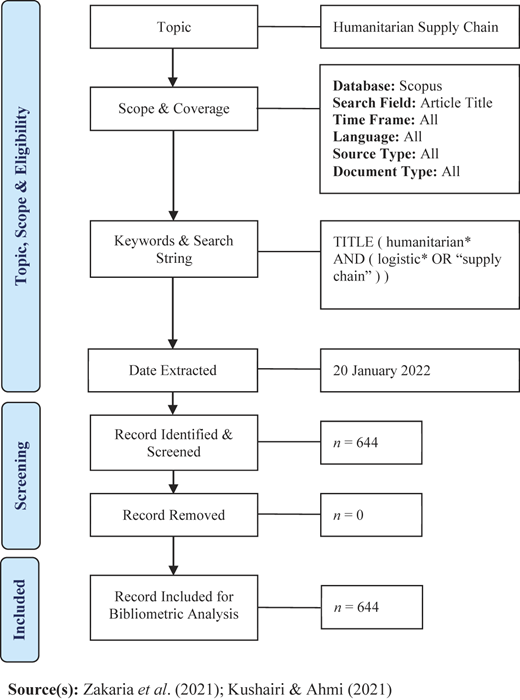
Flow diagram of the search strategy
Flow diagram of the search strategy
3.3 Tool and data analysis
In order to achieve the research objective and answer the research questions developed in this study, we use Biblioshiny, a shiny app for the Bibliometrix R package, to conduct the bibliometric analysis. This software was developed by Aria and Cuccurullo (2017), with the main focus on science mapping analysis. Figure 2 shows the stages and analyses conducted in this study. The analyses have been divided into two types, i.e. descriptive analysis and network analysis, which are conducted mainly to answer the research questions (RQs) stated in the first section of this paper.
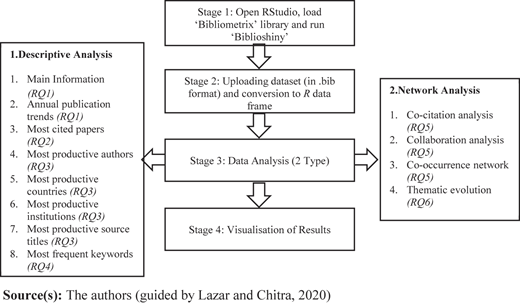
Detail steps for bibliometric analysis using Biblioshiny
Detail steps for bibliometric analysis using Biblioshiny
4. Analysis and results
4.1 Descriptive analysis
This section discusses the humanitarian logistics and supply chain research profile, including the sources of publication from 2006 to 2022. This includes all information on the current state of publications, research trends, highly cited papers, prolific authors, countries and institutions, publication sources and the authors’ keywords.
4.1.1 Main information
The earliest paper discussing humanitarian in logistics and supply chain appeared in the Scopus database in 2006. The number of publications shows substantial growth at the annual rate of 2.57%. Table 1 presents the information on all articles published in humanitarian logistics and supply chain from 2006 to 2022, covering specific information on average years from publication, average citation per document, average citation per year, document types, document contents, authors’ details and authors collaboration.
Main information regarding selected articles
| Description | Results |
|---|---|
| Main information about data | |
| Timespan | 2006:2022 |
| Sources (Journals, Books, etc.) | 263 |
| Documents | 644 |
| Average years from publication | 5.22 |
| Average citations per document | 22.76 |
| Average citations per year per doc | 3.046 |
| References | 27,315 |
| Document types | |
| Article | 410 |
| Conference paper | 139 |
| Book chapter | 60 |
| Review | 28 |
| Book | 3 |
| Editorial | 2 |
| Erratum | 2 |
| Document contents | |
| Keywords Plus (ID) | 1,480 |
| Author’s Keywords (DE) | 1,305 |
| Authors | |
| Authors | 1,232 |
| Author appearances | 1,877 |
| Authors of single-authored documents | 56 |
| Authors of multi-authored documents | 1,176 |
| Authors collaboration | |
| Single-authored documents | 68 |
| Documents per Author | 0.523 |
| Authors per Document | 1.91 |
| Co-Authors per Documents | 2.91 |
| Collaboration Index | 2.04 |
4.1.2 Annual publication trends
Annual publication trends with the details of total publication, total citation, citation per document and citation per year from the year 2006–2022 are carried out as shown in Table 2 and Figure 3 below. According to the data gathered from this bibliometric analysis, the highest total publication in the field of humanitarian logistics and supply chain is in the year 2020 and year 2021, with a total number of 88 and 87 articles. This may be due to the world pandemic issue that we are experiencing from the COVID-19 outbreak. This worldwide health pandemic has affected many countries across the globe and led to supply chain disruption to many business operations and living activities.
Annual publications trends
| Year | TP | TC | C/D | C/Y | Citable years |
|---|---|---|---|---|---|
| 2006 | 4 | 1,217 | 304.25 | 19.02 | 16 |
| 2007 | 2 | 660 | 330.00 | 22.00 | 15 |
| 2008 | 2 | 34 | 17.00 | 1.21 | 14 |
| 2009 | 20 | 1,327 | 66.35 | 5.10 | 13 |
| 2010 | 19 | 988 | 52.00 | 4.33 | 12 |
| 2011 | 24 | 1,083 | 45.13 | 4.10 | 11 |
| 2012 | 20 | 1,268 | 63.40 | 6.34 | 10 |
| 2013 | 27 | 693 | 25.67 | 2.85 | 9 |
| 2014 | 38 | 1,019 | 26.82 | 3.35 | 8 |
| 2015 | 60 | 1,191 | 19.85 | 2.84 | 7 |
| 2016 | 49 | 1,323 | 27.00 | 4.50 | 6 |
| 2017 | 49 | 700 | 14.29 | 2.86 | 5 |
| 2018 | 70 | 1,294 | 18.49 | 4.62 | 4 |
| 2019 | 79 | 1,069 | 13.53 | 4.51 | 3 |
| 2020 | 88 | 528 | 6.00 | 3.00 | 2 |
| 2021 | 87 | 260 | 2.99 | 2.99 | 1 |
| 2022 | 6 | 1 | 0.17 | 0 | |
| Total | 644 | 14,655 | 22.76 | – | – |
Note(s): TP = Total publications; TC = Total citations; C/D = Citation per documents; C/Y=Citations per year
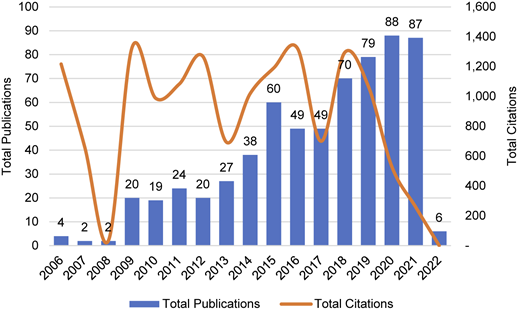
Growth and publications impact per year
Growth and publications impact per year
4.1.3 Most cited papers
The most cited articles globally and locally are shown in Table 3. The top citation paper determines the popularity of the article (Guo et al., 2021). In general, the global citation reflects the frequency of the annual citation whenever data were downloaded. The most cited article by Van Wassenhove (2006) with 911 citation devise humanitarian aid logistics in high gear context. While the second most cited article from Kovács and Spens (2007), with 658 citations, highlights the issue of disaster relief operation, the third most cited article by Holguín-Veras et al. (2012), with 307 citations, discusses post-disaster humanitarian logistics.
Top 20 highly cited documents
| No | Author(s) | Title | TC | C/Y |
|---|---|---|---|---|
| 1 | Van Wassenhove (2006) | Humanitarian aid logistics: Supply chain management in high gear | 911 | 56.94 |
| 2 | Kovács and Spens (2007) | Humanitarian logistics in disaster relief operations | 658 | 43.87 |
| 3 | Holguín-Veras et al. (2012) | On the unique features of post-disaster humanitarian logistics | 307 | 30.7 |
| 4 | Oloruntoba and Gray (2006) | Humanitarian aid: An agile supply chain? | 296 | 18.5 |
| 5 | Kovács and Spens (2009) | Identifying challenges in humanitarian logistics | 289 | 22.23 |
| 6 | Holguín-Veras et al. (2013) | On the appropriate objective function for post-disaster humanitarian logistics models | 250 | 27.78 |
| 7 | Özdamar and Ertem (2015) | Models, solutions and enabling technologies in humanitarian logistics | 235 | 33.57 |
| 8 | Pettit and Beresford (2009) | Critical success factors in the context of humanitarian aid supply chains | 225 | 17.31 |
| 9 | Tofighi et al. (2016) | Humanitarian logistics network design under mixed uncertainty | 223 | 37.17 |
| 10 | Ben-Tal et al. (2011) | Robust optimisation for emergency logistics planning: Risk mitigation in humanitarian relief supply chains | 213 | 19.36 |
| 11 | Tomasini and Van Wassenhove (2009) | From preparedness to partnerships: Case study research on humanitarian logistics | 198 | 15.23 |
| 12 | Leiras et al. (2014) | Literature review of humanitarian logistics research: trends and challenges | 166 | 20.75 |
| 13 | Charles et al. (2010) | A model to define and assess the agility of supply chains: Building on humanitarian experience | 166 | 13.83 |
| 14 | Boonmee et al. (2017) | Facility location optimization model for emergency humanitarian logistics | 162 | 32.4 |
| 15 | Day et al. (2012) | Humanitarian and disaster relief supply chains: A matter of life and death | 160 | 16 |
| 16 | Kovács and Spens (2011) | Trends and developments in humanitarian logistics – a gap analysis | 149 | 13.55 |
| 17 | Kunz and Reiner (2012) | A meta-analysis of humanitarian logistics research | 144 | 14.4 |
| 18 | Tatham and Kovács 2010) | The application of “swift trust” to humanitarian logistics | 143 | 11.92 |
| 19 | Ahmadi et al. (2015) | A humanitarian logistics model for disaster relief operation considering network failure and standard relief time: A case study on San Francisco district | 141 | 20.14 |
| 20 | Dubey and Gunasekaran (2016) | The sustainable HSC design: Agility, adaptability and alignment | 136 | 22.67 |
Note(s): TP = Total publications; C/Y=Citations per year
4.1.4 Most productive authors
In Table 4, the top ten productive authors are shown with their total publication numbers, the number of cited papers, total citation, h index and its publication year start. As presented in Table 4, Kovacs G appeared as a leading author in humanitarian logistics and supply chain, with a total production number of articles is 27. This is followed by Tatham P with 22 articles and Lauras M with 14 articles.
Most productive authors
| Source title | TP | NCP | TC | h | g | m | PYS |
|---|---|---|---|---|---|---|---|
| Kovács G | 27 | 26 | 1757 | 16 | 26 | 1.00 | 2007 |
| Tatham P | 22 | 22 | 769 | 16 | 22 | 1.14 | 2009 |
| Lauras M | 14 | 12 | 263 | 5 | 12 | 0.39 | 2010 |
| Heaslip G | 13 | 13 | 194 | 7 | 13 | 0.64 | 2012 |
| Van Wassenhove LN | 13 | 13 | 2129 | 13 | 13 | 0.77 | 2006 |
| Comes T | 12 | 12 | 116 | 5 | 10 | 0.63 | 2015 |
| Dubey R | 12 | 12 | 766 | 11 | 12 | 1.22 | 2014 |
| De Souza R | 10 | 7 | 86 | 4 | 7 | 0.40 | 2013 |
| Hellingrath B | 10 | 10 | 102 | 5 | 10 | 0.33 | 2008 |
| Klumpp M | 10 | 8 | 199 | 4 | 8 | 0.33 | 2011 |
Note(s): TP = Total publications; NCP=Number of cited papers; TC = Total citations; h = h-index; g = g-index; m = m-index; PYS=Publication year start
4.1.5 Most productive countries
Table 5 presents the 27 productive countries with at least ten published articles. The top ten countries in publishing more research articles on the development of humanitarian logistics and supply chain are the USA, United Kingdom, India, France, Germany, Finland, China, Australia, Iran, Netherlands and Turkey.
Top countries that published ten or more documents
| Country | Total publications | % |
|---|---|---|
| USA | 103 | 15.99% |
| United Kingdom | 77 | 11.96% |
| India | 70 | 10.87% |
| France | 65 | 10.09% |
| Germany | 52 | 8.07% |
| Finland | 44 | 6.83% |
| China | 43 | 6.68% |
| Australia | 42 | 6.52% |
| Iran | 32 | 4.97% |
| Netherlands | 32 | 4.97% |
| Turkey | 29 | 4.50% |
| Brazil | 24 | 3.73% |
| Italy | 24 | 3.73% |
| Norway | 20 | 3.11% |
| Japan | 17 | 2.64% |
| Indonesia | 16 | 2.48% |
| Ireland | 15 | 2.33% |
| Spain | 15 | 2.33% |
| Colombia | 14 | 2.17% |
| South Africa | 14 | 2.17% |
| Thailand | 14 | 2.17% |
| Canada | 13 | 2.02% |
| Singapore | 13 | 2.02% |
| Mexico | 12 | 1.86% |
| South Korea | 12 | 1.86% |
| Sweden | 12 | 1.86% |
| Pakistan | 10 | 1.55% |
4.1.6 Most productive institutions
In a similar manner, the researchers used Biblioshiny to extract the top productive institution. Table 6 shows the most productive affiliations or institutions and the number of articles published by each of them. For simplicity, the top ten affiliations are included in the table. Table 6 indicates that Hanken School of Economics, with a total of 41 publications, is the most productive institution in discussing and publishing issues related to humanitarian logistics and supply chain.
Top institutions that published ten or more documents
| Country | Total publications | % |
|---|---|---|
| Hanken School of Economics | 41 | 6.37% |
| University of Tehran | 18 | 2.80% |
| INSEAD, Europe | 16 | 2.48% |
| Griffith University | 16 | 2.48% |
| IMT Mines Albi | 15 | 2.33% |
| University of Agder | 13 | 2.02% |
| Montpellier Business School | 13 | 2.02% |
| Indian Institute of Technology Delhi | 12 | 1.86% |
| Griffith Business School | 12 | 1.86% |
| Delft University of Technology | 11 | 1.71% |
| FOM University of Applied Sciences | 11 | 1.71% |
| Vrije Universiteit Amsterdam | 10 | 1.55% |
| National University of Singapore | 10 | 1.55% |
4.1.7 Most productive source titles
The 410 articles were published in multiple journals. The source-wise publication analysis is done from the downloaded data and is presented in Table 7 below. For simplicity, the details of the top ten journals are presented with at least more than five articles published. Evidence from Table 7 below indicates that the Journal of Humanitarian Logistics and Supply Chain by Emerald Publisher has the highest number of publications, with a total of 85. This is followed by Annals of Operation Research and The Palgrave Handbook of Humanitarian Logistics and Supply Chain Management. The productivity of the journals over the years is shown in detail in Table 7.
Most productive source titles
| Source title | TP | NCP | TC | h | g | m | PYS |
|---|---|---|---|---|---|---|---|
| Journal of Humanitarian Logistics and Supply Chain Management | 85 | 81 | 1915 | 25 | 40 | 2.08 | 2011 |
| Annals of Operations Research | 29 | 27 | 625 | 15 | 24 | 3.00 | 2018 |
| The Palgrave Handbook of Humanitarian Logistics and Supply Chain Management | 16 | 15 | 45 | 3 | 5 | 0.50 | 2017 |
| International Journal of Disaster Risk Reduction | 14 | 12 | 547 | 10 | 12 | 1.25 | 2015 |
| Lecture Notes in Logistics | 12 | 9 | 26 | 3 | 4 | 0.38 | 2015 |
| Production Planning and Control | 12 | 11 | 170 | 4 | 11 | 0.80 | 2018 |
| Managing Humanitarian Logistics | 11 | 9 | 27 | 3 | 4 | 0.38 | 2015 |
| Proceedings of the International Conference on Industrial Engineering and Operations Management | 11 | 2 | 2 | 1 | 1 | 0.14 | 2016 |
| International Journal of Physical Distribution and Logistics Management | 10 | 10 | 1,054 | 9 | 10 | 0.64 | 2009 |
| Procedia Engineering | 10 | 10 | 96 | 6 | 9 | 0.67 | 2014 |
| International Journal of Production Research | 9 | 9 | 378 | 9 | 9 | 1.29 | 2016 |
| European Journal of Operational Research | 7 | 7 | 651 | 7 | 7 | 0.88 | 2015 |
| Benchmarking | 6 | 6 | 116 | 5 | 6 | 0.63 | 2015 |
| Disasters | 6 | 6 | 102 | 5 | 6 | 0.50 | 2013 |
| International Journal of Production Economics | 6 | 6 | 446 | 5 | 6 | 0.38 | 2010 |
| Lecture Notes in Business Information Processing | 6 | 6 | 37 | 4 | 6 | 0.31 | 2010 |
| Management Research News | 6 | 6 | 247 | 6 | 6 | 0.43 | 2009 |
| Socio-economic Planning Sciences | 6 | 6 | 152 | 6 | 6 | 1.00 | 2017 |
| Supply Chain Management | 6 | 6 | 576 | 6 | 6 | 0.35 | 2006 |
| Transportation Research Part E: Logistics and Transportation Review | 6 | 4 | 295 | 4 | 4 | 0.50 | 2015 |
| Transportation Research Procedia | 6 | 4 | 36 | 3 | 4 | 0.33 | 2014 |
Note(s): TP = Total publications; NCP=Number of cited papers; TC = Total citations; h = h-index; g = g-index; m = m-index; PYS=Publication year start
The 85 publications in the sample dataset were published in the leading and top specific journals in logistics and humanitarian journals with a total citation of h index are 25. These are niche articles that specifically examine the issue of the HSC from the year 2011 until the present.
4.1.8 Most frequent keywords
The researcher performed a similar analysis for the most frequent analysis for this bibliometric study in humanitarian logistics and supply chain management. Table 8 below shows the most commonly used words in this analysis and the list of keywords. Table 8 below shows the top 10 authors’ keywords and indexed keywords that are occur more than ten times.
Top keywords that occur ten or more times
| Author's keywords | Occurrences | Indexed keywords | Occurrences |
|---|---|---|---|
| Humanitarian logistics | 287 | Humanitarian logistics | 123 |
| HSCs | 123 | Disasters | 93 |
| Supply chain management | 57 | Supply chains | 77 |
| Disasters | 42 | Disaster prevention | 67 |
| Disaster management | 39 | Supply chain management | 63 |
| Supply chains | 32 | Logistics | 60 |
| HSC management | 24 | Decision making | 46 |
| Natural disasters | 22 | Disaster management | 41 |
| Coordination | 20 | Humanitarian aid | 35 |
| Disaster relief | 20 | Emergency services | 31 |
| Performance measurement | 20 | Information systems | 29 |
| Aid agencies | 19 | Humanitarian operations | 27 |
| Logistics | 19 | Disaster relief | 25 |
| Humanitarian | 18 | Natural disasters | 24 |
| Humanitarian operations | 16 | Humanitarian relief | 23 |
| Disaster response | 15 | Optimization | 22 |
| Humanitarian organizations | 15 | Decision support systems | 18 |
| Sustainability | 14 | Information management | 16 |
| Agility | 13 | NGO | 16 |
| Analytic hierarchy process | 13 | Literature reviews | 15 |
| Case study | 13 | Human | 14 |
| Humanitarian aid | 13 | Stochastic systems | 14 |
| Deprivation cost | 12 | Altruism | 12 |
| Optimisation | 12 | Article | 12 |
| Literature review | 11 | Earthquakes | 12 |
| Blockchain | 10 | Operations research | 12 |
| Disaster relief operations | 10 | Costs | 11 |
| NGO | 10 | Integer programming | 11 |
| Resilience | 10 | Location | 11 |
| Multi-objective optimization | 11 | ||
| Stochastic models | 11 | ||
| Disaster planning | 10 | ||
| Relief work | 10 |
Figures 4 and 5 show the word cloud of the keywords before and after pandemic COVID-19. Among the top word cloud found from this analysis before pandemic outbreak COVID-19 on humanitarian and logistics supply chain study are disasters, supply chain, logistics, disaster prevention, disaster management, supply chain management, disaster relief, humanitarian aid, decision making and emergency services.
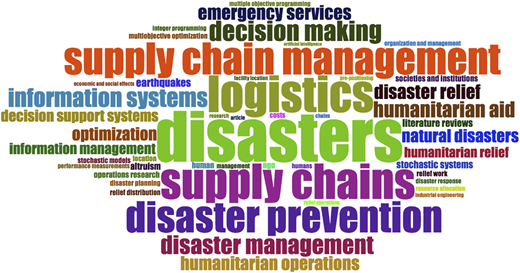
Word cloud of the indexed keywords (before COVID-19)
Word cloud of the indexed keywords (before COVID-19)
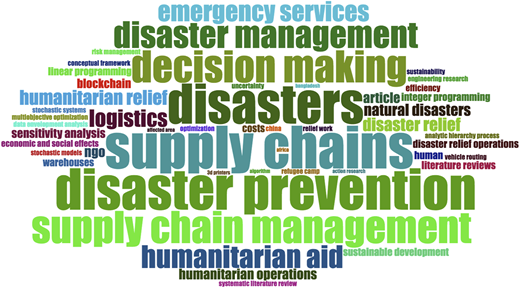
Word cloud of the indexed keywords (after COVID-19)
Word cloud of the indexed keywords (after COVID-19)
While the word cloud of the indexed keywords appeared in the field of humanitarian logistics and supply chain management after pandemic COVID-19 outbreak are disaster prevention, supply chain, disaster, decision making, disaster management, emergency services, supply chain management, humanitarian aids, humanitarian operations, humanitarian relief, natural disasters, disaster relief and disaster relief operations.
4.2 Network analysis
Among the most popular tool in bibliometric analysis is called network analysis. Mishra et al. (2017) mentioned that tools like Pajek, VOSviewer, Gephi and HistCite are the most prevalent tools for conducting network exploration. Recently, Biblioshiny has been recognized as the latest tool for performing network analysis. The next section discusses co-citation, collaboration, co-occurrence and thematic analysis in the HSC.
4.2.1 Co-citation analysis
In order to have a deep understanding of the intellectual history and HSC literature, bibliometric network analysis, namely co-citation analysis are vital. This analysis allows the reader to have a better understanding of the growth and popularity of the articles over time (Zhu et al., 2021). Citation analysis refers to the number of citation frequencies on a specific document while the total number of citations reflects its significance in that field of research. Co-citation analysis, on the other hand, shows relations between cited-reference works. Co-citation exists when two documents both are cited in a third document (Aria and Cuccurullo, 2017). As highlighted by Small (1973), co-citation analysis refers to analysis that examines the relationship between the authors, journal, title, and keywords that show how they are related to each other. Figure 6 presents the co-citation network by documents in HSC literature. It is noted that when the same pairs of papers are co-cited by many authors, clusters of research begin to form. The co-cited papers in these clusters tend to share some common themes. Combined with single link clustering and multidimensional scaling techniques, co-citation analysis can literally map the structure of specialized research areas as well as science as a whole.
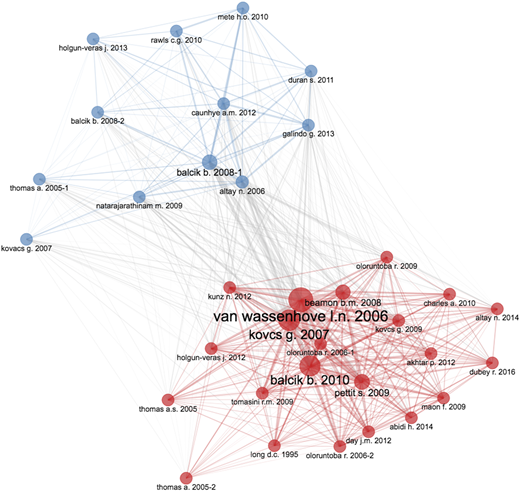
Based on Figure 6, there are two main clusters that show the papers that are co-cited by other papers within the dataset. A node that shares the same color tends to have some common themes. This network literally maps the structure of common references made by the authors in this HSC research. We can see that the important papers listed in Table 3 form this co-citation network in this field.
4.2.2 Collaboration analysis
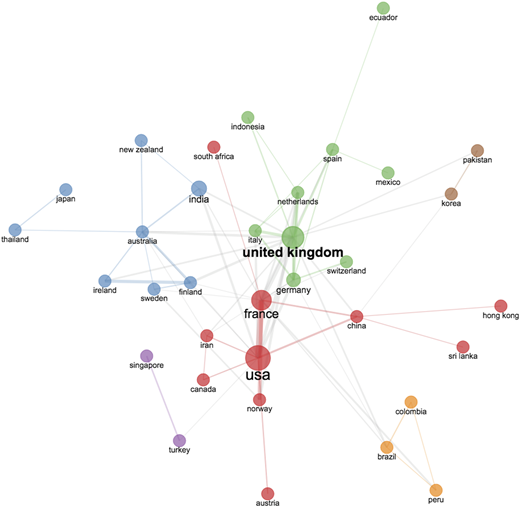
Figure 7 illustrate an analysis of key collaboration between countries on humanitarian logistics and supply chain research. As shown in Figure 7, it is clearly shown that the collaboration is being nurtured by the USA scholars followed by the United Kingdom and France country. These three leading countries have strong collaboration among others and also with other countries such as Germany, Switzerland, Norway, China and Austria. China is recognized as the closest Asia collaborator among the Western key collaboration countries in the study.
4.2.3 Co-occurrence network
A co-occurrence or semantic network refers to the frequency of occurrence on the close proximity of similar keywords present across several documents. Co-occurrence may include keywords that are similar to each other and based on the same topic but are not exactly the same. Figure 8 below shows the authors’ keyword co-occurrence network. The figure shows that the thicker the line, the stronger the relationship between the keywords. Keywords with no connecting lines show that no relationship has been established. If the more co-occurrences are found, the closer the terms appear on the network map to the center. The greater the proximity of keywords used by authors, the closer they are linked, resulting in closer and more strong relationships. If a keyword's bubble is large, the more it was utilized. From this analysis, three thematic clusters have been identified. Each cluster is distinguished by a different color. Based on this result, the following themes have been recognized:
Humanitarian logistics (red bubbles)
Humanitarians organizations (blue bubbles)
Humanitarians operations (green bubbles)
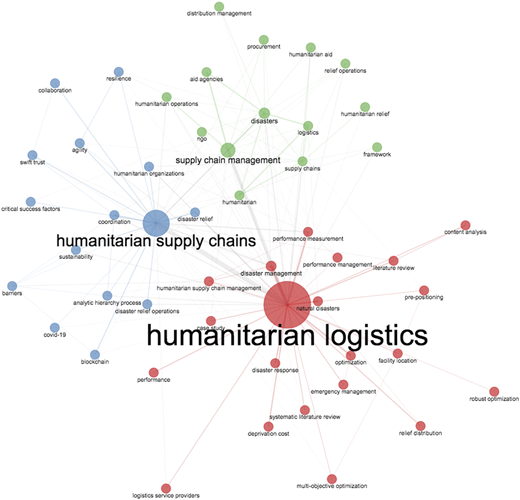
Author’s keyword co-occurrence network
Author’s keyword co-occurrence network
As shown in Figure 8, the major network or biggest cluster of theme studied is humanitarian logistics with consist of the keywords such as disaster response, performance, multi-objective optimization, robust optimization, emergency management, facility location, relief distribution and logistics service providers. While in the second network of the HSC, the related keywords that is used by the previous study are barriers, COVID-19, blockchain, coordination, critical success factor, disaster relief operations, coordination, sustainability and analytic hierarchy process. With regards to the HSC cluster, interestingly, we could see that technology applications such as blockchain were mentioned and COVID-19. This may lead to the application of technology in responding to the HSC during pandemic COVID-19. This area could be one of the further areas that can be explored in detail in future, as explained in the conclusion section.
While on the humanitarian operation clusters, the keyword analysis that is being used by the previous study are aid agencies, humanitarian aid, procurement, disaster, framework, humanitarian relief and relief operation.
4.2.4 Thematic evolution
Figure 9 shows the thematic evolution based on the authors’ keywords before and after the COVID study related to humanitarian logistics and supply chain. Particularly, this analysis allows the reader to convey information about a single topic or theme, in this case, humanitarian logistics and supply chain. From this Figure 9, for example, we can see how the themes related to the HSC have evolved before the COVID-19 (i.e. for the period from 2006 to 2019) and after COVID-19 (from 2019 until 2022). We can see how the nine themes that existed before had become eight themes in the current period. While Figures 10 and 11 show the thematic map before and after the COVID-19 pandemic specifically.
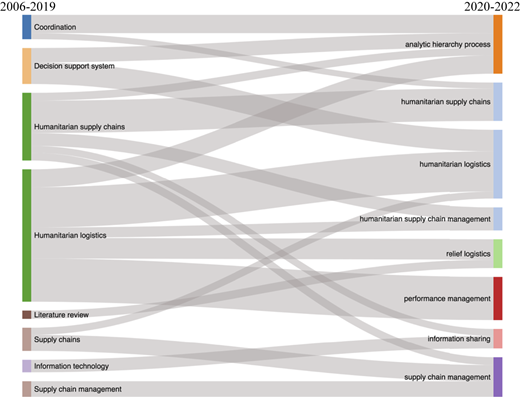
Thematic evolution (based on the author’s keywords) before and after COVID-19
Thematic evolution (based on the author’s keywords) before and after COVID-19
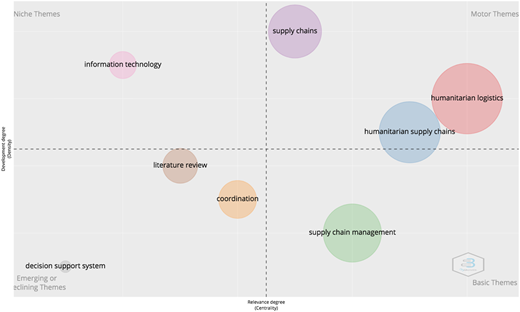
From Figure 10, the upper-right quadrant shows the motor themes. They are categorized by high centrality and density, which is considered the more developed theme in the literature and the main concern in HSC research. The motor theme in this quadrant is HSC, humanitarian logistics and supply chain. The upper-left quadrant shows high-density themes, but unimportant external links and so are of only limited importance for the field (low centrality). The theme that falls in this quadrant is only one theme which is information technology. In the lower-left quadrant are the emerging or declining themes. In the HSC study, the decision support system, literature review and coordination are themes that include in this category. Finally, the lower-right quadrant shows the themes that are basic and transversal. Only one theme appears in this quadrant which is supply chain management. This theme concerns general topics transversal to the different research areas of the field. This map (Figure 10) illustrates the positions of the themes before the COVID-19 pandemic.
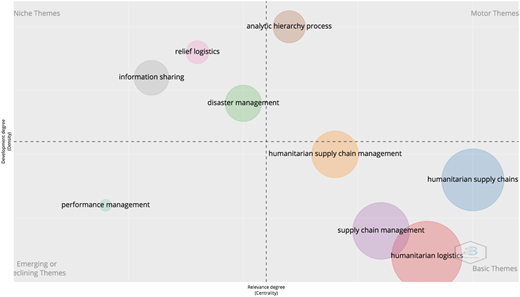
On the other hand, Figure 11 shows the positions of the themes related to the HSC during the COVID-19 pandemic. We can see that the themes on the HSC management, HSC, humanitarian logistics and supply chain management themes become the basic and transversal theme in the current studies in the HSC. Analytical hierarchy processes become the motor themes, and relief logistics, information sharing, and disaster management become niche themes. In the last lower-left quadrant in Figure 11, the performance management theme becomes the new theme that is emerging in this field.
5. Discussion
Owing to the escalating attention to the HSC study recently, this bibliometric analysis on humanitarian logistics and supply chain study focusing on pre, during and after pandemic COVID-19 clearly shows the significant numbers of publications in the area that lead to more call for future research in the area of the HSC. The significant contribution made by previous scholars has been discussed over the last 2 decades. Although the previous studies and related keywords analyzed increasingly show the importance of the HSC study, however from this pandemic COVID-19 perspectives, it has been found that future scholars could be more critical on the issue debated, especially with regards to related research clusters that is appropriate to cover to fill the significant current gap. Logistics and supply chain scholars should consider interpreting the humanitarian activities from different perspectives of stakeholders.
Another important issue related to the HSC in the pandemic era is the lack of policy perspectives in the study. The government role and the country policy in the specific country in managing the disruption and humanitarian supply effort need to also be discussed widely. For instance, the national policy in a certain country related to pandemic management and how they help supply effort should be controlled is also important and interesting to explore. While most of the previous study looks into bibliometric analysis focusing on the issue of investigation and cost management (Behl and Dutta, 2019; Ramos et al., 2020), assessment tool (Banomyong et al., 2019), this study demonstrates the novel analysis of the previous study that was focusing on pandemic COVID-19 humanitarian logistics and supply chain.
As highlighted above, findings from the study are useful not only to the academician or research scholars but also to other related parties that are involved in humanitarian logistics and supply chain. Several approaches by NGOs (non-governmental organization) for example, is significant to improve its activities that support the developments in aiding human during any event or crisis. For instance, lack of technology application in ensuring smooth HSC operation may lead to the effort of NGOs to embark into a systematic system in giving aid and to better facilitation the help during any crisis or events. Moreover, NGOs can also work closely with the government to carefully design and improve the current related policy of the HSC in the relief operation. As highlighted in the network analysis findings, there are many areas that NGOs and policymakers to focus on such as improved supply chain activity, reducing supply with technology application or system, improved relief operation, improved disaster management policy and improved information sharing support system.
6. Conclusion
This research paper has scientifically mapped the evolution and the current state of the humanitarian logistics and supply chain trend in pre, during and post-pandemic COVID-19 via bibliometric analysis using R software. Comprehensively, it has addressed specific information on the articles analyses in this study, highlighting the key information such as years of publication, type of articles, the sources and document contents. Apart from it, this bibliometric analysis also provides key information on the annual publication trends, most productive authors, most cited papers, most productive countries, most productive institution, most productive source titles, the top keyword used before the COVID-19 pandemic, the top keyword used after the COVID-19 pandemic, co-citation analysis, co-citation network, collaboration analysis, thematic evolution analysis, thematic map of the theme study in the HSC before COVID-19, and also a thematic map of the theme study in the HSC after COVID-19.
To conclude, this novel bibliometric analysis is among the pioneer study that focuses on the bibliometric study in humanitarian logistics and supply chain field in the pandemic era of COVID-19. In fact, this original article has contributed to the theoretical via identifying important areas for future studies to focus on. Pandemic and any other disaster tragedy are always led to supply chain disruption and have a high impact on all stakeholders in the industry. This bibliometric review enhances our understanding of the critical aspect of the HSC and how its diverse aspect has been and will be employed because of the pandemic COVID-19.
This study provides critical insight for practitioners, academicians and scholars in the area of humanitarian logistics and supply chain. By investigating the literature using this bibliometric analysis, we identified the humanitarian logistics and supply chain dynamics over the years. Any research has its own limitation, including this study. One of the primary limitations to address in this study is the use of the keywords to search the articles related to humanitarian logistics and supply chain. As the search are utilizing both keyword and keywords plus strategy, the researchers could not ensure that we have covered all published articles in the field. However, as far as the researcher is concerned, with extensively used keywords in search strategy, this study has covered a suitable amount of works in relation to humanitarian in logistics and supply chain. The second limitation to highlight in this study is the online database used in this research. This study uses Scopus online database as the main source for bibliometric analysis. In this case, the choice of the database, the Scopus database, may limit the search. Future scholars are encouraged to combine different types of review databases with bibliometrics to further improve this work.
Future researchers may continue the work from current research with specifically investigating the issue of medical supplies, food assistance and logistics operation during the pandemic. As far as the researcher is concerned, to be specific, future scholars may deeply look into the issue of logistical network and infrastructure during pandemic aid. The investigation may be performed in different organizations such as the private-public sector, corporate social responsibility, NGOs and other group communities. Additionally, the scholars could also examine the key difference in managing humanitarian operations during the pandemic, man-made and nature-inspired disasters; and see how the neighboring countries were used as humanitarian hubs to supply food, medical aids and other emergency supplies.
Similarly, future research may also explore how technology could play a role in quick, safe and secure transportation during a pandemic. The researcher may also investigate the latest issue on technological advancement in managing supply chain disruptions. Digital advancement in the humanitarian logistics and supply chain may offer new findings in managing supply chain disruption during a pandemic outbreak. This aligns with what has been recommended by Chen et al. (2019) that information technology and digitalization are becoming the top emerging research area to study in the field. Therefore, it is recommended for future studies to explore this topic in humanitarian logistics and supply chain, focusing on recovery strategy in humanitarian supply disruption, humanitarian operation, relief operation and disaster prevention. All quantitative, qualitative and experimental research on the technology application may provide significant findings to the area.
This paper forms part of a special section “The COVID19 impact on humanitarian operations: lessons for future disrupting events”, guest edited by Bhavin Shah, Guilherme Frederico, Vikas Kumar, Jose Arturo Garza-Reyes and Anil Kumar.

