


Each individual needs to be vaccinated to control the spread of the COVID-19 pandemic in the shortest possible time. However, the vaccine distribution with an already strained supply chain in low- and middle-income countries (LMICs) will not be effective enough to vaccinate all the population in stipulated time. The purpose of this paper is to show that there is a need to revolutionize the vaccine supply chain (VSC) by overcoming the challenges of sustainable vaccine distribution.
An integrated lean, agile and green (LAG) framework is proposed to overcome the challenges of the sustainable vaccine supply chain (SVSC). A hybrid best worst method (BWM)–Measurement of Alternatives and Ranking According to COmpromise Solution (MARCOS) methodology is designed to analyze the challenges and solutions.
The analysis shows that vaccine wastage is the most critical challenge for SVSC, and the coordination among stakeholders is the most significant solution followed by effective management support.
The result of the analysis can help the health care organizations (HCOs) to manage the VSC. The effective vaccination in stipulated time will help control the further spread of the virus, which will result in the normalcy of business and availability of livelihood for millions of people.
To the best of the author's knowledge, this is the first study to explore sustainability in VSC by considering the environmental and social impact of vaccination. The LAG-based framework is also a new approach in VSC to find the solution for existing challenges.
1. Introduction
COVID-19 pandemic is still wreaking havoc in many parts of the world. Between the initial outbreak in late 2019 and September 2021, the virus-infected 226 million individuals and killed approximately 4.6 million people around the world (World Health Organization, 2021). The global spread of the pandemic has also had a destructive effect on supply chain networks due to the restrictions on human movement and business activities worldwide (Chowdhury et al., 2021). The safety measures like lockdown, containment, social distancing, etc., are used worldwide to limit the further spread of the virus, but these techniques affect regular human activities and hence, the global business. Healthcare institutions worldwide stated that vaccine is the only permanent solution to contain the pandemic (Guan et al., 2020).
Vaccines restrict viral transmission, reduce illness severity, and minimize morbidity (Burgos et al., 2021). Mass vaccination is one of the most effective and efficient tools to control the spread of infectious diseases (Duijzer et al., 2018). However, the availability of the vaccine to all targeted populations of a country depends on their supply chain network's ability to receive, store, and transport vaccines at the required location under the controlled environment (Zaffran et al., 2013). Vaccines being a biopharmaceutical product, require controlled temperature (as prescribed by the manufacturers) from their inception to final delivery. Maintaining the required temperature throughout the network is a challenge, and its failure will spoil the vaccine and the whole effort of the supply chain process. The smooth flow of vaccines from manufacturers to final beneficiaries requires multiple players' involvement, cold-chain logistics, surveillance mechanisms, last-mile delivery, and crowd management; this constitutes a complex Vaccine Supply Chain (VSC) with several inherent challenges. Maintaining and monitoring the low temperature throughout the supply chain process is one of the essential prerequisites of VSC (De Boeck et al., 2020; Plotkin et al., 2017).
The government's Healthcare Organizations (HCOs) run the Universal Immunization Program (UIP) to vaccinate children and pregnant females through various international organizations like WHO, UNICEF, USAID, etc. The VSC in Low and Middle-Income Countries(LMICs) for UIP are highly strained due to the lack of infrastructure, unstable vaccine policies, and the inclusion of new vaccines (Chandra and Kumar, 2020). The countries like India have boosted their routine immunization program with the help of other international healthcare agencies, and child immunization coverage has increased significantly since the introduction of UIP (MoHFW Government of India, 2018). India's VSC also has a great success story in eradicating polio with routine immunization programs (Global Polio Eradication Initiative, 2020; WHO, 2021). However, the country still faces various challenges in its routine vaccination distribution network, including frequent vaccine stockouts, inadequate cold chain infrastructure, safe immunization practices, and immunization waste management (Chandra and Kumar, 2021; Chandra and Vipin, 2021). The inclusion of a large quantity of COVID-19 vaccines to a country's already overburdened vaccine supply network exacerbated existing challenges while also posing many new ones.
The COVID-19 vaccine in India was first introduced in January 2021, and then mass vaccination started in several phases based on the prioritized age groups. The accelerated introduction of various vaccines has resulted in an ever-evolving global immunization effort that is offering hope to the recovery from the unprecedented struggle of the pandemic. HCOs are focused on maximizing the vaccination rate to curb the virus at the earliest possible. But this has also created a significant challenge for HCOs to store and distribute the excess volume of vaccines on time, with limited infrastructure and human resources. The limited infrastructure resulted in stocking the vaccines at the places where controlled environment is available instead of where they are required. Due to this, most of the cold storage is stocked beyond its capacity, which poses the risk of cold logistics failure. The failure of the cold chain logistics during the COVID-19 vaccination will cause a shortage of vaccines, aggravating the current situation (Alam et al., 2021). During our field visit to several vaccine stores in north India, it was observed that there are issues related to inventory and replenishment policy between different levels of SC, old cold chain equipment, vaccine wastage due to quality failure, and proper disposal of vaccine waste. Several issues related to overstocking and stockout of vaccine, open vial vaccine wastage, crowd management, and adverse aftereffect of vaccinations are reported at many immunizations sited during COVID-19 vaccination. In addition, decreased immunization coverage for routine immunization of infants and pregnant/lactating ladies during mass COVID-19 vaccination is also reported in various regions of the world, including India (Dinleyici et al., 2021; Shet et al., 2021).
In the long run, maintaining vaccine quality through limited cold chain infrastructure, managing a large outsourced workforce, and maintaining routine immunization programs for infants and pregnant/lactating ladies along with pandemic/emergency vaccination are all critical for a sustainable VSC. In addition, VSC Being a humanitarian SC, has to minimize the cost without affecting the quality and other aspects of lifesaving vaccines and be agile enough to include various types of vaccines in varying amounts within as short a time as possible (Zaffran et al., 2013). The latter aspect is important as the process of development/improvement of medical interventions is going on, which may cause frequent replacement or inclusion of new vaccines. As mass vaccination programs for COVID-19 are taking place in different parts of the world, vaccine wastage is becoming a more significant concern for HCOs. It is directly related to immunization costs and is capable of spreading infectious diseases (Phadke et al., 2021). Furthermore, since pandemic vaccination is prioritized over energy and environmental considerations, extended mass vaccination will have a negative impact on the ecological system (Jiang et al., 2021). Thus, there is a necessity for a sustainable vaccine supply chain (SVSC) that can handle the spread of infectious diseases and regular immunization programs simultaneously, without neglecting economic, environmental, and social aspects.
So, to design a sustainable VSC, there is a need for the identification of critical sustainability challenges and a framework for their solutions. This study made an effort to identify the challenges from an extensive literature review of vaccine supply chain and sustainability, field visits, and interviews with experts. An integrated lean Agile and Green (LAG) management practices-based framework has also been developed to solve these challenges. As many of the challenges can be overcome by using many of the solutions, Multi-Criteria Decision Making (MCDM) methodology is used to rank and analyze them. An integrated MCDM approach of Best Worst Method (BWM)- Measurement of Alternatives and Ranking According to COmpromise (MARCOS) with Delphi is used in this study.
BWM method is used to rank the main and subcategories of challenges. The other MCDM techniques like Analytical Hierarchy Process (AHP), Interpretive Structure Modelling (ISM), Decision Making Trial and Evaluation Laboratory (DEMATEL), and Analytical Network Process (ANP) are also used for the analysis of issues and challenges. However, most of these methodologies, according to Rezaei (2015), suffer from a lack of consistency due to the unstructured way of pairwise comparison. Compared to existing MCDM techniques, the BWM methodology eliminates the inconsistency difficulty during pairwise assessment by adopting a different approach for comparing criteria. It also involves fewer comparisons (Rezaei, 2015). Due to its enhanced consistency and lesser number of comparisons, BWM is widely used in the identification of challenges, barriers, enablers, and drivers in the field of MSME, energy, and healthcare (Ahmad et al., 2021; Badri Ahmadi et al., 2017; Gupta and Barua, 2016, 2018; Malek and Desai, 2019; Wankhede and Vinodh, 2021). The MARCOS method is used to rank the solution on the basis of its influence on the challenges. The new MARCOS methodology can handle a larger number of criteria and alternatives with more excellent stability when compared to the other existing technique (Stević et al., 2020). The comparatively new MARCOS method is used in the field of road safety, healthcare, e-services, etc., to evaluate different functions (Bakır and Atalık, 2021; Ecer and Pamucar, 2021; Stanković et al., 2020).
This study made an effort to prioritize the challenges of country's SVSC, which is responsible for routine immunization as well as the mass vaccination for the pandemic. The finding shows that operational challenges like “vaccine wastage” and “storage and handling” of vaccines with limited cold chain infrastructure are critical, and policymakers should focus on these issues before designing the new policies. The LAG-based solutions show that the implication of practices such as “coordination mechanism among stakeholders” and “effective management support” are most important to tackle the challenges. Apart from analyzing challenges and solutions of VSC, this study also contributes to develop a LAG-based framework for finding sustainable solutions in SC. The use of LAG framework gives a systematic approach for inclusion of sustainability in SC. To reach these findings, the rest of the paper's structure is as follows: The literature evaluation on sustainable VSC, LAG practices as well as research gaps and highlights are discussed in Section 2. The methodologies are presented in Section 3. The data collection and application of proposed methodolgies for this study are described in Section 4. The result and discussion are presented in Section 5. The study's managerial implications are presented in Section 6. Finally, Section 7 brings the study to a close by outlining certain limits and future directions.
2. Literature review
2.1 Sustainable vaccine supply chain challenges
The regular vaccine supply chain used for UIP is ill-structured and highly ineffective in many of LMICs (De Boeck et al., 2020). Maintaining and monitoring the stringent temperature across the supply chain is one of the most important challenges found in the literature (Ashok et al., 2017). Several innovations have been added for maintaining a low temperature in LMICs over time (Robertson et al., 2017), but they became vulnerable in the pandemic. VSC also faces several issues due to the lack of technological advancement in vaccine manufacturing and cold chain logistics (De Boeck et al., 2020; Dai et al., 2021; Ulmer et al., 2006). There is also a need for the development of technology that can keep vaccines stable at normal cold temperatures (De Boeck et al., 2020; Chen and Kristensen, 2009). Some of the existing vaccines require a subzero temperature of −70°C, storage of these vaccines is not possible in LMICs due to the lack of infrastructure (Administration Overview for Pfizer-BioNTech COVID-19 Vaccine | CDC, 2021; Alam et al., 2021).
Arifoǧlu et al. (2012) found that yield uncertainty in the production process is one of the initial phase challenges of vaccine manufacturing, which impacts the whole supply chain. Vaccine manufacturing has become a highly complex process due to working with live, attenuated organisms in many cases. Vaccine manufacturing goes through several biological and natural processes, which results in a larger manufacturing lead time (Pagliusi et al., 2020; Ulmer et al., 2006). Chandra and Kumar (2018a) study shows that stock out due to mismanagement of inventory is one of the major causes of delay in immunization programs. De Boeck et al. (2020) extended literature review shows how the location of delivery points influences the vaccination rate. To manage inventory, real-time data must be updated from the vaccination center and the local warehouse. Updating inventory data and real-time updates of temperature and storage conditions are required to avoid stockout, maintain vaccine potency and minimize vaccine wastage. Thus proper information sharing becomes vital for efficient SC (Li et al., 2018).
Most vaccine wastage at vaccination sites occurs due to open vial wastage or ill-handling and storage of the vaccine, syringes, and the vials (Azadi et al., 2020; Phadke et al., 2021). This leads to extra costs, the environmental impact of hazardous waste, and delay in the vaccination program (Klemeš et al., 2021). Vaccine wastage results in hazardous waste that can spread other infectious diseases if not disposed of properly (Wanyoike et al., 2017). Along with vaccine waste, disposable syringe waste is also a byproduct of vaccination which must be disposed of according to the biowaste disposal protocols. The other environmental-related challenges of vaccination programs are high energy requirements for cold chain logistics and associated carbon footprint (Jiang et al., 2021; Klemeš et al., 2021).
2.2 Lean-Agile-Green
Over the last century, revolutionary innovations in industrial process design have dramatically enhanced the quality and efficiency of manufacturing and services. Young et al. (2004) suggested that managerial innovations of the industrial process have the potential to deliver high-quality, low-cost healthcare services. Industries' highly successful management strategies like Lean, Agile, and Green can be adopted in the healthcare setting to improve service delivery. The lean concept was first used by Toyota and was developed by Womack and Jones (1997). It aims to deliver what the consumer wants in a timely, efficient, and waste-free manner. Poksinska (2010) discusses lean healthcare, implementation challenges, and its outcome in the field, and he also concluded that value stream mapping (VSM) is the most used lean technique in healthcare. It is found that the implementation of lean is comparatively tricky in healthcare compared to the industrial environment (Kovacevic et al., 2016). Several studies explored the challenges and barriers of lean implementation in healthcare (Ahn et al., 2021; Cohen, 2018; Fogliatto et al., 2019; Radnor et al., 2012). The lean implementation demands a significant shift in institutional culture, innovative leadership, and highly motivated frontline healthcare staff (Cohen, 2018). Aronsson et al. (2011) analyze the implementation of lean and agile process strategies to improve the healthcare supply chain.
Agility can be defined as a dynamic capability that allows a company to respond to an unpredictable and changing business environment while also maintaining its market position (Rosário Cabrita et al., 2016). The concept of agile strategy originated from the need for companies and services to become more flexible and responsive to customers (Gunasekaran et al., 2008). In a constantly changing global competitive market, a company's supply chain agility directly impacts its capacity to develop and deliver novel products to customers quickly and cost-effectively (Mehralian et al., 2015). The integrated application of agile manufacturing processes enhances manufacturing competitiveness strength in volatile conditions, resulting in improved operational, market, and financial performance (Vázquez-Bustelo et al., 2007). Agile strategy, when integrated with strategies like lean and green, improves the overall sustainability of SC. The lean strategy is designed to improve supply chain effectiveness, whereas the agile strategy is related to time and thus improves responsiveness (Rashad and Nedelko, 2020). Lean concept increases profit by cutting the cost and reducing all types of waste from SC. At the same time, agility optimizes SC's efficiency by delivering what consumers want with the shortest lead time (Ben Naylor et al., 1999). Coupling Green strategies with lean and agile improves the overall sustainability of SC by increasing profit, improving lead time, and reducing environmental impact.
In the era of drastic climate change and ecological imbalance, environmental sustainability becomes a strategic obligation for institutions. Green techniques can often result in significant waste reductions, savings in energy and raw material consumption, and reductions in the usage of hazardous materials, thus improving environmental sustainability (Verrier et al., 2014). Companies have been under pressure from all sections of society to make their processes more environmentally friendly, driving the adoption of Lean and Green strategies together (Reis et al., 2018). The integration of lean and green can improve environmental sustainability but requires more research in the field (Garza-Reyes, 2015). Chakraborty et al. (2021) study concluded that green and agile practices substantially impact healthcare service delivery in the healthcare system, which contributes to patient satisfaction. Kuupiel et al. (2017) gave a lean and agile supply chain approach for enhancing the accessibility and efficiency of Point of Care (POC) diagnostics services in LMICs.
In the pandemic situation, HCOs are constantly trying to evolve the cure of diseases. Pharmaceutical industries and the HCO are challenged to shift their position to deliver the latest and most effective medicines and vaccines to the masses within the earliest possible time, considering cost and environmental impact. The integration of Lean-Agile-Green in VSC can result in a more improved and sustainable SC for mass vaccination and pandemic control (Yadav and Kumar, 2022).
2.3 Research gap and highlights
The literature review of VSC shows that several studies analyze the challenges of Universal Immunization Programs (UIP) for children and pregnant ladies in the Indian context (Chandra and Kumar, 2018b, 2020). Still, the high volume of COVID-19 vaccines in the country's VSC raised several new challenges that are not documented in many studies to date. In previous studies, the environmental impacts of vaccination are not considered, along with other system challenges. Few studies discuss the problem of environmental sustainability of immunization programs (Klemeš et al., 2021), but they are neither from the Indian context nor discuss the other challenges of VSC. To fill this gap, this study proposes the concept of Sustainable VSC which considers both regular immunizations as well as pandemic/epidemic mass vaccination and considers environmental and social challenges along with others.
In order to model the VSC challenges and design a more sustainable distribution network, a framework using Lean, Agile, and Green (LAG) management approaches is developed. Although few studies have used Lean, Agile, and Green separately in the field of healthcare (Mishra et al., 2018; Patri and Suresh, 2018; Radnor et al., 2012), the use of integrated LAG framework as the solution of VSC challenges is unique in this regard. Given the aforementioned research gaps, an effort has been made to achieve the following objectives:
Identification of SVSC challenges from literature review and field visit
Development of Lean-Agile-Green (LAG) based framework as the solution of the SVSC challenges.
Finalization of challenges and solution with Delphi technique.
Integrated BWM-MARCOS approach to prioritize and rank the SVSC challenges and their LAG-based solutions.
Discussion of finding with the experts.
3. Methodology
Identifying SC challenges and finding solutions based on experts' opinions involves a complex decision-making process. Decision-making aids in identifying, evaluating, and selecting alternatives based on the decision makers' values and preferences (Gupta and Barua, 2016). Multi-Criteria Decision Making (MCDM) techniques are widely used in literature to prioritize the criteria and alternatives. MCDM techniques work on the pairwise comparison between different criteria. Several MCDM techniques, like AHP, ISM, ANP, DEMATEL, BWM, etc., are available in the literature for the analysis of issues and challenges of SC (Chandra and Kumar, 2018b; Shweta and Kumar, 2020). The BWM is used in this study due to its improved consistency and more structured way of pairwise comparison when compared to other MCDM techniques (Rezaei, 2015).
To rank or prioritize the solutions based on the challenges or other attributes, various MCDM techniques are used in the existing literature. TOPSIS and SAW methodology are frequently used to prioritize the solution (Gandhi et al., 2018; Yadav et al., 2018). A comparatively new MCDM technique, MARCOS, is used in this study to rank the solutions. It can handle a larger number of criteria and alternatives with more excellent stability when compared to the other existing technique (Stević et al., 2020). The details of BWM and MARCOS methodology are given in the following sections.
3.1 Best worst method (BWM)
BWM is a comparatively new method and involves fewer pairwise judgments compared to other MCDM methods (Rezaei, 2015). BWM is widely used in the identification of challenges, barriers, enablers, and drivers in the field of MSME, energy, and healthcare (Gupta and Barua, 2016, 2018; Malek and Desai, 2019). Wankhede and Vinodh (2021) used BWM to analyze the challenges of Industry 4.0, Mostafaeipour et al. (2021) prioritized the challenges and barriers of the development of solar energy, and Ahmad et al. (2021) prioritize the strategy to tackle COVID-19 using the BWM method.
In BWM, the expert first chooses the best and the worst criterion from the list of all the available criteria; then, the expert performs comparisons of the best criterion and other criteria, as well as other criteria and the worst criterion, in pairs. A mathematical model is constructed and applied to the collected replies of experts' opinions. The results are then analyzed in terms of optimal weightings of criteria.
The following steps are involved in calculating the weight of challenges by using BWM.
Step 1: The challenges were recognized from the literature review and finally decided using the Delphi technique. The finalized challenges were categorized into criteria and sub-criteria.
Step 2: On a scale of 1–9, each expert is asked to choose the best criteria above all others in order of preference and all criteria over worst criteria .
where implies the inclination of the best criterion over criteria .
where indicates the preference of the criteria over the worst criterion
Step 3: The optimal weight of criteria are calculated so that the maximum absolute difference for all of the set are kept to minimum. This can be written as
Min max
This model (1) is converted into the linear programming problem for solving as-
Solving model (2) will give the optimal weight and value of
Step 4: The final weight of criteria was calculated by taking average of individual expert's weight.
3.2 MARCOS method
The MARCOS method is first introduced by Stević et al. (2020) to rank the supplier for healthcare industries. It works on establishing a link between alternative and reference values (ideal and anti-ideal alternatives). Based on the established relationships, the utility functions of alternatives are identified, and a compromise ranking is constructed in terms of ideal and anti-ideal solutions (Stević et al., 2020). This technique is recently used for supplier selection, evaluation of services, road traffic analysis (Bakır and Atalık, 2021; Ecer and Pamucar, 2021; Stanković et al., 2020). The steps of the MARCOS method are as follows.
Step 1: Formation of the initial decision matrix takes place first by evaluating alternatives over criteria. Individual experts' decision matrix is aggregated in a single matrix named as initial decision matrix by taking the average of each expert's matrices.
Step 2: An extended initial matrix is formed by defining Ideal (AI) and Anti Ideal solution (AAI) as following
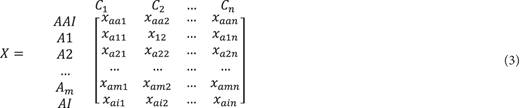
The Anti ideal solution (AAI) is the worst alternative, and the ideal solution (AI) is the best alternative solution. AI and AAI are defined as the following
Where and are benefit criteria and cost criteria, respectively.
Step 3: Extended initial matrix is converted to Normalized matrix by using equation
where elements and represents the element of the matrix .
Step 4: Weighted matrix is calculated by multiplying normalized matrix with the weight of criteria such that
Step 5: The utility degree of alternatives is calculated as following
Where and are utility degree of alternatives in relation with the anti-ideal solution and ideal solutions, respectively and
Step 6: The utility function is determined in this step. It is the compromise between observed alternative with respect to ideal and ant ideal solution and is defined as
Where and are the utility function in relation with ideal and anti-ideal solutions, respectively, and
Step 7: Finally, alternatives are ranked on the basis of their utility functions value. Alternatives with higher value of utility functions ranked high.
4. Data collection and application of the proposed methodology
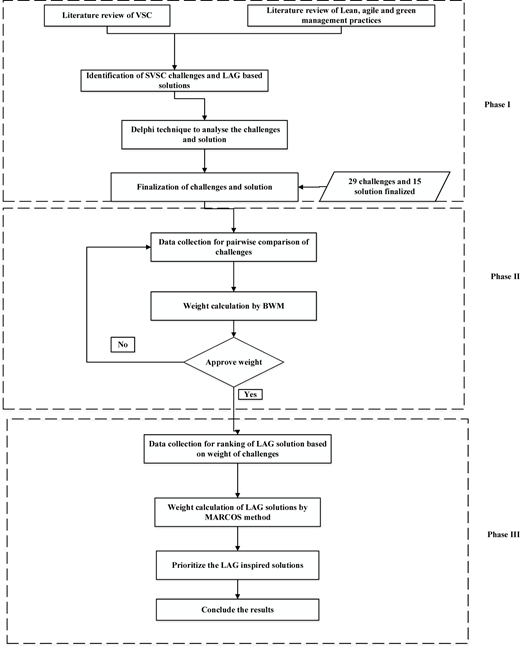
This section of the paper deals with the data collection and application of the integrated BWM-MARCOS methodology for prioritization of the Lean-Agile-Green inspired solution, which will help in overcoming the challenges of the sustainable vaccine supply chain (SVSC). Figure 1 shows the three-phase integrated BWM-MARCOS methodology used in this paper. The detailed description of data collection and all three phases is given in the following sections.
4.1 Data collection
In order to identify the challenges of the SVSC and their solutions, an in-depth literature review and field visits were conducted. The literature related to “vaccine supply chain”, “sustainability in vaccine distribution”, “challenges and issues of vaccine supply chain”, “vaccine distribution network design” and “environmental impact of mass vaccination” keywords are searched through Web of Science, Scopus, and PubMed, and the relevant paper in the English language since the year 2000 were selected. The white paper and reports published by the Ministry of Health and Family Welfare (MoHFW)- govt of India, WHO, and other international health agencies were also accessed. The literature related to Lean, agile, and green practices in SC and healthcare SC were accessed to frame a LAG-based solution. The field visit of GMSD, state, and zonal cold storage facilities of North India was performed to assess the challenges related to storage and cold chain logistics. The several district administration and immunization sites of Delhi, Uttarakhand, and Uttar Pradesh were also visited to explore the day-to-day challenges faced during last-mile delivery, crowd management, and waste disposal. The field visit was done during the period of September 2019 to July 2021.
After identification of challenges and solutions from the extensive literature review and field visit, several experts from the various organization involved in immunization programs were contacted to participate in this study. A heterogeneous group of experts from different domains of VSC was agreed for face-to-face or online interviews. The group of experts contains managers from international agencies working as management consultants in UIP of India, cold chain supervisors responsible for maintaining temperature requirements of vaccines as well as cold chain equipment, and a senior pharmacist from the GMSD. Two doctors, one acting as nodal officer for COVID-19 vaccine management and the other as vaccine administrator at the district level, are also part of the expert panel. A senior professor of healthcare supply chain and another having vast experience in lean-green studies were also contacted to include the perspective of academia in this study. The detail of all nine experts participating in this study is given in Table 1. These experts were invited to an online meeting to explain the ideas of lean, agile, and green, as well as their importance to the VSC's long-term sustainability.
Profile of experts involved in the study
| Position | Number | Academic background | Experience | Organization |
|---|---|---|---|---|
| Senior manager | 2 | Master's degree in business administration | >7 | WHO, USAID |
| Immunization officer | 2 | Medical degree | >16 | State/central Government |
| Senior pharmacist | 1 | Master's in pharmacy | >6 | Govt. Medical store Depot |
| Cold chain supervisor | 2 | University degree | >13 | State Government |
| Supply chain experts | 2 | Higher degree | >12 | Universities |
The data collection for this study is performed in two stages. In the first stage, several rounds of discussion have been performed to finalize challenges and solutions of SVSC with the help of Delphi technique. The challenges were also classified into five categories based on the suggestions of experts. In the second stage of data collection, a two-set of questionnaires is distributed among the experts to collect data for BWM-MARCOS analysis. The sample of questionnaires used in this study is given in Appendix 1. Several previous studies show that seven experts are sufficient for the MCDM techniques like BWM, TOPSIS, and MARCOS (Gupta and Barua, 2018; Kumar et al., 2021; Mathiyazhagan et al., 2021; Stević et al., 2020). Following the data analysis, an online meeting with all the experts was held to discuss the validity of the findings.
4.2 Finalization of challenges and solutions for the study
After identification of challenges from literature review and field visit, challenges were finalized after multiple rounds of discussion with the experts using the Delphi technique. Delphi technique is a consensus-building mechanism that leverages experts' opinions. A team of 9 experts was formed to finalize the SVSC challenges and categorize them into five main categories. Following the finalization of the challenges, additional rounds of discussion with experts were held to select the LAG-inspired techniques from the ones already identified. The basis of the finalization of LAG techniques was their capability to tackle the challenges of SVSC.
A total of twenty-nine SVSC challenges categorized in five main categories and fifteen LAG-inspired techniques are finalized with the help of the Delphi technique and given in Tables 2 and 3, respectively.
Challenges of sustainable vaccine supply chain
| Technical challenges (T) | ||
| Maintaining cold chain logistics (T1) | Maintaining the required temperature and cold chain to avoid equipment throughout SC | Alam et al. (2021), Anderson et al. (2014), Chen and Kristensen (2009), Hanson et al. (2017), Kahn et al. (2017), Lin et al. (2020), Matthias et al. (2007), Privett and Gonsalvez (2014) |
| Production failure at an early stage (T2) | Yield uncertainty of egg-based vaccine production and the product failure due to a technical glitch or workers negligence | Arifoǧlu et al. (2012), Chick et al. (2017), Cho (2010), Deo and Corbett (2008), Duijzer et al. (2018), LaFraniere and Noah (2021) |
| Manufacturing lead time (T3) | Vaccine manufacturing is a long and time-consuming process due to the natural process involved in it, and it cannot be accelerated easily | Lemmens et al. (2016), Plotkin et al. (2017), Ulmer et al. (2006) |
| Production capacity (T4) | Limited no. of companies which have mass production facilities compared to the demand | Hayman et al. (2021), Lassi et al. (2021), Pagliusi et al. (2020), Ulmer et al. (2006), Wouters et al. (2021) |
| Technology transfer for mass production (T5) | mRNA-based vaccines for COVID-19 came within a year but technology transfer for mass production is still a challenge | Lassi et al. (2021), Pagliusi et al. (2020), Plotkin et al. (2017), Singh et al. (2018), Ulmer et al. (2006), Burgos et al. (2021) |
| Strategical challenges (S) | ||
| Accurate forecasting of demand (S1) | Forecasting the vaccine demand to plan the vaccination program in a different part of the country | Alam et al. (2021) Expert opinion |
| Location allocation (S2) | Lesser no. of cold storage with limited capacity | Chandra and Kumar (2018a, 2020), Wouters et al. (2021), Zaffran et al. (2013) |
| Planning vaccination strategy (S3) | Planning vaccination strategy with changing nature of the pandemic and inclusion of new vaccines | Plotkin et al. (2017), Ulmer et al. (2006), Pagliusi et al. (2020), Wouters et al. (2021) |
| Multiple stakeholder involvement (S4) | VSC involves multiple players to deliver a dose successfully; interoperability among them is a significant challenge | Alam et al. (2021), Chiarini et al. (2017), Decouttere et al. (2016), Lemmens et al. (2016) |
| Tackling emergencies (S5) | Tackling emergencies like a new mutation of the virus, sudden spread of new infectious diseases, natural disasters and war/civil war also make vaccination challenging | Duijzer et al. (2018), Hayman et al. (2021), Lassi et al. (2021), Lin et al. (2021), Pagliusi et al. (2020), Wouters et al. (2021) |
| Stable financing (S6) | Being humanitarian relief, most of the vaccination programs are free of cost for the people of LMICs. This requires stable donors to continue immunization programs uninterrupted | Chandra et al. (2021), Alam et al. (2021), Massinga Loembé and Nkengasong (2021) |
| Supplier selection (S7) | Vaccine manufactured by different companies has different efficiency, side effects, price, and storage property. Selecting the best vaccine to optimize benefit of vaccination | Chick et al. (2008, 2017), Duijzer et al. (2018), Xie et al. (2021) |
| Vaccine surveillance (S8) | Monitoring the safety of vaccines and their adverse effect on the people. Tracking each and every individual in the mass vaccination becomes very tedious | de Figueiredo et al. (2020), Ghadimi and Heavey (2014), Lin et al. (2020), Massinga Loembé and Nkengasong (2021), Silva et al. (2015), Teytelman and Larson (2013), Patel and Orenstein (2019) |
| Operational challenges (O) | ||
| Data and information flow (O1) | The rapid vaccination program requires the smooth flow of information related to temperature maintenance, demand, availability, inventory, after effects, etc | Alam et al. (2021), Duijzer et al. (2018), Hayman et al. (2021), Lin et al. (2021), Massinga Loembé and Nkengasong (2021), Pagliusi et al. (2020), Patel and Orenstein (2019), Xie et al. (2021) |
| Inventory management (O2) | With the very limited production capacity of vaccines, stock-outs are very common. Managing inventory for optimum output becomes highly challenging in this scenario | Chandra et al. (2021), Duijzer et al. (2018), Lemmens et al. (2016), Zaffran et al. (2013) |
| Vaccine wastage (O3) | In the initial phase of COVID-19, some of the states noticed vaccine wastage beyond 30%, resulting in the delay of the vaccination program, increase in cost, and hazardous waste | Alam et al. (2021), Azadi et al. (2020), CNBC News (2021), Duijzer et al. (2018), Lee et al. (2010), Wallace et al. (2017), Zaffran et al. (2013) |
| Quick responsiveness (O4) | Responding to any operational failure such as cold equipment failure at facilities, transportation failure, stockouts at the vaccination center etc | Chandra and Kumar (2020), Chick et al. (2008), Chowdhury et al. (2021), Fattahi et al. (2017), Lemmens et al. (2016), Shah (2004) |
| Storage and handling of vaccines (O5) | The inflow of vast amounts of vaccines to very limited cold storage capacity posed a threat to the safety of vaccines. There is a greter risk of temperature leakage at storage and handling | Duijzer et al. (2018), Alam et al. (2021), Massinga Loembé and Nkengasong (2021), Chowdhury et al. (2021) |
| Cold chain logistics disruption (O6) | LMICs have the risk of equipment failure, electricity blackouts, natural calamity, etc., resulting in cold logistic disruption | Chowdhury et al. (2021), Lemmens et al. (2016), Chandra and Kumar (2020) |
| Human resource management (O7) | Rapid mass vaccination for COVID-19 requires a large number of medical staff and skilled volunteers. Arranging these human resources in the midst of a pandemic is very challenging for authorities | Chandra and Kumar (2020), Dasaklis et al. (2012), Zaffran et al. (2013) |
| Social challenges (So) | ||
| Vaccine hesitancy (So1) | Pandemic control requires vaccination of almost all populations, but a chunk of people or societies are highly reluctant to take vaccines despite their availability. Fear of adverse aftereffects, misconception, lack of positive vaccine marketing cultural and religious taboos are some of the main reasons for vaccine hesitancy | Dror et al. (2020), Guo and Cao (2021), Massinga Loembé and Nkengasong (2021), Wiyeh et al. (2018), Nguyen et al. (2021) |
| The adverse aftereffect of vaccines (So2) | Most of the vaccines for COVID-19 are allowed for emergency use only as their research and development phase are still in progress. This resulted in a significant amount of severe adverse aftereffects; managing these is very important to keep society's faith in vaccination programs | Crawford et al. (2014), Klein et al. (2021), Massinga Loembé and Nkengasong (2021) |
| Lack of faith in the healthcare sector (So3) | The debacle of the healthcare system during the pandemic left the people vulnerable. Gaining the confidence of people in government-run institutions is becoming a challenge | Expert opinion |
| Lack of vaccine advocacy in society (So4) | Educating people about vaccines, how vaccines work, and responsibility after vaccination is a significant challenge | Kaddar et al. (2013), Chandra and Kumar (2020) |
| Vaccine inequity (So5) | To end the pandemic, rapid vaccination of the global population is required. The distribution of vaccines to every individual irrespective of their economic and social background, nationality, and ideology is still a distant dream | Enayati and Özaltın (2019), Ismail et al. (2020), Jean-Jacques and Bauchner (2021) |
| Environmental challenges (E) | ||
| Bio-pharmaceutical waste management (E1) | The vaccine waste is hazardous waste and has the capability to spread new infectious diseases. With the massive vaccination, disposal of vaccine waste in the right manner is a very critical challenge | Duijzer et al. (2018), Klemeš et al. (2021), Zaffran et al. (2013), Phadke et al. (2021) |
| High energy consumption (E2) | VSC being a cold chain logistics, requires vast energy to maintain low temperature. Transportation of vaccines through all geography, immunization waste treatment also has a major contribution to energy consumption | Saif and Elhedhli (2016), Klemeš et al. (2021), Jiang et al. (2021) |
| Solid waste management (E3) | Other than vaccine wastage, the immunization program has syringes, vials, and protective gears of staff as wastage | Klemeš et al. (2021), Phadke et al. (2021) |
| Ecological effect of VSC(E4) | VSC produces a significant amount of carbon footprint in the life cycle of a vaccine. To eradicate the pandemic, the ecological effect of VSC is almost ignored | Klemeš et al. (2021), Phadke et al. (2021), Jiang et al. (2021) |
LAG based solutions for sustainable vaccine supply chain
| Lean | ||
| Visual stream mapping (VSM) (L1) | Material and information flow mapping of a vaccine life cycle to identify all the redundant processes business waste, material waste to streamline the process | Choudhary et al. (2019), Farias et al. (2019), Hartini and Ciptomulyono (2015), Parveen et al. (2011), Ruiz-Benítez et al. (2018) |
| Employee training (L2) | Training the employees for maintenance of low-temperature equipment, monitoring temperature, electronic data updation, crowd management, and necessary medical skills | Gebauer (2008), Kaswan and Rathi (2019), Privett and Gonsalvez (2014), Vázquez-Bustelo et al. (2007) |
| Technology advancement (L3) | Innovation in cold chain equipment, thermostability of vaccines, advancement in last-mile delivery passive cold boxes will improve the efficiency of SC. Inclusion of IoT devices, electric vehicles, and solar-powered freezers for more sustainable VSC | Brooks et al. (2017), Hayman et al. (2021), Leong et al. (2019), Lindsey (2015), Robertson et al. (2017), Tandon et al. (2020), Ulmer et al. (2006) |
| Effective management support (L4) | The VSC works in association with the existing healthcare system preliminary run by medical experts, cold chain technicians, and bureaucrats. The inclusion of management professionals will improve the strategic and operational efficiency of VSC | Gebauer (2008), Kaswan and Rathi (2019) |
| Innovation in electronic information sharing (L5) | Monitoring and maintenance of temperature throughout the distribution is a prerequisite for VSC. Installment of IoT devices at different nodes and connecting them with blockchain or other innovations will assure temper proof flow of information within the network | Cherrafi et al. (2018), Enayati and Özaltın (2019), Klemeš et al. (2021), Lydon et al. (2017), Shweta and Kumar (2020) |
| Vaccine awareness and education (L6) | The success of a vaccination program depends upon the willingness of people to take vaccines at the right time. So, the positive campaign for vaccines and educating people about the vaccination and post-vaccination through electronic and social media is very helpful to reduce vaccine hesitancy | Chandra and Kumar (2018a, b) |
| Agile | ||
| Contingency planning (A1) | Maintaining the reserve stock and logistic support for emergency outbreaks or any possible disruption due to electricity blackout, cold-chain equipment failure, transportation failure, etc | Dasaklis et al. (2012), Klemeš et al. (2021), Shamsi et al. (2018), Golan et al. (2021), Lee et al. (2009) |
| Demand visibility (A2) | Maintaining a dashboard of demand and inventory at each point of the distribution network for better demand and supply matches, transshipment between the storage nodes, and crowd management at the vaccination center | Eman et al. (2017), Privett and Gonsalvez (2014) |
| Flexible sourcing (A3) | Considering the pool of vaccine manufacturers and logistic providers to avoid delay in vaccination programs due to production failure or logistic disruptions. The flexible sourcing policy helps switch between different manufacturers to select the best available vaccine in the market | Azevedo et al. (2013), Govindan et al. (2014), Pazirandeh (2011) |
| Dynamic alliance (A4) | Collabrating with the other supply chains in the field for the different periods and different locations to assist VSC. This makes VSC more agile to cope with any turmoil and provides flexibility to select the best partner for the time being | Carvalho et al. (2011), Kumar et al. (2019), Mangla et al. (2018), Rosário Cabrita et al. (2016) |
| Coordination mechanism among all the stakeholders (A5) | A better coordination mechanism is required to improve interoperability among the different players with a varied work profiles | Chick et al. (2008), Kabra and Ramesh (2015), Lin et al. (2021), Singh et al. (2018), Alam et al. (2021) |
| Green | ||
| Environmental collaboration with partners (G1) | Stricter environmental guidelines for manufacturers, logistics partners, last-mile delivery partners, waste collectors, etc., to minimize the ecological impact of vaccination | Klemeš et al. (2021), Chin et al. (2015), Green et al. (2012), Grekova et al. (2016), Vachon and Klassen (2008) |
| Sustainable packaging (G2) | Vaccine waste and the associated wastes like syringes, vials, etc., can be reduced by using preloaded syringes. Preloaded syringes eliminate the open vial wastages. The plastic syringes can be replaced with polymer-based syringes, which can be easily recycled | Phadke et al. (2021) Expert opinion |
| ISO certification for bio-chemical waste management (G3) | The disposal of hazardous waste produced at a different section of VSC should follow the stricter guidelines as they have the potential to spread the new infectious disease | Klemeš et al. (2021) Expert opinion |
| Use of renewable energy (G4) | A huge amount of energy is used to deliver a vaccine to the beneficiary resulting in a higher carbon footprint. The use of solar-based freezers, electric vehicles, and other innovations can reduce the carbon emission load | Klemeš et al. (2021), Rehman Khan et al. (2018) |
4.3 Calculation of the weight for challenges using best worst method (BWM)
In the second phase of the study, the weight of main category and subcategory challenges were calculated using BWM. In the BWM technique, the best challenge is the one that is the most critical and demands to be tackled first, while the worst challenge has the least important and thus the slightest essential from the study's perspective and may be addressed last. First, the main category challenges pairwise comparison was performed, followed by subcategory challenges. Each expert was asked to select the most important (best) and least important (worst) criteria and rank other criteria accordingly using a 1 to 9 scale, where 1: equally important and 9: extremely important. The sample questionnaire used for pairwise comparison using BWM is given in Appendix 1. The rating of main category challenges for expert one is given in Table 4.
Pairwise comparison for main criteria
| Best to others | T | S | O | So | E |
|---|---|---|---|---|---|
| Best (S) | 4 | 1 | 2 | 6 | 8 |
| Others to the Worst | Worst (E) | ||||
| T | 5 | ||||
| S | 8 | ||||
| O | 7 | ||||
| So | 3 | ||||
| E | 1 | ||||
The next step is to determine the main criteria and sub-criteria weights after the experts have compared each of the main criteria challenges and sub-criteria challenges pairwise. The weight of criteria and sub-criteria are calculated by using Equation (2). In order to find the final weight of challenges, the weights from all the experts are aggregated by taking an average of individual weight. The final weight of challenges is given in Table 5.
Weightage and rank of challenges
| Challenge | Local | Local rank | Global eight | Global rank |
|---|---|---|---|---|
| Technological (T) | 0.145423263 | 3 | ||
| T1 | 0.512638434 | 1 | 0.07455 | 5 |
| T2 | 0.092100743 | 4 | 0.013394 | 23 |
| T3 | 0.156279882 | 3 | 0.022727 | 19 |
| T4 | 0.178499267 | 2 | 0.025958 | 14 |
| T5 | 0.060481674 | 5 | 0.008795 | 25 |
| Strategical (S) | 0.322188157 | 2 | ||
| S1 | 0.047394391 | 8 | 0.01527 | 22 |
| S2 | 0.05109242 | 7 | 0.016461 | 21 |
| S3 | 0.076114243 | 5 | 0.024523 | 16 |
| S4 | 0.279799792 | 1 | 0.090148 | 3 |
| S5 | 0.234095161 | 2 | 0.075423 | 4 |
| S6 | 0.081519914 | 4 | 0.026265 | 13 |
| S7 | 0.073774194 | 6 | 0.023769 | 18 |
| S8 | 0.156209885 | 3 | 0.050329 | 7 |
| Operational (O) | 0.379170933 | 1 | ||
| O1 | 0.139715899 | 3 | 0.052976 | 6 |
| O2 | 0.106321704 | 5 | 0.040314 | 9 |
| O3 | 0.255828933 | 1 | 0.097003 | 1 |
| O4 | 0.122503946 | 4 | 0.04645 | 8 |
| O5 | 0.24549759 | 2 | 0.093086 | 2 |
| O6 | 0.028691371 | 7 | 0.010879 | 24 |
| O7 | 0.101440556 | 6 | 0.038463 | 10 |
| Social (So) | 0.092121501 | 4 | ||
| So1 | 0.268191845 | 2 | 0.024706 | 15 |
| So2 | 0.332677997 | 1 | 0.030647 | 11 |
| So3 | 0.061355387 | 5 | 0.005652 | 28 |
| So4 | 0.072946711 | 4 | 0.00672 | 27 |
| So5 | 0.264828061 | 3 | 0.024396 | 17 |
| Environmental (E) | 0.061096146 | 5 | ||
| E1 | 0.450592031 | 1 | 0.027529 | 12 |
| E2 | 0.3587275 | 2 | 0.021917 | 20 |
| E3 | 0.129080243 | 3 | 0.007886 | 26 |
| E4 | 0.061600226 | 4 | 0.003764 | 29 |
4.4 Phase 3: prioritizing the solutions by MARCOS method
In the third phase, the LAG-inspired techniques are prioritized using the MARCOS method discussed in Section 3.2. The experts were asked to compare the LAG-based solutions with challenges using a scale of five degrees: 1 = VL → Very low influence; 3 = L → Low influence; 5 = M → Medium influence; 7 = H → High influence; 9 = VH → Very high influence. The ratings of all the experts are aggregated in a single matrix as the initial decision matrix. Then the extended initial matrix is calculated by using Equations (4) and (5) and given in Table 6.
Extended initial decision matrix
| T1 | T2 | T3 | T4 | T5 | S1 | S2 | S3 | S4 | S5 | S6 | S7 | S8 | O1 | O2 | O3 | O4 | O5 | O6 | O7 | So1 | So2 | So3 | So4 | So5 | E1 | E2 | E3 | E4 | |
|---|---|---|---|---|---|---|---|---|---|---|---|---|---|---|---|---|---|---|---|---|---|---|---|---|---|---|---|---|---|
| AAI | 1 | 1 | 1 | 1 | 1 | 1 | 1.7 | 3 | 1.7 | 1.7 | 1 | 1 | 1.7 | 1 | 1.7 | 3 | 1 | 3 | 1 | 1.7 | 1 | 2.3 | 1 | 1 | 1 | 2.3 | 1 | 1 | 1 |
| L1 | 3.7 | 3.7 | 7.7 | 3 | 5 | 3.7 | 3 | 5 | 2.3 | 4.3 | 1 | 1.7 | 5 | 3.7 | 5.7 | 9 | 3 | 5 | 1 | 7 | 1 | 3.7 | 1 | 1.7 | 1 | 6.3 | 5 | 5 | 7 |
| L2 | 3.7 | 4.3 | 5.7 | 2.3 | 2.3 | 4.3 | 1.7 | 5 | 4.3 | 5 | 1 | 1 | 7 | 7 | 5.7 | 8.3 | 5 | 7 | 3 | 6.3 | 2.3 | 5.7 | 3 | 5.7 | 5 | 7 | 5 | 9 | 5 |
| L3 | 9 | 5 | 7 | 5 | 6.3 | 3 | 3 | 3 | 2.3 | 5.7 | 2.3 | 3 | 7.7 | 6.3 | 5 | 8.3 | 5 | 7 | 3 | 3 | 1 | 3 | 1.7 | 2.3 | 3 | 5 | 9 | 1.7 | 7 |
| L4 | 5 | 1 | 3 | 5 | 2.3 | 7 | 5 | 7 | 7 | 5.7 | 5.7 | 6.3 | 7 | 8.3 | 7.7 | 6.3 | 7 | 8.3 | 5 | 9 | 4.3 | 6.3 | 3 | 7 | 7 | 7.7 | 5 | 7 | 5 |
| L5 | 7.7 | 2.3 | 3 | 2.3 | 4.3 | 7 | 3 | 7 | 6.3 | 7 | 1.7 | 4.3 | 9 | 9 | 7 | 7 | 7.7 | 7 | 7 | 7.7 | 2.3 | 9 | 5.7 | 5.7 | 7 | 7 | 3.7 | 7 | 5 |
| L6 | 4.3 | 1 | 2.3 | 1 | 1 | 4.3 | 3 | 6.3 | 4.3 | 7 | 1.7 | 1.7 | 7 | 6.3 | 7 | 9 | 7 | 7 | 3 | 5.7 | 8.3 | 8.3 | 5.7 | 9 | 7 | 8.3 | 3 | 9 | 7 |
| A1 | 1 | 7 | 1 | 1 | 2.3 | 2.3 | 4.3 | 5.7 | 1.7 | 9 | 4.3 | 4.3 | 3 | 1 | 7 | 3 | 9 | 3 | 9 | 2.3 | 1 | 2.3 | 6.3 | 3 | 3 | 2.3 | 1 | 1 | 1 |
| A2 | 2.3 | 2.3 | 1.7 | 4.3 | 1 | 9 | 6.3 | 9 | 5.7 | 7.7 | 4.3 | 6.3 | 3 | 3 | 7 | 7 | 5.7 | 5.7 | 4.3 | 4.3 | 1 | 3 | 2.3 | 1 | 7 | 5 | 3 | 5 | 1 |
| A3 | 3.7 | 6.3 | 2.3 | 3 | 1.7 | 2.3 | 5.7 | 7.7 | 3.7 | 8.3 | 1.7 | 4.3 | 1.7 | 1.7 | 5.7 | 3.7 | 7.7 | 3 | 7.7 | 1.7 | 1 | 3 | 3.7 | 1 | 1 | 3.7 | 4.3 | 3.7 | 9 |
| A4 | 5.7 | 3.7 | 3.7 | 6.3 | 5.7 | 2.3 | 7.7 | 6.3 | 5 | 9 | 5 | 5 | 7 | 5 | 3 | 4.3 | 9 | 7 | 9 | 6.3 | 1.7 | 6.3 | 3 | 3.7 | 5 | 7.7 | 6.3 | 7.7 | 7 |
| A5 | 6.3 | 3 | 5.7 | 3 | 3 | 7 | 3 | 6.3 | 9 | 7 | 3.7 | 5 | 7.7 | 7 | 9 | 8.3 | 7 | 6.3 | 6.3 | 7.7 | 2.3 | 8.3 | 4.3 | 3.7 | 5 | 5.7 | 3 | 6.3 | 5 |
| G1 | 1 | 1 | 1.7 | 1.7 | 1 | 2.3 | 2.3 | 3.7 | 5.7 | 2.3 | 5 | 6.3 | 1.7 | 1 | 2.3 | 3 | 1 | 5 | 1 | 2.3 | 1 | 2.3 | 3.7 | 1.7 | 1 | 8.3 | 4.3 | 8.3 | 9 |
| G2 | 7 | 1 | 1 | 1 | 1 | 2.3 | 5 | 7 | 2.3 | 5.7 | 3.7 | 4.3 | 7 | 6.3 | 6.3 | 9 | 3 | 8.3 | 5.7 | 2.3 | 1.7 | 4.3 | 3 | 2.3 | 1 | 7 | 5 | 7.7 | 7 |
| G3 | 1 | 1.7 | 1 | 2.3 | 1 | 1 | 3.7 | 4.3 | 2.3 | 1.7 | 3.7 | 5 | 1.7 | 2.3 | 1.7 | 7.7 | 1 | 3.7 | 1 | 1.7 | 1 | 3.7 | 3.7 | 1.7 | 1 | 9 | 1.7 | 9 | 9 |
| G4 | 7 | 1 | 1 | 3 | 1 | 1.7 | 7 | 3.7 | 2.3 | 8.3 | 5 | 3 | 5 | 5.7 | 3 | 5.7 | 5.7 | 6.3 | 7 | 1.7 | 1 | 2.3 | 1.7 | 1.7 | 1 | 3 | 9 | 3 | 9 |
| AI | 9 | 7 | 7.7 | 6.3 | 6.3 | 9 | 7.7 | 9 | 9 | 9 | 5.7 | 6.3 | 9 | 9 | 9 | 9 | 9 | 8.3 | 9 | 9 | 8.3 | 9 | 6.3 | 9 | 7 | 9 | 9 | 9 | 9 |
In the next step, a normalized matrix is calculated by Equations (6) and (7) and given in Table 7. The weighted matrix is calculated using Equation (8) and given as Table 8. The solutions are ranked on the basis of their utility function , which is calculated by using Equations (9) to (14) and given in Table 9.
Normalized matrix
| T1 | T2 | T3 | T4 | T5 | S1 | S2 | S3 | S4 | S5 | S6 | S7 | S8 | O1 | O2 | O3 | O4 | O5 | O6 | O7 | So1 | So2 | So3 | So4 | So5 | E1 | E2 | E3 | E4 | |
|---|---|---|---|---|---|---|---|---|---|---|---|---|---|---|---|---|---|---|---|---|---|---|---|---|---|---|---|---|---|
| AAI | 0.11 | 0.14 | 0.13 | 0.16 | 0.16 | 0.11 | 0.22 | 0.33 | 0.19 | 0.19 | 0.18 | 0.16 | 0.19 | 0.11 | 0.19 | 0.33 | 0.11 | 0.36 | 0.11 | 0.19 | 0.12 | 0.26 | 0.16 | 0.11 | 0.14 | 0.26 | 0.11 | 0.11 | 0.11 |
| L1 | 0.41 | 0.52 | 1 | 0.47 | 0.79 | 0.41 | 0.39 | 0.56 | 0.26 | 0.48 | 0.18 | 0.26 | 0.56 | 0.41 | 0.63 | 1 | 0.33 | 0.6 | 0.11 | 0.78 | 0.12 | 0.41 | 0.16 | 0.19 | 0.14 | 0.7 | 0.56 | 0.56 | 0.78 |
| L2 | 0.41 | 0.62 | 0.74 | 0.37 | 0.37 | 0.48 | 0.22 | 0.56 | 0.48 | 0.56 | 0.18 | 0.16 | 0.78 | 0.78 | 0.63 | 0.93 | 0.56 | 0.84 | 0.33 | 0.7 | 0.28 | 0.63 | 0.47 | 0.63 | 0.71 | 0.78 | 0.56 | 1 | 0.56 |
| L3 | 1 | 0.71 | 0.91 | 0.79 | 1 | 0.33 | 0.39 | 0.33 | 0.26 | 0.63 | 0.41 | 0.47 | 0.85 | 0.7 | 0.56 | 0.93 | 0.56 | 0.84 | 0.33 | 0.33 | 0.12 | 0.33 | 0.26 | 0.26 | 0.43 | 0.56 | 1 | 0.19 | 0.78 |
| L4 | 0.56 | 0.14 | 0.39 | 0.79 | 0.37 | 0.78 | 0.65 | 0.78 | 0.78 | 0.63 | 1 | 1 | 0.78 | 0.93 | 0.85 | 0.7 | 0.78 | 1 | 0.56 | 1 | 0.52 | 0.7 | 0.47 | 0.78 | 1 | 0.85 | 0.56 | 0.78 | 0.56 |
| L5 | 0.85 | 0.33 | 0.39 | 0.37 | 0.68 | 0.78 | 0.39 | 0.78 | 0.7 | 0.78 | 0.29 | 0.68 | 1 | 1 | 0.78 | 0.78 | 0.85 | 0.84 | 0.78 | 0.85 | 0.28 | 1 | 0.89 | 0.63 | 1 | 0.78 | 0.41 | 0.78 | 0.56 |
| L6 | 0.48 | 0.14 | 0.3 | 0.16 | 0.16 | 0.48 | 0.39 | 0.7 | 0.48 | 0.78 | 0.29 | 0.26 | 0.78 | 0.7 | 0.78 | 1 | 0.78 | 0.84 | 0.33 | 0.63 | 1 | 0.93 | 0.89 | 1 | 1 | 0.93 | 0.33 | 1 | 0.78 |
| A1 | 0.11 | 1 | 0.13 | 0.16 | 0.37 | 0.26 | 0.57 | 0.63 | 0.19 | 1 | 0.76 | 0.68 | 0.33 | 0.11 | 0.78 | 0.33 | 1 | 0.36 | 1 | 0.26 | 0.12 | 0.26 | 1 | 0.33 | 0.43 | 0.26 | 0.11 | 0.11 | 0.11 |
| A2 | 0.26 | 0.33 | 0.22 | 0.68 | 0.16 | 1 | 0.83 | 1 | 0.63 | 0.85 | 0.76 | 1 | 0.33 | 0.33 | 0.78 | 0.78 | 0.63 | 0.68 | 0.48 | 0.48 | 0.12 | 0.33 | 0.37 | 0.11 | 1 | 0.56 | 0.33 | 0.56 | 0.11 |
| A3 | 0.41 | 0.9 | 0.3 | 0.47 | 0.26 | 0.26 | 0.74 | 0.85 | 0.41 | 0.93 | 0.29 | 0.68 | 0.19 | 0.19 | 0.63 | 0.41 | 0.85 | 0.36 | 0.85 | 0.19 | 0.12 | 0.33 | 0.58 | 0.11 | 0.14 | 0.41 | 0.48 | 0.41 | 1 |
| A4 | 0.63 | 0.52 | 0.48 | 1 | 0.89 | 0.26 | 1 | 0.7 | 0.56 | 1 | 0.88 | 0.79 | 0.78 | 0.56 | 0.33 | 0.48 | 1 | 0.84 | 1 | 0.7 | 0.2 | 0.7 | 0.47 | 0.41 | 0.71 | 0.85 | 0.7 | 0.85 | 0.78 |
| A5 | 0.7 | 0.43 | 0.74 | 0.47 | 0.47 | 0.78 | 0.39 | 0.7 | 1 | 0.78 | 0.65 | 0.79 | 0.85 | 0.78 | 1 | 0.93 | 0.78 | 0.76 | 0.7 | 0.85 | 0.28 | 0.93 | 0.68 | 0.41 | 0.71 | 0.63 | 0.33 | 0.7 | 0.56 |
| G1 | 0.11 | 0.14 | 0.22 | 0.26 | 0.16 | 0.26 | 0.3 | 0.41 | 0.63 | 0.26 | 0.88 | 1 | 0.19 | 0.11 | 0.26 | 0.33 | 0.11 | 0.6 | 0.11 | 0.26 | 0.12 | 0.26 | 0.58 | 0.19 | 0.14 | 0.93 | 0.48 | 0.93 | 1 |
| G2 | 0.78 | 0.14 | 0.13 | 0.16 | 0.16 | 0.26 | 0.65 | 0.78 | 0.26 | 0.63 | 0.65 | 0.68 | 0.78 | 0.7 | 0.7 | 1 | 0.33 | 1 | 0.63 | 0.26 | 0.2 | 0.48 | 0.47 | 0.26 | 0.14 | 0.78 | 0.56 | 0.85 | 0.78 |
| G3 | 0.11 | 0.24 | 0.13 | 0.37 | 0.16 | 0.11 | 0.48 | 0.48 | 0.26 | 0.19 | 0.65 | 0.79 | 0.19 | 0.26 | 0.19 | 0.85 | 0.11 | 0.44 | 0.11 | 0.19 | 0.12 | 0.41 | 0.58 | 0.19 | 0.14 | 1 | 0.19 | 1 | 1 |
| G4 | 0.78 | 0.14 | 0.13 | 0.47 | 0.16 | 0.19 | 0.91 | 0.41 | 0.26 | 0.93 | 0.88 | 0.47 | 0.56 | 0.63 | 0.33 | 0.63 | 0.63 | 0.76 | 0.78 | 0.19 | 0.12 | 0.26 | 0.26 | 0.19 | 0.14 | 0.33 | 1 | 0.33 | 1 |
| AI | 1 | 1 | 1 | 1 | 1 | 1 | 1 | 1 | 1 | 1 | 1 | 1 | 1 | 1 | 1 | 1 | 1 | 1 | 1 | 1 | 1 | 1 | 1 | 1 | 1 | 1 | 1 | 1 | 1 |
The weighted matrix
| T1 | T2 | T3 | T4 | T5 | S1 | S2 | S3 | S4 | S5 | S6 | S7 | S8 | O1 | O2 | O3 | O4 | O5 | O6 | O7 | So1 | So2 | So3 | So4 | So5 | E1 | E2 | E3 | E4 | |
|---|---|---|---|---|---|---|---|---|---|---|---|---|---|---|---|---|---|---|---|---|---|---|---|---|---|---|---|---|---|
| AAI | 0.01 | 0 | 0 | 0 | 0 | 0 | 0 | 0.01 | 0.02 | 0.01 | 0 | 0 | 0.01 | 0.01 | 0.01 | 0.03 | 0.01 | 0.03 | 0 | 0.01 | 0 | 0.01 | 0 | 0 | 0 | 0.01 | 0 | 0 | 0 |
| L1 | 0.03 | 0.01 | 0.02 | 0.01 | 0.01 | 0.01 | 0.01 | 0.01 | 0.02 | 0.04 | 0 | 0.01 | 0.03 | 0.02 | 0.03 | 0.1 | 0.02 | 0.06 | 0 | 0.03 | 0 | 0.01 | 0 | 0 | 0 | 0.02 | 0.01 | 0 | 0 |
| L2 | 0.03 | 0.01 | 0.02 | 0.01 | 0 | 0.01 | 0 | 0.01 | 0.04 | 0.04 | 0 | 0 | 0.04 | 0.04 | 0.03 | 0.09 | 0.03 | 0.08 | 0 | 0.03 | 0.01 | 0.02 | 0 | 0 | 0.02 | 0.02 | 0.01 | 0.01 | 0 |
| L3 | 0.07 | 0.01 | 0.02 | 0.02 | 0.01 | 0.01 | 0.01 | 0.01 | 0.02 | 0.05 | 0.01 | 0.01 | 0.04 | 0.04 | 0.02 | 0.09 | 0.03 | 0.08 | 0 | 0.01 | 0 | 0.01 | 0 | 0 | 0.01 | 0.02 | 0.02 | 0 | 0 |
| L4 | 0.04 | 0 | 0.01 | 0.02 | 0 | 0.01 | 0.01 | 0.02 | 0.07 | 0.05 | 0.03 | 0.02 | 0.04 | 0.05 | 0.03 | 0.07 | 0.04 | 0.09 | 0.01 | 0.04 | 0.01 | 0.02 | 0 | 0.01 | 0.02 | 0.02 | 0.01 | 0.01 | 0 |
| L5 | 0.06 | 0 | 0.01 | 0.01 | 0.01 | 0.01 | 0.01 | 0.02 | 0.06 | 0.06 | 0.01 | 0.02 | 0.05 | 0.05 | 0.03 | 0.08 | 0.04 | 0.08 | 0.01 | 0.03 | 0.01 | 0.03 | 0.01 | 0 | 0.02 | 0.02 | 0.01 | 0.01 | 0 |
| L6 | 0.04 | 0 | 0.01 | 0 | 0 | 0.01 | 0.01 | 0.02 | 0.04 | 0.06 | 0.01 | 0.01 | 0.04 | 0.04 | 0.03 | 0.1 | 0.04 | 0.08 | 0 | 0.02 | 0.02 | 0.03 | 0.01 | 0.01 | 0.02 | 0.03 | 0.01 | 0.01 | 0 |
| A1 | 0.01 | 0.01 | 0 | 0 | 0 | 0 | 0.01 | 0.02 | 0.02 | 0.08 | 0.02 | 0.02 | 0.02 | 0.01 | 0.03 | 0.03 | 0.05 | 0.03 | 0.01 | 0.01 | 0 | 0.01 | 0.01 | 0 | 0.01 | 0.01 | 0 | 0 | 0 |
| A2 | 0.02 | 0 | 0 | 0.02 | 0 | 0.02 | 0.01 | 0.02 | 0.06 | 0.06 | 0.02 | 0.02 | 0.02 | 0.02 | 0.03 | 0.08 | 0.03 | 0.06 | 0.01 | 0.02 | 0 | 0.01 | 0 | 0 | 0.02 | 0.02 | 0.01 | 0 | 0 |
| A3 | 0.03 | 0.01 | 0.01 | 0.01 | 0 | 0 | 0.01 | 0.02 | 0.04 | 0.07 | 0.01 | 0.02 | 0.01 | 0.01 | 0.03 | 0.04 | 0.04 | 0.03 | 0.01 | 0.01 | 0 | 0.01 | 0 | 0 | 0 | 0.01 | 0.01 | 0 | 0 |
| A4 | 0.05 | 0.01 | 0.01 | 0.03 | 0.01 | 0 | 0.02 | 0.02 | 0.05 | 0.08 | 0.02 | 0.02 | 0.04 | 0.03 | 0.01 | 0.05 | 0.05 | 0.08 | 0.01 | 0.03 | 0 | 0.02 | 0 | 0 | 0.02 | 0.02 | 0.02 | 0.01 | 0 |
| A5 | 0.05 | 0.01 | 0.02 | 0.01 | 0 | 0.01 | 0.01 | 0.02 | 0.09 | 0.06 | 0.02 | 0.02 | 0.04 | 0.04 | 0.04 | 0.09 | 0.04 | 0.07 | 0.01 | 0.03 | 0.01 | 0.03 | 0 | 0 | 0.02 | 0.02 | 0.01 | 0.01 | 0 |
| G1 | 0.01 | 0 | 0 | 0.01 | 0 | 0 | 0.01 | 0.01 | 0.06 | 0.02 | 0.02 | 0.02 | 0.01 | 0.01 | 0.01 | 0.03 | 0.01 | 0.06 | 0 | 0.01 | 0 | 0.01 | 0 | 0 | 0 | 0.03 | 0.01 | 0.01 | 0 |
| G2 | 0.06 | 0 | 0 | 0 | 0 | 0 | 0.01 | 0.02 | 0.02 | 0.05 | 0.02 | 0.02 | 0.04 | 0.04 | 0.03 | 0.1 | 0.02 | 0.09 | 0.01 | 0.01 | 0 | 0.01 | 0 | 0 | 0 | 0.02 | 0.01 | 0.01 | 0 |
| G3 | 0.01 | 0 | 0 | 0.01 | 0 | 0 | 0.01 | 0.01 | 0.02 | 0.01 | 0.02 | 0.02 | 0.01 | 0.01 | 0.01 | 0.08 | 0.01 | 0.04 | 0 | 0.01 | 0 | 0.01 | 0 | 0 | 0 | 0.03 | 0 | 0.01 | 0 |
| G4 | 0.06 | 0 | 0 | 0.01 | 0 | 0 | 0.02 | 0.01 | 0.02 | 0.07 | 0.02 | 0.01 | 0.03 | 0.03 | 0.01 | 0.06 | 0.03 | 0.07 | 0.01 | 0.01 | 0 | 0.01 | 0 | 0 | 0 | 0.01 | 0.02 | 0 | 0 |
| AI | 0.07 | 0.01 | 0.02 | 0.03 | 0.01 | 0.02 | 0.02 | 0.02 | 0.09 | 0.08 | 0.03 | 0.02 | 0.05 | 0.05 | 0.04 | 0.1 | 0.05 | 0.09 | 0.01 | 0.04 | 0.02 | 0.03 | 0.01 | 0.01 | 0.02 | 0.03 | 0.02 | 0.01 | 0 |
Final weight of solutions
| Rank | |||||||
|---|---|---|---|---|---|---|---|
| 0.2 | |||||||
| L1 | 0.51 | 2.55 | 0.51 | 0.17 | 0.83 | 0.49 | 11 |
| L2 | 0.61 | 3.05 | 0.61 | 0.17 | 0.83 | 0.59 | 7 |
| L3 | 0.63 | 3.14 | 0.63 | 0.17 | 0.83 | 0.61 | 6 |
| L4 | 0.76 | 3.8 | 0.76 | 0.17 | 0.83 | 0.74 | 2 |
| L5 | 0.75 | 3.77 | 0.75 | 0.17 | 0.83 | 0.73 | 3 |
| L6 | 0.68 | 3.38 | 0.68 | 0.17 | 0.83 | 0.66 | 5 |
| A1 | 0.42 | 2.08 | 0.42 | 0.17 | 0.83 | 0.4 | 13 |
| A2 | 0.59 | 2.96 | 0.59 | 0.17 | 0.83 | 0.57 | 9 |
| A3 | 0.45 | 2.27 | 0.45 | 0.17 | 0.83 | 0.44 | 12 |
| A4 | 0.69 | 3.46 | 0.69 | 0.17 | 0.83 | 0.67 | 4 |
| A5 | 0.76 | 3.82 | 0.76 | 0.17 | 0.83 | 0.74 | 1 |
| G1 | 0.36 | 1.81 | 0.36 | 0.17 | 0.83 | 0.35 | 14 |
| G2 | 0.6 | 3.02 | 0.6 | 0.17 | 0.83 | 0.58 | 8 |
| G3 | 0.35 | 1.77 | 0.35 | 0.17 | 0.83 | 0.34 | 15 |
| G4 | 0.54 | 2.69 | 0.54 | 0.17 | 0.83 | 0.52 | 10 |
| 0.2 |
5. Result and discussion
The hybrid BWM-MARCOS methodology used in this paper involves less pairwise comparison and is comparatively more systematic for experts to prioritize the challenges and solutions for SVSC. The successful history of lean, agile, and green paradigms in manufacturing and management helps to give experts a clearer idea of how the integrated LAG-based technique will perform to address the challenges of SVSC. Thus, the LAG-based framework will result in a more realistic and stable ranking of the solution.
5.1 Critical challenges of SVSC
Finding the critical issues and challenges is vital for redesigning the VSC in a more sustainable distribution network. For this purpose, the twenty-nine SVSC challenges were divided into five categories and assessed using the BWM technique. The analysis shows that the Operational challenge (O) was weighted highest, followed by, Strategical challenge (S), Technological challenge (T), Social challenge (So), and Environmental challenge (O > S > T > So > E) as given in Table 4. The Previous studies on regular immunization programs have also underlined the severity of operational challenges (Chandra et al., 2021; Chandra and Kumar, 2020), but the emergency of COVID-19 amplified this. The experts highlighted that the mass vaccination for COVID-19 with limited infrastructure and workforce resulted in several day-to-day challenges which were not very dominant in earlier universal immunization programs. Next, in order of importance, is the “strategic challenges” that result from the critical role of policy and governance in the humanitarian supply chain. In LMICS like India, where the central government runs most immunization programs as well as COVID-19 vaccination, strategic decision-making is centralized, which makes the strategic challenges critical for policymaking. The “technical challenges” is ranked next, which is one of the major causes that hamper mass vaccination as well as routine immunizations. As a cold chain, VSC necessitates further technological innovation to store and distribute vaccines in geographically and demographically diverse countries such as India. The vaccine damage due to disruption in cold chain logistics caused by equipment failure or interrupted electricity is also reported at some vaccination stores. Pandemic has had a devastating effect on human life; the short-term goal is to end this by any means; this is why the environmental impact of vaccination is ignored by many, resulting in lesser importance. In the era of climate change and ecological imbalance, the impact of vaccination on the environment must be considered for a sustainable vaccination (Klemeš et al., 2021).
The weight of subcategory with their local and global ranking is given in Table 5. The overall importance of the challenges based on their global weights are ranked in order O3 > O5 > S4 > S5 > T1 > O1 > S8 > O4 > O2 > O7 So2 > E1 > S6 > T4 > So1 > S3 > So5 > S7 > T3 > E2 > S2 > S1 > T2 > O6 > T5 > E3 > So4 > So3 > E4. Vaccine wastage (O3) is weighted highest in this analysis and regarded as the most critical challenge. Open vial waste is a serious concern in routine immunization (Azadi et al., 2020; Chandra and Kumar, 2021), but storing vaccines in cold storage beyond their capacity aggravated the situation of vaccine wastage in warehouses. This is also in conformation with the study of Hasija et al. (2021). India also reported the wastage of more than 6 million doses of COVID-19 vaccines at the end of the year 2021(Deccan Herald, 2021). The wastage of vaccines is not limited to LMICs only. In the mid of the pandemic, the USA wasted more than 15 million doses of COVID-19 vaccines due to malfunctioning of cold chain equipment and several other reasons (CNBC News, 2021). The next challenge in this order is storage and handling of vaccines (O5). The addition of a huge quantity of COVID-19 vaccines to an already overburdened cold logistics produced an issue with vaccine storage and handling in the VSC. The higher weight of storage and handling is due to the fact that it is causing/amplifying several other challenges in VSC. This is also concluded in the study of Alam et al. (2021).
The involvement of multiple stakeholders (S4) is the next significant challenge, which may be due to the lack of coordination among different organizations working in VSC as well as the lack of collaboration among the different levels of SC. Alam et al. (2021) also highlighted that the lack of collaboration between different levels of VSC is a significant challenge during the pandemic. The next ranked challenge is tackling emergencies (S5). The experts pointed out that the existing VSC was designed for routine immunization programs, and the logistics support and personnel were not sufficient to respond to any sudden outbreak of infectious disease or bioterror attack. The maintenance of cold chain logistics (T1) is ranked next in order of importance of challenges. The potency of vaccines is reduced when they are exposed to temperatures outside of the recommended range; thus, maintaining a low-temperature environment is essential throughout the SC (Lin et al., 2020). The interrupted supply of electricity in the country's interior, the old cold chain equipment, and the ultra-deep freeze requirement for some vaccines raised several challenges in this regard.
Apart from these five critical challenges, the other significant challenges are as follows. Data and information flow (O1) is ranked next. The cold logistics and vaccination process produces a huge amount of data regarding the temperature of vaccines at different nodes, inventory at various levels, information of beneficiaries, and their post-vaccination feedback. Handling this amount of data is always a significant challenge. Vaccine surveillance (S8) and quick responsiveness (O4) are the next in order, followed by Inventory management (O2) and human resource management (O7). Most of the social and environmental challenges are weighted low in the result. According to the experts, mass vaccination is linked to a humanitarian cause, and individuals are fully cognizant of their necessities of vaccines, resulting in a lower weighting of social challenges. Experts pointed out that the low weighting of environmental challenges is due to a lack of assessment of the environmental impact of vaccine during such a pandemic emergency. This should not be overlooked in the long term because immunization would not save us from climate change.
5.2 Ranking of LAG based solutions
A LAG-based framework has been proposed to tackle the aforementioned challenges of SVSC. The LAG practices have been prioritized based on their influence on challenges using the MARCOS method. The outcome of () value is used to rank the LAG techniques in the order of A5 > L4 > L5 > A4 > L6 > L3 > G2 > L2 > A2 > G4 > L1 > A3 > A1 > G1 > G3 and given in Table 9. The coordination mechanism among stakeholders (A5) is weighted highest. In the LMICs like India, routine immunization programs run with the help of the government's HCOs and many international healthcare agencies. Close coordination among all these key stakeholders is important for efficient VSC. The experts agreed that a better coordination mechanism among all key stakeholders will aid in managing VSC's strategic and operational challenges. In this regard, frequent workshops and meetings should be arranged to make all management domains aware of their roles and responsibilities. Chandra and Kumar (2019) also found that improvement in coordination is one of the critical factors for the successful routine immunization programs of India. The next ranked solution is the deployment of effective management support (L4) to the VSC. During our field visit, it was found that most of the VSC decision-makers and administrators were from medical background, which may be one of the reasons for the inefficiency of VSC. The experts suggested that the inclusion of more management professionals will help in identifying the bottlenecks, the unproductive process. This will also help in better forecasting as well as the implementation of new management techniques in VSC. The study of Chandra et al. (2021) also revealed that in the future, with the inclusion of new vaccines, more VSC professionals with the necessary technical and leadership skills will be required to operate the VSC.
Innovation in electronic information sharing (L5) is ranked third in this study. Electronic Vaccine Intelligence Network (eVIN) for routine immunization program and CoWIN during COVID-19 mass immunization program has a great success in India. Anderson et al. (2014) also showed that innovation in information sharing that monitors country vaccine store's information and the cold chain equipment is important for strategic as well as operational challenges. The next solution for SVSC challenges is Dynamic alliance (A4). This practice was a new revelation in VSC during our interactions with experts. The experts suggested that flexible alliances of enterprises with the same capability will help VSC include more vaccines and quick delivery in case of emergencies. This will be possible by pooling the core competence of allied enterprises. The fifth-ranked LAG practice is vaccine awareness education (L6). The awareness regarding necessity of vaccines, safe vaccination practices, and proper management of immunization waste should be spread through different online and offline modes. During COVID-19 mass vaccination, healthcare organizations used social media and influential people to spread awareness regarding vaccination, it reduced vaccine hesitancy significantly. However, people must be educated about safe immunization practices and their responsibilities in terms of waste management and the environment. The next practice in order is technical advancement (L3), which is important for large-scale vaccine production, the advancement of cold chain equipment, and innovation in last-mile delivery. During the field visit, it was observed that most vaccine stores were overburdened due to the inclusion of a huge quantity of COVID-19 vaccines. The lack of cold chain infrastructure in the country is one of the main reasons behind this. Lee et al. (2012) show that thermostable vaccines will eliminate the need for refrigerators and freezers in the vaccine distribution network, which will reduce bottleneck as well as operational costs. Robertson et al. (2017) study emphasized the use of solar refrigerators, passive cold boxes, and other innovations for last-mile delivery. Sustainable packaging (G2) is the next important practice mainly related to reducing vaccine wastage and the environmental impact of vaccination. The use of optimal vial size, sustainable and recyclable packaging materials for vaccines and other immunization-related products will help reduce vaccine wastage and its impact on the environment (Phadke et al., 2021).
These top solutions will efficiently overcome most of the operational and strategical challenges impeding effective vaccination for controlling infectious disease. After analyzing the result, experts concluded that solutions like environmental collaboration (G1) and ISO certification for bio-chemical waste management (G3) are ranked very low due to emergencies like a pandemic, but they cannot be ignored. There is a need for awareness about the environmental impact of vaccination among researchers to highlight the issue (Klemeš et al., 2021). When comparing lean and agile practices to green practices, the rating of LAG practices as solutions shows that lean and agile practices are ranked higher. However, experts point out that the inclusion of green practices makes VSC more sustainable, and their weightage will improve as the pandemic subsides. The ranking of the LAG-based solution is in the context of India, but it can be transcended in other LMICs also by including the experts from a particular region or nation.
5.3 Sensitivity analysis
The Sensitivity Analysis (SA) objective is to determine the impact of the most important criterion on the performance of the proposed model. The proportionality of weight method used by Stević et al. (2020) is utilized in this study for sensitivity analysis. In order to perform sensitivity analysis, the SVSC challenge (criteria) with max weight is selected. The weight of the most significant challenge, “vaccine wastage (O3)” is varied from 0 to 1 along with the proportional change in weight of other challenges. A total of twenty-one scenarios is created for this study. Each set of scenarios always satisfies the universal state of proportionality of weight coefficient, such that the sum of all weight coefficients must be equal to 1. The weight of twenty-one set with the different scenarios is given in Table 10. The impact of changes in weight of SVSC challenges on the LAG-based solution is given as Figure 2.
The new weights of SVSC challenges for 21 experiments
| E1 | E2 | E3 | E4 | E5 | E6 | E7 | E8 | E9 | E10 | E11 | E12 | E13 | E14 | E15 | E16 | E17 | E18 | E19 | E20 | E21 | |
|---|---|---|---|---|---|---|---|---|---|---|---|---|---|---|---|---|---|---|---|---|---|
| T1 | 0.083 | 0.078 | 0.074 | 0.07 | 0.066 | 0.062 | 0.058 | 0.054 | 0.05 | 0.045 | 0.041 | 0.037 | 0.033 | 0.029 | 0.025 | 0.021 | 0.017 | 0.012 | 0.008 | 0.004 | 0 |
| T2 | 0.015 | 0.014 | 0.013 | 0.013 | 0.012 | 0.011 | 0.01 | 0.01 | 0.009 | 0.008 | 0.007 | 0.007 | 0.006 | 0.005 | 0.004 | 0.004 | 0.003 | 0.002 | 0.001 | 0.000 | 0 |
| T3 | 0.025 | 0.024 | 0.023 | 0.021 | 0.02 | 0.019 | 0.018 | 0.016 | 0.015 | 0.014 | 0.013 | 0.011 | 0.01 | 0.009 | 0.008 | 0.006 | 0.005 | 0.004 | 0.003 | 0.001 | 0 |
| T4 | 0.029 | 0.027 | 0.026 | 0.024 | 0.023 | 0.022 | 0.02 | 0.019 | 0.017 | 0.016 | 0.014 | 0.013 | 0.011 | 0.01 | 0.009 | 0.007 | 0.006 | 0.004 | 0.003 | 0.001 | 0 |
| T5 | 0.01 | 0.009 | 0.009 | 0.008 | 0.008 | 0.007 | 0.007 | 0.006 | 0.006 | 0.005 | 0.005 | 0.004 | 0.004 | 0.003 | 0.003 | 0.002 | 0.002 | 0.001 | 0.000 | 0.000 | 0 |
| S1 | 0.017 | 0.016 | 0.015 | 0.014 | 0.014 | 0.013 | 0.012 | 0.011 | 0.01 | 0.009 | 0.008 | 0.008 | 0.007 | 0.006 | 0.005 | 0.004 | 0.003 | 0.003 | 0.002 | 0.000 | 0 |
| S2 | 0.018 | 0.017 | 0.016 | 0.015 | 0.015 | 0.014 | 0.013 | 0.012 | 0.011 | 0.01 | 0.009 | 0.008 | 0.007 | 0.006 | 0.005 | 0.005 | 0.004 | 0.003 | 0.002 | 0.000 | 0 |
| S3 | 0.027 | 0.026 | 0.024 | 0.023 | 0.022 | 0.02 | 0.019 | 0.018 | 0.016 | 0.015 | 0.014 | 0.012 | 0.011 | 0.01 | 0.008 | 0.007 | 0.005 | 0.004 | 0.003 | 0.001 | 0 |
| S4 | 0.1 | 0.095 | 0.09 | 0.085 | 0.08 | 0.075 | 0.07 | 0.065 | 0.06 | 0.055 | 0.05 | 0.045 | 0.04 | 0.035 | 0.03 | 0.025 | 0.02 | 0.015 | 0.01 | 0.005 | 0 |
| S5 | 0.084 | 0.079 | 0.075 | 0.071 | 0.067 | 0.063 | 0.058 | 0.054 | 0.05 | 0.046 | 0.042 | 0.038 | 0.033 | 0.029 | 0.025 | 0.021 | 0.017 | 0.013 | 0.008 | 0.004 | 0 |
| S6 | 0.029 | 0.028 | 0.026 | 0.025 | 0.023 | 0.022 | 0.02 | 0.019 | 0.017 | 0.016 | 0.015 | 0.013 | 0.012 | 0.01 | 0.009 | 0.007 | 0.006 | 0.004 | 0.003 | 0.001 | 0 |
| S7 | 0.026 | 0.025 | 0.024 | 0.022 | 0.021 | 0.02 | 0.018 | 0.017 | 0.016 | 0.014 | 0.013 | 0.012 | 0.011 | 0.009 | 0.008 | 0.007 | 0.005 | 0.004 | 0.003 | 0.001 | 0 |
| S8 | 0.056 | 0.053 | 0.05 | 0.047 | 0.045 | 0.042 | 0.039 | 0.036 | 0.033 | 0.031 | 0.028 | 0.025 | 0.022 | 0.02 | 0.017 | 0.014 | 0.011 | 0.008 | 0.006 | 0.003 | 0 |
| O1 | 0.059 | 0.056 | 0.053 | 0.05 | 0.047 | 0.044 | 0.041 | 0.038 | 0.035 | 0.032 | 0.029 | 0.026 | 0.023 | 0.021 | 0.018 | 0.015 | 0.012 | 0.009 | 0.006 | 0.003 | 0 |
| O2 | 0.045 | 0.042 | 0.04 | 0.038 | 0.036 | 0.033 | 0.031 | 0.029 | 0.027 | 0.025 | 0.022 | 0.02 | 0.018 | 0.016 | 0.013 | 0.011 | 0.009 | 0.007 | 0.004 | 0.002 | 0 |
| O3 | 0 | 0.05 | 0.1 | 0.15 | 0.2 | 0.25 | 0.3 | 0.35 | 0.4 | 0.45 | 0.5 | 0.55 | 0.6 | 0.65 | 0.7 | 0.75 | 0.8 | 0.85 | 0.9 | 0.95 | 1 |
| O4 | 0.051 | 0.049 | 0.046 | 0.044 | 0.041 | 0.039 | 0.036 | 0.033 | 0.031 | 0.028 | 0.026 | 0.023 | 0.021 | 0.018 | 0.015 | 0.013 | 0.01 | 0.008 | 0.005 | 0.003 | 0 |
| O5 | 0.103 | 0.098 | 0.093 | 0.088 | 0.082 | 0.077 | 0.072 | 0.067 | 0.062 | 0.057 | 0.052 | 0.046 | 0.041 | 0.036 | 0.031 | 0.026 | 0.021 | 0.015 | 0.01 | 0.005 | 0 |
| O6 | 0.012 | 0.011 | 0.011 | 0.01 | 0.01 | 0.009 | 0.008 | 0.008 | 0.007 | 0.007 | 0.006 | 0.005 | 0.005 | 0.004 | 0.004 | 0.003 | 0.002 | 0.002 | 0.001 | 0.000 | 0 |
| O7 | 0.043 | 0.04 | 0.038 | 0.036 | 0.034 | 0.032 | 0.03 | 0.028 | 0.026 | 0.023 | 0.021 | 0.019 | 0.017 | 0.015 | 0.013 | 0.011 | 0.009 | 0.006 | 0.004 | 0.000 | 0 |
| So1 | 0.027 | 0.026 | 0.025 | 0.023 | 0.022 | 0.021 | 0.019 | 0.018 | 0.016 | 0.015 | 0.014 | 0.012 | 0.011 | 0.01 | 0.008 | 0.007 | 0.005 | 0.004 | 0.003 | 0.001 | 0 |
| So2 | 0.034 | 0.032 | 0.031 | 0.029 | 0.027 | 0.025 | 0.024 | 0.022 | 0.02 | 0.019 | 0.017 | 0.015 | 0.014 | 0.012 | 0.01 | 0.008 | 0.007 | 0.005 | 0.003 | 0.002 | 0 |
| So3 | 0.006 | 0.006 | 0.006 | 0.005 | 0.005 | 0.005 | 0.004 | 0.004 | 0.004 | 0.003 | 0.003 | 0.003 | 0.003 | 0.002 | 0.002 | 0.002 | 0.001 | 0.000 | 0.000 | 0.000 | 0 |
| So4 | 0.007 | 0.007 | 0.007 | 0.006 | 0.006 | 0.006 | 0.005 | 0.005 | 0.004 | 0.004 | 0.004 | 0.003 | 0.003 | 0.003 | 0.002 | 0.002 | 0.001 | 0.001 | 0.000 | 0.000 | 0 |
| So5 | 0.027 | 0.026 | 0.024 | 0.023 | 0.022 | 0.02 | 0.019 | 0.018 | 0.016 | 0.015 | 0.014 | 0.012 | 0.011 | 0.009 | 0.008 | 0.007 | 0.005 | 0.004 | 0.003 | 0.001 | 0 |
| E1 | 0.03 | 0.029 | 0.027 | 0.026 | 0.024 | 0.023 | 0.021 | 0.02 | 0.018 | 0.017 | 0.015 | 0.014 | 0.012 | 0.011 | 0.009 | 0.008 | 0.006 | 0.005 | 0.003 | 0.002 | 0 |
| E2 | 0.024 | 0.023 | 0.022 | 0.021 | 0.019 | 0.018 | 0.017 | 0.016 | 0.015 | 0.013 | 0.012 | 0.011 | 0.01 | 0.008 | 0.007 | 0.006 | 0.005 | 0.004 | 0.002 | 0.001 | 0 |
| E3 | 0.009 | 0.008 | 0.008 | 0.007 | 0.007 | 0.007 | 0.006 | 0.006 | 0.005 | 0.005 | 0.004 | 0.004 | 0.003 | 0.003 | 0.003 | 0.002 | 0.002 | 0.001 | 0.000 | 0.000 | 0 |
| E4 | 0.004 | 0.004 | 0.004 | 0.004 | 0.003 | 0.003 | 0.003 | 0.003 | 0.003 | 0.002 | 0.002 | 0.002 | 0.002 | 0.001 | 0.001 | 0.001 | 0.000 | 0.000 | 0.000 | 0.000 | 0 |
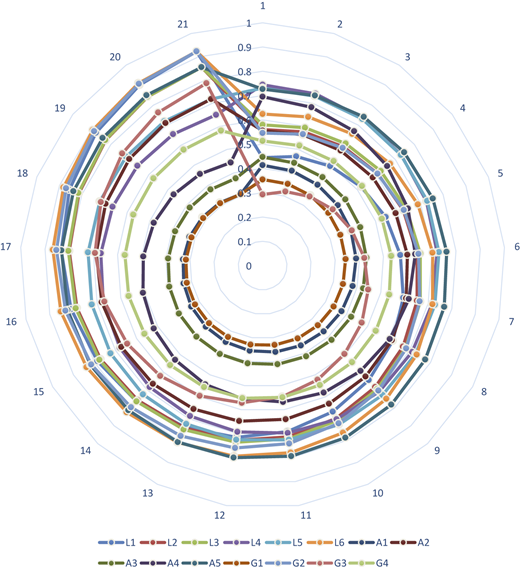
The result of sensitivity analysis (Figure 2) reveals that allocating different weights to the SVSC challenges across the different sets of experiments causes change in the ranking of certain solutions (alternatives), confirming that the model is sensitive to changes in weight coefficient. In sensitivity analysis, factor A5 received the highest ranking in 12 of the 21 experiments, which is more than 50% and shows the stability of the model (Mangla et al., 2015). But as the weightage of criteria O3 increases beyond its original value, other factors like L6 and G2 show significant improvement along with the L1, L3, and G3. This happens due to the fact that L6 and G2 are strongly correlated with the mitigation of vaccine wastage. This also justifies the expert's discussion that environmental factors like G2 and G3 rankings will improve as the emergency of pandemic subsides and the environmental concern rise.
5.4 Managerial implications
The availability of vaccines is an essential component to minimize the loss of human life as well as the business losses, but the huge population of LMICs like India and their poor infrastructure are popping several new challenges in rapid mass vaccination. This research has focused on investigating the critical challenges of the sustainable VSC during the mass vaccination for COVID-19 pandemic. This study will benefit the HCOs and other organizations to improve the vaccination process in India and other LMICs having a similar distribution chain by addressing the critical challenges. This study revealed that Operational challenge has ranked highest; thus, there is an urgent need to focus on day-to-day activities at lower levels of management to fix the inefficiency. Vaccine wastage at different levels of storage and open vial wastage at immunization sites, storage-handling of vaccines, involvement of multiple stakeholders, tackling emergencies, and maintaining cold chain logistics are the most critical challenge found during this study. Focusing on these critical challenges will assist practitioners in developing new strategies and policies to increase VSC's effectiveness and efficiency.
In addition to identifying and ranking challenges to SVSC, this study also provides a framework to help overcome these challenges. Fifteen practices have been identified and ranked based upon their influence on the challenges. The study shows that the better coordination mechanisms among all the players of the VSC and effective management support are the top-ranked techniques that will address major challenges of SVSC. The HCOs must clearly define the role and responsibility of each agency and their personnel in immunization programs. Frequent workshops and training at each level of the network must be conducted for better coordination among the various agencies and their staff. However, India and other LMICs do not have a regular practice of engaging supply chain managers and other similar specialists in the government healthcare sector to manage and train the VSC staff. The inclusion of management staff will aid in better coordination among multiple stakeholders and help reduce vaccine wastage by strengthening the cold chain logistics and better inventory policies. The training of staff will result in safe immunization practices along with the proper disposal of immunization waste. Although the implementation of eVIN and CoWIN improved the efficiency of immunization programs in India, we found that more data on consumer/beneficiary feedback is required. This will aid vaccination surveillance as well as consumer satisfaction with the overall process, leading to the development of more consumer-centric network designs. The other revelation for practitioners is to make a virtual alliance with enterprises of similar capabilities that can assist them in emergency for quick and environment-friendly delivery of vaccines.
6. Conclusion
This paper addresses the key challenges of SVSC, a LAG-based framework has been proposed to address these identified challenges. An integrated BWM-MARCOS methodology is used to analyze the challenges and solutions. This methodology requires fewer pairwise comparisons and can handle large numbers of alternatives with comparatively good stability. The analysis shows that the operational challenges are most significant in the case of a pandemic VSC. Vaccine wastage, handling, and storage of vaccines are some of the most critical operational challenges.
The LAG-based techniques are proposed as a solution to overcome the SVSC challenges. The lean and agile-based techniques are ranked high in this case of pandemic VSC, but the green techniques also have significant environmental benefits. Based upon this study, the HCOs will be benefited from making decisions depending upon the established properties.
This study has taken place in the first phase of mass vaccination after the deadly second wave of the COVID-19 pandemic in India. Some challenges may be added or avoided when mass vaccination moves forward. The study has been performed with limited experts' opinions and may be improved further by including more experts. The methodology used in this study is comparatively new and can be compared with other available MCDM techniques in further studies. Evaluating these challenges and solutions in a fuzzy environment can be other extensions of this study.
| Part I: Pairwise comparison of challenges of SVSC | ||||||
|---|---|---|---|---|---|---|
(Pairwise challenges for main criteria challenges) | ||||||
Select the most important category of challenge in VSC: | Technical ○ | Strategical ○ | Operational ○ | Social ○ | Environmental ○ | |
Select the least important category of challenge in VSC: | Technical ○ | Strategical ○ | Operational ○ | Social ○ | Environmental ○ | |
How much more essential is the most important challenge when compared to other category of challenge on scale of 1:9. | Technical ○ | Strategical ○ | Operational ○ | Social ○ | Environmental ○ | |
How much more essential is other category of challenge when compared to least important challenge on scale of 1:9. | Technical ○ | Strategical ○ | Operational ○ | Social ○ | Environmental ○ | |
(Pairwise challenges for sub criteria technical challenges) | ||||||
Select the most important technical challenge in VSC: | Maintaining cold chain logistics ○ | Production failure at an early stage ○ | Manufacturing lead time ○ | Production capacity ○ | Technology transfer for mass production ○ | |
Select the least important technical challenge in VSC: | Maintaining cold chain logistics ○ | Production failure at an early stage ○ | Manufacturing lead time ○ | Production capacity ○ | Technology transfer for mass production ○ | |
How much more essential is the most important technical challenge when compared to other technical challenges on scale of 1:9. | Maintaining cold chain logistics ○ | Production failure at an early stage ○ | Manufacturing lead time ○ | Production capacity ○ | Technology transfer for mass production ○ | |
How much more essential is other technical challenges when compared to least important technical challenge on scale of 1:9. | Maintaining cold chain logistics ○ | Production failure at an early stage ○ | Manufacturing lead time ○ | Production capacity ○ | Technology transfer for mass production ○ | |
| Part II: Influence of LAG solution on mitigating the challenges of SVSC | |||||
|---|---|---|---|---|---|
VL→ Very low influence; L→ Low influence; M→ Medium influence; H→ High influence; VH→ Very high influence | |||||
What is the impact of practice “Visual Stream Mapping (VSM)” in mitigating the following challenges? | |||||
Maintaining cold chain logistics | ○ VL | ○ L | ○ M | ○ H | ○ VH |
Production failure at an early stage | ○ VL | ○ L | ○ M | ○ H | ○ VH |
Manufacturing lead time | ○ VL | ○ L | ○ M | ○ H | ○ VH |
Production capacity | ○ VL | ○ L | ○ M | ○ H | ○ VH |
Technology transfer for mass production | ○ VL | ○ L | ○ M | ○ H | ○ VH |
Data and information flow | ○ VL | ○ L | ○ M | ○ H | ○ VH |
Inventory management | ○ VL | ○ L | ○ M | ○ H | ○ VH |
Vaccine wastage | ○ VL | ○ L | ○ M | ○ H | ○ VH |
Quick responsiveness | ○ VL | ○ L | ○ M | ○ H | ○ VH |
Storage and handling of vaccines | ○ VL | ○ L | ○ M | ○ H | ○ VH |
Cold chain logistics disruption | ○ VL | ○ L | ○ M | ○ H | ○ VH |
Human resource management | ○ VL | ○ L | ○ M | ○ H | ○ VH |
Accurate forecasting of demand | ○ VL | ○ L | ○ M | ○ H | ○ VH |
Location allocation | ○ VL | ○ L | ○ M | ○ H | ○ VH |
Planning vaccination strategy | ○ VL | ○ L | ○ M | ○ H | ○ VH |
Multiple stakeholder involvement | ○ VL | ○ L | ○ M | ○ H | ○ VH |
Tackling emergencies | ○ VL | ○ L | ○ M | ○ H | ○ VH |
Stable Financing | ○ VL | ○ L | ○ M | ○ H | ○ VH |
Supplier selection | ○ VL | ○ L | ○ M | ○ H | ○ VH |
Vaccine surveillance | ○ VL | ○ L | ○ M | ○ H | ○ VH |
Vaccine hesitancy | ○ VL | ○ L | ○ M | ○ H | ○ VH |
The adverse aftereffect of vaccines | ○ VL | ○ L | ○ M | ○ H | ○ VH |
Lack of faith in the healthcare sector | ○ VL | ○ L | ○ M | ○ H | ○ VH |
Lack of vaccine advocacy in society | ○ VL | ○ L | ○ M | ○ H | ○ VH |
Vaccine inequity | ○ VL | ○ L | ○ M | ○ H | ○ VH |
Bio-pharmaceutical waste management | ○ VL | ○ L | ○ M | ○ H | ○ VH |
High energy consumption | ○ VL | ○ L | ○ M | ○ H | ○ VH |
Solid waste management | ○ VL | ○ L | ○ M | ○ H | ○ VH |
Ecological effect of VSC | ○ VL | ○ L | ○ M | ○ H | ○ VH |
References
Appendix 1 Sample questionnaire
Name:
Position*:
Experience*:
Highest Qualifications*:
Organization:
COVID-19 wreaked havoc on practically every industry, including the vaccine supply chain (VSC). When mass vaccination for pandemic was rolled out, the already overburdened VSC of the routine immunisation programme faced various challenges. The purpose of this study to prioritize the challenges faced during the mass vaccination of COVID-19.
Systematic integration of some management techniques which are very successful in other field can also tackle the challenges of VSC and increase the sustainability of country's vaccinations programs. An integrated Lean-Agile-Green (LAG) management practices-based framework is developed for the solution of these challenges. This survey is divided in two parts, first part deals with the pairwise comparison of main criteria and sub criteria of challenges and second part deals with the prioritization of LAG solutions-based om their influence on challenges.
Important points:
This survey will only be used for academic and research purposes, and neither your name nor the name of your organization will be revealed at any point during the process.
You can add/suggest any factor/technique, as well as provide comments on the questionnaire, in the feedback box provided at the end.
The twenty-nine challenges selected for this study are divided in five main categories and the fifteen lean, agile, and green practices are selected as solution for tackling these challenges. The brief description of challenges and solutions are attached with this questionnaire.

