


– As humanitarian organizations often operate in highly volatile environments, a good understanding of their learning mechanisms would improve the knowledge acquisition and retention in these organizations, and complement the formal logistics education and training for their relief staff. The paper explores the following research question: what learning mechanisms are used by humanitarian organizations to acquire sufficient knowledge for their logistics operations.
– The paper opts for a theoretical study based on the existing literature. We apply organizational learning theory to examine the learning process and mechanisms of humanitarian organizations. An actual case is used to validate the findings.
– The study develops a theoretical framework for the learning mechanism of humanitarian organizations, and reports four learning mechanisms: learning by hiring, learning by doing, learning by observing, and learning by searching. Five propositions are proposed for empirical validation.
– Because of the theoretical nature of the study, the research is still an exploratory one. The organization learning literature employed is not comprehensive. Researchers are encouraged to test the proposed propositions further.
– The paper includes implications for humanitarian organization to better manage their learning processes, improve the effectiveness of their knowledge management, and benefit more disaster-affected people.
– This paper fills a gap in the learning processes and knowledge management of humanitarian organizations.
1. Introduction
Global disasters are increasing in diversity, frequency, and severity. Indeed, in 2010 alone, 640 disasters of varying forms and intensities occurred across the world, resulting in over 300,000 deaths and economic damage worth US$123.3 billion. In response, the international humanitarian assistance reached a peak of US$16.7 billion in 2010 (IFRC, 2011). Disasters tend to affect the poorer nations disproportionately because of the poor infrastructure, lack of preparedness, and population concentration patterns (Coppola, 2011). To save lives and support survivors, humanitarian relief organizations (HROs) are working in disaster-prone areas often with poor infrastructure, which makes logistics critical.
Today, there is a strong demand for greater effectiveness and efficiency in humanitarian logistics operations as almost 60-80 percent of the expenses incurred in humanitarian operations are due to supply-chain activities (Wassenhove, 2006). In addition, disasters due to natural calamities, wars, and political strife are increasing across the world, and humanitarian aid agencies have to assume an even greater role.
To improve relief logistics operations, one area of focus has been that of the training and education needs of humanitarian logisticians. However, a critical aspect related to the education programs is to understand existing learning mechanisms used by the HROs. This study applies organization learning theories to examine the learning process, and develops a conceptual framework to better understand the knowledge acquisition and retention in these organizations, and improve the effectiveness of the formal logistics education and training.
The rest of the paper is organized as follows. We first review the context of humanitarian logistics as well as the organization learning literature. We then apply organization learning theory to develop a theoretical framework for the learning mechanism of HROs. Five propositions are proposed, and an actual case is presented and discussed.
2. Research background
2.1 Context of humanitarian logistics
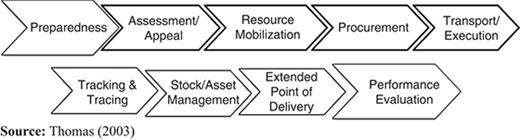
A typical humanitarian supply chain consists of a range of logistics activities and processes, including procurement, transport, tracking and tracing, customs clearance, local transportation, warehousing, and last mile delivery as illustrated in Figure 1 (Thomas, 2003). HRO preparedness must inevitably begin before the onset of a disaster. While we focus more on the sudden-onset disasters, most of our analysis is equally applicable to slow-onset ones.
For a disaster response operation, there are seven major activities in HROs: assessment, appeal, operations planning, mobilization, in-country operation, coordination with other HROs, and reporting (Thomas, 2003). The first two start immediately after the onset of the disaster, and coincide with the first process in the humanitarian supply chain. During the stage of assessment, HROs quickly assess the supplies required for relief needs, followed by an appeal for donations of cash and relief supplies. The main challenge faced by the HROs is the high degree of uncertainty in both relief needs and donations. Rodríguez et al. (2011) use fuzzy rule-based learning procedures to help decision makers assess the post-disaster damage with uncertain and incomplete data.
At the same time, the HROs start their operation planning to enhance the effectiveness of their relief operations. This planning covers the entire supply-chain process and is critical for its success. During the planning, the HROs would examine various constraints, such as the political situation, weather, and the condition of physical infrastructures which are often destroyed or damaged after the disaster. Banomyong and Sopadang (2010) develop a generic disaster model for emergency logistics response planning, which was tested with information from the Thailand tsunami in 2004.
Mobilization is the activity that links the HROs to site operations, the second process in the humanitarian supply chain. Having a broad picture of the supply and demand situation for the relief operation, the HROs then mobilize their existing material and human resources, and emergency supplies are sent to the afflicted country. The activities of each function such as transportation and customs clearance should be tied closely to avoid possible delays.
The in-country operation is the main logistics activity, covering all supply-chain processes in the afflicted country, from the arrival of supplies at the local entry points to the last mile delivery of goods. The processes include in-country/local distribution, tracking/tracing, stock, and asset management. Coordination with other HROs is also important and is more prominent for the relief operations of major disasters when hundreds of organizations are working together. As all HROs seek to set up facilities and to move supplies and people in and out, congestions or bottlenecks may limit the availability of relief supplies, and the competition for scarce local commodities and services such as lodging and vehicles may lead to significant price increases (Tomasini and Wassenhove, 2009). Effective coordination can significantly reduce the logistics costs and improve supply-chain efficiency.
Reporting as the last activity is both a coordinating mechanism and a means to monitor the relief effort. Early reporting to the media can also demonstrate effective action, and thereby increase pledged contributions. Reporting also include performance evaluation as lessons learned in the field need constant and consistent codification for future improvement. Beamon and Balcik (2008) develop performance metrics for humanitarian supply chains comprising three groups: resource, output, and flexibility.
2.2 Learning needs for humanitarian logistics operations
There are a number of challenges for HROs in humanitarian logistics operations. First, the urgency of crises often necessitates that relief staff are immediately assigned to the next mission after a disaster. This leaves insufficient time for staff to reflect and improve. Second, in some cases, the relief staff has to leave the field completely due to a lack of funding. Third, due to the low remuneration and high stress, the turnover of relief workers can be as high as 80 percent, particularly for the field logistics personnel (Thomas, 2003). As a result, while knowledge is learned quickly, it is also lost quickly. For instance, during the Afghanistan relief work after the overthrow of the Taliban regime, the operation for the first winter was largely successful but a total failure for the second winter (Tomasini and Wassenhove, 2009). The reason is that none of the staff in the first year stayed to the second winter. Given the complexity and difficulty of humanitarian logistics operations, HROs are thus in great need of learning and knowledge retention.
In humanitarian logistics operations, there are three levels at which knowledge is generated and used: field, supply chain, and theater (Tomasini and Wassenhove, 2009). At the field level, local knowledge resides with the people in the field operations. Knowledge such as the needs of the beneficiaries and the local terrain is essential for effective humanitarian operations but it can be easily lost with the change of staff as highlighted by the Afghani example.
The second level of knowledge is in the process at the supply-chain level such as procedures, manuals, and standardized processes that can improve supply-chain performance. One example is the pre-packed kits which can meet on-site needs more efficiently. As many relief workers are not professional logisticians but volunteers desiring to resolve crises and helping people in need, they are often short of such supply-chain knowledge (Thomas, 2003).
The third level of knowledge is at the theater level. It is more high level pertaining to the physical, economic, or social conditions of the country or region in disaster. One example is the cultural context such as the dietary restriction in communities practising certain religions. In the context of relief operations in developing countries, HROs are often ill-informed or insensitive to such religious issues. As many HROs and relief workers are from the western developed countries, there is a need for greater awareness of the diverse language and cultural barriers.
Besides pure knowledge, network is also important and can be seen as a type of knowledge. Here the network refers to the HRO network in the relief field as well as donor countries, including both the organizational and personal network. The importance of network is highlighted by social network theory (Granovetter, 1985). Organizations are not atomic but embedded within their social networks, which have economic value in many aspects. Further, networks are related to knowledge as they provide the organization with a fast access to knowledge (Kogut, 2000). In the humanitarian context, the network of HROs is an important resource for accessing to knowledge.
3. HRO learning mechanisms
To study the learning process of HROs in relief operations, we use organization learning theory as the theoretical lens (e.g. Levitt and March, 1988; Huber, 1991; Kogut and Zander, 1996). Adapting Huber's (1991) five learning processes with some adjustments, we propose four mechanisms for the HROs to accumulate knowledge, namely, learning by hiring, learning by doing, learning by observing, and learning by searching. Here congenital learning is removed as it happens at the founding of an HRO, whereas we are looking at the learning after the formation of the HRO.
The first mechanism, called grafting in Huber (1991), refers to organizations increasing their knowledge by acquiring and grafting on members who possess new knowledge, in the form of either organizational grafting or individual grafting. In the HRO context, organizational grafting is rare and individual grafting is more common. Individual grafting happens by hiring either capable relief workers from donor countries with professional knowledge or staff from host countries with local knowledge or experience. We thus call it learning by hiring. The knowledge literature suggests that human mobility is often a way of transferring tacit knowledge (e.g. Winter, 1987; Song et al., 2003). In the HRO context, much knowledge and network resources are possessed by the individual relief workers rather than the HROs, thus learning by hiring is a common means for HROs to acquire new knowledge. They can recruit either experienced logisticians from commercial firms for their experience in supply-chain management (i.e. supply-chain knowledge) or experienced relief workers for humanitarian operational knowledge and/or networks (i.e. field knowledge).
The second mechanism, called experiential learning in Huber (1991), refers to the learning through direct experience, or called learning by doing in the organization learning literature (e.g. Levitt and March, 1988; Tsang, 2002). It refers to the process by which the organization becomes more practised and hence more efficient at doing what it is already doing (Cohen and Levinthal, 1989). In the HRO context, learning by doing is to accumulate knowledge and networks through relief operations. It is an important way of learning because much knowledge such as field knowledge is better learned first-hand through on-site experience (Pisano, 1994).
The third mechanism, called vicarious learning in Huber (1991), refers to organization learning through observing the strategies, and management practices possessed by other organizations. Here we call it learning by observing following the learning literature (e.g. Bandura, 1973; Couzijn, 1999; Nadler et al., 2003). In the HRO context, learning by observing is to learn knowledge by observing the practice of other organizations, mainly the other HROs. Here we focus on the collaboration with the other HROs which is the main means of learning by observing. It would help HROs to acquire new knowledge at a low cost and in a short time. This is especially valuable for inexperienced HROs or HROs entering a new field.
The fourth learning mechanism, called searching in Huber (1991), refers to organization learning through actively searching and examining the organization's external environment, internal conditions, and performance. In the HRO context, searching would be mainly used to capture field and theater knowledge. It would be more prominent at the start of relief operations for critical information such as context knowledge as well as at the end of operations during the reporting. Searching would be secondary as relief workers have little time for intentional information searching at the middle of hectic in-country operations.
The four mechanisms of HRO learning are not mutually exclusive and can happen simultaneously. For example, HROs can hire new staff from the private or the public sector at the start of a relief operation. They would search for information to prepare the operations at the same time. After starting their relief work on site, they can continue learn through their own operations (learning by doing) and collaboration with others (learning by observing).
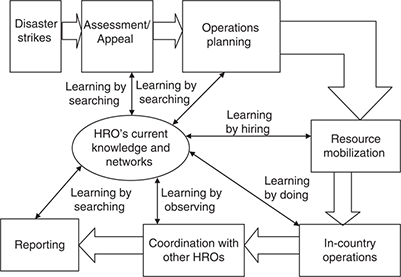
We then develop a framework to analyze the interaction of an HRO’s knowledge and learning along the humanitarian logistics activities. For the seven major activities in relief logistics (Thomas, 2003), HRO’s knowledge and learning would play important roles though by different ways and means. Before a disaster strikes, the HRO would possess some initial knowledge and networks, which would be used in all later activities, but the HRO still needs much more knowledge for the effectiveness of its relief operations. During the first two activities (assessment/appeal), the HRO would mainly use its existing knowledge and networks to evaluate the relief needs and appeal for funding and other critical suppliers. Learning plays a less prominent role though some learning by searching happens in the assessment stage. It becomes more intense and important in the next activity, operations planning, where the HRO relies on learning by searching heavily to accumulate more knowledge to plan for the relief operation according to the needs on the ground.
At the same time, the HRO starts to mobilize its existing resources and use learning by hiring for more knowledge and networks. It can hire either relief workers from donor countries for their expertise in either relief operation or commercial logistics (supply-chain knowledge), or local workers from the host countries for their field knowledge and networks.
Once reaching the in-country operations, the main learning mechanism would be learning by doing as the HRO would learn new knowledge and build networks through its on-site operations. At the same time, coordination with other HROs opens the venue for learning by observing. Its learning motive may affect its coordination partner selection and the role it takes in collaboration activities. At the end of the relief operation, reporting is a learning opportunity for learning by searching. The HRO could also codify some knowledge for future use and pave the way for a robust boilerplate on relief operations.
To summarize the discussion, we develop a framework to highlight the learning process in the relief activities of HROs as shown in Figure 2. It demonstrates how an HRO learns along its relief operation processes and the influence of its knowledge base (including networks) on these processes.
4. Propositions
Having the framework on HRO's learning mechanisms, we then focus on the impact of HRO resources on the use of the four learning mechanisms. We would investigate how the HRO's initial knowledge, networks, and other characteristics affect the use and effectiveness of these learning mechanisms.
4.1 Learning by hiring
In a humanitarian operation, learning by hiring normally happens during the resource mobilization stage. As discussed, an HRO may hire relief workers for either supply-chain knowledge (often from donor countries) or field knowledge and local networks (often in host countries). Compared to the other learning mechanisms, the benefit of learning by hiring is the quick access to critical knowledge, including much private or tacit knowledge (Song et al., 2003). For example, a new HRO entering the relief operation in Afghanistan may hire a local for field knowledge such as the possible climate and road conditions in the coming winter. The HRO then may not be taken off-guard when supplies are blocked by heavy snowfalls.
The disadvantage of learning by hiring would be high cost, especially for small HROs without good reputation and networking in the field. Due to the low remuneration and poor working conditions of humanitarian workers at the relief field, the personnel in the HROs are driven by a strong desire to help needy people. Large multinational organizations (e.g. UN agencies, Red Cross) and international NGOs such as Médecins Sans Frontières (MSF) would have advantage over the smaller HROs in hiring needed talent with their global reputation. It is especially true for talent in high demand such as the local relief workers at the onset of a major disaster.
However, learning by hiring could be feasible for the smaller HROs if they have other advantages. While they may be weak on international reputation, the smaller HROs with broad international networks could also use learning by hiring as their networks can help them connect to needed talent. For example, a religious NGO such as the Lutheran World Service can use its global religion network to hire personnel who share the same faith and belief in various locations. With the same belief as the background, it is easier for the newcomers to assimilate quickly into the stressful relief operations. It is reported that one advantage of Christian faith-based NGOs is their ability to provide humanitarian assistance through channels not necessarily open to secular NGOs. They can be connected with and inspire local religious communities, which in turn enhance their effectiveness in relief operations (Thaut, 2009). Summarizing the discussion, we have the following proposition:
P1. The learning mechanism of learning by hiring is more likely to be used by either large HROs with good international reputation or small HROs but with broad international networks.
4.2 Learning by doing
In a humanitarian operation, learning by doing normally happens during the stage of in-country operations. As discussed, this mechanism is more suitable for local field knowledge as well as the supply-chain knowledge as many relief workers are not trained logisticians. Through the on-site experience, they would gain a better understanding of the supply-chain processes and improve the logistics operations.
One practical advantage for an HRO to learn through this means is that it is easy to execute. Other types of humanitarian organizations such as NGOs focussing on rural developments may enter into relief operations after sensing the needs and accumulate the related knowledge by learning by doing.
However, for an inexperienced HRO, learning by doing can be risky due to its shortage of related knowledge and experienced logisticians. The existing resources of the HRO would limit the scope of its future learning by doing. Since learning is a path-dependent process (Teece et al., 1997), it is incremental where current learning is constrained by resources accumulated in the past. In other words, an HRO's absorptive capacity, the ability to absorb from learning, is constrained by its existing resources (Cohen and Levinthal, 1990). Therefore, it is risky for an HRO to work in a region or field far from its existing bases as its current resources are insufficient in reducing the high operation risk. For a new HRO or an HRO entering a new field, learning by doing must be complemented by other learning mechanisms to reduce the potential risk, which would be elaborated next.
4.3 Learning by observing
In a humanitarian operation, learning by observing normally happens during the stage of coordination with other HROs. It is suitable for both supply-chain knowledge and field knowledge by learning from more experienced HROs. Learning by observing is a common practice in the humanitarian community, especially for relief operations in either a newly opened humanitarian field (e.g. Libya after the fall of Gaddafi regime in 2011) or a region experiencing a mega-disaster with the entry of lots inexperienced NGOs (e.g. Haiti Earthquake in 2010).
Organizational learning theory has highlighted two important aspects for effective learning, one is the absorptive capacity of the learning organization, and the other is the transparency of the learning object (the more experienced one; Cohen and Levinthal, 1990; Larsson et al., 1998). The former refers to how much you can absorb and the latter refers to how much you can access to the things you desire to learn. Here we only focus on the latter in the context of HRO learning as the former is not related to partner selection. If a resourceful HRO is very protective and not transparent to others about its knowledge or supply-chain practices, its partners may actually learn very little even if they manage to collaborate with the HRO. Thus an HRO with strong learning desire would be concerned about the transparency of its partners and prefers a more transparent partner if other things are equal. As good cooperative experience can nurture trust and usually bring on high transparency (Larsson et al., 1998), an HRO with strong learning desire would put more emphasis on past cooperative experience in the partner selection. Thus for an HRO with a strong learning motive, it would prefer to collaborate with an HRO with good past cooperative experience as the learning target in the field operation.
There are two advantages of learning by observing compared to learning by doing. The first advantage is the lower risk involved as the presence of more experienced partners could reduce the operation risk. The second advantage is that an HRO can learn something different from its current resources at a relatively low risk. An HRO without much relief experience in a new field can accumulate valuable knowledge and networks quickly after cooperating with the more experienced HROs in that field.
However, there are constraints for learning by observing also. The main constraint is the absorptive capacity of the learning HRO as the relief operation at the ground may be overwhelming for an inexperienced HRO. While learning by observing allows an HRO to learn new knowledge in a new field, the HRO must carefully balance its current operations with the learning. The second constraint is the HRO must possess some valuable resources to establish a partnership with more experienced HROs. For example, inexperienced HROs in the host country with strong local networks are more likely to build the partnership with large international HROs. Summarizing above discussions, we have following three propositions:
P2. For an HRO, the learning mechanism of learning by observing is more likely to be used when it is short of critical knowledge.
P3. For an HRO, partners for learning by observing are more likely to be experienced HROs with good past cooperation experiences.
P4. An HRO with more valuable resources such as strong local networks is more likely to establish partnerships with experienced HROs for learning by observing.
4.4 Learning by searching
Different from the other learning mechanisms, learning by searching mainly happens during the two ends of the relief operation, the assessment and planning stage at the beginning and the reporting stage at the end. At the beginning, it is used for learning both theater and field knowledge. At the end, it is more related to knowledge codification and retention.
As no one denies the importance of learning by searching at the beginning, we focus on the end stage when it is neglected by many HROs. A comprehensive performance evaluation and the detailed report writing can codify field and supply-chain knowledge accumulated from the current operation for the future usage, while the neglecting of the process may cause the significant loss of newly acquired knowledge. However, many HROs have lost much knowledge after the end of the field operation due to the high-staff turnover and poor knowledge codification. Comparatively, HROs with institutional donors such as governments and private companies would have advantage in knowledge codification since detailed reporting is often the mandatory requirement of such institutional donors. While these institutional donors use such reports for evaluation and future donation decisions, HROs could use the process to codify and retain knowledge. Thus we would expect HROs with more institutional donors, often large international HROs, would use learning by searching more effectively at the later stage of relief operations:
P5. The learning mechanism of learning by observing is more likely to be used at the end of relief operation by HROs with institutional donors.
4.5 A case
The learning experience of Yayasan Sosial Bina Sejahtera (YSBS), a local social NGO in Indonesia, is one interesting case for investigation (Sulistiono and Mulyadi, 2012). YSBS is one of the largest local NGO in Cilacap District, Central Java. It specializes in social development programs such as poverty alleviation and education. After the flood in Cilacap district in September 2010, it sensed the relief needs from the field reports by its on-site workers (learning by searching) and started the relief operation in affected villages. Its existing resources such as school facilities and vehicles were used to help the victims. While its logistics operation is primitive without the standard operating procedures and measuring tools, YSBS’ entry to the relief operation was smooth with much support from its local and regional partners. It also learned a lot from its on-site operations (leaning by doing). As YSBS was new in the relief operation, it worked together with multiple levels of local governments as well as the local community for the effective delivery of aids (learning by observing).
At the start of its relief operation, YSBS was weak on supply-chain knowledge but strong in networks as well as field and theater knowledge. Learning by hiring is unnecessary with its existing full-time staff and strong local network, a source of part-time volunteers. But learning by observing is still important, and it is interesting to observe that YSBS learned from government agencies rather than experienced NGOs for relief operations. There was no mention on reporting, so we are not sure whether learning by searching happened at the end of the operation, but it did happen at the start of the operation.
Among the five propositions proposed, we are not sure whether Proposition 5 is valid in the case of YSBS due to the lack of information, but the rest are valid. Proposition 1 is valid from the opposite direction as YSBS is neither large nor having broad international networks, and it does not choose learning by hiring. Proposition 2 is valid as the partnership of YSBS with government agencies (learning by observing) is critical for its operation success due to its lack of experience in relief works. Proposition 3 is also valid though the term “experienced HROs” should be changed to “government agencies.” The past experience of implementing various development programs with government agencies gave the NGO a good reputation, which led to governmental support to its relief effort. Proposition 4 is valid also as the scope of the disaster is beyond the capacity of local government agencies and they are willing to establish the partnership with a resourceful local NGO.
5. Conclusion
This study applies organization learning theory to analyze the HRO's learning process in relief operations. Adapting from Huber (1991), we have shown four learning mechanisms as used by the HROs, namely, learning by hiring, learning by doing, learning by observing, and learning by searching. We further develop a theoretical framework to examine the HRO learning process along the relief supply-chain activities, and five propositions are proposed for future empirical validation. An actual case is analyzed to illustrate the framework as well as the propositions. While many HROs are based in developed countries, which are their main sources for funding and supplies, they operate mostly in developing countries in different environments and thus have to adjust to the local contexts for the effectiveness of their operations. They need to learn and acquire much knowledge at the onset of a disaster and keep the acquired knowledge for future use despite the high-staff turnover. By developing a learning framework, this study can facilitate the HROs’ learning processes, improve the effectiveness of their knowledge management, and benefit the disaster-affected people.
Moving forward, more studies can be undertaken to validate the propositions and further refine the framework presented thus far. Theoretically, our framework is largely based on the work of Huber (1991), more recent theoretical work in organization learning can be applied to the context of humanitarian logistics to further develop a comprehensive framework. For example, Bell et al. (2002) have shown that there are four schools of thought in the organizational learning literature, namely, economic, developmental, managerial, and process. Employing these approaches to our humanitarian logistics study may enrich our understandings on the learning of HROs. Empirically, researchers can explore the learning mechanisms in-depth in multiple HROs with various backgrounds for deeper understanding of the learning processes and the dynamic interactions among the learning mechanisms. Besides the case study, an empirical investigation covering a large sample of HROs could reveal the relationship between the learning effectiveness and organization characteristics (e.g. large vs small, international vs local, religious vs secular) and validate the framework and propositions.
References
About the authors
Qing Lu is a Research Fellow in supply-chain management at The Logistics Institute – Asia Pacific (TLIAP), the collaboration between National University of Singapore (NUS) and Georgia Institute of Technology. He is experienced in logistics research, with special focus on the strategic level of supply-chain management for both firms and governments such as logistics outsourcing, supply-chain security and governance. His research interests also include humanitarian logistics and remanufacturing. He obtained PhD in business strategy from NUS Business School. Qing Lu is the Corresponding author and can be contacted at: tlilq@nus.edu.sg
Mark Goh is the Director for Industry Research at TLIAP. He is also a Faculty at NUS Business School and University of South Australia. He is currently on the Editorial Boards of the Journal of Supply Chain Management, Q3 Quarterly, Journal for Inventory Research, and Advances in Management Research, and has served as an associate editor for the Asia Pacific Journal of Operational Research. His current research interests focus on supply-chain strategy, performance measurement, buyer-seller relationships, and reverse logistics. Professor Goh holds a PhD from the University of Adelaide.
Robert De Souza is the Executive Director of TLIAP. He is a Professor at the Georgia Institute of Technology in USA and a Senior Fellow at the National University of Singapore. He has published extensively and is a sought after speaker and consultant. He is a Chartered Engineer and serves on multiple industry, government and academic committees. He received his PhD, MSc and BSc Honors in the UK.

