


– The purpose of this paper is to understand the impact of cooperative purchasing on buyers’ purchasing power. Purchasing in the humanitarian sector has traditionally been characterized by a low level of coordination due to inter-agency competition for funding, diverging mandates and other organizational differences. Relationships with commercial suppliers have also remained arm's-length and often dormant due to high levels of uncertainty and strict public procurement rules and regulations. However, recent pushes for increased efficiency and effectiveness are driving humanitarian agencies toward cooperative purchasing – a purchasing strategy that is claimed to be highly beneficial for members of the purchasing consortium not least for its ability to increase buyers’ purchasing power. In reality, the effectiveness of the strategy in increasing purchasing power is unclear.
– The authors study a single case of several humanitarian organizations aiming to increase their leverage in buying freight forwarding services by joining forces.
– Following several incidents during the process, the cooperative purchasing initiative did not contribute to increased power in the case. It was found that in addition to increased volumes, the effect of the strategy on other sources of power such as interconnections is also of importance.
– The research is limited to the boundaries of a single case study including the perceptive view of respondents interviewed.
– The findings of the study provide insights for organizations aiming to practice cooperative purchasing.
– The findings of the study provide insights for organizations aiming to practice cooperative purchasing.
Introduction
The humanitarian sector is characterized by a large number of organizations, predominantly non-profit institutions, with diverse legal mandates, interests and structures. These humanitarian agencies interact with the commercial market when they purchase various aid and relief items or freight forwarding services for delivering goods to beneficiaries. Due to, for example, funding uncertainty and the unpredictability of beneficiary needs, long-term agreements with suppliers are rare (Balcic et al., 2010). Establishing such supplier relationships is further complicated by strict public procurement rules and regulations meant to ensure transparency, fair competition and best value-for-money purchases (Erridge and McIlroy, 2002). Consequently, there has historically been an emphasis on independent, competitive bidding practices within public and humanitarian purchasing as opposed to coordination and relationship building. Instead of binding themselves to pre-disaster purchase commitments, humanitarian agencies have relied on pre-positioned stock and dormant (latent) supplier preparedness for spot purchases (Kovács and Spens, 2011b; Balcic et al., 2010).
Recent calls for increased public sector efficiency and effectiveness are, however, transforming purchasing practices. In order to avoid duplications of efforts, there is a strong push for coordination and alignment among humanitarian agencies. Along these lines, both practitioners and academics have promoted the practice of cooperative purchasing among humanitarian organizations. For example, Gustavsson (2003) suggests that agencies would gain increased leverage and price discounts by joining forces and according to Balcic et al. (2010) cooperative purchasing can lead to beneficial synergy effects. Schultz and Søreide (2008) further claim that cooperative purchasing can reduce the risk of corruption in emergency procurement and thereby increase “the integrity of the entire relief effort”. Moreover, in their thesis focussing specifically on the cooperative purchasing of transportation services, Merkx and Gresse (2012) suggest that members benefit from decreased purchasing complexity, reduced lead time, new learning opportunities, as well as capacity sharing.
In anticipation of benefits discussed above, humanitarian organizations have begun developing various joint purchasing arrangements (Kovács and Spens, 2011b, p. 34). The sector is also benefiting from a number of voluntary pooled procurement initiatives such as that of HIV/AIDS by the Global Fund, or those by Clinton HIV/AIDS Initiative. So far, however, little is known about actual outcomes of these arrangements (Kovacs and Spens, 2011a, b; Schotanus and Telgen, 2007). Our study addresses this topic, and is a response to Kovacs and Spens's (2011a, p. 7) call for more research on consortia development in humanitarian logistics. In general, cooperative purchasing has gained popularity in several industries to increase bargaining power (cf. Bakker et al., 2006; Nollet and Beaulieu, 2005; Cruijssen et al., 2007). This popularity has also contributed to a growing research attention that we connect to, for example, Schotanus and Telgen (2007), Nollet and Beaulieu (2005), Rozemeijer (2000), Taylor and Bjornsson (1999), Hendrick (1997) (for an exhaustive review of studies and gaps on the topic see Schotanus and Telgen, 2007).
In 1998, two humanitarian organizations decided to buy their freight forwarding needs in a joint tender. The success of the practice attracted more players and by 2010, the third round of the cooperative purchasing aimed to include more organizations with hopes of increasing benefits, especially the purchase power. But, the strategy did not deliver as expected. By investigating and explaining this situation, we aim to further the understanding of the impact of cooperative purchasing on buyers’ purchasing power.
As we focus specifically on the impact of cooperative purchasing on purchasing power, the next section is allocated to a review of purchasing power, its sources and the connection to cooperative purchasing. Then in Section 3, the methodology incorporated in this study is described. The case and its consequences are presented and analyzed in Section 4, and discussed, connecting back to theoretical predictions, in Section 5. Finally, the paper is concluded by considering contributions and providing recommendations for both practitioners and other researchers in Section 6.
Literature review
In strive to access required resources organizations are exposed to uncertainty (Pfeffer, 1981), and become dependent on their partners (e.g. Caniels and Gelderman, 2005; Pfeffer and Salancik, 1978). Their level of dependence indicates the influence, or leverage they might have on the partner (Batt, 2003; Anderson and Narus, 1990; Pfeffer, 1981). The leverage the buyer has in front of its supplier base is what we term “purchasing power”. The strategies buyers take can directly impact this purchasing power for or against them (Pfeffer and Salancik, 1978). In this study, we focus on the impact of a cooperative strategy aimed at increasing purchasing power. First purchasing power is explored in detail, and then the cooperative strategy is reviewed.
Purchasing power and its sources
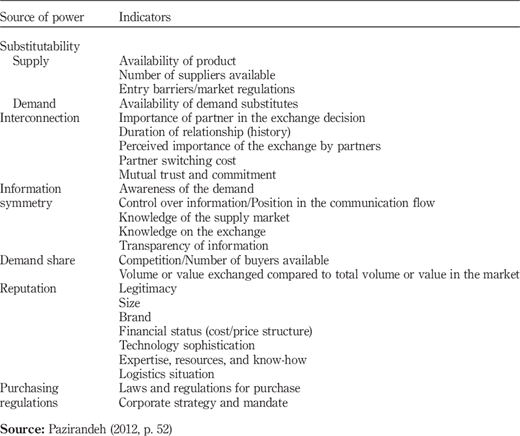
To understand purchasing power, we first investigate the sources giving rise to less or more leverage. Compiling suggestions on sources of power in literature, these can be categorized based on substitutability of supply and demand, the level of interconnectivity with suppliers, symmetry of information, demand share and reputation of the buyer (see Table I for indicators of each). Based on such characteristics, some organizations have more power than others (cf. Pfeffer and Salancik, 1978).
Buyers decide on purchasing strategies in response to constraints from these sources of power (cf. Pfeffer and Salancik, 1978), safeguarding against them, adapting or attempting to change them (Pazirandeh, 2012). High dependence on the supplier base limits buyers’ purchasing power (Pfeffer and Salancik, 1978). This situation can be seen in several industries such as the airline industry, in purchase of oil/gas, in purchase of vaccines or other public sector goods. There are several forms of purchasing strategies practiced in situations of low purchasing power.
Most earlier studies have, however, viewed buyers as the powerful actors who can control the contracts and the purchase decision (e.g. Benton and Maloni, 2005; Cox, 2001), and only few have studied them as the weaker party in buyer-supplier relationships (exceptions include, e.g. Christiansen and Maltz (2002) who focus on weaker buyers developing partnerships with their suppliers, Herlin and Pazirandeh (2011), who studied possible purchasing strategies to influence the supply market, and Bastl et al. (2013) looking at consortia development by the weaker partner as a mean to gain more power). Historically, Emerson (1969) suggests for the weaker partners in an asymmetric power situation to increase their power position by withdrawing from the relationship, expanding the relationship network, increasing their status or forming coalitions with other weak parties. This theory can be extended to buyer-supplier relationships. Herein, we specifically study cooperative purchasing as one form of consortia development, in which a number of buyers pool their purchasing functions.
Cooperative purchasing and purchasing power
Bastl et al. (2013) study coalitions formed by weaker partners in a triad (two buyers and a supplier, or two suppliers and a buyer), and suggest that the coalition should have greater power than the dominant player for it to make sense. Their study is among the first attempts to investigate the weaker parties in buyer-supplier relationships. It is, however, not clear how to extend this proposition to a real time situation where buyers face multiple suppliers within the market; specifically, when a number of weaker buyers form consortia to gain better leverage in approaching the supply market. We understand purchasing power as the buyer's dependence on the whole supplier base (see Figure 1(a)). Thus, forming a coalition should be measured as the new power structure in front of the supplier base (see Figure 1(b)).
Formation of such a coalition among buyers is what is termed cooperative purchasing here forth, and can be directly connected to Emerson's (1969) fourth suggestion. In other words, cooperative purchasing can be defined as “sharing or bundling purchasing related information, processes, resources, and/or volumes by two or more agencies in a group to improve their performance” (Schotanus et al., 2008, p. 162). Different forms can be identified based on the influence of members as well as the number of activities performed in the group (e.g. use of a third party, lead buyer or a program group) (Schotanus and Telgen, 2007). It can be argued that the practice directly attempts to change the power situation in favor of buyers, but the impact of the strategy on purchasing power is not clearly studied within existing literature. Cruijssen et al. (2007) note how studies on horizontal cooperation are in general scarce.
According to Taylor and Bjornsson (1999), buyers usually form cooperative arrangements in situations of low power, where demand is uncertain and the industry fragmented. To increase purchasing power, cooperative purchasing efforts should improve the different sources of purchasing power as listed in Table I. There should be sufficient buyers available to see the benefits in the coalition and to form the coalition. The combined purchasing power of the coalition justifies the formation (Bastl et al., 2013). In addition, there should also be a driving factor such as high supplier power driving up prices, to motivate formation of such coalition.
The formed cooperative purchasing driven by a less-powerful purchasing situation, can impact sources of power, which can potentially restructure the power/interdependencies for the buyers involved. While there are suggestions on the impact of the strategy on these sources of power in literature, the impact has not been clearly studied in the past. Thus, in this study we aim to further explore this impact and by doing so both evaluate and extend existing literature suggestions.
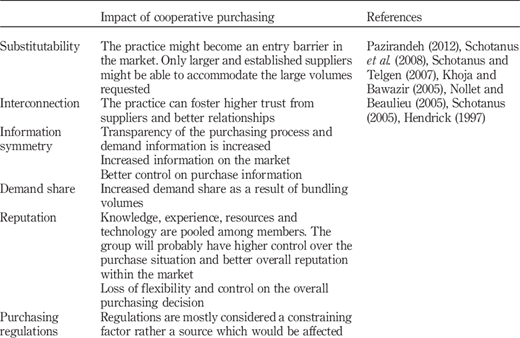
In Table II possible impacts of cooperative purchasing on different power sources, as suggested in literature, are listed. In the most direct form, practicing cooperative purchasing increases power by pooling demand (Turner et al., 2000). In addition to increased demand volumes, pooling demand increases transparency of information (Schotanus and Telgen, 2007) and consolidates expertise and resources (Hendrick, 1997), which affects the reputation of buyers.
Studying multiple buyers of vaccines, Pazirandeh (2012) finds that practice of cooperative purchasing increased the demand share and thus the negotiation leverage, information symmetry and reputation of buyers. Some buyers perceive the practice to decrease substitutability in the long run, arguing that only suppliers with sufficient capacity might be able to respond, pushing smaller players out of the market (Pazirandeh, 2012; Nollet and Beaulieu, 2005). Increased demand and better transparency of information can increase supplier incentives in partnering with buyers, fostering better relationships with suppliers (Schotanus and Telgen, 2007). Purchasing regulations can drive or limit the practice, but the exact interaction between the two is not clear.
Methodology
We use findings from an in-depth single case study of four buyers joining together to cooperatively purchase their freight forwarding. Understanding change before and after the cooperative purchase on indicators of power requires conversation with individuals involved. Additionally, strength of a case study method does not come from increased data points but rather increased variables used to understand a phenomenon (Yin, 2003). So if used to extend theory, instead of relying on comparison of several observations, a pattern of observed outcomes on several variables are compared with expectations gained from theory (Bitektine, 2011). We follow the process introduced by Ross and Staw (1993), to compare our conceptually developed predictions, and to develop an understanding for how cooperative purchasing influences purchasing power. The case was developed in interaction with processes happening in reality (as suggested by Ragin and Becker, 1992) and our theoretical understanding was affected and developed while doing the study (in line with Dubois and Araujo, 2007).
There are relatively few global freight forwarders with experience and understanding of the humanitarian sector limitations and requirements. However, these forwarders are increasingly interested in maintaining and developing their relationship with the organizations. One of the reasons is the fact that the humanitarian market is commercially worth billions of dollars (Binder and Witte, 2007). Companies developing relationships with humanitarian organizations may also be attracted by the ability to realize corporate social responsibility ambitions, increase or retain staff motivation and improve their own image and reputation (Balcic et al., 2010, p. 27).
In competition with the commercial sector, humanitarian demand is small and fragmented (i.e. based on operation/emergency), purchasing power is considered limited and contracts are based on projections with usually no set figures. The purchasing power is perceived higher in areas with less commercial presence (e.g. parts of the African continent). The joint tender was thought to further increase the attractiveness of a buyer-supplier partnership and give the freight forwarders additional incentive to perform well. Data from this case were collected and analyzed.
Data collection and analysis
Initially, data were collected from the tender preparation phase, from the lead organization in 2011. One of the authors had the chance to observe discussions around the initiative between buyers, and the initial supplier reactions. A year after the joint tender was finalized, and most suppliers had entered relationships with the buyer organizations, the study continued by first reviewing 700 pages (56 pages directly on the tender and the rest on general purchasing within the organizations and on the freight forwarding market) in 17 documents and then conducting 14 semi-structured one to two hour interviews (i.e. around 350 transcript pages in total). The aim was to understand the case as much as possible (Ross and Staw, 1993).
Documents ranged from preparation notes, call for expression of interests, request for proposals/quotations, tender strategy documents, evaluation methodology documents, synopsis of the agencies and the suppliers, presentations, general procurement guidelines of the agencies, freight market factsheets, to supplier guidelines. Purposive sampling followed by snowball sampling was used to contact both individuals involved during the tender, and those dealing with the aftermaths of the process within buyer and supplier organizations (see Table III).
Following Eisenhardt's (1989) suggestions, while following the general structure of the interview guide, questions were tailored for each specific organization and each respondent. Questions were also added during the course of the study as a result of gaining new information. In general, the data collection process had five stages:
(1) initial data from semi-structured interviews to understand the case (see Table III);
(2) complementing data to fill in the gaps in understanding within follow-up interviews;
(3) validating data on the case descriptions from feedback on executive summaries;
(4) cross-data analysis to check differences between respondent opinions from a written questionnaire, where buyers were given a list of identified aspects by all interviewees and asked to mark those they agreed with; and
(5) input on viability and applicability of the findings and suggestions.
All interviews were recorded and conducted by one of the authors, transcribed by the other, and again summarized by the first author, and reviewed by the second. We conceptually developed our model and suggestions on how different sources of power are impacted by practice of cooperative purchasing. We used a more “fluid form of pattern matching” between data and theory to develop an understanding not necessarily stated or predicted in literature (following the suggestion in Ross and Staw, 1993, p. 705, study). Our aim was to understand the case as much as possible and to match the single case with suggestions from literature, to, in general, increase understanding of the phenomenon. Due to the intertwined process of data and analysis (Dubois and Gadde, 2002), analyses are presented combined with case descriptions (e.g. Bygballe and Jahre, 2009).
The case description
In this section, we first briefly introduce the buyers and suppliers involved in this case, and then review the case from initiation to outcome. All agencies and respondents are anonymized.
Involved buyers and suppliers
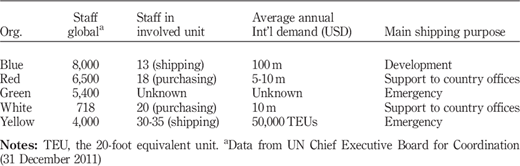
All humanitarian agencies in the tender have country offices with more operational functions, and headquarters (HQ) with more strategic/tactical responsibilities. Table IV shows some background data on these agencies. The country offices work independently, within the limits of the overall organization strategy and policies.
Agency Blue purchases freight both on its own and for its clients. Agencies Red and White purchase mainly on behalf of their country offices. Agencies Green and Yellow purchase more in relation to emergency situations. The agencies were jointly tendering their international freight forwarding needs at the HQs. Only Blue and Yellow have dedicated shipping units dealing with purchase of logistics needs, while at the other agencies the responsibility falls under the purchasing unit. Purchase of air and sea freight is outsources at all agencies except for Yellow. They practice competitive bidding within five-year agreements (usually in a two to three-year initial contract with possibility of extension). Both buyers and suppliers prefer long-term agreements due to the highly resource intensive tendering process. All agencies except for Yellow, finance freight forwarding purchases from general donations received which is allocated per shipment. Yellow does not have any core funding and finances its freight from voluntary emergency donations.
Two of the organizations (Blue and White) have been practicing long-term contractual relationships, Yellow practices spot purchase and others have been piggybacking on Blue's contracts. Both FOB and CFR contracts are commonly practiced in the sector, which is partly driven from the market price.
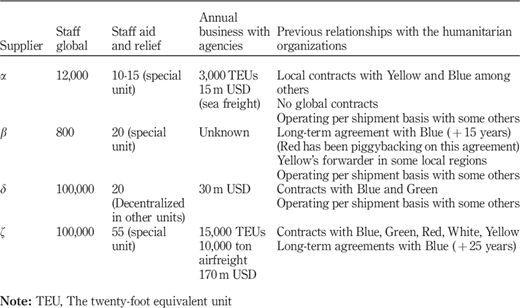
Four suppliers won the joint tender in 2010-2011 for sea freight, and two for airfreight. There were also other agencies, which had hoped to win the tender, but either did not have the required geographical presence or were omitted due to a technical error at submission. Table V shows the background information of the winning suppliers.
The initiation
Possible benefits of a joint tender drove two of the agencies to jointly purchase their need in 1998. The sector is also under much scrutiny, and there has been a call for reducing duplications of efforts at different levels. The practice was successful and raised interest from other agencies. In 2010, the agencies decided to expand the benefits by including a larger number of buyers, especially agency Yellow with their significant volumes. Even though Yellow knew they had notably different requirements, they were interested to join the group to reap possible benefits. Some perceived that the smaller agencies with less volume had more to gain from the tender, and thus their motivation was higher. The result, however did not correspond to initial expectations and created much frustration among buyers and the freight forwarders.
Some of the main drivers for expanding the new joint tender, as stated by buyers were the success in the previous cooperation rounds and to get better terms due to increased leverage. The smaller agencies were all hoping for better rates, some wanted a benchmark on their practice and rates, some were hoping for better service and geographical coverage, others were hoping to strengthen their brand, and some were hoping to learn or combine knowledge. One manager regarded the relationship among individuals as a key factor in the initiative's success. The strategy was also to diversify the supplier base and reduce dependence on the existing suppliers for agencies Blue and White.
Suppliers were open to the initiative. For them it meant to partake in one tender instead of several, possible increase of business, access to new partners, and increase in know-how. Supplier δ, however, did not see the tender as a joint approach, but rather merely one tender instead of several, which made them not have any specific initial reactions to it. However, some had concerns about the outcome being affected by organizational politics, hampering consensus among buyers. One forwarder thought the fact that the joint tender would have affected individual jobs, could have also created internal resistance to its initiation.
The tender process
The buyers decided for agency Blue to take the lead, partly due to their experience and higher volumes. The team appreciated the dynamics of the team. Between three and four meetings were arranged to discuss requirements, modalities of the cooperation, and to develop solutions for the differing requirements. There were different levels of representatives from the organizations (e.g. logistics, procurement, finance, clerk, etc.). This representation was mainly driven from the interest and stakes organizations had in the initiative. Several of the smaller organizations gave the baton to the lead agency, trusting that their requirements would be fulfilled but specific requirements such as differences in geographical delivery locations were also discussed to some extent.
After finalized inter-agency negotiations, a call for expression of interest was sent per e-mail to suppliers. The tender was carried out in two sections: for air and sea freight. For airfreight, coverage and handling capacities at port of departure were considered most important, whereas capacity at port of entry was emphasized for sea freight. Suppliers were first shortlisted according to their technical capabilities and only later, a financial evaluation of the bids was made. An electronic tendering system was employed in order to increase process transparency and shortlisted forwarders were invited to submit their proposals within a closed forum.
At this point of the tender process, and before selecting forwarders, staff rotation decisions relocated most individuals involved from their positions. Second, the obstacles and differences with Yellow's traditional way of spot purchasing freight forwarding services drove them to decide not to continue with the joint tender. Withdrawal of Yellow was considered a blow to the tender process. The volumes projected and communicated with the suppliers in the tender documents were now lower. This affected both supplier strategies, and also the expected added leverage for buyers. Both incidents also prolonged the outcome by four to five months.
Post-tender dynamics
Based on the evaluation, four suppliers were awarded the sea freight category, and two were awarded the airfreight category. For agency Blue this decision meant a larger supplier base, while for Yellow, it would have meant reducing the supplier base significantly. For other organizations involved, the difference was negligible. Even without Yellow, the selected suppliers were now introduced to new buyers in the group which they previously did not have a relation on international freight level.
However, except for agencies Blue and Green, which signed contracts relatively close to the tender decision, Red and White decided to tweak the contractual terms further, which prolonged negotiations and the decisions for up to a year. Red introduced a secondary bidding process upon each demand. Legal entities at both organizations did not see the liability terms fit and thus required for the liability to be shifted to the forwarders. This was considered unacceptable and extreme by the forwarder market. These buyers also realized that due to different funding mechanisms they needed to introduce different payment terms and different supply locations required different geographical terms. In the original documents, it is not clear how organizations are to use the outcome of the joint tender. Forwarders were all expecting a more harmonized approach. Consequently, several forwarders thought contract deviations from the original tender document, which they had planned and submitted bids upon, was unfair.
Forwarders still thought there would be advantages in a joint tender approach as opposed to individual organizations each having a separate tender, however, were critical to the way this joint tender was executed. One of the buyer organizations noted toward the broken relationship, stating that much personal effort has gone into mending the relationship in the past year. They thought the extent of contractual difference between organizations should be understood and aligned beforehand in future practices. It was also noted how given the current situation, and with the given lack of inter-organizational commitment, a more formalized approach would guarantee more favorable outcomes.
Buyer organizations were more skeptical and diverse in opinion. While Red's manager could not imagine freight forwarding needs being purchased any other way, Blue's manager could not imagine it being purchased jointly under these conditions. Others while critical to the 2010-2011 process, also thought higher inter-agency alignment, formalization and communication necessary for future.
The outcome on indicators of purchasing power
Table VI gives a summary of how the joint tender impacted the different indicators of purchasing power as noted by the buyer and supplier representatives. In general, it can be concluded that the joint tender did not increase the purchasing power of the agencies and it might have even reduced this leverage to some extent. While volume has obviously increased from before due to the additional members, the fact that the volume partly dropped from what was initially promised to the forwarders has overall created an unfavorable reaction. Consequently, there has not been any noticeable effect on the rates or the service. Geographical coverage has improved, but this was due to the change in selection criteria and move toward a parallel sourcing strategy, rather than the joint tender. Based on both buyer and supplier perceptions, the main reasons for the unexpected results can be connected to information asymmetry and the impacted reputational aspects. Even though perceptions are not all similar between the actors, there are common denominators: drop of volume from what had been promised, contractual term deviation from tender documents, and the introduced secondary bidding by some agencies are the main reasons behind raised concerns.
Among solutions on how to do the joint tender next time, some suggested higher formalization of the process and procedures to ensure commitment of agencies. It was also mentioned that individuals at the buyer agencies should increase their understanding of the supply market and the power situations not to demand the unacceptable (e.g. full liability of forwarders in this case). Also, more strategic involvement of agencies in, for example strategic risk management was noted. In general, most solutions address the fragmented approach of the agencies after the joint tender and suggest higher formalization, and more transparent communication of requirements and expectations in the specification phase of the process.
Discussion
The cooperative purchasing strategy can be directly related to Emerson's (1962) suggestion of forming coalitions. In forming coalition among a number of buyers facing the same supply market, theoretically, buyers should obtain more purchasing power and hence, associated benefits such as better contractual terms and negotiation power. In practice, several inter-agency cooperation challenges in strategy design and implementation process can impact this ideal outcome. In the case reviewed in this study, the coalition not only did not gain better purchasing power but also partly lost their previously developed negotiation power.
Comparing the findings from this study (in Table VI) and those deducted from theoretical suggestions (in Table II), gave us some insight into why this has happened. The findings are listed in Table VII. In the studies case, cooperative purchasing was combined with other strategies such as multiple (/parallel) sourcing resulting to gain a more diversified supplier base. Meena et al. (2011) has previously suggested multiple sourcing as a superior strategy in high service and supply risk disruption environments. This shows that a combined strategy can in fact modify/intensify the expected outcomes. For example, combining the strategy with multiple sourcing and awarding a small portion of the demand to smaller suppliers can mitigate the predicted supplier base reduction side effect of cooperative purchasing.
In this specific case, the most obvious impact of cooperative purchasing on interconnection aspects was on trust and commitment. Our observations also suggest that the process design can impact the outcome on sources of power. For example, a homogenous and coordinated tender process can offer an attractive and transparent view of demand to suppliers and hence, develop higher trust and commitment, the opposite can diminish this. The same situation was observed with information symmetry being disrupted as a result of the fragmented contracting approach in our case example.
With competition being inherently reduced and demand share increased, for the outcome of consortia to benefit the coalition, their power should be more than that of the supplier base (cf. Bastl et al., 2013). This is while the impact of the strategy on other sources of power might not be favorable for buyers. In the studied case, the unfavorable impact of the strategy on other sources of power such as interconnection and reputation resulted in the purchasing power not improving for the buyer consortium. According to theory (see Table II), reputation should increase in a cooperative purchase group, but in this case the lack of harmonization and fragmented process design somewhat hurt supplier perceptions of the buyers (as a group, and as individual agencies). Finally, we also found that differences in purchasing regulations and policies among organizations acted as a barrier to an aligned and coordinated purchasing approach. This constraining factor has resulted in several managers realizing the need for, and requiring, regulation/policy changes.
Findings of the study are conceptualized in Figure 2. It is suggested that cooperative purchasing affects purchasing power through its impact on sources of power. While evidence from our case confirms strive for better leverage to be a driver of the practice, buyers did not necessarily consider themselves within a less-powerful situation. On the contrary, some buyers considered themselves within the buyer dominance structure. Such perspective is due to, for example, whether buyers view the commercial sector as competition or not.
Due to the perceptive and relative nature of power, it is difficult to see the direct relation between power structures (as the cumulative effect of sources of power) and the strategy. It should be further emphasized that strive for better leverage is not merely driven from a less powerful position. The changed level of sources can result in a changed power structure. This impact is the cumulative result of all sources of power after practicing cooperative purchasing. A changed structure can possibly eliminate the expected benefits of, or the need for, practicing cooperative purchasing.
Thus, to increase leverage, buyers should focus on employing the cooperative purchasing strategy in a way to increase the combination of power sources, to consequently increase their overall purchasing power. The paper shows that merely increasing demand share (e.g. volumes) will not suffice to increase overall purchasing power, if other sources of power are impacted in an unfavorable manner for the buyer. Of course, further empirical studies are needed to test the findings of this study in different contexts.
From a societal perspective, the agencies’ failure to cooperate means that valuable resources are wasted as a result of duplication of efforts and unnecessary bureaucratic procedures. To facilitate humanitarian cooperation inter-agency rules and regulations should be further harmonized and there is also a need for liberation of general public purchasing frameworks that strongly promote competition and constrict collaboration. If the benefits of cooperative purchasing would be realized in the humanitarian sector, consequences could be far-reaching as funds would be used in a more cost-efficient manner and suppliers of emergency and development goods could be “pushed” by agencies to improve their performance both in terms of effort, quality and price.
Conclusions
While the role of power in inter-organizational relationships, is well established in literature (e.g. Pfeffer and Salancik, 1978; Cox, 2004), buyers have been predominantly viewed as the powerful partners, influencing the contract and the purchase decision (Bastl et al., 2013). In reality, there are several situations where buyers face a powerful supplier front. Examples of such situations can be found in the humanitarian and the public sector, where we focussed on. Cooperative purchasing is becoming increasing popular as a strategy employed to increase leverage (Bastl et al., 2013; Taylor and Bjornsson, 1999). Through studying a case where unexpected outcomes resulted in non-increased purchasing power, this study contributes to the discussions on less powerful buyers, to the growing body of research on cooperative purchasing and to discussions on joint efforts in humanitarian logistics literature.
In relation to all three areas, we found that cooperative purchasing can impact all sources of power (see Table VII for findings regarding this aspect; see Table I for sources of power and its indicators), which can potentially change the buyer's purchasing power. While as an obvious impact of cooperative purchasing, demand share is increased, the impact on other sources of power might not be as positive. In the studied case, the unfavorable impact of the strategy on other sources of power (see Table VI) resulted in the purchasing power not improving for the buyer consortium. Thus, buyers who aim to practice cooperative purchasing are recommended to consider the effect of the strategy on all sources of power and to design the process so that potential unfavorable impacts are minimized.
Further empirical studies are needed to test the findings of this study in different contexts. More studies are also needed to develop theories on the outcome of cooperative purchasing for buyers and suppliers in the consortium. Cooperative purchasing can be mixed with other strategies to get a more favorable output (e.g. combined with multiple sourcing or supplier partnerships). The connection between such mixed strategies and the outcome on purchasing power should also be subject to further studies.
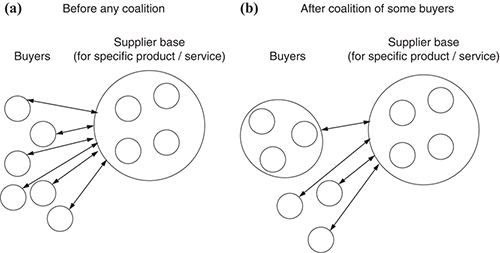
Possible impact of cooperative purchasing (coalition of buyers) on buyer's power relative the supplier base
Possible impact of cooperative purchasing (coalition of buyers) on buyer's power relative the supplier base
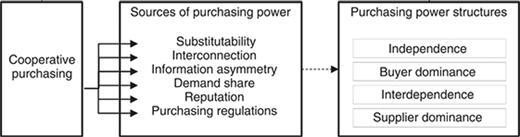
Conceptualizing findings on the impact of cooperative purchasing on purchasing power
Conceptualizing findings on the impact of cooperative purchasing on purchasing power
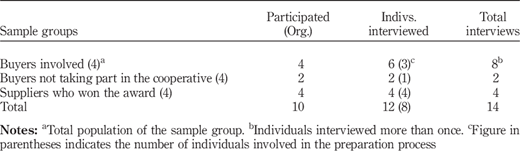
Sample groups and number of participants and individuals (indivs.) in the study
Sample groups and number of participants and individuals (indivs.) in the study
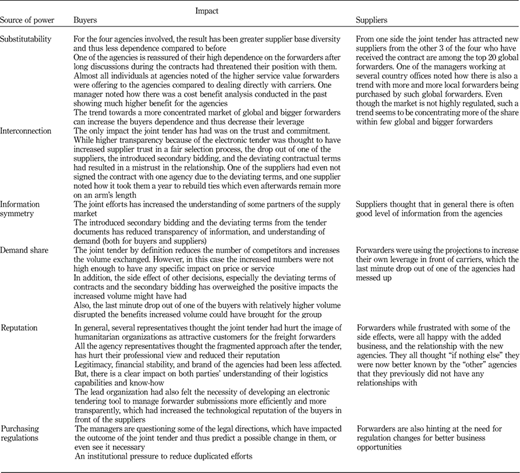
Analyzing the perceived impact of the joint tender on different sources of power for buyers and suppliers
Analyzing the perceived impact of the joint tender on different sources of power for buyers and suppliers
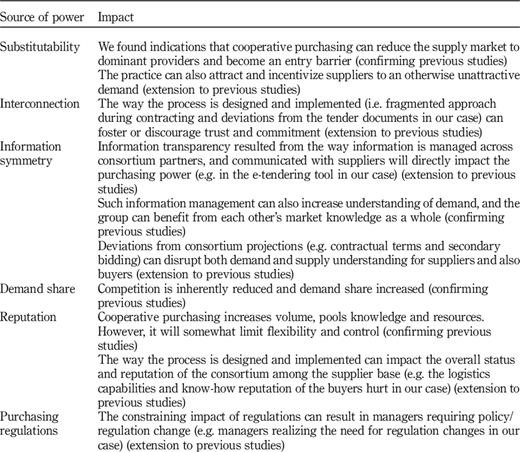
Findings from the study in comparison with previous studies on each source of power
Findings from the study in comparison with previous studies on each source of power
References
Further reading
About the authors
Ala Pazirandeh is a Doctoral Candidate in Industrial Management and Logistics at the Lund University, Sweden. She has been conducting research on purchasing strategies within the humanitarian sector during her PhD education. Her research interests include purchasing strategies, cross-sector partnerships, development aid and humanitarian logistics. Ala Pazirandeh is the corresponding author and can be contacted at: ala.pazirandeh@tlog.lth.se
Heidi Herlin is a Doctoral Candidate in Supply Chain Management and Corporate Geography at the Hanken School of Economics in Helsinki, Finland. She has also spent a year (2010-2011) as a visiting scholar at the Centre for corporate social responsibility at the Copenhagen Business School. Her research interests include business ethics, cross-sector partnerships, development aid and humanitarian logistics.

