


– The purpose of this paper is to present a literature review of humanitarian logistics (HL) that aims to identify trends and suggest some directions for future research.
– This conceptual paper develops a research framework for literature review through qualitative and quantitative content analysis. First, previous literature reviews in HL are updated and detailed. Then, seven classification criteria are added to earlier ones in order to advance the literature analysis.
– The conclusions identify some literature gaps and research opportunities. The main conclusions are the need for more studies into the disaster recovery phase and the need for closer relationships between academia and humanitarian organizations to increase the number of applied research.
– The literature is limited to academic peer-reviewed journals because of their academic relevance, accessibility, and ease of searching.
– Help potential researchers to set up a research agenda for future work.
– Reinforce earlier calls to increase truly applied research and improve social impact of the field.
– In total, 228 papers that were published in the HL area are reviewed, giving rise to the most extensive literature review in this area. New dimensions for literature review in HL are proposed, which give some new insights into potential research directions.
1. Introduction
Natural disasters (such as floods, droughts, earthquakes, hurricanes, and famine) and man-made disasters (such as wars, conflicts, and refugee crises) have increasingly impacted communities and nations around the world in recent decades, and forecasts suggest that the trend will continue (EM-DAT – Emergency Events Database, 2011). Between 1992 and 2012, disasters worldwide affected 4.4 billion people were and killed 1.3 million people and lead to costs of two trillion US dollars in damages (UNISDR – The United Nations Office for Disaster Risk Reduction, 2012). Forecasts estimate that over the next 50 years, natural and man-made disasters will increase by five times in number and severity (Thomas and Kopczak, 2005). According to the International Federation of the Red Cross (IFRC) and Red Crescent Societies, disasters can be defined as sudden, calamitous events that disrupt the activities of a society or a community and cause human, material, economic, or environmental losses that exceed the recovery capacity of the affected community or society using only its own resources (Natarajarathinam et al., 2009). One of the main factors used to measure the intensity of a disaster is the site's vulnerability (Alcántara-Ayala, 2002). Such disasters as the earthquake and the tsunami in Asia in 2004 and in Japan in 2011, the earthquakes in Pakistan in 2005 and Haiti in 2010, among others, have demonstrated the vulnerability of the affected societies by requiring more efforts from humanitarian organizations to provide disaster relief. Considering the urgency, the uncertainty, and the complexity of the global supply chain that is driven by humanitarian entities, usually non-governmental, at the onset of a disaster anywhere in the world, enhancements in logistics and supply chain management directly affect the ability of humanitarian organizations to respond to disasters and improve their overall effectiveness. In this sense, humanitarian logistics (HL) can be defined as the process of planning, implementing, and controlling the efficient, cost-effective flow and the storage of goods and materials, as well as related information, from the point of origin to the point of consumption to meet the requirements of the beneficiaries (Thomas and Mizusjima, 2005). Humanitarian operations encompass the lifecycle of a disaster including preparedness, response, and recovery. Thus, the ability to conduct efficient and effective humanitarian operations is a critical element of a disaster relief process.
Academic research of disaster operations management and HL is relatively new but has grown in terms of quantity and relevance in the last years (e.g. Beamon, 2004; Thomas, 2004, 2007; Beamon and Kotleba, 2006a, b; Van Wassenhove, 2006a, b; Van Wassenhove et al., 2008). Until 2005, there was a limited set of research on HL (Beamon and Kotleba, 2006a), as indicated in the literature reviews by Natarajarathinam et al. (2009) and Altay and Green (2006). Most of the papers on HL were published in practitioner journals. Since then, however, HL has been included in special tracks at prominent conferences, such as those of INFORMS (Institute for Operations Research and the Management Sciences) and Production and Operations Management Society (Kovács and Spens, 2009). Special issues on the subject were published by such journals as OR Spectrum (2011), the International Journal of Production Economics (2010), the International Journal of Physical Distribution & Logistics Management (2009, 2010), the International Journal of Services Technology and Management (2009), the International Journal of Risk Assessment and Management (2009), Management Research News (2009), and Transportation Research Part E (2007) (Kovács and Spens, 2011). In 2011, the first journal on HL, the Journal of Humanitarian Logistics and Supply Chain Management (JHLSCM), was published. Additionally, research groups dedicated to the topic – for example, the Fritz Institute, the INSEAD (Institut européen d’administration des affaires), and the Massachusetts Institute of Technology groups – and graduate programmes on the topic have been created at several universities (Kovács and Spens, 2011), which indicates that recognition of and research into HL have evolved in the past few years.
In this context, the purpose of this work is to deepen the knowledge about HL by reviewing the current research trends in logistics and supply chain management in these types of crisis situations. Papers published were reviewed and classified to observe trends, identify literature gaps, and subsequently propose ideas for future research.
Other literature reviews have been published in the HL research area so far, but they consider different perspectives and approaches. The first literature review in disaster operations management was conducted by Altay and Green (2006). These authors reviewed 109 papers that were published in operations research (OR) and management science (MS) journals from 1980 to 2004 in which papers were included that covered such situations as computer network emergencies. Logistics and supply chain management journals were not included in their work. Kovács and Spens (2007) proposed a conceptual framework that distinguishes the actors, the phases, and the logistical processes of disaster relief. The number of papers they reviewed was not specified. Natarajarathinam et al. (2009), conversely, reviewed papers dealing with supply chain management during a crisis, including such situations as a supplier bankruptcy and the loss of key clients. These researchers’ work considered 118 papers, which were published in 48 journals from 1975 to 2008. Pettit and Beresford (2009) reviewed the literature about the critical success factors in commercial supply chains, considering their applicability to humanitarian relief. More recently, other literature reviews have appeared (Overstreet et al., 2011; Caunhye et al., 2012; Kunz and Reiner, 2012). Overstreet et al. (2011) reviewed 51 papers considering only sudden-onset disasters published until 2009 and categorized the literature using eight key elements of logistics: organization personnel, equipment/infrastructure, transportation, information technology/communication, planning/policies/procedures, and inventory management. Caunhye et al. (2012) reviewed 74 papers about optimization models in emergency logistics. Finally, Kunz and Reiner (2012) used content analysis methodology to cover the literature on HL and analyzed 174 papers published in 68 academic journals until 2011. However, the most of these interesting contributions, which include the proposal of several criteria to classify the literature and rigorous research process, have a more general scope than the present paper, which focusses solely on disaster relief and HL. Only the works by Kovács and Spens (2007), Overstreet et al. (2011), and Kunz and Reiner (2012) focussed in the literature in HL, but the number of papers they considered is lower than the one considered in our research.
Therefore, given the increasing number of works published in the HL field, there is a need for an updated and detailed review of the current literature that requires further investigation, as well as different criteria for further literature classification. In this paper, 228 papers that were published in the HL area are reviewed, giving rise to a most extensive literature review in this area. Among these 228 papers, 135 were published after 2004 and 95 after 2008, which means that they were not included in the Altay and Green or Natarajarathinam et al. reviews. In addition to the updated review, additional classification criteria to those adopted by the abovementioned papers, such as geographical, stakeholder, and coordination perspectives of academic production are proposed to better detail different contributions. The research methodology is based on content analysis as discussed in Seuring and Gold (2012). Considering the research framework here proposed, some issues and potential directions for future research are identified.
The remainder of this text is organized as follows. Section 2 presents the research methodology used to classify the previous works. Next, Section 3 offers results and discussions of the literature review. Trends and future research directions are presented in Section 4. The concluding remarks are given in Section 5.
2. Research methodology
A systematic review on the HL literature was conducted. According to Rowley and Slack (2004), literature reviews make it easy to obtain information sources and contribute to the understanding of concepts, analysis, and interpretation of results related to a specific subject. In this regard, content analysis is a useful way to conduct quantitative and qualitative literature reviews in a structured and reproducible way (Seuring et al., 2005). In our literature review we use both qualitative and quantitative content analysis because, according to Seuring et al. (2005), quantitative and qualitative methods are not contradictory but can appropriately support each other.
Seuring and Gold (2012) provide practical guidance on how to use content analysis for literature reviews following the process model described in Seuring et al. (2005). This process model, adopted here, consists of four steps:
(1) material collection;
(2) descriptive analysis;
(3) category selection; and
(4) material evaluation.
Material collection
The scope of the literature review presented in this paper is limited to academic peer-reviewed journals because of their academic relevance, accessibility, and ease of searching. Books, conference proceedings, project reports, and practitioner journals are outside the scope of this work and the inclusion of these types of references is suggested as future works. It should be highlighted that the previous reviews cited in the introduction section also consider solely academic papers. Editorial papers and paper not focussed in disaster operations management and HL are beyond the scope of the paper and were excluded from the material selected. In addition, this review considers only papers that were published after 1980, as that is the period when the first works on disaster operations management appeared (Sheffi et al., 1982; Sampson and Smith, 1982). The keywords “disaster”, “relief”, and “humanitarian logistics” were used for the literature search in several journal databases (such as Science Direct, Wiley, Springer Link, Emerald, Informs, etc.) and for content analysis in journal issues based on title, abstract, and the keywords. The search was subsequently extended with reference lists from the reviewed papers. Finally, as our paper is focussed on disaster relief, studies of daily responses to routine emergency calls are excluded from this work, and the interested reader can refer, for example, to the work by Swersey (1994). This material selection process led to the sample of 228 papers published in 85 journals (the complete reference list is presented in Appendix).
Descriptive analysis
Information about the distribution of papers per year, per journal, and country are addressed and presented along with findings in the next section to give an idea of publication trends.
Category selection
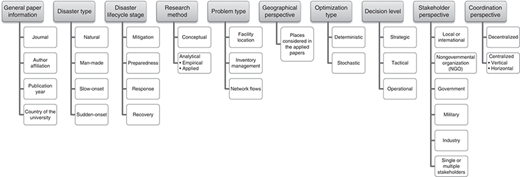
The method used to classify the literature is based on the criteria presented in Figure 1. In our conceptual research framework, the classification criteria are divided in ten blocks, each one giving important information about the paper. Three of these criteria were used in previous literature reviews as well. The other criteria are proposed to provide a more comprehensive view of the analyzed papers as contribution for this paper.
The categories presented in Figure 1 are detailed below:
(1) General paper information: journal title, publication year, author affiliations, and countries of the affiliation of authors. This criterion was also adopted in the literature review by Natarajarathinam et al. (2009).
(2) Disaster type: Van Wassenhove (2006a) proposed a classification of natural and man-made disasters according to the speed with which the disaster strikes: slow-onset or sudden-onset. Famine, drought, political, and refugee crises are examples of the former category, whereas the latter includes, for example, earthquakes, hurricanes, technological failures, and terrorist attacks.
(3) Disaster lifecycle stage: Altay and Green (2006) divided the disaster lifecycle into four stages: mitigation, preparedness, response, and recovery. In the mitigation stage, measures are applied either to prevent the onset of a disaster or to reduce the impacts of its occurrence. Hence, risk measurement and risk analysis articles were classified in the mitigation stage. Preparedness activities train the community to respond when a disaster strikes. The resources and the emergency procedures employed immediately after the disaster occurs comprise the response stage. Recovery involves the actions taken in the long term after the immediate impact of the disaster. This criterion was also adopted in the literature review by Altay and Green (2006).
(4) Research method: the research method classification follows the approach of Natarajarathinam et al. (2009). Papers can be classified as conceptual, analytical, empirical or applied. The conceptual works consider a new method, a technique, or an approach to disaster relief and are not justified with any additional work such as modeling, a case study, or empirical research. Literature review works are additionally classified as conceptual research. The analytical category considers research methods such as simulation or mathematical modeling. These papers may use empirical or applied research to illustrate the analytical study. Empirical works include the collection and the evaluation of data and observations, and evaluate the collected information. Case studies, opinions, and interviews are included in the applied research category (i.e. empirical research could use some secondary data or even actual data but are not characterized as a study of a real case). This criterion was also adopted in the literature review by Natarajarathinam et al. (2009).
(5) Problem type: for the OR-oriented papers, the relevant academic literature falls into three problem types: facility location, inventory management, and network flows. According to Duran et al. (2011), the first type focusses on the spatial aspects of operations and the second type focusses on estimating demand at the various nodes of a supply chain, whereas the third type focusses on the delivery of goods and the sequence of activities. In addition, optimization type and model type are described to provide more detail about the use of mathematical programming in the HL field. This criterion is a paper's contribution. Altay and Green focussed their review on OR papers which indicates the importance of having more detail from this subset of papers.
(6) Geographical perspective: the site of the applied research is specified when available.
(7) Optimization type: OR-oriented papers are classified as deterministic (in which the parameters assume the average value) or stochastic (in which uncertainty is considered and the parameters follows a probability distribution).
(8) Decision level: papers are divided according to the decision level because humanitarian logistics services require good strategic (long term), tactical (medium term), and operational (short term) decisions to ensure the efficient allocation of resources.
(9) Stakeholder perspective: based on the point of view decision maker that could be a local or international non-governmental organization (NGO), government, military, private sector, and United Nations (UN), in a single or multiple context. Interactions among these actors are also investigated.
(10) Coordination perspective: for Akhtar et al. (2012), the coordination process is understood in activities among interdependent organizations to achieve the common goal of be effective in improve the information flow along the supply chain by controlling the production and delivery of goods, receiving donations, costs ,and quality of services. When entities operate individually (without collaborating with other entities), the coordination is characterized as decentralized. On the other hand, if the entities collaborate with each other, the coordination is centralized. According to Fearne (1998), coordination can be classified in vertical and horizontal. In vertical coordination, the links of the chain (suppliers, manufacturers, warehouses, distribution, and customers) interact with each other. The horizontal coordination involves parties or links of the same level of the chain (Fearne, 1998; Akhtar et al., 2012).
Material evaluation
The paper sample was reviewed according to the criteria above mentioned. As the categorization process was based on academic judgment, to ensure the quality, validity, and reliability of the review, at least three authors participated in the categorization process and cross-checking was conducted to test agreements and aligning mental schemes in order to avoid classification deviations. First, decision rules to paper assignments to each category were designed and validated by all authors. After that, a sample of papers was read and classified by all authors to compare assignment decisions and address inter-coder agreement. The subjectivity of data analysis issue was considered by discussing ambiguous decisions among the authors. Finally, a set of papers was assigned to be analyzed by each author and cross-checked by another author to ensure reliability of the categorization process; where the first one was responsible for the full length paper reading and the second one was responsible for a quick reading to check the assigned categorization. Although the attempt to ensure quality and reliability of the review, there is no indicators about the quality of the agreement among coders; if no clear categorization emerged, the issue was discussed among all authors to improve the quality of academic judgment, which is a simplification of the review process.
3. Results
General characteristics of the included papers
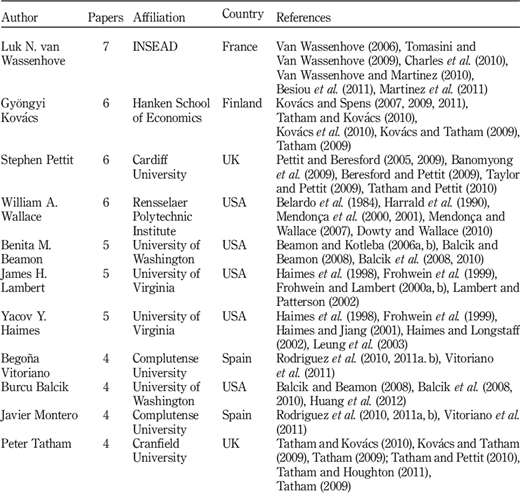
Table I ranks authors of papers in humanitarian logistics with at least four papers published. The highest-ranking author in the number of publications comes from a French institution (INSEAD), followed for Finland, UK, and USA.
Geographical perspective
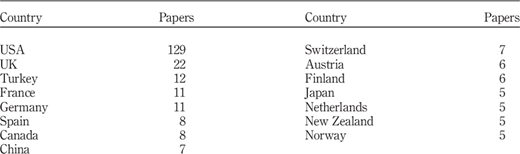
Table II presents the list of countries with at least five publications. The paper distribution by the country of origin shows the USA and Europe as main contributors.
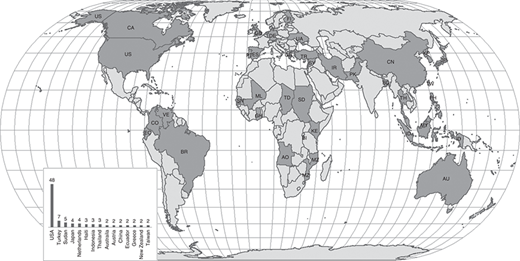
Figure 2 shows the localities considered in the applied papers. Regarding applied research, the USA again has the highest number (48 papers) followed by Turkey (seven papers), Sudan (five papers), Japan, and the Netherlands (four papers).
Disaster characteristics
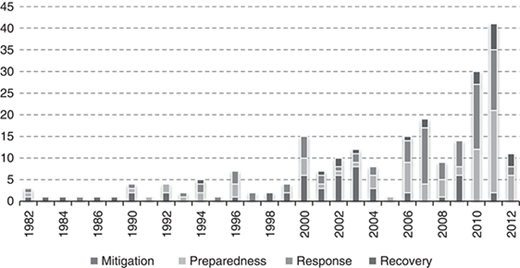
Figure 3 illustrates the distribution of papers per year according to the disaster lifecycle stage. The results indicate an emphasis on the mitigation stage from 1998 to 2003 and the growth of research into the response stage from 2006 to 2012 (only until August). Figure 3 additionally shows the paucity of literature on HL prior to 1990, indicating that it was an under explored field, and the figure indicates a sharp increase in the number of publications on the subject in the past few years, especially after 2009, when journals published special issues.
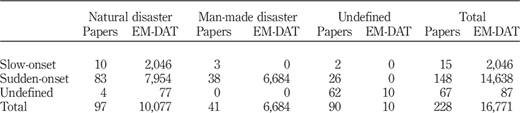
The division of papers according to Van Wassenhove (2006a) approach is summarized in Table III, where sudden-onset disasters can be viewed as the category that has gained more attention from academia Table III also shows data from EM-DAT – Emergency Events Database (2011) which shows that academia has focussed in sudden-onset disasters – the type of disaster more frequently according to the EM-DAT.
Research method
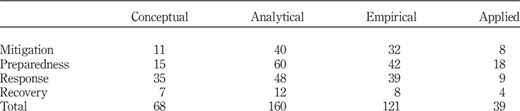
The distribution of papers by research method and disaster lifecycle stage is shown in Table IV. It is important to note that the articles are divided into categories of conceptual or analytical and the analytical papers are further classified in empirical or applied. Thus, the sum of conceptual and analytical papers equals the grand total of 228 papers and the sum of empirical and applied papers is equal to the number of analytical papers. The results suggest that the analytical work is predominant over conceptual work and that the number of empirical and applied papers is well distributed. From Table IV, it can be observed that preparedness and response are currently the most addressed phases of the disaster lifecycle.
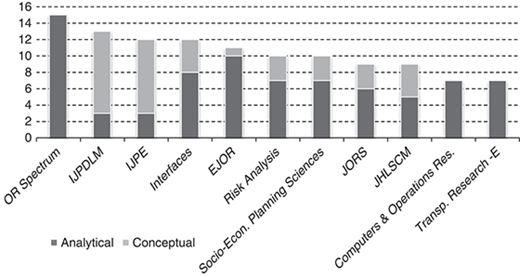
The analysis of the research methods (analytical or conceptual) employed in the journals with large number of publications is shown in Figure 4 and highlights the conceptual line of journals oriented toward logistics and supply chain management (such as International Journal of Physical Distribution & Logistics Management – IJPDLM and International Journal of Production Economics – IJPE) in contrast to the analytical feature of OR-oriented journals (such as OR Spectrum and European Journal of Operational Research – EJOR).
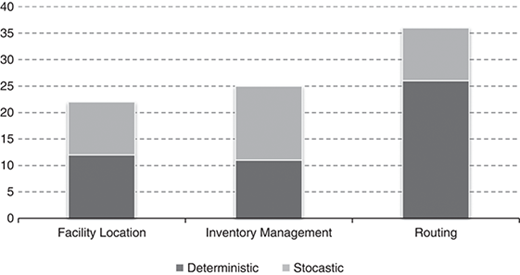
Mathematical programming used in OR papers was originally developed with well-established deterministic models. However, decisions to support HL activities for disaster operations management are challenging because of the uncertainties in these events. In this regard, stochastic programming can be a most appropriate tool to support decisions because of its ability to handle uncertainty. The predominance of deterministic studies can additionally be observed in Figure 5, where the articles are classified according to the type of problem (actually, the number of stochastic applications reaches a total of 34 studies in contrast to 49 deterministic works). Networks flows (routing problems) appear to be the most common problem type. Routing problems and scheduling of activities after the onset of a disaster are included in this category (e.g. relief distribution and evacuation of displaced people and those in need of emergency medical assistance).
Decision level
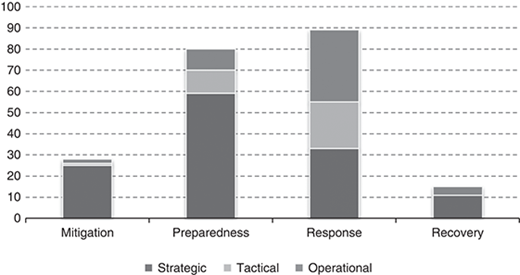
The need for preparedness for disasters is confirmed by the high number of papers that cover strategic decisions (128) followed by operational (50) and tactical papers (34). Prepositioning of warehouses in facility location problems (Balcik and Beamon, 2008) and determining the inventory level of critical commodities for immediate relief (Beamon and Kotleba, 2006a b) are typical preparedness activities for disaster operations management. According to Caunhye et al. (2012), in OR-papers, facility location models are mainly based in mixed integer programs. As presented in Figure 6, where certain papers can be classified in more than one category, the focus is on strategic planning in the period before a disaster occurs, whereas operational (e.g. the work by Barbarosoglu and Arda, 2004 for vehicle routing) and tactical initiatives (e.g. the work by Falasca and Zobel, 2011 for inventory management) gain more relevance after a disaster strikes, which is a conclusion based mainly on the publications concerning the delivery routing of relief supplies.
Stakeholder perspective
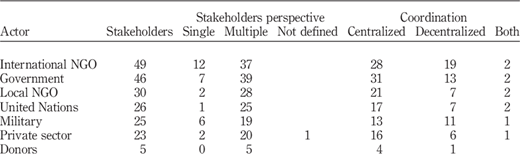
Humanitarian aid may enroll a large number and variety of actors (international and local NGOs, government, military, private sector, and donors) with different interest and expertise (Balcik et al., 2010). Table V shows the stakeholders (actors) perspective of the papers analyzed where government appears as predominant in our review.
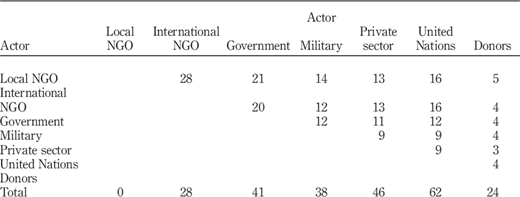
Typically, no single actor has sufficient resources to respond effectively to a major disaster (Bui et al., 2000). Coordination among multiple stakeholders, the most covered stakeholder perspective in the literature, may be centralized or decentralized. Table VI presents the number of papers that examine the relationships between each pair of stakeholders. Interactions between local and international NGOs and from these types of NGOs with governments appear as the most common relationship. UN, private sector, and military are stakeholders also well explored in the literature of humanitarian logistics.
The findings presented in Table V indicate that centralized coordination has been more explored in the literature than decentralized coordination and that coordination among NGOs and government is pointed out as the most discussed relationship in this topic. Among the papers that cover centralized coordination (51 papers), 22 papers address horizontal coordination; nine papers cover vertical coordination; 12 papers discuss both horizontal and vertical coordination; and in eight papers the type of coordination is not defined.
The gaps in the literature and future research directions are summarized in Section 4.
4. Discussions: trends and future research directions
From the results of our review (Table IV), it can be concluded that research on the proactive and the immediate-reaction stages of the disaster lifecycle, such as mitigation, preparation, and response, is more widespread than research on the recovery stage. The publication profile by disaster lifecycle stage has changed since the Altay and Green study was published. As Altay and Green focussed on OR papers, this profile may have an impact on the results. In these researchers’ review, the mitigation stage accounted for 44 percent of the papers followed by response, preparedness, and recovery in decreasing order. The recovery of a site after experiencing a disaster continues to receive little attention as had been attested by Altay and Green (2006), Kovács and Spens (2007), Overstreet et al. (2011), Natarajarathinam et al. (2009), and Kunz and Reiner (2012). Considering the need for a recovery plan to return to normal operations and that this process may take a long time (e.g. one year after the floods in Rio de Janeiro, life has not yet returned to normal in the affected area), more research in recovery planning is needed considering the socio technical aspects (Holguín-Veras et al., 2012). The quality and speed of logistics activities in the recovery phase strongly impact the ability of the local community reconstruct itself from a disaster. Thus, there is a need for studies that enroll humanitarian logistics in long-term development programs, as suggested by Kovács and Spens (2011). In a lesser scale, studies on mitigation phase are also in need (see Table IV), what had been earlier suggested by Altay and Green (2006).
As Altay and Green (2006) studied exclusively the OR/MS literature, only four of the top journals listed in Figure 4, which shows the analysis of the research methods employed in the journals, are featured in the Altay and Green review (EJOR, Journal of the Operational Research Society – JORS, Interfaces, and Comp. & OR). As Natarajarathinam et al. (2009) considered crisis supply chain management in a broader scope, only five papers are featured in the Natarajarathinam et al. review (IJPDLM, Interfaces, EJOR, JORS, and IJPE). The journals OR Spectrum, Risk Analysis, Transportation Research E, Socio-Economic Planning Sciences, and JHLSCM did not appear in previous reviews. This finding suggests a new trend of publication channels in the HL area, underscoring the usefulness of an updated literature review in this research area.
The imbalance in academic efforts and actual needs was confirmed by contrasting the number of papers by disaster type in Table III; where sudden-onset disasters appear as the most frequently disaster type – corroborating the results of Altay and Green (2006) and Kunz and Reiner (2012). Actually, as attested by Long and Wood (1995), even though slow-onset disasters generally allow for more time to react, they can cause more damages to population, yet academic studies regarding these crises are seldom presented. High complexity of man-made disasters may be a reason for this type of disaster also be rarely explored in the literature (41 in the 228 papers reviewed). Kunz and Reiner (2012) state that the difficulty of access to areas affected by man-made disasters may complicate research in the field.
Additionally, Altay and Green (2006), Natarajarathinam et al. (2009), and Kunz and Reiner (2012) indicated that papers linking theory and practice were rarely explored. This situation still persists. If on one hand this finding is determined by the methodology adopted in this paper (the literature review is limited to academic peer-reviewed journals and practitioner journals are not considered), on the other hand it shows that an approximation of academia and practice is needed for relevant humanitarian problems be also published in scientific journals. In our review, only 23 of the 160 analytical papers included a case study (not simply a model or a numerical example to test the model with historical and geographical data). Among the applied papers, the IFRC, the World Food Program, Medecins Sans Frontieres (aka, Doctors without Borders), and the Federal Emergency Management Agency appear most frequently, especially the IFRC. Therefore, there is a need for closer collaboration with non-profit humanitarian organizations to strengthen relationships between academia and these entities such that more case studies and empirical research can be conducted (Van Wassenhove, 2006a; Kovács and Spens, 2011). It could be beneficial for scholars and practitioners to exchange data and knowledge about the process of providing humanitarian aid and that academic community publishes this knowledge.
Table II presents USA as the major contributor in the field of HL research This trend was also identified in previous studies (Altay and Green, 2006; Natarajarathinam et al., 2009). More than 50 percent of the papers reviewed involved the participation of scholars from the USA. Therefore, the involvement of the academic community from other parts of the world is essential to share knowledge about the local characteristics of HL problems.
Productivity and efficiency studies are challenging issues that have gained importance in humanitarian operations because of the pressure from donors on humanitarian organizations to deliver aid to beneficiaries in a cost-effective way. This trend can be observed in the research history. Whereas Altay and Green (2006) concluded that disaster operations management did not have widely accepted measures of productivity and efficiency, more recent papers tracked parallels between the performance indicators of business logistics and humanitarian logistics (e.g. Beamon and Balcik, 2008; Van der Laan et al., 2009; Schulz and Height, 2009; Pettit and Beresford, 2009; Oloruntoba and Gray, 2009). Natarajarathinam et al. (2009) and Kovács and Spens (2007) further suggest that disaster relief logistics should learn from business logistics. In this review, we concluded that technologies and management models used in logistics business can also be seized for performance improvements in humanitarian operations.
A predominance of work focussed on the strategic decision level was identified in the literature. The most of analytical strategic problems covers facility location in disaster preparedness. As suggested by Caunhye et al. (2012), there is an opportunity for facility location modeling in post-disaster situations (temporary distribution and treatment centers). Kovács and Spens (2007) claimed for research on operations planning in disaster relief. The operational level is concentrated on routing problems. Thus, there is a need to extend the analysis to the other decision levels (tactical and operational). Research on manpower management during emergencies, capacity planning, and casualty transportation is needed (Caunhye et al., 2012) and can be modeled as tactical and operational decisions.
Strategic, tactical, and operational decision levels are conventionally viewed as being related in a hierarchical fashion, with strategic planning decisions imposing goals, targets, and constraints on tactical decisions, which are, in turn, implemented and supported via a number of operational execution functions. One way to emphasize the need for integration is by recognizing the natural hierarchy among these steps and the fact that they may not operate with the same level of information. Thus, the political hierarchy in emergency response organizations is well-suited for hierarchical planning and multi-attribute, multi-objective approaches (Altay and Green, 2006; Jahre et al., 2009; Caunhye et al., 2012). Kovács and Spens (2011) and Kunz and Reiner (2012) suggest more research about the impact of politics in humanitarian logistics. In this sense, hierarchical planning could be a suitable way to explore this problem.
Coordination in HL can be either among the supply chain links or among humanitarian organizations. Coordination in humanitarian logistics may occur among different types of actors, such as international and national NGOs, governments, private entities, local community, military, and donors. The finding of some key stakeholders perspective as predominant, as shown in Table V, also appears in the keyword analysis of Kunz and Reiner (2012) review, in which the word “government” is mentioned in 73 percent of the papers. Kovács and Spens (2011) highlight the strong impact of politics in humanitarian aid and recommend further research in this area. Collaboration and coordination among actors involved in humanitarian relief is one of the main challenges to effectively respond to disasters (Kovács and Spens, 2007; Akhtar et al., 2012). In the immediate response phase after a disaster occurs, coordinating supply under unpredictable demand and distributing relief supplies are overwhelming in the chaotic post-disaster environment. The types of cooperation and coordination for resources utilization and information sharing need to be carefully studied, especially the perspective of multiple stakeholders, to promote the development and get better overall results in the chain without undermining deadlines and quality of disaster relief. Emphasis must be given to the use of computerized systems that may facilitate and ensure the data internal and external sharing and control of the organizations. In this regard, decisions can be made through centralized or decentralized coordination structures. Our review suggests a predominance of a single perspective and identifies the need to study the interaction between stakeholders. Altay and Green (2006), however, suggested expanding the knowledge regarding organization and network structures that could facilitate communication and coordination among the humanitarian organizations. Despite the existing contributions (e.g. Van der Laan et al., 2009; Balcik et al., 2010; Jahre and Jensen, 2010), further research is still needed.
Table VII summarizes the research trends of the previous literature reviews and some suggestions for future studies.
Finally, humanitarian logistics is a multidisciplinary field of both a social and a political nature and presents problems that are suitable for conceptual, analytical, empirical, and applied research. Despite several interesting contributions to humanitarian logistics listed in all the revised papers, humanitarian relief chain management still has many open issues and is therefore relevant for mathematical modeling, actual applications, and multidisciplinary perspectives to get a holistic analysis in the decision-making process.
5. Conclusions
This paper presented a literature review of humanitarian logistics and disaster operations management and showed an increase in the number of publications on the subject over the past five years. The number of papers on the subject has significantly increased since previous literature reviews in this research area were published. Despite of contributions of the existing literature reviews, our review is the most extensive in humanitarian logistics research area. In total, 228 published papers in the HL area were reviewed and classified, and research trends were identified, allowing several conclusions for future research. The main conclusions are the need for more studies into the disaster recovery phase and the need for closer relationships between academia and humanitarian organizations to generate more applied research. In the last several years, most publications have focussed on strategic decision making. The authors agree that a closer collaboration among these stakeholders may lead to a greater development of applied research at the tactical and the operational decision levels, where a thorough knowledge of real-world problems is needed. As this review was limited to academic papers published in peer-reviewed journals, relevant practioner studies may be excluded from the review and the extension to include this material is suggested as future development.
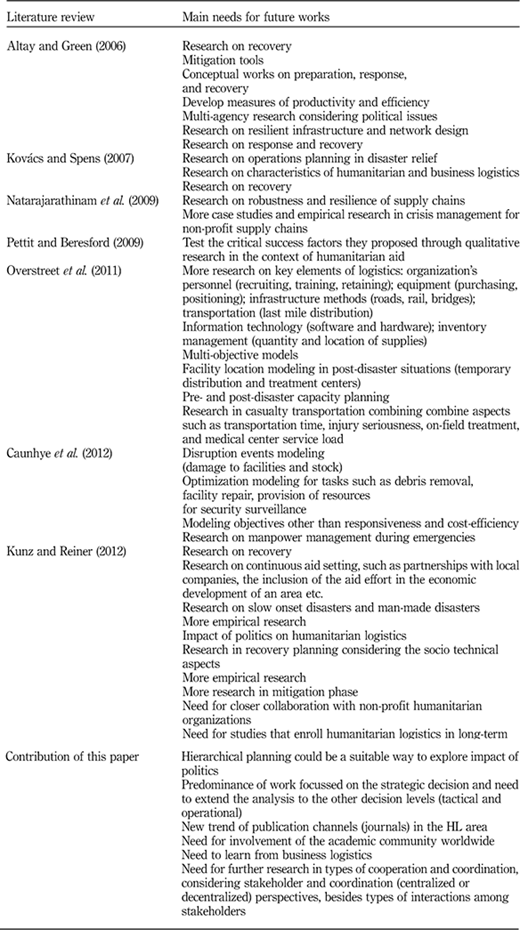
Trends from previous literature reviews (adapted from Kunz and Reiner, 2012) and contribution of this paper
Trends from previous literature reviews (adapted from Kunz and Reiner, 2012) and contribution of this paper
References
Further reading
Appendix – Complete reference list (228 papers)
Aaby, K., Herrmann, J.W. Jordan, C.S. Treadwell, M. and Wood. K. (2006), “Montgomery county’s public health service uses operations research to plan emergency mass dispensing and vaccination clinics”, Interfaces, Vol. 36 No. 6, pp. 569-579.
Akhtar P., Marr, N.E. and Garnevska, E.V. (2012), “Coordination in humanitarian relief chains: chain coordinators”, Journal of Humanitarian Logistics and Supply Chain Management, Vol. 2 No. 1, pp. 85-103.
Albala-Bertrand, J.M. (2000a), “Complex emergencies versus natural disasters: an analytical comparison of causes and effects”, Oxford Development Studies, Vol. 28 No. 2, pp. 187-204.
Albala-Bertrand, J.M. (2000b), “Responses to complex humanitarian emergencies and natural disasters: an analytical comparison”, Third World Quaterly, Vol. 21 No. 2, pp. 215-227.
Altay, N., Prasad, S. and Sounderpandian, J. (2009), “Strategic planning for disaster relief logistics: lessons from supply chain management”, International Journal of Services Sciences, Vol. 2 No. 2, pp. 142-161.
Altay, N. and Green, W.G. III (2006), “OR/MS research in disaster operations management”, European Journal of Operational Research, Vol. 175 No. 1, pp. 475-493.
Balcik, B., Beamon, B.M., Krejci, C.C., Muramatsu, K.M. and Ramirez, M. (2010), “Coordination in humanitarian relief chains: practices, challenges and opportunities”, International Journal of Production Economics, Vol. 126 No. 1, pp. 22-34.
Balcik, B., Beamon, B.M. and Smilowitz, K. (2008), “Last mile distribution in humanitarian relief”, Journal of Intelligent Transportation Systems, Vol. 12 No. 2, pp. 51-63.
Balcik, B. and Beamon, B.M. (2008), “Facility location in humanitarian relief” International Journal of Logistics: Research and Applications, Vol. 11 No. 2, pp. 101-121.
Banomyong, R., Beresford, A. and Pettit. S. (2009), “Logistics relief response model: the case of Thailand’s tsunami affected area”, International Journal of Services Technology and Management, Vol. 12 No. 4, pp. 414-429.
Banomyong, R. and Sopadang, A. (2010), “Using Monte Carlo simulation to refine emergency logistics response models: a case study”, Journal of Physical Distribution & Logistics Management, Vol. 40, No. 8-9, pp. 709-721.
Barbarosoglu, G., Özdamar, L. and Çevik, A. (2002), “An interactive approach for hierarchical analysis of helicopter logistics in disaster relief operations”, European Journal of Operational Research, Vol. 140 No. 1, pp. 118-133.
Barbarosoglu, G. and Arda, Y. (2004), “A two-stage stochastic programming framework for transportation planning in disaster response”, Journal of the Operational Research Society, Vol. 55 No. 1, pp. 43-53.
Beamon, B.M. and Kotleba. S.A. (2006), “Inventory management suppot systems for emergency humanitarian relief operations in South Sudan”, International Journal of Logistics Management, Vol. 17 No. 2, pp. 187-212.
Beamon, B.M. and Kotleba, S.A. (2006), “Inventory modeling for complex emergencies in humanitarian relief”, International Journal of Logistics: Research and Applications, Vol. 9 No. 1, pp. 1-18.
Belardo, S., Karwan, K.R. and Wallace, W.A. (1984), “Managing the response to disasters using microcomputers”, Interfaces, Vol. 14 No. 2, pp. 29-39.
Belgasmi, D. (2007), “Emergency operations: Darfur, a case study”, Refugee Survey Quarterly, Vol. 26 No. 4, pp. 243-249.
Benini, A.A. (1993), “Simulation of the effectiveness of protection and assistance for victims of armed conflit (Sepavac): an example from Mali, West Africa”, Journal of Contingencies and Crisis Management, Vol. 1 No. 4, pp. 215-228.
Ben-Tal, A., Chung, B.D., Mandala, S.R. and Yao, T. (2011), “Robust optimization for emergency logistics planning: risk mitigation in humanitarian relief supply chains”, Transportation Research Part B, Vol. 45 No. 8, pp. 1177-1189.
Beresford, A. and Pettit, S.E. (2009), “Emergency logistics and risk mitigation in Thailand following the Asian tsunami”, International Journal of Risk Assessment and Management, Vol. 13 No. 1, pp. 7-21.
Berkoune, D., Renaud, J. Rekik, M. and Ruiz, A. (2012), “Transportation in disaster response operations”, Socio-Economic Planning Sciences, Vol. 46 No. 1, pp. 23-32.
Besiou, M., Stapleton, O. and Van Wassenhove, L.N. (2011), “System dynamics for humanitarian operations”, Journal of Humanitarian Logistics and Supply Chain Management, Vol. 1 No. 1, pp. 78-103.
Bish, D.R. (2011), “Planning for a bus-based evacuation”, OR Spectrum, Vol. 33 No. 3, pp. 629-654.
Blecken, A., Hellingrath, B., Dangelmaier, W. and Schulz, S.F. (2009), “A humanitarian supply chain process reference model”, International Journal of Services Technology and Management, Vol. 12 No. 4, pp. 391-413.
Boswell, M.R., Deyle, R.E., Smith, R.A. and Baker, E.J. (1999), “A quantitative method for estimating probable public costs of hurricanes”, Environmental Management, Vol. 23 No. 3, pp. 359-372.
Bozorgi-Amiri, A., Jabalameli, M.S., and Mirzapour Al-e-Hashem, S.M.J. (2011), “A multi-objective robust stochastic programming model for disaster relief logistics under uncertainty”, OR Spectrum, Online First™, 13 August.
Brown, G.G., and Vassiliou, A.L. (2006), “Optimizing disaster relief: real-time operational and tactical decision support”, Naval Research Logistics, Vol. 40 No. 1, pp. 1-23.
Bryson, K.-M., Millar, H., Joseph, A. and Mobolurin, A. (2002), “Using formal MS/OR modeling to support disaster recovery planning”, European Journal of Operational Research, Vol. 141 No. 3, pp. 679-688.
Campbell, A.M., Vandenbussche, D. and Hermann, W. (2008), “Routing for relief efforts”, Transportation Science, Vol. 42 No. 2, pp. 127-145.
Campbell, A.M. and Jones, P.C. (2011), “Prepositioning supplies in preparation for disasters”, European Journal of Operational Research, Vol. 209 No. 2, pp. 156-165.
Carroll, A. and Neu, J. (2009), “Volatility, unpredictability and asymmetry: an organising framework for humanitarian logistics operations?”, Management Research News, Vol. 32 No. 11, pp. 1024-1037.
Caunhye, A.M., Nie, X. and Pokharel, S. (2012), “Optimization models in emergency logistics: a literature review”, Socio-Economic Planning Sciences, Vol. 46 No. 1, pp. 4-13.
Chakravarty, A.K. (2011), “A contingent plan for disaster response”, International Journal of Production Economics, Vol. 134, pp. 3-15.
Chang, M.-S., Tseng, Y.-L. and Chen, J.-W. (2007), “A scenario planning approach for the flood emergency logistics preparation problem under uncertainty”, Transportation Research Part E: Logistics and Transportation Review, Vol. 43 No. 6, pp. 737-754.
Chang, S.E., Shinozuka, M. and More, J.E. (2000), “Probabilistic earthquake scenarios: extending risk analysis methodologies to spatially distributed systems”, Earthquake Spectra, Vol. 16 No. 3, pp. 557-572.
Chang, S.E. and Nojima, N. (2001), “Measuring post-disaster transportation system performance: the 1995 Kobe earthquake in comparative perspective”, Transportation Research Part A: Policy and Practice, Vol. 35 No. 6, pp. 475-494.
Charles, A., Lauras, M. and Wassenhove, L.V. (2010), “A model to define and assess the agility of supply chains: building on humanitarian”, International Journal of Physical Distribution & Logistics Management, Vol. 40 Nos 8-9, pp. 722-741.
Charles, A. and Lauras, M. (2011), “An enterprise modeling approach for better optimization modeling: application to the humanitarian relief chain coordination problem”, OR Spectrum, Vol. 33 No. 3, pp. 815-841.
Chiang, W.L. and Shah, H.C. (1987), “Fuzzy information processing in seismic hazard analysis and decision making”, Soil Dynamics and Earthquake Engineering, Vol. 6 No. 4, pp. 220-226.
Chiu, Y.-C. and Zheng, H. (2007), “Real-time mobilization decisions for multi-priority emergency response resources and evacuation groups: model formulation and solution”, Transportation Research Part E: Logistics and Transportation Review, Vol. 43 No. 6, pp. 710-736.
Church, R.L., Scaparra, M.P. and Middleton, R.S. (2004), “Identifying critical infrastructure : the median and covering facility interdiction problems”, Annals of the Association of American Geographers, Vol. 94 No. 3, pp. 491-502.
Coles, J.B., Zhuang, J. and Yates, J. (2012), “Case study in disaster relief: a descriptive analysis of agency partnerships in the aftermath of the January 12th, 2010 Haitian earthquake”, Socio-Economic Planning Sciences, Vol. 46 No. 1, pp. 67-77.
Coles, S. and Pericchi, L. (2003), “Anticipating catastrophes through extreme value modeling”, Journal of the Royal Statistical Society – Series C – Applied Statistics, Vol. 52 No. 4, pp. 405-416.
Costa, C.A.B., Oliveira, C.S. and Vieira, V. (2008), “Prioritization of bridges and tunnels in earthquake risk mitigation using multicriteria decision analysis: application to Lisbon”, Omega, Vol. 36 No. 3, pp. 442-450.
Cotta, C. (2011), “Effective patient prioritization in mass casualty incidents using hyperheuristics and the pilot method”, OR Spectrum, Vol. 33 No. 3, pp. 699-720.
Cret, L., Yamazaki, F., Nagata, S. and Katayama, T. (1993), “Earthquake damage estimation and decision analysis for emergency shutoff of city gas”, Structural Safety, Vol. 12 No. 1, pp. 1-19.
Cruz, A.M., Steinberg, L.J. and Vetere-Arellano, A.L. (2006), “Emerging issues for Natech disaster risk management in Europe”, Journal of Risk Research, Vol. 9 No. 5, pp. 483-501.
Current, J. and O’Kelly, M. (1992), “Locating emergency warning sirens”, Decision Sciences, Vol. 23 No. 1, pp. 221-234.
Dalziell, E. and Nicholson, A. (2001), “Risk and impact of natural hazards on a road network”, Journal of Transportation Engineering, Vol. 127 No. 2, pp. 159-166.
Dantas, A., Seville, E. and Gohil, D. (2001), “Information sharing during emergency response and recovery: a framework for road organizations”, Transportation Research Record, Vol. 2022, pp. 21-28.
Davidson, R.A., Zhao, H. and Kumar, V. (2003), “Quantitative model to forecast changes in hurricane vulnerability of regional building”, Journal of Infrastructure Systems, Vol. 9 No. 2, pp. 55-64.
De Angelis, V., Mecoli, M., Nikoi, C. and Storchi, G. (2007), “Multiperiod integrated routing and scheduling of World Food Programme cargo planes in Angola”, Computers & Operations Research, Vol. 34 No. 6, pp. 1601-1615.
de la Torre, L.E., Dolinskaya, I.S. and Smilowitz, K.R. (2011), “Disaster relief routing: Integrating research and practice”, Socio-Economic Planning Sciences (in press).
de Silva, F.N. and Eglese, R.W. (2000), “Integrating simulation modelling and GIS: spatial decision support systems for evacuation planning”, Journal of the Operational Research Society, Vol. 51 No. 4, pp. 423-430.
Deckle, J., Lavieri, M.S., Martin, E., Emir-Farinas, H. and Francis, R.L. (2005), “A Florida county locates disaster recovery centers”, Interfaces, Vol. 35 No. 2, pp. 133-139.
Doocy, S., Sirois, A., Anderson, J., Tileva, M., Biermann, E., Storey, J.D. and Burnham, G. (2011), “Food security and humanitarian assistance among displaced Iraqi populations in Jordan and Syria”, Social Science & Medicine, Vol. 72 No. 2, pp. 273-282.
Dowty, R.A., Wallace, W.A. (2010), “Implications of organizational culture for supply chain disruption and restoration”, International Journal of Production Economics, Vol. 126 No. 1, pp. 57-65.
Drezner T., Drezner, Z. and Salhi, S. (2006), “A multi-objective heuristic approach for the casualty collection points location problem”, The Journal of the Operational Research Society, Vol. 57 No. 6, pp. 727-734.
Duque, P.M. and Sörensen, K. (2011), “A GRASP metaheuristic to improve accessibility after a disaster”, OR Spectrum, Vol. 33 No. 3, pp. 525-542.
Duran, S., Gutierrez, M.A. and Keskinocak, P. (2011), “Pre-positioning of emergency items for CARE international”, Interfaces, Vol. 41 No. 3, pp. 223-237.
Egan, M.J. (2010), “Private goods and services contracts: Increased emergency response capacity or increased vulnerability?”, International Journal of Production Economics, Vol. 126 No. 1, pp. 46-56.
Englehardt, J.D. (2002), “Scale invariance of incident size distributions in response to sizes of their causes”, Risk Analysis, Vol. 22 No. 2, pp. 369-381.
Ergun, O., Stamm, J.L.H., Keskinocak, P. and Swann, J.L. (2010), “Waffle House Restaurants hurricane response: a case study”, International Journal of Production Economics, Vol. 126 No. 1, pp. 111-120.
Erkut, E., Ingolfsson, A. (2000), “Catastrophe avoidance models for hazardous materials route planning”, Transportation Science, Vol. 34 No. 2, pp. 165-179.
Ertem, M.A., Buyurgan, N. and Rossetti, M. (2010), “Multiple-buyer procurement auctions framework for humanitarian supply chain management”, International Journal of Physical Distribution & Logistics Management, Vol. 40 No. 3, pp. 202-227.
Ertem, M.A., Buyurgan, N. (2011), “An auction-based framework for resource allocation in disaster relief”, Journal of Humanitarian Logistics and Supply Chain Management, Vol. 1 No. 2, pp. 170-188.
Esogbue, A.O. (1996), “Fuzzy sets modeling and optimization for disaster control systems planning”, Fuzzy Sets and Systems, Vol. 81 No. 1, pp. 169-183.
Esogbue, A.O., Theologidu, M. and Guo, K. (1992), “On the application of fuzzy sets theory to the optimal flood control problem arising in water resources systems”, Fuzzy Sets and Systems, Vol. 48 No. 2, pp. 155-172.
Falasca, M. and Zobel, C.W. (2011), “A two-stage procurement model for humanitarian relief supply chains”, Journal of Humanitarian Logistics and Supply Chain Management, Vol. 1 No. 2, pp. 151-169.
Fiedrich, F., Gehbauer, F. and Rickers, U. (2000), “Optimized resource allocation for emergency response after earthquake disasters”, Safety Science, Vol. 35 No. 1-3, pp. 41-57.
Freeman, P.K. and Ch Pflug, G. (2003), “Infrastructure in developing and transition countries: risk and protection”, Risk Analysis, Vol. 23 No. 3, pp. 601-609.
French, S. (1996), “Multi-attribute decision support in the event of a nuclear accident”, Journal of Multi-Criteria Decision Analysis, Vol. 5 No. 1, pp. 39-57.
Frohwein, H.I., Lambert, J.H. and Haimes, Y.Y. (1999), “Alternative measures of risk of extreme events in decision trees”, Reliability Engineering & System Safety, Vol. 66 No. 1, pp. 69-84.
Frohwein, H.I. and Lambert, J.H. (2000), “Risk of extreme events in multiobjective decision trees part 1: severe events”, Risk Analysis, Vol. 20 No. 1, pp. 113-123.
Frohwein, H.I. and Lambert, J.H. (2000), “Risk of extreme events in multiobjective decision trees part 2: rare events”, Risk Analysis, Vol. 20 No. 1, pp. 125-134.
Gatignon A., Van Wassenhove, L.N. and Charles, A. (2010), “The Yogyakarta earthquake: humanitarian relief through IFRC’s decentralized supply chain”, International Journal of Production Economics, Vol. 126 No. 1, pp. 102-110.
Gillespie, D.F., Robards, K.J. and Cho, S. (2004), “Designing safe systems: using system dynamics to understand complexity”, Natural Hazards Review, Vol. 5 No. 2, pp. 82-88.
Gonçalves, P. (2011), “Balancing provision of relief and recovery with capacity building in humanitarian operations”, Operations Management Research, Vol. 4 No. 1-2, pp. 39-50.
Görmez, N., Köksalan, M. and Salman, F.S. (2011), “Locating disaster response facilities in Istanbul”, Journal of the Operational Research Society, Vol. 62, pp. 1239-1252.
Gottinger, H.W. (1998), “Monitoring pollution accidents”, European Journal of Operational Research, Vol. 104 No. 1, pp. 18-30.
Gregory, W.J., Midgley, G. (2000), “Planning for disaster: developing a multi-agency counselling service”, Journal of the Operational Research Society, Vol. 51 No. 3, pp. 278-290.
Gunnec, D. and Salman, F.S. (2011), “Assessing the reliability and the expected performance of a network under disaster risk”, OR Spectrum, Vol. 33 No. 3, pp. 499-523.
Haghani, A. and Oh, S.-C. (1996), “Formulation and solution of a multi-commodity, multi-modal network flow model for disaster relief operations”, Transportation Research Part A: Policy and Practice, Vol. 30 No. 3, pp. 231-250.
Haimes, Y.Y., Matalas, N.C., Lambert, J.H., Jackson, B.A. and Fellows, J.F.R. (1998), “Reducing vulnerability of water supply systems to attack”, Journal of Infrastructure Systems, Vol. 4,No. 4, pp. 164-177.
Haimes, Y.Y. and Jiang, P. (2001), “Leontief-based model of risk in complex interconnected infrastrutures”, Journal of Infrastructure Systems, Vol. 7 No. 1, pp. 1-12.
Haimes, Y.Y. and Longstaff, T. (2002), “The role of risk analysis in the protection of critical infrastructures against terrorism”, Risk Analysis, Vol. 22 No. 3, pp. 439-444.
Hamalainen, R.P., Lindstedt, M.R.K. and Sinkko, K. (2000), “Multiattribute risk analysis in nuclear emergency management”, Risk Analysis, Vol. 20 No. 4, pp. 455-467.
Han, L.D., Yuan, F., Chin, S.-M. and Hwang, H. (2006), “Global optimization of emergency evacuation assignments”, Interfaces, Vol. 36 No. 6, pp. 502-513.
Harrald, J.R., Marcus, H.S. and Wallace, W.A. (1990), “The EXXON valdez: an assessment of crisis prevention and management systems”, Interfaces, Vol. 20 No. 5, pp. 14-30.
Helbing, D. and Kühnert, C. (2003), “Assessing interaction networks with applications to catastrophe dynamics and disaster management”, Physica A: Statistical Mechanics and its Applications, Vol. 328 No. 3-4, pp. 584-606.
Hernández, J.Z. and Serrano, J.M. (2001), “Knowledge-based models for emergency management systems”, Expert Systems and Applications, Vol. 20 No. 2, pp. 173-186.
Herzog, R.J. (2007), “A model of natural disaster administration: naming and framing theory and reality”, Administrative Theory & Praxis, Vol. 29 No. 4, pp. 586-604.
Hobeika, A.G., Kim, S. and Beckwith, R.E. (1994), “A decision support system for developing evacuation plans around nuclear power stations”, Interfaces, Vol. 24 No. 5, pp. 22-35.
Holguín-Veras, J., Pérez, N., Ukkusuri, S., Wachtendorf, T. and Brown, B. (2007), “Emergency logistics issues impacting the response to Katrina: a synthesis and preliminary suggestions for improvement”, Transportation Research Record, Vol. 2022, pp. 76-82.
Hsieh, P.-H. (2004), “A data-analytic method for forecasting next record catastrophe loss”, Journal of Risk and Insurance, Vol. 71 No. 2, pp. 309-322.
Hua Zhang, J., Li, J. and Liu, Z.-P. (2012), “Multiple-resource and multiple-depot emergency response problem considering secondary disasters”, Expert Systems with Applications, Vol. 39 No. 2012, pp. 11066-11071.
Huang, M., Smilowitz, K. and Balcik, B. (2012), “Models for relief routing: equity, efficiency and efficacy”, Transportation Research Part-E Vol. 48, pp. 2-18.
Huibregtse, O.L., Hoogendoorn, S.P., Hegyi, A. and Bliemer, M.C.J. (2011), “A method to optimize evacuation instructions”, OR Spectrum, Vol. 33 No. 3, pp. 595-627.
Hwang, H.-S. (1999), “A food distribution model for famine relief”, Computers & Industrial Engineering, Vol. 37 No. 1-2, pp. 335-338.
Iakovou, E., Ip, C.M., Douligeris, C. and Korde, A. (1996), “Optimal location and capacity of emergency cleanup equipment for oil spill response”, Vol. 96 No. 1, pp. 72-80.
Ishigami, T., Kobayashi, K., Umemoto, M. and Matsunaga, T. (2004), “A simplified simulation method for selecting the most effective off-site protection action”, Reliability Engineering & System Safety, Vol. 86 No. 1, pp. 61-74.
Jacobs, T.L. and Vesilind, P.A. (1992), “Probabilistic environmental risk of hazardous Materials”, Journal of Environmental Engineering, Vol. 118 No. 6, pp. 878-889.
Jahre, M., Dumoulin, L. and Greenhalgh, L.B. (2012), “Improving health in developing countries: reducing complexity of drug supply chains”, Journal of Humanitarian Logistics and Supply Chain Management, Vol. 2 No. 1, pp. 54-84.
Jahre, M. and Jensen, L.-M. (2010), “Coordination in humanitarian logistics through clusters”, International Journal of Physical Distribution & Logistics Management, Vol. 40 Nos 8-9, pp. 657-674.
Jahre, M., Jensen, L.-M. and Listou, T. (2009), “Theory development in humanitarian logistics: a framework and three cases”, Management Research News, Vol. 32 No. 11, pp. 1008-1023.
Jamison, M.D., Steven, A.M., Larson, P.D., Davis, E.W., and Whybark, D.C. (2012), “Humanitarian and disaster relief supply chains: a matter of life and death”, Journal of Supply Chain Management, Vol. 48 No. 2, pp. 21-36.
Jenkins, L. (2000), “Selecting scenarios for environmental disaster planning”, European Journal of Operational Research, Vol. 121 No. 2, pp. 271-286.
Jiang, W., Deng, L., Chen, L., Wu, J. and Li, J. (2009), “Risk assessment and validation of ood disaster based on fuzzy mathematics”, Progress in Natural Science, Vol. 19 No. 10, pp. 1419-1425.
Jianshe, D., Shuning, W. and Xiaoyin, Y. (1994), “Computerized support systems for emergency decision making”, Annals of Operations Research, Vol. 51 No. 7, pp. 131-325.
Kimms, A. and Maassen, K.-C. (2011), “Optimization and simulation of traffic flows in the case of evacuating urban areas”, OR Spectrum, Vol. 33 No. 3, pp. 571-593.
Kovács, G.A.M. and Hayes, O. (2010), “A community-based approach to supply chain design”, International Journal of Logistics Research and Applications: A Leading Journal of Supply Chain Management, Vol. 13 No. 5, pp. 411-422.
Kovács, G. and Spens, K.M. (2007), “Humanitarian logistics in disaster relief operations”, International Journal of Physical Distribution & Logistics Management, Vol. 37 No. 2, pp. 99-114.
Kovács, G., and Spens, K.M. (2009), “Identifying challenges in humanitarian logistics”, International Journal of Physical Distribution & Logistics Management, Vol. 39 No. 6, pp. 506-528.
Kovács, G. and Spens, K.M. (2011), “Trends and developments in humanitarian logistics – a gap analysis”, International Journal of Physical Distribution & Logistics Management, Vol. 41 No. 1.
Kovács, G. and Tatham, P. (2009), “Responding to disruptions in the supply network – from dormant to action”, Journal of business logistics, Vol. 30 No. 2.
Kunheuther, H.C. and Linnerooth-Bayer, J. (2003), “The financial management of catastrophic flood risks in emerging-economy countries”, Risk Analysis, Vol. 23 No. 3, pp. 627-639.
Kunz, N. and Reiner, G. (2012), “A meta-analysis of humanitarian logistics research”, Journal of Humanitarian Logistics and Supply Chain Management.
Kwan, M.-P. and Ransberger, D.M. (2010), “LiDAR assisted emergency response: detection of transport network obstructions caused by major disasters”, Computers, Environment and Urban Systems, Vol. 34 No. 3, pp. 179-188.
Lambert, J.H. and Patterson, C.E. (2002), “Priorization of schedule dependencies in hurricane recovery of transportation agency”, Journal of Infrastructure Systems, Vol. 8 No. 3, pp. 103-111.
Larson, R.C., Metzger, M.D. and Cahn, M.F. (2006), “Responding to emergencies: lessons learned and the need for analysis”, Interfaces, Vol. 36 No. 6, pp. 486-501.
Lee, E.K., Maheshwary, S., Mason, J. and Glisson, W. (2006), “Large-scale dispensing for emergency response to bioterrorism and infectious-disease outbreak”, Interfaces, Vol. 36 No. 6, pp. 591-607.
Leung, M.F., Santos, J.R. and Haimes, Y.Y. (2003), “Risk modeling, assessment, and management of lahar ow threat”, Risk Analysis, Vol. 23 No. 6, pp. 1323-1335.
Lian, Y. and Yen, B.C. (2003), “Comparison of risk calculation methods for a culvert”, Journal of Hydraulic Engineering, Vol. 129 No. 2, pp. 140-152.
Lin, Y., Batta, R., Rogerson, P.A., Blatt, A. and Flanigan, M. (2012), “Location of temporary depots to facilitate relief operations after an earthquake”, Socio-Economic Planning Sciences, Vol. 46, pp. 112-123.
Lin, Y.-H., Batta, R., Rogerson, P.A., Blatt, A. and Flanigan, M. (2011), “A logistics model for emergency supply of critical items in the aftermath of a disaster”. Socio-Economic Planning Sciences, Vol. 45 No. 4, pp. 132-145.
Lodree, E.J. Jr (2011), “Pre-storm emergency supplies inventory planning”, Journal of Humanitarian Logistics and Supply Chain Management, Vol. 1 No. 1, pp. 50-77.
Lodree , E.J. Jr and Taskin, S. (2008), “An insurance risk management framework for disaster relief and supply chain disruption inventory planning”, Journal of the Operational Research Society, Vol. 59 No. 5, pp. 674-684.
Long, D.C. and Wood, D.F. (1995), “The logistics of famine relief”, Journal of Business Logistics, Vol. 16 No. 1, pp. 213-230.
Manivannan, S. and Guthrie, S. (1994), “A knowledge-based fatal incident decision model”, IEEE Transactions on Knowledge and Data Engineering, Vol. 6 No. 4, pp. 534-548.
Martinez, A.J.P., Stapletonb, O. and Van Wassenhove, L.N. (2011), “Field vehicle fleet management in humanitarian operations: a case-based approach”, Journal of Operations Management, Vol. 29 No. 5, pp. 404-421.
Matisziw, T.C. and Murray, A.T. (2009), “Modeling s-t path availability to support disaster vulnerability assessment of network infrastructure”, Computers & Operations Research, Vol. 36 No. 1, pp. 16-26.
Maxwell, D., Young, H., Jaspars, S., Frize, J. and Burns, J. (2011), “Targeting and distribution in complex emergencies: participatory management of humanitarian food assistance”, Food Policy, Vol. 36 No. 4, pp. 535-543.
McCoy, J.H. and Brandeau, M.L. (2011), “Efcient stockpiling and shipping policies for humanitarian relief: UNHCR’s inventory challenge”, OR Spectrum, Vol. 33 No. 3, pp. 673-698.
McLachlin, R., Larson, P.D. and Khan, S. (2009), “Not-for-profit supply chains in interrupted environments: the case of a faith-based humanitarian relief organisation”, Management Research News, Vol. 32 No. 11, pp. 1050-1064.
McLachlin, R. and Larson, P.D. (2011), “Building humanitarian supply chain relationships: lessons from leading practitioners”, Journal of Humanitarian Logistics and Supply Chain Management, Vol. 1 No. 1, pp. 32-49.
Mehrez, A. and Gafni, A. (1990), “Resource allocation, equity and public risk: dying one at a time vs dying all together”, Socio-economic Planning Sciences, Vol. 24 No. 4, pp. 285-294.
Mendonça, D., Beroggi, G.E.G. and Wallace, W.A. (2001), “Decision support for improvisation during emergency response operations”, International Journal of Emergency Management, Vol. 1 No. 1, pp. 30-39.
Mendonça, D., Rush, R. and Wallace, W.A. (2000), “Timely knowledge elicitation from geographically separate, mobile experts during emergency response”, Safety Science, Vol. 35 Nos 1-3, pp. 193-208.
Mendonça, D. and Wallace, W.A. (2007), “A cognitive model of improvisation in emergency management”, IEEE Systems, Man and Cybernetics: Part A, Vol. 37 No. 4, pp. 547-561.
Mete, H.O. and Zabinsky, Z.B. (2010), “Stochastic optimization of medical supply location and distribution in disaster management”, International Journal of Production Economics, Vol. 126 No. 1, pp. 79-84.
Miller, G., Randolph, S. and Patterson, J.E. (2006), “Responding to Bioterrorist Smallpox in San Antonio”, Interfaces, Vol. 36 No. 6, pp. 580-590.
Moghtaderi-Zadeh, M. and Kiureghian, A.D. (1983), “Reliability upgrading of lifeline networks for post-earthquake serviceability”, Earthquake Engineering and Structural Dynamics, Vol. 11 No. 4, pp. 557-566.
Murali, P., Ordóñez, F. and Dessouky, M.M. (2012), “Facility location under demand uncertainty: response to a large-scale bio-terror attack”, Socio-Economic Planning Sciences, Vol. 46 No. 1, pp. 78-87.
Natarajarathinam, M., Capar, I. and Narayanan, A. (2009), “Managing supply chains in times of crisis: a review of literature and insights”, International Journal of Physical Distribution and Logistics Management, Vol. 39 No. 7, pp. 535-573.
Neumayer, E., and Plumper, T. (2007), “The Gendered Nature of Natural Disasters: The Impact of Catastrophic Events on the Gender Gap in Life Expectancy, 1981-2002”, Annals of the Association of American Geographers, Vol. 97 No. 3, pp. 551-566.
Nikolopoulos, C.V. and Tzanetis, D.E. (2003), “A model for housing allocation of a homeless population due to natural disaster”, Nonlinear Analysis: Real World Applications, Vol. 4 No. 4, pp. 561-579.
Nolz, P.C., Semet, F. and Doerner, K.F. (2011), “Risk approaches for delivering disaster relief supplies”, OR Spectrum, Vol. 33 No. 3, pp. 543-569.
Nolz, P.C., Doerner, K.F. and Hartl, R.F. (2010), “Water distribution in disaster relief”, International Journal of Physical Distribution & Logistics Management, Vol. 40 No. 8-9, pp. 693-708.
Noyan, N. (2012), “Risk-averse two-stage stochastic programming with an application to disaster management”, Computers & Operations Research, Vol. 39 No. 3, pp. 541-559.
Oloruntoba, R. (2010), “An analysis of the cyclone larry emergency relief chain: some key success factors”, International Journal of Production Economics, Vol. 126 No. 1, pp. 85-101.
Oloruntoba, R. and Gray, R. (2009), “Customer service in emergency relief chains”, International Journal of Physical Distribution & Logistics Management, Vol. 39 No. 6, pp. 486-505.
Overstreet, R.E., Hall, D., Hanna, J.B. and Rainer, R.K. Jr. (2011), “Research in humanitarian logistics”, Journal of Humanitarian Logistics and Supply Chain Management, Vol 1, No. 2, pp. 114-131.
Özdamar, L., Ekinci, E. and Küçükyazici, B. (2004), “Emergency logistics planning in natural disasters”, Annals of Operations Research, Vol. 129 Nos 1-4, pp. 217-245.
Ozguven, E.E. and Ozbay, K. (2011), “A secure and efcient inventory management system for disasters”, Transportation. Research Part-C (in press).
Papamichail, K.N. and French, S. (1999), “Generating feasible strategies in nuclear emergencies – a constraint satisfaction problem”, Journal of the Operational Research Society, Vol. 50 No. 6, pp. 617-626.
Paul, B.K. (2006), “Disaster relief efforts: an update”. Progress in Development Studies, Vol. 6 No. 3, pp. 211-223.
Pauwels, N., Van de Walle, B., Hardeman, F. and Soudan, K. (1995), “The implications of irreversibility in emergency response decisions”, Theory and Decision, Vol. 49 No. 1, pp. 25-51.
Peduzzi, P., Dao, H., Herol, C. and Mouton, F. (2009), “Assessing global exposure and vulnerability towards natural hazards: the Disaster Risk Index”, Natural Hazards and Earth System Sciences, Vol. 9 No. 4, pp. 1149-1159.
Peeta, S., Salman, F.S., Gunnec, D. and Viswanath, K. (2010), “Pre-disaster investment decisions for strengthening a highway network”, Computers & Operations Research, Vol. 37 No. 10, pp. 1708-1719.
Peizhuang, W., Xihui, L. and Sanchez, E. (1986), “Set-valued statistics and its applications to earthquake engineering”, Fuzzy Sets and Systems, Vol. 18 No. 3, pp. 347-356.
Perry, M. (2007), “Natural disaster management planning: a study of logistics managers responding to the tsunami”, International Journal of Physical Distribution & Logistics Management, Vol. 37 No. 5, pp. 409-433.
Peterson, M, “The Limits of Catastrophe Aversion”, Risk Analysis, Vol. 22 No. 3, pp. 527-538.
Pettit, S. and Beresford, A. (2009), “Critical success factors in the context of humanitarian aid supply chains”, International Journal of Physical Distribution & Logistics Management, Vol. 39 No. 6, pp. 450-468.
Pettit, S. and Beresford, A.K.C. (2005), “Emergency relief logistics: an evaluation of military, non-military, and composite response models”, International Journal of Logistics: Research and Applications, Vol. 8 No. 4, pp. 313-331.
Psaraftis, H.N. and Ziogas, B.O. (1985), “A tactical decision algorithm for the optimal dispatching of oil spill cleanup equipment”, Management Science, Vol. 31 No. 12, pp. 1475-1491.
Qiang, P. and Nagurney, A. (2012), “A bi-criteria indicator to assess supply chain network performance for critical needs under capacity and demand disruptions”, Transpn. Res. – A, Vol. 46 No. 2012. pp. 801-812.
Rath, S. and Gutjahr, W.J. (2011), “A math-heuristic for the warehouse location – routing problem in disaster relief”, Computers & Operations Research, in press.
Rawls, C.G. and Turnquist, M.A. (2010), “Pre-positioning of emergency supplies for disaster response”, Transportation Research Part B: Methodological, Vol. 44 No. 4, pp. 521-534.
Rawls, C.G. and Turnquist, M.A. (2011), “Pre-positioning planning for emergency response with service quality constraints”, OR Spectrum, Vol. 33 No. 3, pp. 481-498.
Rawls, C.G. and Turnquist, M.A. (2012), “Pre-positioning and dynamic delivery planning for short-term response following a natural disaster”, Socio-Economic Planning Sciences, Vol. 46, pp. 46-54.
Reer, B. (1994), “A probabilistic method for analysing the realiability effect of time and organizational”, European Journal of Operational Research, Vol. 75 No. 3, pp. 521-539.
Reshetin, V.P. and Regens, J.L. (2003), “Simulation modeling of anthrax spore dispersion in a bioterrorism incident”, Risk Analysis, Vol. 23 No. 6, pp. 1135-1145.
Riddington, G., Beck, M. and Cowie, J. (2004), “Evaluation train protection systems”, Journal of the Operational Research Society, Vol. 55 No. 6, pp. 606-613.
Rodon, J., Serrano, J.F.M. and Gimenez, C. (2011), “Managing cultural conflicts for effective humanitarian aid”, International Journal of Production Economics (in press).
Rodriguez, J.T., Vitoriano, B. and Montero, J. (2012), “A general methodology for data-based rule building and its application to natural”, Computers & Operations Research, Vol. 39 No. 4, pp. 863-873.
Rodríguez, J.T., Vitoriano, B., Montero, J. and Kecman, V. (2011), “A disaster-severity assessment DSS comparative analysis”, OR Spectrum, Vol. 33 No. 3, pp. 451-479.
Rodríguez, J.T., Vitoriano, B. and Montero, J. (2010), “A natural-disaster management DSS for humanitarian non-governmental organisations”, Knowledge-Based Systems, Vol. 23 No. 1, pp. 17-22.
Rottkemper, B., Fischer, K., Blecken, A. and Danne, C. (2011), “Inventory relocation for overlapping disaster settings in humanitarian operations”, OR Spectrum, Vol. 33 No. 3, pp. 721-749.
Rottkemper, B.K. and Blecken, A. (2011), “A transshipment model for distribution and inventory relocation under uncertainty in humanitarian operations”, Socio-Economic Planning Sciences, Vol. 45 , pp. 132-145, in press.
Rudolph, J.W. and Repenning, N.P. (2002), “Disaster dynamics: understanding the role of quantity in organizational collapse”, Administrative Science Quaterly, Vol. 47 No. 1, pp. 1-30.
Salmerón, J. and Apte, A. (2010), “Stochastic optimization for natural disaster asset prepositioning”, Production and Operations Management, Vol. 19 No. 5, pp. 561-574.
Sampson, A.R. and Smith, R.L. (1982), “Assessing risks through the determination of rare event probabilities”, Operations Research, Vol. 30 No. 5, pp. 839-866.
Sandwell, C. (2011), “A qualitative study exploring the challenges of humanitarian organizations” Journal of Humanitarian Logistics and Supply Chain Management, Vol. 1 No. 2, pp. 132-150.
Sarker, B.R., Mann L. Jr, Triantaphyllou, E. and Mahankali. S. (1996), “Power restoration in emergency situations”, Computers & Industrial Engineering, Vol. 31 Nos 1-2, pp. 367-370.
Schulz, S.F. and Blecken, A. (2010), “Horizontal cooperation in disaster relief logistics: benefits and impediments”, International Journal of Physical Distribution & Logistics Management, Vol. 40 Nos 8-9, pp. 636-656.
Schulz, S.F. and Heigh, I. (2009), “Logistics performance management in action within a humanitarian organization”, Management Research News, Vol. 32 No. 11, pp. 1038-1049.
Sheffi, Y., Mahmassani, H. and Powell, W.B. (1982), “A transportation network evacuation model”, Transportation Research Part A: Policy and Practice, Vol. 16 No. 3, pp. 209-218.
Shen, Z., Dessouky, M.M. and Ordóñez, F. (2009), “A two-stage vehicle routing model for large-scale bioterrorism emergencies”, Networks, Vol. 54 No. 4, pp. 255-269.
Sherali, H.D. and Carter, T.B. (1991), “A location-allocation model and algorithm for evacuation planning under hurricane/flood conditions”, Transportation Research Part B: Methodological, Vol. 25 No. 6, pp. 439-452.
Sheu, J.-B. (2007), “An emergency logistics distribution approach for quick response to urgent relief demand in disasters”, Transportation Research Part E: Logistics and Transportation Review, Vol. 43 No. 6, pp. 687-709.
Shim, K.-C., Fontane, D.G. and Labadie, J.W. (2002), “Spatial decision support system for integrated river basin flood control”, Journal of Water Resources Planning and Management, Vol. 128 No. 3, pp. 190-201.
Sohn, J. (2006), “Evaluating the significance of highway network links under the flood damage: an accessibility approach”, Transportation Research Part A: Policy and Practice, Vol. 40 No. 6, pp. 491-506.
Srinivasa, A.V. and Wilhelm, W.E. (1997), “A procedure for optimizing tactical response in oil spill clean up operations”, European Journal of Operational Research, Vol. 102 No. 3, pp. 554-574.
Suzuki E., Miyata, M. and Hongo, S. (1984), “A statistical study of the danger of flood-disasters caused by meteorological factors”, Natural Disaster Science, Vol. 6 No. 2, pp. 27-41.
Talas, R. and Menachof, D.A. (2009), “The efficient trade-off between security and cost for sea ports: a conceptual model”, International Journal of Risk Assessment and Management, Vol. 13 No. 1, pp. 46-59.
Tamura, H., Yamamoto, K., Tomiyama, S. and Hatono, I. (2000), “Modeling and analysis of decision making problem for mitigating natural disaster risks”, European Journal of Operational Research, Vol. 122 No. 2, pp. 461-468.
Taskin, S. and Lodree, E.J. Jr (2010), “Inventory decisions for emergency supplies based on hurricane count predictions”, International Journal of Production Economics, Vol. 126 No. 1, pp. 66-75.
Tatham, P. (2009), “An investigation into the suitability of the use of unmanned aerial vehicle systems (UAVS) to support the initial needs assessment process in rapid onset humanitarian disasters”, International Journal of Risk Assessment and Management, Vol. 13 No. 1, pp. 60-78.
Tatham, P. and Kovács, G. (2010), “The application of ‘swift trust’ to humanitarian logistics”, International Journal of Production Economics, Vol. 126 No. 1, pp. 35-45.
Tatham, P. and Houghton, L. (2011), “The wicked problem of humanitarian logistics and disaster relief aid”, Journal of Humanitarian Logistics and Supply Chain Management, Vol. 1 No. 1, pp. 15-31.
Taylor, D. and Pettit, S. (2009), “A consideration of the relevance of lean supply chain concepts for humanitarian aid provision”, International Journal of Services Technology and Management, Vol. 12 No. 4, pp. 430-444.
Thévenaz, C. and Resodihardjo, S.L. (2010), “All the best laid plans … conditions impeding proper emergency response”, International Journal of Production Economics, Vol. 126 No. 1, pp. 7-21.
Tolentino, A.S. Jr (2007), “The challenges of tsunami disaster response planning and management”. International Review for Environmental Strategies, Vol. 7 No. 1, pp. 147-154.
Tomasini, R.M. and Van Wassenhove, L.N. (2009), “From preparedness to partnerships: case study research on humanitarian logistics”, International Transactions in Operational Research, Vol. 16 No. 5, pp. 549-559.
Tompkins, E.L., Lemos, M.C. and Boyd, E., “A less disastrous disaster: managing response to climate-driven hazards in the Cayman Islands and NE Brazil”, Global Environmental Change. Vol. 18 No. 4, pp. 736-745.
Trautsamwieser, A., Gronalt, M. and Hirsch, P. (2011), “Securing home health care in times of natural disasters”, OR Spectrum, Vol. 33 No. 3, pp. 787-813.
Trestrail, J., Paul, J. and Maloni, M. (2009), “Improving bid pricing for humanitarian logistics”, International Journal of Physical Distribution & Logistics Management, Vol. 39 No. 6, pp. 428-441.
Tricoire, F., Graf, A. and Gutjahr, W.J. (2012), “The bi-objective stochastic covering tour problem”, Computers & Operations Research, Vol. 39, pp. 1582-1592.
Tysseland, B.E. (2009), “Maintenance and spare parts inventories in man-made humanitarian disasters”, Management Research News, Vol. 32 No. 11, pp. 1065-1080.
Tzeng, G.-H., Cheng, H.-J. and Huang, T.D. (2007), “Multi-objective optimal planning for designing relief delivery systems”, Transportation Research Part E: Logistics and Transportation Review, Vol. 43 No. 6, pp. 673-686.
Ukkusuri, S.V. and Yushimito, W.F. (2008), “Location routing approach for the humanitarian prepositioning problem”, Transportation Research Record, Vol. 2089 No. 1, pp. 18-25.
Uribe-Sánchez, A., Savachkin, A., Santan, A., Prieto-Santa, D. and Das, T.K. (2011), “A predictive decision-aid methodology for dynamic mitigation of influenza pandemics”, OR Spectrum, Vol. 33 No. 3, pp. 751-786.
Van der Laan, E.A., De Brito, M.P. and Vergunst, D.A. (2009), “Performance measurement in humanitarian supply chains”, International Journal of Risk Assessment and Management, Vol. 13 No. 1, pp. 22-45.
Van der Laan, E.A., De Brito, M.P. Van Fenema, P.C. and Vermaesen, S.C. (2009), “Managing information cycles for intra-organisational coordination of humanitarian logistics”, International Journal of Services Technology and Management, Vol. 12 No. 4, pp. 362-390.
Van Wassenhove, L.N. (2006), “Humanitarian aid logistics: supply chain management in high gear”, Journal of the Operational Research Society, Vol. 57 No. 5, pp. 475-489.
Van Wassenhove, L.N. and Martinez, A.J.P. (2010), “Using OR to adapt supply chain management best practices to humanitarian logistics”, International Transactions in Operational Research, pp. 1-16.
Viswanath, K. and Peeta, S. (2003), “Multicommodity maximal covering network design problem for planning critical routes for earthquake response”, Transportation Research Record, Vol. 1857, pp. 1-10.
Vitoriano, B., Ortuño, M.T., Tirado, G. and Montero, J. (2011), “A multi-criteria optimization model for humanitarian aid distribution”, Journal of Global Optimization, Vol. 51 No. 2, pp. 189-208.
Wei, Y., Xu, W., Fan, Y. and Tasi, H.-T. (2002), “Artificial neural network based predictive method for flood disaster”, Computers & Industrial Engineering, Vol. 42 No. 2-4, pp. 383-390.
Whitworth, M.H. (2006), “Designing the response to an anthrax attack”, Interfaces, Vol. 36 No. 6, pp. 562-568.
Whybark, D.C. (2007), “Issues in managing disaster relief inventories”, International Journal of Production Economics, Vol. 108 Nos 1-2, pp. 228-235.
Wilhelm, W.E. and Srinivasa, A.V. (1996), “A strategic, area-wide contingency planning model for oil spill cleanup operations with application demonstrated to the galveston bay area”, Decision Sciences, Vol. 27 No. 4, pp. 767-799.
Wilhelm, W.E. and Srinivasa, A.V. (1997), “Prescribing tactical response for oil spill clean up operations”, Management Science, Vol. 43 No. 3, pp. 386-402.
Wolensky, R.P. and Wolensky, K.C. (1990), “Local government’s problem with disaster management: a literature review and structural analysis”, Policy Review Studies, Vol. 9 No. 4, pp. 703-725.
Wright, P.D., Liberatore, M.J. and Nydick, R.L. (2006), “A survey of operations research models and applications in homeland security”, Interfaces, Vol. 36 No. 6, pp. 514-529.
Yi, W. and Kumar, A. (2007), “Ant colony optimization for disaster relief operations”, Transportation Research Part E: Logistics and Transportation Review, Vol. 43 No. 6, pp. 660-672.
Yi, W. and Özdamar, L. (2007), “A dynamic logistics model for evacuation and support in disaster response activities”, European Journal of Operational Research, Vol. 179 No. 3, pp. 1177-1193.
Zhou, Q., Huang, W. and Zhang, Y. (2011), “Identifying critical success factors in emergency management using a fuzzy DEMATEL method”, Safety Science, Vol. 49 No. 2, pp. 243-252.
The authors would like to thank The State of Sao Paulo Research Foundation – FAPESP, and Vanzolini Foundation, Brazil.

