


– Lagos is flooded perennially due to its low-lying coastal location. Empirical studies on the impacts of the disaster and humanitarian relief for the victims are scanty. The purpose of this paper is to assess the causes and severity of the floods, the aids to victims and the supply chains in six flood-prone local government areas (LGAs) of the metropolis comparatively.
– Data were collected using a questionnaire instrument that was administered to 292 victims and/or residents of 42 flooded neighborhoods in six LGAs of Lagos in the years 2010-2012. The administration was some few weeks after major incidences were reported for the respective years.
– The results show that floods are recurrent in the areas during every wet season (between May and October), emanate from both natural and human-induced causes and lead to large-scale human displacement and loss of assets. Humanitarian reliefs are from neighbors, spiritual homes and relatives mostly and are supplied directly to victims. These suggest gloomy implications for sustainable disaster management, humanitarian services and supply chains. Areas for further studies are highlighted.
– Studies in humanitarian relief and supply chains are scanty in the part of the world. The paper is original and not been considered for publication elsewhere.
Introduction
Location characteristics and human activities have strong influences on occurrences and impacts of disasters. In recent times, many cities in developing countries are becoming more vulnerable to disasters as a result of high population density and poor adherence to planning and development protocols (Shaw and Gupta, 2009; Surjan and Shaw, 2009). Locations in delicate geographical environments such as those prone to active volcanoes, aridity, floodplains, mountainous and landslides are most vulnerable (Wahlstrom, 2009; Gleick, 2010). Disaster impacts are more severe in developing countries although the frequencies and magnitudes are increasing globally (Mulyasari et al., 2011; Wahlstrom, 2009).
Large-scale natural disasters are few in Nigeria. To Ajakaiye et al. (1998), cases of earthquakes, volcanoes and landslides are hardly reported while tremors are occasional. Human-induced disasters from technological and socio-economic activities are however persistent. They range from explosion of oil and gas exploration facilities, automobile accidents on the overstretched road transport systems and collapsed buildings due to poor construction ethics. Also are communal clashes triggered by inequality in access to basic resources, fire outbreaks, extreme weathers and floods (Fasona and Omojola, 2005; Soneye, 2011).
Flood as a disaster is common in almost all the parts of the world. They occur as flash floods and landslides from sudden rains in mountainous regions to coastal and bank water floods along coastlines. Examples of incidences in developing countries are provided in the literature for Indonesia (Fahmi, 2009; Fahmi et al., 2008), Malaysia (Pradhan, 2009; Lee and Pradhan, 2007), Bangladesh (Shimi et al., 2011) and India (Dai et al., 2001). All the 36 states of Nigeria are vulnerable to the disaster. Settlements around low altitudes, riverine and coastal plains are of higher risks, more so as they increase in size, population and density rapidly. For example, a single flood led to the death of 363 people and rendered more than two million people homeless in the country in 2012 (Fabiyi, 2013).
Casualties from floods are less spontaneous compared to some other disasters. Rather, the disaster displaces more people and damage more properties and infrastructures thereby requiring more assistance for survivors (Smith and Petley, 2008). A humanitarian relief is any material or logistic assistance designed to save lives and properties, alleviate suffering of the vulnerable population and protect human dignity during and in the aftermath of disasters and emergencies. To Darcy and Hofmann (2003), humanitarian relief is a reactionary provision of critical supplies of immediate needs for victims through the process of mitigating through disasters. It includes aids for serious and unexpected natural or man-made disasters as well as reconstruction and rehabilitation to maintain or improve quality of life of the victims (Smith and Petley, 2008, p. 73).
Humanitarian relief is provided by governments, multilateral organizations – domestic and international, individuals, Non Govermental Organizations (NGOs) and private companies. The four priorities identified by Darcy and Hofmann (2003) are protection of life, health, subsistence and physical security. The relief includes shelter, water, food and healthcare are designed for disaster survivors at relief camps mainly (Chan, 1995; Neto, 2001; Sanyal and Lu, 2005). The primary goal is to protect human life from large-scale mortality, prevent prolonged displacement of victims and reduce suffering from the aftermath of a disaster by providing opportunities for overcoming traumas, restoring livelihoods and rebuilding human dignity.
Relief operations cover supplies, transportation and distribution of aids; long-term assistances to affected individuals and households for social, economic or political well-being as well as enhancement of communication and publicity of the humanitarian agenda and policies of donor agencies (Richard, 2010). Examples of studies on humanitarian needs, relief operations and supply chain management practices are provided by Huan et al. (2009), McEntire (1997), Neto (2001), Paul (2003), Portsea (1992), Richard (2010), Tierney (1985), Van Wassenhove Martinez, 2010 and Zhou et al. (2011). They argue that the demands for humanitarian relief are on the increase due to rising disaster incidences and impacts but that access to funding is not rising at the same rate. These lead to uncertainties in supplies, involvement of multiple parties whose objectives vary and incidences of complex operations and logistics to allocate the limited aids.
Flooding forecasts, preparedness and relief are not effective just like emergency management and operations in developing countries,. Government responses to emergency disasters in Nigeria commenced in 1976 with the creation of the National Emergency Relief Agency (NERA), renamed National Emergency Management Agency (NEMA) in 1999. NEMA (2011) identified its objectives as follows:
formulate policy on all activities relating to disaster management in Nigeria and coordinate plans and programs for efficient and effective response to disaster at the national level;
coordinate and promote research activities relating to disaster management at national level;
monitor the state of preparedness of all organizations or agencies which may contribute to disaster management in Nigeria;
collate data from relevant agencies so as to enhance the forecasting, planning and field operation of disaster management;
educate and inform the public on disaster prevention and control measures; and
coordinate and facilitate the provision of necessary resources for search and rescue and other types of disaster curtailment activities and distress call.
NEMA activities at local levels are supported by the counterparts in each state of the federation and some NGOs especially the Nigerian Red Cross Society (NRCS). Despite the increasing incidences of disasters in the country, emphases by the agency have remained limited to few and uncoordinated policy programs on occurrences, modeling, warning systems and distribution of relief packages provided by the government. Neither the aspects of humanitarian relief to victims nor the supply chains are investigated. Neither are studies on the needs and satisfaction of disaster victims nor evaluation of the aids, the providers and supply chains for sustainable policy decision.
The focus of this study is on humanitarian relief supply chains for victims of floods in different parts of Lagos over the years 2010-2012. We examined the levels of vulnerability of six selected LGAs of the Metropolis comparatively and evaluated the humanitarian aids accessible to the victims vis-à-vis the supply chains.
This paper is structured into five sections. The first part on the Introduction is of the concept of disasters, humanitarian reliefs especially in developing countries and management agencies in Nigeria. It is followed by the geographical description of the study area, the methodology of study and the results and findings. The discussion reviews the implications of the relatively late and meager humanitarian relief mainly from altruism and first responders on disaster and emergency management, before the conclusion.
The study area
Lagos (3°E, 6°N) is the largest human settlement in west Africa, and one of the highest populated in the African continent. It grew from a fishing farm on a natural break of the 2,500 km-long west African parallel creeks and lagoons to the Atlantic coastline in 1,472 to become the administrative capital of Nigeria in 1914-1991 (Odumosu, 1999). It remains the commercial and socio-political nerve center of the country (Ojo and Omotayo, 1988). The climate is tropical with high temperature all the year round and torrential rains between April and November. Most part of the shoreline areas are below 10 m above sea level, slip into the Atlantic Ocean at low gradients and is dominated by coastal plain sands, barrier beaches and cut-off channels of coastal rivers and fringing lagoons.
The population of Lagos is estimated at about 6 million in 1996 and above 24 million by 2020 (Agbola and Agunbiade, 2007). About two-thirds of the populace live in high density and low-income slum neighborhoods that are characterized by chaotic developments of unplanned squatter settlements, inadequacy of shelter delivery system and high demand for land by rural-urban immigrants dominantly (Nwanna, 2012). Morakinyo et al. (2012) estimated about 8.7 persons per room in some of the areas, drains and roads are provided and maintained poorly while some developers have little regard for landuse and regulatory controls. With high runoffs from torrential rains and discharges by dams upstream the main River Ogun on safety consideration, floods build up water flows sluggishly into the creeks and lagoons toward the Atlantic Ocean. The floods are worsened by backwash and easily saturated sedimentary soils.
These geographical characteristics and resilience by developers expose some areas to high flood risks. Recently, incidences of the disaster are common in the wet season) with residents around floodplains and shoreline communities being susceptibility but yet unwilling to relocate because properties and rents are cheaper (Ayoade and Akintola, 1980; Ologunorisa, 1999).
In 2007, Lagos State Emergency and Management Agency (LASEMA) was established with the responsibilities to prevent and manage disasters in the state, develop appropriate loss prevention programs, design and construct emergency management facilities, procure necessary technology for mitigating all emergency situations, formulate policies in relation to emergency management research and technology planning and engage in emergency call time functions (LASEMA, 2009). The conflicting similarities with that of NEMA and other agencies are noticed by the agency when it noted that:
[…] nevertheless of the existence of all other stakeholders’ ministries/agencies including non-governmental agencies in emergency management in Lagos state. LASEMA is to coordinate the activities in terms of responding promptly, timely and sustained intervention at any emergency site (LASEMA, 2009).
Methods
The study was empirical and longitudinal-based. Against the background of reviews and reports by the mass media on the disaster vs the comments by emergency agencies in 2009 and 2010, primary data were collected through interviews and questionnaires administered to sampled victims and residents in six purposely selected LGAs of the state in 2010-2012.
A total of 368 copies of the instrument were administered to household respondents, out of which 292 were found completed adequately for the descriptive and inferential analyzes for the study in the SPSS environment. The administration was with limited challenges because the enumerators were residing in the communities, could speak the local language and had adequate communication skills for the respondents to have confidence in them and understand the research objectives. Nonetheless, some potential respondents declined information while some others misconstrued the research as being funded for political reasons and/or economic gains, which affected the details of information they provided and led to the rejection of some submissions. Supplementary secondary information were from reviews of newsprints, debates in the media and relevant literature.
The questionnaire
Relevant studies and literature on the theme are scanty over the sub-Saharan Africa and Nigeria in particular. Hence, the questionnaire instrument used was scooped from relevant literature materials on regions with similar characteristics and experiences including Darcy and Hofmann (2003), Fahmi (2009), McEntire (1997), NEMA (2011), Olajuyigbe et al. (2012), Paul (2003), Salmon et al. (2012), Sani et al. (2010), Tatham and Houghton (2011), Shimi et al. (2011) and Thompson (2008).
The questionnaire was divided into five sub-sections. The first is on the geographical characteristics of the neighborhoods and respondents that are relevant to the study including the physical, geo-political and socio-economic settings. Next is on the incidences of floods in the vicinity including the periodicities, frequencies, causes and nature of impacts on means of livelihood, normal ways of live and household properties. The third focusses on the disaster preparedness and aids by government, non-governmental organizations, community-based organizations, kinsmen, religious homes, corporate institutions and other stakeholders. The fourth is on the types, sources, accessibility and adequacy of the reliefs, the chain of supply right from the providers until when handed over to the victims, the response time and any conditions governing the access. Respondents were requested to rank the adequacy or otherwise of the reliefs based on a ten-point Likert scale in this section. The last section is on the challenges to the relief access and suggestions for improvement.
The initial design was pre-tested on residents of Makoko and Iwaya areas of the mainland LGA by the researcher and two field assistants to simplify any fundamental problems in the instrument such as the wording, language interpretation and bias due to question order; the coding and the analyzes.
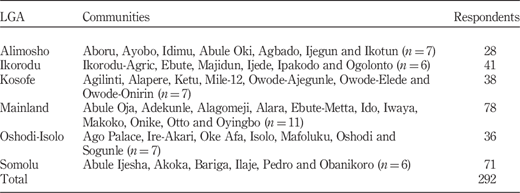
Table I shows the six LGAs and 42 communities chosen for the study. They were those reported across the metropolis by the national newspapers and local radio and television medias to have been so seriously affected to the extent that people were displaced and properties were lost considerably. The three most flooded streets were then chosen in each community, from which two to five households were then selected randomly for a face-to-face administration of the questionnaire.
Since the study was not funded by any agency or institution but by the researcher personally which is not uncommon to similar endeavors in the country, research assistants from the University of Lagos, who were resident in the target neighborhoods were recruited and trained over each flood season for the administration. Those certified to be conversant with the study theme and had appreciable background in relevant disciplines were then engaged under close directive and supervision of the researcher for maximum possible quality assurance and control.
Results and findings
The sampled respondents
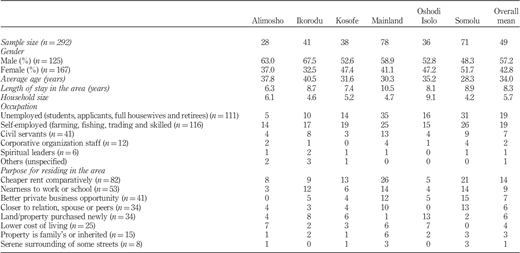
The results of the questionnaire analysis revealed that 65 percent of the sampled population were victims of floods in their respective communities within the period of investigation, others being close neighbors to the victims. As summarized in Table II, they comprised of 57 percent males and 43 percent females. The average ages on LGA basis ranged from 28.3 to 40.5 years, length of stay in the communities was between 6.3 and 10.5 years while the household sizes ranged from 6.3 to 10.5. In order of significance, the reasons for staying in the communities were identified as cheaper accommodation relative to other parts of the metropolis, nearness to work/school and better private business opportunities. Most of them were self-employed private businessmen and women, unemployed or civil servants in that order.
Frequencies of occurrence
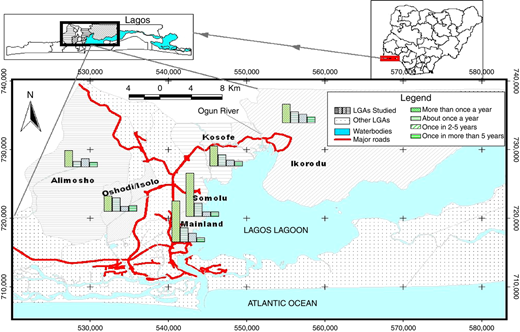
The regularities of the disaster reported by the respondents in the LGAs are presented in Figure 1. That it occurs “more than once in a year” is noted by 65.1 percent; some 22.3 percent claimed the occurrence is “about once a year” while 9.2 and 3.4 percent argued for “once in 2-5 years” and “once in more than five years,” respectively. Probability of occurrence every year is higher with subsequent rains in July through September and when water is released by Oyan or Ikere Gorge Dams upstream the main Ogun river around September and October.
Impacts of the floods
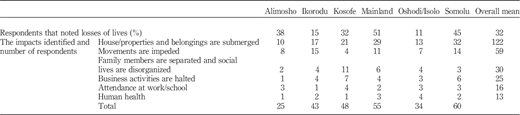
A total of 93 of the respondents across the six LGAs (representing 32 percent of the sampled population) reported loss of 13 lives (Table III). One life each was lost at Ikorodu and Somolu, four each at Oshodi Isolo and Kosofe and five at Alimosho. The deaths were reported to have resulted from victims being swept off when they slipped into canals with high currents or when babies fell off their mothers into the currents. Only at Aboru (Alimosho LGA) were a baby and an aged woman who were sleeping got drowned when a flood occurred in 2011.
In order of significance, the respondents perceived the flood impacts as submergence of properties and household assets; impeded movement within own properties and on the streets; separation of family members and disorganized social ties; halted business activities; low attendance at workplaces and schools; and hampered human health (Table III). In particular, household appliances ranged from cars, electronics, furniture, mattresses, kitchen utensils and clothes, some building foundations were threatened structurally by ensuing erosion, roads were washed away while some stores of goods in markets and shops were destroyed . Some flood waters imported and trapped suspended wastes including faeces into apartments. Younger ones are accommodated temporarily in rescuers apartments. Risks of diseases outbreak were high as victims go on flood vigil or sleep on bare floors with mats (at best) as long as wetness lasted. Escalating cases of seasonal landlords were noted whereas properties in vulnerable areas are occupied in the dry season but abandoned in the wet season.
The humanitarian aids provided
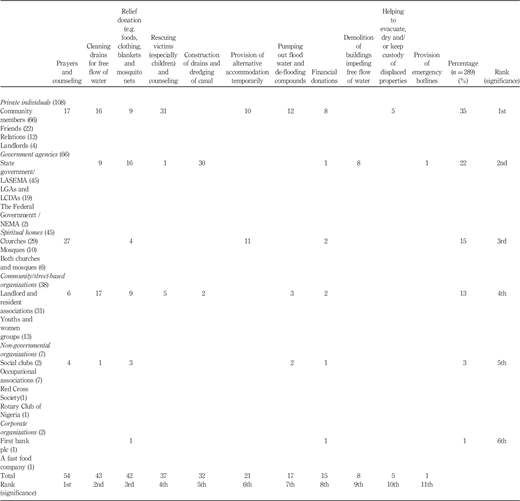
The nature of reliefs to victims and the list of providers are shown in Table IV. Private individuals ranked highest, followed by government agencies at the state level, community-based organizations and spiritual homes. NGOs and corporate organizations hardly provided any. In most cases, the supports from government are in form provision and maintenance of drainage shortly after the disasters have occurred. The neighbors support victims as private individuals from altruism.
Earliest visitors were identified as private individuals such as relatives and associates of victims and survivors on condolence visits but ended up being emergency rescuers. The untrained and unprepared volunteers are without any experience/facilities for the tasks ahead and work on weak chains of responsibilities. Nonetheless, they assist to de-flood drainage channels, pump out waters entering compounds and clear new paths to divert flood waters. With nobody in charge, the operations were rowdy sometimes resulting in confusion and slow recovery process. Religious homes (both from churches and mosques) arrive thereafter for spiritual support through prayers and counseling. Some others provide temporary accommodation. Impacts of foreign donations through NGOs are of least significant.
Accessibility to the reliefs
The result shown in Table V shows that CBOs were most accessible (µ=2.52, δ=2.551), followed by private individuals (µ=1.90, δ=1.377). Corporate organizations were least (µ=1.13, δ=0.398).
The result established that the aids were inadequate over time and space. On timeliness, first responders private individuals and CBOs are noted to arrive promptly for search and rescue operations, while religious homes arrive shortly afterwards. This is explained by the fact that they are neighbours and (sometimes) friends, know each other and can reach one another quickly for information.
The chains of supply
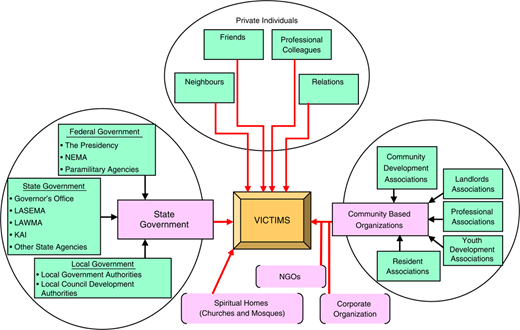
The supply chain shown in Figure 2 reveals that respective donations are through different arrangements. Private individuals for instance hand over their reliefs to victims right in their houses or at their temporary places of abode. Spiritual homes handover theirs directly to victims in their residences, churches and mosques.
Discussion
The humanitarian reliefs will achieve the fundamental goals of immediate and long-term recovery if the responding individuals, groups and agency stakeholders on the supply and management are coordinated. The planning, implementation and control stages require efficient and cost-effective flows of responsibilities, materials and decision right from the points of supply by donors, distribution and collection by beneficiary victims. The component stages are dependent on the specific disasters types and differences in the management principles of humanitarian space, humanity, neutrality and impartiality (Apte, 2009; Tierney, 1985).
The limited contribution by multinationals revealed in the study underscores the issue of corporate social responsibility as revealed by studies on resource cause and local content in developing countries that indigenous operating companies are few, poorly empowered and dominated by struggling small and medium scale enterprises (SMEs) (Vaaland et al., 2012) and that corporate organizations are international multinationals which usually embark on limited social responsibilities in their areas of operation (Kolstad et al., 2009), merge community assistances and corporate social responsibilities for many projects and components into single packages (Zalik, 2009), and are more interested in strategies for improving their chances of winning contracts in their environment of operation (Accenture, 2010).
The reliefs provided and donations for the flood victims were not timely in almost all the incidences reported. Rather, they were received some days after the recession of the floods, following which the victims were abandoned to their fate. Since the floods are seasonal and location based, there are sufficient opportunities to warn and plan for required operations such as public safety control, evacuation, search and rescue, sheltering, food and medical care as well as supply of donations, incident management, damage assessment, utility restoration, public information and business resumption. These are visible through inferences from reliable records on the causes, loses and the post-disaster experiences. These are elusive of the country currently because they are accessed through subjective eye witnesses accounts and media reviews.
Figure 2 suggests lack of cooperation and collaboration amongst the donor and management stakeholders. Some respondents argued that more causalities and properties are recorded from the ensuing disorderliness rather than from the actual disasters. Examples cited included victims being trampled upon, jumping into unsuspected deep canals in attempt to flee for dear lives and properties being stolen by miscreants posing as rescuers. Perpetrators were neither identified nor brought to book as some local politicians also joined to hijack the confused situation to gain political leverage.
The findings accentuate the observation by Portsea (1992), McEntire (1997) and Richard (2010) on government agencies and volunteers versus businesses and humanitarian organizations as obstacles to effective humanitarian relief operations. The multiple volunteers at the disaster sites would not have streamlined, functional or sustainable objectives nor collaboration. The implication is that key operations such as orders, evacuation and resettlement activities are left to multiple commanders who hardly know what to do at respective points in time. On the long run, offsite aids would be different from the needs by victims, the supplies and chains would not be transparent while most of the operations would be motivated by socio-political pursuit. The study notes that humanitarian operations hardly rely on experiences from preceding incidences for subsequent actions and that the relief operations are meager, delayed or never carried out.
Despite the fact that Lagos is the economic capital of the country with many multinational organizations, social corporate responsibilities are poor while some companies are discouraged to support humanitarian logistics such as deployment, warehousing, transport, management and communication. They always wait until when they are invited and mainly after the efforts by the “first respondents” and government agents have failed woefully. The locally based CBOs, NGOs and SMEs have limited capability and are hesitant to get involved either. The study considers that humanitarian reliefs and supply chain for victims of flooding in the region and, by implication, for other disasters in Nigeria are hampered largely by institutional and management gridlocks.
No standard model is validated for the supply chain management of humanitarian reliefs to population affected by disasters yet. Rather they are applied for management decisions within companies where the suppliers and customers support relationships among the source, make and deliver processes. The supply chain operations reference (SCOR) model is a most common strategic practice and standard tool in this wise. The model describes the business processes required to satisfy demands by customers. The framework focusses on five areas of the chain including plan, source, make, deliver and return (Huan et al., 2009; Zhou et al., 2011).
The supply chains for victims of the Lagos floods are complex for demand and supply planning and management because the elements are not balanced with SCOR requirements and communication. Hence, there are no simple rules to evaluate the efficiency for the relief inventory, transportation, assets and regulatory compliance for improvement. Neither do the chains align with any established financial plan, sourcing for aids and suppliers, supplier-networks, agreements and performances nor the transportation, delivery and management regulatory models. Each component of the current supply chain would require further research investigations with relevant models and framework that would address improvement in the operation.
Conclusion
Water is a necessity of life but could be dangerous if a large volume is disturbed from regular flow or unabsorbed by soils thereby thereby leading to flooding. The success of humanitarian aids depends on organized systems that integrate prevention and preparedness with responses and recovery. In view of the geographical location and human activities, experiences in Lagos suggest that flooding disaster will intensify over time both in frequency, magnitude and impact. More people will also be displaced as settlements expand into floodplains and low-lying coastal areas due to ineffective management of the disaster.
The forecasts and preparedness would remain deficient as long as the disaster is propelled suddenly by human profligacy; the geo databases for reliable decisions are lacking; and coordination of the relief operations is weak. The rescue, humanitarian relief, rehabilitation and reconstruction operations would remain unsustainable and the supply chains least proactive for logistics and communication management between partners, thereby resulting to poor performance. The need for disaster insurances for life, physical properties and household belongings cannot be overemphasized to cushion the effects especially around the flood-prone zones.
Even though, disasters are not uncommon around the megacities of the world, experience in humanitarian logistics and management varies much widely, least understood or validated empirically compared to that of commercial and military. The poor chains of operations in the Nigeria are least enthusiastic because of the limited understanding of the needs and perception of the population at risk by potential providers, operators and managers. This calls for in-depth evaluation of previous disaster experiences with a view for improvement. Areas identified for further researches in the current study include humanitarian needs and assessment, the supply chain logistics and uncertainties, collaboration and resource sharing as well as service quality.
Glossary
KAI Kick Against Indiscipline (A Lagos State Government Agency)
LASEMA Lagos State Emergency and Management Agency
LCDA Local Council Development Authority
LGAs Local Government Areas
NRCS Nigerian Red Cross Society
NERA National Emergency Relief Agency
NEMA National Emergency Management Agency
NGO Non Governmental Organization
NCRS Nigerian Red Cross Society
SMEs Small and Medium Scale Enterprises
SPSS Statistical Packages for Social Scientists
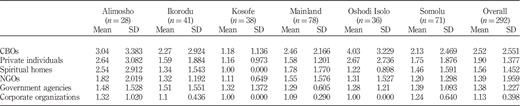
Ease of the relief access from different sources based on a Likert scale of 1 (inaccessible) to 10 (accessible)
Ease of the relief access from different sources based on a Likert scale of 1 (inaccessible) to 10 (accessible)
References
Further reading
About the author
Alabi Soneye (PhD) is an Associate Professor of Geography at the University of Lagos. Alabi Soneye has specialization in resource analysis, environment and geographic techniques of spatial analysis, remote sensing and GIS. Alabi Soneye can be contacted at: asoneye@unilag.edu.ng

