


– The purpose of this paper is to investigate the use of freight containers to store relief items instead of operating a permanent warehouse building.
– A mathematical model is developed to determine the location and quantity of containers as well as the type and amount of relief supplies to store in order to investigate the practicality of using freight containers for storage. The model is tested using earthquake risk data, estimates of population under risk, and the distances between cities. An experimental study is performed using Turkish Prime Ministry Disaster and Emergency Management Presidency (abbreviated as AFAD in Turkish) data for total number of relief supplies.
– Considering the earthquake risk of possible locations, the results of the study indicate the target locations for containers. The idea of using containers as storage facilities helped beneficiaries to be reached within a short distance and in an efficient way.
– The presented model is not implemented in real life disaster relief operations even if it is tested with real earthquake risk, demand and distance data.
– To apply this model in practice, the container locations within cities should be determined and managerial operations such as maintenance, environmental, and security planning have to be considered.
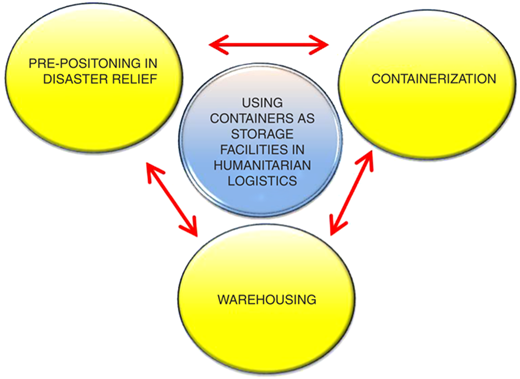
– This study presents the first analysis of three sub-topics’ intersection: warehousing, pre-positioning in disaster relief, and containerization. To the best of authors’ knowledge, containers have not been considered for storage of relief items in humanitarian logistics before.
1. Introduction
Humanitarian logistics is defined as “the process of planning, implementing and controlling the efficient, cost-effective flow and storage of goods and materials, as well as related information, from the point of origin to the point of consumption for the purpose of alleviating the suffering of vulnerable people” (Thomas and Kopczak, 2005). The purpose in this definition can be interpreted as taking measures to prevent the negative impacts of a disaster and effectively respond to the needs of beneficiaries. Pre-positioning of relief supplies near disaster-prone areas is applied in disaster relief to quickly respond to the immediate needs of beneficiaries in a short time after a disaster strike. In the classical approach, pre-positioning in disaster relief is mainly considered using permanent warehousing. As a new approach, pre-positioning of relief supplies in mobile (temporary) warehouses is proposed in this study. Temporary warehousing will be realized by using freight containers instead of operating a warehouse building for storage of relief supplies.
Generally speaking, containers are defined as large boxes, which are used to transport goods from an origin to a destination. Compared to conventional bulk transportation, the use of containers has several advantages, such as less product packaging, less damage, and higher productivity. The dimensions of containers have been standardized throughout the years, and transport over the sea is mostly carried out by containers on ships. Additionally, trucks or trains can be used to transport containers over land (Vis and Koster, 2003). The introduction of containerization caused some dramatic changes in logistics by taking full advantage of the container-stacking ability; more cargo can be stored requiring a smaller area of land (Kozan and Preston, 2006). Despite the advantages of containers in storage, containers have usually been considered as transportation units up until now.
In humanitarian logistics, the beneficiaries are supplied from pre-positioned inventory during the initial days after the disaster; therefore, having those supplies ready to dispatch is of critical importance in disaster response. When deciding how to pre-position inventory, humanitarian organizations should consider the number of warehouse(s) and their locations, as well as the types and the amount of relief supplies to stock, which requires extensive investigation and managerial effort. Previous studies focussed on operating a permanent warehouse building for storage of relief supplies (Balcik and Beamon, 2008; Duran et al. 2011; Görmez et al. 2011; Rawls and Turnquist, 2010). The objective of this paper is to investigate how containers (e.g. 20 or 40 feet steel freight containers) could be used as storage facilities.
Using containers as storage facilities is an appealing idea because of the ad-hoc nature of the disaster relief network. First, containers can be shipped from unaffected locations to the disaster locations after the disaster strike. Second, containers can be stacked on top of each other occupying less land than warehouse buildings. Third, using containers for storage is cheaper than operating a warehouse building. Moreover, the containers that are used to store relief supplies can be used as accommodation places in the immediate aftermath of a disaster strike. In this study, a mathematical model is developed to help decision makers determine the locations and quantity of containers as well as the type and amount of relief supplies to store. The model is tested using earthquake risk data, estimates of population under risk, and the distances between cities in Turkey.
The rest of this paper is organized as follows: In Section 2, a literature review of warehousing, pre-positioning in disaster relief, and containerization is provided. In Section 3, the system characteristics, as well as the problem on hand, are explained in detail and a mixed integer programming model formulation is given. In Section 4, the data set, experimental approach and results of computational experiments are explained. In Section 5, the managerial and research implications are discussed for the practitioners and researchers. Finally, we conclude in Section 5 and discuss the future work.
2. Literature review
Despite the importance of humanitarian logistics, the academic studies in this area are limited (Van Wassenhove, 2006). Altay and Green (2006) survey the literature to identify potential research directions in disaster operations, discuss relevant issues, and provide a starting point for interested researchers. Kovacs and Spens (2011) give an overview of the research in humanitarian logistics and highlight several research gaps. Galindo and Batta (2013) made the review of recent developments in operations research/management science (OR/MS) research as a continuation of the work of Altay and Green (2006) by giving some neglected topics in humanitarian logistics. Overstreet et al. (2011) created a framework for identification and categorization of the literature about humanitarian logistics as a guide of existing research for future efforts.
The operations of disaster management can be separated into four major phases: mitigation, preparedness, response, and recovery (Altay and Green, 2006). Pre-positioning of containers as disaster response facilities is a new approach for the preparedness phase, and to the best of our knowledge, this approach has not been addressed in the humanitarian logistics literature. Therefore, the literature is reviewed under warehousing, pre-positioning in disaster relief, and containerization sub-topics as can be seen in Figure 1.
Traditional definition of a warehouse, where it is defined as a place to store, reconfigure, and shorten lead times, has become much more complex and technology driven. The warehouse of tomorrow will emphasize fast movement rather than efficient storage (Ackerman, 1997). All warehouse opportunities such as order picking, cross-docking, productivity, space utilization, and value-added services allow warehouses to process more effectively (Tompkins et al., 2003). The ad-hoc nature of relief chain makes permanent warehousing more cumbersome and does not allow for effective processing.
Activities in humanitarian logistics include preparedness, planning, procurement, transport, warehousing, tracking and tracing, and customs clearance (Thomas and Kopczak, 2005). Warehousing is part of an overall effort to add place and time utility to the relief supplies. That is to say, by pre-positioning inventory in warehouses, humanitarian practitioners have access to relief supplies at another place than the original production point (place utility) and at another time than the original production date (time utility). In one of the seminal studies in warehousing and inventory management in humanitarian logistics, a multi-supplier inventory model was developed by Beamon and Kotleba (2006) for the south Sudan relief operations to obtain optimal order quantities and reorder points for a long-term emergency relief response.
Warehousing is usually envisaged using permanent structures. The idea of using temporary facilities or storage units, having ability to move for warehousing, has not been analyzed thoroughly. Some research effort has been aimed at devising pre-positioning plans for emergency supplies since 2005 (Rawls and Turnquist, 2010). Caunhye et al. (2012) stated that the stock prepositioning, evacuation and relief distribution aims are brought together in location analysis in most of the facility location optimization models in humanitarian logistics. The decisions are varied such as commodity prepositioning, facility selection among potential local and global distribution centers, and optimizing facility size. Frequently used objective functions in the prepositioning literature are: minimizing costs of setting up relief centers, transportation and commodity purchase, average or maximum response time, unfilled demand and expected number of casualties left behind or maximizing coverage of beneficiaries. The prepositioning literature is analyzed here by addressing whether a local warehouse opening (LWO) or a global warehouse opening (GWO) approach is suggested and the type of objective function used.
Balcik and Beamon (2008) developed a model to design a pre-positioning system balancing the costs against the risks in the relief chain by integrating facility location and inventory decisions under a GWO approach. Duran et al. (2011) developed an inventory-location model to find the location of warehouses, the amount of inventory by minimizing the response time with a GWO approach. Görmez et al. (2011) developed a multi-objective model determining the locations of new disaster response facilities for Istanbul considering regional vulnerability to minimize the average-weighted distance under LWO approach. Ukkusuri and Yushimito (2008) developed a model for prepositioning disaster relief supplies considering the routing of vehicles to find optimum location and number of the warehouses. Chang et al. (2007) developed a two-stage stochastic programming model to group the rescue centers by miminizing the distance and then determine the location allocation of rescue centers by minimizing the set up cost. Bemley et al. (2013) developed a two-stage stochastic pre-positioning model providing short-term port recovery with respect to weather events to maximize expected amount of repaired ports under a LWO approach.
Mete and Zabinsky (2010) developed a two-stage stochastic programming model for determining the storage locations and amounts of medical supplies to minimize warehouse operation costs, the response time and unfilled demand rate under a LWO approach.
Döyen et al. (2012) developed a two-stage stochastic programming model determining the locations for pre- and post-disaster rescue centers, and the amount of relief items to minimize the cost of facility location, stock holding, transportation, and shortage. Davis et al. (2013) developed a stochastic programming model for pre- and post-disaster periods determining the number of supplies and distribution network similar to Döyen et al. (2012) to minimizine relevant costs under a LWO approach. Salmerón and Apte (2010) developed a two-stage stochastic programming model pre-positioning the relief assets and locations to minimize the expected number of casualties and warehouse operating cost, then the allocation and transportation costs.
Containers were used for the first time in the mid-50s. Through the years, the proportion of cargo handled with containers has steadily increased (Vis and Koster, 2003). The overwhelming majority of general cargo is nowadays containerized (Imai et al., 2006). There are two billion containers used for cargo transportation according to World Trade Organization (WTO) summaries (Hu, 2011). Use of containers for transportation is cost effective when large amount of emergency relief is transported. Hu (2011) developed a container multimodal path selection model for container supply chain in emergency relief by minimizing the relevant costs for transportation. Kim et al. (2008) developed a container multimodal transportation model for transportation flow to minimize shipping and inland transportation costs.
Intermodal freight transportation is used to describe the movement of goods in one loading unit or vehicle, which uses successive, various modes of transport (road, rail, and water) without any handling of the goods themselves during transfers between modes (Macharis and Bontekoning, 2004). Container-based transportation services are an important part of intermodal transportation and the backbone of international trade (Crainic and Kim, 2007). Since 1990, a substantial number of analytical publications specifically addressing intermodal transportation issues have appeared (Macharis and Bontekoning, 2004). The studies concerning container, multimodal and intermodal transportation mainly focus on stowage planning, transshipment of containers, and bottlenecks of transportation (Vis and Koster, 2003; Steenken et al., 2004). Use of containers is observed in real life as shipping units or for housing aims. Morgan et al. (2006) used refrigerated containers in mass fatality management after South Asian Tsunami as shipping units of dead bodies to protect them from high temperatures. Peña and Schuzer (2012) presented a solution to the temporary housing by using shipping containers as a shelter. Moreover, the containers are utilized as mobile hospitals in disaster locations far from the hospitals to ensure the safe treatment of patients (Anonymous, 2014a).
Thanks to its myriad advantages, containerization entered its peak growth years (Notteboom and Rodrigue, 2009). The main advantage of using a container is to be transshipped directly from one mode of transportation to another. Another advantage is that containers can remain in a storage area while preserving the stored goods for a certain period of time before they are transferred to another mode. Moreover, the developments in logistics in the last decades give a new meaning to the temporary storage on terminals. “Instead of using the stacking area as a facilitator for a smooth synchronization between transport modes, shippers and logistics service providers started to use terminals as places for the cheap storage of goods” (Notteboom and Rodrigue, 2009). This implies using containers as storage units. In addition to many advantages of using containers, this change in the functional use of terminals awakens the idea of using containers as a storage unit in humanitarian logistics.
To the best of our knowledge, following our literature review, there is no such study at the intersection of the three sub-topics: warehousing, pre-positioning in disaster relief, and containerization. Therefore, pre-positioning of disaster response facilities as containers and using containers as a storage facility seems to be a viable research topic.
3. Problem and model description
When pre-positioning studies in the literature are analyzed, it is observed that exposure to disaster risk has to be considered together with minimizing the distance between beneficiaries and warehouses. A warehouse location far from a disaster-prone location might be more suitable than a nearer location having lower risk location to satisfy the demand of beneficiaries. Without loss of generality, the problem in consideration focusses on earthquake risks. Each potential relief location faces different destruction powers in terms of earthquake risks, so location of warehouses and pre-positioning of the relief supplies in the warehouse should be balanced against the effect of destruction. Here, relief supplies are prepositioned in containers located at some potential sites. The number of containers and their locations are important to satisfy the needs of demand points. The cost elements (e.g. purchasing cost, transportation cost, operational costs, etc.) are left out of scope in the assignment model. The cost analysis of the assignment model could be performed in the second phase after getting the assignment results since life-saving of affected people is prioritized in humanitarian settings. Here we refer the container locations as “supply points” and the population-concentrated areas (i.e. cities, towns) as “demand points.” The assumptions are given in the following.
3.1 Assumptions
the disaster response facilities are located in city centers to reach the population easily;
one tent covers a limited number of people;
a container can store a limited number of relief supplies;
overall supply amount is enough to cover some percent of potentially affected people;
vehicle routing decisions are left out of scope; and
transportation, purchasing, and operational costs are left out of scope.
3.2 Objective
The objective is determining the locations of supply points using a limited number of containers and relief supplies assigned to each supply point by satisfying the demand while travelling the minimum distance in order to quickly respond to the immediate needs of beneficiaries.
3.3 Model formulation
The following notations are used for the model:
3.3.1. Sets
C set of supply points; i∈C
T set of demand points; j∈T
Sset of relief supplies; k∈S
3.3.2. Parameters
Ej: potential number of affected people in demand point j in an earthquake;
Dij: distance between supply point i and demand point j in kilometers;
Wk: weight of the relief supply k in kilograms;
Vk: volume of the relief supply k in meters-cubed;
Bk: unit usage coefficient of relief supplies corresponding to one tent unit;
Rij: average destruction power between supply point i and demand point j;
Fj: normalized destruction power for demand point j;
M: total available tent amount;
A: total allowable average destruction power between supply point i and demand point j;
P: allowable minimum normalized destruction power (MNDP); and
β: the percentage of covered affected people for total tent amount.
3.3.3. Constants
N: maximum number of people a tent can accommodate
WT: total weight capacity of a container in kilograms, and
VT: total volume capacity of a container in meters-cubed.
3.3.4. Decision variables
yik= amount of relief supply k assigned to supply point i
ai = number of containers assigned to supply point i
The mathematical model for the problem is as follows:
subject to:
The objective function (1) minimizes the total distance travelled between the supply and demand points. Constraint set (2) ensures that the supply points provide some percentage of covered potential number of affected people with a limited tent amount. Constraint set (3) ensures that total assigned tents to the supply points must be lower than or equal to the total available tent amount. Constraints (4) and (5) require total weight and total volume of the relief items to be lower than or equal to the total weight and volume of container quantities, respectively. Constraint set (6) provides the unit usage coefficient of relief supplies in terms of one unit of tent. Constraint set (7) ensures that the total average destruction power between supply and demand points must be lower than or equal to total allowable average destruction power. Constraint set (8) ensures that for every demand point, the sum of normalized destruction power of assigned cities must be greater than or equal to allowable MNDP. Constraint set (9) is the sign restriction for decision variables.
4. Experimental study
The proposed mathematical model is tested with a real life data set for all the cities of Turkey. The computational results are given for the assignment of demand points, containers, and relief supplies to supply points. The main governmental organization in Turkey for disaster relief is the Prime Ministry Disaster and Emergency Management Presidency (abbreviated as AFAD in Turkish). AFAD is working on locating some relief supplies and tents to select cities of Turkey, and these cities (i.e. supply points) will supply the remainder cities (i.e. demand points). AFAD currently has 80,000 tents and plans to increase this amount to 120,000. The required number and location of containers to store relief supplies at each supply point is found by a mathematical model. The mathematical model is solved by changing some parameters and the system behavior is observed.
4.1 The data set
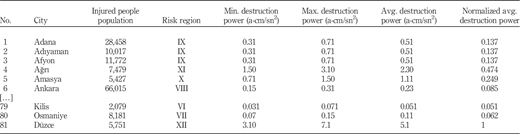
The earthquake risk data are taken from the earthquake risk map at city- and town-level (Ercan, 2012). These data include the risk regions of cities and destruction powers corresponding to the risk regions. The intercity distances are obtained from General Directorates for Highways (Anonymous, 2013). The potential number of affected people in each city is obtained from AFAD earthquake scenarios (AFAD, 2012). AFAD analyzed an earthquake database between 1894 and 2011 years and generated the potential number of affected people in each city. Table I shows a sample from the relevant data. The first column of the table shows cities, while the second and third columns show the potential number of injured people and risk regions of these cities. The fourth and fifth columns show minimum and maximum destruction powers corresponding to risk regions. The sixth column is the average destruction power value calculated with the minimum and maximum destruction powers. The average is used to provide a moderate representation of the destruction power, and the normalized values give better results for comparison in the model. The last column represents the normalized values of average destruction powers computed between 0.051 and 1 with the following equation (Equation 10):
For instance, according to Table II, the corresponding maximum and minimum destruction powers are 0.31 and 0.15 g for Ankara which takes place in the VIII risk area. The average destruction power is 0.23 g and the corresponding normalized value is 0.085.
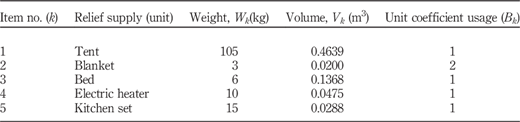
The relief supplies to be stored in each container are taken from AFAD scenarios as a tent, blanket, bed, electric heater, and a kitchen set as illustrated in Table II. The list and the quantities of products are taken from AFAD. The weight and volume of the relief supplies are given on the third and fourth column of the table. Each measure is given for one unit of supply. On the last column of the table, the unit usage coefficient of each supply corresponding to one unit of tent is given. For instance, if one unit of tent is stored, two units of blanket, one unit of bed, one unit of electric heater, and one unit of kitchen set must be stored.
4.2 Experimental setting
A full experimental design is constructed by changing the parameters of total tent amount, total allowable average destruction power between supply and demand points, and allowable MNDP for supply points. By using three parameters, 12 experiments (i.e. scenarios) are generated and presented in Table III. In Table III, total tent quantity takes two different values; 80,000 and 120,000 as AFAD currently has 80,000 tents available, and they plan to increase the available number of tents to 120,000 in the near future. Total allowable average destruction powers take three different values; three, four and, five because each supply point is restricted up to a total amount of average destruction power for the demand points it serves. Total MNDP (represented by P) take two different values; 0.1 and 0.2, since F j values are between 0.062 and 1.00 each demand point should be served by either one supply point with high MNDP or more than one supply points with low MNDP.
4.3 Computational results
In all, 12 scenarios for the developed model were solved by using the GAMS 22.6 optimization tool with CPLEX 11 Solver and run on a PC with a Pentium Dual-Core CPU, 3.00 GB, and 2.00 GHz. Three of the generated scenarios had infeasible solutions (Scenarios 4, 10, and 11) due to changes in the allowable MNDP parameter for supply points. The summary of the results for the scenarios which have feasible solutions are presented in Table IV.
In Table IV, the first column represents the total travelled distance between demand and supply points. The second column shows the total number of containers assigned to cities in terms of supply points. The total quantity of assigned containers to supply points is given in the third column of the table. On the last column, the execution time of the scenarios is given in seconds. As seen in Table IV, the lowest objective function values result from Scenario 3 using 80,000 tent amounts and Scenario 9 using 120,000 tent amounts. Scenario 3 assigned 2,049 containers to 47 supply points while Scenario 2 has the second lowest objective function with 2,065 containers assigned to 49 supply points. Scenario 2 has two supply points, 16 containers and 68 km travelled distance more than Scenario 3. Scenario 1 uses 12 containers fewer than Scenario 2, but the total travelled distance is higher. In Scenario 6, the total travelled distance is higher than Scenario 3, but the supply points number assigned is fewer than Scenario 3. The largest objective function appears in Scenario 5 with fewer supply points and higher container amounts with regard to Scenario 3. However, the total travelled distance is almost twofold. Destruction power affects the results in such a way that higher destruction power demand points (e.g. risky locations) should be supported by several cities, thus have backup supply points. When MNDP is doubled, the objective function almost doubles (i.e. from Scenario 2 to Scenario 5) leading to a higher total distance.
Scenario 9 assigns 3,079 containers to 41 supply points for 120,000 planned tent amounts when all other experimental design variables are the same with Scenario 3. The second lowest objective function is very close to Scenario 9 and is obtained from Scenario 8 with the same amounts of supply points and containers. However, Scenario 9 is superior to Scenario 8 in terms of total travelled distance. Scenario 7 has about 1,100 km travelled distance, four supply points and nine containers more than Scenario 9. The largest objective function appears in Scenario 12 with fewer supply points and almost the same container amounts when compared to Scenario 9. However, the total travelled distance is unacceptable in terms of response time. The comparison between the scenarios is depicted in Figure 2 according to total travelled distance and the number of supply points for 80,000 and 120,000 tents.
In Figure 2, the number of container-assigned cities is demonstrated above the bars. The lowest objective function value arises from Scenario 3 and Scenario 9 for 80,000 and 120,000 tent amounts, respectively. The details of Scenario 3 for on hand tent amount are depicted in Table V.
In Table V, the first and second columns show the city plate codes and the cities as being supply points. The third column is the corresponding normalized destruction powers of supply points. The fourth and fifth columns depict the assigned container quantity and demand points to the supply points, respectively. On the sixth and seventh columns, the distance and average destruction powers are given between demand and supply points, respectively. For instance, Adana covers five demand points, namely Hatay, Mersin, Niğde, Karaman, and Osmaniye, which are its neighbors. The nearest and the furthest demand points are Mersin and Karaman, respectively. Adana has 85 containers to supply one of these demand points after an earthquake. The maximum numbers of containers (i.e. 400) in a city is stored in Sakarya to supply İstanbul after an earthquake. The minimum number of containers (i.e. four) in a city is stored in Artvin and Elazığ. The total travelled distance between supply points and demand points is 10,702 km and the total average destruction power is 81.61 a-cm/sn2.
The visual presentation of the results of Scenario 3 is given in Figure 3. As illustrated in Figure 3, the red marked points are the supply points, and the blue marked points are the demand points seen on the cities. Each supply point acts as both a supply and a demand point, and can be supported by another supply point. However, the supply points without support are considered self-sufficient.
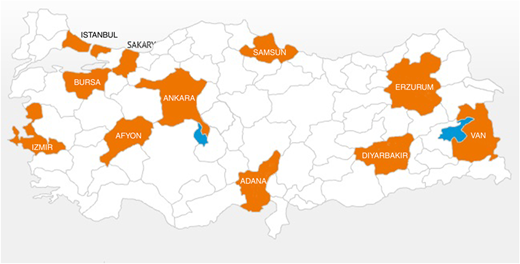
The earthquake risk map of Turkey is given in Figure 4 (Ercan, 2012). As demonstrated in Figure 4, it can be concluded that the dispersion of the supply points are determined according to the earthquake risks of the cities. The supply points determined with the optimization tool are clustered in the riskiest areas, which are marked by dark and light orange colors on the earthquake risk map. However, after some discussion with AFAD, it is considered that the supply points do not cover all the AFAD Provincial Directorates given in Figure 5. These directorates have a crucial role in the provinces in assignment of relief supplies and manpower after any disaster. For this reason, Ankara and Van should be accounted as supply points. Çankırı and Kırşehir supply points are combined, and Ankara is formed as a new supply point. Bitlis and Hakkari supply points are combined, and Van is formed as a new supply point. After these changes, some demand points are swapped from previous supply points and assigned to the new supply points.
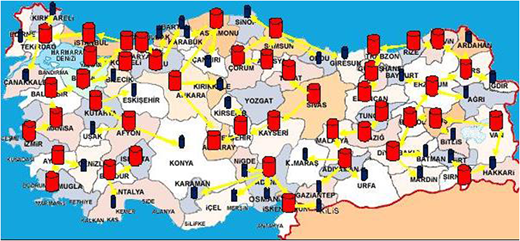
The resulting assignment of demand points to supply points after swapping is given in Table VI. As seen on Table VI, the old supply points, which are Çankırı and Kırşehir, are assigned to the new supply point Ankara. Nevertheless, the old supply points Bitlis and Hakkari are assigned to new supply point Van. Thus, all the AFAD Province Directorates are covered by swapping, and the integrity of the supply points are provided with supply points added in the post-processing. Consequently, the total travelled distance decreased from 10,702 to 9,440 km, and the total average destruction power decreased from 81.61 to 81.31 a-cm/sn2. For the case in Scenario 3, the total assigned container quantity did not change and distributed to new supply points by taking from combined supply points. The visual representation of the resulting assignment after post-processing of the current scenario (i.e. Scenario 3) is given in Figure 6. A similar analysis can be done for the future scenario (i.e. Scenario 9) for 120,000 tents.
As seen from Figures 5 and 6, the supply points are in scattered locations but have advantages in terms of both response time and closeness. For instance, if there is a disruption between the demand point and supply point connection, the second closer supply point is activated during the response. Life-saving and quick response to disasters is prioritized in this work despite the coordination challenges of these scattered supply points.
5. Managerial and research ımplications
The proposed model helps managers and researchers in determining the locations of supply points and the quantity of containers and relief supplies assigned to each supply point. This is accomplished by satisfying the demand while travelling the minimum distance to quickly respond to the immediate needs of beneficiaries. The results of the model can be used in both tactical and strategic decisions by the practitioners. Upon retrieving results from the model, the implementation procedure can be summarized under three issues: selection of the container locations within the supply points (cities), managerial operations of the supply points, and environmental planning and security.
5.1. Selection of the container locations within the supply points
Many criteria arise while determining the locations of the containers within a city region. The selection of the container locations should be planned by considering the climate characteristics, such as the raining rate, moisture, temperature, and wind. Also geological availability of the selected location should be considered in terms of endurance. It should be considered that the road infrastructure could collapse in case of a disaster. It would be better if the container locations are positioned closer to the railway and highway connections to provide alternative means to reach to container locations.
5.2. Managerial operations in supply points
The operation and maintenance of the containers will be the main pursuit. The purchasing costs of containers changes according to the manufacturing country and could be at a high price, therefore, the managers and practitioners may evaluate the leasing instead of purchasing. The containers can be stacked as much as three containers high to save more land for operations. In case of any disaster, the containers will be loaded to the trucks with a mobile crane, reach stacker or overhead crane and dispatched to the disaster area. The containers can be transported by one of the transport modes available near that location. The transportation costs of the containers alter according to the distance between origin and destination and the available transport mode. The practitioners may prioritize fast, but high-cost modes in the beginning phases of disaster relief and select the low-cost alternatives in the later phases. After the procurement and stacking of the containers, the humanitarian logistician should decide how many items to procure from suppliers. The model presented in this paper ties tent quantity with the capacity of a tent and the required relief items are calculated. Humanitarian logisticians can use these quantities to determine how many to order. The procured relief items will be transported according to the terms of agreement. The items arrived at the container locations will be loaded to the containers with a material handling equipment such as pallet trucks. A first-in-first-out (FIFO) system could be used to keep inventory up-to-date, and the tracking of the products could be performed using a radio-frequency identification (RFID) barcode system. Moreover, GPS-based systems for container tracking could be used to increase the traceability and security of containers during transportation (Anonymous, 2014b).The containers could be covered with a material like polyurethane foam for the insulation and could be ventilated on a biannual basis. It is recommended that the ventilations are made for two or three containers monthly for each city. Visual inspection of the supplies could be done during the ventilation process and should be reported to the decision maker.
5.3. Environmental planning and security
The current scenario tries to allocate 80,000 tents to 81 candidate locations (i.e. all cities of Turkey). This type of large data can lead to light scatter of containers and difficult management of them. Some precautions should be taken in order to better conduct the management of containers and ensure the security of supply points. The environmental planning for the maneuver area of trucks and parking area are the foremost aspects in terms of loading/unloading operations. The containers would be located on a concrete floor and there would be one mobile crane for the movement of the containers. A wire fence around the container location could be used as a security precaution. A fire alarm and camera system can also be recommended to the practitioners and managers. Security personnel can be hired for 24 hours to ensure the security of the containers in case of any theft or looting. The costs of security and environmental planning should be well considered and planned by the managers and practitioners including personnel payments.
6. Conclusion and future work
Making a synthesis of warehousing, pre-positioning, and containerization topics helped us to develop a new idea in humanitarian logistics and an analytical approach that would enable relief practitioners to make efficient and effective pre-positioning decisions. This analytical approach is presented in our study with a mathematical model formulation that determines the locations of supply points, quantity of containers and relief supplies assigned to each supply point by satisfying the demand while travelling minimum distance to achieve a temporary warehousing strategy.
The idea of using temporary facilities or storage units, having ability to move for warehousing in the relief sector, can have several benefits, including more efficient acquirement of goods, and improvement of response times given the ad-hoc nature of the disaster relief network. These benefits are in conformity with the purpose of alleviating the suffering of vulnerable people in humanitarian logistics. The benefits depend greatly on the critical balance between supply points and demand points of the network, particularly with the reduction in response time.
The proposed mathematical model is tested for Turkey, and the computational results are given. The main aim of our study is to protect the balance between the earthquake risks in demand points and supply points by minimizing the distance between them to shorten response times. The results of our study illustrate how to best use containers as storage facilities to achieve the most possible response-time benefit and also support the implementation of an ad-hoc pre-positioning strategy. In humanitarian logistics the most important factor is reaching the affected people as soon as possible. The cost of not reaching to beneficiaries is the loss of human life. Therefore proposed model focusses on assignment of supply points to demand points and does not include the purchasing, transportation, and operating costs of containers. These costs could be considered after selecting the container locations by practitioners.
The managerial and research implications are handled in three aspects: selection of the container locations within the supply points, managerial operations, and the environmental planning and security of the supply points. Since our model has not been implemented in real-life disaster relief operations, we discuss some guidelines for the practitioners and researchers for implementation.
In any case of a disaster, some portion of the beneficiaries’ needs will be available in containers, so the practitioners will not be negatively affected from price increases of the relief items in the chaotic environment of the disaster aftermath. The temporary warehouse idea will be advantageous if the container cost is low and the material handling requirement is lessened. Moreover, if the containers are located closer to intermodal hubs, the movements of the containers would be easier.
In this study, we take a first step in mobile pre-positioning strategy using freight containers. In future work, transportation, and routing decisions of containers used for storage can be considered. This study can be extended by considering towns instead of cities to be supply points. Cost comparison of temporary and permanent warehousing in terms of purchasing, transportation, and operational parameters is left for future work.
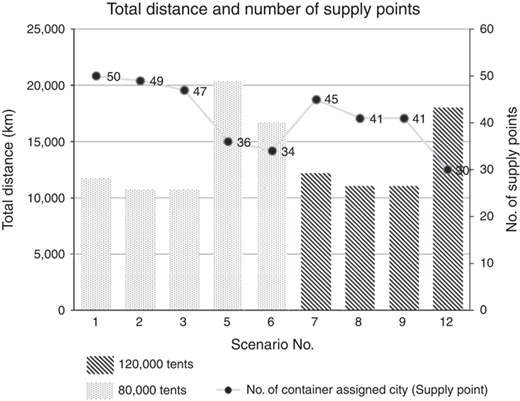
Comparison between the scenarios for 80,000 and 120,000 tent amounts
Comparison between the scenarios for 80,000 and 120,000 tent amounts
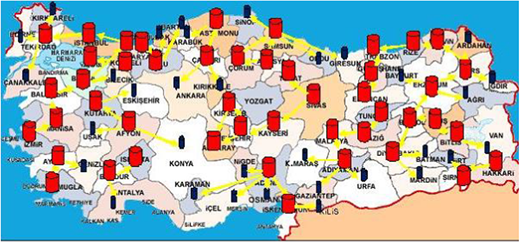
Graphical representation of Scenario 3
Graphical representation of Scenario 3
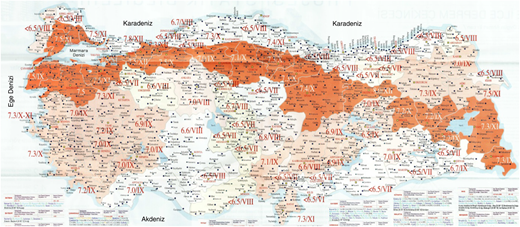
Earthquake risk map prepared by Professor Dr Ahmet Ercan
Earthquake risk map prepared by Professor Dr Ahmet Ercan
Graphical representation of supply and demand points after post-processing
Graphical representation of supply and demand points after post-processing
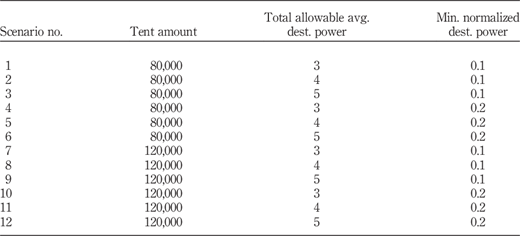
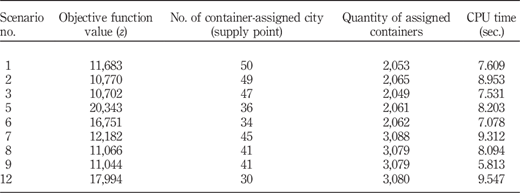
Results summary of feasible scenarios
Results summary of feasible scenarios
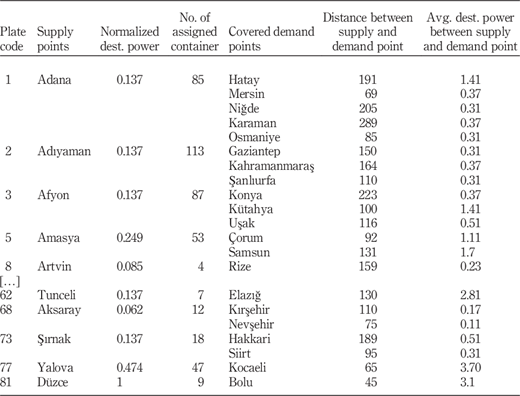
Assignment of demand points to supply points of Scenario 3
Assignment of demand points to supply points of Scenario 3
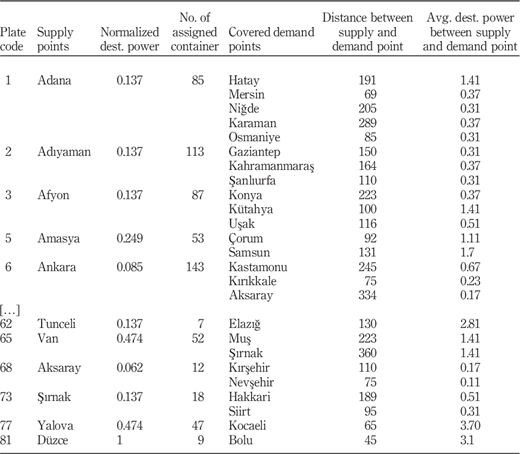
Assignment of demand points to supply points after post-processing
Assignment of demand points to supply points after post-processing











References
Further reading
About the authors
Ayşenur Şahin is a Research Assistant in the Industrial Engineering Department of Çankaya University, Ankara. She worked as a Research Assistant at Ondokuz Mayıs University before joining Çankaya University. She is studying Master of Science in the field of Humanitarian Logistics.
Mustafa Alp Ertem, PhD, is an Assistant Professor of Industrial Engineering at the Çankaya University. Before joining Çankaya University, he worked at J.B. Hunt Transport Services Inc. (NASDAQ100: JBHT) as a Logistics Engineer II. He holds a PhD Degree from the University of Arkansas, an MS Degree from Middle East Technical University, and a BS Degree from Istanbul Technical University, all in industrial Engineering. His research interests are logistics in disaster relief operations, procurement operations in supply chain management, and network models in intermodal transportation. Assistant Professor Mustafa Alp Ertem is the corresponding author and can be contacted at: alpertem@cankaya.edu.tr
Emel Emür has a BSc in Industrial Engineering. She worked as a Purchasing Representative for MAN Türkiye, Ankara. She is studying Master of Science in the field of Logistics.
The authors are grateful to AFAD personnel who shared some of the experimental data and commented on the results of our model to increase the practicality of the idea. The authors would like to express our sincere thanks to the editor, and to the anonymous referees whose detailed reviews and constructive comments helped us improve the paper. The authors also thank the Scientific and Technological Research Council of Turkey (TUBITAK) who partially supported this study with the research Grant No. 113M493.

