


The purpose of this paper is to compare perspectives on humanitarian logistics (HL) and supply chain management (SCM) among programmes and logistics/support staff.
Underpinned by services supply chain management (SSCM) theory, a single case study of a leading international non-governmental organisation is presented based on a web-based survey of the organisation’s global operations staff, supplemented by semi-structured interviews conducted with senior representatives.
The study is believed to be the first to consider the different perspectives of programmes and logistics staff on the interpretation of logistics and SCM. The results indicate both significant divergence between the views of these two cohorts, as well as a general lack of clarity over the concept of SCM, its relationship with logistics and the cross-functional nature of SCM.
Insufficient responses from programme staff limit the generalisability of the findings. Suggestions for future research include further examination of the potential of applying SSCM and demand chain management concepts to the humanitarian context.
The results support the notion that a broader, more strategic interpretation of SCM, more clearly distinguished from the practice of HL, may assist in breaking down perceived jurisdictional boundaries, bridging the gap between programmes and logistics teams, and strengthening demand-chain influences and the “voice of the beneficiary”.
By taking into account the views of non-logisticians, a broader, cross-functional interpretation of SCM is offered leading to revised definitions for both SCM and HL within this sector, together with a framework that integrates SCM across humanitarian relief and development contexts.
1. Introduction
International non-governmental organisations (INGOs) are part of a service industry where the output is a pre-agreed impact on a target beneficiary population in a given timeframe. Managing and demonstrating that impact is core to an INGO’s business model, and its successful delivery – in effect, the delivery of beneficiary satisfaction – is the responsibility in the first instance of the “Programmes” function. This label refers to a range of technical specialists who act as the beneficiary-facing frontline, and who typically comprise the internal customer to other functions within the INGO, such as logistics. This organisational construct, and the associated culture of many INGOs, has been a source of concern to humanitarian logisticians in the past as exemplified in articles by senior logisticians at some of the largest INGOs which appeared in a special issue of Forced Migration Review, and which revealed shared concerns about such silo effects (Rickard, 2003; Fenton, 2003; Chaikin, 2003).
Two years later, however, a seminal paper by Thomas and Kopczak (2005), which sought to outline the key challenges for humanitarian logistics (HL), failed to register the problem and treated what they referred to as “limited collaboration” only as an external issue. The ensuing decade of HL research has largely followed suit with an overwhelming focus on external integration. Papers have considered civil-military cooperation (Rietjens, 2008; Heaslip et al., 2012; Whiting, 2012; Heaslip and Barber, 2014; Tatham and Rietjens, 2016), the UN cluster mechanisms (De Leeuw et al., 2010; Jahre and Jensen, 2010), and trust (Tatham and Kovács, 2010, 2014), as well as general collaboration and coordination amongst humanitarian actors (Stephenson, 2005; Schulz, 2009; Balcik et al., 2010; Dolinskaya et al., 2011; Mclachlin, Larson, 2011).
That said, the issue of internal integration through collaboration at the strategic level and coordination at the operational level (Mattessich et al., 2001) recently resurfaced in the context of INGO efficiency and effectiveness when Tatham and Hughes (2011) ask, albeit in passing, whether an apparent disregard for beneficiary-focussed performance metrics in HL may be related to the structural divide between Programmes and Logistics teams. Nevertheless, in practice, the internal integration issue has been largely overlooked in the literature, and the role of Programmes in emergent INGO interpretations of supply chain management (SCM) remains far from clear.
The aim of this paper is, therefore, to investigate perceptions around SCM held by staff working on either side of what might be called the logistics-programmes interface (LPI) within a major INGO. Central to this aim is the belief that consulting broader practitioner views is likely to be key, not only to optimising emergent forms of SCM in the sector, but also to their reconciliation with a historical and evolving HL function. In essence, therefore, the question that we pose can be summarised as follows: to what extent is there a common understanding of the roles and responsibilities of Programmes and Logistics staff in the achievement of efficient and effective SCM?
To achieve this aim, a case study was undertaken that focussed on the international operations staff at one of the “Top 5” INGOs (Taylor et al., 2012). Importantly, by giving a voice to non-logisticians, we aim to respond to calls for greater consideration of “relationship building, cultural context, and the human factor” in HL research (Kovács and Spens, 2011, p. 41), and thereby establish greater relevance, as well as clearer and more appropriate paradigms, for the evolving field of HL.
This paper begins with a “Context” section which sets the scene by examining the Programmes function, how in theory it might relate to the concept of SCM, and how its role is impacted by the way organisations define the boundary between logistics and SCM. The next section contains a “Literature review” which discusses the subject of internal integration, and from which a conceptual framework is derived. Following an outline of the methodology used, a review of the case study’s key findings is then presented after which an emergent interpretation of SCM for the sector is offered. The research limitations, opportunities, and conclusions are summarised in the final section.
2. Context
2.1 The Programmes identity
Despite the 60-80 per cent of their income that is estimated to be expended on logistics activities (Tatham and Pettit, 2010), it is argued that INGOs should not be considered logistics organisations. Rather, INGOs provide project implementation services – be they humanitarian (i.e. disaster response) or development projects – to their donors. Recognising the interdependency of the two contexts, most INGOs adopt a “dual-mandate” approach, balancing relief work with community development programmes – with the latter being built around, for example, capacity building, advocacy, and governance which involve minimal logistical effort.
But even humanitarian relief involves much more than the simple movement of material from point A to point B and is perhaps better described as a dialogue between the humanitarian system and affected communities: a two-way process designed to, among other things, establish needs and determine coordinated solutions, mitigate any possible harmful effects of aid, support marginalised demographics, and seek opportunities to “build back better”. Thus, such operations should never be a disengaged process of physical distribution and many practitioners might prefer the service dominant logic model, positioning logistics as a “distribution mechanism for service provision” (Lusch, 2011, p. 14), or – in service-management terms – an “enabling service” rather than the “core service” (Grönroos, 2007).
Positioning INGOs as service-providers helps clarify the role of their “Programmes”[1] function which can be seen as the lead organisational entity that bears immediate ownership of, and much of the accountability for, the delivery and quality of the service(s) provided by the INGO. Within the overall functional area of Programmes, there are multiple technical specialists in sectoral domains (Livelihoods, Shelter, Health, etc.) as well as in a range of interdisciplinary specialties such as Monitoring and Evaluation (M&E), Humanitarian Accountability, and Gender.
Thus, while Programmes departments are invariably a formal part of an INGO’s structure, the term “Programmes” is also informally recognised and used widely throughout the sector to refer to the beneficiary-facing frontline. Thus it is Programmes staff who define demand through needs analysis; develop measures of customer satisfaction (“impact”); assume responsibility for beneficiary accountability and engagement; and who, at the field level, interface directly (or via implementing partners) with the beneficiary. As a result, Programmes staff are typically regarded as the primary internal customer by other functions and this has given rise to a commonly perceived structural dualism of “Programmes” and “Support” (Whiting and Ayala-Öström, 2009).
Within this model, “Logistics” represents one of the support functions which interfaces with Programmes. It operationalises the plan devised by Programmes and arranges, typically through a network of international and local sub-contractors, the delivery of the equipment and supplies to the affected area or to the development project in line with the quantity, quality, timeliness and cost parameters set by the Programmes team.
2.2 SCM and Programmes
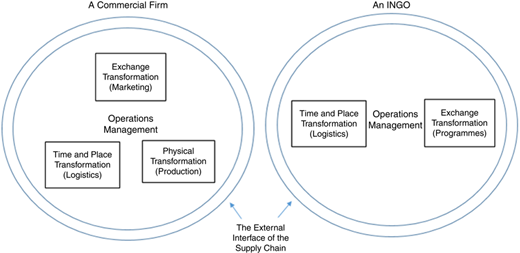
Delivering superior customer value plays a central role in the concept of SCM, and this is perhaps most plainly stated by Christopher (2011) who argues that: “the whole purpose of SCM is to provide customers with the level and quality of service they require” (p. 42). This market-orientated approach is embodied in the emergence of demand chain management (DCM) concepts: “a set of practices aimed at managing and coordinating the whole chain, starting from the end customer and working backward to raw material supplier” (Vollmann et al., 2000, p. 83). Internally, such practices focus on the intersection of activities between Logistics, Production and Marketing or what Mentzer et al. (2008) refer to as “Time and Place”, “Physical”, and “Exchange” transformation, respectively.
In the humanitarian context, while the donor is the customer in the sense that requires a commercial transaction, clearly the beneficiary is also a customer (Oloruntoba and Gray, 2009). For INGOs, a DCM approach might suggest that Programmes – with their leading role in programme design, demand assessment, and the evaluation of customer satisfaction – could be equated to the element of exchange transformation. Furthermore, because the production function is negligible in this context, the management of INGO supply chain processes effectively hinges on the single interface between Programmes and Logistics (Figure 1).
In a commercial environment, consumer revenue and choice promote a continuous focus on efficiency and quality such that the activities of support functions can have a direct impact on profits. However, in the humanitarian context, the non-commercial customer-relationship with the beneficiary creates a challenging vacuum for INGOs where for-profit corporations would normally expect to encounter consumer revenue, demand, and choice (Oloruntoba and Gray, 2009; Tatham and Hughes, 2011; Walker and Russ, 2010). In the absence of a commercial transaction, market forces that might drive performance metrics and continuous supply chain improvements in other industries are simply not present. Humanitarians cannot, for instance, apply a “cash-to-cash” metric; not least because the “return” here is the relatively nebulous concept of beneficiary and community “impact”. Indeed, once a grant to an INGO has been approved by a donor, substantial motivation for additional efficiencies is frequently lost. From this perspective, the support functions of INGOs can hope at best not to hinder, through mismanagement, a project’s outcomes.
However, examination of typical project activities at field level suggests that Programmes not only engages with the management of the supply chain, but arguably takes ownership of it at various stages. For example, supply chain planning is typically driven by Programmes staff as part of project design, and the identification of demand through needs assessment is commonly viewed as a programmatic activity. Similarly, sourcing is triggered by Programmes staff through the submission of material and service requisitions and, while these are typically actioned by logistics or procurement units, Programmes will often participate in and exert more direct control over larger and more technical purchases, as well as the sourcing of Gifts-in-Kind (GIK).
More significantly, Programme teams tend to have a prominent role in “last-mile” delivery activities, which are not necessarily limited to simple distributions but can take an almost endless variety of forms: from setting up Ebola treatment centres to installing boreholes (for water extraction); from repairing fishing boats to running trauma counselling centres. Even where technical oversight is not required by Programme sector specialists, it is vital that the physical delivery of aid is accompanied by a degree of programmatic supervision to ensure a minimum level of transparency through M&E – key processes of value delivery and customer satisfaction which, in a commercial setting, might well be considered a component of supply chain management.
In short, while the prevailing view of humanitarian SCM found within the literature tends to be dominated by the discussion of the Logistics function, a demand-chain perspective would recognise Programmes as a critical protagonist in, and in many cases the owner of, an INGO’s supply chain and thus a vital link to the beneficiary-customer.
3. Literature review
The line is pretty blurred between SCM and logistics – what exactly it is, whether it is different […]
(Interviewee H).
3.1 Perspectives on logistics vs SCM
The first stage of the literature review was to examine the relevant discussion relating to the relationship between logistics and SCM within a commercial context. This is a challenging task as, for example, some 20 years ago Bechtel and Jayaram (1997) found more than 50 definitions of SCM, and in the intervening years this has expanded still further with Stock and Boyer (2009) offering 166 alternatives a decade later. However, an analysis of the relationship between of SCM and its relationship with logistics in these contributions seldom deviates from the models developed by Larson and Halldórsson (2004) in their study of the perspectives of academics, and their subsequent parallel analysis of the perspectives of practitioners (Larson et al., 2007):
Traditionalists position SCM as a special form of logistics – “logistics outside the firm” – which includes external parties such as customers and suppliers.
Relabellers consider SCM simply to be a new name for Logistics: the planning and control of materials flow from suppliers to end users.
Unionists consider SCM to be an end-to-end integration of key business processes linking suppliers to end users in a value chain. As well as Logistics, SCM might include, for example, operations and demand planning, and marketing and sales.
Intersectionists see SCM as a broad strategy cutting across business processes: only long-term strategic aspects of logistics are considered part of SCM, along with similarly strategic supply chain concerns from other functions.
Importantly, in their second contribution Larson et al. (2007) note that there is an increasing trend in the commercial sector for SCM to be seen as moving from simply integrating logistics activities to a broader and more strategic role of integrating business processes as suggested by Cooper et al. (1997). This has fostered new, more ambitious, interpretations of SCM in which, for instance, Mentzer et al. (2008) define SCM as “[…] the systemic, strategic coordination of the traditional business functions within a particular company and across businesses within the supply chain, for the purposes of improving the long-term performance of the individual companies and the supply chain as a whole” (p. 32). By implication, Mentzer et al. adopted a unionist perspective in which logistics is an operational subset of SCM an outcome which is in line with the formal evaluation of Larson et al. (2007) and, indeed, subsequent literature – for example the recent contribution of Sweeney et al. (2015).
Indeed, this is considered to be the dominant view within the commercial arena, and this relationship between SCM and Logistics is clearly enshrined in the definition of Logistics Management from the Council of Supply Chain Management Professionals (CSCMP):
That part of SCM that plans, implements, and controls the efficient, effective forward and reverses flow and storage of goods, services and related information between the point of origin and the point of consumption in order to meet customers’ requirements
(Council of Supply Chain Management Professionals (CSCMP), 2017) (emphasis added).
Importantly, however, when devising what has become the “go-to” definition of HL, Thomas and Kopczak (2005) omitted the first phrase of the original CSCMP definition (highlighted in bold above) proposing, instead, that HL is:
The process of planning, implementing and controlling the efficient, cost-effective flow and storage of goods and materials as well as related information, from the point of origin to the point of consumption for the purpose of meeting the end beneficiary’s requirements
(p. 2).
The absence of the keywords “That part of SCM […]” would suggest that Thomas and Kopczak have sidestepped the need to explore a relationship between the two terms and, arguably, therefore their definition effectively represents a “relabelling” perspective.
In contrast with the broad spectrum of literature in the commercial SCM/logistics arenas, that relating to HL is significantly less developed with a recent review by Leiras et al. (2014) uncovering just 228 papers that had been published in the last 20 years. However an analysis of a number of Journal Special Editions devoted to the subject together with all of the issues of the Journal of Humanitarian Logistics and Supply Chain Management published to date (see Table I) demonstrates that, to the extent that they have offered a definition of HL, most have used that from Thomas and Kopczak (2005) quoted above.
A summary of the definitions of HL found in the literature
| Journals | Thomas and Kopczak (2005) | Other | No definition |
|---|---|---|---|
| Management Research News: 32(11) | 2 | 1 | 3 |
| International Journal of Physical Distribution & Logistics Management: 39(6) and 40(8/9) | 4 | 8 | |
| Transportation Research Part E: 43(6) | 1 | 6 | |
| International Journal of Production Economics: 126(1) | 0 | 13 | |
| Journal of Humanitarian Logistics and Supply Chain Management: 1(1)-6(1) | 15 | 43 | |
| Total | 22 | 1 | 73 |
In summary, out of the 96 papers reviewed, 22 offered a formal definition of HL, and of these all bar one grounded their research either directly or indirectly on the Thomas and Kopczak (2005) definition. Thus, whilst the term “SCM” continues to gain currency among INGOs, there is a clear tendency for the two terms (SCM and logistics) to be applied interchangeably – in other words reflecting the adoption of the “relabelling” perspective of Larson et al. (2007), a fact that has been specifically noted by various authors (e.g. Tatham and Spens, 2011; Day et al., 2012; Antai et al., 2015).
However if, as is increasingly recognised in the “for-profit” world, SCM involves “[…] the systemic, strategic coordination of the traditional business functions” (Mentzer et al., 2008, p. 32), and taking into account the typical INGO organisational construct outlined in Section 2.1, then it is argued that the role of both Programmes and Logistics functions in achieving efficient and effective SCM demands further exploration and clarification.
Importantly, this is not just a question of semantics or an academic nuance. Organisational norms can have a direct bearing on cross-functional coordination and supply chain performance and, according to Mentzer et al. (2008), decisions concerning the definition and scope of SCM are likely to impact a firm’s structure, corporate culture, strategy, and budget allocations.
Integration can be defined as “the extent to which separate parties work together in a cooperative manner to arrive at mutually acceptable outcomes” (O’Leary-Kelly and Flores, 2002, p. 226) and can relate to both internal and external supply chain members. Work on customer-driven supply chains placed a greater focus on cross-functional processes and led to the recognition of a Great Operating Divide (Sabath and Whipple, 2004): the notion that achieving integration across internal functions is not only a prerequisite to successful external supply chain integration, but also relatively more difficult. Specifically, in the commercial sector, misalignment between logistics and marketing has been a topic of interest for nearly 40 years (Johnson and Borger, 1977; Speh, 1977), and improved integration between the two functions is considered a key challenge for firms in the twenty-first century (Bowersox et al., 2000). Despite some scepticism surrounding the rhetoric of integration (Fawcett and Magnan, 2002; Fabbe-Costes and Jahre, 2007, 2008), the link between internal integration and supply chain performance is widely held to have been demonstrated, and internal coordination has been touted as one of the “five pillars” of effective supply chain strategy (Stank et al., 2011).
The actual mechanisms behind integration have been a source of some debate. The literature typically distinguishes two tiers: one level of simple “interaction” characterised by information exchange, meetings, and improved contact between teams; and another deeper level of “collaboration”, focussed on more substantive resource and goal sharing, with the latter generally being more strongly linked to performance (Kahn and Mentzer, 1998). In particular, Ellinger (2000) has confirmed that cross-functional collaboration is an antecedent of supply chain performance. Collaboration has been defined as “an affective, volitional, mutual shared process where two or more departments work together, have mutual understanding, have a common vision, share resources, and achieve collective goals” (Schrage in Stank et al., 2001, p. 31).
Self-evidently, in an ideal scenario, the elements of an organisation such as the INGO in question would interact seamlessly and thus their relationship could be clearly categorised as collaborative (at the strategic level) and, thus, operationally “coordinated”. Unfortunately as demonstrated in the actual research (Section 5), and reinforced by Larson et al. (2007) who questioned whether “turf wars” might be inhibiting SCM implementation and suggested that: “within organizations, definitions of and perspectives on SCM may differ across functional areas [and this] may explain some of the internal resistance to SCM implementation” (p. 20), this is not always the case.
Thus, the work on internal collaboration and coordination suggests that the ability of an INGO to optimise supply chain performance will depend, at least in part, on the extent to which internal teams share a common interpretation of SCM and Logistics, the relationship of these concepts to each other, and their implied roles and responsibilities. Furthermore, this cannot simply be mandated: such behaviours are based on informal processes of trust, mutual respect, willingness, and a sense of collective responsibility (Ellinger et al., 2006). It follows that indirect influence through the careful management of organisational norms may be one of the few mechanisms open to firms seeking to generate greater integration.
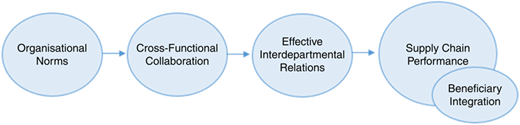
We, therefore, arrive at a conceptual framework (Figure 2) that places organisational norms at the beginning of a causal chain connecting greater cross-functional coordination to improved interdepartmental integration and, ultimately, better supply chain performance. While greater customer integration has been shown to positively impact supply chain performance in a manufacturing context (Frohlich and Westbrook, 2001), here – due to the ambiguities of the customer role of beneficiaries and following Tatham and Hughes (2011) – we limit ourselves to considering beneficiary integration as a component or measure of performance.
Turning to the broader humanitarian literature, three key sources were examined to determine the extent to which cross-functional coordination has featured in the literature, namely: the comprehensive literature reviews of Kunz and Reiner (2012), and Leiras et al. (2014), and the unofficial HL bibliography[2] published on the website of the HUMLOG Institute. This was further supplemented by consideration of key practitioner sources including the Humanitarian Logistics Association (HLA) website, the Fritz Institute website, publications from the Overseas Development Institute, and Forced Migration Review.
It was clear from these sources that no prior discussion of the issues surrounding the interface between Programmes and Logistics has featured in the literature and, indeed, discussion of the role of Programmes (as distinct from Logistics) is almost non-existent. Thus, the authors adopted the recommendation of Stock (1997) that logistics, as an emerging field of study, should “borrow” from other disciplines as a means of advancing knowledge and understanding. This led to consideration of the ways in which Logistics and SCM have developed in commercial contexts and, the applicability or otherwise of these models in the Humanitarian sector.
The resulting questions that this investigation aims to investigate are therefore summarised as follows:
To what extent is there a common understanding of the concept and ambit of “logistics” and “SCM” amongst those within the Programmes and Logistics teams within a major INGO?
To the extent that they exist, how can the disparate perspectives of the two communities (Programmes and Logistics) on the concept and ambit of logistics and SCM be developed and integrated?
What actions can be undertaken in order to achieve a more integrated response to meet the needs of the INGO’s beneficiaries?
4. Methodology
Given the descriptive and exploratory nature of the topic under consideration, a pragmatic research philosophy was adopted. For the descriptive element, a web-based questionnaire was used to capture a quantifiable “snapshot” of a range of perceptions among the subject INGO’s staff. The LPI is also presented under an interpretive epistemology, highlighting the relevance of meanings and relative understanding among the “social actors” involved. On this basis, for the exploratory element, qualitative, semi-structured interviews were used to investigate the subjective knowledge and experiences of staff as a social phenomenon laden with subjective meaning (Saunders et al., 2011).
Our research was informed by a pilot study which surveyed members of the HLA and clearly indicated that there were differing perspectives on the key question concerning the nature of logistics and SCM. A case study approach was selected due to the contemporary and contextual nature of our subject. Siggelkow (2007) emphasises the ability of case studies to get closer to theoretical constructs, whilst Eisenhardt and Graebner (2007) stress their importance in developing a rich understanding of context and processes. Fabbe-Costes and Jahre (2008, p. 144) have gone as far to suggest that case studies are “the only option when it comes to [researching] supply chain integration”.
The subject INGO is a large, global aid organisation operating on a donor-funded model. It responds in all UN relief sectors, has a broad geographic coverage, relies on the full range of institutional donors, and assumes a “dual-mandate” to work in both long-term development and humanitarian response. These qualities make it representative of the wider sector; especially in light of criticism that HL research has tended to focus exclusively on emergency response (Kovács and Spens, 2011).
Run over a three-week timeframe, the pilot survey provided an initial template for our approach and in situ validation of the questionnaire design, including feedback from senior researchers in the HL field. The revised questionnaire was published in English and pre-tested with the organisation’s Head of Logistics as well as five other senior staff. Although space limitations prohibit a fuller presentation of the survey questions, they were designed around three aspects of the LPI: definitions and paradigms, beneficiary voice and demand-side factors, and internal coordination. The final version consisted of 22 questions and, on average, took respondents 50 minutes to complete.
In line with the INGO’s policies, the survey was not sent directly to staff members, but rather jointly from the Head of Logistics and the Director of International Operations to each of the 56 Country Directors with a request that it be forwarded on to their respective teams, as well as to a number of specialist teams with extensive field experience based at the INGO’s headquarters. The resultant theoretical reach (i.e. maximum number of potential respondents) was 13,230 staff, or some 90 per cent of the INGO’s staff numbers. However, adjustments for routine absences and language limitations – in combination considered to limit access by some 25 per cent – resulted in an effective reach of some 9,900 staff.
Although, the survey was designed to obtain the perspectives of the two cohorts (Programmes and Logistics/Support), drawing a line between these two groupings is not straightforward as the organisation’s structure varies from country to country. Logisticians are not always considered Support staff (particularly in large, rapid-onset emergencies), and conversely some Programmes staff operating in an advisory capacity may, on that basis, consider themselves “support”. With this blurred line in mind, the decision was taken to use self-identification to distinguish the two cohorts. Survey respondents were, therefore, asked whether they identified more closely with “Logistics/Support”, “Programmes”, or “Neither”. Only 19 of the 202 respondents (8.6 per cent) selected “Neither” – an indication of the degree of recognition and acceptance of these labels – and these responses were discounted in the subsequent analysis.
A pre-notification e-mail was sent out two weeks ahead of the survey invitation itself, and a follow-up e-mail was circulated twice over a six-week period to encourage responses. In practice, however, it is accepted that the relatively tight survey timeframe, the inevitable pressures on staff time, the title of the survey which may have led some potential respondents to believe that they were not part of the target population, and the length of the survey itself may have been factors that limited the response leading to a margin of error of 7 per cent at a 95 per cent confidence level. Nevertheless, the 202 useable responses obtained (Table II) compares well with other studies in the sector (e.g. Van Wassenhove and Allen, 2012), and the locus and geographic spread of responses support the validity of the data as a reflection of field-level perspectives, with 80 per cent of responses coming from in-country operational staff in 45 different countries across all regions.
Survey responses
| Neither | Logistics/support | Programmes | Total included | |
|---|---|---|---|---|
| Respondents | 19 (8.6%) | 108 (48.9%) | 94 (42.5%) | 202 (91.4%) |
| Reach (estimated no. of staff) | n/a | 2,775 | 7,148 | 9,923 |
| Sample size | (Excluded) | 3.89% | 1.32% | 2.04% |
On the other hand, at only 2 per cent, the sample size is clearly limited and skewed by the greater response rate from the Logistics/Support cohort. In view of the potential non-respondent bias, the limitations of extrapolating results from this sample should be noted. It should also be noted that this differential response rate may reflect a level of disinterest in the subject of Logistics and SCM among Programmes staff which would be a relevant result in itself.
The statistical limitations of the questionnaire are, however, considered to be partially mitigated by the ten semi-structured interviews conducted with senior managers. Based in seven different countries across four continents, these staff represented a combined length of service within the INGO of 59 years and 133 years within the sector as a whole. They were, thus, perceived to have sufficient senior operations experience to be able to speak objectively from a cross-functional perspective. Table III shows a breakdown of their length of service and their area of expertise. The initial list of potential interviewees was developed by the Researcher in concert with the Head of Logistics, and those selected were invited to take part by e-mail. The resultant list of ten interviewees reflects those who were willing and able to take part within the relatively tight timeframe in which this element of the research was conducted.
Length of service and area of expertise of interviewees
| Interviewee | Length of service within the sector (years) | Length of service within the INGO (years) | Area of expertise |
|---|---|---|---|
| A | 9 | 2 | Country Director |
| B | 23 | 2 | Country Director |
| C | 13 | 13 | Country Director |
| D | 20 | 11 | Operations Director |
| E | 7 | 4 | Operations Director |
| F | 17 | 15 | Operations Director |
| G | 9 | 2 | Head of Logistics |
| H | 12 | 4 | Senior Logistician |
| I | 14 | 4 | Regional HR Manager |
| J | 9 | 2 | Operations Monitoring Advisor |
| Total | 133 | 59 |
In each case, the interviews were undertaken using a Skype discussion that lasted some 60 minutes and which was recorded digitally using the Evaer software and subsequently transcribed. Whilst the transcription was not shared with the interviewees as a matter of course, in cases where there was some doubt as to the meaning of the response to a particular point, this was further discussed with the interviewee. The format of the interviews was semi-structured, and based on eight questions that provided the over-arching framework for the discussion. These were designed to capture key aspects of the survey with a particular focus on the discussion of the challenges facing the two communities (programmes and logistics) both separately, and at their intersection.
The survey data were analysed using SPSS, including frequencies, means ranking and comparison of means and percentages. In comparing the responses of the two cohorts, the strength of correlation was gauged using Spearman’s rank-order correlation, whilst the Mann-Whitney U (MWU) test “Exact Tests Module” was used to gauge the statistical significance of differences found in the data, with the results of the analysis being independently validated by a second researcher.
The interview data were analysed both by spreadsheet and also physically by the lead researcher, using a paper-and-scissors approach, to unitize and categorise statements according to the three topics: definitions, beneficiaries and demand-chain, and collaboration. Common themes were then sought using manual coding with Post-It™ notes and colour highlighters. These were tested against the data set so that themes derived reflect a majority view among interviewees. Due to the limited data set further pattern matching or variable analysis was deemed unlikely to be useful.
5. Findings and analysis
5.1 Definitions and paradigms
Respondents were asked to select the areas that they considered to fall under the Logistics function. The options given were not intended to be exhaustive, but rather to provide broad areas which should reflect varying degrees of inferred strategic importance. The results, plotted as means in Figure 3, effectively illustrate the certainty with which functions are perceived to be “logistics” from the collective viewpoint. In each case, the X and Y axes represent the mean number of respondents from each cohort who recognised a particular function as being part of “logistics”.
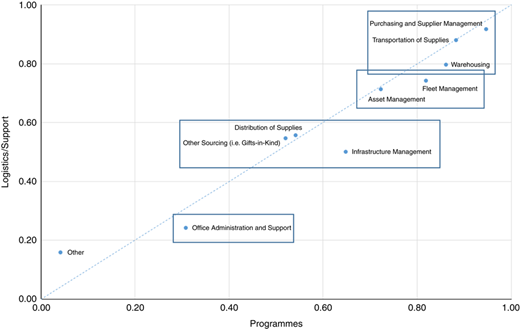
Unsurprisingly, classic commercial logistics functions – Warehousing, Procurement, and Transport – dominate (top right of the graph), but Fleet and Asset Management are strongly reflected in a second layer. Infrastructure Management, Beneficiary Distribution, and GIK Sourcing make up a third layer; and a fourth layer indicating a component of Office Administration (with “gardening” and the “issue of stationery” among the examples offered).
We calculated the Spearman’s rank-order correlation coefficient (rs) to assess the ranking of the importance of logistics functions for the two cohorts. To calculate the coefficient, the mean responses for these logistics functions were calculated and based on these “within-cohort” ranks were assigned for each function within both cohorts. The Spearman’s rank-order correlation coefficient was then calculated.
This calculation revealed a strong degree of correlation in the mean responses from the two cohorts (rs=0.964), whilst these also underlined the broad scope of the logistics function. Effectively, as one interviewee put it:
Logistics is a very broad term for support: housing, managing cars, warehouse, managing IT, transport, managing procurement […] a big basket
(Interviewee B).
Importantly, there was also broad consensus on the overall order of business for the logistics function and supply-related functions appear more salient in the collective perception of the role.
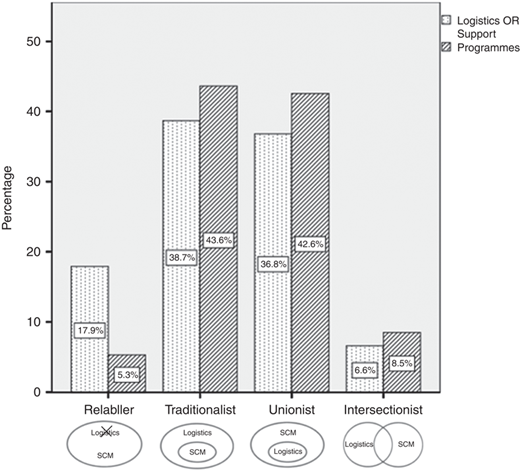
Having positioned the logistics function, respondents were then asked to indicate their view of the relationship between Logistics and SCM using brief descriptions drawn from Larson and Halldórsson’s (2004) model. Overall, responses (Figure 4) reflected a strong preference among both cohorts for either the traditionalist or the unionist perspective, but opinions were almost equally divided over whether SCM subsumes logistics, or vice versa.
This lack of clarity was further emphasised in the subsequent interviews where, on the one hand, the term “SCM” was commonly used to refer to that subset of logistics which is supply-focussed:
SCM for me is inside logistics
(Interviewee B).
Logistics is much more than just SCM […] there is also Fleet management, Asset management, Warehousing
(Interviewee C).
Logistics in our sector is broader than SCM. A subset of logistics – you’ve got Fleet Management, ICT Management, and Facilities Management
(Interviewee I).
Yet, respondents would simultaneously contradict this with reference to the need for SCM to extend beyond logistics, i.e. a unionist view:
SCM is wider than Logistics. It involves award management for example. The functions of logistics are within SCM
(Interviewee D).
Logistics is not the only partner in the picture of SCM at [this INGO] […] logistics is definitely not the only player
(Interviewee C).
Logistics plays just a support/administrative, extremely limited portion of the supply chain […] they don’t actually do the supply planning – that’s the programme staff
(Interviewee G).
The remaining questions in this category sought to gauge respondents’ perception of the relative value of Logistics and SCM.
The X and Y axes of Figure 5 represent the mean (i.e. average) scores of the importance of the particular area (based on a 1-3 Likert scale: Optional, Desirable, Essential) as perceived by the respondents from each cohort.
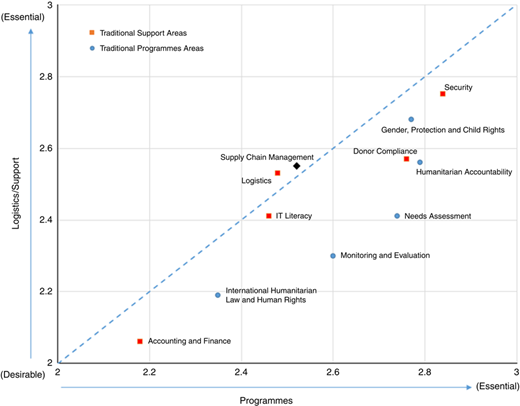
First, respondents were asked to rate the importance, to the average employee, of knowledge of a selection of different Programmatic and Support task areas, among them Logistics and SCM (Figure 5). The fact that Logistics and SCM ranked almost identically supports the lack of a clear distinction between the two concepts as perceived by many staff from both cohorts. A secondary finding is that task areas traditionally regarded as the domain of Programmes were equally as dispersed throughout the rankings as those more typically associated with Support. Any tendency to the contrary might be suggestive of a bias, but the means of each cohort are strongly correlated (Spearman’s rank-order correlation coefficient rs=0.856), suggesting that both cohorts agree that an even balance of support and programmatic knowledge is important.
Nevertheless, Programmes staff did seem to value certain skills more highly than the Logistics/Support cohort: Needs Assessment (MWU=3,439.5, z=−3.462, p=0.001 two tailed), Donor Compliance (MWU=3,884.0, z=−2.218, p=0.029 two tailed), M&E (MWU=3,462.5, z=−3.200, p=0.001 two tailed), and Humanitarian Accountability (MWU=3,650.0, z=−2.958, p=0.003 two tailed) and it is relevant to note that these key customer-facing skills are precisely those that, in a commercial setting, would relate to demand management and customer satisfaction.
5.2 Beneficiary “voice” and demand-side factors
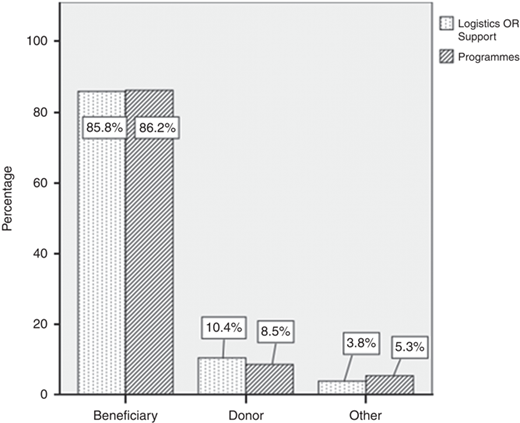
Our survey findings indicated that the beneficiary is strongly felt – by both cohorts – to be the customer (Figure 6).
Importantly, however, customer satisfaction and the concept of quality are usually discussed from the perspective of programme quality, and are, therefore, perceived to be the jurisdiction of Programmes:
There’s no use blaming logistics for the quality of goods going to beneficiaries. You [Programmes] are the specialist and you should have chosen better
(Interviewee C).
You see your [Programmes] technical advisor as a jack-of-all trades who knows all the things and does not need to include anyone really so it is only for him to talk about impact […]
(Interviewee F).
Operations will make sure that logistics needs are met, but how the health people treat the children is not the business of operations. How well they screen the children, whether the treatment follows national protocol or not, whether the quantity provided matches protocol or not, how they follow the children up to healing […] that’s quality, not operations
(Interviewee E).
Sometimes you will find information [from beneficiaries about quality of items provided] in written reports but not sure it’s always shared with logistics – it’s considered a Programmes issue
(Interviewee I).
At the same time quality in the context of SCM was generally perceived to be the responsibility of Logistics:
In our case, the ones who feel accountable for the supply chain are logistics. At our level the Programme head does not feel accountable for supply chain – even about any area of logistics
(Interviewee E).
For me this [supply chain processes such as planning supplies, selecting and managing suppliers, inventory quality, etc.] is the responsibility of Logistics
(Interviewee B).
Both of these viewpoints would seem to contribute to the distancing of the beneficiary-customer from SCM in terms of service quality. On the one hand, customer satisfaction is generally not perceived to be a logistics/support issue and, on the other, SCM is not perceived to be a programmatic issue.
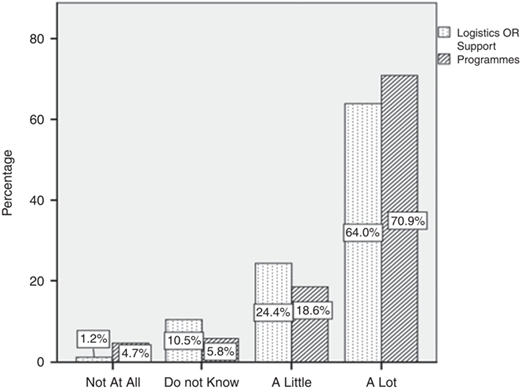
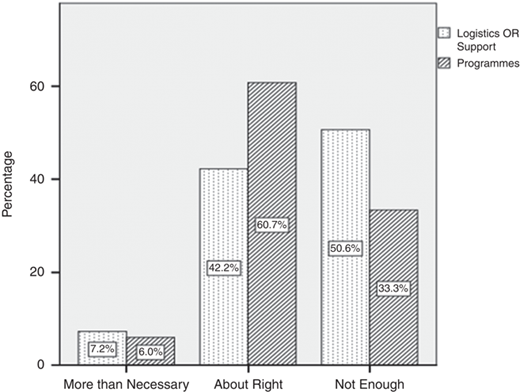
This disconnect is widely acknowledged, as demonstrated by the broad support for greater consideration of the “voice of the beneficiary” in supply chain processes to improve SCM performance (Figure 7), and substantial dissatisfaction from both cohorts with current levels of beneficiary interaction (Figure 8).
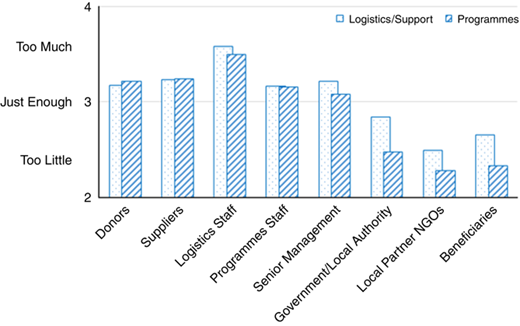
To explore perceptions around demand-side influences further, respondents were asked to rate the degree of influence that different stakeholders exert over quality in the supply chain. The results (Figure 9) clearly show a progressive reduction in staff-perceived influence along the supply chain as one approaches the beneficiary-customer. In turn, this would seem to indicate an opportunity to engage these latter groups to a greater extent in the overall logistic response process and, in particular, to elicit their feedback (in a similar way to that which is increasingly found in the “for-profit” environment).
The disconnect between the evaluation of SCM and programmatic quality was also noted by interviewees:
If we consider only Programme units, say, the PDQ [Programme Development and Quality] Director, they have nothing to do with supply chain. [Programmes] are more interested in the quality of impact to beneficiaries, not on the complete picture of how we achieved that result. In this we can definitely improve
(Interviewee H).
[Beneficiaries are] A bit of an afterthought at the moment [in SCM] but if the Monitoring, Evaluation, and Learning teams react quickly and there is that whole new initiative around beneficiary satisfaction […] through those feedback loops they could influence the supply chain
(Interviewee C).
Such indications seem to highlight the relationship between Logistics and Programmes and the remainder of the questionnaire focussed on this area.
5.3 Internal collaboration
Respondents were invited to select from four statements describing Programmes’ role in SCM: both current (Figure 10) and ideal (Figure 11).
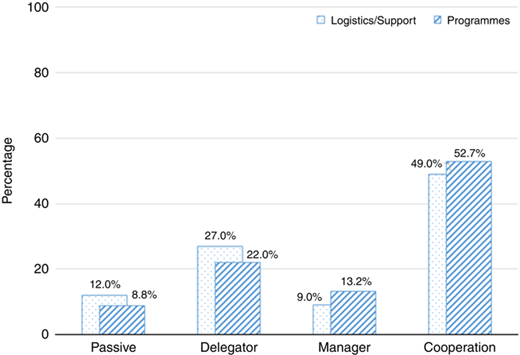
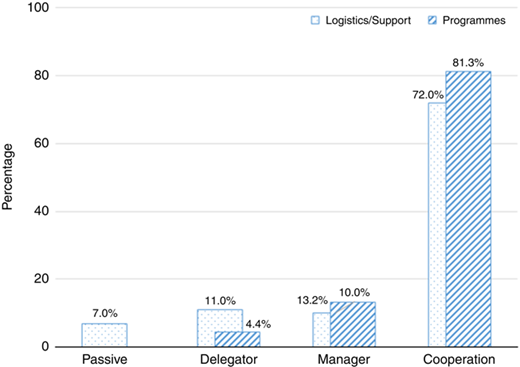
An integrated dynamic was overwhelmingly preferred by both cohorts and, indeed, was deemed by half of respondents to already describe the present relationship. However, it is interesting to note that a significant proportion of the Logistics/Support cohort – albeit a minority – seemed to advocate a “passive” or “delegator” role for Programmes. Given Programmes’ role as a customer gatekeeper this seems somewhat at odds with the broad support voiced for greater beneficiary integration (as described in the previous section).
To determine the importance of various elements of internal integration, respondents were asked to rank obstacles to better SCM (Figure 12).
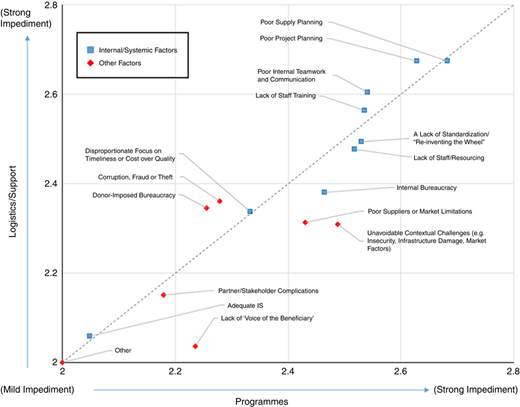
The X and Y axes of Figure 12 represent the mean (i.e. average) scores of the importance of the particular area (based on a 1-3 Likert scale: No Impediment; Mild Impediment; Strong Impediment) as perceived by the respondents from each cohort.
Generally, the results suggest that internal, systemic factors are at the forefront of staff concerns: poor planning is considered the primary obstacle, closely followed by poor teamwork and communication, and then lack of training, lack of standardisation, a lack of resources, and internal bureaucracy. The interrelatedness of these factors in terms of cross-functional coordination is notable and, arguably, indicates that internal supply chain integration is more than a question of logistics planning – albeit, if so, the low ranking of Information Systems seems anomalous. It is speculated that this may have been because such information systems are perceived to reflect an external, rather than internal, communications interface.
The responses from both cohorts show a high degree of overall correlation (Spearman’s rank-order correlation coefficient rs=0.920), but some factors were of more concern to Programmes. Noticeable divergence, though not statistically significant at p=0.05 level, was found in the cases of Unavoidable Contextual Challenges (MWU=3,012.0, z=−1.818, p=0.075 two tailed) and Lack of the Voice of the Beneficiary (MWU=3,024.0, z=−1.909, p=0.060 two tailed) perhaps again reflecting the external focus of Programmes.
In our interviews, internal integration across the LPI tended to be described as a customer-service provider relationship, though often with reservations expressed about an unhealthy transactional nature to the mechanism, with Logistics often operating, and treated, as a “black box”:
Programmes play more of a customer role, saying “this is what I want and when I want it”, “Where is it now in the process?”[…] Programmes see themselves as customers and may complain about timelines and quality. They are more passive than active in the sense that they just say what they want
(Interviewee A).
Put some input and expect some results. I think that is still the characteristic [of the relationship between Programmes and Logistics] in quite a number of countries where [this INGO] is working. I experienced that a lot in East Africa and Middle East […] In some cases even, Programme technical staff expect logistics to provide all the necessary specifications
(Interviewee H).
[Programmes] see themselves as customers actually, expecting logistics to provide services to their programmes and projects – buying, storing and distributing things for their projects. And this is usually how logisticians see themselves as well – they are waiting for someone to tell them what has to be obtained and stored and so on […] and then they do it
(Interviewee F).
The final questions in this category presented a set of activities that traditionally tend to be perceived as Programme-led, and a second set of activities traditionally perceived as Logistics-led. Respondents were asked to rank the adequacy of engagement of Logistics teams in the former, and Programmes teams in the latter.
Although the term SCM was not used in the phrasing, the activities were carefully selected so as to reflect a broader supply chain system and so juxtapose views on supply chain engagement from each side of what might be considered a “Great Operating Divide”. The objective here, in effect, was to get a sense of whether any such gap is reflected in perceptions either that logisticians do not think “Programmatically” enough or that Programmes staff do not think “logistically” enough. The results (Figures 13 and 14) suggest the latter: staff from both cohorts are generally less satisfied with Programmes’ involvement in Logistics-type activities (mean=2.34) than vice versa (mean=2.07).
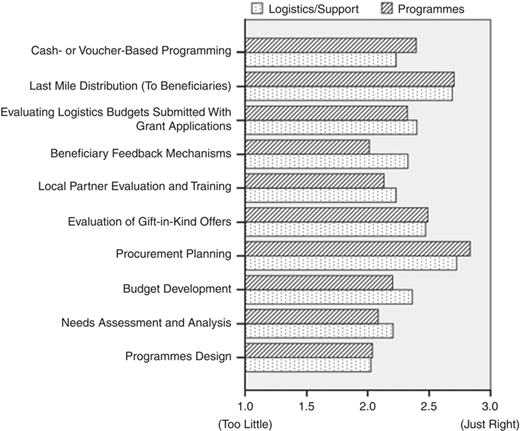
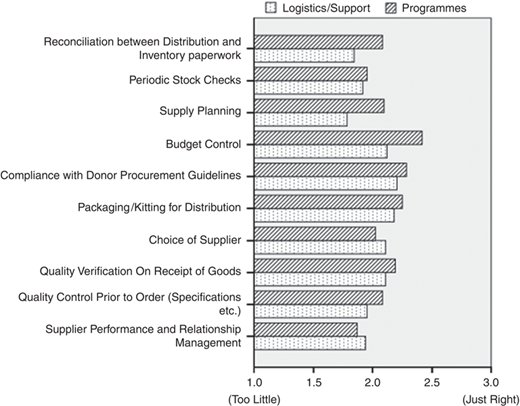
Similar concerns were also expressed in our interviews, with Programmes’ involvement in logistical activities considered at best ad hoc and, at times, even reluctant:
Programme managers are involved because they have to confirm the required quality, but this is ad hoc: they are not so good at thinking long term about how they need to work with logistics over the course of the grant
(Interviewee D).
I think the understanding from Programme staff [of SCM] is rather narrow – they don’t see the depth of what is required: just the tip of the iceberg. That comes from lack of joint planning. If your impression is that to get something delivered in your team is to write a PO and it magically arrives, you probably missed part of the point!
(Interviewee I).
Programme staff are very focussed. If logistics people don’t plan well the stages and steps where they want Programme people to be involved, they will not get them
(Interviewee E).
In most of the cases you will have logistics & supply chain thrown somewhere in a corner of the office, or behind the office in some small room and contacted only when something is needed, and it will be on an ad hoc basis and everything will be reactive
(Interviewee H).
Conversely, the prospect of involving logisticians more in Programme activities seemed to be greeted as a novel idea, with scepticism rather thinly veiled by polite enthusiasm:
I’ve never seen a logs who has worked with Programmes teams to do a quality evaluation or assessment. We should check for some balance. In terms of needs assessment they can be more involved. Maybe they will see some aspects of needs that Programme people won’t see
(Interviewee E).
It never occurred to me to include them [logisticians] really in working with partners or in collecting feedback from partners or beneficiaries, but I can understand and recognize quite good value out of it
(Interviewee F).
They [Logistics] don’t really feel they are part of the award management system to be honest
(Interviewee D).
Looking more closely at Figure 14, however, the view that Programmes should or could engage more with supply chain activities may not always be shared by Programmes. There was statistically significant divergence in the cases of supply planning (MWU=2,696.0, z=−2.710, p=0.006 two tailed), the reconciliation of distribution data (MWU=2,882.5, z=−2.061, p=0.034 two tailed), and budget control (MWU=2,773.5, z=−2.473, p=0.014 two tailed), for instance, where Programmes staff appear to feel relatively more satisfied with their current input.
A further analysis of the data underpinning Figures 13 and 14 was undertaken to test whether there was any significant difference between those respondents who had identified themselves as “unionists” and “traditionalists” (see Figure 4). In the case of Figure 13, only “evaluating logistics budgets submitted with grant applications” indicated a significant difference between the unionist and traditionalist groups (MWU=2,298.5, z=−1.989, p=0.047 two tailed). Similarly, in Figure 14, only “choice of supplier” indicated a significant difference between the two groups (MWU=1,985.0, z=−3.290, p=0.001 two tailed). The item “reconciliation between distribution and inventory paperwork” had a noticeable difference but not significant at p=0.05 level (MWU=2,379.0, z=−1.719, p=0.075 two tailed).
To the extent that there is a difference across these areas, the traditionalists consistently (as indicated by the minus sign of the z value) ranked lower than the unionists. While the number of instances is small, it would appear that the unionists, when compared with the traditionalists, have a slightly wider view on the SCM activities and focus more on “out-of-the-organisation” functions.
5.4 Summary
The above findings provide clear insights into perspectives concerning SCM as held by operational staff at the LPI. Such perspectives reflect organisational norms which could themselves impact collaboration and SCM performance and, in this respect, the divergence found between the two cohorts is clearly of importance. Such dissonance is helpful in pointing out some of the topics around which a useful organisational dialogue might be developed with a view to reconciling the definition and boundaries of SCM.
The appetite for this is clearly reflected where the views of the two cohorts converge – for example, they both share aspirations to increase beneficiary integration and concerns about an internal relationship which is often perceived to be overly transactional. On the other hand, the prospect of engaging Logisticians more in programme activities is met with muted enthusiasm, while involving Programmes staff in logistics activities is widely held to be a continuous struggle. Thus, while an internal divide seems to be recognised, the mechanisms by which it might be bridged are proving elusive.
6. Discussion
6.1 An emergent interpretation of SCM
Our results strongly support the notion that the sector is at a “pre-SCM” stage, and this is most clearly demonstrated by the widespread division found between unionist and traditionalist perspectives among staff. Both cohorts seem equally unable to decide whether logistics is a subset of SCM or vice versa, and also found difficulty distinguishing the two terms from each other. It is suggested that, until and unless there is clarity in this regard, the existing siloes and jurisdictional boundaries are likely to continue to obstruct performance. This may, in reality, reflect the extent to which the respondents have been exposed to this discussion in, for example, a tertiary education setting – but this possible influence on their understanding was not tested for (and, therefore, represents a potential future area of research).
While the subject INGO does not have a formal definition of SCM, the term was commonly employed by staff in the course of our interviews to refer to that subset of HL concerned with the procurement and movement of goods. Such a narrow viewpoint is, however, difficult to reconcile with the understanding of SCM that emerged from the survey and interviews as a fundamentally customer-focussed process which should encompass Programmes and beneficiary-side activities in a more explicit way. The need to clarify the relationship between Programmes and SCM is, thus, likely to be key to the ability of the subject INGO – and perhaps other similar donor-funded INGOs – to leverage those SCM processes and mechanisms which, in the commercial world, promise greater customer satisfaction and long term, strategic advantage.
6.2 Towards a cross-functional definition of SCM
Revisiting definitions may be a useful way to start exploring the positioning of SCM vs Logistics in this context. We follow Day et al. (2012) who advocate a unionist position in which SCM completely subsumes Logistics. In the context of Humanitarian and Disaster relief, Day et al. suggest that SCM should be considered long term in outlook and focussed on the strategic allocation of resources between responses. However, these authors do not explore the internal cross-functional implications of the adoption of such a unionist perspective. Furthermore and importantly, the question of what form SCM might take in a pure development context is left unanswered. The inter-dependence between successful development and humanitarian work is well-documented (see e.g. Pelling et al., 2004) and so the prospect of a truly interdisciplinary unionist interpretation of SCM may present difficulties for Programme staff working in a development context where logistics is all but absent. A definition of SCM which adequately serves this sector must encompass both humanitarian and development modes, not least in view of the absence of clear boundaries (physical or temporal) between them. Thus, closely modelled on Day et al.’s (2012) definition, we propose a definition of humanitarian relief and development SCM, or HRDSCM, which emphasises the continuum between the two contexts as well as the focus on beneficiaries as highlighted below:
The system that supports the delivery of both humanitarian relief and development programmes through the identification and strategic management of all interfaces involved in the provision of goods and services, in order to optimise service quality to beneficiaries, and by extension, to donors. It includes the strategic development of global supply chain capacity and the identification of competing and complementary supply chains and the organisation’s strategic response to them.
In order to further emphasise the distinction between SCM and Logistics, we propose a new definition of HL which is loosely based on a military rather than a commercial definition (US Department of Defense, 1994), and which reflects a balance in terms of logistics’ wider, specialist role in this context beyond the supply of goods:
The science of planning and implementing the physical delivery of humanitarian relief. In its most comprehensive form, those aspects of humanitarian operations which deal with: a) the acquisition, storage, movement, distribution, maintenance, and recovery or disposal of materials; b) the safe accommodation, movement and evacuation of personnel; and c) the construction or acquisition, maintenance, and disposal of facilities.
In tandem, the above definitions deliberately seek to distinguish between a cross-functional, strategic interpretation of SCM and the tactical function of HL. While this is contrary to prevailing views within the INGO community and much of the HL literature, which tend towards a relabelling perspective, it better reflects the perceptions expressed by many staff in our case study and would be aligned with emerging commercial SCM trends.
To that extent, it is suggested that the proposed definitions (and associated roles, responsibilities and activities) are more closely aligned with those found in the “for-profit” environment (see e.g. Christopher, 2011). This has clear benefits in two specific areas – first, when the INGO is engaging with, for example, its commercial providers the use of a common language and common concepts is likely to ease communications and help develop a more clear and “joined-up” relationship. By the same token, many staff within the INGO will have joined this organisation after a period of time in a commercial environment. Thus the use of common language and concepts is likely to result in an easier and swifter transition.
6.3 Implications for INGOs
By distancing the strategic concept of SCM from the tactical realm of logistics, several opportunities arise for INGOs to reposition organisational norms and thus foster improved internal coordination.
In terms of procurement, for instance, responsibility for the contracting of specialist consultancy services is often diffused among technical Programme teams and the strategic control and management of this cost centre remains, as Interviewee H put it, “a grey area”. By transcending departmental boundaries, the adoption of a service-dominant approach to SCM would allow for greater flexibility such that the locus of control for procurement of services might shift depending on the project context, whilst ensuring that such procurement nevertheless falls under the SCM framework and is, thereby, subject to greater visibility and control. Ellram et al. (2004), for example, lay out a unifying framework for services supply chains with a focus on the procurement of services and the control of associated costs. The common challenges they outline will be familiar to many INGOs.
Furthermore, a services-dominant view could help cast a different light on beneficiary and partner engagement by highlighting their input into service delivery. The bi-directional characteristics of services supply chain management (SSCM) reframes the customer as a simultaneous supplier of inputs in the service delivery process and thus partly responsible for quality and their own satisfaction (Sampson, 2000). For example, Maull et al. (2012) discuss the concept of the “intelligent customer” as “one who is assumed to have, or can acquire, sufficient technical knowledge of the services provided by a range of organizations, is able to specify their requirements to them and competent in managing and coordinating the provision of the service” (p. 83). Thus a service-dominant view of SCM could suggest new directions in Humanitarian Accountability where a customer-centric view of SCM prompts Programmes staff to seek to understand not only their own supply chains but also to develop an awareness of competing and complementary supply chains available to the beneficiary. This may enable them to take on the role of “systems integrator”, advising beneficiaries on the optimal ways to engage those supply chains, and passing on intelligence that would otherwise remain beyond their horizon (Maull et al., 2012, p. 78).
Most importantly, a service-dominant view of SCM could be used to accommodate the cyclical shift from humanitarian to development work. In a humanitarian context, the transition between agile and lean supply chains has been studied by several authors (Tomasini et al., 2008; Taylor and Pettit, 2009; Charles et al., 2010; Scholten et al., 2010; Cozzolino et al., 2012). However the full disaster management lifecycle, and the scope of most INGOs’ business models, demands an extension of these ideas to also incorporate development work. This can be illustrated on a continuum as shown in Figure 15. The first row depicts the classic disaster management lifecycle (Safran, 2003). The middle row shows the changing degree of logistical and development-mode content that make up the programme portfolio at any given stage. The bottom row shows an integrated supply chain continuum.
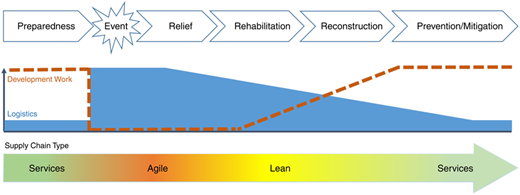
In theory, the normal working mode is one dominated by development with a minimal (if any) logistics component. With the onset of a humanitarian crisis, development work is typically suspended as operational resources are dominated by, and redirected towards, the logistical challenge of managing what is suddenly a very physical supply chain. As the emergency response transitions through the subsequent rehabilitation and reconstruction phases, the need for physical supplies reduces as communities get back on their feet and local economies are revived. During this period, the emergency response gains intelligence about communities and starts to develop an increasing focus on capacity building, sustainability and services. Eventually, following the strategic prepositioning of stocks and the review of service contracts, the logistics component falls back to a minimal, perhaps even non-existent, level as the portfolio returns to a development profile until the next emergency.
Thus, a service-dominant view of SCM suggests that there is always a supply chain to manage, regardless of the degree of logistics involved – including in development work and not just in terms of preparing for the next emergency. The degree to which SCM requires logistical involvement is, thus, entirely context-dependent. Indeed, even in emergencies where logistics activities dominate, the provision by Programme staff of augmented services to beneficiaries attending distribution events may be perceived to represent engagement in SSCM.
Thus, a unionist perspective of SCM helps to illuminate the role which Programmes staff are already playing in SSCM: in both emergencies and development work, and not simply through their interactions with the Logistics department. Furthermore, because a unionist approach suggests the need to integrate demand-creation and demand-fulfilment processes, repositioning SCM concepts in this way may help draw particular attention to the processes that occur between internal teams. In the case of the LPI this might look something like Figure 16.
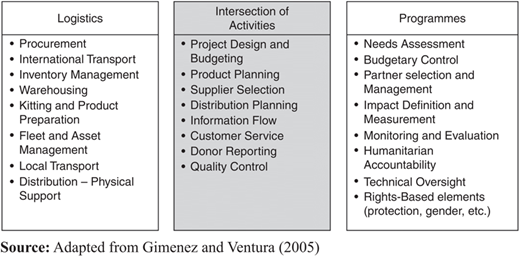
Such an approach may be helpful to INGOs as a means of improving collaboration between Programmes and Logistics teams: particularly in terms of the beneficiary/quality focus that our survey participants perceived to be lacking. For example, the literature examines reward mechanisms and their potential to influence collaboration and supply chain performance (Ellinger, 2000; Gimenez and Ventura, 2005). Jüttner et al. (2007) suggest that “supply chain managers who are rewarded on the basis of costs view customisation of products, product variety and delivery options as threats to their performance” (p. 389). It is not hard to imagine how such effects could translate to the humanitarian context, where special requests from Programme staff hoping to inject greater value for beneficiaries at late stages in a project can be unpopular with logisticians. The lead author of this paper has witnessed such situations many times, where the well-intentioned objective is eclipsed by tension that instead arises between teams. Thus siloes are subtly reinforced and any potential for broader strategic assimilation is lost. Rather than blaming a lack of planning (all too easy a scapegoat with the benefit of hindsight), a broader interpretation of SCM could create a neutral standpoint from which to examine collaboration on product quality throughout the entire project lifecycle, and establish collaborative KPIs that encourage and reinforce joint ownership of quality considerations. The SCM framework could also then provide a platform and formal mechanisms by which strategic dialogue about such problems can be captured and elevated – if necessary with external peer organisations and the donor community. If, on the other hand, SCM continues to be seen as “simply” a question of Logistics, its perceived jurisdiction and ability to bridge the LPI will remain severely limited.
6.4 Research limitations and opportunities
The lack of participation from Programme staff in this survey is both indicative and problematic. Whilst significant efforts have been made to understand the Programmes perspective, a gap remains in terms of the engagement and, hence, views of those operating at the customer-facing side. It is thus accepted that the analysis of this research must be considered tentative and a more comprehensive survey of Programme staff across the sector is clearly needed, including for example their exposure to the theory of SCM/logistics in an academic context. However, the absence of the Programme “voice” in this exercise ultimately reinforces our underlying concern: that the role of Programmes in SCM must be reconciled.
The potential value of applying SSCM theory to development work and the services component of humanitarian aid also needs to be explored. To put it another way, if the humanitarian system represents an $18 bn industry, what then might SCM theory offer to the $136 bn industry represented by foreign aid in general? (Provost, 2014). Practical challenges are implied at an organisational level also. For example, how might INGOs best handle the transition between product-dominated and services-dominated supply chains, as well as the integration of both in hybrid supply chains?
Similarly, research should investigate the potential of a DCM approach to provide new insights on the problem of the beneficiary as a “silent stakeholder” (Tatham and Hughes, 2011, p. 79) and to drive an improved customer-focus. The mapping of processes at this interface and the practical implications warrant further study. In particular, questions relating to how supply chain performance management might be linked to the evaluation of programme quality and impact, and what the potential might be for greater consideration of the “voice of the beneficiary” in SCM, clearly emerge from this research.
DCM theory points us back to the need to establish a conceptual model which adequately explains the unique nature of “choice” and “demand” among beneficiaries in HRDSCM. For instance, an open systems approach might position the beneficiary merely as an input in the delivery of a service to donors: as unpalatable as this may seem, a convincing alternative is needed in order to successfully reconcile the donor and beneficiary as simultaneous customers in INGO supply chains. Thus, following ideas expressed in the context of welfare consumerism (Hughes, 1998, p. 33), the donor-beneficiary could be conceptualised as a “conglomerate” customer entity, with one hopefully reflecting the interests of the other in an accurate way.
Finally, the research was focussed on a particular INGO – albeit one that is a major participant in the logistic operations in the preparation and response to disasters and in development activities – and thus no specific claim of generalisability can be made. That said, one of the researchers has been active as a humanitarian logistician for some 20 years and has worked for a number of INGOs during this period. As a result, it is believed that the results offered in the research are, indeed, a good reflection of those found in the sector as a whole, but clearly this proposition needs to be formally tested.
7. Conclusions
This research found some important divergence among staff in their perspectives on SCM and Logistics but, more fundamentally, considerable confusion as to the distinction between the two concepts and their relationship with each other across the spectrum of humanitarian relief and development. To help address this, we advocate a move towards a DCM/unionist approach: a “deep” and interdisciplinary interpretation of SCM that leverages SSCM concepts and may help to incorporate beneficiary considerations. Extending the interpretation of SCM to encompass a wider array of activities, including many that are (and should continue to be) Programmes-led, could facilitate a more open, collaborative dynamic at the operational level, conducive to improved supply chain performance and programme delivery. The practical implications for INGOs of adopting such an approach are considered significant. Where should the locus of control for SCM sit in the organisational structure? How should the traditionally programmatic domains of, say, Humanitarian Accountability, M&E, and Programme Quality be conscripted into a new, broader version of SCM? How could a SCM approach be leveraged to the benefit of development programmes?
The role of beneficiary communities as participants in supply and value chains is gaining ever greater prominence in diverse areas of both emergency relief and international development. INGOs will increasingly be required to extend their SCM expertise beyond the basic remit of procuring, storing and distributing goods. INGOs should give thought to broader interpretations of SCM, and undergo a conscious, consultative process to position this strategic business concept in relation to the logistics function. Avoiding the temptation to simply relabel Logistics and instead embracing new models such as those explored here, could help improve programme quality while simultaneously preparing INGOs for the changes ahead.
Special thanks to Rosie, wife of the author David Makepeace, for the encouragement and patience during this long process. A tremendous thanks to the co-author, Peter Tatham, for the guidance and thought-provoking, but always gracious, debate. Thanks also to Dr Kiran Fernandes of Durham University and Dr Yong Wu of Griffith University for their input. No funding was received by any party in the development of this work.
Notes
Throughout this paper we refer to a “programme” as a container for multiple related projects. In contrast, we will use the capitalised “Programmes” when referring to the staff contingent described above.
www.hanken.fi/en/about-hanken/organisation/departments-and-subjects/department-marketing/humlog/publications-0 (Version dated 27 November 2015).

