


The purpose of this paper is to link humanitarian logistics (HL) and supply chain risk management (SCRM) to provide an understanding of risk mitigation strategies that humanitarian organisations use, or could use, to improve their logistics preparedness.
Based on systematic reviews of RMS in SCRM and supply chain strategies (SCS) in HL literature, a framework is developed and used to review published case studies in HL.
The study finds that humanitarian actors use a number of the strategies proposed in the framework, particularly those related to strategic stocks, postponement, and collaboration. Strategies related to sourcing and procurement, however, especially those on supplier relationships, seem to be lacking in both research and practice.
The study is based on secondary data and could be further developed through case studies based on primary data. Future studies should explore the generalisability of the findings.
Practitioners can use the framework to identify potential new SCS and how strategies can be combined. Findings can help them to understand the abnormal risks of main concern, how they may impact normal risks, and provide ideas on how to tackle trade-offs between different risks.
The results can support improvements in humanitarian supply chains, which will provide affected people with rapid, cost-efficient, and better-adapted responses.
The paper connects SCRM and HL to develop a framework and suggests propositions on how humanitarian actors can mitigate supply chain risks. Questioning the focus on strategic stock it suggests complementary or alternative strategies for improving logistics preparedness.
1. Introduction and purpose
Where is the Crisis Management Component of [Humanitarian Operations]?
(Starr and Van Wassenhove, 2014, p. 934).
This paper links humanitarian logistics (HL) and humanitarian operations (HO) to supply chain risk management (SCRM). Extant research is concerned with differences between commercial and humanitarian supply chains (Dubey and Gunasekaran, 2016; Oloruntoba and Kovács, 2015), but has concluded that concepts, models, and tools can be applied in the humanitarian context as well (Day et al., 2012; Maon et al., 2009; Oloruntoba and Gray, 2006; Swanson and Smith, 2013; van Wassenhove, 2006). SCRM was developed for the commercial context and is concerned with assessing, mitigating, responding to and monitoring normal and abnormal risks (disruptions) (cf. Ho et al., 2015). The present paper focusses on mitigation, with the aim of providing an initial understanding of humanitarian organisations’ use of supply chain strategies (SCS) to improve their logistics preparedness. Better preparedness improves response (Van Wassenhove, 2006; Jahre and Heigh, 2008; Jahre, Kembro, Rezvanian, Håpnes, Ergun and Berling, 2016; Scholten et al., 2014), even if there are challenging trade-offs between cost efficiency and flexibility (Day, 2014; Jahre and Fabbe-Costes, 2015; UNDP, 2015). SCRM also points to trade-offs between different types of risk such as return on investments in safeguarding against disruptions (e.g. Sodhi and Tang, 2012; Nooraie and Parast, 2016).
Research on logistics preparedness mainly concerns network design and warehouse location for prepositioning of goods (Kunz and Reiner, 2012), a focus also seen in practice (Jahre, Pazirandeh, and Van Wassenhove, 2016). Prepositioning can be viewed as strategic stock and is only one among many strategies suggested in the SCRM literature. Accordingly, this paper questions the implicit (in-house, cf. Alvesson and Sandberg, 2011, p. 254) assumption in much HL/HO literature that strategic stock is the (only) mean by which organisations can mitigate risks. Using SCRM theory we see logistics preparedness as robust logistics strategies (Tang, 2006a) and identify alternatives to prepositioning, contributing to understanding how the humanitarian community can improve its logistics preparedness and thereby response.
While SCRM is a vastly expanding area (Colicchia and Strozzi, 2012; Ho et al., 2015), few studies have linked it with HL. McLachlin et al. (2009) suggested that SCRM is important in the humanitarian context for two reasons: a supply chain interruption can cause or contribute to a humanitarian crisis, and humanitarian relief efforts often face multiple risks. Choi et al. (2010) referred to risk management in their study of aid distribution in East Africa where actors charge risk premiums. Wild and Zhou (2011) were concerned with ethical procurement in relation to risk. Iakovou et al. (2014) suggested dual sourcing as a proactive risk mitigation sourcing strategy. Scholten et al. (2014) showed the importance of collaboration, supply chain re-engineering, agility, risk awareness, and knowledge management. Kovács and Tatham (2009) discussed the use of vendor-managed inventory, public-private partnerships, joint warehouses for resource pooling, and postponement. Schniederjans et al. (2016) discussed risks related to information sharing through cloud computing for the purpose of improving for collaboration. A recent study by L’Hermitte et al. (2016a, b) used the term when discussing the need for agility and the types of risks encountered in protracted operations. They concluded that such risks exist and that agility is indeed needed, even if such operations may be viewed as hybrids also characterised by stability and regularity (p. 192). None of these studies, however, have related the strategies to an overall framework, nor did they report on empirical testing of relations between specific types of risk and strategies.
SCRM frameworks suggest categorising strategies by different dimensions, including redundancy vs flexibility (Chang et al., 2015; Kleindorfer and Saad, 2005; Talluri et al., 2013); reducing vs coping (Ghadge et al., 2012; Knemeyer et al., 2009; Simangunsong et al., 2012) such as sharing and transferring (Ghadge et al., 2013); monitoring vs collaboration (Hajmohammad and Vachon, 2016); and depending on what risks they are to handle (Chopra and Sodhi, 2004; Ghadge et al., 2013; Ho et al., 2015; Lavastre et al., 2014; Manuj and Mentzer, 2008; Ritchie and Brindley, 2007; Sodhi et al., 2012; Sodhi and Tang, 2012; Tang, 2006a; Tummala and Schoenherr, 2011). Using Tang (2006a) as a basis, combined with a systematic review of papers presenting SCRM frameworks and papers discussing SCS in the humanitarian context, we conducted a review of case studies published in the HL literature. The three literature reviews were conducted in accordance with recommendations for systematic reviews (Wilding and Wagner, 2014).
We found that publications in HL/HO as well as the case studies focus on strategic stock, and to a limited extent on other means. A lot of the evidence is anecdotal. We propose a framework and use it to review cases regarding strategies and risks. We suggest further research based on primary data with data collection instruments derived from the framework. In particular, we recommend future research to develop and test propositions on how different types of risks are related, e.g. abnormal risks’ influence on normal risks, and how certain strategies can mitigate specific types of risks. Developing such propositions require better data than were at hand in the published case studies. A contingency approach to risk mitigation is vastly under-researched also in SCRM. Hence, future studies that suggest and test propositions in HL/HO can contribute to SCRM with what Whetten (1989) calls a theoretical feedback loop.
This study contributes with an initial understanding of humanitarian organisations’ use of SCS to improve logistics preparedness. Practitioners can use the framework to identify potential new SCS and how strategies can be used in combination. The findings can help them to understand the abnormal risks of main concern, how they may impact normal risks, and provide ideas on how to tackle trade-offs between different risks. The results can be used to support improvements in humanitarian supply chains, thereby providing affected people with rapid, cost-efficient and better-adapted responses. Section 2 presents the research design and Section 3 continues with the literature reviews and resulting framework. Section 4 presents the analysis and discussion, before Section 5 concludes and suggests further research.
2. Research design – data collection and analysis
We conducted a systematic review in accordance with recommendations in recent literature (Wilding and Wagner, 2014) following the method suggested by Bryman and Bell (2015):
define the research question/aim of the study;
identify articles;
select and evaluate articles;
analyse and synthesise; and
present results.
The research question in this study is concerned with humanitarian organisations’ use of SCS to improve logistics preparedness. It was defined by questioning the in-house assumption (Alvesson and Sandberg, 2011) about goods prepositioning as the (only) mean for improving logistics preparedness. Searching for theory we identified numerous SCS frameworks in SCRM. With help of HL/HO literature, we define the constructs and operationalizations that constitute our framework, which we then use to classify published case studies, identify gaps, and suggest avenues for further research.
2.1 Selecting databases, identifying and analysing articles for developing the framework
A systematic process identified relevant articles using a screening process similar to that of the study of Abidi et al. (2014). Four databases – Business Source Complete, Emerald, ScienceDirect, and Wiley – were selected to cover all articles published by June 2016 in internationally refereed logistics, supply chain, and operations management journals (see list in the Appendix). This step ensured appropriate journal and publication quality (Wilding and Wagner, 2014).
We only included articles written in English. A further important inclusion criterion (cf. Kembro et al., 2014) was that abstracts had to demonstrate a SCRM framework and HL/HO strategy as the clear focus/research objective. Hence, for SCRM frameworks, we searched abstracts using “supply chain risk management” + “framework” as search terms. Searching in abstracts rather than the whole text ensured that we identified papers with the appropriate scope and focus (Wilding and Wagner, 2014). The articles were screened to select general frameworks, excluding those that covered only specific risk types (such as price) and/or specific contexts (such as food). Similarly, for SCS, we searched abstracts using “strategy” + “humanitarian operations”/“humanitarian logistics”. Conceptual and empirical studies were screened to identify those studies concerned with preparedness, disaster relief, and logistics, but excluding papers on response and other “operations” (the term “operation” is often used for other activities than those related to logistics and supply chain management).
Based on results from the analysis of the two research streams, we developed a framework for SCS in the humanitarian context. In the first step, we built the framework on Chopra and Sodhi (2004), claimed by Colicchia and Strozzi (2012) to be the most cited article in SCRM; together with Tang’s (2006a) robust strategies, which has been identified as the most comprehensive to date, thus considered a “path-defining study” (Alvesson and Sandberg, 2011). Ho et al. (2015) has been identified as the most recent and comprehensive review of SCRM, particularly focussing on risk types and factors driving specific risks; therefore, we used that study as the basis for risk types. The second step is the analysis and categorisation of strategies in other SCRM frameworks (Table II), identifying three additional strategies not originally suggested by Tang (2006a). In the third step, Table II was used to analyse the HL/HO articles with regard to humanitarian SCS, operationalizing and exemplifying 8 of the 14 strategies, resulting in a framework for humanitarian SCS.
Risk mitigation strategies identified in the SCRM literature
| Strategy | Explanation and examples | Authors |
|---|---|---|
| Centralisation | Stocks, production, distribution | Lavastre et al. (2014) |
| Collaboration | Risk sharing, supplier development, information sharing | Chang et al. (2015), Ghadge et al. (2012), Ghadge et al. (2013), Lavastre et al. (2014) Ritchie and Brindley (2007), Simangunsong et al. (2012), Talluri et al. (2013), Tang (2006b), and Tummala and Schoenherr (2011) |
| Dynamic assortment planning | Can be used to influence choice and demand, and to entice customers to purchase products that are widely available when certain products are facing supply disruptions | Simangunsong et al. (2012) and Tang (2006a, b) |
| Economic supply incentives | Encourage additional suppliers to stay or enter into a certain market in order to avoid monopolistic situations, and to secure multiple sources should a disruption occur | Ghadge et al. (2013), Tang (2006a), and Tummala and Schoenherr (2011) |
| Flexible manufacturing process | Allow for adjustments in quantity and quality produced in their network; for example, varying between plants and/or production lines | Chopra and Sodhi (2004), Kleindorfer and Saad (2005), Lavastre et al. (2014), Simangunsong et al. (2012), Sodhi and Tang (2012), Talluri et al. (2013), Tang (2006a), and Tang and Tomlin (2008) |
| Flexible supply base | Multiple sourcing options available, thus allowing for alternatives should one source be disrupted. One way of doing this is to develop a supply alliance network with suppliers in various countries. Also called hedging | Chang et al. (2015), Chopra and Sodhi (2004), Ghadge et al. (2012), Ghadge et al. (2013), Kleindorfer and Saad (2005), Knemeyer et al. (2009), Lavastre et al. (2014), Manuj and Mentzer (2008), Simangunsong et al. (2012), Talluri et al. (2013), Tang (2006a, b), Tang and Tomlin (2008), and Tummala and Schoenherr (2011) |
| Flexible supply contracts | Agreements with suppliers allowing the customer to adjust order quantities depending on need | Chopra and Sodhi (2004), Ghadge et al. (2012), Ghadge et al. (2013), Manuj and Mentzer (2008), Simangunsong et al. (2012), Sodhi and Tang (2012), Tang (2006a, b), and Tang and Tomlin (2008) |
| Flexible transportation | Multi-modality, multiple carriers and/or multiple routes | Chopra and Sodhi (2004), Kleindorfer and Saad (2005), Lavastre et al. (2014), and Tang (2006a) |
| Make-and-buy | Combination of in-house and outsourcing, which allows more flexibility in case of a disruption. Includes vertical integration | Chopra and Sodhi (2004), Ghadge et al. (2013), Kleindorfer and Saad (2005), Manuj and Mentzer (2008), Simangunsong et al. (2012), and Tang (2006a) |
| Postponement | Utilises product or process design concepts such as standardisation, commonality, modular design, and operations reversal to delay the point of differentiation in products, services, movement and other value-adding activities | Ghadge et al. (2012), Ghadge et al. (2013), Manuj and Mentzer (2008), Simangunsong et al. (2012), Tang (2006a, b), and Tang and Tomlin (2008) |
| Revenue management | Dynamic pricing and/or promotion | Chopra and Sodhi (2004), Simangunsong et al. (2012), Tang (2006a, b), and Tang and Tomlin (2008) |
| Silent product rollover | “Leak” new products into a market without making formal announcements | Tang (2006a) and Tang and Tomlin (2008) |
| Speculation | Opposite of postponement, such as forward placement of inventory, forward buying and early commitment to the form of a product | Manuj and Mentzer (2008) |
| Strategic stock | Inventories at certain “strategic” locations (warehouses, logistics hubs, distribution centres) that can be deployed quickly in case of a disaster. Often shared by multiple supply chain partners, e.g. vendor-managed inventory | Chang et al. (2015), Chopra and Sodhi (2004), Ghadge et al. (2012), Ghadge et al. (2013), Knemeyer et al. (2009), Lavastre et al. (2014), Simangunsong et al. (2012), Talluri et al. (2013), and Tang (2006a) |
2.2 Identifying and classifying cases in HL/operations literature
The framework was used to classify cases, that is, documented practised strategies in the humanitarian context. The case studies of humanitarian organisations’ SCS were identified by searching abstracts using “case study” + strategy + “humanitarian operations”/“humanitarian logistics”. Papers were screened to identify relevant cases, that is, those that report in-depth case studies of organisations’ SCS for logistics preparedness in disaster relief. The case studies were reviewed using the framework with the dual purpose of obtaining an overview of empirical HL research and what strategies humanitarian organisations seem to be focussing on currently, and identifying gaps for further research and developments in practice.
The search for case studies was complex and we tested combinations of search terms in different types of content (abstract, all) in order to capture as many as possible, while keeping the screening volume at a reasonable level. The searches were cross-referenced with the authors’ knowledge of case studies in HL/HO and we found that some studies were not identified, partly because they had not yet been published and partly because some journals and/or authors simply do not use the term “case study” or “case” even if they report on one. Accordingly, we complemented the results from the systematic review with case studies identified in previous research.
2.3 Results and limitations
Above, we described the procedures for searching, selecting, and analysing the articles to ensure transparency, allowing for auditing and replication (Bryman and Bell, 2015; Kache and Seuring, 2014). Table I provides an overview of the results.
Results from screening
| Database | Business Source Complete | Emerald | ScienceDirect | Wiley |
|---|---|---|---|---|
| Journals (full journal names in the Appendix) | OR, IJOPM, JPSM, SCF:IJ, JORS, JOM, TR, POM | IJLM, IJOPM, IJPDLM, JHLSCM, SCM:IJ | EJOR, IJPE, JOM, JPSM, TR | JBL, JSM, POM |
| No. of SCRM articles identified | 64 | 140 | 108 | 20 |
| No. of articles before/(after screening) | ||||
| Humanitarian operations + strategy | 7 (1) | 77 (13) | 15 (1) | 20 (2) |
| Humanitarian logistics + strategy | 13 (5) | 40 (20) | 18 (3) | 1 (0) |
| Humanitarian operations (abstract) + case study (all) | 17 (1) | 183 (8) | 22 (2) | 87 (3) |
| Humanitarian logistics (abstract) + case study (all) | 16 (0) | 122 (10) | 25 (1) | 23 (1) |
“Logistics” and “operations” were both used as search terms because journals differ in terms of which term they normally use. Consequently, there is an overlap between the two groups regarding the total numbers. There is also some overlap between the four databases. For example, JOM, POM, and IJOPM are included in Business Source Complete and in ScienceDirect, Wiley, and Emerald, respectively.
One limitation in the study is the use of published cases only. Organisations may use strategies that have not been reported in the scientific literature. However, the data still give sufficient indications to demonstrate the use of the framework and provide a basis for further research with other research designs and data sources.
Another limitation is that the case studies were undertaken and published for purposes other than the analysis presented here. This is a weakness in using secondary data (Bryman and Bell, 2015), which was mitigated by spending time becoming familiarised with the data and only selecting studies published or forthcoming in refereed journals to ensure data quality (p. 328). However, this made it difficult to analyse with any rigour what types of risks the organisations tried to mitigate through their strategies. We scrutinised every case reported in terms of the extent to which it studied how specific types of risks were mitigated through specific strategies; however, we found that many papers simply did not report on this issue, whether termed risk or uncertainties. Most of those that did report on the issue approached it at a very general level.
A third limitation is that most of the case studies concern large international organisations, which makes it difficult to generalise to the whole population of humanitarian actors. Finally, some strategies for particular organisations are reported in more than one case study; an example is the use of prepositioning in the International Federation Red Cross Red Crescent (IFRC) Society. To capture more depth and breadth, further research should collect primary data with data collection instruments developed from the framework; conduct more case studies, particularly of other types of organisations; and conduct cross-sectional studies. Development of propositions regarding how the risk types are related to the specific strategies (Whetten, 1989, p. 491) and what other factors may possibly influence chosen strategies and resulting performance, require analyses and data beyond those offered by this paper.
3. Framework
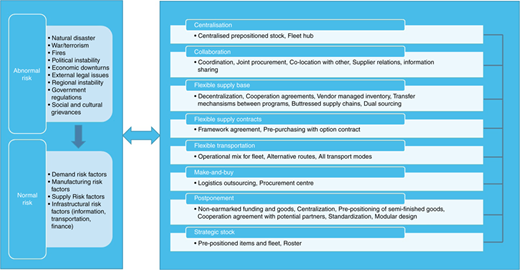
In line with suggestions by Whetten (1989), the main building blocks of the suggested framework are presented in terms of constructs (Whetten’s “what”) from SCRM (Table II) compared with those identified in HL/HO literature (Table III). The suggested relations (Whetten’s “how”) between risk and SCS are depicted in Figure 1.
Supply chain strategies identified in the humanitarian logistics/operations literature
| SCS | Humanitarian SCS with example papers |
|---|---|
| Centralisation | Centralised prepositioning (Listou, 2008), centralised fleet hubs (Pedraza-Martinez et al., 2011) |
| Collaboration | Coordination (van Wassenhove, 2006), supplier relations (Kóvacs and Tatham, 2009), commercial-humanitarian cooperation (Majewski et al., 2010), collaborative procurement (Wild and Zhou, 2011), civil-military coordination (Heaslip et al., 2012), adaptability (Dubey and Gunasekaran, 2016), and orchestrating networks (Oloruntoba and Kovács, 2015) |
| Flexible supply base | Multiple suppliers (Ertem et al., 2010), asset transfer mechanism (Bhattacharya et al., 2014), dual sourcing (Iakovou et al., 2014), flexible sourcing (Day, 2014), buttressing supply chains (Sodhi and Tang, 2014), adaptive entity capacity (Day, 2014), and arms-length and transactional (Oloruntoba and Kovács, 2015) |
| Flexible supply contracts | Flexible order quantities (Lodree, 2011), framework agreements (Balcik and Ak, 2013), and option contract (Wang et al., 2015) |
| Flexible transportation | Operational mix for fleet (Besiou et al., 2014) |
| Information sharing | Demand signal visibility (Day et al., 2012), performance measurement Abidi et al., 2014), visibility (Maghsoudi and Pazirandeh, 2016), alignment (Dubey and Gunasekaran, 2016), and cloud computing (Schniederjans et al., 2016) |
| Make-and-buy | Logistics outsourcing (Majewski et al., 2010) and resource sharing (Maghsoudi and Pazirandeh, 2016) |
| Postponement | Non-earmarking of items (Jahre and Heigh, 2008), rosters (Kóvacs and Tatham, 2009), non-earmarked funding (Besiou et al., 2014), and standardisation (Jahre and Fabbe-Costes, 2015) |
| Speculation | Full speculation (Listou, 2008), decentralised prepositioning (Jahre and Heigh, 2008), and unsolicited goods (Holguín-Veras and Van Wassenhove, 2014) |
| Strategic stock | Secure location (Hale and Moberg, 2005), pooling resources (Kóvacs and Tatham, 2009), vendor-managed inventory (Van Wassenhove and Pedraza Martinez, 2012), prepositioning (Kunz et al., 2015), temporary fleet hubs (Stauffer et al., 2015), and distribution warehouses (Hong et al., 2015) |
Humanitarian supply chain strategies
Humanitarian supply chain strategies
3.1 Risk mitigation strategies in SCRM
SCRM concerns how abnormal/unanticipated risks and normal risks, often called anticipated delays, are mitigated in the commercial context (Chopra and Sodhi, 2004; Lavastre et al., 2014; Tang, 2006a). Delays often occur when it is difficult to respond to changes in demand due to a lack of flexibility. Other problems can be poor quality in the organisation’s own plant or those of suppliers, difficult border crossings, and transportation challenges. Abnormal risks – that is, unpredictable and rare disruptions – include natural disasters (e.g. volcanic ash over Europe in 2010, and the Japanese disaster in 2011), financial crises, breakdowns in important supplier facilities, labour strikes, terrorism, etc. Ho et al. (2015) used the term macro risk factors to represent abnormal risks, while micro risks represent normal risks and are related to the organisation’s supply, demand, manufacturing, and infrastructure. Table II presents results from the review.
Relations between abnormal risk types and strategies are vastly under-researched in SCRM. Chopra and Sodhi (2004) suggested that flexible supply base and strategic stocks are the two strategies that can mitigate disruptions. Ghadge et al. (2013) found flexible supply base as a way to cope with geopolitical risks. Ritchie and Brindley (2007) differentiate risks by “high” vs “low” only. So do Manuj and Mentzer (2008) in their propositions on risk/strategy relations. They suggested that outcomes depend on additional factors such as complexity and inter-organisational learning. Talluri et al. (2013) evaluated individual risk mitigation strategies under different scenarios, and found that those related to flexibility to be more efficient than redundancy strategies. They measured disruptions merely by changing capacity and demand and did not consider joint impact of strategies. In particular, they found that “holding just-in-case inventory [strategic stock] is a costly strategy that serves only to shield risks and does not aid in risk recovery” (p. 262). Ho et al. (2015) concluded that with regards to abnormal risks “proposed mitigation strategies were not assessed and benchmarked to see which are more effective and efficient” (p. 5048).
3.2 Humanitarian SCS
Humanitarian organisations experience both normal (micro) and abnormal (macro) risks when they prepare for, and respond to, natural and/or man-made disasters. Compared with commercial supply chains, such organisations are more subject to macro risks because their supply chains are set up, and operate, in disaster-prone areas (Day et al., 2012). Therefore, preparing for disruptions is very important (Van Wassenhove, 2006). Based on the SCRM strategies, Table III lists humanitarian SCS identified in the literature. References in the second column represent example papers on each strategy type and how the construct has been operationalized in the humanitarian context.
We did not identify any papers that provided an overview of or framework for a set of strategies. Papers did not describe any strategy in great depth, nor was there anything related to which strategies handle which types of risk. Specific SCRM strategies not identified include revenue management, economic supply incentives, dynamic assortment planning, silent product rollover, and flexible manufacturing processes. This may be explained by two factors in particular. First, humanitarian organisations do not aim for profit; and second, they are not greatly involved with manufacturing. Hence, this result is not particularly surprising, but has consequences for the resulting framework.
3.3 Framework for humanitarian risk mitigation strategies
Including different types of risk and humanitarian SCS, Figure 1 depicts the resulting framework.
Humanitarian organisations must cope with both abnormal and normal risks. Abnormal risks, such as occurrence of natural and/or man-made disasters, may influence normal risks: demand, supply, and infrastructural risk typically increase in situations and locations where organisations set up supply chains in preparedness for and response to disasters, i.e. in areas with high abnormal risk. Hence, the arrow between abnormal and normal risk suggests an important relation between the constructs. To cope, humanitarian actors choose various SCS. While the literature, at least implicitly, discusses strategies, many papers are of a conceptual or theoretical nature, providing little more than anecdotal evidence. Furthermore, HO/HL does not discuss how specific strategies (may) mitigate different risk types, which is why the arrow between risks and strategies indicate they are related, but not how. Finally, the lines at the right hand side in the figure indicate that strategies can be used in combination.
4. Analysis and discussion
We found a total of 25 papers reporting case studies, the first of which was published in 2008. There seems to be an upward trend, even if the findings are not consistent (six papers published in 2014, but only three in 2015). Table IV provides an overview of the most important results.
Risk mitigation strategies practised by organisations
| Reference | Case study | ||||
|---|---|---|---|---|---|
| Year | Authors | Organisation | Disaster/area | Supply chain strategy | Exemplified by |
| 2008 | Jahre and Heigh | IFRC | Global | Postponement | Non-earmarking of items |
| Strategic Stock | Regionalised prepositioning | ||||
| 2008 | Listou | Norwegian Defence | Operation Atalanta, Medical supplies to Nordic Battle Group | Postponement | Prepositioning semi-finished goods |
| Strategic Stock | Prepositioning of finished goods | ||||
| Collaboration | Relations with suppliers | ||||
| 2009 | McLachlin et al. | MCC | 70 countries | Collaboration | Strategic partnerships |
| 2010 | Charles | IFRC, UNHRD | Global | Strategic stock | Regionalised item prepositioning |
| 2010 | Choi et al. | na | Rwandan Refugee Crisis, 1994-1996 | Flexible transportation | All transport modes |
| Strategic stock | |||||
| 2010 | Gatignon et al. | IFRC | Yogyakarta Earthquake, 2006 | Strategic stock | Prepositioning |
| Postponement | Decentralisation standardisation | ||||
| Collaboration | Information system | ||||
| 2010 | Jahre and Jensen | Logistics Cluster | Global | Collaboration | Coordination |
| Strategic stock | Global stockpile | ||||
| 2010 | Oloruntoba | na | Cyclone Larry | Collaboration | Joint planning |
| Strategic stock | Items with commercial and standby roster | ||||
| 2011 | Duran et al. | CARE | Global | Strategic stock | Prepositioning |
| 2011 | McCoy and Brandeau | UNHCR | Darfur Crisis, 2004/2005 | Strategic stock | Stockpiling |
| 2011 | Pedraza-Martinez et al. | IFRC, ICRC WFP, WVI | Global | Strategic stock | Fleet |
| 2012 | Cozzolino et al. | WFP | Global | Collaboration | Supplier net |
| Postponement | |||||
| 2013 | Pedraza Martinez and Van Wassenhove | ICRC, IFRC, WFP, WVI | Global | Strategic stock | Fleet |
| 2014 | Besiou et al. | ICRC | Zambezia Province, Tanzania | Flexible transportation | Operational mixed use of vehicles |
| Postponement | Centralised fleet stock | ||||
| Flexible supply base | Decentralised decision | ||||
| 2014 | Buddas | Fincross ERU | Global | Strategic stock | Prepositioning of ERU boxes |
| 2014 | Eftekhar et al. | ICRC | Sudan, Afghanistan, Ethiopia | Strategic Stock | Fleet |
| 2014 | Ergun et al. | Salvation Army | Haiti earthquake, 2010 | Collaboration | Information sharing |
| 2014 | Holguín-Veras et al. | Region, commercial companies | Japan earthquake, Tohoku, 2011 | Postponement | Signed cooperation agreements with potential private sector partners |
| 2014 | Scholten et al. | VOAD | Hurricane Katrina, 2005 | Collaboration | Coordination/knowledge management |
| Flexible supply base | Alternative sources | ||||
| Flexible transportation | Alternative evacuation routes | ||||
| Strategic Stock | Prepositioned critical supplies | ||||
| 2015 | Gralla et al. | Logistics Cluster/WFP LRT | Simulation exercises | Strategic Stock | Training |
| 2015 | Jahre and Fabbe-Costes | Norcross ERU, IFRC | Global | Postponement | Standardisation and modular design |
| Strategic stock | |||||
| 2015 | Kunz et al. | UNHCR | Global | Centralisation | Internal leasing programme for fleet |
| 2015 | Stauffer et al. | IFRC | Global | Strategic stock | Fleet prepositioning |
| Centralisation/postponement/speculation | Centralisation/decentralisation | ||||
| 2016 | L’Hermitte et al. | WFP | Global | Collaboration | Agility |
| 2016 | Jahre, Kembro, Rezvanian, Håpnes, Ergun and Berling | UNHCR | Global | Strategic stock | Joint supply chains for ongoing operations and emergencies |
| Postponement | |||||
| 2016 | Aaki and Pedraza Martinez | IFRC, MSF, ECHO, USAID | Global | Postponement | Non-earmarked funding |
Strategic stock is by far the most commonly reported strategy (17 out of the 26 papers; 69 per cent). IFRC, United Nations Humanitarian Response Depots, Christian Action Research and Education (CARE), United Nations High Commissioner for Refugees (UNHCR), and World Food Programme (WFP), all represent large international organisations that preposition stocks of basic relief items. Although the number of locations vary, there has been a trend to regionalise, that is, to establish stocks in a number of regions. They also have emergency funds, which can be viewed as prepositioning of money so that the response can be started immediately without having to wait for funding for the specific operation. However, recent studies have suggested that physical regionalised prepositioning is expensive and risky and have called for other alternatives (Jahre, Kembro, Rezvanian, Håpnes, Ergun and Berling, 2016). IFRC, International Committee Red Cross (ICRC), WFP, and World Vision International are also reported to preposition vehicles and run fleet management programmes in which country offices and specific operations can lease vehicles for transport of personnel. This seems to be a trend for large organisations. UNHCR is developing its programme at the moment (Kunz et al., 2015). Finnish Red Cross Emergency Response Unit and Norwegian Red Cross Emergency Response Unit exemplify more specialised prepositioning in terms of facilities, equipment, and items for health operations in the form of field hospitals and health clinics. Items prepositioning is also used by Norwegian Defence, and Voluntary Organisations Active in Disaster, the latter being a national US-based organisation. Finally, Gralla et al. (2015) presented a case study of training in simulation exercises to prepare for deployment, exemplifying staff development as a “prepositioning” strategy for human resources. Accordingly, we propose that:
Humanitarian organisations’ will substitute and/or complement their use of strategic stock with prepositioning of other resources including funds, vehicles, and human resources.
Furthermore, we propose that:
Humanitarian organisations’ will substitute and/or complement prepositioning of resources with other supply chain strategies including postponement, flexible supply base and collaboration.
Postponement (38 per cent) includes non-earmarked funding/goods, centralisation of stocks, and prepositioning of semi-finished goods. Organisations seem to combine the storing of items at various locations in case of disaster (prepositioning) with the non-earmarking, standardised, and half-finished goods to keep flexibility (postponement) so that the same items can be used in different areas and operations. IFRC and Médecins Sans Frontières are two HOs that use such funding, while European Commission’s Humanitarian Aid and Civil Protection Department (ECHO) and US Agency for International Development are two donors that provide it. Postponement is also used for fleets by having a centralised stock rather than country stocks of vehicles such as in ICRC and UNHCR. Further, Holguín-Veras et al. (2014) described how agencies and local governments partner with private companies for items and services to be used in case of disaster, reducing the need for own investments. This can also be viewed as a form of postponement.
Collaboration (35 per cent) includes coordination, cooperation with suppliers, joint planning, and information exchange. Defence, HOs such as IFRC and WFP, coordination mechanisms such as the logistics cluster, and religious organisations (the Salvation Army and the Mennonite Central Committee) are reported to cooperate with other organisations and agencies and develop relationships with suppliers. Flexible transportation (12 per cent) includes operational mix (using vehicles for both long-term operations and emergencies such as in ICRC), alternative evacuation routes, and transport modes (whatever mode is available and needed depending on the destruction of infrastructure). Flexible supply base (12 per cent) includes decentralised decisions (allowing for local adaptations), alternative sources (e.g. various suppliers and different item specifications) and cooperation agreements with suppliers and service providers.
As can be seen in Table V, an analysis of the cases with regard to risk types suggests that HL/HO literature only differentiate between two types of abnormal risks, that is, the extent to which the organisation in question is involved with natural and/or man-made disasters. Extant literature seems to be implicitly concerned with how these abnormal risks influence normal risks in demand, supply, and infrastructure, but do not analyse it per se. More research is required.
Risk types included in the studies
In general, there has not been a lot of explicit in-depth discussion concerning risk types, except for in L’Hermitte et al., (2016a, b) and some of the quantitative papers. Furthermore, similar to SCRM the studies do not provide evidence on how specific types of risks are reduced by certain strategies, nor how strategies may influence other performance measures such as cost. Exceptions are first and foremost network design papers based on real data, where the network size with location and capacity of prepositioned stocks are determined by demand, supply, and infrastructural risks. Duran et al. (2011) is a typical example, which concludes that prepositioning (strategic stock) positively affects how CARE can fulfil demand. McCoy and Brandeau (2011) developed a model that balances a key trade-off between cost and responsiveness through strategic stocks under budget constraints. Jahre, Kembro, Rezvanian, Håpnes, Ergun and Berling (2016) quantified and incorporated infrastructural, political, and security risks into a network design model and found that integrating supply chains for ongoing operation and emergencies reduces cost and improves response because additional prepositioning (strategic stock) may occur. Other approaches include that of Kunz et al. (2015), who concluded that UNHCR can save costs by centralising its fleet management programme; and that of Jahre and Heigh (2008), who found that a combination of postponement and strategic stocks significantly improves the speed, cost, and quality of IFRC’s response. Further, Aaki and Pedraza Martinez (2016) and Besiou et al. (2014) showed that non-earmarked donations (postponement) improve operational performance; while Stauffer et al. (2015) showed how temporary hubs (postponement) for their global fleet gives IFRC an opportunity to use of earmarked funding in a good way. These examples illustrate how combining different SCS may reduce certain risks without increasing others. We suggest the following proposition:
Combinations of SCS mitigate different types of risks and help avoiding trade-offs.
The analysis confirms that while prepositioning is the most common, also other strategies individually and in combination are to a certain extent used. Applying the framework provides more visibility of the available options. We see that we know too little about what risks organisations are concerned with, and which strategies they choose for mitigating certain risks, as well as how each strategy (may) impact specific types of risk. Neither do we know much about what other factors than risks may impact on choice of SCS. Empirical studies are required for the purpose of developing propositions on relations between types of risks and SCS and how (moderating) factors such as organisations’ mandate, culture, type of operations, etc., come into the picture.
5. Concluding remarks and further research
This paper aimed to increase understanding of SCS for improving logistics preparedness in the humanitarian context. The paper connects SCRM and HL to develop a framework and suggest propositions on how humanitarian actors can mitigate supply chain risks. Based on strategies suggested in SCRM, we conducted a review of HL and HO research. We found that humanitarian actors do indeed use SCS particularly related to strategic stocks, postponement and collaboration. Providing more understanding of the use of strategic stock we suggest complementary or alternative strategies for improving logistics preparedness. Three propositions were developed, providing basis for further research. Developing additional propositions, with subsequent testing, require more empirical studies. The present paper suggests a framework and questions the implicit assumption in much HL/HO research that strategic stock is the only mean to improve logistics preparedness. The study reaches several conclusions in terms of future research.
First, we suggest studies on how organisations (can) substitute and/or complement strategic stock with prepositioning of other resources and/or use of other SCS. Judging by published cases, some strategies do not seem to have been used a lot. In particular, little research has reported on SCS related to sourcing and how organisations work, or could work, with product and service suppliers to improve their supply chains. Pereira et al.’s (2014) study of the significant contribution that procurement makes for creating resilience in the commercial context, i.e. helping companies to recover from turbulence, would be interesting here. Accordingly, there is a need for more research on how organisations develop markets for the items and services of interest by making use of a flexible supply base, flexible supply contracts, and develop relationships with suppliers. Bealt et al. (2016) present findings from a study on collaboration between commercial service providers and humanitarian organisations and conclude that such relationships are best developed in the preparedness phase. They propose further research to develop a theoretical framework for testing propositions on challenges and advantages. We suggest research that can contribute to understanding the content of flexible supply contracts, and the risks they can mitigate as well as how contracts and other collaborative approaches aid in developing a flexible supply base and transportation solutions.
Second, research is needed to help understanding how actors perceive different types of risks and the influence abnormal risk (might) have on normal risks. It is probable that risks are perceived differently depending on other factors such as mandate, location, etc. Hence, research on what these other factors are, for example, in terms of varying challenges in developing preparedness, is suggested. Furthermore, questions related to trade-offs are important, both between different types of risks and between risks and other performance measures such as cost.
Third, it became very clear from our study that the relationship between types of risks and chosen SCS is unclear, both in descriptive and normative terms, i.e. what organisations do as well as what they should do. Hence, we suggest research into what risks are mitigated by the different SCS, as well as how combinations of SCS can avoid trade-offs. Understanding SCS in their context is important and one avenue could be to study how the SCS fit in with the overall strategy of the organisation (Tang, 2006a). Another is to use longitudinal case approaches to study how strategies change over time, similar to that of Kunz et al. (2015). Yet another is to understand when each strategy should be used, drawing on contingency theory (cf. Talluri et al., 2013; Micheli et al., 2014; Grötsch et al., 2013; Simangunsong et al., 2012). Nooraie and Parast (2016) modelled trade-offs in the commercial context between increased investment in supply chain capabilities and reduced supply chain risks. Similarly, Ambulkar et al. (2015) operationalised resilience and found that the influence of supply chain disruption orientation on a firm’s resilience differs depending on whether the firm operates in a low vs a high impact disruption context. Further research could build on these approaches.
Suggestions above are concerned with what to study. How to conduct studies is another important point. SCRM and HL/HO research is packed with theoretical reviews and conceptual framework development. Future research should make use of these contributions to position and design empirical studies. This study has made use of secondary data. We suggest that research be undertaken through new case studies with data collection instruments directly based on the framework, studies that can provide sufficient evidence to suggest additional propositions. Further research should also explore the generalisability of the findings – for example, through cross-sectional approaches similar to Maghsoudi and Pazirandeh (2016) – and make refinements to the framework. Surveys or case studies of other organisations, particularly smaller- and medium-sized ones, are encouraged.
Finally, tools and models that can aid in the evaluation of costs and benefits of strategy investments are needed (Listou, 2015). This is particularly important in the humanitarian context, since organisations need funding to make such changes, but find this difficult to achieve:
Nobody gets credit for fixing problems that never happened
(Repenning and Sterman, 2001, p. 64).
In terms of practical and social implications, practitioners can use the framework to identify potential new SCS and how they can be used in combination. The findings can help them to understand the abnormal risks of main concern, how they may impact normal risks, and provide ideas on how to tackle trade-offs between different risks. The results can support improvements in humanitarian supply chains, which will provide affected people with rapid, cost-efficient, and better-adapted responses. However, the study provides an initial understanding and more research is needed to provide normative advice on what strategies to choose for improvements in logistics preparedness, and how this will influence response.
Appendix. Journals included in the review
EJOR: European Journal of Operations Research
IJLM: International Journal of Logistics Management
IJOPM: International Journal of Operations and Production Management
IJPDLM: International Journal of Physical Distribution and Logistics Management
IJPE: International Journal of Production Economics
JBL: Journal of Business Logistics
JHLSCM: Journal of Humanitarian Logistics and Supply Chain Management
JOM: Journal of Operations Management
JORS: Journal of Operations Research Society
JPSM: Journal of Purchasing and Supply Chain Management
JSCM: Journal of Supply Chain Management
OR: Operations Research
POM: Production and Operations Management
SCF:IJ: Supply Chain Forum: An International Journal
SCM:IJ: Supply Chain Management: An International Journal
TR: Transportation Review

