


While the need for information systems is regularly highlighted in the humanitarian logistics literature, a detailed model of what such system would look like is missing. The purpose of this paper is to highlight the need and advantages of enterprise resource planning (ERP) technology in humanitarian emergency logistics. The paper also proposes a model for the configuration, maintenance, operation, and improvement of the system.
This conceptual paper uses existing logistics and information systems literature to build the logical case for an integrated enterprise system for humanitarian emergencies, and to propose conceptual content and process models.
The problem of lack of coordination is reviewed, and a holistic solution is proposed through a structure and model of ERP systems technology to meet the specific requirements of humanitarian emergencies.
As in any conceptual paper, a limitation of this paper is the lack of empirical validation of the proposed system. It also might be difficult to obtain the cooperation of multiple organizations. This research focuses on emergency humanitarian logistics, where effectiveness and speed have priority over simplicity or cost.
The model proposed in this paper links current efforts in humanitarian emergency coordination with existing supply chain information technologies, and is practically feasible both from the technological and organizational perspectives.
Because of the critical, life or death nature of the problem, social and ethical implications of this research are broad, including the divergence of coordination in humanitarian vs commercial and military logistics, as well as inter-agency politics.
This paper is a bold but realistic attempt to take a holistic view of humanitarian logistics and design a system that would be effective, and calls humanitarian organizations worldwide to collaborate in its implementation.
1. Introduction
Supply chains are interconnected networks where multiple organizations exchange materials and information to operate in a coordinated manner. Efficient use of limited resources requires the use of system-wide data with optimization models. Efficiency, speed, and reliability are especially critical in disaster relief supply chains. There have been many calls to combine the supply chain management and information systems literatures and adapt them to the special needs of humanitarian logistics (Day et al., 2012). This paper combines these literatures to propose the use of integrated enterprise resource planning (ERP) as the next step in the road toward integration of humanitarian supply chains. Furthermore, the paper proposes a conceptual model for the implementation and use of integrated ERP for emergency humanitarian logistics (EHL). In order to build the main thesis of this paper, an extensive literature review was performed in the fields of humanitarian operations, logistics information systems, and ERP. Articles that are relevant to the logical structure of the paper were identified from these literatures, and from the articles cited in these papers. These articles include surveys, case studies, conceptual papers, and literature reviews or meta-analyses. The literature supports the multi-organizational supply chain coordination needed in humanitarian logistics, and compares them commercial supply chains where ERP systems are commonly used. The specific requirements of humanitarian organizations are analyzed from an information perspective, and existing information systems for humanitarian logistics are reviewed, contrasting inter-organizational systems with an integrated enterprise system. The system development life cycle is used as a basis for a process model, while common ERP information structure is used to propose the general structure of the humanitarian enterprise system.
1.1 Organizations in humanitarian operations
Humanitarian operations have the goal of protecting human beings from suffering or death in humanitarian crises such as wars, political conflicts, natural disasters, poverty, or violence. All humanitarian operations are motivated by the idea that all human beings have the right to life and dignity. The original goal of the Red Cross was to ameliorate the condition of wounded soldiers in the battlefield. Over the years, the action of humanitarian organizations has been extended beyond wars to civilians that are victims of humanitarian disasters, and new governmental and non-governmental international humanitarian organizations have been created such as Médecins Sans Frontières (MSF), Save the Children, Care International, World Vision International, Caritas Internationalis, the World Food Program, and Oxfam, in addition to several branches of the United Nations. In addition to non-governmental organizations (NGOs), businesses, donor individuals and organizations, governments at the national and local levels and the military are also key elements in humanitarian emergency response, as are for-profit providers of goods and services (Balcik et al., 2010; Thomas and Kopczak, 2005). The list of organizations involved in the relief effort is not only long, but also diverse. Each organization has its own policies and goals, making collaboration particularly difficult relative to the standard business to business supply chain relationship. The existence of such a large number or humanitarian organizations poses the challenge of standardization, coordination, and control of the supply chain. For example, in order to better define how humanitarian organizations should operate; the Sphere Project developed a handbook of minimum standards in disaster response in 1997.
1.2 Coordination mechanisms in humanitarian logistics
Well-known failures in the response to humanitarian disasters due to poor coordination and information management highlight the shortcomings of current EHL systems (Altay and Labonte, 2014; Holguín-Veras et al., 2012; Kovács and Spens, 2007). An independent report commissioned by the United Nations Office for the Coordination of Humanitarian Affairs (OCHA) describes the need for better coordination among humanitarian response agencies both within the United Nations and among major NGOs (Adinolfi et al., 2005). The OCHA report highlights the problems in logistics: “The movement of personnel, material, and frequently food continues to present serious difficulties for many agencies. Delays or lack of knowledge of custom clearance procedures and uncertainties related to stockpile availability compounds these issues.” The report concludes that there is “a major gap in preparedness at the organizational as well as at the strategic levels” and that UN humanitarian coordination “depends too much on the personal qualities and diplomatic skills of the Relief Coordinator and the Humanitarian Coordinators.” As a solution to these problems, the report suggests the creation of a system-wide coordination mechanism and a cluster system where “lead organizations” coordinate others in specific task clusters, and the Inter-Agency Standing Committee (IASC) forum establishes an individual NGO asset reporting mechanism to estimate “pooled capabilities.” These clusters include multiple groups of organizations with a myriad of coordination mechanisms managed by yet more coordination entities, the number of which seems to increase after each failure in emergency response (Jahre and Jensen, 2010). These coordination mechanisms tend to be administrative and bureaucratic in nature, and too dependent on the skills and reliability of the people involved.
Current humanitarian coordination mechanisms include the IASC chaired by the United Nations Emergency Relief Coordinator, an Emergency Management Group, UN Humanitarian Coordinators and OCHA, Humanitarian Country Teams, and a plethora of other coordinating organizations. To these, we need to add the internal coordination mechanism of the Red Cross/Red Crescent, and NGO coordination networks such as the Disaster Emergency Committee and the Inter-Agency Working Group. Testimony of the complexity of the system is that the Humanitarian Response Review document (Adinolfi et al., 2005) includes a list of 113 acronyms of organizations and processes involved in humanitarian response.
The cluster approach to coordination has a number of shortcomings, including the limited willingness of humanitarian agencies to exchange information, and the ability of cluster leads to accurately filter and diffuse information to other humanitarian actors (Altay and Pal, 2014). Focusing on information flows, the impediments to disaster relief include inaccessible information, inconsistent data and information formats, information overload, people giving low priority to information flows or not knowing where to get information, storage media misalignment, unreliability, and unwillingness to share information (Day et al., 2009). In addition to deficient communication and processes, personal and organizational politics interfere with effective emergency response (Pettit and Beresford, 2009). For example, in an open letter from 112 doctors and humanitarian workers to the UN emergency relief coordinator, there is a complaint that the local UN officers are too close to the Assad regime or too scared of having their visas revoked (Naylor, 2016).
In order to provide a timely response to humanitarian emergencies, the coordination of the humanitarian supply chain must be relevant to logistic execution, and cannot be an added layer of mechanisms, bureaucratic processes, and complexity. A global supply chain information system provides a solution to these EHL coordination problems, both because of better information, optimization, and execution systems and because the implementation of the system provides a framework for process improvement and inter-organizational collaboration. A single team of specialized personnel is necessary to implement and operate such system.
This paper follows and expands on existing EHL research, proposing an information technology-based infrastructure that is compatible with the cluster approach for cooperation, information gathering and filtering, but provides a common database of information and uses it to optimize the use of globally available materials, transportation, and infrastructure resources, to provide immediate response to humanitarian emergencies.
1.3 Classification of humanitarian disasters
A humanitarian disaster is an event that threatens the safety or well-being of a large community of people, and therefore requires a response to reduce human suffering. Humanitarian disasters are usually classified by whether they are caused by man or by nature. Natural caused disasters include natural catastrophes such as earthquakes, floods, volcano eruptions, tsunamis, epidemics, and famine. Only between 2000 and 2016, the Brussels-based Centre for Research on the Epidemiology of Disasters reports a total of 7,036 natural disasters worldwide, causing 1.3 million deaths and 4.8 million people injured. The most deadly disasters types have been earthquakes and storms. The most important man-made type of humanitarian disaster is armed conflict which impacts both combatants and non-combatants. Chemical and radioactive spills or explosions also cause humanitarian crises. Industrial and transportation accidents caused an additional 144,000 deaths.
A more operational categorization is sudden vs slow onset humanitarian disaster (Van Wassenhove, 2006). Many humanitarian disasters happen suddenly and unexpectedly, causing emergency situations, although the impacts of the crisis can last a long time and later require long-term operations. Humanitarian emergencies are characterized by their unpredictability and their demand for an immediate response. Examples of emergency humanitarian operations include responses to unexpected discrete disasters, such as earthquakes, storms, and floods, which happen at a point in time and require immediate action to aid the affected population. Non-EHL includes distribution of supplies for disease prevention, development, and post-disaster recovery and reconstruction. Since post-disaster operations can include both the initial emergency response and the later non-emergency disaster recovery phase, in this paper the term EHL will be used. Due to the contrast between emergency and long-term operations, these types of EHL must be treated separately (Holguín-Veras et al., 2012) and it is not appropriate to generalize supply chain management research based on commercial environments to EHL situations.
Humanitarian operations have been classified into the four phases of mitigation, preparedness, response, and recovery (Altay and Green, 2006; Van Wassenhove, 2006; Day et al., 2012). This research is relevant to the phases of preparedness and response, particularly relevant to catastrophic events where the local resources and infrastructure of the local community have been disrupted or are otherwise insufficient to cope with the needs of the event, and require external assistance of regional or global scope. This definition contrasts with non-catastrophic event where local resources are largely sufficient to provide the necessary assistance, and therefore the local emergency response systems and a smaller number of aid agencies and organizations, as well as ordinary for-profit providers are likely to be sufficient to provide an adequate response. Because of the ability of ERP technology to configure and execute logistics transactions across organizations in real time, this paper focuses on emergency logistical response as a first step, although the humanitarian enterprise could benefit from ERP technology for further cross-functional integration in humanitarian program management.
1.4 Commercial vs humanitarian logistics
The vast majority of research on supply chain management information systems has been performed with data from and directed to commercial supply chains (Day et al., 2012). A number of studies have contrasted commercial vs humanitarian logistics (Thomas and Kopczak, 2005; Oloruntoba and Gray, 2006; Van Wassenhove, 2006; Pettit and Beresford, 2009). In commercial supply chains, it is understood that competitive forces guide the response to market demand which can also be managed through demand management strategies. Commercial processes are stable and ongoing, showing a largely predictable pattern, and subject to competitive forces that induce firms to reduce costs and increase revenue. Humanitarian operations, however, constitute a wide range of situations, ranging from emergency operations, to long-term recovery, reconstruction and developmental processes that are more similar to commercial supply chains. Since the goal of humanitarian operations is to reduce human suffering and death, which is an externality to markets and not measurable in dollar terms, competitive markets do not provide appropriate guidance to humanitarian logistics. While commercial logistics are designed to optimize efficiency, in humanitarian logistics the priority should be effectiveness and speed (Day et al., 2012). Therefore, flexibility, resiliency and agility are the key characteristics of humanitarian response systems.
Commercial supply chains operate continuously, and therefore generate performance data that provides constant feedback that can be used in process improvement. Conversely, the default state of a humanitarian supply chain is dormant, in stand-by mode, and it only operates when an actual emergency situation exists. This default state of stand-by reduces the opportunities to collect performance data for continuous improvement between emergency crises. These differences between commercial and emergency humanitarian operations have a critical implication: While in commercial and non-emergency operations the main goal is efficiency, in emergency humanitarian operations the main goal is effectiveness.
1.5 Why commercial supply chains fail in emergency situations?
All logistics systems, whether commercial or humanitarian, have the same goal of getting the right materials to the right location at the right time. However, it is well-known that under disaster conditions, commercial supply chains are unable to respond (Wagner and Bode, 2006; Park et al., 2013). Supply chain failures are not due to an inability of ERP to respond in those conditions, but to the lack of flexibility in supply chains that are designed for commercial organizations. For-profit organizations are designed to fulfill market demand needs under normal conditions. For example, a transportation partner can be best in class for land distribution as long as the highways are drivable. If the highways are not drivable, alternative modes of transportation are needed, and commercial supply chains do not include those resources. Although businesses do not have access to military transportation assets, their ERP can easily and instantly switch from a transportation provider to another, as long as they are set up and committed. The problem in disaster relief coordination is therefore not inherent to commercial-based ERP, but to the fact that the commercial supply chain is not designed with sufficient alternatives for disaster situations. Furthermore, can easily be argued that commercial ERP are the most flexible and reliable applications available, and it is clear that a commercial ERP can be configured to satisfy the requirements of EHL.
2. Requirements of EHL
Much of the literature on the humanitarian relief focuses on critical success factors of the humanitarian organization (e.g. Pettit and Beresford, 2009). Thomas and Kopczak (2005) propose five major strategies: creating a professional humanitarian logistics community, investing in training and certification, creating metrics for performance measurement, communicating the strategic importance of logistics, and developing information technology solutions for humanitarian logistics.
A disaster often renders existing local infrastructures unusable even in locations with a high level of preparedness prior to the humanitarian crisis. In situations where some of the local response systems are operational, they are the first line of response after the crisis, including local governments and NGOs; but because of the very nature of the humanitarian crisis, local organizations are quickly overwhelmed by the needs, and often lack the necessary resources to face the crisis. Local organizations are followed by national government, and NGOs, and international humanitarian organizations tend to take several days to respond. Local chaos makes it necessary to rely on a relief system that is localized outside the affected area (Tang, 2006). The system should be in a safe location and communications should be redundant and independent of local disruptions. The system must be also simple and operated from a central location by a reduced number of highly qualified personnel.
Humanitarian logistics are often subject to disruptions to transportation caused by the disaster situation itself, and therefore must implement robust transportation strategies that can provide enhanced inventory, supplier, and transportation flexibility (Balcik et al., 2010; Tang, 2006; Vaillancourt, 2016). In a global humanitarian logistics system, these strategies can be used to deploy materials to the affected areas quickly.
2.1 Flexible inventories
Inventory flexibility is achieved through strategies such as vendor-managed inventory, postponement of configurations of humanitarian relief packages, maintaining strategic stocks pre-positioned in multiple strategic locations to increase preparedness and reduce costs (Akkihal, 2006; Balcik et al., 2010). Instead of changes in past demand, disaster risk assessment and monitoring allows the allocation of optimal inventory levels pre-positioned in alternative locations (Lodree, 2011). Inventories can also be shifted to different locations as risk factors change, such as a hurricane or typhoon season, or a time of armed conflict. These strategies combine with the reduction of the number of inventory items to a very reduced number, using standardized food, shelter, and medical kits. As an example, agencies like the US center for disease control’s Strategic National Stockpile maintains inventories of medical supplies, vaccines, and antidotes, as well as standard deployable medical stations in “push packages” that can be delivered anywhere in the USA within 12 hours, while 90 percent of the US population is within one hour of an inventory location. These inventories were planned in response to humanitarian events in the USA such as the World Trade Center and anthrax attacks in 2001, and hurricanes Katrina and Rita in 2005, and are combined with other stockpiles maintained by state and local governments and NGOs. In addition to inventory locations, a network of pre-designated receipt, staging, and distribution locations can be maintained that are easy to access by road and air, and can easily reach target populations. Materials should be received by identified personnel, who are responsible for their staging and delivery to the legitimate users, to avoid pilferage or diversion of assets. Existing systems such as the International Rescue Committee’s Commodity Tracking System help ensuring that materials are delivered to the intended recipients. To provide inventory flexibility, the EHL system must be able to support vendor-managed inventories with periodic physical inventory counts, and track expiration dates of specific lots to maintain medical inventories within their shelf-life potency limits. Material movements must be documented and processed in real time, so that inventory-level data are always current and additional inventory can be ordered as soon as there is a requirement. The EHL system must also maintain a network of receiving and distribution locations, as well as support of procedures for the delivery of the materials to the correct targets.
2.2 Flexible supply base
A global humanitarian system would also benefit from a flexible supply base that increases resilience to disruptions. The ability to find alternative suppliers justifies the use of multiple suppliers that are members of the system with shared responsibilities, pre-approved and certified for specific materials, and must participate in humanitarian system tests and activities. Information systems must be able to maintain supplier data, certification, evaluation, and availability to quickly configure deliveries in a humanitarian emergency.
2.3 Flexible transportation
Transportation flexibility and resilience can be achieved through the use of multi-modal transportation that goes beyond conventional modes used under non-emergency conditions, and where special modes of transportation resilient to disaster conditions, such as military resources, are critical. In addition to road, airplane, and commercial shipping, alternative transportation such as specialized aircraft, and helicopters should be available when other modes of transportation are not available. Highly flexible transportation modes, such as drones, bicycles and all terrain vehicles can also be deployed as standard materials that can themselves be used for access to affected areas. Multiple carriers should also be part of the system, including commercial, government and NGO transportation resources. The EHL system should have transportation configuration capabilities to select among not only modes and carriers, but also among multiple routes considering existing infrastructure conditions.
2.4 Data integration in humanitarian supply chains
Inter-organizational communication, collaboration, and integration are widely recognized as key requirements of effective supply chain management (Chapman and Corso, 2005; Flynn et al., 2010; Chen and Paulraj, 2004; Paulraj et al., 2008; Riley et al., 2016). Centralized IT-driven inter-organizational logistic coordination has been shown to increase supply chain efficiency, standardizing communications and optimizing logistic flows and reducing the number of intermediaries (Devaraj et al., 2007; Lai et al., 2008; Lewis and Talalayevsky, 1997; Frohlich, and Westbrook, 2001; Gunasekaran and Ngai, 2004; Stank et al., 1994). Supply chains have become increasingly integrated with the use of information technologies. The evolution of logistics information systems tends to follow a sequence of increasingly integrated stages. For example, an empirical study by Narasimhan and Kim (2001) found that supply chain information systems evolve in three stages: it is used for infrastructural support of independent functions; it is used for value creation management, affecting cross-functional integration within the organization; and it is used for logistical operations focused on external integration with other supply chain partners. Speier et al. (2008) also describe a continuum of supply chain information integration in four similar levels, from internal linking across functions and processes, to information sharing with customers and vendors, to information collaboration among two supply chain partners, and finally to information synchronization among multiple supply chain partners. The maximum level of supply integration in a commercial supply chain involves close links such as just-in-time purchasing using electronic kanban, which has the goal of reducing the bullwhip effect, establishing a stable, uniform, continuous flow of materials that is responsive to monthly, quarterly, or annual fluctuations in the rate of customer demand. It is clear that this model of supply chain integration is insufficient to satisfy the needs of the humanitarian emergency supply chain. Focusing on the technological evolution of information systems in business organizations, another model of supply chain integration (Mabert and Watts, 2005; Umble et al., 2003) describes five stages of integration, as follows: MRP, with the intention of reducing inventories, and with the goal of reduced cost in purchasing; MRPII, where all operation activities are consolidated including all production resources such as labor and equipment, with the goal of low cost of operations and improved on-time delivery; ERP, where the internal supply chain of the organization is fully integrated with sales, distribution, and accounting; extended supply chain, including business partner electronic communication, with the goal of a better visibility across supply chain partners; and integrated supply chain network, with advanced planning systems across the supply chain. This last level of integration represents maximum supply system optimization, coordination, and agility, with the ability to provide real-time response to changing demand.
2.5 Development of humanitarian logistics information systems
Humanitarian organizational have been slower than their commercial counterparts in the use of information systems. When microcomputers became available, individual humanitarian organizations switched from paper-based systems to generic office productivity software such as spreadsheets and text processors. Independent “legacy” systems were also implemented for logistics planning and accounting, service delivery, purchasing and fundraising activities. Eventually, the expansion of the use of the internet allowed quick exchange of messages and documents within and across organizations. Legacy software is in general unable to generate the responses required by crisis situations, and it is also insufficient to provide full internal integration and humanitarian supply chain integration.
The first software application specifically designed for humanitarian supply chains was the supply management system (SUMA), designed in 1992 by the Pan American Health Organization which included modules for the coordination hub, field units, and warehouses. The system was developed for simplicity, had very limited functionality, and was not able to communicate with other systems (Blecken and Hellingrath, 2008). A successor of SUMA was the logistics support system (LSS), which was made available for free to all humanitarian organizations. While LSS allowed filing requests, managing inventory, making deliveries and printing reports, it was still far from being an integrated supply chain system.
The next step was the development of the humanitarian logistics software (HLS), designed specifically to meet the logistics requirements of the International Federation of Red Cross and Red Crescent Societies. HLS was developed in collaboration with the Fritz Institute, and its early success clearly highlighted the need for a general solution for any humanitarian organization (Tatham and Pettit, 2010). In collaboration with other humanitarian organizations such as World Vision International, the Fritz Institute embarked in the development of humanitarian supply chain management software for general use. The resulting supply chain management software, called Helios, was a best practices approach to humanitarian logistics directed to all organizations for inter-organizational coordination, and was pilot tested by Oxfam in 2007 (Blansjaar and Stephens, 2014). The requirements for the Helios system were to be simple so it could be used by field workers with low computer literacy; and light and easy to implement, requiring minimal infrastructure. Helios was able to reduce process times and inventories, and improve material flow visibility and coordination. Lastly, in 2006, the organization MSF developed a humanitarian application called Logistix. This software is used to manage requisitions, inventories, deliveries, and purchases within MSF, but does not support linking with other systems and is not widely available outside MSF.
As a response to the 2004 Indian Ocean tsunami, the Lanka Software Foundation developed the Sahana humanitarian response software, which now is developed and distributed open source by the US-based nonprofit Sahana Foundation (Sahana Fondation, 2011). This software is made available for free to humanitarian organizations that have the capability of installing it on a Linux platform and have developers capable of configuring and maintaining or modifying their local software deployment. Sahana Eden software allows the management of organizational resources, people, assets and inventory, with enhanced GIS mapping functionality. Sahana allows internal strategic management and operational planning including people, inventories, and shipments, as well as improved organizational networking through organizational registries with links to websites and resources.
2.6 Shortcomings of inter-organizational systems in humanitarian logistics
The need for an integrated information system for humanitarian logistics has been proposed in the literature through a rigorous study of the impediments to information sharing that led to lack of coordination in the response to the 2010 Haiti earthquake (Altay and Labonte, 2014). These impediments include inaccessibility, inconsistent data formats, inadequate information streams, storage media misalignment, and unreliable information. Inter-organizational supply chain integration can be achieved by linking multiple, independent information systems so they can share information with each other. Multiple systems can be linked using any interface such as electronic data interchange, extensible markup language, component object model, or distributed component object model (Themistocleous et al., 2004). This type of arrangement is common in commercial supply chains and is called inter-organizational information system (IOIS). However, in humanitarian supply chains, IOIS have a number of shortcomings including sub-optimization, lack of reliability, complexity, reaction time, and leadership. These shortcomings are explained in the next paragraphs.
2.6.1 Sub-optimization
Independent decision making would lead to a focus on local optimization of each organization and a sub-optimization of the total humanitarian relief system, resulting in a loss of efficiency in the use of available resources, lack of coordination, and duplication.
2.6.2 Reliability
In the real world, linked independent systems have reliability issues, since it cannot be expected that each of the many organizations involved in a relief effort have well implemented, internally integrated information systems that will work reliably and communicate with others at all times.
2.6.3 Complexity
Establishing an IOIS that allows each system to reliably share all information related to a humanitarian crisis including governments, NGOs and commercial organizations seems overly complex or even unfeasible. This problem is shared by business enterprises trying to integrate their supply networks.
2.6.4 Reaction time
Systems that share information are dependent of each other, and process the data in a sequential, non-interactive, time-phased manner. As a result, organizations take time to react and get ready for a humanitarian response. The result is incomplete information, switching to informal and personal communications and decision making, which leads to errors and delays that often compound into many hours or several days.
2.6.5 Supply chain leadership
Commercial supply chains are organized so a single member exercises leadership and control, and organizes the logistics. The leader of a commercial supply chain tends to be the largest and more powerful organization in the supply chain. In manufacturing supply chains, the final product manufacturer (OEM) makes the decisions and organizes several tiers of upstream suppliers, while in distribution supply chains a retailer such as Amazon or Wal-Mart organizes the supply chain. This organization and leadership in supply chains does not take place in humanitarian emergencies, where multiple organizations work in parallel or even in competition with each other to satisfy the same needs.
In order to achieve a tight level of enterprise integration, independent information systems linked with IOIS are not sufficient. In a commercial supply chain, organizations can link their separate information systems to share demand information such as demand forecasts and planned material requirements, and they have weeks or months to develop sales and operations plans and make adjustments to production schedules with information from an ongoing process. In humanitarian emergency response supply chains, however, the order cycle is dramatically different from the commercial supply chain, and is structured as follows: first, while the system is on stand-by, a disaster takes place at an unexpected time and in an unpredictable place. Second, an assessment of the scope of the emergency and the logistical infrastructure is conducted, including the affected area, nature of the disaster and requirements, availability of transportation infrastructure such as roads, bridges, and airports. Third, with the best information about requirements and available resources, an optimized logistical response is designed by a single information system. Finally, the central system issues detailed material movements to the member organizations, and coordinates the logistical execution in real time.
The immediate and optimal response to a humanitarian crisis must come from one single system, and not from a network of independent systems that exchange information. This system must be operational at all times and requires a systematic testing and improvement plan. A centralized humanitarian emergency information system must have control and leadership of the overall emergency response system, and make immediate, optimized decisions using global data.
3. The humanitarian emergency enterprise
Although the advantages of both internally and externally integrated logistics with shared databases and decision models have been well documented, there is also evidence that there is more competition than collaboration across organizations in supply chains, especially beyond the first tier upstream or downstream in both commercial (Fawcett and Magnan, 2002) and humanitarian supply chains (Pettit and Beresford, 2009). There is significant research interest in inter-organizational integration in humanitarian supply chains, which requires networks of relationships, consolidation knowledge, and physical infrastructure (Vaillancourt, 2016). It is therefore necessary to view the humanitarian supply chain as an enterprise. An enterprise has been defined as “a loose collection of trading partners that can contract with manufacturers, logistics companies, and distribution organizations” (Themistocleous et al., 2004). The enterprise is a multi-organizational entity, and is defined by a common mission. Accordingly, the humanitarian emergency enterprise includes all humanitarian organizations and suppliers that are involved in the mission of providing emergency humanitarian relief. In order to be truly effective, the humanitarian emergency enterprise must be integrated and optimized as a holistic system, in such way that demand requirements are estimated with all available information, and material movements are configured involving the best available resources, and executed quickly and seamlessly through pre-configured processes.
3.1 ERP
ERP, also sometimes called enterprise systems, are integrated software and information systems that manage the resources of an enterprise, as defined above in this paper. The role of ERP is optimization of all resources through decision models based on global information. The term “enterprise” refers not necessary to a single multinational organization, but to a system of resources that are coordinated to satisfy a need (Themistocleous et al., 2004). Business organizations are increasingly using ERP for their internal management and coordination with supply chain partners. Standard ERP functionality includes all business processes in the supply chain, operations planning, sales and distribution systems, warehousing and inventory control, materials planning, production planning and control, purchasing, financial accounting and cost accounting, human resource management, and supply chain management. In this paper, we adopt a wide definition of ERP: a fully integrated system including supply chain management capabilities and advanced optimization models.
ERP systems have the ability to integrate multiple business processes, optimizing the flows of materials and the use of resources through a selection of analytical and optimization models, executed by integrated software with a single database (Umble et al., 2003). The benefits of ERP go beyond sharing of information across supply chain partners. The key is having access to a valid, current, central database with the most current information, and to have logistics processes that are aligned with the requirements of the humanitarian supply chain for effective planning and immediate execution.
In addition to the functionality of the information system itself, a key benefit of ERP is an improvement of organizational effectiveness derived from the implementation of a process model that provides transparency and accountability, and clearly defines organizational relationships. At the strategic level, the implementation and configuration of an ERP system requires the engagement in a formal process of enterprise modeling which clearly defines the goals, tasks, organization, resources, and processes. The processes included in the humanitarian reference model should be selected from a repository of best practices, derived from benchmarking and business process reengineering, and are directed toward practical effectiveness (Blecken, 2010). For example, an approach for humanitarian relief process modeling has been developed based on ISO19439 standard for enterprise modeling and integration (Charles and Lauras, 2011), and the Supply Chain Operations Reference model also has been applied as a framework for modeling humanitarian logistics (Lu et al., 2016). Such reference models can facilitate the implementation of ERP to EHL.
3.2 The systems development life cycle
The Systems Development Life Cycle model (Hoffer et al., 2013) provides a staged framework to plan and design information systems starting with a set of desired performance requirements. The framework includes the following stages:
Definition of requirements: the scope of the project and objectives of the system are defined. A humanitarian logistics system will be able to deliver materials to the affected population or a humanitarian disaster, taking into consideration existing disruptions to infrastructure and other constraints. The system must maintain inventory, plan and manage material needs, configure sources and transportation options, confirm availabilities, and execute and confirm deliveries.
System design, selection, and development: If a new system will be developed, the actual design and coding of the system is executed. System processes and functionality must closely adhere to the requirements defined and documented in the first stage. The overall structure of the system includes data structure, hardware, communications, interfaces, subsystems, training materials, and so on.
Integration, training, and testing: In this phase, the system is configured and tested including all involved organizations in a testing environment. The operation of the system itself serves as a basis for continuous improvement. In a humanitarian ERP, the testing environment must be used periodically as part of continuous improvement cycle. Initial training is also performed at this state.
System acceptance and deployment: Using information obtained in testing, user acceptance and awareness of the system is obtained, and the system is transferred from a testing environment to a production environment, where it becomes active and ready for operation.
Real system operation: After go-live, the system enters into service and performs as intended.
System assessment, evaluation, reporting, and improvement: The strategic improvement loop is closed.
System disposal and replacement. Eventually, continuous improvement cannot keep the system from falling into functional or technological obsolescence. This model will be used to develop a model for ERP that satisfies the requirements of EHL.
4. Conceptual model for enterprise systems in humanitarian emergency logistics
This paper proposes a model for an integrated enterprise system for humanitarian emergency logistics, with a structure similar to that of a commercial ERP system designed for a multinational enterprise (Figure 1). The system is designed to be centrally managed by a team of skilled ERP professionals, and to allow member organizations to maintain their own inventory and transportation resources data. Centralized data eliminates inconsistencies and minimizes errors, and the functionality of the system allows immediate configuration and execution of deliveries to the authorized recipients. Advanced transportation planning functionality allows immediate configuration of shipments in real time using all available resources and responding to current needs and status of facilities and infrastructures.
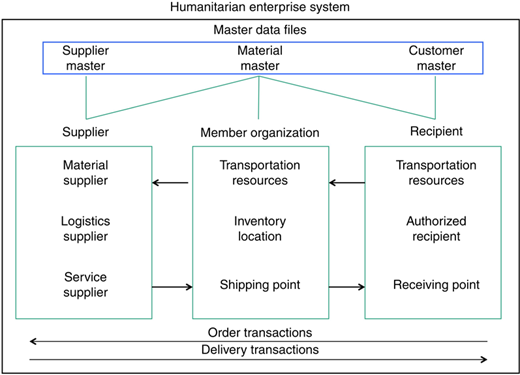
The main data structure includes master data, organizational data, and transaction data. The most important master data is the material master file, the supplier master file, and customer (recipient) master file. Suppliers and recipients can be external partners, or the same member organizations executing internal transfers. Each member organization has a stable structure that includes locations, resources, inventories and shipping points maintained in real time in the common database. System functionality allows the configuration of material orders and execution of deliveries.
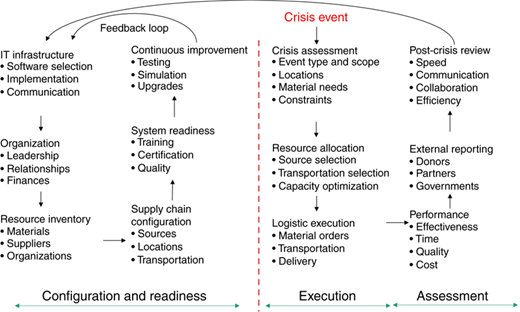
This model is designed to maintain a perpetual, integrated humanitarian logistics system capable of resource optimization, supply chain coordination, and rapid execution. Since the system will remain on stand-by until a humanitarian emergency takes place, it contains separate readiness and execution activity cycles, each one with its own continuous improvement loop (Figure 2). The configuration and readiness cycle is exercised constantly to assure that the system is functional at all times. Any performance gap detected in this cycle opens a continuous improvement project. A real humanitarian crisis triggers the execution cycle, which generates specific material orders to be executed immediately using existing resources, in the most efficient way. The crisis event generates data for post-crisis improvement and external reporting. The following sections describe the structure and functioning of the system, divided into configuration and readiness, execution, and assessment.
4.1 System configuration and readiness
In this phase, the hardware and software are installed, the supply chain is configured, people are trained, and the system becomes ready, in stand-by for a real emergency.
4.1.1 System organization and planning
Organizational aspects must be addressed before the implementation of the ERP system. This includes what organization takes leadership in the organization of the supply chain, its relationships with other organizations, and how finances are handled. An organization must lead and responsible for the operation of the system. This organization should have a central position in the humanitarian logistics community, and enough resources and relationships to be able to exercise leadership. The relationship between humanitarian organizations and the emergency system must be clearly defined during the implementation phase, and each organization is responsible of maintaining accurate data and availability, and must be ready to execute planned deliveries. Current coordination arrangements promoted by OCHA and IASC can be used as a basis for the system, which simply operationalizes such arrangements so they become effective, expedient, and efficient.
Financial relationships and arrangements should also be determined before the implementation. ERP systems have a wide variety of financial functionalities that can handle any arrangement that is desired. Financial capabilities include invoice verification, payment processing, and financial and cost reporting. The system also can have the ability to receive donations targeted to a humanitarian emergency, that are independent of organizations or specific uses of funds, reducing the competition among organizations. Donors should be aware of contributions to a coordinated response to disasters, and direct their philanthropy to organizations that have a high impact on the effectiveness of the response. Alternatively, donors can make donations directed not specifically to an organization, but to providing relief for a specific event. Such donations can be processed by the system through the appropriate accounts, and financial resources can be available immediately. When needed, financial payments to external suppliers or member organizations can also be processed through the payment processes available in the ERP.
4.1.2 IT infrastructure and security
Hardware and software infrastructures are considered in this stage, paying special attention to system security, an issue especially sensitive in a system that is critical to the survival of large numbers of people. The selection of enterprise software for EHL involves multiple variables and is subject for further research. Among the major choices to be made is the selection of commercially available software made for businesses or nonprofits, a project management-based ERP, or to develop customized software specifically for EHL. Commercially available ERP systems are very reliable; they run the largest and most complex organizations and are flexible enough to be configured to satisfy the specific needs of EHL. ERP software is also regularly maintained and upgraded by the software vendor and has many advanced features such as training materials, data security and advanced access control, scheduled maintenance and updates, logistics and supply chain capabilities, and advanced reporting. Since many ERP systems are designed to work in very large organizations, the EHL configuration is comparatively simple from the technical, organizational and master data perspectives. Success depends on correct implementation and configuration of the selected system. Implementation means the definition of the goals, processes, and master and organizational structures to be configured in the software. Master data includes materials, vendors, and recipients of humanitarian supplies. Organizational data includes a simple organizational structure for purchasing, distribution, warehouses and locations, as well as a regional structure and other classifications used in reporting.
When using ICTs in humanitarian supply chains, information security becomes an important concern. Since information is exchanged across organizations, it could be subject to unauthorized access by outsiders. The political implications of any humanitarian intervention, particularly those directly related to armed conflicts, make the humanitarian supply chain particularly vulnerable to malicious cyber attacks attempting to disrupt the operation. Humanitarian supply chains are not only vulnerable at the transaction level, but also at the planning and strategic level, so data security mechanisms should include all strategic inter-organizational communications. Inter-organizational policies protecting the confidentiality of supply chain information are key to maintain the trust and collaboration among supply chain partners. Technologies supporting supply chain information security include system access control, hardware and software firewalls, data encryption, multiple digital signatures, authentication, and secure communication protocols. These security tools are included by default in any commercial ERP. The presence of numerous volunteers and a wide variety of professional profiles in the humanitarian supply chain implies that many of them might be unfamiliar with the security aspects of information technologies, so it is important to establish training protocols for all persons with access to sensitive data, as well as regular computer security audits.
4.1.3 Resource inventory
The system must include a detailed inventory of the global resources available for emergency response. Resources can be divided into material resources and logistics/transportation capabilities. Adinolfi et al. (2005) reported that both UN agencies and NGOs have accurate information of their material stockpiles, but it is difficult to get up to date information from the very large number of organizations in a global response system, as well as the need for a functioning relief stock positioning system. This problem can be addressed with an ERP where inventories are officially kept up to date and physical inventory counts are performed periodically, following common practice in commercial logistics.
The integration of inventory data requires the use a common material codes for materials or groups of materials such as water, food kits, blankets, medical kits, tents and so on. Material information provides a global stock positioning system, and allows the use supply chain tactics such as pre-positioning by moving materials to the locations where they are most likely to be needed. In addition, the system can provide material lot traceability that can track the usability of materials and expiration dates of perishable foods and medicines. Materials can also be classified in multiple dimensions, for example, dangerous goods such as fuels or chemical or biological products might have special transportation requirements.
Providers of goods and services for humanitarian emergencies, whether public or private, must be included as suppliers in the system, and they can receive orders to deliver materials or provide transportation services. Electronic links with suppliers should make them able to receive orders electronically, so they can execute them immediately.
Participating organizations should have their transportation availability listed and updated in real time. Military transportation resources, as well as private transportation providers, are critical in this area. Currently, the IASC maintains a list of agencies providing “humanitarian common services” and there is a United Nations Joint Logistics Center to provide these common services. Accurate material and transportation data allows the configuration of delivery orders of verified materials with verified transportation resources in the most effective and efficient manner. While today “common services” includes both transportation and communication resources, the system proposed in this paper would provide a simple and effective communication network between all organizations involved.
4.1.4 Supply chain configuration
All sources of materials, warehouses, delivery locations and transportation resources are configured in the system, so they can be considered for the optimal configuration of deliveries. Locations of inventories, transportation resources and delivery points allow the system to calculate optimal routing. Transportation modes are available to cover a wide variety of environmental contingencies, consistent with the volatility inherent to a disaster scenario. While the structure of the system is similar to that of a commercial organization the supply chain configuration in the system is different, giving priority to execution, speed, and flexibility required by EHL.
4.1.5 System readiness
System readiness includes all activities that guarantee that a logistic response can be executed immediately after a humanitarian disaster takes place. System readiness requires the training and the certification that all people and systems involved are ready to respond. Readiness also means that actions are taken in advance so nothing unexpected can impede or delay the response to a humanitarian crisis. For example, international legal regulations, procedures and permits must be ready before disaster strikes.
All people involved in the operation of the information system must be trained professionals. An integrated humanitarian logistics system is quite complex and requires significant user training but one inherent benefit of an integrated system is that a very limited number of users operate the system, and they have to be highly qualified and reliable in a real emergency. Each provider of goods and services is responsible for order fulfillment. Training should lead to a formal certification, used with identity in security access. Employees of humanitarian organizations that are part of the system should be certified for their roles within the response plan. For example, a group of doctors without borders can be recipients of materials (customers) of the logistics system, and they must be identified as such and active in system procedures. Quality control functionality allows maintaining accurate data on the quality of materials and providers, and the implementation of quality tools and techniques as needed.
4.1.6 Testing and continuous improvement
In a commercial supply chain, the initial testing is performed once before system go-live, and the system is operational after that. In humanitarian relief, the default state is stand-by, and a special testing environment must be in constant operation to verify the constant readiness of the system. Testing protocols verify that all participants in the system and resources are operational. The humanitarian logistics system is in a constant improvement cycle, where failure modes are identified, and solutions are designed and implemented for each failure mode. Akin to military exercises, simulations of humanitarian disasters should be used to test whether the system actually meets its design objectives. A variety of target disaster scenarios are created to test the actual effectiveness of the system under realistic conditions. Periodic system upgrades should maintain software up to date technologically and in security, and reflect the improvements derived from testing and simulation exercises. System upgrade closes the continuous improvement cycle of the testing and simulation activity of the system while on standby.
4.2 Emergency response
When a real humanitarian emergency takes place, the system is used to coordinate an emergency logistic operation with optimal use of all resources available. This cycle starts with an assessment of needs as information becomes available after the event takes place, followed by allocation of material and transportation resources, and the logistic execution of detailed material orders.
4.2.1 Crisis needs assessment
The first information to arrive is always the location and type of disaster, which provides basic information as to the needs that it might generate and the disruptions that it might cause. The type and scope of the disaster allows an early estimation of shipment volumes and capacities needed. The general location of the event allows selection of inventory locations and modes of transportation. The ERP can generate advance notices, to warehouses and transportation providers, and verify material availability. Information on the location of the will become increasingly detailed as information arrives, and the ERP can configure and schedule optimal shipments using geographic information and the existing network of shipping locations.
Immediately after the disaster, the chaos and disruption of communications can make information slow to arrive, so an early assessment can be made with an estimation based on demographics and the type of disaster. Basic, standard emergency supplies such as water, shelter, rescue equipment, food, and basic medical supplies can be transported immediately based on projections, from the most convenient locations. This emergency assessment procedure is akin to aggregate planning in a commercial system. As material needs become more specific, additional material request can be entered in the system with varying levels of priority so the system can schedule and prioritize and expedite shipments. If materials are not available in stock, purchase orders can be issued to certified suppliers.
Disruptions in infrastructure, such as roads, airports, and delivery locations must be updated in the system, so no shipments will be scheduled using infrastructures that have inactive status. Constraints in transportation can generate additional material needs such as alternative modes of transportation such as inflatable boats, drones, or other vehicles.
4.2.2 Resource allocation and optimization
Optimization models used in humanitarian organizations focus on inventory, warehousing, transportation, and vehicle routings, subject to the constraints of vehicles, facilities, and infrastructures dictated by the situation (Caunhye et al., 2012). These optimization models are ordinarily used by businesses and readily available in commercial ERP packages.
Once the material needs have been determined, the ERP can maximize transportation asset utilization by selecting the most appropriate transportation modes, assigning carriers, and vehicles based on pre-configured locations, availabilities, and capacities. A holistic transportation optimization requires detailed configuration of transportation assets and capacities, so a feasible transportation schedule is generated for inbound and outbound logistics.
4.2.3 Logistic execution
The ERP system generates material and transportation orders that match requirements with available resources under current conditions. Material and transportation orders are immediate, complete and feasible, and contain all necessary information, shipping instructions, and documentation, which are automatically and immediately transferred to all parties involved. All transactions take place in digital format, removing papers from the hands of emergency workers, and providing only with the information they need, when they need it. Information can also be sent to users automatically through pre-configured mobile solutions as simple as web portals, automated faxes, e-mail or SMS messages to cellular phones.
While the materials are being transported, the ERP system provides end-to-end track-and-trace functionality for events such as picking, loading, departure, and arrival. Communication with transportation providers takes place through standardized message formats through standard e-commerce platforms. Such capabilities increase visibility and reduce uncertainty and confusion during the crisis as everybody knows the status of a shipment and when and where to expect delivery. Deliveries are made and confirmed to the target receiving party.
4.3 Performance assessment
A real humanitarian crisis event provides an opportunity to collect performance data, including effectiveness, time, quality, and cost. Performance data is used for evaluation, and internal and external reporting.
4.3.1 Performance measurement
The key measure of success in humanitarian response is whether the original goal of reduction of human death and suffering has been accomplished as intended. The total time to respond includes all the processes involved in the execution cycle, from the initial crisis assessment, allocation of resources, transportation, and delivery. The ERP system provides analytic tools to measure time performance of each process, and evaluation of transportation and materials providers based on their responsiveness and reliability. Reliable quality and cost information is also collected by the system, which provides analytical tools to guide continuous improvement processes.
4.3.2 External reporting
Humanitarian aid organizations have been subjected to increased transparency and accountability standards. Donors, and particularly large donors, require detailed information and figures about the activities of an organization and its effectiveness. They want to know specifically what help has been provided, to whom, the operational details of the interventions, the strategic approach, and impact and cost structure. For this reason, good information systems will provide the level of reporting, independence and transparency required by communication media and donors (Day et al., 2012). External reporting data are given to donors, partner organizations, governments, and media organizations. Information sharing with donors is critical because it provides donors with transparency and performance data, increasing donations. Partner organizations and governments also must have detailed information of the effectiveness of the system and the contributions of each organization.
4.3.3 Post-crisis continuous improvement
A real crisis event represents an opportunity to generate performance data and use it for control and continuous improvement. Specific metrics are designed to measure the degree of effectiveness of the system, including correct evaluation of needs, correct sourcing, material planning, transportation, and delivery statistics. Performance data are compared against target metrics. The evaluation phase is also designed to make sure that the integrated logistic system is being improved continuously. Real post-crisis analytics are critical for the improvement of speed, coordination, and efficiency of the humanitarian response.
5. Conclusions, limitations, and future research
5.1 Conclusions
The need for effective information systems in the coordination of emergency response is constantly highlighted in the humanitarian logistics literature, but there is a lack of detailed proposals as to what those information systems might look like. Although some information systems such as HLS, Helios, and Logistix have been developed in the past, they are mostly targeted to developmental humanitarian operations, and lack the agility, efficiency, and robustness required by humanitarian emergencies. Only an advanced, integrated ERP can provide timely, effective and optimal responses to emergencies under existing constraints. An ERP system contains the functionality to design and execute a logistic response to a disaster, in coordination with partner organizations, and provide analytical tool for reporting and continuous improvement. In this paper, the humanitarian supply chain is conceptualized as an enterprise, and the Systems Development Life Cycle model has been adapted to the requirements of EHL to develop a model for the use of ERP to provide a holistic emergency response making optimal use of all available resources. Beyond the functionalities of the system itself, this research argues that, not unlikely its business counterpart, the implementation process of the ERP system provides a vehicle for the design and organization of the supply chain using a single reference model. The implementation and configuration effort facilitates the operationalization of the system through software-embedded decision models for execution, testing, reporting, and improvement.
5.2 Limitations
The model developed in this study has the goal of improving EHL performance, first in effectiveness and speed, and then in efficiency to maximize the use of existing resources. It does not address specific organizational arrangements or financial flows or compensation across organizations. Humanitarian agencies should still get all the credit for their contribution to a holistic system. While this paper proposes a system that will facilitate inter-agency collaboration, membership, participation in activities and contributions to the relief effort are voluntary, and this paper does not address motivations of specific agencies or inter-agency politics that could impact an agency’s decision to participate in the system as a supplier. This study is focused on emergency situations, where the priority is providing an immediate logistical response, avoiding duplication of efforts, information inconsistencies, human errors, and bureaucratic delays. However, ERP technology can also be applicable to non-emergency logistics.
5.3 Future research
While this research only describes the problem of lack of coordination in EHL and proposes a general model, many questions remain unanswered and need to be addressed. Future research should focus on the organizational and technical details of a humanitarian ERP. These details include the selection and configuration of the software, enterprise modeling, project management, detailed functionality, procurement, routing, scheduling, inventory management, distribution, data structure, operation, control and improvement, as well as social and political perspectives. An additional line of future research would be the potential cross-functional integration of the humanitarian enterprise beyond emergency logistics. The problem addressed in this research is multi-disciplinary in nature, and requires research from multiple disciplines.

