


The purpose of this paper is to present a model for selecting specific assets to be used in relief and disaster response missions based on the capabilities of, and contributions to, the demanded need for humanitarian assistance and disaster relief. During past disasters, the US Navy (USN) has responded with whatever ships were in the area regardless of their contribution to the need. The authors use data from the USN that has been gathered in other studies as an illustration of how the model may be applied to allocate the most useful vessels at the lowest cost.
A simple optimization model is used that utilizes scored capabilities as well as the estimated costs associated with US Naval vessels that will allocate the most useful assets at the lowest economic cost.
The model selects the most effective assets while minimizing the estimated economic cost. The US Naval assets that contribute the most effective humanitarian assistance and disaster response capability at the lowest cost are amphibious ships, leased commercial vessels and ready reserve force cargo ships.
This research fills a critical gap in the literature as there is no research that takes into account national Navy capability and proposes a solution to find those assets that are most mission and cost effective. As the USN looks for ways to cut costs while meeting mission priorities it will be necessary to determine which ship classes and types contribute the most while saving cost. The model introduced in this research provides insight into where investments should be made to meet strategic goals.
1. Introduction
Many humanitarian organizations respond to disasters around the globe. We define humanitarian organizations as those organizations that provide humanitarian relief, whether military or non-military and whether government or non-government (NGO). The goal of organizations providing humanitarian assistance and disaster relief (HADR) is to reduce suffering and fatalities. Providing effective relief is dependent upon the speed of the response, matching the supply of resources with the demand need as it is assessed (Apte, 2014), and involving the right assistance and relief organizations at the right time and place based upon their functional capacities. When major disasters strike, NGOs, intergovernmental humanitarian organizations, governmental organizations, military institutions and many others move quickly to provide relief. The effectiveness of the assistance and relief that is provided is a function of whether there was any strategic forethought or planning (Apte and Yoho, 2015) as well as the capabilities and competencies of the organizations responding to the mission (Apte et al., 2016). Understanding resources that lead to unique capabilities of such diverse organizations facilitates the planning of humanitarian operations. A strategic plan based on this understanding by such an organization utilizing its resources to ensure efficiency while maintaining effective relief is our goal in this research.
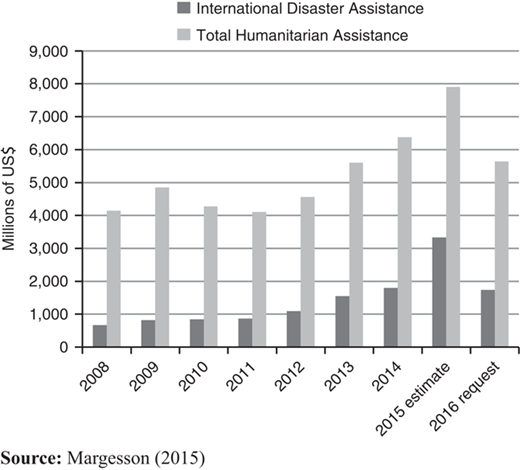
In this research, we study an organization that is prominent in providing disaster assistance and relief: the US Navy (USN). In the last decade, the USA has responded to many major disasters. Figure 1 shows the humanitarian assistance in millions of US dollars (US$) provided by the US since 2008 (Margesson, 2015). By its own account, the US Department of Defense responds to between 70 and 80 natural disasters around the globe every year and has developed specific policies on how to interoperate with other governmental relief and aid agencies as well as non-governmental relief and aid agencies (United States Department of Defense (USDoD), 2011, p. i). The US Department of Defense has six geographic combatant commands that are responsible for fighting the nation’s wars and responding to contingencies. The USN is a force provider in a supporting role to the geographic combatant commander who sets the priorities for their geographic region. US Southern Command (USSOUTHCOM), for example, has three main lines of effort as part of their theater strategy: building relationships, countering threat networks, and enabling rapid response for humanitarian assistance and foreign disaster relief (United States Southern Command (USSOUTHCOM), 2017). Because there is no other single organization on earth that can bring as much vertical (primarily in the form of helicopters) or amphibious lift into the littoral and operate continuously as the USN, the geographic combatant commanders regularly request forces from the Navy that are assigned to or that may be outside of, their geographic area to respond to a significant HADR event.
US forces have been diverted from original missions 366 times for humanitarian assistance as opposed to 22 times for combat from 1979 to 2000 (Figure 2).
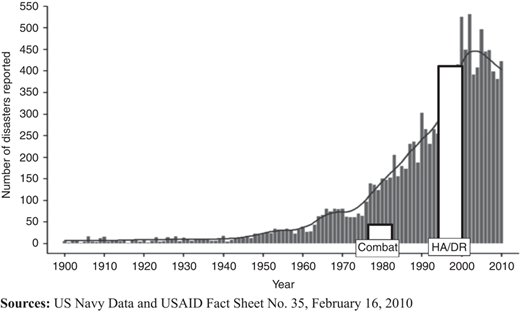
USN ships diverted for humanitarian operations during natural disasters reported 1900–2010
USN ships diverted for humanitarian operations during natural disasters reported 1900–2010
There has always been a need to perform HADR smartly and economically. The USN and US Marine Corps, in coordination with the US agency for International Development, are the principal organizations that provide HADR for the USA. In the year 2012, the USA provided about $3.7bn on humanitarian assistance, whereas EU, UK, Turkey and Sweden – the remaining top aid suppliers – provided a combined contribution across all four nations of $4.6 (Margesson, 2015). It will be even more important in the future, when budget reductions and uncertainty are likely to be the norm, to conduct HADR operations as economically efficiently as possible (Roughead et al., 2013). Therefore, given the substantial costs incurred (Figure 1), the important question is whether the USN utilizes its resources wisely. In other words, are the right ships deployed for HADR?
The vessels that the USN deployed for HADR in the 2004 Indian Ocean tsunami consisted of the entire carrier strike group 9, which included two fast attack submarines (SSN), one cruiser (CG), three destroyers (DDGs), one fast combat support ship (T-AOE) and nine aircraft squadrons. During the response efforts following Hurricane Katrina, the USN sent nine Minesweepers. In 2007, in order to help Bangladesh with the Category 5 cyclone, Sidr, the ship that was diverted to help was the USS Hopper (DDG 70) which is a destroyer that does not carry any embarked helicopters and has a draft that is not sufficient for getting in close to shore. Many of these vessels did not play a substantial role in the relief process because they lacked the necessary capabilities (Apte et al., 2013), yet they were tasked with these missions anyway simply because they were available. The experience off the coast of Bangladesh suggests that sometimes ships are diverted or deployed in a suboptimal way, perhaps due to decision making taking place in the context of inflexible time or process constraints (Apte et al., 2013). The USN has frequently supported HADR across the globe, however, the response tends to be reactionary resulting in the deployment or diversion of ships that had no or little capability of delivering the needed disaster relief. The Cooperative Strategy for 21st Century Seapower (United States Navy (USN), 2015) is the current maritime strategy of the USA that guides the USN and HADR is an important part of this strategy. In fact, the word “humanitarian” appears ten times in the 37-page document. For smart and economical HADR, the USN needs to strategize the future humanitarian operations based on the lessons learned from the past efforts. In this research, we offer a method that will support the USN in its planning to fulfill their HADR strategy. Our model is simple and sufficient for planning at the strategic and operational level. Further, our model is easily implemented in a spreadsheet which lends itself to application and use by military planners as well as tactical commanders charged with providing a response in a short period of time. The key contribution of our work is identifying those ships in the USN inventory that provide the most HADR capability at the lowest operational cost and no other work has done this.
Apte et al. (2013) investigated and identified the capabilities of USN vessels deployed to meet HADR mission requests. The authors studied different platforms of ship classes and analyzed their HADR-related characteristics to find the relative utility of each vessel type using ordinally scaled expert ratings. In this research, we draw upon Apte et al. (2013) to study every ship that was deployed to respond to four specific disasters. Apte et al. (2013) studied the 2004 Indian Ocean tsunami, the 2005 Hurricane Katrina and the 2010 Haiti earthquake and Kaczur et al. (2012) analyzed the scope of the USN response and costs incurred during the 2011 earthquake and tsunami in Japan. Table I describes the USN response to the four disasters considered in our study.
Response from USN to four disasters
| Disaster | Number of vessels deployed | Number of days of assistance provided |
|---|---|---|
| 2004 Indian Ocean Tsunami | 29 | 81 |
| 2005 Hurricane Katrina | 34 | 42 |
| 2010 Haiti Earthquake | 31 | 72 |
| 2011 Japan Earthquake/Tsunami | 48 | 32 |
Sources: Greenfield and Ingram (2011) and Kaczur et al. (2012)
Table II shows the categories of the ships and their capabilities in reference to humanitarian assistance. Table III shows the categories of the ships sent for disaster relief to the four disasters referenced in Table I. Throughout the rest of the paper, we will refer to the ship types in Table II as they have been deployed or diverted to HADR events in the past.
Categories of the ships and their humanitarian assistance capabilities
| Hull classification or mission code | Platform type | Humanitarian assistance capabilities |
|---|---|---|
| CVN | Nuclear carrier | Aircraft support, search and rescue, personnel transfer, personnel support, medical support, berthing capability, medical support, fast transit speed, dry goods storage, refrigerated goods storage, fresh water production and fuel storage |
| LHA/LHD | Amphibious Assault (AMPHIB) | Aircraft support, landing craft support, search and rescue, dry goods storage, fresh water storage, fuel storage, personnel transfer, fresh water production, personnel support, berthing capability and medical support |
| CG/DDG | Cruiser or destroyer (CRUDES) | Fast transit speed, aircraft support (not all have embarked helicopters), search and rescue and personnel support |
| LPD/LSD | Landing Platform Dock Sealift (PM-3) | Aircraft support, landing craft support, search and rescue, dry goods storage, fresh water storage, fuel storage, roll-on/roll-off, personnel transfer and berthing capability |
| LCS | Littoral combat ship (LCS) | Fast transit speed, embarked helicopters, search and rescue, personnel transfer |
| PM-1 | Fleet oiler | Fueling support, aircraft support, dry goods storage, refrigerated goods storage and fresh water storage |
| PM-2 | Special mission – submarine and special warfare support | Salvage operations and personnel support |
| PM-3 | Prepositioning | Aircraft support, dry goods storage, refrigerated goods storage, fresh water storage, roll-on/roll-off, fuel storage, berthing capability and distribution of cargo pier-side |
| PM-4 | Service support – hospital ship | Medical support, berthing capability, dry goods storage, refrigerated goods storage, aircraft support and fresh water storage |
| PM-5 | Sealift | Roll-on/roll-off, dry goods storage, refrigerated goods storage, fresh water storage, fuel storage and distribution of cargo pier-side |
| PM-8 | Expeditionary fast transport (EPF) or high-speed vessel (HSV) | Fast transit speed, personnel transfer, dry goods storage and roll-on/roll-off |
Categories of the ships in USN responses to four HADR events
| Hull classification or mission code | Platform type | 2004 Indian Ocean Tsunami | 2005 Hurricane Katrina | 2010 Haiti Earthquake | 2011 Japan Earthquake/Tsunami |
|---|---|---|---|---|---|
| CVN | Nuclear Carrier | 1 | 2 | 1 | 0 |
| LHA/LHD | Amphibious | 2 | 2 | 3 | 6 |
| CG/DDG | CRUDES | 6 | 0 | 4 | 11 |
| LPD/LSD | Landing Platform Dock | 3 | 3 | 5 | 15 |
| MCM/MHC | Minesweeper | 0 | 9 | 0 | 0 |
| SSN | Submarine | 2 | 0 | 0 | 0 |
| PM-3 | TAK, TAK-E, LMSR | 14 | 17 | 17 | 15 |
| PM-4 | T-AH | 1 | 1 | 1 | 0 |
| PM-8 | EFP, HSV | 1 |
Sources: Greenfield and Ingram (2011) and Kaczur et al. (2012)
In this research, we develop a mathematical model with certain parameters to explore which resources will achieve this goal. In other words, to optimize the deployment of USN assets for HADR operations based upon the capability rating system used in Apte et al. (2013). Our objective is to suggest an optimal mix of ships that should be sent for HADR based on available supply, demand and capabilities. This model may be used to adopt a profile for a HADR flotilla as well as guide future force structure decisions for the USN and other navies.
Our contribution in this research is two-fold. First, we use the analysis from our computational experiments to support informed decision making at the operational level regarding which ships are most appropriate for supporting HADR missions based upon their capability and cost to operate. Second, our analysis of costs and capabilities of the ships provide necessary data for the USN to develop a strategic plan for flotilla composition to respond to HADR, thus moving from a reactionary to strategic posture that deliberately plans, trains and exercises for this mission. Both of these are necessary given the maritime services should always be “‘where it matters, when it matters’ – especially when it comes to HADR, offering resources, care, and compassion to alleviate human suffering” (Navy League of the United States, 2017, p. 5). The Cooperative Strategy for 21st Century Seapower states that “this maritime strategy reaffirms two foundational principles. First, U.S. forward naval presence is essential to accomplishing the following naval missions derived from national guidance: defend the homeland, deter conflict, respond to crises, defeat aggression, protect the maritime commons, strengthen partnerships, and provide humanitarian assistance and disaster response” (USN, 2015, p. 2). Through our analysis of the capabilities of the primary naval resources, the vessels and what they would cost the USN, we describe how HADR can be made both effective and efficient. Though our model is a simple one it is adequate for the task at hand. As was aptly pointed out by George Box, “[S]ince all models are wrong the scientist cannot obtain a ‘correct’ one by excessive elaboration. On the contrary following William of Occam he should seek an economical description of natural phenomena. Just as the ability to devise simple but evocative models is the signature of the great scientist so overelaboration and overparameterization is often the mark of mediocrity” (Box, 1976, p. 792).
2. Literature review
The research within the humanitarian assistance and disaster response domain has relied on many different methods to solve a multitude of problems addressing preparation, response, and recovery. Altay and Green (2006) review the operations research (OR) and management science (MS) methods used in the various stages of disaster operations management and find that the problems within the domain are often difficult to structure for optimal outcomes because of competing, multiple objectives. One of the earlier works to use optimization as a methodology is that by Brown and Vassiliou (1993) who develop a real-time decision support system to assign units to tasks and tactical allocation of units to task assignments to support operations using optimization, simulation, and expert judgement. The novelty of their model is in its level of detail, iterative approach, and ability to take in expert judgements in real-time as an input when more information becomes available or as insights from initial model runs are revealed.
Galindo and Batta (2013) continue the review of OR and MS methods in disaster operations by Altay and Green (2006) and find that mixed methods combining statistical estimation, simulation, and optimization comprise approximately 11 percent of the studies in the research domain. However, none of the studies reviewed by Galindo and Batta (2013) addresses optimizing the allocation of resource capabilities in response to a disaster. Galindo and Batta (2013) find that the research in the disaster operations management domain has remained the same in many respects. There remains a paucity of work that addresses recovery operations, for example. The notable change in the OR and MS literature identified by Galindo and Batta (2013) since the review by Altay and Green (2006) has been that there is a growing body of work that is applied in nature, and that takes existing methods and applies them to new problems using them in novel ways; what Corbett and van Wassenhove (1993) refer to this as management engineering.
Leiras et al. (2014) reviewed 228 papers that were published on the topic of humanitarian logistics. This is a far-reaching review of the literature in this field. The authors claim that the literature has focused on strategic decisions made in the humanitarian logistics. They recommend that future research fulfill the need for tactical and operational decisions in the area. Caunhye et al. (2012) reviewed 74 papers about optimization models in emergency logistics but not focused on resource utilization.
Gutjahr and Nolz (2016) review the literature on multicriteria optimization in humanitarian aid and find that most papers of this type have a cost minimizing objective function along with one or several other objectives such as response time, travel distance and coverage. Lassiter et al. (2015) develop an optimization to dynamically allocate volunteers with different capabilities to meet unmet demand as well as maximize volunteer preference for types of work. This work is perhaps the closest to our own in that it allocates specific capabilities to specific demands. However, our work differs in that we are seeking a cost minimizing capability and do not consider the preferences of the source of capabilities.
One model that comes close to our analytical process is capability-based resource allocation for effective disaster response (Altay, 2013). The model is a special case and modification of the generalized resource allocation problem (Winston, 1995). Altay (2013) illustrates the model using three supply locations and two disaster response locations. Our model is a simplification of this model due to the fact that it is focused on one organization that supplies the hard assets with certain capabilities for a specific disaster in an attempt to be efficient and effective.
Humanitarian logistics is a complex field and its scope is large. There is a need to understand the operational efficiency due to long term sustainable efforts in HADR (Holguín-Verasa et al., 2012). We focus on resource utilization which is a major concern in this field for achieving efficiency and efficacy. It is a known fact for the researchers in the field of HADR that data are hard to come by. Holguín-Verasa et al. (2012) state that there are many reasons why it is difficult to obtain realistic data to input in a model. The number of practicing individuals in the humanitarian logistics is small. Very few public accounts of the past disaster relief efforts are readily available and if they are, not in detail. This poses a major hindrance for developing analytical models that are applicable to realistic situations.
The demand data are another one of the major challenges faced by many researchers in this area. The effectiveness of relief provided depends not only on the actual goods delivered or services rendered but also on the demand estimation (Apte, 2014; Celik et al., 2012). Under- or over-estimate of needs assessment can push the suppliers to depend on surge a very expensive strategy (United Nations, 2007; Duran et al., 2011; Yoho and Apte, 2014; World Meteorological Organization (WMO), 2009). Forecasting the demand is a difficult task but estimating where and when is even harder (McCoy, 2008; Apte, 2009; Apte et al., 2013).
The principle contribution of our current research in the HADR optimization literature is in the management engineering space whereby we apply a known methodology to a new problem in a relatively new domain. In our work, we use an optimization method to allocate resource-constrained capabilities (ship characteristics and capabilities) to a disaster response with specific needs, requirements or demands for aid and relief. Our research is different from other optimization work in the HADR domain in that the cost minimizing objective function serves to prevent the employment of naval vessels that provide capabilities that are no demanded or that provide the capabilities at a cost that is greater than an alternative ship that could satisfy the demanded capabilities.
3. The problem
Our problem posits a potential disaster in a littoral environment. The problem for the discussed scenario uses the characteristics of previous disasters such as the 2004 Indian Ocean tsunami, 2005 Hurricane Katrina, 2010 Haiti earthquake and 2011 Japan earthquake and tsunami as well as the corresponding responses provided by the USN. Based on the extent of destruction and casualties, the affected host country (AHC) has requested HADR from the USA. While the US State Department is ultimately responsible for the USA’ response to such requests, they do not have the means to conduct HADR operations and the costs of doing so are substantial (Apte and Yoho, 2017). Holguín-Verasa et al. (2012) point out the difficulties in obtaining the real data for developing and executing analytical models. The costs used in this research for the third computational experiment are derived from the USN’s Visibility and Management of Operating and Support Cost (VAMOSC) as reported by Moffat (2014), the budget and funding model used by the US State Department (Ures, 2011; Herbert et al., 2012), actual and estimated costs from Yoho et al. (2013), and actual costs obtained from the Government Accountability Office (GAO) (2014).
The scenario in this research is a notional scenario, however the demands are based upon demands experienced during actual HADR events as stated. The demands are a combination of all the four disasters. Knowing exact demands of any disaster is one of the most complex and difficult issue in humanitarian logistics. Even after the fact analysis based on lessons learned does not offer adequate understanding of the demands. Therefore, we estimate the demands based on previous disaster data about relief efforts. In our scenario, the USN is preparing to deploy and/or divert certain vessels to the AHC. Grounded in the available analysis of the capabilities of the fleets (Apte et al., 2013), we develop the optimization model to decide what optimal mix of ships should be deployed to respond to this disaster considering only those ship types that were used in the four disasters described in Table I.
In our disaster scenario, the AHC has suffered devastation due to high winds, torrential rains and flood. There are many casualties and many more are injured, displaced or missing. Due to landslides, buildings, such as hospitals, some administrative buildings, and telecommunication towers, are down. Certain roads are not traversable and bridges have collapsed. There is no potable water available. There is the fear of outbreak of diseases like cholera and malaria.
The representative list of relief requirements consists of medical support and supplies, humanitarian supplies, such as water or water purification facilities, search and rescue teams, temporary shelters, salvage operations and engineering support for infrastructure. The demand for relief must be matched with the supply of existing capabilities of ships available to fulfill them. The relief requirement of medical support can be met by the capability of medical support or berthing or both. Delivery of medical supplies during a HADR event typically needs aircraft support and so does the delivery of food and water. Therefore, the demand for aircraft support is high. Since nuclear carriers, amphibious ships, cruisers and destroyers (CRUDES), LCSs, LPDs, LSDs, PM-1, PM-5 and expeditionary fast transport (EPF) ships all have aircraft support capability any combination or a single one of them can satisfy that requirement of transportation for a limited number of aircraft. Dependencies between requirements may exist but we are more focused on the capabilities that can satisfy the requirements. The question we attempt to answer using our model is whether the demand in aggregate can be met by the aggregate supply of capabilities of the ships and, for this purpose, which ships should be deployed based upon their capabilities and costs.
The model
Based on the disaster described above, Table IV describes a plausible set of relief requirements that constitute levels of demand in dimensionless quantities for capabilities in the AHC. The substantial data from past disasters suggest that aircraft support for medical and humanitarian supplies is the most demanded capability (Ures, 2011; Moffat, 2014) and we, therefore, assume the level of demand for this capability to be the largest.
Demands for the baseline model
| Deamnd | Level | Deamnd | Level |
|---|---|---|---|
| Aircraft support | 10 | Fuel | 4 |
| Landing Craft support | 5 | Personnel transfer | 2 |
| Search and rescue | 1 | Fresh water production | 1 |
| Dry goods | 7 | Personnel support | 4 |
| Refrigerated goods | 2 | Berthing capability | 2 |
| Fresh water | 2 | Medical support | 2 |
| Roll-On/Roll-Off | 4 | Salvage Ops | 2 |
Table V reports the level of specific capabilities of each ship based upon its capability score described in Apte et al. (2013). Each capability is given a score of 0, 1 or 2. For a specific capability, a value of 2 means that the ship is capable, a value of 1 means the ship is somewhat capable, and a value of 0 (or an empty cell) means the ship is not capable of delivering that specific capability.
Ship platforms and capabilities codes
| Ship platforms | ||||||||||
|---|---|---|---|---|---|---|---|---|---|---|
| Capability | Nuclear carrier | AMPHIB | CRUDES | LCS | Landing dock ship | PM-1 | PM-2 | PM-3 | PM-5 | PM-8 |
| Aircraft support | 2 | 2 | 1 | 1 | 1 | 1 | 0 | 0 | 1 | 1 |
| Landing craft support | 0 | 2 | 0 | 0 | 0 | 0 | 0 | 0 | 0 | 0 |
| Search and rescue | 2 | 2 | 1 | 1 | 0 | 0 | 0 | 0 | 0 | 0 |
| Dry goods storage | 1 | 1 | 0 | 0 | 2 | 1 | 0 | 2 | 2 | 1 |
| Refrigerated goods storage | 1 | 0 | 0 | 0 | 2 | 1 | 0 | 2 | 2 | 0 |
| Fresh water storage | 1 | 1 | 0 | 0 | 2 | 1 | 0 | 2 | 2 | 0 |
| Roll-on/Roll-off | 0 | 0 | 0 | 0 | 1 | 0 | 0 | 2 | 1 | 1 |
| Fuel storage | 1 | 1 | 0 | 0 | 2 | 2 | 0 | 2 | 2 | 0 |
| Personnel transfer | 2 | 2 | 1 | 1 | 1 | 0 | 0 | 0 | 0 | 2 |
| Fresh water production | 1 | 1 | 0 | 0 | 0 | 0 | 0 | 0 | 0 | 0 |
| Personnel support | 2 | 2 | 1 | 0 | 0 | 0 | 1 | 0 | 0 | 0 |
| Berthing capability | 2 | 2 | 0 | 0 | 1 | 0 | 0 | 0 | 0 | 0 |
| Medical support | 2 | 1 | 0 | 0 | 0 | 0 | 0 | 0 | 0 | 0 |
| Salvage operations | 0 | 0 | 0 | 0 | 0 | 0 | 1 | 0 | 0 | 0 |
For the optimization model, we use the following notation:
I=set of resources (ships), for i∈I; J=set of capabilities, for j∈J;
Dj= demand for capability, for j∈J;
{ηij}I×J= capability of ship i∈I for capability j∈J;
bi=daily operating cost of ship i∈I; and
Decision variable: Yi=number of ships i∈I.
The optimization model
The objective function (1) minimizes the cost of a ship i∈I summed over all ships, thus yielding the total cost. Constraints (2) ensure that demand for capability is met by the flotilla of the ships that are deployed and/or diverted to the AHC. Constraints (3) guarantee that fractional ships are not deployed or diverted.
4. The results
We conducted three computational experiments for this model. The objective of the first experiment was to explore which ships should be on the optimal HADR flotilla based on a single attribute of capability irrespective of the cost as mentioned before. Therefore, the costs were held equal. The second computational experiment ranks the ships by their cost using interval cost factors that were developed during interviews with subject matter experts (SMEs) that had served aboard the various ship types and were familiar with the relative difference in their costs. The third computational experiment uses ship costs obtained from the Navy VAMOSC system as well as data gathered from the GAO (2014) and Yoho et al. (2013) that report actual or estimated costs data.
Computational experiment 1
We solved the optimization model using Microsoft Excel Solver. Results of the baseline model using plausible yet notional demand data based on previously collected information for the 2004 Indian Ocean tsunami, the 2005 Hurricane Katrina, the 2010 Haiti earthquake (Greenfield and Ingram, 2011; Ures, 2011), and the 2011 Tohoku earthquake in Japan (Kaczur et al., 2012; Herbert et al., 2012) are given in Table VI.
Results from computational experiment 1
| Ship platforms | Number of ships |
|---|---|
| Nuclear carriers | 2 |
| AMPHIBs (LHA, LHD) | 0 |
| CRUDES | 0 |
| LCS | 0 |
| Landing Dock Ship (LPD, LSD) | 4 |
| PM-1 | 0 |
| PM-2 | 1 |
| PM-3 | 0 |
| PM-5 | 0 |
| PM-8 | 0 |
| Total ships | 7 |
A total of seven ships were selected consisting of two nuclear carriers, four landing dock ships (LPD or LSD), and one PM-2 special mission ship. The baseline model offered one perspective, namely, which ships will be used if all costs were the same by focusing on capabilities alone as opposed to the cost associated with each specific capability.
Computational experiment 2
Not all ships cost the same when deployed or diverted. The costs depend on many factors, such as a ships’ size and, among other things, whether they are built to commercial standards. In order to determine the impact of different ship costs on the baseline model, we conducted a second computational experiment that incorporates a relative ranking of the cost of the ship itself. The ships were all ranked on an interval scale from 1 to 10 points with 1 point being a relatively inexpensive cost and 10 points being 10 times more expensive than 1 point. The cost rankings for the ships were determined by SMEs who were current or retired USN officers. Some of the SMEs had extensive experience in shipbuilding and an awareness of were knowledgeable of the operating costs.
The SMEs ranked the cost of the ships as follows: nuclear carriers (10), amphibious ships (9), CRUDES (8), LCS (7), LPDs, LSDs, PM-1, PM-3 and PM-5 (5), PM-2 (1) and PM-8 (2). This means that an aircraft carrier’s cost is ten times that of a landing craft and is 1 point more “expensive” than an amphibious ship. Assuming that all ships are ready to be deployed and are traveling from the same point A to the same point B, and maintaining the same demands, we ran the model with the different point rankings. Based upon these point rankings, the model selected a total of ten ships to respond to our disaster scenario for a total cost of 35 points (see Table VII).
Results of computational experiment 2
| Ship platforms | Number of ships |
|---|---|
| Nuclear carriers | 0 |
| AMPHIBs (LHA, LHD) | 2 |
| CRUDES | 0 |
| LCS | 0 |
| Landing dock ship (LPD, LSD) | 1 |
| PM-1 | 0 |
| PM-2 | 2 |
| PM-3 | 0 |
| PM-5 | 0 |
| PM-8 | 5 |
| Total ships | 10 |
In this experiment, the nuclear carriers were not chosen because of their relative expense to other ships with similar capabilities. Instead, two amphibious ships (AMPHIBs), one landing dock ship (LPD or LSD), two PM-2 special mission ships and five PM-8 EPFs were selected.
Computational experiment 3
For the third computational experiment, we used operating costs for the ships obtained from the USN’s VAMOSC as reported by Moffat (2014), actual costs from Yoho et al. (2013) and actual costs obtained from the Government Accountability Office (GAO) (2014). For each ship type, we used a specific ship’s daily operating cost to represent the daily operating cost for that ship’s class. There is some variation of ship daily operating costs by ship within ship class but they are not so different that they would impact the model. The daily operating costs for the ships by ship type are given in Table VIII.
Ship costs used in computational experiment 3
| Ship type | Ship code | Ship name | Daily operating cost |
|---|---|---|---|
| Nuclear Carriers | CVN | USS Washington | $1,240,141 |
| AMPHIB | LHA, LHD | USS Essex | $427,440 |
| CRUDES | DDG IIA | USS McCamble | $184,833 |
| LCS | LCS | USS Freedom | $216,438 |
| Landng Dock Ship | LPD, LSD | USS Tortuga | $144,902 |
| PM-1 | TAO | USS Rappahannock | $105,408 |
| PM-2 | MV | MV C-Commando | $27,827 |
| PM-3 | TAK-E | USNS Perry | $127,486 |
| PM-5 | TAK-E | USNS Byrd | $140,686 |
| PM-8 | EPF, HSV | Westpac Express | $62,329 |
The results of computational experiment 3 reported in Table IX. The relative point rankings of ships costs by the SMEs used in computational experiment 2 were close to the relative actual cost differences in computational experiment 3, thus, yielding identical solutions.
5. Discussion
The developed optimization model was run for a notional scenario grounded in actual disaster events to which the USN responded. The first computational experiment results show that the optimal mix of vessels included nuclear carriers, landing dock ships (LPDs, LSDs), special mission ships (PM-2), and EPF (PM-8) ships. The critical capabilities of these platforms together provide the necessary relief to satisfy the demands of our notional scenario based upon previous disasters. The second computational experiment incorporated relative costs represented by points assigned to each vessel by SMEs. The optimal solution in computational experiment 2 selected two amphibious ships (LHAs, LHDs), a landing dock ship (LPD, LSD), two special mission ships (PM-2) and five EPF ships. The incorporation of the costs resulted in nuclear carriers being dropped from the optimal solution and the less expensive amphibious ships and EPF ships replacing them. The third computational experiment incorporated actual daily operational costs and resulted in the same selection of ships as computational experiment 2.
Based upon our three computational experiments, the ships that contribute most to HADR demands are amphibious ships, landing dock ships, special mission ships and EPF ships. The unique and critical capabilities of the amphibious ships in providing aircraft and landing craft support, search and rescue operations, berthing facilities, medical capability and transfer of personnel make them indispensable for HADR. The landing dock ships provide the greatest landing craft support and have aircraft support as well as berthing capability to house personnel. The special mission (PM-2) ships offer personnel support for planning and conducting operations at a low cost with the added benefit of being able to conduct salvage and towing operations, and launch and recover smaller craft. Finally, the fast expeditionary transport ships are some of the newest vessels in the fleet and provide roll-on/roll-off capability as well as aircraft support and personnel transfer in a platform that is fast and at a lower cost than other ships. The fast expeditionary transport ships are some of the newest ships in the fleet and there are several new concepts being developed for them that include use as an expeditionary medical vessel, a counter-piracy and counter-narcotics platform, a railgun platform and use as an amphibious assault platform. As the Navy explores more uses for this fast, flexible and relatively inexpensive vessel, it may be a good candidate for conducting HADR operations as well. What is also important to note is that the ships that did not show up at all in the optimal solutions were cruisers and destroyers (CRUDES) littoral combat ships (LCS), prepositioning ships, and sealift ships. When costs were added the nuclear carriers dropped out of the optimal solution as the cost for the capabilities provided far exceed those that could be provided by a larger number of less expensive ships. We summarize the results from all the computational experiments in Table X.
6. Conclusion
The overarching goal of this research was more strategic than operational. Our contribution from this research is to put forth the idea of utilizing resources effectively with efficiency and verifying such decisions analytically. The point we make in this research is that reactionary deployment of ships is costly and may turn out to be ineffective. We show that deployment based on capability and cost of the corresponding ship, even if it is reactionary at some level, is better than a kneejerk reaction of deploying or diverting ships with not much consideration for the capabilities. No one expects the USN to pre-position the ships in anticipation of a disaster. However, for certain natural disasters, it is possible to anticipate deployment or diversion based on capability and cost. In this research, we develop a model that may be used to determine those ships that will deliver the greatest HADR capability at the lowest cost. The objective of the first computational experiment was to explore which ships should be on the optimal HADR flotilla based on a single attribute of capability irrespective of the cost as mentioned before. Therefore, the costs were held equal. The second computational experiment rectified that by ranking the costs of the ships. The third computational experiment involved using the estimated operating costs of the ships.
We developed a model for selecting ship capabilities to respond to a HADR event-based upon the demands arising from a notional disaster. Our motivation was to understand the resources that contribute to the capabilities and the utilization of these resources by one such organization, the USN. For this purpose, we developed an optimization model to find out which USN platforms are critical and hence most effective for delivering support during a disaster event. Our conclusions were that amphibious, PM-2 and RRF ships are the most capable ships to support humanitarian operations. On the other hand, nuclear carriers, crudes and LCS ships are less desirable based upon their relative costs and capabilities. Such information is critical for the decision makers to have in setting the maritime strategy for HADR.
Given that the focus of this first project was to examine the cost and capabilities of the resources for effective utilization we did not want to extend the model further in this article. This research was done to help decision makers in making strategic decisions. These may not be operational for many reasons such as the most capable ship may not be close enough to the affected host county. It may not be available to be deployed due to other commitments or lack of organic staff. However, we are currently engaged in the exploration of adding two more attributes of availability and proximity. We believe this second research project has its own strength and focus due to detailed data collection and different methodologies and hence will be addressed in another article.
Understanding resources that lead to unique capabilities of diverse organizations facilitates the planning of humanitarian operations. A strategic plan based on this understanding by such organization utilizing the resources to optimize the efficacy while maintaining the effective relief is our goal in this research. We started this process by studying one such organization USN. Given that there were 29 foreign militaries present in the Philippines during assistance and relief for Typhoon Haiyan in 2013 such models can be adapted by these departments for their own resources (CFE (Center for Excellence) report, 2015). Thus, a model like this would be useful to the USN, as well as other nations that utilize their naval assets to respond to disasters, for answering the question of when, how many, and which ships should be diverted as part of the larger policy question of how to best use all resources to respond to a HADR event. The model can be extended using the right parameters and, thus, generalized to other services in USDoD and militaries of other nations to utilize their resources with efficacy and efficiency. Our optimization model can also be adapted to fit the resources and corresponding parameters of NGOs such as WFP with the fleet of airplanes as their primary resources or red cross utilizing the resources for providing immediate aid through health volunteers or hot meals, snacks and water in affected areas through their logistical assets.

