This article explores the intendants, the pre-modern French bureau- crats, as proto-modern bureaucrats. Historical research highlights their role in strengthening the state’s fiscal capacity, but few works provide empirical evidence on the intendants as bureaucrats. My paper fills this gap by constructing a new data set of 430 inten- dants from 1640 to 1789, the period in which these officials were systematically assigned. I use this data set to explore personnel recruitment and appointment in comparison to venal officeholding. My findings indicate that only less than a half of the recruits went through the legally-specified training path, and a wide variabil- ity in appointment duration suggests that the state did not run it mechanically. Strong familial and marital ties in appointment also threaten impersonality. My analysis highlights the process of political development for investigation as fiscal capacity hinges on how states manage staff who administer revenue collection.
Introduction
In the study of political development, fiscal capacity plays a crucial role in understanding the centralization of state authority. For it proxies the state’s ability to force taxpayers to do what they do not like—to give up portions of their assets. Extant scholarship offers influential hypotheses that drive fiscal capacity, including interstate war (Downing, 1992; Ertman, 1997; Tilly, 1992), rulers who prize survival (Besley and Persson, 2009, 2010; Levi, 1988; Olson, 1993) or glory (Hoffman, 2015), the dynamics between state and society (Gorski, 2003; Migdal, 1988; Spruyt, 1994), and elite competition whose timing and key actors shape the state’s ability to tax (Beramendi et al., 2019; Garfias, 2018; Mares and Queralt, 2015; Vogler, 2020; Wang, 2019).1 The growth of fiscal capacity goes hand in hand with other dimensions of state capacity that can collectively be termed as “legal” capacity (Besley and Persson, 2009).2
How the shift from a patrimonial form of state organizations to a modern one affects fiscal capacity has not been widely investigated. Few doubt that the capacity to generate revenue effectively requires a bureaucracy or a “ratio- nal” organization whose administration is characterized by well-defined rules, decision-making and policy implementation based on formal procedures, and performance evaluations based on meritocracy. The literature suggests that the transition is essentially a function of the demand for such an organization. Drawing on the comparison between England and France in medieval times, Strayer (1970, pp. 70–1), for instance, points to the chronic under-collection of revenue in the mid-fourteenth century as a driver for a more efficient organi- zation. Strayer suggests that the timing of a departure from patrimonialism could depend on the underlying fiscal capacity itself—more specifically the type and the rate of taxes. Weber (1978) also provides detailed illustrations of partimonialism and bureaucracy, how rulers legitimate each, and how officials run each. Yet these yield few testable hypotheses about how the transition occurs.
In this paper I study intendancy, the early-modern French bureaucracy, as a case of the transition from patrimonialism to bureaucracy. More specifically, I investigate its recruitment and appointment. These are two crucial dimensions to understand the development of fiscal capacity, because the state with a “strong” fiscal capacity should be able to recruit and manage personnel who undertake the tasks of revenue generation. In European history, France is an appropriate case, not only because it was a precocious state-builder among the European powers that enjoyed a large swath of territory (Fukuyama, 2011, p. 336; Strayer, 1970, p. 49) but also because it faced constant struggles to raise taxes in ways similar to its neighbors. France was typical in the sense that its territorial authority was fragmented and this “composite” authority structure raised the cost of collecting the taxes and had to rely on indirect means to do so (Dincecco, 2009, 2015).3 For France, the problem was particularly severe because of its land size (Johnson and Koyama, 2014) as demonstrated by a series of bankruptcies that occurred prior to the Revolution, including those in 1557–1558, 1602, 1634, 1648, and 1721 (Collins, 2009, p. 60). Intendancy bears particular importance in this context as one of the first bureaucratization efforts in pre-modern Europe (Kettering, 1986, p. 225). It exhibits characteristics, at least in design, associated with modern bureaucracy, such as office-holding based on temporary appointments, merit-based promotion, and career-building within government. As I describe in more detail later, intendancy began to play a greater role in the French state’s effort to centralize its authority from the 1640s, under the leadership of chief ministers such as Cardinal Richelieu, Cardinal Mazarin, and Jean-Baptiste Colbert. The expansion of the office was of historical significance in that it was intended to make a bridge between the central government seeking to consolidate authority at the expense of regional autonomy and the local strongmen vowing to protect their own vested interests. Thus, how pre-modern France ran this proto-modern bureaucracy advances the understanding of the fiscal capacity.
My analysis compares intendancy as an emerging bureaucracy to lower-ranking venal offices, particularly the maîtres des requêtes (masters of requests) in the central government. This comparison is motivated on both theoretical and empirical grounds. Recruitment and appointment in bureaucracy are distinct from those in patrimonialism, includes venal officeholding, in terms of personnel training and management. As the extant scholarship provides little, if any, systematic account of intendancy as bureaucratic development, I broadly explore the degree to which intendancy departs from venal offices. I use the maîtres des requêtes as my main reference category, because the literature indicates that most intendants are drawn from it. I focus on recruitment and appointment in my analysis. On recruitment, I highlight three dimensions: First, how maîtres as prospective intendants would be trained in the central government. Second, how their evaluators use this process to assess the candidates’ aptitude as the king’s representatives. Third, a certain age band among these candidates as a proxy for maturity. On appointment, I examine two dimensions: the duration and the degree of impersonality, i.e., how much familial ties matter.
My empirical analysis documents evidence drawn on a new data set I construct in two ways: First, broad trends on the extent to which intendancy was employed by presenting chronological and geographical variations as well as the distribution of assignments by destination. Second, tests on recruitment and appointment. As this paper is the first to provide quantitative evidence drawing on nearly universal observations, I rely primarily on empirical regularities and variation to guide my analysis. In my tests on recruitment and appointment, I document a series of descriptive evidence to assess the bureaucratization of intendancy in comparison to the office of the maîtres des requêtes.
My main finding is that intendancy is at best judged as an incipient bureau- cracy in terms of recruitment and appointment as it still possesses patrimonial attributes. On recruitment, a slightly less than half of the observations hold the position as a maître prior to their first commission. Years of experience in this lower-ranking office represent a period during which senior statesmen train intendant candidates and test their aptitude. My data indicates that half did not go through this path before their first appointment, while other half are more likely to receive appointments after the first one. This could be evidence that the maître experience cultivates the “right” aptitude, but unobserved attributes might as well drive this variation. My finding is stronger on age. It shows that first-time appointees are typically in their late thirties and, on average, eight years older than the average age of acquiring the maître office. It also comports with the average time of experience between maîtres des requêtes and intendants for the observations that have both positions. These findings suggest that paths to the king’s deputies are not as structured as suggested in the literature.
On appointment, the mean duration revolves around six to eight years, but there is a wide variability across individuals. Of the 430 intendants who have at least one appointment, 75 observations (17.4%) serve 10 years or more in the first assignment. By contrast, the distribution of duration is relatively even when destination is used as the unit. The proportion of time intendants spend in overseas territories is similar to that in many locales of continental France. On familial connections in appointment, evidence on the persistence of patrimonial practices is quite strong. My data set documents that family members connected through birth and marriage win appointments to the same destinations (but not necessarily consecutively) in almost every city of continental France. It is so extensive that it must have been the standard practice at the time. These patterns of appointment suggest that concerns about cronyism or nepotism are not a priority in the personnel management of the office.
I make two contributions in this paper. First, largely sluggish and lim- ited progress marked one of the first bureaucratization efforts in pre-modern Europe. As my broad-trend evidence finds, the French state made substantial investments in this institution, in which commissioned officials were dispatched even to overseas territories that are more than 8,000 kilometers away from Paris. It also installed a structure for recruitment within the central gov- ernment and created an incentive for the appointees to serve the state while working independently as the king’s deputies in their assigned locales. Evi- dence indicates that the recruitment structure was not as strictly implemented as designed. Using the evidence on familial and marital connections, I also show that nepotism in appointment remained widespread. Second, I argue that bureaucratic development is not just a standalone outcome in terms of state-capacity types but also a distinct process that merits investigation. In the literature, intendants may be considered to be well-functioning proto-modern bureaucrats, because “they lacked ties to either local elites or the hierarchy of venal officeholders” (Fukuyama, 2011, p. 343). My analysis offers evidence in ways that challenge this interpretation and suggests that a weak fiscal capacity may be partly endogenous to the limited development of intendancy. This is consistent with France’s failure to develop an effective fiscal capacity in the pre-modern period and with its repeated bankruptcies. Thus “decomposing” the forces that undergird fiscal capacity helps specify mechanisms of political development.
Analytical Framework
Before laying out the framework, a brief history of intendancy provides a context. France began to rely on intendancy around the 1640s, but the organization was much older. France had been sporadically using it since at least 1551 under the reign of Henry II (r. 1547–1559) (Collins, 2009, p. 63). At the time, the primary task of the intendants, those who serve in the office, was justice-related; they were assigned on missions to collect or suppress local grievances and report back to the state (Bonney, 1978, p. 41). The organization’s size and scope expanded quickly in 1634 under Cardinal Richelieu, who as the chief minister made it more permanent by sending intendants as the king’s deputies to much of the généralités, the fiscal administrative unit roughly equivalent of the modern province. In the following decade, they were dispatched to all généralités and even overseas territories including today’s Canada, Haiti, Mauritius, and the French Caribbean. As intendants were rolled out on a regular basis in the 1640s, their formal title became intendants de la justice, police et finances. It refers to the three main functions of the office — judicial investigations (justice), administrative functions (police), and financial matters (finances) — where the last two were added in this period. Regarding the finance, intendants worked in pays d’élection, one of the three financial districts of the généralité and the one over which the king had a greater control on taxation, to conduct investigations on the assessment and collection of the taille, a direct tax and a primary source of state revenue (Bonney, 1978, p. 33).4 The police functions involved the implementation of the king’s orders, including the levying of forced loans on major cities such as Paris and Rouen (Bonney, 1978, pp. 43–4). They also include what present-day observers may term as “developmental” or “programmatic” policies, such as welfare, poor relief, food supply, and the building of roads and hospitals (Le Goff, 2004).
The intendants are high-ranking officials in the central government. One key reason that intendancy may be regarded as a proto-bureaucracy is that its position is a royally-commissioned one. Because it is contract-based, the monarch reserves the right to revoke it at will (Le Goff, 2004). The institution is analogous to present-day consultancy, where competent staff are hired on a temporary contract to give expert advice to a client on a project. Once the contract ends, intendants may be offered another appointment. This institution constitutes a major departure from the standard practice of the period, venality, in which purchasers acquire government offices through bidding in exchange for services and treat those offices as an inheritable asset. Venality kept the cost of revenue-raising and other government functions high when the technologies of control were limited and ineffective (Kiser, 1994). As the king’s deputies, the intendants are expected to serve as a bridge between Paris and the localities and are accorded with the authority to undercut venality. When they are on a financial assignment, they go assist local strongmen who have purchased tax-collecting offices, such as the trésoriers and the élus, as these officers would habitually miss the deadlines and reassign the tax burden disproportionately to politically powerless peasants in favor of their family members and other local powerholders (Gruder, 1968, p. 4).
One of the measures that assesses intendancy as a burgeoning bureaucracy is recruitment. The intendants are typically drawn from a pool of candidates in the mid-level position in the royal administration of the maîtres des requêtes. Although this office could lead to more senior positions of the state, it is venal so that wealthy families could take advantage of their socioeconomic status to jumpstart on the government career.5 By contrast, intendant commissions are considered highly prestigious and competitively awarded (Gruder, 1968, p. 12). The ruling on October 27, 1674, brought the two offices closer by its stipulation that a maître position essentially be a prerequisite to qualify for intendancy (Bonney, 1978, p. 110). Although the historical literature gives no predetermined set of criteria for recruitment, the three dimensions of the maître experience seem to matter. The first is training. As the intendants worked independently in a given locality in a time when communications technologies were unreliable, they were expected to have a deep understanding of the monarch’s — i.e., the state’s — interests. Service in the office of the maîtres des requêtes could provide this training. The maîtres are usually tasked to prepare paperwork and conduct other administrative duties for their ministerial superiors in the assigned council. They also observe and participate in the policy and legal deliberations, although they are not eligible to vote on them (Gruder, 1968, p. 81). These roles allow them not only to be familiar with the inner workings of policy- and law-making but also to come to identify with royal interests. The latter is crucial to political development, because, upon appointed to be intendants, maîtres would need independently to render judgment in ways that best promote royal interests (Gruder, 1968, p. 85).
The second is the assessment of candidates’ aptitude. Senior statesmen regard the maîtres as their prospective colleagues. This is mainly because intendancy could lead to more senior positions in Paris, such as the State Councilors (Conseillers d’État), and provide an opportunity to be involved in policymaking. Ambitious candidates may have a strong incentive to demon- strate aptitude and impress senior officials in their duties (Gruder, 1968, p. 81). Finally, age matters as a proxy for maturity. Related to the first point, it is an indicator for the amount of training, although there seems to be no clear rule for an “appropriate” age range for recruitment. For the eighteenth century, Gruder (1968, p. 89) points out that a half of the intendants have five to eight years of experience as maîtres and they are typically in their mid-thirties.
Another measure of intendancy as a proto-bureaucracy is appointment. In a bureaucracy, personnel appointment is expected to be based on written rules as opposed to personal attributes. Once commissioned, intendants may take multiple appointments, often consecutively. Yet there are no a priori rules about the place and duration of appointment in the historical literature. One way to assess empirics is to explore the variation in appointment duration across individuals, more specifically whether a single contract ends within a certain time limit. The rationale is that if intendancy is regarded as an emerging bureaucracy, duration is expected to be “not too long” — or create an incentive for patrimonial practices when the state’s monitoring capacity is weak. By contrast, a high variability might reflect indifference by the state to make intendancy more bureaucratic, which would assist in its ability to govern its subjects more directly. Rent-seeking behavior was a perennial concern to Paris in the pre-modern era as it struggled to win timely cooperation from venal officeholders. Another indicator is the variation in appointment duration over time. If the range of duration among a number of appointees exhibits a certain pattern across time, this may constitute evidence of rules that were being developed about the expected service length. Similarly, one can examine appointment based on nepotism among the intendants themselves. This issue has not been raised in the scholarship. In the absence of an merit- based selection system such as state-administered examinations adopted in pre-modern China and Korea, family name may function as a positive signal in Europe, in terms of the knowledge and skills that individuals are expected to carry. Examining this issue allows for assessing the extent to which intendancy incorporates impersonal and objective performance criteria more to become a bureaucracy. If the state drew on a wide pool of families for appointment, that could constitute some evidence that it valued training and merit accrued in the lower positions, including the maîtres des requêtes. A narrow pool of families, by contrast, could indicate that the state relied more on familial and nepotistic ties.
Empirical Strategy
In the literature, John Armstrong (1972) is the only one who conducts a quantitative analysis. In his article, Armstrong compares the French intendancy with the Russian gubernators to assess whether either institution has advanced as an early-modern bureaucracy. Although the data set is publicly accessible, it has unfortunately been all corrupted and rendered machine-unreadable nearly 50 years after the publication. I thus had to construct a new one first by identifying two published sources that comprise the Armstrong data set, Paul Ardascheff (1909) and Vivian Gruder (1968). In addition, I take advantage of subsequently published works and online databases to locate information not used in the Armstrong data set. These include: First, Sylvie Nicolas (1998), which provides prosopographical descriptions of the maîtres des requêtes in the late eighteenth century, many of whom also served as intendants. Second, François Alexandre Aubert de La Chesnaye-Desbois and Jacques Badier (1863– 76), which constitutes a 19-volume set primarily on the biography of the French nobility.6 Third, Jean Baptiste Pierre Julien de Courcelles (1822–33), which offers genealogical information about the same group in a 12-volume set. Fourth, the online database of the Bibliothèque nationale de France, which contains similar biographical and some career-related information about many intendants. Finally, the geneanet, an online repository of genealogical data on a number of French nobility that goes as far back in time as the early sixteenth century. Published and online data on the prosopography of intendants rely primarily on either archival documents or historical sources such as Aubert de La Chesnaye-Desbois and Badier (1863–76) and Courcelles (1822–33). Thus, biographical information, including the dates of birth and marriage, is mostly consistent across these sources.
My data set consists of 430 intendants who have at least one appointment when France ran the institution systematically from 1640 through 1789, the last year of the ancien régime. It counts all known individuals for the entire duration of the bureaucracy in all places of the appointments — both in continental France and its overseas territories such as Corsica, Guadeloupe (the French West Indies), the Mascarene Islands (Mauritius), New France (Québec), and Saint Domingue (Haiti). It is a pooled cross-sectional data set composed of 430 intendants over the 150-year period, which yields 6,450 intendant-years by basing the généralité as the cross-sectional unit. This comes close to saturation in the number of intendants. Armstrong (1972, p. 27) estimates that, based on his sample of 377 intendants for the period between 1661 and 1770, the universe of the intendants would be around 400. According to the article, his data set would have offered the name, the place of service, and the duration of service for each observation. Armstrong’s data also seem to contain the date of death and the age of intendants who entered the French central government as maîtres des requêtes, but no information is documented.
In my data set, for each intendant-observation I have the complete data on the family name, mostly complete data on the given name, the date of birth for 372 individuals (86.5% of all observations), the place of birth which is often missing, and the complete information on the place of appointment as well as the start and end date of appointment. Date of birth allows for precisely computing the age of appointment. All intendants are male. This is a substantial improvement in the number of intendants whose date of birth is available: The information was available for 67 individuals (or 18% of the 377 intendants) in Armstrong (1972, p. 16).
I collect the following information with regard to recruitment and appoint- ment. Data on recruitment draws primarily from the lower-ranking office of the maîtres des requêtes. Armstrong (1972, p. 13) provides data on the age of 54 individuals who follow the maître-intendant path. My data set improves on this area substantially by identifying 277 individuals (or nearly 65% of the 430 intendants) who had the maître office with the starting date and, often, the end date. Data on appointment focus on family-related connections of the observations. These officials may not just come from an affluent background but are also well-connected with one another. The intendants in my data set include many whose kin members serve as colleagues. Of the 430 observations, 58 have their father holding the same position; similarly, 16 have a brother as a colleague. In total, 174 (40%) of the intendants have at least one kin rela- tionship in one way or another, including, inter alia, the uncle, the granduncle, the grandson, the cousin, and the nephew. Little evidence is discussed on the presence of familial connections in Armstrong (1972).
Besides family, I compile marriage-related data. This type of information is significant, because many intendants are interlinked in this manner. It is another way through which these families reinforce their ties, and this article is the first to document quantitative evidence. My data set identifies 375 (or over 87% of the intendants) who got married at least once; of these, 322 or nearly three-quarters have the date of marriage and the name of wife. This is a new type of information on the study of the intendants.
Exploring kin and marriage data allows me to identify a third way of connection: endogamy or marriage within community. Two intendants from two separate families may be linked by forming an in-law relationship. It happens either when an intendant marries a female sibling or a relative of another or when the wife of an intendant has her own sisters and/or other female relatives, such as aunts and female cousins, who marry another intendant. In my data set, 109 individuals have at least one endogamous tie; some have as many as seven such ties. Thus, these intendants knit a close community not just by bringing their own kin but also by practicing endogamy within a single bureaucracy. Like the marriage data, this is also a new type of information in this research.
Quantitative Evidence
Broad Trends
I first document evidence on the extent to which intendancy was used in the early-modern period, with a focus on key dimensions including chronology, geography, and intendant distribution by geography.
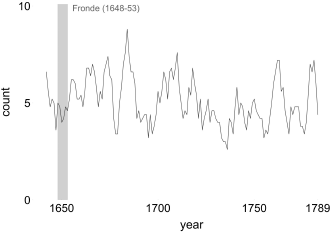
The first dimension is chronology. Figure 1 displays the frequency of intendancy appointments, in a five-year moving average, for the entire period from 1640 to 1789. It indicates that once Cardinal Richelieu decided to rely on the intendants for governance, appointments never ceased. They continued during the Fronde of 1648–1653, contrary to the convention in the literature. The historical scholarship points out that the Fronde, which was a series of domestic revolts, occurred due in part to the intendants who tried to raise revenue so aggressively that intendancy had to stop or at least substantially declined during the Fronde (Collins, 2009). Yet the data indicate that appointments continued to be made, despite that the frequency declined in the early 1650s.
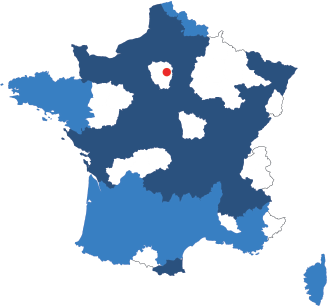
The second is geography. I show the geographical distribution of appoint- ments by counting the number of intendants in each généralité across the entire period. As the généralité is no longer in use as an administrative unit, I redistribute the frequency to the level of the département (i.e., the county) for display. For visual simplicity, I use the median value of the distribution on the département level as the cutoff, in which the dark blue color indicates above the median and the light blue color indicates below the median. Figure 2 maps the geographical distribution. Consistent with the literature, it indicates that intendants were dispatched in much of France, with a greater concentration in areas close to the capital (i.e., pays d’élections), while locales of the pays d’états such as Brittany in the northwest and in Languedoc in the south, where the main language spoken was non-French, receive less attention.
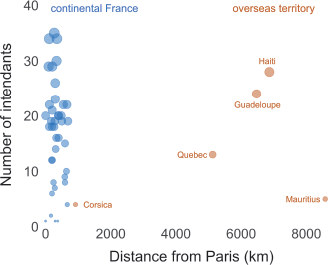
I further explore the geographical dimension by including appointments in the French overseas territories. As with continental France, the king also relied upon intendants to govern his overseas domains, including Corsica, Québec (Nouvelle France), Guadeloupe or the French West Indies (Martinique), Haiti (Saint-Domingue), and Mauritius or the Mascarene Islands (archipel des Mascareignes). As shown in Figure 3, these places received intendants throughout the early-modern period, although some were located as much as 10 times farther away from Paris than the most distant destination within France. Figure 3 conveys four dimensions of information: the number of intendants on the vertical axis, the geographical distance from Paris on the horizontal axis, whether locality is within continental France or in overseas territory in two different colors, and the proportion of intendants among all places in the size of the bubble. The figure suggests the extent to which the institution of bureaucracy is used for governance. The French state’s dependence on intendancy in these far-flung islands indicates its centrality to public administration for early-modern France.
These findings on broad trends confirm the convention in the literature that the French state relied on them for governance throughout the period. In addition, I find that intendants served not only in continental France, particularly the northern half, but also in its overseas territories at comparable rates. This section establishes that Paris put serious efforts in developing intendancy.
Descriptive Evidence on Recruitment and Appointment
This section documents evidence on the recruitment and appointment of intendancy. First, I examine the extent to which commissioning intendants depended on whether they previously served as maîtres des requêtes by splitting the 430 observations into two groups.
Table 1 reports the duration of the first intendant appointment in different time periods by these groups. It indicates that a little less than a half go through this position whose service length in intendancy is virtually identical with those without it in terms of the mean and the variance. To see if this pattern changes in specific periods, I break the data into three roughly 50-year periods between 1640 and 1789. One expectation for time-specific differences comes from the 1674 ruling that the maître position be a prerequisite. If correct, the post-1674 periods should have more intendants with the position. Table 1 shows otherwise. It reports that the mean duration and its variance follow similar trends in both the 1691–1740 and the 1741–1789 periods. Moreover, the maître position might not function as training. If Paris believes that it would provide a training opportunity for venal officials, those intendants without it could hold the first intendancy appointment longer so that they could use it for “on the job” training. The descriptive evidence does not support the notion that the 1675 ruling changed the recruiting pattern or that officials with the maître experience received preferential treatment in recruitment.
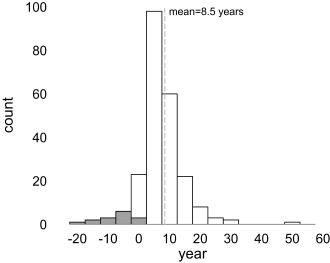
Figure 4 describes the recruitment patterns in terms of time, in years, be- tween the acquisition of a maître position and the first intendancy appointment for 229 individuals. The average is around 8.5 years. The data also shows a wide variability in the distribution. Some win an intendancy assignment after more than 20 years in the maître position, while 15 observations (6.6%) obtain it after being recruited as intendants first (shown in gray).
These two pieces of descriptive evidence suggest that the office of the maîtres des requêtes does not seem to be the only training ground for intendancy recruitment and that the link between the two positions is not necessarily tight. This is the first paper to document evidence on this connection, but interpreting it requires caution, due in part to incomplete data on the maîtres des requêtes; information about whether an intendant serves as a maître is not always included in my sources.
The second is the idea that the maître experience serves as the search for aptitude. Although my data set does not have a measure that directly captures individual aptitude, the frequency of intendant appointments offers one indirect method. Building on the previous table, Table 2 summarizes the appointment records by whether intendants serve as maîtres before. The data indicate that there are a total of 715 intendant-appointments of which individual intendants receive up to six appointments. Of these, a majority (58%) hold only a single appointment and those serving more than three times are relatively few (16%). Table 2 highlights a pattern, in which intendants with the maître experience tend to receive more repeated commissions than those without it. Even though the first appointments were roughly equally distributed, the next assignment is awarded to approximately 57% of the former group, while only a third of the first-time appointees receives a second appointment in the latter group. A similar pattern holds for the third appointment. If aptitude is driving the variation, the initial appointment could reveal that the maître position sent such a signal (but not on the recruitment stage). Yet this interpretation is but one possibility, because my data set does not contain information about the other recruitment paths to intendancy.
The third test is on age, specifically the idea that age as a proxy for maturity would be a recruitment criterion. Table 3 provides largely supportive evidence. Of the 327 intendants whose date of birth is available, the average age of the first appointment is 38 years old and there is little fluctuation across the periods, suggesting that the age band between the late thirties and the early forties was considered appropriate.
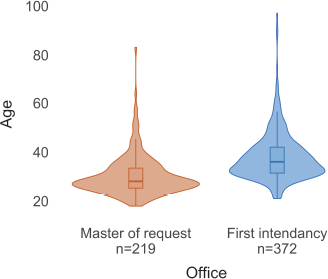
Figure 5 further examines age by comparing intendancy to the 219 maîtres des requêtes whose date of birth is known. The mean age of the latter is 30. The eight-year difference is similar to the finding in Figure 4. The data show that age is just one criterion for recruitment. There is a wide variability in age within and across appointments. As Figure 5 reveals, while a majority of intendants are recruited in their mid- to late thirties (the median is 36 years), some are much older, and younger appointees are not rare. There are 40 individuals over the age of 50 (of whom four are more than 70 years old) and 42 become intendants for the first time when they are less than 30 years old, the mean age of purchasing a maître position.7 This variability indicates that the office of intendancy does not exercise stringent rules to use age as a proxy for maturity.
The second area to explore the development of intendancy is appointment. The key empirical question is whether appointment bears some regularity, which may reflect the state’s desire to minimize the chances that intendants engage in rent-seeking behavior through collusion or cronyism with local venal officeholders in their destination. By contrast, appointments of highly- variable duration suggest that Paris neither established rotation nor removed patrimonial practices in the office. Table 4 reports the duration both across periods and across appointments. It indicates that intendant assignments last, on average, six to seven years in their first and second appointments and that their variability remains flat throughout the early-modern era. The stability of duration could suggest that the intendancy office could have made some rules about the expected duration of each appointment.
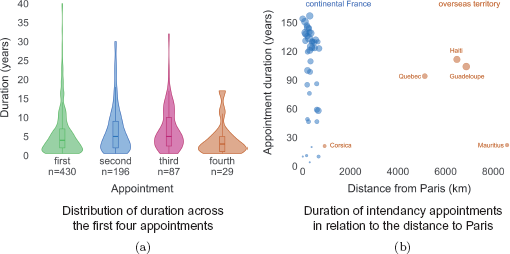
At the same time, each appointment has a long tail of intendants who serve in a single locale for more than a decade, as shown in Panel (a) of Figure 6. In the first appointment, for instance, 75 individuals served for more than 10 years or longer, of whom sixteen stayed in the position for at least 20 years. Similar patterns hold in the second and third appointments. Panel (b) shows the relationship between appointment duration, in intendant-years, and the distance from Paris. The bubbles indicate the cities as destinations, their size indicates the proportion of duration, and colors denote whether destinations are within continental France. This is of interest, because it elicits insight about how Paris manages the distribution of service duration in relation to the geographical distance from it. Panel (b) documents that the size of bubbles is similar between most of within-France destinations and overseas ones, suggesting that the capital paid as much attention to places far from it, such as Haiti and Guadeloupe, to cities under pays d’élection such as Bordeaux and Tours, while intendants served much less in time in other financial districts within France such as Rennes (pays d’état) and Lille (pays d’imposition). Figure 6 seems to point to the limited bureaucratization of intendancy: France had the capacity to dispatch its deputies to far-flung places but did not seem to devise a rule about how long each they should serve.
To further explore the degree of impersonality in appointment, I turn to within-destination variation. Table 5 documents evidence on the extent to which two aspects of familial appointments, kin and endogamous colleagues, are practiced in 35 cities of continental France. The term “colleagues” does not mean that kinsmen serve at the same time; it simply represents an individual who has kin or endogamous colleagues and who is posted at the same city before or after his appointment. No such ties are found for France’s overseas territories. The main finding here is that kin or marital ties are observed in every city except for Trévoux which receives just one intendant, suggesting that these types of appointments were perennial at the time. It also suggests that family name played a major role in distributing where candidates should go. Assuming that Paris wanted to avoid the cronyism between intendants and local powerholders, the widespread use of familial ties means either that candidates actively sought to be posted in a particular locale or that the state found this degree of nepotism to be a means to ensure that intendants exercise authority. In either way, the importance of impersonality in appointment was relegated to a lower priority.
The empirical findings on the development of intendancy as a burgeoning bureaucracy are mixed at best. On the three dimensions of recruitment, evidence indicates that a little less than a half of the first-time intendants follow the expected track in the previous rank of the office of the maîtres des requêtes, which supposedly provides adequate training. Yet the experience of the previous position could be a proxy for some aptitude as it helps explain the number of appointments beyond the initial one. The finding on age as an indicator for maturity is the strongest of the three tests, reporting that purchasers of the venal maître office typically spend eight to nine years before given the chance to be appointed intendants in their late thirties. On appointment, findings are also mixed. Duration shows little variation, on average, across appointments and time but exhibits a great variability among individual appointees in each appointment. As for duration in terms of location, findings indicate that service length is evenly distributed between destinations in continental France and those overseas. These findings suggest that the office of intendancy managed appointment well as a rising bureaucracy, but the findings on appointment through familial and marital ties suggest that patrimonial practices remained strong. Virtually all destination cities within continental France used this method; its extent was so widespread that it must have been the standard practice.
Conclusion
This paper explores the French institution of intendancy as one of the first instances of bureaucratic development in early-modern Europe (Kettering, 1986). I focus on its recruitment and appointment processes, because the functioning of these two dimensions could undergird fiscal capacity. Based on a new data set of the nearly universal 430 intendants from 1640 through 1789, my empirical analysis indicates that while intendancy exhibited empirical regularities that hold across time, space, and appointments, their variability was so large that the state was unable to manage it well. Evidence also suggests that although intendancy was designed to undermine the inefficient tax farming run by venal officeholders, nepotistic practices remained strong in appointment.
One implication drawn from the evidence documented in this paper is that fiscal capacity may be endogenous to the underlying institution that handles the administration. The degree of familial and marital ties among the intendant appointees leaves room for cronyism and rent-seeking behavior, which, in turn, may undermine the state’s ability to raise revenue and conduct other policies. This view helps bridge the seemingly contrasting views in the literature, in which intendancy played a crucial role in the French political development of the early-modern period on the one hand and, on the other hand, France suffered from numerous bankruptcies in the same period. My paper highlights the study of state-capacity building less as standalone outcomes of various types than as a process, more specifically pointing to how one dimension of capacity hinges on another. Unpacking this mechanism could help understand ongoing questions such as why pre-modern France remained unable to overcome the chronic fiscal shortages.
See Johnson and Koyama (2017) and Gennaioli and Voth (2015) for recent overviews of the literature.
The legal capacity includes the capacity to identify subjects, deliver information, enforce rules, implement policies, raise manpower, and, more generally, “broadcast” authority. For influential theoretical works, see, for instance, Mann (1993), Scott (1998). See Hanson and Sigman (Forthcoming) for a recent review on the subject.
On the compositeness of the early-modern European polity, see Elliott (1992), Koenigs- berger (1987), and Nexon (2009).
4The pays d’élection covers roughly two-thirds of the land.
5The purchase of an office in the maîtres des requêtes must ultimately be approved by the king (Collins, 2009, p. xlvi).
6The original editions were published by Aubert de La Chesnaye-Desbois alone between 1757 and 1761.
The youngest is 21 years old and the oldest is 97 years old as shown in Figure 5.