


The study aims to test the efficacy of brief-caries risk assessment form with standard caries risk assessment form and to evaluate the application of caries risk assessment following American Academy of Pediatric Dentistry (AAPD) between brief and standard caries risk assessment on dental health status among preschool children.
Brief-caries risk assessment form was developed. Then, experimental study was conducted in public health center 54 among 70 patients (35 test and 35 control) from January to July 2019. Test group used brief-caries assessment form, and control group used standard form. Both groups received the same caries risk assessment criteria and management protocol from AAPD. At baseline, 3-month and 6-month follow-up, caries risk and dental health status (plaque index, cavitated caries lesion and non-cavitated caries lesion) were assessed. Data were analyzed by descriptive statistic, t-test, chi-square test, Fisher's exact test and repeated measures ANOVA.
Percentage of high caries risk decreased from baseline (93.9%: test and 96.9%: control) to 6-month follow-up (66.7%: test and 65.6%: control) in both groups, with no statistically significant differences between groups. Plaque index, cavitated caries lesion and non-cavitated caries lesion were not statistically significant differences between groups. Brief-caries assessment decreased times/visit from 10-15 minutes to 5 minutes.
Brief-caries assessment form decreased caries risk and prevented dental caries as the standard form. Using brief-caries assessment form could save time, is cost-effective and is appropriate for use in public health centers. However, a short follow-up time might have insufficient power to detect the differences between groups.
Introduction
Early childhood is a time of remarkable growth, with brain development at its peak. During this stage, children are highly influenced by the environment and the people that surround them. They develop rapidly in form and thought, as well as socially and emotionally [1].
A major public health problem in both developed and developing countries that continues to negatively affect children's oral health is early childhood caries (ECC). ECC affects the immediate and long-term quality of life of the child and their family [2, 3]. Children with ECC may suffer both physical and developmental difficulties, including pain, tooth loss, malocclusion, malnutrition, sleep disruption, speech problems and social development [2].
ECC is a multifactorial disease caused by many factors, including host factors (tooth, saliva and acquired pellicle), carbohydrate food intake, dental plaque, genetics and environmental factors [4]. ECC is caused by the imbalance between de-mineralization and re-mineralization of the tooth. Dental cavity exists when the tooth has more de-mineralization than re-mineralization [2–4]. The American Academy of Pediatric Dentistry (AAPD) therefore recommended periodic and regular dental care for children by caries risk level; every 3 months for high risk, every 6 months for moderate risk and annually for low risk [5].
The 8th Thai National Oral Health Survey 2017 found a trend for the prevalence of dental caries among the 3-year-old age group of the national population to be decreasing. However, the prevalence of dental caries incidence for the same age group in Bangkok was increasing. In Bangkok, the mean decay, missing, and filled teeth (dmft) of 3-year-old children was 2.5 teeth/person, increasing to 3.7 teeth/person for 5-year-olds [6]. Public health centers in Bangkok have oral health prevention and promotion in Well Baby Clinics (WBCs) which are responsible for preschool children (0–5 years). Although the WBCs had oral health prevention and promotion programs including oral health education, oral health examination and topical fluoride application, the tendency of dental caries prevalence in Bangkok has continued to rise [6].
Nowadays, there are four types of caries risk assessment, including (1) the American Dental Association (ADA)'s caries risk assessment [7], assessing caries risk by specialists (doctor and dentist), (2) Cariogram program [8], using a special software package to calculate caries risk to percentage, (3) caries management by risk assessment (CAMBA) [9] using a special software package and the patient's factors and rationale to calculate caries risk without percentage and (4) AAPD's caries risk assessment [5], predicting dental caries in children and adolescents by assessing biological, protective and clinical factors since the prevalence of dental caries in each child is different. This method used prevention, promotion and periodic follow-up appropriate to each child and their compliance. The advantage of AAPD's caries risk assessment is its appropriateness to each child and its cost-effectiveness. However, this method has some disadvantages. It needs a specialist to assess the risk, uses special equipment to test mutans streptococci levels and has some unchangeable factors such as low socioeconomic status, special health care needs and recent immigrant status [5].
The present study used the AAPD's caries risk assessment because of its appropriateness to each child and their compliance, its cost-effectiveness and because it did not require the purchase of a special software package. The standard caries risk assessment form has 14 questions. It takes time to complete and has some unchangeable factors, including low socioeconomic status, special health care needs and recent immigrants. Furthermore, public health centers in Bangkok did not have fluoride supplement tablets, water fluoridation and fluoride milk in preschool children.
Public health centers in Bangkok are responsible for every Bangkokian. The WBCs have many children receiving vaccinations, evaluation of child development and oral health prevention and promotion. In the scenario of the increase in preschool children attending the WBCs with its limited resources, time and human resources, the full version of AAPD's caries risk assessment cannot cover every child attending the WBCs. The brief-caries risk assessment form was developed to be appropriate for use in public health centers by excluding the questions for unchangeable factors, water fluoridation and fluoride supplement and the salivary test for mutans streptococci levels which need special equipment and a specialist. The brief-caries risk assessment form left only eight questions, thereby decreasing time per visit from 10–15 min (standard caries risk assessment) to 5 min. The criteria to assess caries risk still followed the standard caries risk assessment form of the AAPD [5] including high, moderate and low risks.
The present study tested the efficacy of a brief-caries risk assessment form against the standard caries risk assessment form and evaluated a diagnostic assessment between the two based on the dental health status among preschool children.
Methods
Development of the brief-caries risk assessment form
The brief-caries risk assessment form was adapted from the standard caries risk assessment form of the AAPD [5]. The standard caries risk assessment form consists of 14 questions, including 6 questions for biological factors, 4 questions for protective factors and 4 questions for clinical factors. A focus group discussion was conducted to develop the brief-caries risk assessment form by collecting ideas from a dentist, a dental hygienist, a nurse and a pediatrician. A moderator (researcher) posted a series of questions in a way that did not lead group members to provide desired responses, but rather elicited honest and insightful responses. The questions included the advantages and disadvantages of the standard caries risk assessment form and problems and obstacles in the use of the standard caries risk assessment form. The comments from the focus group discussion concluded that the standard caries risk assessment form was appropriate to prevent and promote dental health by each child and their compliance. However, comments also noted that it took time to complete; that some questions were unchangeable, for example, the low socioeconomic status, specialist health care needs and recent immigrant status; and also that fluoride tablets, water fluoridation and fluoride milk were not available to Bangkok's preschool children. Furthermore, public health centers did not have the necessary budget to purchase the mutans streptococci test. After gathering all feedback, the brief-caries risk assessment form excluded the unchangeable factors from biological factors, by deleting items regarding low socioeconomic status, special health care needs and recent immigrant questions. Questions on protective factors (water fluoridation and fluoride supplement questions) were also excluded since Bangkok does not have fluoride supplements by tablet, water fluoridation or fluoride milk available to preschool children. Clinical factors were combined to present at least one dmft question with an active white spot lesion or enamel defects question, and the questions for mutans streptococci levels were excluded since they needed special equipment and a specialist. So, the developed brief-caries risk assessment form consisted of eight questions: three questions for biological factors, three questions for protective factors and two questions for clinical factors. The criteria to assess caries risk still followed the standard caries risk assessment form of the AAPD [5] including high, moderate and low risks. The brief-caries risk assessment form was validated by experts in pediatric dentistry, research methodology and preschool childcare. The pretest was conducted in the WBC in Public Health Center 42 to test its reliability.
Testing the brief-caries risk assessment form
An experimental study was conducted in the WBC in Public Health Center 54, Bangkok, Thailand, from January to July 2019, to compare the efficacy and evaluate a diagnostic assessment between the responses of participants to the brief-caries risk assessment form (test group) and the responses of participants completing the AAPD's standard caries risk assessment form (control group). Public Health Center 54 serves the population in Thung-Khru district, Bangkok, Thailand. This public health center was chosen because of its location in Bangkok (high caries prevalence); it serves mostly low-socioeconomic status patients and had sufficient numbers of participants. Parents or caregivers who were primary caregivers, had children aged 6 to 12 months, both male and female, and with at least one natural tooth were included. The exclusion criteria included the parents or caregivers who had children with a cleft lip, cleft palate, ectodermal dysplasia, communication disorders, could not speak the Thai language or did not agree to participate. The results of the mean dmft from a previous study were used to calculate the sample size [10]. The sample size calculation required 30 participants in each group by achieving 80% power at the 5% significant level. The mean plaque index score of the test and control groups was 0.92 and 0.98 and the pooled variance was 0.007 [10]. The entire sample size was increased to 70 participants (35 per group) due to the increasing 15% for attrition and refusal.
Dentists were trained in caries risk assessment, oral health examination and the application of fluoride varnish by experts in this field. One dentist used the brief-caries risk assessment form (test group), and another dentist used the standard caries risk assessment form (control group). Intra-examiner reliability was achieved by examination of 20 participants on two occasions (24 h apart) before beginning the study. Inter-examiner reliability was also achieved by using three dentists including one expert in pediatrics (gold standard) and the other two dentists who conducted the oral examination in the present study examining five children.
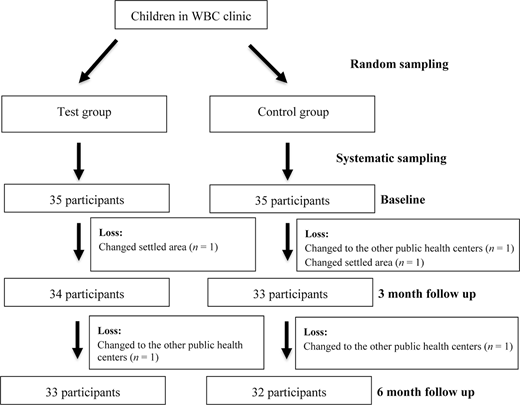
The WBC in Public Health Center 54 was open on Tuesdays and Thursdays. The research team randomly assigned Tuesday and Thursday WBC to the test (Tuesday) and the control (Thursday) groups. Systematic sampling was used to select 35 participants for each group by choosing the even numbers in the queues. If the randomly selected participants met the exclusion criteria, then the next number was chosen. An opaque envelope was used to seal the list of participants. Following the exclusion criteria, eight participants were excluded. In the test group, five participants were excluded because three participants could not speak the Thai language and two participants did not agree to participate. In the control group, three participants were excluded because two participants could not speak the Thai language and one participant did not agree to participate.
Test group
At the baseline, the test group received a caries risk assessment by using the brief-caries risk assessment form, and a trained dentist examined a child's oral health. The caries risk included high, moderate and low risks. Then, the trained dentist applied fluoride varnish to the teeth of children with moderate and high risks. The participants received the caries management protocol of the AAPD [5] which included oral health education, periodic recall and the application of fluoride varnish. The high-risk children received an oral health examination and fluoride varnish every three months, whereas the moderate risk children received an oral health examination and fluoride varnish every six months. The low-risk category children received only an oral health examination. The session took approximately 5 min to complete.
After both the 3rd and 6th months, participants received the caries risk assessment and oral health examinations to compare with the previous caries risk assessment. Oral health education, periodic recall and applied fluoride varnish followed the AAPD's caries management protocol [5]. The session took approximately 5 min to complete.
Control group
At the baseline, 3rd and 6th months, the control group received the same activities as the test group except the control group used the standard caries risk assessment form of the AAPD [5]. The activities included the caries risk assessment and an oral health examination by another trained dentist. Oral health education, periodic recall and application of fluoride varnish continued to follow the AAPD's caries management protocol [5] as in the test group. The session at the baseline took approximately 15 min to complete. The 3rd and 6th months sessions took approximately 10 min to complete.
Outcome measures
Participants in both groups received the caries risk assessment, child's oral examination and face-to-face interview using a questionnaire at the baseline, after 3 months and at the 6-month follow up. The double-blind technique was used, meaning that neither the participants nor the dentists knew if they were in the test or the control groups.
Oral examination was conducted by the calibrated dentists. A full-mouth plaque index (PI) [11] was measured. The score of PI ranged from 0 to 3; 0: no plaque, 1: a film of plaque adhering to the free gingival margin, 2: moderate accumulation of deposits and 3: the abundance of soft matter on the tooth. A full-mouth dental caries was also examined. Dental caries were divided into cavitated and non-cavitated caries lesions following the criteria from Warren et al. [12]. The questionnaire was used to find general characteristics of the participants, including primary caregiver, gender, age, educational level, occupation, age of child, gender and the number of teeth for each child.
Statistical analyses
Descriptive statistic, chi-square test, Fisher's exact test and a t-test were used to compare the difference of the baseline characteristics and compared caries risk at the baseline and 3-month and 6-month follow-ups between the test and the control groups. Repeated measure ANOVA was used to compare the differences in dental health status across time. A post hoc test (Bonferroni) was used to evaluate the groups' differences in dental health status. The data were analyzed by SPSS statistical package version 16.0. All analyses used a 95% confidence interval (CI) and a statistically significant p-value of less than 0.05.
Ethical issue
The study protocol was approved by the Bangkok Metropolitan Administration Ethics Committee for Human Research (085). Informed consent was signed by all participants.
Results
Brief-caries risk assessment form
The item-objective congruence (IOC) index from the validity test of the brief-caries risk assessment form was 0.86, and the Cronbach's alpha reliability test was 0.87. The intra-examiner reliability's Cohen's kappa of dentist A and dentist B were 0.98 and 0.95, respectively, and the inter-examiner reliability's Cohen's kappa of the dental examination was 0.91.
Study population
Among 70 participants who enrolled at the baseline (35 test and 35 control), 65 (92.9%) (33 test and 32 control) were eligible for the 3-month and 6-month follow-ups. Of the five participants who were not eligible, two were in the test group. One participant changed their settled area, and another attended a WBC in another public health center. The remaining three participants were in the control group. One participant changed their settled area, and two participants attended a WBC in other public health centers (Figure 1).
Baseline characteristic
Among 70 participants (35 per group), most of the primary caregivers in both groups were mothers and had completed secondary school. Half the caregivers in both groups were employed. The gender of the children in both groups was quite balanced between males and females. Baseline characteristics did not have statistically significant differences between the test and the control groups (Table 1).
Baseline characteristics (n = 70)
| Variables | Test group (n = 35) (%) | Control group (n = 35) (%) | p-value |
|---|---|---|---|
| Primary caregiver | |||
| Mother | 29 (82.9) | 26 (74.3) | 0.111 |
| Father | 5 (14.3) | 2 (5.7) | |
| Grandmother/grandfather/cousin | 1 (2.8) | 7 (20.0) | |
| Gender of caregiver | |||
| Male | 5 (14.3) | 3 (8.6) | 0.452 |
| Female | 30 (85.7) | 32 (91.4) | |
| Age of caregiver (years) | |||
| Mean ± SD | 29.83 ± 7.92 | 32.40 ± 11.98 | 0.293 |
| Min-max | 18–54 | 18–68 | |
| Educational level | |||
| Illiteracy | 1 (2.9) | 3 (8.6) | 0.107 |
| Primary school | 7 (20.0) | 10 (28.5) | |
| Secondary school | 22 (62.9) | 16 (45.7) | |
| Vocational school | 2 (5.7) | 3 (8.6) | |
| Bachelor's degree | 3 (8.6) | 3 (8.6) | |
| Occupation | |||
| Employed | 19 (54.3) | 18 (51.4) | 0.864 |
| Unemployed | 16 (45.7) | 17 (48.6) | |
| Gender of children | |||
| Male | 18 (51.4) | 19 (54.3) | 0.811 |
| Female | 17 (48.6) | 16 (45.7) | |
| Age of children (months) | |||
| Mean ± SD | 10.51 ± 1.98 | 9.89 ± 1.94 | 0.183 |
| Min-max | 6–12 | 6–12 | |
| Number of children's teeth | |||
| Mean ± SD | 4.11 ± 2.41 | 3.94 ± 2.21 | 0.757 |
| Min-max | 1–8 | 1–8 | |
Note(s): p by chi-square test, Fisher's exact test or t-test
At baseline, most of the participants in the test and the control groups had a high caries risk. The percentage of high caries risk participants gradually decreased at the 3-month and 6-month follow-ups. In the test group, the percentage of high caries risk decreased from 93.9% at the baseline to 81.8% at the 3-month follow-up, and decreased further to 66.7% at the 6-month follow-up. In the control group, the percentage of high caries risk decreased from 96.9% at the baseline to 93.8% at the 3-month follow-up and decreased to 65.6% at the 6-month follow-up. There were no statistically significant differences in caries risks between the test and the control groups at the baseline, 3-month and 6-month follow-ups (Table 2).
Caries risk at baseline, 3-month and 6-month follow-ups (n = 65)
| Variables | Test group (n = 33) (%) | Control group (n = 32) (%) | p-value |
|---|---|---|---|
| Baseline | |||
| High risk | 31 (93.9) | 31 (96.9) | 0.573 |
| Moderate risk | 0 (0.0) | 0 (0.0) | |
| Low risk | 2 (6.1) | 1 (3.1) | |
| 3rd month | |||
| High risk | 27 (81.8) | 30 (93.8) | 0.195 |
| Moderate risk | 0 (0.0) | 0 (0.0) | |
| Low risk | 6 (18.2) | 2 (6.2) | |
| 6th month | |||
| High risk | 22 (66.7) | 21 (65.6) | 0.929 |
| Moderate risk | 0 (0.0) | 0 (0.0) | |
| Low risk | 11 (33.3) | 11 (34.4) | |
Note(s): p by chi-square and Fisher's exact test
The average number of children's teeth in the test group increased from 4.15 ± 2.33 teeth at baseline to 12.21 ± 3.20 teeth at the 6-month follow-up. In the control group, the average number of children's teeth increased from 3.91 ± 2.26 teeth at baseline to 11.75 ± 3.63 teeth at the 6-month follow-up (Table 3).
Number of teeth at baseline, 3-month follow-up and 6-month follow-up (n = 65)
| Variables | Test group (n = 33) (%) | Control group (n = 32) (%) |
|---|---|---|
| Baseline | ||
| Number of children's teeth | ||
| Mean ± SD | 4.15 ± 2.33 | 3.91 ± 2.26 |
| Min-max | 1–8 | 1–8 |
| 3rd month | ||
| Number of children's teeth | ||
| Mean ± SD | 8.50 ± 3.68 | 8.82 ± 3.69 |
| Min-max | 4–14 | 4–14 |
| 6th month | ||
| Number of children's teeth | ||
| Mean ± SD | 12.21 ± 3.20 | 11.75 ± 3.63 |
| Min-max | 6–16 | 6–16 |
Dental caries
PI and non-cavitated caries lesions were significantly different in the test group when compared to the control group (p < 0.001 and 0.004). Within measurements, PI and non-cavitated lesion also showed statistically significant differences (p < 0.001 and 0.004) (Table 3). Whereas the repeated measure ANOVA of cavitated caries lesion showed no statistically significant differences between groups and within measurements (Table 4). Pairwise comparison between the test and the control groups found the mean difference of PI, cavitated lesion and non-cavitated lesion was not significantly different at the baseline, the 3-month follow-up and 6-month follow-up (Table 5). This meant that the PI and non-cavitated lesion changed over time, but this change did not differ between groups.
Repeated measure ANOVA of PI, cavitated caries lesion and non-cavitated caries lesion (n = 65)
| Source of variation | SS | Df | MS | F | P |
|---|---|---|---|---|---|
| Plaque index | |||||
| Between subjects | |||||
| Intervention | 2.021 | 1 | 2.021 | 20.393 | <0.001 |
| Within group (error) | 6.242 | 63 | 0.099 | ||
| (Between group error) | |||||
| Within subjects | |||||
| Time | 0.390 | 1.354 | 0.288 | 14.090 | <0.001 |
| Cavitated caries lesion | |||||
| Between subjects | |||||
| Intervention | 0.129 | 1 | 0.129 | 2.836 | 0.097 |
| Within group (error) | 2.866 | 63 | 0.045 | ||
| (Between group error) | |||||
| Within subjects | |||||
| Time | 0.258 | 1 | 25.074 | 2.836 | 0.097 |
| Non-cavitated caries lesion | |||||
| Between subjects | |||||
| Intervention | 2.985 | 1 | 2.985 | 9.090 | 0.004 |
| Within group (error) | 20.687 | 63 | 0.328 | ||
| (Between group error) | |||||
| Within subjects | |||||
| Time | 5.970 | 1 | 5.970 | 9.090 | 0.004 |
Pairwise comparisons of the different measurements of PI, cavitated caries lesion and non-cavitated caries lesion in the test and the control groups (n = 65)
| Variables | Test group (n = 33) | Control group (n = 32) | Mean difference | p |
|---|---|---|---|---|
| Plaque index | ||||
| Baseline | 0.07 ± 0.21 | 0.02 ± 0.06 | 0.05 ± 0.04 | 0.236 |
| 3rd month | 0.12 ± 0.21 | 0.11 ± 0.20 | 0.01 ± 0.05 | 0.866 |
| 6th month | 0.14 ± 0.22 | 0.16 ± 0.28 | −0.02 ± 0.06 | 0.768 |
| Cavitated caries lesion | ||||
| Baseline | 0.00 ± 0.00 | 0.00 ± 0.00 | 0.00 ± 0.00 | – |
| 3rd month | 0.00 ± 0.00 | 0.00 ± 0.00 | 0.00 ± 0.00 | – |
| 6th month | 0.06 ± 0.35 | 0.09 ± 0.39 | −0.03 ± 0.09 | 0.719 |
| Non-cavitated caries lesion | ||||
| Baseline | 0.00 ± 0.00 | 0.00 ± 0.00 | 0.00 ± 0.00 | – |
| 3rd month | 0.00 ± 0.00 | 0.00 ± 0.00 | 0.00 ± 0.00 | – |
| 6th month | 0.24 ± 0.83 | 0.50 ± 1.14 | −0.26 ± 0.25 | 0.300 |
Note(s): Pairwise comparisons of the indifferent measurements. Adjustment for multiple comparisons: Bonferroni, based on estimated marginal means. The mean difference is significant at the 0.05 level
Discussion
The brief-caries risk assessment form demonstrated the same level of efficacy and diagnostic assessment as the standard caries risk assessment form in testing the decrease in caries risk and dental health status in preschool children.
The efficacy of the brief-caries risk assessment form is consistent with a previous research paper in Thailand [10] which also excluded the unchangeable factors, salivary test for mutans streptococci levels and oral examination and found that their form had the effectiveness to prevent dental caries. Furthermore, Ramarao and Sathyanarayanan found that excluding the salivary test in the caries risk assessment-grid for school children also prevented dental caries [13]. However, these previous studies administered the form with 2–5-year-old children [10] and school children [13], respectively. Whereas the present study measured 6–12-month-old children. The present study selected 6–12-month-old children to assess caries risk because this age group is when an eruption of the dentition begins and is the best time to commence prevention strategies [4, 5, 13]. The present study did not exclude an oral examination in the brief-caries risk assessment form even though the oral examination needed a dentist or dental hygienist as a specialist because the oral examination was an important aspect of the prediction of caries risk [14].
Decreasing caries risk from high caries risk to low caries risk in both groups stated the efficacy of the brief-caries risk assessment form as the standard caries risk assessment form did. When children have low caries risk, they have a low chance of developing dental caries in the future [4, 15–17].
PI and non-cavitated caries lesion had statistically significant differences between groups and within groups from the baseline, 3-month follow-up and 6-month follow-up. Post hoc tests showed no statistically significant differences. The mean of the PI and non-cavitated caries lesion was increasing from the baseline to the 3-month follow-up and 6-month follow-up because the present study included 6–12-month-old children with about 4 teeth at the baseline (Table 1). By the 3-month and 6-month follow-ups, the participants had more erupted teeth, so they had more opportunity to have PI and non-cavitated caries lesions [4]. However, the cavitated caries lesions did not show any statistically significant difference between and within groups. These results stated that the brief-caries risk assessment form and the standard caries risk assessment form could prevent or inhibit the existence of cavitated caries lesions consistent with the results of previous studies [4, 16, 17]. Furthermore, the AAPD's caries management protocol [5] which is appropriate for each child, including oral health education, periodic recall and the application of fluoride varnish, also helps to prevent or inhibit the development of cavitated caries lesions [16, 17]. Furthermore, non-cavitated caries lesions could reverse to a normal tooth if it received periodic fluoride varnish and proper dental prevention [2, 18].
A caries risk assessment by the AAPD has been shown to prevent dental caries in children [5]. Gannam et al. found caries risk assessment was effective if dental providers were skilled in assessing children's caries risks [19]. Furthermore, Chaffee et al. found baseline risk information related to clinical outcomes, and caries risk assessment helped dental providers to give more intensive dental prevention to children [20]. The results of the present study confirm the effectiveness of caries risk assessment by AAPD. However, the full version of the caries risk assessment by the AAPD took time, used special equipment and a specialist and carried high costs that were not appropriate in public health [10, 13]. Therefore, in order to be more cost-effective, the present study excluded the unchangeable factors, water fluoridation and fluoride supplement and salivary testing for mutans streptococci levels. The results of the present study are consistent with the findings of Intarasompun et al. [10] and Ramarao and Sathyanarayanan [13] which also adjusted the full version of caries risk assessment by AAPD by excluding some questions and salivary testing for cost-effectiveness yet also reported effectiveness in preventing dental caries. The IOC index and Cronbach's alpha from the present study registered high values, meaning that the brief-caries risk assessment form was a valid instrument. In the future, if it would have been a more valid brief-caries risk assessment instrument and formative research was done to design and develop test items complete with necessary re-evaluations, the final version might be achieved with acceptable reliability.
The strengths of the present study were its high response rate (92.9%) and the use of PI and dental caries as the indicators to examine the efficacy of the brief-caries risk assessment form. The limitations of the present study include the short follow-up time for non-cavitated and cavitated caries lesion. The 6-month follow-up from the present study showed only a small change in all outcomes in both groups, so the results of the present study might have insufficient power to detect the differences between groups. Other limitations are that it might cause selection bias from non-randomization and willingness to participate. Also, the results of the present study represented only the preschool children in Thung-Khru district, Bangkok.
The brief-caries risk assessment form developed for this study exhibited a level of efficacy and acceptability that could be adapted into the routine work by staff in other public health centers. Future studies need to incorporate a longer follow-up period to generate an understanding of the effects, adherence and sustainability over time.
Conclusion
This study found that the brief-caries assessment form decreased caries risk and prevented dental caries as effectively as the standard caries risk assessment form. Using the brief-caries assessment form could save time, improve cost-effectiveness and be appropriate for use in public health centers. However, a longer follow-up time might provide greater power to detect differences between groups.
The study was successfully completed with excellent support from Dr Lawan Boonyamanond, Panthapat Sumrittisut and the staff in Dental Clinic 654.Conflicts of Interest: The author reports no conflict of interest in the present study.

