


This study examines how family travel influencers construct their personas and deploy persuasive appeals to shape travel perceptions and decisions for foreign destinations.
A qualitative two-stage research design was adopted, combining netnography with content analysis. Textual content from a purposive sample of UK-based family travel influencers was used.
Four positioning patterns emerged, that is Nurturing Parent, Family Travel Evangelist, Distinguished Expert and Trailblazer. The three composite types of appeal they used were Inspirational Wanderlust, Informational Guidance and Experiential Reasoning.
Findings are constrained by the UK-based sample and the textual content. Examining multiple types of content along with audience reactions would definitely broaden the perspective and enhance the validity of our findings.
Rather than relying on generic family-friendly branding, influencer selection should be at a micro-level. Destination/Tourism marketers should adopt differentiated influencer strategies aligned with positioning and audience appeal; personality and brand fit, emotional resonance and credibility should be prioritised.
This study introduces a contextualised framework of influencer legitimacy within the complex and morally sensitive domain of family travel. The identification of positioning patterns and distinct appeal types offers a novel lens to understand how trust and credibility are constructed for the audience of these specialised influencers.
1. Introduction
Despite the myriad challenges it entails, family travel remains as one of the most valuable segments in the tourism market (Statista, 2025). In parallel, the influencer marketing ecosystem continues to expand at a rapid pace, with 6,939 influencer marketing-focused service providers and platforms recorded in 2025 and an annual industry growth exceeding 30% (Influencer Marketing Hub, 2025). Despite extensive research on influencer marketing and families’ growing reliance on social media for travel inspiration and decision-making (Sharaievska and Mirehie, 2023), limited attention has been paid to how influencers operate within family travel, a collaborative consumption context marked by multiple actors, collective decision-making and heightened risk sensitivity. While various travel influencer typologies have been proposed (e.g. Flavián and Barta, 2022; Gross and von Wangenheim, 2018), none of them has been explored in the context of family travel. Interestingly, the practice of sharing parenting content on social media (“sharenting”) has led some parents to assume the role of family influencers (Jorge et al., 2022).
In light of the complex dynamics of family travel and the growing importance of influencer marketing for tourism stakeholders at large, this exploratory study addresses two main research questions:
How do family travel influencers position themselves and construct their unique personas? Which positioning patterns can be identified in the context of family travel?
How do family travel influencers appeal to their audience? Are there underlying content strategies and tactics embedded in their content, so as to engage audiences while featuring international destinations and presenting travel journeys?
By answering these questions, this study aims to propose valuable market insights for both travel influencers and tourism marketers: a typology of positioning patterns along with a classification of persuasive appeals used by specialised family travel influencers.
2. Literature review: family travel and influencer communication
Effectively marketing to family travellers requires a nuanced understanding of the social, emotional and structural complexities that shape their tourism behaviour. Family travel represents a form of collective, high-involvement consumption, where decisions emerge from intra-family negotiations, shifting power dynamics and shared responsibilities rather than individual preferences (Fu et al., 2014; Liu et al., 2024; Tseng et al., 2023; Wang and Li, 2021). These dynamics are further shaped by life-stage variation, caregiving demands and children’s increasing agency in decision-making (Hamilton et al., 2021; Jamal et al., 2019; Li et al., 2023; Yen et al., 2023). At the same time, parents retain ultimate responsibility for safety and risk management, creating tensions between aspirational leisure and protective caution (Hu et al., 2023; Jia et al., 2023). As a result, family travel is characterised by heightened uncertainty, risk sensitivity and emotional intensity, prompting reliance on peer-generated content and influencers for reassurance and validation (Karl, 2018; Schänzel, 2021; Sharaievska and Mirehie, 2023).
Parallel to this, influencer research has developed across three key streams. First, influencer typologies classify creators based on content style or functional roles (e.g. informers, entertainers) (Gross and von Wangenheim, 2018; Flavián and Barta, 2022). Second, authenticity and self-presentation research examines how influencers build homophily and relational closeness through disclosure and everyday narratives (e.g. van Nuenen, 2016; Jaiswal et al., 2024). Third, source credibility and message appeal literature explains how informational and emotional content shape trust and persuasion outcomes (Lorgeoux and Divakaran, 2023; Lou and Yuan, 2019; Luo et al., 2025). However, these streams remain largely analytically disconnected, offering fragmented insights into influencer effectiveness.
This fragmentation becomes particularly limiting in the context of family travel. Existing typologies, for instance, tend to treat influencer roles as context-neutral and functionally defined, overlooking how positioning is shaped by domain-specific pressures such as parental responsibility and risk management. Similarly, studies on authenticity and message appeals often examine these constructs in isolation, without accounting for how they interact to produce trust under conditions of moral accountability and uncertainty. In contrast, family travel influencers operate not merely as entertainers or informers but as legitimacy brokers, whose authority emerges from the alignment between shared parental experiences and homophily, caregiving competence and context-sensitive guidance (Lu et al., 2023; Pop et al., 2022; Xu et al., 2025).
Importantly, the effectiveness of influencer communication in this domain depends not only on what is communicated but on how identity, content and context intersect. Platform affordances (e.g. blogs vs. Instagram or TikTok) and algorithmic visibility logics further shape how influencers construct and adapt their personas, often encouraging emotionally charged or simplified narratives (Hsiao and Lin, 2025; Polat et al., 2024). At the same time, commercialisation introduces additional tensions: while self-disclosure can foster intimacy, excessive intimacy or poorly managed sponsorship transparency may undermine credibility (Audrezet et al., 2020; Leite et al., 2024). These dynamics highlight that trust is not a static attribute but a context-dependent outcome of how influencers balance emotional resonance, informational value and moral legitimacy.
Taken together, prior research has examined family travel decision-making, influencer typologies and message appeals as largely separate domains. This study addresses this gap by integrating these streams into a coherent conceptual model, where influencer positioning and appeal strategies are analytically linked within the specific conditions of family travel. In doing so, it aims to move beyond descriptive classification toward a process-oriented explanation of how influencer effectiveness is constructed in a risk-sensitive, morally charged consumption context.
3. Method
To pursue our twofold research aim, two-stage qualitative design was implemented. Netnography, complemented with qualitative content analysis, was used as the overarching methodological framework, as it has proven to be particularly well-suited for both influencer content (Femenia-Serra et al., 2022; Gholamhosseinzadeh et al., 2023) and the experiential nature of tourism-related issues (Kozinets and Gretzel, 2024).
3.1 Ethical issues
The study drew on publicly available social media content and was entirely non-participatory (Kozinets and Gretzel, 2024), involving no direct interaction with influencers. The data collected came only from publicly available posts where disclosing researcher presence was not required, allowing for a non-obtrusive approach that private fora disallow (Kozinets, 2020). As such, influencer identities and their personal data were not relevant to the analysis, and content was presented in an anonymised manner. The textual material used was non-sensitive, and the study posed no risk of harm to influencers or their audiences.
3.2 Sample and data collection
To inform the study design and sampling, we first undertook an exploratory familiarisation process with the family travel influencer landscape in the United Kingdom. Empirically, the United Kingdom represents a particularly suitable research setting due to its mature and highly competitive tourism market, dense influencer ecosystem and strong international content visibility, especially within the global English-speaking digital sphere. Family influencers in the United Kingdom reflect diverse ethnic backgrounds, cultural heritages and parenting worldviews, which are selectively expressed through their narratives and interactions. Moreover, this cultural hybridity enriches the study’s interpretive value and enables the identification of positioning strategies that are simultaneously localised and globally intelligible, balancing individual family identity with broader audience relatability. In line with Kozinets and Gretzel (2024), national context is treated as a discursive anchor that enhances interpretive depth by reducing “cross-cultural noise” in meaning-making. A single-country focus thus supports analytical coherence while remaining consistent with exploratory qualitative research practices (e.g. Mouritzen et al., 2026). Importantly, the aim of the study is not to claim universal applicability but to develop a context-grounded typology and identify transferable mechanisms relevant to the focal consumption domain.
Following Kozinets (2020), we adopted an unbounded netnographic approach to examine online content, discourses and community practices related to family travel. This involved scanning major platforms and curated rankings (e.g. ClickAnalytic, 2024; Mini Travellers, 2024) to map the field and identify UK-based influencers engaged in international travel. Data collection followed the netnographic framework outlined by Femenia-Serra et al. (2022), including a 12-month period of non-participant immersion (July 2023–July 2024). Observations focused on travel experiences, family structures, influencer personas and tourism-related themes (e.g. decision-making, safety, child-friendliness). This phase deepened our understanding of influencer culture and informed subsequent sampling and analysis.
Sampling was guided by netnographic principles prioritising theoretical relevance, content richness and cultural intelligibility (Kozinets, 2020). In the current study, purposive sampling ensured diversity in family structures, life-cycle stages, children’s ages and travel orientations, enhancing interpretive richness while mitigating cultural bias within the United Kingdom’s pluralistic context. Focussing on micro-influencers who actively maintained both blogs and Instagram accounts dedicated to family travel, general travel or broader parenting content creators were excluded. To enhance the global relevance of the findings, our analysis concentrated on content featuring international destinations, aligning with prior research showing that foreign-based influencers significantly shape destination perceptions (Lorgeoux and Divakaran, 2023).
The following criteria were applied for inclusion of cases in our analysis: (a) explicit self-identification as family travel influencers travelling with non-adult children, (b) a minimum of five blog posts featuring international destinations and (c) an active, publicly accessible Instagram account. Influencers were also purposively selected to reflect variation in audience size, tone and style. Follower count was used as a proxy for reach, and the sample consisted exclusively of micro-influencers, consistent with evidence that they can outperform larger influencers in terms of engagement and persuasion (Borges-Tiago et al., 2023; Park et al., 2021; Spörl-Wang et al., 2025). Thus, from an initial pool of 30 influencers, 17 met the selection criteria, with follower counts ranging from 1,444 to 41,000 (mean = 12,329).
Formal data collection took place between July and December 2024. In addition to the 17 profile sections, 124 in-depth blog posts documenting family travel experiences across various non-UK destinations were collected for analysis. The dataset spans content published between 2018 and 2024. Systematic archives were maintained while data collection adhered to the ethical and methodological considerations of netnographic research (Kozinets, 2020).
3.3 Data analysis
The unit of analysis comprised meaningful textual content in the form of blog posts relevant to the research questions, that is self-presentations and travel content from destinations abroad. Narrative descriptions constitute the interpretive layer through which influencers articulate meaning, justify practices and negotiate their identities as parents, making them particularly suitable for examining positioning strategies and types of appeal. In line with netnographic principles, textual data provide discursively rich, traceable and comparable material that enables systematic analysis of values, norms and trust-building mechanisms across cases.
We employed qualitative content analysis to identify influencer positioning patterns and types of appeal. Two researchers initially worked independently, drawing on Braun and Clarke’s (2021) emphasis on classifying language into categories reflecting shared meaning. This approach, situated at the intersection of observation and document analysis (Jaspal, 2020), was well-suited for analysing blog content as communicative artefacts. Following established guidelines (Neuendorf, 2018; Stemler, 2015), each researcher coded all posts independently using custom tables, guided by both emergent meanings and theoretical constructs (e.g. influencer typologies and appeal types derived from prior literature). This hybrid approach ensured sensitivity to context while enabling theoretical grounding. Emergent themes were labelled separately, then reconciled into a consensus scheme that was iteratively refined and applied to the full dataset until saturation was achieved (Fusch and Ness, 2015). Codes were then grouped into broader categories capturing influencers’ positioning and appeal types, forming the structure of the findings. To ensure methodological trustworthiness, the process prioritised transparency and reflexivity, including independent dual coding and shared codebook development.
To assess reliability, intercoder agreement was calculated using Krippendorff’s alpha for nominal data. Each researcher coded the same textual units using the defined positioning and appeal categories. The resulting α = 0.81, computed using the K-Alpha Calculator (Marzi et al., 2024), exceeded the 0.80 benchmark recommended by Krippendorff (2019), indicating strong agreement. Discrepancies were resolved through iterative discussion, leading to refined category boundaries. A third researcher, independent of the coding process, conducted peer cross-checking to further enhance interpretive rigour. More specifically, the third researcher reviewed the full codebook, assessed category mutual exclusivity and exhaustiveness, evaluated theoretical grounding of themes and examined alignment between research questions and results.
While triangulation across multiple data sources (e.g. interviews or visual analysis) was not feasible due to the study’s focus on naturally occurring online content, rigour was ensured through several complementary strategies. First, the analysis relied on systematic, iterative coding of a diverse corpus of textual data (profiles and posts), enabling cross-case comparison and pattern validation. Second, transparency was enhanced through the inclusion of representative quotations and clear coding procedures, supporting analytical traceability. Third, we employed theoretical triangulation, drawing on multiple conceptual lenses (e.g. authenticity, source credibility, ethics of care) to interpret the data.
4. Results
4.1 Positioning patterns and personas of family travel influencers
To identify positioning patterns among family travel influencers, we analysed self-descriptions provided in their blogs or social media profiles, which often functioned as personal mission statements. These texts – together with projected lifestyles and recurring value themes – revealed how influencers construct their personas, aspirations and family travel ethos. From this analysis, four distinct positioning types were identified:
The Nurturing Parent Curating Family Experiences: These influencers do not seek persuasion but instead validate shared parenting realities through emotionally resonant storytelling. As indicatively mentioned: “We don’t have it all figured out – sometimes there are tears and missed trains – but seeing the world through their eyes makes it all worthwhile.” Their positioning is defined by relational authenticity and caregiving visibility rather than by informational authority or persuasive intent.
The Family-Travel Evangelist: These influencers frame family travel as a challenge worth embracing, positioning themselves as motivational role models who normalise family travel through demonstrated feasibility and commitment. While they share experiential narratives, these narratives serve primarily as instruments of advocacy. Indicatively it is noted: “If we can do it with two under five, so can you! Let me show you how we made … (country destination) work for our family.” Their inspirational tone positions them as persuasive figures who normalise travel under constraint.
The Distinguished Family-Travel Expert: Their parental authority is expressed through responsibility, not relatability. Their positioning is grounded in cognitive authority and professionalised parenting. An indicative quote follows: “We reviewed three kid-friendly resorts with a focus on price, location, and safety certifications.” Their legitimacy derives from structured knowledge and responsibility.
The Trailblazer: Their content foregrounds autonomy, long-term exploration and educational experimentation. The parental role is ideological and centred on raising adaptable, worldly children through unconventional choices. As they indicatively state: “We educate on the road, from mountains to museums.” Their legitimacy derives from lifestyle consistency and ideological coherence rather than emotional identification or institutional authority, while their positioning is grounded in counter-normativity rather than functional versatility. They use narrative divergence to construct symbolic authority, positioning their children as beneficiaries of alternative wisdom. Their positioning is therefore ideological rather than functional, grounded in lifestyle coherence rather than informational or emotional value provision.
Trailblazers diverge from all other types by rejecting conventional family travel frameworks; while the Family-Travel Evangelist and Distinguished Family-Travel Expert operate within mainstream tourism discourse, Trailblazers position themselves against it, framing travel as a form of personal and ideological liberation. Interestingly, sponsorship disclosure strategies also differed by persona. Distinguished Travel Experts tended to use direct, professional disclosures aligned with regulatory norms, while Trailblazers and Family-Travel Evangelists framed partnerships relationally – for example “this collaboration helped us make memories together” – thus moralising commercial content to preserve trust.
These influencers adopt distinct positioning strategies that build trust and align with different ways of managing uncertainty regarding child safety, well-being and developmental value: Nurturing Parents reduce emotional strain through validation and shared experience, Family-Travel Evangelists reframe constraints as surmountable through motivational normalisation, Distinguished Experts address cognitive risk through structured knowledge and planning and Trailblazers resolve tension by redefining norms altogether.
Although these four personas or positioning patterns represent analytically distinct ideal types, in reality, empirical cases frequently exhibit hybrid and more fluid configurations. Some influencers combine, for example, emotional authenticity with professional expertise or inspirational advocacy with ideological differentiation. Such hybridity reflects strategic brand management efforts aimed at differentiation in a competitive attention economy, as well as individual life-course trajectories and family circumstances. Importantly, hybridity does not imply conceptual overlap but rather selective integration of complementary positioning resources. Influencers typically maintain a dominant orientation while drawing on secondary elements to enhance credibility, reach or audience resonance. Appendix 1 illustrates the primary positioning patterns observed for each case while Table 1 comparatively clarifies the boundaries between the four positioning patterns in terms of orientation, primary function, tone, core value offered and distinguishing focus.
Summary of conceptual boundaries between positioning patterns
| Type | Orientation | Primary function | Tone | Core value offered | Distinguishing focus |
|---|---|---|---|---|---|
| Nurturing Parent | Inward-facing | Emotional sharing | Intimate, empathetic | Authentic connection | Family togetherness and emotional resonance |
| Family-Travel Evangelist | Outward-facing | Motivational advocacy | Enthusiastic, encouraging | Inspiration and reassurance | Inspiring others to travel |
| Distinguished Family-Travel Expert | Professional-facing | Informational authority | Formal, instructive | Trust and expertise | Reliable, expert guidance |
| Trailblazer | Value-driven | Ideological representation | Idealistic, independent | Identity affirmation | Alternative lifestyles and freedom |
Given the family context, special emphasis was put on how children’s needs, feelings and experiences are integrated into family travel narratives. Nurturing Parents and Family-Travel Evangelists foreground children’s preferences and emotions, reflecting their influence on family decision-making and on-site choices. In contrast, Distinguished Experts and Trailblazers focus more on parental authority or lifestyle, positioning children as peripheral figures following parental decisions. Through the lens and narratives of family travel influencers, children often serve as emotional anchors, showcasing joy, wonder and excitement to validate travel choices and reinforce parental competence. These experiences of children shrieking with joy or marvelling at wildlife become markers of successful, meaningful parenting, legitimising the influencer’s travel narratives and aspirational appeal. Simultaneously, children are framed as vulnerable bodies requiring constant care. Influencers frequently share risk-mitigation strategies by emphasising insurance, safety gear and logistical foresight as moral obligations. These practices reinforce the influencer’s identity as a responsible caregiver, transforming the uncertainty of travelling abroad into a controllable circumstance or routine.
Yet, children’s agency remains limited in the examined material. While depicted as playful and curious, their preferences, frustrations or dissent are rarely depicted in the content. Parents retain narrative control, justifying itineraries through adult-centric logics like cost, efficiency or education. Moments of reluctance are reframed as brief obstacles resolved through competent parenting, reinforcing an image of orderly, managed mobility. Emotional expression and vulnerability are selectively presented to enhance relatability and sponsorship value, especially in branded content promoting “child-friendliness.” Notably, variation also emerges across influencer personas. Nurturing Parents and Evangelists emphasise emotional intimacy and parenting struggle, while Experts and Trailblazers highlight structure and lifestyle coherence. These differences reflect broader parental attitudes and positioning priorities more than recognition of children’s autonomy. Overall, children are central actors in influencer content, indirectly impacting most of the decisions in international family travel, but remain selectively constructed. They serve as emotional capital, narrative proof of responsible parenting and personal identification points of reference, with limited representation of their own voices or agency.
4.2 Types of appeal and content utilities
Beyond personal positioning, the analysed influencer content featuring family travel to international destinations revealed distinct appeal strategies aimed at engaging audiences and communicating value. Following Canavan’s (2020) approach, textual data were iteratively examined to identify emergent first-order concepts (content utilities). These concepts were refined into second-order themes and grouped into broader categories (types of appeal). The resulting content analysis identified three main types of appeal. Appendix 2 summarises these types and utilities while providing indicative quotes from the analysed content.
Inspirational Wanderlust: This type of appeal is based on inspiration and empowerment, encouraging families to overcome perceived difficulties and barriers (e.g. logistics or routines) and embrace meaningful travel with children. It operates through two key utilities: (1) motivating and reassuring families about the feasibility and benefits of travel and (b) providing enriching content that aligns with diverse family preferences. By combining emotional encouragement with interest-based advice, influencers help parents envision travel as both achievable and rewarding. Overall, this type of appeal mitigates hesitation and aids destination choice.
Informational Guidance: It centres on delivering descriptive, practical, decision-supporting insights about destinations from a parent-oriented perspective. Influencers function as trusted sources, sharing firsthand experiences to help families plan effectively. This appeal encompasses three core utilities: (1) destination facts and insights that provide detailed overviews and insider information; (2) budgeting advice that clarifies costs, value and spending alternatives; and (3) travel planning assistance and practical tips covering logistics such as transportation, timing and itineraries. Such content reduces uncertainty and enables informed decision-making. Illustrative examples include tips on “avoiding hidden costs,” “family-friendly lunch spots” and “shorter queues at certain times.” Informational Guidance reduces uncertainty through practical advice on destinations, logistics and budgeting.
Experiential Reasoning: Distinct from Informational Guidance, this type of appeal draws on influencers’ lived parental experiences and destination familiarity to help families interpret what works best for their own circumstances. It goes more in-depth in comparison to “Informational Guidance” to frame travel advice through a parental lens, offering explanations of why certain choices succeeded or failed and how others might adapt these lessons. Three utilities underpin this appeal: (1) practical guidance in the form of reasoning, (2) strategies for addressing children’s needs and activities and (3) evaluative personal testimonials highlighting both positive and challenging family travel experiences. Here, children’s needs shape not only travel choices but the reasoning behind them. Content often features foresight on potential pitfalls, age-appropriate activity suggestions and reflections that balance enjoyment with practicality. Examples include: “Avoid … to prioritise safety” and “Bring books or games to keep children entertained during long journeys.” It can be claimed that Experiential Reasoning builds trust and credibility, addressing tourists’ concerns about the reliability of influencer narratives.
These appeals are not just stylistic variations but serve as strategic trust mechanisms tailored to the risk-sensitive, morally charged nature of family travel. Together, these appeals align with family travellers’ emotional and decision-making needs, particularly given their heightened involvement and sensitivity to risk (Wang and Li, 2021).
5. Discussion and conclusions
5.1 Conclusions
The typology of positioning patterns offers insights into the diverse ways family travel influencers build their personas and present themselves to their audience. While keeping parental homophily as the common basis of connection with their audience, content in all cases reflects on the diverse personality traits, values, lifestyles and family cycle stages. Moreover, the complex dynamics inherent in family travel substantially differentiate the types of appeal from other generic travel content. The three core appeals highlight the mechanisms through which influencers communicate value, reduce uncertainties inherent in family travel and connect with their audience. While inspirational appeals reduce parental anxiety by normalising family travel (Dai et al., 2022), informational appeals offer risk-mitigating support (Karl, 2018) and experiential appeals provide empathetic guidance and reasoning rooted in personal parenting experiences (Meng et al., 2024).
5.1.1 Theoretical anchoring and comparison with previous influencer typologies
Anchored in ethics of care (Gilligan, 1993) and van Nuenen’s (2016) concept of relational authenticity, Nurturing Parents focus on normalising family chaos and offering emotional validation, rather than persuasion. Centred on emotional intimacy and caregiving visibility, Nurturing Parents differ from broader “personal sharing” or “snooper” profiles (Gross and von Wangenheim, 2018) by embedding self-disclosure within parental responsibility and moral accountability. Authenticity in this case is not preformative but relational, functioning as a basis for trust among similarly situated parents. The Nurturing Parent represents a relationally grounded influencer, whose credibility stems from emotionally rich caregiving visibility. Travel is presented as an opportunity to strengthen family bonds and create valuable memories. Unlike commercially driven personas, these influencers emphasise shared struggles and co-presence, activating what Lu et al. (2023) describe as parasocial bonds that deepen follower loyalty through self-disclosure, affective alignment rather than aspirational projection.
Family-Travel Evangelists, building on transformational leadership and advocacy (Bass, 1985), blend their motivational energy with credibility drawn from lived parenting experience. Compared with “entertainer” profiles in existing typologies, Family-Travel Evangelists’ engagement is less oriented toward spectacle and more towards moralised encouragement grounded in parental legitimacy. They position themselves as role models who “make it work,” cultivating affinity through shared family aspirations but defining themselves primarily by their commitment to inspiring other parents to travel and provide rich stimuli and experiences to their family. A key distinction of this pattern is that unlike the previous one, the primary goal is to influence others’ behaviour, not just share personal moments. Emotional warmth remains, but it serves a persuasive, inspirational function rather than a purely relational one. Seeler et al. (2019) highlight the importance of secondary experiences passively consumed through other people’s eyes. The Family-Travel Evangelists blend motivational discourse with strategic transparency to reduce audience fear. While retaining parenting authenticity, they extend their persona into what Su et al. (2022) frame as “lifestyle mentors,” that is figures who legitimate travel through energy, optimism and solutionism. Their emotional persuasion creates hopeful normalisation of logistical difficulty. This aligns with recent findings that influencers in emotionally sensitive contexts succeed by demonstrating resilience under constraint, thereby building trust through perceived competence and emotional regulation (Zhao et al., 2022).
Drawing on source credibility theory, Distinguished Family-Travel Experts establish trust through professionalisation, accreditations and evidence-based content. Although they partially resemble “informers” (Gross and von Wangenheim, 2018), they differ in their explicit integration of parental accountability. Expertise is not merely informational but also based on extensive travel experiences and is normatively anchored in responsibility toward children’s safety and well-being. Consequently, trust is built through professionalisation rather than personal closeness. The Distinguished Family-Travel Expert embraces a quasi-professional ethos, building legitimacy through evidence-based recommendations, planning tools and “rational parenting” appeals. As shown in Manthiou et al. (2024), trust increases when advice is framed through child safety, budgeting and expertise discourse, that is exactly the hallmarks of this persona. These influencers implicitly perform parental duty as market knowledge, fusing affective responsibility with cognitive trustworthiness. Their personas respond directly to the anxieties of high-involvement family decision-making.
As for Trailblazers, anchored in lifestyle movement theory (Haenfler et al., 2012), they reimagine family travel as a moral stance against conventional living. Trailblazers represent a counter-normative family travel identity, often rejecting traditional educational or domestic routines in favour of slow, nomadic or minimalist lifestyles. These influencers deploy an alternative ideological positioning as a basis for parenting legitimacy. Table 2 provides a comparison of our typology with generic influencer typologies.
Comparison of influencer typologies – existing models versus the present study
| Dimension/Focus | Gross and von Wangenheim (2018) “Big four” typology | Flavián and Barta (2022) Content orientation typology | Manthiou et al. (2024) Influencer traits model | Present study Family travel influencer typology |
|---|---|---|---|---|
| Typology focus | Communication style: snooping, informing, entertaining, infotaining | Type of content: informative, entertaining, narrative, promotional | Psychological traits: inspiration, authenticity, trust | Positioning and appeals shaped by parenthood, risk and legitimacy |
| Contextual sensitivity | Context-neutral | Context-neutral | Context-neutral | Family travel as a moralised, high-risk domain |
| Relational framing | Parasocial, surface-level affinity | Self-branding and storytelling | Emotional closeness and similarity | Influencers as symbolic caregivers and legitimacy brokers |
| Influencer types | Snoopers, informers, entertainers, infotainers | Informative, narrative, entertainment, promotional | Inspirational, authentic, expert, trusted | Nurturing Parent, Family-Travel Evangelist, Distinguished Expert, Trailblazer |
| Appeal mechanisms | Style-driven (fun, facts, mix) | Format/Content-driven | Trait-driven trust | Functionally integrated legitimacy strategies:
|
| Hybrid configurations | Rarely addressed | Not explored | Trait overlap implied | Explicit treatment of hybrid personas and strategic blending |
| Legitimacy sources | Popularity, relatability | Entertainment, value | Authenticity, attractiveness | Parental credibility, ethical guidance, child-centred risk management |
| Role of children | Not considered | Not considered | Not considered | Central – as emotional anchors, legitimacy triggers and managed risk factors |
| Commercialisation | Implicit | Peripheral | Partly addressed | Treated as tension with moral responsibility; integrated into branding strategy |
In parallel, each influencer type contributed to audience trust in distinct ways. Nurturing Parents fostered affective trust through emotionally resonant caregiving stories, while Experts built cognitive trust by offering systematic, solution-oriented advice. Trailblazers leveraged lifestyle coherence to gain moral legitimacy, and Evangelists employed motivational rhetoric to encourage identification. These trust strategies were not incidental; they were carefully aligned with family-specific anxieties around risk, responsibility and information overload, suggesting that trust formation operates as a strategic outcome of influencer positioning.
5.1.2 Types of appeal and their use from each influencer type
Positioning patterns and appeal types represent analytically distinct dimensions. Positioning refers to the relatively stable identity orientation through which influencers define their role and legitimacy (i.e. who they are), whereas appeals refer to the situational communicative strategies used within individual posts to deliver value (i.e. what their content does). While specific positioning types may privilege certain appeals, the two dimensions are not isomorphic: the same influencer may deploy multiple appeals across posts, but typically maintains a dominant positioning orientation.
Within this context, appeal types act as emotional and rational trust-building mechanisms. Affective appeal (Inspirational Wanderlust) fosters connection through shared struggles and triumphs, while cognitive appeal (Informational Guidance) enhances perceived competence. Experiential Reasoning blends both, offering vulnerable but actionable insights grounded in parental experience. These types of appeal integrate with Manthiou et al.’s (2024) influencer dimensions: inspiration and attractiveness map to Inspirational Wanderlust, authenticity to Informational Guidance and expertise along with trustworthiness to Experiential Reasoning. These findings extend findings from the broader influencer marketing literature (e.g. de Veirman et al., 2017; Kay et al., 2020; Saima and Khan, 2021) by showing that family travel influencers do not just inform or entertain but they make aspirational mobility seem feasible, responsible and worthwhile. To grasp these complexities, Figure 1 positions the four influencer types along a continuum from relatable to expert identities and summarises the blend of appeals each type typically foregrounds. This visual synthesis aligns with research that views influencer communication as a multi-dimensional construct shaped by self-presentation strategy and the mix of appeals deployed (Lou and Yuan, 2019).
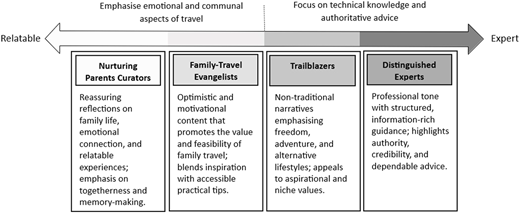
Positioning and appeal of family travel influencer types. Source(s): Developed by authors
Positioning and appeal of family travel influencer types. Source(s): Developed by authors
Considering findings on the mediating role of trust regarding the impact of expertise, authenticity and homophily on loyalty and marketing outcomes (Kim and Kim, 2021), each of the identified appeal types contributes to distinct trust-building processes between influencers and their audiences. Inspirational Wanderlust appeals foster affective trust by evoking emotional resonance and parasocial intimacy while parents feel emotionally connected to influencers who share moments of family joy and wonder. Informational Guidance generates cognitive trust through structured, practical advice that alleviates uncertainty, signalling competence and preparedness. Meanwhile, Experiential Reasoning supports moral legitimacy, as influencers justify travel choices by aligning with values such as child development, sustainability or cultural learning.
5.2 Theoretical implications
Our study advances influencer marketing theory by showing how family travel constitutes a moralised, high-involvement consumption context, where persuasive strategies are shaped by child-centred risk, heightened parental responsibility and collective decision-making. These constraints along with the intangibility and the inherent uncertainties of the tourism experience demand that influencers legitimise persuasion through ethical credibility, relational accountability and caregiving competence. This alignment builds a context-sensitive framework, showing that influencer persuasion in family travel differs fundamentally from generic travel contexts, moving beyond surface classification towards understanding how parental identity and perceived risk structure strategic positioning.
The suggested typology complements and sharpens prior frameworks. For instance, Nurturing Parents mirror Snoopers (Gross and von Wangenheim, 2018) via emotional resonance; Distinguished Family-Travel Experts resemble Informers by providing structured guidance; Evangelists parallel Entertainers through motivational storytelling; and Trailblazers, akin to Infotainers, combine inspiration with ideological narrative. While the four personas partially overlap with existing typologies, they represent a distinct contribution by grounding credibility not in format or tone but in moral and relational accountability. For instance, Nurturing Parents embed authenticity in parental ethics, while Trailblazers turn alternative family lifestyles into ideological branding. This reframes influencer work as legitimacy construction, not simply content production.
Moreover, the present study theorises hybrid positioning: influencers dynamically combine identity resources such as parenthood, professionalism or lifestyle uniqueness in response to life-stage transitions and platform demands (Khamis et al., 2017). By defining a clear family target audience and crafting a consistent persona -without compromising authenticity- influencers can enhance credibility and brand value (Saleh, 2025). This flexible self-branding aligns with audience-specific needs and enhances parasocial engagement (Lu et al., 2023).
Importantly, the proposed typology conceptualises influencer positioning as relationally and normatively embedded, shaped by parental responsibility, caregiving visibility and family-specific anxieties. It identifies distinct trust-building logics: affective (Nurturing Parents), motivational (Evangelists), cognitive (Experts) and ideological (Trailblazers), thus revealing qualitatively different mechanisms of legitimacy rooted in how influencers negotiate care, risk and responsibility in high-involvement decisions such as family travel. By introducing parenthood as a structuring dimension of influencer identity, the typology shows that authenticity, expertise and persuasion operate differently when filtered through caregiving roles, thereby shifting analysis from surface-level classifications to deep social positioning.
Beyond classification, the framework advances a process-based explanation of trust formation. As illustrated in Figure 1, influencer positioning functions as an upstream identity orientation that shapes the selection of content appeals, which act as downstream mechanisms through which trust is constructed. Embedded in the risk-sensitive context of family travel, this process follows a clear pathway from positioning to appeals and trust, with different influencer types activating distinct trust routes. In doing so, the framework reframes influencer marketing as a context-sensitive mechanism of uncertainty reduction, integrating identity, communication and context into a coherent explanatory model.
5.3 Practical implications
As influencers’ role in destination branding increases (Hernández-Méndez and Baute-Díaz, 2024), destination marketers should move beyond generic “family-friendly” branding and adopt differentiated influencer collaboration strategies aligned with specific positioning and appeal profiles. As noted by Zhang et al. (2025), influencers’ perceived personality traits can be transferred to tourism brands; thus, careful considerations and choices should be made. It is therefore suggested that influencer marketing campaigns for family travel are grounded not only in quantitative metrics but also in positioning–appeal alignment. Influencers operating as Nurturing Parents and Family-Travel Evangelists rely heavily on emotional resonance and experiential reassurance. Partnerships with these creators should prioritise narrative-based formats such as family diaries, behind-the-scenes travel routines and reflective storytelling that foreground children’s emotions, logistical challenges and coping strategies.
In contrast, collaborations with Distinguished Family-Travel Experts should emphasise structured informational content. Campaign briefs should specify deliverables such as comparative accommodation reviews, safety audits and transport guides, which respond directly to parents’ risk-management concerns identified in the findings. Trailblazers, by comparison, are most effective when campaigns support longer-term storytelling around lifestyle coherence, slow travel or alternative mobility practices, rather than short-term promotional posts. Moreover, in terms of content creation, the prominence of precautionary discourses in the dataset suggests that risk communication constitutes a central credibility resource. Tourism organisations should therefore integrate explicit safety and contingency messaging into influencer campaigns. This may include co-created checklists, destination-specific risk maps and emergency-response narratives embedded within experiential content. Rather than diluting aspirational imagery, such transparency enhances legitimacy in morally sensitive family contexts. Table 3 links the proposed positioning patterns with specific managerial strategies for DMOs and Tourism Businesses.
Positioning patterns and managerial implications for DMOs and tourism businesses
| Positioning patterns | Managerial strategies for DMOs | Managerial strategies for tourism businesses |
|---|---|---|
| Nurturing Parent | Suitable choice to position destinations through authentic, emotion-driven storytelling that highlights family bonding and everyday travel realities Most appropriate for campaigns that normalise challenges and showcase inclusivity | Collaboration on soft-sell, experience-based content (e.g. family stays, dining, activities) Most appropriate for prioritisation of relatability over promotion, encouraging reviews and narratives that build trust rather than immediate conversion |
| Family-Travel Evangelist | Suitable for campaigns that stimulate demand by reframing the destination as accessible and family-friendly Most appropriate for “you can do it too” narratives to reduce perceived barriers | Suitable for conversion-oriented storytelling, combining inspiration with practical demonstrations of services (e.g. itineraries, packages) Most appropriate to position offerings as enablers of memorable family experiences |
| Distinguished Family-Travel Expert | Suitable to position destination as safe, well-organised and family-oriented through data-backed content (e.g. infrastructure, accessibility, safety standards) Most appropriate for informative guides and planning tools | Suitable for high-involvement decision support, such as detailed reviews, comparisons and transparent pricing Most appropriate to highlight functional value, safety and reliability to facilitate bookings |
| Trailblazer | Ideally aligned with place branding strategies that emphasise uniqueness, sustainability or alternative lifestyles (e.g. slow tourism, digital nomadism) Most appropriate for destination differentiation and positioning as alternative travel choices | Suitable for selective partnerships for niche positioning, allowing high creative freedom Most appropriate on experiential, non-mainstream offerings (e.g. eco-lodges, long-stay packages) that align with values-driven narratives |
Considering the limited agency afforded to children in influencer narratives, managers should develop campaign formats that foreground children’s experiential perspectives in ethically appropriate ways. Examples include age-sensitive activity reviews, child-led itineraries and reflective “what my child loved most” segments. Such practices can strengthen relational authenticity while avoiding exploitative representations. Beyond that, sponsorship arrangements should be structured to protect perceived integrity. Our findings along with previous studies, demonstrate that excessive commercialisation risks undermining moral credibility. Managers should therefore favour long-term partnerships over single-post sponsorships and allow influencers editorial autonomy to disclose limitations, inconveniences or trade-offs. Performance metrics should extend beyond reach and engagement to include sentiment analysis, trust indicators and follower retention.
Finally, platform-specific affordances must inform campaign execution. Long-form blogs and YouTube formats are better suited for risk-reduction narratives and detailed guidance, while Instagram and TikTok are more effective for emotional engagement and inspiration. Integrated campaign architectures should therefore coordinate differentiated content across platforms rather than replicating identical messages.
5.4 Limitations and future research
This study is constrained by its UK-based sample and primary emphasis on textual blog content. While this scope enabled a focused interpretive analysis of discursive positioning and trust-building mechanisms, it does not capture the multimodal and interactive dimensions through which influencer credibility is enacted. In particular, our findings highlight that trust is constructed through the alignment between positioning and appeals, yet remain producer-centric, leaving unclear how these mechanisms are received and interpreted by audiences. Future research should therefore adopt cross-platform, multimethod designs integrating visual analysis and user interactions to examine how relational authenticity and trust are co-constructed in practice. Incorporating audience responses would address this gap by extending the framework from discursive production to reception and validation.
Furthermore, while the study identifies positioning as contextually embedded in family travel norms, it does not examine how these norms vary across cultural settings. The findings suggest that legitimacy is grounded in parenting values, caregiving practices and moral accountability; however, these dimensions are likely to differ cross-culturally. Future research should therefore explore cross-cultural variations in influencer positioning, testing the transferability of the typology and examining how differing institutional, cultural and regulatory environments shape trust formation. This would extend the framework by situating it within comparative cultural contexts.
In addition, although children are central to the construction of influencer narratives, their role remains implicitly embedded rather than explicitly theorised in the current analysis. The findings indicate that children function as anchors of authenticity and legitimacy; yet their agency in shaping content and audience perceptions is not directly examined. Future studies should address this gap by investigating children’s representational and discursive roles, using approaches such as child-inclusive ethnography or longitudinal content analysis to understand how their presence influences positioning strategies and trust over time.
Finally, the analysis points to emerging tensions between authenticity and commercialisation, particularly in how sponsorship is integrated into caregiving narratives. While different disclosure strategies were observed across influencer types, the role of platform affordances and algorithmic incentives in shaping these practices remains underexplored. Future research should therefore examine how algorithmic visibility logics and commercial pressures interact with influencer positioning, influencing disclosure practices, persona flexibility and trust outcomes. Such work would advance the framework by incorporating platform governance and monetisation dynamics as structural conditions of influencer communication.
Declaration of generative artificial intelligence in scientific writing
During the preparation of this work, the author(s) used ChatGPT 5.3 in order to improve readability and use of English language. After using this tool/service, the author(s) reviewed and edited the content as needed and take(s) full responsibility for the content of the published article.
Appendix 1
Projected emphasis and positioning patterns of family-travel influencers
| Projected emphasis | Main positioning patterns* | ||||
|---|---|---|---|---|---|
| a | b | c | d | ||
| Case 1 | Encouragement and inspiration to families | x | x | ||
| Case 2 | Expertise and experience in the tourism sector, giveaways | x | |||
| Case 3 | Travel and exploration, parenthood, family life memories | x | |||
| Case 4 | Distinctions and expertise | x | |||
| Case 5 | Variety of content, inspiration, first-hand practical advice | x | x | ||
| Case 6 | Passion for travel, inspiration to travel with kids, useful info (positive and negative aspects) | x | x | ||
| Case 7 | Independent travel, adventure, off-the-beaten-track experiences | x | |||
| Case 8 | Professional and pioneer in parenting influencer space | x | x | ||
| Case 9 | Storytelling, photography and film-making lover | x | |||
| Case 10 | Vanlife, alternative travel, adventures, family-friendly outdoor escapes | x | |||
| Case 11 | Awards and distinctions in family travel | x | x | ||
| Case 12 | Inspiration, tips, reviews and guides to make family travel easier | x | |||
| Case 13 | Taking the fear out, proving family travel can be enjoyable, providing guides and reviews | x | x | ||
| Case 14 | Slow travel, with or without kids, appreciating the travel experience | x | x | ||
| Case 15 | Alternative way of life, exploring the world as a priority | x | x | ||
| Case 16 | Adventure lovers, tips, tales, information to plan family holidays | x | x | ||
| Case 17 | Rich travel experiences from an ex flight attendant | x | |||
Note(s): *Positioning patterns: (a) Nurturing Parent Curating Family Experiences, (b) Family-Travel Evangelist, (c) Distinguished Family-Travel Expert and (d) Trailblazer
Appendix 2
Types of appeal and utilities in family travel influencer content
| Appeals and utilities | Representative expressions from the analysed content |
|---|---|
| A. Inspirational Wanderlust | |
| A1. Inspiration and feasibility | “It is definitely possible to have a wonderful holiday in … with kids.” |
| “With a bit of planning and the right mindset, family travel can be smooth sailing.” | |
| “Seek new experiences, connections and perspectives as a family!” | |
| A2. Special interests and enrichment | “This beautiful natural reserve is a lovely place for a walk with kids or without and it also has some of the best views of the coastline and the city.” |
| “Karting is a popular activity for people of all ages … race to beat the rest of the family!” | |
| “This is a great place to either try canoeing for the first time, or to just take an easy jaunt along the river.” | |
| B. Informational Guidance | |
| B1. Destination facts | “It was a good place to stop for lunch as …” |
| “It felt like a very relaxed place to be.” | |
| “The queues are much shorter in the evening, the weather is cooler and the night-time parades and fireworks are truly spectacular!” | |
| B2. Budgeting issues | “For great advice on booking discounted theme park tickets and avoiding sneaky costs whilst in … check out …” |
| “Price includes boat rental, fully-equipped kitchen, … Price excludes ….” | |
| “Taxis have a fixed fare into the city, so don’t worry about being ripped off.” | |
| B3. Trip organising assistance and practical tips | “Fabulous location for exploring. We walked practically everywhere.” |
| “It’s only 40 min or so from the airport and they have welcoming interconnecting rooms too.” | |
| “There’s a shuttle bus that picks up directly from most hotels in the area, making transfers really easy.” | |
| C. Experiential Reasoning | |
| C1. Practical guidance | “Here are 10 tips for doing a self-drive safari in … with kids.” |
| “We loved this half day tour for a number of reasons but here are the main five …” | |
| “It was also very easy to book and reassuring as they have an easy rescheduling option should you need to due to the uncertain times we are in.” | |
| C2. Proactive strategies for children’s needs and interests | “I recommend steering clear of these areas to prioritise the safety and comfort of our little explorers.” |
| “Keep kids entertained: Bring books, games, and other activities to keep kids entertained during long drives and downtime at the accommodations.” | |
| “… fairly flat easy route (apart from a couple of tunnels on the main road which are impossible to avoid and I wouldn’t recommend with young children)” | |
| C3. Testimonials and recommendations | “… surpassed all of our hopes, and despite the long days and quiet moments, the children absolutely loved it.” |
| “I would not advise anyone else to put this on their itinerary, especially with kids. … 9 h (possibly 10 and a half by the time we had finished) is not really ideal for anyone.” | |
| “All of these destinations have been tried and tested by real families and have been selected as they offer child-friendly attractions and good public transportation.” | |

