This study aims to examine how the human, structural and relational dimensions of Circular Intellectual Capital (CIC) contribute to the development of Circular Disclosure Capital (CDC), conceptualized as a domain-specific organizational disclosure capability enabling firms to codify, formalize and legitimize DEI-related knowledge. The study adopts a strictly separated measurement architecture in which CDC items (dependent variable) and CIC items (independent variables) share no overlap, directly addressing the circularity concern raised by both reviewers.
A sequential exploratory mixed-method design was applied to a sample of 128 Italian SMEs. CDC is operationalized as a three-level ordinal variable via tertile scoring of four governance-oriented items. Hypotheses are tested with an Ordered Probit model with robust standard errors; nine robustness and sensitivity analyses are reported.
Under strict separation, Circular Human Capital carries the strongest single association with the maturity of Circular Disclosure Capital, alongside a sector effect, while Circular Structural and Circular Relational Capital are not independently distinguishable in the joint model owing to the high integration among the CIC dimensions, interpreted as IC co-evolution in SMEs. Robustness analyses indicate that Circular Structural Capital becomes salient when human capital is excluded and predominates among service-sector firms. The associative second-stage analysis shows Circular Disclosure Capital positively associated with all three dimensions of Circular Intellectual Capital.
Cross-sectional design precludes causal inference. Low CSC reliability (a = 0.027) is acknowledged and addressed through formative interpretation. Single-country, non-random sampling limits generalizability; selection bias is quantified.
SME managers should prioritize CHC investments, leadership training, DEI awareness, female leadership promotion, as the primary lever. In services, formal DEI governance (CSC) dominates; while in manufacturing, leadership commitment (CHC) is decisive.
The study introduces a strictly separated CIC–CDC measurement model, repositions CDC as a domain-specific disclosure capability, documents CHC dominance and IC co-evolution in SMEs, and provides nine robustness checks.
1. Introduction
Recent literature on intellectual capital has progressively shifted attention from the mere identification of intangible resources to the analysis of the processes through which knowledge, structures and relationships are transformed into organizational capabilities. In this perspective, transparency, accountability and inclusion are interpreted as outcomes of deeper cognitive and organizational transformations within firms (Del Giudice et al., 2021; Rossi et al., 2021; Secundo et al., 2023). Although previous studies have linked intellectual capital to circular innovation and sustainability performance (Martínez-Falcó et al., 2025), and others have examined levels of disclosure related to Circular Intellectual Capital (CIC) in non-financial reports (Raimo et al., 2025), it remains underdeveloped how CIC is internally transformed into disclosure capabilities. Existing research predominantly adopts output-oriented approaches or aggregate measures, overlooking the micro-foundational mechanisms through which the human, structural and relational dimensions of CIC translate into mature and structured disclosure practices. Consequently, prior studies explain differences in disclosure outcomes, but provide limited theoretical understanding of the organizational capability through which intellectual capital is transformed into structured disclosure practices. This missing organizational layer constitutes the theoretical gap addressed by the present study.
Within this stream of research, several scholars have emphasized the need to interpret disclosure and transparency as knowledge-based phenomena, shaped by firms' ability to integrate cognitive, structural and relational resources into stabilized organizational practices (Pigatto et al., 2023). However, a dimensional perspective capable of clarifying the specific role of individual components of intellectual capital in the development of disclosure capabilities is still lacking. To address this gap, the present study introduces the concept of Circular Disclosure Capital (CDC), conceptualized as the organizational capability through which Circular Intellectual Capital is translated into structured disclosure practices.
CDC enables firms to codify, formalize and legitimize knowledge related to diversity, equity and inclusion (DEI) through internal strategies, governance mechanisms, incentive systems and shared perceptions of cultural impact. Accordingly, the study seeks to explain how intellectual capital is translated into organizational disclosure capability, rather than simply explaining differences in disclosure outcomes.
In line with the dynamic capabilities perspective, CDC is therefore interpreted not as a simple communicative output, but as an organizational capability that develops through learning and progressive institutionalization processes (Awwad, 2025; Teece, 2018; Zollo and Winter, 2002).
Unlike disclosure capability, which broadly refers to an organization's ability to communicate information, and reporting maturity, which primarily evaluates the quality and completeness of reporting outputs, Circular Disclosure Capital (CDC) captures the organizational mechanism through which intellectual capital is converted into disclosure capability. CDC explains how disclosure capability emerges from the interaction of human, structural and relational intellectual capital.
From a theoretical standpoint, CDC is rooted in the three dimensions of Circular Intellectual Capital. Circular Human Capital reflects inclusive leadership, awareness and organizational learning (Hambrick and Mason, 1984; Helfat and Peteraf, 2015); Circular Structural Capital captures the degree of institutionalization of DEI practices through routines, policies and formal mechanisms (Di Maggio and Powell, 1983); Circular Relational Capital, in turn, encompasses stakeholder-oriented practices that strengthen trust and social legitimacy (Freeman, 1984; Suchman, 1995). This dimensional perspective enables the study to explain the distinct organizational mechanisms through which each component of intellectual capital contributes to the development of disclosure capability.
The empirical analysis focuses on small and medium-sized enterprises (SMEs), a context characterized by lower regulatory pressures and a strong dependence on intangible resources (Tortora et al., 2024). SMEs therefore represent a particularly suitable setting for observing how disclosure capabilities primarily emerge from internal cognitive, organizational and relational processes, rather than from economies of scale or forms of symbolic compliance, thereby providing an appropriate context for investigating the organizational capability underlying disclosure.
The study contributes to the Intellectual Capital literature along four dimensions. First, it introduces a strictly separated measurement model for CIC and CDC that eliminates item overlap between dependent and independent variables. Second, it provides original evidence on the dominant role of Circular Human Capital and on the integrated co-evolution of IC dimensions in SME contexts. Third, it develops a revised CIC–CDC model characterized by symmetric associative feedback mechanisms, repositioning CDC as a domain-specific disclosure capability. Fourth, by focusing on SMEs, it enriches the understanding of how circular intangible resources are transformed into structured, legitimized and learning-oriented disclosure practices in resource-constrained organizational contexts.
2. Theoretical contribution
This study extends the IC literature by introducing CDC as a domain-specific disclosure capability through which organizations transform CIC into structured, formalized and socially legitimized DEI disclosure practices.
2.1 Conceptual positioning of CDC
CDC is grounded in the circular and regenerative logic of CIC, whereby disclosure contributes to resource renewal and fosters recursive cycles of learning and legitimization (Awwad, 2025; Secundo et al., 2022).
Accordingly, CDC is conceptualized as the organizational capability through which intellectual capital is converted into structured disclosure practices rather than as a disclosure output itself.
It may therefore be conceptualized as a domain-specific organizational disclosure capability, analytically distinct from the broader notion of dynamic capability, as cross-sectional data do not allow the sensing, seizing, and reconfiguring processes required by the definition proposed by Teece et al. (1997) to be observed.
In this vein, Table 1 systematically positions CDC relative to four adjacent constructs, clarifying its distinctive domain-specific and process-centric nature.
In this study, circularity is not considered as a generic synonym for “dynamic” or “sustainable”. Building on the application of circular-economy principles to intangible resources (Raimo et al., 2025), the term “circular” denotes a specific regenerative property whereby the intangible resource base is continuously recombined and renewed through the outputs it generates, rather than being consumed through a linear input–output sequence. Circularity differs from a linear conception of intellectual capital on three concrete grounds. (1) From a logical perspective, intellectual capital is viewed linearly as an antecedent stock that is progressively depleted through its deployment, whereas under a circular perspective disclosure outputs feedback as inputs that regenerate the stock itself. (2) In terms of functioning, the unit of analysis shifts from the level of resources to the closure of the loop between resource deployment, reflected in the CIC → CDC relationship, and resource renewal, reflected in the CDC → CIC relationship. (3) From a measurement perspective, circularity requires the observation of both the CIC → CDC path and the return path from CDC to CIC, operationalized through the two-stage design described in Section 5.5. Given the cross-sectional nature of the design, the return path is established in associative rather than causal terms. Accordingly, the circular property is treated as conceptually grounded and empirically supported at an associative level, rather than as causally demonstrated.
2.2 Circular disclosure capital and the CIC system
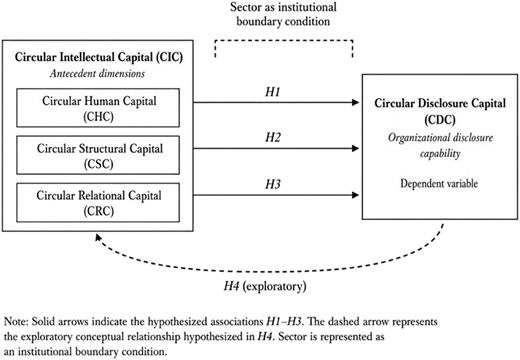
Consistent with the IC–Dynamic Capabilities framework (Awwad, 2025), Circular Disclosure Capital (CDC) represents the organizational capability through which the three dimensions of Circular Intellectual Capital become translated into structured disclosure practices. The proposed framework does not assume that intellectual capital directly influences disclosure maturity, but that this relationship operates through the development of an organizational disclosure capability. More specifically, Circular Human Capital (CHC) influences the way DEI-related information is identified, selected, and interpreted, particularly through inclusive leadership and a stronger orientation towards female leadership (Hambrick and Mason, 1984; Loulou-Baklouti, 2024). Circular Structural Capital (CSC), in turn, supports the institutionalization of DEI practices by embedding them within formal procedures, routines, and organizational mechanisms (Di Maggio and Powell, 1983). Finally, Circular Relational Capital (CRC) contributes to strengthening trust and organizational legitimacy, thereby facilitating more meaningful dialogue with stakeholders (Suchman, 1995).
Accordingly, CHC, CSC and CRC should not be interpreted as independent determinants of disclosure, but as complementary organizational resources that jointly contribute to the emergence of CDC.
3. Research questions and hypotheses
Taken together, these arguments suggest that the circular dimensions of intellectual capital influence DEI disclosure maturity through the development of CDC. While CHC, CSC, and CRC provide the human, organizational, and relational conditions for identifying, formalizing, and communicating DEI-related information, CDC represents the capability through which these resources are translated into more mature disclosure practices.
Tables 2 and 3 summarize the research questions, hypotheses, focal variables, and theoretical foundations of the proposed model.
Figure 1 integrates these relationships by depicting CDC as the mechanism linking CIC to DEI disclosure maturity and guiding the empirical analysis that follows in the next sections.
3.1 Circular human capital and CDC
Circular Human Capital (CHC) is captured through inclusive leadership, DEI awareness, and the promotion of female leadership (B3, B4, and B7). These dimensions provide the cognitive conditions through which DEI-related knowledge is recognized, interpreted and transformed into disclosure capability.
Drawing on Upper Echelons Theory, leadership values and cognitive orientations influence organizational decisions and communication choices (Hambrick and Mason, 1984). Evidence on gender diversity and IC disclosure further suggests that inclusive leadership orientations may foster more transparent disclosure practices (Loulou-Baklouti, 2024). On this basis, the following hypothesis is proposed:
Higher CHC is positively associated with CDC.
3.2 Circular structural capital and CDC
Circular Structural Capital (CSC) refers to the formal organizational mechanisms through which DEI principles are embedded in everyday practices. It is operationalized through inclusive processes (B5) and fair wage governance (B10). By incorporating DEI commitments into procedures and governance arrangements, organizations may be better able to systematically collect, formalize, and communicate relevant information.
Institutional Theory suggests that formalization supports organizational stability and legitimacy (Di Maggio and Powell, 1983). This leads to the following hypothesis:
Higher CSC is positively associated with CDC.
3.3 Circular relational capital and CDC
Circular Relational Capital (CRC) captures inclusive practices that strengthen relationships with employees and other relevant stakeholders. It encompasses disability and neurodiversity practices (B8), parenting support (B9), and DEI-related incentives (B14). Such practices provide substantive evidence of organizational commitment to inclusion and may enhance the credibility of related disclosure.
Stakeholder Theory and Legitimacy Theory suggest that responsiveness to stakeholder expectations strengthens the social relevance and legitimacy of organizational communication (Freeman, 1984; Suchman, 1995). Therefore, the following hypothesis is advanced:
Higher CRC is positively associated with CDC.
4. Research methodology
4.1 Sample and context
The sample consists of 128 Italian firms recruited through DEI-oriented entrepreneurial networks (81.2% report positive perceived DEI impact). Approximately 72% have fewer than 50 employees, 19% are medium-sized, 9% are large (mean size = 1.375). Sectoral composition: 61.7% service-sector firms. A potential upward bias in absolute disclosure maturity levels is acknowledged and quantified in Section 5.7.
4.2 Strict separation architecture
The four items operationalizing CDC (B1, B2, B11, and B13) are exclusively governance- and outcome-oriented and are not included in any CIC dimension. Conversely, the items used to construct CHC (B3, B4, and B7), CSC (B5 and B10), and CRC (B8, B9, and B14) are entirely excluded from the CDC composite, ensuring full measurement separation between the dependent and independent variables (Table 4). All items, including B7, which captures active initiatives promoting female leadership, were included in the original survey instrument.
4.3 Variable operationalisation and reliability
The variables included in the empirical analysis are operationalized through the questionnaire items described in the previous Section 4.2.
Particularly, Table 5 presents the composition of each construct, the relevant items, the operationalization procedures, reliability statistics, and the expected direction of the hypothesized relationships. In line with the strict separation architecture, no item is shared between CDC and the three CIC dimensions.
CDC is modelled as an ordinal dependent variable derived from a composite measure of disclosure-related governance and outcomes. CHC and CRC are specified as reflective composite measures, whereas CSC is treated as a formative construct because its indicators capture distinct, rather than interchangeable, structural mechanisms. Consequently, the low Cronbach's alpha for CSC is consistent with the heterogeneous nature of its formative dimensions (Coltman et al., 2008).
4.4 Descriptive statistics and correlations
The standardized CIC dimensions have a mean of zero and a standard deviation of one by construction, while the distribution of the ordinal CDC measure and its underlying raw composite is also presented to provide a clearer overview of the level of disclosure maturity across the sample. Table 6 reports the descriptive statistics for the study variables.
Additionally, the correlations provide an initial overview of the associations among CDC, the three CIC dimensions, and the control variables. As theoretically expected, CHC, CSC, and CRC are positively related, reflecting the interconnected and co-evolving nature of intangible capital dimensions within SMEs (Table 7).
At the same time, the absence of shared measurement items ensures that these associations do not result from item overlap between the constructs.
4.5 Ordered probit specification and validity
Given the ordinal nature of the dependent variable, the study employs an Ordered Probit model in which the latent propensity for Circular Disclosure Capital is specified as follows:
The observed CDC categories are derived from the underlying latent variable through estimated threshold parameters. Each CIC dimension is operationalized by first summing its corresponding raw questionnaire items and subsequently transforming the resulting composite into a z-score. This aggregation procedure is adopted throughout the analysis and ensures the exact reproducibility of the correlation and multicollinearity diagnostics reported below.
Variance Inflation Factor diagnostics indicate no evidence of severe multicollinearity. The recomputed VIF values are 3.9 for CHC, 3.5 for CSC, and 2.6 for CRC, all remaining below the conventional threshold of 5. Although the CIC dimensions are positively correlated, these associations are interpreted as reflecting the substantive co-evolution of human, structural, and relational components of intellectual capital within SMEs, rather than a methodological concern.
As an additional diagnostic for common method bias, a Harman single-factor test was conducted. The first unrotated factor accounts for 46.9% of the total variance, remaining below the conventional 50% threshold. This result provides no indication that a single common factor dominates the observed relationships, although it is interpreted as a supplementary diagnostic rather than definitive evidence against common method bias.
5. Results
5.1 Ordered probit results: CIC → CDC
The main analysis examines whether the three dimensions of CIC are associated with Circular Disclosure Capital, while accounting for firm size and sector. The Ordered Probit estimates provide an assessment of the independent contribution of CHC, CSC, and CRC to the ordinal levels of CDC maturity. Table 8 presents the results of the full model, together with the relevant model-fit statistics.
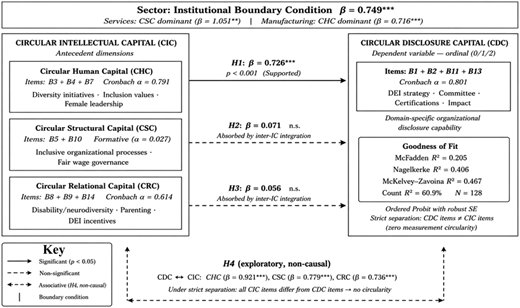
The model is estimated on 128 observations and shows an acceptable overall fit (Log-lik = −110.657; AIC = 235.31; BIC = 255.28; McFadden R2 = 0.205; Nagelkerke R2 = 0.406; McKelvey–Zavoina R2 = 0.467). The results indicate that CHC and sector are the only statistically significant predictors in the full specification.
Circular Human Capital is positively associated with CDC maturity (CHC: β = 0.726; z = 3.46; p < 0.001), thereby supporting H1. Firms characterized by stronger female leadership promotion, diversity initiatives, and inclusion-oriented values tend to exhibit higher levels of disclosure maturity. This finding is consistent with Upper Echelons Theory, according to which leadership-related values and cognitive orientations shape organizational choices and communication practices (Hambrick and Mason, 1984), as well as with evidence linking gender diversity to intellectual capital disclosure (Loulou-Baklouti, 2024). CHC should, however, be interpreted as the strongest individual predictor within an integrated CIC system rather than as the sole antecedent of CDC. The relatively high inter-correlations among CIC dimensions suggest that human, structural, and relational forms of capital co-evolve, while their relative contribution remains dependent on the allocation of shared variance across the model specification (Table 11).
Circular Structural Capital (CSC: β = 0.071; n.s.) and Circular Relational Capital (CRC: β = 0.056; n.s.) do not reach independent statistical significance in the full model. This result should be interpreted cautiously in light of the substantial correlations among the CIC dimensions (r ≥ 0.73; see Section 5.2 and Table 10). The robustness analyses indicate that CSC retains explanatory relevance when CHC is excluded from the specification (M4: β = 0.470; p < 0.01), and that its association with CDC is particularly pronounced among service firms (M5: β = 1.051; p < 0.01). These findings suggest that the non-significant coefficients in the full model do not necessarily imply a lack of substantive relevance, but may reflect the overlapping and mutually reinforcing nature of CIC dimensions.
Firm size is not statistically significant (β = 0.182; n.s.). Although the sector coefficient is positive and statistically significant in the reported model (β = 0.749; z = 3.82; p < 0.001), and comparable in magnitude to the CHC coefficient, sector is treated as a control variable rather than as a headline result. Its significance depends on the services/manufacturing classification adopted. Specifically, the reported estimate is based on a broader definition of services comprising 79 firms, whereas the coefficient is not statistically significant under the more natural sectoral split including 62 service firms. The classification rule is therefore documented explicitly, and the sector-stratified models M5 and M6 are interpreted as exploratory indications of potentially differentiated mechanisms rather than confirmatory evidence.
Finally, the estimated cut-off points are correctly ordered (τ1 = 0.000; τ2 = 1.249), supporting the internal consistency of the ordinal specification.
To complement the coefficient estimates, average marginal effects were calculated to assess the substantive implications of the model for the probability of reaching a high level of disclosure maturity. Table 9 reports the average change in the predicted probability of belonging to the highest CDC category associated with a one-standard-deviation increase in each continuous explanatory variable.
The results reinforce the central role of Circular Human Capital. A one-standard-deviation increase in CHC is associated with an approximately 15.8 percentage-point increase in the probability of high CDC maturity, representing the only substantively large and statistically significant marginal effect. This result indicates that the association identified in the Ordered Probit model is not only statistically significant but also meaningful in probability terms. Marginal effects for the remaining CIC dimensions are not statistically significant in the full specification and should be interpreted in light of their shared variance with CHC.
5.2 IC integration in SMEs: interpreting the collinearity pattern
The non-significant independent coefficients of CSC and CRC in the full model should be interpreted in light of the interconnections among the three CIC dimensions. Under the aggregation procedure adopted in the main analysis, namely the z-standardization of summed item scores, CHC, CSC, and CRC are strongly correlated, with correlations ranging from 0.73 to 0.83. This pattern is consistent with the possibility that, in SMEs, inclusive leadership, formal DEI arrangements, and stakeholder-oriented practices develop in a mutually reinforcing manner, often under the influence of the same managerial actors. However, this interpretation should remain cautious, as the magnitude of the correlations is sensitive to the aggregation rule. When constructs are computed as the mean of pre-standardized items, the inter-CIC correlations range from 0.61 to 0.74. The co-evolution of CIC dimensions should therefore be regarded as a plausible substantive interpretation rather than as a definitive empirical conclusion.
The revised correlation matrix also reports the corrected associations between CDC and the CIC dimensions, which are 0.60 for CHC, 0.51 for CSC, and 0.47 for CRC. These correlations are consistent with the positive direction of the hypothesized relationships, while also indicating that the CIC dimensions share a substantial proportion of variance. Table 10 reports the corresponding Variance Inflation Factor diagnostics. Although the VIF values for CHC and CSC indicate moderate collinearity, all values remain below the conventional threshold of 5. The estimates therefore do not indicate severe multicollinearity, but they do suggest that the independent coefficients should be interpreted as conditional effects within an integrated CIC system.
A specific measurement consideration concerns CSC. Its Cronbach's alpha of 0.027 reflects the heterogeneous nature of its two indicators, namely inclusive organizational processes (B5) and fair-wage governance (B10), rather than inadequate measurement quality. CSC is specified as a formative construct because these items represent distinct organizational mechanisms through which DEI principles may become structurally embedded. In this case, the indicators are defining components of the construct rather than interchangeable manifestations of a common latent variable. Internal-consistency reliability measures, including Cronbach's alpha, are therefore not appropriate criteria for its assessment (Coltman et al., 2008; Diamantopoulos and Winklhofer, 2001).
The formative specification is supported by the negligible collinearity between B5 and B10, with an indicator-level VIF close to 1.0, and by evidence of nomological validity. In the robustness models, CSC becomes positively associated with CDC when CHC is excluded from the specification (M4: β = 0.470, p < 0.01), and it shows a particularly strong association among service-sector firms (M5: β = 1.051, p < 0.01). These findings are consistent with the institutional argument that formalized DEI-related structures may support disclosure capability, although the sector-specific result remains exploratory.
As an additional sensitivity check, B5 and B10 were entered separately rather than combined into the formative CSC composite. The substantive conclusions remained unchanged: neither indicator was independently significant in the full model, CHC retained a positive and statistically significant association with CDC, and overall model fit was essentially identical across specifications (McFadden pseudo-R2 = 0.22). This result suggests that the main findings do not depend on the use of the CSC composite.
5.3 Robustness analyses
The robustness analyses assess whether the main results remain stable across alternative model specifications and, separately, whether they are sensitive to the allocation of questionnaire items across the CIC dimensions and the dependent variable. Table 11 reports six Ordered Probit specifications that progressively modify the set of controls, the inclusion of CHC, and the sectoral composition of the sample.
Across Models 1–3, CHC remains positively and significantly associated with CDC, with coefficients ranging from 0.726 to 0.782 (p < 0.001). This pattern indicates that the positive association between CHC and disclosure maturity is stable to the exclusion of sector and other control variables. However, consistently with the collinearity pattern discussed in Section 5.2, CHC should be interpreted as the strongest individual predictor within the adopted specification rather than as the exclusive driver of CDC.
When CHC is excluded from the model, CSC becomes positive and statistically significant (M4: β = 0.470; p < 0.01). This result indicates that structural capital retains explanatory relevance once the variance shared with human capital is no longer allocated to CHC. It therefore provides supportive, albeit conditional, evidence for H2. CRC remains non-significant across the alternative specifications.
The sector-stratified models point to potentially differentiated patterns. Among service firms, CSC is the strongest predictor of CDC (M5: β = 1.051; p < 0.01), whereas among manufacturing firms, CHC remains positive and significant (M6: β = 0.716; p < 0.001). Given the sensitivity of the sector variable to the adopted services/manufacturing classification, these estimates are interpreted as exploratory indications of heterogeneous mechanisms rather than as confirmatory sectoral effects.
A further and more demanding robustness assessment concerns the allocation of items between CDC and the CIC dimensions. Under the main measurement architecture, the governance-oriented items B1, B2, and B11 are assigned to CDC, leaving CSC operationalized through two heterogeneous residual indicators. Alternative yet theoretically defensible item allocations produce different relative patterns. When B1 and B2 are reassigned to CSC, CSC becomes the dominant predictor of CDC (β = 0.75; p < 0.05). When B1, B2, and B11 are reassigned, CRC becomes the only statistically significant predictor. In addition, excluding B7, which captures active initiatives promoting female leadership, substantially reduces the CHC coefficient, from approximately 0.80 to 0.54.
These allocation-sensitive results do not invalidate the main specification, but they qualify its interpretation. The CHC-dominant result should be understood as conditional on the adopted measurement architecture rather than as an unconditional property of the CIC dimensions (Table 11).
5.4 Exploratory second-stage analysis: CDC → CIC (H4)
To provide an illustrative assessment of the proposed return path from CDC to the CIC dimensions, a second-stage analysis examines the association between predicted CDC and the pure components of CHC, CSC, and CRC. This exercise is reported as descriptive evidence only and does not provide a causal test of regeneration.
Because predicted CDC is constructed from the CIC dimensions in the first-stage model, the resulting second-stage associations are mechanically related to the correlation between the generated CDC predictor and each CIC component. Moreover, the associated standard errors do not account for first-stage estimation uncertainty. The estimates should therefore not be interpreted as independent inferential evidence in support of H4, but only as an illustration of the reciprocal conceptual linkage underlying the circular framework (Table 12).
The Table reports the standardized descriptive associations. The positive patterns are consistent with the conceptual argument that disclosure capability and circular intellectual capital are interconnected. However, given the cross-sectional design and the generated-regressor structure, they carry no evidential weight for a regenerative or causal return mechanism. In particular, the positive and comparable associations observed for all three dimensions, including CSC, do not corroborate a differentiated pattern across the CIC components; H4 is therefore assessed only in its associative formulation, and the significance levels reported in Table 12 should not be given inferential weight, since they derive from a generated regressor whose standard errors do not incorporate first-stage estimation uncertainty.
5.5 CRC measurement sensitivity
Re-estimating with two-item CRC (B8+B9; α = 0.633) yields CHC β = 0.410 (p < 0.01); CSC β = 0.579 (p < 0.001); CRC β = 0.038 (n.s.). The persistent non-significance of CRC indicates that its independent association with CDC remains weak regardless of item composition, while the exclusion of B14 reallocates shared variance towards CSC (β = 0.579, p < 0.001), further confirming the sensitivity of the relative ordering of the CIC dimensions to measurement choices. The three-item CRC specification (B8+B9+B14) is retained as the primary measure on theoretical grounds.
5.6 Selection bias and generalizability
The findings should be interpreted in light of the characteristics of the sample and the data-collection procedure. Compared with the Italian SME population, in which micro and small firms account for approximately 95% of enterprises, medium-sized firms for 4.5%, and large firms for 0.5% (ISTAT), the present sample over-represents medium-sized and large organizations by approximately 4.2 and 18.8 times, respectively. In addition, 81.2% of sampled firms report a positive perceived DEI impact.
The study population should therefore be understood as SMEs that are already relatively engaged with DEI and sustainability issues, rather than as representative of the entire Italian SME population. This constitutes a meaningful but bounded empirical context, particularly suited to examining the organizational conditions associated with DEI disclosure maturity. Generalization to firms with limited or no engagement in DEI should be made cautiously and would require future studies based on stratified or probability-based sampling designs.
The questionnaire was distributed between November 2024 and April 2025 through Italian business and professional networks involved in DEI and sustainability initiatives. Participating firms were invited to complete a structured online questionnaire, resulting in 128 complete responses. Because the survey was disseminated through professional and business networks rather than through a closed sampling frame, a precise response rate cannot be calculated. The sample is therefore best characterized as a convenience and network-based sample.
A qualitative assessment of potential non-response bias was conducted by comparing the observable characteristics of respondents with those of the contacted organizations, where such information was available. No systematic differences emerged with respect to firm size and sector. Nevertheless, self-selection remains a relevant limitation, as firms already attentive to DEI were more likely to participate. This selection mechanism is treated as an explicit boundary condition of the study rather than as evidence of population-level representativeness.
5.7 CDC operationalisation: threshold sensitivity
Sensitivity analyses with alternative CDC cutpoints (theoretically motivated at 2/5 on the 0–8 scale; quartile cutpoints at 2/7) yield consistent core findings: CHC positive and significant (β range: 0.32–0.57); sector stable (β range: 0.61–0.82). An OLS specification on the continuous CDC composite (0–8) yields R2 = 0.469 with the same ordering. The ordinal specification is retained for theoretical interpretability.
5.8 Repositioning CDC: domain-specific disclosure capability
The empirical findings are consistent with the conceptualization of CDC as an organizational disclosure capability through which DEI-related knowledge is codified, formalized and embedded within organizational governance systems. Rather than representing disclosure outputs themselves, the results support the interpretation of CDC as the organizational capability enabling the systematic development of disclosure practices.
This conceptualization extends prior work on sustainability and non-financial disclosure by linking disclosure capability to the human, structural, and relational dimensions of Circular Intellectual Capital in SMEs (Adams and Larrinaga, 2019; Cuozzo et al., 2017; Pigatto et al., 2023). At the same time, a construct-validity boundary should be acknowledged. The CDC measure is operationalized through governance-related infrastructure, including formal strategies, committees, and certification, together with one perceptual item. It does not directly capture the volume, quality, or audience reach of external DEI reporting. The term “disclosure” is therefore used to refer primarily to the internal organizational capacity that enables DEI-related information to be formalized and communicated, while implications for external reporting should be interpreted cautiously.
Figure 2 summarizes the empirical model and highlights the main and qualified findings. It presents the positive association between CHC and CDC in the full specification, the conditional relevance of CSC across alternative models, the non-significant independent role of CRC, and the role of sector as a contextual control whose significance remains sensitive to the adopted classification rule.
Overall, the findings support an interpretation of CDC as embedded within an integrated system of circular intellectual capital rather than as the isolated outcome of a single resource dimension. CHC emerges as the strongest individual correlate under the main measurement architecture, but the robustness and allocation analyses indicate that the relative prominence of CIC dimensions depends partly on the way shared governance-related elements are assigned across constructs. The empirical evidence should therefore be read as supporting an associative and context-dependent model of DEI disclosure capability, rather than a causal account of resource regeneration or a definitive ranking among the CIC dimensions.
6. Discussion
6.1 CHC dominance and IC Co-evolution
Under the strict measurement-separation architecture, CHC emerges as the strongest individual predictor of CDC maturity. This result should not, however, be interpreted as evidence of unconditional CHC primacy. Rather, the findings suggest that CIC operates as an integrated system within SMEs, in which human, structural, and relational dimensions are substantially interconnected. CHC carries the strongest individual signal in the full specification, but the high inter-CIC correlations indicate that these dimensions are not fully separable in empirical terms and may develop jointly in resource-constrained organizational settings.
The relative ordering of CHC, CSC, and CRC is also conditional on the adopted measurement architecture. In the main specification, the governance-oriented items B1, B2, and B11 are assigned to the CDC composite. Under alternative but theoretically defensible allocations, CSC or CRC emerge as the strongest predictor (Table 11). The results therefore qualify the earlier interpretation of CSC dominance as a consequence of measurement overlap and indicate more broadly that the apparent prominence of individual CIC dimensions depends partly on how governance-related elements are allocated across constructs.
Within this bounded interpretation, the positive association between CHC and CDC remains theoretically meaningful. Inclusive leadership, DEI awareness, and the promotion of female leadership appear to provide important conditions through which DEI-related information can be recognized, interpreted, and translated into organizational disclosure practices. This pattern is consistent with Upper Echelons Theory, which emphasizes the role of managerial values and cognitive orientations in shaping organizational choices and communication practices (Hambrick and Mason, 1984), as well as with evidence linking gender diversity to intellectual capital disclosure (Loulou-Baklouti, 2024).
At the same time, the dependent variable should be interpreted carefully. CDC captures DEI-related governance infrastructure and perceived disclosure-related impact rather than the volume or quality of external DEI reporting. The findings should therefore be understood as addressing the organizational capacity to formalize and communicate DEI-related knowledge, rather than providing direct evidence on external disclosure outputs.
The sector effect offers a further contextual indication, although it is not treated as a definitive finding. The positive coefficient observed under the broader services classification suggests that institutional environments may shape the conditions under which CDC develops. However, because the effect is sensitive to the services/manufacturing classification, the sector-stratified results are best interpreted as exploratory evidence of potentially differentiated mechanisms rather than as confirmatory support for a sector-specific explanation.
6.2 Theoretical implications: symmetric regeneration
The exploratory second-stage analysis points to positive associations between CDC and the three CIC components, which is broadly consistent with the conceptual premise that disclosure-related organizational capacity and circular intellectual capital are interconnected. This pattern may be interpreted as compatible with a regenerative view in which the formalization and communication of DEI-related knowledge contribute to organizational learning, legitimacy, and stakeholder engagement (Awwad, 2025; Zollo and Winter, 2002).
However, this interpretation must remain cautious. Given the cross-sectional design and the generated-regressor structure of the second-stage analysis, the observed associations do not constitute causal evidence of a regenerative feedback loop. Rather, they provide an illustrative representation of the reciprocal conceptual linkage between CIC and CDC. The contribution of the study therefore lies in proposing and empirically exploring a circular framework, while leaving the temporal and causal dynamics of regeneration to future longitudinal research.
6.3 Managerial and policy implications
The findings suggest that managers seeking to strengthen DEI-related disclosure capability should invest in the organizational conditions that enable DEI information to be recognized, formalized, and communicated. In particular, attention should be directed towards leadership development, DEI awareness, and initiatives supporting female leadership, including the practices captured by item B7. These interventions may reinforce the human-capital conditions associated with more mature DEI governance and disclosure infrastructure.
The exploratory sector-specific analyses further suggest that different organizational levers may be more relevant across contexts. In service firms, formal DEI processes and governance arrangements appear particularly relevant, whereas in manufacturing firms leadership-related human capital shows the strongest association with CDC. Since these patterns are sensitive to sector classification and based on a non-probability sample, they should guide context-sensitive reflection rather than be treated as prescriptive sectoral rules.
For policymakers, the results support the potential value of soft, capacity-building instruments. DEI-oriented training initiatives, leadership-development programmes, peer-learning networks, and voluntary reporting guidance may help firms develop both the human and structural foundations of DEI governance without imposing disproportionate compliance burdens. Such interventions may be especially relevant for SMEs that are already beginning to engage with DEI and sustainability issues, while broader conclusions require evidence from more representative samples.
7. Conclusions
This study examined the associations between the human, structural, and relational dimensions of Circular Intellectual Capital and Circular Disclosure Capital in Italian SMEs. By adopting a strictly separated measurement architecture, the study sought to distinguish the governance- and outcome-oriented items used to operationalize CDC from the items capturing the three CIC dimensions.
The strict separation between CIC and CDC enabled the study to examine the organizational conditions associated with DEI disclosure capability while minimizing conceptual and measurement overlap. Under the main specification, Circular Human Capital emerges as the strongest individual correlate of CDC maturity (β = 0.726, p < 0.001). This finding suggests that inclusive leadership, DEI awareness, and initiatives supporting female leadership are meaningfully associated with the organizational capacity to This finding should be interpreted within the empirical boundaries of the study. The relative prominence of CHC, CSC and CRC depends partly on the adopted measurement architecture, suggesting that CHC represents the strongest individual association in the estimated model rather than a stable hierarchy among CIC dimensions, rather than as evidence of a stable hierarchy among the CIC dimensions.
The results also reveal substantial interconnections among CHC, CSC, and CRC. The findings also suggest that the three CIC dimensions are empirically interconnected, supporting the interpretation of CIC as an integrated organizational system rather than as a set of fully independent resources. This pattern is compatible with the view that, in SMEs, leadership orientations, formal DEI arrangements, and stakeholder-related practices may develop jointly as part of an integrated intellectual-capital system. At the same time, the observed correlations may also limit the statistical separation of the independent contribution of each CIC dimension. The integrated-system interpretation should therefore be regarded as a theoretically plausible reading of the findings, rather than as a definitive demonstration of co-evolutionary processes.
The sector results provide an additional contextual indication, but do not support a definitive sectoral conclusion. Sector is statistically significant under the broader services classification, whereas the result does not hold under the more natural sectoral split. Similarly, the sector-stratified models suggest that CSC may be more strongly associated with CDC in service firms, while CHC remains more prominent in manufacturing firms. Given the sensitivity of these estimates to the sector classification and the non-probability nature of the sample, these patterns should be treated as exploratory evidence of potentially differentiated mechanisms rather than as confirmatory sector-specific effects.
The exploratory second-stage analysis is conceptually consistent with the proposed circular framework, insofar as predicted CDC is positively associated with the CIC components. However, this result cannot be interpreted as empirical evidence of regeneration or reciprocal causality. The exploratory second-stage analysis is consistent with the proposed circular framework, although it should be interpreted as associative rather than causal evidence. Longitudinal research will be necessary to examine whether these relationships evolve into observable regenerative dynamics over time. The circular and regenerative logic of the framework should therefore be understood as an interpretive lens grounded in the circular intellectual-capital literature, rather than as a dynamic process demonstrated by the present cross-sectional data.
The study offers three main contributions. First, it advances CDC as a domain-specific organizational capability embedded in DEI-related governance structures and connected to the human, structural, and relational dimensions of circular intellectual capital. Second, it highlights the importance of strict measurement separation when examining the relationship between intellectual capital and disclosure-related constructs. The allocation-sensitivity analyses show that theoretical conclusions can be materially affected by the way governance-oriented items are assigned across dependent and independent variables. Third, it proposes an integrated reading of CIC in SMEs, suggesting that the relevant dimensions may be empirically intertwined rather than fully distinct in resource-constrained organizational settings.
From a managerial perspective, the findings suggest that DEI disclosure capability is more likely to develop where firms invest in leadership development, DEI awareness, and initiatives supporting female leadership. Formal organizational arrangements, including inclusive procedures and fair-wage governance, may also play an important role in creating the infrastructure through which DEI-related information can be systematically collected and formalized. Rather than treating disclosure as a stand-alone compliance activity, SMEs may benefit from approaching it as part of a broader organizational process linking leadership orientation, governance structures, and stakeholder-related practices.
For policymakers and business-support organizations, the findings point to the potential value of non-coercive, capacity-building interventions. DEI-oriented training, governance templates, voluntary reporting guidance, certification pathways, and peer-learning networks may help firms develop the organizational conditions required to formalize and communicate DEI-related practices. Such instruments may be particularly relevant for SMEs that are beginning to engage with DEI and sustainability issues but lack the internal resources required to develop more structured governance arrangements.
Several limitations should be acknowledged. The cross-sectional design precludes causal and temporal inference. The sample consists of 128 firms recruited through business and professional networks engaged with DEI and sustainability, making it a convenience and network-based sample rather than a representative cross-section of Italian SMEs. Medium-sized and large firms are over-represented, and the sample is likely to include organizations already more attentive to DEI than the broader SME population. In addition, the use of self-reported measures may introduce social-desirability and common-method concerns. Finally, CSC is specified as a formative construct composed of heterogeneous indicators, and its assessment should therefore rest primarily on theoretical content validity, indicator relevance, and nomological consistency rather than on internal-consistency reliability alone.
Future research should test the proposed framework using longitudinal designs able to observe whether, and under what conditions, disclosure capability contributes over time to the renewal of intellectual-capital resources. Larger and more representative samples would enable more robust tests of the differentiation and interaction among CHC, CSC, and CRC, including SEM or PLS-based approaches. Comparative studies across countries and institutional settings could examine whether the CIC–CDC relationships vary according to regulatory environments, sectoral logics, and DEI maturity. Further research may also incorporate additional dimensions, such as digital capital, network capital, and data-governance capabilities, to deepen understanding of how SMEs build and sustain DEI-related organizational capacity.
Overall, the study positions Circular Disclosure Capital as a meeting point between knowledge, governance, and legitimacy. The findings do not demonstrate a causal regenerative loop, but they provide a bounded empirical basis for considering DEI disclosure capability as embedded within a broader and interconnected system of circular intellectual capital. In this perspective, the capacity to formalize and communicate DEI-related knowledge is not simply a reporting outcome, but an organizational condition that may support more coherent, credible, and inclusive business practices over time.
Author’s contribution
Armando Papa's contribution to this article is an output of the research project HSE-BR-2025-14, implemented as part of the Basic Research Program at HSE University.