European countries are experiencing a phenomenon known as “double aging,” which is placing long-term care regimes under considerable strain. The majority of long-term care is provided by relatives, and this informal care is vital for the functioning of care regimes. Most of this informal long-term care (iLTC) is provided by women. The consequences of the unequal distribution of care within society are a crucial, yet poorly addressed aspect of social policy research. We address this research gap and provide insights into the socio-economic impacts of the unequal gender distribution of iLTC.
For the review, systematic database searches were performed in PubMed and EBSCO CINAHL, using the SPIDER methodology. A total of 7,385 abstracts were screened, whereof 11 studies were included. A critical appraisal tool, the PRISMA checklist and a qualitative synthesis were applied.
Three analytical themes were identified: (1) Social Experiences and Norms, (2) Informal Caregivers’ Labour Market Participation and (3) Economic Costs of iLTC. The results showed that women and men are impacted differently: Women are quantitatively discriminated, while caregiving men are likely to face qualitative discrimination within their tasks due to role expectations and gender norms.
Novel insights emerge from embedding fragmented empirical findings into a holistic societal perspective, opening possibilities for addressing (adverse) outcomes together on a policy level. The findings are of interest for policy makers developing measures to ensure sufficient care supply whilst taking action against gender inequality.
Introduction
In our society formal elderly care is an increasingly scarce good: Due to demographic changes of longer life expectancy and declining birth-rates, European societies struggle with double aging (Kingston et al., 2018; Spasova et al., 2018). As care needs, that health systems globally currently struggle to meet, will increase in extent and complexity (Rahman et al., 2022; Spasova et al., 2018), the demand for care services is rising. At the same time, the supply is challenged by a decline in professional workforce and aging care suppliers (Spasova et al., 2018).
To address this increasing gap between demand and supply of formal care, informal care is often provided by relatives, spouses or friends to complement or substitute professional services (Bonsang, 2009; European Union, 2021; Firgo et al., 2020; Gannon and Davin, 2010) and can be understood as part of an integrated care approach to ensure that care needs are not only met, but in an optimal and holistic way (Goodwin, 2016). Due to aging carers, a growing number of single households and the cost-oriented care policies in most European countries, the question of substitution of formal care with informal care became evident. European studies show that with more complex needs, informal care could not sufficiently substitute formal care (Firgo et al., 2020; Gannon and Davin, 2010).
Informal long-term care (iLTC)
In contrast to formal or professional care, informal care is understood as unpaid care work performed by non-professionals (Barrett et al., 2014). Based on increasing care demand and scarce formal long-term care supply, it is obvious that iLTC is necessary to avoid unmet care needs in a society.
ILTC can be straining: psychologically, relationally, socioeconomically, health-related and physically (Bom et al., 2018; Deufert, 2013; Gérain and Zech, 2019; Labbas and Stanfors, 2023) – defined as caregiver burden (Deufert, 2013). Due to demographic and societal changes, the share of informal care work and its burden will increase for caregivers (Collins, 2014; Heitmueller and Inglis, 2007). Demographic developments like longer life expectancy and therefore a higher share of multimorbidity and frailty in the population in conjunction with declining birth rates entail growing care needs on a societal level that fewer potential caregivers struggle to meet (European Union, 2021). With women’s increasing labour market participation and changes in family structures (European Union, 2021), the pressure on (potential), mostly female, individual caregivers rises. Therefore, more care needs are supposed to be met by relatively fewer potential caregivers, who need to compensate for a growing gap between professional care supply and demand as well as a relatively smaller group of potential informal caregivers compared to more care recipients. While individual drivers towards providing iLTC (e.g. the quality of the respective relationship, the employment status of a potential informal caregiver as well as his or her health status, etc.) have been addressed (Canta et al., 2021; Plöthner et al., 2019; Verbakel et al., 2017), research lacks a holistic societal perspective regarding outcomes of iLTC in Europe. This research aims to contribute to an understanding of the effects of mostly female informal care provision for European societies by analysing socioeconomic outcomes arising from the care situation by gender.
A gendered distribution of iLTC provision
It is well-researched that unpaid care work in Europe is mainly provided by women (European Union, 2021; Skinner and Sogstad, 2022) – contributing to a higher economic vulnerability (Folbre, 2018) or adverse health effects for the caregivers (Bom et al., 2018). Although the share of male carers is rising, this phenomenon still prevails (Deufert, 2013; Heitmueller and Inglis, 2007). Despite male carers quantitatively stepping into the picture across Europe, there remain qualitative differences: Men tend to undertake tasks that are less complex and less time-consuming as compared to women, leaving women rather with long-term care (Estrada Fernández et al., 2019; Skinner and Sogstad, 2022). This unequal distribution can to some extent be explained by gender norms and role expectations: Women are viewed as responsible for caregiving (Zygouri et al., 2021) – leading to female carers taking up help later than male carers (Deufert, 2013).
According to Gidden’s Theory of Structuration societal conditions are on the one hand shaping, on the other hand (re)produced by human action (Giddens, 1984; Turner, 1986) – including gender relations and identities, which are (re)negotiated within care situations (Zygouri et al., 2021). Gender norms are a guiding structure or cause for, as well as an outcome of social agency. Hence, the theory of structuration explains the social patterns on macro- and micro-level of care responsibilities, including social policy within the care-regime, from a gender perspective. Gender norms shape care regimes which in turn (re)produce gender norms that become hegemonial in social policy. Besides different role expectations, female and male carers differ in their characteristics, entailing different economic, social, cognitive and physical resources to manage the care situation as well as mitigate negative effects of it (Zygouri et al., 2021). Therefore, differentiated policies are required to enable and support male and female informal care.
To work towards ensuring care supply in a socially sustainable way and mitigate (gendered) discrimination, we address the question What are socioeconomic outcomes of the gender-unequal distribution of the provision of informal long-term elderly care towards female caregivers in Europe? By gendered discrimination we mean the unequal and unjust treatment of individuals based on their gender, that is often rooted in societal norms, stereotypes and gender imbalances. We seek to embed various gender-relevant outcomes of the provision of informal long-term elderly care in a theoretical framework addressing European society as a whole and therefore provide a more comprehensive understanding of the gender-unequal distribution of the provision of iLTC.
Methods
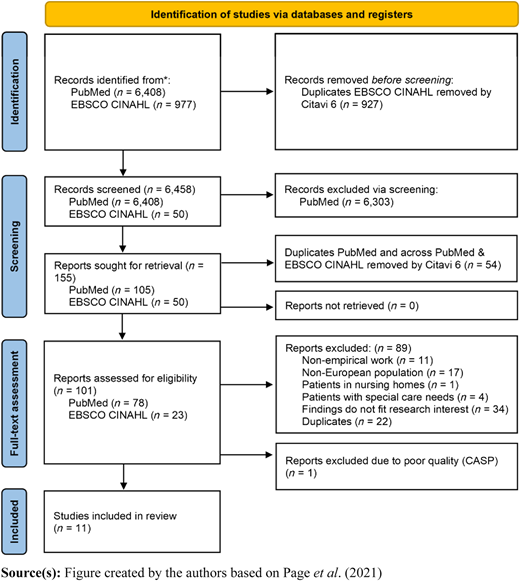
We address the research interest in socioeconomic outcomes of the gender-unequal distribution of iLTC with a systematic review using the databases PubMed and EBSCO CINAHL in May, June and November 2022 – including a final search in November 2023 – and following the Preferred Reporting Items for Systematic Reviews and Meta-Analysis (PRISMA; Page et al., 2021) (Figure 1). Two investigators (BG, AB) developed a search strategy, validated the search process by inclusion and exclusion criteria and screened all abstracts independently. The findings are presented within a qualitative systematic evidence synthesis (Booth et al., 2012), underlying a comprehensive societal perspective based on Anthony Gidden’s Theory of Structuration (Giddens, 1984; Turner, 1986).
Search strategy
To capture socioeconomic outcomes of unequal distribution of providing iLTC, we used the following search query based on the SPIDER model: (gender OR gender*) AND ((elder* OR “older people” OR longterm OR long-term) AND (family OR spousal OR informal) AND (care OR caring)) in the databases PubMed and EBSCO CINAHL. To validate the search process both investigators developed inclusion and exclusion criteria together (shown in Table 1) and screened the abstracts independently via the Abstrackr literature evaluation tool, which is a software for semi-automatic citation screening (Wallace et al., 2012).
Data extraction and analysis
After screening titles and abstracts via Abstrackr (Center for Evidence Synthesis in Health (CESH), 2022), removing duplicates via Citavi (Swiss Academic Software, 2022) and applying a critical appraisal (Critical Appraisal Skills Programme, 2018), we performed open coding using MAXQDA (VERBI, 2022) on the remaining material and generated memos to qualitatively grasp the meaning of the findings and possible implications in a first step. In a second step these passages were assigned to inductive categories to provide an overview of gendered empirical evidence of effects of providing iLTC for hereby it is important that socio-economics male and female caregivers in Europe. The results therefore include aspects stemming from the informal care situation that affect female and male caregivers differently; aspects that vary by caregivers’ gender. In general, there are more than these outcomes of informal care that either affect caregivers irrespectively of their gender or have not been explored across their (possible) gender dimension yet.
Critical appraisal
The checklist of the Critical Appraisal Skill Programme was used for the critical appraisal (Critical Appraisal Skills Programme, 2018). For this purpose, all included studies were independently assessed by two reviewers with regard to the quality of the research question, the study design, the sampling methodology, the adequacy of the methodology to answer the research question and the contribution to the overall research question. As both qualitative and quantitative study designs were included in the synthesis, the checklists for qualitative study designs and cross-sections were merged and assessed according to the study design. Conflicting judgements were discussed and documented in sequential discussions between the reviewers. The critical appraisal at study level can be found in the supplements.
Thematic analysis
To arrive at our final themes, we applied open coding of the material and generated memos to qualitatively grasp the meaning of the findings and possible implications in a first step. In a second analytical step, after finalising the code system, the openly coded passages were assigned to the respective categories they addressed to provide an overview of (until today) found gendered empirical evidence of effects of providing informal care for male and female caregivers in Europe. The results therefore include aspects stemming from the informal care situation that affect female and male caregivers differently; aspects that vary by caregivers’ gender. In general, there are more than these outcomes of informal care that either affect caregivers irrespectively of their gender or have not been explored across their (possible) gender dimension yet.
Results
Included studies
The review includes studies with European populations that operate at least on two levels: 1) They examine the influence of the provision of iLTC for elderly patients from the caregiver’s perspective, and 2) differentiate the caregivers by gender. To meet the inclusion criteria, papers needed to contain empirical evidence concerning social and/or economic outcomes from the caregivers’ perspective. Studies focusing on special needs care that differ from elder care in general and studies focusing on family members of nursing home patients were excluded from the analysis.
Our search yielded 7,385 results. We proceeded to 155 full papers and found twelve papers fitting all inclusion criteria. After a critical appraisal, we dropped another one due to poor quality. In total, eleven studies were further analysed. Conflicts during the whole process were resolved by discussion and consensus.
Of all eleven studies, seven included (potential) informal caregivers directly in their sample (Bainbridge et al., 2021; Heger and Korfhage, 2020; Heitmueller and Inglis, 2007; Kotsadam, 2012; Maresova et al., 2020; Mortensen et al., 2017; Swinkels et al., 2019), three used a proxy sample of the respective care-recipient (Bywaters and Harris, 1998; Kolodziej et al., 2018; Schneider et al., 2013), and one study worked with a sample of the general population in Germany (Zwar et al., 2021). Seven studies performed a secondary analysis (Bainbridge et al., 2021; Heger and Korfhage, 2020; Heitmueller and Inglis, 2007; Kolodziej et al., 2018; Kotsadam, 2012; Mortensen et al., 2017; Swinkels et al., 2019), four collected their own data (Bywaters and Harris, 1998; Maresova et al., 2020; Schneider et al., 2013; Zwar et al., 2021) – two directly from informal caregivers or the national population (Maresova et al., 2020; Zwar et al., 2021). The study descriptives are presented in Table 2.
Three dimensions of socioeconomic outcomes
In the thematic analysis, three themes emerged: 1) social experiences and affected norms, 2) informal caregivers’ labour market participation and 3) economic costs of iLTC.
Since iLTC is mostly provided by women, women are facing what we call quantitative discrimination – while caregiving men are qualitatively discriminated against within their tasks due to role expectations and gender norms. Male carers face an even bigger lack of support compared to female ones, despite their increasing share in caregiving. This might result in men providing less care and therefore reinforce the quantitative discrimination towards women.
Theme 1: social experiences and affected norms
Considering societal expectations and norms, there is evidence that gender egalitarianism values shape caregiving decisions (Bainbridge et al., 2021) – which is in line with the dualism of structure and agency (Giddens, 1984). Where there are less gender role differences and more gender egalitarianism, women and men seem to share care tasks more equally (Bainbridge et al., 2021). Hand in hand with a general expectation for females to take on care tasks goes increased public stigma and increased social distance towards male carers compared to female ones for acting outside their role (Zwar et al., 2021). Moreover, Bywaters and Harris (1998) found that professionals have certain gendered expectations towards caregivers, which result in different responses to female and male informal carers and biased planning and assessing of services. While this public stigma could lead to negative consequences for male carers – such as lack of support – it also fosters disadvantages for female caregivers (Zwar et al., 2021) and more adverse effects (Maresova et al., 2020): The qualitative discrimination of male caregivers might reinforce the quantitative discrimination of women.
Contrary to expectations stemming from these considerations and findings, Bainbridge et al. (2021) not only found a constant level of elder care provision among females if gender egalitarianism increases, but even a reduction in male caregiving for the elderly. For possible explanations they suggest that in more gender egalitarian countries, men might allocate more time primarily to childcare – time they take from other activities. Countries with greater gender egalitarianism usually also have more accessible possibilities to outsource elder care to healthcare providers, which men might use more often (Bainbridge et al., 2021). These considerations suggest that caring for children seems to be a stronger-valued form of informal care than providing care for elders.
In addition, spouses might be expected to take on care tasks, for example by care professionals (Bywaters and Harris, 1998), reflecting role expectations connected to the state of marriage. This is also depicted in Swinkels et al.'s (2019) work, stating that burden increases. Within spousal caregivers, women seem to face higher expectations and therefore less suggestions and pressure towards support offers, whereas male carers are better supported when it comes to day and respite care (Bywaters and Harris, 1998). On average, the burden of partner-caregivers seems to increase over time – especially for older and female carers (Swinkels et al., 2019). While the physical functioning has a higher detrimental impact on male carers’ burden, relational problems have a significant influence on female caregivers’ burden. Therefore, they suggest that “(…) women in particular may benefit from interventions that help them deal emotionally (…), whereas men may benefit from reducing the burden of care related to severe physical impairment.” (Swinkels et al., 2019).
In this situation, professional or other support does not necessarily help per se – it rather depends on the context and the support directed at the caregiver:
It is not the mere presence of other helpers that serves as a resource in the caregiver process; it is more who is present, how they meet the needs of the spousal caregiver, and how the spousal caregiver stays in control of the caregiving process. (Swinkels et al., 2019)
They further found that the burden-reducing effect of feelings of fulfilment, which are improved by appreciation for the care work, decrease over time for female caregivers (but not for male ones), suggesting that fulfilment is not a suitable long-term coping mechanism for female carers.
Working caregivers might face less social distance or stigma and increased appreciation than non-working caregivers (Zwar et al., 2021), suggesting a latent societal preference towards maintaining employment while caregiving. This is true for female working caregivers, while male (working) caregivers are shown more stigma and less appreciation than their female counterparts (Zwar et al., 2021). Zwar et al. (2021) conclude that “(…) while women extending their gender roles may be appreciated, men seem to be stigmatized for leaving as well as for extending their traditional gender roles.”
While both caregiving and being employed are supposed to be time-consuming and probably burdensome, Mortensen et al. (2017) found no interaction between high job strain and informal care work and therefore suggest that (1) working and caregiving might act as a stress-buffer or (2) that there is a self-selection of people with greater personal resources taking on care tasks more frequently and therefore are less likely to suffer negative consequences.
Despite employment’s potential to act as a buffer, high appreciation of working while caregiving may not necessarily lead to a reduction in stress and burden for female caregivers: it might even counteract it, for example by preventing them to modify their working life by reducing working hours, etc.
There are changes in gender roles, showing female working caregivers more appreciation than female non-working carers (Zwar et al., 2021). This indicates that gender roles are a strong influence for shaping care situations, but that market logic of employment might even be more important. Females are seen as primarily responsible for care provision, but the societal obligation to take part in gainful employment might be dominant.
Theme 2: informal caregivers’ labour market participation
Regarding informal caregiving for the elderly, labour market participation currently seems to be the best-researched theme – and connected to Analytical theme 3: Economic costs of iLTC. For example, in Norway informal caregiving seems not to reduce the probability of being employed, the amount of working hours or employment decisions in general – unless being an intensive caregiver, providing care more than 20 times a month for someone in the same household (Kotsadam, 2012). These intensive caregivers, are less likely to be employed (Kotsadam, 2012), which means that this per se more vulnerable group faces additional disadvantages due to the intensive caregiving situation. Again, women as a societal group are more affected, as most of these caregivers are women, but there were no different effects for male and female intensive caregivers (Kotsadam, 2012).
Informal carers are less mobile on the labour market, more often wish to reduce working hours than employees without care responsibilities and face reduced labour force participation (Kolodziej et al., 2018) – because of time restraints as well as expectations of wage discrimination, increasing non-participation of informal carers in the labour force (Heitmueller and Inglis, 2007).
While care provision seems to have negative effects on employment rates and working hours irrespectively of caregiver’s gender (Kolodziej et al., 2018; Kotsadam, 2012), other studies found different labour market behaviour between male and female caregivers: Bainbridge et al. (2021) suggest that with increasing gender egalitarianism, men tend to provide even less care while women’s share did not change. Women rather reduce their job tasks or change their job with increasing hours of caregiving, amongst others to lessen family-conflicts (Bainbridge et al., 2021; Schneider et al., 2013). Schneider et al. (2013) point out that for female (but not male) employees with eldercare responsibilities, flexible working time arrangements facilitate their labour market and job attachment.
In the short run, informal caregiving reduces women’s as well as men’s probability of being employed, but increases only women’s probability of retirement (Heger and Korfhage, 2020). Being a caregiver reduces the probability for women not only to work full-time, but also part-time or being self-employed (Kolodziej et al., 2018). After care responsibilities, females “face a persistent reduction of paid working hours by 6.6%, on average” (Heger and Korfhage, 2020).
Theme 3: economic costs of iLTC
In a lot of European countries informal caregiving is accompanied by monetary and timely disadvantages (Heitmueller and Inglis, 2007; Maresova et al., 2020). For example, informal carers might face burden stemming from constantly allocating their time between care responsibilities, leisure activities and gainful employment. Opportunity costs arise from wage penalties and foregone wages by labour market exit or reduction in working hours (Heitmueller and Inglis, 2007). Wage penalties are seen as an individual as well as opportunity cost: A wage penalty occurs as employees with care responsibilities might be systematically viewed as, for example less committed or reliable when asking for more flexible working hours – resulting in fewer promotion opportunities and lower wages. This seems not to apply if caregivers reduce hours, since they might only temporarily work part-time compared to non-caregiving “genuine part-time workers” at a lower hourly wage (Heitmueller and Inglis, 2007).
While there might not necessarily be a relationship between the time spent caregiving and caregiver’s gender (Maresova et al., 2020), a study found a financial difference between male and female caregivers: When separated by gender women have a greater wage penalty for taking on care tasks than male carers (Heitmueller and Inglis, 2007). This translates into women being most affected by adverse effects on the socioeconomic status stemming from the provision of informal elderly care (Maresova et al., 2020).
Finally, the reduced informal caregivers’ labour market participation also leads to economic costs. Aside from individual costs, informal caregivers might be confronted with a subsequent withdrawal from the labour market, which constitutes opportunity costs at a macro level. If employees with care responsibilities must expect wage discrimination when asking for flexible arrangements, it is possible they rather exit the labour force completely (Heitmueller and Inglis, 2007). In other words, a (looming) decrease in labour supply caused by non-participation or wage discrimination of informal carers must be (financially) compensated by the welfare state. These costs consist of direct, and indirect costs (Maresova et al., 2020).
Discussion and conclusion
While informal caregivers as a societal group face certain adverse effects stemming from the care situation, these outcomes additionally tend to affect male and female carers differently. It is highly important for policy makers to support the heterogenous group of informal carers with well-tailored measures and initiatives within an integrated care approach rather than applying a one-size-fits-all model.
Besides fostering affordable and accessible professional services to address rising care needs of the population and minimize informal caregivers’ burden, social policy needs to address informal carers explicitly as their work is inevitable for future care supply due to demographic changes. The insights this paper offers not only inform policies to help informal carers perform a task essential for society – yet burdensome and inequality-fostering – but also to allocate resources accurately and more effectively.
Assuming a societal preference towards gainful employment, even when care responsibilities exist (Zwar et al., 2021), the call for flexible working time arrangements – in particular for female workers (Schneider et al., 2013) – appears even more urgent to prevent family conflicts (Bainbridge et al., 2021) and to ease the burden on caregivers. In this context, societal norms of reciprocity and gendered role expectations need to be addressed and counteracted by economic incentives and well-tailored supporting offers for the diverse group of informal carers. This also implies the aspect of public stigmatisation towards male caregivers (Zwar et al., 2021). We stress that the qualitative discrimination men are facing when taking on informal care tasks is underestimated in current social policy approaches and in research (Zygouri et al., 2021). Besides strengthening different types of support for informal caregivers in general, it is necessary to additionally provide support that differentiates by gender and especially targets male carers (Zygouri et al., 2021). This might be accomplished by participation procedures to capture the caregivers’ views and struggles and include them in the policy making process.
The policy implications of this review are threefold: (1) Social policy approaches should be gender-sensitive and adaptive towards the tight linkages between social experiences and norms, economic burden of iLTC and the challenges of labour market integration. (2) Social policy should address the different forms of discrimination between genders. Although most informal carers are women, setting the focus only on female carers bears the risk of leaving male carers under-addressed, leading to a qualitative discrimination of the latter which might reinforce women’s quantitative discrimination. (3) Social policy should beware of enacting pressure on either care task or labour market participation, but rather provide support offers, ranging from financial help and opportunities for flexible time arrangements or care leaves at the workplace to respite offers to reduce psychological and emotional burden.
Limitations
This systematic review includes empirical work in English with European populations that examine social and economic effects of caregiving on informal caregivers along a gender dimension. The review is limited to available studies meeting these criteria.
The conclusions should be interpreted with caution, as some studies depict findings that might be country-specific. However, the included studies cover – besides SHARE and EWCS data – populations in the UK, France, the Netherlands, the Czech Republic, Austria, Norway, Finland and Germany.
The authors thank the Society for Research Funding in Lower Austria for granting the PhD with the “FTI Call 2020: Dissertationen”.
References
Supplementary material
The Supplementary material for this article can be found online