This study examines school-level and student-level factors influencing student achievement at lower secondary schools in Cambodia.
The study uses data from the Program for International Student Assessment for Development for Cambodia, which included 2,643 students age 15 and 2,643 teachers from 135 schools.
The results show that at the school level, the school type and teachers being late for class significantly affected all three achievements. The school location significantly affected reading achievement, and private tutoring significantly affected mathematics achievement. At the student level, the grade, gender, student life satisfaction, absenteeism, parents’ motivation, students’ work responsibilities and the number of books at home significantly affected achievement in all three subject areas. Grade repetition negatively affected student achievement in all three subject areas, but less so in mathematics. The availability of home resources significantly affected achievement, but parents’ education level negatively affected science achievement.
The study analyzes large-scale data at the secondary education level in low-income countries. Although some large-scale data is available at the primary-education level in low-income countries, there is less data available for analysis at the secondary-education level. In addition, we discuss the Heyneman–Loxley effect as it relates to the secondary-education level in low-income countries. The lack of large-scale data prompted us to analyze the impact at the secondary-education level.
1. Introduction
The UN Sustainable Development Goal 4 (SDG4) states that all children should acquire basic skills by the end of their basic education. Student achievement is a key indicator of educational effectiveness and has typically been seen as an important indicator of economic growth (Hanushek, 2007; Tandon & Fukao, 2015). However, in many low-income and middle-income countries, the percentage of students who achieve minimum proficiency is still low (UNESCO, 2021).
School effectiveness research has been widely conducted to address ways to improve student achievement in low-, middle-, and high-income countries. Against the 1966 Coleman report, Heyneman and Loxley (1983) concluded that school-level factors could account for a greater variance in student achievement in low-income countries than in high-income countries. This finding has been widely disseminated both in academic and non-academic arenas. As a result, education policy officers and researchers have focused on determining the school-level factors that are instrumental in addressing ways to improve student achievement. However, in low-income countries, there is a potential problem with existing data. To analyze school-level factors, large-scale data is needed. We especially need to collect data from a large number of schools. The lack of data has delayed analyzing school-level factors in most low-income countries. Likewise, little is known about the factors influencing student academic achievement yield from the large-scale data in Cambodia.
Improving basic skills at lower secondary schools is a critical issue in Cambodia. Unfortunately, only 8%–10% of students reach a minimum proficiency level (level 2) or higher in reading and mathematics, respectively (Auld, Rappleye, & Morrris, 2019; MoEYS, 2018a). In recent years, the Cambodian government has tried to solve this issue by participating in the Program for International Student Assessment for Development (PISA-D), implemented by the Organization for Economic Cooperation and Development (OECD). PISA-D collected data from 170 schools in Cambodia. This rich data allows us to determine school-level factors that are most related to student achievement.
This study aims to improve student achievement in reading, mathematics, and science by examining PISA-D data. In particular, this study investigated school-level and student-level factors influencing the achievement of 15-year-old students using multilevel modeling. We addressed three research questions: (1) What are the proportional differences in the impact of school-level factors on overall achievement? (2) What are the school-level factors influencing the achievement of 15-year-old Cambodian students in all three subject areas after controlling for student-level factors? (3) What are the student-level factors influencing the achievement of 15-year-old Cambodian students in all three areas after controlling for school-level factors?
This study has two features. The first is to analyze large-scale data at the secondary education level in low-income countries. Although some large-scale data is available at the primary-education level in low-income countries, there is less data available for analysis at the secondary-education level. The second is to discuss the Heyneman–Loxley effect as it relates to the secondary-education level in low-income countries. The lack of large-scale data prompted us to analyze the impact at the secondary-education level.
2. Literature review
2.1 Concerning school-level factors in low-income countries
The proportion of school-level factors influencing student achievement has been discussed since 1960. The Coleman report (1966) asserted that school factors do not change student achievement. Instead, the student’s family background has a considerable influence on student achievement. The Coleman report declined input from education policymakers and researchers. However, report, some researchers showed evidence that school factors can impact student achievement. For example, Edmods (1979) listed five factors of effective schools. Purkey and Smith (1983) pointed out the importance of school-level factors by reviewing effective schools.
Heyneman and Loxley’s (1983) findings that school-level factors have a greater impact in low-income countries than in high-income countries have drastically changed the situation, particularly in low-income countries. Therefore, many researchers have been motivated to examine school-level factors influencing student achievement (Teodorović, 2011; Sellström & Bremberg, 2006; Stewart, 2007, 2008; Webster & Fisher, 2003). However, there is less evidence in low-income countries because of the lack of large-scale data in those countries. Recently, an effort has been made for large-scale data collection in low-income countries. For example, the Programme analyze des systèmes éducatifs de la CONFEMEN (PASEC) conducted a cross-sectional data collection project in Africa in 1991. It later extended the effort to the Middle East and Asia in 2011 and 2012. PASEC focused on measuring academic achievement at the primary-education level. The Southeast Asia Primary Learning Metrics (SEA-PLM) was implemented in 2019 in six Southeast Asian countries (Cambodia, Lao PDR, Malaysia, Myanmar, the Philippines, and Vietnam). It measured academic achievement in Grade 5 and collected student background, teacher, and school information. Although many studies have been conducted at the primary-education level, there is less cross-sectional data at the secondary-education level. However, the PISA-D has been implemented in nine low- and middle-income countries (Bhutan, Cambodia, Ecuador, Guatemala, Honduras, Panama, Paraguay, Senegal, and Zambia). This movement intends to determine school-level factors influencing student achievement at the secondary-education level in low-income countries.
2.2 School-level factors
Compared with student-level factors, fewer studies found school-level factors influencing student achievement. In reviewing previous studies, school-level factors are classified into three types: school, classroom, and community.
2.2.1 School factors
The main factors that have been widely used relating to student achievement are enabling conditions, school climate, and the teaching and learning processes (Heneveld & Craig, 1996). Similarly, the basic inputs, facilitating conditions, and school management are paramount school factors required to build effective schools in low-income countries (Pennycuick, 1993). Empirical studies reveal that the head teacher’s role and performance affect student achievement because schools operate in the context of school management, school culture, and teacher performance, all of which are linked to student achievement (Bossert, Dwyer, Rowan, & Lee, 1982; Hallinger and Heck, 1998; Leithwood & Levin, 2005; Pounder et al., 1995; Sharif, 2020; Ten Bruggencate, Luyten, Scheerens, & Sleegers, 2012). Student achievement was shown to be influenced by the head teachers’ performance, which indirectly underpins the learning environment, school functioning, and organizational contexts (Hallinger, Bickman, & Davis, 1996). The TIMSS results in 1996, supported by the International Association for the Evaluation of Educational Achievement in the United States and Australia, demonstrated that school factors affect mathematics scores (Lamb & Fullarton, 2002). A comparison of student achievement between low-income and high-income countries indicated that the impact of school quality and teaching quality in low-income countries was greater than in high-income countries (Heyneman & Loxley, 1983). The studies measured school factors based on key variables, such as school location, school type, school principal leadership, school building features, school facility features, textbooks, teacher behavior, and individual teacher work in the classroom.
2.2.2 Classroom factors
The classroom is a crucial setting for students’ learning outcomes (Baek & Choi, 2002). Similarly, the degree of learning in the classroom is a function of the amount of time that the learner actually spends on a task, which embraces three variables:
Opportunity: the time allowed for learning,
Perseverance: the time the learner is willing to actively engage in learning, and
Aptitude: the amount of time needed to master the task under ideal conditions, which increases because of reduced quality of instruction and lower understanding less than optimal instructions (Carroll, 1963, p. 730).
Walberg (1984) was the pioneer of the theory of educational productivity, studied the amount of time required for students to learn and then compared that with the experience level of teachers. Scheerens and Creemers (1989) showed that the quality of instruction is also an inevitable variable needed to improve the mastery of learning. This mastery is consistently fulfilled by corrective materials arrangement and teaching skills in ways that support the specific instructional practice (Anderson & Burns, 1987). The main predictors—the school resource inputs in terms of teacher education and years of teaching experience—are utilized to predict student achievement. The impact of these school resources is positively related to academic achievement (Greenwald, Hedges, & Laine, 1996). Teacher qualification improvement is taken into consideration as a prerequisite for seeking to improve student learning outcomes (Rivkin, Hanushek, & Kain, 2005; Saha, 1983). Sanders and colleagues did find that “the teachers do make a difference in student achievement” (Sanders, Wright, & Horn, 1997, p. 66). In particular, teacher behaviors and attitudes are explained by “the teacher expectation of students, teaching methods, teacher absenteeism, and punctuality, teacher attitude toward the job, and aspect of teacher behavior (assignment of homework and time spent in lesson preparation” (Saha, 1983, p. 77).
There are several studies about classroom factors related to teacher education level, teacher job satisfaction, years of teaching experience, pre-teaching service training, professional development attendance, and private tutoring. For example, a study in primary schools in the United States asserted that teacher gender had an impact on student achievement (Antecol, Eren, & Ozbeklik, 2015). The association between teacher and instructional factors and science achievement in the United States, Singapore, Japan, Australia, and Scotland conducted by Hierarchical Linear Modeling, the use of the grade fourth result of the TIMSS 2003 has been found (Kaya & Rice, 2010). Another study found that teacher characteristics in terms of gender and years of teaching experience have a relationship with student achievement (Mwamwenda & Mwamwenda, 1989). The quality of teachers, which was determined by the instructor assessment score, positively impacts such scores as mathematics, English, chemistry, and biology at lower and upper secondary schools in Indonesia (Sirait, 2016). Another study found that students who have been taught by teachers whose subject area has a standardized certificate outperform students who have been taught by teachers whose subject area does not have a certificate (Goldhaber & Brewer, 2000). Xu and Gulosino (2006) confirmed that the higher qualified instructors are, the better the student outcomes. Lastly, (Clotfelter, Ladd, & Vigdor, 2009) found that the time lost in learning caused by teacher absences contributes to a decline in academic achievement.
2.2.3 Community factors
Community involvement is a key factor contributing to improved student learning outcomes. School reform in many countries has drawn on the promotion of community participation in the formation of school-based management. Sawada (1999) and Taniguchi and Hirakawa (2016) delineated that active community participation contributes to improved student achievement. Moreover, close collaboration between communities and schools tends to improve the quality of learning (Hara, Maruyama, Kageyama, & Kunieda, 2020). Community involvement is demonstrated by the performance of school management committees (SMCs). The committees take responsibility for participating in school improvement planning, personnel management, monetary contribution, provision of labor, monitoring and evaluating performance, and school accountability (MoEYS, 2018b; 2018c). The influence of community participation is denoted by SMC’s characteristics, such as educational level, length of member participation, number of meetings held in a term, monetary contributions, participating activities, and economic status. Community involvement demonstrates the extent to which local community members or parents contribute to support the school facility building and maintenance.
2.3 Student-level factors
Although school-level factors have been the focus in low-income countries, student-level factors are a primary concern. Several studies have identified student-level factors influencing student achievement. These factors are classified into individual and family.
2.3.1 Individual factors
The review indicates that pre-primary school attendance affects academic achievement. In fact, the results of language and mathematics tests at primary schools in Argentina revealed that attending pre-primary school increased scores for language and mathematics (Berlinski, Galiani, & Gertler, 2009). The mathematical achievement of students aged 10 in England was influenced by attending pre-primary school (Melhuish et al., 2008). The PISA results from OECD member countries in 2009 showed that 15-year-old students who did not attend preschool underperformed those who did (OECD, 2011). Pre-primary schooling in terms of school readiness programs implemented in Cambodia demonstrated that the test scores of pupils who attended such programs outperformed those who had not (Nonoyama-Tarumi & Bredenberg, 2009). Student achievement, which was measured by proficiency tests in the fourth, sixth, ninth, and twelfth grades in Ohio (USA), showed a statistically significant relationship with preschool attendance (Roby, 2004).
Low student achievement (higher failure rate) was associated with high absenteeism (Ehrenberg, Ehrenberg, Rees, & Ehrenberg, 1989). The correlation between student absenteeism and low performance was notably found by quantile regression analysis in a study in the UK on student performance impacted by absenteeism (Arulampalam, Naylor, & Smith, 2012) and another study described that school absenteeism among students had a negative relationship with academic achievement (Balkis, Arslan, & Duru, 2016). Additionally, individual students who experienced with grade repetition had negatively related to their academic achievement (García-Pérez, Hidalgo-Hidalgo, & Robles-Zurita, 2014; Pov, Kawai, & Matsumiya, 2021). Feelings about school were also reflected in the student’s efforts, which were perceived by schools and teachers (Stewart, 2007). Academic achievement is associated with self-esteem because educational outcomes are derived from competencies or abilities (Crocker, Luhtanen, Cooper, & Bouvrette, 2003) and self-esteem has been decreased among students who failed minimum competency tests (Richman, Brown, & Clark, 1987). The high expectation of education students aim to achieve is revealed by their satisfaction with academic achievement (Scheerens & Creemers, 1989; Scheerens & Stoel, 1988). As for students’ work responsibilities, working outside the home negatively affected the results of reading and mathematics tests (Heady, 2003). Further, the examination of the third- and fourth-graders in Latin America showed that the student’s average scores reduced by 7% and 7.5 %, respectively, for reading and mathematics (Gunnarsson, Orazem, & Sánchez, 2006). The amount of time spent on homework affects student achievement. The multilevel analysis of students’ achievement in learning the Chinese language, the more that fathers were helping children with doing homework, the higher were the test scores (Yuan & Keeves, 2001). There are various elements of student factors that affect academic outcomes, the studies focused on grade, gender, life satisfaction, pre-primary school attendance, grade repetition, absenteeism, perceived school reward, and self-esteem.
2.3.2 Family factors
It was widely recognized that family factors on student achievement went beyond the Coleman report in the 1960s, which asserted that family background and home environment principally influence student learning achievement. A study on student achievement in Hong Kong indicated lower reading and science scores among students who lived with only one parent (Ming Chiu & Sui Chu Ho, 2006). The mathematics test results of the Trends in International Mathematics and Science Study (TIMSS) in 2003 of eighth-grade students in 48 countries showed a positive association with parents’ education level (Kodippili, 2011). Their parents’ education level reflects the human capital in the family that impacts student achievement (Van der Velden and Bosker, 1991), the higher the parents’ education level, the greater the ability to select schools for children (Traag & Van der Velden, 2011). In Ghana, the selection of schools by parents impacts students’ learning outcomes (Glewwe & Jacoby, 1994). Addressing the poverty levels of students by reducing the prices of the lunch program had less of an impact on student achievement than did the effect on a family’s socioeconomic status (Caldas & Bankston, 1997). Also, the standardized test results from the study of charter and non-charter schools in California were shown to be influenced by socioeconomic status (Slovacek, Kunnan, & Kim, 2002).
Family background is measured by urbanism, parents’ schooling, family members, and items and materials for reading at home (Hanushek, 2016). Specifically, within the family, student achievement is influenced by the family’s economic status, parental education level, and the parent’s involvement in their children’s education at home (Coleman, 1968). Consequently, family factors ranging from the parents’ motivations, children’s responsibilities at home, the number of home resources, the number of books at home, and parents’ education level were examined in the studies.
2.4 Concerning student achievement in Cambodia
Student achievement in Cambodia was conceived with the initiative of a standardized test design for measuring student achievement by the Ministry of Education, Youth and Sport (MoEYS). The standardized assessment for grades 3, 6, and 9 on Khmer language and mathematics was launched by MoEYS in 2005 (Ogisu & Williams, 2016; Tan, 2007). However, relevant factors such as teacher capacity, school, and student background have hindered students’ learning outcomes. The assessment result in the 2007–2008 academic year stated that mathematic scores and Khmer language of grade 9 students were low and at a minimum level, respectively, due to limited mathematics teacher capacity (Ogisu & Williams, 2016).
Although some previous studies have applied the SER model since 2003, student achievement has been explained in a different context, and little is known about the effects of individual- and school-level factors compared to the advancement of SER beyond the criticism of Coleman’s report in 1966. Student achievement at 15 years old is a crucial indicator of understanding what they have learned and what they can do in society “near the end of their compulsory education.” On the other hand, although some studies found that some variables of individual-level factors had a significant relationship with student achievement at primary school, SES had no significant relationship (Chhinh, 2003), and family had no statistically significant effect on student achievement at rural lower secondary school (Pov et al., 2021). At the school factor level, there was a significant relationship between school factors and student achievement at the primary level in both rural and urban areas (Chhinh, 2003; Soeung, 2020) but not at seventh grade in rural lower secondary schools (Pov et al., 2021). Additionally, a study at rural primary schools found that classroom and community factors had a significant relationship with student achievement (Soeung, No, Ang, & Hirakawa, 2011). Therefore, the statistical analytics that uses the PISA-D data contribute to deeply explaining student achievement, which fills in the gap of losing the effect of school and some individual-level factors in the contemporary Cambodian context. Furthermore, there are more relevant variables than in previous studies in both rural and urban schools.
3. Methodology
3.1 Conceptual framework
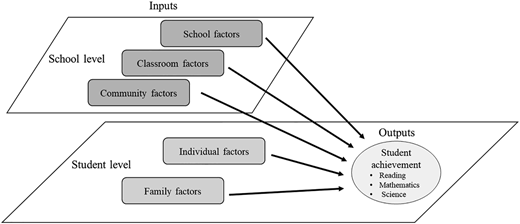
Figure 1 shows the conceptual framework of the study. It was created based on studies conducted by Scheerens and Stoel (1988), Scheerens and Creemers (1989), and Taniguchi and Hirakawa (2016). This study focused on school, classroom, and community factors at the school level. In low-income countries, community involvement was emphasized because of financial constraints and educational awareness (Taniguchi & Hirakawa, 2016).
3.2 Data and variables
This study used the PISA-D data. It measured the academic achievement of 15-year-old students in three subjects: reading, mathematics, and science. Also, children’s background information was collected to distribute the questionnaire. In addition to student information, teacher and school information was obtained through the questionnaires. In Cambodia, the data was collected from 5,162 students and 4,263 teachers from 170 schools in 2017. However, we used data for 2,643 students and 2,643 teachers from 135 schools because the variables we used in the analysis were missing data. There is a way to deal with missing data, but we considered it in further study. Here is the limitation of the study.
There were several variables in the PISA-D data. The study selected variables by referring to previous studies. Appendix A and B show the variables used in the study. Reading, mathematics, and science achievements were computed by the averages of 10 plausible values in each subject. Eighteen variables at the school level (classified into school, classroom, and community factors) were selected from the questionnaires of students, teachers, and schools. Thirteen variables at the school level (classified into individual and family factors) were selected from the students’ questionnaire. Table 1 shows the descriptive analysis of the selected variables. The details are provided in Appendix A and B.
3.3 Analysis
The study employs a multi-level modeling analysis, which is a statistical analysis technique to account for the variation of outcome variables influenced by the predictor variables at the different hierarchical levels (Woltman, Feldstain, MacKay, & Rocchi, 2012). The different hierarchical levels of variables were that the student’s achievement shared variance according to student individual-level factors and school-level factors since the students within schools. Moreover, multi-level modeling analysis accounts for the variability of relationships within-group (student level) and between-group (school level). The model accounts for individual differences at the student level (within-group) and variations across different schools (between-group). Four models were constructed: null model, model 1 was generated by adding the school-level variables to the null model, model 2 was generated by adding student-level variables to the null model, and model 3 was generated by adding the school-level and student-level variables to the null model. Firstly, the null model contains only outcome variables and provides the baseline estimate for the intra-class correlation in the outcome variables, reading, mathematics, and science test scores. The intra-class correlation is based on a model with only random intercept, which accounts for differences between schools in the average test scores (Kreft & De Leeuw, 1998). Following the null model, the intra-class correlation (ICC) was calculated to estimate the response variables in comparison to the variance of the models. At the same time, the school and student level variance, ICC, and loglikelihood were presented in this model. Secondly, in the level 1 model, thirteen variables were added to the null model. The effect of new variables changed the model since there was a change in the intercept value. Thirdly, in level 2, seventeen variables of school level were added to the null model.
Similarly, the intercept value change appeared by affecting these variables. Lastly, the combination of levels 1 and 2 models presented a significant variation in intercepts and slopes for the individual-level variables caused by differences among schools. This combination of levels 1 and 2 explores the school-level variables in data related to the observed differences among schools. The basic formula is shown below (Raudenbush, 2002).
Null model:
Where:
is the outcome variable for individual in group .
is the overall mean intercept.
is the random effect for group (random intercept).
is the residual error for individual in group .
Lelel-1 model
Level 2 model:
Combined level 1 and level 2 model:
Where:
4. Results
Tables 2 and 4 show the results of multilevel analyses for reading, mathematics, and science achievements, respectively.
4.1 Student-level and school-level variances in student achievement
In the multilevel modeling analysis, “the null model is used as a baseline for the estimation of explained versus unexplained variances in comparison to more elaborate models” (Kreft & De Leeuw, 1998, p. 63). The null model was estimated for the variation explained by the fixed effect (intercept) and random effect. Then, the intra-class correlation (ICC) was calculated to present the value of the between-school variance accounted for student achievement. The ICCs in the null models of reading, mathematics, and science achievements were 0.39, 0.42, and 0.37, respectively. This implies that 39% of the difference in reading test scores, 42% in mathematics test scores, and 37% in science test scores can be explained by the between-school differences. It indicated that individual students differ more from each other than schools or that individual student variation was larger than school variation. However, the percentages of school-level variance remained higher than in high-income countries, such as the empirical studies in the US and Australia by (Lamb & Fullarton, 2002) were only 12.10% and 10.40%, respectively. Therefore, it means that the variations in student achievement also explain school-level factor.
4.2 School-level factors influencing student achievement
The research question was answered based on the results from model 3, which combined the student-level and school-level variables shown in Tables 2–4. In particular, this model had a higher log-likelihood value than other models. The value of the log-likelihood tells how well a model fits the data, with a higher value indicating better model fit (Gal & Ghahramani, 2016).
Reading achievement was influenced by the school location, school type, and the extent to which teachers were late for a class. The coefficient for school location was 4.10, which indicates the increase in the reading test scores of students from schools located in small towns (3,000 to about 15,000 people) or urban areas. The coefficient for school type was 23.20, indicating that the reading test scores of students who attended private schools were higher (23.20 points) than those in public schools. The coefficient for teachers who arrived late for the class was −7.60, indicating that the reading achievement decreased by 7.60 points when one of the teachers was late for class in the previous two weeks.
Achievement in mathematics was significantly affected by school type, teacher tardiness, and private tutoring. The coefficient for school type was 27.63, indicating that the mathematics test scores of students who attended private schools were higher (27.63 points) than those in public schools. The coefficient for teachers who were late for a class was −11.34, indicating that the mathematics achievement decreased by 11.34 points when one teacher was late for class in the previous two weeks. Finally, the coefficient for private tutoring was 20.83, indicating that mathematics achievement increased by 20.83 points when a private tutoring class was taught for more than 10 hours per week.
Science achievement was influenced by school type and teacher tardiness. The coefficient for school type was 17.51, indicating that the science achievement of students who attended private schools was higher (17.51 points) than students in public schools. However, the coefficient for teachers who were late for the class was −6.60, indicating that science achievement decreased by 6.60 points when one of the teachers was late for class in the last two weeks.
In short, the achievement of 15-year-old Cambodian students revealed that the school type and teacher tardiness affected all three subjects’ achievement, and further, school location and private tutoring affected reading and mathematics achievement, respectively.
4.3 Student-level factors influencing student achievement
The statistical analysis of model 3 for reading achievement indicated that at the student level, the grade, gender, student life satisfaction, absenteeism, parents’ motivation, students’ labor, and the number of books at home significantly affected reading achievement. The coefficient for the grade was 16.09, indicating that 16.09 points of the reading achievement were expected to increase when the students increased by one grade. The coefficient for gender was 10.10, indicating that the reading achievement of females was 10.10 points higher than males. Simultaneously, student life satisfaction reduced reading achievement. The coefficient for grade repetition was −5.16, indicating that reading achievement was expected to decrease when a student experienced grade repetition at primary or lower-secondary schools. The coefficient for absenteeism was −10.87, meaning that the reading achievement was likely to reduce by 10.87 points when students missed school for more than three months consecutively. The coefficient for students’ work responsibilities was −4.79, indicating this corresponded to a 4.79 decline in reading test scores. The coefficient for the number of books at home was 7.34, meaning that the reading achievement was expected to increase by 7.34 points when there were 10–50 books or more.
In reviewing the results of mathematics achievement at the student level, it would appear that the grade, gender, student life satisfaction, absenteeism, parents’ motivation, students’ labor, number of home resources, and the number of books at home significantly affected mathematics achievement. The coefficient for the grade was 18.79, indicating that 18.79 points for mathematics achievement were expected to increase when students were promoted by one grade. The coefficient for gender was −10.08, indicating that the mathematics achievement of females was 10.08 points lower than males. The coefficient for student life satisfaction was −1.85, indicating that higher life satisfaction was expected to reduce mathematics achievement by 1.85 points. The coefficient for absenteeism was −15.14, indicating that mathematics achievement was reduced by 15.14 points when students missed school for more than three months. The coefficient for parents’ motivation was 9.01, indicating that mathematics achievement was expected to increase by 9.01 points when parents spent time discussing or talking with their children about their academic life once a month or more. The coefficient for students’ work responsibilities was −5.05, indicating that this corresponded to a 5.05 decline in mathematics achievement. The coefficient for the number of home resources was 5.25, which showed that a greater number of home resources increased mathematics achievement. Finally, the coefficient for the number of books at home was 8.73, indicating that mathematics achievement was expected to increase when the number of books at home increased.
Science achievement was influenced by grade, gender, student life satisfaction, absenteeism, parents’ motivation, students’ work responsibilities, and the number of books at home at the student level. The coefficient for the grade was 12.49, indicating that students who were at an upper grade increased by 12.49 points in science achievement. The coefficient for gender was −3.31, indicating that the science achievement of females was 3.31 points lower than male students. The coefficient for student life satisfaction was −1.58, meaning that higher life satisfaction was expected to reduce science achievement by 1.58 points. The coefficient for grade repetition was −4.82, indicating that the science test score was expected to decrease when a student experienced grade repetition at primary or lower-secondary schools. The coefficient for absenteeism was −8.14, indicating that science achievement was reduced by 8.14 points when students missed school for more than three months. The coefficient for parents’ motivation was 3.82, indicating that science achievement was expected to increase by 3.82 points when parents spent time discussing or talking with their children about their schools once a month or more. The coefficient for students’ work responsibilities was −4.95, indicating that it corresponded to a decline in science achievement. The coefficient for the number of books at home was 7.82, meaning that the science achievement was expected to increase with the number of books at home. Finally, the coefficient for parents’ education level was −0.81, indicating that the current education level of parents reduced science achievement by 0.81 points.
In short, the achievement of 15-year-old Cambodian students revealed that grade, gender, student life satisfaction, absenteeism, parents’ motivation, students’ work responsibilities, and the number of books at home affected all three subjects’ achievement. Further, the number of home resources also affected mathematics achievement.
5. Discussion
5.1 School-level factors are significant in improving student achievement
The individual-level factor variables explained more variance in performance than the school-level factor variables. Overall results of the variation in student achievement in Cambodia suggest that school-level factors explained between 30% and 40% of the variance in achievement levels. These percentages are higher than the findings in high-income countries and in other studies. For example, the studies in the US and Australia using TIMSS showed that the school variance was 12.10% and 10.40%, respectively (Lamb & Fullarton, 2002). Sellström and Bremberg (2006) reviewed the studies using multi-modeling tools. Compared with their findings, 30%–40% is considerably higher. The results of this study confirmed Heyneman and Loxley’s findings (1983) and expanded the significance of considering school-level factors to improve student achievement.
5.2 Teachers need to come to class on time
Although a few factors at the school level have been found, we focused on teacher tardiness, which was significant in all three subjects. Student achievement was influenced by the time teachers arrived late to class: the later their arrival, the lower the students’ achievement. A study on teaching hours in primary schools in Cambodia in 2015 revealed absenteeism more than once a month by teachers was 13% and 7% in rural and city schools, respectively and MoEYS launched an initiative for stricter protocols for teaching hours (Sonyka, 2015). The ministry reported that teachers were more likely to be tardy or absent in urban schools than in rural schools, and about 72% of target students were studying at schools where teachers were tardy (MoEYS, 2018a). In another study, Hirakawa and Taniguchi (2021) also found a correlation between the number of days of teacher absences and increased dropouts in Cambodia. Maintaining teachers’ behavior is a critical issue in Cambodia.
5.3 Student-level factors are also significant
Several student-level factors influence student achievement. For example, student grades, grade repetition, absenteeism, and life satisfaction strongly influenced achievement. Students who have many grade repetitions are late to promote to the next grades. A study in Spain showed that grade repetition had a negative effect on learning outcomes (García-Pérez et al., 2014). Moreover, grade repetition, absenteeism, and inadequate learning time not only negatively affected student achievement but were also correlated with the dropout rate in rural Cambodian primary schools (Hirakawa & Taniguchi, 2021). Student achievement was influenced by student grades, grade repetition, and absenteeism. It is widely recognized that the less time spent learning, the lower student achievement because the determinants of time are needed for education in a model of school learning (Carroll, 1963). In addition, student work responsibilities contributed to reducing learners’ time and opportunities.
Interestingly, student life satisfaction negatively affected all three achievements. The findings seem to contradict those of (Watson, Sotardi, Park, & Roy, 2021), which revealed that life satisfaction was positively associated with learning outcomes. Although students were more likely to be satisfied in the context of secondary education sector reforms which were embarked upon from 1999 to 2020 and attempted to address the challenges of access, quality, and governance (Bredenberg, 2022), the overall satisfaction in their lives was more likely broader since either correlation between student satisfaction with the schools or school performance or family. The theoretical model of overall life satisfaction and the relationship between domain satisfaction and achievement is reflected in leisure, family, school, and housing (Rode et al., 2005). As shown in the analysis results, student labor negatively affected achievement in the three subject areas. From the results, students still struggle in their daily existence.
6. Conclusion
The study’s findings reveal that lower secondary schools in Cambodia have a positive impact on student achievement. The results influencing student achievement are summarized as follows. At the school level, the school type and teacher tardiness significantly affected all three achievements. The school location significantly affected reading achievement, and private tutoring significantly affected mathematics achievement. Changing the behaviors of teachers (e.g. teacher tardiness) is a key factor in improving student achievement. At the individual level, the grade, gender, student life satisfaction, absenteeism, parents’ motivation, students’ work responsibilities, and the number of books at home significantly affected all three achievements. The grade repetition had a negative effect on all three achievements but not as significantly on mathematics achievement. The number of home resources significantly affected mathematics achievement, and parents’ education level negatively affected science achievement. A reduction in student absenteeism and grade repetition, as well as an improvement in student life satisfaction, are significant means for improving achievement.
Improving the student learning outcome is seen as the top priority for Cambodia because reading, mathematics, and science achievements are still low. The factors that negatively affected achievement should be taken into consideration. There were several policies and practice implications to improve student achievement in Cambodia. First, to reduce grade repetition, a policy on remedial classes is needed. The remedial education system provides the opportunity for students to build their lack of basic reading and numeracy skills. Therefore, policymakers should formulate a policy for remedial classes. Second, student absenteeism may relate to school and classroom management. The school management regulations should be improved, and information should be regularly shared between schools and parents. Moreover, schools should be located where students are interested in coming to learn. Third, the topic of students’ work responsibilities is a vital issue that prevents students from regularly attending school. The MoEYS should formulate a policy to support students from disadvantaged families to reduce child work responsibilities by instituting a scholarship program. Finally, teaching and learning time needs to be improved by reducing the time lost because of teacher tardiness; the policymakers should formulate policies for school management and discipline. The robust school management system led to an improved school process. This policy promotes effective leadership, a capable teaching force, increased learning time, and variety in teaching strategies. Furthermore, although private tutoring seems to play a role for learners and is shown to be effective in improving mathematics test scores, the inequality educational gap remains a challenge for students from disadvantaged families. Thus, MoEYS and development partners should increase funding to improve underperforming students like their counterpart’s access to private tutoring classes.
The school level was the crucial unit in improving education quality (Heneveld & Craig, 1996). Enabling conditions, school climate, and the teaching and learning processes were the core determinants for investigating effectiveness. Although the quantitative results demonstrate that several variables influence student achievement levels, some variables that were behind the limitation of the time for learners were not widely explained. In addition, there were also differences in student achievement between socioeconomic status and leadership styles (Chen, Ning, & Bos, 2022). Therefore, qualitative research in further studies will be crucial to highlight enabling conditions, school climate, and the teaching and learning processes for educational authorities to consider for allocating sufficient time for learners. Additionally, the primary data will be crucial in explaining the contemporary Cambodian context more precisely regarding changes in the school reform movement.
Educational relevance statement: This study contributes to enhancing student achievement at lower secondary schools in Cambodia by identifying the school-level and student-level factors. The PISA-D represents the first large-scale study at the secondary education level in Cambodia. Therefore, it holds significant importance to analyze its data and discuss evidence-based suggestions for the education policy.
Ethical approval: All researchers and educational officers who participated in the research confirmed ethical approval.
Conflict of interest: There are no conflicts of interest to disclose.
References
Further reading
The supplementary material for this article can be found online.